LIST OF PLATES. (continued 6)
Reading edition
Having been for some time wounded, and being a good deal exhausted by the loss of blood, it became my wish to devolve the command on General Scott, and retire from the field; but on enquiry, I had the misfortune to learn, that he was disabled by wounds; I therefore kept my post, and had the satisfaction to see the enemy's last effort repulsed. I now consigned the command to General Ripley.
While retiring from the field, I saw and felt, that the victory was complete on our part, if proper measures were promptly adopted to secure it. The exhaustion of the men was, however, such as made some refreshment necessary. They particularly required water. I was myself extremely sensible of the want of this necessary article. I therefore believed it proper, that General Ripley and the troops should return to camp, after bringing off the dead, the wounded, and artillery; and in this I saw no difficulty, as the enemy had entirely ceased to act. Within an hour after my arrival in camp, I was informed that General Ripley had returned without annoyance, and in good order. I now sent for him, and after giving him my reasons for the measure I was about to adopt, ordered him to put the troops in the best possible condition; to give to them the necessary refreshment; to take the pickets and camp-guards, and every other description of force; to put himself on the field of battle as the day dawned, and there to meet and beat the enemy if he again appeared. To this order he made no objection, and I relied upon its execution. It was not executed. I feel most sensibly how inadequate are my powers in speaking of the troops, to do justice to their merits, or to my own sense of them. Under abler direction, they might have done more and better.
From the preceding details, you have new evidence of the distinguished gallantry of Generals Scott and Porter, of Colonel Miller and Major Jessup, of the 1st brigade. The chief, with his aid-de-camp Worth, his major of brigade Smith, and every commander of battalion, were wounded. The 2d brigade suffered less; but as a brigade, their conduct entitled them to the applause of their country. After the enemy's strong position had been carried by the 21st and the detachments of the 17th and 19th, the 1st and 23d assumed a new character. They could not again be shaken or dismayed. Major McFarland, of the latter, fell nobly at the head of his battalion.
Under the command of General Porter, the militia volunteers of Pennsylvania and New York stood undismayed amidst the hottest fire, and repulsed the veterans opposed to them. The Canadian volunteers, commanded by Colonel Wilson, are reported by General Porter as having merited and received his approbation.
The corps of artillery commanded by Major Hindman, behaved with its usual gallantry. Towson's company attached to the 1st brigade, was the first and the last engaged, and during the whole conflict maintained that high character which they had previously won by their skill and their valour. Captains Biddle and Ritchie were both wounded early in the action, but refused to quit the field. The latter declared that he would never leave his piece; and true to his engagement, fell by its side covered with wounds.
The staff of the army had its peculiar merit and distinction. Colonel Gardner, adjutant-general, though ill, was on horseback, and did all in his power; his assistant, Major Jones, was very active and useful. My gallant aids-de-camp, Austin and Spencer, had many and critical duties to perform, in discharge of which the latter fell; I shall ever think of this young man with pride and regret; regret that his career has been so short; pride that it has been so noble and distinguished. The engineers, Majors McRee and Wood, were greatly distinguished on this day, and their high military talents exerted with great effect; they were much under my eye and near my person, and to their assistance a great deal is fairly to be ascribed. I most earnestly recommend them as worthy of the highest trust and confidence. The staff of Generals Ripley and Porter, discovered great zeal and attention to duty. Lieutenant E. B. Randolph, of the 20th regiment, is entitled to notice; his courage was conspicuous.
I enclose a return of our loss: those noted missing may generally be numbered with the dead. The enemy had but little opportunity of making prisoners.
I have the honour to be, etc., Jacob Brown.
General Brown to the Secretary of War.
Headquarters, Camp Fort Erie, September 29th, 1814. To the Honourable John Armstrong, Secretary of War, Washington, D. C.
Sir: In my letter of the 18th instant I briefly informed you of the fortunate issue of the sortie which took place the day preceding. But it is due to the gallant officers and men, to whose bravery we are indebted for our success on this occasion, that I should give you a more circumstantial and detailed account of this affair.
The enemy's camp I had ascertained to be situated in a field, surrounded by woods, nearly two miles distant from their batteries and entrenchments, the object of which was to keep the parts of their force which was not upon duty, out of the range of our fire from Fort Erie and Black Rock. Their infantry was formed into three brigades, estimated at 1,200 or 1,500 men each. One of these brigades, with a detail from their artillery, was stationed at their works, (these being but 500 yards distant from old Fort Erie, and the right of our line). We had already suffered much from the fire of two of their batteries, and were aware that a third was about to open upon us. Under these circumstances, I resolved to storm the batteries, destroy the cannon, and roughly handle the brigade upon duty, before those in reserve could be brought into action.
On the morning of the 17th, the infantry and riflemen, regulars and militia, were ordered to be paraded, and put in readiness to march precisely at 12 o'clock. General Porter with the volunteers, Colonel Gibson with the riflemen, and Major Brooke with the 23rd and 21st infantry, and a few dragoons acting as infantry, were ordered to move from the extreme left of our position, upon the enemy's right, by a passage opened through the woods for the occasion. General Miller was directed to station his command in the ravine, which lies between Fort Erie and the enemy's batteries, by passing them by detachments through the skirts of the wood, and the 21st infantry, under General Ripley, was posted as a corps of reserve between the new bastions of Fort Erie; all under cover and out of the view of the enemy.
About 20 minutes before 3 p.m. I found the left columns, under the command of General Porter, which were destined to turn the enemy's right, within a few rods of the British entrenchments. They were ordered to advance and commence the action. Passing down the ravine, I judged from the report of musketry, that the action had commenced on our left; I now hastened to General Miller and directed him to seize the moment and pierce the enemy's entrenchments between batteries No. 2 and 3. My orders were promptly and ably executed. Within 30 minutes after the first gun was fired, batteries No. 3 and 2, the enemy's line of entrenchments, and his two block houses, were in our possession. Soon after, battery No. 1 was abandoned by the British. The guns in each were spiked by us, or otherwise destroyed, and the magazine of No. 3 was blown up.
A few minutes before the explosion, I had ordered up the reserve under General Ripley. As he passed me at the head of his column, I desired him, as he would be the senior in advance, to ascertain, as near as possible, the situation of the troops in general, and to have a care that not more was hazarded than the occasion required; that, the object of the sortie effected, the troops would retire in good order, &c. General Ripley passed rapidly on; soon after, I became alarmed for General Miller, and sent an order for the 21st to hasten to his support towards battery No. 1. Colonel Upham received the order, and advanced to the aid of General Miller. General Ripley had inclined to the left, where Major Brooke's command was engaged, with a view of making some necessary enquiries of that officer, and in the act of doing so, was unfortunately wounded. By this time, the object of the sortie was accomplished beyond my most sanguine expectations. General Miller had consequently ordered the troops on the right to fall back; observing this movement, I sent my staff along the line to call in the other corps. Within a few minutes they retired from the ravine, and from thence to camp.
Thus, one thousand regulars, and an equal portion of militia, in one hour of close action, blasted the hopes of the enemy, destroyed the fruits of fifty days labour, and diminished his effective force 1,000 men at least. I am at a loss how to express my satisfaction at the gallant conduct of the officers and men of this division, whose valour has shown superior to every trial. General Porter, in his official report herein enclosed, has very properly noticed those patriotic citizens who have done so much honour to themselves, by freely and voluntarily tendering their services at a dangerous and critical period.
As the scene of action was in a wood, in advance of the position I had chosen for directing the movements of the whole, the several reports of commandants of corps, must guide me in noticing individuals.
General Miller mentions Lieutenant-Colonel Aspinwall, Lieutenant-Colonel Beedle, Major Trimble, Captain Hull, Captain Ingersoll, Lieutenant Crawford, Lieutenant Lee, and particularly Ensign O'Fling, as entitled to distinction.
Lieutenant-Colonel McDonald, upon whom the command of the rifle corps devolved, upon the fall of the brave and generous Gibson, names Adjutant Shortridge, of the 1st, and Ballard of the 4th regiments, as deserving the highest applause for their promptness and gallantry in communicating orders. Of the other officers of the corps, he reports generally, that the bravery and good conduct of all was so conspicuous as to render it impossible to discriminate.
Major Brooke, to whom much credit is due for the distinguished manner in which he executed the orders he received, speaks in high terms of Lieutenants Goodell, Ingersoll, Livingston, and ensigns Brant and O'Fling, of the 23d, particularly of the latter. Also of Captain Simms, Lieutenants Bissel, Shore, and Brinot, of the 1st infantry, and Lieutenant Watts, of the dragoons.
Lieutenant-Colonel Upham, who took the command of the reserve after General Ripley was disabled, bestows great praise upon Major Chambers, of the 4th regiment of riflemen, attached to the 21st infantry, as also upon Captain Bradford and Lieutenant Holding of that regiment.
My staff, Colonel Snelling, Colonel Gardner, Major Jones, and my aids-de-camp, Major Austin and Lieutenant Armstrong, were, as usual, zealous, intelligent, and active; they performed every duty required of them to my entire satisfaction.
Major Hall, assistant inspector general, led a battalion of militia, and conducted with skill and gallantry. Lieutenant Kirby, aid-de-camp to General Ripley, was extremely active and useful during the time he was in action.
Lieutenants Frazer and Riddle were in General Porter's staff; their bravery was conspicuous, and no officers of their grade were more useful.
The corps of artillery, commanded by Major Hindman, which has been so eminently distinguished throughout this campaign, had no opportunity of taking a part in the sortie. The 25th infantry, under Colonel Jessup, was stationed in Fort Erie to hold the key of our position.
Colonel Brady, on whose firmness and good conduct every reliance could be placed, was in command at Buffalo with the remains of the 22d infantry. Lieutenant-Colonel McRee and Lieutenant-Colonel Wood, of the corps of engineers, having rendered to this army services the most important, I must seize the opportunity of again mentioning them particularly. On every trying occasion, I have reaped much benefit from their sound and excellent advice. No two officers of their grade could have contributed more to the safety and honour of this army. Wood, brave, generous and enterprising, died as he had lived, without a feeling but for the honour of his country and glory of her arms. His name and example will live to guide the soldiers in the path of duty so long as true heroism is held in estimation. McRee lives to enjoy the approbation of every virtuous and generous mind, and to receive the reward due to his services and high military talents.
It is proper here to notice, that although but one-third of the enemy's force was on duty when his works were carried, the whole were brought into action while we were employed in destroying his cannon. We secured prisoners from seven of his regiments, and know that the 6th and 87th suffered severely in killed and wounded, yet these regiments were not upon duty.
Lieutenant-General Drummond broke up his camp during the night of the 21st, and retired to his entrenchments behind the Chippewa. A part of our men came up with the rear of his army at Frenchman's creek; the enemy destroyed part of their stores by setting fire to the building from which they were employed in conveying them. We found in and about the camp a considerable quantity of cannon ball, and upwards of one hundred stand of arms.
I send you enclosed herein a return of our loss. The return of prisoners enclosed does not include the stragglers that came in after the action.
I have the honour to be, &c., Jacob Brown.
General Brown to the Secretary of War.
Head Quarters, Fort Camp Erie, October 1st, 1814. To the Honourable John Armstrong, Secretary of War, Washington, D. C.
Sir: Looking over my official account of the action of the 17th ultimo, I find that the names of the regiments which composed General Miller's command have not been given. As I believe it even more important to distinguish corps than individuals, I am anxious to correct this mistake. General Miller on that day commanded the remains of the 9th and 11th infantry, and a detachment of the 19th. Of three field officers who were attached to them, two were severely wounded, Lieutenant-Colonel Aspinwall, of the 9th, gallantly leading his men to the attack upon the enemy's entrenchments; and Major Trimble, of the 19th, who was shot within their works, conducting with great skill and bravery. A detachment of the 17th regiment was attached to the 21st.
I have the honour to be, &c., Jacob Brown.
Plate XLI. No. 40.
July 5 and 25, and September 17, 1814.
Major General Peter B. Porter. ℞. Resolution of Congress November 3. 1814.
MAJOR-GENERAL PETER BUEL PORTER.
[Victories of Chippewa, Niagara, and Erie.]
MAJOR GENERAL PETER B. (Buel) PORTER. Bust of General Porter, in uniform, facing the right. FÜRST. F. (fecit).
RESOLUTION OF CONGRESS NOVEMBER 3. 1814. A winged Victory, holding in her right hand a palm branch and a wreath of laurel, and in her left three standards, upon which are written: "ERIE" "CHIPPEWA" "NIAGARA." She dictates to the muse of History, who is seated on the ground, writing. Exergue: BATTLES OF CHIPPEWA. JULY 5. 1814. NIAGARA. JULY 25. 1814. ERIE. SEP. (September) 17. 1814. FÜRST. F. (fecit).
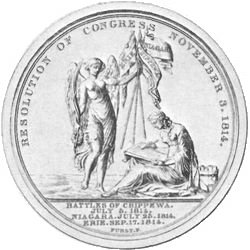
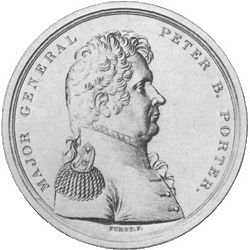
ORIGINAL DOCUMENTS.
Brigadier-General P. B. Porter to Major-General Jacob Brown.
Fort Erie, September 22d, 1814. To Jacob Brown, Esq., Major-General commanding.
Sir: In executing the duty you have imposed on me, of reporting the conduct of the officers and men composing the left column, which you were pleased to place under my command, in the sortie of the 17th instant, the pleasure I derive in representing to you the admirable conduct of the whole, is deeply chastened by sorrow for the loss of many brave and distinguished men.
Being obliged, from the nature of the ground, to act on foot, it was impossible that my own personal observation should reach to every officer. Some part of this report must therefore rest upon the information of others.
It is the business of this communication to speak of the conduct of individuals; yet you will permit me to premise, although well known to yourself already, that the object of the left column was to penetrate by a circuitous route between the enemy's batteries, where one-third of his force was always kept on duty, and his main camp, and that it was sub-divided into three divisions: the advance of 200 riflemen, and a few Indians, commanded by Colonel Gibson, and two columns moving parallel to, and 30 yards distant from, each other. The right column was commanded by Lieutenant-Colonel Wood, headed by 400 infantry, under Major Brooke, of the 23d, and followed by 500 volunteers and militia, being parts of Lieutenant-Colonels Dobbin's, M'Burney's, and Fleming's regiments, and was intended to attack the batteries.
The left column of 500 militia was commanded by Brigadier-General Davis, and comprised the commands of Lieutenant-Colonels Hopkins, Churchhill and Crosby, and was intended to hold in check any reinforcements from the enemy's camp; or both columns (circumstances requiring it, which frequently happened) to co-operate in the same object.
After carrying by storm, in the handsomest style, a strong block house, in rear of the third battery, making its garrison prisoners, destroying the three 24-pounders and their carriages in the third battery, and blowing up the enemy's magazine, and after co-operating with General Miller in taking the second battery, the gallant leaders of the three divisions all fell nearly at the same time; Colonel Gibson, at the second battery, and General Davis and Lieutenant-Colonel Wood in an assault upon the first.
Brigadier-General Davis, although a militia officer of little experience, conducted on this occasion with all the coolness and bravery of a veteran, and fell while advancing upon the enemy's entrenchments. His loss as a citizen as well as a soldier, will be severely felt in the patriotic county of Genesee. Colonel Gibson fully sustained the high military reputation which he had before so justly acquired. You know how exalted an opinion I have always entertained of Lieutenant-Colonel Wood of the engineers. His conduct on this day was what it uniformly has been, on every similar occasion, an exhibition of military skill, acute judgment, and heroic valour. Of the other regular officers, Lieutenant-Colonel M'Donald and Major Brooke, senior in command, will report to you in relation to their respective divisions. Permit me, however, to say of these two officers, that, much as was left to them by the fall of their distinguished leaders, they were able to sustain their parts in the most admirable manner, and they richly deserve the notice of the government.
Of the militia, I regret that the limits of a report will not permit me even to name all of those who on this occasion established claims to the gratitude of their fellow citizens; much less to particularize individual merit. Lieutenant-Colonels Hopkins, M'Burney, Churchhill and Crosby, and Majors Lee, Marcle, Wilson, Lawrence, Burr, Dunham, Kellogg and Ganson, are entitled to the highest praise for their gallant conduct, their steady and persevering exertions. Lieutenant-Colonel Dobbin being prevented by severe indisposition from taking the field, Major Hall, assistant inspector general, volunteered his services to join Major Lee in the command of the volunteer regiment; and Major Lee and every other officer speak in the highest terms of the gallant and good conduct of this young officer.
Captain Fleming, who commanded the Indians, was, as he always is, in the front of the battle. There is not a more intrepid soldier in the army. I should be ungrateful were I to omit the names of Captains Knapp and Hull of the volunteers, and Captain Parker and Lieutenant Chatfield of the militia, by whose intrepidity I was, during the action, extricated from the most unpleasant situation. Captains Richardson, Buel and Kennedy, Lieutenants Parkhurst and Brown, and Adjutants Dobbin, Bates and Robinson, particularly distinguished themselves. The patriotic conduct of Captain Elliot, with twenty young gentlemen, who volunteered from Batavia, and of Major Hubbard, with fourteen men exempted by age from military duty, should not be omitted. They were conspicuous during the action.
You will excuse me if I shall seem partial in speaking of my own family, consisting of my brigade major, Frazer, my volunteer aid-de-camp Riddle (both first lieutenants in the 15th infantry), Captain Bigger, of the Canadian volunteers, Messrs. Williams and Delapierre, volunteer aids for the day, all of whom, except Mr. Williams, were wounded.
Lieutenants Frazer and Riddle were engaged for the most of the preceding day with fatigue parties, cutting roads for the advance of the column through the swamp, and falling timber to the rear, and within 150 yards of the enemy's right; which service they executed with so much address as to avoid discovery; and on the succeeding day they conducted the two columns to the attack. Frazer was severely wounded by a musket ball while spiking a gun on the second battery. Riddle, after the first battery was carried, descended into the enemy's magazine, and after securing (with the assistance of quarter master Greene of the volunteers, whose good conduct deserves much praise) a quantity of fixed ammunition, blew up the magazine, and suffered severely by the explosion. I must solicit, through you, Sir, the attention of the general government to these meritorious young men. Captain Bigger is an excellent officer, and rendered me much assistance, but was dangerously wounded. The other young gentlemen are citizens, and deserve much credit for their activity, and for having voluntarily encountered danger. My aid-de-camp, Major Dox, was confined at Buffalo by sickness.
On the whole, Sir, I can say of the regular troops attached to the left column, of the veteran volunteers of Lieutenant-Colonel Dobbin's regiment, that every man did his duty, and their conduct on this occasion reflects a new lustre on their former brilliant achievements. To the militia, the compliment is justly due, and I could pay them no greater one, than to say, that they were not surpassed by the heroes of Chippewa and Niagara in steadiness and bravery.
The studied intricacy of the enemy's defences, consisting not only of the breastwork connecting their batteries, but of successive lines of entrenchments for a hundred yards in the rear, covering the batteries and enfilading each other, and the whole obstructed by abatis, brush and felled timber, was calculated to produce confusion among the assailants, and led to several contests at the point of the bayonet. But by our double columns, any temporary irregularity in the one, was always corrected by the other. Our success would probably have been more complete but for the rain which unfortunately set in soon after we commenced our march, which rendered the fire of many of our muskets useless, and by obscuring the sun, led to several unlucky mistakes. As an instance of this, a body of 50 prisoners who had surrendered, were ordered to the fort in charge of a subaltern and 14 volunteers; the officer mistaking the direction, conducted them towards the British camp in the route by which we had advanced, and they were re-taken with the whole of the guard, excepting the officer and one man, who fought their way back. Several of our stragglers were made prisoners by the same mistake. But, Sir, notwithstanding these accidents, we have reason to rejoice at our signal success, in inflicting a vastly disproportionate injury on the enemy, and in wholly defeating all his plans of operation against this army.
I have the honour to be, &c. P. B. Porter, Brigadier General commanding Volunteers and Militia.
Plate XLII. No. 41.
July 5 and 25, August 15, and September 17, 1814.
Brig. General Eleazer W. Ripley. ℞. Resolution of Congress Novemb. 3. 1814.
BRIGADIER-GENERAL ELEAZER WHEELOCK RIPLEY.
[Victories of Chippewa, Niagara, and Erie.]
BRIG. (Brigadier) GENERAL ELEAZER W. (Wheelock) RIPLEY. Bust of General Ripley, in uniform, facing the right FÜRST. F. (fecit).
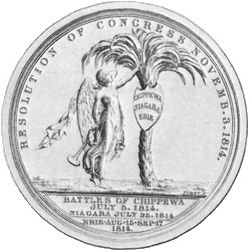
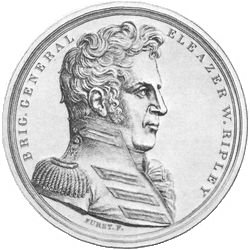
Eleazer Wheelock Ripley was born in Hanover, New Hampshire, April 15, 1782. He was graduated at Dartmouth College, Hanover, New Hampshire, in 1800, and studied law. He was speaker of the Legislature of Massachusetts in 1812; a lieutenant-colonel the same year; colonel of the 21st regiment of infantry, 1813; and a brigadier-general, 1814. He distinguished himself at Chippewa, at Niagara, and at Erie, for which services he received the thanks of Congress and a gold medal. He was wounded at Niagara, and again dangerously at Erie; was breveted a major-general, July 25, 1814; resigned in 1820, and settled in Louisiana, which he represented in Congress, 1835-1839. He died at West Feliciana, Louisiana, March 2, 1839.
ORIGINAL DOCUMENTS.
Brigadier-General E. W. Ripley to Brigadier-General Gaines.
Fort Erie, August 17th, 1814. To Brigadier-General Gaines.
Sir: I take the liberty of reporting you the cause of operations on the left flank of the camp, during the action of the 15th instant.
From indications satisfactory to me, I was persuaded very early of the enemy's design of attacking us in our position. Before any alarm, I caused my brigade to occupy their alarm posts. On the first fire of the picket, Captain Towson opened his artillery upon them from Fort Williams, in a style which does him infinite credit. It was continued with very great effect upon the enemy during the whole action.
The enemy advanced with fixed bayonets, and attempted to enter our works between the fort and water. They brought ladders for the purpose of scaling, and in order to prevent their troops from resorting to any other course excepting the bayonet, had caused all the flints to be taken from their muskets. The column that approached in this direction consisted of Colonel Fischer's command, and amounted in number to at least 1,500 men; and, according to the representation of prisoners, they were 2,000 strong. The companies posted at the point of the works, which they attempted to escalade, were Captain Ross's, Captain Marston's, Lieutenant Bowman's, and Lieutenant Larned's, of the 21st regiment, not exceeding 250 men, under command of Major Wood, of the engineer corps. On the enemy's approach they opened their musketry upon them in a manner the most powerful. Fort Williams and this little band, emitted one broad uninterrupted sheet of light. The enemy were repulsed. They rallied, came on a second time to the charge, and a party waded round our line by the lake, and came in on the flank; but a reserve of two companies, posted in the commencement of the action to support this point, marched up and fired upon the party, who were all killed or taken. Five times in this manner did the enemy advance to the charge; five times were their columns beaten back in the utmost confusion by a force one-sixth of their numbers; till at length finding the contest unavailing, they retired. At this point we made 147 prisoners.
During the contest in this quarter, the lines of the whole of the left wing were perfectly lined, in addition to the reserves; and I found myself able to detach three companies of the 23d regiment from the left, to reinforce the troops at Fort Erie, viz.: Captain Wattles', Lieutenant Cantine's, and Lieutenant Brown's companies, and one of the 19th under Captain Chunn. They were in the fort during the time of the explosion, and their conduct is highly spoken of by Major Brooke, their commanding officer. Indeed, from the high state to which that regiment has been brought by Major Brooke, I am convinced that no troops will behave better.
In submitting to your view the conduct of the troops under my command on this occasion, I find every thing to applaud, nothing to reprehend. The utmost coolness and subordination was manifested, both by the 21st and 23d regiments. To Major Wood I feel particularly indebted. This officer's merits are so well known, that approbation can scarcely add to his reputation. He has the merit, with the Spartan band, in connection with Captain Towson's artillery, of defeating a vaunting foe of six times his force. Major Brooke did every thing in his power: and it affords me pleasure at all times to call the attention of the general commanding to this amiable and accomplished officer.
The officers commanding companies immediately engaged, have my highest commendation. Their conduct was most judicious and gallant. I cannot refrain from adverting to the manner in which Captain Towson's artillery was served. I have never seen it equalled. This officer has so often distinguished himself, that to say simply that he is in action, is a volume of eulogium; the army, only to be informed he is there, by a spontaneous assent, are at once satisfied that he has performed well his part. I have no idea that there is an artillery officer in any service superior to him in the knowledge and performance of his duty.
The officers I have mentioned as commanding companies of the 21st and 23d regiments, are particularly commended by their commanding officers. Captain Marston, a most valuable officer, commanded a first line of three companies opposed to the enemy's column. Captain Ropes commanded the companies of reserve. Major Wood reports in the highest terms of the good conduct of the subalterns. Lieutenants Riddle, of the 15th, attached to the 21st, and Hall, and ensigns Bean, Jones, Gumming, and Thomas, of the 19th, as being extremely active, and performing their duties with alacrity.
The manner in which Lieutenant Belknap, of the 23d, retired with his picket guard from before the enemy's column, excites my particular commendation. He gave orders to fire three times as he was retreating to camp, himself bringing up the rear. In this gallant manner, he kept the light advance of the enemy in check, for a distance of two or three hundred yards. I have to regret, that when entering our lines after his troops, the enemy pushed so close upon him that he received a severe wound from a bayonet.
Lieutenant Bushnel and Cissney, of the 19th, while gallantly engaged with the enemy at Fort Erie, were both severely, if not mortally, wounded. Their conduct merits the warmest approbation.
Permit me to recommend to your notice, the good conduct of my staff, Lieutenant Kirby, of the corps of artillery, my aid-de-camp, and Lieutenant Holding, acting brigade major; their activity and zeal was entirely to my satisfaction.
I close this long report, with stating to you, in the highest terms of approbation, the skillfulness exhibited by Doctor Fuller, surgeon of the 23d, and Doctor Trowbridge, surgeon of the 21st infantry, with their mates Doctor Gale, of the 23d, and Doctors Everett and Allen, of the 21st; their active, humane and judicious treatment of the wounded, both of the enemy and of our own, together with their steady and constant attention to the duties of their station, must have attracted your personal observation, and I am confident will receive your approbation.
I have the honour to be, etc., E. W. Ripley, Brigadier-General commanding 2d Brigade.
Plate XLIII. No. 42.
July 5 and 25, and September 17, 1814.
Brigadier Genl. James Miller. ℞. Resolution of Congress November 3. 1814.
BRIGADIER-GENERAL JAMES MILLER.
[Victories of Chippewa, Niagara, and Erie.]
BRIGADIER GENl. (General) JAMES MILLER. Bust of General Miller, in uniform, facing the right. Exergue: I'LL TRY. His answer when he received the order to attack the enemy's batteries on the hill at Niagara. furst. f. (fecit).
RESOLUTION OF CONGRESS NOVEMBER 3. 1814. Colonel Miller, at the head of his troops, is carrying the British batteries on the hill at Niagara. Exergue: BATTLES OF CHIPPEWA JULY 5. 1814. NIAGARA. JULY 25. 1814. ERIE SEP. (September) 17. 1814. furst. f. (fecit).
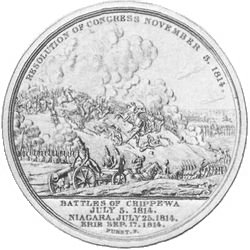
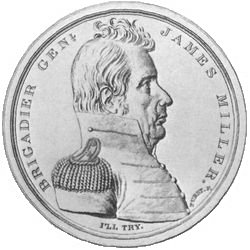
Plate XLIV. No. 43.
July 5 and 25, 1814.
Major General Winfield Scott. ℞. Resolution of Congress November 3. 1814 etc.
MAJOR-GENERAL WINFIELD SCOTT.
[Victories of Chippewa and Niagara.]
MAJOR GENERAL WINFIELD SCOTT. Bust of General Scott, in uniform, facing the right. FÜRST. F. (fecit).
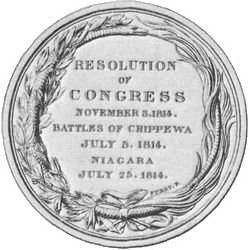
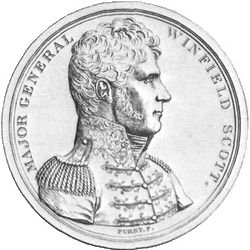
Plate XLV. No. 44.
August 15, 1814.
Major General Edmund P. Gaines. ℞. Resolution of Congress November 3. 1814.
MAJOR-GENERAL EDMUND PENDLETON GAINES.
[Victory of Erie.]
MAJOR GENERAL EDMUND P. (Pendleton) GAINES. Bust of General Gaines, in uniform, facing the right FÜRST. F. (fecit).
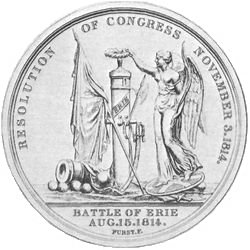
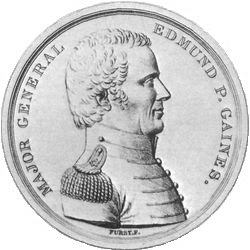
Edmund Pendleton Gaines was born in Culpepper County, Virginia, March 20, 1777. He entered the army as ensign of infantry, 1799; became first-lieutenant, 1802; captain, 1807; major and lieutenant-colonel, 1812; colonel, 1813, and brigadier-general 1814. He greatly distinguished himself at the battle of Erie, August 15, 1814, and was badly wounded on the 28th of the same month. For his services on this occasion he was breveted major-general, September 14, 1814, and Congress gave him a vote of thanks and a gold medal. He served in Florida (Seminole war) and in Georgia (Creek war); and was commander of the southern and afterward of the western military districts. He died in New Orleans, June 6, 1849.
ORIGINAL DOCUMENTS.
General Gaines to the Secretary of War.
Sir: My heart is gladdened with gratitude to Heaven and joy to my country, to have it in my power to inform you that the gallant army under my command has this morning beaten the enemy commanded by Lieutenant-General Drummond, after a severe conflict of nearly three hours, commencing at 2 o'clock this morning. They attacked us on each flank, got possession of the salient bastion of the old Fort Erie, which was regained at the point of the bayonet, with a dreadful slaughter. The enemy's loss in killed and prisoners, is about 600; near 300 killed. Our loss is considerable, but I think not one-tenth as great as that of the enemy. I will not detain the express to give you the particulars. I am preparing my force to follow up the blow.
With great respect, etc., Edmund P. Gaines, Brigadier-General commanding.
General Gaines to the Secretary of War.
Head-Quarters, left wing, 2d Division, Fort Erie, U. C., August 23d, 1814. To the Honourable John Armstrong, Secretary of War, Washington, D. C.
Sir: I have the honour to communicate, for the information of the department of war, the particulars of the battle fought at this place, on the 15th instant, between the left wing of the 2d division of the northern army, under my command, and the British forces in the Peninsula of Upper Canada, commanded by Lieutenant-General Drummond, which terminated in a signal victory in favour of the united American arms.
Our position on the margin of the lake, at the entrance of the Niagara river, being nearly a horizontal plain, twelve or fifteen feet above the surface of the water, possessing few natural advantages, had been strengthened in front by temporary parapet breast works, entrenchments and abatis, with two batteries and six field pieces. The small unfinished fort, Erie, with a 24, 18 and 12 pounder, forms the north-east, and the Douglass battery, with an 18 and 6 pounder near the edge of the lake, the south-east angle of our right. The left is defended by a redoubt battery, with six field pieces just thrown up on a small ridge. Our rear was left open to the lake, bordered by a rocky shore of easy ascent. The battery on the left was defended by Captain Towson; Fort Erie, by Captain Williams, with Major Trimble's command of the 19th infantry; the batteries on the front, by Captains Biddle and Fanning; the whole of the artillery commanded by Major Hindman. Parts of the 11th, 9th and 22d infantry (of the late veteran brigade of Major-General Scott) were posted on the right, under the command of Lieutenant-Colonel Aspinwall. General Ripley's brigade, consisting of the 21st and 23d, defended on the left. General Porter's brigade of New York and Pennsylvania volunteers, with our distinguished riflemen, occupied the centre.
I have heretofore omitted stating to you, that during the 13th and 14th, the enemy had kept up a brisk cannonade, which was sharply returned from our batteries, without any considerable loss on our part. At 6 p.m. one of their shells lodged in a small magazine in Fort Erie, which was fortunately almost empty. It blew up with an explosion more awful in appearance than injurious in its effects, as it did not disable a man or derange a gun. It occasioned but a momentary cessation of the thunders of the artillery on both sides; it was followed by a loud and joyous shout by the British army, which was instantly returned on our part, and Captain Williams, amidst the smoke of the explosion, renewed the contest by an animated roar of his heavy cannon.
From the supposed loss of our ammunition, and the consequent depression such an event was likely to produce upon the minds of our men, I felt persuaded that this explosion would lead the enemy to assault, and made my arrangements accordingly.
The night was dark, and the early part of it raining, but the faithful sentinel slept not; one-third of the troops were up at their posts. At half-past two o'clock, the right column of the enemy approached, and though enveloped in darkness black as his designs and principles, was distinctly heard on our left, and promptly marked by our musketry under Major Wood, and cannon under Captain Towson. Being mounted at the moment, I repaired to the point of attack, where the sheet of fire rolling from Towson's battery, and the musketry of the left wing of the 21st infantry under Major Wood, enabled me to see the enemy's column of about 1,500 men approaching on that point, his advance was not checked, until it had approached within ten feet of our infantry. A line of loose brush representing an abatis only intervened; a column of the enemy attempted to pass round the abatis through the water, where it was nearly breast deep. Apprehending that this point would be carried, I ordered a detachment of riflemen and infantry to its support, but having met with the gallant commander, Major Wood, was assured by him that he could defend his position without reinforcements. At this moment the enemy were repulsed, but instantly renewed the charge and were again repulsed. My attention was now called to the right, where our batteries and lines were soon lighted by a most brilliant fire of cannon and musketry; it announced the approach of the centre and left columns of the enemy, under Colonels Drummond and Scott; the latter was received by the veteran 9th, under the command of Captain Foster, and Captains Broughton and Harding's companies of New York and Pennsylvania volunteers, aided by a six-pounder judiciously posted by Major M'Ree, chief engineer, who was most active and useful at this point; they were repulsed. That of the centre, led by Colonel Drummond, was not long kept in check; it approached at once every assailable point of the fort; and with scaling ladders ascended the parapet, but was repulsed with fearful carnage. The assault was twice repeated, and as often checked, but the enemy having moved round the ditch covered by darkness, added to the heavy cloud of smoke which had rolled from our cannon and musketry, enveloping surrounding objects, repeated the charge, re-ascended the ladders; the pikes, bayonets and spears fell upon our gallant artillerists. The gallant spirits of our favourite Captain Williams and Lieutenants M'Donough and Watmough, with their brave men, were overcome. The two former, and several of their men, received deadly wounds. Our bastion was lost; Lieutenant M'Donough, being severely wounded, demanded quarter; it was refused by Colonel Drummond. The lieutenant then seized a handspike and nobly defended himself until he was shot down with a pistol by the monster who had refused him quarter, who often reiterated the order: "Give the damned Yankees no quarter." This officer, whose bravery, if it had been seasoned with virtue, would have entitled him to the admiration of every soldier, the hardened murderer soon met his fate. He was shot through the breast while repeating the order "to give no quarter."
The battle now raged with increased fury on the right, but on the left the enemy was repulsed and put to flight. Thence and from the centre I ordered reinforcements. They were promptly sent by Brigadier-General Ripley and Brigadier-General Porter. Captain Fanning, of the corps of artillery, kept up a spirited and destructive fire with his field pieces, on the enemy attempting to approach the fort. Major Hindman's gallant efforts, aided by Major Trimble, having failed to drive the enemy from the bastion, with the remaining artillerists and infantry in the forts, Captain Birdsall, of the 4th rifle regiment, with a detachment of riflemen, gallantly rushed in through the gateway to their assistance, and with some infantry, charged the enemy, but was repulsed, and the captain severely wounded. A detachment from the 11th, 19th, and 22d infantry, under Captain Foster, of the 11th, were introduced over the interior bastion, for the purpose of charging the enemy. Major Hall, assistant inspector general, very handsomely tendered his services to lead the charge. The charge was gallantly made by Captain Foster and Major Hall, but owing to the narrowness of the passage up to the bastion, admitting only two or three men abreast, it failed. It was often repeated, and as often checked; the enemy's force on the bastion was, however, much cut to pieces and diminished by our artillery and small arms. At this moment every operation was arrested by the explosion of some cartridges deposited in the end of the stone building adjoining the contested bastion. The explosion was tremendous: it was decisive; the bastion was restored. At this moment Captain Biddle was ordered to cause a field piece to be posted so as to enfilade the exterior plain and salient glacis. The captain, though not recovered from a severe contusion in the shoulder, received from one of the enemy's shells, promptly took his position, and served his field piece with vivacity and effect. Captain Farming's battery likewise played upon them at this time with great effect. The enemy were in a few moments entirely defeated, taken or put to flight, leaving on the field 222 killed, 174 wounded, and 186 prisoners. A large portion are so severely wounded that they cannot survive; the slightly wounded, it is presumed, were carried off.
To Brigadier-General Ripley, much credit is due for the judicious disposition of the left wing, previous to the action, and for the steady disciplined courage manifested by him and his immediate command, and for the promptness with which he complied with my orders for reinforcement during the action. Brigadier-General Porter, commanding the New York and Pennsylvania volunteers, manifested a degree of vigilance and judgment in his preparatory arrangements, as well as military skill and courage in the action, which proves him to be worthy the confidence of his country, and the brave volunteers who fought under him. Of the volunteers, Captains Broughton and Harding with their detachments posted on the right, and attached to the line commanded by Captain E. Foster, of the veteran 9th infantry, handsomely contributed to the repulse of the left column of the enemy under Colonel Scott.
The judicious preparations and steady conduct of Lieutenant-Colonel Aspinwall commanding the first brigade, merit approbation.
To Major McRee, chief engineer, the greatest credit is due for the excellent arrangement and skillful execution of his plans for fortifying and defending the right, and for his correct and seasonable suggestions to regain the bastion. Major Wood, of the engineers, also greatly contributed to the previous measures of defence. He has accepted the command of a regiment of infantry, (the 21st,) for which he has often proved himself well qualified, but never so conspicuously as on this occasion.
Towson's battery emitted a constant sheet of fire. Wood's small arms lighted up the space, and repulsed five terrible charges made between the battery and the lake. Brigadier-General Ripley speaks in high terms of the officers and men engaged, particularly Captains Marston and Ropes, Lieutenants Riddle (of the 15th, doing duty with the 21st) and Hall; Ensigns Benn, Jones, Cummings and Thomas of the 21st, and Keally and Green of the 19th.
Major Hindman, and the whole of the artillery under the command of that excellent officer, displayed a degree of gallantry and good conduct not to be surpassed. The particular situation of Captain Towson, and the much lamented Captain Williams and Lieutenant M'Donough, and that of Lieutenant Watmough, as already described, with their respective commands, rendered them most conspicuous. The courage and good conduct of Lieutenant Zantzinger and Lieutenant Childs, is spoken of in high terms by Major Hindman and Captain Towson, as also that of Sergeant-Major Denhon. Captains Biddle and Fanning, on the centre and right of their entrenchments, threw their shot to the right, left and front, and annoyed the Indians and light troops of the enemy approaching from the woods. Lieutenant Fontaine in his zeal to meet the enemy, was unfortunately wounded and made prisoner. Lieutenant Bird was active and useful, and in fact every individual belonging to the corps did their duty.
The detachment of Scott's gallant brigade, consisting of parts of the 9th, 11th and 22d infantry, did its duty in a manner worthy the high reputation the brigade had acquired at Chippewa, and at the Falls of Niagara. The 9th, under the command of Captain Edmund Foster, was actively engaged against the left of the enemy, and with the aid of Lieutenant Douglass's corps of bombardiers, commanding the water battery, and that of the volunteers, under Captains Broughton and Harding, effected their repulse. The good conduct of Lieutenants Childs, Cushman and Foot, and Ensign Blake, deserves commendation.
The officers killed, are Captain Williams and Lieutenant McDonough of the artillery. Wounded, Lieutenant Watmough of the artillery; Ensign Cissney 19th; Lieutenant Bushnel 21st; Lieutenants Brown and Belknap 23d; and Captain Birdsall, 4th rifle regiment, all severely.
Lieutenant Fontaine of the artillery, who was taken prisoner, writes from the British camp, that he fortunately fell into the hands of the Indians, who, after taking his money, treated him kindly. It would seem, then, that these savages had not joined in the resolution to give no quarter.
To Major Jones, assistant adjutant-general, and Major Hull, assistant inspector-general; Captain Harris of the dragoons, volunteer aid-de-camp; Lieutenant Belton, aid-de-camp, much credit is due for their constant vigilance and strict attention to every duty previous to the action, and the steady courage, zeal, and activity, which they manifested during the action.
The surgeons, doctors Fuller 23d, Trowbridge 21st, with their mates, doctors Gale of the 23d, and Everett and Allen of the 21st, deserve the warmest approbation, for their indefatigable exertions and humane attention to the wounded of our army, as well as to the prisoners who fell into their hands.
I have the honour to be, etc., E. P. Gaines, Brigadier-General commanding.
General Gaines to the Secretary of War.
Headquarters, Fort Erie, Upper Canada, August 26th, 1814. To the Honourable John Armstrong, Secretary of War, Washington, D. C.
Sir: In my report of the battle of the 15th instant, I inadvertently omitted the names of Captain Chunn of the 19th, Lieutenants Bowman and Larned, of the 21st, and Jewett of the 11th infantry, as also my brigade major, Lieutenant Gleason, each of whom bore a conspicuous part in the action, and whom I beg leave to recommend to your notice. Lieutenants Bowman and Larned commanded companies in the 21st, which so gallantly beat the enemy's right column. Captain Chunn, with his company was doing duty with the same regiment. I also omitted mentioning that a part of this regiment pursued the enemy's right upwards of a mile, and took 100 prisoners; his left was also pursued, and more than a hundred prisoners were taken beyond our works. These facts prove that the affair was not merely a defence of our position, or a mere repulse of the enemy, as I find it called by some. As regards myself, I am satisfied with the result, and am not disposed to make any difficulty about the name by which the affair may be called; but it is due to the brave men I have the honour to command, that I should say, that the affair was to the enemy a sore beating and a defeat, and it was to us a handsome victory.
Our position is growing stronger every day by the exertions of Majors M'Ree and Wood, and the officers and men generally. We keep up a smart cannonade.
One of the enemy's pickets yesterday approached nearer to ours than usual. Major Brooke, officer of the day, added 100 men to our picket, attacked and drove them in with considerable loss; the major brought in about 30 muskets. In this affair however, we have to lament the loss of another gallant officer, Captain Wattles, of the 23d; our loss was otherwise inconsiderable.
I have the honour to be, &c., E. P. Gaines, Brigadier-General commanding.
Plate XLVI. No. 45.
September 11, 1814.
Major General Alexander Macomb. ℞. Resolution of Congress November 3. 1814.
MAJOR-GENERAL ALEXANDER MACOMB.
[Victory of Plattsburgh.]
MAJOR GENERAL ALEXANDER MACOMB. Bust of General Macomb, in uniform, facing the right FÜRST. F. (fecit).
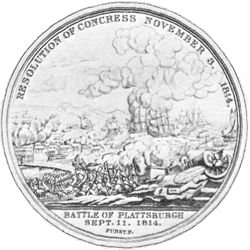
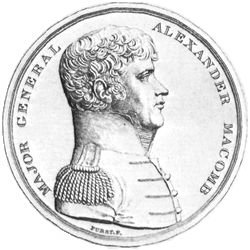
Alexander Macomb was born in Detroit, April 3, 1782. He entered the army as cornet of cavalry, 1799; was 2d lieutenant, 1801; 1st lieutenant of engineers, 1802; captain, 1805; major, 1808; lieutenant-colonel 1810; colonel 3d Artillery, 1812; and brigadier-general, January, 1814. He gained the victory of Plattsburgh over the British troops, commanded by the governor-general of the Canadas, General Sir George Prevost, September 11, 1814, for which important achievement Congress gave him a vote of thanks and a gold medal, and he was breveted major-general. He was appointed chief of the engineer corps, 1821, and became major-general and commander-in-chief of the army, May 24, 1828. He died at the head-quarters of the army in Washington, June 25, 1841.
ORIGINAL DOCUMENTS.
General Macomb to the Secretary of War.
Head-Quarters, Plattsburgh, September 15th, 1814. To the Honourable John Armstrong, Secretary of War, Washington, D. C.
Sir: I have the honour to communicate for the information of the war department, the particulars of the advance of the enemy into the territory of the United States, the circumstances attending the siege of Plattsburgh, and the defence of the posts entrusted to my charge.
The governor-general of the Canadas, Sir George Prevost, having collected all the disposable force of Lower Canada, with a view of conquering the country as far as Crown Point and Ticonderoga, entered the territories of the United States on the first of the month, and occupied the village of Champlain, there avowed his intentions, and issued orders and proclamations tending to dissuade the people from their allegiance, and inviting them to furnish his army with provisions. He immediately began to press the wagons and teams in the vicinity, and loaded them with his heavy baggage and stores. From this I was persuaded he intended to attack this place. I had but just returned from the lines, where I had commanded a fine brigade, which was broken to form the division under Major-General Izard, ordered to the westward. Being senior officer he left me in command, and except the four companies of the 6th regiment, I had not an organized battalion among those remaining. The garrison was composed of convalescents and recruits of the new regiments, all in the greatest confusion, as well as the ordnance and stores, and the works in no state of defence.
To create an emulation and zeal among the officers and men in completing the works, I divided them into detachments, and placed them near the several forts; declaring in orders, that each detachment was the garrison of its own work, and bound to defend it to the last extremity. The enemy advanced cautiously and by short marches, and our soldiers worked day and night; so that by the time he made his appearance before this place we were prepared to receive him.
General Izard named the principal work Fort Moreau, and to remind the troops of the actions of their brave countrymen, I called the redoubt on the right Fort Brown, and that on the left Fort Scott. Besides these three works, we have two block-houses strongly fortified.
Finding, on examining the returns of the garrison, that our force did not exceed fifteen hundred effective men for duty, and well informed that the enemy had as many thousands, I called on General Mooers, of the New York militia, and arranged with him plans for bringing forth the militia en masse. The inhabitants of the village fled with their families and effects, except a few worthy citizens and some boys, who formed themselves into a party, received rifles, and were exceedingly useful. By the 4th of the month, General Mooers collected about 700 militia, and advanced seven miles on the Beekmantown road, to watch the motions of the enemy, and to skirmish with him as he advanced; also to obstruct the roads with fallen trees, and to break up the bridges.
On the Lake road, at Deer Creek bridge, I posted 200 men under Captain Sproul, of the 13th regiment, with orders to abatis the woods, to place obstructions in the road, and to fortify himself; to this party I added two field pieces. In advance of that position, was Lieutenant-Colonel Appling, with 110 riflemen, watching the movements of the enemy and procuring intelligence. It was ascertained that before daylight on the 6th, the enemy would advance in two columns, on the two roads before mentioned, dividing at Sampson's, a little below Chazy village. The column on the Beekmantown road proceeded most rapidly, the militia skirmished with his advanced parties, and, except a few brave men, fell back most precipitately in the greatest disorder, notwithstanding the British troops did not deign to fire on them, except by their flankers and advanced patrols. The night previous, I ordered Major Wool to advance with a detachment of 250 men, to support the militia, and set them an example of firmness. Also Captain Leonard, of the light artillery, was directed to proceed with two pieces, to be on the ground before day; yet he did not make his appearance before 8 o'clock, when the enemy had approached within two miles of the village. With his conduct, therefore, I am not well pleased. Major Wool, with his party, disputed the road with great obstinacy, but the militia could not be prevailed on to stand, notwithstanding the exertions of their general and staff officers; although the fields were divided by strong stone walls, and they were told that the enemy could not possibly cut them off. The State dragoons of New York wear red coats, and they being on the heights to watch the enemy, gave constant alarm to the militia, who mistook them for the enemy, and feared his getting in their rear. Finding the enemy's columns had penetrated within a mile of Plattsburgh, I despatched my aid-de-camp, Lieutenant Root, to bring off the detachment at Dead Creek, and to inform Lieutenant-Colonel Appling that I wished him to fall on the enemy's right flank. The colonel fortunately arrived just in time to save his retreat, and to fall in with the head of a column debouching from the woods. Here he poured in a destructive fire from his riflemen at rest, and continued to annoy the column until he formed a junction with Major Wool. The field pieces did considerable execution among the enemy's columns. So undaunted, however, was the enemy, that he never deployed in his whole march, always pressing on our columns. Finding that every road was full of troops crowding on us on all sides, I ordered the field pieces to retire across the bridge and form a battery for its protection, and to cover the retreat of the infantry, which was accordingly done, and the parties of Appling and Wool, as well as that of Sproul, retired alternately, keeping up a brisk fire until they got under cover of the works. The enemy's light troops occupied the houses near the bridge, and kept up a constant firing from the windows and balconies, and annoyed us much. I ordered them to be driven out with hot shot, which soon put the houses in flames, and obliged the sharp-shooters to retire. The whole day, until it was too late to see, the enemy's light troops endeavoured to drive our guards from the bridge, but they suffered dearly for their perseverance. An attempt was also made to cross the upper bridge, where the militia handsomely drove them back. The column which marched by the Lake road was much impeded by the obstructions and the removal of the bridge at Dead Creek, and, as it passed the creek and beach, the gallies kept up a lively and galling fire. Our troops being now all on the south side of the Saranac, I directed the planks to be taken off the bridges and piled up in the form of breastworks, to cover our parties intended for disputing the passage, which afterwards enabled us to hold the bridges against very superior numbers.
From the 7th to the 11th, the enemy was employed in getting on his battering train, and erecting his batteries and approaches, and constantly skirmishing at the bridges and fords. By this time, the militia of New York, and the volunteers of Vermont, were pouring in from all quarters: I advised General Mooers to keep his force along the Saranac, to prevent the enemy's crossing the river, and to send a strong body in his rear to harass him day and night, and keep him in continual alarm. The militia behaved with great spirit after the first day, and the volunteers of Vermont were exceedingly serviceable. Our regular troops, notwithstanding the constant skirmishing and repeated endeavours of the enemy to cross the river, kept at their work day and night strengthening the defences, and evinced a determination to hold out to the last extremity.
It was reported that the enemy had only waited the arrival of his flotilla, to make a general attack. About eight in the morning of the 11th, as was expected, the flotilla appeared in sight round Cumberland Head, and at nine, bore down and engaged our flotilla at anchor in the bay off the town. At the same instant, the batteries were opened on us, and continued throwing bomb shells, shrapnels, balls, and congreve rockets until sunset, when the bombardment ceased, every battery of the enemy being silenced by the superiority of our fire. The naval engagement lasted but two hours, in full view of both armies. Three efforts were made by the enemy to pass the river, at the commencement of the cannonade and bombardment, with a view of assaulting the works, and he had prepared for that purpose an immense number of scaling ladders. One attempt to cross was made at the village bridge, another at the upper bridge, and a third at a ford about three miles from the works. At the two first he was repulsed by the regulars; at the ford, by the brave volunteers and militia, where he suffered severely in killed, wounded, and prisoners; a considerable body having crossed the stream, but were either killed, taken, or driven back. The woods at this place were very favourable to the operations of the militia. A whole company of the 76th regiment was here destroyed, the three lieutenants and 27 men prisoners, the captain and the rest killed.
I cannot forego the pleasure of here stating the gallant conduct of Captain M'Glassin, of the 15th regiment, who was ordered to ford the river, and attack a party constructing a battery on the right of the enemy's line, within five hundred yards of Fort Brown, which he handsomely executed at midnight with fifty men; drove off the working party, consisting of one hundred and fifty, and defeated a covering party of the same number, killing one officer and six men in the charge, and wounding many. At dusk the enemy withdrew his artillery from the batteries, and raised the siege; at nine, under cover of the night, he sent off in a great hurry all the baggage he could find transport for, and also his artillery. At two next morning the whole army precipitately retreated, leaving the sick and wounded to our generosity, and the governor left a note with a surgeon requesting the humane attention of the commanding general.
Vast quantities of provisions were left behind and destroyed, also an immense quantity of bombshells, cannon balls, grape shot, ammunition, flints, &c., &c.; intrenching tools of all sorts, also tents and marquees. A great deal has been found concealed in the ponds and creeks, and buried in the ground, and a vast quantity carried off by the inhabitants. Such was the precipitancy of his retreat, that he arrived at Chazy, a distance of eight miles, before we had discovered he had gone. The light troops, volunteers, and militia pursued immediately on learning of his flight; and some of the mounted men made prisoners five dragoons of the 19th regiment, and several others of the rear guard. A continued fall of rain and a violent storm prevented further pursuit. Upwards of 300 deserters have come in, and many are hourly arriving. We have buried the British officers of the army and navy with the honours of war, and shown every attention and kindness to those who have fallen into our hands.
The conduct of the officers, non-commissioned officers, and soldiers of my command, during this trying occasion, cannot be represented in too high terms, and I feel it my duty to recommend to the particular notice of government, Lieutenant-Colonel Appling of the 1st rifle corps, Major Wool of the 29th, Major Totten of the corps of engineers, Captain Brooks of the artillery, Captain M'Glassin of the 15th, Lieutenants De Russy and Trescott of the corps of engineers, Lieutenants Smyth, Mountford, and Cromwell of the artillery, also my aid-de-camp Lieutenant Root, who have all distinguished themselves by their uncommon zeal and activity, and have been greatly instrumental in producing the happy and glorious result of the siege.
I have the honour to be, &c., Alexander Macomb.
The loss of the enemy in killed, wounded, prisoners, and deserters, since his first appearance, cannot fall short of 2,500, including many officers, among whom is Colonel Wellington, of the Buffs.
Resolution of Congress Voting Rifles to Martin F. Aitkin and others.
Resolved by the Senate and House of Representatives of the United States of America in Congress assembled: That the President of the United States be, and he is hereby authorized to cause to be delivered to Martin J. Aitkin, Azariah C. Flagg, Ira A. Wood, Gustavus A. Bird, James Trowbridge, Hazen Mooers, Henry K. Averill, St. John B. L. Skinner, Frederick P. Allen, Hiram Walworth, Ethan Everist, Amos Soper, James Patten, Bartemus Brooks, Smith Bateman, Melancthon W. Travis and Flavel Williams, each, one rifle, promised them by General Macomb, while commanding the Champlain department, for their gallantry and patriotic services as a volunteer corps, during the siege of Plattsburgh in September, one thousand eight hundred and fourteen, on each of which said rifles there shall be a plate containing an appropriate inscription.
Approved May 20, 1826.
Plate XLVII. No. 46.
January 8, 1815.
Major General Andrew Jackson. ℞. Resolution of Congress February 27. 1815.
MAJOR-GENERAL ANDREW JACKSON.
[Victory of New Orleans.]
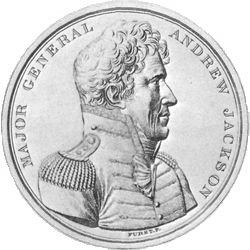
MAJOR GENERAL ANDREW JACKSON. Bust of General Jackson, in uniform, facing the right. FÜRST. F. (fecit).
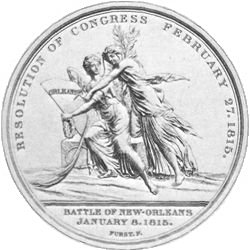
RESOLUTION OF CONGRESS FEBRUARY 27. 1815. A winged Victory, holding in her left hand a crown of laurel, and a tablet upon which she has written, at the dictation of Peace, the word ORLEANS. Exergue: BATTLE OF NEW ORLEANS JANUARY 8. 1815. FÜRST. F. (fecit).
Andrew Jackson was born in the Waxhaw Settlement, North Carolina, March 15, 1767. His parents had recently emigrated from Ireland, and he lost them both early in life. In 1781 he joined the Continental Army and served in North Carolina. Having studied law, he removed, in 1788, to Nashville. He was the first member of Congress from Tennessee, in 1796; was United States senator, 1797-1798; judge of the Supreme Court of Tennessee, 1799; resigned in 1804, and retired to his farm, called "The Hermitage," near Nashville. As major-general of the Tennessee Volunteers, he gained victories over the Creek Indians at Talladega, November 9, 1813, at Emuckfaw and Enotochopco, January 22 and 24, and at Tohopeka, March 27, 1814. He was appointed brigadier-general in the United States Army on April 19, major-general on May 1, 1814, and commander-in-chief for the defence of Louisiana against the British troops under General Packenham, whom he completely defeated at the battle of New Orleans, January 8, 1815. For this great victory Congress gave him a vote of thanks and a gold medal. He retired from the army, 1819, was governor of Florida territory, 1821, United States senator from Tennessee, 1823-1824, unsuccessful presidential candidate in 1824, and President of the United States (first term), 1829-1833; (second term), 1833-1837. He retired to the Hermitage in 1837, and died there June 8, 1845. He was known by the sobriquet of "Old Hickory."
ORIGINAL DOCUMENTS.
Resolution of Congress Voting a Medal to General Jackson.
Resolved unanimously by the Senate and House of Representatives of the United States of America in Congress assembled: That the thanks of Congress be, and they are hereby, given to Major-General Jackson, and, through him, to the officers and soldiers of the regular army, of the militia and of the volunteers, under his immediate command, and to the officers and soldiers charged with the defence of Fort St. Philip, for their uniform gallantry and good conduct, conspicuously displayed against the enemy, from the time of his landing before New Orleans until his final expulsion from the State of Louisiana, and particularly for the valour, skill, and good conduct on the eighth of January last, in repulsing, with great slaughter, a numerous British army of chosen veteran troops, when attempting by a bold and daring attack to carry by storm the works hastily thrown up for the protection of New Orleans, and thereby obtaining a most signal victory over the enemy with a disparity of loss, on his part, unexampled in military annals.
Resolved, That the President of the United States be requested to cause to be struck a gold medal, with devices emblematical of this splendid achievement, and presented to Major-General Jackson, as a testimony of the high sense entertained by Congress of his judicious and distinguished conduct on that memorable occasion.
Resolved, That the President of the United States be requested to cause the foregoing resolution to be communicated to Major-General Jackson in such terms as he may deem best calculated to give effect to the objects thereof.
Approved February 27, 1815.
General Jackson to the Secretary of War.
Head Quarters, Camp 4 miles below New Orleans, January 13th, 1815. To the Honourable Secretary of War, Washington, D. C.
Sir: At such a crisis, I conceive it my duty to keep you constantly advised of my situation.
On the 10th instant I forwarded you an account of the bold attempt made by the enemy on the morning of the 8th to take possession of my works by storm, and of the severe repulse he met with. That report having been sent by the mail which crosses the lake, may possibly have miscarried; for which reason I think it the more necessary briefly to repeat the substance of it.
Early on the morning of the 8th, the enemy having been actively employed the two preceding days in making preparations for a storm, advanced in two strong columns on my right and left. They were received, however, with a firmness which it seems they little expected, and which defeated all their hopes. My men, undisturbed by their approach, which indeed they long anxiously wished for, opened upon them a fire so deliberate and certain as rendered their scaling ladders and fascines, as well as their more direct implements of war, perfectly useless. For upwards of an hour it was continued with a briskness of which there have been but few instances, perhaps in any country. In justice to the enemy, it must be said, they withstood it as long as could be expected from the most determined bravery. At length, however, when all prospect of success became hopeless, they fled in confusion from the field, leaving it covered with their dead and wounded. Their loss was immense. I had at first computed it at 1500, but it is since ascertained to have been much greater. Upon information which is believed to be correct, Colonel Hayne, the inspector-general, reports it to be in total 2600. His report I enclose you. My loss was inconsiderable, being only seven killed and six wounded. Such a disproportion in loss, when we consider the number and kind of troops engaged, must, I know, excite astonishment, and may not everywhere be fully credited; yet I am perfectly satisfied that the account is not exaggerated on the one part, nor underrated on the other.
The enemy, having hastily quitted a post which they had gained possession of on the other side of the river, and we having immediately returned to it, both armies at present occupy their former positions. Whether, after the severe losses he has sustained, he is preparing to return to his shipping, or to make still mightier efforts to attain his first object, I do not pretend to determine. It becomes me to act as though the latter were his intention. One thing, however, seems certain, that if he still calculates on effecting what he has hitherto been unable to accomplish, he must expect considerable reinforcements, as the force with which he landed must undoubtedly be diminished by at least 3000. Besides the loss which he sustained on the night of the 23d ultimo, which is estimated at 400, he cannot have suffered less between that period and the morning of the 18th instant than 3000; having, within that time, been repulsed in two general attempts to drive us from our position, and there having been continual cannonading and skirmishing during the whole of it. Yet he is still able to show a very formidable force.
There is little doubt that the commanding general, Sir Edward Packenham, was killed in the action of the 8th, and that Major-Generals Keane and Gibbs were badly wounded.
Whenever a more leisure moment shall occur, I will take the liberty to make and forward you a more circumstantial account of the several actions, and particularly that of the 8th, in doing which my chief motive will be to render justice to those brave men I have the honour to command, and who have so remarkably distinguished themselves.
I have the honour to be, &c., Andrew Jackson.
General Jackson to the Secretary of War.
Camp below New Orleans, January 19th, 1815. To the Honourable Secretary of War, Washington, D. C.
Sir: Last night at 12 o'clock, the enemy precipitately decamped, and returned to their boats, leaving behind them, under medical attendance, eighty of his wounded, including two officers, 14 pieces of his heavy artillery, and a quantity of shot, having destroyed much of his powder. Such was the situation of the ground he abandoned, and of that through which he retired, protected by canals, redoubts, entrenchments and swamps on his right, and the river on his left, that I could not, without encountering a risk which true policy did not seem to require, or to authorize, attempt to annoy him much on his retreat. We took only eight prisoners.
Whether it is the purpose of the enemy to abandon the expedition altogether, or renew his efforts at some other point, I do not pretend to determine with positiveness. In my own mind, however, there is but little doubt that his last exertions have been made in this quarter, at any rate for the present season, and by the next I hope we shall be fully prepared for him. In this belief I am strengthened not only by the prodigious loss he has sustained at the position he has just quitted, but by the failure of his fleet to pass Fort St. Philip.
His loss on this ground, since the debarkation of his troops, as stated by the last prisoners and deserters, and as confirmed by many additional circumstances, must have exceeded four thousand; and was greater in the action of the 8th than was estimated, from the most correct data then in his possession, by the inspector-general, whose report has been forwarded to you. We succeeded, on the 8th, in getting from the enemy about 1000 stand of arms of various descriptions.
Since the action of the 8th, the enemy has been allowed very little respite; my artillery from both sides of the river being constantly employed, till the night, and indeed until the hour of their retreat, in annoying them. No doubt they thought it quite time to quit a position in which so little rest could be found.
I am advised by Major Overton, who commanded at Fort St. Philip, in a letter of the 18th, that the enemy having bombarded his fort for 8 or 9 days from 13-inch mortars without effect, had, on the morning of that day, retired. I have little doubt that he would have been able to have sunk their vessels had they attempted to run by.
Giving the proper weight to all these considerations, I believe you will not think me too sanguine in the belief that Louisiana is now clear of its enemy. I hope, however, I need not assure you, that wherever I command, such a belief shall never occasion any relaxation in the measures for resistance. I am but too sensible that the moment when the enemy is opposing us, is not the most proper to provide for them.
I have the honour to be, etc., Andrew Jackson.
General Jackson's Farewell Address to his Army.
New Orleans, March, 1815.
The major-general is at length enabled to perform the pleasing task of restoring to Tennessee, Kentucky, Louisiana, and the territory of the Mississippi, the brave troops who have acted such a distinguished part in the war which has just terminated. In restoring these brave men to their homes, much exertion is expected of, and great responsibility imposed on, the commanding officers of the different corps. It is required of Major-Generals Carroll and Thomas, and Brigadier-General Coffee, to march their commands, without unnecessary delay, to their respective states. The troops from the Mississippi territory and state of Louisiana, both militia and volunteers, will be immediately mustered out of service, paid, and discharged.
The major-general has the satisfaction of announcing the approbation of the President of the United States to the conduct of the troops under his command, expressed, in flattering terms, through the honourable Secretary of War.
In parting with those brave men, whose destinies have been so long united with his own, and in whose labours and glories it is his happiness and his boast to have participated, the commanding general can neither suppress his feelings, nor give utterance to them as he ought. In what terms can he bestow suitable praise on merit so extraordinary, so unparalleled? Let him, in one burst of joy, gratitude, and exultation, exclaim, "These are the saviours of their country; these the patriot soldiers, who triumphed over the invincibles of Wellington, and conquered the conquerors of Europe!" With what patience did you submit to privations; with what fortitude did you endure fatigue; what valour did you display in the day of battle! You have secured to America a proud name among the nations of the earth; a glory which will never perish.
Possessing those dispositions which equally adorn the citizen and the soldier, the expectations of your country will be met in peace, as her wishes have been gratified in war. Go, then, my brave companions, to your homes; to those tender connections and blissful scenes which render life so dear; full of honour, and crowned with laurels that will never fade. When participating in the bosoms of your families, the enjoyment of peaceful life, with what happiness will you not look back to the toils you have borne, to the dangers you have encountered? How will all your past exposures be converted into sources of inexpressible delight? Who, that never experienced your sufferings, will be able to appreciate your joys? The man who slumbered ingloriously at home, during your painful marches, your nights of watchfulness, and your days of toil, will envy you the happiness which these recollections will afford; still more will he envy the gratitude of that country which you have so eminently contributed to save.
Continue, fellow-soldiers, on your passage to your several destinations, to preserve that subordination, that dignified and manly deportment, which have so ennobled your character.
While the commanding general is thus giving indulgence to his feelings, towards those brave companions, who accompanied him through difficulties and danger, he cannot permit the names of Blount, and Shelby, and Holmes, to pass unnoticed. With what generous ardour and patriotism have these distinguished governors contributed all their exertions to provide the means of victory! The recollection of their exertions, and of the success which has resulted, will be to them a reward more grateful than any which the pomp of title, or the splendour of wealth, can bestow.
What happiness it is to the commanding general, that, while danger was before him, he was, on no occasion, compelled to use, towards his companions in arms, either severity or rebuke. If, after the enemy had retired, improper passions began their empire in a few unworthy bosoms, and rendered a resort to energetic measures necessary for their suppression, he has not confounded the innocent with the guilty, the seduced with the seducers. Towards you, fellow-soldiers, the most cheering recollections exist, blended, alas! with regret, that disease and war should have ravished from us so many worthy companions. But the memory of the cause in which they perished, and of the virtues which animated them while living, must occupy the place where sorrow would claim to dwell.
Farewell, fellow-soldiers. The expression of your general's thanks is feeble; but the gratitude of a country of freemen is yours, yours the applause of an admiring world.
Andrew Jackson, Major-General commanding.
Resolutions of Congress complimentary to Commodore D. T. Patterson and others.
Resolved unanimously by the Senate and House of Representatives of the United States of America in Congress assembled: That the Congress entertain a high sense of the valour and good conduct of Commodore D. T. Patterson, of the officers, petty officers, and seamen attached to his command for their prompt and efficient co-operation with General Jackson in the late gallant and successful defence of the city of New Orleans when assailed by a powerful British force.
Resolved, That Congress entertain a high sense of the valour and good conduct of Major Daniel Carmick, of the officers, non-commissioned officers, and marines under his command, in the defence of the said city, on the late memorable occasion.
Approved February 15, 1815.
Resolutions of Congress complimentary to the People of the State of Louisiana, etc.
Resolved unanimously by the Senate and House of Representatives of the United States of America in Congress assembled: That Congress entertain a high sense of the patriotism, fidelity, zeal, and courage with which the people of the State of Louisiana promptly and unanimously stepped forth, under circumstances of imminent danger from a powerful invading army, in defence of all the individual, social and political rights held dear to man. Congress declare and proclaim, that the brave Louisianians deserve well of the whole people of the United States.
Resolved, That Congress entertain a high sense of the generosity, benevolence, and humanity displayed by the people of New Orleans in voluntarily affording the best accommodations in their power, and giving the kindest attention to the wounded, not only of our own army, but also to the wounded prisoners of a vanquished foe.
Resolved, That the President of the United States be requested to cause the foregoing resolutions to be communicated to His Excellency the Governor of Louisiana, accompanied with the request that he cause the greatest possible publicity to be given to them for the information of the whole people of Louisiana.
Approved February 15, 1815.
Plate XLVIII. No. 47.
February 20, 1815.
Carolus Stewart navis Amer. Constitution dux. ℞. Una victoriam eripuit ratibus binis.
CAPTAIN CHARLES STEWART.
[Capture of the Cyane and of the Levant.]
CAROLUS STEWART NAVIS AMER. (Americanæ) CONSTITUTION DUX. (Charles Stewart, captain of the American vessel Constitution.) Bust of Captain Stewart, in uniform, facing the right. FÜRST. F. (fecit).
UNA VICTORIAM ERIPUIT RATIBUS BINIS. (He snatched victory from two vessels with one.) Naval action between the United States frigate Constitution, of fifty-two guns, Captain Stewart, and the British frigate Cyane, of thirty-four guns, Captain Falcon, and the sloop-of-war Levant, of twenty-one guns, Captain the Honorable George Douglas. The Constitution, to windward, is opening with her port battery on the Levant; both British vessels are returning the fire from their starboard batteries. Exergue: INTER CONSTITU. NAV. AMERI. ET LEVANT ET CYANE NAV. ANG. DIE XX. FEBR. MDCCCXV. (Inter Constitution navem Americanam et Levant et Cyane naves Anglicanas, die 20 Februarii, 1815: Between the American vessel Constitution and the English vessels Levant and Cyane, on the 20th of February, 1815.) On the platform, FÜRST. F. (fecit).
Charles Stewart was born in Philadelphia, July 18, 1778. He began life in the merchant service, but entered the navy as lieutenant, March 13, 1798. He served in the West Indies, and afterward in the Tripolitan campaign, commanding the Siren. He escorted the Intrepid to Tripoli when Decatur blew up the Philadelphia, and was promoted to the rank of master-commandant, May 19, 1804, and of captain, April 22, 1806. While in command of the frigate Constitution he fought and captured, February 20, 1815, the two British ships-of-war, Cyane, Captain Gordon Falcon, and Levant, Captain the Honorable George Douglas, for which brilliant action he received the thanks of Congress and a gold medal. He commanded in the Mediterranean from 1816 to 1820; in the Pacific from 1821 to 1823; was member of the Naval Board from 1830 to 1833; commanded the navy yard at Philadelphia, 1837; and was put on the retired list in 1857; but was replaced on the active list as senior flag officer, 1859, and was appointed rear-admiral on the retired list, 1862. He died at Bordentown, New Jersey, November 7, 1869.
ORIGINAL DOCUMENTS.
Resolution of Congress Voting Medals to Captain Stewart, etc.
Approved February 22, 1816.
Captain Stewart to the Secretary of the Navy.
United States Frigate Constitution, May, 1815. To the Honourable Secretary Of The Navy, Washington, D. C.
Sir: On the 20th of February last, the island of Madeira bearing about west southwest, distant 60 leagues, we fell in with His Britannic Majesty's two ships-of-war, the Cyane and Levant, and brought them to action about 6 o'clock in the evening, both of which, after a spirited engagement of 40 minutes, surrendered to the ship under my command.
Considering the advantages derived by the enemy from a divided and more active force, as also their superiority in the weight and number of guns, I deem the speedy and decisive result of this action the strongest assurance which can be given to the government that all under my command did their duty, and gallantly supported the reputation of American seamen.
Enclosed you will receive the minutes of the action, and a list of the killed and wounded on board this ship; also enclosed you will receive for your information a statement of the actual force of the enemy, and the number killed and wounded on board their ships, as near as could be ascertained.
I have the honour to be, &c., Charles Stewart.
American loss: 3 killed, 12 wounded. British loss: 35 killed, 42 wounded. Prisoners taken, 313.
Minutes of the action between the United States frigate Constitution, and His Britannic Majesty's skips Cyane and Levant, on the 20th February, 1815.
Commences with light breezes from the east, and cloudy weather. At one, discovered a sail two points on the larboard bow, hauled up and made sail in chase. At a quarter past one, made the sail to be a ship; at three-quarters past one, discovered another sail ahead; made them out at two p.m. to be both ships, standing close hauled, with their starboard tacks on board; at four p.m. the weathermost ship made signals, and bore up to her consort, then about 10 miles to leeward; we bore up after her, and set lower top-mast, top-gallant, and royal studding-sails in chase; at half-past four, carried away our main royal mast; took in the sails and got another prepared; at five p.m. commenced firing on the chase from our two larboard bow guns; our shot falling short, ceased firing; at half-past five, finding it impossible to prevent their junction, cleared ship for action, then about four miles from the two ships; at forty minutes after five, they passed within hail of each other, and hauled by the wind on the starboard tack, hauled up their courses, and prepared to receive us: at forty-five minutes past five, they made all sail close hauled by the wind, in hopes of getting to the windward of us; at fifty-five minutes past five, finding themselves disappointed in their object, and we were closing with them fast, they shortened sail, and formed on a line of wind, about half a cable's length from each other. At six p.m. having them under command of our battery, hoisted our colours, which was answered by both ships hoisting English ensigns. At five minutes past six, ranged up on the starboard side of the sternmost ship, about 300 yards distant, and commenced the action by broadsides, both ships returning our fire with the greatest spirit for about fifteen minutes, then the fire of the enemy beginning to slacken, and the great column of smoke collected under our lee, induced us to cease our fire to ascertain their positions and conditions. In about three minutes the smoke clearing away, we found ourselves abreast of the headmost ship, the sternmost ship luffing up for our larboard quarter; we poured a broadside into the headmost ship, and then braced aback our main and mizzen topsails, and backed astern under cover of the smoke, abreast the sternmost ship, when the action was continued with spirit and considerable effect until 35 minutes past 6, when the enemy's fire again slackened, and we discovered the headmost bearing up; filled our topsails, shot ahead, and gave her two stern rakes. We then discovered the sternmost ship wearing also; wore ship immediately after her, and gave her a stern rake, she luffing to on our starboard bow and giving us her larboard broadside. We ranged upon her larboard quarter, within hail, and were about to give her our starboard broadside, when she struck her colours, fired a lee gun and yielded. At fifty minutes past six took possession of His Britannic Majesty's ship Cyane, Captain Gordon Falcon, mounting 34 guns. At 8 p.m. filled away after her consort, which was still in sight to leeward. At half-past eight found her standing towards us, with her starboard tacks close hauled, with top-gallant sails set and colours flying. At 50 minutes past 8 ranged close alongside to windward of her, on opposite tacks, and exchanged broadsides; wore immediately under her stern, and raked her with a broadside. She then crowded all sail and endeavoured to escape by running, hauled on board our tacks, set spanker and flying-jib in chase. At half-past 9 commenced firing on her from our starboard bow chaser; gave her several shot, which cut her spars and rigging considerably. At 10 p.m. finding they could not escape, fired a gun, struck her colours, and yielded. We immediately took possession of His Britannic Majesty's ship Levant, Hon. Captain George Douglas, mounting 21 guns. At 1 a.m. the damages of our rigging were repaired, sails shifted, and the ship in fighting condition.
Plate XLIX. No. 48.
March 23, 1815.
The Congress of the U. S. to Capt. James Biddle, etc. ℞. Capture of the British ship Penguin by the U. S. ship Hornet.
CAPTAIN JAMES BIDDLE.
[Capture of the Penguin.]
THE CONGRESS OF THE U. S. (United States) TO CAPT. (Captain) JAMES BIDDLE. FOR HIS GALLANTRY GOOD CONDUCT AND SERVICES. Bust of Captain Biddle, in uniform, facing the right FÜRST. F. (fecit).
CAPTURE OF THE BRITISH SHIP PENGUIN BY THE U. S. (United States) SHIP HORNET. Naval action between the United States sloop-of-war Hornet, of eighteen guns, Captain Biddle, and the British sloop-of-war Penguin, of nineteen guns, Captain Dickenson. The Hornet, to windward, is raking the Penguin. The British vessel has lost her main-top-gallant-mast In the distance the peak of Tristan d'Acunha. Exergue: OFF TRISTAN D'ACUNHA MARCH XXIII MDCCCXV. On the platform, FÜRST. F. (fecit).
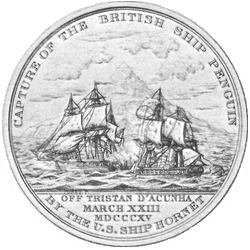
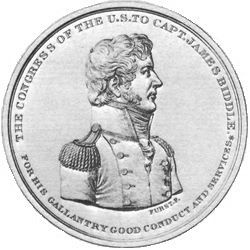
James Biddle was born in Philadelphia, February 28, 1783. He entered the navy as a midshipman in 1800, and went to the Mediterranean with Captain Bainbridge. He was wrecked in the Philadelphia, and was a prisoner in Tripoli for nearly two years; was a lieutenant in 1807, and first lieutenant of the Wasp in 1812, when she captured the Frolic. For his conduct on this occasion he was promoted to the rank of master-commandant. While in command of the sloop-of-war Hornet he captured the British sloop-of-war Penguin, Captain Dickenson, March 23, 1815, receiving for this gallant deed the thanks of Congress and a gold medal. He became a captain in the same year, and commanded the Mediterranean squadron, 1830-1832. He was governor of the Naval Asylum in Philadelphia, 1838-1842; commanded the East India squadron, 1845, and was on the west coast of Mexico during the Mexican war. He died in Philadelphia, October 1, 1848.
ORIGINAL DOCUMENTS.
Resolution of Congress Voting Medals to Captain Biddle, etc.
Approved February 22, 1816.
Captain Biddle to the Secretary of the Navy.
United States sloop Hornet, Off Tristan D'Acunha, March 25th, 1815. To the Honourable Secretary of the Navy, Washington, D. C.
Sir: I have the honour to inform you, that on the morning of the 23d instant, at half past ten, when about to anchor off the north end of the island of Tristan d'Acunha, a sail was seen to the southward and eastward, steering to the westward, the wind fresh from the S. S. W. In a few minutes she had passed on to the westward, so that we could not see her for the land. I immediately made sail for the westward, and shortly after getting in sight of her again, perceived her to bear up before the wind. I hove to for him to come down to us. When she had approached near, I filled the main-topsail, and continued to yaw the ship, while she continued to come down, wearing occasionally to prevent her passing under our stern. At 1.40 p.m. being within nearly musket shot distance, she hauled her wind on the starboard tack, hoisted English colours and fired a gun. We immediately luffed to, hoisted our ensign and gave the enemy a broadside. The action being thus commenced, a quick and well directed fire was kept up from this ship, the enemy gradually driving near to us, when at 1.05 minutes he bore up apparently to run us on board. As soon as I perceived he would certainly fall on board, I called the boarders, so as to be ready to repel any attempt to board us. At the instant every officer and man repaired to the quarterdeck, where the two vessels were coming in contact, and eagerly pressed me to permit them to board the enemy; but this I would not permit, as it was evident, from the commencement of the action, that our fire was greatly superior both in quickness and effect. The enemy's bowsprit came in between our main and mizzen rigging, on our starboard side, affording him an opportunity to board us, if such was his design, but no attempt was made. There was a considerable swell on, and as the sea lifted us ahead, the enemy's boom carried away our mizzen shrouds, stern davits, and spanker boom, and he hung upon our larboard quarter. At this moment an officer, who was afterwards recognized to be Mr. M'Donald, the first lieutenant, and the then commanding officer, called out that they had surrendered. I directed the marines and musketry men to cease firing, and, while on the taffrail asking if they had surrendered, I received a wound in the neck. The enemy had just then got clear of us, and his fore-mast and bowsprit being both gone, and perceiving us wearing to give a fresh broadside, he again called out that he had surrendered. It was with difficulty I could restrain my crew from firing into him again, as he had certainly fired into us after having surrendered. From the firing of the first gun, to the last time the enemy cried out he had surrendered, was exactly 22 minutes by the watch. She proved to be His Britannic Majesty's sloop of war Penguin, mounting six 32 pound carronades, two long 12's, a 12 pound carronade on the top-gallant fore-castle, with swivels on the capstern in the tops. She had a spare port forward, so as to fight both her long guns a side. She sailed from England in September last. She was shorter upon deck than this ship, by two feet, but she had a greater length of keel, greater breadth of beam, thicker sides, and higher bulwarks than this ship, and was in all respects a remarkably fine vessel of her class. The enemy acknowledge a complement of 132, 12 of them supernumerary marines from the Medway 74, received on board in consequence of their being ordered to cruise for the American privateer Young Wasp. They acknowledge, also, a loss of 14 killed and 28 wounded; but Mr. Mayo, who was in charge of the prize, assures me that the number of killed was certainly greater. Among the killed is Captain Dickenson, who fell at the close of the action, and the boatswain; among the wounded is the second lieutenant, purser, and two midshipmen. Each of the midshipmen lost a leg. We received on board, in all, 118 prisoners, four of whom have since died of their wounds. Having removed the prisoners, and taken on board such provisions and stores as would be useful to us, I scuttled the Penguin this morning, before daylight, and she went down. As she was completely riddled by our shot, her foremast and bowsprit both gone, and her main-mast so crippled as to be incapable of being secured, it seemed unadvisable, at this distance from home, to attempt sending her to the United States.
This ship did not receive a single round shot in her hull, nor any material wound in her spars; the rigging and sails were very much cut; but having bent a new suit of sails and knotted and secured our rigging, we are now completely ready, in all respects, for any service. We were eight men short of complement, and had nine upon the sick list the morning of the action.