LIST OF PLATES. (continued 2)
Reading edition
Friday, November 3, 1780.
General Washington to the President of Congress.
Robinson House, In The Highlands, September 26, 1780. To The President Of Congress. Sir:
In the mean time, a packet had arrived from Lieutenant-Colonel Jameson, announcing the capture of a John Anderson, who was endeavouring to go to New York with several interesting and important papers, all in the handwriting of General Arnold. This was also accompanied with a letter from the prisoner, avowing himself to be Major John André, adjutant-general of the British army, relating the manner of his capture, and endeavouring to show that he did not come under the description of a spy. From the several circumstances, and information that the general (Arnold) seemed to be thrown into some degree of agitation on receiving a letter, a little time before he went down from his quarters, I was led to conclude immediately, that he had heard of Major André's captivity, and that he would, if possible, escape to the enemy; and I accordingly took such measures as appeared the most probable, to apprehend him. But he had embarked in a barge, and proceeded down the river under a flag to the Vulture sloop-of-war, which lay some miles below Stony and Verplanck's Points. After he got on board, he wrote to me a letter, of which the enclosed is a copy.
Major André is not arrived yet, but I hope he is secure, and that he will be here to-day. I have been and am taking proper precautions, which I trust will prove effectual, to prevent the important consequences which this conduct on the part of General Arnold was intended to produce. I do not know the party that took Major André, but it is said to have consisted only of militia, who acted in such a manner as does them the highest honour, and proves them to be men of great virtue. They were offered, I am informed, a large sum of money for his release, and as many goods as they would demand, but without any effect. Their conduct gives them a just claim to the thanks of their country, and I also hope they will be otherwise rewarded. As soon as I know their names, I shall take pleasure in transmitting them to Congress.
I have the honour to be, &c., Geo. Washington.
General Washington to the President of Congress.
Paramus, October 7, 1780. To The President Of Congress. Sir:
I have now the pleasure to communicate the names of the three persons who captured Major André, and who refused to release him, notwithstanding the most earnest importunities and assurances of a liberal reward on his part. Their conduct merits our wannest esteem; and I beg leave to add, that I think the public will do well to make them a handsome gratuity. They have prevented in all probability our suffering one of the severest strokes that could have been meditated against us. Their names are John Paulding, David Williams, and Isaac Van Wart.
I have the honour to be, &c., Geo. Washington.
Plate VIII. No. 8.
January 17, 1781.
Danieli Morgan duci exercitus Comitia Americana. ℞. Victoria libertatis vindex.
BRIGADIER-GENERAL DANIEL MORGAN.
[Victory of the Cowpens.]
DANIELI MORGAN DUCI EXERCITUS COMITIA AMERICANA. (The American Congress to General Daniel Morgan.) America, personified as an Indian queen, standing, places with her right hand a crown of laurel upon the head of General Morgan, while her left rests on a bow. To the left are seen trophies of the enemy's arms; against a cannon is the American shield, upon which lies a branch of laurel; to the right is a forest. dupré, f. (fecit).
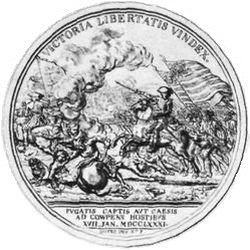
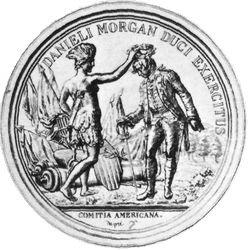
The legend of the exergue of this medal, as originally proposed by the French Academy of Inscriptions and Belles-Lettres, was CÆSIS AUT CAPTIS AD COWPENS HOSTIUM * * SIGNIS RELATIS * * 17 JAN. 1781. The change was made at the suggestion of Jefferson.
Augustin Dupré was born in St. Etienne, France, October, 1748. He began life as a workman in a manufactory of arms. In 1768 he went to Paris as apprentice to an engraver, and became one of the most distinguished medal engravers of the latter part of the 18th century. Among his works are the celebrated five franc piece known as "à l'Hercule," the five centime and one decime pieces, on which the head of Liberty is the profile of Madame Récamier, and seven medals relating to America: John Paul Jones, General Morgan, General Greene, Libertas Americana, the Diplomatic medal, and two of Franklin. Dupré was engraver-general of the Paris Mint from July, 1791, to 1801, when he was dismissed by General Bonaparte, then first consul. He died at Armentières, January 31, 1833.
Daniel Morgan was born in Hunterdon County, New Jersey, in 1736. In early life he served as a teamster in General Braddock's army, and afterward settled in Frederick (now Clarke) County, Virginia. In 1775 he was captain of a rifle company, and served under Washington. He accompanied General Arnold to Canada, and was made prisoner at Quebec; he served again under Washington, as colonel of a rifle regiment, in 1776, and greatly distinguished himself under General Gates at Saratoga. He was brigadier-general in 1780, served in the South under Generals Gates and Greene, and won the brilliant victory of the Cowpens, January 17, 1781, for which Congress gave him a vote of thanks and a gold medal. Soon afterward he resigned from ill health, and retired to his plantation. He was a member of Congress from 1795 to 1799. In 1780 he removed to Winchester, Virginia, where he died July 6, 1802.
ORIGINAL DOCUMENTS.
Resolutions of Congress Voting Medals to General Morgan and to Lieutenant-Colonels Washington and Howard, etc.
By the United States in Congress Assembled.
Considering it as a tribute due to distinguished merit to give a public approbation of the conduct of Brigadier-General Morgan, and of the officers and men under his command, on the 17th day of January last, when with 80 cavalry and 237 infantry of the troops of the United States, and 553 militia from the States of Virginia, North Carolina, South Carolina, and Georgia, he obtained a complete and important victory over a select and well appointed detachment of more than 1,100 British troops commanded by Lieutenant-Colonel Tarleton; do therefore resolve:—
That the thanks of the United States in Congress assembled be given to Brigadier-General Morgan, and the officers and men under his command, for their fortitude and good conduct displayed in the action at the Cowpens, in the State of South Carolina, on the 17th day of January last:
That a medal of gold be presented to Brigadier-General Morgan, and a medal of silver to Lieutenant-Colonel Washington (William), of the cavalry, and one of silver to Lieutenant-Colonel Howard, of the infantry of the United States; severally with emblems and mottoes descriptive of the conduct of those officers respectively on that memorable day:
That a sword be presented to Colonel Pickens, of the militia, in testimony of his spirited conduct in the action before mentioned:
That Captain Edward Giles, aid-de-camp of Brigadier-General Morgan, have the brevet commission of major; and that Baron de Glasbuch, who served with Brigadier-General Morgan as a volunteer, have the brevet commission of captain in the army of the United States; in consideration of their merit and services.
Ordered, That the commanding officer in the southern department communicate these resolutions in general orders.
Friday, March 9, 1781.
General Morgan to General Greene.
Camp, near Cain Creek, January 19, 1781. To General Greene.
Sir: The troops I have the honour to command have been so fortunate as to obtain a complete victory over a detachment from the British army, commanded by Lieutenant-Colonel Tarleton. The action happened on the 17th instant, about sunrise, at the Cowpens. It perhaps would be well to remark, for the honour of the American arms, that although the progress of this corps was marked with burning and devastation, and although they waged the most cruel warfare, not a man was killed, wounded, or even insulted, after he surrendered. Had not the Britons during this contest received so many lessons of humanity, I should natter myself that this might teach them a little. But I fear they are incorrigible.
To give you a just idea of our operation, it will be necessary to inform you, that on the 14th instant, having received certain intelligence that Lord Cornwallis and Lieutenant-Colonel Tarleton were both in motion, and that their movements clearly indicated their intentions of dislodging me, I abandoned my encampment on Grindall's Ford on the Pacolet, and on the 16th, in the evening, took possession of a post, about seven miles from the Cherokee Ford, on Broad river. My former position subjected me at once to the operations of Cornwallis and Tarleton, and in case of a defeat, my retreat might have easily been cut off. My situation at the Cowpens enabled me to improve any advantages I might gain, and to provide better for my own security should I be unfortunate. These reasons induced me to take this post, at the risk of its wearing the face of a retreat.
I received regular intelligence of the enemy's movements from the time they were first in motion. On the evening of the 16th instant they took possession of the ground I had removed from in the morning, distant from the scene of action about twelve miles. An hour before daylight, one of my scouts returned and informed me that Lieutenant-Colonel Tarleton had advanced within five miles of our camp. On this information, I hastened to form as good a disposition as circumstances would admit, and from the alacrity of the troops, we were soon prepared to receive them. The light infantry, commanded by Lieutenant-Colonel Howard, and the Virginia Militia, under the command of Major Triplett, were formed on a rising ground, and extended a line in front. The third regiment of dragoons, under Lieutenant-Colonel Washington, were posted at such a distance in their rear as not to be subjected to the line of fire directed at them, and to be so near as to be able to charge the enemy should they be broken. The volunteers of North Carolina, South Carolina, and Georgia, under the command of the brave and valuable Colonel Pickens, were situated to guard the flanks. Major McDowell, of the North Carolina Volunteers, was posted on the right flank in front of the line, one hundred and fifty yards; and Major Cunningham, of the Georgia Volunteers, on the left, at the same distance in front. Colonels Brannon and Thomas, of the South Carolinians, were posted on the right of Major McDowell, and Colonels Hays and McCall, of the same corps, on the left of Major Cunningham. Captains Tate and Buchanan, with the Augusta Riflemen, to support the right of the line.
The enemy drew up in single line of battle, four hundred yards in front of our advanced corps. The first battalion of the 71st regiment was opposed to our right, the 7th regiment to our left, the infantry of the legion to our centre, the light companies on their flank. In front moved two pieces of artillery. Lieutenant-Colonel Tarleton, with his cavalry, was posted in the rear of his line.
The disposition of battle being thus formed, small parties of riflemen were detached to skirmish with the enemy, upon which their whole line moved on with the greatest impetuosity, shouting as they advanced. McDowell and Cunningham gave them a heavy and galling fire, and retreated to the regiments intended for their support. The whole of Colonel Pickens' command then kept up a fire by regiments, retreating agreeably to their orders. When the enemy advanced to our line, they received a well-directed and incessant fire; but their numbers being superior to ours, they gained our flanks, which obliged us to change our position. We retired in good order about fifty paces, formed, advanced on the enemy, and gave them a fortunate volley, which threw them into disorder. Lieutenant-Colonel Howard, observing this, gave orders for the line to charge bayonets, which was done with such address that they fled with the utmost precipitation, leaving their field pieces in our possession. We pushed our advantages so effectually, that they never had an opportunity of rallying, had their intentions been ever so good.
Lieutenant-Colonel Washington, having been informed that Tarleton was cutting down our riflemen on the left, pushed forward, and charged them with such firmness, that, instead of attempting to recover the fate of the day, which one would have expected from an officer of his splendid character, they broke and fled.
The enemy's whole force were now bent solely in providing for their safety in flight—the list of their killed, wounded, and prisoners, will inform you with what effect Tarleton, with the small remains of his cavalry, and a few scattering infantry he had mounted on his waggon horses, made their escape. He was pursued twenty-four miles, but owing to our having taken a wrong trail at first, we never could overtake him.
As I was obliged to move off the field of action in the morning, to secure the prisoners, I cannot be so accurate as to the killed and wounded as I could wish. From the reports of an officer whom I sent to view the ground, there were one hundred non-commissioned officers and privates, and ten commissioned officers, killed, and two hundred rank and file wounded. We have now in our possession five hundred and two non-commissioned officers and privates prisoners, independent of the wounded, and the militia are taking up stragglers continually. Twenty-nine commissioned officers have fallen into our hands. Their rank you will see by an enclosed list. The officers I have paroled, the privates I am conveying by the safest route to Salisbury.
Two standards, two field pieces, thirty-five waggons, a travelling forge, and all their music are ours. Their baggage, which was immense, they have in a great measure destroyed.
Our loss is inconsiderable, which the enclosed return will evince. I have not been able to ascertain Colonel Pickens' loss, but know it to be very small.
From our force being composed of such a variety of corps, a wrong judgment may be formed of our numbers. We fought only eight hundred men, two-thirds of which were militia. The British, with their baggage guard, were not less than one thousand one hundred and fifty, and these veteran troops. Their own officers confess that they fought one thousand and thirty-seven.
Such was the inferiority of our numbers, that our success must be attributed to the justice of our cause and the bravery of our troops. My wishes would induce me to mention the name of every sentinel in the corps I have the honour to command. In justice to the bravery and good conduct of the officers, I have taken the liberty to enclose you a list of their names, from a conviction that you will be pleased to introduce such characters to the world.
Major Giles, my aid, and Captain Brookes, my brigade-major, deserve and have my thanks for their assistance and behaviour on this occasion.
The Baron de Glasbuch, who accompanies Major Giles with these despatches, served with me in the action as a volunteer, and behaved in such a manner as merits your attention.
I am, dear Sir, your obedient servant, Daniel Morgan.
P.S. Our loss was very inconsiderable, not having more than twelve killed and about sixty wounded.
The enemy had ten commissioned officers and upwards of one hundred rank and file killed, two hundred rank and file wounded, and twenty-seven officers and more than five hundred privates which fell into our hands, with two pieces of artillery, two Standards, eight hundred stand of arms, one travelling forge, thirty-five waggons, ten negroes, and upwards of one hundred dragoon horses.
Although our success was complete, we fought only eight hundred men, and were opposed by upwards of one thousand British troops.
Act of Congress directing a gold copy of General Morgan's medal to be struck and presented to Morgan Neville, Esq., the lineal heir of General Morgan.
Be it enacted by the Senate and House of Representatives of the United States in Congress assembled, That, in pursuance of the request of Morgan Neville, in his memorial presented at the present session of Congress, the director of the mint be and he is hereby authorized and directed to cause to be struck, a gold medal, of the intrinsic value of one hundred and fifty dollars, in honour of the battle of the Cowpens, which was fought on the seventeenth day of January, seventeen hundred and eighty-one, to replace the original medal presented by a resolution of the Continental Congress, of March ninth, seventeen hundred and eighty-one, to Brigadier-General Daniel Morgan; the said medal to be struck from the original die, and delivered when executed to the said Morgan Neville, the lineal heir of General Morgan; the expense of the same to be paid out of any money in the treasury not otherwise appropriated.
Approved July 2d, 1836.
Plate IX. No. 9.
January 17, 1781.
Gulielmo Washington legionis equit. præfecto Comitia American. ℞. Quod parva militum manu, etc.
LIEUTENANT-COLONEL WILLIAM AUGUSTINE WASHINGTON.
[Victory of the Cowpens.]
GULIELMO WASHINGTON LEGIONIS EQUIT. (equitum) PRÆFECTO COMITIA AMERICAN. (Americana.) (The American Congress to William Washington, commander of a regiment of cavalry.) Lieutenant-Colonel Washington, at the head of his men, is pursuing the enemy's cavalry. A winged Victory hovers above him, holding in her right hand a crown of laurel, and in her left a palm branch. duv. (Duvivier).
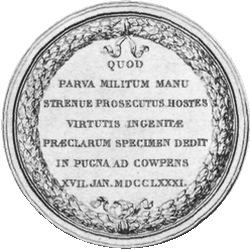
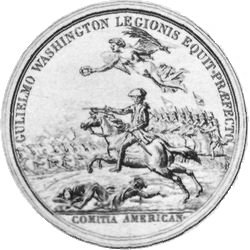
William Augustine Washington, a distant relation of General Washington's, was born in Stafford County, Virginia, February 28, 1752. He was educated for the church, but entered the army as captain of infantry, and fought in the battles of Long Island, Trenton, and Princeton. In 1778 he was lieutenant-colonel of dragoons, and served in the South under Generals Lincoln, Greene, and Morgan. He distinguished himself at the victory of the Cowpens, for which he received from Congress a silver medal; was made a prisoner at Eutaw Springs, and remained in captivity in Charleston, South Carolina, till the close of the war, when he settled in that city. He served for some time in the South Carolina Legislature; was appointed on General Washington's staff with the rank of brigadier-general, in 1797, and died in Charleston, March 6, 1810.
Plate X. No. 10.
January 17, 1781.
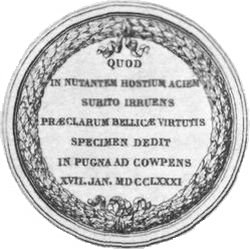
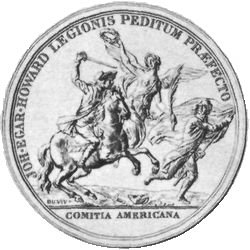
Joh. Egar Howard legionis peditum præfecto Comitia Americana. ℞. Quod in nutantem hostium aciem, etc.
LIEUTENANT-COLONEL JOHN EAGER HOWARD.
[Victory of the Cowpens.]
JOH. (Johanni) EGAR. (sic) HOWARD LEGIONIS PEDITUM PRÆFECTO COMITIA AMERICANA. (The American Congress to John Eager Howard, commander of a regiment of infantry.) Lieutenant-Colonel Howard, on horseback, is in pursuit of a foot-soldier of the enemy who is carrying away a standard. A winged Victory hovers over him, holding in her right hand a crown of laurel, and in her left a palm branch. duviv. (Duvivier).
John Eager Howard was born in Baltimore County, Maryland, June 4, 1752. On the breaking out of the Revolution he was appointed captain, and took part in the battle of White Plains. He was promoted to the rank of major in 1777, and fought at Germantown and Monmouth. He became lieutenant-colonel of the 5th Maryland regiment of infantry in 1779, and served in the South under Generals Gates, Greene, and Morgan, taking a brilliant part in every engagement. At the victory of the Cowpens he held in his hands at one time the swords of seven British officers who had surrendered to him. For his services in this battle Congress awarded him a silver medal. He was colonel of the 2d Maryland regiment at Eutaw Springs. At the close of the war he retired to Baltimore, and was governor of Maryland, 1789-1792, and United States senator, 1796-1803 When a war with France was expected in 1797, he was selected by General Washington for one of his brigadier-generals. He organized the defence of Baltimore in 1814, and died in that city, October 12, 1827.
Plate XI. No. 11.
September 8, 1781.
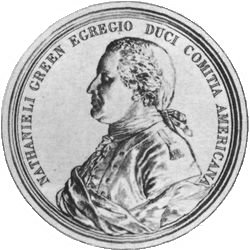
Nathanieli Green egregio duci Comitia Americana. ℞. Salus regionum australium.
MAJOR-GENERAL NATHANIEL GREENE.
[Victory of Eutaw Springs.]
NATHANIELI GREEN (sic) EGREGIO DUCI COMITIA AMERICANA. (The American Congress to Nathaniel Greene, a distinguished general.) Bust of General Greene, in uniform, facing the left.
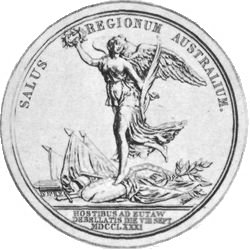
The legend of the reverse of this medal, as originally proposed by the French Academy of Inscriptions and Belles-Lettres was, SALUS PROVINCIARUM AUSTRALIUM.
Nathaniel Greene was born at Potowhommet, Warwick County, Rhode Island, May 27, 1742. He began life as a blacksmith, but entered the "Kentish Guards" as a private in 1774. He was made brigadier-general of the Rhode Island contingent to the army before Boston, in May, 1775, and a brigadier-general in the Continental Army, June 22, 1775, and remained in active service throughout the war. In 1776 he commanded in Long Island as a major-general; and fought at Trenton, Princeton, the Brandywine, Germantown, Monmouth, Newport, and Springfield. He was quartermaster-general from March 2, 1778, to August, 1780; and was commander of the army, in September, when Arnold's treason was discovered. The same year he was appointed commander-in-chief of the southern department, retook the two Carolinas and Georgia, and won the battle of Eutaw Springs, September 8, 1781, for which victory Congress gave him a vote of thanks and a gold medal. After the war he removed to a plantation, which the State of Georgia had given him, on the Savannah river, and died there of a sunstroke, June 19, 1786.
ORIGINAL DOCUMENTS.
Resolutions of Congress Voting a Medal to General Greene, etc.
By the United States in Congress Assembled.
Resolved, That the thanks of the United States in Congress assembled, be presented to Major-General Greene for his wise, decisive, and magnanimous conduct in the action of the 8th of September last, near the Eutaw Springs, in South Carolina, in which, with a force inferior in number to that of the enemy, he obtained a most signal victory.
That the thanks of the United States in Congress assembled, be presented to the officers and men of the Maryland and Virginia brigades, and Delaware battalion of continental troops, for the unparalleled bravery and heroism by them displayed, in advancing to the enemy through an incessant fire, and charging them with an impetuosity and ardour that could not be resisted.
That the thanks of the United States in Congress assembled, be presented to the officers and men of the legionary corps and artillery, for their intrepid and gallant exertions during the action.
That the thanks of the United States in Congress assembled, be presented to the brigade of North Carolina for their resolution and perseverance in attacking the enemy, and sustaining a superior fire.
That the thanks of the United States in Congress assembled, be presented to the officers and men of the state corps of South Carolina, for the zeal, activity, and firmness by them exhibited throughout the engagement.
That the thanks of the United States in Congress assembled, be presented to the officers and men of the militia, who formed the front line in the order of battle, and sustained their post with honour, propriety, and resolution, worthy of men determined to be free.
Resolved, That a British standard be presented to Major-General Greene as an honourable testimony of his merit, and a golden medal emblematical of the battle and victory aforesaid.
That Major-General Greene be desired to present the thanks of Congress to Captains Pierce and Pendleton, Major Hyrne and Captain Shubrick, his aids-de-camp in testimony of their particular activity and good conduct during the whole of the action.
That a sword be presented to Captain Pierce, who bore the general's despatches giving an account of the victory, and that the Board of War take order herein.
Resolved, That the thanks of the United States in Congress assembled, be presented to Brigadier-General Marion, of the South Carolina militia, for his wise, gallant, and decided conduct in defending the liberties of his country; and particularly for his prudent and intrepid attack on a body of the British troops, on the 30th day of August last, and for the distinguished part he took in the battle of the 8th of September.
Monday, October 29, 1781.
General Greene to the President of Congress.
Headquarters, Martin's Tavern, near Ferguson's Swamp, South Carolina, September 11, 1781.
To His Excellency The President of Congress.
Sir: In my last despatch of the 25th of August, I informed Your Excellency that we were on our march for Fryday's Ferry, to form a junction with the State troops and a body of militia, collecting at that place, with an intention to make an attack upon the British army laying at Colonel Thompson's, near McCord's Ferry. On the 27th, on our arrival near Fryday's Ferry, I got intelligence that the enemy were retiring.
We crossed the river at Howell's Ferry, and took post at Motte's plantation. Here I got intelligence that the enemy had halted at the Eutaw Springs, about forty miles below us; and that they had a reinforcement, and were making preparations to establish a permanent post there. To prevent this, I was determined rather to hazard an action, notwithstanding our numbers were greatly inferior to theirs. On the 5th we began our march, our baggage and stores having been ordered to Howell's Ferry under a proper guard. We moved by slow and easy marches, as well to disguise our real intention, as to give General Marion an opportunity to join us, who had been detached for the support of Colonel Harden, a report of which I transmitted in my letter of the 5th, dated Maybrick's Creek. General Marion joined us on the evening of the 7th, at Burdell's plantation, seven miles from the enemy's camp.
We made the following disposition, and marched at four o'clock the next morning to attack the enemy. Our front line was composed of four small battalions of militia, two of North and two of South Carolinians; one of the South Carolinians was under the immediate command of General Marion, and was posted on the right, who also commanded the front line; the two North Carolina battalions, wider the command of Colonel Malmady, were posted in the centre; and the other South Carolina battalion under the command of General Pickens, was posted on the left. Our second line consisted of three small brigades of continental troops—one from North Carolina, one from Virginia, and one from Maryland. The North Carolinians were formed into three battalions, under the command of Lieutenant-Colonel Ash, Majors Armstrong and Blount; the whole commanded by General Sumner, and posted upon the right. The Virginians consisted of two battalions, commanded by Major Snead and Captain Edmonds, and the whole by Lieutenant-Colonel Campbell, and posted in the centre. The Marylanders also consisted of two battalions, commanded by Lieutenant-Colonel Howard and Major Hardman, and the brigade by Colonel Williams, deputy adjutant-general to the army, and were posted upon the left. Lieutenant-Colonel Lee with his legion covered our right flank; and Lieutenant-Colonel Henderson, with the State troops, commanded by Lieutenant-Colonels Hampton, Middleton, and Polk, our left. Lieutenant-Colonel Washington, with his horse and the Delaware troops, under Captain Kirkwood, formed a corps of reserve. Two three-pounders, under Captain-Lieutenant Gaines, advanced with the front line, and two sixes, under Captain Browne, with the second.
The legion and State troops formed our advance, and were to retire upon the flanks upon the enemy's forming. In this order we moved on to the attack. The legion and State troops fell in with a party of the enemy's horse and foot, about four miles from their camp, who, mistaking our people for a party of militia, charged them briskly, but were soon convinced of their mistake by the reception they met with. The infantry of the State troops kept up a heavy fire, and the legion in front, under Captain Rudolph, charged them with fixed bayonets; they fled on all sides, leaving four or five dead on the ground, and several more wounded. As this was supposed to be the advance of the British army, our front line was ordered to form and move on briskly in line, the legion and State troops to take their position upon the flanks. All the country is covered with timber, from the place the action began to Eutaw Springs. The firing began again between two and three miles from the British camp. The militia were ordered to keep advancing as they fired. The enemy's advanced parties were soon driven in, and a most tremendous fire began on both sides from right to left, and the legion and State troops were closely engaged. General Marion, Colonel Malmady, and General Pickens conducted the troops with great gallantry and good conduct; and the militia fought with a degree of spirit and firmness that reflects the highest honour upon that class of soldiers. But the enemy's fire being greatly superior to ours, and continuing to advance, the militia began to give ground. The North Carolina brigade, under General Sumner, was ordered up to their support. These were all new levies, and had been under discipline but little more than a month, notwithstanding which they fought with a degree of obstinacy that would do honour to the best of veterans, and I could hardly tell which to admire most, the gallantry of the officers or the bravery of the troops. They kept up a heavy and well directed fire, and the enemy returned it with equal spirit, for they really fought worthy of a better cause, and great execution was done on both sides. In this stage of the action, the Virginians under Lieutenant-Colonel Campbell, and the Marylanders under Colonel Williams, were led on to a brisk charge, with trailed arms, through a heavy cannonade and a shower of musket balls. Nothing could exceed the gallantry and firmness of both officers and soldiers upon this occasion. They preserved their order, and pressed on with such unshaken resolution that they bore all before them. The enemy was routed in all quarters. Lieutenant-Colonel Lee had, with great address, gallantry, and good conduct, turned the enemy's left flank, and was charging them in rear at the same time the Virginia and Maryland troops were charging them in front. A most valuable officer, Lieutenant-Colonel Hampton, who commanded the State cavalry, and who fortunately succeeded Lieutenant-Colonel Henderson in command, charged a party of the enemy, and took upwards of one hundred prisoners. Lieutenant-Colonel Washington brought up the corps of reserve upon the left, where the enemy seemed disposed to make further resistance, and charged them so briskly with the cavalry and Captain Kirkwood's infantry as gave them no time to rally or form. Lieutenant-Colonels Polk and Middleton, who commanded the State infantry, were no less conspicuous for their good conduct than their intrepidity; and the troops under their command gave a specimen of what may be expected from men, naturally brave, when improved by proper discipline. Captain-Lieutenant Gaines, who commanded the three-pounders with the front line, did great execution until his pieces were dismounted. We kept close at the enemy's heels after they broke, until we got into their camp, and a great number of prisoners were continually falling into our hands, and some hundreds of the fugitives ran off toward Charleston. But a party threw themselves into a large three-story brick house, which stands near the spring; others took post in a picqueted garden, while others were lodged in an impenetrable thicket, consisting of a cragged shrub called a blackjack. Thus secured in front, and upon the right by the house and a deep ravine, upon the left by the picqueted garden and in the impenetrable shrubs, and the rear also being secured by the springs and deep hollow ways, the enemy renewed the action. Every exertion was made to dislodge them. Lieutenant-Colonel Washington made most astonishing efforts to get through the thicket to charge the enemy in the rear, but found it impracticable, had his horse shot under him, and was wounded and taken prisoner. Four six-pounders were ordered up before the house—two of our own and two of the enemy's, which they had abandoned—and they were pushed on so much under the command of the fire from the house and the party in the thicket as rendered it impracticable to bring them off again when the troops were ordered to retire. Never were pieces better served; most of the men and officers were either killed or wounded. Washington failing in his charge upon the left, and the legion baffled in an attempt upon the right, and finding our infantry galled by the fire of the enemy, and our ammunition mostly consumed, though both officers and men continued to exhibit uncommon acts of heroism, I thought proper to retire out of the fire of the house, and draw up the troops at a little distance in the woods, not thinking it advisable to push our advantages further, being persuaded the enemy could not hold the post many hours, and that our chance to attack them on the retreat was better than a second attempt to dislodge them, in which, if we succeeded, it must be attended with considerable loss.
We collected all our wounded, except such as were under the command of the fire of the house, and retired to the ground from which we marched in the morning, there being no water nearer, and the troops ready to faint with the heat and want of refreshment, the action having continued near four hours. I left on the field of action a strong picquet, and early in the morning detached General Marion and Lieutenant-Colonel Lee, with the legion of horse between Eutaw and Charleston, to prevent any reinforcements from coming to the relief of the enemy; and also to retard their march, should they attempt to retire, and give time to the army to fall upon their rear and put a finishing stroke to our success. We left two pieces of our artillery in the hands of the enemy, and brought off one of theirs. On the evening of the 9th the enemy retired, leaving upward of seventy of their wounded behind them, and not less than one thousand stand of arms that were picked up on the field, and found broke and concealed in the Eutaw Springs. They stove between twenty and thirty puncheons of rum, and destroyed a great variety of other stores, which they had not carriages to carry off. We pursued them the moment we got intelligence of their retiring; but they formed a junction with Major McArthur at this place, General Marion and Lieutenant-Colonel Lee not having a force sufficient to prevent it; but on our approach they retired to the neighbourhood of Charleston. We have taken five hundred prisoners, including the wounded the enemy left behind; and I think they cannot have suffered less than six hundred more in killed and wounded. The fugitives that fled from the field of battle spread such an alarm that the enemy burnt their stores at Dorchester, and abandoned their post at Fair Lawn; and a great number of negroes and others were employed in felling trees across the roads for some miles without the gates at Charleston. Nothing but the brick house, and the peculiar strength of the position at Eutaw, saved the remains of the British army from being all made prisoners.
We pursued them as far as this place; but not being able to overtake them, we shall halt a day or two to refresh, and then take our old position on the high hills of Santee. I think myself principally indebted for the victory we obtained to the free use of the bayonet, made by the Virginians and Marylanders, the infantry of the legion, and Captain Kirkwood's light infantry, and though few armies ever exhibited equal bravery with ours in general, yet the conduct and intrepidity of these corps were peculiarly conspicuous. Lieutenant-Colonel Campbell fell as he was leading his troops to the charge, and though he fell with distinguished marks of honour, yet his loss is much to be regretted; he was the great soldier and the firm patriot.
Our loss in officers is considerable, more from their value than their number; for never did men or officers offer their blood more willingly in the service of their country. I cannot help acknowledging my obligations to Colonel Williams for his great activity on this and many other occasions in forming the army, and for his uncommon intrepidity in leading on the Maryland troops to the charge, which exceeded anything I ever saw. I also feel myself greatly indebted to Captains Pierce and Pendleton, Major Hyrne and Captain Shubrick, my aids-de-camp, for their activity and good conduct throughout the whole of the action.
This despatch will be handed to Your Excellency by Captain Pierce, to whom I beg leave to refer you for further particulars.
I have the honour to be, &c., Nath. Greene.
John Jay to Major William Pierce and others.
Office for Foreign Affairs, 12 February, 1788. To the Honourables
Sir: It gives me pleasure to have an opportunity of transmitting to you, by order of Congress, a copy of the medal struck by their direction in honour of the late General Greene. A variety of circumstances conspire to render this work of public attention acceptable to you, though I am persuaded none among them will more immediately affect the feelings, than the relation it bears to that great man, whose loss you in particular, and the people of America in general, have great reason to regret and lament.
I have the honour to be, etc. John Jay.
Plate XII. No. 12.
April 19, 1782.
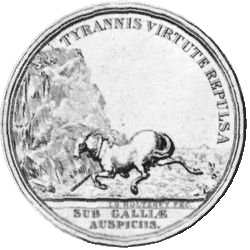
Libera soror. ℞. Tyrannis virtute repulsa.
ACKNOWLEDGMENT OF THE UNITED STATES OF AMERICA BY THE UNITED NETHERLANDS.
LIBERA SOROR. (Free sister.) The sun shedding its rays on two maidens, one of whom, with breast-plate and helmet, and personifying the States-General of the Netherlands, holds with her left hand a staff surmounted by a cap of Liberty over the head of her companion. The latter, an Indian queen (America), holds in her left hand a lance, a shield with thirteen stars (the thirteen original United States), and the end of a chain which binds a leopard (Great Britain), on whose head she rests her left foot. Their right hands, clasped, are extended over a fire burning on an antique altar ornamented with a caduceus and a cornucopia, the attributes of Mercury, god of commerce. Exergue: SOLEMNI DECR. AGN. 19 APR. MDCCLXXXII (Solemni decreto agnita, 19 Aprilis, 1782: Acknowledged by a solemn decree, April 19, 1782).
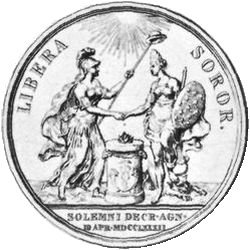
John George Holtzhey was born in Amsterdam, in 1729. He was the eldest son of Martin Holtzhey, a celebrated engraver, who died in Middleburg, November I, 1767. John George Holtzhey was the pupil of his father, and engraved, in collaboration with him, the plates in a work entitled: "Catalogus der (73 stuks) Medailles en gedenkpenningen betrekking hebbende op de voornamste historien der Vereenigde Nederlanden (Amsterdam, 1755)." Among his works are two medals relating to the United States of America, "Libera Soror," and "Faustissimo Fœdere Junctæ." He was one of the most eminent engravers of his day. He died in Amsterdam, February 15, 1808.
ORIGINAL DOCUMENTS.
John Adams to Robert R. Livingston.
Amsterdam, April 19th, 1782. To Robert R. Livingston, Secretary for Foreign Affairs.
Sir: I have the honour to transmit you the following resolutions of the respective provinces, relative to my admission in quality of Minister Plenipotentiary, together with two resolutions of their High Mightinesses, upon the same subject, all in the order in which they were taken.
I have the honour, etc., John Adams.
Friesland.
Extract from the Register Book of the Lords, the States of Friesland.
"The requisition of Mr. Adams, for presenting his letters of credence from the United States of North America to their High Mightinesses, having been brought into the Assembly and put into deliberation, as also the ulterior address to the same purpose, with a demand of a categorical answer, made by him, as is more amply mentioned in the minutes of their High Mightinesses, of the 4th of May, 1781, and the 9th of January, 1782, whereupon, it having been taken into consideration, that the said Mr. Adams would have, probably, some propositions to make to their High Mightinesses, and to present to them the principal articles and foundations upon which the Congress, on their part, would enter into a treaty of commerce and friendship, or other affairs to propose, in regard to which dispatch would be requisite.
"It has been thought fit and resolved to authorize the gentlemen, the Deputies of this Province at the generality, and to instruct them to direct things, at the table of their High Mightinesses, in such a manner that the said Mr. Adams be admitted forthwith as Minister of the Congress of North America, with further order to the said Deputies, that if there should be made, moreover, any similar propositions by the same to inform immediately their Noble Mightinesses of them. And an extract of the present Resolution shall be sent them for their information, that they may conduct themselves conformably.
"Thus resolved at the Province House, the 26th of February, 1782. "Compared with the aforesaid book to my knowledge, A. J. V. Sminia."
Holland and West Friesland.
Extract of the Resolutions of the Lords, the States of Holland and West Friesland, taken in the Assembly of their Noble and Grand Mightinesses.
Thursday, March 28th, 1782.
"Deliberated by resumption upon the address and the ulterior address of Mr. Adams, made the 4th of May, 1781, and the 9th of January, 1782, to the President of the States-General, communicated to the Assembly, the 9th of May, 1781, and the 22d of last month, to present his letters of credence, in the name of the United States of America, to their High Mightinesses, by which ulterior address the said Mr. Adams has demanded a categorical answer, that he may acquaint his constituents thereof; deliberated also upon the petitions of a great number of merchants, manufacturers and others, inhabitants of this Province interested in commerce, to support their request presented to the States-General the 20th current, to the end that efficacious measures might be taken to establish a commerce between this country and North America, copies of which petitions have been given to the members the 21st; and it has been thought fit, and resolved, that the affairs shall be directed, on the part of their Noble and Grand Mightinesses, at the Assembly of the States-General, and there shall be there made the strongest instances that Mr. Adams be admitted and acknowledged, as soon as possible, by their High Mightinesses in quality of Envoy of the United States of America. And the Counsellor-Pensionary has been charged to inform, under his hand, the said Mr. Adams of this Resolution of their Noble and Grand Mightinesses."
Zealand.
Extract of the Resolutions of their High Mightinesses, the States-General of the United Provinces.
Monday, April 8th, 1782.
"The Deputies of the Province of Zealand have brought to the Assembly and caused to be read there the Resolution of the States of the said Province, their principals, to cause to be admitted as soon as possible, Mr. Adams, in quality of Envoy of the Congress of North America in the following terms:
Extract from the Register of the Resolutions of the Lords, the States of Zealand.
April 4th, 1782.
"It has been thought fit and ordered, that the gentlemen, the Ordinary Deputies of this Province at the generality, shall be convoked and authorized, as it is done by the present, to assist in the direction of affairs at the Assembly of their High Mightinesses, in such a manner that Mr. Adams may be acknowledged as soon as possible as Envoy of the Congress of North America; that the letters of credence be accepted, and that he be admitted in that quality according to the ordinary form, enjoining further upon the said Lords, the Ordinary Deputies, to take such propositions as should be made to this Republic, by the said Mr. Adams, for the information and the deliberation of their High Mightinesses, to the end to transmit them here as soon as possible. And an extract of this resolution of their Noble Mightinesses shall be sent to the gentlemen, their Ordinary Deputies, to serve them as an instruction.
J. M. Chalmers."
"Upon which, having deliberated, it has been thought fit and resolved to pray, by the present, the gentlemen, the Deputies of the Provinces of Guelderland, Utrecht, and Groningen, and Ommelanden, who have not as yet explained themselves upon this subject, to be pleased to do it, as soon as possible."
Overyssel.
Extract from the Register of the Resolutions of the Equestrian Order, and of the cities composing the States Overyssel.
Zwoll, 5th of April, 1782.
"The grand Bailiff de Sallande, and the other commissions of their Noble Mightinesses for the affairs of finance, having examined, conformably to their commissarial resolution of the 3d of this month, the addresses of Mr. Adams, communicated to the Assembly the 4th of May, 1781, and the 22d of February, 1782, to present his letters of credence to their High Mightinesses, in the name of the United States of North America; as well as the resolution of the Lords, the States of Holland and West Friesland, dated the 28th of March, 1782, carried the 29th of the same month to the Assembly of their High Mightinesses, for the admission and acknowledgment of Mr. Adams, have reported to the Assembly, that they should be of opinion that the gentlemen, the Deputies of this Province in the States-General, ought to be authorized and charged to declare in the Assembly of their High Mightinesses, that the Equestrian Order and the cities' Judge, that it is proper to acknowledge, as soon as possible, Mr. Adams, in quality of Minister of the United States of North America, to their High Mightinesses. Upon which, having deliberated, the Equestrian Order and the cities have conformed themselves to the said report.
"Compared with the aforesaid Register. Derk Dumbar."
Groningen.
Extract from the Register of the Resolutions of their Noble Mightinesses, the States of Groningen and Ommelanden.
Tuesday, 9th of April, 1782.
"The Lords, the States of Groningen and Ommelanden, having heard the report of the gentlemen, the Commissioners for the Petitions of the Council of State and the Finances of the Province, and having carefully examined the demand of Mr. Adams, to present his letters of credence from the United States of North America, to their High Mightinesses, have, after deliberation upon the subject, declared themselves of opinion that in the critical circumstances in which the Republic finds itself at present, it is proper to take, without loss of time, such efficacious measures as may not only repair the losses and damages that the kingdom of Great Britain has caused, in a manner so unjust, and against every shadow of right, to the commerce of the Republic, as well before as after the war, but particularly such as may establish the free navigation and the commerce of the Republic, for the future, upon the most solid foundations, as may confirm and re-assure it by the strongest bonds of reciprocal interest, and that, in consequence, the gentlemen, the Deputies at the Assembly of their High Mightinesses, ought to be authorized on the part of the Province, as they are by the present, to admit Mr. Adams to present his letters of credence from the United States of North America, and to receive the propositions which he shall make, to make report of them to the Lords, the States of this Province.
E. Lewe, Secretary."
"The States-General, having deliberated the same day upon this resolution, have Resolved, 'That the Deputies of the Province of Guelderland, which has not yet declared itself upon the same subject, should be requested to be pleased to do it as soon as possible.'"
Utrecht.
Extract of the Resolutions of their Noble Mightinesses, the States of the Province of Utrecht.
10th of April, 1782.
"Heard the report of Mr. de Westerveld, and other Deputies of their Noble Mightinesses for the Department of War, who, in virtue of the commissarial resolutions of the 9th of May, 1781, the 16th of January, and the 20th of March, of the present year, 1782, have examined the resolution of their High Mightinesses of the 4th of May, 1781, containing an overture, that the President of the Assembly of their High Mightinesses had made, 'that a person, styling himself J. Adams, had been with him, and had given him to understand that he had received letters of credence for their High Mightinesses from the United States of North America, with a request that he would be pleased to communicate them to their High Mightinesses,' as well as the resolution of their High Mightinesses, of the 9th of January, containing an ulterior overture of the President, 'that the said Mr. Adams had been with him, and had insisted upon a categorical answer, whether his said letters of credence would be accepted or not;' finally, the resolution of their High Mightinesses, of the 5th of March last, with the insertion of the resolution of Friesland, containing a proposition 'to admit Mr. Adams in quality of Minister of the Congress of North America.'"
"Upon which, having deliberated and remarked that the Lords, the States of Holland and West Friesland, by their resolution, carried the 29th of March to the States-General, have also consented to the admission of the said Mr. Adams in quality of Minister of the Congress of North America, it has been thought fit, and resolved, that the gentlemen, the Deputies of this Province in the States-General, should be authorized, as their Noble Highnesses authorize them by the present, to conform themselves, in the name of this Province, to the resolution of the Lords, the States of Holland and West Friesland, and of Friesland, and to consent, by consequence, that Mr. Adams be acknowledged and admitted as Minister of the United States of North America, their Noble Mightinesses being at the same time of opinion that it would be necessary to acquaint Her Majesty, the Empress of Russia, and the other neutral powers, with the resolution to be taken by their High Mightinesses upon this subject, in communicating to them (as much as shall be necessary) the reasons which have induced their High Mightinesses to it, and in giving them the strongest assurances, that the intention of their High Mightinesses is by no means to prolong thereby the war, which they would have willingly prevented and terminated long since; but that, on the contrary, their High Mightinesses wish nothing with more ardor than a prompt re-establishment of peace, and that they shall be always ready on their part to co-operate in it, in all possible ways, and with a suitable readiness, so far as that shall be any way compatible with their honour and their dignity. And to this end an extract of this shall be carried by missive to the gentlemen, the Deputies at the Generality."
Guelderland.
Extract from the Precis of the ordinary Diet, held in the City of Nimeguen, in the month of April, 1782.
Wednesday, 17th of April, 1782.
"The requisition of Mr. Adams to present his letter of credence to their High Mightinesses, in the name of the United States of North America, having been brought to the Assembly and read, as well as an ulterior address made upon this subject, with the demand of a categorical answer by the said Mr. Adams, more amply mentioned in the registers of their High Mightinesses, of the date of the 4th of May, 1781, and the 9th of January, 1782, moreover, the resolutions of the Lords, the States of the six other Provinces, carried successively to the Assembly of their High Mightinesses, and all tending to admit Mr. Adams, in quality of Envoy of the United States of North America, to this Republic; upon which their Noble Mightinesses, after deliberation, have resolved to authorize the Deputies of this Province, as they authorize them by the present, to conform themselves in the name of this Province, to the resolution of the Lords, the States of Holland and West Friesland, and to consent, by consequence, that Mr. Adams may be acknowledged and admitted, in quality of Envoy of the United States of North America, to this Republic. In consequence, an extract of the present shall be sent to the said Deputies, to make, as soon as possible, the requisite overture of it to the Assembly of their High Mightinesses.
J. In De Betouw."
This resolution of Guelderland was no sooner remitted, on the 19th, to their High Mightinesses, than they took immediately a resolution conformable to the unanimous wish of the Seven Provinces, conceived in the following terms:
Extract from the Register of the Resolutions of their High Mightinesses, the States-General of the United Provinces.
Friday, April 19th, 1782.
"Deliberated by resumption upon the address and the ulterior address, made by Mr. Adams, the 4th of May, 1781, and the 9th of January of the current year, to the President of the Assembly of their High Mightinesses, to present to their High Mightinesses his letters of credence, in the name of the United States of North America, and by which ulterior address the said Mr. Adams has demanded a categorical answer, to the end to be able to acquaint his constituents thereof; it has been thought fit and resolved, that Mr. Adams shall be admitted and acknowledged in quality of Envoy of the United States of North America to their High Mightinesses, as he is admitted and acknowledged by the present."
W. Boreel." "Compared with the aforesaid register. H. Fagel."
The Formal Resolution Of Their High Mightinesses.
Extract from the Register of the Resolutions of their High Mightinesses, the States-General of the United Provinces.
Monday, April 22d, 1782.
"Mr. Boreel, who presided in the Assembly the last week, has reported to their High Mightinesses and notified them, that Mr. John Adams, Envoy of the United States of America, had been with him last Saturday, and had presented to him a letter from the Assembly of Congress, written at Philadelphia, the 1st of January, 1781, containing a credence for the said Mr. Adams, to the end to reside in quality of its Minister Plenipotentiary near their High Mightinesses. Upon which, having deliberated, it has been thought fit and resolved to declare by the present, that the said Mr. Adams is agreeable to their High Mightinesses; that he shall be acknowledged in quality of Minister Plenipotentiary, and that there shall be granted to him an audience, or assigned commissioners, when he shall demand it. Information of the above shall be given to the said Mr. Adams by the agent, Van der Burch de Spieringshoek.
W. van Citters." "Compared with the aforesaid register. H. Fagel."
Extract uit het Register der resolutien van de Heeren Staten der provincie Friesland van den jare 1782.
Adams te admitteeren als minister weegens het congres van Noord-America.
Ter vergaderinge voorgedragen en in deliberatie gelegd zijnde het versoek van de heer Adams om zijne brieven van credentie van de Verenigde Staten van Noord-America aan Hun Hoog Mog' te overhandigen, mitsgaders het nader adres ten dien einde, met versoek van een cathegorisch antwoord door deselve gedaan en breeder in de notulen van Hun Hoog Mog' van den 4 May 1781 en 9 January 1782, vermeld.
Waarop in consideratie genomen zijnde dat de voorschr. heer Adams niet onwaarschijnlijk eenige propositien aan Hun Hoog Mog' zoude hebben te doen en voorname articulen en gronden aan Hun Hoog Mog' kunnen ter hand stellen, waarop 't congres aan haare zijde in een tractaat van commercie en vriendschap zoude willen treeden of andere zaaken hebben voortedragen, waaromtrent spoed vereischt wierde, is goedgevonden en verstaan de heeren deeser prov. gecommitteerden ter generaliteit te authoriseeren en te gelasten, het ter tafel van Hun Hoog Mog' daar heen te dirigeeren, dat gedagte heer Adams met den eersten als minister van het Congres van Noord-America, werde toegelaten, met verdere last aan opgemelde gecommitteerden, om indien door deselve eenige soortgelijke propositien werden gedaan, daar van ten spoedigsten Hun Ed. Mog' te informeeren.
En sal extract deeses aan hun worden toegesonden tot narigt en om sig daar na te gedragen.
Aldus geresolveert op 't Landschapshuis den 26e February 1782.
Extract uit het Register der resolutien van de Heeren Staten van Holland en Westfriesland van den jare, 1782.
Donderdag den 28 Maart 1782.
Bij resumtie gedelibereert zijnde op het adres en nader adres van den heer Adams den 4 Mey 1781 en 9 January 1782 aan den heer ter generaliteit presideerende en den 9 Mey 1781 en 22 der voorlede maand ter vergadering gecommuniceert, om uit naam der Vereenigde Staten van Noord-America zijne brieven van credentie aan Hun Hoog Mogende te overhandigen en bij welk nader adres gemelde heer Adams een cathagorisch antwoord heeft versogt, om daar van aan sijne principaalen kennis te kunnen geeven, als meede op de requesten van een groot aantal commercieerende, fabriceerende en sig door den handel geneerende ingezeetenen in deese provincie, tot appui van hunne versoeken ter generaliteit den 20 deeser gedaan ten einde tot verkrijging der handel uit deesen landen op Noord-America, efficacieuse middelen werden beraamt, op den 21 deeser bij copie aan de leden gegeeven.
Is goedgevonden en verstaan dat de saak van wegens Hun Edele Groot Mog' ter generaliteit daar heen sal worden gedirigeert en daar op ten sterkste geinsteert, dat de heer Adams als afgezant van de Vereenigde Staten van Noord-America, ten spoedigsten bij Hun Hoog Mog' moge werden ge admitteert en erkent; en word de raadpensionaris gelast den voornoemden heer Adams van deese Hun Edele Groot Mog' resolutie onder de hand te informeeren.
Extract uit het Register der resolutien van de Heeren Staten der provincie Zeeland van den jare 1782.
Den 29 Maart 1782.
De raadpensionaris heeft ter voldoening aan Hun Ed. Mog' onderscheiden resolutien commissoriaal van den 5, 11 en 25 deezer maand, uit naam van heeren commissarissen gerapporteerd, dat geexamineerd hadden het nader adres van den heer Adams, den 9 January deezes jaars aan den heer præsideerende ter vergadering van Hun Hoog Mog' gedaan op het subject van het overhandigen zijner brieven van credentie aan hoogstdezelve uit naam der Vereenigde Staten van Noord-America, ten einde en met verzoek van een cathagorisch antwoord daar op, om deswegens aan dezelve kennis te kunnen geeven, voorts de resolutie der heeren Staten van Vriesland den 5 deezer ter generaliteit ingebragt, houdende een auctorisatie op derzelver gecommitteerden om het aldaar daar heen te dirigeeren dat gemelden heer Adams met den eersten als minister van Noord-America worde erkend, nog Hun Hoog Mog' resolutie nopens de aan hoogstdezelve den 20 deezer gepræsenteerde drie requesten door commercieerende, fabriceerende en met verscheiden handel zig geneerende ingezeetenen deezer landen, waar bij op het sterkste aandringen op een vryen handel tusschen de ingezeetenen deezer republicq en die van Noord-America, en eindelijk de den 25 deezer aan Hun Ed. Mog' gepræsenteerde requesten door het collegie van de kooplieden te Middelburg en die te Vlissingen, verzoekende dat hoogstdezelve de heeren gedeputeerden van deeze provincie ter generaliteit gelieven te auctoriseeren, om het ter vergadering van Hun Hoog Mog' insgelyks daar heen te helpen dirigeeren dat meergenoemden heer Adams in voorschr. qualiteit erkend, met denzelven in onderhandeling getreeden en een tractaat van commercie en navigatie gesloten werde, bij voorige notulen breeder vermeld, bij welke gelegenheid de raadpensionaris wyders heeft gerelateerd, dat even voor het aangaan van het besogne nog ontfangen hebbende een request van een groot aantal kooplieden, rheeders, assuradeurs, trafiquanten en fabricquers binnen de stad Middelburg, tendeerende ten zelven einde als de twee evengemelde requesten, heeren commissarissen, onder Hun Ed. Mog' welnemen (als relatif tot het onderwerp waar over 't besogne was gedecerneerd) geen zwarigheid hadden gemaakt om hetzelve al mede te examineeren en daarop rapport te doen, ter wyl heeren commissarissen ook waren geinformeerd geworden dat eenige kooplieden te Veere mede van voornemen zijn geweest om tot hetzelve oogmerk zig aan Hun Ed. Mog te adresseeren, indien tijdig genoeg van de voorschr. requesten hadden kennis gehad; dat heeren commissarissen, in ernstige overweginge genomen hebbende het verval van den koophandel, die voorname zenuw van den Staat, de vermindering, ja bijna geheelen stilstand van de fabricquen en traficquen, mitsgaders het middel 't geen mogelyk zon kunnen strekken om al het zelve wederom eenigsins te herstellen of wel tot voorig aanzien te brengen, en dus de schaden, welken de commercieerende ingezeetenen door den oorlog met het rijk van Groot Brittannien bereids geleeden hadden, wederom vergoed te krijgen, door naamelyk het sluyten van een tractaat van commercie en negotie tusschen deeze republyk en de Vereenigde Staten van Noord-Amerika als waar op zoo zeer door 's lands ingezeetenen alomme wordt aangedrongen en waar toe ook van de zyde van het congres sedert eenige maanden aanzoek was gedaan; na alles rijpelyk onderzogt, als mede in 't breede beredeneerd te hebben, eindelijk gemeend hadden Hun Ed. Mog' te moeten adviseeren dat de heeren ordinaris gedeputeerden deezer provincie ter generaliteit door Hun Ed. Mog' zoo spoedig immers doenlijk zij, zouden behooren te worden aangeschreeven en geauctoriseerd, om het ter vergadering van Hun Hoog Mog' daar heen te helpen dirigeeren, dat de heer Adams, als minister plenipotentiaris van het congres van Noord-America, ten spoedigsten werde erkend, deszelfs brieven van credentie geaccepteerd, en in die hoedanigheid ter gemelde vergadering van Hun Hoog Mog' toegelaaten, met verderen last aan dezelve heeren ordinaris gedeputeerden om zoodaanige propositien, als door den voorschr. heer aan deeze republijk zouden mogen worden gedaan, ter kennis en deliberatie van Hun Ed. Mog' copielijk overtenemen en dezelve ten spoedigsten overtezenden. Waarop gedelibereerd zijnde, hebben de raadpensionaris voor den heer eersten edelen, benevens de heeren gedeputeerden van Middelburg, Ziericzee, Goes, Tholen en Veere copie verzogt van het voorschr. rapport en die van Tholen ook van de drie over het zelve onderwerp aan Hun Ed. Mog' gepresenteerde requesten, om te brengen ter kennis en deliberatie van de heeren hunne respective committenten. De heeren gedeputeerden van Vlissingen hebben geinhaereerd het advys door dezelve omtrent de admissie van den heer Adams op de laastvoorige sessie uitgebragt en wyders geinsteerd dat de andere leden zig, zoo ras mogelijk op dit important poinct gelieven te verklaaren, waar op die van Veere aannaamen om in deeze zaak alle spoed te recommandeeren aan de heeren hunne principaalen, ten einde zoo veel van dezelve dependeerde, een spoedige conclusie zal kunnen worden genomen.
Extract uit het Register der resolutien van de Heeren Staten der provincie Zeeland van den jare 1782.
Den 4 April 1782.
De heer van Lijnden voor den heer eersten edelen en de heeren gedeputeerden van Middelburg, Ziericzee, Goes, Tholen en Veere verzogt zijnde zig te verklaaren op het rapport van het besogne den 29 Maart, jongstleden ter vergadering uitgebragt, raakende het erkennen van den heer Adams, als minister plenipotentiaris der Vereenigde Staten van Noord-Amerika, by voorige notulen breeder gemeld, heeft eerstgemelden heer aangenomen zig daar op nader te zullen verklaaren; die van Middelburg, Goes, Tholen en Veere hebben, op speciaalen last van de heeren hunne committenten, zig met het voorschr. rapport geconformeerd en die van Ziericzee uit specialen last gedeclareerd, dat indien de kooplieden binnen de stad Ziericzee in tijds kennisse bekomen hadden dat die van de Walchersche steden zig wegens deeze zaak aan Hun Ed. Mog' zouden addresseeren, zij uyt overtuiging van het nut, het geen uit eene alliantie met de Noord-Americaansche Staten voor den koophandel en scheepvaart deezer landen zouden voortspruiten, zig zeer gaarne daar bij zouden hebben gevoegd. Dat Hun Ed. Actb. ook volkomen geconvinceerd van het important belang hetgeen in zoodanige alliantie voor de geheele republiq geleegen zij, van wegens hunne stad de dertien Vereenigde Staten van Noord-America als vry en onafhankelyk erkennen en mitsdien met alle empressement moeten insteeren, dat de heeren ordinaris geedeputeerden ter generaliteit ten spoedigsten werden gelast, den heer Adams als minister plenipotentiaris van het congres, ter audientie te admitteren en als dan de propositien, welke door denzelven tot het aangaan van een tractaat van koophandel of eenige andere dergelijke, mogten worden gedaan, ter deliberatie van Hun Ed. Mog' overteneemen. Het welk gehoord, heeft de raadpensionaris verzogt dat den heer van Lijnden zig nu ook geliefde te expliceeren, die daar op gezegd heeft dat, ziende de inclinatie van alle deszelfs medeleden in de admissie van den heer Adams zeer wel konde toekomen, doch dat eenige bedenkingen hebbende op een te neemen resolutie, conform het dispositif van het voorschr. rapport, zoude praefereeren dat in deeze zaak werde te werk gegaan even als bij de heeren Staten van Holland, en mitsdien hoogstderzelver resolutie gevolgd, en vervolgens door den raadpensionaris daar op omvrage gedaan zijnde, hebben die van Middelburg geoordeeld dat alle zwaarigheid zoude kunnen worden weggenomen, indien maar eenvoudig wierde gesteld de volgende periode: "en in die hoedanigheid, op de gewoone wijze toegelaaten," zonder melding te maken van het "admitteeren" bepaaldelijk "ter vergadering van Hun Hoog Mogende," de heeren gedeputeerden van de vijf andere steden hebben zig met onderlinge concurrentie met het gemeld conciliatoir advijs der heeren van Middelburg geconformeerd, waar na de heer van Lijnden heeft gedeclareerd dat, ofschoon meer inclineerde, zoo als gezegd heeft, om de resolutie van Holland te volgen, echter bespeurende de overeenkomende sentimenten der andere leden om, onder de voorgeslage verandering, het rapport ter conclusie te brengen en overtuigd zijnde van de noodzaakelykheid dat hier omtrent een resolutie met eenpaarigheid werde genomen, zig als nu ook daar by zoude voegen, om de afdoening deezer zaak te bevorderen. Vervolgens bij resumtie gedelibereerd zijnde op het voorschr. rapport, als mede op de onderscheidene requesten en andere stukken daar bij gemeld, is, met eenparige bewilliging van alle de leden, goedgevonden en verstaan dat de heeren ordinaris gedeputeerden deezer provincie ter generaliteit zullen worden aangeschreven, en geauctoriseerd, gelijk geschiedt by deeze om het ter vergadering van Hun Hoog Mogende daar heen te helpen dirigeeren, dat de heer Adams, als afgezant van het congres van Noord-America, ten spoedigsten werde erkend deszelfs brieven van credentie geaccepteerd en in die hoedanigheid op de gewoone wyze toegelaaten; met verdere last aan dezelve heeren ordinaris gedeputeerden om zoodaanige propositien, als door den voorschr. heer Adams aan deeze republicq zouden mogen worden gedaan, ter kennis en deliberatie van Hun Ed. Mog' copielijk overteneemen en dezelve ten spoedigsten herwaards te zenden.
En zal extract van deeze Hun Ed. Mog' resolutie aan gemelde heeren ordinaris gedeputeerden, tot derzelver narigt worden gezonden, zonder resumtie.
Extract uit het Register der resolutien van de Heeren Staten der provincie Overijssel, van 11 Maart tot 1 November 1782.
Vrijdag den 5 April 1782.
De heeren de droste van Zalland en andere Hunner Ed. Mog' gecommitteerden tot de zaaken van financie, ingevolge en ter voldoening van derzelver resolutie commissoriaal van den 30 deezer hebbende geexamineerd de adressen van den heere Adams, den 4e Mey 1781 en 9e January 1782, aan den heere ter generaliteit presideerende en den 9e Mey 1781 en 22 February 1782 ter vergadering gecommuniceert, om uit naam van de Vereenigde Staten van Noord-America, zijne brieven van credentie aan Hun Hoog Mogende te overhandigen; als mede de resolutie van de heeren staten van Holland en Westvriesland van den 28e Maart 1782 den 29e, dierzelfde maand ter vergadering van Hun Hoog Mog' ingebragt op de admissie en erkentenis van den heere Adams, als afgezant der Vereenigde Staten van Noord-America. Hebben ter vergadering gerapporteert, dat van advise zouden wesen, dat de heeren gecommitteerden van wegens deeze provincie ter generaliteit zouden behooren te worden geautoriseerd en gelast, om ter vergadering van Hun Hoog Mog' te declareeren, dat Ridders en Steden van oordeel zijn, dat de heer Adams als afgezant van de Vereenigde Staten van Noord-America bij Hun Hoog Mog' ten spoedigsten behoorde te worden erkent.
Waarop zijnde gedelibereerd, hebben Ridders en Steden zig met het voorschr. rapport geconformeert.
En hebben wijders de heeren gedeputeerden der stad Deventer geinsteert, dat de twee overige pointen vervat in derzelver resolutie van den 30 Maart 1782, geinsereerd in deeze onze notulen van den 3 dezer mede ter deliberatie mogen worden genomen.
Waarmede de heere droste van Ysselmuijden zig heeft gevoegd.
Extract uit het Register der resolutien van de Heeren Staten der provincie Stad en Lande (Groningen) van 1781-1782.
Dingsdag den 9 April 1782.
Gedelibereert sijnde op het rapport der heeren Gecommitteerden tot de petitien van de Raad van State en deezer provincie finances, in dato den 26 deser, tenderende om den heere Adams tot het overgeven van zijne brieven van credentie van de Vereenigde Staten van Noord-America aan Hun Hoog Mogende toetelaaten, luidende als volgt:
Rapport der heeren Gecommitteerden tot de petitien van de Raad van State en deser provincie finances.
Edele Mogende Heeren.
Door de heeren Uwer Edele Mogende gecommitteerden ingevolge en ter voldoeninge aan de resolutie commissoriaal, in dato den 4 May des voorigen jaars, zijnde geexamineert, het verzoek van den heer Adams, om zijne brieven van credentie van de Vereenigde Staten van Noord-America aan Hun Hoog Mogende te overhandigen, als mede ter voldoeninge aan de resolutie commissoriaal in dato den 14 Maart jongstl. daar tevens zijnde gelesen en naagegaan, de resolutie der Heeren Staten van Friesland op den 5 Meert, daar bevorens ter vergadering van Hun Hoog Mogende ingebragt waar bij de heeren derzelver gecommitteerden ter generaliteit hebben gelast ter tafel van Hun Hoog Mogende het daar heen te dirigeren dat de heer Adams, als minister van 't congres van Noord-America, by Hun Hoog Mogende werde toegelaten met verdere last aan opgemelde gecommitteerden indien door dezelve eenige propositien werden gedaan, betrekkelijk het aangaan van een tractaat van commercie en vriendschap, daar van ten spoedigsten de heeren Staten van Friesland te informeren, hebben de heeren gecommitteerden de eer UEdele Mogende te rapporteeren, dat van gedagten zouden zijn, dat in de hachelijke omstandigheden, waar in de republyk zich thans ziet gebragt, zodane efficacieuse maatregelen, zonder tijdverzuim, behoorden te worden genomen, waar door niet alleen de geledene schadens en naedeelen tegens allen schijn van recht, zoo voor als nae het declareren van den oorlog door het rijk van Groot Brittannien, op zulk een onregtvaardige wyze aan de commercie dezer landen toegebragt, zoude kunnen worden vergoed, maar vooral ook de vrye scheepvaart en koophandel van de Republyk voor het toekomende op vaste gronden gestelt en door de sterkste banden van weederkerige belangens bevestigt en beveiligt en dat overzulks de heeren UEdele Mogende gedeputeerden ter vergaderinge van Hun Hoog Mogende behoorden te worden geauthoriseert, om zoo haast door de provincie van Holland en Westfriesland, of eene der meest geinteresseerde provincien, daar in mede zal sijn geconsenteert, den heer Adams, tot het overgeven sijner brieven van credentie van de Vereenigde Staten van Noord-America toetelaten, diens te doene propositie overtenemen en daar van aan UEdele Mogende ten eersten verslag te doen.
Aldus gedaan binnen Groningen in het provincie huis, op dingsdag den 26 Maart 1782—
was getekent:
T. van Hoorn, L. A. Trip, I. H. Keiser, P. Laman, G. Lewe, T. Jarges, S. I. Niehoff, F. Fiddens, en I. A. Engelhard.
Hebben de heeren Staten van Stad en Lande, zich met het uitgebragte rapport geconformeert en de heeren ministers geauthoriseert, hier van extract naa der zaaken omstandigheid geconcipieert, te verzenden; zonder resumtie aftewachten.
Extract uit het Register der resolutien van de Heeren Staten der provincie Gelderland van 1782-1783.
Mercurii den 17 April 1782.
Was ter vergaderinge ingekomen en aan gedeputeerden en hoofdsteden copielijk medegedeeld.
1.
Een missive van de gecommitteerdens ter generaliteit van den 8 Maart, hebbende tot bylage copie van eene bij haar nevens de heeren gedeputeerden van de provincien van Zeeland, van Utrecht en van Stad en Lande overgenomene resolutie van de heeren Staten van de provincie van Friesland op den 5 daar bevorens ter tafele van Haar Hoog Mogende geexhibeerd, waar bij de gecommitteerdens van welgemelte provincie ter generaliteit worden gelast, het ter vergadering van Haar Hoog Mogende daar heenen te dirigereen, dat, in consideratie der redenen in voorschreeve resolutie vervat, de heer Adams, met ten eersten als minister van het congres van Noord-America, bij de republicq werde geadmitteerd, van welke missive en bijlage op den 9 Maart de afschriften aan gedeputeerden en hoofdsteden waaren ingezonden.
2. Dat 't hof enz.
Op welke voorschreve poincten voor zoo verre daar op niet mogte geresolveerd zijn, welgemelde raaden verzogten, dat Haar Edele Mogende zoodane resolutien zouden gelieven te neemen als na derselver hooge wijsheid zouden oordeelen en vermeenen te behooren.
Ter vergaderinge voorgebragt en gelesen zijnde het versoek van den heer Adams, om uit naam van de Vereenigde Staten van Noord-America, zijne brieven van credentie aan Hun Hoog Mogende te overhandigen, mitsgaders het nader adres ten dien einde, met versoek van een cathegorisch antwoord door denzelven gedaan en breder in de notulen van Hun Hoog Mogende van den 4 May 1781 en 9 January 1782, vermeld, als mede de resolutie van de heeren Staten van de ses andere provincien, ter vergadering van Hun Hoog Mogende successivelyk ingebragt, alle tendeerende tot het admitteeren van den heer Adams, als afgesant van de Vereenigde Staten van Noord-America, bij dese republicq.
Hebben Haar Edele Mogende na gehoudene deliberatie, goedgevonden de gecommitteerdens van wegens dese provincie ter generaliteit te authoriseeren, gelijk geauctoriseert worden bij dezen, on zig namens deze provincie met de resolutie der heeren Staten van Holland en Westfriesland te conformeeren en dienvolgens te consenteeren dat de heer Adams, als gezant van de Vereenigde Staten van Noord-America bij deze republicq werde erkend en geadmitteerd.
Zullende oversulx extract dezes aan welgemelte gecommitteerdens worden toegesonden, om daar van ten spoedigsten ter vergadering van Hun Hoog Mogende de vereischte opening te doen.
Extract uit het Register der resolutien van de Hoog Mogende Heeren Staten Generaal der Vereenigde Provincien van den jare 1782. 1 deel.
Veneris den 19 April 1782.
Bij resumtie gedelibereerd sijnde op het adres en nader adres van den heer Adams, den 4 Mey, 1781 en 9 January deezes jaars aan den heer ter vergadering van Haar Hoog Mogende præsideerende, gedaan, om uit naem der Vereenigde Staten van Noord-America, zijne brieven van credentie aan Haar Hoog Mogende te overhandigen, en bij welk nader adres, gem. heer Adams, een cathegorisch antwoord heeft versogt, om daer van aan zijne principalen kennis te kunnen geeven.
Is goedgevonden en verstaan, dat de heer Adams als afgezant van de Vereenigde Staten van Noord-America, bij Haar Hoog Mogende zal worden geadmitteert en erkent, gelijk deselve geadmitteert en erkend word bij deezen.
De heeren gedeputeerden van de provincien van Zeeland en Utrecht hebben geinhaereert de resolutien van de heeren Staten hunne principalen op het voorn subject ter vergadering van Haar Hoog Mogende ingebragt.
Extract uit het Register der resolutien van de Hoog Mogende Heeren Staten Generaal der Vereenigde Nederlanden van den jare 1782. 1 deel.
Lunae den 22 April 1782.
De heer Boreel, in de voorleeden week ter vergaderinge gepraesideert hebbende heeft aan Haar Hoog Mogende voorgedragen en bekend gemaakt dat den heer John Adams, afgezant van de Vereenigde Staten van America, voorleeden saturdag bij hem was geweest en aan hem overgeleevert hadde een missive van de vergadering van 't Congres, geschreeven te Philadelphia den 1 January 1781, houdende creditif op gemelde heer Adams, om in qualitiet als hunnen minister plenipotentiars bij Haar Hoog Mogende te resideeren.
Waarop gedelibereerd sijnde, is goedgevonden en verstaan mits deezen te verklaaren dat gemelde heer Adams aan Haar Hoog Mogende aangenaam is en dat deselve in de qualitiet van minister plenipotentiaris sal worden erkent en dat aan dezelve audientie sal worden verleent of commissarissen toegevoegt zullen worden, als hij die zal komen te versoeken.
En zal hier van aan geme. heer Adams door den agent van der Burch van Spieringshoek, kennise worden gegeeven.
John Adams to Robert R. Livingston.
The Hague, April 22d, 1782. To Robert R. Livingston.
Sir: On the 22d of April I was introduced, by the Chamberlain, to His Most Serene Highness, the Prince of Orange.
Knowing that His Highness spoke English, I asked his permission to speak to him in that language, to which he answered, smiling, "if you please, Sir." Although French is the language of the Court, he seemed to be pleased, and to receive as a compliment my request to speak to him in English.
I told him I was happy to have the honour of presenting the respects of the United States of America, and a letter of credence from them to His Most Serene Highness, and to assure him of the profound veneration in which the House of Orange had been held in America even from its first settlement, and that I should be happier still to be the instrument of further cementing the new connexions between two nations professing the same religion, animated by the same spirit of liberty, and having reciprocal interests, both political and commercial, so extensive and so important; and that, in the faithful and diligent discharge of the duties of my mission, I flattered myself with hopes of the approbation of His Most Serene Highness.
His Highness received the letter of credence, which he opened and read. The answer that he made to me was in a voice so low and so indistinctly pronounced that I comprehended only the conclusion of it, which was that "he had made no difficulty against my reception." He then fell into familiar conversation with me, and asked me many questions about indifferent things, as is the custom of Princes and Princesses upon such occasions. How long I had been in Europe? How long I had been in this country? Whether I had purchased a house at the Hague? Whether I had not lived some time at Leyden? How long I had lived at Amsterdam? How I liked the country? &c.
This conference passed in the Prince's chamber of audience, with his Highness alone. I had waited some time in the antechamber, as the Duc de la Vauguyon was in conference with the Prince. The Duke, on his return through the antechamber, meeting me unexpectedly, presented me his hand with an air of cordiality which was remarked by every courtier, and had a very good effect.
The Prince has since said to the Duc de la Vauguyon that he was obliged to me for not having pressed him upon the affair of my reception at the beginning. He had reason; for if I had, and he had said or done anything offensive to the United States or disagreeable to me, it would now be remembered, much to the disadvantage of the Court.
I have the honour to be, Sir, Your most obedient and most humble servant, John Adams.
Plate XIII. No. 13.
October 8, 1782.
Favstissimo foedere jvnctæ. die VII Octob. MDCCLXXXII. ℞. Justitiam et non temnere divos.
TREATY OF AMITY AND COMMERCE BETWEEN THE UNITED STATES OF AMERICA AND THE UNITED NETHERLANDS.
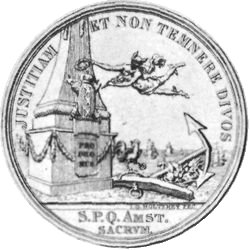
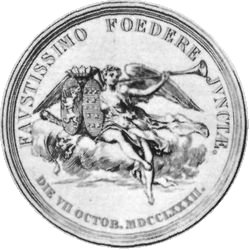
ORIGINAL DOCUMENTS.
Treaty of Amity and Commerce between their High Mightinesses the States-General of the United Netherlands and the United States of America, to wit: New Hampshire, Massachusetts, Rhode Island and Providence Plantations, Connecticut, New York, New Jersey, Pennsylvania, Delaware, Maryland, Virginia, North Carolina, South Carolina, and Georgia. Concluded October 8, 1782; ratified January 22, 1783.
Their High Mightinesses the States-General of the United Netherlands and the United States of America, to wit: New Hampshire, Massachusetts, Rhode Island and Providence Plantations, Connecticut, New York, New Jersey, Pennsylvania, Delaware, Maryland, Virginia, North Carolina, South Carolina, and Georgia, desiring to ascertain, in a permanent and equitable manner, the rules to be observed relative to the commerce and correspondence which they intend to establish between their respective States, countries and inhabitants, have judged that the said end cannot be better obtained than by establishing the most perfect equality and reciprocity for the basis of their agreement, and by avoiding all those burdensome preferences which are usually the sources of debate, embarrassment, and discontent; by leaving also each party at liberty to make, respecting commerce and navigation, such ulterior regulations as it shall find most convenient to itself; and by founding the advantages of commerce solely upon reciprocal utility and the just rules of free intercourse; reserving withal to each party the liberty of admitting at its pleasure other nations to a participation of the same advantages.
On these principles their said High Mightinesses the States-General of the United Netherlands have named for their Plenipotentiaries, from the midst of their assembly, Messieurs their Deputies for the Foreign Affairs; and the said United States of America, on their part, have furnished with full powers Mr. John Adams, late Commissioner of the United States of America at the Court of Versailles, heretofore Delegate in Congress from the State of Massachusetts Bay, and Chief Justice of the said State, who have agreed and concluded as follows, to wit:
Article I.
There shall be a firm, inviolable, and universal peace and sincere friendship between their High Mightinesses, the Lords, the States-General of the United Netherlands, and the United States of America, and between the subjects and inhabitants of the said parties, and between the countries, islands, cities, and places situated under the jurisdiction of the said United Netherlands and the said United States of America, their subjects and inhabitants, of every degree, without exception of persons or places.
Article II.
The subjects of the said States-General of the United Netherlands shall pay in the ports, havens, roads, countries, islands, cities, or places of the United States of America, or any of them, no other nor greater duties or imposts, of whatever nature or denomination they may be, than those which the nations the most favoured are or shall be obliged to pay; and they shall enjoy all the rights, liberties, privileges immunities, and exemptions in trade, navigation, and commerce which the said nations do or shall enjoy, whether in passing from one port to another in the said States, or in going from any of those ports to any foreign port of the world, or from any foreign port of the world to any of those ports.
Article III.
The subjects and inhabitants of the said United States of America shall pay in the ports, havens, roads, countries, islands, cities or places of the said United Netherlands, or any of them, no other nor greater duties or imposts, of whatever nature or denomination they may be, than those which the nations the most favoured are or shall be obliged to pay; and they shall enjoy all the rights, liberties, privileges, immunities and exemptions in trade, navigation and commerce, which the said nations do or shall enjoy, whether in passing from one port to another in the said States, or from any one toward any one of those ports from or to any foreign port of the world. And the United States of America, with their subjects and inhabitants, shall leave to those of their High Mightinesses the peaceable enjoyment of their rights in the countries, islands and seas in the East and West Indies, without any hindrance or molestation.
Article IV.
There shall be an entire and perfect liberty of conscience allowed to the subjects and inhabitants of each party, and to their families; and no one shall be molested in regard to his worship, provided he submits, as to the public demonstration of it, to the laws of the country: There shall be given, moreover, liberty, when any subjects or inhabitants of either party shall die in the territory of the other, to bury them in the usual burying-places, or in decent and convenient grounds to be appointed for that purpose, as occasion shall require; and the dead bodies of those who are buried shall not in any wise be molested. And the two contracting parties shall provide, each one in his jurisdiction, that their respective subjects and inhabitants may henceforward obtain the requisite certificates in cases of deaths in which they shall be interested.
Article V.
Their High Mightinesses the States-General of the United Netherlands and the United States of America shall endeavour, by all the means in their power, to defend and protect all vessels and other effects, belonging to their subjects and inhabitants, respectively, or to any of them, in their ports, roads, havens, internal seas, passes, rivers, and as far as their jurisdiction extends at sea, and to recover, and cause to be restored to the true proprietors, their agents, or attorneys, all such vessels and effects, which shall be taken under their jurisdiction: And their vessels of war and convoys, in cases when they may have a common enemy, shall take under their protection all the vessels belonging to the subjects and inhabitants of either party, which shall not be laden with contraband goods, according to the description which shall be made of them hereafter, for places with which one of the parties is in peace and the other at war, nor destined for any place blockaded, and which shall hold the same course or follow the same route; and they shall defend such vessels as long as they shall hold the same course or follow the same route, against all attacks, force and violence of the common enemy, in the same manner as they ought to protect and defend the vessels belonging to their own respective subjects.
Article VI.
The subjects of the contracting parties may, on one side and on the other, in the respective countries and States, dispose of their effects by testament, donation or otherwise; and their heirs, subjects of one of the parties, and residing in the country of the other, or elsewhere, shall receive such successions, even ab intestato, whether in person or by their attorney or substitute, even although they shall not have obtained letters of naturalization, without having the effects of such commission tested under pretext of any rights or prerogatives of any province, city or private person. And if the heirs to whom such successions may have fallen shall be minors, the tutors or curators established by the judge domiciliary of the minors may govern, direct, administer, sell and alienate the effects fallen to the said minors by inheritance, and, in general, in relation to the said successions and effects, use all the rights and fulfill all the functions which belong, by the disposition of the laws, to guardians, tutors and curators: provided, nevertheless, that this disposition cannot take place but in cases where the testator shall not have named guardians, tutors or curators by testament, codicil or other legal instrument.
Article VII.
It shall be lawful and free for the subjects of each party to employ such advocates, attorneys, notaries, solicitors or factors as they shall judge proper.
Article VIII.
Merchants, masters and owners of ships, mariners, men of all kinds, ships and vessels, and all merchandizes and goods in general, and effects of one of the confederates, or of the subjects thereof, shall not be seized or detained in any of the countries, lands, islands, cities, places, ports, shores, or dominions whatsoever of the other confederate, for any military expedition, publick or private use of any one, by arrests, violence, or any colour thereof; much less shall it be permitted to the subjects of either party to take or extort by force anything from the subjects of the other party, without the consent of the owner; which, however, is not to be understood of seizures, detentions, and arrests which shall be made by the command and authority of justice, and by the ordinary methods, on account of debts or crimes, in respect whereof the proceedings must be by way of law, according to the forms of justice.
Article IX.
It is further agreed and concluded that it shall be wholly free for all merchants, commanders of ships, and other subjects and inhabitants of the contracting parties, in every place subjected to the jurisdiction of the two powers respectively, to manage themselves their own business; and moreover as to the use of interpreters or brokers, as also in relation to the loading or unloading of their vessels, and everything which has relation thereto, they shall be, on one side, and on the other, considered and treated upon the footing of natural subjects, or, at least, upon an equality with the most favoured nation.
Article X.
The merchant ships of either of the parties, coming from the port of an enemy, or from their own, or a neutral port, may navigate freely towards any port of an enemy of the other ally: they shall be, nevertheless, held, whenever it shall be required, to exhibit, as well upon the high seas as in the ports, their sea-letters and other documents described in the twenty-fifth article, stating expressly that their effects are not of the number of those which are prohibited as contraband; and not having any contraband goods for an enemy's port, they may freely, and without hindrance, pursue their voyage towards the port of an enemy. Nevertheless, it shall not be required to examine the papers of vessels convoyed by vessels of war, but credence shall be given to the word of the officer who shall conduct the convoy.
Article XI.
If, by exhibiting the sea-letters and other documents described more particularly in the twenty-fifth article of this treaty, the other party shall discover there are any of those sorts of goods which are declared prohibited and contraband, and that they are consigned for a port under the obedience of his enemy, it shall not be lawful to break up the hatches of such ship, nor to open any chests, coffers, packs, casks, or other vessels found therein, or to remove the smallest parcels of her goods, whether the said vessel belongs to the subjects of their High Mightinesses the States-General of the United Netherlands or to the subjects or inhabitants of the said United States of America, unless the lading be brought on shore, in presence of the officers of the Court of Admiralty, and an inventory thereof made; but there shall be no allowance to sell, exchange or alienate the same until after that due and lawful process shall have been had against such prohibited goods of contraband, and the Court of Admiralty, by a sentence pronounced, shall have confiscated the same, saving always as well the ship itself as any other goods found therein, which are to be esteemed free, and may not be detained on pretence of their being infected by the prohibited goods, much less shall they be confiscated as lawful prize: But, on the contrary, when, by the visitation at land, it shall be found that there are no contraband goods in the vessel, and it shall not appear by the papers that he who has taken and carried in the vessel has been able to discover any there, he ought to be condemned in all the charges, damages and interests of them, which he shall have caused, both to the owners of vessels and to the owners and freighters of cargoes with which they shall be loaded, by his temerity in taking and carrying them in; declaring most expressly the free vessels shall assure the liberty of the effects with which they shall be loaded, and that this liberty shall extend itself equally to the persons who shall be found in a free vessel, who may not be taken out of her, unless they are military men actually in the service of an enemy.
Article XII.
On the contrary, it is agreed that whatever shall be found to be taken by the subjects and inhabitants of either party, or any ship belonging to the enemies of the other, or to their subjects, although it be not comprehended under the sort of prohibited goods, the whole may be confiscated in the same manner as if it belonged to the enemy; except, nevertheless, such effects and merchandizes as were put on board such vessel before the declaration of war, or in the space of six months after it, which effects shall not be, in any manner, subject to confiscation, but shall be faithfully and without delay restored in nature to the owners who shall claim them, or cause them to be claimed, before the confiscation and sale, as also their proceeds, if the claim could not be made, but in the space of eight months after the sale, which ought to be publick: Provided, nevertheless, that if the said merchandizes are contraband, it shall by no means be lawful to transport them afterwards to any port belonging to enemies.
Article XIII.
And that more effectual care may be taken for the security of subjects and people of either party, that they do not suffer molestation from the vessels of war or privateers of the other party, it shall be forbidden to all commanders of vessels of war and other armed vessels of the said States-General of the United Netherlands and the said United States of America, as well as to all their officers, subjects and people, to give any offence or do any damage to those of the other party; and if they act to the contrary they shall be, upon the first complaint which shall be made of it, being found guilty after a just examination, punished by their proper judges, and, moreover, obliged to make satisfaction for all damages and interests thereof, by reparation, under pain and obligation of their persons and goods.
Article XIV.
For further determining of what has been said, all captains of privateers or fitters-out of vessels armed for war, under commission and on account of private persons, shall be held, before their departure, to give sufficient caution, before competent judges, either to be entirely responsible for the malversations which they may commit in their cruizes or voyages, as well as for the contraventions of their captains and officers against the present treaty, and against the ordinances and edicts which shall be published in consequence of and conformity to it, under pain of forfeiture and nullity of the said commissions.
Article XV.
All vessels and merchandizes, of whatsoever nature, which shall be rescued out of the hands of any pirates or robbers, navigating the high seas without requisite commissions, shall be brought into some port of one of the two States, and deposited in the hands of the officers of that port, in order to be restored entire to the true proprietor as soon as due and sufficient proofs shall be made concerning the property thereof.
Article XVI.
If any ships or vessels belonging to either of the parties, their subjects, or people, shall, within the coasts or dominions of the other, stick upon the sands, or be wrecked, or suffer any other sea damage, all friendly assistance and relief shall be given to the persons shipwrecked, or such as shall be in danger thereof; and the vessels, effects and merchandizes, or the part of them which shall have been saved or the proceeds of them, if, being perishable, they shall have been sold, being claimed within a year and a day by the masters or owners, or their agents or attorneys, shall be restored, paying only the reasonable charges, and that which must be paid, in the same case, for the salvage, by the proper subjects of the country: there shall also be delivered them safe conducts or passports for their free and safe passage from thence, and to return, each one to his own country.
Article XVII.
In case the subjects or people of either party, with their shipping, whether publick and of war, or private and of merchants, be forced, through stress of weather, pursuit of pirates or enemies, or any other urgent necessity for seeking of shelter and harbor, to retract and enter into any of the rivers, creeks, bays, ports, roads or shores belonging to the other party, they shall be received with all humanity and kindness, and enjoy all friendly protection and help, and they shall be permitted to refresh and provide themselves, at reasonable rates, with victuals, and all things needful for the sustenance of their persons or reparation of their ships; and they shall no ways be detained or hindered from returning out of the said ports or roads, but may remove and depart when and whither they please, without any let or hindrance.