LIST OF PLATES. (continued 7)
Reading edition
Enclosed is a list of killed and wounded. I lament to state that Lieutenant Conner is wounded dangerously. I feel great solicitude on his account, as he is an officer of much promise, and his loss would be a serious loss to the service.
It is a most pleasing part of my duty to acquaint you that the conduct of Lieutenants Conner and Newton, Mr. Mayo, Acting-Lieutenant Brownlow, of the marines, sailing master Romney, and other officers, seamen, and marines I have the honour to command, was in the highest degree creditable to them, and calls for my warmest recommendation. I cannot, indeed, do justice to their merits. The satisfaction which was diffused throughout the ship when it was ascertained that the stranger was an enemy's sloop of war, and the alacrity with which every one repaired to quarters, fully assured me that their conduct in the action would be marked with coolness and intrepidity.
The loss on board the Hornet, was 1 killed and 11 wounded.
I have the honour to be, &c., J. Biddle.
Plate L. No. 49.
March 4, 1817—March 4, 1825.
James Monroe President of the U. S. A. D. 1817. ℞. Peace and friendship.
PRESIDENT JAMES MONROE.
[Fifth President of the United States of America.]
JAMES MONROE PRESIDENT OF THE U. S. (United States) A. D. (Anno Domini: The year of our Lord) 1817. Bust of President Monroe, facing the right. FÜRST. F. (fecit).
PEACE AND FRIENDSHIP. Two hands clasped in token of amity; on the cuff of the left wrist three stripes, and buttons with the American eagle on them; the other wrist bare; above the hands, a calumet and a tomahawk crossed—Indian emblems of peace and war.
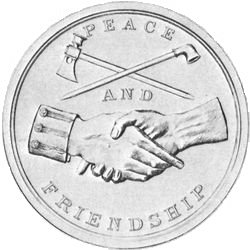
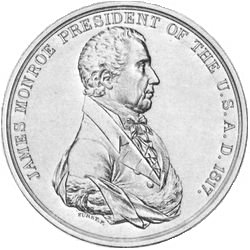
James Monroe was born in Westmoreland County, Virginia, April 28, 1758. He was educated at William and Mary College, Virginia, served with distinction in the revolutionary war from 1776 to 1778; was member of the Virginia Assembly, 1782; delegate to Congress, 1783-1786; senator of the United States, 1790-1794; minister to France, 1794-1796; governor of Virginia, 1799-1802; was sent on a special mission to France for the acquisition of Louisiana, 1802; was minister to England, 1803-1808; and to Spain, 1805; governor of Virginia, 1810; secretary of State under President Madison, 1811-1817; acting secretary of War, 1814-1815; President of the United States (first term), 1817-1821; (second term), 1821-1825. He died in the city of New York, July 4, 1831, on the fifty-fifth anniversary of the Independence of the United States.
Plate LI. No. 50.
October 5, 1813.
Major General William H. Harrison. ℞. Resolution of Congress April 4. 1818.
MAJOR-GENERAL WILLIAM HENRY HARRISON.
[Victory of the Thames.]
MAJOR GENERAL WILLIAM H. (Henry) HARRISON. Bust of General Harrison, in uniform, facing the right. FÜRST. F. (fecit).
RESOLUTION OF CONGRESS APRIL 4, 1818. America, personified as a maiden, with a spear in her right hand and resting on the American shield, places with her left a crown of laurel on a trophy formed of the arms of the enemy, on which hangs a buckler, with the inscription FORT MEIGS BATTLE OF THE THAMES. Exergue: BATTLE OF THE THAMES OCTOBER 5. 1813. FÜRST. F. (fecit).
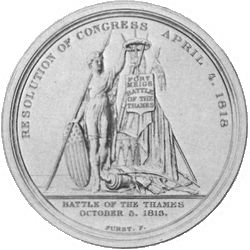
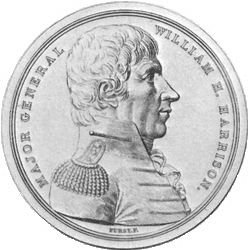
William Henry Harrison was born in Berkeley, Charles City County, Virginia, February 9, 1773. He entered the army as ensign in 1791; served in the north-west against the Indians, under General St. Clair, and afterward under General Wayne, to whom he was aid-de-camp; became captain in 1795; resigned in 1797; was appointed secretary of the North-west territory, and was its delegate in Congress, 1799. He was governor of the territory of Indiana, 1801-1813; defeated Tecumseh at Tippecanoe, November 7, 1811; was made brigadier-general and commander of the North-west territory in 1812, major-general in 1813; gallantly defended Fort Meigs, and defeated the British army at the battle of the Thames, October 5, 1813, for which victory Congress gave him a vote of thanks and a gold medal. He resigned his commission shortly afterwards. Was a member of Congress from Ohio, 1816-1819; Ohio State senator, 1819-1824; United States senator, 1825-1828, and President of the United States, March 4, 1841. He died in the White House, Washington, on April 4, one month after his inauguration. He was known in the West by the sobriquet of "Old Tippecanoe." No presidential medal of him was struck.
ORIGINAL DOCUMENTS.
Resolutions of Congress Voting Medals to General Harrison and Governor Shelby, etc.
Resolved unanimously by the Senate and House of Representatives of the United States of America in Congress assembled: That the thanks of Congress be, and they are hereby, presented to Major-General William Henry Harrison, and Isaac Shelby, late Governor of Kentucky, and, through them, to the officers and men under their command, for their gallantry and good conduct in defeating the combined British and Indian forces under Major-General Proctor, on the Thames, in Upper Canada, on the fifth day of October, one thousand eight hundred and thirteen, capturing the British army, with their baggage, camp equipage and artillery; and that the President of the United States be requested to cause two gold medals to be struck, emblematical of this triumph, and presented to General Harrison and Isaac Shelby, late Governor of Kentucky.
Resolved, That the President of the United States be requested to present to Colonel Richard M. Johnson a sword, as a testimony of the high sense entertained by Congress of the daring and distinguished valour displayed by himself and the regiment of volunteers under his command, in charging and essentially contributing to vanquish the combined British and Indian forces under Major-General Proctor, on the Thames, in Upper Canada, on the fifth day of October, one thousand eight hundred and thirteen.
Approved April 4, 1818.
General Harrison to the Secretary of War.
Headquarters, near Moravian Town, On the river Thames, 80 miles from Detroit, October 5, 1813. To General John Armstrong, Secretary of War, Washington, D. C.
Sir: I have the honour to inform you that, by the blessing of Providence, the army under my command has obtained a complete victory over the combined Indian and British forces under the command of General Proctor. I believe that nearly the whole of the enemy's regulars are taken or killed. Amongst the former are all the superior officers, excepting General Proctor. My mounted men are now in pursuit of him. Our loss is very trifling. The brave Colonel R. M. Johnson is the only officer whom I have heard of that is wounded, he badly, but I hope not dangerously.
I have the honour to be, &c., William H. Harrison.
General Harrison to the Secretary of War.
Head Quarters, Detroit, October 9th, 1813. To General John Armstrong, Secretary of War, Washington, D. C.
Sir: In my last letter from Sandwich, of the 30th ultimo, I did myself the honour to inform you, that I was preparing to pursue the enemy on the following day. From various causes, however, I was unable to put the troops in motion until the morning of the 2d instant, and then to take with me only about 140 of the regular troops, Johnson's mounted regiment, and such of Governor Shelby's volunteers as were fit for a rapid march, the whole amounting to about 3500 men. To General M'Arthur, with about 700 effectives, the protection of this place, and the sick, was committed. General Cass's brigade, and the corps of Lieutenant-Colonel Ball, were left at Sandwich, with orders to follow me as soon as the men received their knapsacks and blankets, which had been left on an island in Lake Erie.
The unavoidable delay at Sandwich was attended with no disadvantage to us. General Proctor had posted himself at Dalson's, on the right bank of the river Thames (or French), fifty-six miles from this place, where I was informed he intended to fortify and to receive me. He must have believed, however, that I had no disposition to follow him, or that he had secured my continuance here, by the reports that were circulated that the Indians would attack and destroy this place, upon the advance of the army, as he neglected the breaking up of the bridges until the night of the 2d instant. On the night our army reached the river, which is 25 miles from Sandwich, and is one of four streams crossing our route, over all of which are bridges, and being deep and muddy, are unfordable for a considerable distance into the country. The bridge here was found entire, and in the morning I proceeded with Johnson's regiment, to save, if possible, the others. At the second bridge, over a branch of the river Thames, we were fortunate enough to capture a lieutenant of dragoons and 11 privates, who had been sent by General Proctor to destroy them. From the prisoners I learned that the third bridge was broken up, and that the enemy had no certain information of our advance. The bridge, having been imperfectly destroyed, was soon repaired, and the army encamped at Drake's farm, four miles below Dalson's.
The river Thames, along the banks of which our route lay, is a fine deep stream, navigable for vessels of considerable burthen, after the passage of the bar at its mouth, over which there is six and a half feet water.
The baggage of the army was brought from Detroit in boats, protected by three gun-boats, which Commodore Perry had furnished for the purpose, as well as to cover the passage of the army over the Thames itself, or the mouth of its tributary streams; the banks being low, and the country generally open (prairies), as high as Dalson's, these vessels were well calculated for the purpose. Above Dalson's, however, the character of the river and adjacent country, is considerably changed. The former, though still deep, is very narrow, and its banks high and woody. The commodore and myself, therefore, agreed upon the propriety of leaving the boats under a guard of 150 infantry, and I determined to trust to fortune, and the bravery of my troops, to effect the passage of the river. Below a place called Chatham, and four miles above Dalson's, is the third fordable branch of the Thames. The bridge over its mouth had been taken up by the Indians, as well as at M'Gregor's Mills, one mile above. Several hundred of the Indians remained to dispute our passage, and, upon the arrival of the advanced guard, commenced a heavy fire from the opposite bank of the creek, as well as that of the river. Believing that the whole force of the enemy was there, I halted the army formed in order of battle, and brought up our two six-pounders to cover the party that were ordered to repair the bridge, and cross the troops. Colonel Johnson's mounted regiment, being upon the right of the army, had seized the remains of the bridge at the mills, under a heavy fire from the Indians. Our loss, upon this occasion, was two killed and three or four wounded; that of the enemy was ascertained to be considerably greater. A house near the bridge, containing a very considerable number of muskets, had been set on fire; but it was extinguished by our troops, and the arms saved. At the first farm above the bridge, we found one of the enemy's vessels on fire, loaded with arms and ordnance stores, and learned that they were a few miles ahead of us, still on the right bank of the river, with the great body of Indians. At Bowles's farm, four miles from the bridge, we halted for the night, found two other vessels, and a large distillery, filled with ordnance and other valuable stores, to an immense amount, in flames. It was impossible to put out the fire; two twenty-four pounders, with their carriages, were taken, and a large quantity of ball and shells of various sizes. The army was put in motion early on the morning of the 5th. I pushed on, in advance, with the mounted regiment, and requested Governor Shelby to follow, as expeditiously as possible, with the infantry. The governor's zeal, and that of his men, enabled them to keep up with the cavalry, and by 9 o'clock, we were at Arnold's mills, having taken, in the course of the morning, two gun-boats and several bateaux, loaded with provisions and ammunition.
A rapid at the river at Arnold's mills affords the only fording to be met with for a very considerable distance; but, upon examination, it was found too deep for the infantry. Having, however, fortunately taken two or three boats and some canoes, on the spot, and obliging the horsemen to take a footman behind each, the whole were safely crossed by 12 o'clock. Eight miles from the crossing we passed a farm where a part of the British troops had encamped the night before, under the command of Colonel Warburton. The detachment with General Proctor had arrived the day before at the Moravian towns, four miles higher up. Being now certainly near the enemy, I directed the advance of Johnson's regiment to accelerate their march, for the purpose of procuring intelligence. The officer commanding it, in a short time, sent to inform me that his progress was stopped by the enemy, who were formed across our line of march. One of the enemy's wagoners being also taken prisoner, from the information received from him, and my own observation, assisted by some of my officers, I soon ascertained enough of their position, and order of battle, to determine that which it was proper for me to adopt.
I have the honour herewith to enclose you my general order of the 27th ultimo, prescribing the order of march and of battle when the whole army should act together. But as the number and description of the troops had been essentially changed since the issuing of the order, it became necessary to make a corresponding alteration in their disposition. From the place where our army was last halted, to the Moravian towns, a distance of about three and a half miles, the road passes through a beech forest without any clearing, and for the first two miles near to the bank of the river. At from two to three hundred yards from the river a swamp extends parallel to it throughout the whole distance. The intermediate ground is dry, and although the trees are tolerably thick, it is in many places clear of underbrush. Across this strip of land, its left appuyed upon the river, supported by artillery placed in the wood, their right in the swamp covered by the whole of their Indian force, the British troops were drawn up.
The troops at my disposal consisted of about one hundred and twenty regulars of the 27th regiment, five brigades of Kentucky volunteer militia infantry under his excellency Governor Shelby, averaging less than five hundred men, and Colonel Johnson's regiment of mounted infantry, making in the whole an aggregate something above 3000. No disposition of an army opposed to an Indian force can be safe, unless it is secured on the flanks and in the rear. I had therefore no difficulty in arranging the infantry conformably to my general order of battle. General Trotter's brigade of 500 men formed the front line, his right upon the road and his left upon the swamp. General King's brigade as a second line, 150 yards in the rear of Trotter's, and Childs's brigade, as a corps of reserve, in the rear of it. These three brigades formed the command of Major-General Henry; the whole of General Desha's division, consisting of two brigades, were formed en potence upon the left of Trotter.
While I was engaged in forming the infantry, I had directed Colonel Johnson's regiment, which was still in front, to be formed in two lines opposite to the enemy, and upon the advance of the infantry, to take ground to the left, and forming upon that flank, to endeavour to turn the right of the Indians. A moment's reflection, however, convinced me, that from the thickness of the woods and swampiness of the ground, they would be unable to do anything on horseback, and there was no time to dismount them and place their horses in security; I therefore determined to refuse my left to the Indians, and to break the British lines at once by a charge of the mounted infantry; the measure was not sanctioned by any thing I had seen or heard of, but I was fully convinced that it would succeed. The American backwoodsmen ride better in the woods than any other people. A musket or rifle is no impediment to them, being accustomed to carry them on horseback from their earliest youth. I was persuaded, too, that the enemy would be quite unprepared for the shock, and that they could not resist it. Conformably to this idea, I directed the regiment to be drawn up in close column, with its right at the distance of fifty yards from the road (that it might be, in some measure, protected by the trees from the artillery), its left upon the swamp, and to charge, at full speed, as soon as the enemy delivered their fire. The few regular troops of the 27th regiment, under the command of their colonel (Paul), occupied, in column of sections of four, the small space between the road and the river, for the purpose of seizing the enemy's artillery, and some ten or twelve friendly Indians were directed to move under the bank. The crotchet, formed by the front line and General Desha's division was an important point. At that place the venerable governor of Kentucky was posted, who, at the age of sixty-six, preserves all the vigour of youth, the ardent zeal which distinguished him in the Revolutionary war, and the undaunted bravery which he manifested at King's Mountain. With my aids-de-camp, the acting Assistant Adjutant-General, Captain Buttler, my gallant friend Commodore Perry, who did me the honour to serve as my volunteer aid-de-camp, and Brigadier-General Cass, who, having no command, tendered me his assistance, I placed myself at the head of the front line of infantry, to direct the movements of the cavalry and give them the necessary support. The army had moved on this order but a short distance, when the mounted men received the fire of the British line, and were ordered to charge; the horses in the front of the column recoiled from the fire; another was given by the enemy, and our column, at length getting into motion, broke through the enemy with irresistible force. In one minute the contest in front was over. The British officers seeing no hopes of reducing their disordered ranks to order, and our mounted men wheeling upon them and pouring in a destructive fire, immediately surrendered. It is certain that three only of our troops were wounded in this charge. Upon the left, however, the contest was more severe with the Indians. Colonel Johnson, who commanded on that flank of his regiment, received a most galling fire from them, which was returned with great effect. The Indians still further to the right advanced and fell in with our front line of infantry, near its junction with Desha's division, and, for a moment, made an impression on it. His Excellency, Governor Shelby, however, brought up a regiment to its support, and the enemy, receiving a severe fire in front, and a part of Johnson's regiment having gained their rear, retreated with precipitation. Their loss was very considerable in the action and many were killed in their retreat.
I can give no satisfactory information of the number of Indians that were in the action, but they must have been considerably upwards of one thousand. From the documents in my possession (General Proctor's official letters, all of which were taken), and from the information of respectable inhabitants of this territory, the Indians, kept in pay by the British, were much more numerous than has been generally supposed. In a letter to General de Rottenburg, of the 27th instant, General Proctor speaks of having prevailed upon most of the Indians to accompany him. Of these it is certain that fifty or sixty Wyandot warriors abandoned him.
A British officer, of high rank, assured one of my aids-de-camp, that on the day of our landing, General Proctor had at his disposal upwards of three thousand Indian warriors, but asserted that the greatest part had left him previous to the action.
The number of our troops was certainly greater than that of the enemy, but when it is recollected that they had chosen a position that effectually secured their flank, which it was impossible for us to turn, and that we could not present to them a line more extended than their own, it will not be considered arrogant to claim for my troops the palm of superior bravery.
In communicating to the President, through you, Sir, my opinion of the conduct of the officers who served under my command, I am at a loss how to mention that of Governor Shelby, being convinced that no eulogium of mine can reach his merits. The governor of an independent State, greatly my superior in years, in experience and in military character, he placed himself under my command, and was not more remarkable for his zeal and activity, than for the promptitude and cheerfulness with which he obeyed my orders. The Major-Generals Henry and Desha, and the Brigadiers Allen, Caldwell, King, Childs, and Trotter, all of the Kentucky volunteers, manifested great zeal and activity. Of Governor Shelby's staff, his adjutant-general, Colonel Walker, rendered great service, as did his aids-de-camp, General Adair, and Majors Barry and Crittenden. The military skill of the former was of great service to us, and the activity of the two latter gentlemen could not be surpassed. Illness deprived me of the talents of my adjutant-general, Colonel Gaines, who was left at Sandwich. His duties were, however, ably performed by the acting assistant adjutant-general, Captain Buttler. My aids-de-camp, Lieutenant O'Fallon and Captain Todd, of the line, and my volunteer aids, John Speed Smith and John Chambers, Esquires, have rendered me the most important services from the opening of the campaign. I have already stated that General Cass and Commodore Perry assisted me in forming the troops for the action. The former is an officer of the highest merit, and the appearance of the brave commodore cheered and animated every breast.
It would be useless, Sir, after stating the circumstances of the action, to pass encomiums upon Colonel Johnson and his regiment. Veterans could not have manifested more firmness. The colonel's numerous wounds prove that he was in the post of danger. Lieutenant-Colonel James Johnson, and the Majors Payne and Thompson were equally active though more fortunate. Major Wood of the engineers, already distinguished by his conduct at Fort Meigs, attended the army with two six-pounders. Having no use for them in the action, he joined in the pursuit of the enemy, and with Major Payne, of the mounted regiment, two of my aids-de-camp, Todd and Chambers, and three privates, continued it for several miles after the rest of the troops had halted, and made many prisoners.
I left the army before an official return of the prisoners, or that of the killed and wounded, was made out. It was however ascertained that the former amounts to 601 regulars, including 25 officers. Our loss is 7 killed and 22 wounded, 5 of which have since died. Of the British troops 12 were killed and 22 wounded. The Indians suffered most, 33 of them having been found upon the ground, besides those killed on the retreat.
On the day of the action, six pieces of brass artillery were taken, and two iron 24 pounders the day before. Several others were discovered in the river, and can be easily procured. Of the brass pieces, three are the trophies of our revolutionary war, that were taken at Saratoga and York, and surrendered by General Hull. The number of small arms taken by us and destroyed by the enemy, must amount to upwards of 5000; most of them had been ours and taken by the enemy at the surrender of Detroit, at the river Raisin, and at Colonel Dudley's defeat. I believe that the enemy retain no other military trophy of their victories than the standard of the 4th regiment; they were not magnanimous enough to bring that of the 4th regiment into the field, or it would have been taken.
You have been informed, Sir, of the conduct of the troops under my command in action; it gives me great pleasure to inform you, that they merit also the approbation of their country for their conduct, in submitting to the greatest privations with the utmost cheerfulness.
The infantry were entirely without tents, and for several days the whole army subsisted upon fresh beef, without bread or salt.
I have the honour to be, etc., William H. Harrison.
P.S. General Proctor escaped by the fleetness of his horses, escorted by 40 dragoons and a number of mounted Indians.
General Orders of Debarkation, of March, and of Battle.
Head Quarters, on Board the United States schooner Ariel, September 27, 1813.
As it is the intention of the general to land the army on the enemy's coast, the following will be order of debarkation, of march, and of battle:
The right wing of the army will be composed of the Kentucky volunteers, under the command of His Excellency, Governor Shelby, acting as major-general. The left wing, of the light corps of Lieutenant-Colonel Ball, and the brigades of Generals M'Arthur and Cass. The arrangement is made with a view to the localities of the ground upon which the troops are to act and the composition of the enemy's force, and is calculated, in marching up the lake or straight, to place our regular troops in the open ground on the lake, where they will probably be opposed by the British regulars, and the Kentucky volunteers in the woods, which it is presumed will be occupied by the enemy's militia and the Indians. When the signal is given for putting to the shore, the corps of Lieutenant-Colonel Ball will precede the left wing: the regiment of volunteer riflemen the right wing: these corps will land with the utmost celerity, consistent with the preservation of good order, and as soon as landed will seize the most favourable position of annoying the enemy and covering the disembarkation of the troops of the line. General Cass's brigade will follow Colonel Ball's corps, and General Calmes the volunteer riflemen. The regiments will land and form in succession upon those which precede them. The right wing, with its left in front, displaying to the right; and the left wing, with its right in front, displaying to the left. The brigades of Generals King, Allen, and Caldwell will form successively to the right of General Calmes. General M'Arthur and Child's brigades will form the reserve. The general will command in person the right brigades of Generals Cass and Calmes, assisted by Major-General Henry. His Excellency, Governor Shelby, will have the immediate command of three brigades on the right, assisted by Major-General Desha. As soon as the troops are disembarked, the boats are to be immediately sent back to the fleet. It will be observed that the order of landing here prescribed is somewhat that of direct eschelons deployed into line upon the advanced corps of the right and left wing. It is the intention of the general, however, that all the troops which are provided with boats should land in as quick succession as possible; and the general officers in command towards the extremities of the line, are authorized to deviate from the arrangement to counteract any movement of the enemy, by landing any part of their commands, previously to the formation of the corps, which is herein directed to precede them. The corps of Lieutenant-Colonel Ball and the volunteer rifle regiment will maintain the position they occupy on landing, until the troops of the line are formed to support them; they will then retire through the intervals of the line, or to the flanks, and form in the rear of the line.
A detachment of artillery, with a six, four and three-pounder and howitzer, will land with the advanced light corps; the rest of the artillery will be held in reserve, and landed at such point as Major Wood may direct.
The point of landing for the reserve, under Brigadier-General M'Arthur, cannot now be designated; it will be made to support any point of the line which may require aid, or be formed on the flanks, as circumstances may render necessary. The arrangement for landing the troops will be made entirely under the direction of an officer of the navy, whom Commodore Perry has been so obliging as to offer for that purpose. The debarkation of the troops will be covered by the cannon of the vessels. The troops being landed, and the enemy driven off, or not opposing the landing, the army will change its front to the left, and form in order of battle in the following manner: The two brigades of regular troops, and two of the volunteers, to be formed in two lines at right angles to the shore of the lake. General M'Arthur's brigade and Calmes' to form the front line, and Cass's and Childs's the second line; the regular troops still on the left; that flank of both lines, resting on the shore; the distance between the two lines will be 300 yards. The remaining three brigades of volunteers will be drawn up in a single line of two ranks, at right angles to the line of march, its head upon the right of the front line, forming a crotchet (en potence) with that line, and extending beyond the second line. The corps of Lieutenant-Colonel Ball will form the advance of the left wing, at the distance of 300 yards, the regiment of rifle volunteers the advance of the right wing, at the same distance.
Some light pieces of artillery will be placed in the road leading up the lake, and at such other points as Major Wood may direct. When the order is given for marching, the first and second lines will advance by files from the heads of companies; in other words, these two lines will form two columns, marching by their flanks by companies at entire distances. The three brigades on the right flank will be faced to the left and marched forward; the head of this column still forming en potence with the front line. It is probable that the two brigades of the front line will extend from the lake some distance into the woods, on the right flank, and it is desirable it should be so; but should it be otherwise, and the crotchet or angle be at any time on the open ground, his excellency Governor Shelby will immediately prolong the front line to the right, by adding to it as many companies of the leading brigade of the flank column as will bring the angle, and consequently the flank column itself, completely within the woods. It is to be presumed that the enemy will make their attack upon the army in its march, that their regular troops will form their right upon the lake, their militia occupy the ground between the regulars and the woods, and the Indians the woods. The formation herein prescribed is intended to resist an arrangement of this kind. Should the general's conjecture on that subject prove correct, as it must be evident that the right of the enemy cannot be turned, and on that wing his best troops must be placed, it will be proper to refuse him our left, and direct our principal effort to uncover the flank of his regulars by driving off his militia. In the event supposed, therefore, it will be proper to bring up a part or the whole of General Cass's brigade, to assist the charge made by General Calmes, or that the former should change positions with the brigade of volunteers in the second line. Should the general think it safe to order the whole of Cass's brigade to the right, without replacing it with another, General Cass will march to the right, formed in oblique eschelons of companies. It will be the business of General M'Arthur, in the event of his wing being refused to watch the motions of the enemy, with the assistance of the artillery, to prevent his front line at least from interrupting the progress of our right. Should the enemy's militia be defeated, the brigade of ours in advance will immediately wheel upon the flank of the British regulars, and General M'Arthur will advance to attack them in front. In the mean time, his excellency Governor Shelby can use the brigade in reserve of the second line to prolong the flank line from its front or left, or to reinforce any weak part of the line. In all cases where troops in advance are obliged to retire through those who are advancing to support them, it will be done by companies in files, which will retire through the intervals of the advancing line, and will immediately form in rear. The light troops will be particularly governed by this direction.
The disposition of the troops on the right flank is such as the commanding general thinks best calculated to resist an attack from Indians, which is only to be expected from that quarter. His excellency Governor Shelby will, however, use his discretion in making any alteration which his experience and judgment may dictate. Lieutenant-Colonel Ball, Lieutenant-Colonel Simral, and the general officers commanding on the flank line, are to send out small detachments in advance of the two former corps, and to the flank of the latter. Should they discover the enemy in force, immediately notice will be sent to the head of the lines. The general commanding on the spot will immediately order the signals for forming in order of battle, which will be the beat "to arms."
All signals will be immediately repeated by all the drums of the line; the signal for the whole to halt, is the retreat. Drums will be distributed along the heads of companies, and the taps occasionally given to regulate their march.
Lieutenant-Colonels Ball and Simral are to keep the general constantly advised of the discoveries made by the advanced parties. Where it shall become necessary for the corps of Ball and Simral to retire, they will form on the flank or in the rear of Generals M'Arthur and Calmes's brigades, and receive the orders of the brigadiers respectively.
Brigadier-General Cass will designate such officers as he may deem proper, to assist Captain Elliott, of the navy, in the arrangement of the troops. The general will be the signal for the whole to move. By command,
Edmund P. Gaines, Col. Adj. Gen.
Plate LII. No. 51.
October 5, 1813.
Governor Isaac Shelby. ℞. Battle of the Thames. Octo. 5. 1813.
GOVERNOR ISAAC SHELBY.
[Victory of the Thames.]
GOVERNOR ISAAC SHELBY. Bust of Governor Shelby in a general's uniform, facing the right. FÜRST. F. (fecit).
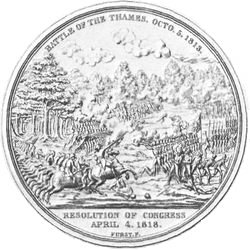
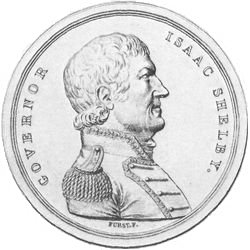
Isaac Shelby was born in Hagerstown, Maryland, December 11, 1750. He served in the South throughout the Revolutionary War, rose to the rank of colonel, and displayed great gallantry in the battle of King's Mountain, October 7, 1780, for which he received a sword of honor and thanks from the Legislature of North Carolina. He was governor of Kentucky, 1792-1796, and 1812-1816; he joined General Harrison with four thousand Kentucky volunteers, and distinguished himself in the battle of the Thames, October 5, 1813, for which victory Congress gave him a vote of thanks and a gold medal. He declined to be secretary of War in 1817, and died in Lincoln County, Kentucky, July 18, 1826.
Plate LIII. No. 52.
June 24, 1822.
Lvdovicvs. XVIII Franc. et. Nav. rex. ℞. Gallia. et. America. foederata.
TREATY OF COMMERCE WITH FRANCE.
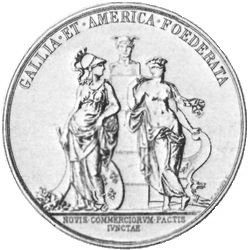
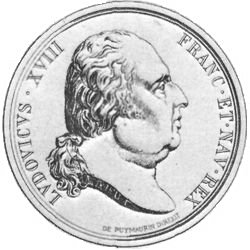
Bertrand Andrieu was born in Bordeaux, France, in 1762. He studied first at the academy of Bordeaux, then with Lavaux. He came to Paris early in life. Among his principal medals are: the taking of the Bastille; the battle of Marengo; the passage of the St. Bernard; the baptism of the King of Rome; the head of the Emperor Napoleon; the head of the Empress Josephine; the head of the Empress Marie Louise; and the cathedral of Vienna. He also executed the obverse of the medal commemorating the treaty of commerce of 1822, between the United States of America and France. He died in Paris, December 10, 1822.
Raymond Gayrard was born at Rodez, France, in 1777. He volunteered and served in the army from 1796 to 1802; then studied under Launay and Jeoffroy, and first attracted attention by his medallions of the Emperor Napoleon and of the Archduchess Marie Louise, on the occasion of their marriage. Among his principal medals are: the visits to the mint of the Emperor of Austria, and of the King of Prussia; the second entrance of Louis XVIII. into Paris; the removal of the ashes of the Duke d'Enghien to the chapel at Vincennes; the triumphal entrance of the Duke d'Angoulême into Paris; the death of Louis XVIII.; and the accession to the throne of Charles X. He also engraved the reverse of the medal commemorating the treaty of commerce between the United States of America and France. He was distinguished also as a sculptor, and among his statues is one of the American Republic. He was engraver to King Louis XVIII. and Charles X., was decorated with the Legion of Honor in 1825, and received a medal of the 2d class for sculpture at the Exhibition of Fine Arts in 1814, and an honorable mention at the Universal Exhibition of 1855. He died in Paris, May 4, 1858.
ORIGINAL DOCUMENTS.
Treaty with France, 1822.
Convention of Navigation and Commerce between the United States of America and His Majesty the King of France and Navarre, concluded June 24, 1822; ratifications exchanged February 12, 1823; proclaimed February 12, 1823.
The United States of America and His Majesty the King of France and Navarre, being desirous of settling the relations of navigation and commerce between their respective nations, by a temporary convention reciprocally beneficial and satisfactory, and thereby of leading to a more permanent and comprehensive arrangement, have respectively furnished their full powers in manner following, that is to say,
The President of the United States to John Quincy Adams, their Secretary of State, and His Most Christian Majesty to the Baron Hyde de Neuville, Knight of the Royal and Military Order of St. Louis, Commander of the Legion of Honour, Grand Cross of the Royal American Order of Isabella the Catholic, his Envoy Extraordinary and Minister Plenipotentiary near the United States; Who, after exchanging their full powers, have agreed on the following articles:
Article I.
Articles of the growth, produce, or manufacture of the United States, imported into France in vessels of the United States, shall pay an additional duty, not exceeding twenty francs per ton of merchandize, over and above the duties paid on the like articles, also of the growth, produce, or manufacture of the United States, when imported in French vessels.
Article II.
Articles of the growth, produce or manufacture of France, imported into the United States in French vessels, shall pay an additional duty, not exceeding three dollars and seventy-five cents per ton of merchandize, over and above the duties collected upon the like articles, also of the growth, produce or manufacture of France, when imported in vessels of the United States.
Article III.
No discriminating duty shall be levied upon the productions of the soil or industry of France, imported in French bottoms into the ports of the United States for transit or re-exportation; nor shall any such duties be levied upon the productions of the soil or industry of the United States, imported in vessels of the United States into the ports of France for transit or re-exportation.
Article IV.
The following quantities shall be considered as forming the ton of merchandize for each of the articles hereinafter specified:
Wines: Four 61-gallon hogsheads, or 244 gallons of 231 cubic inches, American measure.
Brandies, and all other liquids, 244 gallons.
Silks and all other dry goods, and all other articles usually subject to measurement, forty-two cubic feet French, in France, and fifty cubic feet American measure in the United States.
Cotton: 804lbs. avoirdupois, or 365 kilogrammes.
Tobacco: 1600lbs. avoirdupois, or 725 kilogrammes.
Ashes, pot and pearl: 2240lbs. avoirdupois, or 1016 kilogrammes.
Rice: 1600lbs. avoirdupois, or 725 kilogrammes, and for all weighable articles, not specified, 2240lbs. avoirdupois, or 1016 kilogrammes.
Article V.
The duties of tonnage, light money, pilotage, port charges, brokerage, and all other duties upon foreign shipping, over and above those paid by the national shipping in the two countries respectively, other than those specified in articles 1 and 2 of the present convention, shall not exceed in France, for vessels of the United States, five francs per ton of the vessel's American register; nor for vessels of France in the United States, ninety four cents per ton of the vessel's French passport.
Article VI.
The contracting parties, wishing to favour their mutual commerce, by affording in their ports every necessary assistance to their respective vessels, have agreed that the consuls and vice-consuls may cause to be arrested the sailors, being part of the crews of the vessels of their respective nations, who shall have deserted from the said vessels, in order to send them back and transport them out of the country. For which purpose the said consuls and vice-consuls shall address themselves to the courts, judges, and officers competent, and shall demand the said deserters in writing, proving by an exhibition of the registers of the vessel, or ship's roll, or other official documents, that those men were part of the said crews; and on this demand, so proved, (saving however where the contrary is proved,) the delivery shall not be refused; and there shall be given all aid and assistance to the said consuls and vice-consuls for the search, seizure, and arrest of the said deserters, who shall even be detained and kept in the prisons of the country, at their request and expense, until they shall have found an opportunity of sending them back. But if they be not sent back within three months, to be counted from the day of their arrest, they shall be set at liberty, and shall be no more arrested for the same cause.
Article VII.
The present temporary convention shall be in force for two years from the first day of October next, and even after the expiration of that term, until the conclusion of a definitive treaty, or until one of the parties shall have declared its intention to renounce it, which declaration shall be made at least six months beforehand.
And in case the present arrangement should remain without such declaration of its discontinuance by either party, the extra duties specified in the 1st and 2d articles shall, from the expiration of the said two years, be, on both sides, diminished by one-fourth of their whole amount, and, afterwards by one-fourth of the said amount from year to year, so long as neither party shall have declared the intention of renouncing it as above stated.
Article VIII.
The present convention shall be ratified on both sides, and the ratifications shall be exchanged within one year from the date hereof, or sooner, if possible. But the execution of the said convention shall commence in both countries on the first of October next, and shall be effective, even in case of non-ratification, for all such vessels as may have sailed bonâ fide for the ports of either nation, in the confidence of its being in force.
In faith whereof, the respective Plenipotentiaries have signed the present convention, and have hereto affixed their seals, at the city of Washington, this 24th day of June, A. D. 1822.
John Quincy Adams [l.s.]
G. Hyde de Neuville [l.s.]
Separate Article.
The extra duties levied on either side before the present day, by virtue of the act of Congress of 15th May, 1820, and of the ordinance of 26th July of the same year, and others confirmative thereof, and which have not already been paid back, shall be refunded.
Signed and sealed as above, this 24th day of June, 1822.
John Quincy Adams [l.s.]
G. Hyde de Neuville [l.s.]
Plate LIV. No. 53.
March 4, 1825—March 4, 1829.
John Quincy Adams President of the United States 1825. ℞. Peace and friendship.
PRESIDENT JOHN QUINCY ADAMS.
[Sixth President of the United States of America.]
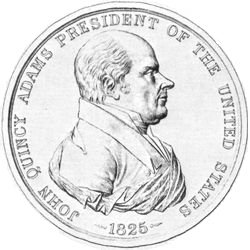
JOHN QUINCY ADAMS PRESIDENT OF THE UNITED STATES 1825. Bust of President John Quincy Adams, facing the right.
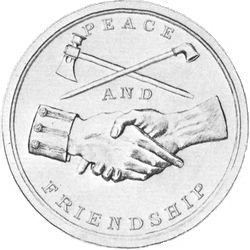
PEACE AND FRIENDSHIP. Two hands clasped in token of amity; on the cuff of the left wrist three stripes, and buttons with the American eagle on them; the other wrist bare; above the hands, a calumet and a tomahawk crossed—Indian emblems of peace and war.
The obverse of this medal, though not signed, was engraved by Fürst.
John Quincy Adams, son of President John Adams, was born in Braintree, now Quincy, Massachusetts, July 11, 1767. He spent several years of his early life in Europe with his father; was graduated at Harvard College, Cambridge, Massachusetts, 1787; was admitted to the bar in 1791, and settled in Boston; was minister to Holland, England, and Prussia, 1794-1801; United States senator, 1803-1808; minister to Russia, 1809-1814; one of the negotiators of the treaty of Ghent, 1814; secretary of State under President Monroe, 1817-1825; President of the United States, 1825-1829; representative in Congress, 1831-1848. He died in the Capitol in Washington, February 23, 1848.
Plate LV. No. 54.
March 4, 1829—March 4, 1837.
Andrew Jackson President of the United States A.D. 1829. ℞. Peace and friendship.
PRESIDENT ANDREW JACKSON.
[Seventh President of the United States of America.]
ANDREW JACKSON PRESIDENT OF THE UNITED STATES A. D. (Anno Domini: The year of our Lord), 1829. Bust of President Jackson, facing the right. FÜRST. F. (fecit).
PEACE AND FRIENDSHIP. Two hands clasped in token of amity; on the cuff of the left wrist three stripes and buttons with the American eagle on them; the other wrist bare; above the hands, a calumet and tomahawk crossed—Indian emblems of peace and war.
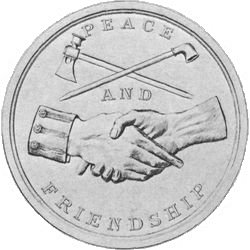
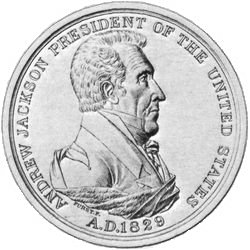
Plate LVI. No. 55.
August 2, 1813.
Presented by Congress to Colonel George Croghan 1835. ℞. Pars magna fuit.
COLONEL GEORGE CROGHAN.
[Defence of Fort Stephenson.]
PRESENTED BY CONGRESS TO COLONEL GEORGE CROGHAN 1835. Bust of Colonel Croghan, in uniform, facing the right. FÜRST. F. (fecit).
As this medal was not voted by Congress until 1835, it is placed here according to the chronological order adopted.
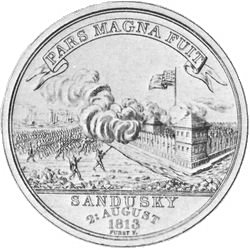
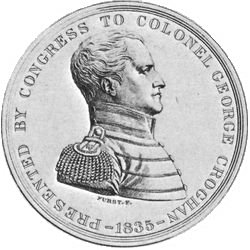
George Croghan was born near Louisville, Kentucky, November 15, 1791. He was graduated at William and Mary College, Virginia, and in 1811 was aid-de-camp to Colonel Boyd at the battle of Tippecanoe; captain in 1812, major in 1813, and aid-de-camp to General Harrison at Fort Meigs. On August 3, 1813, with a garrison of one hundred and sixty men, he repulsed General Proctor at the head of an army of one thousand British troops and Indians. For this gallant deed Congress, in 1835, gave him a vote of thanks and a gold medal. In 1814 he was appointed lieutenant-colonel; resigned in 1817; was promoted to the rank of inspector-general and colonel in 1825; served under General Taylor in Mexico, and died in New Orleans, January 8, 1849.
ORIGINAL DOCUMENTS.
Resolution of Congress Voting a Medal to Colonel Croghan, etc.
Resolved unanimously by the Senate and House of Representatives of the United States of America in Congress assembled: That the President of the United States be requested to cause a gold medal to be struck, with suitable emblems and devices, and presented to Colonel Croghan, in testimony of the high sense entertained by Congress of his gallantry and good conduct in the defence of Fort Stephenson; and that he present a sword to each of the following officers engaged in that affair: to Captain James Hunter, to the eldest male representative of Lieutenant Benjamin Johnston, and to Lieutenant Cyrus A. Baylor, John Meek, Ensign Joseph Duncan, and the nearest male representative of Ensign Edmund Shipp, deceased.
Approved February 13, 1835.
Major Croghan to General Harrison.
Lower Sandusky, August 5th, 1813. To Major-General Harrison, Commanding Northwestern Army.
Dear Sir: I have the honour to inform you that the combined force of the enemy, amounting to at least 500 regulars, and seven or eight hundred Indians, under the immediate command of General Proctor, made its appearance before this place early on Sunday evening last, and so soon as the general had made such disposition of his troops as would cut off my retreat, should I be disposed to make one, he sent Colonel Elliott, accompanied by Major Chambers, with a flag to demand the surrender of the fort, as he was anxious to spare the effusion of blood, which he should probably not have it in his power to do should he be reduced to the necessity of taking the place by storm. My answer to the summons was, that I was determined to defend the place to the last extremity, and that no force, however large, should induce me to surrender it. So soon as the flag had returned, a brisk fire was opened upon us from the gunboats in the river, and from a five and a half inch howitzer on shore, which was kept up with little intermission through the night. At an early hour the next morning, three sixes (which had been placed during the night within 250 yards of the pickets) began to play upon us, but with little effect. About 4 o'clock p.m., discovering that the fire from all his guns was concentrated against the northwestern angle of the fort, I became confident that his object was to make a breach, and attempt to storm the works at that point. I therefore ordered out as many men as could be employed for the purpose of strengthening that front, which was so effectually secured by means of bags of flour, sand, &c., that the picketing suffered little or no injury. Notwithstanding which, the enemy, about 5 o'clock, having formed in close column, advancing to assail our works at the expected point, at the same time making two feints at the front of Captain Hunter's line, the column which advanced against the north-western angle, consisting of about 350 men, was so completely enveloped in smoke as not to be discovered until it had approached within fifteen or twenty paces of the lines; but the men being all at their posts and ready to receive it, commenced so heavy and galling a fire as to throw the column a little into confusion. Being quickly rallied, it advanced to the outer works and began to leap into the ditch. Just at that moment a fire of grape was opened from our six pounder (which had been previously arranged so as to rake in that direction), which, together with the musketry, threw them into such confusion, that they were compelled to retire precipitately to the woods. During the assault, which lasted about half an hour, an incessant fire was kept up by the enemy's artillery (which consisted of five sixes and a howitzer), but without effect. My whole loss during the siege, was one killed and seven wounded slightly. The loss of the enemy in killed, wounded, and prisoners, must exceed one hundred and fifty; one lieutenant-colonel, a lieutenant and fifty rank and file, were found in and about the ditch, those of the remainder, who were not able to escape, were taken off during the night by the Indians. Seventy stand of arms and several brace of pistols have been collected near the work. About three in the morning the enemy sailed down the river, leaving behind them a boat, containing clothing and considerable military stores. Too much praise cannot be bestowed on the officers, non-commissioned officers, and privates under my command for their gallantry and good conduct during the siege.
Yours, with respect, G. Croghan, Major 17th U. S. Infantry comdg. L. S.
Plate LVII. No. 56.
March 4, 1837—March 4, 1841.
Martin Van Buren President of the United States A. D. 1837. ℞. Peace and friendship.
PRESIDENT MARTIN VAN BUREN.
[Eighth President of the United States of America.]
MARTIN VAN BUREN PRESIDENT OF THE UNITED STATES A. D. (Anno Domini: The year of our Lord) 1837. Bust of President Van Buren, facing the right. FÜRST. F. (fecit).
PEACE AND FRIENDSHIP. Two hands clasped in token of amity; on the cuff of the left wrist three stripes, and buttons with the American eagle on them; the other wrist bare; above the hands, a calumet and tomahawk crossed—Indian emblems of peace and war.
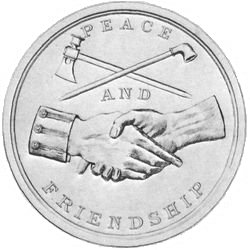
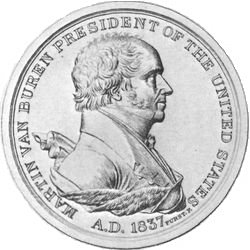
Martin Van Buren was born at Kinderhook, Columbia County, New York, December 5, 1782. He received his early education at a common school; was admitted to the bar in the city of New York, 1803; State senator, 1812; attorney-general of New York, 1815; United States senator, 1821-1828; governor of New York, 1828; secretary of State to President Jackson, 1829-1831; appointed minister to England, 1831, but was not confirmed by the Senate; vice-president of the United States, 1833-1837; President of the United States, 1837-1841. He was an unsuccessful candidate for the Presidency in 1848. He died at Kinderhook, July 24, 1862.
Plate LVIII. No. 57.
April 4, 1841—March 4, 1845.
John Tyler, President of the United States. 1841. ℞. Peace and friendship.
PRESIDENT JOHN TYLER.
JOHN TYLER, PRESIDENT OF THE UNITED STATES 1841. Bust of President Tyler, facing the left.
PEACE AND FRIENDSHIP. Two hands clasped in token of amity; on the cuff of the left wrist three stripes, and buttons with the American eagle on them; the other wrist bare; above the hands, a calumet and tomahawk crossed—Indian emblems of peace and war.
This medal bears no signature. Below are given the only documents relating to it which could be obtained.
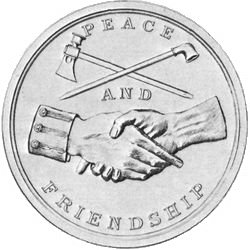
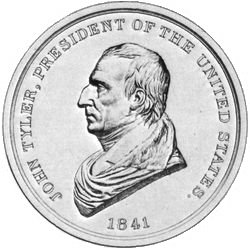
John Tyler was born in Charles City County, Virginia, March 29, 1790. He was graduated at William and Mary College, Virginia, 1807; and was admitted to the bar, 1809. He was a member of the State Legislature, 1811-1816; member of Congress, 1816-1821; member of the State Legislature, 1823-1825; governor of Virginia, 1825-1827; United States senator, 1827-1836; vice-president of the United States, March 4, 1841, and President, on the death of General Harrison (April 4), 1841-1845. He took part with the South during the Civil War, and was a member of the Confederate Congress. He died in Richmond, January 17, 1862.
ORIGINAL DOCUMENTS.
R. M. Patterson to J. C. Spencer.
Mint of the United States, November 2, 1841. To the Honorable J. C. Spencer, Secretary of War.
Sir: I have the honor to acknowledge the receipt of your letter of the 28th ult., and am gratified to see the interest which you take in the subject of our American Medals.
The Military Medals of which we have the dies, are now in the course of execution, in compliance with your request. Among them is included the Medal voted, in 1777, to General Gates, of which the dies were given, by the family, through Colonel Burr, to our former chief coiner, Mr. Eckfeldt.
The dies for the Indian Medals, bearing the heads of the successive Presidents, have heretofore been cut by artists in this country; the earlier ones by Reich, the later by Fürst. One of these is dead, and the other in Europe.
I now propose, with your approbation, to pursue a different course, and to dispense entirely with the services of the die sinker. For this purpose, a medallion likeness of the President must be modeled in wax or clay, on a table of four inches in diameter, and I understand that an artist at Washington, named Chapman, is competent to this work. A plaster cast from this model is used as a pattern for a casting in fine iron, which can be executed by Babbit at Boston, as well as at the celebrated foundries at Berlin. This casting is then placed in an instrument called a portrait lathe (of which we have a very perfect one at the Mint, which I caused to be made at Paris), and reduced fac-similes of it are turned by the lathe, thus preparing for us the dies which we need.
The advantages offered by this mode of operating are manifest. A model made on a large scale in relief, and in plastic material, can hardly fail to be more perfect than a head sunk originally on a die of steel. I accordingly anticipate from this process a more perfect set of dies, than any we have yet made. But it is not an untried experiment which I propose to make. I send you herewith, a medal of Franklin executed by us here, entirely by this process. The original was a medallion likeness of Franklin in burnt clay. All the rest was a purely mechanical operation, (the work being, in fact, done by a steam engine), except a little retouching, and the impression of the letters.
The proposed method presents the advantage of greater economy. The last Indian Medal dies, which were the cheapest we have had made, cost $1,160; Mr. Peale, our chief coiner, is willing to undertake the execution of those for President Tyler, for $800.
The Medals for President Van Buren were begun, and in fact completed, in anticipation of the necessary appropriation by Congress, and I would suggest to you, whether the same course would not be desirable now.
I present the following estimate, for the appropriation to be asked:
For furnishing three head dies $800.00
For preparing, striking, ringing, etc., 60 of the largest Medals at $2.37 each 142.20
For 200 of the two smaller sizes at $1.37 each 274.00
Fine silver used for the Medals 1,000.00
Contingencies 283.80
————
$2,500.00
It may perhaps be judged proper to introduce Indian Medals of President Harrison into the series.
In this case, the estimate need not be doubled, for it is not to be supposed that many more Medals would be wanted. I should suppose that an additional appropriation of $1000 would be sufficient. I may remark, however, that Washington is not in the series of Indian Medals, and that Harrison, like Washington, is in the series of those voted by Congress to our successful military commanders.
I wait your instructions, which I shall execute with great pleasure.
Very respectfully, your faithful servant, R. M. Patterson, Director.
J. C. Spencer to R. M. Patterson.
Department of War. Washington, Nov. 13, 1841. To Doctor R. M. Patterson, Director of the Mint, Philadelphia, Penn.
Sir: I have had the pleasure to receive your letter of the 2d instant, respecting the means of procuring the dies for Medals bearing the likeness of President Tyler. The advantages of the mode you propose are sufficiently attested by the execution of the Medal accompanying your letter, and, in accordance with your suggestions, measures have been adopted to have a medallion likeness of the President taken, the execution of which has been entrusted to Mr. Pettrich, whose merit as an artist cannot be unknown to you.
Very respectfully, your obedient servant, J. C. Spencer.
R. M. Patterson to John C. Spencer.
Mint, U.S. September 17, 1842. To the Honorable John C. Spencer, Secretary of War.
Sir: Permit me to ask whether an appropriation was made at the late session of Congress for defraying the expense of making a set of medals bearing the head of the President, to be given to Indian chiefs, as has been the custom heretofore. In consequence of our former correspondence on this subject, you are aware that some steps have already been taken for accomplishing this object. Let me inquire of you whether the work is to go forward.
R. M. Patterson, Director.
D. Parker to R. M. Patterson.
War Department. Washington, D. C., Sep. 21, 1842. R. M. Patterson, Esq., Director of the Mint, Philadelphia.
Sir: In answer to your letter of the 17th instant, in the absence of the Secretary of War, I have to state that $2,500 was appropriated during the last session of Congress for making medals bearing the head of the President, to be given to Indian chiefs. Of this $50 was paid to Mr. Pettrich, and a requisition has this day been made in your favor for $1,500, which the Treasury Department is requested to remit to you as early as practicable.
Very respectfully, your obedient servant, D. Parker, Chief Clerk.
Plate LIX. No. 58.
March 4, 1845—March 4, 1849.
James K. Polk, President of the United States, 1845. ℞. Peace and friendship.
PRESIDENT JAMES KNOX POLK.
[Eleventh President of the United States of America.]
JAMES K (Knox) POLK PRESIDENT OF THE UNITED STATES. 1845. Bust of President Polk, facing the left.
PEACE AND FRIENDSHIP. Two hands clasped in token of amity; on the cuff of the left wrist three stripes, and buttons with the American eagle on them; the other wrist bare; above the hands, a calumet and tomahawk crossed—Indian emblems of peace and war.
The obverse of this medal, though not signed, was made by Franklin Peale, as may be seen by the following extract from a despatch of R. M. Patterson, director of the Mint, to William Medill, commissioner of Indian Affairs, and dated Philadelphia, June 15, 1846. "The Indian medals, with the head of President Polk, being nearly finished by our chief coiner, Mr. Peale, etc."
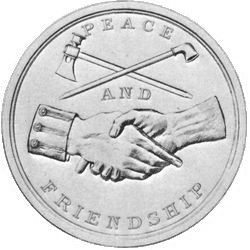
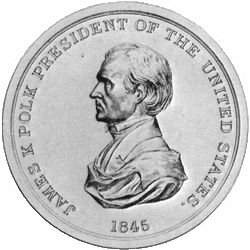
James Knox Polk was born in Mecklenburg County, North Carolina, November 2, 1795. He was graduated at the University of North Carolina, 1818; was admitted to the bar in Nashville, Tennessee, 1820; member of the State Legislature, 1823-1825; member of Congress, 1825-1839; speaker of the House of Representatives of the United States, 1835-1839; governor of Tennessee, 1839-1841; President of the United States, 1845-1849. He died in Nashville, June 15, 1849.
Plate LX. No. 59.
May 8 and 9, 1846.
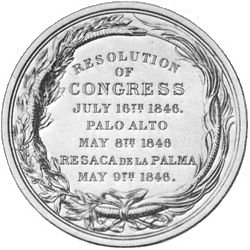
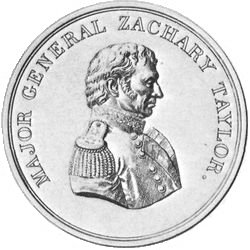
Major General Zachary Taylor. ℞. Resolution of Congress, July 16th, 1846, etc.
MAJOR-GENERAL ZACHARY TAYLOR.
[Victories on the Rio Grande.]
MAJOR GENERAL ZACHARY TAYLOR. Bust of General Taylor, in uniform, facing the right.
ORIGINAL DOCUMENTS.
Resolution of Congress Voting a Medal to General Taylor.
Resolved unanimously by the Senate and the House of Representatives of the United States of America in Congress assembled: That the thanks of Congress are due, and are hereby tendered to Major-General Zachary Taylor, commanding the army of occupation, his officers and men, for the fortitude, skill, enterprise, and courage, which have distinguished the recent brilliant operations on the Rio Grande.
Section 2. And be it further resolved, That Congress sincerely sympathize with the relatives and friends of the officers and soldiers of the army of the United States who so bravely fell in the service of their country on the Rio Grande.
Section 3. And be it further resolved, That the President of the United States be requested to cause the foregoing resolutions to be communicated to General Taylor, and through him to the army under his command.
Section 4. And be it further resolved, That the President of the United States be authorized and requested to have a medal of gold procured, with appropriate devices and inscriptions thereon, and presented to General Taylor, in the name of the Republic, as a tribute to his good conduct, valor, and generosity to the vanquished.
Approved July 16, 1846.
General Taylor to the Adjutant-General of the Army.
Headquarters, Army of Occupation, Camp at Palo Alto, Texas, May 9, 1846. To The Adjutant-General of the Army, Washington, D. C.
Sir: I have the honor to report that I was met near this place yesterday, on my march from Point Isabel, by the Mexican forces, and, after an action of about five hours, dislodged them from their position and encamped upon the field. Our artillery consisting of two eighteen-pounders and two light batteries, was the arm chiefly engaged, and to the excellent manner in which it was manœuvred and served is our success mainly due.
The strength of the enemy is believed to have been about 6000 men, with seven pieces of artillery and 800 cavalry. His loss is probably at least one hundred killed. Our strength did not exceed, all told, twenty-three hundred, while our loss was comparatively trifling: four men killed, three officers and thirty-seven men wounded, several of the latter mortally. I regret to say that Major Ringgold, 2d Artillery, and Captain Page, 4th Infantry, are severely wounded. Lieutenant Luther, 2d Artillery, slightly so.
The enemy has fallen back, and it is believed has repassed the river. I have advanced parties now thrown forward in his direction, and shall move the main body immediately.
In the haste of this report, I can only say that the officers and men behaved in the most admirable manner throughout the action. I shall have the pleasure of making a more detailed report when those of the different commanders shall be received.
I am, Sir, very respectfully, your obedient servant, Z. TAYLOR, Brevet Brigadier-General U. S. A., commanding.
General Taylor to the Adjutant-General of the Army.
Head-Quarters, Army of Occupation, Camp at Resaca de la Palma, 3 miles from Matamoros, 10 o'clock p.m., May 9, 1846. To The Adjutant-General of the Army, Washington, D. C.
Sir: I have the honor to report that I marched with the main body of the army at two o'clock to-day, having previously thrown forward a body of light infantry into the forest, which covers the Matamoros road. When near the spot where I am now encamped, my advance discovered that a ravine crossing the road had been occupied by the enemy with artillery. I immediately ordered a battery of field artillery to sweep the position, flanking and sustaining it by the 3d, 4th, and 5th regiments, deployed as skirmishers to the right and left. A heavy fire of artillery and of musketry was kept up for some time, until finally the enemy's batteries were carried in succession by a squadron of dragoons and the regiments of infantry that were on the ground. He was soon driven from his position, and pursued by a squadron of dragoons, battalion of artillery, 3d Infantry, and a light battery, to the river. Our victory has been complete. Eight pieces of artillery, with a great quantity of ammunition, three standards, and some one hundred prisoners have been taken; among the latter, General La Vega, and several other officers. One general is understood to have been killed. The enemy has recrossed the river, and I am sure will not again molest us on this bank.
The loss of the enemy in killed has been most severe. Our own has been very heavy, and I deeply regret to report that Lieutenant Inge, 2d Dragoons, Lieutenant Cochrane, 4th Infantry, and Lieutenant Chadbourne, 8th Infantry, were killed on the field. Lieutenant-Colonel Payne, 4th Artillery, Lieutenant-Colonel McIntosh, Lieutenant Dobbins, 3d Infantry; Captain Hoe and Lieutenant Fowler, 5th Infantry; and Captain Montgomery, Lieutenants Gates, Selden, McClay, Burbank, and Jordan, 8th Infantry, were wounded. The extent of our loss in killed and wounded is not yet ascertained, and is reserved for a more detailed report.
The affair of to-day may be regarded as a proper supplement to the cannonade of yesterday; and the two taken together, exhibit the coolness and gallantry of our officers and men in the most favorable light. All have done their duty, and done it nobly. It will be my pride, in a more circumstantial report of both actions, to dwell upon particular instances of individual distinction.
It affords me peculiar pleasure to report that the field-work opposite Matamoros has sustained itself handsomely during a cannonade and bombardment of 160 hours. But the pleasure is alloyed with profound regret at the loss of its heroic and indomitable commander, Major Brown, who died to-day from the effect of a shell. His loss would be a severe one to the service at any time, but to the army under my orders it is indeed irreparable. One officer and one non-commissioned officer killed, and ten men wounded, comprise all the casualties incident to this severe bombardment.
I inadvertently omitted to mention the capture of a large number of pack-mules left in the Mexican camp.
I am, Sir, very respectfully, your obedient servant, Z. Taylor, Brevet Brigadier-General U. S. A., commanding.
General Order Congratulating the Army.
Head Quarters, Army of Occupation, Resaca de la Palma, May 11, 1846.
The commanding general congratulates the army under his command upon the signal success which has crowned its recent operations against the enemy. The coolness and steadiness of the troops during the action of the 8th, and the brilliant impetuosity with which the enemy's position and artillery were carried on the 9th, have displayed the best qualities of the American soldier. To every officer and soldier of his command, the general returns his thanks for the noble manner in which they have sustained the honor of the service and of the country. While the main body of the army has been thus actively employed, the garrison left opposite Matamoros has rendered no less distinguished service, by sustaining a severe cannonade and bombardment for many successive days. The army and the country, while justly rejoicing in this triumph of our arms, will deplore the loss of many brave officers and men who fell gallantly in the hour of combat.
It being necessary for the commanding general to visit Point Isabel on public business, Colonel Twiggs will assume command of the corps of the army near Matamoros, including the garrison of the field-work. He will occupy the former lines of the army, making such dispositions for defence and for the comfort of his command as he may deem advisable. He will hold himself strictly on the defensive until the return of the commanding general.
By order of Brig. Gen. Taylor.
W. W. Bliss, Act. Adj. Gen.
General Taylor to the Adjutant-General of the Army.
Head-Quarters, Army of Occupation, Camp near Matamoros, May 16, 1846. To The Adjutant-General of the Army, Washington, D. C.
"Sir: The main body of the Army of Occupation marched under my immediate orders from Point Isabel on the evening of the 7th of May, and bivouacked seven miles from that place.
"Our march was resumed the following morning. About noon, when our advance of cavalry had reached the water-hole of 'Palo Alto,' the Mexican troops were reported in our front, and were soon discovered occupying the road in force. I ordered a halt upon reaching the water, with a view to rest and refresh the men, and to form deliberately our line of battle. The Mexican line was now plainly visible across the prairie, and about three-quarters of a mile distant. Their left, which was composed of a heavy force of cavalry, occupied the road, resting upon a thicket of chapparal, while masses of infantry were discovered in succession on the right, greatly outnumbering our own force.
"Our line of battle was now formed in the following order, commencing on the extreme right: 5th Infantry, commanded by Lieutenant-Colonel M'Intosh; Major Ringgold's Artillery; 3d Infantry, commanded by Captain L. N. Morris; two eighteen-pounders, commanded by Lieutenant Churchill, 3d Artillery; 4th Infantry, commanded by Major G. W. Allen; the 3d and 4th regiments composed the Third Brigade, under command of Lieutenant-Colonel Garland; and all the above corps, together with two squadrons of dragoons, under Captains Ker and May, composed the right wing, under the orders of Colonel Twiggs. The left was formed by the battalion of artillery, commanded by Lieutenant-Colonel Childs, Captain Duncan's Light Artillery, and the Eighth Infantry, under Captain Montgomery; all forming the First Brigade, under command of Lieutenant-Colonel Belknap. The train was parked near the water, under direction of Captains Grossman and Myers, and protected by Captain Ker's squadron.
"About 2 o'clock, we took up the march, by heads of columns, in the direction of the enemy, the eighteen-pounder battery following the road. While the columns were advancing, Lieutenant Blake, Topographical Engineer, volunteered a reconnoissance of the enemy's line, which was handsomely performed, and resulted in the discovery of at least tyro batteries of artillery in the intervals of their cavalry and infantry. These batteries were soon opened upon us, when I ordered the columns halted and deployed into line, and the fire to be returned by all our artillery. The Eighth Infantry, on our extreme left, was thrown back to secure that flank. The first fires of the enemy did little execution, while our eighteen-pounders and Major Ringgold's artillery soon dispersed the cavalry which formed his left. Captain Duncan's battery, thrown forward in advance of the line, was doing good execution at this time. Captain May's squadron was now detached to support that battery and the left of our position. The Mexican cavalry with two pieces of artillery were now reported to be moving through the chapparal to our right to threaten that flank, or make a demonstration against the train. The Fifth Infantry was immediately detached to check this movement, and, supported by Lieutenant Ridgely, with a section of Major Ringgold's battery and Captain Walker's company of volunteers, effectually repulsed the enemy, the Fifth Infantry repelling a charge of lancers, and the artillery doing great execution in their ranks. The Third Infantry was now detached to the right as a still further security to that flank, yet threatened by the enemy. Major Ringgold, with the remaining section, kept up his fire from an advanced position, and was supported by the Fourth Infantry.
"The grass of the prairie had been accidentally fired by our artillery, and the volumes of smoke now partially concealed the armies from each other. As the enemy's left had evidently been driven back, and left the road free, the cannonade having been suspended, I ordered forward the eighteen-pounders on the road nearly to the position first occupied by the Mexican cavalry, and caused the First Brigade to take up a new position still on the left of the eighteen-pounder battery. The Fifth was advanced from its former position and occupied a point on the extreme right of the new line. The enemy made a change of position corresponding to our own, and after suspension of nearly an hour the action was resumed.
"The fire of artillery was now most destructive; openings were constantly made through the enemy's ranks by our fire, and the constancy with which the Mexican infantry sustained this severe cannonade was a theme of universal remark and admiration. Captain May's squadron was detached to make a demonstration on the left of the enemy's position, and suffered severely from the fire of artillery to which it was for some time exposed.
"The Fourth Infantry, which had been ordered to support the eighteen-pounder battery, was exposed to a most galling fire of artillery, by which several men were killed, and Captain Page dangerously wounded. The enemy's fire was directed against our eighteen-pounder battery, and the guns under Major Ringgold in its vicinity. The major himself, while coolly directing the fire of his pieces, was struck by a cannon ball and mortally wounded.
"In the mean time, the Battalion of Artillery, under Lieutenant-Colonel Childs, had been brought up to support the artillery on our right. A strong demonstration of cavalry was now made by the enemy against this part of our line, and the column continued to advance under a severe fire from the eighteen-pounders. The battalion was instantly formed in square, and held ready to receive the charge of cavalry, but when the advancing squadrons were within close range, a deadly fire of canister from the eighteen-pounders dispersed them. A brisk fire of small-arms was now opened upon the square, by which one officer, Lieutenant Luther, 2d Artillery, was slightly wounded, but a well directed volley from the front of the square silenced all further firing from the enemy in this quarter. It was now nearly dark, and the action was closed on the right of our line, the enemy having been completely driven back from his position, and foiled in every attempt against our line.
"While the above was going forward on our right, and under my own eye, the enemy had made a serious attempt against the left of our line. Captain Duncan instantly perceived the movement, and by a bold and brilliant manœuvring of his battery, completely repulsed several successive efforts of the enemy to advance in force upon our left flank. Supported in succession by the 8th Infantry and Captain Ker's squadron of dragoons, he gallantly held the enemy at bay, and finally drove him, with immense loss, from the field. The action here and along the whole line continued until dark, when the enemy retired into the chapparal in rear of his position. Our army bivouacked on the ground it occupied. During the afternoon the train had been moved forward about half a mile, and was parked in rear of the new position.
"Our loss this day was nine killed, forty-four wounded, and two missing. Among the wounded were Major Ringgold, who has since died, and Captain Page dangerously wounded. Lieutenant Luther slightly so.
"Our own force is shown by the field report to have been 177 officers and 2111 men: aggregate 2288. The Mexican force, according to the statements of their own officers, was not less than 6000 regular troops, with ten pieces of artillery, and probably exceeded that number; the irregular force not known. Their loss was not less than 200 killed and 400 wounded; probably greater. This estimate is very moderate, and formed upon the number actually counted upon the field, and upon the report of their own officers.
"As already reported in my first brief despatch, the conduct of our officers and men was everything that could be desired. Exposed for hours to the severest trial, cannonade of artillery, our troops displayed a coolness and constancy which gave me throughout the assurance of victory.
"I am, Sir, very respectfully, your obedient servant, "Z. Taylor, "Brevet Brigadier-General U.S.A., commanding."
The Secretary of War to Doctor Patterson.
War Department, December 9th, 1846. To Doctor R. M. Patterson, Director of the United States Mint, Philadelphia.
Sir: By a resolution of Congress, approved the 16th of July last, the President is authorized and requested to have a medal of gold procured, with appropriate devices and inscriptions thereon, and presented to General Taylor. Preliminary arrangements are being made to carry out the object of the resolution, and as soon as a likeness of the general can be procured, the Department will be prepared to place the design of the medal in the hands of the die sinker. In the meantime it is desired to know whether the work can be executed at the Mint, under your direction, and what measures it may be necessary to take to insure a speedy compliance with the resolution. May I request to be furnished with your views on the subject, with such suggestions as may facilitate the object contemplated.
Very respectfully, your obedient servant, Wm. L. Marcy, Secretary of War.
Doctor Patterson to the Secretary of War.
Mint of the United States, December 12, 1846. To the Honorable William L. Marcy, Secretary of War.
Sir: I have the honor to acknowledge the receipt of your letter of the 9th inst., regarding the execution of the Medal voted by Congress to General Taylor, and asking me to present "my views on the subject with such suggestions as may facilitate the object contemplated."
I comply cheerfully with this request, and recommend the following measures:
First. That a likeness of General Taylor be procured in profile. A good daguerreotype would answer very well.
Secondly. That a medallion of the head and bust be made in wax, on a plate of about four inches in diameter. Mr. Chapman, of New York, would be competent to make it.
Thirdly. This being done, the remainder of the work required for making the obverse die can be committed to Mr. Franklin Peale, the chief coiner of the Mint. A cast is made from the medallion in iron. This is used as a pattern, and a reduced copy of it is cut in steel, by the action of an apparatus called a portrait lathe, which we have in our possession here.
When the likeness is thus cut on the die, the legend is to be struck in, and will consist, I presume, of the name and title, Major-General Zachary Taylor.
For the reverse, I would recommend that no emblematic design should be attempted, but that it be composed of a wreath, enclosing the words:
Resolution of Congress July 16, 1846. Palo Alto May 8, 1846. Resaca de la Palma May 9, 1846.
The medal awarded General Scott presents an example of that which is now suggested.
For the dies thus described (hardened and polished complete), Mr. Peale estimates the whole cost at $600.
For the gold medal the estimate is as follows:
8 oz. fine gold at $20.67 $165.36
Striking and wastage 20.00
Case 5.00
———
$190.36
Whole cost $790.36
May I venture to make another suggestion? It is, that besides the medal of gold which is sent to General Taylor himself, there be a large number of copies struck in bronze, to be distributed in such manner as may be determined by the War Department.
In this case, it would be necessary to make hubs for the purpose of replacing the dies when injured.
Including this work Mr. Peale presents the following estimates:
500 bronze medals, at $1.50 $750
500 cases, at $1.00 500
——
$1,250
Mr. Peale asks me to present the medals which are sent with this letter. That in bronze is for yourself, and that in silver gilt we request you to give to the President.
They were made by the process recommended in this letter. The medallion was modelled by Mr. Chapman. You will not fail to observe that the head and shoulder are in too great relief, the former to such an extent as partially to overshadow the features of the face. This is a fault easily avoided in a new medallion.
I beg you to be assured that any services which I can render to you in this matter are fully at your command.
Very respectfully, Your faithful servant, R. M. Patterson, Director.
Plate LXI. No. 60.
September 24, 1846.
Major General Zachary Taylor, ℞. Resolution of Congress March 2nd 1847, etc.
MAJOR-GENERAL ZACHARY TAYLOR.
[Taking of Monterey.]
MAJOR GENERAL ZACHARY TAYLOR. Bust of General Taylor, in uniform, facing the right.
Within a wreath of oak: RESOLUTION OF CONGRESS MARCH 2nd 1847 MONTEREY SEPTEMBER 1846.
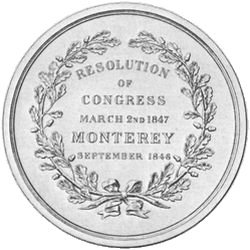
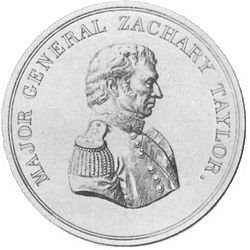
ORIGINAL DOCUMENTS.
Resolution of Congress Voting a Medal to General Taylor.
Resolved unanimously by the Senate and House of Representatives of the United States of America in Congress assembled: That the thanks of Congress are due, and are hereby tendered, to Major-General Zachary Taylor, his officers and men, for the fortitude, skill, enterprise, and courage which distinguished the late brilliant military operations at Monterey.
Resolved, That the President be requested to cause to be struck a gold medal, with devices emblematical of this splendid achievement, and presented to General Taylor as a testimony of the high sense entertained by Congress for his judicious and distinguished conduct on that memorable occasion.
Resolved, That the President of the United States be further requested to cause swords, with suitable devices, to be presented to Major-General Butler, Major-General Henderson, and to Brigadier-General Quitman, in testimony of the high sense entertained by Congress of their gallantry and good conduct in storming Monterey.
Resolved, That the President of the United States be further requested to present a sword, with suitable devices, to the nearest male relative of Brigadier-General Hamer, and to communicate to him the deep regret which Congress feels for the loss of a gallant man, whose name ought to live in the recollection and affection of a grateful country.
Resolved, That the President of the United States be requested to cause the foregoing resolutions to be communicated to General Taylor, and through him, to the army under his command.
Approved March 2d, 1847.
General Taylor to the Adjutant-General of the Army.
Head-Quarters, Army of Occupation, Camp Near Monterey, October 9, 1846. To The Adjutant-General of the Army, Washington, D. C.
Sir: I have now the honor to submit a detailed report of the recent operations before Monterey, resulting in the capitulation of that city.
The information received on the route from Seralvo, and particularly the continual appearance in our front of the Mexican cavalry, which had a slight skirmish with our advance at the village of Ramas, induced the belief, as we approached Monterey, that the enemy would defend that place. Upon reaching the neighborhood of the city, on the morning of the 19th of September, this belief was fully confirmed. It was ascertained that he occupied the town in force; that a large work had been constructed commanding all the northern approaches; and that the Bishop's Palace, and some heights in its vicinity near the Saltillo road, had also been fortified and occupied with troops and artillery. It was known, from information previously received, that the eastern approaches were commanded by several small works in the lower edge of the city.
The configuration of the heights and gorges in the direction of the Saltillo road, as visible from the point attained by our advance on the morning of the 19th, led me to suspect that it was practicable to turn all the works in that direction, and thus cut the enemy's line of communication. After establishing my camp at the "Walnut Springs," three miles from Monterey, the nearest suitable position, it was, accordingly, my first care to order a close reconnoissance of the ground in question, which was executed on the evening of the 19th by the engineer officers, under the direction of Major Mansfield. A reconnoissance of the eastern approaches was at the same time made by Captain Williams, Topographical Engineer. The examination made by Major Mansfield proved the entire practicability of throwing forward a column to the Saltillo road, and thus turning the position of the enemy. Deeming this to be an operation of essential importance, orders were given to Brevet Brigadier-General Worth, commanding the second division, to march with his command on the 20th; to turn the hill of the Bishop's Palace; to occupy a position on the Saltillo road, and to carry the enemy's detached works in that quarter, where practicable. The first regiment of Texas mounted volunteers, under command of Colonel Hays, was associated with the second division on this service. Captain Sanders, Engineers, and Lieutenant Meade, Topographical Engineers, were also ordered to report to General Worth for duty with his column.
At 2 o'clock p.m., on the 20th, the second division took up its march. It was soon discovered by officers who were reconnoitering the town, and communicated to General Worth, that its movement had been perceived, and that the enemy was throwing reinforcements towards the Bishop's Palace and the height which commands it. To divert his attention as far as practicable, the first division, under Brigadier-General Twiggs, and the field division of volunteers, under Major-General Butler, were displayed in front of the town until dark. Arrangements were made at the same time to place in battery during the night, at a suitable distance from the enemy's main work, the citadel, two twenty-four pounder howitzers, and a ten-inch mortar, with a view to open a fire on the following day, when I proposed to make a diversion in favor of General Worth's movement. The 4th Infantry covered this battery during the night. General Worth had, in the mean time, reached and occupied for the night a defensive position just without range of a battery above the Bishop's Palace, having made a reconnoissance as far as the Saltillo road.
Before proceeding to report the operations of the 21st and following days, I beg leave to state that I shall mention in detail only those which were conducted against the eastern extremity of the city, or elsewhere, under my immediate direction, referring you for the particulars of General Worth's operations, which were entirely detached, to his own full report.
Early on the morning of the 21st, I received a note from General Worth, written at half-past nine o'clock the night before, suggesting what I had already intended, a strong diversion against the centre and left of the town, to favor his enterprise against the heights in rear. The infantry and artillery of the first division, and the field division of volunteers, were ordered under arms and took the direction of the city, leaving one company of each regiment as a camp guard. The 2d Dragoons, under Lieutenant-Colonel May, and Colonel Wood's regiment of Texas mounted volunteers, under the immediate direction of General Henderson, were directed to the right to support General Worth, if necessary, and to make an impression, if practicable, upon the upper quarter of the city. Upon approaching the mortar battery, the 1st and 3d regiments of infantry and battalion of Baltimore and Washington volunteers, with Captain Bragg's field battery, the whole under the command of Lieutenant-Colonel Garland, were directed toward the lower part of the town, with orders to make a strong demonstration, and carry one of the enemy's advanced works, if it could be done without too heavy loss. Major Mansfield, Engineers, and Captain Williams and Lieutenant Pope, Topographical Engineers, accompanied this column, Major Mansfield being charged with its direction and the designation of points of attack. In the meantime the mortar, served by Captain Ramsay, of the Ordnance, and the howitzer battery under Captain Webster, 1st Artillery, had opened their fire upon the citadel, which was deliberately sustained, and answered from the work. General Butler's division had now taken up a position in rear of this battery, when the discharges of artillery, mingled finally with a rapid fire of small arms, showed that Lieutenant-Colonel Garland's command had become warmly engaged. I now deemed it necessary to support this attack, and accordingly ordered the 4th Infantry and three regiments of General Butler's division, to march at once by the left flank in the direction of the advanced work at the lower extremity of the town, leaving one regiment (1st Kentucky) to cover the mortar and howitzer battery. By some mistake two companies of the 4th Infantry did not receive this order, and consequently did not join the advance companies until some time afterward.
Lieutenant-Colonel Garland's command had approached the town in a direction to the right of the advanced work (No. 1) at the northeastern angle of the city, and the engineer officer, covered by skirmishers, had succeeded in entering the suburbs and gaining cover. The remainder of this command now advanced and entered the town under a fire of artillery from the citadel and the works on the left, and of musketry from the houses and small works in front. A movement to the right was attempted with a view to gain the rear of No. 1, and carry that work, but the troops were so much exposed to a fire which they could not effectually return, and had already sustained such severe loss, particularly in officers, that it was deemed best to withdraw them to a more secure position. Captain Backus, 1st Infantry, however, with a portion of his own and other companies, had gained the roof of a tannery, which looked directly into the gorge of No. 1, and from which he poured a most destructive fire into that work and upon the strong building in its rear. This fire happily coincided in point of time with the advance of a portion of the volunteer division upon No. 1, and contributed largely to the fall of that strong and important work.
The three regiments of the volunteer division, under the immediate command of Major-General Butler, had in the mean time advanced in the direction of No. 1. The leading brigade, under Brigadier-General Quitman, continued its advance upon that work, preceded by three companies of the 4th Infantry, while General Butler, with the first Ohio regiment, entered the town to the right. The companies of the 4th Infantry had advanced within short range of the work, when they were received by a fire that almost, in one moment, struck down one-third of the officers and men, and rendered it necessary to retire and effect a conjunction with the two other companies then advancing. General Quitman's brigade, though suffering most severely, particularly in the Tennessee regiment, continued its advance, and finally carried the work in handsome style, as well as the strong building in its rear. Five pieces of artillery, a considerable supply of ammunition, and thirty prisoners, including three officers, fell into their hands. Major-General Butler, with the 1st Ohio regiment, after entering the edge of the town, discovered that nothing was to be accomplished in his front, and at this point, yielding to the suggestions of several officers, I ordered a retrograde movement; but learning almost immediately from one of my staff that the battery No. 1 was in our possession, the order was countermanded; and I determined to hold the battery and defences already gained. General Butler, with the 1st Ohio regiment, then entered the town at a point farther to the left, and marched in the direction of the battery No. 2. While making an examination, with a view to ascertain the possibility of carrying this second work by storm, the general was wounded and soon after compelled to quit the field. As the strength of No. 2 and the heavy musketry fire flanking the approach rendered it impossible to carry it without great loss, the 1st Ohio regiment was withdrawn from the town.
Fragments of the various regiments engaged were now under cover of the captured battery, and some buildings in its front, and on the right. The field batteries of Captains Bragg and Ridgely were also partially covered by the battery. An incessant fire was kept up on this position from battery No. 2, and other works on its right, and from the citadel on all our approaches. General Twiggs, though quite unwell, joined me at this point, and was instrumental in causing the artillery captured from the enemy to be placed in battery, and served by Captain Ridgely against No. 2, until the arrival of Captain Webster's howitzer battery, which took its place. In the mean time, I directed such men as could be collected of the 1st, 3d, and 4th regiments, and Baltimore battalion, to enter the town, penetrating to the right, and carry the 2d battery if possible. This command, under Lieutenant-Colonel Garland, advanced beyond the bridge "Purisima," when, finding it impracticable to gain the rear of the 2d battery, a portion of it sustained themselves for some time in that advanced position; but as no permanent impression could be made at that point, and the main object of the general operation had been effected, the command, including a section of Captain Ridgely's battery, which had joined it, was withdrawn to battery No. 1. During the absence of this column, a demonstration of cavalry was reported in the direction of the citadel. Captain Bragg, who was at hand, immediately galloped with his battery to a suitable position, from which a few discharges effectually dispersed the enemy. Captain Miller, 1st Infantry, was dispatched with a mixed company to support the battery on this service. The enemy's lancers had previously charged upon the Ohio and a part of the Mississippi regiment, near some fields at a distance from the edge of the town, and had been repulsed with a considerable loss. A demonstration of cavalry on the opposite side of the river was also dispersed in the course of the afternoon by Captain Ridgely's battery, and the squadrons returned to the city. At the approach of evening, all the troops that had been engaged were ordered back to camp, except Captain Ridgely's battery, and the regular infantry of the first division, who were detailed as a guard for the works during the night, under command of Lieutenant-Colonel Garland. One battalion of the 1st Kentucky regiment was ordered to reinforce this command. Intrenching tools were procured, and additional strength was given to the works, and protection to the men, by working parties during the night, under the direction of Lieutenant Scarritt, Engineers.