LIST OF PLATES. (continued 9)
Reading edition
To prepare for an assault, it was foreseen that the play of the batteries might run into the second day; but recent captures had not only trebled our siege-pieces, but also our ammunition; and we knew that we should greatly augment both by carrying the place. I was, therefore, in no haste in ordering an assault before the works were well crippled by our missiles.
The bombardment and cannonade, under the direction of Captain Huger, were commenced early in the morning of the 12th. Before nightfall, which necessarily stopped our batteries, we had perceived that a good impression had been made on the castle and its outworks, and that a large body of the enemy had remained outside, towards the city, from an early hour to avoid our fire, and to be at hand on its cessation, in order to re-enforce the garrison against an assault. The same outside force was discovered the next morning, after our batteries had re-opened upon the castle, by which we again reduced its garrison to the minimum needed for the guns.
Pillow and Quitman had been in position since early in the night of the 11th. Major-General Worth was now ordered to hold his division in reserve, near the foundry, to support Pillow; and Brigadier-General Smith, of Twiggs' division, had just arrived with his brigade from Piedad (two miles), to support Quitman. Twiggs' guns, before the southern gates, again reminded us, as the day before, that he, with Riley's brigade, and Taylor's and Steptoe's batteries, was in activity, threatening the southern gates, and there holding a great part of the Mexican army on the defensive.
Worth's division furnished Pillow's attack with an assaulting party of some two hundred and fifty volunteer officers and men, under Captain McKenzie, of the 2d Artillery; and Twiggs' division supplied a similar one, commanded by Captain Casey, 2d Infantry, to Quitman. Each of these little columns was furnished with scaling ladders.
The signal I had appointed for the attack was the momentary cessation of fire on the part of our heavy batteries. About 8 o'clock in the morning of the 13th, judging that the time had arrived by the effect of the missiles we had thrown, I sent an aid-de-camp to Pillow, and another to Quitman, with notice that the concerted signal was about to be given. Both columns now advanced with an alacrity that gave assurance of prompt success. The batteries, seizing opportunities, threw shots and shells upon the enemy over the heads of our men, with good effect, particularly at every attempt to re-enforce the works from without to meet our assault.
Major-General Pillow's approach, on the west side, lay through an open grove, filled with sharp-shooters, who were speedily dislodged; when being up with the front of the attack, and emerging into open space, at the foot of a rocky acclivity, that gallant leader was struck down by an agonizing wound. The immediate command devolved on Brigadier-General Cadwallader, in the absence of the senior brigadier (Pierce) of the same division, an invalid since the events of August 19. On a previous call of Pillow, Worth had just sent him a re-enforcement, Colonel Clarke's brigade.
The broken acclivity was still to be ascended, and a strong redoubt, midway, to be carried, before reaching the castle on the heights. The advance of our brave men, led by brave officers, though necessarily slow, was unwavering, over rocks, chasms, and mines, and under the hottest fire of cannon and musketry. The redoubt now yielded to resistless valor, and the shouts that followed announced to the castle the fate that impended. The enemy were steadily driven from shelter to shelter. The retreat allowed no time to fire a single mine, without the certainty of blowing up friend and foe. Those who at a distance attempted to apply matches to the long trains, were shot down by our men. There was death below, as well as above ground. At length the ditch and wall of the main work was reached; the scaling ladders were brought up and planted by the storming parties; some of the daring spirits first in the assault were cast down, killed or wounded; but a lodgment was soon made; streams of heroes followed; all opposition was overcome, and several of our regimental colors flung out from the upper walls, amidst long-continued shouts and cheers, which sent dismay into the capital. No scene could have been more animating or glorious.
Major-General Quitman, nobly supported by Brigadier-Generals Shields and Smith, (P. F.,) his other officers and men, was up with the part assigned him. Simultaneously with the movement on the west, he had gallantly approached the southeast of the same works, over a causeway with cuts and batteries, and defended by an army strongly posted outside, to the east of the works. Those formidable obstacles Quitman had to face, with but little shelter for his troops or space for manœuvring. Deep ditches flanked the causeway, made it difficult to cross on either side into the adjoining meadows, and these again were intersected by other ditches. Smith and his brigade had been early thrown out to make a sweep to the right, in order to present a front against the enemy's lines, (outside,) and to turn two intervening batteries near the foot of Chapultepec. This movement was also intended to support Quitman's storming parties, both on the causeway. The first of these, furnished by Twiggs' division, was commanded in succession by Captain Casey, 2d Infantry, and Captain Paul, 7th Infantry, after Casey had been severely wounded; and the second, originally under the gallant Major Twiggs, Marine Corps, killed, and then Captain Miller, 2d Pennsylvania Volunteers. The storming party, now commanded by Captain Paul, seconded by Captain Roberts, of the Rifles, Lieutenant Stewart, and others of the same regiment, Smith's brigade, carried the two batteries in the road, took some guns, with many prisoners, and drove the enemy posted behind in support. The New York and South Carolina Volunteers (Shields' brigade) and the 2d Pennsylvania Volunteers, all on the left of Quitman's line, together with portions of his storming parties, crossed the meadows in front, under a heavy fire, and entered the outer enclosure of Chapultepec just in time to join in the final assault from the west.
Besides Major-Generals Pillow and Quitman, Brigadier-Generals Shields, Smith, and Cadwallader, the following are the officers and corps most distinguished in those brilliant operations: The Voltigeur regiment in two detachments, commanded respectively by Colonel Andrews and Lieutenant-Colonel Johnstone, the latter mostly in the lead, accompanied by Major Caldwell; Captains Barnard and Biddle, of the same regiment, the former the first to plant a regimental color, and the latter among the first in the assault; the storming party of Worth's division, under Captain McKenzie, 2d Artillery, with Lieutenant Selden, 8th Infantry, early on the ladder and badly wounded; Lieutenant Armistead, 6th Infantry, the first to leap into the ditch to plant a ladder; Lieutenants Rodgers of the 4th, and J. P. Smith of the 5th Infantry, both mortally wounded; the 9th Infantry, under Colonel Ransom, who was killed while gallantly leading that gallant regiment, the 15th Infantry, under Lieutenant-Colonel Howard and Major Woods, with Captain Chase, whose company gallantly carried the redoubt, midway up the acclivity; Colonel Clarke's brigade (Worth's division) consisting of the 5th, 8th, and part of the 6th regiments of Infantry, commanded respectively by Captain Chapman, Major Montgomery, and Lieutenant Edward Johnson, the latter specially noticed, with Lieutenants Longstreet (badly wounded, advancing, colors in hand), Pickett, and Merchant, the last three of the 8th Infantry; portions of the United States marines, New York, South Carolina, and 2d Pennsylvania Volunteers, which, delayed with their division (Quitman's) by the hot engagement below, arrived just in time to participate in the assault of the heights, particularly a detachment under Lieutenant Reid, New York Volunteers, consisting of a company of the same, with one of marines; and another detachment, a portion of the storming party, (Twiggs' division, serving with Quitman,) under Lieutenant Steele, 2d Infantry, after the fall of Lieutenant Gantt, 7th Infantry.
In this connection, it is but just to recall the decisive effect of the heavy batteries, Nos. 1, 2, 3 and 4, commanded by those excellent officers, Captain Drum, 4th Artillery, assisted by Lieutenants Benjamin and Porter of his own company; Captain Brooks and Lieutenant Anderson, 2d Artillery, assisted by Lieutenant Russell, 4th Infantry, a volunteer; Lieutenants Hagner and Stone of the Ordnance, and Lieutenant Andrews, 3d Artillery; the whole superintended by Captain Huger, chief of Ordnance with this army, an officer distinguished by every kind of merit. The mountain howitzer battery, under Lieutenant Reno, of the Ordnance, deserves, also, to be particularly mentioned. Attached to the Voltigeurs, it followed the movements of that regiment, and again won applause.
In adding to the list of individuals of conspicuous merit, I must limit myself to a few of the many names which might be enumerated. Captain Hooker, assistant adjutant-general, who won special applause, successively, in the staff of Pillow and Cadwallader; Lieutenant Lovell, 4th Artillery (wounded), chief of Quitman's staff; Captain Page, assistant adjutant-general (wounded), and Lieutenant Hammond, 3d Artillery, both of Shields' staff, and Lieutenant Van Dorn (17th Infantry), aid-de-camp to Brigadier-General Smith.
Those operations all occurred on the west, southeast, and heights of Chapultepec. To the north and at the base of the mound, inaccessible on that side, the 11th Infantry, under Lieutenant-Colonel Hebert, the 14th, under Colonel Trousdale, and Captain Magruder's field battery, 1st Artillery: one section advanced under Lieutenant Jackson, all of Pillow's division, had, at the same time, some spirited affairs against superior numbers, driving the enemy from a battery in the road, and capturing a gun. In these, the officers and corps named gained merited praise. Colonel Trousdale, the commander, though twice wounded, continued on duty until the heights were carried.
Early in the morning of the 13th, I repeated the orders of the night before to Major-General Worth, to be, with his division, at hand to support the movement of Major-General Pillow from our left. The latter seems soon to have called for that entire division, standing momentarily in reserve, and Worth sent him Colonel Clarke's brigade. The call, if not unnecessary, was at least, from the circumstances, unknown to me at the time; for, soon observing that the very large body of the enemy, in the road in front of Major-General Quitman's right, was receiving re-enforcements from the city, less than a mile and a half to the east, I sent instructions to Worth, on our opposite flank, to turn Chapultepec with his division, and to proceed cautiously by the road at its northern base, in order, if not met by very superior numbers, to threaten or to attack, in rear, that body of the enemy. The movement, it was also believed, could not fail to distract and to intimidate the enemy generally.
Worth promptly advanced with his remaining brigade, Colonel Garland's, Lieutenant-Colonel C. F. Smith's light battalion, Lieutenant-Colonel Duncan's field battery, all of his division, and three squadrons of dragoons, under Major Sumner, which I had just ordered up to join in the movement.
Having turned the forest on the west, and arriving opposite to the north centre of Chapultepec, Worth came up with the troops in the road, under Colonel Trousdale, and aided, by a flank movement of a part of Garland's brigade, in taking the one gun breastwork, then under the fire of Lieutenant Jackson's section of Captain Magruder's field battery. Continuing to advance, this division passed Chapultepec, attacking the right of the enemy's line, resting on that road, about the moment of the general retreat consequent upon the capture of the formidable castle and its outworks.
Arriving some minutes later, and mounting to the top of the castle, the whole field to the east lay plainly under my view.
There are two routes from Chapultepec to the capital, the one on the right entering the same gate, Belen, with the road from the south, via Piedad; and the other obliquing to the left, to intersect the great western or San Cosmo road, in a suburb outside of the gate of San Cosmo.
Each of these routes (an elevated causeway) presents a double roadway on the sides of an aqueduct of strong masonry and great height, resting on open arches and massive pillars, which together afford fine points both for attack and defence. The sideways of both aqueducts are, moreover, defended by many strong breastworks at the gates, and before reaching them. As we had expected, we found the four tracks unusually dry and solid for the season.
Worth and Quitman were prompt in pursuing the retreating enemy, the former by the San Cosmo aqueduct, and the latter along that of Belen. Each had now advanced some hundred yards.
Deeming it all important to profit by our successes, and the consequent dismay of the enemy, which could not be otherwise than general, I hastened to dispatch from Chapultepec, first Clarke's brigade, and then Cadwallader's, to the support of Worth, and gave orders that the necessary heavy guns should follow. Pierce's brigade was, at the same time, sent to Quitman, and, in the course of the afternoon, I caused some additional siege pieces to be added to his train. Then, after designating the 15th Infantry, under Lieutenant-Colonel Howard (Morgan, the Colonel, had been disabled by a wound at Churubusco), as the garrison of Chapultepec, and giving directions for the care of the prisoners of war, the captured ordnance and ordnance stores, I proceeded to join the advance of Worth, within the suburb, and beyond the turn at the junction of the aqueduct with the great highway from the west to the gate of San Cosmo.
At this junction of roads, we first passed one of these formidable systems of city defences, spoken of above, and it had not a gun! a strong proof, 1. That the enemy had expected us to fail in the attack upon Chapultepec, even if we meant anything more than a feint; 2. That, in either case, we designed, in his belief, to return and double our forces against the southern gates: a delusion kept up by the active demonstration of Twiggs and the forces posted on that side; and, 3. That advancing rapidly from the reduction of Chapultepec, the enemy had not time to shift guns—our previous captures had left him, comparatively, but few—from the southern gates.
Within those disgarnished works, I found our troops engaged in a street fight against the enemy posted in gardens, at windows, and on house-tops, all flat, with parapets. Worth ordered forward the mountain howitzers of Cadwallader's brigade, preceded by skirmishers and pioneers with pickaxes and crowbars, to force windows and doors, or to burrow through walls. The assailants were soon in an equality of position fatal to the enemy. By eight o'clock in the evening, Worth had carried two batteries in this suburb. According to my instructions, he here posted guards and sentinels, and placed his troops under shelter for the night. There was but one more obstacle, the San Cosmo gate, (custom-house,) between him and the great square in front of the cathedral and palace, the heart of the city; and that barrier it was known could not, by daylight, resist our siege guns thirty minutes.
I had gone back to the foot of Chapultepec, the point from which the two aqueducts begin to diverge, some hours earlier, in order to be near that new depot, and in easy communication with Quitman and Twiggs, as well as with Worth.
From this point I ordered all detachments and stragglers to their respective corps, then in advance; sent to Quitman additional siege guns, ammunition, intrenching tools; directed Twiggs' remaining brigade, Riley's from Piedad, to support Worth, and Captain Steptoe's field battery, also at Piedad, to rejoin Quitman's division.
I had been, from the first, well aware that the western or San Cosmo, was the less difficult route to the centre, and conquest of the capital, and therefore intended that Quitman should only manœuvre and threaten the Belen or southwestern gate, in order to favor the main attack by Worth, knowing that the strong defences at the Belen were directly under the guns of the much stronger fortress, called the citadel, just within. Both of these defences of the enemy were also within easy supporting distance from San Angel (or Nino Perdido) and San Antonio gates. Hence the greater support, in numbers, given to Worth's movement as the main attack.
These views I repeatedly, in the course of the day, communicated to Major-General Quitman; but being in hot pursuit, gallant himself, and ably supported by Brigadier-Generals Shields and Smith, Shields badly wounded before Chapultepec, and refusing to retire, as well as by all the officers and men of the column, Quitman continued to press forward, under flank and direct fires, carried an intermediate battery of two guns, and then the gate, before two o'clock in the afternoon, but not without proportionate loss, increased by his steady maintenance of that position.
Here, of the heavy battery, (4th Artillery,) Captain Drum and Lieutenant Benjamin were mortally wounded, and Lieutenant Porter, its third in rank, slightly. The loss of those two most distinguished officers the army will long mourn. Lieutenants J. B. Morange and William Canty, of the South Carolina Volunteers, also of high merit, fell on the same occasion, besides many of our bravest non-commissioned officers and men, particularly in Captain Drum's veteran company. I cannot, in this place, give names or numbers; but full returns of the killed and wounded, of all corps, in their recent operations, will accompany this report.
Quitman within the city, adding several new defences to the position he had won, and sheltering his corps as well as practicable, now awaited the return of daylight under the guns of the formidable citadel, yet to be subdued.
About 4 o'clock next morning (September 14th) a deputation of the ayuntamiento (city council) waited upon me to report that the federal government and the army of Mexico had fled from the capital some three hours before; and to demand terms of capitulation in favor of the church, the citizens, and the municipal authorities. I promptly replied that I would sign no capitulation; that the city had been virtually in our possession from the time of the lodgments effected by Worth and Quitman the day before; that I regretted the silent escape of the Mexican army; that I should levy upon the city a moderate contribution, for special purposes; and that the American army should come under no terms not self-imposed: such only as its own honor, the dignity of the United States, and the spirit of the age, should, in my opinion, imperiously demand and impose.
For the terms, so imposed, I refer the department to subsequent General Orders, Nos. 287 and 289 (paragraphs 7, 8, and 9 of the latter), copies of which are herewith enclosed.
At the termination of the interview with the city deputation, I communicated, about daylight, orders to Worth and Quitman to advance slowly and cautiously (to guard against treachery) towards the heart of the city, and to occupy its stronger and more commanding points. Quitman proceeded to the great plaza or square, planted guards, and hoisted the colors of the United States on the national palace, containing the halls of Congress and executive departments of Federal Mexico. In this grateful service Quitman might have been anticipated by Worth, but for my express orders, halting the latter at the head of the Alameda (a green park), within three squares of that goal of general ambition. The capital, however, was not taken by any one or two corps, but by the talent, the science, the gallantry, the prowess of this entire army. In the glorious conquest all had contributed, early and powerfully, the killed, the wounded, and the fit for duty, at Vera Cruz, Cerro-Gordo, Contreras, San Antonio, Churubusco, (three battles,) the Molinos del Rey, and Chapultepec, as much as those who fought at the gates of Belen and San Cosmo.
Soon after we had entered, and were in the act of occupying the city, a fire was opened upon us from the flat roofs of the houses, from windows and corners of streets, by some two thousand convicts, liberated the night before by the flying government, joined by perhaps as many Mexican soldiers, who had disbanded themselves and thrown off their uniforms. This unlawful war lasted more than twenty-four hours, in spite of the exertions of the municipal authorities, and was not put down till we had lost many men, including several officers, killed or wounded, and had punished the miscreants. Their objects were to gratify national hatred, and in the general alarm and confusion, to plunder the wealthy inhabitants, particularly the deserted houses. But families are now generally returning; business of every kind has been resumed, and the city is already tranquil and cheerful, under the admirable conduct (with exceptions very few and trifling) of our gallant troops.
This army has been more disgusted than surprised that by some sinister process on the part of certain individuals at home, its numbers have been, generally, almost trebled in our public papers, beginning at Washington.
Leaving, as we all feared, inadequate garrisons at Vera Cruz, Perote, and Puebla, with much larger hospitals; and being obliged, most reluctantly, from the same cause (general paucity of numbers) to abandon Jalapa, we marched (August 7-10) from Puebla with only 10,738 rank and file. This number includes the garrison of Jalapa, and the 2,429 men brought up by Brigadier-General Pierce, August 6.
At Contreras, Churubusco, etc. (August 20), we had but 8,497 men engaged, after deducting the garrison of San Augustin (our general depot), the intermediate sick and the dead; at the Molinos del Rey (September 8), but three brigades, with some cavalry and artillery, making in all 3,251 men, were in battle; in the two days, September 12th and 13th, our whole operating force, after deducting again the recent killed, wounded, and sick, together with the garrison of Miscoac (the then general depot) and that of Tacubaya, was but 7,180; and, finally, after deducting the new garrison of Chapultepec, with the killed and wounded of the two days, we took possession (September 14th) of this great capital with less than 6,000 men. And I re-assert, upon accumulated and unquestionable evidence, that, in not one of those conflicts was this army opposed by fewer than three and a half times its numbers, in several of them, by a yet greater excess. I recapitulate our losses since we arrived in the basin of Mexico.
August 19-20. Killed, 137, including 14 officers. Wounded, 877, including 62 officers. Missing (probably killed), 38 rank and file. Total 1,052.
September 8. Killed, 116, including 9 officers. Wounded, 665, including 49 officers. Missing, 18 rank and file. Total 789.
September 12, 13, 14. Killed, 130, including 10 officers. Wounded, 703, including 68 officers. Missing, 29 rank and file. Total 862.
Grand total of losses, 2,703, including 383 officers.
On the other hand, this small force has beaten on the same occasions in view of their capital, the whole Mexican army, of (at the beginning) thirty odd thousand men; posted always in chosen positions, behind intrenchments, or more formidable defences of nature and art; killed or wounded, of that number, more than 7,000 officers and men; taken 3,730 prisoners, one-seventh officers, including 13 generals, of whom 3 have been presidents of this republic; captured more than 20 colors and standards, 75 pieces of ordnance, besides 57 wall pieces, 20,000 small arms, an immense quantity of shots, shells, powder, &c., &c.
Of that enemy, once so formidable in numbers, appointments, artillery, &c., twenty odd thousand have disbanded themselves in despair, leaving, as is known, not more than three fragments, the largest about 2,500, now wandering in different directions, without magazines or a military chest, and living at free quarters upon their own people.
General Santa Anna, himself a fugitive, is believed to be on the point of resigning the chief magistracy, and escaping to neutral Guatemala. A new president, no doubt, will soon be declared, and the federal Congress is expected to reassemble at Queretaro, 125 miles north of this, on the Zacatecas road, some time in October. I have seen and given safe conduct through this city to several of its members. The government will find itself without resources; no army, no arsenals, no magazines, and but little revenue, internal or external. Still, such is the obstinacy, or rather infatuation, of this people, that it is very doubtful whether the new authorities will dare to sue for peace on terms which in the recent negotiations were made known by our minister.
In conclusion, I beg to enumerate, once more, with due commendation and thanks, the distinguished staff officers, general and personal, who, in our last operations in front of the enemy, accompanied me, and communicated orders to every point and through every danger. Lieutenant-Colonel Hitchcock, Acting Inspector-General, Major Turnbull and Lieutenant Hardcastle, Topographical Engineers; Major Kirby, Chief Paymaster; Captain Irwin, Chief Quartermaster; Captain Grayson, Chief Commissary; Captain H. L. Scott, Chief in the Adjutant-General's Department; Lieutenant Williams, Aid-de-Camp; Lieutenant Lay, Military Secretary; and Major J. P. Gaines, Kentucky Cavalry, volunteer Aid-de-Camp; Captain Lee, Engineer, so constantly distinguished, also bore important orders from me (September 13), until he fainted from a wound and the loss of two nights' sleep at the batteries. Lieutenants Beauregard, Stevens and Tower, all wounded, were employed with the divisions, and Lieutenants G. W. Smith and G. B. McClellan, with the company of sappers and miners. Those fine Lieutenants of Engineers, like their Captain, won the admiration of all about them. The ordnance officers, Captain Huger, Lieutenants Hagner, Stone, and Reno, were highly effective, and distinguished at the several batteries; and I must add that Captain McKinstry, Assistant Quartermaster, at the close of the operations, executed several important commissions for me as a special volunteer.
Surgeon-General Lawson, and the medical staff generally, were skillful and untiring, in and out of fire, in ministering to the numerous wounded.
To illustrate the operations in this basin, I enclose two beautiful drawings, prepared under the directions of Major Turnbull, mostly from actual surveys.
I have the honor to be, Sir, with high respect, your most obedient servant, Winfield Scott.
General Orders No. 286.
Head-quarters of the Army, National Palace of Mexico, September, 1847.
The general-in-chief calls upon his brethren in arms to return, both in public and in private worship, thanks and gratitude to God for the signal triumphs which they have recently achieved for their country.
Beginning with the 19th of August, and ending the 14th instant, this army has gallantly fought its way through the fields and forts of Contreras, San Antonio, Churubusco, Molinos del Rey, Chapultepec, and the gates of San Cosmo and Tacubaya or Belen, into the capital of Mexico.
When the very limited numbers who have performed those brilliant deeds shall have become known, the whole world will be astonished, and our own countrymen filled with joy and admiration.
But all is not yet done. The enemy, though scattered and dismayed, has still many fragments of his late army hovering about us, and aided by an exasperated population, he may again reunite in treble our numbers, and fall upon us to advantage if we rest inactive on the security of past victories.
Compactness, vigilance, and discipline are, therefore, our only securities. Let every good officer and man look to those cautions and enjoin them upon all others.
By command of Major-General Scott, H. L. Scott, Acting Adjutant-General.
Plate LXIV. No. 63.
February 22 and 23, 1847.
Major General Zachary Taylor, etc. ℞. Buena Vista Feb 22. &. 23. 1847.
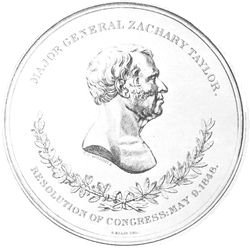
MAJOR-GENERAL ZACHARY TAYLOR.
[Victory of Buena Vista.]
MAJOR GENERAL ZACHARY TAYLOR. RESOLUTION OF CONGRESS: MAY 9. 1848. Undraped bust of General Taylor, facing the right; underneath, branches of oak and laurel, S. ELLIS. DEL. (delineavit.) C. C. WRIGHT. F. (fecit).
BUENA VISTA FEB. 22. & 23. 1847. Within a circle formed by two serpents, one of which is a rattlesnake, the American army, commanded by General Taylor, is repulsing the attack of the Mexicans. Beneath are branches of cactus and oak. F. A. SMITH DEL. (delineavit..) C. C. WRIGHT SCULP. (sculpsit).
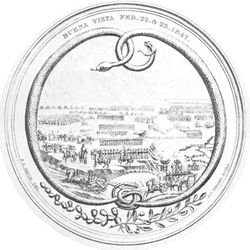
Frederic Augustus Smith was graduated at West Point as second lieutenant of engineers, July 1, 1833. He was appointed captain, July, 1838, and died in Washington, District of Columbia, October 16, 1852. He designed the reverse of the medal to Major-General Taylor for Buena Vista.
ORIGINAL DOCUMENTS.
Resolution of Congress Voting a Medal to General Taylor.
Resolved unanimously by the Senate and House of Representatives of the United States of America in Congress assembled: That the thanks of Congress are due, and they are hereby tendered to Major-General Zachary Taylor, and, through him, to the officers and soldiers of the regular army and of the volunteers under his command, for their valor, skill, and good conduct, conspicuously displayed, on the twenty-second and twenty-third days of February last, in the battle of Buena Vista, in defeating a Mexican army of more than four times their number, consisting of chosen troops, under their favorite commander, General Santa Anna.
Resolved, That the President of the United States be requested to cause to be struck a gold medal, with devices emblematical of this splendid achievement, and presented to Major-General Zachary Taylor, as a testimony of the high sense entertained by Congress of his judicious and distinguished conduct on that memorable occasion.
Resolved, That the President of the United States be requested to cause the foregoing resolutions to be communicated to Major-General Taylor in such terms as he may deem best calculated to give effect to the object thereof.
Approved May 9, 1848.
General Taylor to the Adjutant-General of the Army.
To Headquarters, Army of Occupation, Agua Nueva, March 6, 1847. To The Adjutant-General of the Army, Washington, D. C.
Sir: I have the honor to submit a detailed report of the operations of the forces under my command, which resulted in the engagement of Buena Vista, the repulse of the Mexican army, and the re-occupation of this position.
The information which reached me of the advance and concentration of a heavy Mexican force in my front, had assumed such a probable form, as to induce a special examination far beyond the reach of our pickets to ascertain its correctness. A small party of Texan spies, under Major McCulloch, dispatched to the hacienda of Encarnacion, thirty miles from this, on the route to San Louis Potosi, had reported a cavalry force of unknown strength at that place. On the 20th of February, a strong reconnoissance under Lieutenant-Colonel May was dispatched to the hacienda of Heclionda, while Major McCulloch made another examination of Encarnacion. The result of these expeditions left no doubt that the enemy was in large force at Encarnacion, under the orders of General Santa Anna, and that he meditated a forward movement, and attack upon our position.
As the camp of Agua Nueva could be turned on either flank, and as the enemy's force was greatly superior to our own, particularly in the arm of cavalry, I determined, after much consideration, to take up a position about eleven miles in rear, and there await the attack. The army broke up its camp and marched at noon on the 21st, encamping at the new position a little in front of the hacienda of Buena Vista. With a small force I proceeded to Saltillo, to make some necessary arrangements for the defence of the town, leaving Brigadier-General Wool in the immediate command of the troops.
Before those arrangements were completed, on the morning of the 22d, I was advised that the enemy was in sight, advancing. Upon reaching the ground, it was found that his cavalry advance was in our front, having marched from Encarnacion, as we have since learned, at eleven o'clock on the day previous, and driving in a mounted force, left Agua Nueva to cover the removal of public stores. Our troops were in position, occupying a line of remarkable strength. The road at this point becomes a narrow defile, the valley on its right being rendered quite impracticable for artillery by a system of deep and impassable gullies, while on the left a succession of rugged ridges and precipitous ravines extends far back toward the mountain which bounds the valley. The features of the ground were such as nearly to paralyze the artillery and cavalry of the enemy, while his infantry could not derive all the advantages of its numerical superiority. In this position we prepared to receive him. Captain Washington's battery (4th Artillery) was posted to command the road, while the 1st and 2d Illinois regiments, under Colonels Hardin and Bissell, each eight companies (to the latter of which was attached Captain Conner's company of Texas Volunteers), and the 2d Kentucky, under Colonel McKee, occupied the crests of the ridges on the left and in rear. The Arkansas and Kentucky regiments of cavalry, commanded by Colonels Yell and H. Marshall, occupied the extreme left near the base of the mountain, while the Indiana brigade, under Brigadier-General Lane (composed of the 2d and 3d regiments, under Colonels Bowles and Lane), the Mississippi riflemen, under Colonel Davis, the squadrons of the 1st and 2d Dragoons, under Captain Steen and Lieutenant-Colonel May, and the light batteries of Captains Sherman and Bragg, 3d Artillery, were held in reserve.
At eleven o'clock I received from General Santa Anna the following summons to surrender at discretion:
"Camp at Encantada, February 22d, 1847. "To "General Z. Taylor, "Commanding the Forces of the United States.
"God and Liberty!
"You are surrounded by 20,000 men, and cannot, in any human probability, avoid suffering a route, and being cut to pieces with your troops; but as you deserve consideration and particular esteem, I wish to save you from a catastrophe, and for that purpose give you this notice, in order that you may surrender at discretion, under the assurance that you will be treated with the consideration belonging to the Mexican character, to which end you will be granted an hour's time to make up your mind, to commence from the moment when my flag of truce arrives in your camp.
"With this view, I assure you of my particular consideration,
"Antonio Lopez de Santa Anna."
To this summons I immediately replied in these terms:
"Headquarters, Army Of Occupation, "Near Buena Vista, February 22, 1847. "Señor General Don Antonio Lopez de Santa Anna, "Commander-in-Chief, La Encantada.
"Sir: In reply to your note of this date, summoning me to surrender my forces at discretion, I beg leave to say that I decline acceding to your request.
"With high respect, I am, Sir, your obedient servant,
"Z. Taylor, "Major-General United States Army, commanding."
The enemy still forbore his attack, evidently waiting for the arrival of his rear columns, which could be distinctly seen by our look-outs as they approached the field. A demonstration made on his left caused me to detach the 2d Kentucky regiment and a section of artillery to our right, in which position they bivouacked for the night. In the mean time the Mexican light troops had engaged ours on the extreme left (composed of parts of the Kentucky and Arkansas cavalry dismounted, and a rifle battalion from the Indiana brigade, under Major Gorman, the whole commanded by Colonel Marshall), and kept up a sharp fire, climbing the mountain side, and apparently endeavoring to gain our flank. Three pieces of Captain Washington's battery had been detached to the left, and were supported by the 2d Indiana regiment. An occasional shell was thrown by the enemy into this part of our line, but without effect. The skirmishing of the light troops was kept up with trifling loss on our part until dark, when I became convinced that no serious attack would be made before the morning, and returned, with the Mississippi regiment and squadron of 2d Dragoons, to Saltillo. The troops bivouacked without fires, and laid upon their arms. A body of cavalry, some 1500 strong, had been visible all day in rear of the town, having entered the valley through a narrow pass east of the city. This cavalry, commanded by General Minon, had evidently been thrown in our rear to break up and harass our retreat, and perhaps make some attempt against the town if practicable. The city was occupied by four excellent companies of Illinois volunteers, under Major Warren of the 1st regiment. A field-work, which commanded most of the approaches, was garrisoned by Captain Webster's company, 1st Artillery, and armed with two twenty-four-pound howitzers, while the train and headquarter camp was guarded by two companies of Mississippi riflemen, under Captain Rogers, and a field-piece commanded by Captain Shover, 3d Artillery. Having made these dispositions for the protection of the rear, I proceeded on the morning of the 23d to Buena Vista, ordering forward all the other available troops. The action had commenced before my arrival on the field.
During the evening and night of the 22d, the enemy had thrown a body of light troops on the mountain side, with the purpose of outflanking our left; and it was here that the action of the 23d commenced at an early hour. Our riflemen, under Colonel Marshall, who had been re-enforced by three companies, under Major Trail, 2d Illinois Volunteers, maintained their ground handsomely against a greatly superior force, holding themselves under cover, and using their weapons with deadly effect. About eight o'clock a strong demonstration was made against the centre of our position, a heavy column moving along the road. This force was soon dispersed by a few rapid and well-directed shots from Captain Washington's battery. In the mean time the enemy was concentrating a large force of infantry and cavalry under cover of the ridges, with the obvious intention of forcing our left, which was posted on an extensive plateau. The 2d Indiana and 2d Illinois regiments formed this part of our line, the former covering three pieces of light artillery, under the orders of Captain O'Brien, Brigadier-General Lane being in the immediate command. In order to bring his men within effective range, General Lane ordered the artillery and 2d Indiana regiment forward. The artillery advanced within musket range of a heavy body of Mexican infantry, and was served against it with great effect, but without being able to check its advance. The infantry ordered to its support had fallen back in disorder, being exposed, as well as the battery, not only to a severe fire of small arms from the front, but also to a murderous cross-fire of grape and canister from a Mexican battery on the left. Captain O'Brien found it impossible to retain his position without support, but was only able to withdraw two of his pieces, all the horses and cannoneers of the third piece being killed or disabled. The 2d Indiana regiment, which had fallen back as stated, could not be rallied, and took no further part in the action, except a handful of men, who, under its gallant colonel, Bowles, joined the Mississippi regiment; and did good service, and those fugitives who, at a later period in the day, assisted in defending the train and depot at Buena Vista. This portion of our line having given way, and the enemy appearing in overwhelming force against our left flank, the light troops which had rendered such good service on the mountain were compelled to withdraw, which they did, for the most part, in good order. Many, however, were not rallied until they reached the depot at Buena Vista, to the defence of which they afterward contributed.
Colonel Bissell's regiment (2d Illinois) which had been joined by a section of Captain Sherman's battery, had become completely outflanked, and was compelled to fall back, being entirely unsupported. The enemy was now pouring masses of infantry and cavalry along the base of the mountain on our left, and was gaining our rear in great force. At this moment I arrived upon the field. The Mississippi regiment had been directed to the left before reaching the position, and immediately came into action against the Mexican infantry which had turned our flank. The 2d Kentucky regiment, and a section of artillery under Captain Bragg, had previously been ordered from the right to re-enforce our left, and arrived at a most opportune moment. That regiment, and a portion of the 1st Illinois, under Colonel Hardin, gallantly drove the enemy, and recovered a portion of the ground we had lost. The batteries of Captains Sherman and Bragg were in position on the plateau, and did much execution, not only in front, but particularly upon the masses which had gained our rear. Discovering that the enemy was heavily pressing upon the Mississippi regiment, the 3d Indiana regiment, under Colonel Lane, was despatched to strengthen that part of the line, which formed a crotchet perpendicular to the first line of battle. At the same time Lieutenant Kilburn, with a piece of Captain Bragg's battery, was directed to support the infantry there engaged. The action was, for a long time, warmly sustained at that point, the enemy making several efforts, both with infantry and cavalry, against our line, and being always repulsed with heavy loss. I had placed all the regular cavalry, and Captain Pike's squadron of Arkansas horse, under the orders of Brevet Lieutenant-Colonel May, with directions to hold in check the enemy's column, still advancing to the rear along the base of the mountain, which was done in conjunction with the Kentucky and Arkansas cavalry under Colonels Marshall and Yell.
In the mean time our left, which was still strongly threatened by a superior force, was farther strengthened by the detachment of Captain Bragg's, and a portion of Captain Sherman's batteries to that quarter. The concentration of artillery fire upon the masses of the enemy along the base of the mountain, and the determined resistance offered by the two regiments opposed to them, had created confusion in their ranks, and some of the corps attempted to effect a retreat upon their main line of battle. The squadron of the 1st Dragoons, under Lieutenant Rucker, was now ordered up the deep ravine which these retreating corps were endeavoring to cross, in order to charge and disperse them. The squadron proceeded to the point indicated, but could not accomplish the object, being exposed to a heavy fire from a battery established to cover the retreat of those corps. While the squadron was detached on this service, a large body of the enemy was observed to concentrate on our extreme left, apparently with the view of making a descent upon the hacienda of Buena Vista, where our train and baggage were deposited. Lieutenant-Colonel May was ordered to the support of that point, with two pieces of Captain Sherman's battery under Lieutenant Reynolds. In the mean time, the scattered forces near the hacienda, composed in part of Majors Trail and Gorman's commands, had been, to some extent, organized under the advice of Major Munroe, chief of artillery, with the assistance of Major Morrison, volunteer staff, and were posted to defend the position. Before our cavalry had reached the hacienda, that of the enemy had made its attack; having been handsomely met by the Kentucky and Arkansas cavalry under Colonels Marshall and Yell. The Mexican column immediately divided, one portion sweeping by the depot, where it received a destructive fire from the force which had collected there, and then gaining the mountain opposite, under a fire from Lieutenant Reynolds' section, the remaining portion regaining the base of the mountain on our left. In the charge at Buena Vista, Colonel Yell fell gallantly at the head of his regiment; we also lost Adjutant Vaughan, of the Kentucky cavalry, a young officer of much promise. Lieutenant-Colonel May, who had been rejoined by the squadron of the 1st Dragoons, and by portions of the Arkansas and Indiana troops, under Lieutenant-Colonel Roane and Major Gorman, now approached the base of the mountain, holding in check the right flank of the enemy, upon whose masses, crowded in the narrow gorges and ravines, our artillery was doing fearful execution.
The position of that portion of the Mexican army which had gained our rear was now very critical, and it seemed doubtful whether it could regain the main body. At this moment I received from General Santa Anna a message by a staff officer, desiring to know what I wanted. I immediately dispatched Brigadier-General Wool to the Mexican general-in-chief and sent orders to cease firing. Upon reaching the Mexican lines, General Wool could not cause the enemy to cease their fire, and accordingly returned without having an interview. The extreme right of the enemy continued its retreat along the base of the mountain, and finally, in spite of all our efforts, effected a junction with the remainder of the army.
During the day, the cavalry of General Minon had ascended the elevated plain above Saltillo, and occupied the road from the city to the field of battle, where they intercepted several of our men. Approaching the town, they were fired upon by Captain Webster from the redoubt occupied by his company, and then moved off towards the eastern side of the valley, and obliquely toward Buena Vista. At this time Captain Shover moved rapidly forward with his piece, supported by a miscellaneous command of mounted volunteers, and fired several shots at the cavalry with great effect. They were driven into the ravines which lead to the lower valley, closely pursued by Captain Shover, who was farther supported by a piece of Captain Webster's battery, under Lieutenant Donaldson, which had advanced from the redoubt, supported by Captain Wheeler's company of Illinois volunteers. The enemy made one or two efforts to charge the artillery, but was finally driven back in a confused mass, and did not again appear upon the plain.
In the mean time, the firing had partially ceased upon the principal field. The enemy seemed to confine his efforts to the protection of his artillery, and I had left the plateau for a moment, when I was recalled thither by a very heavy musketry fire. On regaining that position, I discovered that our infantry (Illinois and 2d Kentucky) had engaged a greatly superior force of the enemy, evidently his reserve, and that they had been overwhelmed by numbers. The moment was most critical. Captain O'Brien, with two pieces, had sustained this heavy charge to the last, and was finally obliged to leave his guns on the field, his infantry support being entirely routed. Captain Bragg, who had just arrived from the left, was ordered at once into battery. Without any infantry to support him, and at the imminent risk of losing his guns, this officer came rapidly into action, the Mexican line being but a few yards from the muzzles of his pieces. The first discharge of canister caused the enemy to hesitate, the second and third drove him back in disorder, and saved the day. The 2d Kentucky regiment, which had advanced beyond supporting distance in this affair, was driven back and closely pressed by the enemy's cavalry. Taking a ravine which led in the direction of Captain Washington's battery, their pursuers became exposed to his fire, which soon checked and drove them back with loss. In the mean time, the rest of our artillery had taken position on the plateau, covered by the Mississippi and 3d Indiana regiments, the former of which had reached the ground in time to pour a fire into the right flank of the enemy, and thus contribute to his repulse. In this last conflict we had the misfortune to sustain a very heavy loss. Colonel Hardin, 1st Illinois, and Colonel McKee and Lieutenant-Colonel Clay, 2d Kentucky regiment, fell at this time while gallantly leading their commands.
No further attempt was made by the enemy to force our position, and the approach of night gave an opportunity to pay proper attention to the wounded, and also to refresh the soldiers, who had been exhausted by incessant watchfulness and combat. Though the night was severely cold, the troops were compelled for the most to bivouack without fires, expecting that morning would renew the conflict. During the night the wounded were removed to Saltillo, and every preparation made to receive the enemy, should he again attack our position. Seven fresh companies were drawn from the town, and Brigadier-General Marshall, with a re-enforcement of Kentucky cavalry and four heavy guns, under Captain Prentiss, 1st Artillery, was near at hand, when it was discovered that the enemy had abandoned his position during the night. Our scouts soon ascertained that he had fallen back upon Agua Nueva. The great disparity of numbers, and the exhaustion of our troops, rendered it inexpedient and hazardous to attempt pursuit. A staff officer was dispatched to General Santa Anna to negotiate an exchange of prisoners, which was satisfactorily completed on the following day. Our own dead were collected and buried, and the Mexican wounded, of which a large number had been left upon the field, were removed to Saltillo, and rendered as comfortable as circumstances would permit.
On the evening of the 26th, a close reconnoissance was made of the enemy's position, which was found to be occupied only by a small body of cavalry, the infantry and artillery having retreated in the direction of San Luis Potosi. On the 27th, our troops resumed their former camp at Agua Nueva, the enemy's rear guard evacuating the place as we approached, leaving a considerable number of wounded. It was my purpose to beat up his quarters at Encarnacion early the next morning, but upon examination, the weak condition of the cavalry horses rendered it unadvisable to attempt so long a march without water. A command was finally dispatched to Encarnacion, on the 1st of March, under Colonel Belknap. Some two hundred wounded, and about sixty Mexican soldiers were found there, the army having passed on in the direction of Matehuala, with greatly reduced numbers, and suffering much from hunger. The dead and dying were strewed upon the road and crowded the buildings of the hacienda.
The American force engaged in the action of Buena Vista was 344 officers and 4,425 men, exclusive of the small command left in and near Saltillo. Of this number, two squadrons of cavalry and three batteries of light artillery, making not more than 453 men, composed the only force of regular troops. The strength of the Mexican army is stated by General Santa Anna, in his summons, to be 20,000; and that estimate is confirmed by all the information since obtained. Our loss is 267 killed, 456 wounded, and 23 missing. Of the numerous wounded, many did not require removal to the hospital, and it is hoped that a comparatively small number will be permanently disabled. The Mexican loss in killed and wounded may be fairly estimated at 1,500, and will probably reach 2,000. At least 500 of their killed were left upon the field of battle. We have no means of ascertaining the number of deserters and dispersed men from their ranks, but it is known to be very great.
Our loss has been especially severe in officers, twenty-eight having been killed upon the field. We have to lament the death of Captain George Lincoln, Assistant Adjutant-General, serving in the staff of General Wool, a young officer of high bearing and approved gallantry, who fell early in the action. No loss falls more heavily upon the army in the field than that of Colonels Hardin and McKee, and Lieutenant-Colonel Clay. Possessing, in a remarkable degree, the confidence of their commanders, and the last two having enjoyed the advantage of a military education, I had looked particularly to them for support in case we met the enemy. I need not say that their zeal in engaging the enemy, and the cool and steadfast courage with which they maintained their positions during the day, fully realized my hopes, and caused me to feel yet more sensibly their untimely loss.
I perform a grateful duty in bringing to the notice of the government the general good conduct of the troops. Exposed for successive nights, without fires, to the severity of the weather, they were ever prompt and cheerful in the discharge of every duty; and finally displayed conspicuous steadiness and gallantry in repulsing, at great odds, a disciplined foe. While the brilliant success achieved by their arms releases me from the painful necessity of specifying many cases of bad conduct before the enemy, I feel an increased obligation to mention particular corps and officers, whose skill, coolness and gallantry in trying situations, and under a continued and heavy fire, seem to merit particular notice.
To Brigadier-General Wool my obligations are especially due. The high state of discipline and instruction of several of the volunteer regiments was attained under his command, and to his vigilance and arduous service before the action, and his gallantry and activity on the field, a large share of our success may justly be attributed. During most of the engagement he was in immediate command of the troops thrown back on our left flank. I beg leave to recommend him to the favorable notice of the government. Brigadier-General Lane (slightly wounded) was active and zealous throughout the day, and displayed great coolness and gallantry before the enemy.
The services of the light artillery, always conspicuous, were more than usually distinguished. Moving rapidly over the roughest ground, it was always in action at the right place and the right time, and its well-directed fire dealt destruction in the masses of the enemy. While I recommend to particular favor the gallant conduct and valuable services of Major Munroe, chief of artillery, and Captains Washington, 4th Artillery, and Sherman and Bragg, 3d Artillery, commanding batteries, I deem it no more than just to mention all the subaltern officers. They were nearly all detached at different times, and in every situation exhibited conspicuous skill and gallantry. Captain O'Brien, Lieutenants Brent, Whiting, and Couch, 4th Artillery, and Bryan, Topographical Engineer (slightly wounded), were attached to Captain Washington's battery. Lieutenants Thomas, Reynolds, and French, 3d Artillery, (severely wounded), to that of Captain Sherman; and Captain Shover and Lieutenant Kilburn, 3d Artillery, to that of Captain Bragg. Captain Shover, in connection with Lieutenant Donaldson, 1st Artillery, rendered gallant and important service in repulsing the cavalry of General Minon. The regular cavalry, under Lieutenant-Colonel May, with which was associated Captain Pike's squadron of Arkansas horse, rendered useful service in holding the enemy in check, and in covering the batteries at several points. Captain Steen, 1st Dragoons, was severely wounded early in the day, while gallantly endeavoring, with my authority, to rally the troops which were falling to the rear.
The Mississippi riflemen, under Colonel Davis, were highly conspicuous for their gallantry and steadiness, and sustained throughout the engagement the reputation of veteran troops. Brought into action against an immensely superior force, they maintained themselves for a long time unsupported and with heavy loss, and held an important part of the field until re-enforced. Colonel Davis, though severely wounded, remained in the saddle until the close of the action. His distinguished coolness and gallantry at the head of his regiment on this day entitle him to the particular notice of the government. The 3d Indiana regiment, under Colonel Lane, and a fragment of the 2d, under Colonel Bowles, were associated with the Mississippi regiment during the greater portion of the day, and acquitted themselves creditably in repulsing the attempts of the enemy to break that portion of our line. The Kentucky cavalry, under Colonel Marshall, rendered good service dismounted, acting as light troops on our left, and afterward, with a portion of the Arkansas regiment, in meeting and dispersing the column of cavalry at Buena Vista. The 1st and 2d Illinois, and the 2d Kentucky regiments, served immediately under my eye, and I bear a willing testimony to their excellent conduct throughout the day. The spirit and gallantry with which the 1st Illinois and 2d Kentucky engaged the enemy in the morning, restored confidence to that part of the field, while the list of casualties will show how much these three regiments suffered in sustaining the heavy charge of the enemy in the afternoon. Captain Conner's company of Texas volunteers, attached to the 2d Illinois regiment, fought bravely, its captain being wounded and two subalterns killed. Colonel Bissell, the only surviving colonel of these regiments, merits notice for his coolness and bravery on this occasion. After the fall of the field officers of the 1st Illinois and 2d Kentucky regiments, the command of the former devolved upon Lieutenant-Colonel Weatherford, that of the latter upon Major Fry.
Regimental commanders and others who have rendered reports, speak in general terms of the good conduct of their officers and men, and have specified many names, but the limits of this report forbid a recapitulation of them here. I may, however, mention Lieutenants Rucker and Campbell, of the dragoons, and Captain Pike, Arkansas cavalry, commanding squadrons; Lieutenant-Colonel Field, Kentucky cavalry; Lieutenant-Colonel Roane, Arkansas cavalry, upon whom the command devolved after the fall of Colonel Yell; Major Bradford, Captain Sharpe (severely wounded), and Adjutant Griffith, Mississippi regiment; Lieutenant-Colonel Hadden, 2d Indiana regiment, and Lieutenant Robinson, aid-de-camp to General Lane; Lieutenant-Colonel Weatherford, 1st Illinois regiment; Lieutenant-Colonel Morrison, Major Trail, and Adjutant Whiteside (severely wounded), 2d Illinois regiment; and Major Fry, 2d Kentucky regiment, as being favorably noticed for gallantry and good conduct. Major McCulloch, quarter-master in the volunteer service, rendered important services before the engagement, in the command of a spy company, and during the affair was associated with the regular cavalry. To Major Warren, 1st Illinois Volunteers, I feel much indebted for his firm and judicious course, while exercising command in Saltillo.
The medical staff, under the able direction of Assistant Surgeon Hitchcock, were assiduous in attention to the wounded, upon the field, and in their careful removal to the rear. Both in these respects, and in the subsequent organization and service of the hospitals, the administration of this department was every thing that could be wished.
Brigadier-General Wool speaks in high terms of the officers of his staff, and I take pleasure in mentioning them here, having witnessed their activity and zeal upon the field. Lieutenant and Aid-de-camp McDowell, Colonel Churchill, inspector-general, Captain Chapman, assistant quarter-master, Lieutenant Sitgreaves, Topographical Engineers, and Captains Howard and Davis, volunteer service, are conspicuously noticed by the general for their gallantry and good conduct. Messrs. March, Addicks Potts, Harrison, Burgess, and Dusenbury, attached in various capacities to General Wool's head-quarters, are likewise mentioned for their intelligent alacrity in conveying orders to all parts of the field.
In conclusion, I beg leave to speak of my own staff, to whose exertions in rallying troops and communicating orders I feel greatly indebted. Major Bliss, assistant adjutant-general, Captain J. H. Eaton, and Lieutenant R. S. Garnett, aids-de-camp, served near my person, and were prompt and zealous in the discharge of every duty. Major Munroe, besides rendering valuable service as chief of artillery, was active and instrumental, as were also Colonels Churchill and Belknap, inspectors general, in rallying troops and disposing them for the defence of the train and baggage. Colonel Whiting, quartermaster general, and Captain Eaton, chief of the subsistence department, were engaged with the duties of their departments, and also served in my immediate staff on the field. Captain Sibley, assistant quartermaster, was necessarily left with the head-quarter camp near town, where his services were highly useful. Major Mansfield and Lieutenant Benham, engineers, and Captain Linnard and Lieutenants Pope and Franklin, Topographical Engineers, were employed before and during the engagement in making reconnoissances, and on the field were very active in bringing information and in conveying my orders to distant points. Lieutenant Kingsbury, in addition to his proper duties as ordnance officer, Captain Chilton, assistant quartermaster, and Majors Dix and Coffee, served also as extra aids-de-camp, and were actively employed in the transmission of orders. Mr. Thomas L. Crittenden, of Kentucky, though not in service, volunteered as my aid-de-camp on this occasion, and served with credit in that capacity. Major Craig, chief of ordnance, and Surgeon Craig, medical director, had been detached on duty from head-quarters, and did not reach the ground until the morning of the 24th, too late to participate in the action, but in time to render useful services in their respective departments of the staff.
I am, Sir, very respectfully, your obedient servant, Z. Taylor, Major-General U. S. A., commanding.
General Order Congratulating the Army.
Headquarters, Army of Occupation, February 26, 1847.
1. The commanding general has the grateful task of congratulating the troops upon the brilliant success which attended their arms in the conflicts of the 22d and the 23d. Confident in the immense superiority of numbers, and stimulated by the presence of a distinguished leader, the Mexican troops were yet repulsed in efforts to force our lines, and finally withdrew with immense loss from the field.
2. The general would express his obligations to the officers and men engaged, for the cordial support which they rendered throughout the action. It will be his highest pride to bring to the notice of the government the conspicuous gallantry of different officers and corps, whose unwavering steadiness more than once saved the fortunes of the day. He would also express his high satisfaction with the conduct of the small command left to hold Saltillo. Though not so seriously engaged as their comrades, their services were very important and efficiently rendered. While bestowing this just tribute to the good conduct of the troops, the general deeply regrets to say that there were not a few exceptions. He trusts that those who fled ingloriously to Buena Vista, and even to Saltillo, will seek an opportunity to retrieve their reputation, and to emulate the bravery of their comrades who bore the brunt of the battle, and sustained, against fearful odds, the honor of our flag.
The exultation of success is checked by the heavy sacrifice of life which it has cost, embracing many officers of high rank and rare merit. While the sympathies of a grateful country will be given to the bereaved families and friends of those who nobly fell, their illustrious example will remain for the benefit and admiration of the army.
By order of Major-General Taylor, W. W. S. Bliss, Act. Adj. General.
Plate LXV. No. 64.
March 5, 1849—July 9, 1850.
Zachary Taylor President of the United States 1849. ℞. Peace and friendship.
PRESIDENT ZACHARY TAYLOR.
[Twelfth President of the United States of America.]
ZACHARY TAYLOR PRESIDENT OF THE UNITED STATES 1849. Bust of President Taylor, facing the left.
PEACE AND FRIENDSHIP. Two hands clasped in token of amity; on the cuff of the left wrist three stripes, and buttons with the American eagle on them; the other wrist bare; above the hands, a calumet and tomahawk crossed—Indian emblems of peace and war.
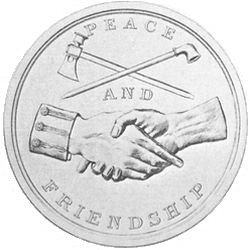
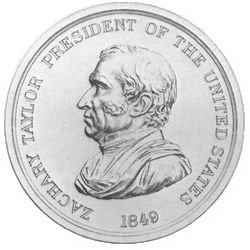
The obverse of this medal, though not signed, was engraved by Franklin Peale, as may be seen by the following extract from a despatch of R. M. Patterson, director of the Mint, to Orlando Brown, office of Indian Affairs, Department of the Interior, and dated Philadelphia, November 26th, 1849:
"Three Indian medal dies, bearing the head of President Taylor, were asked of the chief coiner of the Mint, Mr. Franklin Peale, by Mr. Medill, while Commissioner of Indian Affairs, and he agreed to the estimate of the cost which was $700. I have now the satisfaction of reporting that the dies are finished, and that Mr. Peale is ready to furnish, on sufficient notice, the medals which you may desire.
Plate LXVI. No. 65.
June 10, 1850—March 4, 1853.
Millard Fillmore President of the United States 1850. ℞. Labor virtue honor.
PRESIDENT MILLARD FILLMORE.
[Thirteenth President of the United States of America.]
MILLARD FILLMORE PRESIDENT OF THE UNITED STATES 1850. Undraped bust of President Fillmore, facing the right. S. ELLIS.
LABOR VIRTUE HONOR. A pioneer from the far West, his left hand on a ploughshare, explains to an Indian chief the benefits of civilization, of which he wishes him to partake. The American flag envelops both in its folds. In the background is a farm-house. J. WILLSON.
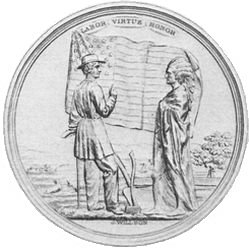
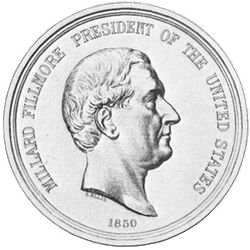
Joseph Willson was born at Canton, St Lawrence County, New York, in 1825. He studied portrait painting with Salathiel Ellis, followed him to New York in 1842, and began cutting cameos and die sinking. In 1848 he removed to Washington, under the patronage of the Honorable R. H. Gillet, member of Congress from St Lawrence County, New York, associated himself in business with Salathiel Ellis, and made the reverses of the Indian medals of Presidents Fillmore and Pierce. In 1851 he went to Italy to study sculpture, and remained abroad three years. He died, September 8, 1857.
Millard Fillmore was born at Summerhill, Cayuga County, New York, January 7, 1800. He began the study of law in 1819, and was admitted to the bar to practise as an attorney in 1827; was counsellor in the Supreme Court of the State of New York, 1829; and settled in Buffalo, 1830. He was a member of the State Legislature, 1829-1831; member of Congress, 1832-1834, and again, 1837-1841; comptroller of the State of New York, 1847; vice-president of the United States, 1849, and President on the death of General Taylor (June 10), 1850-1853. He was an unsuccessful candidate for the Presidency in 1856, and died in Buffalo, New York, March 8, 1874.
Plate LXVII. No. 66.
March 4, 1853—March 4, 1857.
Franklin Pierce, President of the United States. 1853. ℞. Labor virtue honor.
PRESIDENT FRANKLIN PIERCE.
[Fourteenth President of the United States of America..]
FRANKLIN PIERCE, PRESIDENT OF THE UNITED STATES. 1853. Undraped bust of President Pierce, facing the left. S. ELLIS.
LABOR VIRTUE HONOR. A pioneer from the far West, his left hand on a ploughshare, explains to an Indian chief the benefits of civilization, of which he wishes him to partake. The American flag envelops both in its folds. In the background is a farm-house. J. WILLSON.
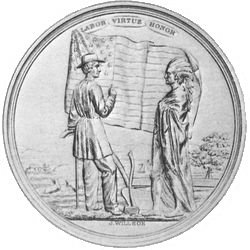
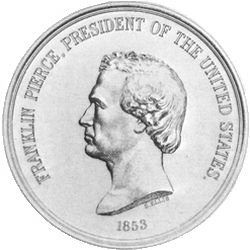
Franklin Pierce was born at Hillsborough, New Hampshire, November 23, 1804. He was graduated at Bowdoin College, Maine, 1824, and was admitted to the bar at Hillsborough, 1827; was member of the State Legislature, 1829; member of Congress, 1833-1837; United States senator, 1837-1842; brigadier-general of volunteers, March, 1847; served under General Scott throughout the Mexican campaign; President of the United States, 1853-1857. He retired to Concord, New Hampshire, and died there, October 8, 1869.
Plate LXVIII. No. 67.
July 2, 1853.
Smyrna. American sloop of war St. Louis. Austrian brig of war Hussar. ℞. Presented by the President of the United States to Commander Duncan N. Ingraham, etc.
COMMANDER DUNCAN NATHANIEL INGRAHAM.
[Release of Martin Coszta.]
The United States sloop-of-war St Louis, and the Austrian brig-of-war Hussar, are at anchor in the roads of Smyrna; while a second Austrian war vessel and three mail steamers are at a little distance. The city of Smyrna and the ruins of the Acropolis, on Mount Pagus, are in the background. Exergue: SMYRNA. AMERICAN SLOOP OF WAR ST. LOUIS. AUSTRIAN BRIG OF WAR HUSSAR, S. EASTMAN D. (delineavit.) P. F. CROSS SC.. (sculpsit.) LONGACRE.
Within a wreath of laurel and oak: PRESENTED BY THE PRESIDENT OF THE UNITED STATES TO COMMANDER DUNCAN N. (Nathaniel) INGRAHAM AS A TESTIMONIAL OF THE HIGH SENSE ENTERTAINED BY CONGRESS OF HIS GALLANT AND JUDICIOUS CONDUCT ON THE 2d OF JULY 1853. JOINT RESOLUTION OF CONGRESS AUGUST 4th 1854. Exergue: The American eagle, with outspread wings, holds an anchor in its talons; above are thirty-one stars, the whole lighted by the rays of the sun. S. EASTMAN D. (delineavit.) J. B. LONGACRE SC. (sculpsit).
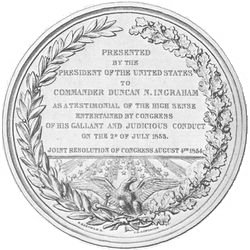
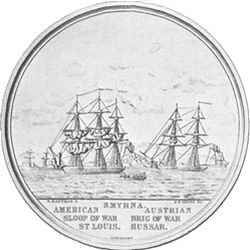
Seth Eastman was graduated at West Point as second lieutenant of infantry, July 1, 1829; was assistant teacher of drawing at West Point, 1833-1840; first lieutenant, 1836; and captain, 1839. He engraved the armorial bearings of several of the new States, and designed the Ingraham medal. He was living in Washington in 1872.
P. F. Cross, who engraved the obverse of the Ingraham medal, was born in Sheffield, England, and died in Philadelphia in 1856.
James Barton Longacre was born in Delaware County, Pennsylvania, August 11, 1794, and became a steel-plate engraver. In 1844 he was appointed engraver to the United States Mint, in Philadelphia, and retained the situation till his death, January 14, 1869. He was also one of the publishers and proprietors of the "National Portrait Gallery," to which he contributed many engravings. His largest plate, however, the equestrian portrait of General Jackson, is not in that work.
Duncan Nathaniel Ingraham was born in Charleston, South Carolina, December 6, 1802. He was appointed a midshipman, June 18, 1812; became a lieutenant, January 13, 1825; and commander, September 8, 1841. While in command of the sloop-of-war St. Louis, off Smyrna, in July, 1853, he rescued Martin Coszta from the Austrian brig-of-war Hussar; for this act Congress gave him a vote of thanks and a gold medal. He became a captain, 1855; and in 1856 was appointed chief of the Bureau of Ordnance and Hydrography in the Navy Department, Washington. He resigned, February 4, 1861, and acted with the Southern Confederacy during the Civil War. He died in Charleston, South Carolina, June 10, 1863.
ORIGINAL DOCUMENTS.
Resolution of Congress Voting a Medal to Commander Ingraham.
Resolved unanimously by the Senate and House of Representatives of the United States of America in Congress assembled: That the President of the United States be, and he is hereby, requested to cause to be made a medal, with suitable devices, and presented to Commander Duncan N. Ingraham, of the navy of the United States, as a testimonial of the high sense entertained by Congress of his gallant and judicious conduct on the second of July, eighteen hundred and fifty-three, in extending protection to Martin Coszta, by rescuing him from illegal seizure and imprisonment on board the Austrian war brig Hussar.
Approved August 4, 1854.
Commander Ingraham to Commodore Stringham.
United States ship St. Louis, Smyrna, July 6th, 1853. To Commodore Silas H. Stringham, Commander-in-Chief of the United States Naval Forces in the Mediterranean.
Sir: It becomes my duty to report to you an affair at this place in which I have taken upon myself to compromise the American flag.
I arrived here upon the 23d of June, and soon after anchoring was informed that an American had been kidnapped by the Austrian Consul upon the Turkish soil and sent on board an Austrian brig-of-war.
I sent for the American Consul and informed him of what I had heard. He told me the man was a Hungarian refugee (named Martin Coszta), who had a certificate of intention to become a citizen of the United States, and came here in an American vessel, but that he did not consider him under his protection, having to his knowledge no passport.
The Consul and myself then went on board the brig, and requested to see the commander, but were told he was not on board. We then went to the Austrian Consul, and demanded to see Coszta, which after some demur was granted.
After a conversation with Coszta, I was afraid I had no right to demand him as a citizen of the United States, but determined neither to make a claim nor acquiesce in his seizure until I could hear from the Legation at Constantinople. I was guided in this opinion by the Consul, who seemed to think we could not use force without more evidence than the paper in his possession gave.
I then requested the Consul to write immediately to the Legation, which he did. Before an answer could arrive, I received information that Coszta was to be sent to Trieste. I immediately wrote to the commander of the brig, protesting against this step, and received a verbal reply that he was ignorant of any such intention. Next morning, at daylight, I got under way, and anchored within half cable's length of the brig, and loaded my guns, the steamer in which it was said Coszta was to be sent being very near. At 11 a.m. an answer came from Mr. Brown, stating that Coszta was an American citizen, and advising the Consul to give him all aid and sympathy, but in an unofficial way. I then told the Consul he must insist upon Coszta remaining until I again heard from the Chargé. He did so, when the Austrian Consul told him he had intended to send the man off that day, but would wait until the next mail. On Saturday, the 2d of July, the Capen Oglan of the Legation arrived with letters from the Chargé to the Consul and myself to use stringent measures.
I immediately held an interview with Coszta, in which he claimed the protection of the American flag. I then addressed note "B" to the commander of the brig, demanding Coszta's release. I also directed the American Consul to furnish the Austrian Consul with a copy of the demand, which was done. At this time the Austrian brig and a ten-gun schooner that arrived the day before prepared for action, having three mail-steamers to assist. I did the same, and awaited the hour of 4 p.m. At 12, our Consul came off with a proposition that Coszta should be delivered into the hands of the Consul-General of France, to be held at the joint order of the American and Austrian Consuls, until his nationality should be determined. After some consideration, and the advice of the English and French Consuls to ours, I agreed to the terms. The prisoner was then landed amid the cheers of the inhabitants and every demonstration of joy. I know, Sir, I have taken a fearful responsibility upon myself by this act, but after Mr. Brown informed me Coszta had taken the oath of allegiance to the United States, and foresworn all allegiance to Austria, that he was an American citizen and had been under the protection of the Legation at Constantinople, I could not hesitate to believe he was fully entitled to protection. It was a case of life and death; for, if Coszta had been taken to Trieste his fate was sealed, and could I have looked the American people in the face again, if I had allowed a citizen to be executed and not used the power in my hands to protect him for fear of doing too much? The easy manner, also, in which he was given up, and the Convention that he should be held by a third party until his nationality could be established, is evidence that they were not sure of their ground.
Should my conduct be approved by you, Sir, it will be one of the proudest moments of my life that I have saved this gallant man from a cruel and ignominious death. On the other hand, should the course I have pursued be disavowed, I must bow to the decision; but whatever may be the consequence to myself, I shall feel I have done my best to support the honor of the flag, and not allow a citizen to be oppressed who claimed at my hands the protection of the flag.
I enclose copies of all the papers (A to E) relating to this affair.
I have the honor to be, very respectfully, your obedient servant,
D. N. Ingraham, Commander.
A
Commander Ingraham to Commander Schwartz.
United States ship St. Louis, Smyrna Roads, Evening June 28, 1853. To The Commander of the Austrian Brig Hussar.
Sir: I have this moment received a letter stating Martin Coszta was to be sent on board the steamer to-morrow at daylight, to be sent to Trieste. I have been only waiting to hear from the Minister at Constantinople before I took some action in the case of Coszta, as he has a paper stating his intention to become a citizen of the United States. He came here in an American vessel, and has been some time in the United States. I earnestly protest against his leaving this port until something has been heard from Constantinople.
Very respectfully, your obedient servant, D. N. Ingraham, Commander.
B
Commander Schwartz to Commander Ingraham.
His Imperial Majesty's brig Hussar, Smyrna, June 29th, 1853. To The Commander of the United States ship St. Louis.
Sir: I had the honor to receive your letter of the 28th inst.
Concerning the matter respecting Martin Coszta, I request you, Sir, to communicate with the Consul General, as I can personally do nothing in the matter, as I receive all my orders from him.
I have the honor to subscribe myself, with great respect, your obedient servant,
Schwartz.
C
Commander Ingraham to Commander Schwartz.
United States ship St. Louis, Smyrna, July 2d, 1853. To The Commander of the Austrian brig Hussar.
Sir: I have been directed by the American Chargé at Constantinople to demand the person of Martin Coszta, a citizen of the United States, taken by force from the Turkish soil and now confined on board the brig Hussar. And if a refusal is given to take him by force.
An answer to the demand must be returned by 4 o'clock p.m.
Very respectfully, your obedient servant, D. N. Ingraham, Commander.
D
Commander Schwartz to Commander Ingraham.
His Imperial Majesty's brig Hussar, Smyrna, July 2d, 1853. To The Commander of the United States ship St. Louis, Present.
Sir: I have the honor to refer you to my letter of the 28th ultimo, in which I stated that I depend altogether upon the Consul General in the matter respecting the prisoner Martin Coszta. I shall send him your letter of this day, and request him to come to an understanding with you himself.
I protest against all violence toward His Imperial Majesty's brig "Hussar," or schooner "Artimesia," and shall consider it as a hostile step for which I would hold you altogether responsible.
I have the honor to subscribe myself, with great respect, your obedient servant,
Schwartz.
E
S. N. Brown to Commander Ingraham.
Legation of the United States, Pera, June 28th, 1853. To Commander Ingraham, United States Corvette St. Louis.
Dear Sir: I send you a copy of my letter to the Austrian Internuncio (Minister) on the subject of the detention of Martin Coszta on board the Austrian brig Hussar; which will serve to show my views of the transaction better than I could do in a note.
The public here are quite as indignant at the brutal conduct of the Austrian Consul as they were in Smyrna. Mussulman, Christian and Jew execrate the conduct of the Consul, and accuse him as the cause of the bloodshed which resulted from the brutal arrest and treatment of Coszta. The Porte would have been much pleased had you taken him from the Austrian brig, and I regret that it was not done on the ground that he had renounced all allegiance to the Austrian Emperor, and taken an oath of allegiance to the government of the United States.
He certainly is not an Austrian subject, and he as certainly can claim no other allegiance to any other power, than to that of the United States. It is not uncommon for persons having received official copies of their declaration of allegiance to procure an American passport stating this fact, in which all protection and satisfaction is assured them from American authorities. I believe that, under the circumstances, you have a right to persist in demanding him from the Austrian commander. The Porte would wish to leave the matter open between us and the Austrians, and if we could see the poor fellow carried off and hung to let us take the ignominy of the transaction on our own shoulders. If I thought you would be governed by my instructions, they would be to demand him, in the most formal and positive language, of the Austrian commander, in my name as Representative of the United States, and after having him in your possession, to leave the matter to be adjusted between the two governments. In case of a refusal to deliver him, founded on the pleas that he had renounced all allegiance to Austria, and that having taken the oath of allegiance to the United States, he has a claim upon our protection, I would take him out of the vessel. Such a course will meet with the most profound applause from this government and from every foreign legation here (except that of Austria), and cannot but call forth strong gratification on the part of our government and people at home.
So abominable an act has excited here extreme abhorrence and execration, and all you have already done has elevated the character of our country and of our navy.
I remain, dear Sir, most truly yours, S. N. Brown.
Be so good as to allow Mr. Offley to peruse the present. I do not doubt but that he will support you in all you do.
S. N. B.
[Enclosure from Caleb Lyon of Lyonsdale.]
My Dear Sir: I cordially approve of the measures of Mr. Brown in taking the exile Coszta per force, and do hope you will do so. So far as my humble power goes, I will defend it. He is not an Austrian subject, he has sworn allegiance to the United States. Sure this is enough to demand our protection, no matter what he says. Do not let this chance slip to acquit yourself nobly, and to do honor to our country.
The Turkish Governor as well as the Austrian Consul have been both dismissed and disgraced.
The eyes of nations are upon the little St. Louis and her commander. For God's sake, and sake of humanity, stand for the right.
Regards and friendship of yours ever, Caleb Lyon of Lyonsdale.
Mr. Lyon is a member of Congress from the State of New York, and now travelling in Europe.
Martin Coszta's Declaration of Intention.
1852. State of New York.
In the Court of Common Pleas for the City and County of New York:
I, Martin Coszta, do declare on oath, that it is bona fide my intention to become a citizen of the United States, and to renounce forever all allegiance and fidelity to any foreign Prince, Potentate, State or Sovereignty whatever, and particularly to the Emperor of Austria, of whom I am a subject.
Martin Coszta.
Sworn this 31st day of July, 1852.
George W. Riblet, Clerk.
Clerk's Office, Court of Common Pleas, For the City and County of New York.
I certify that the foregoing is a true copy of an original Declaration of Intention, remaining of record in my office.
In witness whereof I have hereunto subscribed my name, and affixed the seal of said Court, this 31st day of July, 1852.
[L. S.] George W. Riblet, Clerk.
Agreement between the Consul-General of Austria and the Consul of the United States of America.
Smyrne le 2 Juillet, 1853.
Les Soussignés Consul Général d'Autriche et Consul des États-Unis d'Amérique, prient Monsieur le Consul Général de Sa Majesté l'Empereur des Français de prendre en dépôt dans ses prisons le nommé Martin Koszta (Martin Coszta) détenu sur le brick de guerre Autrichien "Hussard" et dont la nationalité et par conséquent les relations de protection sont en litige, entre les Ambassades respectives à Constantinople, ainsi qu'entre les Consulats à Smyrne.
Ils prient Monsieur le Consul Général de se charger de ce dépôt aux conditions suivantes.
L'individu sus mentionné sera consigné dans la journée d'aujourd'hui et au plus tôt possible par un détachement des soldats du brick Autrichien qui le conduira au débarcadère de l'hôpital Français, où il sera remis entre les mains de Monsieur le Consul Général de France ou de la personne qu'il en aura chargé.
Le détenu ne pourra communiquer avec aucune personne du dehors à l'exception des Consuls soussignés et dans l'hôpital il sera confié spécialement à une personne que Monsieur le Consul Général de France désignera.
Les frais de nourriture et de maintien que les soussignés laissent entièrement à la discrétion de Monsieur le Consul Général de France de fixer au détenu, seront à la charge du soussigné Consul Général d'Autriche.
Il est expressément convenu que Monsieur le Consul Général de France ne délivrera le détenu Martin Koszta (Martin Coszta) que sur une demande collective des soussignés.
E. S. Offley, Consul des États Unis d'Amérique. Weekbecker, Consul Général d'Autriche.
[Translation.]
Smyrna, July 2, 1853.
The undersigned, the Consul-General of Austria and the Consul of the United States of America, request the Consul-General of His Majesty, the Emperor of the French, to take in charge the named Martin Koszta (Martin Coszta), detained on the Austrian brig-of-war "Hussar," whose nationality and consequently whose rights to protection are in litigation, between the respective embassies at Constantinople, and also between the Consulates at Smyrna.
They request the Consul-General to take charge of the detained person on the following conditions:
The above-named individual shall be delivered to-day, and as soon as possible, by a detachment of soldiers from the Austrian brig-of-war, which shall conduct him to the landing of the French hospital, where he shall be handed over to the Consul-General of France, or to the persons designated by him.
The detained shall not be allowed to communicate with any outside person except with the undersigned Consuls; and in the hospital he shall be under the care of some one specially designated by the Consul-General of France.
The expenses of boarding and keeping, the particulars of which the undersigned leave entirely to the discretion of the Consul-General of France, shall be borne by the Consul-General of Austria.
It is expressly agreed that the Consul-General of France shall deliver the detained Martin Koszta (Martin Coszta) only on a collective demand of the undersigned.
E. S. Offley, Consul of the United States of America. Weekbecker, Consul-General of Austria.
Plate LXIX. No. 68.
March 4, 1857—March 4, 1861.
James Buchanan. President of the United States, 1857. ℞. Labor virtue honor.
PRESIDENT JAMES BUCHANAN.
[Fifteenth President of the United States of America.]
JAMES BUCHANAN, PRESIDENT OF THE UNITED STATES 1857. Bust of President Buchanan, facing the right S. ELLIS SC. (sculpsit.)
LABOR VIRTUE HONOR. A pioneer from the far West, his left hand on a ploughshare, explains to an Indian chief the benefits of civilization, of which he wishes him to partake. The American flag envelops both in its folds. In the background is a farm-house. J. WILLSON.
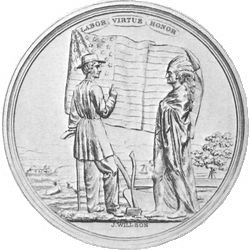
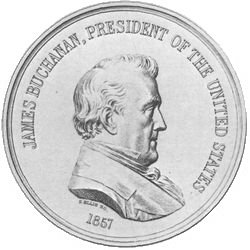
James Buchanan was born in Franklin County, Pennsylvania, April 23, 1791. He was graduated at Dickinson College, Carlisle, Pennsylvania, 1809; and was admitted to the bar in Lancaster, 1812. He was a member of the State Legislature, 1814-1816; member of Congress, 1821-1831; minister to Russia, 1832-1834; United States senator, 1834-1845; secretary of State to President Polk, 1845-1849; minister to England, 1853-1856; President of the United States, 1857-1861. He died at his estate of Wheatland, near Lancaster, Pennsylvania, June 1, 1868.
Plate LXX. No. 69.
April, 1858.
James Buchanan, President of the United States. ℞. To Dr. Frederick Rose, Assistant Surgeon, Royal Navy, G. B.
DOCTOR FREDERICK HENRY ROSE.
[Kindness and Humanity of Doctor Rose.]
JAMES BUCHANAN, PRESIDENT OF THE UNITED STATES. Bust of President Buchanan, facing-the right. PAQUET. F. (fecit).
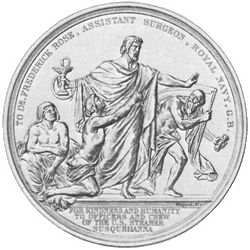
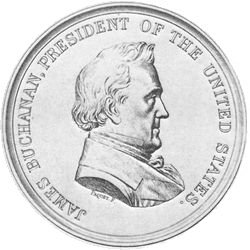
A. C. Paquet was born in Hamburg, Germany, December 5, 1814. He emigrated to America in October, 1848, settled in Philadelphia, and was assistant engraver to the United States Mint from 1857 to 1864. He has designed and engraved a number of medals, of which the principal are: General Grant; the wreck of the steamer San Francisco; the Philadelphia cathedral; President Johnson; Doctor Rose; President Buchanan; the Cincinnati exposition; Melgareja, President of Bolivia; the secretary of State of Bolivia; the Sanitary Commission fair; Humboldt; Everett; Life-saving medal of the first class; Life-saving medal of the second-class; Robinson; four gold, and five silver dies for the Chili Mint, and four silver dies for Bolivia. He is still living.
Frederick Henry Rose was born January 5, 1833, and entered the British Royal Navy as assistant-surgeon, November 10, 1855. He was employed on the home station, on particular service on the North American, West Indian, and West Coast of Africa stations, until June, 1863. While in Jamaica in April, 1858, with the permission of his commanding officer, Admiral Sir Hewston Stewart, Royal Navy, he volunteered, at imminent personal risk, his services on board the United States vessel-of-war Susquehanna, on which the yellow fever had broken out, and sailed in her to New York, devoting himself to the care of the sick. For this noble deed Congress gave him a vote of thanks and a gold medal. In 1866 Doctor Rose was placed on the retired list in consequence of ill health. He died at San Remo, Italy, March 31, 1873.
ORIGINAL DOCUMENTS.
Resolution of Congress Voting a Medal to Doctor Rose.
Resolved by the Senate and House of Representatives of the United States of America in Congress assembled: That the President be, and he is hereby, authorized and requested to cause suitable acknowledgments to be made on the part of this government to Admiral Sir Hewston Stewart, of Her Britannic Majesty's Navy, and officers under his command, for their prompt and efficient aid, and generous hospitality, extended to the disabled officers and crew of the United States ship Susquehanna on her late arrival at Port Royal, Island of Jamaica, with the yellow fever on board; on which occasion, besides placing the naval hospital, with an adequate corps of medical officers, nurses and attendants, at their service, eighty-five of the officers and crew of the Susquehanna were safely and promptly conveyed on shore with the aid of the boats of the British squadron, and the lives of the greater portion of them thereby probably saved. And that the President be further requested to cause a gold medal, with appropriate devices, to be presented, on behalf of this government, to Assistant-Surgeon Frederick H. Rose, of the British Navy, who volunteered, with the permission of his commanding officer, to join the Susquehanna, and, at imminent personal risk, devoted himself, on the voyage from Jamaica to New York, to the care of the sick remaining on board. And that the President cause suitable testimonials to be in like manner presented to the medical officers in the British service, in attendance at the hospital, with appropriate rewards to the nurses and other attendants there, whilst occupied by the officers and crew of the Susquehanna.
Approved May 11, 1858.
Captain Sands to the Secretary of the Navy.
U. S. Ship Susquehanna, New York Harbor, April 15th, 1858. To the Honorable Isaac Toucey, Secretary of the Navy, Washington, D. C.
Sir: I have the honor to report to you the arrival of this ship at New York, having had 155 cases of yellow fever on board, 85 of which were left at the hospital at Port Royal, Jamaica.
For the information of the Honorable Department, I have to state that after lying over one hundred days in San Juan De Nicaragua, with an average sick list of about 15, the first case of fever made its appearance on the 17th ultimo, then a second, then a third, when I thought it advisable to put to sea, hoping that a change of air would dispel the disease. After a few days the ship returned off San Juan and anchored outside. She remained there three days, with some slight modification of the fever, but it again broke out with greater violence. I then got under way and stood toward Aspinwall, expecting to meet the Jamestown, Commander Kennedy, whom I had instructed to relieve us on the 1st April, this ship to take her place, thinking that a change of position might be favorable to the health of both ships; on our way down to Aspinwall fresh cases continued to occur, particularly among the lieutenants and engineers, the first and second of the former being down, and others complaining. I now determined, at the suggestion of the surgeon, to steer for Pensacola; after standing for that port for some hours, and the fever continuing to extend its ravages, there being nearly one hundred down, at the request of the surgeon I changed our course for the Island of Jamaica, where I arrived about 8 o'clock on the evening of the 5th April.
The Admiral of the Port, Sir Hewston Stewart, on hearing of our condition, kindly placed the Naval Hospital at our disposal, and at six o'clock the next morning we landed 63 of our sick. I then had to take coal and water on board, at Kingston, which detained us a part of three days. The ship being now disabled, three lieutenants and six engineers being sick, besides half the firemen and coal-heavers, and many of the most valuable of the men off duty, I shipped about 30 negroes, and agreeably to the recommendation of the surgeon, I deemed it advisable to proceed at once to a northern port.
The whole number of cases from the 17th March to 15th April was 155—85 of which were left at the Hospital at Port Royal, Jamaica. There remain on the list to-day 34 cases. We have had in all 16 deaths, among these was 1st Lieutenant Queen of the Marine Corps.
Lieutenant Howell and four engineers were left at the Hospital, doing, I hope, well.
Since leaving Port Royal we have had two deaths, and some addition to the number of cases, but generally on approaching a cold climate, all seem to improve and we have had no new cases for the last 48 hours.
I beg leave to forward three letters from Surgeon Pinckney, who was taken down in the commencement of the epidemic, also one from Passed Assistant Surgeon Maccoun, from whom I have received the most valuable aid, during this severe visitation. As I had but one surgeon left, and fearing he might also fall sick during the passage home, I applied to Admiral Stewart for a medical officer, and previous to our departure from Port Royal, he sent us Assistant Surgeon Rose, who kindly volunteered his services.
I cannot find words to express my sense of obligation to Admiral Stewart for the kind and prompt manner in which he placed the Royal Naval Hospital at our disposal, and furnished us with every convenience for landing the sick, nor to Dr. Kinnear, Deputy Medical Inspector, and the medical officers under him for their attention to the comforts of those placed under their charge.
I also take great pleasure in mentioning that Commodore Kellett and Captain Hay of the "Indus" came to offer their assistance with boats and cots to land the sick.
I have left instructions with Mr. Harrison, our Consul at Kingston, relating to the sick at the Hospital, and have drawn a bill on the Navy Department in his favor for $1500, to cover any necessary expenses that might occur until further instructions should be received from the Department.
I have only to add my great regret at being obliged to leave my station without instructions from the Department, but the circumstances of the case rendered it absolutely necessary.
I have the honor to be, &c., &c., Joshua R. Sands, Captain United States Navy.
Plate LXXI. No. 70.
March 4, 1861—April 14, 1865.
Abraham Lincoln, President of the United States, 1862.
PRESIDENT ABRAHAM LINCOLN.
[Sixteenth President of the United States of America.]
ABRAHAM LINCOLN, PRESIDENT OF THE UNITED STATES 1862. Bust of President Lincoln, facing the right. S. ELLIS DEL. (delineavit.) SC. (sculpsit.) On edge of bust, PATENTED.
A civilized Indian is ploughing his field; his children are playing at ball; on a hill to the left is a log cabin; to the right, a church; beyond them, some ships and a steamboat on a river; in the background, mountains; above is an Indian scalping his enemy; below, the head of an Indian squaw weeping; on one side, a quiver of arrows; on the other, a calumet and a bow—opposition of civilization to savage life.