LIST OF PLATES. (continued 5)
Reading edition
After informing you that so fine a ship as the Guerrière, commanded by an able and experienced officer, had been totally dismasted, and otherwise cut to pieces, so as to make her not worth towing into port, in the short space of 30 minutes, you can have no doubt of the gallantry and good conduct of the officers and ship's company I have the honour to command. It only remains, therefore, for me to assure you, that they all fought with great bravery; and it gives me great pleasure to say, that from the smallest boy in the ship to the oldest seaman, not a look of fear was seen. They all went into action giving three cheers, and requesting to be laid close alongside the enemy.
Enclosed I have the honour to send you a list of killed and wounded on board the Constitution, and a report of the damages she has sustained; also a list of the killed and wounded on board the enemy, with his quarter-bill, &c.
I have the honour to be, with very great respect, Sir, your obedient servant, Isaac Hull.
Killed and wounded on board the United States frigate Constitution, Isaac Hull, Esquire, Captain, in the action with His Britannic Majesty's frigate Guerrière, James A. Dacres, Esquire, Captain, on the 20th of August, 1812:
Killed: W. S. Bush, Lieutenant of Marines, and 6 seamen 7
Wounded: Lieutenant C. Morris, Master J. C. Aylwin, 4 seamen, 1 marine 7
—
Total killed and wounded 14
United States frigate Constitution, August 21st, 1812.
T. S. Chew, Purser. Isaac Hull, Captain.
Killed and wounded on board His Britannic Majesty's frigate Guerrière:
Killed: 3 officers, 12 seamen and marines 15
Wounded: J. A. Dacres, Captain, 4 officers, 57 seamen and marines 62
Missing: Lieutenants Pullman and Roberts, and 22 seamen and marines, supposed to have gone overboard with the masts 24
——
Total killed, wounded and missing 101
Captain Hull to the Secretary of the Navy.
United States Frigate Constitution, Boston, August 30, 1812. To the Honourable Paul Hamilton, Secretary of the Navy, Washington, D. C.
Sir:
I cannot but make you acquainted with the very great assistance I received from that valued officer, Lieutenant Morris, in bringing the ship into action, and in working her whilst along side the enemy, and I am extremely sorry to state that he is badly wounded, being shot through the body; we have yet hopes of his recovery, when I am sure he will receive the thanks and gratitude of his country, for this and the many gallant acts he has done in its service. Were I to name any particular officer as having been more useful than the rest, I should do them great injustice; they all fought bravely, and gave me every possible assistance that I could wish. I am extremely sorry to state to you the loss of Lieutenant Bush, of marines; he fell at the head of his men in getting ready to board the enemy. In him our country has lost a valuable and brave officer. After the fall of Lieutenant Bush, Lieutenant Contee of the corps, took command of the marines, and I have pleasure in saying that his conduct was that of a brave, good officer, and the marines behaved with great coolness and courage during the action, and annoyed the enemy very much whilst she was under our stern.
I have the honour to be, with very great respect, Sir, your obedient servant, Isaac Hull.
Plate XXVII. No. 26.
October 18, 1812.
Jacobus Jones virtus in ardua tendit. ℞. Victoriam hosti majori celerrime rapuit.
CAPTAIN JACOB JONES.
[Capture of the Frolic.]
IACOBUS JONES VIRTUS IN ARDUA TENDIT. (Jacob Jones. Valor seeks difficulties.) Bust of Captain Jones, in uniform, facing the right. On edge of bust, FÜRST. F. (fecit).
VICTORIAM HOSTI MAJORI CELERRIME RAPUIT. (He quickly snatched victory from a superior enemy.) Naval action between the United States sloop-of-war Wasp, of eighteen guns, Captain Jones, and the British sloop-of-war Frolic, of twenty-two guns, Captain Whinyates. The Wasp has lost her main-topmast, and is raking the Frolic as she lays her on board. The Americans are in possession of the enemy's forecastle. Exergue: INTER WASP NAV. AMERI. ET FROLIC NAV. ANG. DIE XVIII OCT. MDCCCXII. (Inter Wasp navem Americanam et Frolic navem Anglicanam, die 18 Octobris, 1812: Between the American vessel Wasp and the English vessel Frolic, October 18, 1812.) On the platform, FÜRST. F. (fecit).
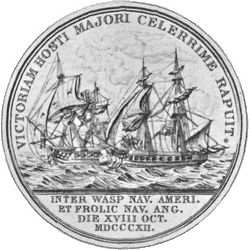
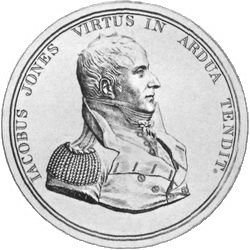
Moritz Fürst was born in Presburg, Hungary, and studied with Würt, a die sinker in the Imperial Mint of Vienna. He was for a time superintendent of the Royal Mint of Lombardy. In 1807 he was engaged by the American Consul at Leghorn as die sinker to the United States Mint, arrived the same year in America, and entered on his duties in the spring of 1808. He made nearly all the medals voted by Congress to the army and navy for the War of 1812-1815, and the Indian medals of Presidents Monroe, John Quincy Adams, Andrew Jackson, and Martin Van Buren. He resided for many years in New York.
Jacob Jones was born near Smyrna, Kent County, Delaware, in March, 1770. He first studied medicine, but entered the navy as midshipman in 1799, was lieutenant in 1801, was taken prisoner in the frigate Philadelphia, off Tripoli, 1803, and remained in captivity for twenty months. Having been commissioned as master-commandant in 1810, he was given, in 1811, the sloop-of-war Wasp, with which he captured the British sloop-of-war Frolic, Captain Whinyates, October 18, 1812. For this gallant action Congress gave him a vote of thanks and a gold medal. He became captain in 1813, and received the frigate Macedonian. He afterward commanded squadrons in the Mediterranean and in the Pacific; was a member of the Naval Board and governor of the Naval Asylum in Philadelphia, where he died, August 3, 1850.
ORIGINAL DOCUMENTS.
Captain Jacob Jones to the Secretary of the Navy.
New York, November 24th, 1813. To the Honourable Paul Hamilton, Secretary of the Navy, Washington, D. C.
Sir: I here avail myself of the first opportunity of informing you of the occurrences of our cruise, which terminated in the capture of the Wasp, on the 18th of October, by the Poictiers, of 74 guns, while a wreck from damages received in an engagement with the British sloop-of-war Frolic, of 22 guns; 16 of them 32-pound carronades, and four twelve-pounders on the main deck, and two twelve-pounders, carronades, on the top-gallant forecastle, making her superior in force to us by four twelve-pounders. The Frolic had struck to us, and was taken possession of, about two hours before our surrendering to the Poictiers.
We had left the Delaware on the 13th. The 16th had a heavy gale, in which we lost our jib-boom and two men. Half-past 11, on the night of the 17th, in the latitude of 37 degrees north, and longitude 65 degrees west, we saw several sail; two of them appeared very large. We stood from them for some time, then shortened sail, and steered the remainder of the night the course we had perceived them on. At daylight, on Sunday the 18th, we saw them ahead, gave chase, and soon discovered them to be a convoy of six sail, under the protection of a sloop-of-war, four of them large ships, mounting from 16 to 18 guns. At 30 minutes past 11, a.m., we engaged the sloop-of-war, having first received her fire at the distance of fifty or sixty yards, which space we gradually lessened until we laid her on board, after a well supported fire of 43 minutes; and although so near, while loading the last broadside, that our rammers were shoved against the side of the enemy, our men exhibited the same alacrity which they had done during the whole of the action. They immediately surrendered upon our gaining their forecastle, so that no loss was sustained on either side after boarding.
Our main-topmast was shot away between four and five minutes from the commencement of the firing, and falling, together with the main-topsail yard, across the larboard fore and fore-topsail braces, rendered our head-yards unmanageable the remainder of the action. At eight minutes the gaff and main-topgallant-mast came down, and at twenty minutes from the beginning of the action, every brace and most of the rigging was shot away. A few minutes after separating from the Frolic, both her masts fell upon deck, the main-mast going close by the deck, and the fore-mast twelve or fifteen feet above it.
The courage and exertions of the officers and crew fully answered my expectations and wishes. Lieutenant Biddle's active conduct contributed much to our success by the exact attention paid to every department during the engagement, and the animating example he afforded the crew by his intrepidity. Lieutenants Rodgers, Booth, and Mr. Rapp shewed, by the incessant fire from their divisions, that they were not to be surpassed in resolution or skill. Mr. Knight and every other officer acted with a courage and promptitude highly honourable, and, I trust, have given assurance that they may be relied on whenever their services may be required.
I could not ascertain the exact loss of the enemy, as many of the dead lay buried under the masts and spars that had fallen upon deck, which two hours exertion had not sufficiently removed. Mr. Biddle, who had charge of the Frolic, states that, from what he saw and from information from the officers, the number killed must have been about thirty, and that of the wounded about forty or fifty: of the killed is her first lieutenant and sailing master; of the wounded Captain Whinyates and the second lieutenant.
We had five killed and five wounded, as per list; the wounded are recovering. Lieutenant Claxton, who was confined by sickness, left his bed a little previous to the engagement, and though too weak to be at his division, remained upon deck, and shewed, by his composed manner of noting incidents, that we had lost, by his illness, the services of a brave officer.
I am, respectfully yours, etc., Jacob Jones.
Plate XXVIII. No. 27.
October 25, 1812.
Stephanus Decatur navarchus, pugnis pluribus, victor. ℞. Occidit signum hostile sidera surgunt.
CAPTAIN STEPHEN DECATUR.
[Capture of the Macedonian.]
STEPHANUS DECATUR NAVARCHUS, PUGNIS PLURIBUS, VICTOR. (Stephen Decatur, a naval captain, conqueror in many battles.) Bust of Captain Decatur, in uniform, facing the right. FÜRST. F. (fecit).
OCCIDIT SIGNUM HOSTILE SIDERA SURGUNT. (The enemy's standard falls, the stars arise.) Naval action between the United States frigate United States, of forty-four guns, Captain Decatur, and the British frigate Macedonian, of forty-nine guns, Captain Carden; the United States, to leeward, is firing her port broadside; the Macedonian has lost her mizzenmast, her fore and main-topmasts, and her mainyard. Exergue: INTER STA. UNI. NAV. AMERI. ET MACEDO. NAV. ANG. DIE XXV OCTOBRIS MDCCCXII. (Inter United States navem Americanam et Macedonian navem Anglicanam, die 25 Octobris, 1812: Between the American vessel United States and the English vessel Macedonian, October 25, 1812.) On the platform, FÜRST. F. (fecit).
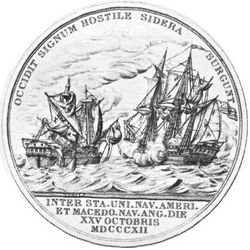
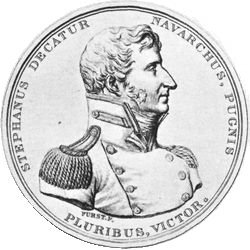
Stephen Decatur was born in Sinnepuxent, Worcester County, Maryland, January 5, 1779. He was appointed a midshipman, 1798; a lieutenant, 1799; served in the Mediterranean under Commodore Dale, 1801, and under Commodore Preble, 1803; and, while in command of the Intrepid, destroyed the Philadelphia, off Tripoli, February 15, 1804. For this gallant deed he was immediately promoted to the rank of captain. He commanded a division of gunboats under Preble in the subsequent attacks on Tripoli. On October 25, 1812, when in command of the frigate United States, he captured the British frigate Macedonian, Captain John Carden, for which action Congress gave him a vote of thanks and a gold medal. In January, 1815, he left New London as commodore, having his flag on the President, but was soon afterward captured by an English fleet. The same year he sailed for the Mediterranean in command of a squadron, and made treaties with Algiers, Tunis, and Tripoli. On his return home he became a member of the Naval Board. He was shot in a duel by Commodore Barron, at Bladensburg, Maryland, March 22, 1820, and died the same evening.
ORIGINAL DOCUMENTS.[79]
Captain Decatur to the Secretary of the Navy.
United States ship United States, at Sea, October 30, 1812. To the Honourable Paul Hamilton, Secretary of the Navy, Washington, D. C.
Sir: I have the honour to inform you, that on the 25th instant, being in the latitude 29°, N., longitude 29°, 30', W., we fell in with, and, after an action of an hour and a half, captured His Britannic Majesty's ship Macedonian, commanded by Captain John Carden, and mounting 49 carriage guns (the odd gun shifting). She is a frigate of the largest class, two years old, four months out of dock, and reputed one of the best sailors in the British service. The enemy being to windward, had the advantage of engaging us at his own distance, which was so great, that for the first half hour we did not use our carronades, and at no moment was he within the complete effect of our musketry or grape: to this circumstance and a heavy swell, which was on at the time, I ascribe the unusual length of the action.
The enthusiasm of every officer, seaman, and marine on board this ship, on discovering the enemy; their steady conduct in battle, and precision of their fire, could not be surpassed. Where all met my fullest expectations, it would be unjust for me to discriminate. Permit me, however, to recommend to your particular notice my first Lieutenant, William H. Allen. He has served with me upwards of five years, and to his unremitted exertions in disciplining the crew, is to be imputed the obvious superiority of our gunnery exhibited in the result of this contest.
Subjoined is a list of the killed and wounded on both sides. Our loss, compared with that of the enemy, will appear small. Amongst our wounded, you will observe the name of Lieutenant Funk, who died in a few hours after the action: he was an officer of great gallantry and promise, and the service has sustained a severe loss in his death.
The Macedonian lost her mizzen-mast, fore and main-top-masts and main yard, and was much cut up in her hull. The damage sustained by this ship was not such as to render her return into port necessary, and had I not deemed it important that we should see our prize in, should have continued our cruize.
With the highest consideration, I am, yours, etc., Stephen Decatur.
Killed 5
Wounded 7 —1 since dead.
—
12
macedonian.
Killed 36
Wounded 68
—
104
Plate XXIX. No. 28.
December 29, 1812.
Gulielmus Bainbridge patria victisque laudatus. ℞. Pugnando.
CAPTAIN WILLIAM BAINBRIDGE.
[Capture of the Java.]
GULIELMUS BAINBRIDGE PATRIA VICTISQUE LAUDATUS. (William Bainbridge praised by his country and by the vanquished foe.) Bust of Captain Bainbridge, in uniform, facing the right; underneath, a star. FÜRST. F. (fecit).
PUGNANDO. (In fighting.) The naval action is over. The British frigate Java, of forty-nine guns, Captain Lambert, is completely dismasted; while the United States frigate Constitution, of forty-four guns, Captain Bainbridge, is but slightly damaged in her rigging. Exergue: INTER CONST. NAV. AMERI. ET JAV. NAV. ANGL. DIE XXIX DECEM. MDCCCXII. (Inter Constitution navem Americanam et Java navem, Anglicanam, die 29 Decembris, 1812: Between the American vessel Constitution and the English vessel Java, December 29, 1812.) FÜRST. F. (fecit).
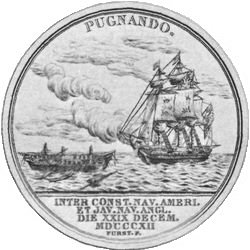
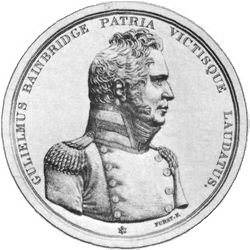
William Bainbridge was born in Princeton, New Jersey, May 7, 1774. He began life in the merchant service, but entered the navy as lieutenant in 1798, was master-commandant in 1799, and captain in 1800. With the frigate George Washington he went to Algiers, whence he conveyed an ambassador to Constantinople, the George Washington being the first American vessel ever seen there. He commanded the Philadelphia when she was lost off Tripoli, November 1, 1803. After his return to the United States he did not serve again afloat till 1812, when he obtained the command of the Constitution; and on December 29 of the same year he captured the British frigate Java, Captain Lambert, for which action Congress gave him a vote of thanks and a gold medal. After the war he commanded twice in the Mediterranean, and after 1821 served on shore, commanding different navy yards, and was president of the Naval Board. He died in Philadelphia, July 28, 1833.
ORIGINAL DOCUMENTS.
Resolution of Congress Voting Medals to Captain Bainbridge, etc.
Approved March 3, 1813.
Captain Bainbridge to the Secretary of the Navy.
United States frigate Constitution, St. Salvador, January 3d, 1813. To The Secretary of the Navy, Washington, D. C.
Sir: I have the honour to inform you that on the 29th ultimo, at 2 p.m., in south latitude 13°, 06', and west longitude 39°, ten leagues distance from the coast of Brazils, I fell in with and captured His Britannic Majesty's frigate Java, of 49 guns, and upwards of 400 men, commanded by Captain Lambert, a very distinguished officer. The action lasted one hour and fifty-five minutes, in which time the enemy was completely dismasted, not having a spar of any kind standing. The loss on board the Constitution was 9 killed and 25 wounded, as per enclosed list. The enemy had 60 killed and 101 wounded, certainly (among the latter, Captain Lambert, mortally), but by the enclosed letter, written on board the ship (by one of the officers of the Java), and accidentally found, it is evident that the enemy's wounded must have been much greater than as above stated, and who must have died of their wounds previously to their being removed. The letter states 60 killed and 170 wounded.
For further details of the action, I beg leave to refer you to the enclosed extracts from my journal. The Java had in addition to her own crew upwards of one hundred supernumerary officers and seamen, to join the British ships-of-war in the East Indies: also Lieutenant-General Hyslop, appointed to the command of Bombay, Major Walker and Captain Wood, of his staff, and Captain Marshall, master and commander in the British navy, going to the East Indies to take command of a sloop-of-war there.
Should I attempt to do justice, by representation, to the brave and good conduct of all my officers and crew, during the action, I should fail in the attempt; therefore, suffice it to say, that the whole of their conduct was such as to merit my highest encomiums. I beg leave to recommend the officers particularly to the notice of government, as also the unfortunate seamen who were wounded, and the families of those men who fell in the action.
The great distance from our own coast, and the perfect wreck we made the enemy's frigate, forbid every idea of attempting to take her to the United States; and not considering it prudent to trust her in a port of Brazils, particularly St. Salvador, I had no alternative but burning her, which I did on the 31st ultimo, after receiving all the prisoners and their baggage, which was very tedious work, only having one boat left (out of eight) and not one left on board the Java.
On blowing up the frigate Java, I proceeded to this place, where I have landed all the prisoners on their parole, to return to England and there remain until regularly exchanged, and not serve in their professional capacities in any place or in any manner whatever, against the United States of America, until the exchange shall be effected.
I have the honour to be, &c., W. Bainbridge.
Extract from Captain Bainbridge's Journal, containing minutes of the action with the British frigate Java.
"Wednesday, December 30th, 1812 (nautical time) in latitude 13 degrees, 6 minutes South, and longitude 39 West, ten leagues from the coast of Brazil, commences with clear weather and moderate breezes from east north-east, hoisted our ensign and pendant. At 15 minutes past meridian, the ship hoisted her colours, an English ensign having a signal flying at her main, red, yellow and red. At 1.26 p.m. being sufficiently from the land, and finding the ship to be an English frigate, took in the main-sail and royals, tacked ship and stood for the enemy. At 1.50 p.m. the enemy bore down with the intention of raking us, which we avoided by wearing. At 2 p.m. the enemy being within half a mile of us, and to windward, and having hauled down his colours, except an Union Jack at the mizzen-mast head, induced me to give orders to the officers of the 3d division to fire one gun ahead of the enemy to make him show his colours, which being done, brought on a fire from us of the whole broadside, on which the enemy hoisted his colours and immediately returned our fire. A general action with round and grape then commenced, the enemy keeping at a much greater distance than I wished, but could not bring him to closer action without exposing ourselves to several rakes. Considerable manœuvres were made by both vessels to rake and avoid being raked. The following minutes were taken during the action:
"At 2.10 p.m. commenced the action within good grape and canister distance, the enemy to windward, but much further than I wished. At 2.30 our wheel was shot entirely away; 2.40, determined to close with the enemy, notwithstanding his raking, set the fore and main-sail and luffed up close to him; 2.50, the enemy's jib-boom got foul of our mizzen rigging; 3, the head of the enemy's bowsprit and jib-boom shot away by us; 3.5, shot away the enemy's foremast by the board; 3.15, shot away his main-top-mast just above the cap; 3.40, shot away gaff and spanker boom; 3.55, shot away his mizzenmast nearly by the board; 4.5, having silenced the fire of the enemy completely, and his colours in main rigging being down, supposed he had struck, then hauled aboard the courses to shoot ahead to repair our rigging, which was extremely cut, leaving the enemy a complete wreck. Soon after discovered the enemy's flag was still flying; hove to, to repair some of our damage; 4.20, the enemy's main-mast went nearly by the board; 4.50, wore ship and stood for the enemy; 5.25, got very close to the enemy in a very effectual raking position, athwart his bows, and was at the very instant of raking him, when he most prudently struck his flag, for had he suffered the broadside to have raked him, his additional loss must have been extremely great, as he laid an unmanageable wreck upon the water.
"After the enemy had struck, wore ship and reefed the topsails, then hoisted out one of the only two remaining boats we had left out of eight, and sent Lieutenant Parker, 1st of the Constitution, to take possession of the enemy, which proved to be His Britannic Majesty's frigate Java, rated 38 but carried 49 guns, and manned with upwards of 400 men, commanded by Captain Lambert, a very distinguished officer, who was mortally wounded. The action continued, from the commencement to the end of the fire, one hour and fifty-five minutes. The Constitution had 9 killed and 25 wounded. The enemy had 60 killed and 101 certainly wounded, but by a letter written on board the Constitution, by one of the officers of the Java, and accidentally found, it is evident the enemy's wounded must have been considerably greater than as above stated, and who must have died of their wounds previously to their being removed. The letter states 60 killed and 170 wounded. The Java had her own complement of men complete, and upwards of one hundred supernumeraries, going to join the British ships-of-war in the East Indies; also several officers, passengers, going out on promotion. The force of the enemy in number of men, at the commencement of the action, was no doubt considerably greater than we have been able to ascertain, which is upwards of 400 men. The officers were extremely cautious in discovering the number. By her quarter bill she had one man more stationed at each gun than we had.
"The Constitution was very much cut in her sails and rigging, and many of her spars injured. At 7 p.m. the boat returned with Lieutenant Chads, the first lieutenant of the enemy's frigate, and Lieutenant-General Hyslop (appointed governor of Bombay), Major Walker and Captain Wood, belonging to his staff. Captain Lambert, of the Java, was too dangerously wounded to be removed immediately. The cutter returned on board the prize for the prisoners, and brought Captain Marshall, master and commander of the British navy, who was passenger on board, as also several other naval officers, destined for ships in the East Indies.
"The Java was an important ship, fitted out in the completest manner, to carry Lieutenant-General Hyslop and staff to Bombay, and several naval officers for different ships in the East Indies; and had despatches for St. Helena, Cape of Good Hope, and every British establishment in the India and China seas. She had on board copper for a 74 and two brigs building at Bombay, and I expect a great many other valuables; but everything was blown up in her except the officers' baggage, when we set her on fire at 3 p.m., on the 1st of January, 1813 (nautical time)."
[Copy.]
H. D. Corneck to Lieutenant Wood.
Prisoner on board the American frigate Constitution. St. Salvador, Brazils, January 1st, 1813. To Lieutenant Peter V. Wood, 22d Regiment of Foot, Isle of France or Bourbon, East Indies.
My dear Sir: I am sorry to inform you of the unpleasant news of Mr. Gascoigne's death. Mr. Gascoigne and myself were shipmates in Marlboro', and first came to sea together. He was shot in the early part of the action by a round shot in his right thigh, and died a few minutes after; four others of his messmates shared the same fate, together with 60 men killed and 170 wounded. The official account you no doubt heard of before this reaches you. I beg you will let all his friends and relations hear of his untimely fate. We were on board the Java frigate for a passage to India, when we fell in with this frigate. Two parcels I have sent you under good care. Hope this will reach you safe.
Yours truly, H. D. Corneck.
[A true copy.] William Bainbridge.
Plate XXX. No. 29.
September 4, 1813.
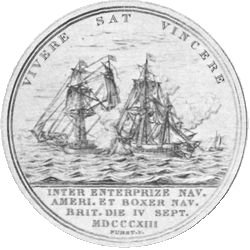
Edward ℞. McCall navis Enterprise præfectus. Sic itur ad astra. ℞. Vivere sat vincere.
LIEUTENANT EDWARD RUTLEDGE McCALL.
[Capture of the Boxer.]
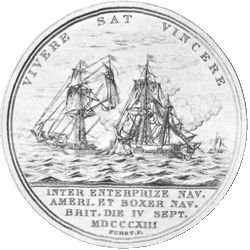
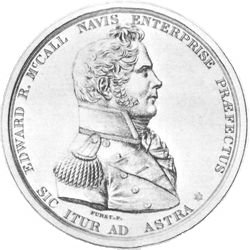
Edward Rutledge McCall was born in Charleston, South Carolina, August 5, 1790. He entered the navy in January, 1808. In 1813 he was first lieutenant of the Enterprize, under Lieutenant Burrows, in the action with the Boxer, took the command after that officer fell, and captured the British vessel, for which gallant deed Congress gave him a vote of thanks and a gold medal. He afterward served in the Mediterranean under Commodore Perry, was promoted to the rank of master-commandant in 1825, and to that of captain in 1835. He died in Bordentown, New Jersey, July 31, 1853.
ORIGINAL DOCUMENTS.
Resolution of Congress Voting Medals to Lieutenants McCall, Burrows, etc.
Approved January 6, 1814.
Captain Hull to the Secretary of the Navy.
United States Navy Yard, Portsmouth, September 14th, 1813. To the Honourable William Jones, Secretary of the Navy, Washington, D. C.
Sir: I have the honour to forward to you, by the mail, the flags of the late British brig Boxer, which were nailed to her mast-heads at the time she engaged, and was captured by, the United States brig Enterprize.
Great as the pleasure is that I derive from performing this part of my duty, I need not tell you how different my feelings would have been, could the gallant Burrows have had this honour.
He went into action most gallantly, and the difference of injury done the two vessels proves how nobly he fought.
I have the honour to be, &c., Isaac Hull.
Lieutenant McCall to Captain Hull.
United States Brig Enterprize, Portland, September 7th, 1813. To Isaac Hull, Esq., United States Navy Yard, Portsmouth.
Sir: In consequence of the unfortunate death of Lieutenant-Commander William Burrows, late commander of this vessel, it devolves on me to acquaint you with the result of our cruize. After sailing from Portsmouth on the 1st instant, we steered to the eastward, and on the morning of the 3d, off Wood Island, discovered a schooner, which we chased into this harbour, where we anchored. On the morning of the 4th weighed anchor and swept out, and continued our cruize to the eastward. Having received information of several privateers being off Manhagan, we stood for that place; and on the following morning, in the bay near Penguin Point, discovered a brig getting under weigh, which appeared to be a vessel of war, and to which we immediately gave chase. She fired several guns and stood for us, having four ensigns hoisted. After reconnoitering and discovering her force, and the nation to which she belonged, we hauled upon a wind to stand out of the bay, and at 3 o'clock shortened sail, tacked and ran down with an intention to bring her to close action. At 20 minutes after 3 p.m., when within half pistol shot, the firing commenced from both, and after being warmly kept up, and with some manœuvering, the enemy hailed and said they had surrendered, about 4 p.m. Their colours being nailed to the masts, could not be hauled down. She proved to be His Britannic Majesty's brig Boxer, of 14 guns, Samuel Blythe, Esquire, commander, who fell in the early part of the engagement, having received a cannon shot through the body. And I am sorry to add that Lieutenant Burrows, who had gallantly led us to action, fell also about the same time by a musket ball, which terminated his existence in eight hours.
The Enterprize suffered much in spars and rigging, and the Boxer both in spars, rigging and hull, having many shots between wind and water. It would be doing injustice to the merit of Mr. Tillinghast, 2d lieutenant, were I not to mention the able assistance I received from him during the remainder of the engagement, by his strict attention to his own division and other departments. And the officers and crew, generally, I am happy to add, from their cool and determined conduct, have my warmest approbation and applause.
As no muster roll that can be fully relied on came into my possession, I cannot exactly state the number killed on board the Boxer; but from information received from the officers of that vessel, it appears that there are between twenty and twenty-five killed, and fourteen wounded. Enclosed is a list of killed and wounded on board the Enterprize.
I have the honour to be, &c., Edward R. M'Call, Senior Officer.
Killed 1. Wounded 13; of whom Lieutenant Burrows, Commander, Midshipman Kervan Waters, and carpenter's mate Elisha Blossom, have since died.
Plate XXXI. No. 30.
September 4, 1813.
Victoriam tibi claram. patriæ mæstam. ℞. Vivere sat vincere.
LIEUTENANT WILLIAM BURROWS.
[Capture of the Boxer.]
VICTORIAM TIBI CLARAM. PATRIÆ MÆSTAM (sic). (A victory brilliant for thee, sorrowful for thy country). A funeral urn upon a tomb is surrounded with naval emblems; a crown of laurel is hanging from a trident, and in a cartoon of elliptical form: W. (William) BURROWS. furst. f. (fecit).
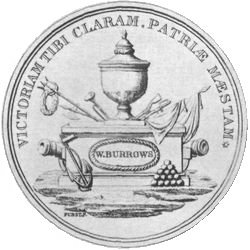
William Burrows was born in Kenderton, near Philadelphia, October 6, 1785. He entered the navy as midshipman, January 4, 1800; served in the Constitution under Commodore Preble in the campaign against Tripoli; returned to America about 1807 as lieutenant, and served in different vessels on various stations. In the summer of 1813, he obtained the command of the sloop-of-war Enterprize, with which, on September 5, he engaged the British sloop-of-war Boxer, Captain Blythe, but was killed in the beginning of the action, as was also the commander of the enemy's vessel, and they were both buried with military honors at Portland, Maine. Congress, by joint resolution, approved January 6, 1814, requested the President of the United States to present to the nearest male relative of Lieutenant Burrows a gold medal, and to communicate to him the deep regret they felt at this officer's loss.
Plate XXXII. No. 31.
September 10, 1813.
Oliverus H. Perry, princeps stagno Eriense. classim totam contudit. ℞. Viam invenit virtus aut facit.
CAPTAIN OLIVER HAZARD PERRY.
[Victory of Lake Erie.]
OLIVERUS H. (Hazard) PERRY. PRINCEPS STAGNO ERIENSE. CLASSIM TOTAM CONTUDIT. (Oliver Hazard Perry, commander-in-chief, destroyed on Lake Erie an entire fleet.) Bust of Captain Perry, in uniform, facing the right.
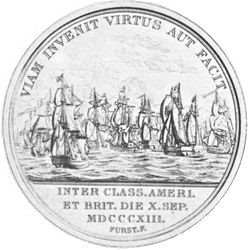
VIAM INVENIT VIRTUS AUT FACIT. (Valor finds or makes a way.) The United States fleet on Lake Erie, carrying fifty-four guns, and commanded by Captain Perry, stands out to meet the British fleet with sixty-three guns, under Captain Barclay. Exergue: INTER CLASS. AMERI. ET BRIT. DIE X. SEP. MDCCCXIII. (Inter classim Americanam et Britannicam, die 10 Septembris, 1813: Between the American and British fleets, September 10, 1813.) FÜRST. F. (fecit).
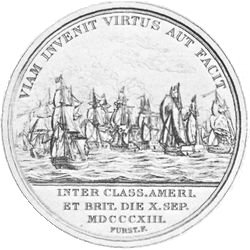
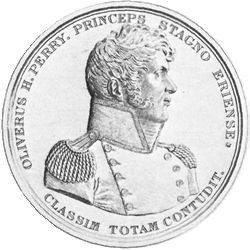
Oliver Hazard Perry was born in South Kingston, Rhode Island, August 23, 1785. He entered the navy as a midshipman, April 7, 1799, on the sloop-of-war General Greene, then commanded by his father, Captain Christopher Raymond Perry. He served in the Mediterranean during the Tripolitan war, was made lieutenant in 1807, and master-commandant in 1812, when he received a division of gunboats at Newport, Rhode Island. In February, 1813, he was transferred to the command on Lake Erie, where, on September 10, he defeated and captured the entire British squadron under Captain Barclay. For this important victory he received the thanks of Congress and a gold medal, and was promoted to the rank of captain, and as such commanded the Java in the Mediterranean for several years. In March, 1819, he set out with a squadron for the coast of South America, and died of yellow fever at Port Spain, Trinidad, August 23, 1819. The remains of Commodore Perry were transferred, in 1827, by order of the Government, in the United States ship Lexington, to Newport, Rhode Island. His battle-flag on Lake Erie, with the motto "Don't give up the ship!" is preserved in the Naval Academy, at Annapolis.
ORIGINAL DOCUMENTS.
Resolutions of Congress Voting Medals to Captains Perry, Elliott, etc.
Resolved unanimously by the Senate and House of Representatives of the United States of America in Congress assembled: That the thanks of Congress be, and the same are hereby, presented to Captain Oliver Hazard Perry, and through him to the officers, petty officers, seamen, marines, and infantry serving as such, attached to the squadron under his command, for the decisive and glorious victory gained on Lake Erie, on the tenth of September, in the year 1813, over a British squadron of superior force.
Resolved, That the President of the United States be requested to present a silver medal, with like emblems and devices, to the nearest male relative of Lieutenant John Brooks, of the marines, and a sword to the nearest male relatives of Midshipmen Henry Lamb, and Thomas Claxton, jr., and to communicate to them the deep regret which Congress feel for the loss of those gallant men, whose names ought to live in the recollection and affection of a grateful country, and whose conduct ought to be regarded as an example to future generations.
Resolved, That three months' pay be allowed, exclusively of the common allowance, to all the petty officers, seamen, marines, and infantry serving as such, who so gloriously supported the honour of the American flag, under the orders of their gallant commander, on that signal occasion.
Approved January 6, 1814.
Resolved by the Senate and House of Representatives of the United States of America in Congress assembled: That the President of the United States be requested to present a sword to the nearest male relation of Midshipman John Clarke, who was slain gallantly combating the enemy in the glorious battle gained on Lake Erie, under the command of Captain Perry, and to communicate to him the deep regret which Congress feels for the loss of that brave officer.
Approved February 19, 1814.
Captain O. H. Perry to the Secretary of the Navy.
U.S. brig Niagara, off the Western Sisters, Head of Lake Erie, Sept. 10, 1813, 4 p.m. To the Honourable William Jones, Secretary of the Navy, Washington, D. C.
Sir: It has pleased the Almighty to give to the arms of the United States a signal victory over their enemies on this lake. The British squadron, consisting of two ships, two brigs, one schooner, and one sloop, have this moment surrendered to the force under my command, after a sharp conflict.
I have the honour to be, etc., O. H. Perry.
Captain O. H. Perry to the Secretary of the Navy.
United States schooner Ariel, Put-in-Bay, Sept. 13, 1813. To the Honourable William Jones, Secretary of the Navy, Washington, D. C.
Sir: In my last I informed you that we had captured the enemy's fleet on this lake. I have now the honour to give you the most important particulars of the action. On the morning of the 10th instant, at sunrise, they were discovered from Put-in-Bay, where I lay at anchor with the squadron under my command. We got under weigh, the wind light at south-west, and stood for them. At 10 a.m. the wind hauled to south-east and brought us to windward; formed the line and bore up. At 15 minutes before 12, the enemy commenced firing; at five minutes before 12, the action commenced on our part. Finding their fire very destructive, owing to their long guns, and its being mostly directed at the Lawrence, I made sail, and directed the other vessels to follow, for the purpose of closing with the enemy. Every brace and bow line being soon shot away, she became unmanageable, notwithstanding the great exertions of the sailing master. In this situation, she sustained the action upwards of two hours within canister distance, until every gun was rendered useless, and the greater part of her crew either killed or wounded. Finding she could no longer annoy the enemy, I left her in charge of Lieutenant Yarnall, who, I was convinced, from the bravery already displayed by him, would do what would comport with the honour of the flag. At half-past two, the wind springing up Captain Elliot was enabled to bring his vessel, the Niagara, gallantly into close action. I immediately went on board of her, when he anticipated my wish by volunteering to bring the schooner which had been kept astern by the lightness of the wind into close action. It was with unspeakable pain that I saw, soon after I got on board the Niagara, the flag of the Lawrence come down, although I was perfectly sensible that she had been defended to the last, and that to have continued to make a show of resistance would have been a wanton sacrifice of the remains of her brave crew. But the enemy was not able to take possession of her, and circumstances soon permitted her flag again to be hoisted. At 45 minutes past 2 the signal was made for "close action." The Niagara being very little injured, I determined to pass through the enemy's line, bore up and passed ahead of their two ships and a brig, giving a raking fire to them from the starboard guns, and to a large schooner and sloop, from the larboard side, at half pistol shot distance. The smaller vessels at this time having got within grape and canister distance, under the direction of Captain Elliot, and keeping up a well directed fire, the two ships, a brig and a schooner surrendered, a schooner and sloop making a vain attempt to escape.
Those officers and men who were immediately under my observation, evinced the greatest gallantry, and I have no doubt that all others conducted themselves as became American officers and seamen. Lieutenant Yarnall, first of the Lawrence, although several times wounded, refused to quit the deck. Midshipman Forrest (doing duty as lieutenant), and sailing-master Taylor, were of great assistance to me. I have great pain in stating to you the death of Lieutenant Brooks, of the marines, and midshipman Lamb, both of the Lawrence, and midshipman John Clarke, of the Scorpion; they were valuable and promising officers. Mr. Hambleton, purser, who volunteered his services on deck, was severely wounded late in the action. Midshipman Claxton and Swartout, of the Lawrence, were severely wounded. On board the Niagara, Lieutenants Smith and Edwards, and midshipman Webster (doing duty as sailing-master) behaved in a very handsome manner. Captain Brevoort, of the army, who acted as a volunteer in the capacity of a marine officer, on board that vessel, is an excellent and brave officer, and with his musketry did great execution. Lieutenant Turner, commanding the Caledonia, brought that vessel into action in the most able manner, and is an officer that, in all situations, may be relied on. The Ariel, Lieutenant Parker, and Scorpion, sailing-master Champlin, were enabled to get early into action, and were of great service. Captain Elliot speaks in the highest terms of Mr. Magrath, purser, who had been despatched in a boat on service, previous to my getting on board the Niagara, and, being a seaman, since the action has rendered essential service in taking charge of one of the prizes. Of Captain Elliot, already so well known to the government, it would be almost superfluous to speak; in this action, he evinced his characteristic bravery and judgment; and, since the close of the action, has given me the most able and essential assistance.
I have the honour to enclose you a return of the killed and wounded, together with a statement of the relative force of the squadrons. The captain and first lieutenant of the Queen Charlotte, and first lieutenant of the Detroit, were killed. Captain Barclay, senior officer, and the commander of the Lady Prevost, severely wounded. Their loss in killed and wounded I have not yet been able to ascertain; it must, however, have been very great.
Very respectfully, &c., O. H. Perry.
Statement of the force of the British squadron.
Ship Detroit 19 guns: 1 on pivot and 2 howitzers.
Queen Charlotte 17 " 1 "
Schooner Lady Prevost 13 " 1 "
Brig Hunter 10 "
Sloop Little Belt 3 "
Schooner Chippeway 1 " 2 swivels.
—
63 guns.
Note: The Detroit is a new ship, very strongly built, and mounts long twenty-fours, eighteens and twelves.
Statement of the force of the United States squadron.
Brig Lawrence 20 guns.
"Niagara 20 "
"Caledonia 3 "
Schooner Ariel 4 " (1 burst early in action.)
"Scorpion 2 "
"Somers 2 " and 2 swivels.
Sloop Trippe 1 "
Schooner Tigress 1 "
"Porcupine 1 "
—
54 guns.
The exact number of the enemy's force has not been ascertained, but I have good reason to believe that it exceeded ours by nearly 100 men.
S. Hambleton, Purser. O. H. Perry, Captain and senior officer.
The Secretary of the Navy to George Harrison.
Navy Department, July 4th, 1814. To George Harrison, Esq., Navy Agent, Philadelphia.
Sir: In order to have made the swords and medals contemplated by the inclosed resolutions of Congress, I have to request that you will engage artists for that purpose whose abilities and taste will insure their being executed in the best manner. You will perceive by the resolution that the device for the medal for Captains Perry and Elliott must be emblematical of the action on Lake Erie; and, it appears to me, that representations of the several engagements are the most suitable devices for the others. The best representations of those engagements yet engraved may be seen, I understand, in the Academy of Arts at Philadelphia, where the artists and amateurs might readily determine on the devices. The number of dies for the medals will be as follows, viz.:
Capture of the Guerrière by the Constitution 1
"" Macedonian by the United States 1
"" Frolic by the Wasp 1
"" Java by the Constitution 1
"" Peacock by the Hornet 1
"" Boxer by the Enterprize 1
Victory on Lake Erie 1
—
Dies 7
The reverse of the medals will be properly appropriated to the respective portraits of the several commanders, which, I believe, have all been published. These, however, ought to be correct likenesses. Of the number of medals of each kind to be struck, you will be informed in due time.
As it will scarcely be possible to represent distinctly the deeply interesting scenes of the memorable victory of Erie on one face of the medal, it may be well to omit the portrait of Commodore Perry, and divide the representation of the action into two prominent and distinct parts which mark the crisis of the battle, in the first terminating with the abandonment of the Lawrence, and the passage of the hero in his gig, with his flag, from that ship to the Niagara. Second, the bringing up of the gunboats and small vessels by Captain Elliott, and the subsequent breaking through the enemy's line and capture of his whole fleet. Thus the entire action may be distinctly and beautifully represented.
Herewith you will receive one of the medals struck for Commodore Preble, which is tolerably well executed and of good size. The emblematical figures ought to be bold and distinct, rather than minutely delineated, which renders the effect less striking and enhances the labour and cost. With respect to the cost it must be regulated by a due attention to the views of the Legislature and to economy without parsimony.
The number is considerable, and will require all the artists who are qualified for the execution.
It is very desirable to have them completed as soon as possible, and particularly before the next meeting of Congress. If the number of artists in Philadelphia shall not be sufficient, you will employ those of New York or elsewhere. I submit this business to your care with confidence and pleasure, because I know that your own discriminating tastes and judgment in these matters will be combined with your admiration of the men, and the scenes to be commemorated, in producing the best and most speedy execution.
The sword for Captain Elliott will be an elegant dress sword; a cut and thrust, with belt, &c., such in form as is prescribed for a dress sword of a captain in the navy, but decorated with devices and inscriptions suitable to the occasion, and finished in the best style the sum of $800 will procure. The swords of the warrant officers, twelve in number, will be of the same form and with proper belts, &c., will be finished in the best style that $250 each will procure. These you will please have finished as soon as possible.
The medals should be finished in succession according to the order of the dates of the events, unless the whole can be put in hand at once, which is very desirable.
I am respectfully, Sir, your most obedient servant,
W. Jones, Secretary of the Navy.
Plate XXXIII. No. 32.
September 10, 1813.
Jesse D. Elliott. Nil actum reputans si quid superesset agendum. ℞. Viam invenit virtus aut facit.
CAPTAIN JESSE DUNCAN ELLIOTT.
[Victory of Lake Erie.]
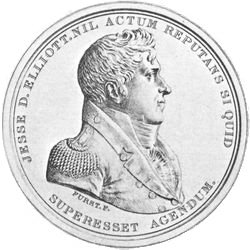
Jesse Duncan Elliott was born in Maryland, July 14, 1782. He was appointed midshipman in 1804; was promoted to be lieutenant in 1810; served under Commodore Chauncey on the lakes in 1812; and on October 8, commanding an expedition, he cut out two British ships from under Fort Erie. For this daring act Congress voted him a sword of honor. He was master-commandant in July, 1813; and second in command in Perry's victory on Lake Erie, for which he received from Congress a vote of thanks and a gold medal. On Perry's departure in October, 1815, he succeeded him in command. He became captain in 1818; and afterward commanded the Mediterranean squadron, and the navy yards of Boston and of Philadelphia. He died in Philadelphia, December 10, 1845.
Plate XXXIV. No. 33.
February 24, 1813.
Jac Lawrence dulce et decorum est pro patria mori. ℞. Mansuetud. maj. quam victoria.
CAPTAIN JAMES LAWRENCE.
[Capture of the Peacock.]
MANSUETUD. MAJ. QUAM VICTORIA. (Mansuetudo major quam victoria: Clemency greater than victory.) The action is over. The United States sloop-of-war Hornet, of twenty guns, Captain Lawrence, is lying to and sending her boats to the rescue of the crew of the British brig-of-war Peacock, of twenty-two guns, Captain Peake, which has lost her mainmast, and is going down head foremost. Exergue: INTER HORNET NAV AMERI ET PEACOCK NAV ANG DIE XXIV FEB MDCCCXIII. (Inter Hornet, navem Americanam, et Peacock, navem Anglicanam, die 24 Februarii, 1813: Between the American vessel Hornet and the English vessel Peacock, February 24, 1813.) On the platform, furst. f. (fecit).
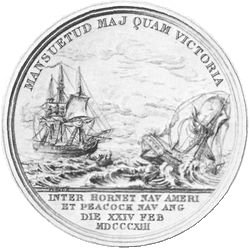
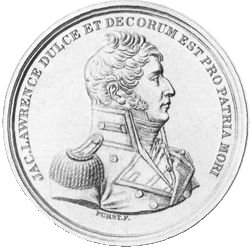
James Lawrence was born in Burlington, New Jersey, October 1, 1781. He was appointed a midshipman in 1798, and became a lieutenant in 1802; served against Tripoli, 1802-1804, and was second in command under Decatur, in the Intrepid, when the Philadelphia was destroyed off Tripoli. In 1810 he became master-commandant, and on February 24, 1813, with the Hornet, captured the British brig-of-war Peacock, Captain William Peake. For this action, Congress awarded him a vote of thanks and a gold medal. As captain he commanded the Chesapeake in 1813 and fell, mortally wounded, in the engagement with the British ship Shannon, Captain Broke. His last words, when carried below, were, "Don't give up the ship!" He died four days after the combat, on June 5, 1813, and was buried with military honors at Halifax, Nova Scotia. His remains were afterward taken to the United States, and now lie in Trinity church-yard, New York city.
ORIGINAL DOCUMENTS.
Resolution of Congress Voting Medals to Captain Lawrence, etc.
Approved January 11, 1814.
Captain Lawrence to the Secretary of the Navy.
United States ship Hornet, Holmes' Hole, March 19th, 1813. To the Honourable William Jones, Secretary of the Navy, Washington, D. C.
Sir: I have the honour to inform you of the arrival, at this port, of the United States ship Hornet, under my command, from a cruise of 145 days, and to state to you, that after Commodore Bainbridge left the coast of Brazils, (on the 6th of January last,) the Hornet continued off the harbour of St. Salvador, blockading the Bonne Citoyenne until the 24th, when the Montagu 74 hove in sight, and chased me into the harbour; but night coming on, I wore and stood to the southward. Knowing that she had left Rio Janeiro for the express purpose of relieving the Bonne Citoyenne and the packet, (which I had also blockaded for fourteen days, and obliged her to send her mail to Rio in a Portuguese smack,) I judged it most prudent to change my cruising ground, and stood to the eastward, with the view of cruising off Pernambuco; and on the 4th day of February, captured the English brig Resolution, from Rio Janeiro, bound to Maranham, with coffee, jerked beef, flour, fustic and butter, and about 25,000 dollars in specie. As the brig sailed dull, and could ill spare hands to man her, I took out the money and set her on fire. I then ran down the coast for Maranham, and cruised there for a short time; from thence ran off Surinam. After cruising off that coast from the 5th to the 22d of February, without meeting a vessel, I stood for Demarara, with an intention, should I not be fortunate on that station, to run through the West Indies, on my way to the United States. But on the morning of the 24th, I discovered a brig to leeward, to which I gave chase; ran into quarter less four, and not having a pilot, was obliged to haul off; the fort at the entrance of Demarara river at this time bearing south west, distance about 2-1/2 leagues. Previously to giving up the chase, I discovered a vessel at anchor without the bar, with English colours flying, apparently a brig of war. In beating round Corobano bank, in order to get at her, at half past 3 p.m. I discovered another sail on my weather quarter edging down for us. At 4.20 minutes she hoisted English colours, at which time we discovered her to be a large man-of-war brig; beat to quarters, and cleared ship for action; kept close by the wind, in order, if possible, to get to the weather gage. At 5.10 minutes, finding I could weather the enemy, I hoisted American colours, and tacked. At 5.20 minutes, in passing each other, exchanged broadsides within half pistol shot. Observing the enemy in the act of wearing, I bore up, received his starboard broadside, ran him close on board on the starboard quarter, and kept up such a heavy and well directed fire, that in less than fifteen minutes he surrendered, being literally cut to pieces, and hoisted an ensign, union down, from his fore-rigging, as a signal of distress. Shortly after, his main-mast went by the board; dispatched Lieutenant Shubrick on board, who soon returned with her first lieutenant, who reported her to be His Britannic Majesty's late brig Peacock, commanded by Captain William Peake, who fell in the latter part of the action; that a number of her crew were killed and wounded, and that she was sinking fast, having then six feet of water in her hold; dispatched the boats immediately for the wounded, and brought both vessels to anchor. Such shot-holes as could be got at were then plugged, her guns thrown overboard, and every possible exertion used to keep her afloat, until the prisoners could be removed, by pumping and bailing, but without effect, and she unfortunately sunk in five and a half fathoms water, carrying down thirteen of her crew and three of my brave fellows, viz.: John Hart, Joseph Williams, and Hannibal Boyd. Lieutenant Conner, Midshipman Cooper, and the remainder of the Hornet's crew, employed in removing the prisoners, with difficulty saved themselves by jumping in a boat that was lying on her bows as she went down. Four men, of the thirteen mentioned, were so fortunate as to gain the fore-top, and were afterwards taken off by the boats. Previous to her going down, four of her men took to her stern boat, which had been much damaged during the action, which I hope reached the shore in safety; but from the heavy sea running at the time, the shattered state of the boat, and the difficulty of landing on the coast, I much fear they were lost. I have not been able to ascertain from her officers the exact number killed. Captain Peake and four men were found dead on board. The master, one midshipman, carpenter, and captain's clerk, and twenty-nine seamen were wounded, most of them very severely; three of them died of their wounds after being removed, and nine drowned. Our loss was trifling in comparison. John Place, killed; Samuel Coulson and Joseph Dalrymple, slightly wounded; George Coffin and Lewis Todd, severely burnt by the explosion of a cartridge. Todd survived only a few days. Our rigging and sails were much cut; one shot through the foremast, and the bowsprit slightly injured. Our hull received little or no damage. At the time the Peacock was brought to action, the L'Espiègle (the brig mentioned above as being at anchor), mounting sixteen two-and-thirty pound carronades, and two long nines, lay at about six miles in shore, and could plainly see the whole of the action. Apprehensive that she would beat out to the assistance of her consort, such exertions were made by my officers and crew in repairing damages, &c., that by 9 o'clock the boats were stowed, a new set of sails bent, and the ship completely ready for action. At 2 a.m. got under weigh, and stood by the wind to the northward and westward, under easy sail.
On mustering next morning, found we had 277 souls on board, including the crew of the American brig Hunter, of Portland, taken a few days before by the Peacock. And, as we had been on two-thirds allowance of provisions for some time, and had but 3,400 gallons of water on board, I reduced the allowance to three pints a man, and determined to make the best of my way to the United States.
The Peacock was deservedly styled one of the finest vessels of her class in the British navy, probably about the tonnage of the Hornet. Her beam was greater by five inches, but her extreme length not so great by four feet. She mounted sixteen twenty-four pound carronades, two long nines, one twelve-pound carronade on her topgallant-forecastle, as a shifting gun, and one four or six-pounder, and two swivels mounted aft. I find, by her quarter-bill, that her crew consisted of 134 men, four of whom were absent in a prize.
The cool and determined conduct of my officers and crew during the action, and their almost unexampled exertions afterwards, entitled them to my warmest acknowledgments, and I beg leave most earnestly to recommend them to the notice of government.
By the indisposition of Lieutenant Stewart I was deprived of the services of an excellent officer; had he been able to stand the deck I am confident his exertions would not have been surpassed by any one on board. I should be doing injustice to the merits of Lieutenant Shubrick, and of acting-lieutenants Conner and Newton, were I not to recommend them particularly to your notice. Lieutenant Shubrick was in the actions with the Guerrière and Java. Captain Hull and Commodore Bainbridge can bear testimony to his coolness and good conduct on both occasions.
With the greatest respect, I remain, &c., James Lawrence.
P.S. At the commencement of the action my sailing master and seven men were absent in a prize, and Lieutenant Stewart and six men on the sick list.
Plate XXXV. No. 34.
September 11, 1814.
Tho. Macdonough. Stagno Champlain clas. Reg. Brit superavit. ℞. Uno latere percusso. alterum impavide vertit.
CAPTAIN THOMAS MACDONOUGH.
[Victory of Lake Champlain.]
THO. MACDONOUGH. STAGNO CHAMPLAIN CLAS. REG. BRIT. SUPERAVIT. (Thomas Macdonough Stagno Champlain classim Regis Britannia superavit: Thomas Macdonough defeated the Royal British fleet on Lake Champlain.) Bust of Captain Macdonough, in uniform, facing the right. FÜRST. F. (fecit).
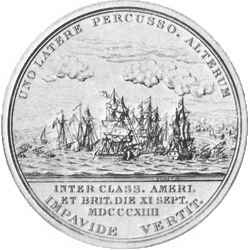
UNO LATERE PERCUSSO. ALTERUM IMPAVIDE VERTIT. (Beaten on one side, he fearlessly turns the other.) Naval action on Lake Champlain, between the United States fleet, carrying eighty-six guns, under Captain Macdonough, and the British fleet, with ninety-five guns, commanded by Commodore Downie. To the right, the city of Plattsburgh in flames. Exergue: INTER CLASS. AMERI. ET BRIT. DIE XI SEPT. MDCCCXIIII. (Inter classim Americanam et Britannicam, die 11 Septembris, 1814: Between the American and British fleets, September 11, 1814.) On the platform, FÜRST. F. (fecit).
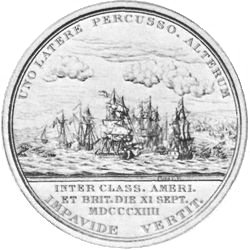
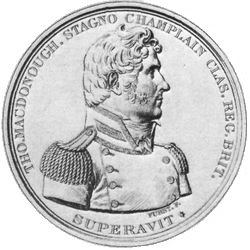
Thomas Macdonough was born in Newcastle County, Delaware, December 23, 1783. He entered the navy as a midshipman in 1800; served in the Tripolitan campaign, and was with Decatur in the Intrepid, when the latter blew up the Philadelphia. He was made a lieutenant in February, 1807, and a master-commandant in July, 1813. He defeated the British squadron, commanded by Commodore George Downie, on Lake Champlain, September 11, 1814, for which victory he received the thanks of Congress and a gold medal, and was promoted to the rank of captain. He commanded the Mediterranean squadron for several years, and died at sea, November 18, 1825, of consumption, on his homeward voyage to the United States.
ORIGINAL DOCUMENTS.
Resolutions of Congress Voting Medals to Captains Macdonough and Henley, Lieutenant Cassin, etc.
Resolved unanimously by the Senate and House of Representatives of the United States of America in Congress assembled: That the thanks of Congress be, and the same are hereby, presented to Captain Thomas Macdonough, and through him to the officers, petty officers, seamen, marines, and infantry serving as marines, attached to the squadron under his command, for the decisive and splendid victory gained on Lake Champlain, on the eleventh of September, in the year one thousand eight hundred and fourteen, over a British squadron of superior force.
Resolved, That the President of the United States be requested to present a silver medal, with like emblems and devices, to the nearest male relative of Lieutenant Peter Gamble, and of Lieutenant John Stansbury, and to communicate to them the deep regret which Congress feel for the loss of those gallant men, whose names ought to live in the recollection and affection of a grateful country.
Resolved, That three months' pay be allowed, exclusively of the common allowance, to all petty officers, seamen, marines, and infantry serving as marines, who so gloriously supported the honour of the American flag on that memorable day.
Approved October 20, 1814.
Resolution of Congress Complimentary to Lieutenant Silas Duncan.
Resolved by the Senate and House of Representatives of the United States in Congress assembled: That the provisions of the joint resolutions of Congress passed October twentieth, eighteen hundred and fourteen, entitled "Resolution expressive of the sense of Congress of the gallant conduct of Captain Thomas Macdonough, the officers, seamen and marines, and infantry serving as marines on board of the United States squadron on Lake Champlain," be so construed and extended as to include the names of Silas Duncan, a lieutenant in the Navy of the United States, in testimony of the sense which is entertained by both houses of Congress of the distinguished gallantry and good conduct of the said Lieutenant Duncan, in an action with the enemy's forces on the sixth of September, eighteen hundred and fourteen, on the same lake.
Approved May 13th, 1826.
Captain Macdonough to the Secretary of the Navy.
United States Ship Saratoga, Off Plattsburgh, September 11th, 1814. To the Honorable William Jones, Secretary of the Navy, Washington, D. C.
Sir: The Almighty has been pleased to grant us a signal victory on Lake Champlain, in the capture of one frigate, one brig, and two sloops-of-war of the enemy.
I have the honor to be, &c. T. Macdonough.
Captain Macdonough to the Secretary of the Navy.
Ship Saratoga, Plattsburgh Bay, September 13th, 1814. To the Honorable William Jones, Secretary of the Navy, Washington, D. C.
Sir: I have the honour to give you the particulars of the action which took place on the 11th instant, on this lake.
For several days the enemy were on their way to Plattsburgh by land and water, and it being well understood that an attack would be made at the same time by their land and naval forces, I determined to await, at anchor, the approach of the latter.
At 8 a.m. the look-out boat announced the approach of the enemy. At 9, he anchored in a line ahead, at about 300 yards distance from my line; his ship was opposed to the Saratoga, his brig to the Eagle, Captain Robert Henley, his gallies, thirteen in number, to the schooner, the sloop, and a division of our gallies, one of his sloops assisting their ship and brig, the other assisting their gallies. Our remaining gallies, with the Saratoga and Eagle.
In this situation, the whole force on both sides became engaged, the Saratoga suffering much, from the heavy fire of the Confiance. I could perceive at the same time, however, that our fire was very destructive to her. The Ticonderoga, Lieutenant Commandant Cassin, gallantly sustained her full share of the action. At half-past 10 o'clock, the Eagle not being able to bring her guns to bear, cut her cable, and anchored in a more eligible position, between my ship and the Ticonderoga, where she very much annoyed the enemy, but unfortunately, leaving me exposed to a galling fire from the enemy's brig. Our guns on the starboard side being nearly all dismounted, or not manageable, a stern anchor was let go, the bower cut, and the ship winded with a fresh broadside on the enemy's ship, which soon after surrendered. Our broadside was then sprung to bear on the brig, which surrendered in about 15 minutes after.
The sloop that was opposed to the Eagle had struck some time before, and drifted down the line; the sloop which was with their gallies having struck also. Three of their gallies are said to be sunk, the others pulled off. Our gallies were about obeying with alacrity the signal to follow them, when all the vessels were reported to me to be in a sinking state. It then became necessary to annul the signal to the gallies, and order their men to the pumps. I could only look at the enemy's gallies going off in a shattered condition, for there was not a mast in either squadron that could stand to make sail on; the lower rigging being nearly shot away, hung down as though it had been just placed over mast heads.
The Saratoga had 55 round shot in her hull, the Confiance 105. The enemy's shot passed principally just over our heads, as there were not 20 whole hammocks in the nettings after the close of the action, which lasted, without intermission, two hours and twenty minutes.
The absence and sickness of Lieutenant Raymond Perry left me without the services of that excellent officer; much ought fairly to be attributed to him for his great care and attention in disciplining the ship's crew, as her first lieutenant. His place was filled by a gallant young officer, Lieutenant Peter Gamble, who, I regret to inform you, was killed early in the action. Acting-lieutenant Vallette worked the first and second division of guns with able effect. Sailing-master Brum's attention to the springs, and in the execution of the order to wind the ship, and occasionally at the guns, met my entire approbation; also Captain Youngs, commanding the acting marines, who took his men to the guns. Mr. Beale, purser, was of great service at the guns, and in carrying my orders throughout the ship, with Midshipman Montgomery. Master's mate Joshua Justin had command of the third division; his conduct during the action was that of a brave officer. Midshipmen Monteath, Graham, Williamson, Platt, Thwing, and Acting-Midshipman Baldwin all behaved well, and gave evidence of their making valuable officers. The Saratoga was twice set on fire by hot shot from the enemy's ship.
I close, Sir, this communication with feelings of gratitude for the able support I received from every officer and man attached to the squadron which I have the honour to command.
I have the honour to be, &c., T. Macdonough.
Plate XXXVI. No. 35.
September 11, 1814.
Rob. Henley Eagle præfect. palma virtu per æternit. florebit. ℞. Uno latere percusso. alterum impavide vertit.
CAPTAIN ROBERT HENLEY.
[Victory of Lake Champlain.]
ROB. HENLEY EAGLE PRÆFECT. PALMA VIRTU. PER ÆTERNIT. FLOREBIT. (Robertus Henley, Eagle præfectus; palma virtutis per æternitatem florebit: Robert Henley, commander of the Eagle. The palm of bravery will flourish forever.) Bust of Captain Henley, in uniform, facing the right. FÜRST. F. (fecit).
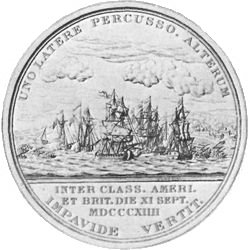
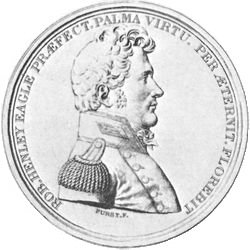
Robert Henley was born in James City County, Virginia, January 5, 1783. He entered the navy as a midshipman in 1799, and was on board of the Constellation, under Captain Truxtun, during her combat with La Vengeance; he was a lieutenant in 1807; a commander August 12, 1814; obtained the Eagle, and was second in command to Macdonough in his victory on lake Champlain, September 11, 1814, receiving for his conduct on that occasion the thanks of Congress and a gold medal. He was appointed captain, March 3, 1825; served in the home squadron and in the West Indies, and died on Sullivan's Island, South Carolina, October 7, 1828.
Plate XXXVII. No. 36.
September 11, 1814.
Step. Cassin Ticonderoga præfect. Quæ regio in terris nos. non plena lab. ℞. Uno latere percusso. alterum impavide vertit.
LIEUTENANT STEPHEN CASSIN.
[Victory of Lake Champlain.]
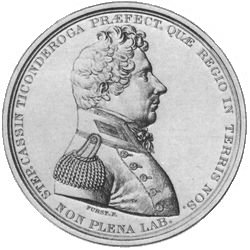
Stephen Cassin was born in Philadelphia, February 16, 1783. He entered the navy as a midshipman in 1800, served in the Tripolitan campaign, and became a lieutenant in 1807. He commanded the Ticonderoga in Macdonough's victory on Lake Champlain, September 11, 1814, and for his conduct on that occasion was promoted to the rank of master, and received a vote of thanks and a gold medal from Congress. He was made captain, March 3, 1825, commanded for some time the navy yard at Washington, District of Columbia, and died there, April 29, 1857.
Plate XXXVIII. No. 37.
March 29, 1814.
Ludovicus Warrington dux navalis Ameri. ℞. Pro patria paratus aut vincere aut mori.
CAPTAIN LEWIS WARRINGTON.
[Capture of the Épervier.]
LUDOVICUS WARRINGTON DUX NAVALIS AMERI. (Americanus) (Lewis Warrington, American naval commander.) Bust of Captain Warrington, in uniform, facing the right. furst. f. (fecit).
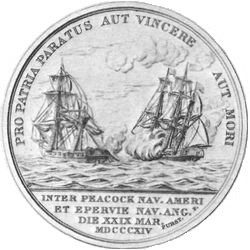
PRO PATRIA PARATUS AUT VINCERE AUT MORI. (Prepared to conquer or die for his country.) Naval action between the United States sloop-of-war Peacock, of eighteen guns, Captain Warrington, and the British brig-of-war Épervier, of eighteen guns, Captain Wales; the Peacock, to leeward, is firing her port broadside. The Épervier has lost her main-topmast Exergue: INTER PEACOCK NAV. AMERI ET EPERVIE (sic) NAV. ANG. DIE XXIX MAR. MDCCCXIV. (Inter Peacock navem Americanam et Épervier navem Anglicanam, die 29 Martii, 1814: Between the American vessel Peacock and the English vessel Épervier, March 29, 1814.) furst. f. (fecit).
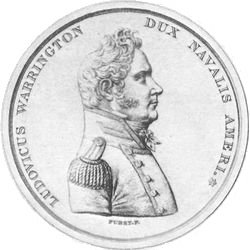
Lewis Warrington was born in Williamsburgh, Virginia, November 3, 1782. He entered the navy as a midshipman in 1800, and served under Commodore Preble in the Tripolitan campaign; was lieutenant, 1807; and master-commandant, 1813. He sailed from New York in March, 1814, in command of the sloop-of-war Peacock, and on the 29th of the same month took the British brig-of-war Épervier, Captain Wales, for which gallant deed he received the thanks of Congress and a gold medal. He was promoted to the rank of captain in November of the same year, and subsequently served on the Naval Board. In 1842 he became chief of the ordnance and hydrographic bureau of the Navy Department, in which capacity he died in Washington, October 12, 1851.
ORIGINAL DOCUMENTS.
Resolution of Congress Voting Medals to Captain Warrington, etc.
Approved October 21, 1814.
Captain Warrington to the Secretary of the Navy.
United States sloop Peacock, at sea, Latitude 27° 47´, longitude 89°. April 29th, 1814. To the Honourable William Jones, Secretary of the Navy, Washington, D. C.
Sir: I have the honour to inform you that we have this morning captured, after an action of 42 minutes, His Majesty's brig Épervier, Captain Wales, rating and mounting 18 thirty-two pound carronades, with 128 men, of whom 8 were killed and 15 wounded, according to the best information we could obtain. Among the latter is her first lieutenant, who has lost an arm, and received a severe splinter wound in the hip. Not a man in the Peacock was killed, and only two wounded, neither dangerously so. The fate of the Épervier would have been determined in much less time, but for the circumstance of our fore-yard being totally disabled by two round shots in the starboard quarter from her first broadside, which entirely deprived us of the use of our fore and fore-top sails, and compelled us to keep the ship large throughout the remainder of the action. This, with a few top-mast and top-gallant back-stays cut away, a few shots through our sails, is the only injury the Peacock has sustained. Not a round shot touched our hull; our masts and spars are as sound as ever. When the enemy struck he had five feet water in his hold, his main top-mast was over the side, his main-boom shot away, his fore-mast cut nearly in two and tottering, his fore rigging and stays shot away, his bowsprit badly wounded, and forty-five shot holes in his hull, twenty of which were within a foot of his water line. By great exertion we got her in sailing order just as dark came on.
In fifteen minutes after the enemy struck, the Peacock was ready for another action, in every respect but her fore-yard, which was sent down, finished and had the fore-sail set again in forty-five minutes: such was the spirit and activity of our gallant crew. The Épervier had under her convoy an English hermaphrodite brig, a Russian and a Spanish ship, which all hauled their wind, and stood to the east-northeast. I had determined upon pursuing the former, but found that it would not answer to leave our prize in her then crippled state, and the more particularly so, as we found she had in her $120,000 in specie, which we soon transferred to this sloop. Every officer, seaman, and marine did his duty, which is the highest compliment I can pay them.
I am, respectfully, L. Warrington.
Plate XXXIX. No. 38.
June 28, 1814.
Johnston Blakeley Reip. Fæd. Am. nav. Wasp dux. ℞. Eheu! bis victor patria tua te luget plauditq.
CAPTAIN JOHNSTON BLAKELEY.
[Capture of the Reindeer.]
JOHNSTON BLAKELEY REIP. FÆD. AM. NAV. WASP DUX. (Johnston Blakeley, Reipublicæ Fæderatæ Americanæ navis Wasp dux: Johnston Blakeley, Captain of the American Federal Republic's vessel Wasp.) Bust of Captain Blakeley, in uniform, facing the right. FÜRST. F. (fecit).
EHEU! BIS VICTOR PATRIA TUA TE LUGET PLAUDITQ. (Plauditque) (Alas! twice conqueror, thy country laments and applauds thee.) Naval action between the United States sloop-of-war Wasp, of eighteen guns, Captain Blakeley, and the British sloop-of-war Reindeer, of eighteen guns, Captain Manners; the Wasp, to windward, is firing her port broadside. The British vessel is striking her colors. Exergue: INTER WASP NAV. AMERI. ET REINDEER NAV. ANG. DIE XXVIII JUNIUS (sic) MDCCCXIV. (Inter Wasp navem Americanam et Reindeer navem Anglicanam, die 28 Junius, 1814: Between the American vessel Wasp and the English vessel Reindeer, June 28, 1814.) On the platform, FÜRST. F. (fecit).
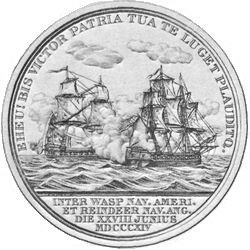
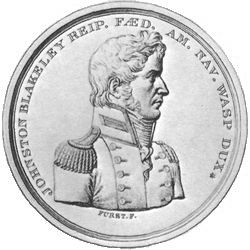
Johnston Blakeley was born at Seaford, County Down, Ireland, October, 1781. He was brought, when very young, to North Carolina, where his parents settled, and where they died while he was still a child. He entered the navy as a midshipman, February 5, 1800, and served under Commodore Preble in the Tripolitan campaign. In 1813, when a lieutenant, he commanded the Enterprize, and in the same year became master-commandant of the sloop-of-war Wasp, with which, on June 28, 1814, he took the British sloop-of-war Reindeer, Commander William Manners. For this memorable action Congress gave him a vote of thanks and a gold medal. He afterward cruised off the coast of France, and was lost at sea in the Wasp, of which no news has ever been received.
ORIGINAL DOCUMENTS.
Resolution of Congress Voting Medals to Captain Blakeley, etc.
Approved November 3, 1814.
Captain Blakeley to the Secretary of the Navy.
United States ship Wasp, L'Orient, July 8th, 1814. To the Honourable William Jones Secretary of the Navy, Washington, D. C.
Sir: On Tuesday, the 28th instant, being then in latitude 48° 36´, north, and longitude 11° 15´ west, we fell in with, engaged, and after an action of nineteen minutes, captured His Britannic Majesty's sloop-of-war the Reindeer, William Manners, Esquire, commander.
Where all did their duty and each appeared anxious to excel, it is very difficult to discriminate. It is, however, only rendering them their merited due, when it is declared of Lieutenants Reily and Bury, 1st and 3d of this vessel, and whose names will be found among those of the conquerors of the Guerrière and Java; and of Mr. Tillinghast, 2d lieutenant, who was greatly instrumental in the capture of the Boxer; that their conduct and courage on this occasion fulfilled my highest expectations and gratified every wish. Sailing-master Carr is also entitled to great credit for the zeal and ability with which he discharged his various duties.
The cool and patient conduct of every officer and man, while exposed to the fire of the shifting gun of the enemy, and without an opportunity of returning it, could only be equalled by the animation and ardour exhibited when actually engaged, or by the promptitude and firmness with which every attempt of the enemy to board was met and successfully repelled. Such conduct may be seen, but cannot well be described.
The Reindeer mounted sixteen 24 pound carronades, two long 6 or 9 pounders, and a shifting 12 pound carronade, with a complement (on board) of 118 men. Her crew were said to be the pride of Plymouth.
Our loss in men has been severe, owing in part to the proximity of the two vessels and the extreme smoothness of the sea, but chiefly in repelling boarders. That of the enemy, however, was infinitely more so, as will be seen by the list of killed and wounded on both sides.
Six round shot struck our hull, and many grape which did not penetrate far. The fore-mast received a 24 pound shot, which passed through its centre, and our rigging and sails were a good deal injured.
The Reindeer was literally cut to pieces in a line with her ports; her upper works, boats and spare spars, were one complete wreck. A breeze springing up next afternoon, her fore-mast went by the board.
Having received all the prisoners on board, which from the number of wounded occupied much time, together with their baggage, the Reindeer was on the evening of the 29th, set on fire, and in a few hours blew up.
I have the honour to be, etc., J. Blakeley.
Killed and Wounded. The loss on board the Reindeer was 25 killed and 42 wounded, total 67. On board the Wasp, 5 killed and 21 wounded, principally in boarding; among the latter, midshipmen Langdon and Toscan, both of whom expired some days after the action.
Plate XL. No. 39.
July 5 and 25, and September 17, 1814.
Major General Jacob Brown. ℞. Resolution of Congress November 3. 1814.
MAJOR-GENERAL JACOB BROWN.
[Victories of Chippewa, Niagara, and Erie.]
MAJOR GENERAL JACOB BROWN. Bust of General Brown, in uniform, facing the right. furst. f. (fecit).
RESOLUTION OF CONGRESS NOVEMBER 3. 1814. In the center of a trophy, composed of the enemy's arms and flags, are the Roman fasces, emblem of the strength and of the union of America. The fasces are surrounded by a crown of laurel, from which hang three cartoons, each bearing the name of one of the three victories: "NIAGARA" "ERIE" "CHIPPEWA". At the foot of the trophy the American eagle, with outspread wings, holds in its talons a British standard. Exergue: BATTLES OF CHIPPEWA. JULY 5. 1814. NIAGARA. JULY 25. 1814. ERIE. SEP. (September) 17. 1814. furst. f. (fecit).
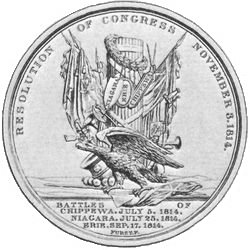
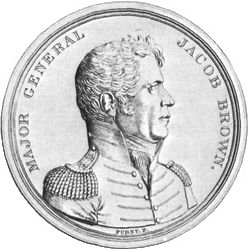
Jacob Brown was born in Bucks County, Pennsylvania, May 9, 1775. He began life as a school teacher, and afterward became a land surveyor in Ohio. He removed to Jefferson County, New York, in 1799; was made a colonel of New York militia, 1809; a brigadier-general of the same, 1810; and distinguished himself by his defence of Sackett's Harbor, May 29, 1813. He was appointed a brigadier-general in the United States army, July 19, 1813; major-general, January 24, 1814; and, in the same year, commander-in-chief on the Canada frontier. In this capacity he won the battles of Chippewa, July 5; Niagara, July 25; and Erie, September 17. For these victories Congress gave him a vote of thanks and a gold medal. He became commander-in-chief of the army in 1821, and died at head-quarters in Washington, February 24, 1828.
ORIGINAL DOCUMENTS.
Resolutions of Congress Voting Medals to Generals Brown, Scott, Porter, Gaines, Macomb, Ripley, and Miller.
Resolved by the Senate and House of Representatives of the United States of America in Congress assembled: That the thanks of Congress be, and they are hereby, presented to Major General Brown, and through him, to the officers and men of the regular army, and of the militia under his command, for their gallantry and good conduct in the successive battles of Chippewa, Niagara, and Erie, in Upper Canada, in which British veteran troops were beaten and repulsed by equal or inferior numbers; and that the President of the United States be requested to cause a gold medal to be struck, emblematical of these triumphs, and presented to Major-General Brown.
Resolved, That the President of the United States be requested to cause a gold medal to be struck, with suitable emblems and devices, and presented to Major-General Scott, in testimony of the high sense entertained by Congress of his distinguished services in the successive conflicts of Chippewa and Niagara, and of his uniform gallantry and good conduct in sustaining the reputation of the arms of the United States.
Resolved, That the President of the United States be requested to cause gold medals to be struck, with suitable emblems and devices, and presented to Brigadier-General Ripley, Brigadier-General Miller, and Major-General Porter, in testimony of the high sense entertained by Congress of their gallantry and good conduct in the several conflicts of Chippewa, Niagara, and Erie.
Resolved, That the thanks of Congress be, and they are hereby, presented to Major-General Gaines, and through him to the officers and men under his command, for their gallantry and good conduct in defeating the enemy at Erie on the fifteenth of August, repelling with great slaughter the attack of a British veteran army, superior in numbers; and that the President of the United States be requested to cause a gold medal to be struck, emblematical of this triumph, and presented to Major-General Gaines.
Resolved, That the thanks of Congress be, and they are hereby, presented to Major-General Macomb, and through him to the officers and men of the regular army under his command, and to the militia and volunteers of New York and Vermont, for their gallantry and good conduct, in defeating the enemy at Plattsburgh on the eleventh of September, repelling with one thousand five hundred men, aided by a body of militia and volunteers from New York and Vermont, a British veteran army, greatly superior in number; and that the President of the United States be requested to cause a gold medal to be struck, emblematical of this triumph, and presented to Major-General Macomb.
Approved November 3, 1814.
Major-General Brown to the Secretary of War.
Head Quarters, Chippewa Plains, July 7th, 1814. To the Honourable John Armstrong, Secretary of War, Washington, D. C.
Sir: On the 2d instant I issued my order for crossing the Niagara river, and made the arrangements deemed necessary for securing the garrison of Fort Erie. On the 3d that post surrendered at 5 p.m. Our loss in this affair was four of the 25th regiment, under Major Jessup, of Brigadier-General Scott's brigade, wounded. I have enclosed a return of the prisoners, of the ordnance and ordnance stores captured.
To secure my rear, I have placed a garrison in this fort, and requested Captain Kennedy to station his vessels near the post.
On the morning of the 4th, Brigadier-General Scott, with his brigade and a corps of artillery, was ordered to advance toward Chippewa, and be governed by circumstances; taking care to secure a good military position for the night. After some skirmishing with the enemy, he selected this plain with the eye of a soldier, his right resting on the river, and a ravine being in front. At 11 at night I joined him with the reserve, under General Ripley, our field and battering train, and corps of artillery under Major Hindman. General Porter arrived the next morning with a part of the New York and Pennsylvania volunteers, and some of the warriors of the Six Nations.
At 4 o'clock in the afternoon, agreeably to a plan I had given General Porter, he advanced from the rear of our camp, with the volunteers and Indians (taking the woods in order to keep out of view of the enemy), with the hope of bringing his pickets and scouting parties between his (Porter's) line of march, and our camp. As Porter moved, I ordered the parties advanced in front of our camp to fall back gradually, under the enemy's fire, in order to draw him, if possible, up to our line. About half past 4, the advance of General Porter's command met the light parties of the enemy in the woods, upon our extreme left. The enemy were driven, and Porter advancing near to Chippewa, met their whole column in order of battle. From the cloud of dust rising, and the heavy firing, I was led to conclude that the entire force of the enemy was in march, and prepared for action. I immediately ordered General Scott to advance with his brigade, and Towson's artillery, and meet them upon the plain in front of our camp. The general did not expect to be gratified with a field engagement. He advanced in the most prompt and officer-like style, and in a few minutes was in close action upon the plain, with a superior force of British regular troops. By this time General Porter's command had given way, and fled in every direction, notwithstanding his personal gallantry, and great exertions to stay their flight. The retreat of the volunteers and Indians caused the left flank of General Scott's brigade to be greatly exposed. Captain Harris, with his dragoons, was directed to stop the fugitives, behind the ravine fronting our camp; and I sent Colonel Gardner to order General Ripley to advance with the 21st regiment which formed part of the reserve, pass to the left of our camp, skirt the woods so as to keep out of view, and fall upon the rear of the enemy's right flank. This order was promptly obeyed, and the greatest exertions were made by the 21st regiment to gain their position, and close with the enemy, but in vain; for such was the zeal and gallantry of the line commanded by General Scott, that its advance upon the enemy was not to be checked. Major Jessup, commanding the left flank battalion, finding himself pressed in front and in flank, and his men falling fast around him, ordered his battalion to "support arms and advance;" the order was promptly obeyed, amidst the most deadly and destructive fire. He gained a more secure position, and returned upon the enemy so galling a discharge, as caused them to retire. By this time, their whole line was falling back, and our gallant soldiers pressing upon them as fast as possible. As soon as the enemy had gained the sloping ground, descending towards Chippewa, and distant a quarter of a mile, he broke and ran to gain his works. In this effort he was too successful, and the guns from his batteries opening immediately upon our line, checked in some degree the pursuit. At this moment I resolved to bring up all my ordnance and force the place by a direct attack, and gave the order accordingly. Major Wood, of the corps of engineers, and my aid, Captain Austin, rode to the bank of the creek towards the right of their line of works, and examined them. I was induced by their report, the lateness of the hour, and the advice of General Scott and Major Wood, to order the forces to retire to camp.
My most difficult duty remains to be performed; I am depressed with the fear of not being able to do justice to my brave companions in arms, and apprehensive, that some who had an opportunity of distinguishing themselves, and promptly embraced it, will escape my notice.
Brigadier-General Scott is entitled to the highest praise our country can bestow: to him, more than any other man, I am indebted for the victory of the 5th of July. His brigade has covered itself with glory. Every officer and every man of the 9th and 22d, 11th and 15th regiments did his duty with a zeal and energy worthy of the American character. When every officer stands so pre-eminently high in the path of his duty and honour, it is impossible to discriminate, but I cannot deprive myself of the pleasure of saying, that Major Leavenworth commanded the 9th and 22d, Major Jessup the 25th, and Major McNeil the 11th. Colonel Campbell was wounded early in the action, gallantly leading on his regiment.
The family of General Scott were conspicuous in the field; Lieutenant Smith of the 6th infantry, major of brigade, and Lieutenants Worth and Watts his aids.
From General Ripley and his brigade, I received every assistance that I gave them an opportunity of rendering. I did not order any part of the reserve into action until General Porter's command had given way, and then General Scott's movements were so rapid and decisive, that General Ripley could not get up in time with the 21st, to the position as directed. The corps of artillery under Major Hindman were not generally in action; this was not their fault. Captain Towson's company was the only one that had a full opportunity of distinguishing itself, and it is believed that no company ever embraced an opportunity with more zeal or more success.
A detachment from the 2d brigade under the command of Lieutenant-Colonel McDonald, penetrated the woods with the Indians and volunteers, and for their support. The conduct of McDonald and his command reflects high honour on the brigade to which they belong.
The conduct of General Porter has been conspicuously gallant. Every assistance in his power to afford, with the description of force under his command, has been rendered. We could not expect him to contend with the British column of regulars which appeared upon the plains of Chippewa. It was no cause of surprise to me to see his command retire before this column.
Justice forbids that I should omit to name my own family. They yield to none in honourable zeal, intelligence, and attention to duty. Colonel Gardner, Major Jones, and my aids, Captains Austin and Spencer, have been as active and as much devoted to the cause as any officers of the army. Their conduct merits my warmest acknowledgments; of Gardner and Jones I shall have occasion again to speak to you.
Major Camp, deputy-quarter-master-general, deserves my particular notice and approbation. By his great exertions, I was enabled to find the means of crossing. Captain Daliba, of the ordnance department, has rendered every service in his power.
The inclosed return will show you our loss, and furnish you with the names of the dead and wounded officers. These gallant men must not be forgotten. Our country will remember them, and do them justice.
With great respect, &c., Jacob Brown.
General Orders.
Adjutant-General's Office, left Division, Chippewa Plains, July 6th, 1814.
Major-General Brown has the gratification to say, that the soldiers of the 2d division, west of the Niagara, merit greater applause than he is able to bestow in general orders; they merit the highest approbation of the country. The conduct of Brigadier-General Scott's brigade, which had the opportunity to engage the whole force of the enemy, the greater part, it is believed, of all in the peninsula, removes on the day of this battle the reflection on our country, that its reputation in arms is yet to be established. His brigade consists of battalions of the 9th, the 11th, the 25th and a detachment of the 22d. Towson's company of artillery, which was attached to it, gallantly commenced, and with it sustained the action.
The volunteers and Indians performed their part; they drove the enemy's Indians and light troops until they met the British army: they meet the general's approbation.
Of the reports of killed and wounded, the names of the wounded officers will be mentioned, in order that they may be rewarded with that honourable mention which is due.
By order of Major-General Brown. C. K. Gardner, Adj't Gen.
General Brown to the Secretary of War.
Buffalo, August, 1814. To the Honourable John Armstrong, Secretary of War, Washington, D. C.
Sir: Confined as I was, and have been, since the last engagement with the enemy, I fear that the account I am about to give may be less full and satisfactory than under other circumstances it might have been made. I particularly fear that the conduct of the gallant men it was my good fortune to lead, will not be noticed in a way due to their fame and the honour of our country.
You are already apprized that the army had, on the 25th ultimo, taken a position at Chippewa. About noon of that day, Colonel Swift, who was posted at Lewistown advised me by express that the enemy appeared in considerable force in Queenstown, and on its heights; that four of the enemy's fleet had arrived during the preceding night, and were then lying near Fort Niagara, and that a number of boats were in view moving up the strait. Within a few minutes after this intelligence had been received, I was further informed by Captain Denmons, of the quarter-master's department, that the enemy was landing at Lewistown, and that our baggage and stores at Schlosser, and on their way thither, were in danger of immediate capture. It is proper here to mention, that having received advices as late as the 20th from General James, that our fleet was then in port, and the commodore sick, we ceased to look for co-operation from that quarter, and determined to disencumber ourselves of baggage, and march directly for Burlington Heights. To mask this intention, and to draw from Schlosser a small supply of provisions, I fell back upon Chippewa.
As this arrangement, under the increased force of the enemy, left much at hazard on our side of the Niagara, and as it appeared by the before stated information, that the enemy was about to avail himself of it, I conceived that the most effectual method of recalling him from this object was to put myself in motion towards Queenstown. General Scott, with his first brigade, Towson's artillery, and all the dragoons and mounted men were accordingly put in march on the road leading thither, with orders to report, if the enemy appeared, and to call for assistance, if that was necessary. On the general's arrival at the falls, he learned that the enemy was in force directly in his front, a narrow piece of woods alone intercepting his view of them. Waiting only to give this information, he advanced upon them. By this time Assistant Adjutant General Jones had delivered his message, the action began, and before the remaining part of the division had crossed the Chippewa, it had become close and general between the advanced corps. Though General Ripley with his second brigade, Major Hindman with the corps of artillery, and General Porter at the head of his command, had respectively pressed forward with ardour, it was not less than an hour before they were brought to sustain General Scott, during which time his command most skilfully and gallantly maintained the conflict. Upon my arrival, I found that the general had passed the wood, and engaged the enemy on the Queenstown road, and on the ground to the left of it, with the 9th, 11th and 22d regiments, and Towson's artillery. The 25th had been thrown to the right, to be governed by circumstances.
Apprehending that these corps were much exhausted, and knowing that they had suffered severely, I determined to interpose a new line with the advancing troops; and thus disengage General Scott, and hold his brigade in reserve. Orders were accordingly given to General Ripley. The enemy's artillery at this moment occupied a hill which gave great advantage, and was the key of the whole position. It was supported by a line of infantry. To secure victory, it was necessary to carry this artillery and seize the height. This duty was assigned to Colonel Miller, while, to favour its execution, the 1st regiment, under the command of Colonel Nicholas, was directed to manœuvre and amuse the infantry. To my great mortification, this regiment, after a discharge or two, gave way and retreated some distance, before it could be rallied, though it is believed the officers of the regiment exerted themselves to shorten this distance. In the mean time, Colonel Miller, without regard to this occurrence, advanced steadily and gallantly to his object, and carried the height and the cannon. General Ripley brought up the 23d regiment, (which had also faltered,) to his support, and the enemy disappeared from before them. The 1st regiment was now brought into line on the left of the 21st, and the detachment of the 17th and 19th, General Porter occupying with his command the extreme left. About this time, Colonel Miller carried the enemy's cannon. The 25th regiment, under Major Jessup was engaged in a more obstinate conflict with all that remained to dispute with us the field of battle. The major, as has been already stated, had been ordered by General Scott, at the commencement of the action, to take ground to his right. He had succeeded in turning the enemy's flank; had captured (by a detachment under Captain Ketchum), General Riall and sundry other officers, and showed himself again to his own army, in a blaze of fire, which defeated or destroyed a very superior force of the enemy. He was ordered to form on the right of the 2d regiment. The enemy rallying his forces, and as is believed, having received reinforcements, now attempted to drive us from our position and regain his artillery. Our line was unshaken and the enemy repulsed. Two other attempts having the same object, had the same issue. General Scott was again engaged in repelling the former of these, and the last I saw of him in the field of battle, he was near the head of his column, and giving to its march a direction that would place him on the enemy's right. It was with great pleasure I saw the good order and intrepidity of General Porter's volunteers from the moment of their arrival; but during the last charge of the enemy those qualities were conspicuous. Stimulated by the examples set them by their gallant leader, by Major Wood of the Pennsylvania corps, by Colonel Dobbin of New York, and by their officers generally, they precipitated themselves upon the enemy's line, and made all the prisoners which were taken at this point of the action.