LIST OF PLATES. (continued 12)
Reading edition
The men saved were badly frozen. They had been on the ledge since 9 o'clock of the night preceding, and at high tide, which was during the night, had stood in a foot and a half of water, which is the height to which the sea rises at that time over the highest point of the rock. When they were taken off they were almost helpless, and probably could not have survived an hour longer. Their boots had to be cut off; their feet and hands kept for hours in cold water; great blisters which puffed up two and three inches high on their extremities were opened with a knife, and they were put to bed in a forlorn condition. Mr. Wheeler then took the dory and rowed two miles dead to windward with extreme difficulty, the wind blowing very hard, and the sea feather-white with foam, till he reached Cape Elizabeth, where he purchased rum, liniment, corn-meal and coffee. He got back to the island about dark, bringing with him Mr. Andrew J. Wheeler. The rescued men were then in great suffering; and rum, gruel and coffee were administered to them, and their feet, hands, and heads bathed in liniment and rum. They were constantly and tenderly cared for by Messrs. Wheeler and Philbrick, assisted by Mr. Andrew J. Wheeler, until Thursday noon following, when they were taken off the island by the revenue-cutter Dallas.
The active and steadfast humanity of Messrs. Wheeler and Philbrick, involving such marked labors, hardships and sacrifices in the interest of two poor castaways, can only be recognized, not recompensed, by the medals of honor bestowed upon them. It appears that they also, together with Mr. John N. Wheeler, of Cape Elizabeth, were subjected to considerable pecuniary loss on account of supplies and medicaments furnished these unfortunate men, clothing and bedding spoiled by the ichor from their sores, and journeys by team to Portland, to notify the Collector of their situation and necessities; and it is matter for deep regret that there is no appropriation available under the law to satisfy claims so intrinsically just, and arising under such circumstances.
Correspondence has been received from the Honorable the Secretary of State in relation to aid rendered by English life-boat crews to the crew of the American ship Ellen Southard, including a dispatch from the American consul at Liverpool, dated October 16, 1875, recommending recognition of the gallantry of these crews upon that occasion, and suggesting that this might take the form of a medal for each one of the members thereof. It appears that the Ellen Southard was wrecked by stranding on Sunday, the 26th of September, 1875, in a furious gale and frightful sea, at the mouth of the river Mersey. The ship soon began to break up, and unavailing efforts to construct a raft were made by her officers and men, who remained in extreme peril during the whole night. The next morning, news of the disaster having reached Liverpool, the life-boat belonging to the Mersey Docks and Harbor Board, and the life-boat stationed at New Brighton, of the Royal National Life-boat Institution, came to the rescue. The Liverpool boat arrived in advance of the other, and, after much difficulty and danger, succeeded in taking off all the persons on the wreck, seventeen in number, including the pilot. A few moments after, while all on board were congratulating themselves upon the fortunate escape, a terrific wave, which appeared, as averred by the deposition of some of the survivors, to be as high as a house, threw the life-boat entirely over, and eight of those belonging to the ship, including the captain and his wife, the pilot, and three of the fifteen life-boat men, making twelve persons in all, were drowned. The life-boat, which appears not to have been of the self-righting variety, remained bottom upward, and after struggling in the water for a considerable time, the survivors, being twelve of the life-boat crew and eight of the crew of the ship, managed to get on to her, where they clung for about an hour in great peril, when the New Brighton life-boat arrived and took them on board.
This melancholy disaster sets in the strongest relief the gallant devotion of the crews of the two English life-boats, all the members of which risked their lives, while three of them died in the brave effort to save our countrymen. The sorrow that must be felt for those who perished in this manly endeavor is tempered with satisfaction that the terms of the law permit us to bestow upon their living comrades in the enterprise the fitting tokens of our appreciation; and gold medals of the first class have been awarded to the twenty-seven survivors, and will be struck as soon as possible.
I have the honor to be, very respectfully, your obedient servant,
S. I. Kimball, In charge of life-Saving Service.
Colonel J. S. Crosby, U. S. Consul at Florence, Italy, for rescuing the life of Miss Edith May, and endeavoring to rescue the late Miss Adele Hunter, and Mr. W. T. Garner and his wife, at the sinking of the Yacht "Mohawk," in New York Harbor, July 20, 1876. Awarded June 8, 1877.
Treasury Department, Office of the Secretary, Washington, D. C., June 30, 1877. To Colonel J. Schuyler Crosby, United States Consul, Florence, Italy.
Sir: I have the honor to transmit herewith a life-saving medal of the first class, and which has been awarded to you, under authority of the provisions of the seventh section of the Act of Congress approved June 20, 1874, for the extreme and heroic daring manifested by you in saving the life of Miss Edith May, and endeavoring to rescue the late Miss Adele Hunter and Mr. William T. Garner and his wife, under the circumstances of peculiar peril and difficulty which attended the sinking of the yacht "Mohawk," on the 20th of July, 1876.
The sorrowful catastrophe of that day will not soon be forgotten, and will be all the more remembered for the noble manhood it called into action. The vessel sank within four minutes. In that brief time you saved one life from the sinking cabin. There you re-entered, and remained until submerged, engaged in the desperate and heroic efforts to save the others, escaping yourself finally only by swimming upward through the broken sky-light, guided by the faint light shed from the above through the water. In sending you this medal, the highest recognition of your conduct which the Government can give, it is felt that no words can add distinction to the splendid gallantry which the token seeks to commemorate and honor.
I have the honor to be, Sir, very respectfully, John Sherman, Secretary.
Carl Fosberg, for endeavoring to save the late Miss Adele Hunter and Mr. William T. Garner and his wife, at the sinking of the Yacht "Mohawk," in New York Harbor, July 20, 1876. Awarded June 8, 1877.
Treasury Department, Office of the Secretary, Washington, D. C., September 22, 1877. To Mr. Carl Fosberg, Quartermaster, Yacht "Madeleine," Care of Commodore John S. Dickerson, No. 29 Cliff Street, New York.
Sir: I have the honor to transmit herewith a life-saving medal of the first class, which has been awarded to you, under authority of the provisions of the seventh section of the Act of Congress approved June 20, 1874, for the extreme and heroic daring manifested by you in endeavoring to rescue the late Miss Adele Hunter and Mr. William T. Garner and his wife, under circumstances of peculiar peril and difficulty, which attended the sudden sinking of the yacht "Mohawk," on the 20th of July, 1876.
It is regretted that, owing to the inability of the Department to discover your address, the medal could not sooner be forwarded. In now sending it to you I recur to the circumstances of the conduct it is intended to recognize and commemorate. The record shows that the "Mohawk" sank within four minutes. During that time and when the vessel was on her beam ends, you rushed down into her cabin, where Colonel Crosby was already, and remained there with him until the cabin was almost filled with water, engaged in devoted though unavailing efforts to extricate the unfortunate ladies from the furniture which had fallen upon them, and escaping finally only by swimming upward through the broken skylight, guided by the faint light which penetrated the water. It must be noted that you were not bound by any tie of friendship or kindred to those you tried to rescue, and that you were not impelled by any consideration of reward, but solely by the gallant instincts of manhood. Language has no power to add distinction to heroism like yours, but in sending you this medal, which is the highest tribute to your conduct that the Government can bestow, it is a satisfaction to be able to express the feeling that in men like you the traditional nobility of the sailor is preserved.
Very respectfully, John Sherman, Secretary.
Report of the United States Life-Saving Service.
Treasury Department, United States Life-Saving Service, Washington, D. C., November 29, 1877. To the Honorable John Sherman, Secretary of the Treasury, Washington, D. C.
Sir:
Awards of Medals.
Two life-saving medals of the first class, and six life-saving medals of the second class, have been awarded during the year under the provisions of the act of June 20, 1874.
The medals of the first class were awarded to Colonel J. Schuyler Crosby, of New York, at this date the American consul at Florence, and Carl Fosberg, a seaman belonging to the yacht Mohawk, in recognition of their extraordinary gallantry upon the occasion of the sudden sinking of that vessel in New York Harbor on the afternoon of the 20th of July, 1876. The horror which this dreadful catastrophe diffused for days through New York and its environs was only relieved by their action, which revealed some of the noblest traits of the human soul. The Mohawk was the largest and costliest of the fleet of pleasure vessels belonging to the New York Yacht Club. She was the property of Mr. William T. Garner, a wealthy merchant of New York, residing near New Brighton, Staten Island, and was sumptuously furnished and appointed. On Thursday afternoon (July 20, 1876) she lay at her anchorage in New York Bay, off Stapleton, Staten Island. At about half past three o'clock Mr. Garner arrived on board with a party of friends, consisting of Mr. Gardiner G. Howland, Mr. Louis B. Montant, Colonel J. Schuyler Crosby, Mr. Frost Thorne, together with Mrs. Garner, Miss Adele Hunter, and Miss Edith May, arrangements having been made for a sail down the bay. The day had been somewhat dark and cloudy, with occasional squalls and showers, and at the time of the company coming on board a thunder-storm was rising in the southwest, of which no other notice was taken by the guests than to retreat into the cabin from the already dropping rain. The order had been given by Mr. Garner to get under way, and under the direction of the sailing-master, Rowland, the anchor had been lifted from the bottom, but was still in the water, and all the working sails were set except the flying-jib. The neighboring craft, of which there was a number, had all taken in sail, and the men upon the decks waited to see how the Mohawk would behave in the coming squall. At that moment although there was hardly a breath on deck, a wind smote the upper sails, and the sailing-master gave orders to let go the fore-sheet, the jib-sheets, and the fore-topsail. The order had only been obeyed in respect to the fore-topsail, when the squall struck the yacht with such fury that she careened, and lurched violently to port.
There was an instant tumult of cries, and the gentlemen rushed up on deck from the cabin. In a moment the vessel was on her side with the water pouring over the rail. While she was going over, Mr. Garner and Colonel Crosby hurried back into the cabin to save the ladies. Miss May was far over on the port side as they entered, and Colonel Crosby, calling to her to get out as quickly as possible, met her half way as she came across, got her to the companion-way, where he pushed her up to Mr. Howland and Mr. Montant, and sprang back into the cabin. The bravery of this action will be realized when it is stated that the water was then pouring down the companion-way in a steady stream. To enter the filling cabin down this narrow way, in a vessel keeled over on her side and rapidly sinking, seemed certain death. This Colonel Crosby did, and with equal courage, the seaman Fosberg rushed in with him. The scene in the cabin was frightful. The rich and heavy furniture had shifted, and Mrs. Garner and Miss Hunter were caught and pinioned by it against the sideboard. Mrs. Garner was screaming and her husband was making frantic efforts to release her and her companion, by throwing off the heavy articles which held them down. In these endeavors Colonel Crosby and Carl Fosberg desperately joined, pulling away the furniture and handing it up to Mr. Montant and Mr. Howland, who threw it out on deck. The water, meanwhile, continued to pour in and the cabin rapidly filled. Although nearly submerged, the three men never stopped their perilous work while it could be continued. Their labors were, however, ineffectual, and were ended by the sinking of the vessel. It was only four minutes from the moment she capsized till she went down. Mr. Garner was drowned, clinging to his wife, whom he would not leave. Colonel Crosby and Carl Fosberg, toiling to the last second, were engulfed, and nearly lost their lives. Swallowed by the flood in the cabin, they only escaped by swimming upward, guided by the faint light shed through the water from the broken skylight. The aperture was fortunately large enough to enable them to pass through, and they reached the surface, and were picked up by one of the many boats which at once began to gather around the sunken vessel.
The yacht sank so rapidly that Miss May, after being saved by Colonel Crosby from the cabin, was again placed in the greatest danger. She had not instantly quitted the vessel, being advised to remain by Mr. Montant, who, with Mr. Howland, was engaged in throwing the cabin furniture out on deck from the companion-way. Consequently, when the vessel went down, they were all three caught between the companion-way and the furniture, which was now washed back into the cabin, and were completely covered by the rushing flood. Fortunately, Miss May had her arm outside the companion-way, which prevented her from being swept back into the cabin, and Mr. Montant, in his struggles, losing hold of her, she was enabled to swim, and with a few strokes gained the surface of the water, coming up near Mr. Howland, who supported her till they were picked up by a boat from a neighboring yacht. Mr. Montant also escaped, though unhappily he did not long survive the shock of the disaster.
The gold medals of the life-saving service have never been awarded more deservedly than in this instance. It was no common courage and humanity that impelled these two brave men to plunge within the sinking vessel, where in the half darkness, amidst the confusion of huddled furniture and rushing water, they strove for the lives of the unfortunate victims. The perfect behavior of the one in his manful efforts for his friends is matched by the action of the other in imperilling his life for strangers. Writing of him to the department, Colonel Crosby expresses a true feeling, the utterance of which adds new honor to his own conduct, in these words: "Too much cannot be said in favor of this man, who was governed simply by his own brave instincts rather than the hope of any reward. Nor did he have friendly or loyal considerations to prompt him to risk his own life, which he did by remaining to the last moment on board."
It deserves to be stated in this connection that Mr. Carl Fosberg completed his gallantry by his modesty. After the affair in which he behaved so well, he kept out of the way. When reporters sought him he hid. It was with difficulty, and after some time, that he could be found to give him the medal to which his conduct had entitled him.
The life-saving medals of the second class were bestowed upon six men who, at the risk of their own lives, saved a crew of nine persons from the wreck of the bark Tanner. This vessel, bound for Buffalo with a cargo of wheat, stranded about ten o'clock on the night of September 9, 1875, on the beach south of the harbor of Milwaukee. A severe northeast gale was prevailing, and the vessel being submerged in about 20 feet of water, her captain and crew were forced to take to the rigging, where they remained all night, with the heavy sea breaking over them. At daylight the captain jumped into the sea, and in the effort to gain the shore was drowned. The unfortunate crew remained in the utmost peril, one of the masts of the sunken vessel having fallen, and the vessel herself fast going to pieces. Their rescue was ineffectually attempted by the revenue-steamer Johnson, aided by the tug F. C. Maxon. It was finally accomplished toward noon of that day (September 10, 1875) by the following contrivance: A scow held by a long line from a steam-tug was allowed to drift down near the wreck, and a yawl-boat, similarly held to the scow, was let down still nearer. The men in the rigging then dropped one by one into the water and were picked up by those in the yawl, which was then drawn up with its burden to the scow, which in turn was drawn to shore. The six men referred to manned the yawl and scow, volunteering for this difficult and hazardous duty. Their names were Henry M. Lee, N. A. Petersen, Barnt Oleson, Anton Oleson, Henry Spark, and John McKenna. The skill and daring they displayed in the task of deliverance won hearty applause from many spectators, and fully entitled them to the recognition expressed by the medals awarded them.
The twenty-seven gold medals, mentioned in the last report as having been awarded to the crew of the life-boat of the Royal National Institution, and the twelve survivors of the crew of the Mersey Docks and Harbor Board life-boat, in recognition of their efforts to rescue the persons on board of the American ship Ellen Southard, wrecked at the mouth of the river Mersey, near Liverpool, on September 26, 1875, efforts which cost three of the life-boatmen their lives, have since been struck, and delivered to the members of the respective crews. The presentation took place on the 16th of April, 1877, at the Town Hall, in Liverpool, the proceedings being attended by a large number of corporation officials, officers of mercantile associations, the principal American merchants in Liverpool, and most of the masters of American ships in port. The deputy mayor of Liverpool presided, and the affair assumed the gratifying character of an ovation to the brave recipients of the medals, and was also the occasion for cordial and enthusiastic references, on the part of the distinguished gentlemen at the meeting, to the action of our government in the matter, which met with a suitable response from General Fairchild, the American consul at Liverpool, who was also present. The same cordial spirit appeared in the comments which the occasion elicited from the English press.
I have the honor to be, very respectfully, your obedient servant,
S. I. Kimball, General Superintendent.
Philip C. Bleil, of the Metropolitan Police force of New York City, for rescuing, at different times, several persons from drowning, from November, 1876, to June, 1877. Awarded January 4. 1878.
Treasury Department, Office of the Secretary, Washington, D. C., January 15, 1878. To Mr. Philip C. Bleil, Patrolman, New York Metropolitan Police, New York City.
Sir: I have the honor to transmit herewith a life-saving medal of the first class, which has been awarded to you under authority of the Act of Congress approved June 20, 1874, in recognition of your services in rescuing from drowning, at the peril of your own life, six persons, on as many occasions, since 1875.
The papers in your case, transmitted to the Department, show that in twelve other instances you rescued persons from drowning. It is regretted that as these rescues were effected prior to the date of the Act of June 20, 1874, they cannot be recognized and honored by the inscription upon the medal awarded you. It is, however, proper that they should be remembered here, in connection with the six deliverances which the medal aims to commemorate, and that thus due acknowledgment should be made of your gallant record as the preserver of eighteen human lives. No record could be prouder, nor could any give you a better title to the respect and gratitude of your fellow beings. In sending you this token of the public appreciation of your noble courage and humanity, it gives me the truest pleasure to add an expression of my sense of your heroism, together with the hope that you may long adorn the force with which you are connected and the community which must rank you among its worthiest citizens.
I have the honor to be, very respectfully, smcap">John Sherman, Secretary.
Plate LXXXV. No. 85.
June 20, 1874.
Life Saving medal of the second class. United States of America. ℞. In testimony of heroic deeds, etc.
LIFE SAVING MEDAL OF THE SECOND CLASS.
[Saving Life from the Perils of the Sea.]
LIFE SAVING MEDAL OF THE SECOND CLASS * UNITED STATES OF AMERICA. * A female figure hovering in the air, and saving a man from the deep.
IN TESTIMONY OF HEROIC DEEDS IN SAVING LIFE FROM THE PERILS OF THE SEA. Within a wreath of laurel: ACT OF CONGRESS JUNE 20th, 1874, and a vacant space for the name of the recipient.
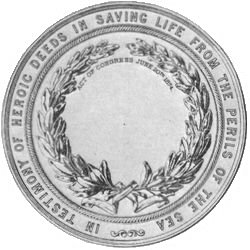
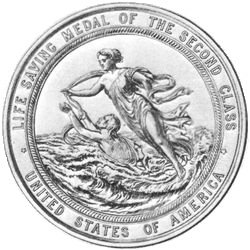
This medal, though not signed, is by Paquet.
ORIGINAL DOCUMENTS.[133]
Sir: I have the honor to transmit herewith a life-saving medal of the second class, which has been awarded to you under authority of the seventh section of the Act of Congress approved June 20, 1874, in recognition of your services in saving the lives of two men who were wrecked on Watts' Ledge, on the coast of Maine, on the 30th of November, 1875.
In sending you this medal, the Department desires to express its sense of the disinterestedness and zeal which marked your gallant conduct in saving the lives referred to.
I have the honor to be, Sir, your obedient servant, Lot M. Morrill, Secretary.
Sir: I have the honor to transmit herewith a life-saving medal of the second class, which has been awarded to you, under authority of the seventh section of the Act of Congress approved June 20, 1874, in recognition of your services in saving the lives of the crew of the barque "Tanner," consisting of nine men, who were wrecked near the entrance to the harbor of Milwaukee, Wisconsin, on the 9th of September, 1875.
The ingenuity, skill and heroic daring displayed by you and your companions in effecting the difficult and dangerous rescue of these men upon the occasion referred to, is felt to merit the highest commendation and to amply justify the award of this medal.
I have the honor to be, Sir, very respectfully, John Sherman, Secretary.
Captain Charles H. Smith, of the Light-House Tender "Rose," for rescuing a boy from drowning in the Christiana River, Wilmington, Delaware, September 17, 1877. Awarded November 23, 1877.
Treasury Department, Office of the Secretary, Washington, D. C., March 12, 1878. To Captain Charles H. Smith, Master Light-House Tender "Rose," Philadelphia, Pennsylvania.
Sir: I have the honor to transmit herewith a life-saving medal of the second class, which has been awarded to you, under authority of the seventh section of the Act of Congress approved June 20, 1874, in recognition of your services in rescuing from drowning, on the 11th of September, 1877, a boy named Thomas Walsh, who had fallen from a wharf at Wilmington, Delaware, into the Christiana river.
The witnesses of the affair testify that you plunged from the deck of your vessel in your clothes and, under circumstances of peculiar danger, seized the drowning lad as he was sinking for probably the last time, handed him up to the people on the wharf, and then swam back to your vessel. In this perilous action your modesty was no less conspicuous than your bravery, and in addition to the pleasure I have in sending you the medal which commemorates your gallant behavior, there is the equal pleasure of knowing that the Department is also honored by such conduct on the part of one of its officers.
Very respectfully, John Sherman, Secretary.
Edward Nordall, seaman on board the revenue steamer "Tench Coxe" for rescuing an unknown man from drowning in the Delaware River, June 3, 1877. Awarded November 23, 1877.
Treasury Department, Office of the Secretary, Washington, D. C., March 12, 1878. To Edward Nordall, Seaman on board the revenue steamer "Tench Coxe," Philadelphia, Pennsylvania.
Sir: I have the honor to transmit herewith a life-saving medal of the second class, which has been awarded to you, under authority of the seventh section of the Act of Congress approved June 20, 1874, in recognition of your services in rescuing an unknown man from drowning in the Delaware river, on the 3d of June, 1877.
The hardy courage and humanity of your action in springing overboard in a squall of violent wind and rain, at the peril of your life, and saving this stranger, cannot fail to be appreciated, and fully deserves the public recognition and esteem which the award of a medal to you, involves. In sending you this testimonial to your brave and humane conduct, I am deeply gratified that it was so well won, and by a seaman of the revenue marine.
Very respectfully, John Sherman, Secretary.
Malachi Corbell, Keeper of Life Saving Station No. 5, District No. 6, for rescuing two men from a capsized boat, near Caffrey's Inlet, North Carolina, November 14, 1875. Awarded November 23, 1877.
Treasury Department, Office of the Secretary Washington, D. C., March 12, 1878. To Captain Malachi Corbell, Keeper of Life Saving Station No. 5, District No. 6, Caffrey's Inlet, N. C.
Sir: I have the honor to transmit herewith a life-saving medal of the second class, which has been awarded to you, under authority of the seventh section of the Act of Congress approved June 20, 1874, in recognition of your services in saving the lives of Willis Westcott and James Gray, near Caffrey's Inlet, North Carolina, on the 25th of November, 1875.
It appears that these two men were clinging to a capsized boat in a heavy sea, two of their companions having already been drowned, and that you went out to their relief, and succeeded in bringing them to shore in an exhausted condition, at the peril of your own life, your boat being also capsized in the effort. Such an action, as marked by manly energy, courage and humanity, denotes no less the worthy keeper of a Life-Saving Station than a good and gallant man, and I have peculiar pleasure in transmitting to you this medal as the memorial of noble conduct and character.
Very respectfully, John Sherman, Secretary.
Plate LXXXVI. No. 86.
June 20, 1874.
John Horn, Jr. ℞. By act of Congress June 20th 1874. In recognition of his heroic exploits, etc.
JOHN HORN, JR.
[Heroic Exploits.]
JOHN HORN, JR. Undraped bust of John Horn, Jr., facing the left. C. BARBER.
BY ACT OF CONGRESS JUNE 20th, 1874. Within a wreath of laurel: IN RECOGNITION OF HIS HEROIC EXPLOITS IN RESCUING MEN WOMEN & CHILDREN FROM DROWNING IN DETROIT RIVER.
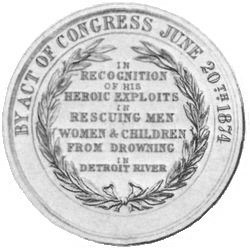
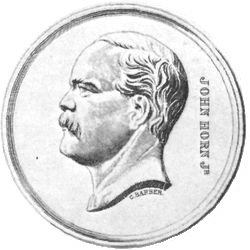
John Horn, Jr., was born at Sidmouth, Devonshire, England, September 7, 1843. He was brought when quite young to Detroit, Michigan, where his parents settled, and he is at present engaged with his father in the boat business, they owning one ferry and two tug-boats. He has been living, since 1863, on the dock at the foot of Woodward Avenue, Detroit, opposite Windsor, in Canada West, and the most dangerous place on the river. Since May, 1863, he has saved more than one hundred persons from drowning, distinguishing himself especially during the great fire at the Detroit and Milwaukee railroad depot, on the night of April 11, 1866, when he rescued nine persons from the water. The citizens of Detroit presented him with a gold medal in 1869, and the Congress of the United States of America voted him another in 1874. He is still living.
ORIGINAL DOCUMENTS.
Act of Congress Voting a Medal to John Horn, Jr.
Be it enacted by the Senate and House of Representatives of the United States of America in Congress assembled: That the President of the United States be authorized and directed to cause to be prepared and presented to John Horn, junior, of Detroit, Michigan, a gold medal, with appropriate devices and inscriptions, in recognition and in commemoration of his heroic and humane exploits in rescuing men, women and children from drowning in the Detroit river.
Approved June 20, 1874.
John Horn, Jr., to Moses W. Field.
Detroit, February 22, 1874. To the Honorable Moses W. Field, House of Representatives, Washington, D. C.
Dear Sir: I have never desired a public statement of the service which, under God, I have been able to render in saving human life, but as you have asked me to send you a list of the men, women and children whom I have rescued from drowning, I will do so, so far as I can from memory. I have never kept a record of the names, and the number is so great that you will excuse me if I leave some unmentioned.
I think I have altogether saved more than one hundred human beings, but I take no credit about this matter, and I have never regretted doing what I have done in any case, although I have had at times to keep my bed for many weeks on account of the exposure in the cold weather. It is well for me that I had a good mother to take care of me at such times of sickness. On the 21st of May, 1863, I saved Mr. Manning, of Windsor; on the 7th of July, 1865, I saved Mr. George Taylor, of New York State; he was very near dead when I got him on the wharf; October 10, 1865, I saved a child of Mr. T. Gorman of Adrian; she was about five years old, and was near drowned when I got her out; December 12, 1865, I saved a son of Mr. Yates, who kept a clothing store on Jefferson avenue. The night was very cold, a high wind was blowing at the time, and he was very near dead when we reached the wharf.
April 11, 1866, was the worst night I ever had. It will be ever memorable as the night of the great conflagration at the Detroit and Milwaukee Railroad depot, when sixteen poor fellows were drowned. I rescued nine, and then became so exhausted that I could not swim, and had to abandon them to their fate. I got a very bad cold and lay in bed two weeks, but that was nothing in comparison to the good accomplished. July 25, 1866, I saved Mr. Joseph Noble, of Windsor, and I believe you were there at the time. He was once engineer on the Great Western Railroad. You know he came near drowning me in his struggles in the water, at which time I received several internal injuries. April 7, 1867, I saved the son of Mr. C. Meyers, who lived in Mullet street. He was a boy about twelve years old. June 14, 1867, I saved the daughter of Mr. Andrew Nourse, of Cleveland. She was going on board the ferry-boat with her mother and some other ladies, when she fell off the plank. When I got to the wharf she was going out of sight for the last time, and I plunged in and brought her to the surface. September 15, 1867, I saved a colored man who was a deck hand on the propeller Meteor. He kicked me about in the water terribly, for drowning men are always crazy. November 2, 1867, I saved Mr. David Miller, the man who drove a wagon for Hull Brothers, storekeepers on Munroe avenue. May 10, 1868, I saved Mr. Robert Sinton, known as "Free Press Bob." You know he used to be a reporter for the "Free Press." And in his haste to get news, he fell in, and I got him out.
A few nights after that I saved Mr. Steele, who used to keep a store on Michigan avenue. He was on the ferry-boat with his wife; he had a very spirited horse, and was holding him by the head when the boat struck the wharf. The horse jumped and threw him into the river, when the current swept him under the wharf. I jumped in and got him out all right. October 4, 1868, I saved a daughter of Mr. McDonald, of Windsor. May 11, 1869, I saved Mr. Flattery, one of the Flattery Brothers who kept a furniture store on Woodward avenue. He was a heavy man; when I got hold of him he was near gone, and I came near losing my own life in getting him out. June 21, 1870, I saved a man called Mr. George Brodier. I was eating dinner at the time, when some persons came running in after me, saying, "there is a man in the river." I ran out and jumped into the river, and as soon as I got near him he clutched me like a vice and took me under water twice. When I came to the top the last time my father handed me a large pole, which I caught and that saved me. He was a powerful man, and kicked and struggled so hard that he made my legs black and blue for many months.
My mother goes to the edge of the wharf with me very often, when I jump in; but when she sees persons struggling in the water and drowning she never holds me back. August 24, 1871, I saved the daughter of Mr. A. Wilson of Milwaukee. March 4, 1872, I saved a colored man by the name of George Wilkes; he fell off the wharf while under the influence of liquor; but I think he has been a sober man ever since. July 4, 1873, I saved the daughter of Mr. F. Barlow, a butcher, who keeps a stall in the market. She was going on board the ferry-boat Detroit with her mother and some other ladies; the crowd was very great, being the Fourth of July, and although her mother held her by the hand, the crowd surged, and she was crowded off the plank, and fell into the river. There were about five hundred people on the wharf at the time, and they were all staring at the poor girl struggling in the water, not one of them daring to go to her rescue. I was in the house when some one came to give the alarm, and when I got out there I could just see her dress as she was going out of sight, four or five feet below the surface. I jumped in and caught her, and when I got out on the top of the wharf with her the people gave me three cheers. March 6, 1873, I saved a young lady called Miss Louise McKenzie. This was the closest call I ever had for my life. I was in the water about seventeen minutes, and the river being full of floating ice at the time, I was nearer dead than alive when I got out. Four men carried me into the house, and they rubbed me with hot whisky for over four hours before circulation was restored to its normal condition. This severe exposure made me sick, and it was over three months before the right feeling was in my hands.
You will remember this incident, for you came to me when I was unwell. I regret very much at this time I lost the beautiful medal presented me by the citizens, and I think you were one of the gentlemen connected with its presentation. I have been informed that I would receive a medal from the British Parliament, but it has not come. I don't ask any.
I saved a poor unfortunate individual last month, when I took a severe cold, and as I was lying in bed reading the proceedings of Congress, I saw something about an appropriation for medals to persons for saving life on the seashore, and I thought then that some gentleman would be very likely to remember also those who saved life on the northern lakes and rivers. There are many other cases which I don't mention, as I have not got their names. You must know yourself of a great many, as your place of business and warehouse are near by, and I recollect seeing you several times when rescuing people from a watery grave. Wishing you and your family good health, I remain, very truly yours,
John Horn, Jr.
THE END.