LIST OF PLATES. (continued 3)
Reading edition
Article XVIII.
For the better promoting of commerce on both sides, it is agreed that, if a war should break out between their High Mightinesses the States-General of the United Netherlands and the United States of America, there shall always be granted to the subjects on each side the term of nine months after the date of the rupture, or the proclamation of war, to the end that they may retire, with their effects, and transport them where they please, which it shall be lawful for them to do, as well as to sell or transport their effects and goods, in all freedom and without any hindrance, and without being able to proceed, during the said term of nine months, to any arrests of their effects, much less of their persons; on the contrary, there shall be given them, for their vessels and their effects, which they could carry away, passports and safe conducts for the nearest ports of their respective countries, and for the time necessary for the voyage. And no prize made at sea shall be adjudged lawful, at least if the declaration of war was not or could not be known in the last port which the vessel taken has quitted; but for whatever may have been taken from the subjects and inhabitants of either party, and for the offences which may have been given them, in the interval of the said terms, a complete satisfaction shall be given them.
Article XIX.
No subject of their High Mightinesses the States-General of the United Netherlands shall apply for or take any commission or letters of marque for arming any ship or ships to act as privateers against the said United States of America, or any of them, or the subjects and inhabitants of the said United States, or any of them, or against the property of the inhabitants of any of them, from any Prince or State with which the said United States of America may happen to be at war: nor shall any subject or inhabitant of the said United States of America, or any of them, apply for or take any commission or letters of marque for arming any ship or ships to act as privateers against the High and Mighty Lords the States-General of the United Netherlands, or against the subjects of their High Mightinesses, or any of them, or against the property of any one of them, from any Prince or State with which their High Mightinesses may be at war: And if any person of either nation shall take such commission or letters of marque, he shall be punished as a pirate.
Article XX.
If the vessels of the subjects or inhabitants of one of the parties come upon any coast belonging to either of the said allies, but not willing to enter into port, or being entered into port and not willing to unload their cargoes or break bulk, or take in any cargo, they shall not be obliged to pay, neither for the vessels nor for the cargoes, at least if there is not just cause to presume that they carry to an enemy merchandizes of contraband.
Article XXI.
The two contracting parties grant to each other, mutually, the liberty of having, each in the ports of the other, consuls, vice-consuls, agents, and commissaries, of their own appointing, whose functions shall be regulated by particular agreement, whenever either party chooses to make such appointments.
Article XXII.
This treaty shall not be understood in any manner to derogate from the ninth, tenth, nineteenth, and twenty-fourth articles of the treaty with France, as they were numbered in the same treaty, concluded the sixth of February, 1778, and which make the articles ninth, tenth, seventeenth, and twenty-second of the treaty of commerce now subsisting between the United States of America and the Crown of France; nor shall it hinder His Catholic Majesty from according to that treaty, and enjoying the advantages of said four articles.
Article XXIII.
If at any time the United States of America shall judge necessary to commence negotiations with the King or Emperor of Morocco and Fez, and with the Regencies of Algiers, Tunis, or Tripoli, or with any of them, to obtain passports for the security of their navigation in the Mediterranean Sea, their High Mightinesses promise that upon the requisition which the United States of America shall make of it, they will second such negotiations in the most favourable manner, by means of their Consuls residing near the said King, Emperor, and Regencies.
Contraband.
Article XXIV.
The liberty of navigation and commerce shall extend to all sorts of merchandizes, excepting only those which are distinguished under the name of contraband, or merchandizes prohibited; and under this denomination of contraband and merchandizes prohibited, shall be comprehended only warlike stores and arms, as mortars, artillery, with their artifices and appurtenances, fusils, pistols, bombs, grenades, gunpowder, saltpetre, sulphur, match, bullets and balls, pikes, sabres, lances, halberts, casques, cuirasses, and other sorts of arms, as also soldiers, horses, saddles, and furniture for horses; all other effects and merchandizes, not before specified expressly, and even all sorts of naval matters, however proper they may be for the construction and equipment of vessels of war, or for the manufacture of one or another sort of machines of war, by land or sea, shall not be judged contraband, neither by the letter, nor according to any pretended interpretation whatever, ought they or can they be comprehended under the notion of effects prohibited or contraband: so that all effects and merchandizes, which are not expressly before named, may, without any exception, and in perfect liberty, be transported by the subjects and inhabitants of both allies, from and to places belonging to the enemy; excepting only the places which at the time shall be besieged, blocked, or invested; and those places only shall be held for such which are surrounded nearly by some of the belligerent powers.
Article XXV.
To the end that all dissention and quarrel may be avoided and prevented, it has been agreed, that in case that one of the two parties happens to be at war, the vessels belonging to the subjects or inhabitants of the other ally shall be provided with sea letters or passports, expressing the name, the property, and the burthen of the vessel, as also the name of abode of the master, or commander of the said vessel, to the end that thereby it may appear that the vessel really and truly belongs to the subjects or inhabitants of one of the parties; which passports shall be drawn and distributed, according to the form annexed to this treaty; each time that the vessel shall return, she should have such her passport renewed, or at least they ought not to be of more ancient date than two years, before the vessel has been returned to her own country.
It has also been agreed that such vessels, being loaded, ought to be provided not only with the said passports or sea letters, but also with a general passport, or with particular passports or manifests, or other publick documents, which are ordinarily given to vessels outward bound in the ports from whence the vessels have set sail in the last place, containing a specification of the cargo, of the place from whence the vessel departed, and of that of her destination, or, instead of all these, with certificates from the magistrates or governors of cities, places and colonies from whence the vessel came, given in the usual form, to the end that it may be known whether there are any effects prohibited or contraband, on board the vessels, and whether they are destined to be carried to an enemy's country or not; and in case any one judges proper to express in the said documents the persons to whom the effects on board belong, he may do it freely, without, however, being bound to do it; and the omission of such expression cannot and ought not to cause a confiscation.
Article XXVI.
If the vessels of the said subjects or inhabitants of either of the parties, sailing along the coasts or on the high seas, are met by a vessel of war, or privateer, or other armed vessel of the other party, the said vessels of war, privateers, or armed vessels, for avoiding all disorder, shall remain without the reach of cannon, but may send their boats on board the merchant vessel, which they shall meet in this manner, upon which they may not pass more than two or three men, to whom the master or commander shall exhibit his passport, containing the property of the vessel, according to the form annexed to this treaty: And the vessel, after having exhibited such a passport, sea letter, and other documents, shall be free to continue her voyage, so that it shall not be lawful to molest her, or search her in any manner, nor give her chase, nor to force her to alter her course.
Article XXVII.
It shall be lawful for merchants, captains, and commanders of vessels, whether publick and of war, or private and of merchants, belonging to the said United States of America, or any of them, or to their subjects and inhabitants, to take freely into their service, and receive on board of their vessels, in any port or place in the jurisdiction of their High Mightinesses aforesaid, seamen or others, natives or inhabitants of any of the said States, upon such conditions as they shall agree on, without being submitted for this to any fine, penalty, punishment, process, or reprehension whatsoever.
And reciprocally, all merchants, captains, and commanders, belonging to the said United Netherlands, shall enjoy, in all the ports and places under the obedience of the said United States of America, the same privilege of engaging and receiving seamen or others, natives or inhabitants of any country of the domination of the said States-General: Provided, that neither on one side nor the other, they may not take into their service such of their countrymen who have already engaged in the service of the other party contracting, whether in war or trade, and whether they meet them by land or sea; at least if the captains or masters under the command of whom such persons may be found, will not of his own consent discharge them from their service, upon pain of being otherwise treated and punished as deserters.
Article XXVIII.
The affair of the refraction shall be regulated in all equity and justice, by the magistrates of cities respectively, where it shall be judged that there is any room to complain in this respect.
Article XXIX.
The present treaty shall be ratified and approved by their High Mightinesses the States-General of the United Netherlands and by the United States of America; and the acts of ratification shall be delivered in good and due form, on one side and on the other, in the space of six months, or sooner if possible, to be computed from the day of the signature.
In faith of which, we the Deputies and Plenipotentiaries of the Lords the States-General of the United Netherlands, and the Minister Plenipotentiary of the United States of America, in virtue of our respective authorities and full powers, have signed the present treaty and apposed thereto the seals of our arms.
Done at the Hague the eighth of October, one thousand seven hundred and eighty-two.
John Adams. [L.S.]
George van Randwyck. [L.S.]
B. V. D. Santheuvel. [L.S.]
P. V. Bleiswijk. [L.S.]
W. C. H. van Lijnden. [L.S.]
D. J. van Heeckeren. [L.S.]
Joan van Kuffeler. [L.S.]
F: G: van Dedem, tot den gelder. [L.S.]
H: Tjassens. [L.S.]
Convention between the Lords the States-General of the United Netherlands and the United States of America, concerning vessels recaptured. Concluded October 8, 1782.
The Lords the States-General of the United Netherlands and the United States of America, being inclined to establish some uniform principles with relation to prizes made by vessels of war, and commissioned by the two contracting Powers, upon their common enemies, and to vessels of the subjects of either party, captured by the enemy, and recaptured by vessels of war commissioned by either party, have agreed upon the following articles:
Article I.
The vessels of either of the two nations recaptured by the privateers of the other, shall be restored to the first proprietor, if such vessels have not been four and twenty hours in the power of the enemy, provided the owner of the vessel recaptured pay therefor one-third of the value of the vessel, as also of that of the cargo, the cannons and apparel, which third shall be valued by agreement, between the parties interested; or, if they cannot agree thereon among themselves, they shall address themselves to the officers of the admiralty of the place where the privateer who has retaken the vessel shall have conducted her.
Article II.
If the vessel recaptured has been more than twenty-four hours in the power of the enemy, she shall belong entirely to the privateer who has retaken her.
Article III.
In case a vessel shall have been recaptured by a vessel of war belonging to the States-General of the United Netherlands, or to the United States of America, she shall be restored to the first owner, he paying a thirtieth part of the value of the ship, her cargo, cannons and apparel, if she has been recaptured in the interval of twenty-four hours, and the tenth part if she has been recaptured after the twenty-four hours, which sums shall be distributed in form of gratifications to the crews of the vessels which have retaken her. The valuation of the said thirtieth parts and tenth parts shall be regulated according to the tenor of the first article of the present convention.
Article IV.
The restitution of prizes, whether they may have been retaken by vessels of war or by privateers, in the mean time and until requisite and sufficient proofs can be given of the property of vessels recaptured, shall be admitted in a reasonable time, under sufficient sureties for the observation of the aforesaid articles.
Article V.
The vessels of war and privateers of one and of the other of the two nations, shall be reciprocally, both in Europe and in the other parts of the world, admitted in the respective ports of each with their prizes, which may be unloaded and sold according to the formalities used in the State where the prize shall have been conducted, as far as may be consistent with the 22d article of the treaty of commerce: Provided, always, that the legality of prizes by the vessels of the Low Countries shall be decided conformably to the laws and regulations established in the United Netherlands; as, likewise, that of prizes made by American vessels, shall be judged according to the laws and regulations determined by the United States of America.
Article VI.
Moreover, it shall be free for the States-General of the United Netherlands, as well as for the United States of America, to make such regulations as they may judge necessary, relative to the conduct which their respective vessels and privateers ought to hold in relation to the vessels which they shall have taken and conducted into the ports of the two powers.
In faith of which, We, the Deputies and Plenipotentiaries of the Lords the States-General of the United Netherlands, and Minister Plenipotentiary of the United States of America, have, in virtue of our respective authorities and full powers, signed these presents, and confirmed the same with the seals of our arms.
Done at the Hague the eighth of October, one thousand seven hundred and eighty-two.
John Adams. [L.S.]
George van Randwyck. [L.S.]
B. V. D. Santheuvel. [L.S.]
P. V. Bleiswijk. [L.S.]
W. C. H. van Lijnden. [L.S.]
D. J. van Heeckeren. [L.S.]
Joan van Kuffeler. [L.S.]
F: G: van Dedem, tot den gelder. [L.S.]
H: Tjassens. [L.S.]
Plate XIV. No. 14.
1782.
Libertas Americana. ℞. Non sine diis animosus infans.
LIBERTAS AMERICANA.
[Surrender of the British Armies at Saratoga and at Yorktown.]
LIBERTAS AMERICANA. (American liberty.) The head of a beautiful maiden, facing the left, with dishevelled hair floating in the wind, and with the rod of liberty surmounted by the Phrygian cap on her right shoulder. Exergue: 4 JUIL. (sic) 1776. (4 Julii, 1776: July 4, 1776.) On edge of bust, DUPRÉ.
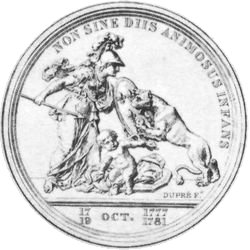
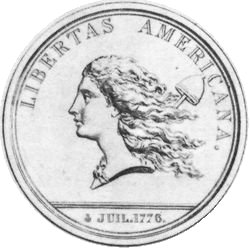
This medal was not voted by Congress, but was ordered by Franklin, in commemoration of the surrenders of Lieutenant-General Burgoyne and of General Lord Cornwallis. As the official reports of the first of these events have already been given under No. 2, page 9, I give here only the documents relating to the surrender of Lord Cornwallis, at Yorktown.
ORIGINAL DOCUMENTS.
General Washington to the President of Congress.
Headquarters, near York, October 19, 1781. To His Excellency The President of Congress.
Sir: I have the honour to inform Congress that a reduction of the British army, under the command of Lord Cornwallis, is most happily effected. The unremitted ardour which actuated every officer and soldier in the combined army on this occasion, has principally led to this important event, at an earlier period than my most sanguine hopes had induced me to expect.
The singular spirit of emulation, which animated the whole army from the first commencement of our operations, has filled my mind with the highest pleasure and satisfaction, and had given me the highest presages of success.
On the 17th instant, a letter was received from Lord Cornwallis, proposing a meeting of commissioners to consult on terms for the surrender of the posts of York and Gloucester. This letter (the first that had passed between us) opened a correspondence, a copy of which I do myself the honour to inclose; that correspondence was followed by the definitive capitulation, which was agreed to and signed on the 19th, copy of which is herewith transmitted; and which I hope will meet with the approbation of Congress.
I should be wanting in the feelings of gratitude did I not mention on this occasion, with the warmest sense of acknowledgment, the very cheerful and able assistance which I have received in the course of our operations from His Excellency the Count de Rochambeau. Nothing could equal this zeal of our allies but the imitating spirit of the American officers, whose ardour would not suffer their exertions to be exceeded.
The very uncommon degree of duty and fatigue, which the nature of the service required from the officers of engineers and artillery of both armies, obliges me particularly to mention the obligations I am under to the commanding and other officers of those corps.
I wish it was in my power to express to Congress how much I feel myself indebted to the Count de Grasse, and the officers of the fleet under his command, for the distinguished aid and support which has been afforded by them, between whom and the army the most happy concurrence of sentiments and views have subsisted, and from whom every possible co-operation has been experienced which the most harmonious intercourse could afford.
Returns of the prisoners, military stores, ordnance, shipping and other matters, I shall do myself the honour to transmit to Congress as soon as they can be collected by the heads of departments to which they belong.
Colonel Laurens and the Viscount de Noailles, on the part of the combined army, were the gentlemen who acted as commissioners for forming and settling the terms of capitulation and surrender, herewith transmitted, to whom I am particularly obliged for their readiness and attention exhibited on the occasion.
Colonel Tilghman, one of my aids-de-camp, will have the honour to deliver these despatches to Your Excellency; he will be able to inform you of every minute circumstance which is particularly mentioned in my letter. His merits, which are too well known to need any observations at this time, have gained my particular attention, and I could wish that they may be honoured by the notice of Your Excellency and Congress.
Your Excellency and Congress will be pleased to accept my congratulations on this happy event, and believe me to be, with the highest respect and esteem,
Sir, your Excellency's most obedient humble servant, Geo. Washington.
P.S. Though I am not possessed of the particular returns, yet I have reason to suppose that the number of prisoners will be between five and six thousand, exclusive of seamen and others.
General Washington to the President of Congress.
Headquarters, near York, October 27, 1781. To His Excellency The President of Congress.
Sir: I do myself the honour to enclose to Your Excellency copies of returns of prisoners, artillery, arms, ordnance, and other stores, surrendered by the enemy in their posts of York and Gloucester, on the 19th instant, which were not completed at the time of my despatches, and but this moment handed to me. A draft of these posts, with the plan of attack and defence, is herewith transmitted; and twenty-four standards, taken at the same time, are ready to be laid before Congress.
My present despatches being important, I have committed to the care of Colonel Humphreys, one of my aids-de-camp, whom, for his attention, fidelity and good services, I beg leave to recommend to Congress and Your Excellency.
I have the honour to be, Sir, Your Excellency's most obedient humble servant, Geo. Washington.
Resolutions of Congress Voting Thanks, etc., for the Taking of Yorktown.
By the United States in Congress Assembled:
Resolved, That the thanks of the United States, in Congress assembled, be presented to His Excellency General Washington, for the eminent services which he has rendered to the United States, and particularly for the well concerted plan against the British garrisons in York and Gloucester; for the vigour, attention, and military skill with which that plan was executed, and for the wisdom and prudence manifested in the capitulation.
That the thanks of the United States, in Congress assembled, be presented to His Excellency the Count de Rochambeau, for the cordiality, zeal, judgment, and fortitude, with which he seconded and advanced the progress of the allied army against the British garrison in York.
That the thanks of the United States, in Congress assembled, be presented to His Excellency Count de Grasse, for his display of skill and bravery in attacking and defeating the British fleet off the Bay of Chesapeake, and for his zeal and alacrity in rendering, with the fleet under his command, the most effectual and distinguished aid and support to the operations of the allied army in Virginia.
That the thanks of the United States, in Congress assembled, be presented to the commanding and other officers of the corps of artillery and engineers of the allied army, who sustained extraordinary fatigue and danger in their animated and gallant approaches to the lines of the enemy.
That General Washington be directed to communicate to the other officers and soldiers under his command the thanks of the United States, in Congress assembled, for their conduct and valour on this occasion:
Resolved, That the United States, in Congress assembled, will cause to be erected, at York, in Virginia, a marble column, adorned with emblems of the alliance between the United States and His Most Christian Majesty, and inscribed with a succinct narrative of the surrender of Earl Cornwallis to His Excellency General Washington, commander-in-chief of the combined forces of America and France, to His Excellency the Count de Rochambeau, commanding the auxiliary troops of His Most Christian Majesty in America, and to His Excellency the Count de Grasse, commanding-in-chief the naval army of France in Chesapeake.
Resolved, That two stands of colours taken from the British army under the capitulation of York, be presented to His Excellency General Washington, in the name of the United States in Congress assembled.
Resolved, That two pieces of the field ordnance, taken from the British army under the capitulation of York, be presented by the commander-in-chief of the American army to Count de Rochambeau; and that there be engraved thereon a short memorandum, that Congress were induced to present them from considerations of the illustrious part which he bore in effectuating the surrender.
Resolved, That the Secretary of Foreign Affairs be directed to request the Minister Plenipotentiary of His Most Christian Majesty, to inform his Majesty that it is the wish of Congress that Count de Grasse may be permitted to accept a testimony of their approbation, similar to that to be presented to Count de Rochambeau.
Resolved, That the Board of War be directed to present to Lieutenant-Colonel Tilghman, in the name of the United States in Congress assembled, a horse properly caparisoned, and an elegant sword, in testimony of their high opinion of his merit and ability.
Monday, October 29, 1781.
Benjamin Franklin to Robert R. Livingston.
Passy, March 4, 1782. To the Honourable Robert R. Livingston, Secretary for Foreign Affairs.
Sir:
With great esteem, B. Franklin.
Benjamin Franklin to Sir William Jones.
Passy, March 17, 1783. To Sir William Jones.
Sir:
The engraving of my medal, which you know was projected before the peace, is but just finished. None are yet struck in hard metal, but will be in a few days. In the meantime, having this good opportunity by Mr. Penn, I send you one of the "épreuves". You will see that I have profited by some of your ideas, and adopted the mottoes you were so kind as to furnish....
B. Franklin.
Benjamin Franklin to Robert R. Livingston.
Passy, April 15, 1783. To the Honourable Robert R. Livingston, Secretary for Foreign Affairs.
Sir: I have caused to be struck here the medal which I formerly mentioned to you, the design of which you seemed to approve. I enclose one in silver for the President of Congress and one in copper for yourself. The impression on copper is thought to appear best; and you will soon receive a number for the members. I have presented one to the King and another to the Queen, both in gold; and one in silver to each of the ministers, as a monumental acknowledgment, which may go down to future ages, of the obligations we are under to this nation. It is mighty well received, and gives general pleasure. If the Congress approve of it, as I hope they will, I may add something on the die (for those to be struck hereafter) to shew that it was done by their order, which I could not venture to do till I had authority for it.
With the greatest respect, I have the honour to be, Sir, your most obedient and most humble servant,
B. Franklin.
Benjamin Franklin to Robert R. Livingston.
Passy, July 22, 1783. To the Honourable Robert R. Livingston, Secretary for Foreign Affairs.
Sir: I made the Grand Master of Malta a present of one of our medals in silver, writing to him a letter of which I enclose a copy, and I believe our people will be kindly received in his port.
With the greatest respect, I have the honour to be, Sir, your most obedient and most humble servant.
B. Franklin
.
Benjamin Franklin to the Grand Master of Malta.
Passy, 6 April, 1783. To His Eminent Highness The Grand Master of Malta.
My Lord: I have the honour to address to Your Eminent Highness the medal which I have lately had struck. It is an Homage of gratitude, my Lord, which is due to the interest you have taken in our cause and we no less owe it to your virtues and to Your Eminent Highnesses wise Administration of Government.
Permit me, my Lord, to demand your protection for such of our citizens as circumstances may lead to your ports. I hope that Your Eminent Highness will be pleased to grant it to them and kindly receive the assurances of the profound respect with which I am, my Lord,
Your Eminent Highnesses most humble and most obedient servant,
B. Franklin.
The Grand Master of Malta to Benjamin Franklin.
Malta, 21 June, 1783. To His Excellency B. Franklin.
Sir: I received with the most lively sensibility the medal which Your Excellency sent me, and the value I set upon this acquisition leaves my gratitude unbounded. This monument of American liberty has a distinguished place in my cabinet.
Whenever chance or commerce shall lead any of your fellow citizens or their vessels into the ports of our Island, I shall receive them with the greatest Welcome, they shall experience from me every assistance they may claim. I shall observe with infinite pleasure any growing connection between that interesting nation and my subjects, especially if it will tend to convince Your Excellency of the distinguished sentiments with which I am,
Sir, Your Excellency's most affectionate servant, The Grand Master, Rohan.
Plate XV. No. 15.
1784.
Benj. Franklin natus Boston. XVII Jan. MDCCVI. ℞. Eripuit cœlo fulmen sceptrum que tyrannis.
BENJAMIN FRANKLIN.
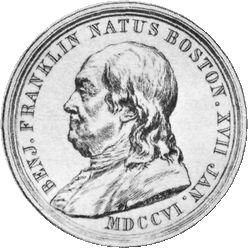
BENJ. FRANKLIN NATUS BOSTON. XVII JAN. MDCCVI. (Benjamin Franklin natus Boston, 17 Januarii, 1706: Benjamin Franklin, born in Boston, January 17, 1706..) Bust of Franklin, facing the left. On edge of bust, dupré f. (fecit).
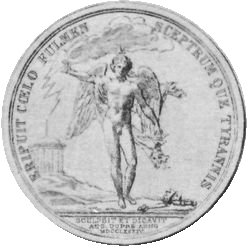
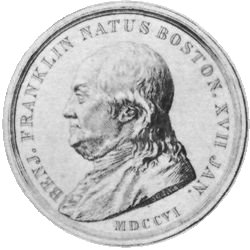
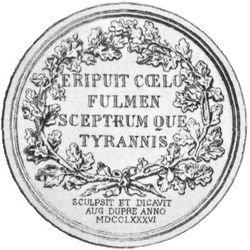
Benjamin Franklin was born in Boston, January 17, 1706. He began life as an apprentice to his brother, a printer; went to England to follow his trade, but ultimately settled in Philadelphia in 1726, where he edited the "Pennsylvania Gazette," and in 1732 began the publication of "Poor Richard's Almanac." He founded the first fire company in 1737, and soon afterward the first fire insurance company. In 1752 he discovered the identity of lightning and the electric fluid, and invented the lightning-rod. In consideration of his brilliant services to science, the degree of LL. D. was conferred upon him by the university of Oxford in 1762. Benjamin Franklin was a member of the Continental Congress, 1775-1776; a signer of the Declaration of Independence, and one of the commissioners to France, 1776-1785. He signed the offensive and defensive treaty with France, in Paris, February 6, 1778; and the definitive treaty of peace with England, September 3, 1783. He was governor of Pennsylvania, 1786-1788; and died in Philadelphia, April 17, 1790. Congress ordered a mourning of four months, and the National Assembly of France, on the proposal of Mirabeau, seconded by Monsieur de la Rochefoucauld and General de la Fayette, went into mourning for three days. Turgot composed in his honor the celebrated latin verse: Eripuit cœlo fulmen sceptrum que tyrannis.
Plate XVI. No. 16.
1786.
Benj. Franklin natus Boston. XVII Jan. MDCCVI. ℞. Eripuit cœlo fulmen sceptrum que tyrannis.
BENJAMIN FRANKLIN.
BENJ. FRANKLIN NATUS BOSTON. XVII JAN. MDCCVI. (Benjamin Franklin, natus Boston, 17 Januarii, 1706: Benjamin Franklin, born in Boston, January 17, 1706.) Bust of Franklin, facing the left. On edge of bust, dupré f. (fecit).
ORIGINAL DOCUMENTS.
William Short to Thomas Jefferson.
Paris, June the 14th, 1790. To the Honourable Thomas Jefferson, Secretary of State.
Sir: On the news of Dr. Franklin's death being received here, the National Assembly decreed that they would go in mourning for three days—and that the President should write to Congress to notify to them the part they take in the melancholy event. A kind of enthusiasm has spread also through the different parts of the capital—different societies and bodies have shown their adhesion to the sentiments of the National Assembly in different ways.
I am, etc., Wm. Short.
Thomas Jefferson to the President of the National Assembly of France.
Philadelphia, March 8th, 1791. To The President of the National Assembly of France.
Sir: I have it in charge from the President of the United States of America to communicate to the National Assembly of France the peculiar sensibility of Congress to the tribute paid to the memory of Benjamin Franklin, by the enlightened and free Representatives of a great nation, in their decree of the 11th of June, 1790.
That the loss of such a citizen should be lamented by us, among whom he lived, whom he so long and eminently served, and who feel their country advanced and honoured by his birth, life and labours, was to be expected, but it remained for the National Assembly of France to set the first example of the Representative of one nation doing homage by a public act to the private citizen of another, and by withdrawing arbitrary lines of separation, to reduce into one fraternity the good and the great, wherever they have lived or died.
That these separations may disappear between us in all times and circumstances, and that the union of sentiment, which mingles our sorrows on this occasion, may continue long to cement the friendship and the interests of our two nations is our constant prayer. With no one is it more sincere than with him, who in being charged with the honour of conveying a public sentiment, is permitted that of expressing the homage of profound respect and veneration with which he is,
Sir, your most obedient and humble servant, Th: Jefferson.
Plate XVII. No. 17.
September 23, 1779.
Joanni Pavlo Jones classis præfecto. Comitia Americana. ℞. Hostivm navibvs captis avt fvgatis.
CAPTAIN JOHN PAUL JONES.
[Capture of the Serapis.]
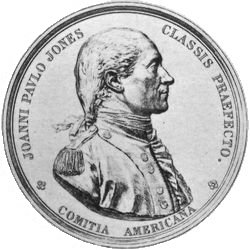
JOANNI PAVLO JONES CLASSIS PRÆFECTO. COMITIA AMERICANA. (The American Congress to naval commander John Paul Jones). Bust of Captain Jones, in uniform, facing the right. On edge of bust, dupré f. (fecit).
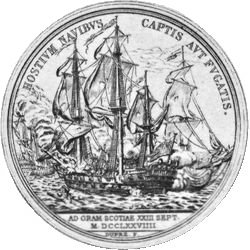
The legend on the reverse of the medal is the second of the two proposed by the French Academy of Inscriptions and Belles-Lettres. The first was, primus americanorum triumphus navalis.
The bust of John Paul Jones, on the obverse of this medal, is from a plaster cast by Houdon, the celebrated sculptor.
The Chevalier John Paul Jones was born at Arbingland, in the parish of Kirkbean, in Scotland, July 6, 1747. He went to sea when young, and settled in Virginia in 1773. In 1775 he was appointed a lieutenant in the navy, through the recommendation of General Jones, of North Carolina, and in gratitude to him, he added the name of Jones to his family name of Paul. He joined the Alfred, of thirty guns and three hundred men, and on her deck, October 10, 1776, when off Chestnut street wharf, Philadelphia, under a salute of thirteen guns, hoisted with his own hands the first American naval flag. This had thirteen stripes, but without the blue union, and bore across the field a rattlesnake with the motto "Don't tread on me." Appointed captain in October, 1776, he was soon afterward sent by Congress to France, to arrange certain naval matters with the American commissioners. Subsequently he carried terror along the coast of England, and on September 23, 1779, fought his famous action off Flamborough Head, near Scarborough, in which he took the Serapis, Captain Richard Pearson. He was enthusiastically received in France, and King Louis XVI. presented him with a sword of honor and with the cross of Military Merit. Congress gave him a vote of thanks and a gold medal, in 1787, and sent him to France, Denmark, and Sweden, as agent for prize money. The same year he entered the Russian service with the rank of rear-admiral, and received from the Empress Catherine II. the cross of St. Anne. He had a command in the squadron stationed in the Black Sea, where he greatly distinguished himself, but embittered by slanderous calumnies, he left the Russian service and settled in Paris, where he died in poverty, July 18, 1792. The National Assembly of France, then in session, expressed their regret for him by wearing mourning, and sent a deputation to attend his funeral.
ORIGINAL DOCUMENTS.
Resolution of Congress Voting a Medal to the Chevalier John Paul Jones.
In Congress.
Resolved unanimously, That a medal of gold be struck and presented to the Chevalier John Paul Jones, in commemoration of the valour and brilliant services of that officer, in the command of a squadron of French and American ships, under the flag and commission of the United States, off the coast of Great Britain, in the late war; and that the Honourable Mr. Jefferson, Minister Plenipotentiary of the United States at the Court of Versailles, have the same executed, with the proper devices.
Resolved, That a letter be written to His Most Christian Majesty, informing him that the United States, in Congress assembled, have bestowed upon the Chevalier John Paul Jones, this medal, as well in consideration of the distinguished marks of approbation which His Majesty has pleased to confer upon that officer, as from a sense of his merit: And, that as it is his earnest desire to acquire greater knowledge in his profession, it would be acceptable to Congress, that His Majesty would be pleased to permit him to embark with his fleets of evolution, convinced that he can no where else so well acquire that knowledge which may hereafter render him more extensively useful.
Ordered, That the Secretary of Foreign Affairs prepare a letter for the above purpose, to be signed by the President, and that the Chevalier Jones be the bearer of the said letter.
Tuesday, October 16, 1787.
Captain John Paul Jones to Benjamin Franklin.
On board the ship Serapis, At anchor without the Texel, in Holland, October 3, 1779. To His Excellency Benjamin Franklin.
Honoured and Dear Sir: When I had the honour of writing to you on the 11th of August, previous to my departure from the Road of Groaix, I had before me the most flattering prospect of rendering essential service to the common cause of France and America. I had a full confidence in the voluntary inclination and ability of every captain under my command to assist and support me in my duty with cheerful emulation; and I was persuaded that every one of them would pursue glory in preference to interest.
Whether I was or was not deceived will best appear by a relation of circumstances.
The little squadron under my orders, consisting of the Bonhomme Richard of 40 guns, the Alliance of 36 guns, the Pallas of 32 guns, the Cerf of 18 guns, and the Vengeance of 12 guns, joined by two privateers, the Monsieur and the Granville, sailed from the Road of Groaix at daybreak on the 14th of August; the same day we spoke with a large convoy bound from the southward to Brest.
On the 18th we retook a large ship belonging to Holland, laden chiefly with brandy and wine that had been destined from Barcelona for Dunkirk, and taken eight days before by an English privateer. The captain of the Monsieur, however, took out of this prize such articles as he pleased in the night, and the next day being astern of the squadron and to windward, he actually wrote orders in his proper name, and sent away the prize under one of his own officers. This, however, I superseded by sending her for L'Orient under my orders in the character of commander-in-chief. The evening of the day following the Monsieur separated from the squadron.
On the 20th we saw and chased a large ship, but could not overtake her, she being to windward.
On the 21st we saw and chased another ship that was also to windward, and thereby eluded our pursuit. The same afternoon we took a brigantine called the Mayflower, laden with butter and salt provisions, bound from Limerick, in Ireland, for London; this vessel I immediately expedited for L'Orient.
On the 23d we saw Cape Clear and S. W. part of Ireland. That afternoon, it being calm, I sent some armed boats to take a brigantine that appeared in the N. W. quarter. Soon after in the evening it became necessary to have a boat ahead of the ship to tow, as the helm could not prevent her from laying across the tide of flood, which would have driven us into a deep and dangerous bay, situated between the rocks on the south called the Shallocks, and on the north called the Blaskets. The ship's boats being absent, I sent my own barge ahead to tow the ship. The boats took the brigantine, she was called the Fortune, and bound with a cargo of oil, blubber, and staves, from Newfoundland for Bristol; this vessel I ordered to proceed immediately for Nantes or St. Malo. Soon after sunset the villains who towed the ship, cut the tow rope and decamped with my barge. Sundry shots were fired to bring them to without effect; in the mean time the master of the Bonhomme Richard, without orders, manned one of the ship's boats, and with four soldiers pursued the barge in order to stop the deserters. The evening was clear and serene, but the zeal of that officer, Mr. Cutting Lent, induced him to pursue too far, and a fog which came on soon afterwards prevented the boats from rejoining the ship, although I caused signal guns to be frequently fired. The fog and calm continued the next day till towards evening. In the afternoon Captain Landais came on board the Bonhomme Richard and behaved towards me with great disrespect, affirming in the most indelicate manner and language that I had lost my boats and people through my imprudence in sending boats to take a prize! He persisted in his reproaches, though he was assured by Messrs. de Weibert and de Chamillard that the barge was towing the ship at the time of elopement, and that she had not been sent in pursuit of the prize. He was affronted because I would not the day before suffer him to chase without my orders, and to approach the dangerous shore I have already mentioned, where he was an entire stranger, and when there was not sufficient wind to govern a ship. He told me he was the only American in the squadron, and was determined to follow his own opinion in chasing when and where he thought proper, and in every other matter that concerned the service, and that, if I continued in that situation three days longer, the squadron would be taken, etc. By the advice of Captain de Cottineau, and with the free consent and approbation of M. de Varage, I sent the Cerf in to reconnoitre the coast, and endeavour to take the boats and people the next day, while the squadron stood off and on in S. W. quarter, in the best possible situation to intercept the enemy's merchant ships, whether outward or homeward bound. The Cerf had on board a pilot well acquainted with the coast, and was ordered to join me again before night. I approached the shore in the afternoon, but the Cerf did not appear; this induced me to stand off again in the night in order to return and be joined by the Cerf the next day; but to my great concern and disappointment, though I ranged the coast along, and hoisted our private signals, neither the boats nor the Cerf joined me. The evening of that day, the 26th, brought with it stormy weather, with the appearance of a severe gale from the S. W., yet I must declare I did not follow my own judgment, but was led by the assertion which had fallen from Captain Landais, when I in the evening made a signal to steer to the northward and leave that station, which I wished to have occupied at least a week longer. The gale increased in the night with thick weather; to prevent separation, I carried a top light and fired a gun every quarter of an hour. I carried also a very moderate sail, and the course had been clearly pointed out by a signal before night; yet, with all this precaution, I found myself accompanied only by the brigantine Vengeance in the morning, the Granville having remained astern with a prize, as I have since understood the tiller of the Pallas broke after midnight, which disabled her from keeping up, but no apology has yet been made in behalf of the Alliance.
On the 31st we saw the Flannen Islands, situated near the Lewis, on the N. W. coast of Scotland; and the next morning, off Cape Wrath, we gave chase to a ship to windward, at the same time two ships appearing in the N. W. quarter, which proved to be the Alliance and a prize ship which she had taken, bound, as I understood, from Liverpool to Jamaica. The ship which I chased brought to at noon; she proved to be the Union, letter of marque, bound from London for Quebec, with a cargo of naval stores on account of government, adapted for the service of British armed vessels on the lakes. The public despatches were lost, as the Alliance very imprudently hoisted American colours, though English colours were then flying on board the Bonhomme Richard. Captain Landais sent a small boat to ask whether I would man the ship, or he should, as in the latter case he would suffer no boat nor person from the Bonhomme Richard to go near the prize. Ridiculous as this appeared to me, I yielded to it for the sake of peace, and received the prisoners on board the Bonhomme Richard, while the prize was manned from the Alliance. In the afternoon another sail appeared, and I immediately made the signal for the Alliance to chase; but, instead of obeying, he wore and laid the ship's head the other way. The next morning I made a signal to speak with the Alliance, to which no attention was shown; I then made sail with the ships in company for the second rendezvous which was not far distant, and where I fully expected to be joined by the Pallas and Cerf.
The 2d of September we saw a sail at daybreak, and gave chase; that ship proved to be the Pallas, and had met with no success while separated from the Bonhomme Richard.
On the 3d the Vengeance brought to a small Irish brigantine, bound homeward from Norway. The same evening I sent the Vengeance in the N. E. quarter to bring up the two prize ships that appeared to me to be too near the islands of Shetland, while with the Alliance and Pallas I endeavoured to weather Fair Isle, and to get into my second rendezvous, where I directed the Vengeance to join me with the three prizes. The next morning, having weathered Fair Isle, and not seeing the Vengeance nor the prizes, I spoke the Alliance, and ordered her to steer to the northward and bring them up to the rendezvous.
On the morning of the 4th the Alliance appeared again, and had brought to two very small coasting sloops in ballast, but without having attended properly to my orders of yesterday. The Vengeance joined me soon after, and informed me that in consequence of Captain Landais' orders to the commanders of the two prize ships, they had refused to follow him to the rendezvous. I am to this moment ignorant of what orders these men received from Captain Landais, nor know I by virtue of what authority he ventured to give his orders to prizes in my presence, and without either my knowledge or approbation. Captain Ricot further informed me that he had burnt the prize brigantine, because that vessel proved leaky; and I was sorry to understand afterward that though the vessel was Irish property, the cargo was property of the subjects of Norway.
In the evening I sent for all the captains to come on board the Bonhomme Richard, to consult on future plans of operations. Captains Cottineau and Ricot obeyed me, but Captain Landais obstinately refused, and after sending me various uncivil messages, wrote me a very extraordinary letter in answer to a written order which I had sent him, on finding that he had trifled with my verbal orders. The next day a pilot boat came on board from Shetland, by which means I received such advices as induced me to change a plan which I otherwise meant to have pursued; and as the Cerf did not appear at my second rendezvous, I determined to steer towards the third in hopes of meeting her there.
In the afternoon a gale of wind came on, which continued four days without intermission. In the second night of that gale the Alliance, with her two little prizes, again separated from the Bonhomme Richard. I had now with me only the Pallas and the Vengeance, yet I did not abandon the hopes of performing some essential service. The winds continued contrary, so that we did not see the land till the evening of the 13th, when the hills of the Cheviot in the S. E. of Scotland appeared. The next day we chased sundry vessels, and took a ship and a brigantine, both from the Firth of Edinburgh, laden with coal. Knowing that there lay at anchor in Leith Road an armed ship of 20 guns, with two or three fine cutters, I formed an expedition against Leith, which I purposed to lay under a large contribution, or otherwise to reduce it to ashes. Had I been alone, the wind being favourable, I would have proceeded directly up the Firth, and must have succeeded, as they lay there in a state of perfect indolence and security, which would have proved their ruin. Unfortunately for me, the Pallas and Vengeance were both at a considerable distance in the offing, they having chased to the southward; this obliged us to steer out of the Firth again to meet them. The captains of the Pallas and Vengeance being come on board the Bonhomme Richard, I communicated to them my project, to which many difficulties and objections were made by them; at last, however, they appeared to think better of the design, after I had assured them that I hoped to raise 200,000 pounds sterling on Leith, and that there was no battery of cannon there to oppose our landing. So much time, however, was unavoidably spent in pointed remarks and sage deliberation that night, that the wind became contrary in the morning.
We continued working to windward up the Firth without being able to reach the road of Leith, till, on the morning of the 17th, when, being almost within cannon shot of the town, having everything in readiness for a descent, a very severe gale of wind came on, and being directly contrary, obliged us to bear away, after having in vain endeavoured for some time to withstand its violence. The gale was so severe that one of the prizes that had been taken on the 14th sunk to the bottom, the crew being with difficulty saved. As the alarm by this time had reached Leith by means of a cutter that had watched our motions that morning, and as the wind continued contrary (though more moderate in the evening), I thought it impossible to pursue the enterprize with a good prospect of success; especially as Edinburgh, where there is always a number of troops, is only a mile distant from Leith, therefore I gave up the project.
On the 19th, having taken a sloop and a brigantine in ballast, with a sloop laden with building timber, I proposed another project to M. Cottineau, which would have been highly honourable though not profitable; many difficulties were made, and our situation was represented as being the most perilous. The enemy, he said, would send against us a superior force, and that if I obstinately continued on the coast of England two days longer, we should all be taken. The Vengeance having chased along shore to the southward, Captain Cottineau said he would follow her with the prizes, as I was unable to make much sail, having that day been obliged to strike the main-top-mast to repair damages; and as I afterward understood, he told M. de Chamillard that unless I joined them the next day, both the Pallas and the Vengeance would leave that coast. I had thoughts of attempting the enterprize alone after the Pallas had made sail to join the Vengeance. I am persuaded, even now, that I would have succeeded, and to the honour of my young officers, I found them as ardently disposed to the business as I could desire; nothing prevented me from pursuing my design but the reproach that would have been cast upon my character, as a man of prudence, had the enterprize miscarried. It would have been said, was he not forewarned by Capt. Cottineau and others?
I made sail along shore to the southward, and next morning took a coasting sloop, in ballast, which, with another that I had taken the night before, I ordered to be sunk. In the evening I again met with the Pallas and Vengeance, off Whitby. Captain Cottineau told me he had sunk the brigantine, and ransomed the sloop, laden with building timber, that had been taken the day before. I had told Captain Cottineau, the day before, that I had no authority to ransom prizes.
On the 21st we saw and chased two sail, off Flamborough Head, the Pallas in the N. E. quarter, while the Bonhomme Richard followed by the Vengeance in the S. W. The one I chased, a brigantine collier in ballast, belonging to Scarborough, was soon taken, and sunk immediately afterward, as a fleet then appeared to the southward. It was so late in the day that I could not come up with the fleet before night; at length, however, I got so near one of them as to force her to run ashore, between Flamborough Head and the Spurn. Soon after I took another, a brigantine from Holland, belonging to Sunderland; and at daylight the next morning, seeing a fleet steering towards me from the Spurn, I imagined them to be a convoy, bound from London for Leith, which had been for some time expected; one of them had a pendant hoisted, and appeared to be a ship of force. They had not, however, courage to come on, but kept back, all except the one which seemed to be armed, and that one also kept to windward very near the land, and on the edge of dangerous shoals, where I could not with safety approach. This induced me to make a signal for a pilot, and soon afterward two pilot boats came off; they informed me that the ship that wore a pendant was an armed merchant ship, and that a king's frigate lay there in sight, at anchor within the Humber, waiting to take under convoy a number of merchant ships bound to the northward. The pilots imagined the Bonhomme Richard to be an English ship of war, and, consequently, communicated to me the private signal which they had been required to make. I endeavoured by this means to decoy the ships out of the port, but the wind then changing, and with the tide becoming unfavourable for them, the deception had not the desired effect, and they wisely put back. The entrance of the Humber is exceedingly difficult and dangerous, and, as the Pallas was not in sight, I thought it not prudent to remain off the entrance; I, therefore, steered out again to join the Pallas off Flamborough Head. In the night we saw and chased two ships until three o'clock in the morning, when, being at a very small distance from them, I made the private signal of recognizance, which I had given to each captain before I sailed from Groaix. One half of the answer only was returned. In this position both sides lay to till daylight, when the ships proved to be the Alliance and the Pallas.
On the morning of that day, the 23d of September, the brig from Holland not being in sight, we chased a brigantine that appeared laying to windward. About noon we saw and chased a large ship that appeared coming round Flamborough Head, from the northward, and at the same time I manned and armed one of the pilot boats to sail in pursuit of the brigantine, which now appeared to be the vessel that I had forced ashore. Soon after this a fleet of forty-one sail appeared off Flamborough Head, bearing N. N. E.; this induced me to abandon the single ship which had then anchored in Burlington Bay; I also called back the pilot boat and hoisted a signal for a general chase. When the fleet discovered us bearing down all the merchant ships crowded sail towards the shore. The two ships of war that protected the fleet at the same time steered from the land, and made the disposition for the battle. In approaching the enemy I crowded every possible sail, and made the signal for the line of battle, to which the Alliance showed no attention. Earnest as I was for the action, I could not reach the commodore's ship until seven in the evening, being then within pistol shot, when he hailed the Bonhomme Richard. We answered him by firing a whole broadside.
The battle being thus begun, was continued with unremitting fury. Every method was practised on both sides to gain an advantage, and rake each other; and I must confess that the enemy's ship being much more manageable than the Bonhomme Richard, gained thereby several times an advantageous situation, in spite of my best endeavours to prevent it. As I had to deal with an enemy of greatly superior force, I was under the necessity of closing with him, to prevent the advantage which he had over me in point of manœuvre. It was my intention to lay the Bonhomme Richard athwart the enemy's bow, but as that operation required great dexterity in the management of both sails and helm, and some of our braces being shot away, it did not exactly succeed to my wishes; the enemy's bowsprit, however, came over the Bonhomme Richard's poop, by the mizzen mast, and I made both ships fast together in that situation, which, by the action of the wind on the enemy's sails, forced her stern close to the Bonhomme Richard's bow, so that the ships lay square alongside of each other, the yards being all entangled, and the cannon of each ship touching the opponent's side. When this position took place it was eight o'clock, previous to which the Bonhomme Richard had received sundry eighteen pound shot below the water and leaked very much. My battery of 12-pounders, on which I had placed my chief dependence, being commanded by Lieut. Dale and Col. Weibert, and manned principally with American seamen and French volunteers, were entirely silenced and abandoned. As to the six old 18-pounders that formed the battery of the lower gun-deck, they did no service whatever; two out of three of them burst at the first fire, and killed almost all the men who were stationed to manage them. Before this time, too, Col. de Chamillard, who commanded a party of twenty soldiers on the poop, had abandoned that station, after having lost some of his men. These men deserted their quarters. I had now only two pieces of cannon, 9-pounders, on the quarter-deck that were not silenced, and not one of the heavier cannon was fired during the rest of the action. The purser, Mr. Mease, who commanded the guns on the quarter-deck, being dangerously wounded in the head, I was obliged to fill his place, and with great difficulty rallied a few men, and shifted over one of the lee quarter-deck guns, so that we afterwards played three pieces of 9-pounders upon the enemy. The tops alone seconded the fire of this little battery, and held out bravely during the whole of the action; especially the main top, where Lieut. Stack commanded. I directed the fire of one of the three cannon against the main-mast with double-headed shot, while the other two were exceedingly well served with grape and canister-shot to silence the enemy's musketry, and clear her decks, which was at last effected. The enemy were, as I have since understood, on the instant of calling for quarter, when the cowardice or treachery of three of my under officers induced them to call to the enemy. The English commodore asked me if I demanded quarter, and I having answered him in the most determined negative, they renewed the battle with double fury; they were unable to stand the deck, but the fire of their cannon, especially the lower battery, which was entirely formed of 18-pounders, was incessant. Both ships were set on fire in various places, and the scene was dreadful beyond the reach of language. To account for the timidity of my three under officers, I mean the gunner, the carpenter, and the master-at-arms, I must observe that the two first were slightly wounded, and as the ship had received various shots under water, and one of the pumps being shot away, the carpenter expressed his fear that she would sink, and the other two concluded that she was sinking, which occasioned the gunner to run aft on the poop, without my knowledge, to strike the colours; fortunately for me, a cannon ball had done that before, by carrying away the ensign staff; he was, therefore, reduced to the necessity of sinking, as he supposed, or of calling for quarter, and he preferred the latter.
All this time the Bonhomme Richard had sustained the action alone, and the enemy, though much superior in force, would have been very glad to have got clear, as appeared by their own acknowledgments, and their having let go an anchor the instant I laid them on board, by which means they would have escaped, had I not made them well fast to the Bonhomme Richard.
At last, at half-past nine o'clock, the Alliance appeared, and I now thought the battle at an end; but to my utter astonishment, he discharged a broadside full into the stern of the Bonhomme Richard. We called to him for God's sake to forbear firing into the Bonhomme Richard; yet he passed along the off side of the ship, and continued firing. There was no possibility of his mistaking the enemy's ship for the Bonhomme Richard, there being the most essential difference in their appearance and construction; besides it was then full moonlight, and the sides of the Bonhomme Richard were all black, while the sides of the prizes were yellow; yet, for their greater security, I showed the signal of our reconnoissance by putting out three lanterns, one at the head (bow), another at the stern (quarter), and the third in the middle, in a horizontal line. Every tongue cried that he was firing into the wrong ship, but nothing availed, he passed round, firing into the Bonhomme Richard's head, stern, and broadside, and by one of his volleys killed several of my best men and mortally wounded a good officer on the forecastle. My situation was really deplorable. The Bonhomme Richard received various shots under water from the Alliance; the leak gained on the pumps; and the fire increased much on board both ships. Some officers persuaded me to strike, of whose courage and good sense I entertain a high opinion. My treacherous master-at-arms let loose all my prisoners, without my knowledge, and my prospect became gloomy indeed. I would not, however, give up the point. The enemy's main-mast began to shake, their firing decreased, ours rather increased, and the British colours were struck at half an hour past ten o'clock.
This prize proved to be the British ship-of-war the Serapis, a new ship of 44 guns, built on their most approved construction, with two complete batteries, one of them 18-pounders, and commanded by the brave Commodore Richard Pearson. I had yet two enemies to encounter far more formidable than the Britons—I mean fire, and water. The Serapis was attacked only by the first, but the Bonhomme Richard was assailed by both: there were five feet water in the hold, and though it was moderate from the explosion of so much gunpowder, yet the three pumps that remained could with difficulty only keep the water from gaining. The fire broke out in various parts of the ship, in spite of all the water that could be thrown to quench it, and at length broke out as low as the powder magazine, and within a few inches of the powder. In that dilemma, I took out the powder upon deck, ready to be thrown overboard at the last extremity, and it was 10 o'clock the next day, the 24th, before the fire was entirely extinguished. With respect to the situation of the Bonhomme Richard, the rudder was cut entirely off the stern frame, and the transoms were almost entirely cut away; the timbers, by the lower deck especially, from the mainmast to the stern, being greatly decayed with age, were mangled beyond my power of description; and a person must have been an eye witness to form a just idea of the tremendous scene of carnage, wreck, and ruin that everywhere appeared. Humanity cannot but recoil from the prospect of such finished horror, and lament that war should produce such fatal consequences.
After the carpenters, as well as Capt. de Cottineau, and other men of sense had well examined and surveyed the ship (which was not finished before five in the evening), I found every person to be convinced that it was impossible to keep the Bonhomme Richard afloat so as to reach a port if the wind should increase, it being then only a very moderate breeze. I had but little time to remove my wounded, which now became unavoidable, and which was effected in the course of the night and next morning. I was determined to keep the Bonhomme Richard afloat, and, if possible, to bring her into port. For that purpose, the first lieutenant of the Pallas continued on board with a party of men to attend the pumps, with boats in waiting, ready to take them on board, in case the water should gain on them too fast. The wind augmented in the night and the next day, on the 25th, so that it was impossible to prevent the good old ship from sinking. They did not abandon her until after 9 o'clock; the water was then up to the lower deck, and a little after ten, I saw with inexpressible grief the last glimpse of the Bonhomme Richard. No lives were lost with the ship, but it was impossible to save the stores of any sort whatever. I lost even the best part of my clothes, books, and papers; and several of my officers lost all their clothes and effects.
Having thus endeavoured to give a clear and simple relation of the circumstances and events that have attended the little armament under my command, I shall freely submit my conduct therein to the censure of my superiors and the impartial public. I beg leave, however, to observe, that the force that was put under my command was far from being well composed; and as the great majority of the actors in it have appeared bent on the pursuit of interest only, I am exceedingly sorry that they and I have been at all concerned. I am in the highest degree sensible of the singular attentions which I have experienced from the court of France, which I shall remember with perfect gratitude until the end of my life, and will always endeavour to merit, while I can, consistent with my honour, continue in the public service. I must speak plainly. As I have always been honoured with the full confidence of Congress, and as I always flattered myself with enjoying in some measure the confidence of the court of France, I could not but be astonished at the conduct of M. de Chaumont, when, in the moment of my departure from Groaix, he produced a paper, a concordat, for me to sign, in common with the officers whom I had commissioned but a few days before. Had that paper, or even a less dishonourable one, been proposed to me at the beginning, I would have rejected it with just contempt, and the word déplacement, among others, should have been necessary. I cannot, however, even now suppose that he was authorized by the court to make such a bargain with me; nor can I suppose that the minister of marine meant that M. de Chaumont should consider me merely as a colleague with the commanders of the other ships, and communicate to them not only all he knew, but all he thought, respecting our destination and operations. M. de Chaumont has made me various reproaches on account of the expense of the Bonhomme Richard, wherewith I cannot think I have been justly chargeable. M. de Chamillard can attest that the Bonhomme Richard was at last far from being well fitted or armed for war. If any person or persons who have been charged with the expense of that armament have acted wrong, the fault must not be laid to my charge. I had no authority to superintend that armament, and the persons who had authority were so far from giving me what I thought necessary that M. de Chaumont even refused, among other things, to allow me irons to secure the prisoners of war.
In short, while my life remains, if I have any capacity to render good and acceptable services to the common cause, no man will step forward with greater cheerfulness and alacrity than myself, but I am not made to be dishonoured, nor can I accept of the half confidence of any man living; of course, I cannot, consistent with my honour and a prospect of success, undertake future expeditions, unless when the object and destination is communicated to me alone, and to no other person in the marine line. In cases where troops are embarked, a like confidence is due alone to their commander-in-chief. On no other condition will I ever undertake the chief command of a private expedition; and when I do not command in chief, I have no desire to be in the secret.
Captain Cottineau engaged the Countess of Scarborough, and took her after an hour's action, while the Bonhomme Richard engaged the Serapis. The Countess of Scarborough is an armed ship of 20 six-pounders, and was commanded by a king's officer. In the action, the Countess of Scarborough and the Serapis were at a considerable distance asunder; and the Alliance, as I am informed, fired into the Pallas, and killed some men. If it should be asked why the convoy was suffered to escape, I must answer, that I was myself in no condition to pursue, and that none of the rest showed any inclination, not even M. Ricot, who had held off at a distance to windward during the whole action, and withheld by force the pilot boat with my lieutenant and 15 men. The Alliance, too, was in a state to pursue the fleet, not having had a single man wounded, or a single shot fired at her from the Serapis, and only three that did execution from the Countess of Scarborough, at such a distance that one stuck in the side, and the other two just touched and then dropped into the water. The Alliance killed one man only on board the Serapis. As Captain de Cottineau charged himself with manning and securing the prisoners of the Countess of Scarborough, I think the escape of the Baltic fleet cannot so well be charged to his account.
I should have mentioned that the main-mast and mizzen topmast of the Serapis fell overboard soon after the captain had come on board the Bonhomme Richard.
Upon the whole, the captain of the Alliance has behaved so very ill in every respect that I must complain loudly of his conduct. He pretends that he is authorized to act independent of my command. I have been taught the contrary; but, supposing it to be so, his conduct has been base and unpardonable. M. de Chamillard will explain the particulars. Either Captain Landais or myself is highly criminal, and one or the other must be punished. I forbear to take any steps with him until I have the advice and approbation of Your Excellency. I have been advised by all the officers of the squadron to put M. Landais under arrest; but, as I have postponed it so long, I will bear with him a little longer, until the return of my express.
We this day anchored here, having since the action been tossed to and fro by contrary winds. I wished to have gained the road of Dunkirk on account of our prisoners, but was overruled by the majority of my colleagues. I shall hasten up to Amsterdam, and there, if I meet with no orders from my government, I will take the advice of the French ambassador. It is my present intention to have the Countess of Scarborough ready to transport the prisoners from hence to Dunkirk, unless it should be found more expedient to deliver them to the English ambassador, taking his obligation to send to Dunkirk, &c., immediately an equal number of American prisoners. I am under strong apprehensions that our object here will fail, and that through the imprudence of M. de Chaumont, who has communicated everything he knew or thought on the matter to persons who cannot help talking of it at a full table. This is the way he keeps state secrets, though he never mentioned the affair to me.
I am ever, &c., John P. Jones.
M. de Sartine to the President of Congress.
Versailles, May 30, 1780. To Mr. Huntington, President of the Congress of the United States.
I have the honour of being, &c., de Sartine.
M. de Sartine to Commodore John Paul Jones.
Versailles, June 28, 1780. Mr. Paul Jones, Commodore in the Navy of the United States of America.
Sir: The King has already testified His approbation of the zeal and valour which you have displayed in Europe, in support of the common cause between the United States and His Majesty, and He has also informed you of the distinguished proofs He is disposed to give you thereof. Persuaded that the United States will give their consent that you should receive the cross of the institution of Military Merit, I send you, in the packet addressed to M. de la Luzerne, the one designed for you. You will be pleased to deliver him this packet, and he will confer on you this distinction by a chevalier of the institution, agreeably to His Majesty's orders. But at any rate that you should have a proof of the King's approbation and munificence, His Majesty has ordered a gold headed sword to be made for you, which will be immediately delivered to you, and He has the greatest confidence in the use you will make of it for His glory and that of the United States.
I have the honour, etc., de Sartine.
Resolution of Congress Authorizing Captain Jones to Accept from the King of France the Cross of Military Merit.
In Congress.
The Committee to whom was referred the letter of May 30, 1780, from M. de Sartine, delivered in a report, whereupon
Resolved, That the Congress entertain a high sense of the distinguished bravery and military conduct of John Paul Jones, Esq., captain in the navy of the United States, and particularly in his victory over the British frigate Serapis on the coast of England, which was attended with circumstances so brilliant as to excite general applause and admiration.
That the Minister Plenipotentiary of these United States at the Court of Versailles, communicate to His Most Christian Majesty the high satisfaction Congress have received from the conduct and gallant behaviour of Captain John Paul Jones, which have merited the attention and approbation of His Most Christian Majesty, and that His Majesty's offer of adorning Captain Jones with a Cross of Military Merit is highly acceptable to Congress.
February 27, 1781.
The United States to the King of France.
In Congress, October 19, 1787.
The Secretary for Foreign Affairs reports that agreeably to the order of the 16th, he hath prepared the following letter to His Most Christian Majesty, which having been duly signed and countersigned, was delivered to the Chevalier John Paul Jones.
Great and Beloved Friend:
We, the United States in Congress assembled, in consideration of the distinguished marks of approbation with which Your Majesty has been pleased to honour the Chevalier John Paul Jones, as well as from a sense of his merit, have unanimously directed a medal of gold to be struck and presented to him, in commemoration of his valour and brilliant services, while commanding a squadron of French and American ships under our flag and commission, off the coast of Great Britain, in the late war.
As it is his earnest desire to acquire greater knowledge in his profession, we cannot forbear requesting of Your Majesty to permit him to embark in your fleets of evolution, where only it will be probably in his power to acquire that degree of knowledge which may hereafter render him more extensively useful.
Permit us to repeat to Your Majesty our sincere assurances that the various and important benefits for which we are indebted to your friendship will never cease to interest us in whatever may concern the happiness of Your Majesty, your family, and people.
We pray God to keep you, our great and beloved friend, under his holy protection.
Done at the city of New York, the nineteenth day of October, in the year of our Lord 1787, and of our sovereignty and independence the 12th.
Thomas Jefferson to General Washington.
Paris, May 2, 1788. To General Washington.
Dear Sir: The war between the Russians and Turks has made an opening for Commodore Paul Jones. The Empress has invited him into her service. She insures to him the rank of a Rear Admiral and will give him a separate command, and it is understood that he is never to be commanded. I think she means to oppose him to the Captain Pasha on the Black Sea. He is, by this time, probably at St. Petersburg. The circumstances did not permit his awaiting the permission of Congress, because the season was close at hand for opening the campaign. But he has made it a condition that he shall be free at all times to return to the orders of Congress, whenever they shall please to call for him; and also that he shall not, in any case, be expected to bear arms against France. I believe Congress had it in contemplation to give him the grade of Admiral from the date of his taking the Serapis. Such a measure now would greatly gratify him, second the efforts of fortune in his favour and better the opportunities of improving him for our service, whenever the moment shall come in which we may want him.
I have the honour to be Your Excellency's most obedient and most humble servant,
Th: Jefferson.
Admiral John Paul Jones to Thomas Jefferson.
On board the Wladimir, Before Oczacoff, August 20,/September 9, 1788. His Excellency Thomas Jefferson, Esq.
Sir: Some of my friends in America did me the honour to ask for my bust. I enclose the names of eight gentlemen, to each of whom I promised to send one. You will oblige me by desiring Mr. Houdon to have them prepared and packed up, two and two; and if Mr. Short, to whom I present my respects, will take the trouble to forward them by good opportunities, via Havre de Grace, writing, at the same time, a few words to each of these gentlemen, I shall esteem it a particular favour.
Before I left Copenhagen, I wrote to Mr. Amoureux, merchant at L'Orient, to dispose of some articles of mine in his hands, and remit you the amount. I hope he has done it, and that his remittance may be sufficient to pay Mr. Houdon, and the expense of striking the medal with which I am honoured by the United States. But lest this should not turn out as I expect, I have directed Dr. Bancroft to pay any draft of yours on him for my account, as far as four or five thousand livres. I shall want four gold medals as soon as the dies are finished. I must present one to the United States, another to the King of France, and I cannot do less than offer one to the Empress. As you will keep the dies for me, it is my intention to have some more gold medals struck; therefore I beg you, in the meantime, not to permit the striking of a single silver or copper medal.
I send enclosed an extract from my journal on my expedition from France to Holland, in the year 1779, for the information of the Academy of Inscriptions and Belles-Lettres. I trust, at the same time, more to your judgment than to theirs. There is a medallist who executed three medals for me in wax, one of them is the battle between the Bonhomme Richard and the Serapis. The position of the two ships is not much amiss; but the necessary figures are much too near the principal objects; and he has placed them to windward, instead of being as they really were, to leeward of the Bonhomme Richard and Serapis. I do not at this moment recollect the medallist's name, but he lives on the 3d or 4th stage, at a marble cutter's almost opposite, but a little higher than your former house, Cul-de-sac Rue Taitbout, and may be easily found. It would be of use to see the medal he has made, although it is by no means to be copied. I have not comprehended, in the extract of my journal, the extreme difficulties I met with in Holland, nor my departure from the Texel in the Alliance, when I was forced out by the Vice Admiral Rhynst, in the face of the enemy's fleet. The critical situation I was in, in Holland, needs no explanation, and I shall not say how much the honour of the American flag depended on my conduct, or how much it affected all the belligerent powers. I shall only say it was a principal cause of the resentment of England against Holland, and the war that ensued. It is for you and the Academy to determine whether that part of my services ought to be the subject of one side of the medal.
I am, with perfect esteem and attachment, Your Excellency's most obedient humble servant,
J. P. Jones.
Plate XVIII. and XIX No. 18.
April 30, 1789—March 4, 1797.
George Washington, President, 1792.
PRESIDENT GEORGE WASHINGTON.
[First President of the United States of America.]
General Washington in uniform and bareheaded, standing, facing the left, has just given the calumet of peace to an Indian chief, who is smoking it. The Indian, standing, facing the right, has a large medal suspended from around his neck; on the left, a pine tree; at its foot, a tomahawk; in the background, a farmer ploughing. Exergue: GEORGE WASHINGTON PRESIDENT. 1792.
It was then customary with the Indians, when they made a treaty of peace, to simulate the burying of the tomahawk. In a speech of Red Jacket's to the Honorable Samuel Dexter, secretary of War, delivered at Philadelphia, February 11, 1802, is the following passage: "Brother, you offered to join with us in tearing up the largest pine tree in our forests, and under it to bury the tomahawk. We gladly join with you, brother, in this work, and let us heap rocks and stones on the root of this tree, that the tomahawk may never again be found."
The engraving is a representation of the medal generally known as the Red Jacket medal, from its having been given by President Washington to the celebrated Seneca orator and chief Sa-go-ya-wat-ha (He keeps them awake), better known as Red Jacket, on the occasion of his visit to Philadelphia in March and April, 1792. On the death of this great chief of the Six Nations of the State of New York (Mohawks, Oneidas, Onondagas, Cayugas, Senecas, and Tuscaroras), in 1830, it passed into the hands of his nephew the Seneca chief So-sa-wa (Corpulent man), James Johnson. It now belongs to James Johnson's grand-nephew, Do-ne-ho-gà-wa (Open door), General Ely S. Parker, who served during the Civil War on the staff of General U.S. Grant. He was afterward for some time commissioner of Indian Affairs, and is now living in the city of New York. It is owing to the politeness of General Parker that I am able to give an engraving of this, the only well-authenticated Washington Indian peace medal, although similar ones were given during his administration to different Indian chiefs, as will be seen from the following extract from a message addressed by General Knox, then secretary of War, to the Choctaw nation, and dated Philadelphia, February, 17, 1792: "Brothers, your father, General Washington, sends you two great silver medals—you will point out the two great chiefs who are to receive these marks of distinction."
General Parker says that this medal was made by Dr. Rittenhouse, who was director of the United States Mint at Philadelphia from 1792 till 1795, that these medals were of three sizes from President Jefferson to President Fillmore's administration, and that they were given to Indian chiefs according to their rank. Since then they have been made of two sizes only.
Plate XX. No. 19.
April 30, 1790.
To Peace and Commerce. ℞. The United States of America.
THE DIPLOMATIC MEDAL.
TO PEACE AND COMMERCE. To the left, America, personified as an Indian queen, seated, facing the right, and holding in her left hand the cornucopia of abundance (Peace), welcomes Mercury (Commerce) to her shores, and with her right calls his attention to her products, packed ready for transportation. In the background, to the right, the sea, and a ship under full sail. Exergue: IV JUL. MDCCLXXVI. (4 Julii, 1776: July 4, 1776).
Only two of these Diplomatic medals have thus far been awarded, one to the Marquis de la Luzerne and the other to the Count de Moustier.
César Anne de la Luzerne was born in Paris in 1741. He was graduated at the Chevau-légers school, became aide-de-camp to the Duke de Broglie; was appointed major-general of cavalry in 1762; and colonel of the French grenadiers in 1776. Quitting the army, he entered the diplomatic service, and was envoy to the court of Maximilian Joseph, Elector of Bavaria, in 1766, and minister to the United States in 1779-1784. He contracted, under his own responsibility, a loan to relieve the distress of the American army in 1780; received from Harvard College the degree of LL.D. in 1781, and the same from Dartmouth College in 1782. He was appointed ambassador to England in January, 1788. Thomas Jefferson, then secretary of State, wrote to him, April 30, 1790, by order of President Washington, conveying to him an express acknowledgment of his services, and of the high appreciation of them by the government and people of America, informing him also that, by order of the President of the United States, a medal and a chain of gold would be prepared and delivered to him by the chargé d'affaires of the United States at the court of France. The Marquis de la Luzerne died in London, September 14, 1791, before the medal was finished.
Éléonore François Élie, Count, afterward Marquis, De Moustier, was born in Paris, March 15, 1751. He entered the army when but fourteen years of age, and at sixteen was sub-lieutenant in the Royal Navarre cavalry; captain in the Dauphin dragoons 1771; mestre-de-camp, 1777, and soon after maréchal-de-camp; and lieutenant-general, 1816. Entering the diplomatic service in 1771, he first served as gentilhomme d'ambassade in Lisbon, then as conseiller d'ambassade in London, 1772; was chargé d'affaires at Naples, and in 1777, minister to the court of Treves, He was sent on a special mission to England in 1783, and as minister to the United States in 1787. In 1790 he declined the mission to the court of St. James, and went as ambassador to Berlin. Thomas Jefferson, then secretary of State, informed him, March 2, 1791, by order of President Washington, that a medal and a chain of gold would be presented to him by Mr. Short, in the name of the United States of America. In September, 1791, he declined the ministry of Foreign Affairs, emigrated in 1792, and came back to France with Louis XVIII. in 1814. The Marquis de Moustier died at Bailli, near Versailles, February 1, 1816.
ORIGINAL DOCUMENTS.
John Adams to the President of Congress.
Braintree, August 3, 1779. To His Excellency John Jay, President of Congress.
Sir: The Chevalier de la Luzerne is a Knight of the Order of St. John of Jerusalem, of an ancient and noble family, connected by blood with many characters of principal name in the kingdom; a grandson of the celebrated Chancellor de la Moignon; a nephew of Monsieur Malesherbes, perhaps still more famous as first President of the Court of Aids, and as Minister of State, a brother of the Comte de la Luzerne, and of the Bishop of Langres, one of the three Dukes and Peers who had the honour to assist in the consecration of the King; a near relative of the Marshal de Broglie, and the Comte his brother, and of many other important personages in that country; nor is his personal character less respectable than his connections. As he is possessed of much useful information of all kinds, and particularly of the political system of Europe, obtained in his late Embassy in Bavaria; and of the justest sentiments of the mutual interests of his country and ours, and of the utility to both of that alliance which so happily unites them, and at the same time divested of all personal and party attachments and aversions, Congress and their constituents, I flatter myself, will have much satisfaction in his negotiations, as well as in those of the Secretary to the Embassy, Monsieur Marbois, who was also Secretary to the Embassy in Bavaria, and is a Counsellor of the Parliament of Metz, a gentleman whose abilities, application and disposition cannot fail to make him useful in this momentous office he sustains.
I have the honour to be with great respect, Sir, Your most obedient and most humble servant, John Adams.
Thomas Jefferson to William Short.
New York, April 30th, 1790. To William Short, Esquire, Chargé d'Affaires of the United States of America, Paris.
Dear Sir: It has become necessary to determine on a present proper to be given to diplomatic characters on their taking leave of us; and it is concluded that a medal and chain of gold will be the most convenient. I am therefore to ask the favour of you to order the dies to be engraved with all the despatch practicable. The medal must be of 30-lines diameter, with a loop on the edge to receive the chain. On one side must be the arms of the United States, of which I send you a written description, and several impressions in wax, to render that more intelligible; round them as a legend must be "The United States of America." The device on the other side we do not decide on; one suggestion has been a Columbia (a fine female figure) delivering the emblems of Peace and Commerce to a Mercury, with the legend "Peace and Commerce" circumscribed, and the date of our Republic, to-wit: IV Jul. MDCCLXXVI, subscribed as an Exerguum; but having little confidence in our own ideas in an art not familiar here, they are only suggested to you, to be altered, or altogether postponed to such better device as you may approve on consulting with those who are in the habit and study of medals. Duvivier and Dupré seem to be the best workmen, perhaps the last is the best of the two.
I am with great and sincere esteem, Thomas Jefferson.
Thomas Jefferson to the Marquis de la Luzerne.
New York, April 30th, 1790. To His Excellency The Marquis de la Luzerne.
Sir: When in the course of your Legation to the United States your affairs rendered it necessary that you should absent yourself a while from that station, we flattered ourselves with the hopes that that absence was not final. It turned out in events that the interests of your Sovereign called for your talents, and the exercise of your functions in another quarter. You were pleased to announce this to the former Congress through their Secretary for Foreign Affairs, at a Time when that body was closing its Administration, in order to hand it over to a Government, then preparing on a different model. This Government is now formed, organized and in action, and it considers among its earliest duties and assuredly among its most cordial, to testify to you the Regret which the People and Government of the United States felt at your Removal from among them; a very general and sincere regret, and tempered only by the consolation of your personal advancement which accompanied it. You will receive, Sir, by order of the President of the United States, as soon as it can be prepared, a Medal and chain of gold, of which he desires your acceptance, in token of their Esteem and of the sensibility with which they will ever recall your Legation to their memory.
But as this compliment may hereafter be rendered to other missions, from which yours was distinguished by eminent circumstances, the President of the United States wishes to pay you the distinguished tribute of an express acknowledgment of your services, and our sense of them. You came to us, Sir, through all the perils which encompassed us on all sides. You found us struggling and suffering under difficulties as singular and trying as our situation was new and unprecedented. Your magnanimous nation had taken side with us in the conflict and yourself become the center of our common councils, the link which connected our common operations.
In that position you laboured without ceasing, till all labours were crowned with glory to your nation, Freedom to ours, and Benefit to both. During the whole we had constant evidence of your Zeal, your abilities, and your good Faith; and we desire to convey this Testimony of it home to your own Breast and to that of your Sovereign, our best and greatest Friend, and this I do, Sir, in the name and by the express Instruction of the President of the United States.
I feel how flattering it is to me, Sir, to be the organ of the public sense on this occasion, and to be justified by that office in adding to theirs, the homage of those sentiments of respect and esteem with which I have the honour to be,
Your Excellency's most obedient and most humble servant, Thomas Jefferson.
William Short to Thomas Jefferson.
Paris, June the 14th, 1790. To the Honourable Thomas Jefferson, Secretary of State.
Dear Sir:
I shall employ Dupré to execute the medal you mention, after having consulted with the Abbé Barthélémi, respecting those parts which are left undecided, and no time shall be lost in forwarding the business.
Wm. Short.
Thomas Jefferson to William Short.
New York, July 26th, 1790. To William Short, Esquire, Chargé d'Affaires of the United States of America, Paris.
Dear Sir:
As I presume the die will be finished by the time you receive this, I am to desire you will have a medal of gold struck for the Marquis de la Luzerne, and have put to it a chain of 365 links, each link containing gold of the value of two dollars and a half, or 13 livres 10 sous, the links to be of plain wire, so that their workmanship may cost as it were nothing. The whole will make a present of a little more than a thousand dollars, including the medal and chain. As soon as done, be pleased to forward them by a safe hand to the Marquis de la Luzerne, in the name of the President of the United States, informing him that it is the one spoken of in my letter to him of April 30th, 1790. Say nothing to anybody of the value of the present, because that will not always be the same in all cases. Be so good as to have a second medal of gold struck in the same die, and to send this second, together with the dies, to Philadelphia by the first safe person who shall be passing. No chain to be sent with it.