Volume 1 — THE FACE AT THE DOOR. THE DRAMA OF A GHASTLY DELUSION. By Walter D. Dobell.
Reading edition
Illustrated by S. H. Vedder.
A Story in Two Letters from Thomas Campbell, of London, to his Brother, Dr. John Campbell, in Bombay.
Dear Jack,Jan. 3rd., 1898.
What the Psychical Research Society really wants is an authentic record of any supernatural or inexplicable event in the life of a "healthy subject" with nerves of iron, and a hearty contempt for all forms of superstition.
Therefore I have not the slightest intention of following your advice and laying this story before that most learned and conscientious tribunal, because I fear that I cannot claim for John Barton, the principal actor in this little drama, either remarkably good health or a complete freedom from superstition. But as you ask for the details you shall have them.
I first met Barton some two years ago in the rooms of a friend of mine. We had been playing whist, and after the departure of the fourth player he and I stayed on talking with our host till the early hours of the morning.
The conversation ran chiefly on vampires, wehr-wolves, and other subjects of an equally light and cheerful nature, and Barton, I remember, showed himself to be an adept at the art of making the flesh creep. He walked part of the way home with me, and we discovered that we had quite a large number of friends and interests in common.
I came across him constantly after this, and one day when he was dining with me—in September, '95, I think it was? he told me that he was engaged to be married, and a few days afterwards introduced me to the lady. I was much struck by her beauty and the wonderful power that was expressed both in her face and by her speech and bearing.
Her age, if a poor bachelor is any judge, was about twenty-eight, and she was, I believe, of Russian extraction. She was living with friends in Paris, the Russian heaven, and naturally Barton spent most of his time in the same city, so that though I heard of him and from him from time to time, we never actually met again till January of this year. Mickleham asked me to come and dine with him for the purpose of meeting Barton, who would, he said, leave England again in a couple of days. I gladly accepted the invitation, and a very pleasant dinner we had at the Travellers' Club, adjourning afterwards to Mickleham's rooms, where we sat and talked for two or three hours.
I noticed at dinner that Barton was not looking well, and afterwards, though he talked as much and as brilliantly as usual, he studiously avoided supernatural subjects, once his favourite topic, and displayed marked uneasiness whenever the talk strayed in that direction. I don't think Mickleham noticed anything—he never was exactly a Sherlock Holmes, you remember—and in fact there was only one trivial indication of the state of Barton's nerves that was particularly remarkable. He seemed to have acquired a habit, even in the middle of some of his best stories, of continually glancing in a sidelong fashion at the door. Once, indeed, he rose and went towards it as if to close it; but seeing, as I then supposed, that it was shut, he went back to his seat.
We both left at about one o'clock, and as he was sleeping at the Métropole we parted at the corner of St. James' Street, and I said good-bye and wished him a pleasant crossing, thinking, of course, that I should not see him again before he left England. You can judge of my surprise when after walking home I found Barton already in my rooms. He apologised, saying that he had remembered something which he had meant to tell me, and had driven back to do it, passing me, I suppose, on the way. It was some time before I could get him to tell me what it was that he had forgotten. I was rather riled, as I wanted to go to bed, but when at last he did begin his story, I can tell you there wasn't much sleepiness left in me. He told it as no one else could have told it, and it's a solid fact that he made me feel like a frightened child, and you know I'm not a particularly imaginative man.
He began by asking me if I had observed his continual glances at the door in Mickleham's room—he was keeping his eye on my door, by the way, all the time he was telling the story. I said I had observed this, and he then gave me the reason for his conduct, and, by George, old boy, when I heard what he was always seeing when he did look at the aforesaid door, I admired the poor devil for his pluck as much as I pitied him for his delusion. I'm quite certain I couldn't stand it for half a minute, and he had been bearing it for more than a year.
He said that the door of any and every room in which he was always appeared to be ajar, and round the edge of the door—I declare it frightens me even to think of it—round the corner, as it were, just coming into the room, he always saw the hand and half the face of a man—never more, and never less. The hand was grasping the door about a foot above the handle, and the face was peering round it, with one eye—he couldn't see the other—always fixed on him. Cheerful, wasn't it? He could see the nose, which was very large and fleshy, and all the left side of the face, which was a sort of dirty white. The hair was black and rather long, he thought, and there was a large abrasion—"something between a cut and a bruise" was his phrase—on the temple.
He had been receiving this delightful visitor daily ever since the autumn of '95—a pleasant year he must have had of it, poor chap. I told him to go to a doctor, but he said that he had tried that without any success—had told the doctor that he was suffering from delusions, and had implicitly followed his instructions, but still the white face kept turning up at the door.
He seemed chiefly distressed about it because of his approaching marriage; he had, as I told you, become engaged in September, '95. He spoke very nicely of his future wife, of whom he seemed extremely fond, and asked my advice as to telling her all about it. I thought he had better not, and advised him to go in for hard exercise and early hours—but really I did not know what to say to him. "Paternosters were peas in plates to his sorrows."
He seemed rather more cheerful before he left, and we tried an interesting, though to me a somewhat alarming, experiment. Keeping his eyes fixed on the door, Barton walked slowly towards it, and laid his hand upon the handle. Directly he did this the face, he said, disappeared, but the hand remained. While he was turning the handle, however, the hand, which he said was large and dirty, followed the example of the head, and it became instantly clear to Barton that the door was not really ajar, but tightly closed. This was the invariable programme, he told me.
I saw him off, wished him well rid of his encumbrance, and promised to say nothing about it; then, taking my life and my candle in my hands, I rushed frantically up to bed.
I didn't meet Barton again until his wedding, which took place last month. He was looking nervous and harassed, but not more so than most men in his unhappy plight—it was a regular church affair. Naturally I had no opportunity for a quiet talk with him, even if I had been particularly anxious to have one—which I was not.
The happy pair started for Italy to spend their honeymoon, and I gave them a day's law before following. I had promised to join Robinson in Florence, and was already overdue. I hadn't the slightest intention of meeting the Bartons, and therefore of course they were almost the first English people that I came across in the streets of Florence. We exchanged a few fatuous remarks, and I then hurried away. It was too early in the honeymoon for them to be longing, like the couple in Punch, "for some friend to turn up, or even some enemy." That very evening, however, Barton came round to see me. I introduced him to Robinson, and we all talked for a bit in the hotel verandah, but it was so obvious that Barton had something to say to me in private that Robinson soon left us.
"Campbell," said Barton immediately, "it's getting worse than ever."
"What is?" I asked, though I knew.
"That infernal man at the door: I can see nearly all his face round the corner now, and I tell you I'm losing my nerve. And there's a new development: he doesn't always look at me now. I've noticed sometimes that his eyes—I can see both are fixed on Helene, my wife; and it's that, I think, that has shaken me."
"You haven't told her, I suppose?" said I.
"Of course not: but I think she sees that there's something wrong. I've seen her look at me very curiously at times, though she doesn't say anything. You don't think I ought to tell her?"
"Certainly not," I said; "but for goodness' sake go to a decent doctor when you get home, and tell him everything. I'm very sorry for you, my dear fellow, but that's really all I can advise; and if I were you I wouldn't put it off too long."
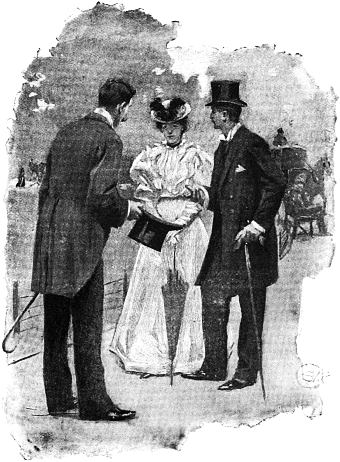
"SHE WAS A RUSSIAN, AND I WAS MUCH STRUCK BY HER BEAUTY."
"We're going home next week," he said, and we parted. I really don't see what I could have said that could have done the slightest good. It was in his liver or his eyes that the fault lay, I thought—I'm not so sure about that now—and I'm no doctor.
Well, two days after this interview, while Robinson and I were at dinner, a waiter came to me and said that there was a lady in our private room who insisted on seeing me immediately. I went up, of course, and there found Mrs. Barton in a state of terrible excitement and anxiety.
"You must come with me, Mr. Campbell," she cried, on seeing me; "my husband has met with a terrible accident," and she literally dragged me out of the hotel into her carriage.
"He is in a doctor's house," she said, as we rattled furiously down the street; "the accident happened at the very door, and he was carried in. He has been asking continually for you."
I thought she seemed to resent this, and perhaps it was only natural. "How did it happen?" I asked.
"He had been buying some old armour and two old Florentine daggers, and was carrying them home when he slipped and fell, and one of the daggers ran into his leg. It was all my fault, I ought to have helped him to carry the things; his hands were full, and he couldn't save himself."
"Oh, it will be all right, Mrs. Barton," said I; "a cut in the leg is not very serious."
"Not serious!" she replied, angrily; "the doctor said himself that in ten seconds more he would have bled to death. Here is the house; I shall take you straight to him." She hurried me through the open door of a somewhat mean little dwelling—we had driven into a rather low quarter of the town. I didn't know Florence well enough to be sure exactly where we were, and during my drive I had been too much occupied to look out of the window. We went into a small bedroom on the ground floor. Two little men in black coats were standing by the bed, and on it lay Barton, with a face of the most ghastly pallor and wildly glaring eyes.
"Thank God you've come, Campbell," he gasped. "I'm too weak—too weak—you must keep him out," and then his head fell back and he fainted. Restoratives were applied without avail, and the two men in black exchanged whispers in Italian which I could not catch.
"Speak English," said Mrs. Barton, furiously—she looked like a madwoman—"Speak English. What are you going to do?"
I thought it improbable that either of the men would know the language, but I was wrong.
"We are agreed," said the taller of the two, speaking with a very slight accent, "my brother and I, that one thing only can be done. Your husband is dying from want of blood: we must give him more blood. How much will you pay?"
"There's no question of that," I said, as I grasped his meaning; "you can bleed me, I'm willing. Be quick, there's no time to lose."
"No, no," said the doctor, "you are not strong enough; it might not save him; it would certainly lose—that is, kill you. But we are fortunate; there is in our house what you call a lodger, he is strong and his blood will serve. He will not refuse me, he is of the Religion; but you must pay."
"Of the Religion?" I said. "Oh, I see, you are a Jew. Well, I will guarantee you five hundred pounds; divide it as you choose, only make haste."
"That will be sufficient," said the shorter of the brothers, "but you and the lady must not be here. The room is small; I will take you to another, and bring down our guest, and I will tell you when it is finished, that you may thank him."
So saying, he led us into a room facing the door of the bedroom and locked us in. I heard him go upstairs; heard voices: then his steps coming down, followed by someone with a much heavier tread; heard them enter the bedroom and close the door. Mrs. Barton was lying back in her chair in a sort of stupor, and I was examining the room by the light of one candle—it was now nearly half-past nine—when I heard a sudden outbreak of noise, the bedroom door opened, the key of our door was turned, and the taller of the two brothers looked in.
"The gentleman must come, please," he said, and I hurried out. "He is calling for you," he said, closing the door, "and will not keep still; we can do nothing if he will not keep still."
We went into the bedroom. Barton was tossing wildly about on the bed; the little doctor was trying to keep him down while a tall dark man of an unmistakably Jewish type was holding the injured leg as still as he was able. I went up and took Barton's hands in mine: instantly he became perfectly quiet, and his eyes closed.
"Keep him away. Campbell, I trust to you," he said, and lapsed into unconsciousness.
"We must be quick," said the little doctor. "If the gentleman holds the right hand all will be well; we will operate on the left arm. Come, Israel," to the stranger, "stand here."
Barton was lying perfectly still, but when the man Israel approached the head of the bed an extraordinary shudder ran through his body, his eyes opened and glared at me, and his lips moved as if to speak; but apparently the sight of me sitting by the bed soothed him, for the panic died out of his eyes and his head fell back again on the pillow.
The operation commenced. I'm not doctor enough to give you the details, and I could not see very clearly, but apparently the doctors—for both the brothers appeared to be medical men—had established, by means of a sort of a pipe, a connection between the circulatory system of the big Jew and the poor fellow on the bed, so that the blood of the former poured into the veins of the latter.
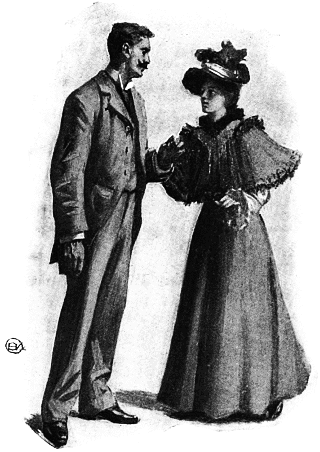
"'MY HUSBAND HAS MET WITH A TERRIBLE ACCIDENT,' SHE CRIED."
As this idea came home to me, I glanced anxiously at the stranger to see if he was fitted to bear such a strain, and I was satisfied. A fine full-blooded fellow he looked, six feet high and well built, with black hair and ruddy cheeks, which seemed to me to be gradually growing paler, but perhaps this may have been due to the failing light of the little lamp by whose feeble rays this difficult operation was being performed.
It seemed to me that this wonderful lending or selling of life, as it were, had been going on for a long time, when I heard a slight noise behind me, and, glancing round, I saw Mrs. Barton at the end of the room near the door. Her eyes were fixed in a stare of terror on the face, not of her husband on the bed, but on the stranger who was saving that husband's life. The operation was almost over apparently. Barton's face was in shadow, and I could see no change in its appearance, but the smaller of the two doctors was bringing forward instruments and bandages with a view apparently to the necessary stoppage of the flow of blood when the connecting pipe should be removed. I motioned to Mrs. Barton to keep back and be silent. I suppose the big Jew Israel noticed my gesture, for his eyes turned towards the door. I saw his face, which was now very pale, suddenly stiffen as it were, and in another moment he gave a terrible cry, and leaped back from the bed.
The smaller doctor, with the most admirable presence of mind, instantly commenced operations on Barton's arm, while his brother seized hold of his lodger round the waist. Mrs. Barton, her eyes still fixed on the big Jew, was crouching down at the end of the room, and I hurried round the bed only just in time to stop the man Israel, who rushed towards her, dragging the doctor after him, and yelling out some perfectly unintelligible gibberish. It was obvious, however, that he meant murder, and I collared him in front while the doctor hung on gallantly behind. Israel was enormously strong, and, seizing the little man by the neck, he simply tore him off and flung him away into a corner of the room. In doing this, however, he threw all his weight on to his left foot, which I promptly kicked from under him, and we came down together, knocking over the table and rolling wildly about on the floor.
He seemed to be growing weaker, and at last I got my knee on his chest, when I suddenly remembered that his arm had never been attended to, that he must be bleeding to death. I could see nothing; for in our fall his head had struck the table and upset the lamp—thank goodness it was filled with colza, not paraffin—so I yelled to the doctors to strike a light and lend a hand. The little man, who had quietly finished Barton's arm while we were waltzing about all over the floor, relighted the lamp, and I don't think I shall ever forget the scene that the feeble light displayed to me.
Barton was sitting up on the bed looking anxiously in my direction; one doctor was just getting on to his feet, the other was hurrying towards me, and in the corner by the door was huddled Mrs. Barton, still wildly staring round, but perfectly motionless. I looked down at the man on the floor, and saw to my horror that he was on the point of death—in fact, before the little doctor could reach him, and put the lamp down, his jaw had dropped and his head fell back with a thud on the bare boards.
"He is dead," said the little man, quietly; "that blow on the head would perhaps have sufficed, but the cause of death was loss of blood; perhaps the gentleman would prefer to make the fee seven hundred pounds and he shall not be troubled with any too curious questions. As the gentleman's carriage is at the door, the gentleman had better be removed; it will not hurt him. Is there anything the matter with the lady?"
Mrs. Barton had risen, and now came slowly forward. "No," she said, "I am well. That man—I was afraid—I thought he was going to—to hurt me."
"It was so, without doubt," said the little man, calmly; "he was angry. Is the gentleman ready to be moved?"
"All right," said Barton, speaking in quite his ordinary voice, "all right, I can walk."
"He must be carried," said the doctors together; "the other gentleman will help us, and then he will perhaps arrange about the money."
We picked Barton up amongst us, his wife going first to prepare the carriage for his reception, and carried him to the door.
"Stop a minute!" said Barton, suddenly, "let me see the poor fellow who is dead."
"It is right that the gentleman should see him," said the smaller brother, "he saved the gentleman's life."
We had propped the corpse up in a sitting position against the end of the bed, and Barton looked long into the ghastly face.
"Good God! how strange!" he whispered at last. "He has saved my life, and I feared him—how I feared him!"
"The gentleman knew Israel Hoffmann then?" said the taller of the two doctors.
"No," said Barton, "I have never met him before. Go on," and we carried him to the carriage where his wife was waiting us. I got in with them, telling the doctors I would return immediately, and they allowed me to depart without protest, somewhat to my surprise. I saw Barton safely in bed, and was hurrying from the room when he called me back and asked his wife to leave us for a moment.
"Campbell," he said, when she had gone, "do you know who that man was?"
"No," said I, "he was a lodger in the house. I know no more than that, but I can find out if you like."
"I don't mean that," he said; "that man's face was the face that had peered at me round the door for more than a year; the face I had told you about, the face I had grown to fear as I never feared anything in my life before; and yet that man has saved my life. It was good, not evil, that the vision meant, Campbell—good, not evil, and it was nearly driving me mad. Go back to that house; you can leave me safely, I am happier and better than I ever was before. I thought the thing was evil, and I find it to be good."
I left him repeating these words over and over again, told his wife, and hurried back to my rooms. Then, having procured the money, I drove to the doctor's house. I settled with the two little men in the sitting-room, and then asked if I might see the body.
"It is upstairs," they said. "We will arrange everything; he is of the Religion. But you may see him."
I went upstairs, and there on a bed in a tiny room lay the body of my late antagonist, wrapped in a sheet. The face was exposed, and I examined it with interest. It was deathly pale and somewhat fallen away, the thick, curving nose standing forward prominently. On the left temple and on the forehead was a terrible bruise, caused, I suppose, by the edge of the table on which the lamp had stood. Certainly the face tallied marvellously with Barton's description of his visionary visitor. I went back to my rooms and tried to puzzle the thing out, but I can't say that I succeeded. The connection that seemed to exist between the dead man and Mrs. Barton only complicated matters instead of simplifying them.
Robinson and I are still staying on here, but the Bartons left yesterday, Barton having recovered in a perfectly marvellous manner. I've written a very long letter, old boy, but as you seem excited by the remarks I let fall in my last epistle to you about the subject, I thought I had better give you the full details. I'm afraid I must ask you not to repeat the story—you will yourself see the reasons against so doing. I don't know if you will be able to form any theory about it—I shall be glad to hear it if you can. Hoping to get a letter from you soon, and that you are quite fit,
I am
Your loving brother,
Tom.
April 14, 1898.
Dear Jack,
I will give you, since you desire it, full details of the whole terrible business, but I must repeat the caution of my last letter. Don't make this public just yet. Of course many of the facts are known, but still I should prefer you not to repeat what I am going to tell you. I am taking legal advice on the subject.
In my letter to you, last summer, I told you, I think, all about Barton's strange delusion and the extraordinary episode of the transfusion of blood from the very man whose wraith he was always seeing into Barton's own veins. The Bartons had been in England for some time before I returned to find an invitation awaiting me to dine at their house in town. I accepted, as I was anxious to see how Barton was getting on, and whether he had got rid of his horrible delusion.
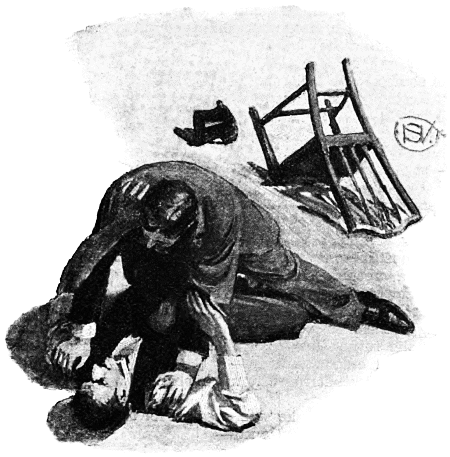
"WE FELL DOWN TOGETHER, AND I GOT MY KNEE ON HIS CHEST."
I found him in the best of health, better and stronger apparently than he had been even before the commencement of his hallucination; but Mrs. Barton was much paler and thinner than when I had seen her last. I was the only guest, and the burden of the conversation was borne by myself and Barton, who was really almost boisterous at times—an extraordinary change for him. Mrs. Barton scarcely spoke. I noticed that she never so much as glanced in the direction of her husband. I thought at the time that probably the first tiff of their married life had come off some time that day, and that Barton's boisterousness and his wife's silence arose from the same cause. I know better now.
When Mrs. Barton left us to our cigarettes, I asked about the man at the door. Barton, I think, was rather vexed at the question, but he told me that he had no return of the vision, and then passed on to something else. I also inquired after his wife's health, and as far as I could judge he seemed actually pleased to hear that I thought her looking ill, and his manner of speaking of her altogether confirmed me in the idea that they had had a quarrel, and a fairly serious quarrel, that very day, though of course I couldn't pursue the subject.
A short while afterwards a message was brought in to Barton, and he asked me to excuse him for a few minutes, as he must see someone—a groom I think he said—and would rejoin me in the drawing-room.
I went upstairs and entered into conversation with my hostess, whose manners had completely changed. She talked now with a feverish rapidity, and I noticed with the most intense surprise, and I must add with a creeping sensation of horror, that she had caught Barton's trick of constantly shooting anxious glances at the door. I suppose she saw that I had observed her, for she turned her chair round with its back to the door and said—
"I was wondering why my husband did not come."
I told her that he was engaged for the moment, and she continued—
"Have you noticed any change in him, Mr. Campbell?"
"He seems marvellously well," I replied. "We really owe a great debt to the two little doctors and to——"
I stopped abruptly. Mrs. Barton had grown ghastly pale, and I remembered how fiercely the Jew had endeavoured to attack her in that terrible little room in Florence. Once again she seemed to read my thoughts.
"I knew that man Israel Hoffmann, Mr. Campbell," she said. "I am a Russian, you know, and we—my father and I—disliked him, and he hated us, and had threatened often to revenge—that is, to injure us. My father warned me against him only a few months before he died, and you see how the man tried to attack me on that night. We do not like Jews in Russia you know, Mr. Campbell.—Why, what is it?"
"Nothing," I said, hastily, but I'm afraid my voice shook; "I thought I saw your husband coming in—I was mistaken."
It was no mistake, I knew. It was Barton's face that I had seen looking round the door, with his eyes fixed on his wife; but as I spoke the head was withdrawn, and the door softly closed.
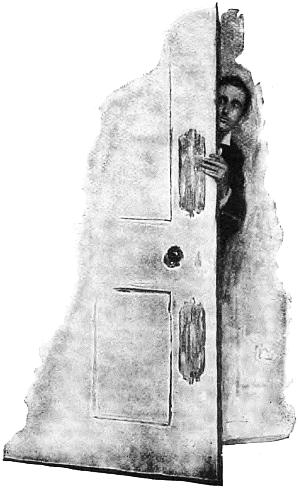
"IT WAS BARTON'S FACE—HIS EYES FIXED ON HIS WIFE."
"Mr. Campbell," said—or, rather, gasped—the woman at my side, "was he—was he peering at me round the door?"
"Well, I—I thought so," I stammered.
"He always does that now," she whispered, "and it frightens me, Mr. Campbell—it frightens me. What does it mean?"
What on earth was I to say? Here was Barton apparently taking the place of his departed ghastly visitor; but how was I to explain this to his wife, who had never heard, and now most certainly must never hear, of her husband's hideous delusion. I was relieved from my difficulty by Barton himself, who now entered the room with the same boisterously cheerful manner that I had noticed before.
"Well, I hope you're not bored, Campbell," he cried.
"Very much the reverse," said I, with perfect truth.
"I'm afraid that isn't true," said Mrs. Barton; "I'm very dull to-night, but Mr. Campbell must excuse me—my head is aching terribly, and I really think I must go to bed."
Of course, I expressed my sympathy and wished her good-night; but as I opened the door for her she whispered, "For God's sake stay as long as you can. Good-night."
Well, I did stay as long as I could; and if ever a host made it clear to a guest that he wasn't wanted, Barton did that night. After about an hour of it he asked me point blank to go, as he had had a very tiring day.
I couldn't very well stay on after that, could I? I soothed my conscience by determining to find some pretext for coming round to the house the next morning, and got up to go. Barton helped me on with my coat himself, and while he was doing so I noticed an immensely heavy whip lying on an old oak chest in the hall.
"Sorry for your horses, Barton," said I, "if that's your idea of a riding-crop."
Barton laughed.
"It's a Russian executioner's knout," he said. "I got it as an interesting curiosity, and a pretty penny I had to pay for it. I thought it might interest my wife—she's a Russian, as you know."
"Rather a ghastly present," I said.
"Oh, horrors appeal to the Slavonic temperament," he answered; "she'll be glad to have that knout. Good-night."
I must admit that I left the house with a very strong presentiment of trouble to come, and cudgelling my brains in vain to discover a reason for Barton's amazing conduct at the drawing-room door. I did not like to ask him about it—the less said about his delusion the better, I thought—but I determined to come round in the morning; I could make the Russian knout an excuse for doing so—I could easily assume an interest in a curiosity like that.
So at ten o'clock next day I walked round to the Bartons'. As I turned the corner into Pont Street, I saw with a thrill of undefined dread that there was a small crowd gathered round the Bartons' house, and two policemen were engaged in pushing the people back from the door, which was open. I forced my way furiously through the crowd, and seeing the white face of the old butler in the hall, behind the policemen, I called to him. He came forward and I was admitted, after some delay, as a friend of the family.
"What is it, Parsons?" I asked.
"God knows, Mr. Campbell," he whispered. "Mr. and Mrs. Barton breakfasted together in the oak room this morning: there wasn't no one waiting, and about ten minutes gone I heard a cry and went to the door. It was locked, Mr. Campbell, and there's something goin' on in there as I don't like, sir. The police are breaking in the door now."
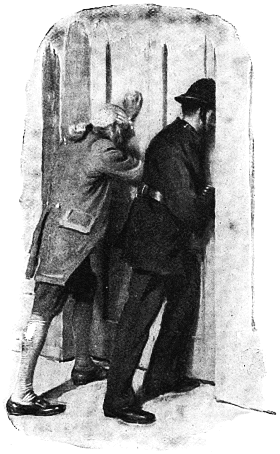
"THE POLICEMAN AND BUTLER TRIED TO BREAK IN THE STRONG OAK DOOR."
I hurried past the old fellow, and up the stairs to the oak room, a little panelled room with a strong oak door, which two men, a policeman and the footman, were trying to break in. From the room came a noise of blows and of a voice singing, heard from time to time, as the two men paused in their violent attack on the door. The voice was strange to me, and I could make nothing of the words of the song; they were not English, that was all I could discover. As I threw my weight against it the door gave way, and the three of us tumbled into the room together. It was a ghastly sight, Jack. There, with her head on the table among the breakfast things and her body resting across the back of a chair, lay Mrs. Barton, dead, and horribly lacerated on the back and shoulders, from which the clothes had been torn away. Her husband was standing beside her, still singing the hideous song we had heard, and waving round his head the terrible whip that I had seen the night before, and which was now dripping with the blood of the wretched woman whose life he had taken.
We all rushed in at him together: he knocked the footman head over heels with his left hand, and struck at me with his whip, but at the same moment the policeman at my side cut him down with a blow of his truncheon, and he lay writhing on the floor. I lifted up the body of the poor woman, but finding that life was quite extinct I laid her down and turned to the madman at my feet. The blow of the policeman's staff had caught him on the side of the head, crushing it in like an egg-shell, and I saw that he was dying. I knelt down by him, and he seemed to recognise me, but in a moment his eyes closed, and though he breathed for more than an hour he never recovered consciousness.
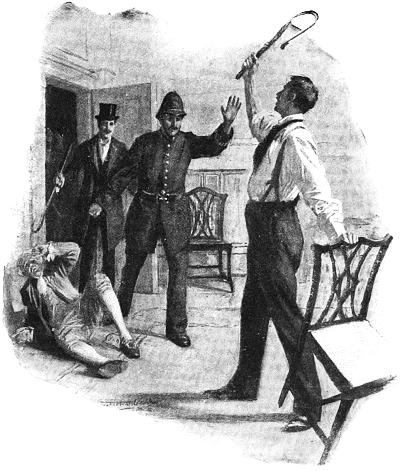
"WE RUSHED AT HIMTOGETHER. HE KNOCKED THE FOOTMAN HEAD OVER HEELS."
You read my evidence at the inquest: of course my description of Barton's delusion was necessary to establish the poor fellow's undoubted madness, but I did not think it incumbent on me to enter into great detail. Now, I want your opinion as a medical man. This affair has shaken my nerves in the most terrible way.
Of course the vision and its fulfilment, if you can call it such, is and must remain inexplicable. It is Barton's conduct after the operation that I want you to explain.
I know, from certain correspondence that I have in my hands, that the man Israel Hoffmann was terribly wronged by Mrs. Barton and her father: his wife was, in fact, executed on their representations alone, as far as I can ascertain, and the whole object of his life was revenge. Is it possible that the spirit of vengeance passed into Barton's soul as the blood of the injured Jew passed into his veins?
Could that be the reason for his strange choice of a weapon, and for the ghastly song, which may have been a Russian song, or even one of the psalms in Yiddish for all I know, which he sang as he beat his wife to death? If this is so, the only feeling we should have towards poor Barton is one of intense pity; and if not, if such an idea is repugnant to medical science, how do you explain the whole hideous story?
Write soon and tell me.
Your loving brother,
Tom.
P.S.—It is a coincidence—an interesting coincidence—that the fatal wound on poor Barton's head corresponded exactly, or almost exactly, with a terrible bruise I saw on the head of Israel Hoffmann.
TRAINING PUPPY TO HUNT CLEAN BOOT.