Volume 1 — A FAMOUS WIGMAKER'S FAMOUS ALBUM. SOME INTERESTING THEATRICAL AUTOGRAPHS. By Gavin Macdonald.
Reading edition
Mr. William Clarkson, of Wellington Street, where the wigs come from, is almost as well known to the general public as the stars of the theatrical and musical professions who frequent his establishment.
In the whole of London, I doubt if you could find a more interesting place to spend an afternoon than the Wellington Street wig shop. And, if you are to any extent a hero worshipper of stage players, it is here you will find them, free, unconventional, Bohemian fellows all, with the strait lace of the footlights gone.
Clarkson's is a sort of theatrical Rotten Row, where all the professional world is wont to meet, and mix reminiscences and general chit-chat of the stage with orders for wigs and make-ups.
The shop itself is hardly less remarkable than the business carried on within it. It has a touch of the last century about it, with its low-pitched ceilings and curious anterooms.
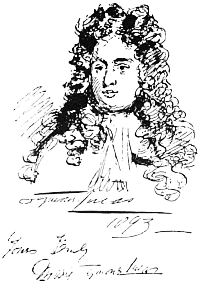
SKETCH BY SEYMOUR LUCAS, R.A.
From the former hang hundreds of grotesque pantomime and fancy-dress masks, scarcely clearing the heads of the customers. In glass cases around the walls of shop and anterooms are wigs and disguises and costumes of every description, an empire's ransom in paste jewels, and the serving of an army corps in stage weapons.
Almost any morning in the theatrical season you will find three or four well-known faces among the crowd in the establishment. It is a convenient meeting-place for one thing, and it teems with familiar faces and opportunities for friendly chats for another.
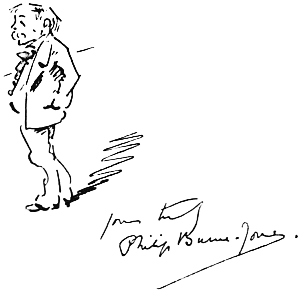
PHILIP BURNE-JONES' SKETCH OF HIMSELF.
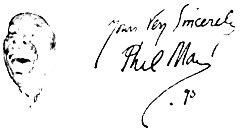
THUMBNAIL BY PHIL MAY.
The groups of actors, actresses, musicians or artists, as the case may be, stand here and there chatting unconcernedly, while the various employés rush hither and thither, dodging between them like a pack of startled deer. And down at the desk sits Mr. Clarkson himself, characteristically occupied in doing twenty things at once. First, it is a genial word with a well-known star across the top of his desk. Then a word is exchanged with a distant group, during which the telephone rings up, and there is the Prince of Wales' fancy-dress ball costume to be discussed. Sir Henry Irving wants a wig curled, or possibly a new elephant is required in a hurry for a West-end pantomime.
Meanwhile assistants momentarily consult him, till you begin to think it is a miracle his reason survives; yet somehow all are answered, and additional orders are shouted to others in the far corners of the building into the bargain. This strange mixture of hustle and scurry on the one hand and on the other is a feature of Clarkson's I have never yet missed, although I have visited the place times without number.
Needless to say, there is scarcely a member of the artistic professions whom Mr. Clarkson cannot number among his friends. He is always ready with an apropos story should any of them be mentioned, or should you evince any special interest in the subject it is quite possible he will show you his famous albums, and point out the absent one's autograph and remarks.
The autograph books—for there are two of them—are the most wonderful of their kind in the world, containing as they do the signatures of almost every member of the theatrical profession, both here and abroad.
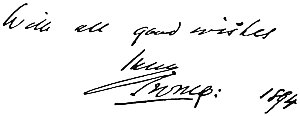
SIR HENRY IRVING'S AUTOGRAPH.
There are many hundreds of them, many accompanied by quotations from favourite parts, snatches of verse, stage catch phrases identified with their names, and so forth.
Many of the artists have contributed sketches. The musicians in most cases have scribbled bars of their own compositions after their autographs.
For the purpose of illustrating this article I have reproduced a few autographs from this unique collection. To publish them all would need a special edition.
Most if not all of the names will be familiar to the readers of this magazine.
First we give some artists' thumbnails. The most ambitious is the pen drawing of a Cavalier's head, by Mr. Seymour Lucas, R.A.
It is a pity that we are not able to give a larger reproduction of the inimitable pencil drawing of a negro's head by Phil May. It is a wonderful piece of drawing.
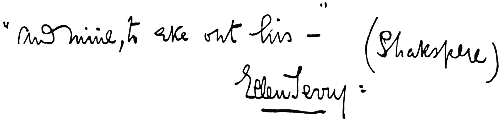
MISS TERRY'S QUOTATION—
Perhaps the cleverest thing in the album is the sketch by that versatile actor-artist, J. Bernard Partridge.
Not less interesting is the sketch of himself by Philip Burne-Jones.
After the artists come the actors and actresses.
Miss Ellen Terry quotes Shakespeare, "And mine, to eke out his." Underneath is a particularly happy retort by Sir Arthur Sullivan, who is inclined to baldness. He writes: "And his (Clarkson's), to eke out mine (hair)."
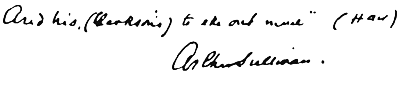
—AND SIR ARTHUR SULLIVAN'S RETORT.
What Mr. Tree means by his quotation from Henry V. I am not prepared to say. Is it the wig or the maker? I leave it to Mr. Clarkson.
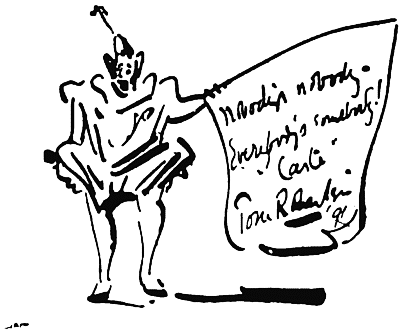
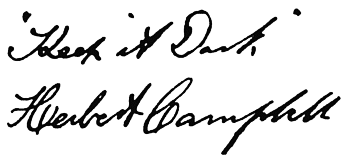
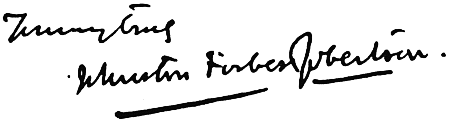
All playgoers will be glad to compare the diversified signatures, whether their favourite be Sir Henry Irving, Sir Squire or Lady Bancroft, Mr. Forbes Robertson, Madame Sarah Bernhardt, or the veteran Mr. Toole.
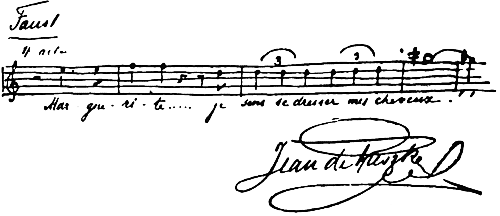
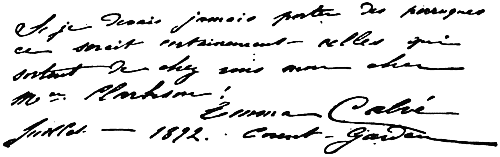
Sarah Bernhardt writes a French sentence. Curiously enough, although this appears at the very bottom of a page, it was the first autograph in the book; another instance of the great Sarah's eccentricity.
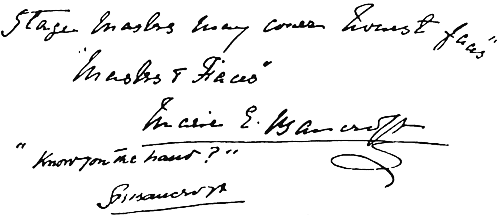
SIR SQUIRE AND LADY BANCROFT'S CONTRIBUTION.
Mr. Clarkson supplies Sarah Bernhardt with all her wigs, and they are never even curled by anyone but him, being sent especially from Paris for the purpose.
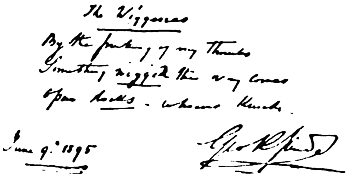
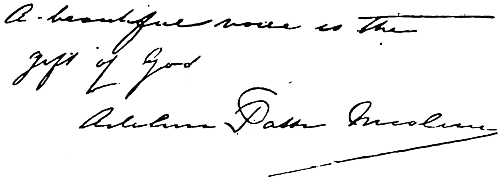
MR. G. R. SIMS ON THE "WIGGERIES." MADAME PATTI'S TEXT.
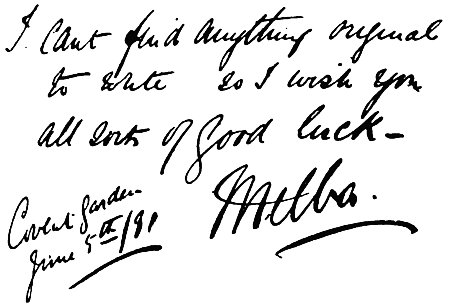
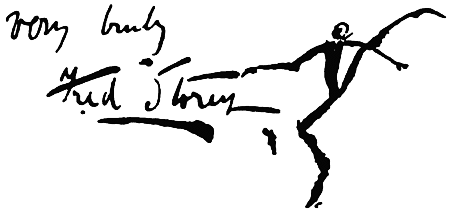
MADAME MELBA WISHES "GOOD LUCK." MR. F. STOREY'S IDEA OF HIMSELF.
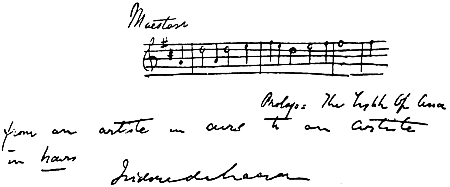
AN AIR BY A POPULAR COMPOSER.
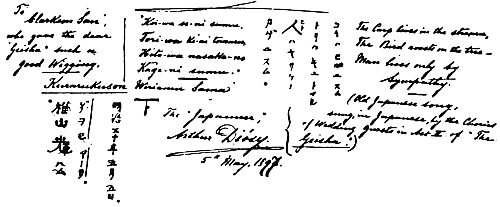
MR. DIOSY WRITES A SNATCH FROM "THE GEISHA" IN JAPANESE AND ENGLISH.
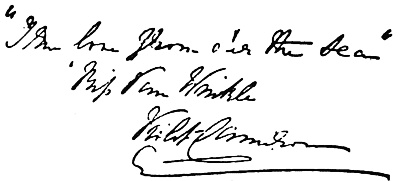
WHAT ONE OF THE "BABES IN THE WOOD" SAYS.
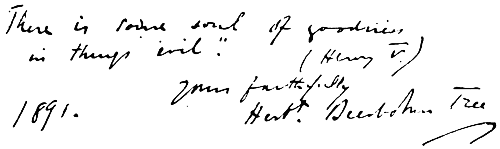
MR. TREE QUOTES SHAKESPEARE.
Mr. Fred Storey's portrait of himself was in all probability produced by the aid of a particularly lissom quill pen.
Mr. George R. Sims contributes a funny travesty of a speech of one of the witches in Macbeth—
"THE WIGGERIES.
"By the pricking of my thumbs Something wigged this way comes; Open locks, whoever knocks."
The inimitable Dan Leno's "Yours with or without lace" is a characteristically original way of saying that their friendship was not one of a business nature merely.
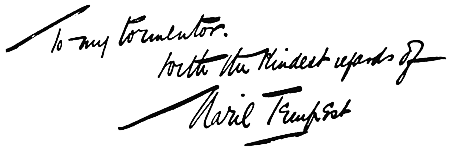
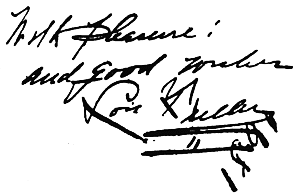
One autograph is of special interest in view of the tragic happening of a few months ago. It is the characteristically bluff signature of the late William Terriss, written while he was playing with Sir Henry Irving in the year 1890.

SARA BERNHARDT'S COMPLIMENTS.
When Mr. Clarkson was a boy just fresh from school, Terriss used to come into his father's workroom and give his order for wigs directly to the younger Clarkson, insisting that he, and he alone, should make them from beginning to end. The late Mr. Terriss may therefore be said to have been Mr. Clarkson's first client.
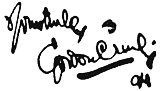
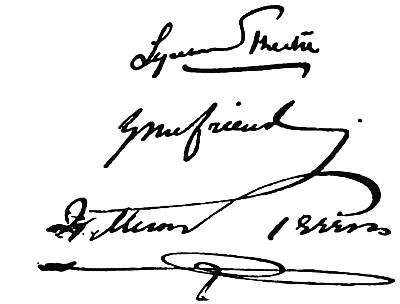
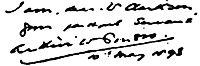
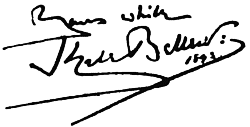
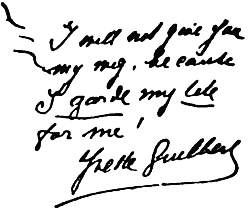
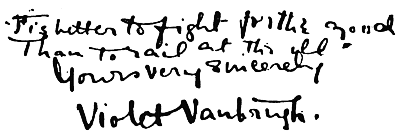
One of the smallest spaces in the whole book contains quite a bunch of prominent names, the signatures of Violet Cameron, Kyrle Bellew, Yvette Guilbert, and Arthur Pinero occupying a space very little larger than a postage stamp.
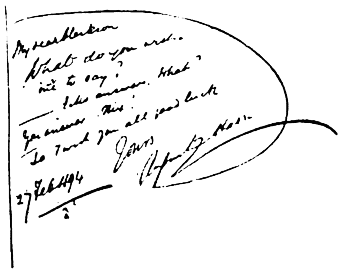
"My dear Clarkson," wrote the late Sir Augustus Harris, "what do you wish me to say? Echo answers, What? You answer, Nix! So I wish you all good luck."
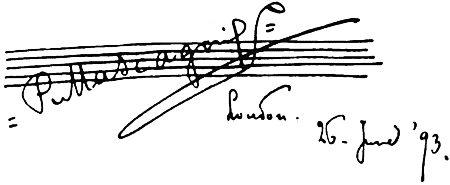
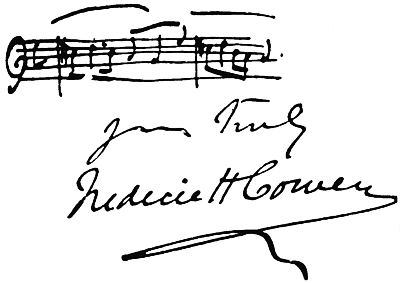
The majority of the world's greatest musicians are represented in the album. For example, Leon Cavalli has contributed two bars of his Pagliacci; Mascagni, of Cavalleria Rusticana fame, signs his name across the musical stave, and Madame Melba contributes her best wishes.
Another quotation of special interest, as it is written by the great singer Madame Patti, runs as follows: "A beautiful voice is the gift of God.—Adelina Patti-Nicolini."
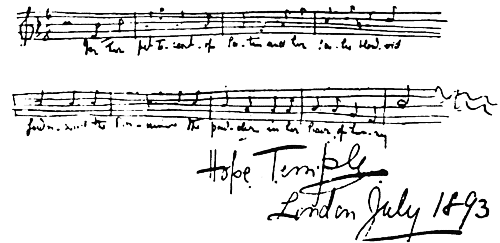
Then by way of contrast there is a portion of one of Miss Hope Temple's songs, in the handwriting of the composer.
One of the most interesting contributions is that supplied by Mr. Diosy, the popular Secretary of the Japan Society. It consists of a message to Mr. Clarkson, and a few lines from The Geisha in Japanese writing and characters.
"From an artiste in airs to an artiste in hairs," over the signature and music of Mr. Isidore de Lara, is a particularly happy contribution.
Many of the illustrations are self-explanatory, and we have therefore omitted mention of them in this article.
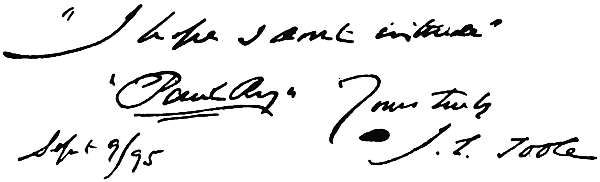
MR. TOOLE'S MODESTY.
A WORD FROM DRURY LANE.
A MURDERED MAN'S AUTOGRAPH.
MR. PINERO FINDS HIMSELF IN PLEASANT COMPANY.
DAN LENO'S INTIMATION.