Volume 1 — Remarkable Secret Chambers. STORIES OF QUEER HIDING PLACES
Reading edition
Written and Illustrated by Allan Fea.
The secret chamber is a favourite item in the properties of the novelist, but few people are aware how many secret chambers really exist. They are not quite so numerous as "ghosts," but many of our country houses still possess these queer hiding places. The majority of them owe their origin to the religious persecutions of Queen Bess.
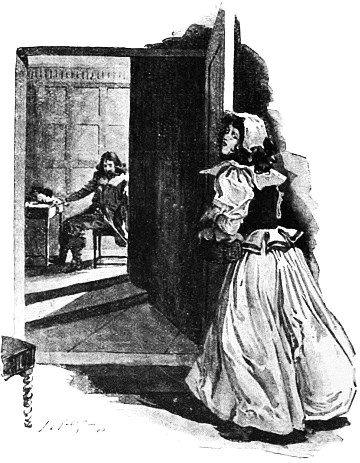
CAPTAIN ARTHUR JONES WAS HARDLY CONCEALED IN THE SECRET CHAMBER AT CHASTLETON, WHEN THE ENEMY ARRIVED TO SEARCH THE HOUSE.
In the mansions of the old Roman Catholic families we often find an apartment in a secluded part of the house or garret in the roof, named "the Chapel," where religious rites could be performed with the utmost privacy; and close handy was usually an artfully contrived hiding place, not only for the officiating priest to slip into in case of emergency, but also where the vestments, sacred vessels, and altar furniture could be put away at a moment's notice.
It appears that most of the hiding places for priests, called "Priests' Holes," were invented and constructed by the Jesuit, Nicholas Owen, a servant of Father Garnet, who devoted the greater part of his life to constructing these places in the principal Catholic houses all over England.
"With incomparable skill," says Father Tanner, writing in the seventeenth century, "he knew how to conduct priests to a place of safety along subterranean passages, to hide them between walls and bury them in impenetrable recesses, and to entangle them in labyrinths of a thousand windings.
"He alone was both their architect and their builder, working at them with inexhaustible industry and labour; for generally the thickest walls had to be broken into, and large stones excavated, requiring stronger arms than were attached to a body so diminutive as to give him the nickname of 'Little John'; and by this his skill many priests were preserved from becoming the prey of the persecutors."
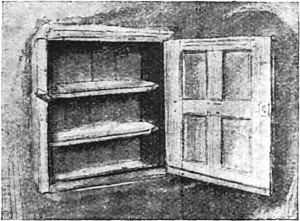
SWINGING SHELVES IN A CUPBOARD AT ABBOTS SALFORD OPENING INTO A SECRET RECESS.
The shelves closed.
After the discovery of the Gunpowder Plot, "Little John" and his master Father Garnet were arrested at Hindlip Hall, Worcestershire, from information given to the Government by Catesby's servant, Bates.
The grey old Jacobean mansion, Chastleton, preserves in its oak-panelled hall the sword and portrait of the gallant Cavalier, Captain Arthur Jones, who, narrowly escaping from the battlefield, rode home with all speed with some of Cromwell's soldiers at his heels, and his wife, a lady of great courage, had scarcely concealed him in the secret chamber, when the enemy arrived to search the house.
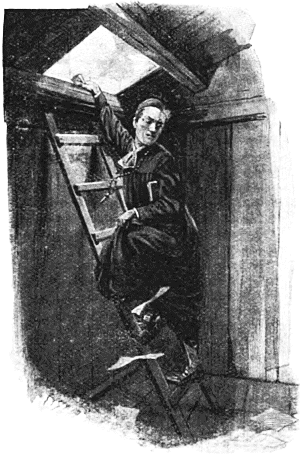
PRIEST'S HOLE AT BOSCOBEL HOUSE USED BY CHARLES II.
Little daunted, the lady, with great presence of mind, made no objection whatever—indeed, facilitated their operations by personally conducting them over the mansion. Here, as in so many other instances, the secret room was entered from the principal bedroom, and in inspecting the latter the suspicion of the Roundheads was in some way or other aroused. So here they determined to remain for the rest of the night.
An ample supper and a good store of wine (which, by the way, had been carefully drugged) was sent up to the unwelcome visitors, and in due course the drink effected its purpose, and its victims dropped off one by one until the whole party lay like logs upon the floor.
Mrs. Arthur Jones then crept in, having even to step over the bodies of the inanimate Roundheads, released her husband, and, a fresh horse being in readiness, by the time the effects of the wine had worn off, the Royalist captain was far beyond their reach. The secret room is situated in the front of the building, and has now been converted into a very cosy little dressing-room, preserving its panelled wainscoting, and but little altered, with the exception of the entry to it, which is now by an ordinary door.
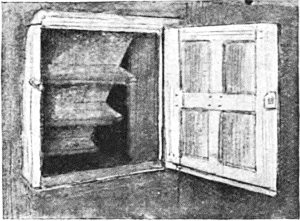
The shelves open.
The above tradition has been provided by Miss Whitmore Jones, the present representative of the family.
Abbots Salford, another fine old mansion, has its chapel and resident priest for the services still held there.
In a dark passage up in the garrets is the priest's hole, as ingeniously concealed and intact as it was three centuries ago. By removing a wooden peg from a particular shelf in the most innocent-looking of cupboards, the whole back of it, oak shelves and all, swings backwards into a large and dismal recess four feet in depth. This ingenious swing door may be fastened on the inside by a stout wooden bolt provided for that purpose.
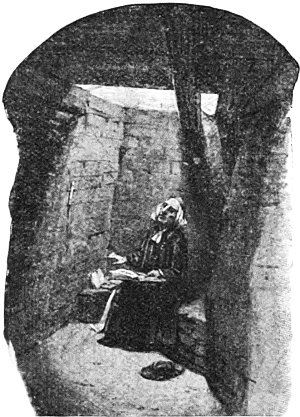
SECRET CHAMBER UNDER A ROOM IN MOSELEY HALL—ALSO USED BY CHARLES II.
When the Civil War was raging, many a defeated Royalist owed his preservation to the priests' holes and secret chambers of the old Catholic houses all over the country. Did not King Charles II. himself owe his life to the artful hiding-places of Boscobel, Moseley, Trent, and Heale?
After the defeat of Wigan the gallant Earl of Derby sought refuge at Boscobel, and after a sojourn of two days proceeded to Gatacre Park—now rebuilt, but also famous for its hiding holes—where he was concealed by a Mr. Humphrey Elliot. When the day was lost on the disastrous 3rd of September, the Earl suggesting his recent place of concealment and the loyalty of the Penderels, Boscobel House was decided upon as the safest place for the King in his dire extremity. "I chose to trust them," says King Charles, "because I knew they had hiding holes for priests that I thought I might make use of in case of need."
A door now occupies the position of the sliding panel in the wainscoting of "the squire's bedroom," behind which one of the hiding places is situated. In the floor a trap-door can be raised, below which is a recess some five feet square, and this communicated by a narrow flight of steps in the great chimney to an outlet screened by creepers, leading to the garden.
The other hiding place is entered from the floor above through a small square hole at the top of a staircase leading to what is known as "the gallery"—a large attic from the windows of which Charles II. could get a good view of the surrounding country, and where he could take some exercise and stretch his limbs after the narrow confinement of his uncomfortable sleeping quarters. The hiding place in the garret is five feet two inches in depth and 3¼ by 4½ feet wide.
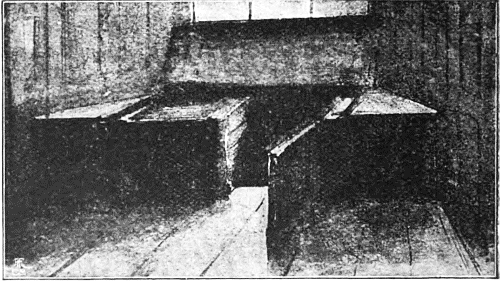
SECRET CHAMBER UNDER A WINDOW SEAT AT PARHAM HALL.
The priest's hole at Moseley Hall, whither His Majesty removed when he left Boscobel, is situated at the back of a large brewhouse chimney, and is entered through a trap-door in the floor of a small room or closet adjoining the apartment which was occupied by the fugitive King. His narrow escape when the house was visited by Southall, the notorious priest-catcher, has thus graphically been described by Charles' host, Mr. Thomas Whitgreave:—
"In the afternoon, reposing himself on his bed in the parlour chamber, and inclining to sleep, as I was watching at the window, one of the neighbours I saw came running in, who told the maid soldiers were coming to search, who therefore presentlie came running to the staires' head and cried, 'Soldiers! Soldiers are coming!' which His Majesty hearing, presentlie started out of his bedd, and ran to his privacie, where I secured him the best I could, and then leaving him, went forth into the street to meet the soldiers who were comeing to search; as soon as they saw me and knew who I was, they were readie to pull mee to pieces, and take me away with them, saying I was come from the Worcester fight, but after much dispute with them, and by the neighbours being informed of their false information that I was not there, being very ill a great while, they let mee goe, but till I saw them clearly all gone forth of the town, I returned not. But as soon as they were I returned to release him."
In a corner of the priest's hole is a low brick seat. The walls are of brick, and huge oak beams, in one of which we noticed a wooden pin, about an inch in diameter, that could be easily pulled out by the fingers. In all likelihood a straw or reed could be passed through to supply an inmate with liquid food, as we shall see was the case at Harvington.
Window seats often contained secret means of ingress to priests' holes. In the long gallery of Parham Hall, Sussex, not far from "the chapel," is an example wherein Charles Paget was concealed for some days after the failure of the Babington Conspiracy.
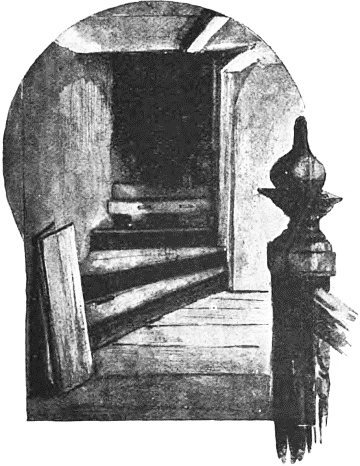
THE MOVABLE STAIR AT HARVINGTON HALL, BENEATH WHICH IS A ROOM FIVE FEET SQUARE.
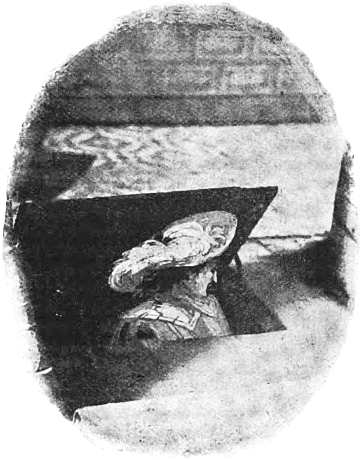
TRAP-DOOR IN ROCHESTER HOUSE, SAID TO HAVE BEEN USED BY JAMES II.
If we visit Harvington Hall in Worcestershire at twilight and ascend the massive oak staircase, it will require no great stretch of the imagination to people it with "pursuivants" hunting for their prey; or if we climb to the top landing, to conjure up an indistinct form stealthily removing the floorboard from one of the stairs and creeping beneath it.
This particular step of a short flight running from the landing into the garrets is upon closer inspection indeed movable, and beneath gapes a dark cavity about five feet square, on the floor of which still remains the piece of sedge matting whereon a certain Father Wall reclined a few days prior to his capture and execution in August 1679.
A small concealed aperture in the wainscoting of the "banqueting-room" would admit a straw being thrust from the hiding hole, through which caudles and broths could be sucked up by the unfortunate inmate should his friends be upon the alert.
The house of the loyal Sir Richard Head still exists at Rochester, where King James II. went from Whitehall for the last few days ere he quitted the country. He departed thence secretly. About twelve at night he was rowed to a smack which was waiting without the fort at Sheerness.
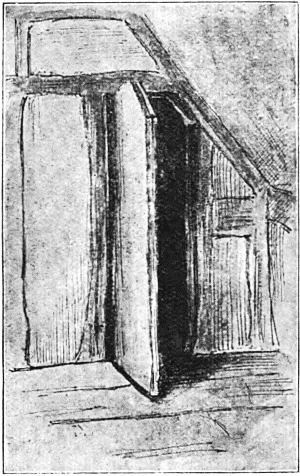
HIDING PLACE IN THE GARRET OF UFTON HALL.
There is a secret passage in the upper story communicating with a trap-door to the floor of one of the garrets; this leads by a private staircase to the back of the house. Whether King James found it necessary to make use of the secret passage and trap-door must remain an open question.
The curious, many-gabled mansion Ufton Court, Berkshire, both from its secluded situation and quaint internal construction, appears to have been peculiarly suitable for the secretion of persecuted priests.
A remarkable hole is to be seen in one of the gables close to the ceiling, of which a sketch is given in the heading to this article. It is triangular in shape, and is opened by a spring bolt that can be unlatched by pulling a string which runs through a tiny hole pierced in the framework of the door of the adjoining room. The door of the hiding place swings upon a pivot, and externally is thickly coated with plaster, so as to resemble the rest of the wall, and is so solid that when sounded there is no hollow sound from the cavity behind, where it is supposed the crucifix and sacred vessels were secreted.
Not far off, in an upper garret, is a hiding place in the thickness of the wall large enough to contain a man standing upright. Like the other, the door or entrance forms part of the plaster wall, intersected by thick oak beams, into which it exactly fits, disguising any appearance of an opening.
Sawston Hall, Cambridgeshire, the fine old mansion of the Huddlestons, has a remarkable hiding place on the top landing of a quaint spiral staircase. When one of the floor-boards is raised, a round hole or tunnel is discovered in the stone masonry slanting into the wall, where is a space ten or twelve feet deep, and of sufficient breadth to contain any sized priest, should he succeed in squeezing through the aforesaid circular entrance, which would not admit a very bulky person.
Blocks of oak fixed upon the inside of the floor-board fit exactly into sockets scooped out of the beams which run at right angles and support the landing, and unless the movable board be pointed out it is impossible to detect it, so ingenious is its construction.
These are but a few of the stories that might be told of these quaint hiding-places which abound in England and Scotland. Unfortunately the buildings in which they exist are gradually disappearing. The pictures and facts here given, however, will bring vividly to mind the romantic and exciting conditions under which some of our forefathers lived.
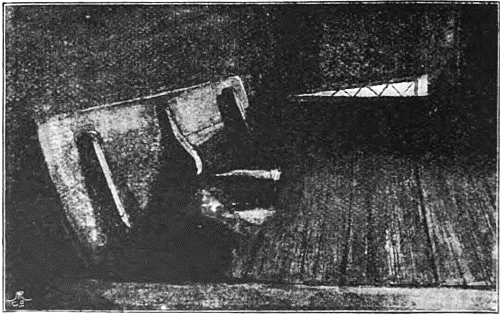
ENTRANCE TO TUNNEL UNDER FLOOR-BOARDS AT SAWSTON HALL.
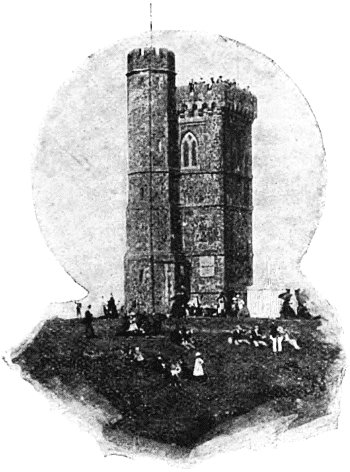
THIS TOWER ON LEITH HILL CONTAINS ITS BUILDER'S BODY.