Volume 1 — DEAD MEN'S STRANGE WISHES. SOME QUEER BURIAL PLACES. By H. G. Archer.
Reading edition
Strange requests are often made by men when they are dying or in their wills. And few are stranger than those made concerning their mode of burial.
The most extraordinary of all was that made by the celebrated Jeremy Bentham. The great philanthropist and exponent of the doctrine of utilitarianism, dying in 1832, left directions that his body should be dissected, and that the skeleton should be put together, and after being clothed in his old vestments, should be seated in a sort of glasshouse on wheels. The first part of the programme was performed by his faithful disciple, Dr. Southwood Smith, who, in endeavouring to preserve the head, deprived the face of all expression. Seeing this would not do for exhibition purposes, Dr. Smith had a model made in wax by a distinguished French artist, who succeeded in producing a most admirable likeness.
The skeleton was then stuffed out to fit Bentham's own clothes, and the wax likeness fitted to the trunk. This figure was placed seated on the chair in which he usually sat, with one hand holding the walking-stick which was his constant companion in life, called by him (like a dog) "Dapple." The whole was enclosed in a mahogany case with a glass front, covered by folding doors, and presented to University College, Gower Street, where it can be seen in the south gallery of the college museum. Our sketch was made on the spot specially for this article.
To those knowing the story the spectacle is certainly a startling one—to all appearances a living man is seated within the case; while to those ignorant of the facts the figure seems to be nothing more than a wax effigy. Mr. Bentham has a whole host of visitors, nearly all Americans though, many of whom want to take photographs.
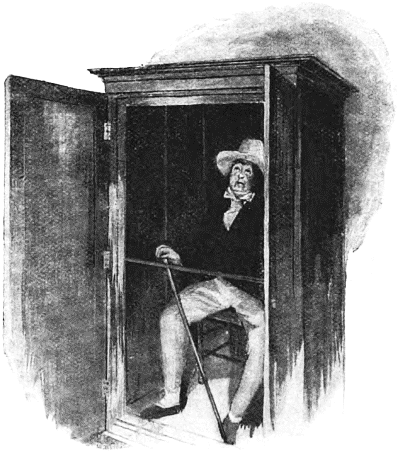
THE STUFFED BODY OF JEREMY BENTHAM IN UNIVERSITY COLLEGE.
Next in point of interest comes the strange request of Anthony Ettericke, who was an eminent lawyer, and once Recorder of Poole. Having some cause of offence against the people of Wimborne, in which town he lived, he declared that he was to be buried in a consecrated spot, but not above nor below the ground, not in the church nor out of it.
To make certain that this was done he got permission to build a coffin into the wall of Wimborne Minster, so that it is half in the church and half out, half above the ground and half below it. To do this a special arch had to be made, and for the repair of this arch and the coffin Anthony Ettericke gave to the church a sum of 20s. from a farm. To bury him the wall of the church level with the pavement was opened and the body deposited in the coffin as described. It is of slate, and is emblazoned with many coats-of-arms.
There are two dates on it, 1691 and 1703, one over the other, so as to render both almost unreadable. He was fully convinced that he should die in 1691, and had his coffin made and that date placed upon it. But he did not die till 1703, and so the second date was cut over the first.
An art gallery seems a queer place in which to bury bodies, and probably few of the inhabitants of Dulwich are aware that Dulwich College Picture Gallery contains three bodies—the bodies of the three people to whom that collection of pictures owes its existence.
Noll Joseph Desenfans was a native of Douai in France, but settled in London, first as a teacher of languages. He became possessed of a valuable picture by Claude, which he sold to George III. for 1,000 guineas, and so became a picture dealer.
Then Stanislaus, King of Poland, commissioned him to purchase pictures to form a National Gallery for Poland, and in this work Desenfans was helped by his friend Sir Francis Bourgeois, R.A.
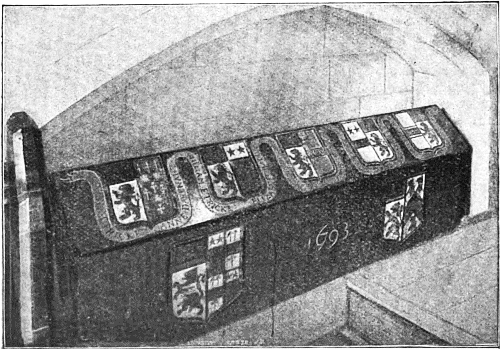
THE SLATE COFFIN OF A MAN WHO WOULD NOT BE BURIED IN THE CHURCH NOR OUT OF IT, NOT ABOVE THE GROUND NOR BELOW IT.
When the Polish King was overthrown, the collection of pictures came back to Desenfans, and was housed in Sir F. Bourgeois' house in Charlotte Street, Portland Place, where Desenfans lived.
On his death Desenfans left his pictures to Bourgeois, and he decided to hand them over to some public body for the benefit of the public. Accident directed his attention to Dulwich College, to which he bequeathed his pictures.
The bequest was conditional. He wished a mausoleum to be erected in the gallery where his own remains and those of his friends Mons. and Mme. Desenfans might repose. The condition was accepted, and our photograph shows the burial place of these three patrons of the fine arts. The mausoleum can be entered from the Art Gallery.
Students of De Quincey will remember his tale of the "clock-case mummy." This was none other than the embalmed corpse of a Miss Beswick, which for many years posed as an exhibit in the Manchester Natural History Museum. When in the flesh, during the middle of the last century, this lady had been attended medically by a Dr. White, to whose skill she had owed much alleviation of her sufferings from chronic neuralgia. Accordingly, she left him a bequest of £25,000, but with the condition annexed to it that she should be embalmed, and that once a year Mr. White, accompanied by two witnesses of credit, should withdraw the veil from her face. To render this easy, Mr. White placed his benefactor in an ordinary grandfather's clock case, with the usual glass face. The doctor died in the year 1813, and the greater part of his museum was divided among the Manchester hospitals and museums, the mummy finding its way to the old Natural History Museum. When, however, the contents of this museum were transferred to Owens College, the authorities had the mummy buried.
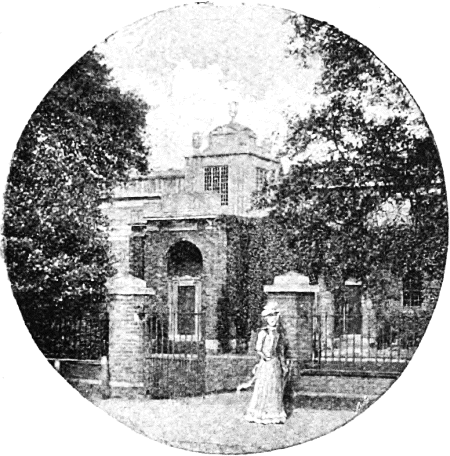
EXTERIOR OF THE TRIPLE GRAVE IN THE DULWICH COLLEGE PICTURE GALLERY.
In 1783, the remains of Margaret, widow of Richard Coosins, of Parrock, Gravesend, were deposited in Cuxton church, near Rochester. Under a pyramidal mural monument is a vault with a glass door, covered with a green silk curtain, with a lock having a key standing inside. Here, resting upon tressels, is a mahogany coffin with gilt furniture, the lid of which is not screwed down. This coffin contains the body of the above lady, attired, so it is said, in a costly dress of scarlet satin, according to her wish.
In 1766, Richard Hull, a native of Bristol, bencher of the Inner Temple, and an ex-member of the Irish Parliament, resided at Leith Hill Place, Dorking. In that year, having obtained permission of the lord of the manor, Sir John Evelyn, of Wotton, he erected a tower on the summit of Leith Hill, both for the benefit of the public and to form his own cenotaph. Dying on January 18, 1772, his body was deposited within the east wall of the building, where a tablet of Portland stone marks the spot.
The subsequent history of this tower is rather curious. For many years it remained open to the public, but as this privilege was abused and the tower became a harbour for smugglers, gypsies, and other lawless characters, a subscription was raised in 1795 among the gentry in the locality to make it uninhabitable. The whole of the interior was then filled up with stones and cement, and remained in this state until a dozen years ago, when the present holder of the property announced his intention of reopening it to the public.
So solid was the cement, however, that it was found impossible to reopen the old entrance and interior staircase. Accordingly, a staircase tower was built by the side in order to make it available for the original purpose. A splendid view is to be obtained from its commanding situation—on a clear day the sea is even visible—but few of the holiday folk frequenting it are acquainted with its real history.
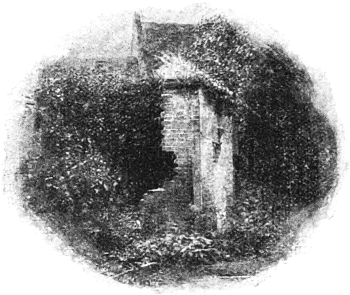
THIS SUMMER HOUSE IN RUINS HAS BEEN USED FOR NEARLY A HUNDRED YEARS AS A MAUSOLEUM.
Another well-known case of eccentric burial is that of the Rev. Langton Freeman, of Whilton, Northamptonshire. This gentleman, by his will, dated September 16, 1783, left the following singular directions for his interment. Five days after death his body was to be wrapped in a strong, double winding-sheet, and to be conveyed to a summer-house in his garden, where it was to be laid in the bed he had slept in during life. This being carried out, the doors and windows of the fragile mausoleum were to be locked up and bolted, and the building planted around with evergreen plants, and fenced off with oak pales, painted a dark blue colour.
His wishes were fulfilled to the letter, and only twenty years ago, when the property, owing to litigation, was without a rightful owner, and consequently much neglected, it was said that the remains in the derelict summer-house were plainly visible. The body is still there, but a large stone slab has been placed over the remains in the bedstead, as some time ago several vandals forced their way in and disturbed them. There is now some talk of removing the bones to the churchyard.
Before railroads swept away the mail-coaches, the coachmen on the London and York stage, as they clattered through Stevenage, used to point out the barn containing within its rafters the body of a farmer named Trigg. This worthy, who died in 1805, ordered that his remains, in a leaden coffin, should rest in this curious position for a period of thirty years. As a considerable sum of money depended upon the fulfilment of this caprice, the heirs were careful to see that it was duly carried out.
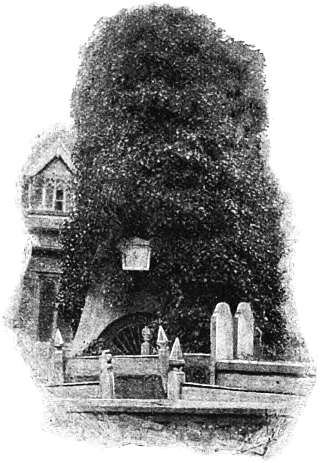
CHURCH TOWER AT PINNER WITH A PROJECTING COFFIN.
Another and somewhat similar case may be seen in Pinner churchyard at the present day, where a mausoleum, raised on arches above the ground, has a stone coffin inserted through it, one end of which—utilised as a tablet for the inscription—projects through. The story goes that the descendants of the occupant, a Scotch merchant named Loudoun, who died in 1804, enjoy a large property so long as it remains in this position, plainly above ground. There are even gratings at the foot of the edifice, probably in order to prove that there is no deception.
Sepulchral vagaries—of far commoner occurrence than might generally be supposed—vary considerably both in character and degree. Some are whimsical and fantastical in the extreme; others apparently consist only in shunning the usual and appointed places of interment, while the peculiarity of others appears, not in the place, but in the mode of burial. In the majority of instances where outlandish places have been chosen for sepulture, the individuals who selected them have been marked by some peculiarities worthy of observation.
For instance, Baskerville, the celebrated printer, whose infidel opinions shocked even the hardened Wilkes, directed that his body should be buried in a tomb of masonry on the site of an old windmill in the garden of his Birmingham residence. This direction proceeded from some curious disbelief in the "Revelation," but his wish was duly carried out on his death in 1775.
More extraordinary still is the case of Major Peter Labellere, the religious fanatic, who, in the year 1800, was interred upon the summit of Box Hill as follows:—The place appointed to receive his remains was about ten feet deep, more in the form of a well than a grave. The coffin was let down and placed on its head, with the feet upright, in that situation. The eccentric Major was firmly convinced that at the resurrection the world will be turned topsy-turvy, and he took this precaution in order that he might then find himself on his feet!
But queer burials are things of the past. For county councils and parish councils now prevent these eccentric interments in cellars, haylofts, and summer-houses.