Volume 1 — A GIRL'S BALLOON JOURNEY OVER LONDON. THE STORY OF AN ADVENTURE IN THE AIR AT FORTY MILES AN HOUR. By Gertrude Bacon.
Reading edition
A few weeks ago a telegram was put into my hands containing two words only, "Come along."
The message was short, but eminently satisfactory, for it signified that the negotiations which had been in progress for a lofty balloon ascent from the Crystal Palace had been completed.
I scanned the weather with interest, for on this occasion I was to accompany my father skywards, and with him and the aeronaut to make an ascent which should not only be my first, but should be noteworthy from the height it was hoped to attain, we being a light party and the balloon a specially large one.
A talismanic card bearing Mr. Spencer's name, and the magic words "Private ascent," gained us free and instant admission to the Palace.
On our way to the balloon enclosure we fell in with our captain, Mr. Stanley Spencer, the youngest member of that firm of distinguished aeronauts who may be said to possess almost the monopoly of the upper regions, and the right of way in the skyey realms.
He was dressed in nautical fashion, as befits the man who sails his own craft through that vastest of all oceans—the ocean of the air—and with his gold-laced cap and blue jacket looked every inch the sailor that he is. He has steered his ship all over the world, being only just returned from India and China, while he wears on his coat the gold medal that the grateful people of Cuba presented him with in the days before the war.
Mr. Spencer's genial face was wreathed in smiles. He said the day was cut out for our ascent, that everything was in readiness, that the sky was clear, and that the wind would carry us directly over London, only he wished there was not quite so much of it.
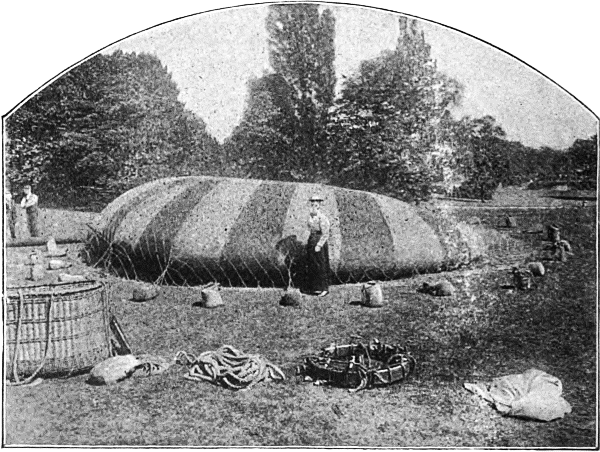
"THE BALLOON WAS A FLAT, LIMP MASS OF RED AND YELLOW SILK AND CORD NETTING."
It was hard to believe that the flat, limp mass of red and yellow silk and cord netting that lay so inert and shapeless on the grass was shortly to bear us among the fleecy clouds that now flecked the heavens.
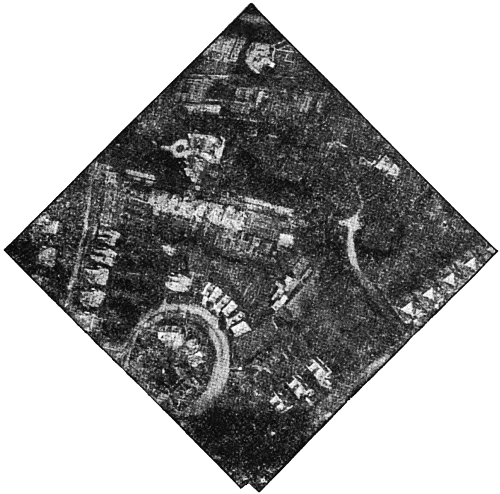
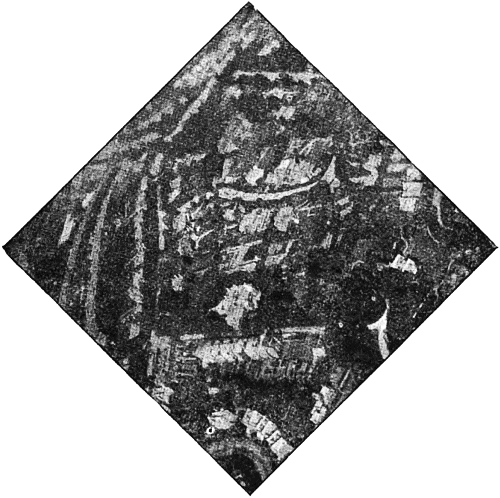
PHOTOGRAPHS OF SOUTH LONDON SUBURBS TAKEN FROM A BALLOON.
In the car we carefully stowed the cameras, the horns and tuning-forks and other acoustic instruments, the big exhausted glass bulb in which we were to bottle up a portion of the higher atmosphere for subsequent analysis, the coats and sandwiches that we might be very glad of later. The balloon was a beauty, of 40,000 odd cubic feet capacity, and had only been used twice before.
At four o'clock the patient company sitting on the grass, at a distance rigidly enforced by a stony-hearted policeman, sent a delegate to ask how much longer we should be. We could not say, but we sat and sadly regarded the swaying silk, and contemplated the ignominy of a return home. At length our captain, in whose mind feelings of prudence were plainly battling with a desire to be off, had the ring and car attached, just to see how things stood. The sand-bags all drew up together, and the balloon rose up higher into the air and began to roll, slowly and majestically, first to one side and then to the other, like a mighty pendulum.
Just at that moment came a lull in the breeze; the angry little squall-demons had whisked themselves off elsewhere; the sun came out from behind a cloud. Things looked brighter in every sense, and Captain Spencer, casting an admiring glance at his stately craft, quivering to be free, came up with a smile.
"I think we'll be off now."
There was a rustle of satisfaction among the onlookers as we sprang into the car, more especially as, the moment the sandbags were removed, the balloon became lively, and gave promise of some fun. Strong arms were holding us down, and up in the ring sat Jack, a weather-beaten old sailor, familiarly known as the "commodore," a tried and trusted servant of the Spencer family, and partner in many an adventure.
"Look here," said our captain; "the wind is stiff, and we may have a roughish descent and need help. Would it not be wiser to abandon the high ascent, part with more ballast-bags, and take up old Jack instead?"
Clearly prudence was on the captain's side, though it was with real sorrow we relinquished our pet scheme of reaching 20,000 feet. So old Jack remained in the ring, our aeronaut commenced throwing bags till we began to rise—but not far. "Hold on!" he cried to the men holding the last rope, and "Look out!" to us, as with a jarring shock the car dashed down on the grass again. Another bag, another rise, and another bump. The squall demons were coming back again, and the people were getting excited.
"Can you spare any of this?" said the captain, looking down at the instruments; "There are not many more sandbags."
So, with another pang, two cameras and other sundries were handed out.
Another bump, a swaying straining of the ropes, while the balloon seemed rapidly losing both patience and temper. One more bag out, a rush upwards, a momentary hesitation, a cheer from the spectators, "She's off! Let go!" and forthwith the tossing car was at peace and still. But the people and the trees, the water-towers and the Palace, took a sudden headlong plunge downwards, and ere I could struggle up from the bottom of the car were hundreds of feet below.
THE CAR OF THE BALLOON CONTAINS CAMERAS, ACOUSTIC INSTRUMENTS, AND A GLASS BULB FOR BOTTLING SOME AIR.
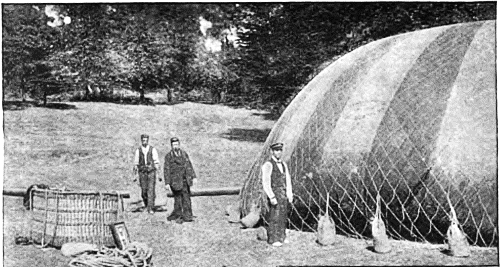
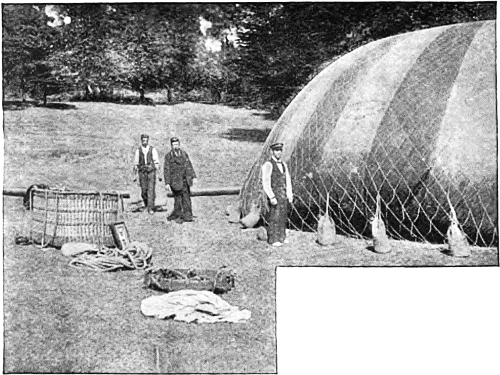
THE CAR OF THE BALLOON CONTAINS CAMERAS, ACOUSTIC INSTRUMENTS, AND A GLASS BULB FOR BOTTLING SOME AIR.
From this moment until we again touched the earth the balloon never moved. Of this I can be sure, for I was in it; but a strange motion caused the earth beneath us to recede rapidly, and at the same time to move backwards; so that trees, fields, houses, gardens, streets, and rivers were rushing madly by under our gaze. Not a breeze disturbed us; not a breath came nigh us. Quickly we rose 1,000 feet, 2,000, 3,000, and very shortly we had attained our greatest altitude, almost 6,000 feet—rather over a mile—high.
And now what a glorious panorama spread itself before our delighted gaze! Above, our view was mainly confined to old Jack's boots, for the commodore maintained his position in the ring. Above him spread the gaudy red and yellow silk, with a vista of the valve through the open mouth of the balloon. The sun, now sinking towards the west, beamed hotly upon us, and directly under it was a fleecy white cloud, but unlike any cloud I had ever seen before, because we were looking at it "end on," from a height as great as its own.
But below was a prospect indescribable in its loveliness and weird in its unfamiliarity. Every house, tree, road, garden and field was outlined with startling distinctness and sharpness of detail, but of Liliputian size and in preposterous perspective.
Swiftly we sped along, bearing northwards at some forty miles an hour. Dulwich, Camberwell, Peckham Rye, Bermondsey, swept by, their parks and gardens and ever-thickening streets almost unnoticed, for now all eyes were turned on the shining river, and the great dark mass of the Metropolis we were so quickly approaching, and whose faint murmur was even now striking our ears. It was as we had foreseen—we were to cross London, and at its densest point. Fortune was favouring us indeed, for not twice in thirty ascents from the Palace does such an event occur.
And now we were actually over Southwark, and about to cross the gleaming Thames that wound so sinuously through the maze and tangle of streets, lost in haze as it crept towards the sea, and dazzling in its brilliance where it reflected the waning sunlight. Dotted about upon its surface were a fleet of the sweetest possible little toy ships—tiny models, such as children would sail in their baths at bedtime. Across it we could trace each teeming thoroughfare, Tower Bridge in particular standing out as a beautiful little miniature.
Every block and square, the great arteries of traffic and the less-trodden by-lanes, were delineated as in a huge map. There was St. Paul's looking as Sir Christopher Wren surely never dreamed of, there the great square of the Tower and the shimmering water of the Docks. Conspicuous among the wilderness of roofs eastward shone out an enclosure of little white objects, puzzling at first, but which we presently decided to be the gravestones of some large cemetery—Tower Hamlets probably.
We crossed the river between London and Tower bridges and kept our course north with just a dash of east in it; and all the while the air was full of a strange loud noise, a deep continuous hum, not so much that of bees in the limes or at swarming time, as the ceaseless roar of vast machinery, the booming drone of a mighty dynamo, suggesting sleepless activity, endless motion, and infinite strength and power. It was the voice of the toiling millions, the whirr of the engines of nations, the throb of the heart of the world.
Northward yet, and the streets thinned out and the fields and trees appeared again, and the roar gave place to an almost deathlike silence, for we were above the height to which the sounds of country life could penetrate. We seemed to cross a region of market-gardeners, and at one place all the country appeared covered with hot-houses, whose glass roofs glittered like diamonds. Anon and all the lovely plain was studded with stately mansions and rich men's country seats.
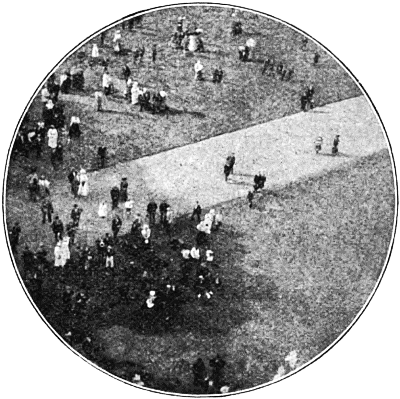
WHAT THE CRYSTAL PALACE GROUNDS LOOKED LIKE AS I LEFT THEM.
On and on over park and field and wood. Presently our balloon began dropping, and we noted that at 3,200 feet elevation the first sounds reached us, the crowing of a cock, a dog's bark, and the shrill voices of children. Above that height all had been absolute silence, except for the occasional report of a gun, which, however, sounded sharp and short, and different from what it was at lesser elevation.
Down we swooped until we could see the rabbits in a field scuttling to their holes and the ducks on a pond flapping with consternation at our approach. All the neighbourhood turned out to look at us and cheer. We hailed one farmstead and inquired our whereabouts, but we could not catch the reply, though we heard one old woman plainly protesting we were knocking the tiles off her roof with our trail rope.
For half an hour longer we floated on, over fields and hedges that gave one no impression so much as that of irregular patchwork.
We could trace the lanes and main roads, and presently we noticed what seemed to be a well marked "non-slipping" pneumatic bicycle track running through the land. There were ridiculous little white sticks beside it, and we knew it for a railway line. The sight of it began to remind us of certain considerations we would fain have forgotten. To quit these realms for earthly cares and earthly limitations, to exchange our steady car, open to the pure, unbreathed air, for a stuffy, jolting train, was a hard thing to do. But the evening was approaching, the balloon once more dropping, and quickly too, and we had but one more bag of ballast. "This looks a good place for landing, Jack," said the captain, and so it did.
A broad stretch of level fields, some grass and some with the corn just cut, no trees and not even a hedge, only a long way ahead a high road with telegraph posts, and beyond that again the railway running north. So we made ready for the end. Jack came down from the ring, the captain took the end of the valve rope ready to pull, I was placed in the centre with orders to stand with my knees bent, to hold on fast to a rope on each side, and to prepare for a big bump. Nearer and nearer the earth we swooped, and as we bore down we could perceive that the wind we had been perfectly unconscious of above, and which we fondly hoped had abated, was blowing as stiffly as ever, and sweeping over the open plain fresh and strong.
We left a young plantation behind us, just shaved a patch of growing wheat, and then hovered over a field where the corn was reaped, and the sheaves, piled in shocks, stretched in neat rows to the high road far ahead. It was the very spot.
"Now!" cried our aeronaut, as he tugged the valve rope with all his force and held it taut. Over went the anchor, and instantly the earth made a sudden violent rush upwards and hit the car with a stunning crash that shook every bone in one's body. We actually landed on a corn shock, scattering the sheaves right and left, and the great floundering balloon pulled us over flat on one side, so that for a moment the wheat ears brushed our faces as we lay, all in a heap, holding on with might and main, till in a moment we lifted again.
HERTFORDSHIRE WOODS AS SEEN FROM A BALLOON.
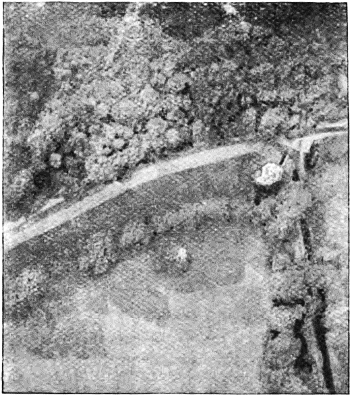
But then an untoward event occurred. Under ordinary circumstances, the many-pronged anchor, let fall from a height, buries itself deeply in the ground, and thus moored, after two or three rebounds, the balloon subsides. But no rain had fallen for many a day, and in that iron-baked soil the grapnel hooks could penetrate scarce half an inch. The balloon rose, plunging and straining, and in a moment the wind had caught the fast emptying silk and carried it madly forward, the useless anchor dragging vainly along the impenetrable ground, and the unfortunate car, all on its side, bumping, banging, leaping, and tearing in its wake. Along we trailed, the wind flapping and roaring in the silk, every stick in the wicker basket creaking and straining as it skipped and bounded from one corn shock to another, while its four inhabitants, bruised and breathless, gripped the sides, set their teeth, and wondered what was coming next.
We could do nothing but hold on for dear life and hope for the best, and all the while the telegraph posts and wires drew nearer and nearer.
In the end those telegraph wires proved our salvation. Only a field beyond them ran the Great Northern, and to have caught our anchor in its boundary fence and fallen on the rails, as we assuredly might have done, would have been a far from pleasant or safe proceeding. As it was, the tight wires caught the netting, so that the great silk bag fell over one side while the car remained the other, and although the dying monster struggled hard, aided by the sweeping wind, to rise again, it had not life enough, so fast its vital force was ebbing, to lift us above the obstacle.
Then, as we lay heaving and straining yet with every gust, came shouts and hurrying feet, and half a dozen lusty harvesters, panting and excited, tore down to the rescue, and brawny sunburnt arms took tight hold on the ropes, and red jovial faces peered over the side of the basket on the four storm-tossed voyagers within. And by the time we had all scrambled out on to the grass, glad to stretch our limbs and find that none were broken, the whole countryside was alive and rushing up, on foot, on horseback, on bicycles, in carts and carriages, to where the huge balloon lay prostrate in the road, blocking the way and quivering yet in its mortal throes.
All was interest and excitement—no, not all. Within ten yards of our resting place browsed placidly an apathetic donkey. When the gaudy, flapping, unknown giant fell down from the heavens at his very hoofs, this intelligent animal went on grazing. The idea that something unusual was occurring presently penetrated his asinine brain, and he raised his head and looked. Half an hour later, when the balloon was packed up and loaded on the cart that took it to the station, he raised his tail also and brayed long and loud. He was beginning to be astonished at last!
We quickly learnt that we had fallen between Ashwell and Baldock on the borders of the shires of Hertford and Cambridge, and soon we had proof of the proverbial hospitality of the Cambridgeshire folk.
One word in extenuation of my photographs taken from the balloon. Balloon pictures are very often apt to be hazy on account of the diffusion of light from the particles of matter in suspension, when viewed from above, and mine were taken late in the day on an occasion when weeks of drought had heavily laden the air with dust and impurities. The rapid motion of the balloon, moreover, forbade anything but snapshot exposures being attempted.