Volume 1 — FROM A SMOKER'S MUSEUM. SOME BEAUTIFUL AND QUAINT BURNERS OF TOBACCO. By T. C. Hepworth.
Reading edition
Smoking being so universal, it is no matter for surprise that much ingenuity has been spent over the chief implement concerned in its practice. We put cigar and cigarette smoking aside, having nothing to do with the object of the present article; moreover, both the cigar and cigarette are of comparatively recent introduction.
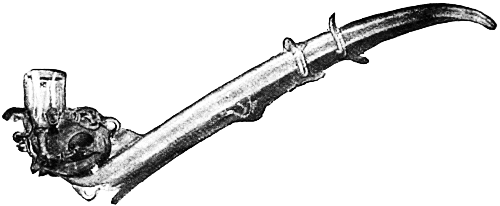
EXQUISITE VENETIAN-GLASS PIPE.
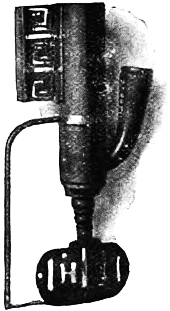
IRON PIPE MADE AS A KEY.
The pipe is the popular smoking appliance and most smokers give it the preference over everything else that can be smoked. It also has the support of the ladies, and any careful housewife will tell us that she would rather admit three or four pipe smokers to her curtained and carpeted rooms than one of those horrid cigars, which leaves its faint and disagreeable odour hanging about the place for many days. Ladies, indeed, are more tolerant of tobacco smoke than they used to be.
The first kind of European pipes were walnut shells, a hole being bored in one side for the reception of the stem—a common straw. It is possible that we get from this early form of tobacco pipe the term "straw," as applied to modern long clays, if, indeed, they are not named like straw-berries, from the material which protects them from injury.
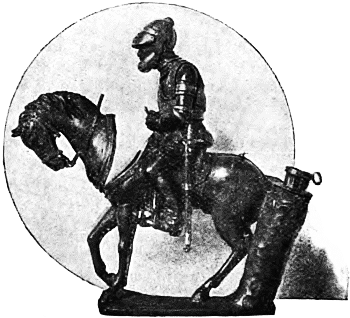
CARVED WOOD PIPE, 6½ INCHES HIGH. TOBACCO PLACED BEHIND HORSE'S HEAD.
The custom of using a pipe common to an assembled company was, no doubt, partly due to the circumstance that tobacco was at one time a most costly thing. Three years after its introduction here it cost per ounce what would be equivalent to 18s. of our present money. Later on it became the custom for a purchaser to throw into the scale a silver coin, and he received just as much tobacco in return as would balance his money.
For the same reason the bowls of early pipes were very small, witness our photographs of early English pipes dug up at Chelsea which could be filled many dozen times over with a single ounce of tobacco. But, as in all other things, demand stimulated supply, until tobacco in our own day has become remarkably cheap. Perhaps some of our readers who pay fourpence an ounce for their little luxury may traverse this statement, forgetting that the value of the weed which they purchase is only about one fourth of what they pay for it, the difference going to H.M. Customs.
After the walnut and straw pipes had had their day, clay pipes became common in this country, where smoking became general after the great plague of London in 1665. To this pestilence we owe the suddenly increased use of tobacco, for it was bruited abroad that of all the tradesmen of London the tobacconists alone had not been attacked by the disease.
Smoking was recognised as a valuable sanitary precaution against the malady, and we find quaint old Pepys mentioning the fact in his famous diary after seeing two houses in Drury Lane marked with a red cross on their portals—the token of a plague-stricken household. "It put me," he says, "in an illconception of myself and my smell, so that I was forced to buy some roll tobacco to smell to, and chaw, which took away my apprehension."
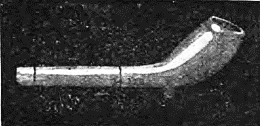
17TH CENTURY CLAY PIPE.
Clay pipes have an enormous sale in this country at the present day, and we may assume that the publicans are the chief buyers, for it has long been the custom to give pipes away to patrons of beershops, without making any charge. Such pipes are mostly made from a Dorsetshire clay, the material being first well kneaded, moulded into pipe form, then dried, and lastly burnt in a kiln. The work of making this kind of pipe is so expeditious that a manufacturer can count on an output of five hundred pipes per day from each hand employed.
At one time there was a demand for "clays" of a more ornate kind, some of the bowls representing heads of popular or unpopular personages. For example, when the great Duke of Wellington tried to stop smoking in the army, except from the muzzles of the guns, he was caricatured in a pipe bowl in which his famous nose was given undue proportions, while the neck of the pipe bore the figure of a subaltern emulating the rude conduct of the gentleman in the Ingoldsby Legends—
"The sacristan said not one word To indicate a doubt, He put his thumb unto his nose And spread his fingers out."
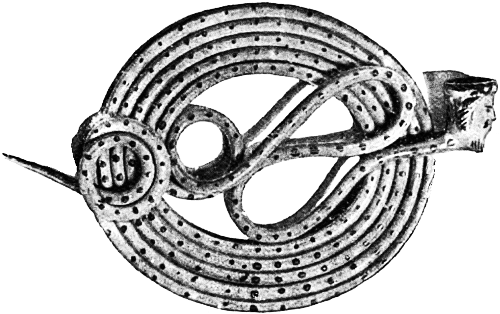
OLD ENGLISH EARTHENWARE SNAKE PIPE.
In the same way the French pipes offered endless variety—one pipe would represent a devil's head; another a skull; a favourite was the head of John Bull treated in a conventional way and not too flattering a spirit. There is also a well-known pipe bearing the head of a Dutchman stuck in a wooden shoe.
But if we want to find variety in pipe design, we must search for it in that country of great smokers—Germany. It would be quite easy to fill an entire number of this publication with pictures of pipes from the German empire, and we have access to collections which would afford endless variety of designs, for pipe collecting is almost as popular a hobby as that of stamp collecting. Here we give three very remarkable examples, as different as they could possibly be.
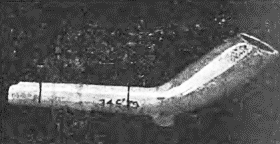
THE TWO CLAY PIPES ON THIS PAGE WERE FOUND IN MILMAN'S ROW, CHELSEA.
First, we show a pipe in the form of a key. It is made of iron, as many of the early pipes were; some were of brass, silver, or other metals; but as knowledge increased, and people learnt that these metals are greedy of heat, they were discarded for more suitable materials.
Our second German example is a very well carved figure of a mounted cavalry officer, made of wood, with silver armour and trappings. This is an eighteenth century pipe, and the original is no less than six and a half inches in height. It will be noted that the bowl proper is in the lower part of the horse's neck, this part of the animal being hinged so that the tobacco can be inserted. The pipe stem fits into a kind of holster at the back. This is essentially a pipe for home use, for although it is not heavy, considering its size, few men would care to be seen smoking such a huge thing out of doors.
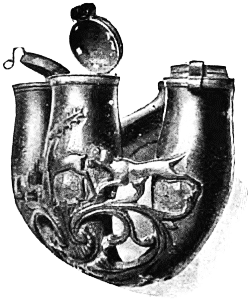
TRIPLE-BOWL PIPE FOR SMOKING THREE KINDS OF TOBACCO.
Our third example from Deutschland is a triple-bowl pipe very finely carved out of one solid piece of hard wood, and mounted with silver tops, etc. There always have been, and probably always will be, persons who prefer to go a roundabout way to accomplish a thing which can be done by far easier means. These simple folk are satirised by genial Artemus Ward in a story of a person who was immured in a gloomy prison. He tried the walls, the floor, the ceiling, and endeavoured to remove the iron bars from the window. Next he tried to escape by the chimney. When suddenly "a lucky thort" struck him. "He opened the door and walked out."
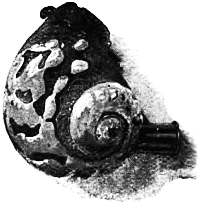
ITALIAN PIPE OF MOTHER-OF-PEARL.
Now, it is quite certain that a man possessing this amount of resource would never have designed a pipe with three bowls in order that he might at the same moment inhale three different kinds of tobacco; he would have done what many smokers prefer to do at the present day—that is, he would have mingled his various kinds of tobacco and smoked them in a pipe of normal construction. The modern German pipes, affected chiefly by students, are too well known to need illustration. They have most capacious bowls of porcelain, and bear a painted picture, generally the representation of a more or less pretty maid.
But the Germans and French must not have it all their own way with the curiosities of pipeland. We give a photograph of an English one, which may be meant for a snake with a man's head, or a catherine wheel; and, if its coils could be opened out, it would measure many feet in length. It is made of earthenware, of a buff colour, covered with brown spots. He would be a bold man who would venture into the smoking-room of a London club with such a grotesque thing between his lips. But it was used before the days of modern clubs.
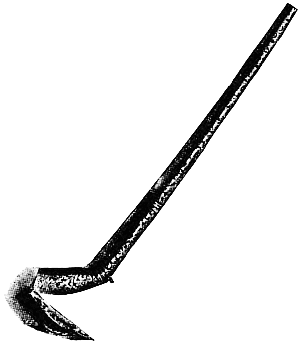
PERFORATED SILVER PIPE CASE.
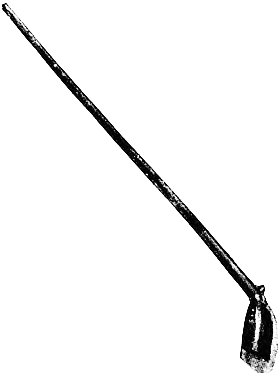
THIS PIPE IS SMOKED IN THE CASE.
Italy supplies many examples of curious pipes. One is a bowl made from a natural shell resplendent with mother-of-pearl; it has an earthenware lining and silver cap. Another is a pipe of glass—not more brittle perhaps than a clay "churchwarden," but rather too expensive to risk between the teeth, for it is a fine example of that beautiful Venetian-glass work which is not excelled throughout the world.
A third Italian pipe is like the fur seal, in that the most valuable part of it is its skin, or case, made of finely-perforated silver. It will be noted that the pipe is too long for the case, an intentional peculiarity, in order that it may be smoked while encased in its handsome covering.
Turkey offers a great variety of pipes, from the humble red clay to the lordly hookah or hubble-bubble—a device of Persian origin for allowing the smoke to be drawn through water in order to purify it before reaching the mouth. Another pipe, with which the hookah is often mistakenly identified, is the "Narghile." This word is a native Indian one for a cocoa-nut, and the pipes are either made of an actual nut, as shown in our illustration, or have a receptacle for the nicotine of similar shape and character. A gourd pipe, with a gourd twelve inches in diameter, is not unknown.
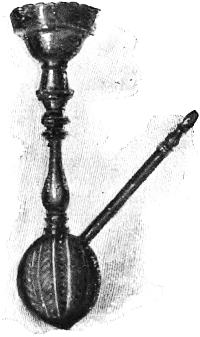
INDIAN COCOA-NUT PIPE.