Volume 1 — A MAN HUNT WITH BLOODHOUNDS. SHOWING HOW THEY MAY BE USED IN THE DETECTION OF CRIME.
Reading edition
By Alfred Arkas.
I have just been hunted by bloodhounds, and, strangely enough, I am none the worse for the experience. It is more exciting than fox-hunting, and for sheer fascination is well ahead of any other sport of which I have any knowledge. The why and wherefore is another story, of which more presently.
The trial of the bloodhound in the practical work of tracking criminals is no new thing. In 1888, when the Whitechapel murders were agitating all England, the public, alarmed and indignant at the impotence of the police, plied the authorities with no less than 1,200 letters per day containing suggestions for the murderer's capture. Of these 800 advocated the trial of bloodhounds.
Ultimately, the weight of public opinion was such as to induce Sir Charles Warren, Commissioner of Police, to give them a trial. Mr. Brough, the eminent authority on the breed, was consulted, and he brought a couple of hounds, trained to hunt man, to London, and several experiments were undertaken.
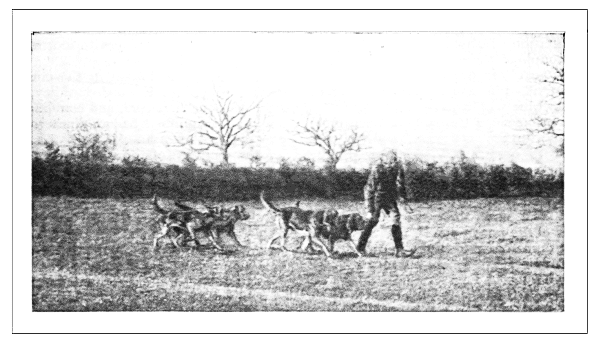
LAYING TRAINED BLOODHOUNDS ON THE SCENT.
In some of these Sir Charles himself acted as quarry, the runs being made in Hyde Park. They were all successful, the Commissioner and others who acted as runners being run to earth each time with unfailing regularity. He expressed himself more than satisfied, it being clearly demonstrated that the hounds would run a man to earth who was a complete stranger to them, notwithstanding that the scent might be crossed by a number of other persons.
During all the weeks the hounds were in London no further crime occurred, and the opportunity of utilising their services was lost. Sir Charles kept them till it seemed that the terrible Jack the Ripper scare was over. The hounds were then returned to their owner. They had not left London more than two or three days when another ghastly crime was perpetrated. Obviously their presence exercised a deterrent effect, and had the police seen fit to add a couple of well-trained hounds to the Scotland Yard staff it is probable no other murder would have been added to the series.
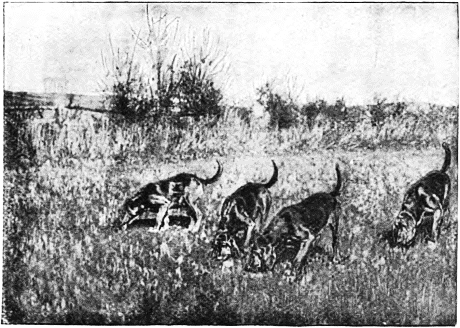
CASTING—TO PICK UP SCENT.
The mysterious and apparently illimitable scenting power possessed by the bloodhound appeals to the imagination of the criminal classes to an extraordinary extent. From what I have gathered of the subject, I cannot help feeling that no police station of any size should be without a couple of trained hounds. The fear of the "cat" is proverbial. Utilise the bloodhound, and a far greater deterrent against crime will have been found.
Some time since the subject once more engaged further attention, and it was decided to organise a series of private trials in connection with The Harmsworth Magazine, with a view to determining the real capability of the hound for hunting man. The next thing was to procure hounds of the purest breed. At this stage we put ourselves into communication with Mr. Edwin Brough, of Wyndyate, near Scarborough.
Mr. Brough has been a breeder of bloodhounds for something like thirty years. He is regarded as the highest living authority on the breed. He is the winner of over 400 first and champion prizes for hounds of his own breeding, and he may be aptly described the creator of the splendid type of hound we have to-day.
Mr. Brough received my suggestion in a sporting manner, and with characteristic generosity offered me every facility in the most difficult and patience-racking task of obtaining the photographs which accompany this article. His hounds are his best friends, and he is willing to go to almost any lengths in order to correct the innumerable absurd ideas that are prevalent with regard to the breed.
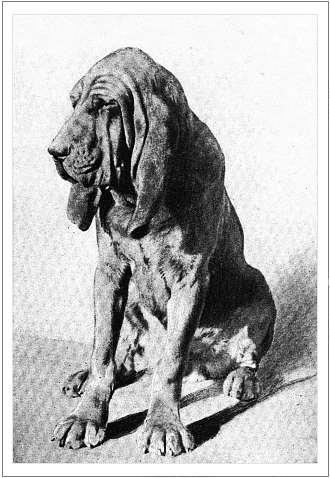
BABBO—THE FAMOUS TRACKER OF HUMAN BEINGS.
Accordingly a short time since a small two-man expedition, equipped with a camera and an unlimited stock of patience, set out for Scarborough.
Early on the following morning I took part in my first manhunt, and a weirdly fascinating experience it was in all conscience—harmless enough, in spite of its sanguinary title.
At the back of Mr. Brough's house are spacious kennels. Here we found thirty or forty valuable hounds, gazing from behind the iron bars of their kennel runs, each handsome and well groomed, the black and fawn coat glistening like velvet; each a perfect type, with handsome expressive face, and pedigree long enough to turn many a human being pale with envy. The kennel man opened two of the doors, and we trudged down the drive and out on to the fields by the cliff-side with four magnificent hounds at our heels.
A soft green undulation in the countryside, sloping into a wooded valley, was chosen for our first trial, and standing at a gate on the summit I had an uninterrupted view of the whole run.
A few moments after our arrival a gentleman who had volunteered to act as runner or quarry started over the slope, and sprinted quickly across the valley on to the opposite hillside. His destination had been previously decided, and with the aid of a glass we could distinctly see him crouching behind the bushes.
A short time after he had concealed himself, the hounds, which had been held in check out of sight, were brought through the gate and laid on scent. The laying on was done by the kennel man, who simply ran his hand along the line or lines of scent to give the hounds a start. A moment later they were rapidly casting round on the trail. Then, before you could say "Jack Robinson," there was a deep sonorous bay, more like the roar of the sea-lion echoing in the roof of Brighton Aquarium than anything else I know, but sweet and resonant as the note of a bell. They had found the scent, and were off like streaked lightning.
FINDING THE QUARRY—INSTANTANEOUS PHOTOGRAPH.
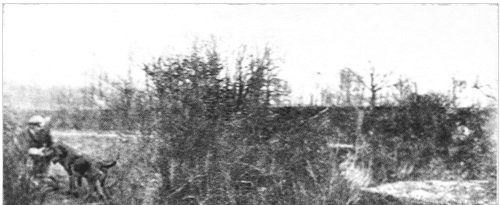
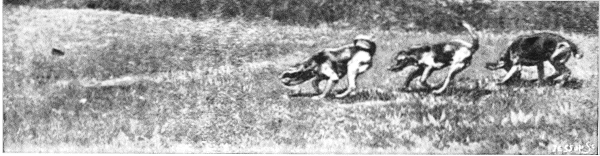
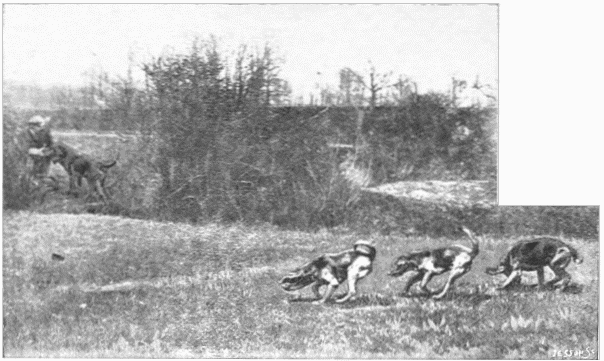
FINDING THE QUARRY—INSTANTANEOUS PHOTOGRAPH.
Down the hill they flew, three in a bunch, the fourth perhaps a yard behind, their noses almost scraping the ground, and the long graceful ears trailing noiselessly in the short grass. A couple of minutes later a deep-bayed quartette echoed away on the further hillside. They had found their man, and were jumping and licking him delightedly. So much for the tearing limb from limb theory.
As a matter of fact, the bloodhound never hurts his quarry when found. He is the gentlest and most lovable of hounds, and vice of any description is utterly foreign to his character. If he is required to hold his man at bay it is necessary to specially train him for the purpose.
"Strong scent," said Mr. Brough. "They went right away." And, in truth, they travelled like racehorses. So fast, indeed, that one forgot for the moment that they were not pursuing a visible object, or racing to a pre-arranged goal.
When the truth made itself clear that they were hunting what is termed "the clean boot"—following the natural scent of a man through his shoe leather—across rough and broken country at a twelve-miles-an-hour gait, it seemed incredible.
And it should be remembered that it was the individual scent of that one man they were tracking. Each human being seems to possess a distinctive scent, and when well-trained hounds are laid on to any one scent they cannot be diverted, though the trail be crossed by any number of other persons.
Five minutes later I ran myself. I was a complete stranger to the hounds. I know that no artificial scent had been attached to my boots, and the course was an entirely different one of my own choosing. Yet they found me a mile away, a few minutes after they were laid on, and bayed with delight as they came up.
In all our trials, extending over three days, they were successful, although every difficulty was placed in their way. In one trial the runner ran to the bank of a river, then up along the side for some yards; back again over the same scent to the first point of contact with the bank; then he forded the river and ran along the opposite bank.
The hounds came up at full trot, traced him along the near bank, till in their eagerness they ran over the scent. Then they all checked and cast again, and after a few moments found by the double scent—although he had practically returned over the same line—that he had doubled over his own track. At the bank they cast again, and after assuring themselves that he had not returned to the starting place they swam the stream, and in a few moments had picked up the scent on the other side and found him.
In another instance several circles were made by the quarry in the middle of a run, and while they were casting about this invisible maze, in an endeavour to find his outgoing trail, we were enabled to obtain our photograph of a cast.
In most of our trials the hounds were put on the trail comparatively soon after the runner had passed over the course, but it must not be forgotten that they are equally successful in working what is termed a "cold scent"—one many hours old. In this respect they surpass all other breeds of hounds.
As I have already said, this power of scent is so subtle as to be almost uncanny. And it is as deep a mystery to those who have devoted a lifetime to hound breeding as to the ignorant layman.
Certain it was, however, that the hounds performed marvels, and their success, under circumstances of great difficulty, was sufficient to more than convince me of their value in the detection of crime. They must have fair play, of course, and conditions more or less favourable for their particular work.
The training of the uneducated puppy to hunt the clean boot is as interesting as the work of the fully trained adults.
The puppies begin their training when only four or five months old, and Mr. Brough resorts to none of the methods generally advocated, such as rubbing the boots of the runner with blood or aniseed. They begin as they finish—on the clean boot. For the first few times they practise tracking a runner whom they know.
The runner starts in view of the pups; runs some two or three hundred yards up wind in a straight line on grass land. He hides himself as soon as possible, and then the trainer takes the pup over the exact line of scent. He trails his hand along it, endeavouring to get the dog to put his head down and work for himself. This goes on till the quarry is reached, when the dog is rewarded by a piece of meat.
This has to be repeated several times perhaps, before the young hound gets his head down and understands what is required of him. Once he understands, he takes the greatest possible interest in the quest, and improves rapidly.
Then difficulties are placed in his way. The line is purposely crossed by others. The time of laying on is postponed some time after the run. Zig-zag runs are also made, and sticks with white flags on them are stuck in the ground at all the angles. By this means the trainer is enabled to judge of the accuracy of the dog's work.
Mr. Brough makes an intimate friend of each and every hound, and their individual characteristics are well known to him. Extreme patience, kindly persistence and firmness are all that is necessary in the upbringing of these beautiful creatures.
As friends they are unsurpassed. Mr. Brough says, "The bloodhound is essentially and pre-eminently a gentlemanly dog, and when you have once won his esteem he may be depended upon as your staunch, trusty, life-long friend."
Mr. Brough's dogs are the handsomest I ever saw. They have a majestic bearing, and thoughtful expressive faces, quite in harmony with their aristocratic lineage.
I should advise every dog lover to obtain a good puppy and train it himself. There are few healthier or more delightful recreations.
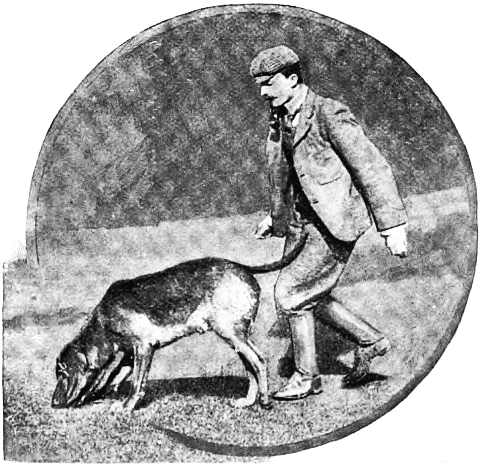
WATCHING A PUPPY'S WORK.
Three Score and Ten.
COME to me, little one, Out of the autumn sun; Play must be surely done— Three kisses, then. Clamber up on my knee. Old, do they say of me? You would not like to be Three score and ten! TIME'S to be blamed, not I; Whether we laugh or sigh, His busy wheels must fly For maids and men. Once I was six years old, Only the years have roll'd; Most of the tale is told At three score and ten! AGE, too, has dreams of May, Loved faces gone away, Green ways grown sad and gray. Scarce we know when. Crying?—no, little one; Tears should be past and done, Rest is so nearly won, At three score and ten! LIFT me your baby eyes, Blue as the summer skies; More in their laughter lies Than Age may ken. Heav'n in their depth I see: Pray it may there still be When you can count, like me, Three score and ten!