Volume 1 — THE EDITOR'S ESCAPADE. THE STORY OF A MAN AND A MANUSCRIPT. By Archibald Eyre.
Reading edition
One sometimes wonders what becomes of those meteoric young men who flash through University firmaments trailing behind them an accumulating tail of honours and other academic distinctions. Do they continue to dazzle onlookers throughout their career, or do they "fizzle out" at an early age?
If the fates had been less kind, it is conceivable that Hubert Didcott might have "fizzled out." That he did not do so may have been due to a piece of luck. While the laurels that crowned his brows were still freshly green, he met a very respectable middle-aged gentleman, who had made an enormous fortune and was turning his attention to literature.
He had recently purchased the Didactic Weekly from the eminent firm of Sholman and Company, publishers, and was understood to be looking out for an editor. Someone introduced him to Hubert Didcott, and they came to terms.
While the new editor and the recent proprietor were gaining experience in lines entirely novel, the position of the paper was parlous in the extreme. The circulation sank to so low an ebb that it was only by a generous courtesy that it could be considered to have a circulation at all.
But when things were at their worst, they began to mend. Hubert Didcott settled himself firmly in his editorial chair, used the intelligence which survived his education, and, shaking himself free from academic trammels, began to grope for the heart of the public. In the end, he found it. When ten years had elapsed, the Didactic Weekly had made for itself a distinct position.
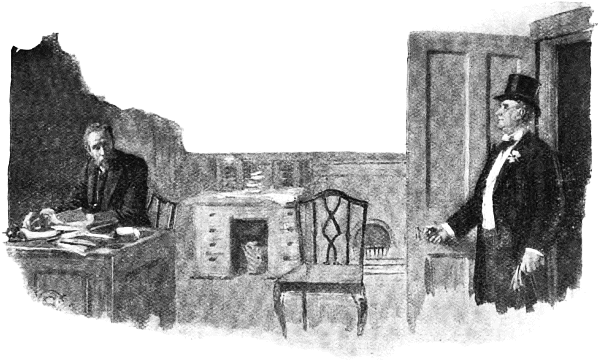
One day, while Didcott sat at his desk, Mr. William Winder, M.P., the proprietor, was announced.
"Good morning, good morning," he began, with great cordiality.
Didcott responded politely.
"Things all right?"
The editor nodded. "Quite a rush for our last number," he said, thawing as he always did when alluding to a success of his beloved paper. "The Bishop of Brighton's article on 'Reunion' has made quite a stir in some circles."
"So I've heard," replied Mr. Winder. "The Prime Minister spoke to me about it. I hadn't read it. Of course," he smiled genially, "I didn't say so."
"The Prime Minister?" echoed the editor. "I wonder if——"
"I asked him," replied Mr. Winder, promptly. "But he couldn't. Too busy. Besides his public works, he's bringing out a new edition of Homer, or the Psalms, or something. He talked to me about it." He smiled again. "I hope he thought my silence betokened intelligence. It didn't."
The editor smiled. "How goes the political world?"
Mr. Winder leant back in his chair. His face assumed an expression of mysterious significance. "The New Year's Honours, I'm told——" he whispered.
Didcott nodded with intelligence; he was aware of Mr. Winder's aspirations. There was a pause while Mr. Winder indulged in silent and pleased anticipations of what the New Year might bring. Very shortly, the pleased look died away; he straightened himself.
"Oh, I say," he said, "I came to speak to you about something. I am afraid you'll think it a great nuisance."
"What is it?"
"Have you fixed on your serial for the New Year?"
"No," replied Didcott, surprised. "I want to get to Meredith's new story, but I haven't done anything yet."
There was a distinct look of worry on the old man's face.
"Didcott, my boy," he said, with an almost beseeching air, "don't be angry with me. I did what I could. I couldn't help it."
"Why, what's the matter?"
"I have a daughter," Mr. Winder went on, a little brokenly. "You know that?"
"Yes, I know," replied Didcott. "But what of that? She's at school, isn't she?"
Mr. Winder shook his head. "No, she's finished. She's home for good."
"That must be very pleasant for you," said Didcott, politely.
"Very nice indeed." Mr. Winder produced his handkerchief, and mopped his brow. "I simply have to do what she tells me. You've no idea. I——" He stopped short, and looked everywhere save at the editor's face.
"Well?" Didcott leant back and smiled encouragingly. He guessed that Mr. Winder was going to confide some domestic incident to his keeping.
"She's nineteen, and quite grown up. And the way she has of getting round me! I can't resist her, the puss!" A smile of mingled vexation and pride played about the father's lips. "You see, she has no mother; so she gets her own way."
"You are quite right to let her have her own way," answered Didcott. "That's the only way to manage a woman."
Mr. Winder brightened. "You think so? You understand? I'm glad, Didcott. It makes it easier for me."
"Makes what easier?"
Mr. Winder sighed. "I do hope you won't mind." He glanced hastily at his companion and then away, and for a few moments an uneasy silence prevailed.
"You want to tell me that——" began Didcott, to help him.
"Would you mind telling someone to bring in the parcel the footman has left in the outer office?"
Slightly amused, Didcott touched the bell, and gave the needful directions. A minute later the boy brought in a bulky brown paper parcel.
When the door was closed Mr. Winder drew his chair close to Didcott's.
"It's a novel; she's written it," he whispered, eyeing his companion eagerly.
Didcott laughed. "Is that all? There's nothing in that. All girls do so sooner or later. It comes as surely as the measles. I expect you want me to read it. I will do so with pleasure."
"She wants it published," said Mr. Winder, forlornly.
"And why not? It won't cost much. And—and she needn't put her real name."
Mr. Winder sighed again. "I've promised that it shall be published. I couldn't help it——"
"And why not?"
"In the Didactic Weekly."
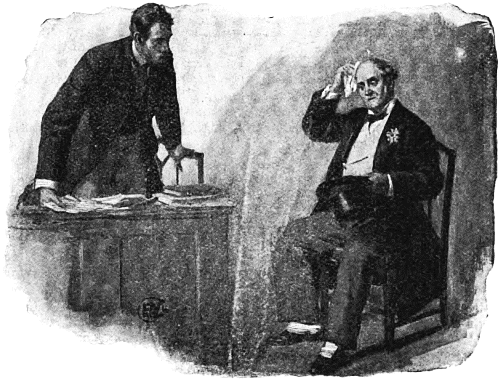
"What!" cried the editor, leaping from his chair.
"'WHAT!' CRIED THE EDITOR, LEAPING FROM HIS CHAIR."
"Now, don't take on, my dear fellow. I did what I could. But she has such ways, and she was so keen on it, and—and she kept worrying, and——"
"It's out of the question," said the editor, with clenched teeth. "Quite absurd."
"I'm afraid it'll have to be. I've given my word, and I can't back out."
Didcott stood frowning and biting his lips. "You must see it is impossible," he said at length.
"I do see that," said the old man, humbly, "but I don't see any way out of it. I've given my word, and I must stick to it. Now, Didcott," he went on, "I beg of you not to be angry. It may not be so very bad. It may be quite good; after all, one never knows."
"Why doesn't she get it published in volume form?"
"The publishers have all declined it."
Didcott groaned. "But if you paid for the cost of production?"
"I offered that. All the good firms decline it even on those terms, and she won't go to a second-rate house. She was so cut up, and—and—hang it, she's my only child."
Didcott rose. "Very well, I'll look through it and see what it is like. We will talk over the matter again."
The old man rose and held out his hand.
"Don't be angry, my boy," he said. "I know it's a great nuisance, but—but very few people read serial stories. I daresay it will pass unnoticed. Good-bye."
"Good-bye," repeated the editor, mechanically. When Mr. Winder had gone, he took up a knife and cut the string of the bulky package. Taking out the manuscript, he began to read.
Half an hour later, he stumbled down the office stairs with the face of a demon and lips that moved without speaking. The office boy trembled as he passed.
II.
For a week the manuscript, roughly wrapped up in its original covering of brown paper, lay undisturbed on the editor's table. Sometimes his eyes dwelt on it with concentrated hatred, but he never touched it. He went on with his work as if it did not exist, but he was never unconscious of its presence.
At last he told himself that he had come to a decision. He would exhaust every method to prevent its publication in the Didactic Weekly. If necessary, he would appeal personally to Miss Winder—on his knees, if that would help matters. If all was in vain, he would resign.
Resign! The very thought gave him indescribable pangs.
"It hasn't come to that yet," he said. "I must exhaust all possibilities first." He shook his fist at the manuscript novel. "I wish it were at the bottom of the sea."
A day or two later he received a note from Mr. Winder, inviting him to dine the following evening. "I have told my daughter," the letter ran, "that you have been reading her novel, and she is most anxious to know your opinion. She wonders whether you would mind bringing the MS., so that she may go through it with you, with a view, no doubt, of pointing out certain beauties you may have missed."
"This is my opportunity," said Didcott, grimly, "and I will take advantage of it."
The next day he presented himself at the house, with the manuscript under his arm. Leaving it in the care of a servant, he was shown into the drawing-room. Mr. Winder came forward hastily as he entered.
"'I DON'T THINK YOU HAVE MET MY DAUGHTER—ELSIE.'"
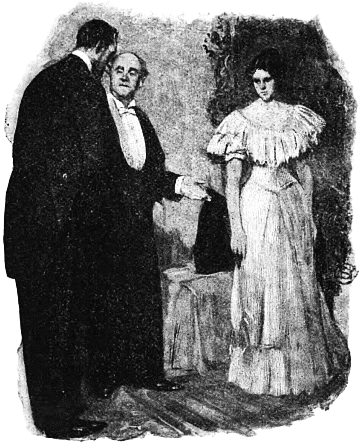
"My dear fellow," he said, rather nervously, "how good of you to come at such short notice. I don't think you have met my daughter. Elsie, this is Mr. Didcott."
Didcott bowed. He glanced at the girl before him.
"No, we haven't met before," he answered, and took the hand she proffered.
"I have often heard of you," said Miss Winder. She was a pretty girl, fresh as a flower, and frank and ready in her manner. "Father is always talking of you. I daresay you've heard of me."
"Oh, yes," replied Didcott, a abruptly; "I've heard of you."
"I think dinner is ready," interposed Mr. Winder, hastily. He moved to the door, and the pair followed him.
"You're not quite what I expected," observed Miss Winder, frankly, as they made their way downstairs. "I thought you would be older."
"I am sorry."
"I am so glad you liked my book."
Didcott was taken aback.
"Who told you that?" he asked, endeavouring to impart an air of archness to the query.
"Father said so. I was so pleased." Something in Didcott's manner struck her, for she asked a little sharply, "You do like it, don't you?"
Didcott blinked.
"I have never read anything like it before," he answered.
"It is original," she admitted. "And isn't the hero lovely?"
"The hero?"
"Yes, Rupert Vavasour. 'Tall and pale, with eyes that flash.'"
"Oh, ah! Yes, indeed, he is lovely. He falls in love with—er—the heroine."
"Not at first. Afterwards. When they meet upon the lake. Isn't that a beautiful scene? I wept like anything when I wrote it."
"I felt the same way when I read it," Didcott murmured.
"Did you really?" cried Miss Winder, delightedly. "How charming of you. Father, Mr. Didcott likes my book tremendously."
The old man beamed with pleasure.
"Really, my boy?—not really?" he asked.
Didcott struggled to free himself from his embarrassment.
"I——" he began.
"I don't think, papa, that you should suggest Mr. Didcott is not sincere," said Miss Winder, with dignity. "I have a better opinion of him than that." She smiled with great sweetness on the young man. "You do really like it, don't you, Mr. Didcott?"
"Of course I like it," replied the unhappy young man.
What else could he say?
Throughout dinner nothing was talked of save the merits of the novel. Before long Didcott found he had committed himself to the opinion that it rivalled George Eliot at her best.
"I never did see much in George Eliot," remarked the fair authoress, modestly. "If you had said Marie Corelli——"
And of course the young man said Marie Corelli. He would have said Shakespeare before the dinner was over. Given a charming profile, an excellent dinner, and '84 champagne, what else could have been expected?
When the young lady returned to the drawing-room, leaving the two men to their cigars, Mr. Winder leant over to him confidentially. "Do you really think," he asked, almost wistfully, "that my little girl's book is as good as you say?"
Didcott did not meet his eye. He puffed out a volume of smoke as if he would have hidden himself in its cloud.
The old man sighed.
"You did it out of kindness, Didcott, my boy. It was good of you."
The young man felt his conscience prick him. He had not acted from kindness, but from weakness. The sad look on the father's face touched him.
"Mr. Winder," he said, acting on a sudden impulse, "the book is excellent."
Very soon they joined Miss Winder. The rest of the evening was spent by the authoress in reading aloud extracts from her immortal work. But Didcott did not listen; he found sufficient occupation in watching the varying expressions on the girl's face.
"HE SPRANG ON THE STEP AND DRAGGED FORTH THE PACKAGE."
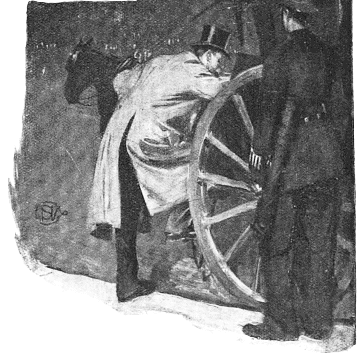
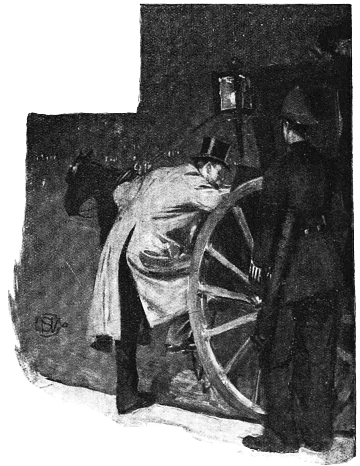
"HE SPRANG ON THE STEP AND DRAGGED FORTH THE PACKAGE."
At a late hour he rose reluctantly to go. When the front door closed on him, and he had climbed into a cab, the manuscript on the seat beside him, he realised suddenly how hopeless his case had become. How could he make a stand against the publication of the novel without exposing himself to the scorn of the young lady, and writing himself down an arrant hypocrite in her eyes and in the eyes of the father? He had committed himself beyond redemption.
Suddenly a thought struck him. Suppose the MS. was lost! Suppose he left it in the cab! He remembered there was no name on the parcel. At the impulse of the moment, without stopping to consider the futility of the project, or the objection to it on a moral score, he shouted to the cab to stop, and almost before it had come to a stand he was in the road. Just opposite were the Houses of Parliament. Thrusting some silver into the man's hand, he set off at a rapid pace across Westminster Bridge. There were few passers-by, and after a minute or two of rapid walking he broke into a run. The stony stare of a solitary policeman caused him to adopt a meditative saunter.
As he walked on, he looked out for another cab. At length he heard wheels behind him and turned joyfully. Alas! it was the cab he had just relinquished.
"Hi, sir!" shouted the man, "You've left a parcel be'ind you."
For a moment Didcott stood paralysed. "No, I didn't," he said, at length.
"What!" said the cabman.
"It isn't mine," said Didcott, faintly.
"Why," said the cabman, astonished, "I saw the blooming servant hand it in to you."
Didcott shook his head. "I don't know anything about it," he replied.
The policeman who had witnessed his haste had approached, and stood a silent spectator.
"You'd better take it to Scotland Yard," he observed at this point.
"Why, I knows it's 'is," said the cabman, aggrievedly.
"The gen'lman says it ain't," responded the policeman, judicially.
"Rats!" returned the cabman, plethorically.
Didcott stood miserably silent; he had got beyond his depth, and the conviction that his behaviour was asinine was growing more acute.
"I'll take it to the Yard," said the cabman, disgustedly, "and then I'll call at the 'ouse I picked 'im up at, and tell them."
"Oh, my goodness!" ejaculated Didcott, overwhelmed at the thought. The cabman and the policeman bent frowning brows on him.
"Beg pardon, sir," said the policeman, politely.
Didcott laughed in a strained and unnatural manner. "Ha, ha! So stupid of me! I had forgotten. It does belong to me."
The eyebrows of the other two ascended to the altitudes.
"I'll get it," said Didcott, blithely.
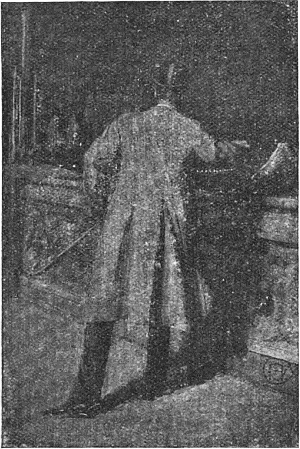
"HE FLUNG THE PARCEL CONTAINING THE MS. OVER WESTMINSTER BRIDGE."
He sprang on to the step, and dragged forth the package. "So much obliged to you. Thank you very much." He tucked the parcel under his arm. "Good-bye."
He turned and hastened along the bridge southwards, leaving the policeman and the cabman regarding him with doubtful eyes. He crossed the bridge, and wandered about in the streets on the Surrey side for nearly an hour before he ventured to retrace his steps.
As he walked back over the bridge, he felt the parcel heavy in his hands. Could he not get rid of it for good and all? Why not drop it over the bridge? No one was in sight. He leant over and looked at the dark waters. Everything was quiet. In an instant, making up his mind, he flung the parcel into the silent river. He heard the splash that followed, and with the sound came an overwhelming sense of guilt.
He turned and hastened homewards, but he had gone only a few yards when, to his consternation, the same policeman confronted him.
"I've been watching you," said the constable.
"Have you?" replied Didcott, vaguely.
"What's that you've thrown into the water?"
"Nothing," said Didcott, finding speech with difficulty.
"Where's that there parcel the cabman gave you?"
Didcott faltered, and then there came a conviction that at any cost he must brazen the matter out.
"I don't know what you mean," he answered, feeling his legs quivering under him.
There was a look of supreme disdain on the policeman's face.
"You'll have to come along of me," he said, briefly.
Didcott shrank back. "With you? Why?"
HE CANNONED INTO A POLICEMAN AND TOPPLED HIM OVER, BUT CONTINUED HIS HEADLONG FLIGHT.


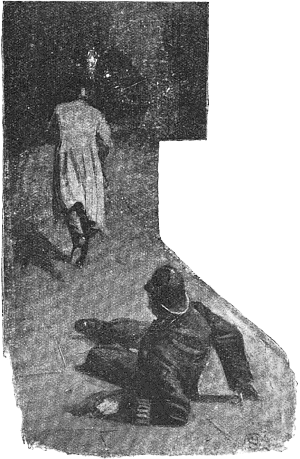
"HE CANNONED INTO A POLICEMAN AND TOPPLED HIM OVER, BUT CONTINUED HIS HEADLONG FLIGHT."
The policeman nodded. "That's all right. Never you mind what for."
"I haven't done anything wrong," cried Didcott, piteously. At no time a man of strong nerve, at this crisis he utterly and entirely lost his head.
"That there brown parcel——" began the policeman, argumentatively.
"I don't know anything about it," cried Didcott. "You're mistaking me for someone else. And—and it was only old clothes and things I didn't want."
"You had better explain that to the inspector," said the policeman, unmoved. "What I says is, that things look a bit fishy."
"You've no right to make me come with you," cried Didcott, despairingly.
"Come along," said the constable.
Before Didcott's mind rose a vision of police-court proceedings and newspaper paragraphs; but above all, and dwarfing everything, he seemed to see Miss Winder's scornful face. He eyed the constable, noticing that he was stout and unwieldy of build. The bridge lay silent on either side. In a moment Didcott made up his mind. Darting past the policeman, he ran headlong towards Westminster. He ran as he had never run before. The policeman started in pursuit, but gave up the chase as hopeless after a few yards; he stopped, and Didcott heard the blast of his whistle shrilling in his rear.
Like a hunted hare Didcott flashed past the Houses of Parliament, standing in grim and disapproving majesty. To his heated imagination hundreds of policemen seemed to start from the shadows and join in the pursuit. Certainly one made an effort to stop him, but Didcott dodged, and then easily distanced him. Then rushing blindly along, Didcott cannoned into another, with the result that the constable was toppled over, and Didcott, skipping over his prostrate form, continued his headlong flight. He managed to reach Victoria Street, more by luck than by any consciousness of direction, and down its electric-lit length he fled. In the distance he believed he heard the roar of pursuit.
Luckily he met no more policemen, and the few passers by made no effort to impede his progress. He ran straight, in panic-stricken haste.
To his horror, he found he had entered a blind alley. To retrace his steps seemed hopeless. He gave himself up for lost, when he noticed a little gate cut in the double doors of a work yard standing slightly ajar. He dashed through, and lay on the ground panting. He lay, he knew not how long, in a state of semi-consciousness.
At last, when the faint approach of dawn had begun to lighten the sky, he stole forth and, like a hunted thief, glided homewards to his flat.
III.
When Didcott woke the next morning he was at first unable to convince himself that his previous night's experience was not merely a bad dream. Then he was lost in astonishment that he could have behaved so idiotically.
He started for Fleet Street at the usual time, but to his disgust found himself blenching before every policeman. Always impulsive, he darted into a barber's shop, and emerged with a beardless face. After this, he was able to confront the world with eyes that did not shift uneasily.
During the course of the day, he wrote a letter to Miss Winder, telling her he had been unfortunate enough to leave her priceless manuscript in a hansom cab, but that he had no doubt of eventually recovering it.
The immediate effect of his note was to bring Miss Winder pale with consternation to his office.
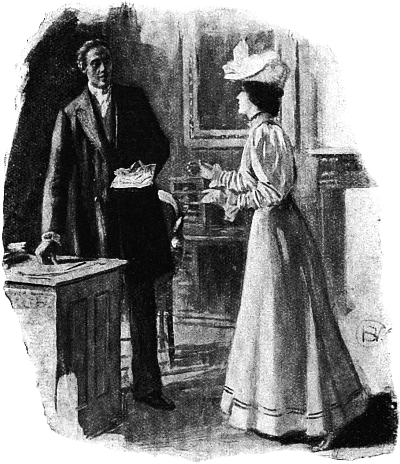
"'OH, MR. DIDCOTT,' SAID MISS WINDER, 'HAVE YOU FOUND MY NOVEL YET?'"
"Oh, Mr. Didcott," she cried, as she entered breathlessly, "have you found it yet?"
"Not yet, Miss Winder. There has been no time."
"How could you have been so—so careless?"
It had not struck him before that his imagined tale left him culpable. In a moment he rent the air with his lamentation.
"Can you ever forgive me my shameful carelessness?" he wound up. "But even if you do, it will matter little, for I can never forgive myself."
She softened at once. "You mustn't blame yourself, Mr. Didcott," she observed, earnestly. "It is an accident that might have happened to anyone."
He took her hand, and pressed it tenderly. "How good you are to me!" he said, brokenly.
She blushed and withdrew her hand hastily, and then felt a little sorry she had done so.
During the following weeks nothing was heard of the unfortunate manuscript. Didcott was always at Mr. Winder's house consulting with the daughter and devising schemes for the recovery of her novel.
Each day brought with it an increase of intimacy. The novel was still the ostensible cause of his visits, but as a subject for conversation it had begun to show a tendency to diminish in value. Something more purely personal commenced to take its place.
One day, about a month after the episode that has been related, Didcott and Miss Winder sat together in the latter's boudoir, chatting confidentially.
"I have been wondering whether I ought to write another book," observed Miss Winder, meditatively.
"I should not if I were you," replied Didcott, with considerable emphasis.
"Why?"
"I don't deny it would be a great book," said Didcott, diplomatically, "but somehow I don't want you to be a literary woman."
Miss Winder smiled a little to herself.
"Why not, Mr. Didcott?" she asked, coyly.
"Oh, I don't know." Then he looked at her. "You were never meant for literary work."
"What!"
"I mean, judging from your appearance," he explained hastily. "Literary ladies are seldom attractive. Their shoulders have an ugly stoop, and they always wear glasses. Oh, no, you mustn't go in for literature."
She smiled tolerantly.
"There is something in what you say—literary women do dress anyhow; but I should like to write just one more book."
He went on hurriedly—
"No sensible man would ever marry a literary woman, however much he cared for her. If a friend of mine was going to marry a lady novelist, I would at once go out and buy him a millstone—yes, and I could fix it for him. It would be an obvious duty."
"Oh, Mr. Didcott!" exclaimed this very young lady, impressed, "are they as bad as all that?"
He nodded darkly.
"But, Mr. Didcott, if a woman has genius——"
He glanced up.
"Take your case, Miss Winder. You have genius. Go on, and you may become a famous novelist. On the other hand, you may marry, and live happily ever afterwards; but you cannot do both."
"I think," Miss Winder observed, ingenuously, "that I shall not write any more."
He pressed her hand.
"Elsie," he began, passionately, "there is something I want to ask you. Oh! Elsie——"
And then the door opened, and the maid came in to say that a man wished to speak to Miss Winder.
"What man—what about?" asked Miss Winder, sharply; for the interruption had come at an inopportune moment.
"About some advertisement, miss."
"Oh, yes, I know. Show him in." She turned to Didcott. "It's about my novel—news at last, evidently."
"News?"
"Yes. I forgot to tell you that I put an advertisement in the Times and the Morning Post. It only appeared this morning, and here is somebody already."
Didcott felt a faintness steal over him. "What did you say in the advertisement?" he asked.
"Oh, I simply said that on such and such a date, and at such and such a time, a parcel was left in a cab, and I asked anyone who knew anything about it to call here."
"I will leave you to interview this man," said Didcott. "I shall only be in the way."
"Oh, no, no," she cried; "it is so lucky you are here."
"THE DOOR OPENED, AND DIDCOTT RECOGNISED THE FORM OF THE POLICEMAN FROM WHOM HE HAD ESCAPED."
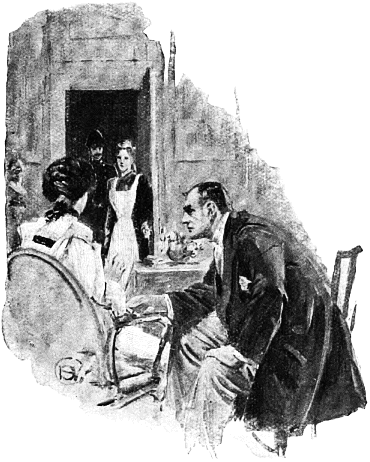
"THE DOOR OPENED, AND DIDCOTT RECOGNISED THE FORM OF THE POLICEMAN FROM WHOM HE HAD ESCAPED."
Just then the door opened, and with a sinking heart Didcott recognised the short stout form of the policeman from whom he had escaped. He shrank back in his seat and uttered a fervent prayer for non-recognition.
"I saw your advertisement, miss," began the policeman, "and I thought as how I might give you some information."
"Thank you," replied Miss Winder. "And do you really think you know where the parcel is?"
The policeman pursed his lips. "I know where a parcel is. But p'raps it ain't the same."
"Oh, it must be the same. Have you got it with you?"
"Did the parcel contain valuables?"
"No—yes. Yes, very valuable contents."
"I thought so," said the policeman.
"Where is it?" repeated Miss Winder, impatiently.
The policeman shook his head. "It was like this, miss," he went on. "I was on Westminster Bridge one night, and I sees a gentleman running very quick and nervous like."
"A gentleman?" queried Miss Winder.
"In evening dress. Quite the toff. So I turns and follows him."
"Did he have the parcel?"
"No, miss. Suddenly a cab drives along the bridge, and the cabman hollers out to the gentleman as how he has left a parcel in the cab. The gen'leman was took aback, and said as how it wasn't his. So the cabman said he'd drive round to where he had picked up his fare and inquire——"
"Yes," said the girl.
"At that the gentleman turns quite white, and says it is his parcel. He hops into the cab, picks up the parcel, and is off before you could say 'Jack Robinson.'"
"You shouldn't have let this strange man take my parcel," said Miss Winder, excitedly.
"I didn't know as how it was yours," said the policeman, "but being suspicious like, I hangs about the bridge, and presently I sees the gen'leman come creeping back, and then he chucks the parcel over the bridge."
"Oh, oh!" cried the girl. "Into the water? "
"Yes, 'm."
"Who was this man? Mr. Didcott, who could this man have been?"
"I don't know," muttered Didcott, painfully conscious that the policeman's heavy eyes were on his face. "Probably it was a different parcel altogether."
"What was the man like," demanded Miss Winder.
"Beg pardon, lady, but he was very much like this here gentleman."
"What!" cried Miss Winder.
"Don't listen to such rubbish," exclaimed Didcott, rising. "Constable, how dare you talk such nonsense?" He stood trembling, with beads of perspiration starting on his forehead.
"The gen'leman had a beard," observed the policeman, impartially.
"You had a beard then, don't you remember?" said Miss Winder, mystified. "How very strange!"
"I am quite sure now as how it was this gen'leman," remarked the constable, imperturbably.
The girl turned on Didcott. Thought after thought chased each other in succession through her brain.
"Did you throw my story into the water?" she asked, in a low voice.
"Yes," said Didcott, and felt relieved. For the first time he dared to meet the policeman's gaze. "Send this man away, and I'll tell you the whole thing." He felt in his waistcoat pocket and drew out a sovereign. "Here, take this and get out."
The policeman took the coin, and stood doubtfully with it between his finger and thumb.
"Yes, please go," said Miss Winder, faintly.
"Shall I wait outside, mum?"
"Confound you, no," shouted Didcott. "Go right away."
"Right away," echoed Miss Winder.
The constable turned and left the room, not dissatisfied with the results of his interview. When the door had closed on him, Didcott turned to Miss Winder.
"What will you think of me? What can you think of me? Of course you will never speak to me again."
"I—I don't understand. Why ever did you throw my story into the water?"
Didcott groaned. "I would to heaven I had thrown myself. How I could have done so monstrous a thing, I can't understand."
"But why? You must have had some kind of reason," persisted the young lady.
"Your father insisted that it should be published in the Didactic Weekly, and it seemed the only way to get rid of it," blurted out Didcott.
Miss Winder drew back a pace. "But you liked it. You said it reminded you of George Eliot at her best. You said it was a work of genius."
"It wasn't!" replied Didcott, briefly.
"What!" cried Miss Winder, her voice raised an octave.
"It was pure drivel," said Didcott, firmly.
Miss Winder sat down suddenly, and began to cry.
Didcott struck his forehead. "I am a brute!" he cried. "I am still a brute." He went on his knees and implored her to smile.
"You pretended you liked it," sobbed the girl.
"I know I did. I was a hypocrite; and now I am being punished."
"You have been laughing at me, all this time," said Miss Winder, wiping her eyes, and becoming dignified.
"No, no. Understand how I was situated. I have worked for years for the Didactic Weekly. My life's work is in it. I have struggled for it and brought it to success; it is part of my life. And then I was told I must publish your story. It would have made me the laughing stock of the journalistic world. It would have damaged if not ruined my paper. I couldn't bear it. I——"
"You might have told me this," said Miss Winder, proudly. "I should have accepted your opinion. I have sense enough not to insist on publishing what is not fit for publication. Why could you not have treated me like a reasonable being?"
"I wanted to," said Didcott, still on his knees. "I came here to do so, but couldn't. I didn't like to disappoint you. I hadn't the heart."
"It was your duty to do so."
"'GET UP, MR. DIDCOTT,' SHE SAID, 'YOU DO LOOK RIDICULOUS ON THE CARPET.'"
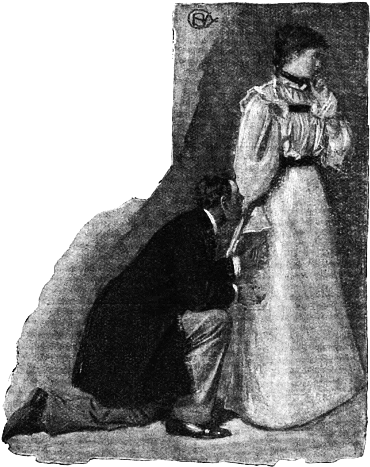
"'GET UP, MR. DIDCOTT,' SHE SAID, 'YOU DO LOOK RIDICULOUS ON THE CARPET.'"
"Ah, I am only a man, and you are a beautiful woman. I was weak."
"Oh," said the lady, and pondered. A pause intervened. "Get up, Mr. Didcott," she said at length. "You do look rather ridiculous on the carpet."
Didcott rose. "I will go away, and you need never see me again. I will resign my editorship at once." He moved towards the door.
"Oh, no," she cried.
He turned.
She came towards him. "Don't you see, Mr. Didcott," she said, a little petulantly, "I don't want to be made ridiculous. I have been conceited and foolish, believing I was a great authoress, when really I have been writing nonsense. I don't want it to get about."
"I will tell no one," he said, earnestly.
"Yes, but——" She was silent a moment. "What I want is that we should mutually agree to forget the whole of this stupid business."
"It is a bargain," he answered, eagerly. "We will slam the door on the past."
She looked away. "Not on all the past," she murmured, "only the past that is concerned with my novel."
"Shall we take up our history from the point where it intervened to-day?" he queried.
She made no sign, save that the flush on her cheek deepened.