Volume 1 — DAPHNE. A Complete Story by Walter E. Grogan.
Reading edition
Illustrated by Harold Copping.
When a man has looked at death out in Nevada, has rioted in a brawling mining camp, and has lived for years where the constraint of civilisation is considerably relaxed, he may outwardly conform to the decorum of an English village, but underneath you may be certain he is as lawless as ever.
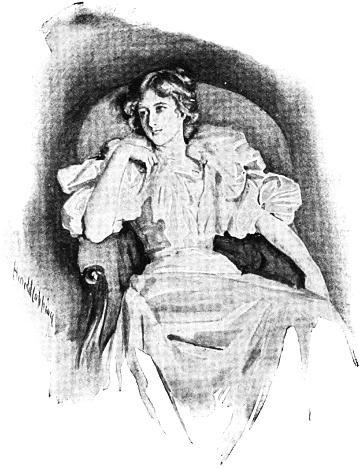
"DAPHNE BLAKISTON WAS PRETTY."
Gustave Derwent locked up the memories of the days when he was known as "Wild Gus," banished the recollection of the rough life he had spent, and brought to Grorepound, on the confines of Dartmoor, only the knowledge of his great wealth; but at heart the master of Grorespound Hall was "Wild Gus" still.
County society received him rapturously. He was very wealthy, and happily of a good family. The Derwents of Gloucestershire were quite in the very best set. It is true that younger sons had little besides the old name, and it was therefore sometimes inconvenient to know them; but Gustave had made quite a fortune in mining, and the name made it easy for him to step into the set which had been his in past days.
His connections were anxious that his subscriptions to the hunt and other county institutions, and also his entertainments generally, might be taken as part payment of their own debts to society. There was little doubt that Derwent understood this, and therefore chose Devon.
Grorepound had little to recommend it. Those who called upon him were few, because there were very few to call; the village was merely rural.
"I have been hunted—it's much more exciting than chasing foxes; and as for shooting, there isn't much sport in butchering tame pheasants," he said to the Squire, standing squarely against his mantelpiece.
The Squire remonstrated.
"It's all very well for me, Derwent. I know every inch of the place and every fool living within twenty miles. I was born here. I fit it and it fits me. I was at sea at Oxford, and when I came down I was glad. My father mortgaged most of the land, I've done the rest. I'm not rich. I'm growing poorer every day. Land isn't what it was. But I love the place. There's a whole army of Blakistons in the church, and please God I shall add to their number. I am someone here—I'm nobody away. I like to potter after the hounds on a half-bred. I like to catch my trout. I have old friends here, and can talk to them of old times. But you? Why, bless me, Derwent, you are rich, not bad looking, and young. What do you want to bury yourself here for? It's no life for you. It isn't as though you were married even."
At all of which Derwent smiled. He smiled habitually. It was not a pleasant smile, for in it lurked a suspicion of irony.
"Blakiston, no man can understand another. This place suits me. It's quiet, and I want quiet. I have had my fill of excitement out West. I am young—but forty does not mean a boy."
"Forty! pooh! what's forty?" cried the Squire. He was well over sixty, and looked upon the vault in the church of which he was fond of speaking as a possibility very hazy from its remoteness.
"Forty, my friend, is middle age. I am not married, and am not anxious for a wife. A wife seems to me a risky bargain; because you are lucky, that is no reason why I should be."
The Squire shifted his hands from his knees and shuffled his feet. He did not regard his wife as absolutely essential to his happiness.
"Of course, of course," he said, testily. "Mary is an excellent woman, a really excellent woman."
"Yes, but it was a lottery. She might not have been excellent, Blakiston; she might have been bad-tempered, she might have attempted to rule you."
The Squire looked at him with a gleam of suspicion. His wife Mary was bad-tempered and did rule him, and that in an unpleasantly harsh way. Derwent smiled still, and the Squire merely reached for his glass of whisky and water and hoped that his host was unconsciously ironical.
"Then you won't marry?" he asked.
"I don't say that," Derwent answered. At moments in his life he had thought that love might be the beautiful thing of which men raved. Those moments were rare, for the making of money is an occupation which gives little leisure.
"No, I don't say that," he went on. "But I am in no hurry."
"Got my niece coming to-morrow, Derwent," the Squire growled, after a period of silence. "She has no nearer relations, worse luck! Been with a girl friend for a year—father was killed in India, mother died when she was a baby. So she comes to us."
"It is fortunate for her that she has so excellent a home open to her."
"Yes," the Squire answered, lamely. He was not sure whether Derwent did not see under the surface. He was conscious of his wife's outcry about the new expense and the new inconvenience.
A few days later Derwent saw the niece and fell in love with her with all the fierceness of his nature.
She was pretty, but a critical observer would have ended at that qualification. The question was whether anyone could be critical in her presence and under the spell of her eyes.
Her hair was of that shade of brown which has kindred with the sun, but is dusky in the shade. Her nose was small and not very straight, her mouth was small, and her chin set forward with a determined tilt; but her eyes were her glory—large, brown, trusting, and yet unfathomable. Derwent, seeing them, thought of stars in a midnight sky, the stars out West, which had spoken to him in those rare moments when he had respite from dollar making.
Daphne Blakiston was high-spirited. In two or three days she conquered both the Squire and his wife, who were surprised to find themselves in accord in liking anyone.
There was a breeziness in her manner which carried them away in spite of themselves.
"She is a thorough Blakiston," the Squire said.
"She might have been a Courtenay to hear her speak," said his wife.
They set much store by family in Devon.
Derwent found her so pleasant that he went exploring the gardens with her. They had never seemed so worthy of notice before.
"You like this place?" he asked her.
"Of course—it's lovely. You can breathe here. Did you ever try to breathe in London? You can't really—you only cough."
"I have had room to breathe in my life."
"You come from the West. It must be grand to be in the forefront of civilisation—to get away from the restrictions of society."
"One gets away from all restrictions," he answered, slowly, "but I do not know that it is grand."
"But you live out there; you work for your living, and you work hard."
"Yes."
"It must be glorious! I wish I could go there."
"God forbid!" he cried.
"Why? I have grit—that's what you call it, isn't it?"
He smiled. "I don't doubt it, Miss Blakiston; but you have also a conscience. A conscience is inconvenient without settled laws to back it up."
"But right is right everywhere," she expostulated.
"Right there is in the possession of a good revolver and a quick eye."
"You have had a wild life," she murmured, looking at him with some curiosity and a little awe.
"Wild enough; and I sometimes wonder whether the wildness is all out yet. Who says habit is second nature? There is a great deal of truth in it. They may put me into English dress and place a riding-whip in my hand in exchange for a pick or a revolver, but if anything I really wanted was to come into my life and there was any obstacle—" He broke off and looked hardly through the hedge, seeing something that was not there. His hands clenched themselves, and his face becoming set made him look more than his forty years.
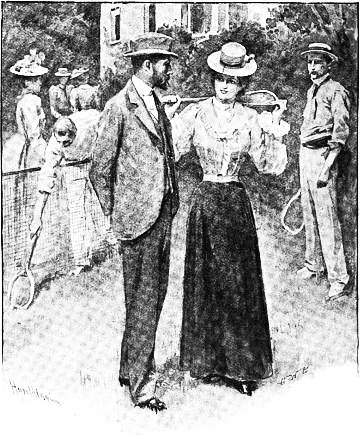
"'COME,' HE SAID, 'I WISH TO SPEAK TO YOU. I CAN'T TALK IN THIS CROWD OF FOOLS.'"
She watched him with a new interest.
"Well?"
"I think it would go hard with the obstacle."
Daphne was about to continue her investigation when she caught sight of a straw hat over the hedge which bordered the meadow from the road.
"There's Jack!" she cried. "I know there is only one straw hat so dilapidated in the world!"
He looked at her narrowly.
"Who's Jack?" he demanded.
"Jack's—well, Jack. He is the son of the rector. I knew him in London. He's on long leave. Jack!" she called.
Jack found a gap in the hedge—the Squire's hedges had many gaps—and came towards them. Derwent saw that he was good-looking, tall, young, and carried himself with the easy air of a military man. He hated him. It was a new experience; he had never hated men before—he had only disliked them.
"Ah, Daphne!" cried Jack; "I hardly hoped to see you."
"This is Mr. Derwent—Mr. De Courcy. I knew you were coming down yesterday. Your father told me." She poured out her words in excited gasps. To Derwent it seemed that she ignored him, and he did not like it.
"You are in the army?" he asked curtly of the young man named Jack.
"Yes, the 10th Lancers. I was too much of a muff for anything else. I can ride a bit, I am fairly well made," he looked down at his length of limb complacently, "and—and I don't think I should funk."
"No man knows until he has been tried."
"I suppose so."
The two left Derwent somewhat unceremoniously. From that he gathered that Daphne merely looked upon him as her uncle's friend. No man likes to awake suddenly and find that he has become middle-aged. He may be fond of joking about it, but that is because he believes he is far from its border. When the knowledge comes to him suddenly, and, above all, through a woman who has found favour in his eyes, it is bitter.
Derwent watched them go, cursing the young soldier.
"An insolent puppy—a mere boy!" he said. "It is dishonourable for him to be making love to her. He is a pauper!"
De Courcy hardly noticed Derwent beyond a vague wonder at his churlishness.
"Rum beggar, Daphne," he said. "I suppose living so long in a savage place has made him grumpy. Beastly rich, isn't he?"
"Yes. Made it all himself. Nevada must be a glorious place!"
"What a mercenary being you are, Daphne!" he laughed. "I prefer Canterbury, or Grorepound, even. I suppose I shall be jealous of him."
"Mr. Derwent? Why, he is an old man."
"He seems over forty—not old, you know; and he has dollars, which mean diamonds."
He smiled throughout, because it seemed manifestly impossible that any woman should prefer anyone to himself. Jack De Courcy was well satisfied with the work of Nature in fashioning himself.
"Oh, Jack!" she protested.
"And I am a pauper," he went on.
He certainly was a pauper in comparison with Derwent; but, poverty being only comparative, he was a rich man to many. His mother's private fortune—some four hundred a year—was added to the pay which a grateful country gave him for his exertions on parade.
Derwent lived for a week in the agony of jealousy. He had never cared for anyone very much in all his previous life. He had indeed been aware of an innate capacity for affection, but the business of making money had left him no leisure.
One day he came to a decision.
"You are a fool," he said, apostrophising himself. "You are a fool. Go and ask her whether she can care for you. You don't know yet for certain; you only imagine. The soldier is a boy. Women—young women—don't care for boys. Besides, he is poor, and women like jewels."
The same afternoon he sought her out from a number of guests playing tennis on the Squire's lawn. She was flushed with victory, having, mainly by the aid of Jack's long legs and skill, succeeded in vanquishing the antagonistic couple in a hard fight. Derwent hated tennis, because he did not play it and Jack did. Tennis is not much practised in mining camps; they prefer shooting.
"Come," he said, very quietly, yet in the tone of one who is set upon a purpose. "I wish to speak to you. I can't talk in this crowd of fools. I have not yet got the hang of it."
She looked at him and laughed.
"What a dear old grumbler you are!" she cried. She really liked him—it is possible that there was something to like in him, and that if matters had run easily he would have been a pleasant member of society. A man after all is largely shaped by his surroundings.
He did not answer her, at which she was surprised, for his general taciturnity had usually disappeared at her bidding.
"You are bad-tempered," she said. "Don't be bad-tempered. The sun is just lovely and I shall be freckled. I hate being freckled, but the process is alluring. And I have news." She added the last softly to herself, expecting him to question her. He did not. He led her to a seat in the shade of a tree and stood behind her looking down on her wide straw hat.
"I am not young," he began; "I have nearly reached forty——"
"I thought you were more," she interrupted, and his brows contracted.
"I have lived hardly. I have done many things which I wish to forget, and which I cannot. I have made money where to make money needs grit and—and a conscience not too tender."
"Are you going to write an autobiography?" she asked. She had no idea of the seriousness of his mood, for all of his moods struck her as more or less serious.
"I am stating broadly the manner of man I am. I don't want to appear a saint. I would rather you did not know how I lived when I was heaping dollars. My past life belongs to the past. I have now another life before me. It may be happier than the drag of years behind."
"It ought to be—you are rich."
"It depends upon you."
She tilted her hat upwards, but the brim was wide and she could not see him.
"On me?"
"Yes. I love you. I have loved you since I first saw you. I have never loved another woman—I never shall. Can you find it in your heart to make my new life happy?"
"Mr. Derwent," she answered, "I had no idea that you cared. I—I like you very much—as a friend. But now—I told you I had news to-day—news which has made me happy—tuned me to the day, which is happy. Jack has asked me to be his wife, and I have accepted him."
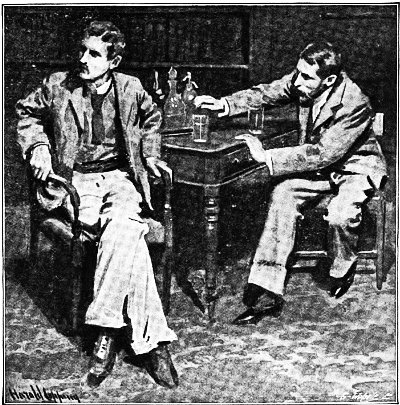
"HE POURED THE CONTENTS OF THE PHIAL INTO HIS COMPANION'S TUMBLER."
Derwent paled a little under his bronze, and his face darkened.
"If—if Mr. De Courcy had not come into your life——" he began.
"That is an idle thought."
"Yes, it is idle—but I thought—it would—if he had not come?"
"Who knows—I cannot realise a life without him." Then she added other words. "I like you, Mr. Derwent, and—and I am very sorry."
He let her find her way back to the guests alone.
In the blindness of his jealousy he construed her words into an admittance that she would have married him if it had not been for De Courcy. They allowed no such interpretation, but jealousy is not shrewd-sighted, and more often than not blunders.
They had not named him "Wild Gus," singling him out from among other wild natures for the epithet, for nothing. All the passions which had been restrained since his advent into society surged upwards and confirmed him in a resolve. With the intention of carrying out that resolve he returned to the tennis lawn.
Daphne, who, in spite of her flippant tongue, was possessed of a very tender heart, was glad to see him, glad to notice the easy way in which he passed from guest to guest talking of quiet matters with that earnestness which had made him popular.
She had been troubled lest he had been too keenly disappointed. She argued that if he cared much he could not hide his hurt so readily. She lacked experience.
Derwent sought out De Courcy and congratulated him with a seeming frankness that completely dispelled the young officer's aversion. Daphne was standing quite close to them, and at the elder man's words was glad.
"I do not pretend," he said, easily, "that we are not all envious, De Courcy. You have gained a very great prize, and we should all be more than human if we were not. But Miss Blakiston's happiness——" His voice faded into an inarticulate murmur.
After dinner he told many stories to De Courcy, strong stories of a man's life in wild lands, and De Courcy told himself that the Derwent fellow was a very decent chap, and that he had underrated him vastly.
"There was little restraint in those early days in Nevada. A man's friendship was true, and his hatred deadly. Vengeance was swift-footed, and I have seen a man anger another and be laid out cold under the blue sky in the very same day."
"Savage, Derwent, savage!" cried the Squire. "I'm glad that we have laws and constables and magistrates here."
"We are all savage underneath."
De Courcy looked at him and laughed.
"I am glad, Derwent, that I am not likely to rile you. I should say you would be apt to lapse into those primitive customs."
"De Courcy," the Squire said, "your father has gone away for the night, hasn't he?"
"Yes. He's Rural Dean, you know, and has driven over to an outlying parish. The rector is putting him up."
"Then you had better stop the night here. It will be lonely for you."
"Thanks, no. The governor would not care for the house to be left to itself. You know, Derwent," he went on, "the governor is awfully faddy, and will let no servant sleep in the Rectory but the housekeeper, and she went two days ago to a dying daughter. Daughter isn't dead yet, so I shall be entirely alone."
Derwent expressed surprise, yet he had been fully aware of this. It was indeed current gossip in the village. The whims of the rector made a good deal of conversation in the course of a year.
At ten o'clock Derwent and De Courcy started together. Both walked, for the night was fine, though a strong wind came over the moor.
"Dear old moor!" De Courcy said. "It blows us strength in the hottest of weather."
"The wind is strong—it will increase." Derwent remarked this with satisfaction.
The Rectory, standing alone, was some little way from the village. It was thatched, and there was much trellis-work over its face, dry and warped with many days' suns. When they reached it Derwent was in the middle of some exciting reminiscence.
"Come in," cried De Courcy, "come in. There's whisky and seltzer, or soda, if you prefer it. You can have a pipe and finish your yarn. It is quite early."
"Not for Grorepound," remonstrated Derwent. The lights in the village were going out one after another like the sparks of an exploded firework.
"But for us? I can't sleep without a pipe, and I expect you are the same. Let us have our pipes in a sociable way instead of in silent communion. Come."
Derwent went in with De Courcy, passing through the hall into the library. The library window looked on to the lawn by the side of the trellised porch.
As they entered the wind rattled the windows gustily.
"You will not find the wind so strong at the back," said Derwent.
"But I sleep in the front," explained De Courcy. "My room is the one over this."
Derwent looked at the porch and smiled.
"Then," he said, "you will probably get little sleep to-night."
"Nonsense! I am used to noises. The stables are very near my quarters at Canterbury, and the horses kick up a fearful row. Seltzer or soda?"
"Soda, thanks."
Derwent watched the other mix the drinks with a curious fascination. When the tumblers were filled he turned to a portrait at the back of De Courcy and over the sideboard.
"Is that your mother?" he asked.
The officer turned with a smile and looked for a moment at the face smiling back at him. During that moment the elder man drew a small phial from his waistcoat pocket, and poured its contents swiftly and silently into the tumbler nearest his companion. It was a preparation of opium which he used for insomnia, and invariably carried with him; a small dose for one accustomed to the drug as he was, but one large enough to ensure a very heavy sleep in anyone not habituated to it.
"Yes," said De Courcy, in a soft voice, "my mother. She died four years ago. If there be any good about me I owe it to her. God never gave man a better mother."
"Ah, I cannot remember my mother. She died when I was quite a youngster."
He leant his head on his hand, shading it from the lamp. For a moment neither man spoke, and then Derwent reached out his hand and took the tumbler nearest to him, not the one into which he had poured the opium.
"Come, De Courcy, we must drink to your bride. Miss Blakiston!" he cried.
"Daphne, God bless her!" answered De Courcy.
Derwent watched him stealthily while he drank, smiling when he set down the empty tumbler.
They remained together smoking for a quarter of an hour, Derwent finishing the story which had been the means of his coming in. De Courcy seemed to lose interest in it, and at its close, after yawning once or twice, laughed.
"I am awfully sorry, but I've grown uncommonly sleepy. The effect of the moor air, I expect," he said.
Derwent rose.
"My dear fellow, don't let me keep you up. I suffer from insomnia so much that I would not willingly rob a man of a minute's sleep. Good-night, and thanks. I can find my way out."
De Courcy protested, but Derwent was determined, and stumbled out into the darkness. For a short while he examined the porch.
"It is dry enough," he muttered. "In half an hour he will be fast asleep. Nothing will wake him—nothing shall wake him! How the wind blows! It blew like this when I shot Black Dan by the Dumper's Claim. Why do I think of that now? I must get back at once—there is little time to be lost."
He strode in the direction of his own house. The butler only was awake.
"I am very tired, John. I shall go to my room now. Lock up."
"Very good, sir."
"I shall be late in the morning. I have suffered from insomnia very badly the last few nights, but now I know I shall sleep. Don't wake me. Let me have my sleep out."
"Very good, sir."
Derwent went up to his room, undressed quickly, jumped into bed, and lay there until he heard the butler pass along the corridor. Then he rose and dressed hastily.
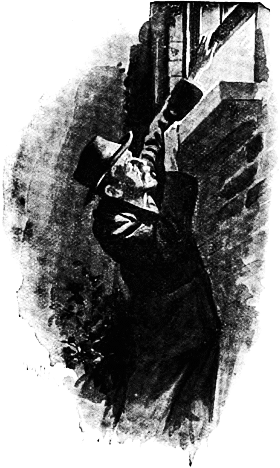
"CLINGING TO THE LEDGE OF THE WINDOW-SILL, HE CLOSED THE WINDOW AFTER HIM."
"They will be able to swear that I was home, and that my bed was slept in," he said. He dressed in a rough, negligent style, unlike the extreme order which he had observed since his return to England.
He opened the window and looked out. The wind rushed in and blew down the heavy looking-glass, cracking it across.
"That," he said, "is unlucky. Some men would turn back at the omen. I never was one to believe in omens. I never was a man to turn back."
A pipe ran close to his window. By it the way to the ground was easy. Outside, clinging to the ledge of the window-sill with one hand, he closed the window after him. Then he slid down the pipe, and walked rapidly to the Rectory.
He approached it from the rear. The wind was in his face. It was so violent that he kept his head down, and his eyes fixed upon a few yards of the way before him.
What was that? Surely the night had grown lighter? Was the dawn breaking? That was impossible—it was little after midnight. But the hedges were plainly seen now, and before they had been blurred into the general blackness. The road was lighter. There was no doubt of it.
Derwent stopped, and, holding his hat, looked up. In front of him the sky was lurid, and over the roof of the Rectory close to hand were long thin tongues of flame and showers of sparks. There was no doubt about it. The thing he had come to do was already accomplished: the Rectory was in flames, and the fire had started from the very quarter he had planned. The wind was fanning it fiercely, as he had seen that it would.
For a moment he was dazed, standing in the middle of the road, staring at the spurting light dancing behind the Rectory, the house looking black against the illumination beyond. Then he ran, struggling against the wind, towards the fire. The reason of his going he did not stop to analyse. He was impelled. The wind whirled his hat away, but he did not notice it. In two minutes he was standing breathless in front of the Rectory. The flames were licking round De Courcy's bedroom window. He saw at once the cause of it. The lamp had overturned in the library. Probably the wind had burst in the window and blown the lamp over.
For a minute he stood gazing at the scene, and then he was conscious of the arrival of Blakiston and his niece.
"Derwent!" the Squire shouted, "where is De Courcy?"
Derwent turned to him. The question seemed a repetition of the older one, "Where is thy brother?" He looked at the Squire and at Daphne clinging to her uncle's arm, white and terrified.
"He must be in his room," he said. "I left him over an hour ago. He was going up then."
The flames leapt in a rush of demoniac exultation, and Daphne cowered.
"Mr. Derwent, can't you do something, can't you do something?" she cried.
He did not answer her. He was busy with his own thoughts. He began to realise that he loved her more than he had supposed men ever loved. It seemed pitiful that she should suffer thus.
"Daphne saw the light from her room and hastened me over," said the Squire, hurriedly, yet in that whispering awe which comes upon men in view of a tragedy.
"He must be in his room," Derwent said, looking at the broad sheet of flame licking the front of the house. Then he suddenly left them, going in the direction of some outbuildings.
Daphne, fascinated with the horror of the scene, clung to her uncle and moaned and prayed. The wind caught her hair and blew it about sportively. The trellis-work crackled and burst in the heat.
"Derwent has gone for help," said the Squire.
"What help can get here quickly enough?" she wailed. "Oh, Jack, Jack, my darling!"
Presently Derwent appeared, moving slowly. He was dragging something. It seemed very heavy. When he came into the light they saw that it was an old ladder, a primitive, rough ladder, very strong and very heavy.
He moved forward. The weight was great, but he was a strong man. Twenty years of heavy work had firmed his muscles.
"Come!" he said to the Squire, "this is stout, it will last longer against the flames."
The old man helped him rear it against the burning casement of the bedroom. A shower of sparks fell upon them as they did it. One fell upon Derwent's eye, and he swore as he brushed it aside. He had wanted all his sight for the work he had before him. He did not care so much for the pain, but the blindness which disabled one eye was serious.
He went over to Daphne.
"Give me something for my face—a handkerchief—anything!" he said, roughly.
She took a silk handkerchief from her bosom. It felt warm to his touch, and he was thrilled with a sudden sense of loss. He strode quickly away from her and wrung it in the fountain sporting merrily in front of the burning house. She followed him.
"Bind it round my mouth and nose," he cried.
She did it silently. Then she noticed his eye.
"You are hurt!" she cried.
"It is nothing. I wish it had come later, that is all. It won't matter much in an hour's time."
She thought of his words after, but then she was too anxious.
"God bless you," she whispered, and he mounted the ladder. The flames curled about him and licked his face and shoulders, but he did not falter. Then he disappeared at the window, and they waited. The Squire had found an old bowl and was throwing water from the fountain upon the ladder, which here and there was beginning to burn. Daphne stood watching the flames spurt and roar, and, with white lips, prayed inaudibly. It was perhaps human that she thought little of Derwent and all of Jack.
The heat beat back the Squire, and he stood looking helplessly at the ladder now crackling in the flames.
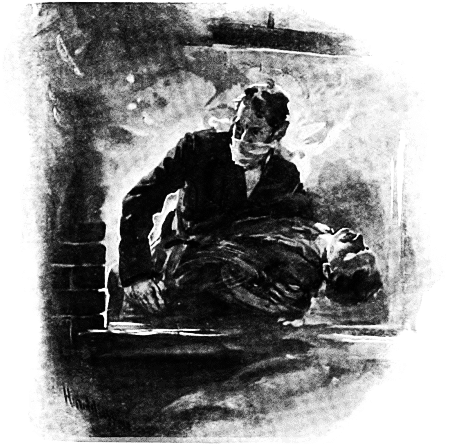
DERWENT APPEARED AT THE WINDOW BEARING DE COURCY IN HIS ARMS."
Suddenly Derwent appeared at the window. He was bearing De Courcy in his arms. The flames rioted round him, and they could see that his clothes were all charred.
"The staircase is a sheet of flame," he cried. "He was on his bed. The flames have not reached him."
As he spoke the ladder snapped in the middle and fell, and Daphne screamed, shutting out the scene with her hands, and then as suddenly snatching them away.
Derwent, framed in the window and holding Jack in his arms, cursed at it. For a moment he seemed nonplussed. Then he shouted—
"Blakiston, stand in as near as possible. I'm going to throw him out. You can break his fall. It is only the drop of a few feet. Stand on that bed, it will be softer."
The old man rushed to the spot. The flower bed seemed a good way from the house, but the flames reached it in the eddies of the wind. Daphne, realising what was meant, also went and stood on the bed. She looked at the twelve feet or more between it and the house, and wondered, yet never for a moment doubted that Derwent could do what he purposed.
They breathlessly watched him brace his muscles. In the glow of the light he looked grand, as a hero might, strengthening himself for his last fight. Then, with a cry of warning, he threw the man out, and the two waiting broke his fall. They, intent upon the rescued man, bore him from the reach of the flames, forgetting for a moment the man who had risked so much. When they looked he was gone.
The recoil had thrown him back, and the floor, rotten with the heating of the fire, had broken away. They knew afterwards that he must have been aware of the result, and that, knowing, he had given his life for the other. For it would have been an easy thing for him to have jumped himself had he been willing to sacrifice De Courcy.
De Courcy could never explain his insensibility that night.
"Felt beastly tired, and must have fallen asleep directly I got to my room." He was rescued fully dressed. "I suppose the smoke suffocated me and rendered me insensible before I awoke. If it had not been for poor old Derwent I must have been burnt. What a grand fellow he was!"
Daphne often wonders at Derwent's words. "It won't matter much in an hour's time," he had said, and it had not. And Jack's explanation always seems unsatisfactory to her, though she has never said so.
Derwent's tomb, which is very handsome, but which contains nothing of Derwent himself, bears the legend, "He gave his life for his friend"; but this is not true.