Chapter V · DEITIES OF THE EARTH AND GROWTH PROPER
Reading edition
INTRODUCTORY
So numerous were the manifestations and variants of the Earth-goddess conceived by the Nahua or adopted into their pantheon, that this has been the cause of considerable misconception on the part of students of Mexican religion, who have confounded them in a manner which in the circumstances is scarcely surprising. An attempt will be made here to provide the reader with a list of the most important of these deities, briefly and barely outlining their various origins and attributes, in order that he may be the better able to comprehend what follows when we come to discuss them more fully.
Chicomecoatl (Seven Serpents)—the Mexican name of the Earth-goddess and that of the seventh day of the seventh week of the tonalamatl. She was probably of Toltec origin. The third interpreter of the Codex Vaticanus A identifies her with Xochiquetzal, and, perhaps more correctly, with Xumoco and Tonacacigua or Tonacaciuatl. She had two temples dedicated to her, the chicome iteopan and the cinteopan, and seems to have become a variant of Tonacaciuatl on the adoption of an agricultural basis of existence.
Cihuacoatl (Serpent Woman)—an earth-goddess of Xochimilco and Colhuacan.
Coatlicue or Coatlantonan (Serpent Skirt)—a Mexican earth-goddess, mother of Uitzilopochtli.
Xochiquetzal—originally a mountain goddess of the Tlalhuica. An earth-and-maize goddess as well as a deity of flowers and vegetation.
Xilonen—originally a maize-goddess of the Huichol tribes. She represented the young maize-plant.
Cinteotl (Maize-god)—son of Tlazolteotl, originally a god of the peoples of the Atlantic seaboard. He is occasionally alluded to as a female deity, but is always male in the MSS. of the Borgia group, executed by a people of Nahua speech dwelling in the south. He is the equivalent of Xochipilli and had a separate temple, the cinteopan.
Xipe—an earth-god of the Teotitlan district, a god of spring vegetation. His temples were called yopico. His great festival was the Tlacaxipeuliztli, or “flaying of men.”
Only three of these deities, Tlazolteotl, Xipe, and Xochiquetzal, appear as rulers of one or other of the twenty day-signs of the tonalamatl. But Cinteotl figures in the ochpaniztli feast and appears as one of the “Lords of the Night.”
These criteria are perhaps sufficient to identify these figures as separate divinities. We find in Sahagun that Chicomecoatl, Cinteotl, and Xipe had separate temples of their own. In several of the rituals of the great festivals, however, the cults of Tlazolteotl, Chicomecoatl, and Cinteotl appear to have been very closely interwoven, and this leads me to suspect that the worship of the old Toltec goddess Chicomecoatl was in process of fusion with that of the “immigrant” Tlazolteotl at the period of the Conquest. Xilonen, too, according to Sahagun, had a separate festival in her honour, the uei tecuilhuitl. From all this and from considerations still to be advanced we may, perhaps, be justified in assuming:
(1) That at the period of the Conquest the cults of Tlazolteotl, Chicomecoatl, and Cinteotl were very naturally in process of becoming amalgamated, the worship of the two goddesses, Mexican and alien, presenting many features in common.
(2) That Xochiquetzal, originally the goddess of the Tlalhuica, was regarded more properly as the goddess of flowers and of the spring florescence, a hypothesis which is upheld by her myths. Her equation with Tonacaciuatl appears to have been a later concept, due to the connection of both with the earth.
(3) That the Huichol goddess Xilonen came to symbolize for the Nahua the maize plant in its early stages of growth, and in that respect resembles Cinteotl.
(4) That the cult of the southern god Xipe, the grain-deity of a related people, had made great headway among the Nahua of Mexico-Tenochtitlan.
(5) It follows from these conclusions that only one of these deities of growth—Coatlicue—was of Nahua origin, all the others being gods of the aboriginal or settled peoples. The Chichimec Nahua, a hunting people, possessing no official grain-goddess of their own, would naturally come to worship these on their adoption of an agricultural mode of life. As most of these forms hailed from districts of considerable cultural antiquity, I believe their worship to have been of long duration in the land, not much less ancient, indeed, than the cult of Tlaloc.
It is not claimed for these conclusions that they are more than approximate. The data relative to these deities is much too complex to permit of any more precise or dogmatic treatment, in fact at one time or another there was identification between them all; but with the above attempt at simplification in view we shall now endeavour to present the reader with a detailed account of each of these and other less important divinities who were regarded as in any way connected with the personification of the earth or the growth of the crops, their festivals and ritual.
The earth-deities seem to have been prophetic and divinatory and to have been connected with medicine, like similar European and Asiatic goddesses. Some of them, like Itzpapalotl, share the butterfly symbol with the gods of fire, with whom they are frequently connected. They are also closely associated with the deer, a fertility animal, and the eagle, the sun-bird, and their victims were, like those of the sun and war deities, decked with eagle-down.
TLAZOLTEOTL = “GODDESS OF DIRT”
Territory: Huaxtec, Mixtec, Olmec.
Minor Names: Tlaelquani = “Filth-eater.” Chicunaui acatl = “Nine Reed.” Teteo Innan = “Mother of the Gods.” Chiquacen acatl = “Six Reed.” Toci = “Our Grandmother.” Naui tecpatl = “Four Flint Knife.” Cocauic Xochitla = “Yellow Bloom.” Tlalli iyallo = “Heart of the Earth.” Iztac Xochitla = “White Bloom.” Ixcuine = “Four Faces.” Tonana Teumechaue = “Our mother, the goddess of the thigh-skin face-painting.”
Calendar Places: Ruler of the fourteenth day, ocelotl, of the thirteenth week, ce olin. Seventh of the nine lords of the night.
Compass Direction: West.
Festivals: Ochpaniztli (“Feast of Brooms”) in the eleventh month.
Symbols: A man eating excrement (“Dirt-eater”); a broom.
Relationships: Mother of Centeotl; one of the Tzitzimimê.
Broom of Tlazolteotl, the symbol of her festival. Headdress of Tlazolteotl.
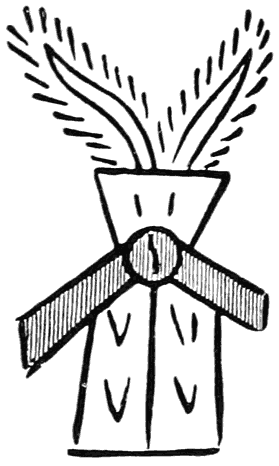
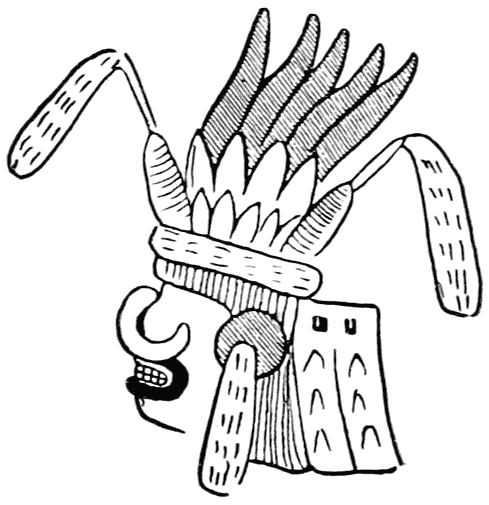
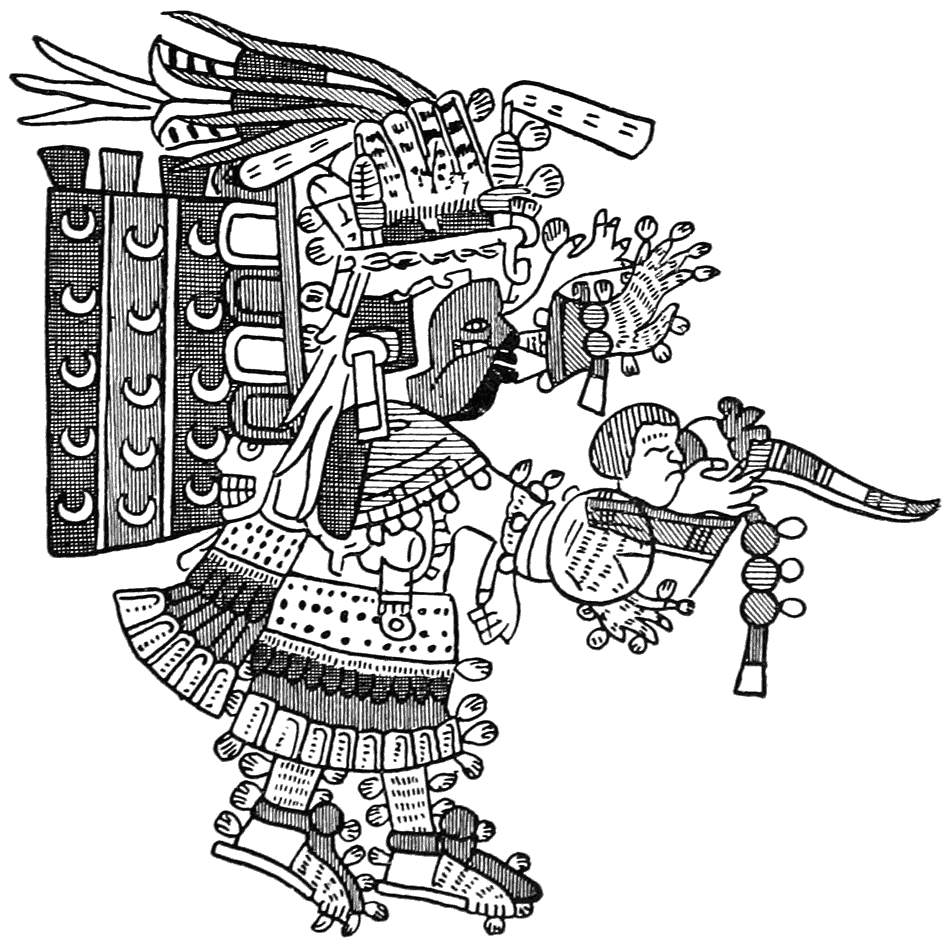
(From Codex Telleriano-Remensis, 17 Verso.)
FORMS OF TLAZOLTEOTL.
ASPECT AND INSIGNIA
Codex Borgia.—Sheet 74: Here Tlazolteotl is depicted as naked, and accompanied by a snake. A patch of rubber appears near the mouth, and her head is bound by a fillet of unspun cotton. Behind the neck a feather ornament is seen, made of the blue plumage of the quail, and she also wears the golden nasal Huaxtec ornament usually seen in connection with the octli-gods. In the Codex Vaticanus B her naked body is painted white, with yellow longitudinal stripes, and she has the bifurcated nose-ornament of Xipe. Significantly, perhaps, the shape of her eye recalls that of the god of flaying, whose eye is usually a mere slit in the flayed human skin which he wears, and through the mask of which he is supposed to be looking. She wears the cotton fillet and ear-plug typical of her.
Sahagun MS.—In this place she has a disk of liquid rubber on the face, with which substance her mouth is also painted, an elaborate cotton headdress, crowned with feathers, a tunic of sac shape with a fringe divided into compartments, a skirt with bands joined by diagonal lines, and she holds in her right hand the broom symbolic of her feast, and in her left a shield decorated with four concentric circles.
General.—In the tonalamatl of the Aubin-Goupil collection, wherever she is depicted as seventh of the nine lords of the night, her face is white, its upper portion being surrounded by a yellow band. In the Codex Borbonicus she is occasionally painted all yellow or all white, and this yellow colour symbolizes that of the ripe maize ear. In the song about her given by Sahagun, we observe that she is alluded to as “the yellow blossom” and the “white blossom,” otherwise the yellow or white maize—the maize at different stages of its growth.
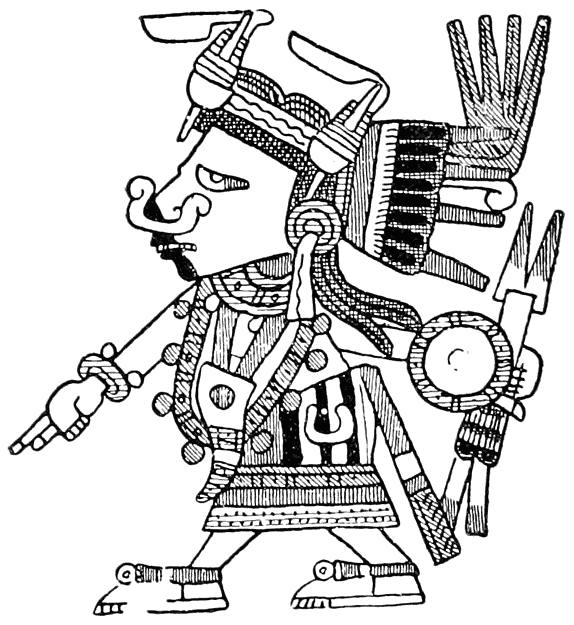
(From Codex Borgia, sheet 55.)
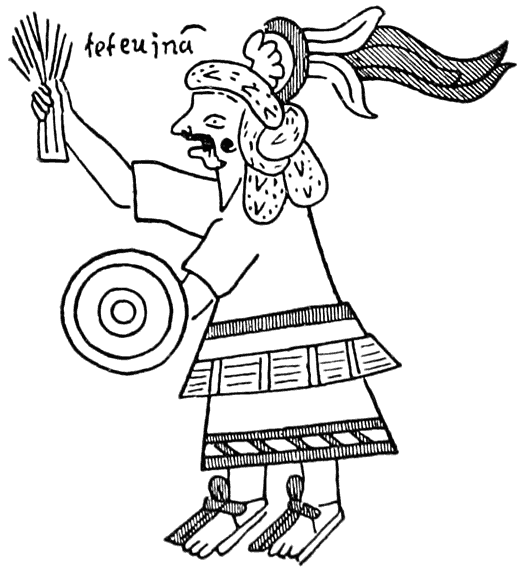
As Teteô innan. (From Sahagun MS.)
FORMS OF TLAZOLTEOTL.
When Tlazolteotl appears as ruler of the thirteenth week she often lacks the ripe-maize colour with which she is represented elsewhere. Thus in Telleriano-Remensis she is painted about the mouth with liquid rubber, and in Borbonicus her face-paint is in two colours. A black stroke is seen descending from brow to nose, but she has the yellow skin-colour. In both cases she is, like Xipe, clothed in the skin of a victim. In Telleriano-Remensis and the Aubin tonalamatl her arms and legs are powdered with white chalk and small feathers are affixed to them, probably with ulli gum. In Telleriano-Remensis these cover part of her costume as well. In this codex, too, her Huaxtec nose-ornament is replaced by one having a stepped motif, or a butterfly formed of the spotted feathers of the quail.
The cotton fillet of the goddess is worthy of further remark. It is made from the unspun produce of the plant, covers the top of the head and reaches the shoulders on either side of the face. Spindles are stuck into the mass, which is marked upon its surface with acute-angled figures or groups of parallel lines on a white ground, which may be regarded as hieroglyphic of raw cotton.
In certain of the MSS., for example in the Aubin tonalamatl and in Telleriano-Remensis, Tlazolteotl wears a feather coronal, which in other codices takes the shape of a fan or nape-ring like that frequently worn by Quetzalcoatl. Occasionally, too, it rises from a rubber ball which rests upon the head. In Codex Borgia (sheet 68) the feathers are dark in colour, but are brightened by the red plumes which spring from them in turn. Elsewhere we find white, brown, or yellow feathers, the latter prepared artificially from palm-leaves, which, like the fan-shaped ornament itself, are Huaxtec in character. In the picture in Borbonicus of Tlazolteotl as ruler of the week ce olin (one reed) we see the conical Huaxtec hat, as worn by Quetzalcoatl, peeping above her cotton headdress, and the palm-leaf plume rising from a feather fan, which springs from a ball of rubber. In Telleriano-Remensis Tlazolteotl is seen wearing a string of snail-shells depending from the waist. This is known as citallicue, or “star-skirt,” another Huaxtec article of dress.
MYTHS
Tlazolteotl is described in the Codex Telleriano-Remensis as “the woman who sinned before the deluge, who was the cause of all evil, of all deceit”; but this would appear to be an error for Ixnextli or Xochiquetzal (q.v.). The Anales de Quauhtitlan says of her: “In the same year (8 Rabbit) came the so-called Ixcuiname female demons [to Tollan] and, as they say from the reports of the old people, they came from Huaxteca. And in the place Cuextecatl ichocayan (“Where the Huaxtecs weep”) they summoned these captives whom they had taken in Huaxteca and explained to them what was about to be done, saying—‘We go now to Tollan. We wish to couple the earth with you, we desire to hold a feast with you, for till now no battle offerings have been made with men. We wish to make a beginning of it and shoot you to death with arrows.’ ”
SACRIFICE BY SHOOTING WITH ARROWS
HYMN
A song in the Sahagun MS. relating to Tlazolteotl is as follows:
This of course symbolizes the yellow and white maize. The thigh-skin of the goddess “is the mask cut from the thigh of the sacrificed girl and worn by the priest” (see “Festivals,” infra). The statement that Tlazolteotl came out of Tamoanchan is important, for another song in the same series tells us that in that paradise was born her son Cinteotl, the Maize-god (q.v.).
FESTIVALS
When midnight had arrived, in a dead and unbroken silence, she was led to the summit of the lofty teocalli, where she was placed on the shoulders of a man, as was the custom with brides about to be borne to the houses of their lords, and ere she could be well aware what was about to happen, she was decapitated and immediately flayed. First of all pieces of skin were removed from the broad portion of the thigh and carried to the temple of Cinteotl, the son of Tlazolteotl. The skin of the upper part of the body formed a jacket, which a priest of Tlazolteotl, chosen for his strength and vigour, drew over his own body. Accompanied by two men vowed to his assistance, as well as by other priests, dressed to represent the goddess’s Huaxtec servants, all of whom carried blood-sprinkled brooms which they brandished in a combative manner, he pursued a number of nobles and warriors, who struck their shields and made a threatening display. The priest who personified the goddess rushed upon these with simulated fury, but they fled before him, refusing him battle. This part of the proceedings symbolized the warlike nature of the goddess, and the military significance of her cult. As has been explained, the people of Mexico believed that only by the continued offering up of human sacrifice and blood could an adequate rainfall, and therefore abundant harvests, be procured, and this naturally presumed the upkeep of a considerable standing army and many military guilds or brotherhoods dedicated to the task of securing a large supply of sacrificial victims. The warlike character of the Earth-goddess was assumed as a matter of course.
In addition to the skin-mask, the Cinteotl priest wore a hat or cap, also made of the skin of the sacrificed victim, which had a vandyked edging of the crown, or a crest like the comb of a cock, symbolic of the stone knife of sacrifice.
Coming to the temple of Cinteotl, the priest of Tlazolteotl placed one foot upon the drum there, and awaited the priest of Cinteotl, who later set out alone in a hasty manner, and accompanied by a large body of warriors, to a point on the frontiers of Mexico where a small hut stood, and at this place he left the mask and cap which he had worn, made from the thighs of the sacrificed woman. Not infrequently the party were attacked or ambushed and fighting ensued. I can form no opinion regarding the significance of this procedure. Was the skin left on the frontier as a gage of war, as would appear to be its most obvious interpretation, or did it possess a deeper and more symbolical meaning? If it did, I am at a loss to supply the elucidation. I feel that this is one of those acts so often encountered in primitive religion, when the temptation is to look for a profound meaning where, perhaps, none exists.
The priest of Tlazolteotl, on the departure of his colleague, proceeded to the temple called Atempan, or “Place of Death,” a favourite muster-place for children and leprous persons about to be sacrificed, which was situated in the precincts of the great temple of Mexico. Here the king took his seat on a throne, his footstool being a nest made of eagles’ skin and feathers, whilst an ocelot-skin was cast over the back of the seat, these articles symbolizing the “knighthoods” of the eagle and ocelot respectively. A military review followed, and the monarch distributed raiment, arms, and insignia to the deserving, who, thus distinguished, were expected to so comport themselves in war that they might eventually die the warrior’s death, the only fitting end for a Mexican brave. The recipients then repaired to the temple of Tlazolteotl, where dancing was engaged in. The scene was picturesque and even magnificent, for all the dancers held flowers in each hand and wore the dazzling insignia of their various ranks and orders.
This spectacle continued for two days, and on the evening of the second day the priests of the goddess Chicomecoatl (q.v.), clothed in the skins of captives slain at the festival of that goddess, ascended a little teocalli known as the “Table of Uitzilopochtli,” and threw broadcast maize and calabash seeds upon the heads of the multitude below, who scrambled for the grain. The young women in the service of Chicomecoatl now advanced, each bearing upon her shoulder seven ears of maize, rolled in a rich mantle, and wrapped in white paper, after being sprinkled with ulli gum. The high-priest of the goddess led the chant, after which he descended from the teocalli and placed in a little cavity between the temple stairs and the temple itself a large basket filled with powdered chalk and feather-down. The warriors at once rushed upon it and scrambled for the contents, which were, of course, symbolical of the goddess’s “make-up.” They were chased by the priests, whom they pelted with the chalk and feathers, even the king taking part in the sport. The priest then betook himself to the temple of the goddess, called Toctitlan (“The Place of our Grandmother”), where he saw the skin of the sacrificed woman properly disposed.
Thus ended the ceremonies of the ochpaniztli, one of the most picturesque and involved, yet gruesome, of the festivals of ancient Mexico.
RITUAL
Tlazolteotl, as we shall find when we attempt our elucidation of her characteristics, was regarded as the goddess of sexual indulgence, a not inappropriate rôle for the wild, wanton, and riotous goddess of earth, so prodigal in her bringing forth and (naturally in the eyes of a primitive people) so bountiful in her favours, for to the barbarian mind productiveness is the outcome of lustfulness. By an easy transition, then, she became the goddess of sexual immorality, the patron of prostitutes, and the archetype of female wantonness. But, rather strangely, although she presided over salacious vice, she alone could pardon it, and once in a lifetime the Mexican adulterer or libertine might approach her to obtain by a full confession remission of his sins. This he generally did late in life, for absolution could not be obtained on a subsequent occasion. The ritual associated with his cleansing was a prolonged and involved one, and is described by Sahagun in the twelfth chapter of his first book.
There is no reason to believe that the account of the ritual as furnished by Sahagun is otherwise than genuine, and he remarks upon the facility with which the native Mexicans embraced the Catholic confession as a proof that the rite was not unknown to them.
TEMPLE
We know from the descriptions of the ochpaniztli festivals in the Sahagun Aztec MS., and the illustrations accompanying them, that the temple of Tlazolteotl, the Toctitlan, was a scaffolding of poles on which was set a representation of the goddess.
PRIESTHOOD
That Tlazolteotl possessed a priesthood of her own is obvious from the repeated mention of the adolescent youths known as Cuecuesteca (“Her Huaxtecs”), who figured in the festival of ochpaniztli. But that these were only priests ad hoc, or employed temporarily for that celebration, is likely, as Sahagun states (Appendix to bk. ii) that the Atempan teohuatzin, or the Chief of Rites connected with the Atempan, had the task of assembling them, as well as charge of the insignia used at the festival. Tlazolteotl’s priests, according to Sahagun (bk. i, c. xii), were “the augurs who possessed the books with the prognostications and the destinies of the new-born and the spells and the omens and the traditions of the ancients, as they were handed down and came unto them.”
NATURE AND STATUS
Tlazolteotl has been completely identified with the Teteo innan or Toci of Sahagun and other writers, but though she ranked as the Earth-mother of Mexico par excellence, there is no room for doubt that her worship was originally alien, and assuredly of Huaxtec origin. The Huaxtecs were a people of Maya origin or affinities, isolated from the main body of that race, dwelling on the east coast of Mexico, and retaining many of their peculiar customs; and it is noteworthy that a Huaxtecan goddess should be alluded to in Mexican tradition as coming to Tollan, the city of the Toltecs, the people whom so many writers have tried to identify with the Maya. As has been observed, she was accompanied at the ochpaniztli festival by a band of youths dressed to represent Huaxtecs, who in the Codex Borbonicus picture of the festival are shown as wearing the cone-shaped Huaxtec cap. She herself wears the Huaxtec nose-ornament in common with the octli-gods. She is repeatedly stated to have had her “home” in Cuextlan, the Huaxtec country, and there are good grounds for supposing that its inhabitants, of whose religion we know little, had brought the cult of the Earth-mother to such a pitch of complex perfection as rendered its absorption of the allied Mexican cults merely a matter of time and occasion.
That she was originally a personification of the maize is also clear. In her songs she is alluded to as “the yellow bloom” and “the white bloom,” and the references to her dwelling in Tamoanchan, the western paradise where the maize was supposed to have had its mythical origin, and where she gave birth to Cinteotl, the young maize-god, proves her association with this food-plant. But she was also the Earth, the insatiable, lustful mother, who gives birth to Cinteotl the young maize-god, who is also the obsidian knife of sacrifice, for the Earth is the mother of stone. As Sin, she was also the mother of death, for Cinteotl in this guise was undoubtedly a god of fatality or doom.
Like many other deities of the earth she may have had an almost plutonic significance, for she is called Tlalli Iyallo, “Heart of the Earth.” But I think that Seler (Fejérváry-Mayer, p. 145) has mistaken the true significance of this expression in applying to it the meaning “interior of the earth.” The word “heart” in the Nahua tongue does not necessarily mean “interior.” True, Tepeyollotl, the Earthquake-god, possessed a similar designation, but on the other hand the Quiche Popol Vuh alludes to the god Hurakan as “The Heart of Heaven,” and I take the expression to mean in general “soul, spirit,” rather than “interior.” But, again, deities of grain have very frequently a subterranean association, and, according to Duran’s description of the feast of the goddess, we find that she was supposed to make her coming known by an earthquake shock, and she is ruler of the thirteenth week, ce olin, which some authorities translate as “earthquake” or “earth-motion.”
All this notwithstanding, in later times it was as the goddess of sensuality and lustfulness that Tlazolteotl made her strongest appeal to the Mexican imagination. We have already seen how this transition took place and how this attribute had its inception. In many climes the figure of the fruitful and abundant Earth-goddess has its bestial, revolting, and highly salacious side, and the Mexican earth-deity was no exception to the almost general rule. In several pictures her symbol is shown as a man devouring excrement (sin). She was the patroness of prostitutes, and by a transition, the ethical character of which seems to me obscure, she finally became the great pardoner of sexual misdeeds.
Probably because they forfeited their lives in the act of bringing forth, she came to be regarded as the chieftainess of those women who, dying in childbed, went to inhabit the Ciutlampa, the house of the women in the west. These female spirits were regarded by the Mexicans as the equal of warriors who had died heroically in battle, and issued daily from their paradise to accompany the sun in his afternoon course. It is typical of these Ciuateteô, or deified women, that in their jealousy of living people and their offspring, they exerted a noxious influence upon mortals, especially upon children, at certain seasons, and as the interpreter of Codex Telleriano-Remensis states, they are identified with European witches, flying through the air and meeting at cross-roads. Now the broom is the symbol of the European witch, as it is of Tlazolteotl, and in Codex Fejérváry-Mayer (sheet 17) we have a picture of Tlazolteotl as representative of the Ciuateteô, naked and riding upon a broomstick. In Codex Borgia (sheet 12) and Codex Vaticanus B (sheet 30) beside her is figured a house with an owl standing at the door, while in front hangs a string of dried medicinal herbs, the whole representing the dwelling of a sorceress or medicine-witch, for Tlazolteotl was also patroness of the medical women, who danced at her festival, and Sahagun (bk. i, c. viii) expressly states that she was venerated by the “physicians,” that is, the medicine-men and wizards.
The warlike nature of Tlazolteotl has already been dwelt upon and its reason demonstrated in the section dealing with the ochpaniztli festival.
CHICOMECOATL = “SEVEN SNAKE”
Area of Worship: Mexico.
Minor Name: Chicomolotl = “Seven Maize-ears.”
Relationship: Sister of Tlaloc.
Symbol: The double maize-ear (commaitl).
Festivals: Uei tozoztli, the fourth month; ochpaniztli, the eleventh month.
Calendar Place: Seventh day of the seventh week; the day chicomecoatl. (Sahagun states that all days containing a seven in their name were regarded as auspicious on her account.)
Chicomecoatl. (From the Sahagun MS.) Figure of Chicomecoatl. (Uhde Collection, Berlin.)
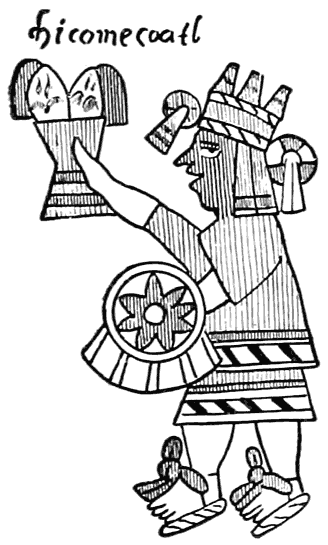
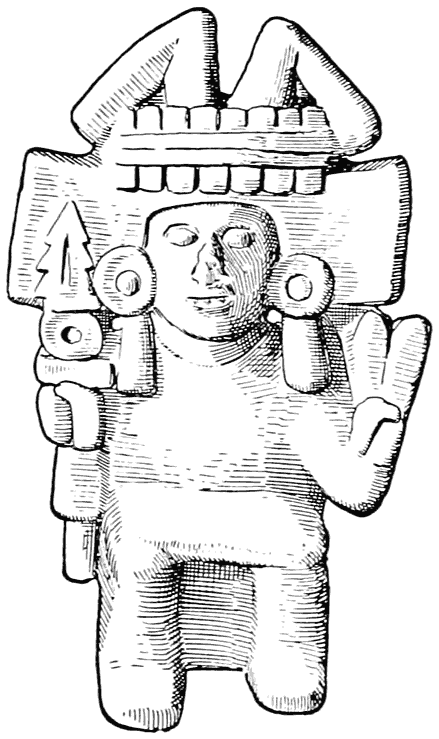
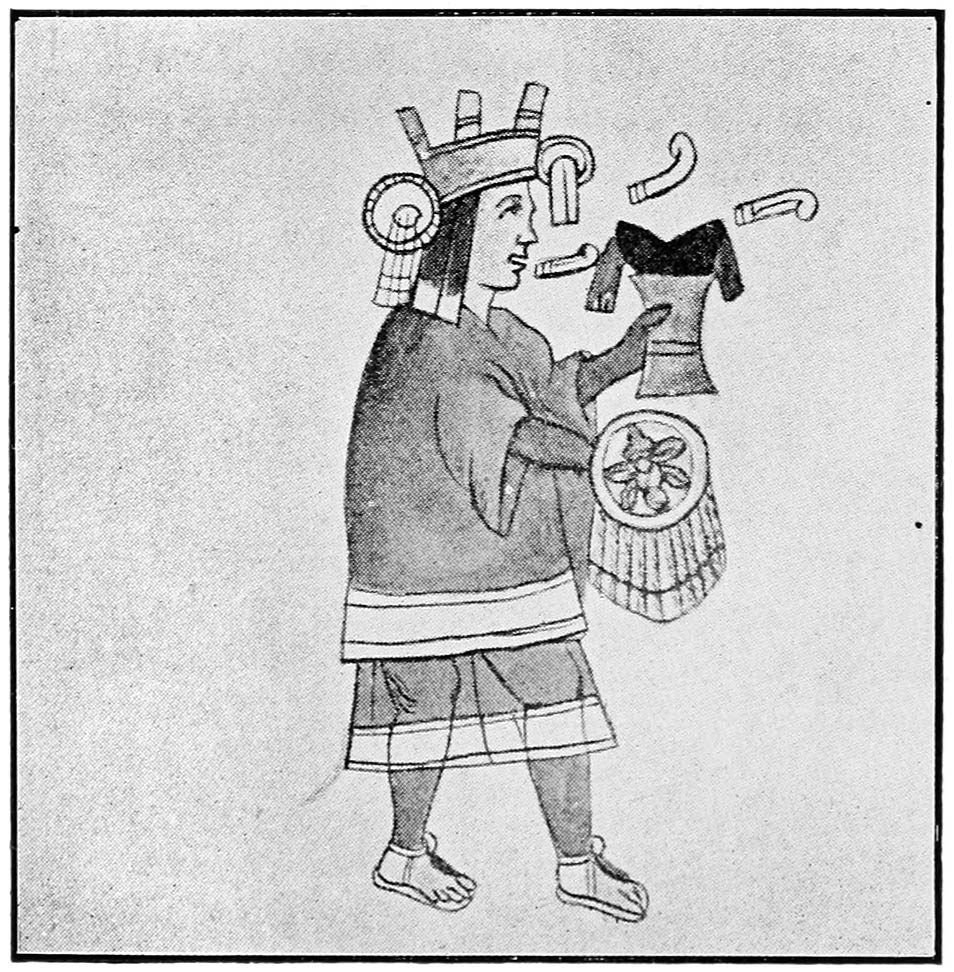
Chicomecoatl. (From the Sahagun MS., Laurenziana).
FORMS OF CHICOMECOATL.
ASPECT AND INSIGNIA
Aubin-Goupil Tonalamatl.—Sheet 7: The goddess is depicted as having a red body and facial painting, and wears variegated raiment in which red is the preponderating colour. On her head is a large square headdress, also red in colour and decorated with rosettes at the four corners—such a headdress, indeed, as Tlazolteotl wears at the ochpaniztli festival. She holds in her hand the double maize-ear, which may be regarded as her peculiar and distinctive emblem.
Codex Borbonicus.—In this codex she is seen wearing red paint and the red garment, holding the double maize-ear, and carrying other maize-ears in a receptacle on her back. Seler thinks that her red colour is that of the granular bunch of the young maize-ear which she represents, and that Tlazolteotl or Teteoinnan, who is painted yellow and white, represents the ripe maize-ear.
Sahagun MS.—The Sahagun MS. states that Chicomecoatl’s face is coloured red and that she wears a paper crown on her head and a collar of green precious stones round her neck. She has an overdress and skirt of spring flowers and wears bells and shells on her feet. Her shield has the emblem of the summer flower painted upon its surface, and she carries the double maize-ear in her hand.
MYTHS
The hymn to Chicomecoatl as given in the Sahagun MS. is as follows:
Goddess of the seven ears, arise, awake!
For, our mother, thou leavest us.
Thou returnest to Tlalocan.
Arise, awake!
Mother, thou leavest us now,
Thou goest to thy home in Tlalocan.
Which may, perhaps, be interpreted thus: The expression “seven ears” is an allusion to the seven ears of maize, sprinkled with rubber oil and wrapped in paper and cloth, which each maiden in a procession of virgins carried to the temple of the goddess, the cinteopan, at the festival of uei tozoztli (April 27th). The maize is now full grown and the goddess’s labours are over for the time being, so that she is enabled to return to Tlalocan, the paradise of her brother Tlaloc.
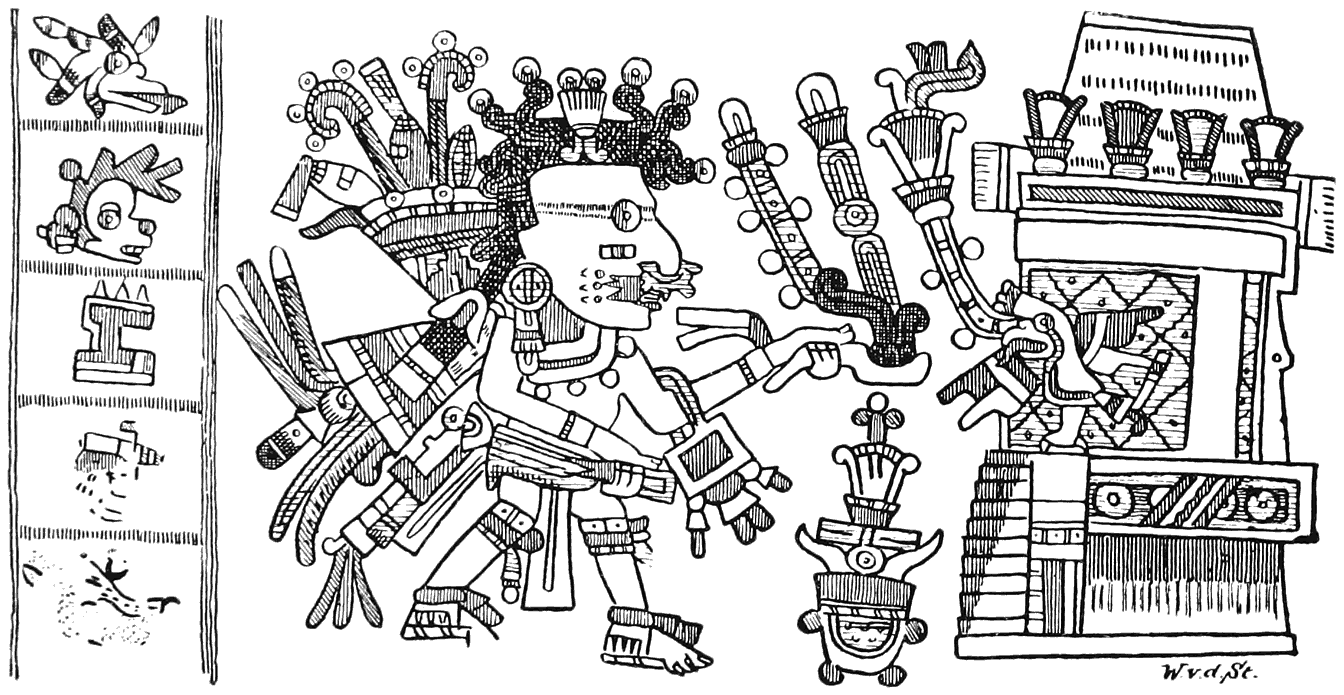
CINTEOTL, SON OF CHICOMECOATL.
(Codex Bologna, sheet 13.)
FESTIVALS
Ochpaniztli (“Sweeping of Temples”).—In this festival, held about the beginning of September, the goddess played an important although by no means the principal part, and as it is fully described in the pages dealing with Tlazolteotl, it will suffice here to mention that the rites accorded to Chicomecoatl on this occasion appear to have been almost the same as those rendered at her first festival. The nature of her connection with the other deities of maize is indicated in the introduction to the section dealing with the earth and grain gods, and her participation in the rites of the ochpaniztli perhaps exhibits the zealous activity of an ancient cult in rivalry with a later and more popular one. It would certainly seem as if Chicomecoatl had been recognized in the ochpaniztli rites as an afterthought and for the purpose of placating her priesthood, as much as for the honour of the goddess herself, or that it was a protest on the part of the ministers of her cult, who did not desire to see their divinity ignored at a season at which she had probably been worshipped from time immemorial.
PRIESTHOOD
That Chicomecoatl had a priesthood specially consecrated to her is manifest from the accounts of her festivals, and this must have been in most respects similar in organization and character to those of Cinteotl (the Cinteotzin), Tlazolteotl, and Xipe. That she had also a corps of priestesses or holy women attached to her worship is equally clear from the same source. But we learn nothing of their precise status or polity from any of the old authorities.
TEMPLES
Chicomecoatl appears to have had two temples, both situated within the precincts of the great temple at Mexico. The first was the Chicomecoatl iteopan (“Temple of Chicomecoatl”) and the other the Cinteopan (“Maize Temple”), which, however, must not be confounded with that sacred to Cinteotl.
NATURE AND STATUS
Chicomecoatl is obviously the ancient and indigenous maize-goddess of the Mexican Valley, whose worship had existed from early times. The statement by the interpreter in Codex Telleriano-Remensis that she caused famines is most certainly an error and much more applicable to Ciuacoatl. The identification of her in the same place with Tonacaciuatl, the female companion of the creative deity, is probably correct, as she seems to have been an agricultural variant of the old earth-mother. Chicomecoatl was the patroness of the food supply, who, says Sahagun, “was the goddess of subsistence,” and “the original maker of bread and victuals and cookery in general,” and whose sign radiated good fortune and happy influences. In this goddess, as viewed through the medium of the observances practised at her festival, we see, perhaps, the old and indigenous earth-goddess as the helper and foster-parent of the younger earth-mother, Tlazolteotl, for the grain of the year before was hers and was placed in the granaries to “help” or form a nucleus to the new grain. Again, it was perhaps natural that the elder earth-goddess should preside over the old grain used for seed, and the younger goddess over the grain which had not yet come to fruition. In many countries two grain-spirits, mother and daughter, appear in the agricultural pantheon. In Breton custom the mother-sheaf—a figure made out of the last sheaf—bears within it a lesser bundle, which is regarded as the unborn daughter; and in Prussia, Malaysia, Scotland, and Greece, this double personification of the corn was or is in vogue.
CINTEOTL = “MAIZE-GOD”
Territory: Totonac; Aztec; Xochimilco.
Minor Names: Ce Xochitl = “One Flower” (date). Chicomoltotzin = “Seven Ears.”
Relationship: Son of Tlazolteotl; husband of Xochiquetzal.
Symbol: The god’s head with maize headdress (as in Bologna tonalamatl).
Festivals: Uei tozoztli; ochpaniztli.
Compass Directions: North; West.
Calendar Place: Fourth of the Nine Lords of the Night. Seventh of the Thirteen Lords of the Day. (Codex Borbonicus, sheet 20.)
ASPECT AND INSIGNIA
Codex Borgia.—Sheet 52: In this place Cinteotl is figured as a male deity of yellow colour and with a peculiar black, angular, longitudinal band on the face and bearing a load of maize-ears on his back. In one hand he carries the rain-staff and in the other the throwing-stick. Sheet 14: In this illustration he is clearly recognized as the Maize-god by the maize-ears and the maize-blooms which he wears in his fillet or on his head. In other respects his insignia resembles that of the Sun-god in its flame-coloured hair, the jewelled head-strap with the conventional bird’s head on the frontal side, the large gold disk on his breast, and on the nape of the neck the rosette painted in the colours of the green jewel chalchihuitl.
Codex Vaticanus B.—Sheet 20: He wears on his head a notched crown like that of the earth, mountain, and rain gods, except that it is painted green and yellow, the colours of the maize. It is fastened with a tie at the occiput, which adornment is painted in like colours and resembles the knot worn by these deities. As with the Rain-god, it shows the long, dark hair hanging down below it. On his breast he wears, attached to a chain of jewelled beads, an ornament which is painted in the colours of the chalchihuitl and from which hang jewelled thongs. The loin-cloth is in the colours of the maize, showing alternate yellow and green cross-bands.
Aubin Tonalamatl.—Sheet 8: Here he is represented opposite Mayauel. On his back he wears a plumed staff with a heart. In his hand he holds the quetzal feather-flag.
MYTHS
Cinteotl was regarded by the Mexicans as having been born of the goddess Tlazolteotl in the sacred western region of Tamoanchan (the House of Birth), which they looked upon as the original home of the maize-plant. A song sung at the atamalqualiztli festival is as follows:
Born is the Maize-god
In the House of Descent,
In the place where the flowers are,
The god One-flower.
The Maize-god is born
In the place of water and of mist,
Where the children of men are made.
In the jewel Michoacan.
He is also associated with the flower-gods in certain strophes of the song to these divinities:
On the ball-ground the quetzalcoxcoxtli sings;
The Maize-god answers him.
Beautifully sings our friend the quetzal,
In the twilight of the red maize god.
My song shall be heard by the lord of the twilight,
The god with the thigh-skin face-painting.
I came to the place where the roads meet,
I, the Maize-god.
Where shall I now go?
Which way shall I take?
This song I would interpret as follows: The game of tlachtli, a description of hockey, is in some measure associated with the maize-gods. The quetzalcoxcoxtli bird is Xochipilli, the Flower-god, with whom Cinteotl is closely associated, and who is connected with games of all kinds, stone effigies of him being set up in the tlachtli courts. Cinteotl is a god who emanates from the west, and is associated with the twilight. At his festival a piece of skin was stripped from the thigh of the female victim and made into a mask for his priest. The place where the roads meet is evidently the haunting-place of the Ciuapipiltin or Ciuateteô, women who died in childbed, of whom Tlazolteotl, Cinteotl’s mother, was the patroness. The god complains that he has a difficulty in finding his way at the cross-roads. This was the precise reason for which they were made, that the Ciupipiltin or haunting mothers should be puzzled by them, or “wandered,” as the Scottish expression is. Witches all the world over are baffled by cross-roads, and formerly the bodies of suicides were buried beneath them, so that, did their spirits arise, they would be puzzled by the multiplicity of directions and be baffled in their intent to haunt the living.
FESTIVALS
TEMPLES
The temple of Tlatauhqui Cinteotl (red maize) appears to have been the preserve of the maize-gods collectively.
PRIESTHOOD
NATURE AND STATUS
It would appear from the data at our disposal that Cinteotl was originally a maize-god of the Totonacs, a people allied in race to the Maya-speaking Huaxtecs of the east coast. It will be recalled that his mother, Tlazolteotl, was of Huaxtec origin. Cinteotl may originally have been regarded by the Maya-speaking coast people as her son, or again the relationship between them may have been symbolic and relatively late in its development. But the myth appears as ancient and well founded, and the corn-mother who has a son or daughter is noticeable in many mythologies.
Cinteotl’s mother, Tlazolteotl, the goddess of lust, undoubtedly typifies sin, and her son symbolizes the death which follows it and is its wages, the sharp knife of sacrifice. The indented cap he wears is typical of this implement, and was known as itzlacoliuhqui (“frost”), an expression which is also translated as “death” and which is occasionally employed of Tezcatlipocâ in his phase of god of justice.
It is, however, as the young maize-god—the maize in its tender and half-ripened condition—that he must be chiefly regarded, and that he was looked upon by the ancient Mexicans. He strongly resembles the Maya god E.
CIUACOATL = “SERPENT WOMAN”
Area of Worship: Colhuacan and Xochimilco.
Minor Names: Quilaztli = “Obsidian Plant” (?). Quauhciuatl = “Woman-eagle.” Yaociuatl = “Woman-warrior.” Tonantzin = “Our Mother.”
Relationship: Mother of Mixcoatl; sister of the Centzon Mimixcoa.
Symbol: Obsidian knife.
ASPECT AND INSIGNIA
General.—In Codex Borgia (sheet 60) she appears as one of the two heads, or faces, of Quaxolotl, a female face framed by long, streaming hair, with the fleshless under-jaw and the exposed teeth of a dead person’s skull.
The Sahagun MS. describes her as having a face painted half-red, half-black, with a thick smear of indiarubber round the lips. She wears a crown of eagle-feathers and a golden ear-plug. Her overdress is “the colour of spring flowers” (red), and she also has an undergarment with a fringe, and a white enagua, or skirt. Her costume is adorned with shells and she wears sandals. Her shield is inset with eagle’s feathers.
An ancient song to her states that she carries a rattle-stick. She has a shield-device similar to that of Chantico, with whom she seems to be a parallel.
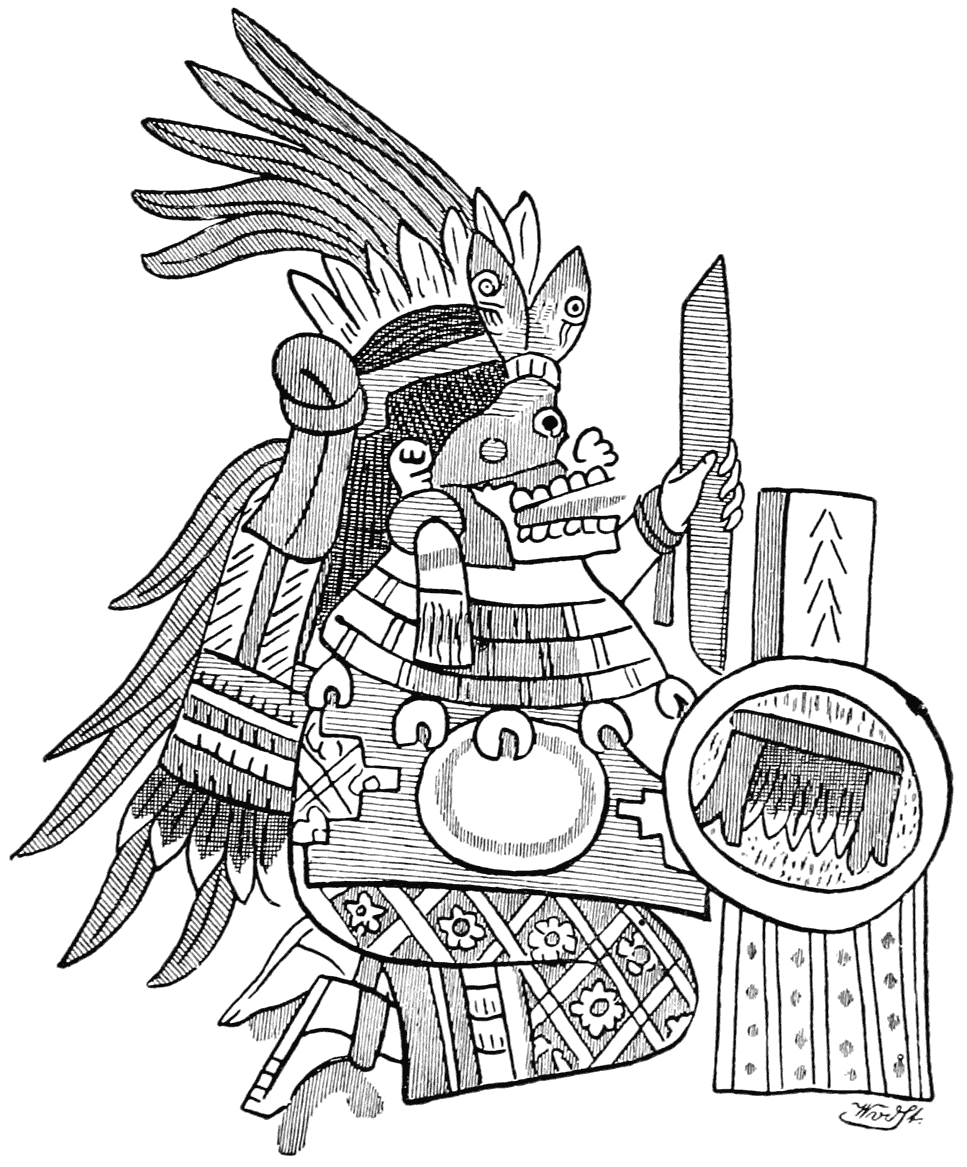
CIUACOATL.
(From Codex Magliabecchiano, sheet 33.)
MYTHS
In the “Song of the Earth-goddesses,” Ciuacoatl is alluded to as follows:
The eagle Quilaztli is painted with serpent’s blood;
Her crown is made of eagle-feathers.
The high cypresses of the Chalmecâ land shelter her.
The maize has come;
On the fields of the gods
She leans on the rattle-staff.
In my hand rests the agave thorn;
On the fields of the gods
She leans on her rattle-staff.
The broom is in my hand;
On the fields of the gods
She leans on the rattle-staff.
Thirteen eagles is our mother, goddess of the Chalmecâ;
The spear of the prickly plant lays me low;
It is my son Mixcoatl.
Our mother the warrior.
The deer from Colhuacan,
She is stuck with feathers.
Morning has dawned
The order to the warriors has gone forth.
Drag the captives hence,
The whole land shall be destroyed.
The deer from Colhuacan,
She is stuck with feathers.
Those who fight bravely in war
This wild song may be interpreted as follows:
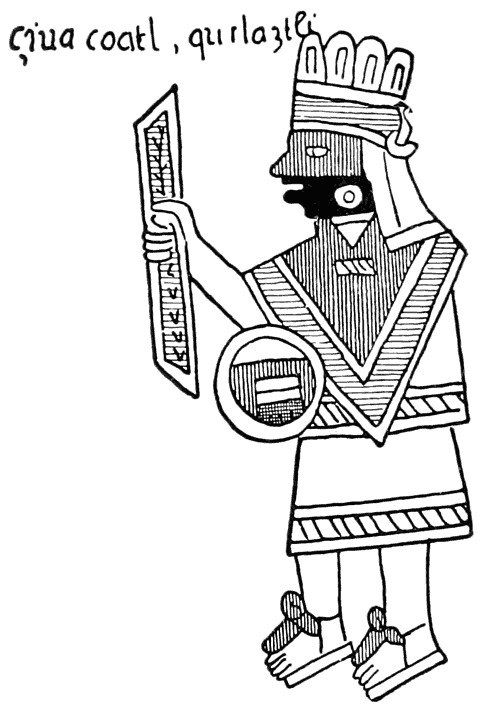
(From the Sahagun MS.)
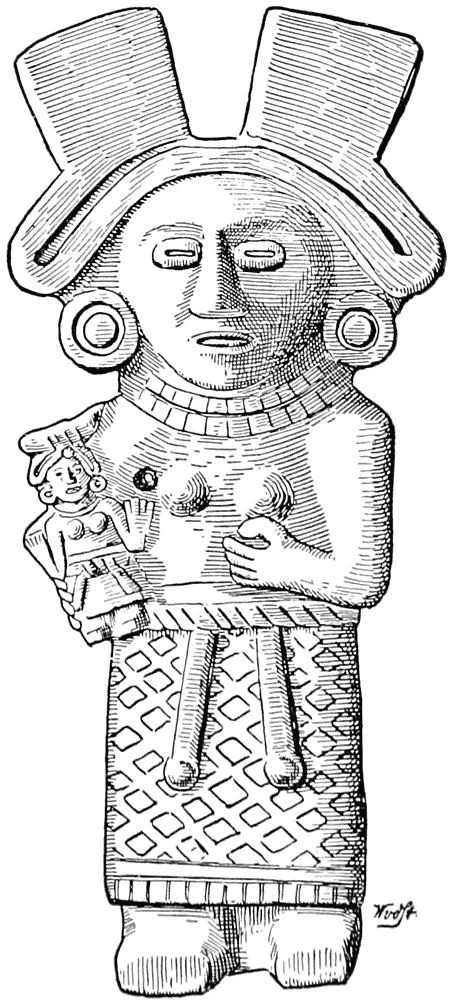
Pottery figure. (Uhde Collection.)
FORMS OF CIUACOATL.
TEMPLES
NATURE AND STATUS
The circumstance that Ciuacoatl appears with the skull of a dead person leads to the conclusion that, besides being an earth-deity, she had phantom or underworld characteristics—a common connection for a grain-goddess. From her hymn we gather that she has a magical influence over the plantation and growth of the maize. She is, perhaps, a prototype of the Ciuateteô, the disappointed and vengeful women who had died in their first childbed, and the myth of her cradle containing the sacrificial knife is eloquent of the connection of the Earth-goddess with human sacrifice. Her martial character, also, is apparent and is a concomitant of her agricultural and sacrificial significance. From her association with Mixcoatl, the Mimixcoa, the Chichimec gods, as from her name, Quilaztli, and her symbol it is evident that she is connected with the Chichimec or native Indian cult. Her connection with childbed is clear from one of the addresses given by Sahagun, who states that the midwife exhorted the woman in childbed to be strong and valiant as was Ciuacoatl. “Who first bore children,” in allusion to a myth mentioned by Gama (pt. i, p. 39), who says that she gave birth to two children, male and female, whence sprung the human race—a story I have failed to trace elsewhere, except in Clavigero.
COATLICUE = “SERPENT-SKIRT”
Area of Worship: Mexico-Tenochtitlan.
Minor Name: Coatlantonan = “Our Serpent Mother.”
Relationship: Mother of Uitzilopochtli by Mixcoatl; mother of Coyolxauhqui and the Centzonuitznaua; wife of Tezcatzoncatl or Izquitecatl.
Festival: Feast of the flower-sellers in the second month, tlacaxipeuliztli.
Symbol: The eagle’s foot.
ASPECT AND INSIGNIA
Sahagun MS.—The face of the goddess is painted with white infusorial earth of the kind known as tiçitl. She wears a crown of eagle-feathers and a white overdress. Her skirt is formed of serpents, as her name implies. On her feet she wears white sandals and shells. Her shield is inset with eagle-feathers, and she bears a serpent-staff in her hand.
STATUES
Other statues and paintings of Coatlicue uphold the theory that she is represented by this idol. One found in the Calle de las Escalerillas, and others recovered from the Calle de Coliseo in Mexico City, show her as having the face of a skull. In the latter she wears a peculiar flat headdress with maize-like motifs depending from the back, and her hair recalls the ruffled “night-hair” of Mictlantecutli. Around her body are strange step-motifs which constitute the ends of parallel lines; and from her ears depend large cotton plugs. She wears a girdle of skulls with serpentine noses. Another relief of her found in the Calle de las Escalerillas is, however, much more enlightening than the foregoing. In this spirited work she wears what is evidently a panache of stone knives or malinalli grass, the face is that of a skull, she has the claws of a jaguar, and the skirt of entwined serpents is noticeable. Be all this as it may, however, the insignia of the goddess is by no means a fixed quantity, and considerable research is necessary before anything like certainty can be arrived at.
MYTH
FESTIVAL
Tlacaxipeuliztli.—Sahagun (bk. ii, c. 22) relates that on the second day of this month the people of the temple quarter of Coatlan offered flowers in the temple and made music during the entire day in honour of Coatlicue. These flowers were the first-fruits of the year, were offered up by the master florists, who had a great devotion to the goddess, and none of the blossoms in their gardens might be smelt until these bouquets had been offered up in the temple of Coatlicue. They made for this feast tamallis called tzatzapaltamalli (“sharp-tasting herb cakes”).
NATURE AND STATUS
Coatlicue is, in one of her aspects, undoubtedly the flower-covered earth of spring, from whom, as it were, the sun (Uitzilopochtli) is reborn. Her serpent-skirt is probably symbolic of the circumstance that, at the season which she represents, the earth is clothed with the rain as with a garment. The myth which makes her a pious widow is obviously of late, and probably of hierophantic, origin. In my view Uitzilopochtli is chiefly her son in his naualli or disguise of a humming-bird. The humming-bird sucks from the breasts of earth as a child from its mother’s. But the myth is highly conglomerate, and, as we possess it, is obviously the result of the fusion of several varying conceptions of the two principal figures. Coatlicue’s appearance as a serpent in her great statue which has been described above, and her name of Coatlantonan, “Our Serpent Mother,” in my view tend to identify her with the earth in its form of dragon, serpent, or cipactli, regarding which hypothesis the reader is referred to my remarks in the Introduction.
It is not improbable that, like Xochiquetzal, Coatlicue is one of those mountain goddesses from whose sacred heights the rain descended upon the parched fields. This seems likely from the name of her abode, Coatepetl (“Serpent Mountain”), the serpents of which her skirt is composed being symbolical, perhaps, of the stream flowing from the tarns or pools situated on its lower acclivities. That such a mountain actually existed in the vicinity of Tollan is proved by the statement of Sahagun. Uitzilopochtli (q.v.) is thus the sun which rises out of the mountain, or is “born” from it, armed with the xiuhcoatl, or fire-snake, the red dawn, with which he slays his sister Coyolxauhqui, whose insignia show her to represent the moon, and puts the stars to flight.
XOCHIQUETZAL = “FLOWER FEATHER”
Area of Worship: Plateau of Anahuac; Tlaxcallan; Tlalhuica.
Minor Names: Ce atl = “One Water.” Ce Mazatl (Calendar date) = “One Deer.” Mazateotl = “Deer Goddess.”
Calendar Place: Ruler of the twentieth day (xochitl) and of the nineteenth “week” (ce quauhtli).
Compass Direction: West.
Festivals: Tepeilhuitl (Tlalhuica). Quecholli (Tlaxcallan). Chicome xochitl (Mexico).
Relationship: The first woman, and thus companion of Piltzintecutli (the Sun-god); otherwise, wife of Tlaloc, abducted by Tezcatlipocâ.
ASPECT AND INSIGNIA
Codex Borgia.—Sheet 9: Here the goddess is represented as wearing an upper garment of diversified pattern, finished with a variegated edging. Her shawl is painted in the chalchihuitl colours, and from it depend two strings or ribbons of a dark shade, completed with a flower. Her nose-plate is blue and is formed rather after the fashion of the butterfly design, while her helmet-mask represents a quetzal-bird. In sheet 58 she is vis-à-vis with the Death-god and is garbed like an earth-deity with a many-coloured robe. Her hair is dressed like that of the Zapotec women, that is, two tresses are twisted up like horns and secured with parti-coloured bands. On the same sheet (next picture) she confronts one of her servitors or priests (tlamacazque), and her garments in this place are very similar to those already described. In the next illustration the only addition to her costume is a wreath of flowers, but under her arm she holds a quetzal-bird and sits opposite a red Tezcatlipocâ. On sheet 59 she is represented in the first place opposite the tlamacazque, and in the following picture confronts a naked prostitute. Between these figures is her servitor, surprised in the act of pressing the courtesan’s breasts. This female is characterized by her wearing of Xochiquetzal’s shawl, hair-dressing, and the hieroglyph of the warrior caste (shield and spears) shown above her head. In the lowest row of the same sheet the goddess is seen opposite the Vulture-god, Tlacacozcaquauhtli. In the following sheets of the codex her aspect and garb are practically similar to those described above, with the exception of sheet 60, where she appears in the act of parturition, with the double head and certain of the insignia of Quaxolotl, being delivered by Quetzalcoatl in the character of Xolotl. In the region of her mouth is an angular line of red.
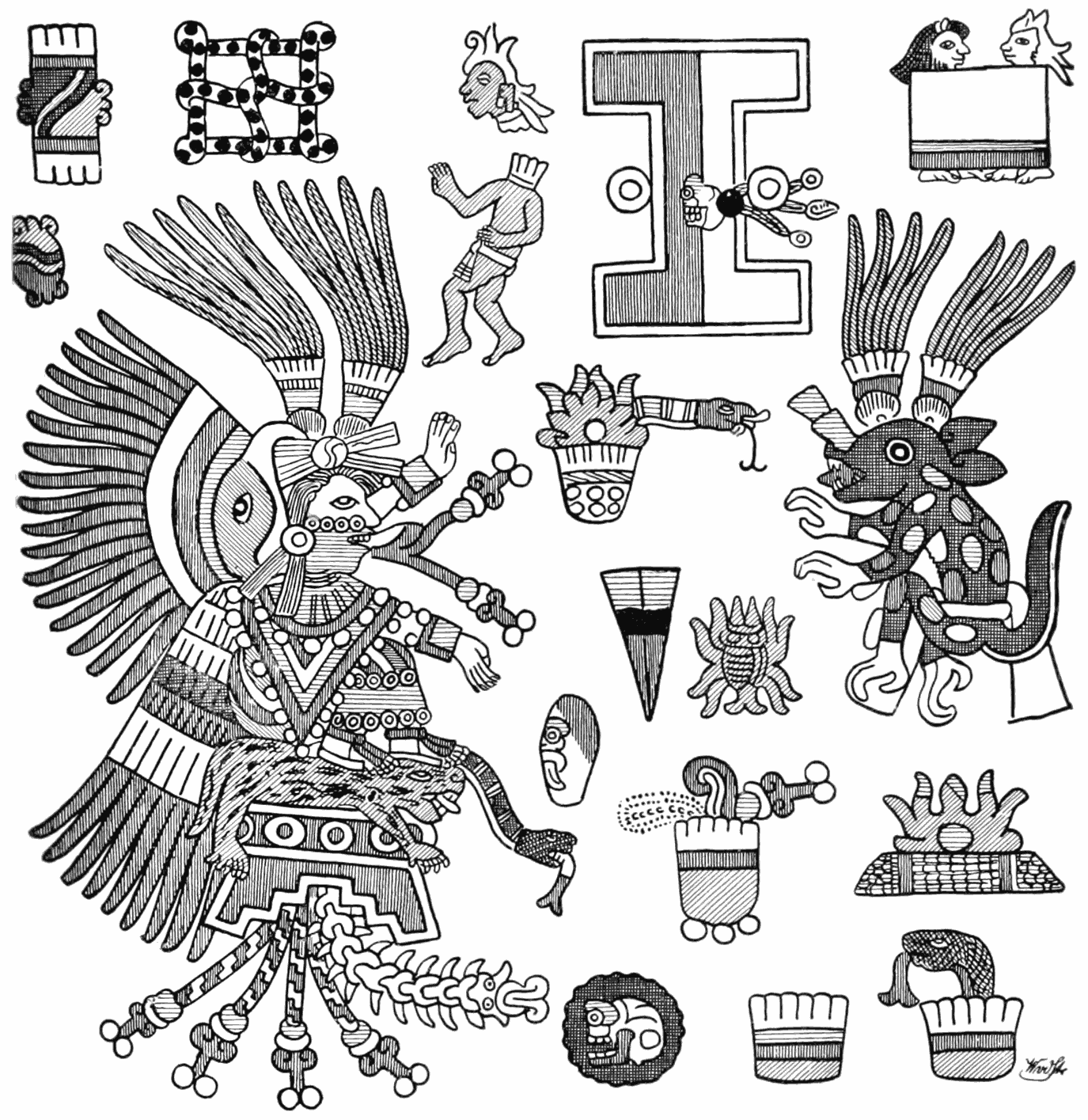
XOCHIQUETZAL AND HER SYMBOLS.
(Codex Borbonicus, sheet 19.)
Codex Vaticanus B.—Sheet 42: Here Xochiquetzal is adorned by a wreath of flowers and faces her servant. On sheet 41 we observe that her cheek is painted with a round red spot, like that of the Sun-god, whilst her head is adorned with quetzal-feathers, and the quetzal-bird is held under her arm. She is ensconced on a jaguar skin, and on her head is the wreath of flowers with two feather tufts, which is especially characteristic of her. On her face is depicted a red, angular line. Opposite is the figure of her priest, and between them is a headless woman, whose head is replaced by a flowering tree. On sheet 39 she is shown as wearing a quetzal-bird mask and a blue, step-shaped nose-plate, while her face-paint is elaborately executed. In this picture is seen issuing from her body a quetzal-feather ornament, symbolic of a newly-born child. In one hand she holds a jewelled ornament, and in the other an ear of maize, and she wears the opossum wristlets applied to women in travail. Her new-born twins are seated beside her. In another part of this codex she is represented as facing various male deities in characteristic positions, which are evidently more typical of her personality than any insignia.
Codex Laud.—Sheet 38: She is here represented facing the tlamacazque in a kneeling attitude, with her hair dressed in a peculiar manner. Sheet 35 shows her similarly represented to her picture in Codex Vaticanus B, sheet 39. Her twins are seated one on the instep curve of each foot.
Pottery Figures.—Various pottery figures of the goddess found in the Valley of Mexico are to be seen in the Uhde Collection, Berlin. In one of these she is represented holding an infant, and her general attire agrees with the manuscript representations of her. Her hair is dressed in the Zapotec style, rising up in two horns and secured with plaited bands. The shawl or tippet with a V-shape in front is a constant factor, and in one example is scalloped, in another plain, while in the third it ends in the chalchihuitl ornament and a bead or ball-fringing. In the Seler collection is a curious little statuette from Cholula, in which the goddess is again represented as carrying a child. She wears a flat cap, almost like that of a cook or chef, the precise significance of which escapes me, unless it be a local headdress, as some other examples in the same collection would seem to prove. In a relief found at Zanja de la Piedra Labrada, near Castillo de Teayo, she is represented opposite Tlaloc, as if to show her connection with rain. Her headdress in this place would seem to be a compromise between the Zapotec hairdressing and a motif representative of florescence. She wears the same V-shaped tippet, which is here adorned with three tassels, and she has the stepped nose-ornament. In her right hand she carries a sceptre of water-rushes, the same as that held by Tlaloc, and in her left the staff commonly seen in the representation of gods in the Sahagun MS. (Biblioteca del Palacio), and which seems to me to be a development of the chicaunaztli, or rain-rattle.
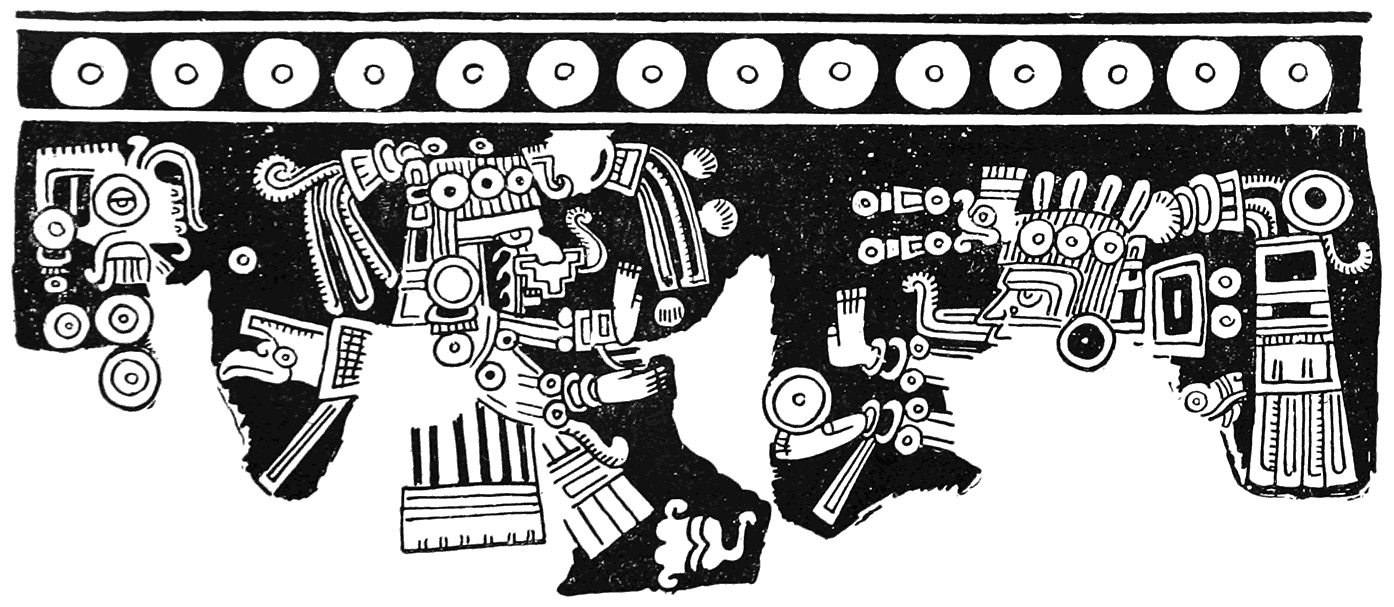
Xochiquetzal and Tonatiuh.
(From a wall-painting at Mitla.)
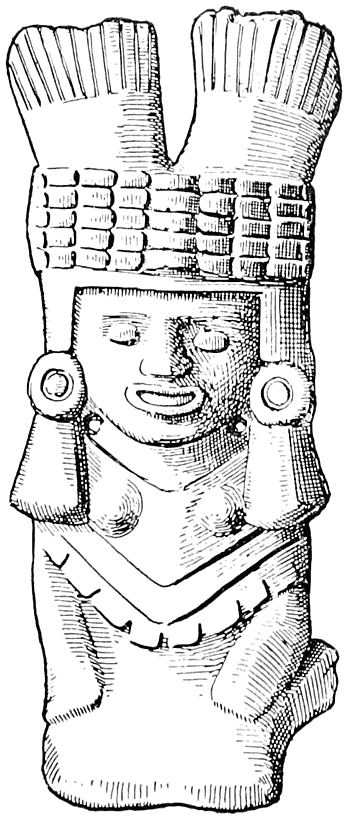
Stone figure of Xochiquetzal.
(Uhde Collection.)
FORMS OF XOCHIQUETZAL.
MYTHS
Perhaps the most important of these is that found in the Sahagun collection of songs or hymns (the ninth item):
Out of the land of the rain and the mist
I, Xochiquetzal, come.
Out of Tamoanchan.
The pious Piltzintecutli weeps;
He seeks Xochiquetzal.
To the land of corruption I must go.
The goddess here declares that, like other fertility goddesses, she comes from the fruitful supernatural country of Tamaonchan, the home of the maize. Piltzintecutli, the Sun-god, seeks her, but, like Ishtar in Babylonian myth, she must betake herself to the Underworld, until it is once more time to resume her growth-assisting labours. We have here good grounds for positing the existence of a popular myth which would seem to have recounted how the divine lovers dwelt happily in Tamoanchan until Xochiquetzal was forced to quit the blest abode or was carried off, and was sought for by the Sun-god, a myth like that of Proserpine or Orpheus. It may refer to the sun seeking the flower, or may have a bearing upon the myth of Ixnextli, a variant of Xochiquetzal, who was expelled from Paradise, and of whom the interpreter of Codex Vaticanus A says: “Ixnextli, who is the same as Eve, is always weeping, her eyes dim with ashes, a rose in her hand, emblematical of her grief, being in consequence of her having gathered it. And accordingly they celebrate a fast every eight years on account of this calamitous event; the fast was on bread and water. They fasted on the eight signs preceding the entrance of the rose, and when that sign arrived, they prepared themselves for the celebration of the festival. They affirm that every series of five days comprised in this calendar was dedicated to this fall, because on such a day Eve sinned. They were accordingly enjoined to bathe themselves on this night in order to escape disease.” Regarding this myth the interpreter of the Codex Telleriano-Remensis says: “They represented her as Eve always weeping and looking at her husband, Adam. She is called Ysnextli, which signifies ‘eyes blind with ashes’; and this refers to the time subsequent to her sinning by plucking the roses. They accordingly declare that they are still unable to look up to heaven, and in recollection of the happy state which she lost, they fasted every eight years on account of this fall.” It is significant that the goddess pictured beside this statement is called “Suchiquezal.”
(From Codex Fejérváry-Mayer.) (From Codex Borgia.)
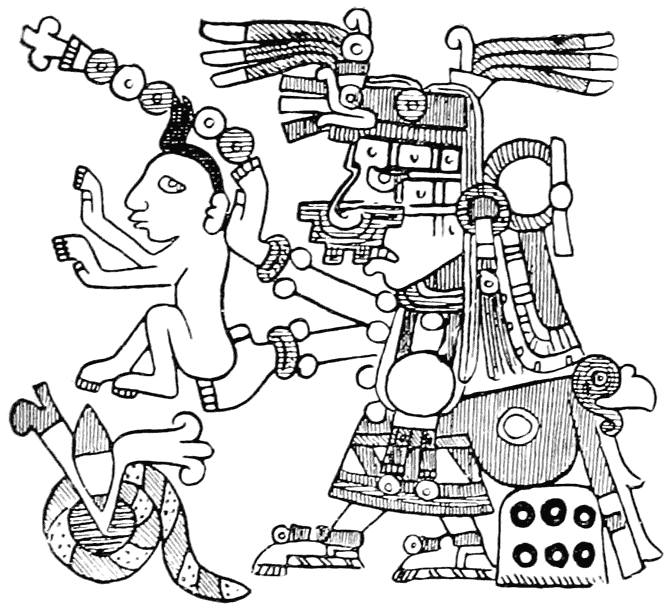
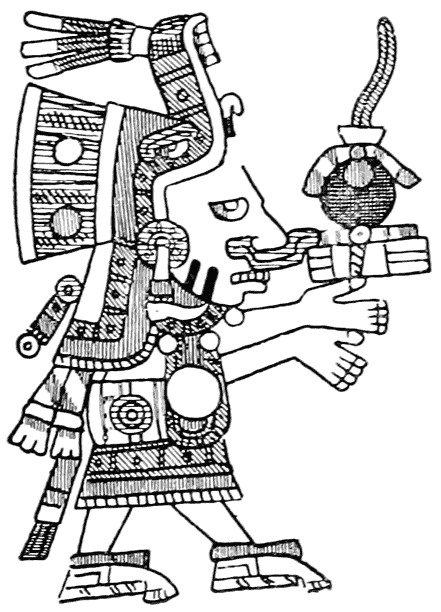
FORMS OF XOCHIQUETZAL.
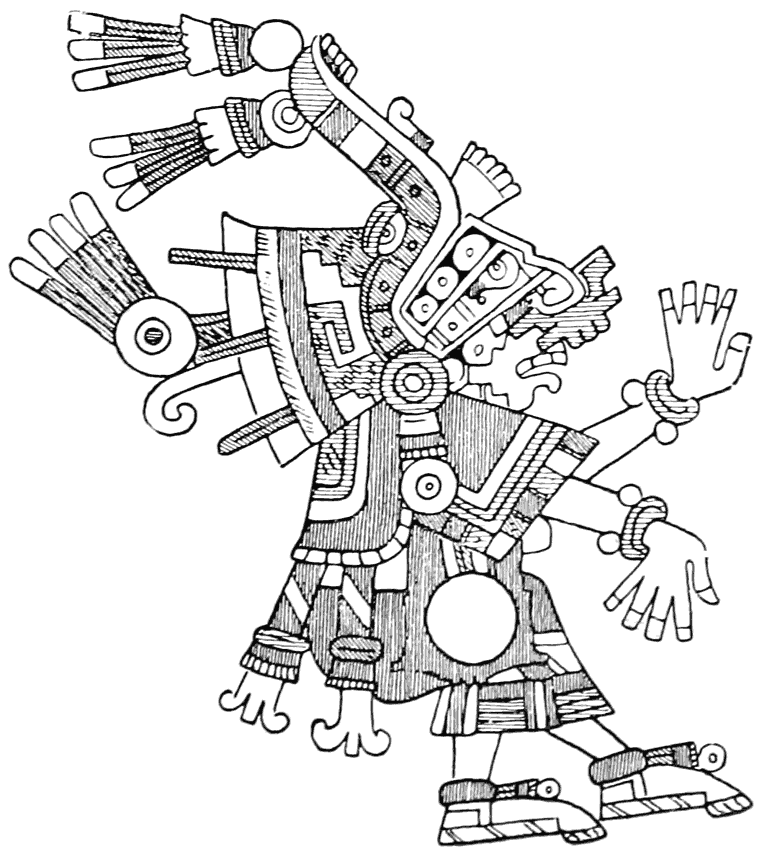
XOCHIQUETZAL
(From the Codex Fejérváry-Mayer.)
FESTIVALS
TEMPLES
NATURE AND STATUS
The original home of Xochiquetzal seems to have been among the Tlalhuica and Tlaxcaltecs. But as the latter were closely connected with the Mexicans racially, there is good reason to believe that she was also an original member of their pantheon. In any case she had a place in the metropolitan calendar, and the contention of the compilers of both interpretative codices, as well as of the native author of the picture writings in the Historia de los Mexicanos por sus Pinturas, that she is to be equated with Tonacaciuatl, the female member of the creative pair, seems to have been a later development.
But Xochiquetzal is more especially the goddess of flowers, the female counterpart of Xochipilli-Macuilxochitl. As has been mentioned, she was probably at first the goddess who presided over some lofty mountain whose streams watered the sun-dried plains beneath and clothed them in abundant florescence, perhaps that very mountain of Xochtecatl to which allusion has been made, and which stood in Tlaxcaltec territory. As the “feminine” of Xochipilli, however, she certainly partook of his festive and frivolous character, and thus presided over the song, the dance, and all sportive amusements. By a further slight effort of imagination she came to be regarded as the goddess of illicit love, or of the sensuous side of intercourse between the sexes, not so much a goddess of degraded animal passion, like Tlazolteotl, as a figure bearing a close resemblance to the Apsarasas of Hindu myth, lovely and voluptuous, and, like them, addicted to the game of throwing the dice (patolli). A further step established her as the patron goddess of the prostitutes who existed for the pleasure of the unmarried warriors and who resided with them in the great common house of the bachelors. From this circumstance arose the obscene character of the feast of Quecholli among the Tlaxcaltecs and the Tepeilhuitl festival among the Tlalhuica.
Xochiquetzal was also in some measure the patroness of pregnant women, according to the interpreter of Codex Vaticanus A, and these worshipped and sacrificed to her in order that they should not give birth to girls. She is herself figured in Codex Borgia as the great parturient, and in Codex Vaticanus B (sheet 39) as has been indicated above.
She had also, like Xochipilli, an artistic significance, as the patroness of weavers and artists. She was revered by the women who practised the former art, the invention of spinning and weaving was attributed to her, and many kinds of craftsmen paid her honours. She had, moreover, a magical side to her character; in the Aubin tonalamatl she is seated opposite the dancing wizard, and she is furthermore one of the Tzitzimimê, or deities of the darksome night, among whom she is symbolized by the spider.
MACUILXOCHITL = “FIVE FLOWER,” OR XOCHIPILLI = “FLOWER PRINCE”
Area of Worship: Tehuacan, Cozcatlan, Teotitlan del Camino, Oaxaca, Mexico.
Minor Names: Auia teotl = “God of Pleasure.” Mazatl = “Deer.” Auiatl = “The Jovial.”
Symbol: The sign five-flower.
Calendar Place: Ruler of the eleventh day-sign, ozomatli. Seventh of the thirteen day-lords. Ruler of the twentieth day-count, xochitl.
Festival: The Xochilhuitl (“Feast of Flowers”), one of the movable feasts.
Compass Directions: South; West.
Relationship: Brother of Ixlilton; son of Piltzintecutli.
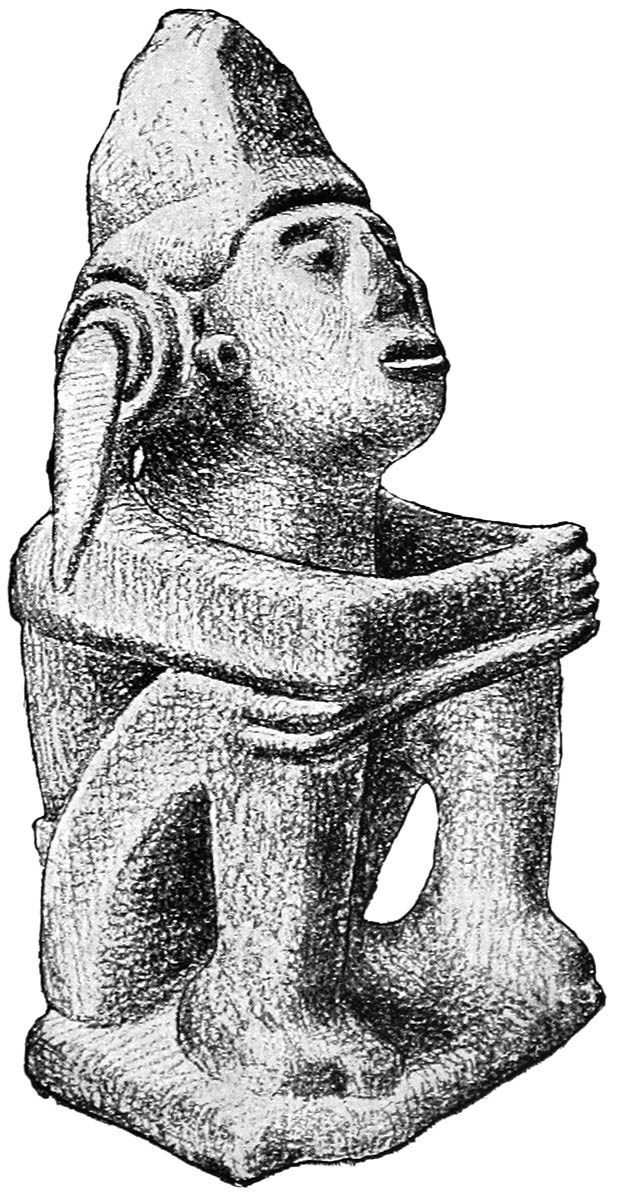
STONE FIGURE OF MACUILXOCHITL.
(In the Uhde Collection, Berlin.)
ASPECT AND INSIGNIA (as Macuilxochitl)
Codex Borgia.—Sheet 15: In this place the god wears as breast-ornament a human lower jaw, which, combined with the green band to which it is tied up, may possibly express the day-count malinalli. He has a large feather nape-ornament. The upper part of his face is white, with a dark band over the nose and cheek, and white painting over the mouth, in the semblance of an outspread hand. He wears a cap with vertically projecting bands painted in the colours of the green jewel chalchihuitl.
Sahagun MS.—Here he is represented with a white hand painted on his mouth and a feather crown surmounted by a crest.
General.—Like the other gods of dance and sport, Macuilxochitl wears the four balls of the toualli emblem on his shield and sometimes carries the staff with the heart. Like Ixtlilton, he had probably once a bird’s-head mask, which in the course of his evolution degenerated into a feather crest and a wing on his back. The deterioration of this feature can be observed in the stone effigies of his counterpart Xochipilli.
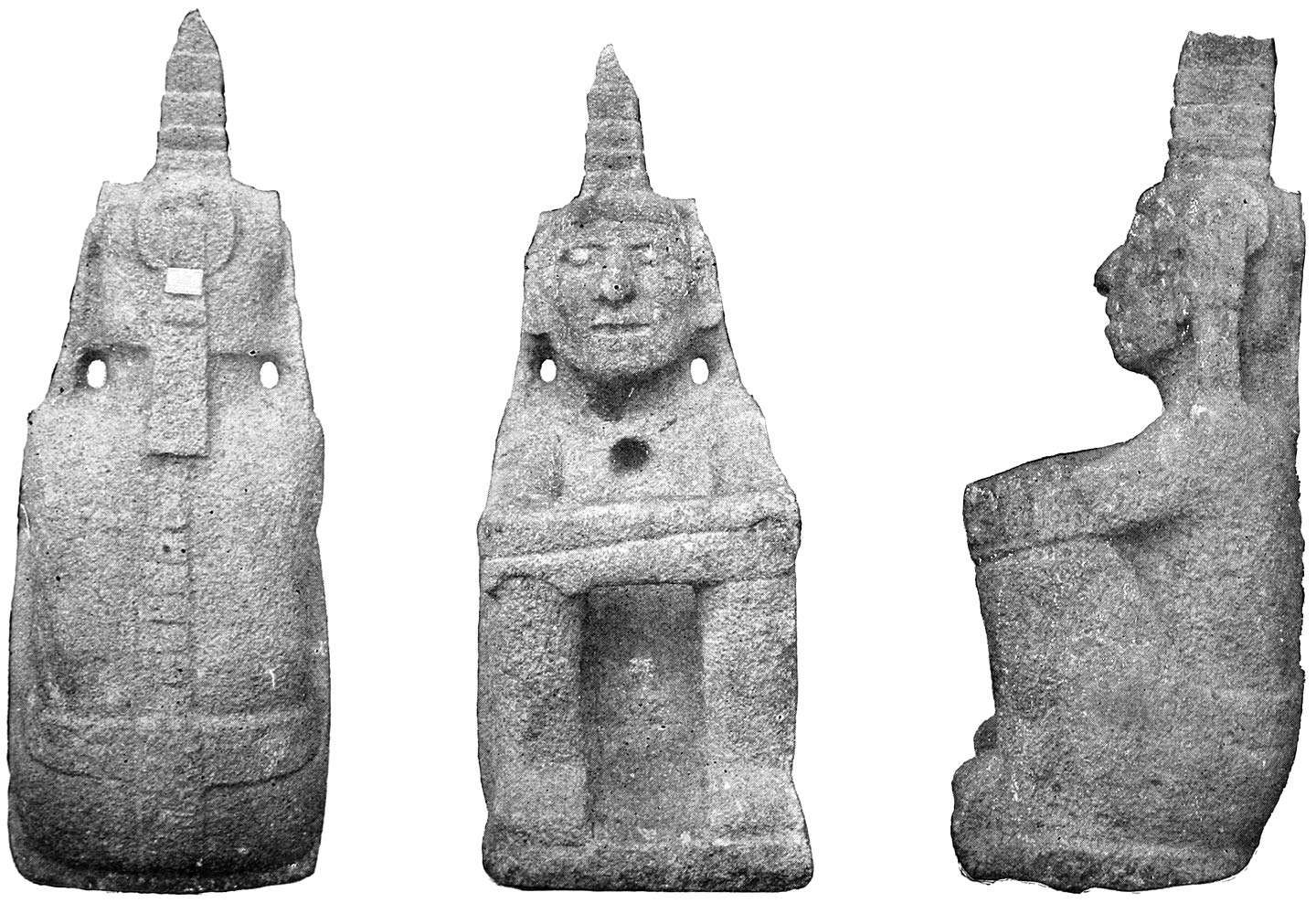
STONE FIGURE OF MACUILXOCHITL.
(In the Uhde Collection, Berlin.)
STATUES
A stone figure of Macuilxochitl found in Cuernavaca represents the god seated in a squatting attitude, and it is evidently intended to show him as an onlooker at the ball-game. He wears a pointed headdress or mitre, on the top of what would seem to be a cotton head-covering. A head of the god in stone is included in the collection of the Natural History Museum at Vienna. In this the nose-plug is prominent and he wears round earrings. The wing-ornament stands well out behind the head and the face seems to look out of a bird helmet-mask, on both sides of which are large, circular holes, through which feathers or cotton ear-plugs fall. The difficulty of working in stone has evidently restrained the sculptor from representing the upper and lower portions of the bird’s beak, and the helmet-mask bears a strong resemblance to that of Xochipilli in the Codex Magliabecchiano, if the beak in that representation were removed. A statue of the god found in the Calle de las Escalerillas in Mexico City on December 13, 1900, is almost identical with the first of those two statues, and agrees with the second in that here we have the circular holes at the side of the headdress with the dependent feathers or cotton plug. The best known of the representations of this god, however, is the clay model found by Seler at Teotitlan del Camino. It represents Macuilxochitl in a sitting position and is brilliantly coloured. The face of the god looks out of a bird helmet-mask, highly conventionalized, and which has practically lost all its birdlike characteristics. The two circular holes below the ear are, however, still represented. The upper part of the face is painted yellow, but under each eye is an oblong patch painted in variegated colours, such as appears on the faces of the gods of grain. Around the mouth is a large white patch, in which we may see the white hand motif conventionalized. The body-paint is red and the garment white, except that portion at the neck, which is blue. Small golden bells adorn the necklace and wristlets. In this statuette we have evidently a very late and highly developed figure of the deity, showing a considerable departure from the earlier drawings and statues of him. In the Anthropological Museum at Berlin is a stone statue of Macuilxochitl, also in a squatting attitude, in which the circular motif above the ear, with its accompanying plug, is strongly in evidence. A number of stone statuettes of the god were found at Tepeaca in the state of Puebla and are now housed in the Natural History Museum at Vienna. These do not differ from the examples already described, save that in one of them the Greek fret-pattern takes the place of the circular ear-plug motif. A stone figure of the god was found amid the ruins of the Castillo de Teayo, a teocalli, or pyramid, in Vera Cruz. In this, which is also a squatting figure, the god is covered by a mantle which is surmounted by the bird’s comb, as seen in Magliabecchiano and elsewhere. Around the head are three of the circular holes above mentioned, one above each ear and one at the back of the head, from which depend a double strip of cotton or other textile.
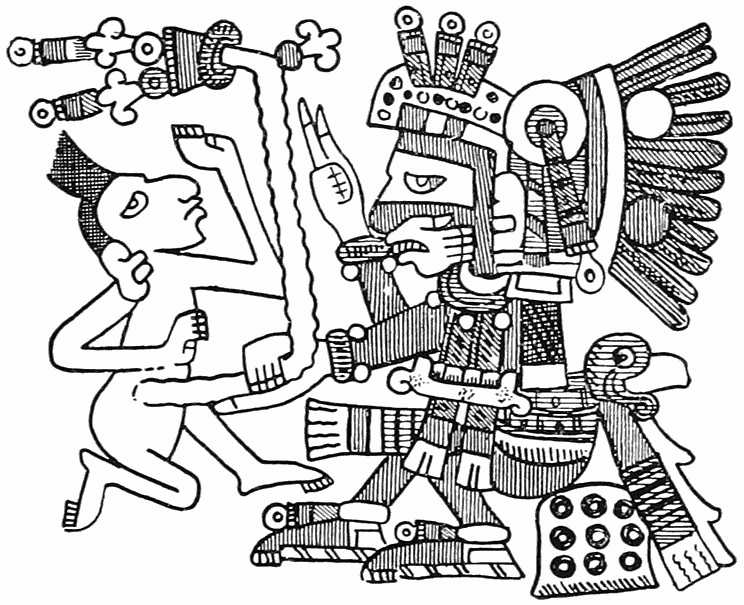
(From Codex Borgia, sheet 15.)
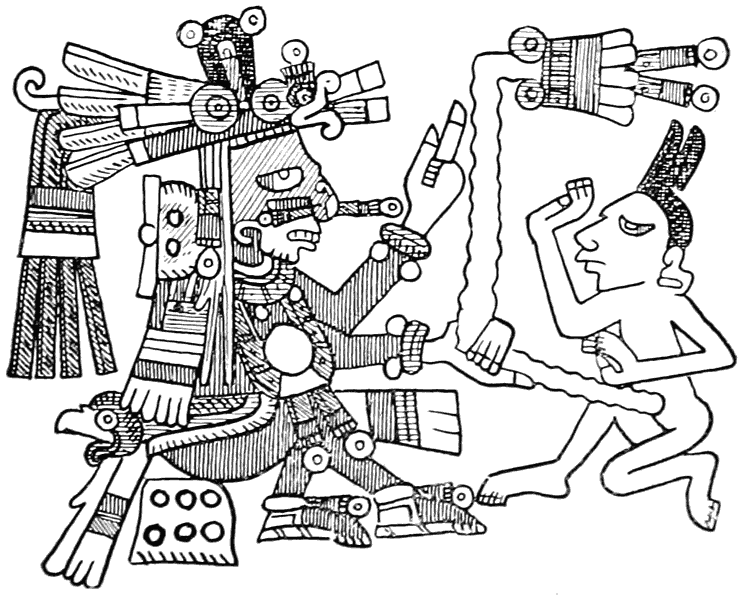
(From Codex Borgia, sheet 16.)
FORMS OF MACUILXOCHITL.
ASPECT AND INSIGNIA (as Xochipilli)
Codex Vaticanus B.—Sheet 26: In this MS. the god is painted a light yellow colour. His light hair is bound with a jewelled strap ornamented on the frontal side with a conventional bird’s head. Round his head he also wears the fillet of the Sun-god, ornamented with a feather tuft. As a breast ornament he has a large gold disk suspended from a broad gold chain, hung with bells. His right hand clasps a bundle of grass, and in his left he bears a staff embellished with turquoise mosaic and flowers, probably intended for a rattle-stick. Above the twilight symbol of the west in the water are instruments of mortification. On sheet 32 he is represented as of a blue colour with a jewelled chain in front of his mouth.
Codex Fejérváry-Mayer.—The description of the god in this MS. is similar to that just given. In his hand he supports a dish with ornaments, a bangle for the upper arm, a feather tuft and a neck-chain.
Codex Borgia.—Sheet 13: In this codex he is seen seated on a royal throne. His body and the lower part of his face are coloured red, the upper facial region is painted yellow, but contains a small, rectangular field, half-red and half-white, while round the mouth is executed a butterfly design, after the manner of Tonacatecutli and the maize-gods. His blue ear-plug has a jewelled thong dependent from it, and his nose-plug is reproduced in the colours of the chalchihuitl jewel. On his head he wears the strap decorated by two large jewelled disks. On the frontal side is the stereotyped bird-ornament, while from the whole, four ends branch off. Surmounting this representation is the symbol of the night-sky, the dusk-enveloped eye. His nape-ornament consists of red and white feathers blended together. On his breast is a large disk of gold, secured by strings of greenstone beads. His loin-cloth is adorned with jewelled disks, and to the back-bow is fastened a coxcoxtli bird’s head, which serves as a “mirror-tail,” or back-mirror. A portion of the ends of his loin-cloth is coloured like the chalchihuitl jewel. In front of his mouth is a flower from which two jewelled thongs project.
Codex Magliabecchiano.—The mantles worn by Xochipilli are alluded to in the MS. which accompanies the paintings in this codex as “mantas de un selo señor o de Cinco Rosas y manta de Cinco Rosas” (see sheets 5 and 6). There is also a picture of him on sheet 47. The figure on the red quemitl which he wears is similar to that worn on sheet 20 of Codex Borbonicus by the god Cinteotl, and is, perhaps, a butterfly motif.
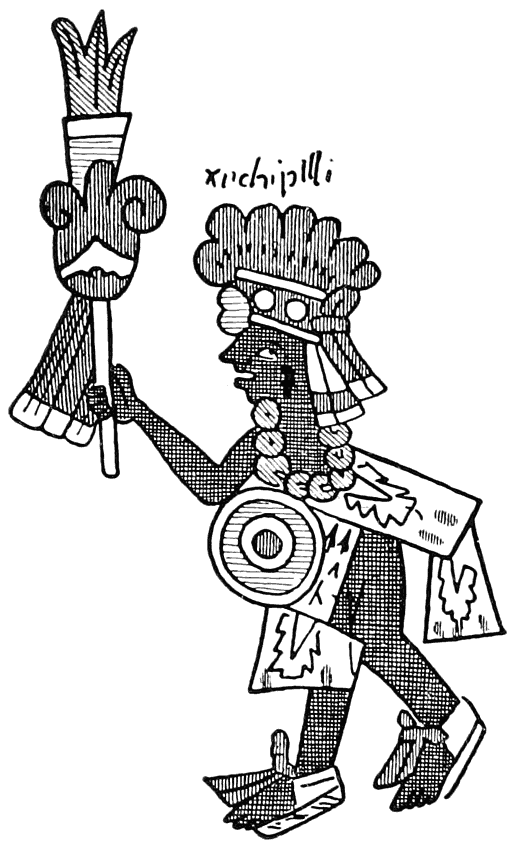
(From the Sahagun MS.)
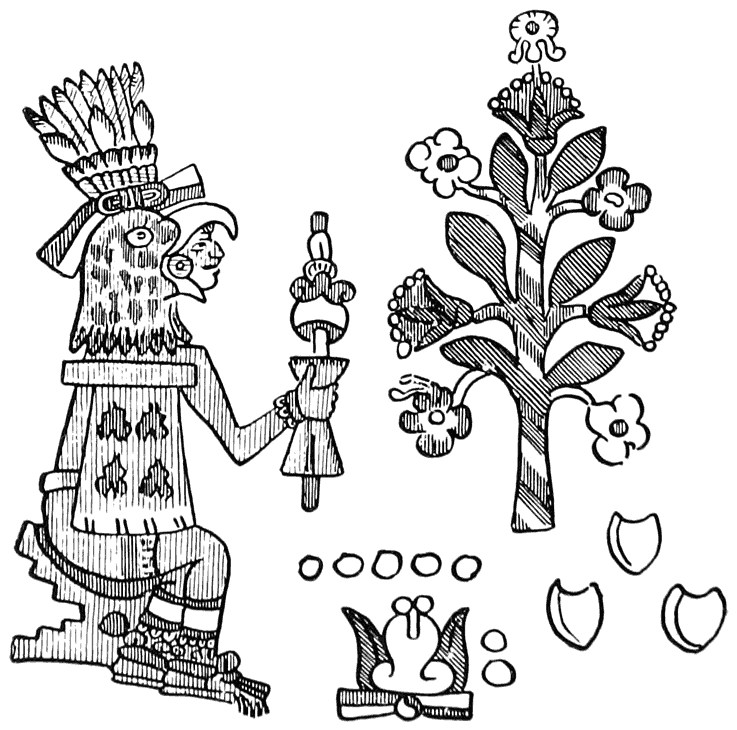
(From Codex Magliabecchiano, folio 35.)
FORMS OF XOCHIPILLI.
STATUES
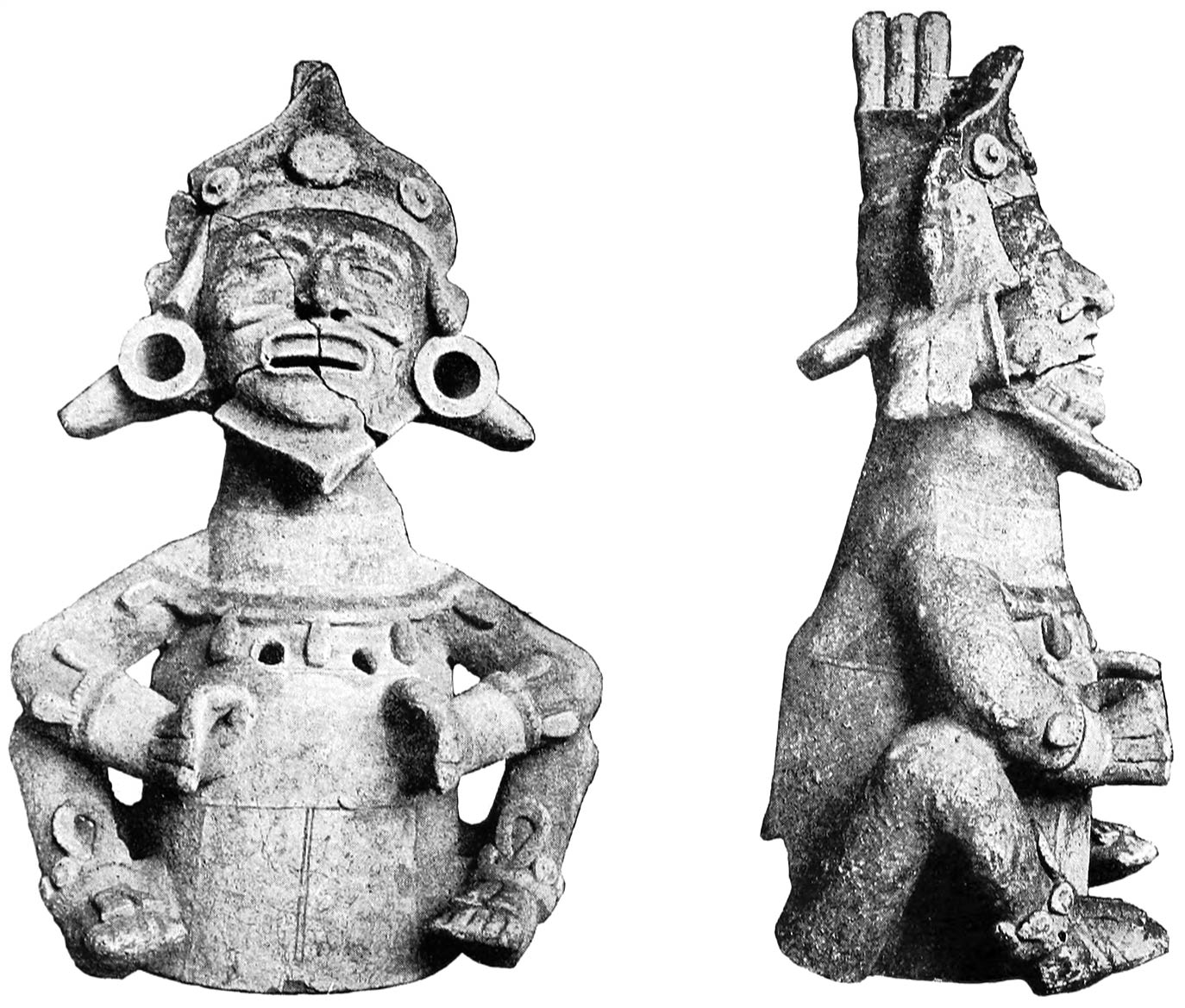
POTTERY FIGURE OF XOCHIPILLI.
(Found at Teotlan del Camino.)
MYTH
Song of the God of Music and Games
Out of the place of flowers I come,
Priest of the Sunset, Lord of the Twilight.
I come even now, my granddam,
Thou of the thigh-skin face-painting,
Lady of the Sunset,
I, priest of the Sunset, Lord of the Twilight.
The god of evil omens,
The lord Tezcatlipocâ,
Shall answer to me, the Maize-god.
In the temple of the octli-god
The rabbit has come to life again.
It runs about.
By my god was it created.
I will bring down the fire-drill, fire will I twirl
On the mountain of Mixcoatl in Culhuacan.
Raising my voice, I strike the little mirror;
The little mirror has grown weak
In the temple of the octli-god.
The white hair grows moist,
Ripe has the octli become.
Statues of Xochipilli in Museo Naçional, Mexico. (From Codex Laud.)
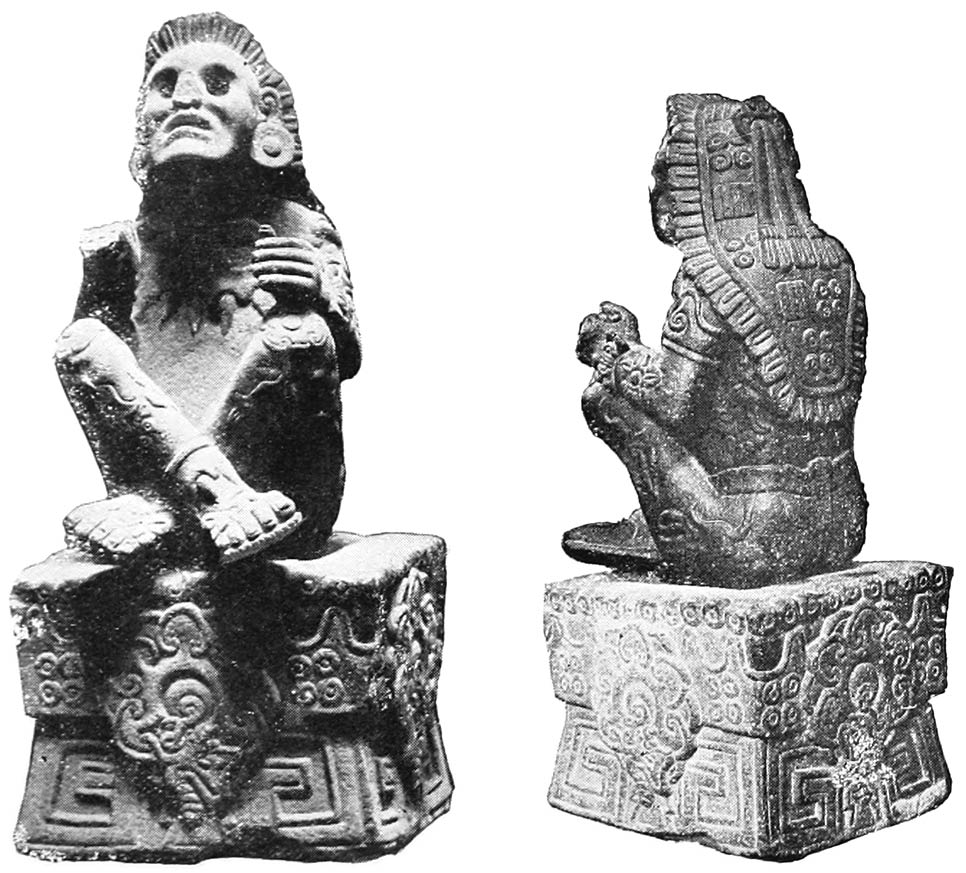
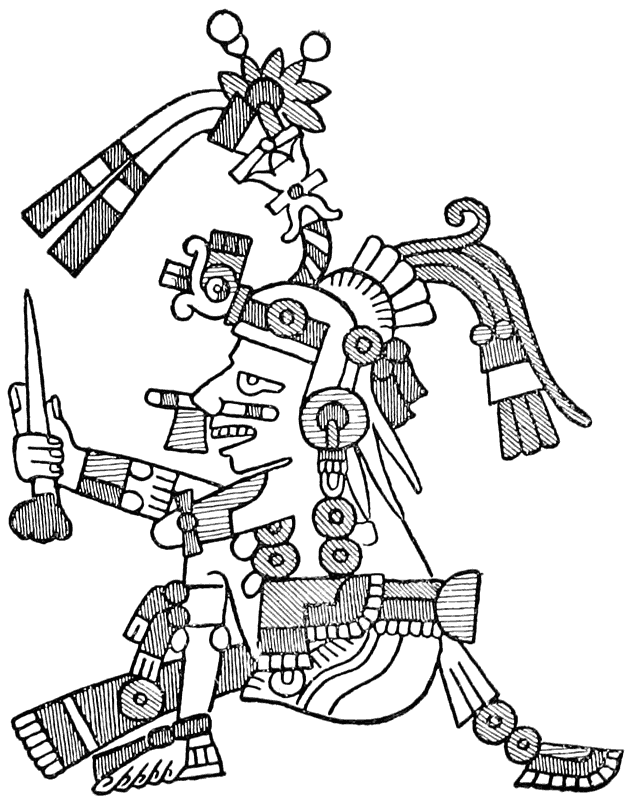
FORMS OF XOCHIPILLI.
FESTIVALS
Xochilhuitl.—Of the feast of flowers over which this god presided Sahagun says: “The great folk made a feast, dancing and singing in honour of this sign, decorating themselves with their feathers and all their grandeur for the areyto. At this feast the king bestowed honours upon warriors, musicians, and courtiers.” He states (Lib. II, Appendix c, xix): “They made each year in his honour a feast called xochilhuitl.… During the four days which preceded this feast all those who were to take part in it, men as well as women, observed a rigorous fast; and if during that period a man had commerce with a woman or a woman with a man, they held that the fast was soiled; that the god held it for a high offence, and that he would visit the offenders with maladies in their privy parts.… Before the feast everyone deprived himself of the use of chilli pepper. They fed upon a kind of broth called tlalcuilolatolli, which is to say, ‘broth decorated with a flower in the middle.’… Those who fasted without the use of chilli or other savoury things, ate only once a day at midday.” Those who did not fast ate fermented bread. The people ornamented themselves with the symbols of the gods “as if they aspired to represent their images,” and danced and sang to the sound of the drum.
At midday they beheaded a great number of quails and made offerings of their blood before the image of the god. They also pierced their ears in his presence. Others pierced the tongue with the spines of the maguey, and passed through it a great number of osier reeds. Another ceremony consisted of making five tamalli (cakes) of maize, which they called “fasting bread.” These were placed beneath an arrow called xochimitl (“flower-dart”) and were offered to the idol as from the whole community. Those who wished to make a separate offering gave the god five tamalli upon a wooden platter, and chilmolli soup in a vase. Maize in all shapes and forms was also offered up. On the same day all the great folk in Mexico who lived near the frontiers of an enemy brought the slaves whom they had captured to the capital for sacrifice.
NATURE AND STATUS
But he had also a more worthy side, for to artists of all kinds, painters, weavers, and musicians in especial, he stood as the patron of all artistic effort, and those engaged in it celebrated their worship of him at the xochilhuitl festival. Several of the mantle designs in the Codex Magliabecchiano indicate that as a flower-god he was not forgotten by the weavers’ caste.
He has associations with several other gods besides Cinteotl, especially with Ixtlilton (q.v.), who is spoken of as his brother, and with the Ciuateteô, or deceased warrior women, probably because as a food-god he was supposed to come from the west, the place of plenty, where they resided, or, more likely, because of the hunger for earthly excitement displayed by these pleasure-starved dead women, debarred from the sensuous delights of earth. His connection with the octli-gods as the god of merriment and abundance of victuals and festive good things is plain; and he is very naturally the male counterpart of the goddess Xochiquetzal (q.v.). As hailing from a locality where planetary mythology was in an advanced condition, and where the worship of the morning star was practised, he may have had an astronomic significance, but what this was precisely is by no means clear. We probably assess his nature correctly if we allude to him as a god of pleasure, feast, and frivolity.
XIPE TOTEC = “OUR LORD THE FLAYED”
Area of Worship: Plateau of Anahuac, Zapotecs, Yopis.
Minor Names: Tlaltecutli = “Lord of the Earth.” Anauatl yteuc = “Lord of the Seaboard.” Tlatauhqui Tezcatlipocâ = “The Red Tezcatlipocâ.” Itztapaltotec = “Our Lord of the Flat Stone.” Youallauan = “Night Drinker.”
Symbol: In Codex Borgia a quail with its head torn off seems symbolical of this god.
Calendar Place: Lord of the fifteenth day, quauhtli, and of the fourteenth week, ce itzcuintli; with the Fire-god, lord of the twentieth tonalamatl division, ce tochtli.
Festival: Tlacaxipeuliztli.
Compass Direction: West.
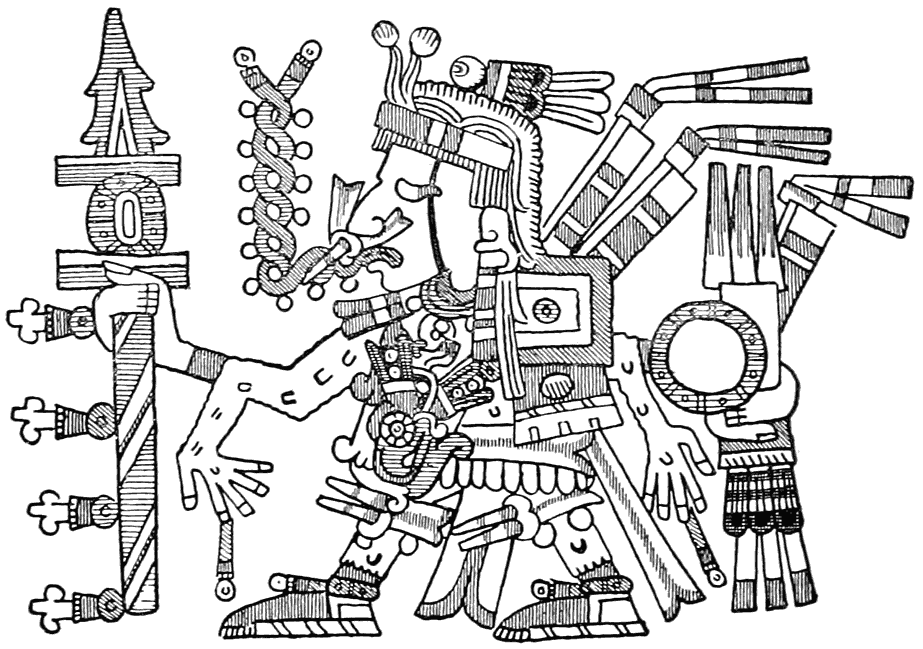
(From Codex Borgia, sheet 49.)
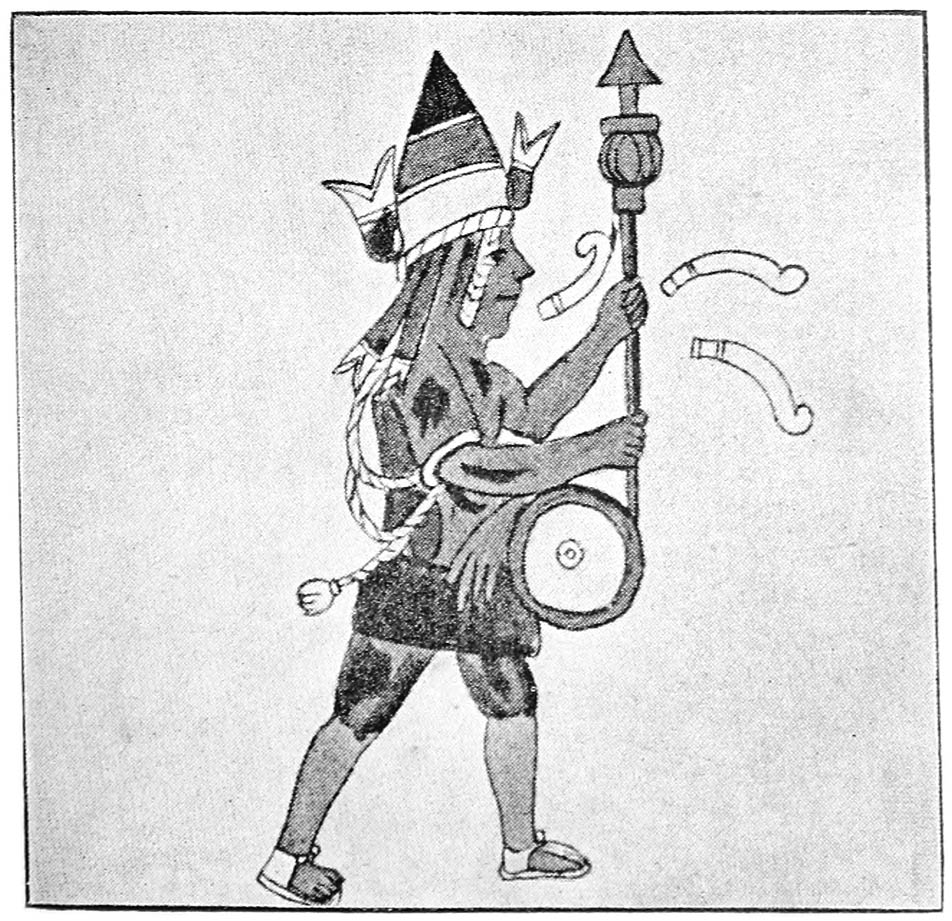
(From the Sahagun MS., Bib. Laurenziana.)
FORMS OF XIPE.
ASPECT AND INSIGNIA
Codex Vaticanus B.—Sheet 92: Xipe is depicted in this codex as clothed in the flayed skin of the sacrificed human victim, which, after the dreadful rite, was drawn over the priest’s body and worn for a number of days. The slit eyes of the mask he wears shows that this also is composed of human skin. He wears a nasal rod and plate having the general appearance of the peculiar peaked cap with which he is sometimes represented. The ends of his loin-cloth are slit and coloured white and red. Sheet 62. As ruler of the fourteenth tonalamatl division and god of the fifteenth day-count, Xipe is represented on this sheet as a red Tezcatlipocâ. The limbless body is red, the costume of the same colour, but with a face-mask of yellow, tinted to represent dead human flesh, with the chapfallen jaw of the dead, narrow slit eyes, as on sheet 92, and a red streak running over the eye, the full length of the face, indicative, perhaps, of the place where the operation of flaying was commenced. Here the nose-cap is also reminiscent of Xipe’s peculiar peaked cap, its ends especially resembling those of that headdress. Two red and white bands, the colours of the roseate spoonbill, depend from the ear. The hair is bound by a fillet on which are twin ornaments of dull gold, and above this rise two rows of quetzal feathers.
Codex Vaticanus A.—Plate xiv, Duc de Loubat’s reproduction: As a back-device he wears the three banners which are also shown of him in the picture in Duran’s collection. As god of the fourteenth tonalamatl division, he holds a shield, banner, and a bundle of spears, while half of his shield is painted in dark and light red rings.
Codex Borgia.—Sheet 49: In the Codex Borgia, Xipe is shown in his character of the patron god of the warrior’s death by combat, or the stone of sacrifice. He wears a wig made from the downy feathers of the eagle, which, however, does not altogether conceal his flame-coloured hair, two forelocks of which recall the hairdressing of Tlauizcalpantecutli, the god of the planet Venus. Underneath is shown his small petticoat or apron of green zapote leaves. From his mouth protrudes a double-jewelled string, which, perhaps, signifies the fertilizing rain, for as god of human sacrifice he has a connection with the gods of fertility. He is similarly represented on sheet 25, where he is also shown as ruler of the fourteenth tonalamatl division, and the picture indeed bears a close resemblance to that in Codex Vaticanus B, except that his breast-ornament, carved from a snail-shell, is attached to his variegated feather necklace. In this place he also wears a feather wig with a red crest made of the plumes of the roseate spoonbill, alternating with chalchihuitls on leather and the heads of rattle-sticks.
(Front.) (Back.)
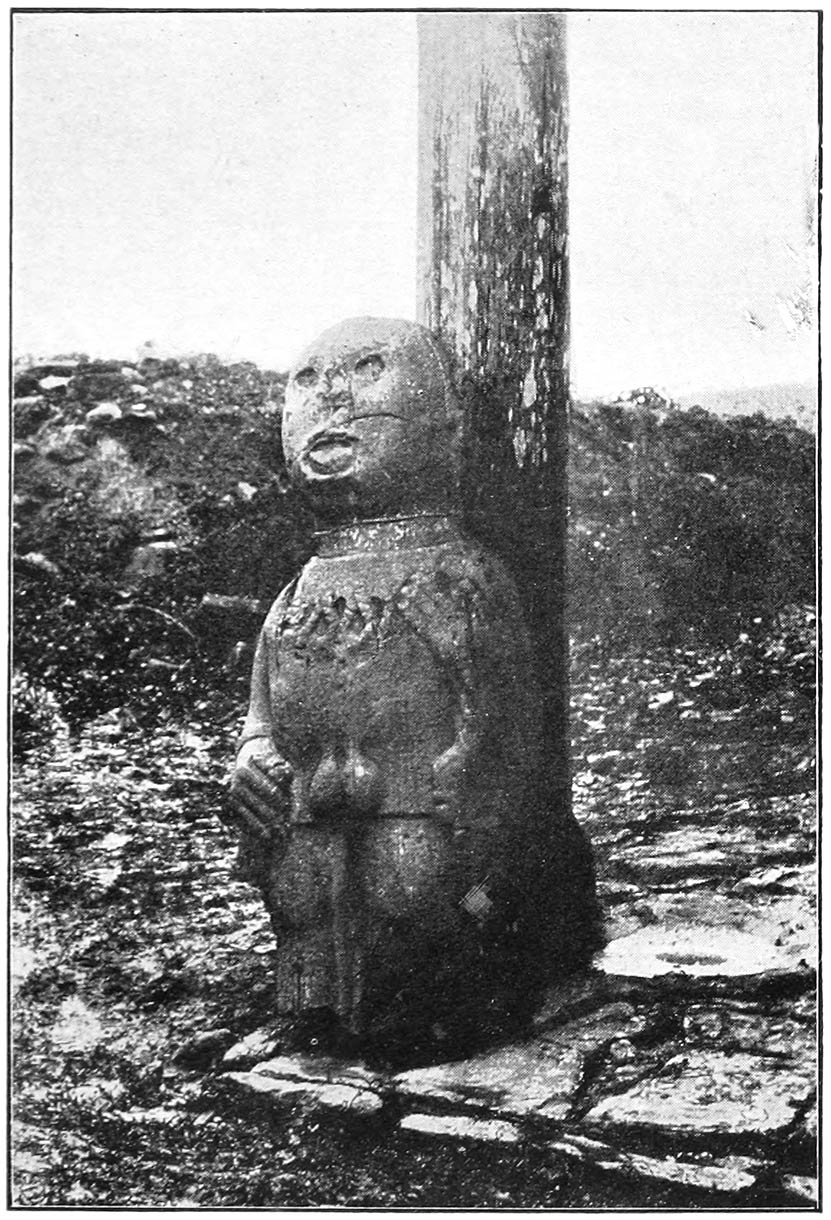
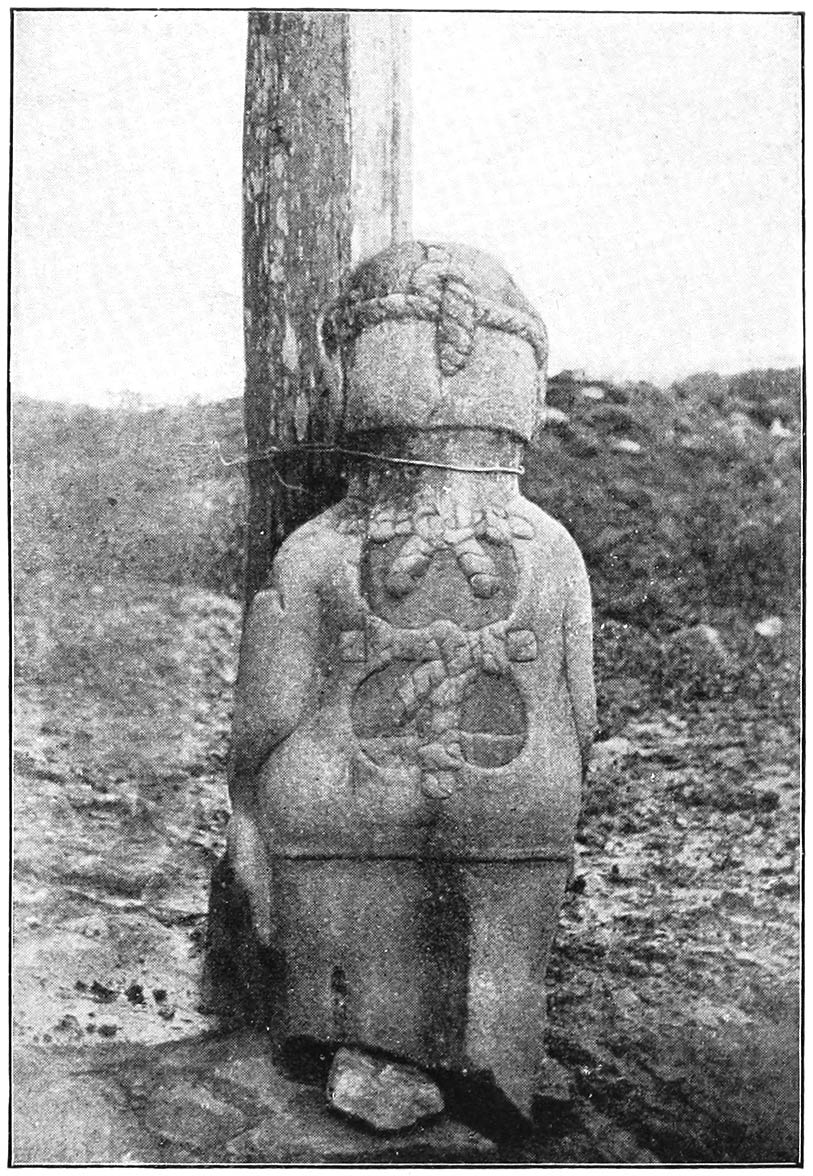
STONE IMAGE OF XIPE.
Image of Xipe found at Castillo de Teayo, showing him dressed in the skin of the sacrificed victim.
Codex Borgia Group Generally.—In this group generally Xipe stands as the representative of the sign of the day quauhtli. His insignia are the same as those of the red Tezcatlipocâ, with striped face-painting, but executed in red and yellow without the human skin, or other special characteristics, and decorated only with the warrior’s headdress and Tezcatlipocâ’s ring-shaped breast-ornament. The head and neck are covered with cloth, on which are stuck downy feather-balls. He holds in some places a severed arm, which he appears to be smelling or about to devour.
Codex Borbonicus.—In this codex Xipe is represented as Tezcatlipocâ, and has the face-painting of the red phase of that god, with the smoking mirror at his temple, the characteristic white ring, and the peculiar form of feather back-ornament, which is to be seen in some other Tezcatlipocâ pictures of this codex. But he wears on his head-fillet, instead of jewelled disks, an ornament of beaten gold, the crown of roseate spoonbill feathers, the ends of the bands shaped in swallow-tailed fashion, and other insignia pertaining to his own regular dress. The quetzalcomitl on his back carries a banner painted in light and dark red, his especial colours, and he also bears a shield painted in light and dark red concentric circles. In this codex he holds a fire-pan, painted with large patches of rubber gum, in which is inserted the rattle-stick with Xipe’s bands and loops coloured red and white, or light red and dark red with bifurcated ends.
Vienna Codex.—Xipe is represented here in the flayed human skin and designated by the date “Seven Rain.”
Codex Nuttall (Zouche).—Sheet 83: In this codex there is a good representation of the god, especially as regards his headdress. He is depicted as the warrior secured to the stone of combat, whose eye sheds tears at the thought of approaching death, and he bears in his hands the bâtons with which the military victims defended themselves against their adversaries (see Festival).
Sahagun MS.—This describes him as having a brown face covered with the feathers of the quail, and with open lips (chapfallen jaw?). His crown has parted ends, and he wears a wig of curled feathers. He has golden ear-plugs. Round the hips he has a woman’s short skirt of zapote leaves, and shells decorate his feet. His shield is red, with concentric circles, and he carries a rattle-staff.
MASKS, VASES, ETC.
The well-known mask of Xipe in the British Museum represents the mask of the sacrificed victim. On the back or inside, the carving of the god shows him wearing his full insignia, with the peculiar headdress and rattle-staff. Another mask of Xipe in the Bauer collection is of a most individual character. It was found near Tezcuco, and bears both wind and serpent symbols. On a stone at Cuernavaca is incised a good representation of the shield, darts, and flag of Xipe, with date ce ocelotl (“one ocelot”). On a cup in the Aldana collection Xipe is seen wearing the flayed skin, with a necklace, evidently of intestines. His hair is dressed in a manner resembling that affected by the warrior caste, and he carries the rattle-staff.
STATUES
Representations of Xipe in statuary are considerably numerous. Several found in the Valley of Mexico are housed in the Uhde collection, Berlin. Two of these represent the god as wearing the victim’s flayed skin and one of them is pitted with marks, evidently indicative of blood-spots. The crown with feathers of the roseate spoonbill is well exemplified in one of these, but in the other a mitre-like headdress superimposed upon a circular crown, from which depend large ribbons or paper ornaments, is noticeable. In another of these figures the headdress is a sort of barret-cap with knobs or studs. Still another figure of the same class shows the god with a very large stepped nose-ornament. All carry a rattle-staff and three bear a shield. A most striking statue of Xipe was discovered at the Castillo de Teayo site, at Vera Cruz. The head, which is round and bullet-shaped, bears an extraordinary resemblance to that of the well-known Egyptian figure of the Sheik-el-Beled in the Boulaq Museum. In this statue the god wears the skin of the victim, and the manner in which it was tied on to the priest is well illustrated by the knotting at the back. The faces, of course, are masks of the sacrificed victim.
ELEMENTS OF XIPE’S INSIGNIA
(1) The painted crown of feathers of the roseate spoonbill, with bifurcated ends.
(2) The gilded timbrel.
(3) The jacket of spoonbill feathers.
(4) The petticoat or apron of zapote leaves, overlapping each other like tiles.
(5) The jaguar or ocelot-skin scabbard.
(6) The round shield covered with red spoonbill feathers, showing concentric circles of darker tints, sometimes noticeably bisected, one-half of which is again subdivided obliquely into a smaller upper portion containing a chalchihuitl on a blue field, and a larger lower portion, covered with jaguar or ocelot-skin.
Xipe’s dress has three forms:
(1) That of the red god, of the colour of the roseate spoonbill.
(2) That of the blue god, of the colour of the blue cotinga.
(3) As a jaguar or ocelot.
(From the Sahagun MS.) Pottery Figure found near Tezcuco. Pottery figure. (Valley of Mexico.)
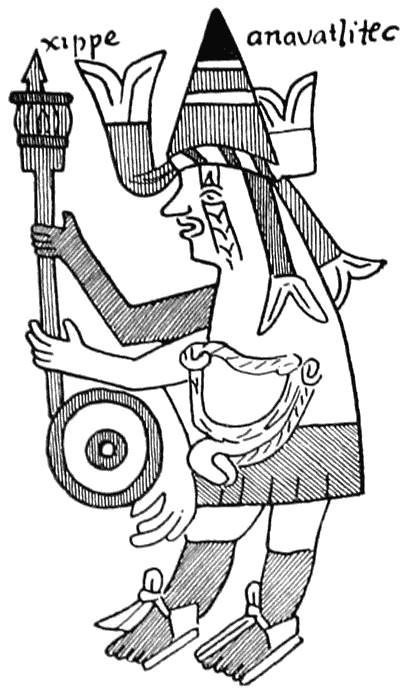
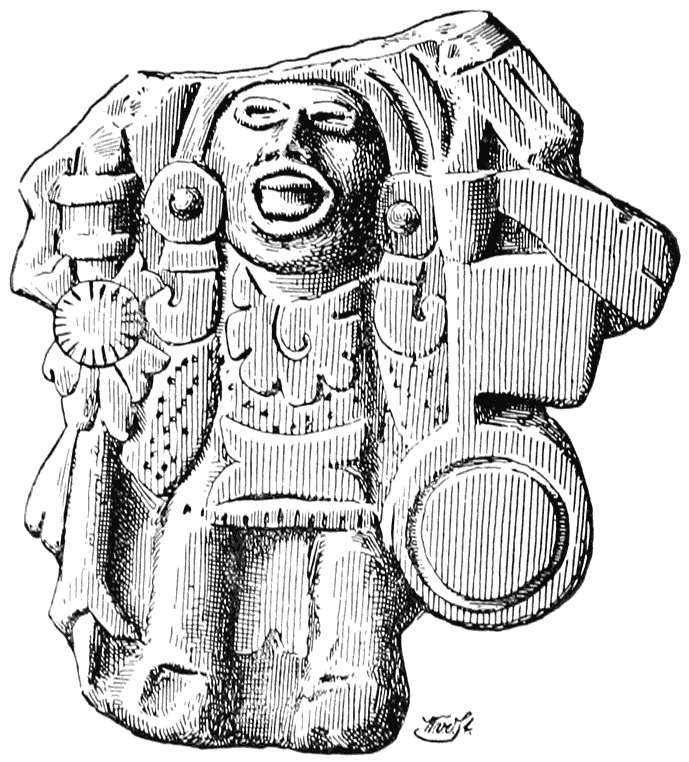
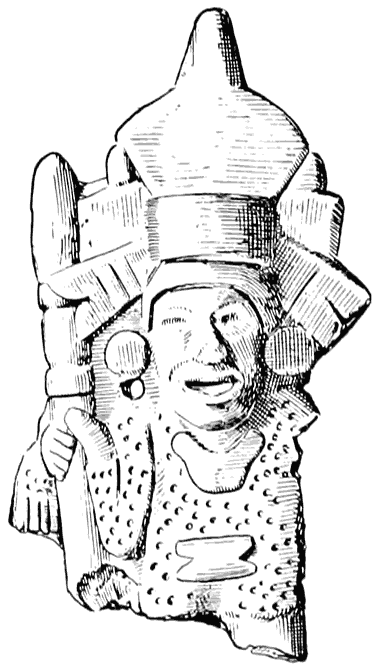
FORMS OF XIPE.
MYTHS
The interpreter of Codex Vaticanus A says of Xipe: “Amongst those who began to follow the example of Quetzalcoatl and his austerities by their own acts of penance, Totec is very famous, who, on account of his having been a great sinner, first stood in the house of sorrow called Tlaxipuchicalco, where, having completed his penance, he ascended the mountain Catcitepulz (‘the mountain which speaks’), which mountain was covered with thorns. There continuing his penance, he cried from thence very strongly, reproving his people of Tulan, calling to them to come and do penance with him for the enormous guilt which they had incurred in forgetting the services and sacrifices of their gods and having abandoned themselves so much to pleasure. They say that Totec was accustomed to go about clothed in a human skin and so it has been the custom till those times. In the festivals, likewise, which they celebrated to Totec, men clothed themselves in the skins of those whom they had slain in war and in this manner danced and celebrated the festival of the sign dedicated to him (for from him, they say, wars originated), and accordingly they paint him with these insignia, viz. a lance, banner, and shield. They hold him in the utmost veneration, for they say that he was the first who opened to them the way to heaven; for they were under this error amongst others; they supposed that only those who died in war went to heaven, as we have already said. Whilst Totec still continued doing penance, preaching and crying from the top of the mountain which has been named, they pretend that he dreamed this night that he beheld a horrible figure with its bowels protruding, which was the cause of the great abomination of his people. On this, praying to his god to reveal to him what the figure signified, he answered that it was the sin of his people, and that he should issue an order to the people, and cause them all to be assembled, charging them to bring thick ropes, and to bind that miserable spectre, as it was the cause of all their sins, and that, dragging it away, they should remove it from the people, who, giving faith to the words of Totec, were by him conducted to a certain wild place, where they found the figure of death, which, having bound, they dragged it to a distance, and drawing it backwards, they fell all into a cavity between the two mountains, which closed together, and there they have remained buried ever since; none of them having effected their escape, with the exception of the innocent children who remained in Tulan.”
A few lines farther on the interpreter says: “The two masters of penance were Quetzalcoatle and Totec, who was called by another name, Chipe; who, having taken the children and the innocent people who remained in Tulan, proceeded with them, peopling the world, and collecting along with them other people whom they chanced to find. They further add that, journeying in this manner with these people, they arrived at a certain mountain, which not being able to pass, they feign that they bored a subterranean way through it and so passed. Others say that they remained shut up and that they were transformed into stones, and other such fables.”
The first part of this myth is, of course, merely ætiological of the practice of making vows to Xipe to capture and immolate an enemy in his honour, as, we shall see in the paragraph dealing with his festivals, was done on that occasion. But I would point out that it possesses some importance as providing further evidence regarding the existence of the ascetic life in Mexico, most of the myths dealing with which, like that under discussion, are connected with the Toltecs, the people of Quetzalcoatl. Xipe, who plays the part of the Toltec Jeremiah, is here the subject of a tale which is also recounted of Tezcatlipocâ, with whom he is frequently confounded or identified, perhaps because both were great gods of the sacrificial stone, or for the reason that practically all Mexican cults tended to gravitate towards Tezcatlipocâ in late times.
The following song from the Sahagun MS. is in celebration of Xipe:
Wherefore dost thou disguise thyself, O Night-drinker?
Put on thy golden garment.
O my god, thy rich sacrificial water descended;
The lofty cypress tree has become a quetzal;
That which was a serpent has become a quetzal.
The fire-serpent, the famine, has left me.
It may be that I shall go thence to perish,
I, the young maize-plant.
My heart is like a chalchihuitl;
But I shall yet see gold in that place.
I shall be satisfied when I can say
The warrior chief is born.
Let the maize be ready in abundance, O my god.
I look towards thy mountain, I, who worship thee.
I will be satisfied
When the maize ripens,
When the warrior chief is born.
Xipe is here entreated by the young maize-plant to don his golden garment, the rain, as, indeed, one translation of this song states it to be, taking a reasonable liberty with the original. When the rain comes the cypress glitters like a quetzal-feather, a Mexican euphuism for a glittering gem, or anything very precious. The xiuhcoatl, or fire-serpent, is the terrible weapon of Uitzilopochtli, with which he slew his rebellious brothers and sister, the enemies of his mother Coatlicue, as Indra slew those of his mother, both of these events occurring immediately after the birth of the gods thus compared. (In the case of Indra the weapon was a thunderbolt.) The fire-serpent in this place evidently symbolizes the scorching, torrid heat which brings about famine. If the rain continues not, the maize-plant, the young heart of which is green as jadeite, and from which the golden maize will emerge later, may perish. Finally the worshipper (?) states that he will remain unsatisfied until the plumed and full-grown plant, symbolic of the warrior and all that he fights for, has come to fruition.
My reading of this song differs considerably from those of other authorities, but I may, perhaps, be pardoned if I say that I prefer my own elucidation as at least more circumstantial and more in line with the facts of Mexican belief.
FESTIVAL
Before the sacrificial rites took place the captors of the victims gathered together, and when the victims had been dispatched the captors, or certain priests (it is not clear which), drew on the skins of the flayed victims, and took up positions on hillocks of hay or heaps of chalk or rubbish. Others approached them, and defied them to combat by words and pinches. A skirmish ensued, and those who were captured did not escape scot-free, being rather roughly handled. This mock combat over, the real business of the day began in terrible earnest. The wretched captive was secured by one ankle to the temalacatl, or stone of combat, and wooden bâtons on which eagle-down had been stuck, in imitation of a maquahuitl, or obsidian-edged sword, were placed in his hands. Four warriors now came against the victim, two of the ocelotl corps of knights and two of the quauhtli or Eagle Corps, and having raised their shields and weapons to the sun, one of them attacked the captive tied to the stone. If he defended himself with address, two or even three of his opponents attacked him, and if he still made good his resistance, all four fell upon him, “intermingling their blows with dances and numerous poses.”
Prior to the combat a solemn procession was formed to the temalacatl. A body of priests, dressed in the insignia of one or other of the gods in whose honour the festival was held, issued from the yopico (“in Yopi land”), the temple of Xipe, followed by the tecutlis, or knights, already alluded to, who flourished their weapons and made a martial show. Arrived at the temalacatl, they marched round it, and seated themselves on carven stools called quecholicpalli (“perch of the strong bird”). The priest who took charge of the proceedings was called Youallauan (Night-drinker), one of the names of the god, and when all were seated, an orchestra of trumpets, flutes, and conch-shells struck up, mingled with whistling and singing. The performers wore on their shoulders streamers of white feathers mounted on long staves, which, as we have seen, was part of the Xipe dress, and sat between the priests and the stone of combat.
When the frightful overture had concluded, a captive was placed on the stone by the person who devoted him to sacrifice, and a beaker of octli was given him to hearten him to fight well. This he presented to the four points of the compass, and then sucked its contents through a reed. A priest then took up his stand in front of the doomed man, and holding a living quail before him as before a god, tore off its head. Another priest clad in a bear-skin secured the captive to the stone and handed him his weapons, and then his captor danced before him, as before a divinity. The combat then took place, and in the unusual event of a victim overcoming the four well-appointed warriors who opposed him, a fifth, who must be a left-handed man, rushed in, raised the exhausted victor in his arms and threw him to the ground, where he was dispatched by the Youallauan.
“The foreigners with whom Motecuhzoma was at war came to assist secretly at the spectacle. These were the men of Uexotzinco, Tlaxcallan and Nonoualco, Cempoallan, and many other places. The Mexicans pretended not to see them, and they were thus able to behold the fate reserved for captives in Mexico. When all was over, everyone ate a tortilla called uilocpalli, or pigeon-seat, a kind of little paté made with uncooked maize. Next day everyone assisted at an areyto of great solemnity, which was commenced in the royal palace. All were dressed in their best and carried tamallis and tortillas of roasted maize, called momochtli, which they wore instead of collars and garlands. They carried also red feathers and stalks of maize. The areyto ceased at midday, and the nobles ranged themselves three and three in the royal palaces. The king appeared, having upon his right the King of Tezcuco and on his left the Lord of Tacuba. A solemn dance then took place, which lasted until the sun went down, after which they commenced another dance, in which everyone took hands and danced in a serpentine figure. The old soldiers and recruits came to this dance, bringing with them female partners and even public women. This lasted also on the place where the captives had been slain till nearly midnight, and they continued to celebrate these feasts for nearly twenty days, until they had arrived at the kalends of the month which they called tozoztontli.”
Twenty days after the festival those who wore the skins of the slain removed them, but it would seem, from what Sahagun says, that certain devotees wore these from the festival of tlacaxipeuliztli at the end of that month to the beginning of the following tlacaxipeuliztli. Persons afflicted with skin diseases or weak sight frequently made a vow to be present at this ceremony. The devotees then performed ceremonial ablutions in a bath in the temple, in which water was mixed with maize flour, or, more strictly speaking, they were bathed by others. They then shampooed their heads and did penance for the death of the captive. After this the captor erected a tripod in the court of his house, on the top of which was a petlatl, or mat rolled into a ball, on which he placed all the paper ornaments which the captive had worn at his sacrifice. “He then chose a courageous young man who wore those papers, and who took a shield in one hand and a cudgel in the other, and went through the streets as if looking for an evil-doer. Everyone was afraid, and cried, ‘Behold the telzompac (noble one) comes!’ If he caught anyone he took his mantle, and all the spoil he took he brought back to the captor. The captor then placed in the middle of the court of his house a joist in the form of a column, which indicated that he had made captives in war, and which was the blazon of his honour. Then he took the thigh-bone of the captive, ornamented it with the papers, and attached it to the top of the column in his courtyard. He then invited his parents, friends, and the men of his quarter, in presence of whom he hung the bone up, and then he gave them to eat and drink. Family songs were sung. All these things were done in the twenty days before they arrived at the uei tozoztli.
The goldsmiths, of whose caste Xipe was the patron, probably because the yellow human skin in which he was represented as being clad typified an overlay of gold-foil, held a festival during tlacaxipeuliztli in the yopico temple sacred to the god, sacrificing and burning victims to him, and covering a human representative of him with ornaments and precious stones, a crown of feathers, golden necklaces and earrings, and scarlet sandals. They then placed him upon a throne and offered him the first fruits and flowers of the season, together with bunches of maize-seed.
The mode of sacrifice by shooting to death with darts or arrows was employed in connection with Xipe as well as in the case of Tlazolteotl (q.v.). A captive was secured to a scaffold and shot with darts, so that his blood might fall upon the ground. This usage may be regarded as of the nature of sympathetic magic to secure rainfall.
TEMPLES
PRIESTHOOD
NATURE AND STATUS
Just as the Egyptian priests of Ammon at Thebes once a year killed a ram, flayed it, and clothed the image of their god in the skin, just as the Celtic priest wore the skin of a bull at certain festivals, so the Mexicans slew and flayed a man, in whose skin they clothed their priests and those who desired to be closely associated with the god. The idea underlying this practice would appear to be the renewal of the life of the deity. It seems to have some bearing on the phenomena of the system known as “totemism,” regarding the real significance of which we know so little, despite the seeming erudition which has of late years been lavished upon its consideration, for, as we have seen, the captor of the slain victim was not permitted to eat of his flesh, although that may only have been taboo to him because he stood to the doomed man in the relation of a sponsor. Xipe represents the earth “flayed,” that is bare, and ready for sowing. The flaying of the captive and the dressing of the god’s representative in the skin may have been of the nature of sympathetic magic, as a suggestion to the earth to rehabilitate itself in its covering of yellow maize.
Xipe was probably a maize-god of the Yopi who came to partake of the character of an Aztec grain-and-sacrifice deity, his own type of immolation, the shooting by arrows, being partially superseded by the warrior’s death upon the temalacatl. It would seem that, as the god of a people of Nahua race, but older in their occupation of the land than the Aztecâ and Chichimecs, he probably took much the same line of development after his worshippers settled in the Yopi country as Tezcatlipocâ and Uitzilopochtli took in a more northern environment, that the resemblance was recognized by the Aztecâ (as is shown by his affinity with Tezcatlipocâ, with whom, indeed, he is identified as Tlatlauhqui Tezcatlipocâ, or “the Red Tezcatlipocâ”), and that under their guidance his festival took a similar form to that of the gods in question. His festival is certainly a mytho-dramatic performance explanatory of the preparation of the earth for the sowing of grain, the soil being rehabilitated by the death of the captive warrior.
XILONEN = “YOUNG MAIZE MOTHER”
Area of Worship: Originally Huichol tribes; later, Valley of Anahuac.
Festival: Uei tecuilhuitl, in the eighth month.
ASPECT AND INSIGNIA
Sahagun MS. (Biblioteca del Palacio).—The face is painted half red, half yellow, and the goddess wears a crown of paper decorated with quetzal-feathers. Her collar is of green precious stones and her overdress is “the colour of spring flowers” (red). Her skirt is of the same hue. She wears sandals, and carries a shield with horizontal lines. In her hand she holds a red rattle-board.
FESTIVAL
The dancer around whom interest chiefly centred was the xalaquia (“she who is clothed with the soil”), a slave girl who represented the goddess, wearing her red face-paint, large square headdress and variegated raiment. She was constantly guarded by three old women called her “mothers,” and was sedulously instructed in the dancing-school for the part she had to play. In all likelihood she was kept in complete ignorance of her impending fate. Day after day she danced, surrounded by the women of the community, who shook their long hair, and it was believed that the maize-crop would be vigorous or the reverse as her terpsichorean exertions were spirited or listless. On the last day of the rites, the priestesses of the Maize-goddess, attired in her insignia, gathered together in the teopan, or temple-precinct, and accompanied the victim in a performance which lasted throughout the night. When day broke, the chief nobles and warriors of Mexico joined the women and danced a solemn areyto, the men dancing in front and the women behind them. In this manner they danced to the foot of the teocalli of the goddess, which they ascended, the victim being carried on the back of one of the priests, after the manner of a bride being borne to her husband’s house. Arrived at the summit, she was decapitated and her heart offered to the goddess. Until she was sacrificed no one might eat of the new maize, lest it should fail to ripen.
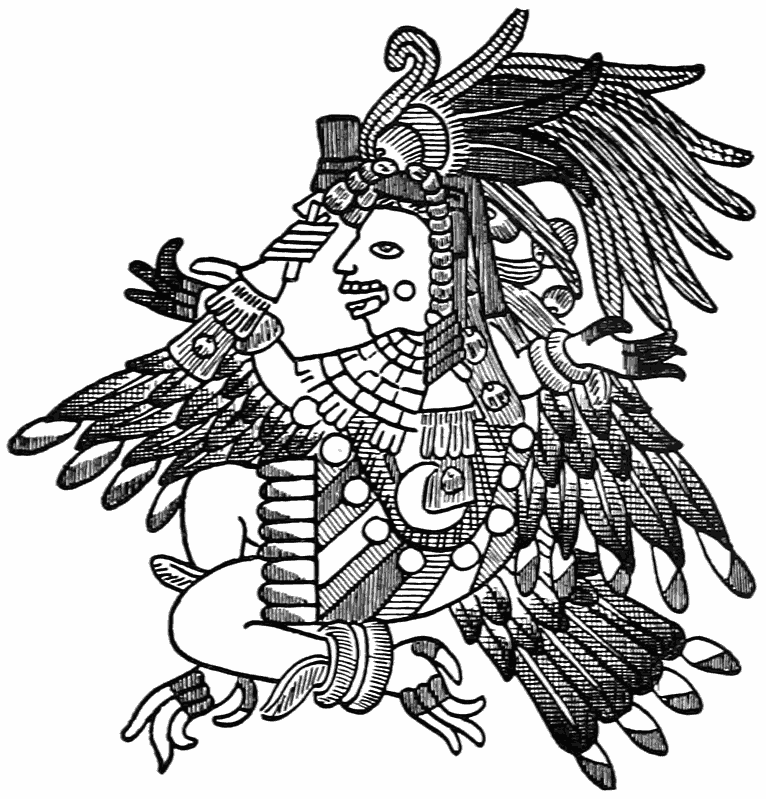
ITZPAPALOTL.
(From Codex Borbonicus, sheet 15.)
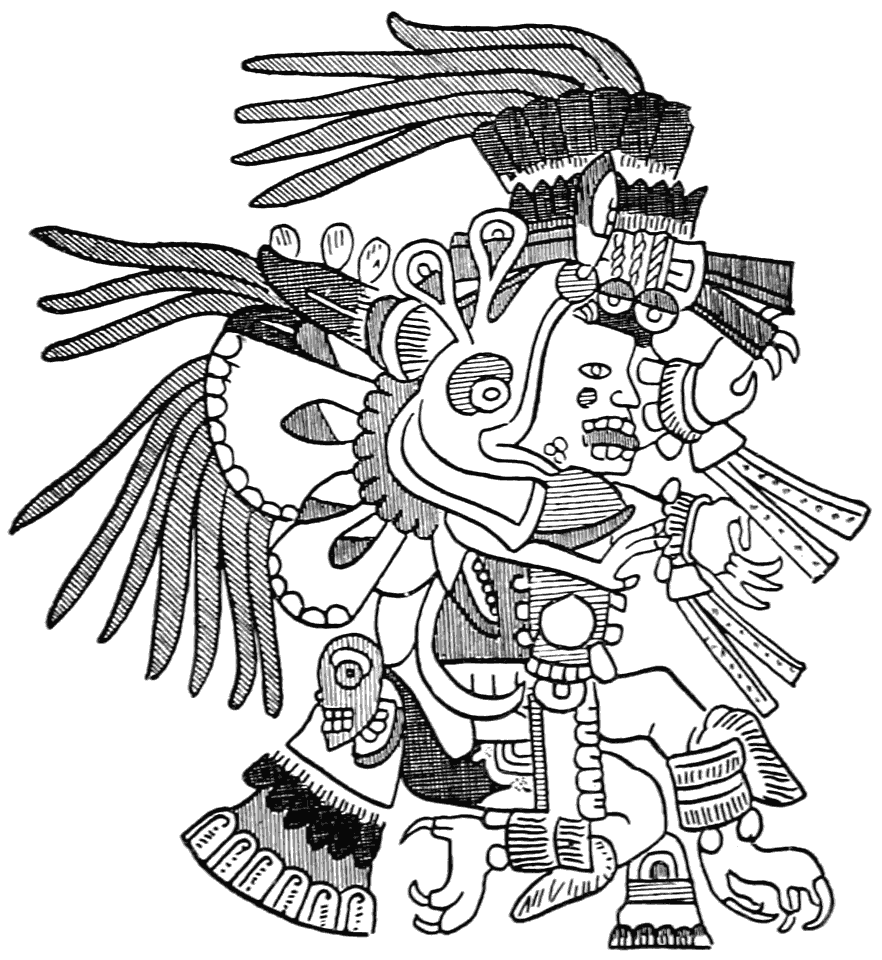
ITZPAPALOTL.
(From Codex Telleriano-Remensis, sheet 18, Verso.)
PRIESTHOOD
The Cinteotzin (Lord of Maize), says Sahagun, had charge of affairs at the festival of Xilonen (see Cinteotl).
NATURE AND STATUS
Xilonen appears to be nothing more than a deification of the young, tender ear of the maize-plant. Her name, the season at which her rites took place and the youth of the xalaquia who represented her would seem to bear this out. She was originally a goddess of the Huichol tribes, and, by some circumstance of evolution or imagery, came to symbolize for the Nahua the maize in the earlier stages of its ripeness, thus to some extent resembling Cinteotl. Payne and also Seler in some places seem to confound her festival with that of Chicomecoatl, and offer no reasons for thus traversing the statements of the older authorities, which are definite enough and which in this instance I prefer to follow.