Chapter III · THE GREAT GODS
Reading edition
METHOD OF TREATMENT
In the section descriptive of the gods, each divinity is dealt with separately. The need for system and orderly arrangement in the study of Mexican Mythology is clamant. In the hope that future students of the subject may be spared the Herculean task of separating the mythology of the Mexican people from their history, I have thought it best to arrange my material in as systematic a fashion as its complex character permits.
The plan employed is a simple one. I have prefaced the description of each god with a table containing the following information concerning him: Area of Worship, Name, Minor Names, Relationship, Calendar-place, Compass-direction, Symbol, Festivals. In some cases where, for example, a god has no festival or no minor names, the item relating to such information is, of course, absent.
UITZILOPOCHTLI = “HUMMING-BIRD WIZARD”
Area of Worship: Mexico.
Minor Names: Tetzateotl—“Terrible God.” Tetzahuitl—“The Raging.” Ilhuicatl Xoxouhqui—“The Blue Heaven.” Mexitli—“Hare of the Maguey.”
Compass Directions: The South; upper region.
Festivals: Toxcatl, the fifth month; first of tlaxochimaco, the ninth month. Panquetzaliztli, the fifteenth month. Movable feast ce tecpatl.
Relationships: Son of Coatlicue. Brother of the Centzonuitznaua. Brother of Coyolxauhqui. One of the Tzitzimimê.
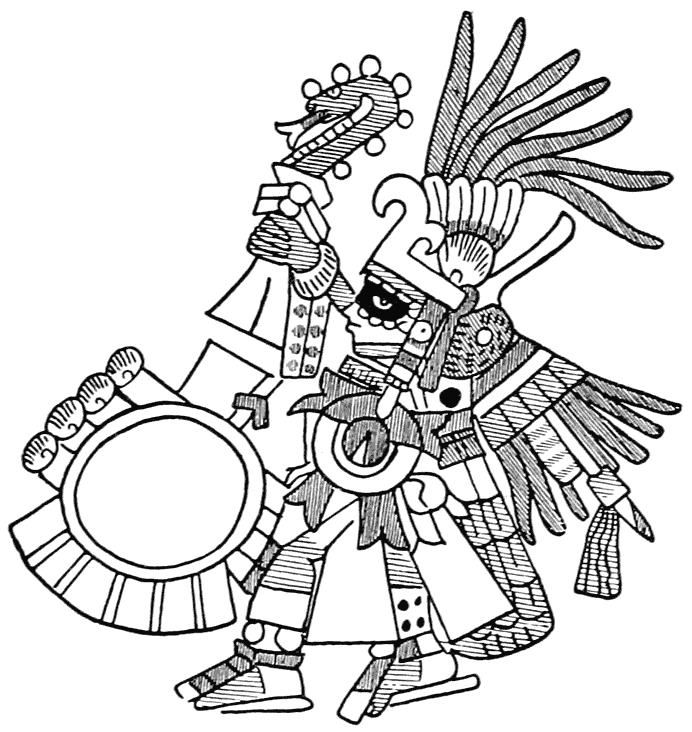
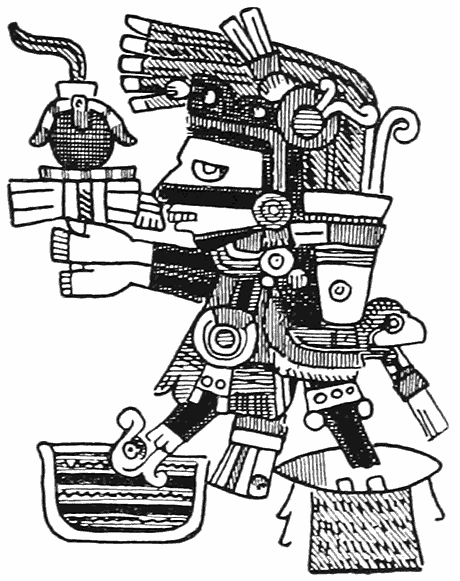
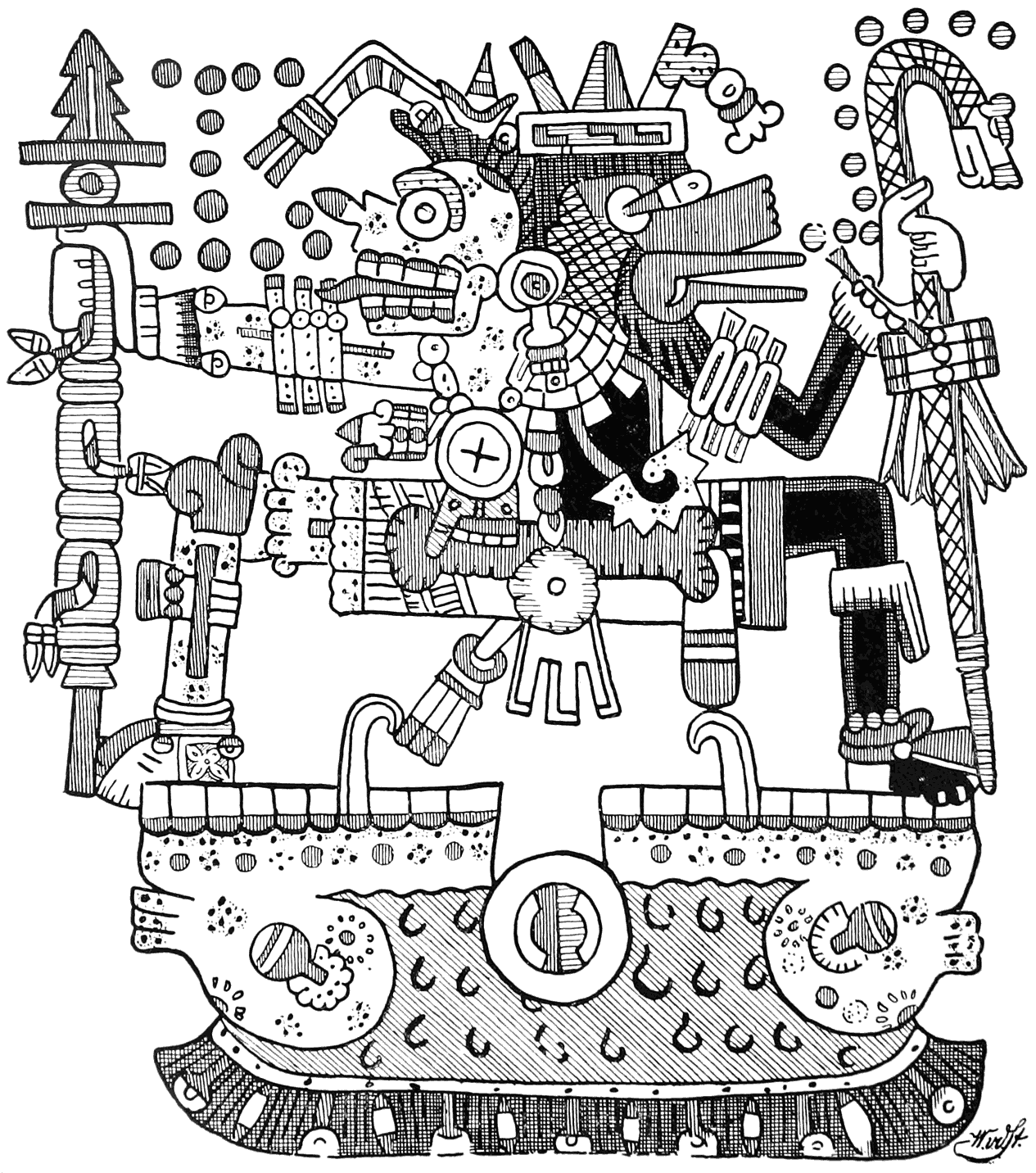
Uitzilopochtli.
(From Codex Borbonicus, sheet 34.)
Paynal. “Messenger” of Uitzilopochtli. (Sahagun MS.) Uitzilopochtli (after Duran).
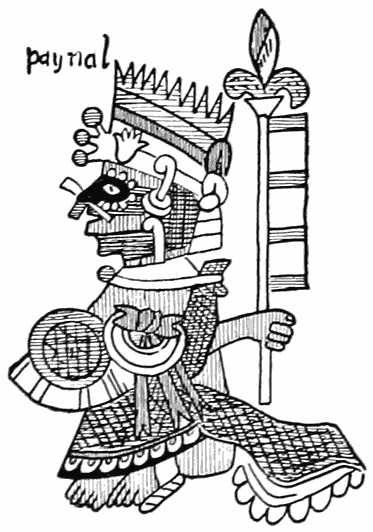
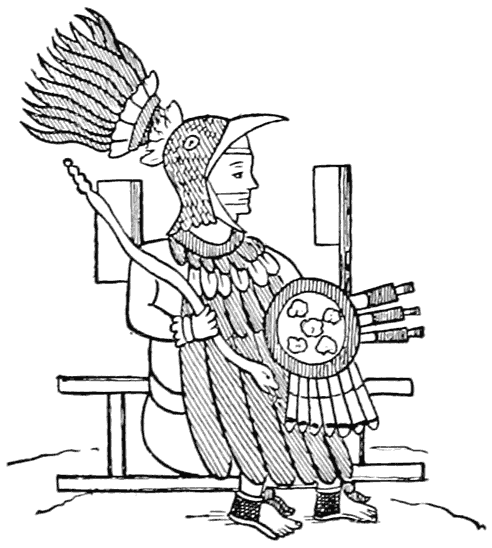
UITZILOPOCHTLI.
ASPECT AND INSIGNIA
Body-paint.—Blue.
Dress.—Usually the humming-bird mantle, pictographic of his name. His head is surmounted by a panache of feathers. On his breast is a white ring made from a mussel-shell, like those of Quetzalcoatl, Tezcatlipocâ, and Paynal, which is called eteocuitlaanauauh (“his golden ring”) or eltezcatl (“his breast mirror”). Perhaps the best representation of him is in Codex Borbonicus (sheet 34).
Weapons.—Shield (teueuelli), made of reeds, with eagle’s down adhering to it in five places in the form of a quincunx. He carries spears tipped with tufts of down instead of stone points (tlauacomalli), the weapons of those doomed to a gladiatorial death, the fire-snake xiuhcoatl as an atlatl, or spear-thrower, and the bow, which he was supposed to have invented or introduced into Mexico. The flag held by him on some occasions represents the panquetzaliztli festival in Codices Telleriano-Remensis and Vaticanus A.
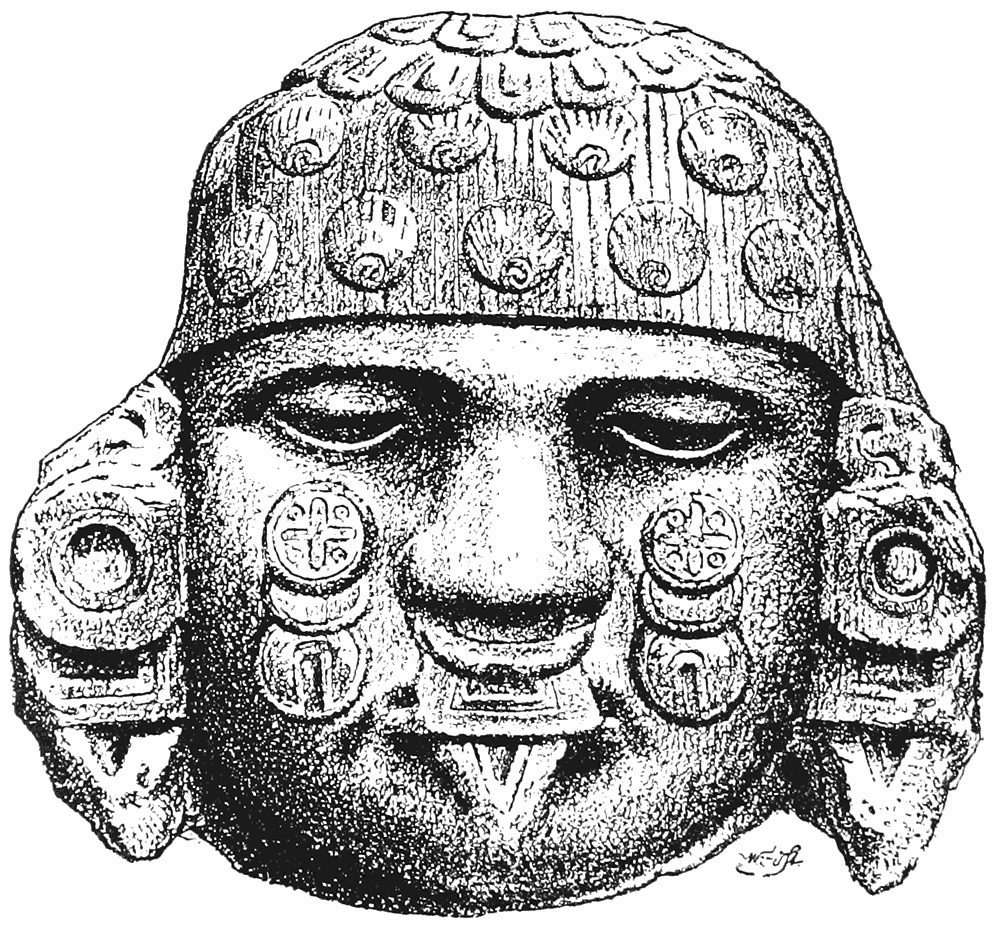
COYOLXAUHQUI, SISTER OF UITZILOPOCHTLI.
(See p. 324.)
Variations.—He is frequently to be observed wearing the insignia of the stellar gods of war and hunting (Mixcoatl, Camaxtli).
According to Seler (Commentary on the Codex Vaticanus B, p. 91), Uitzilopochtli figures in that MS. as showing “in a general way the devices and the dress-badges of the fire-god,” differing, however, in colour and painting. When found along with Tezcatlipocâ as Ruler of the Southern Heaven, in Codex Fejérváry-Mayer (sheet 25), he is seated on a jaguar-skin seat, enveloped in a long robe of a light blue colour, with balls of downy feathers. He wears the aztaxelli or forked heron-feather ornament on his head and has the yellow face-paint alluded to above. In the Sahagun MS. (Bib. del Palacio) he is represented as wearing on his back the “dragon’s head” alluded to in the text. In the Duran MS. (2 o, plate 2 a), drawn by a European hand, the humming-bird headdress forms a helmet-mask, and in the Codex Ramirez (Juan de Tobar), in which the figure is Europeanized almost out of recognition, the same is the case, but the shield-marking is incorrect, consisting as it does of seven tufts of down instead of five.
Clavigero (tom. ii, pp. 17–19) says of Uitzilopochtli’s insignia: “Upon his head he carried a beautiful crest, shaped like the beak of a bird, upon his neck a collar shaped like ten figures of the human heart. His statue was of an enormous size, in the posture of a man seated on a blue-coloured bench, from the four corners of which issued four snakes. His forehead was blue, but his face was covered with a golden mask, while another of the same kind covered the back of his head. In his hand he carried a large blue, twisted club, in his left a shield in which appeared five balls of feathers disposed in the form of a cross, and from the upper part of the shield rose a golden flag with four arrows, which the Mexicans believed to have been sent to them from heaven. His body was girt with a large golden snake, and adorned with lesser figures of animals made of gold and precious stones, which ornaments and insignia had each their peculiar meaning.”
The Sahagun MS. states that “he wears a panache of yellow parrot feathers stuck together, and having a bunch of quetzal-feathers at the tip. His espitzalli is over his forehead. The face or mask is striped in various colours, and the ear-plug is made of the feathers of the blue cotinga. On his back is the fire-snake dress and on his arm he has a quetzal-feather. At the back he is girded with a blue net cloth, and his leg is striped with blue. Bells and shells decorate his feet, and he is shod with sandals of the type usually worn by persons of high degree. His shield is the teueuelli with a bundle of arrows without points stuck in it, and in one hand he holds a serpent-staff.”
Sahagun (c. xxii, bk. iv) describes the insignia employed at the god’s festival of ce tecpatl. These were the quetzalquemitl, or mantle of green quetzal-feathers, the tozquemitl, the mantle made of the yellow feathers of the toztli, a bird of the parrot species, the Uitzitzilquemitl, or mantle of humming-bird’s feathers, “and others less rich.”
FESTIVALS
Toxcatl.—For this festival see under Tezcatlipocâ, to whom it was also and more especially sacred.
Panquetzalitztli.—The following account of this festival is summarized from Sahagun’s pages: For twenty-four days prior to the incidence of the festival the priests did penitence. They hung branches upon the oratories and shrines of the gods of the mountains, and green reeds and leaves of the maguey-plant. At the end of the quecholli festival everyone took to dancing and singing, especially to the song or hymn of Uitzilopochtli. Nine days before the sacrifice those doomed to die bathed in the fountain called Uitzilotl (humming-bird water) in the village of Uitzilopochco. The old men went to seek nine bunches of the leaves of the tree called aueuetl (“old one of the waters”—the Cupressus distica). The faces of the doomed ones were painted in the colours of the god, yellow and blue in transverse bands, and adorned with his insignia.
During the time they made this progress the slaves who were about to die engaged in a skirmish. They divided themselves into two parties, the Uitznauatl (“They of the Thorny Wizard”), the other unnamed. The former seem to have been professional soldiers armed with mock weapons; the others slaves, armed with maquahuitls, wooden swords set with obsidian flakes. On Paynal’s return those who watched them from the summit of the temple, seeing the banner of the god (epaniztli), cried out, “Mexicans, cease your strife, the lord Paynal has come.” The warriors in the patrol of Paynal then rushed to the summit of the temple, where they arrived in a breathless condition. They placed their idol beside the paste image of Uitzilopochtli. Their ears were pierced by the priest. They descended again, carrying an image of Uitzilopochtli made of paste, which they divided, each bearing his own portion to his own house, where he made festival with his parents and neighbours. A tour of the temple was then made, the captives walking in front.
This festival took place at the period of the winter solstice, when the sun has removed farthest to the south. The burning of the papers by the xiuhcoatl, and the fact that the fire-festival of the new period of fifty-two years, the making of the new fire, was usually postponed to coincide with it, show it to be a fire-feast; for in his “avatar” of the sun Uitzilopochtli was a fire-god.
MYTHS
Regarding Uitzilopochtli, Clavigero says: “Huitzilopochtli, or Mexitli, was the god of war; the deity the most honoured by the Mexicans, and their chief protector. Of this god some said he was a pure spirit, others that he was born of a woman, but without the assistance of a man, and described his birth in the following manner: There lived, said they, in Coatepec, a place near to the ancient city of Tula, a woman called Coatlicue, mother of the Centzonhuiznahuas, who was extremely devoted to the worship of the gods. One day, as she was employed, according to her usual custom, in walking in the temple, she beheld descending in the air a ball made of various feathers. She seized it and kept it in her bosom, intending afterwards to employ the feathers in decoration of the altar; but when she wanted it after her walk was at an end she could not find it, at which she was extremely surprised, and her wonder was very greatly increased when she began to perceive from that moment that she was pregnant. Her pregnancy advanced till it was discovered by her children, who, although they could not themselves suspect their mother’s virtue, yet fearing the disgrace she would suffer upon her delivery, determined to prevent it by putting her to death. They could not take their resolution so secretly as to conceal it from their mother, who, while she was in deep affliction at the thought of dying by the hands of her own children, heard an unexpected voice issue from her womb, saying, ‘Be not afraid, mother, I shall save you with the greatest honour to yourself and glory to me.’
“Her hard-hearted sons, guided and encouraged by their sister Cojolxauhqui, who had been the most keenly bent upon the deed, were now just upon the point of executing their purpose, when Huitzilopochtli was born, with a shield in his left hand, a spear in his right, and a crest of green feathers on his head; his left leg adorned with feathers, and his face, arms, and thighs streaked with blue lines. As soon as he came into the world he displayed a twisted pine, and commanded one of his soldiers, called Tochchancalqui, to fell with it Cojolxauhqui, as the one who had been the most guilty; and he himself attacked the rest with so much fury that, in spite of their efforts, their arms, or their entreaties, he killed them all, plundered their houses, and presented the spoils to his mother. Mankind were so terrified by this event, that from that time they called him Tetzahuitl (terror) and Tetzauhteotl (terrible god).
Boturini says of this god: “While the Mexicans were pushing their conquests and their advance toward the country now occupied by them, they had a very renowned captain, or leader, called Huitziton. He it was that in these long and perilous journeys through unknown lands, sparing himself no fatigue, took care of the Mexicans. The fable says of him that, being full of years and wisdom, he was one night caught up in sight of his army and of all his people, and presented to the god Tezauhteotl, that is to say the Frightful God, who, being in the shape of a horrible dragon, commanded him to be seated at his right hand, saying: ‘Welcome, O valiant captain; very grateful am I for thy fidelity in my service and in governing my people. It is time that thou shouldest rest, since thou art already old, and since thy great deeds raise thee up to the fellowship of the immortal gods. Return then to thy sons and tell them not to be afflicted if in future they cannot see thee as a mortal man; for from the nine heavens thou shalt look down propitious upon them. And not only that, but also, when I strip the vestments of humanity from thee, I will leave to thine afflicted and orphan people thy bones and thy skull so that they may be comforted in their sorrow, and may consult thy relics as to the road they have to follow: and in due time the land shall be shown them that I have destined for them, a land in which they shall hold wide empire, being respected of the other nations.’
The myth of Uitzilopochtli, as given by Sahagun, may be condensed as follows:
Under the shadow of the mountain of Coatepec, near the Toltec city of Tollan, there dwelt a pious widow called Coatlicue, the mother of a tribe of Indians called Centzonuitznaua, who had a daughter called Coyolxauhqui, and who daily repaired to a small hill with the intention of offering up prayers to the gods in a penitent spirit of piety. Whilst occupied in her devotions one day she was surprised by a small ball of brilliantly coloured feathers falling upon her from on high. She was pleased by the bright variety of its hues and placed it in her bosom, intending to offer it up to the Sun-god. Some time afterwards she learnt that she was to become the mother of another child. Her sons, hearing of this, rained abuse upon her, being incited to humiliate her in every possible way by their sister Coyolxauhqui.
Quauitlicac climbed the mountain to acquaint Uitzilopochtli with the news that his brothers were approaching to kill their mother.
“Mark well where they are at,” replied the infant god. “To what place have they advanced?”
“To Tzompantitlan,” responded Quauitlicac.
Later on Uitzilopochtli asked: “Where may they be now?”
“At Coaxalco,” was the reply.
Once more Uitzilopochtli asked to what point his enemies had advanced.
“They are now at Petlac,” Quauitlicac replied.
Torquemada says of Uitzilopochtli: “Huitzilopochtli, the ancient god and guide of the Mexicans, is a name variously derived. Some say it is composed of two words: huitzilin, ‘a humming-bird,’ and tlahuipuchtli, ‘a sorcerer that spits fire.’ Others say that the second part of the name comes not from tlahuipuchtli, but from opuchtli, that is, ‘the left hand’; so that the whole name, Huitzilopochtli, would mean ‘the shining-feathered left hand.’ For this idol was decorated with rich and resplendent feathers on the left arm. And this god it was that led out the Mexicans from their own land and brought them into Anahuac.
“Some held him to be a purely spiritual being, others affirmed that he had been born of a woman, and related his history after the following fashion: Near the city of Tulla there is a mountain called Coatepec, that is to say the Mountain of the Snake, where a woman lived, named Coatlicue or Snake-petticoat. She was the mother of many sons called Centzunhuitznahua, and of a daughter whose name was Coyolxauhqui. Coatlicue was very devout and careful in the service of the gods, and she occupied herself ordinarily in sweeping and cleaning the sacred places of that mountain. It happened that one day, occupied with these duties, she saw a little ball of feathers floating down to her through the air, which she taking, as we have already related, found herself in a short time pregnant.
HYMNS
In the Sahagun MS. the following hymns or songs relate to Uitzilopochtli:—
THE SONG OF UITZILOPOCHTLI
I
Uitzilopochtli the warrior, no one is my equal;
Not in vain have I put on the vestment of yellow feathers,
For through me the sun has risen (i.e. the time of sacrifice appears).
II
The man out of the cold land knew (through him) a baneful omen.
He had taken a foot from the man out of the cold land.
III
In the place of Tlaxotlan, the feathers were distributed
With which the war chieftains stuck themselves.
My God is named Tepanquizqui (“He who overcomes the people”).
IV
He makes himself feared, the god of Tlaxotlan,
Dust whirls upon the God of Tlaxotlan,
Dust whirls upon him.
V
Our enemies, the people from Amantlan, assemble; meet me there.
So will in their own house the enemy be. Meet me there.
VI
Our enemies the people of Pipitlan assemble; meet me there.
So will in their own house the enemy be.
This song is probably a chant sung before sacrifice to the god. The line “He had taken a foot from the man out of the cold land” seems to allude to the maiming of one of the gods by Uitzilopochtli, or is symbolic of the punishment of a human enemy by rendering him unfit for war through the amputation of one of his feet. Tezcatlipocâ, one of whose names was Yaotzin, “the enemy,” is frequently represented as having but one foot, and the phrase “the man from the cold land,” i.e. the North, applies almost certainly to him. The rest of the song relates to the peoples with whom the Mexicans were frequently at war.
SONG OF THE SHIELD
I
In his shield of the young wife the great warrior chieftain was born.
In his shield of the young wife (or maid) the great warrior chieftain was born.
II
He who gained his heroic title on the serpent mountain
In his (warrior) face-painting, (and with the shield) teueuelli.
No one in truth rises.
The earth quakes
As he put on his (warrior) face-painting (and his shield) teueuelli.
The first couplet is obscure to me, and seems to refer to a lost myth, which perhaps stated that the god was born of a virgin. The second strophe, of course, relates to the slaughter by Uitzilopochtli of his brothers the Centzonuitznaua.
PRIESTHOOD
TEMPLE
Acosta describes Uitzilopochtli’s great temple at Mexico as follows: “There was in Mexico this Cu, the famous Temple of Vitziliputzli, it had a very great circuite, and within a faire Court. It was built of great stones, in fashion of snakes tied one to another, and the circuite was called Coatepantli, which is, a circuite of snakes: vppon the toppe of every chamber and oratorie where the Idolls were, was a fine piller wrought with small stones, blacke as ieate, set in goodly order, the ground raised vp with white and red, which below gave a great light. Vpon the top of the pillar were battlements very artificially made, wrought like snailes (caracoles), supported by two Indians of stone, sitting, holding candlesticks in their hands, the which were like Croisants garnished and enriched at the ends, with yellow and greene feathers and long fringes of the same. Within the circuite of this court there were many chambers of religious men, and others that were appointed for the service of the Priests and Popes, for so they call the soveraigne Priests which serve the Idoll.
NATURE AND STATUS
In many lands the serpent is the symbol of reproductive power and has a phallic significance. In Mexico he casts his winter skin near the time of Uitzilopochtli’s first festival, about the beginning of the rainy season. Moreover, this reptile is connected with soothsaying, and in this respect resembles the god.
His myths, as well as his status in Mexico-Tenochtitlan, of which he was the tutelary deity, make it plain that Uitzilopochtli was a tribal god of the Aztecâ, their national god par excellence. The brave Quauhtemoc, the last native defender of the city, imagined himself invincible when armed with the bow and arrows of Uitzilopochtli, and we know that the advice of the oracle of that deity was sought by the Mexicans when hard pressed by the Conquistadores.
Nor is there any dubiety regarding his character as a god of war. This may have arisen from the circumstance that he presided over the liquor which was given to the troops when about to engage in battle, or, as has been said, may have followed his promotion to the rank of sun-god, the deity of human sacrifice, the god who demanded human hearts and blood. A larger number of captives were devoted to him than to any other divinity, and as the waging of war was the only means by which so many victims might be procured, the sun would naturally become the great patron of strife.
As the sun is the great central cause of all agricultural success, so Uitzilopochtli came to be looked upon as one of the promoters of plant growth, as is witnessed by his festivals, which synchronize with the first rainfall of the year, the growth of plant life, and the end of the fruitful season, when, in the form of a paste image, the god was slain. He is thus the sun of the season of plenty, as his “brother” Tezcatlipocâ represents that of sereness and drought. He is the “young warrior” of the South, who drives away the evil spirits of the dry season and causes the land to rejoice.
TEZCATLIPOCÂ = “FIERY MIRROR”
Area of Worship: Nahua territory generally, with extension into Central America (as Hurakan).
Minor Names: Titlacahuan—“He whose slaves we are.” Yaotl—“Enemy.” Yaomauitl—“Dreaded Enemy.” Chico Yaotl—“Enemy on one side.” Necoc Yaotl—“Enemy on both sides.” Moyocoyotzin—“Capricious Lord.” Uitznahuac Yaotl—“Warrior in the Southern House or Temple.” Tlacochcalco Yaotl—“Warrior in the (Northern) Spear House.” Telpochtli—“The Youth.” Neçaualpilli—“Fasting Lord.” Itztli—“Obsidian.”
Festivals: Toxcatl, teotleco, and the movable feasts ce miquiztli, ce malinalli, and ome coatl.
Compass Directions: North and south in different aspects. Guardian of the fifth quarter, “the below and above.”
Calendar Place: Ruler of the 18th day, tecpatl; ruler of the second tonalamatl quarter, the region of the north; as Itztli, second of the nine lords of the night; ruler of the 13th day-count acatl.
Symbol: The smoking or fiery mirror; the obsidian knife.
ASPECT AND INSIGNIA
Codex Borgia.—By far the best representation of Tezcatlipocâ in any of the manuscripts is that to be found on page 17 of Codex Borgia, where he is seen in connection with the insignia of the twenty calendric days. The picture on the lower right portion of page 21 is without these symbols, but is almost identical with the former figure. The god wears the black body-paint of a priest, and his face-painting is similar to that of Uitzilopochtli, that is, it consists of black horizontal stripes upon a yellow ground, the latter having the same origin as in the case of Uitzilopochtli. From his back rises a very large and elaborate bunch of feather plumes, which arches itself over his head. His hair, dressed in a manner which resembles the “night-hair” of Mictlantecutli, is ornamented with feather-balls as indicating his sacrificial character, and in the picture on page 21 several of these depend from his side-locks. He wears the white ring (anauatl) on his breast, and a short tunic, seemingly covered with stellar devices. His right foot ends in the smoking mirror symbolic of his name and in which he was supposed to observe the actions of humanity, and on page 21 he carries the jaguar-skin purse in which the priests placed copal for incense. In his left hand he holds a shield, the field of which is a tawny yellow in colour, traversed by two white stripes, and a paper banner. On page 3 the god is shown in a springing attitude. He wears the face and body-paint characteristic of him, and the warrior’s headdress, with hair tousled on one side, and the blue nasal rod, with square plaque, falling over the mouth. At the side of the head is the fiery mirror which gives him his name. On page 14 he is seen wearing on his breast, and fastened to two strong red leather straps, the white ring teocuitlaanauatl, an ornament resembling a large, round eye. On his back is a feather device known as the “quetzal feather-pot.” The right foot, as in other pictures of him, is replaced by a small fiery mirror and his left by an obsidian knife.
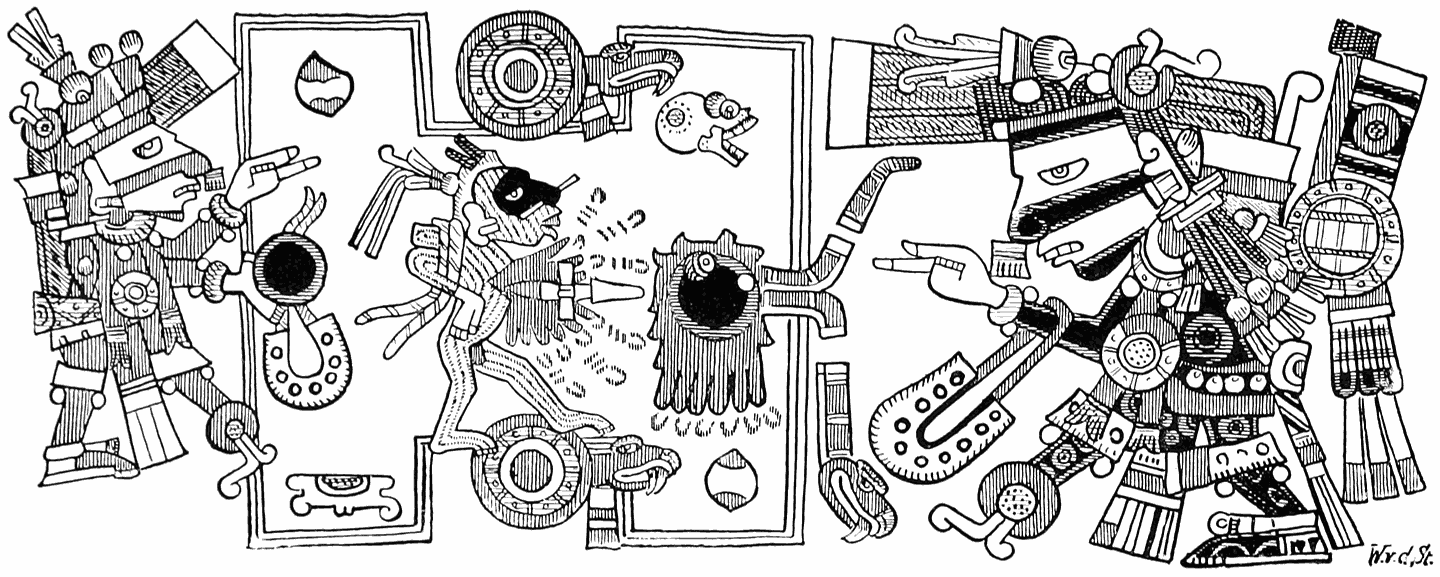
THE RED AND BLACK TEZCATLIPOCÂS.
(Codex Borgia, sheet 21.)
Codex Borbonicus.—In this manuscript Tezcatlipocâ is depicted with the yellow-and-black face-painting, but in his form as a black god. At his forehead is the smoking mirror, on his back the large quetzal-feather ornament with a banner, on his breast the anauatl, and round his loins the hip-cloth, with a bordering of red eyes. On his feet he wears sandals showing the motif of the obsidian snake, and his headdress is painted with the stellar symbol, the round white spots on a black ground, which typifies the night sky. Here also we see two bamboo staves attached to his neck—undoubtedly the collar worn by captives or slaves which rendered flight impossible, and which Tezcatlipocâ wears to symbolize his enslavement of the Mexican people and in allusion to his name Titlacauan, which means “He whose slaves we are.” The spear and the net-pouch in this place recall the insignia of Mixcoatl, and seem to indicate that Tezcatlipocâ was a god of the Chichimec or hunting folk of the North Steppes, or perhaps it may merely symbolize the proneness of all stellar, lunar and solar deities in Mexico to the chase.
Tonalamatl of the Aubin Collection.—In this manuscript Tezcatlipocâ appears as the representative of the Moon-god and sits opposite the Sun-god. He is shown with his usual attributes and face-painting, the smoking mirror in the region of the ear, the white ring on his breast, and on his back the quetzalcomitl, the large quetzal-feather ornament in which a banner is stuck. In his right hand he holds several of the agave-spikes which the priests employed for piercing the tongue. In this manuscript the Death-god is also depicted as Tezcatlipocâ, and wears his body-and-face painting and his general insignia, as well as the rosette at the nape of the neck. In this place, however, the snail-shaped shield rises above the forehead, which is also decorated with a row of feather balls and a single arara plume.
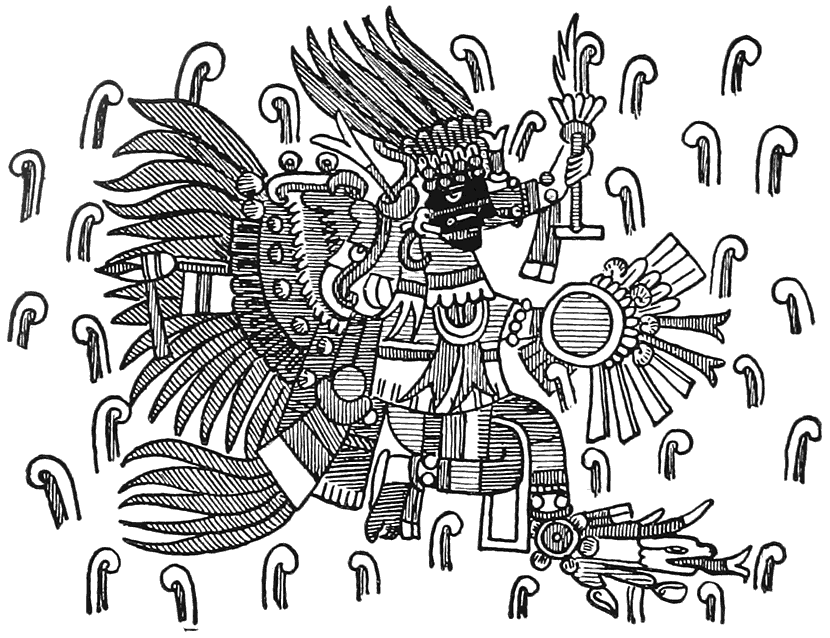
(From Codex Vaticanus A, sheet 44 Verso.)
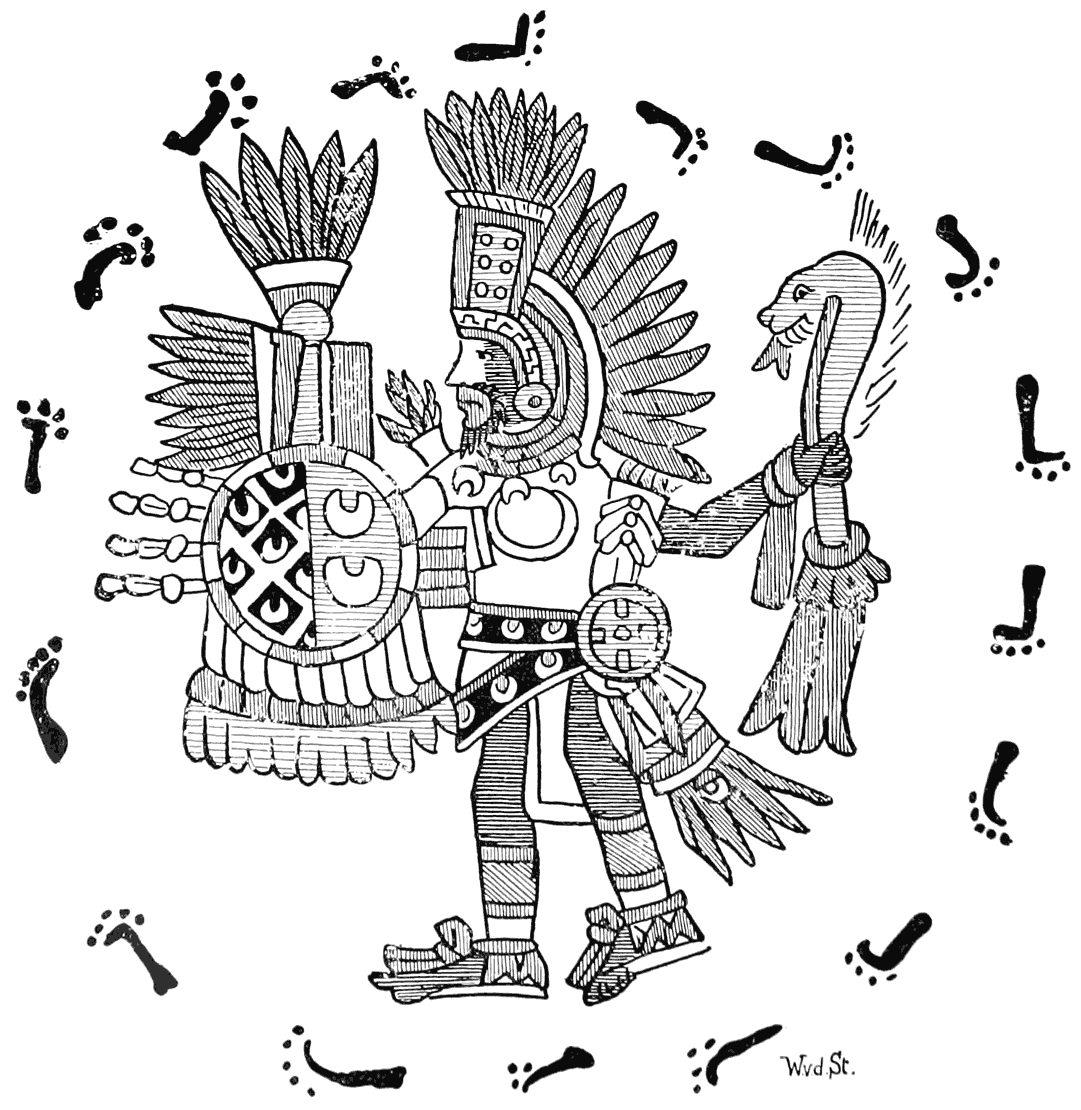
(From Codex Magliabecchiano, sheet 3, folio 89.)
TEZCATLIPOCÂ IN VARIOUS FORMS.
Codex Magliabecchiano.—A good illustration of Tezcatlipocâ will be found on page 89 of this codex. The figure of the god is surrounded by footprints, symbolic, probably, of the circumstance that as the youngest and swiftest of the gods he arrived first at the teotleco festival (coming of the gods) and impressed his footprint on the heap of maize arranged by the priests for its reception in order that they might know of his coming. He wears a large panache of green feathers, consisting of two parts; that immediately above the face being inserted in a tumbler-shaped ornament painted blue, with a red rim, and having six white disks upon its field. To the lower part of this is joined a rainbow-like device in various colours, from which springs the main part of the feather panache. The upper fore-part of the face is painted yellow, the rear portion purple or grey, and the region about the mouth is bright red. He is bearded. The tunic is white, with a white shoulder-knot, and a bunch of maize springs from the right shoulder. On the breast is the god’s mirror, and at the waist an ornament or symbol resembling the Maya Kin (sun) sign, painted blue. The rest of the body-colour is purple-grey. In the left hand he carries an atlatl, or spear-thrower, with a serpent’s head having a brown mane, and bearing a resemblance to some horse-like ornamental motifs found in Guatemala. In the right hand he bears a shield, the field of which is divided into two parts, the right painted blue and bearing what would seem to be the nose-ornament of the pulque-gods, whilst the left resembles the design found on the skirt of the Earth-goddess. The shield is crossed behind by four darts and is surmounted by a befeathered banner. In this place Tezcatlipocâ is undoubtedly represented in his variant of “the young warrior,” as his equipment shows.
Sahagun MS. (Biblioteca del Palacio).—The god’s feather crown is set with obsidian knives. His face is barred with horizontal lines of black, and on his back he carries a basket filled with quetzal-feathers. His arm-ring is set with obsidian knives, and one-half of his leg is painted black. On his legs and feet he wears shells and sandals, the latter the so-called “obsidian sandals,” painted with a picture of the obsidian snake. His arms are covered with paper fans. His shield is inlaid with feather balls, and in one of his hands he holds the “seeing” or scrying implement tlachialoni.
Face-mask.—When Cortéz landed at Vera Cruz, the messengers of Motecuhzoma tendered him, along with other presents, “the ornaments or finery with which Tezcatlipocâ was decorated.” The mask belonging to this costume is still in existence, and is to be seen in the room devoted to American antiquities in the British Museum. It consists of a human skull encrusted with mosaic in alternate bands of black and green, the nasal cavity being set with a red stone and the eyes with pyrites ringed with white.
Statuette.—A statuette of Tezcatlipocâ from the Valley of Mexico, and now in the Uhde collection, shows the god as nude, with the exception of a loin-cloth and a flat headdress, rising in the middle.
Tezcatlipocâ in His Black and Red Forms.—Tezcatlipocâ was regarded by the Mexican people as possessing two definite forms, the Black and the Red. In this paragraph we will deal only with the insignia of these and not with their mythological significance, which we will attempt to explain in its proper place. Perhaps the best and most classical examples of these forms we possess are to be observed on sheet 21 of Codex Borgia, on both halves of which we see the two forms represented as parallel figures, closely resembling one another in nearly every detail. It should at once be stated that the Red Tezcatlipocâ is merely a variant of Xipe, and indeed in one place in Codex Vaticanus B we observe that his loin-cloth forks in the swallow-tail fashion noticeable in the loin-cloth of that god, and, generally speaking, the red colours he wears are those of the roseate spoon-bill, the feathers of which are typical of Xipe’s dress. These pictures in the Codex Borgia are supplemented by two on sheets 85 and 86 of Vaticanus B, where the swallow-tail ends of the loin-cloth and the nasal rod show distinctly that the Red Tezcatlipocâ is only a form of Xipe. The Black Tezcatlipocâ opposite him is, however, represented with the striped body-paint of Tlauizcalpantecutli, the arms being entirely black. In the Borgia paintings the Black Tezcatlipocâ wears the black body-paint of the priest, his face-paint is alternately black and yellow, he has the warrior’s tousled hair, the nasal rod with the square plaque falling over the mouth, the forked heron-feather adornment in his hair, and on his temple the smoking mirror. The foot, too, is torn off and replaced by a smoking mirror—all symbolical of the “standard” character of the god’s sable form. The Red Tezcatlipocâ represented in the upper portion of Borgia (sheet 21) has a yellow face-painting striped with horizontal bands of red and his body-paint is red. On the red bands crossing the face is seen the stellar eye. A brown fillet encircles a red headdress, and the torn-off foot is also replaced by the smoking mirror. On his back is seen the bundle of the merchant, surmounted by the arara bird, two symbols which indicate his southern character. The representation of the Red Tezcatlipocâ in the lower portion of sheet 21 is practically similar to this, save that he wears feather balls and heron plumes in his headdress, is without the merchant’s pack, and holds in one hand the jaguar-skin copal-bag of the priests and the smoking rubber ball used as incense.
FESTIVALS
(From Codex Borgia.) (From the Sahagun MS.)
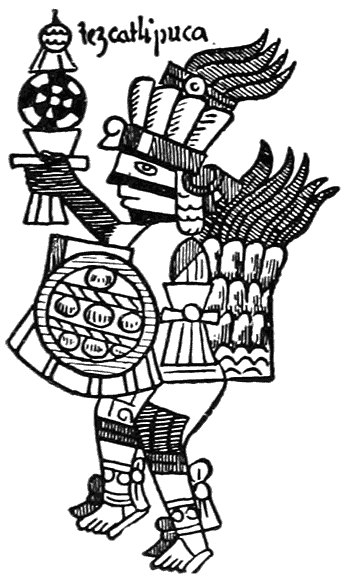
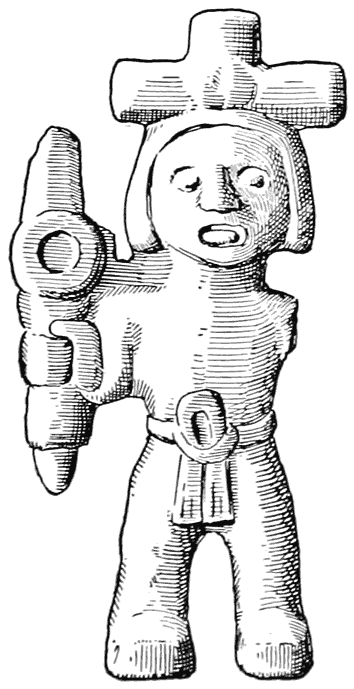
(Pottery figure from the Uhde Collection.)
TEZCATLIPOCÂ.
All this was the attire he wore from the beginning of his year of preparation; but twenty days before the coming of the festival they changed his vestments, washed away the paint or dye from his skin, and cut down his long hair to the length, and arranged it after the fashion, of the hair of the captains, tying it up on the crown of the head with feathers and fringe and two gold-buttoned tassels. At the same time they married to him four damsels, who had been pampered and educated for this purpose, and who were surnamed respectively after the four goddesses, Xochiquetzal, Xilonen, Atlantonan, and Uixtociuatl. Five days before the great day of the feast, the day of the feast being counted one, all the people, high and low, the king it would appear being alone excepted, went out to celebrate with the man-god a solemn banquet and dance, in the ward called Tecanman; the fourth day before the feast the same was done in the ward in which was guarded the statue of Tezcatlipocâ. The little hill or island called Tepetzinco, rising out of the waters of the Lake of Mexico, was the scene of the next day’s solemnities; which were renewed for the last time on the next day, or that immediately preceding the great day, on another like island called Tepelpulco, or Tepepulco. There, with the four women who had been given to him for his consolation, the honoured victim was put into a covered canoe usually reserved for the sole use of the king, and he was carried across the lake to a place called Tlapitzaoayan, near the road that goes from Yztapalapan to Chalco, at a place where was a little hill called Acaccuilpan, or Cabaltepec. Here left him the four beautiful girls whose society for twenty days he had enjoyed, they returning to the capital with all the people. There accompanied him only those eight attendants who had been with him all the year. Almost alone, done with the joys of beauty, banquet, and dance, bearing a bundle of his flutes, he walked to a little cu, some distance from the road mentioned above, and about a league removed from the city. He marched up the temple steps; and as he ascended he dashed down and broke on every step one of the flutes that he had been accustomed to play on in the days of his prosperity. He reached the top, where he was sacrificed. From the sacrificial stone his body was not hurled down the steps, but was carried by four men down to the tzompantli, to the place of the spitting of heads.
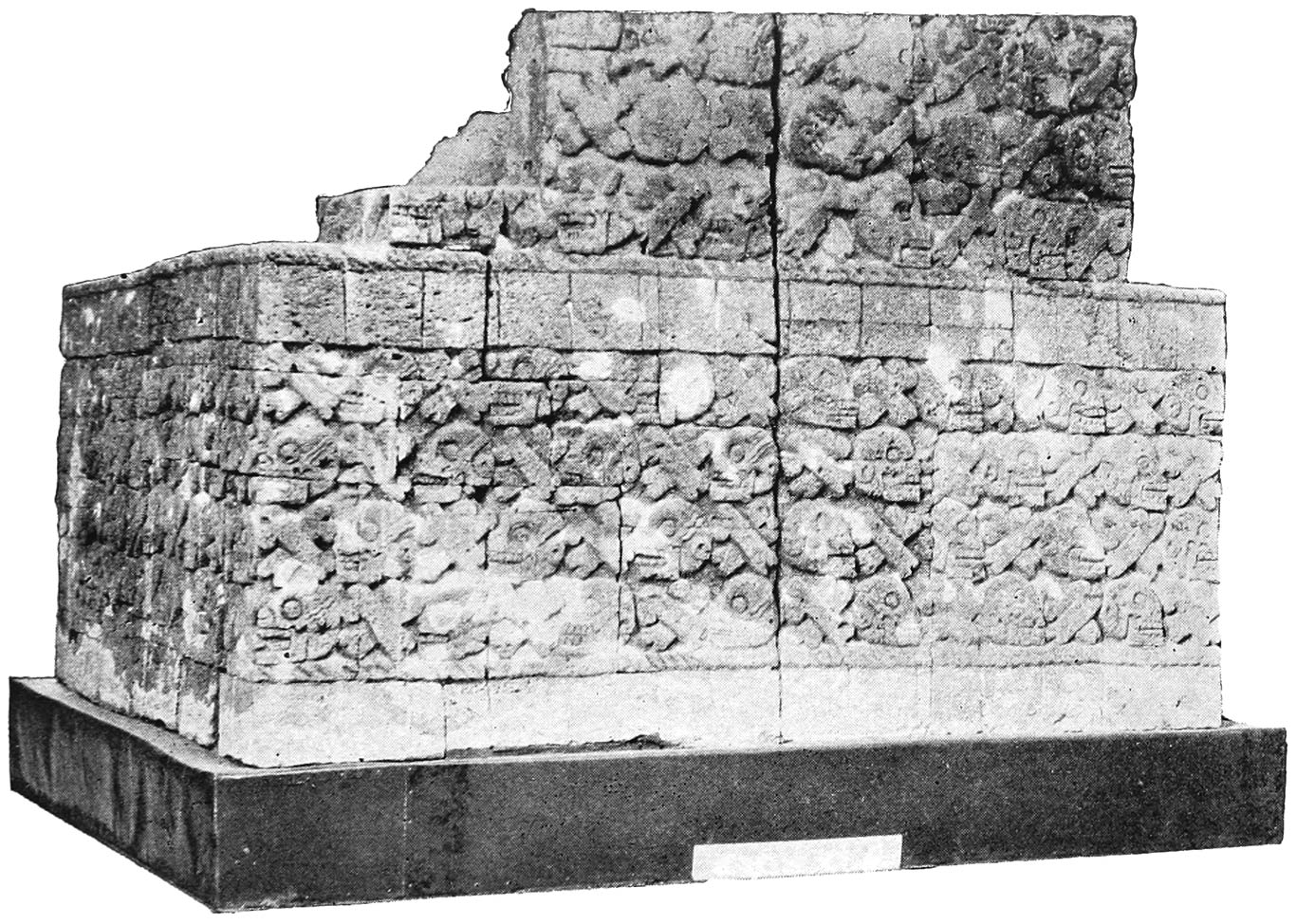
TEZCATLIPOCÂ.
STONE ALTAR OF SKULLS TO TEZCATLIPOCÂ CARVED IN STONE.
(Museo Naçional, Mexico.)
Teotleco.—The movable feasts sacred to Tezcatlipocâ and alluded to in the list of his festivals are only briefly mentioned by Sahagun, and do not appear to have been of any particular importance. As regards the Teotleco Sahagun says: “The twelfth month was called Teotleco, which signifies the arrival of the gods. A festival was celebrated in honour of all the gods who were said to have gone to some country, I know not where. On the last day of the month a greater one was held, because the gods had returned.
“On the fifteenth day of this month the young boys and the servitors decked all the altars or oratories of the gods with boughs, as well those which were in the houses as the images which were set up by the wayside and at the cross-roads. This work was paid for in maize. Some received a basketful, and others only a few ears.
“On the eighteenth day the ever-youthful god Tlamatzincatl, or Titlacauan, arrived. It was said that he marched better and arrived the first because he was young and strong. Food was offered him in his temple on that night. Everyone drank, ate, and made merry; the old people especially celebrated the arrival of the god by drinking wine, and it was alleged that his feet were washed by these rejoicings. The last day of the month was marked by a great festival, on account of the belief that the whole of the gods arrived at that time. On the preceding night a quantity of flour was kneaded on a carpet into the shape of a cheese, it being supposed that the gods would leave a footprint thereon as a sign of their return. The chief attendant watched all night, going to and fro to see if the impression appeared. When he at last saw it he called out, ‘The master has arrived,’ and at once the priests of the temple began to sound the horns, trumpets, and other musical instruments used by them. Upon hearing this noise everyone ran forthwith to offer food in all the temples or oratories, and gave themselves up to renewed rejoicings, to wash the feet of the gods, as we have already described.
“The next day the aged gods were said to come last, because they walked more slowly on account of their age. On that day several captives were doomed to be burnt alive. A great brazier was prepared; young men disguised as monsters danced round about it, and while dancing, hurled the unhappy victims into the fire, in the manner already explained. Other ceremonies took place which will be described in the account of this festival.”
MYTHS
The interpreter of Codex Telleriano-Remensis states that “Tezcatlipocâ is he who appeared to the nation on the mountain of the mirror, as they say, and is he who tempted Quetzalcoatl the penitent.” Elsewhere he says: “They do not here paint Tezcatlipocâ with a foot formed of a serpent, since they say that this festival [panquetzaliztli] relates to a time previous to his sinning while still in heaven, and that hence happened the war in heaven, from whence wars sprung below.”
The interpreter of Codex Vaticanus A. says of him: “Tezcatlipocâ, here represented, was one of their most potent gods. They say that he appeared in that country on the top of a mountain called Tezcatepu, which signifies the mountain of mirrors.” Later on he remarks that the god was sometimes painted with the feet of a man and of a cock, “as they say his name bears allusion to this circumstance. He is clothed with a fowl, which seems to cry in laughing accents, and when it crows, Oa, Oa, Oa, they say that it deceived the “first woman, who committed sin, and accordingly they place him near the goddess of pollution.”
A report on the Huaxtec territory, dated 1579, states that: “They relate another fable, that they had two other effigies as gods, one called Ometochtli, who is the god of wine, the other Tezcatlipocâ, which is the name of the most exalted idol worshipped by them, and with these they had painted the figure of a woman named Hueytonantzin, that is ‘our great mother,’ because they said that she was the mother of all these gods or demons. And those four above-mentioned male demons, they related, had killed this great mother, founding with her the institution of human sacrifice, and taking her heart out of her breast, and presenting it to the sun. Similarly, they related that the idol Tezcatlipocâ had killed the god of wine with his consent and concurrence, giving out that in this way he gave eternal life, and that if he did not die, all persons drinking wine must die; but that the death of this Ometochtli was only the sleep of one drunk, that he afterwards recovered, and again became fresh and well.”
Tezcatlipocâ, it will be remembered, is alluded to in the cosmogonic myths of Mendieta and Sahagun, already related in the chapter on Cosmogony. The Historia de los Mexicanos por sus Pinturas refers to him as the creator, says that “he made the sun to shine,” and states that he was the constellation Ursa Major, the Great Bear, which “sank in the water.” He also made the Tazcaquavlt, or “tree of the mirror,” fashioned four hundred men and a hundred women as food for the sun, and, along with Quetzalcoatl, constructed “the road in the heavens, the Milky Way.”
“And after this, Toveyo adorned all his body with the rich feathers called tocivitl, and commanded the Toltecs to gather together for a festival, and sent a crier up to the top of the mountain Tzatzitepec, to call in the strangers and the people afar off to dance and to feast. A numberless multitude gathered to Tulla. When they were all gathered, Toveyo led them out, young men and girls, to a place called Texcalapa, where he himself began and led the dancing, playing on a drum. He sang too, singing each verse to the dancers, who sang it after him, though they knew not the song beforehand. Then was to be seen a marvellous and terrible thing. A panic seized the Toltecs. There was a gorge or ravine there, with a river rushing through it called the Texcaltlauhco. A stone bridge led over the river. Toveyo broke down this bridge as the people fled. He saw them tread and crush each other down, under-foot, and over into the abyss. They that fell were turned into rocks and stones; as for those that escaped, they did not see nor think that it was Toveyo and his sorceries had wrought this great destruction; they were blinded by the witchcraft of the god, and out of their senses like drunken men.
“Tezcatlipocâ then proceeded to hatch further evil against the Toltecs. He took the appearance of a certain valiant man called Teguioa, and commanded a crier to summon all the inhabitants of Tulla and its neighbourhood to come and help at a certain piece of work in a certain flower-garden (said to have been a garden belonging to Quetzalcoatl). All the people gathered to the work, whereupon the disguised god fell upon them, knocking them on the head with a hoe. Those that escaped the hoe were trodden down and killed by their fellows in attempting to escape. A countless number was slain. Every man that had come to the work was left lying dead among the trodden flowers.
“And after this Tezcatlipocâ wrought another witchcraft against the Toltecs. He called himself Tlacavepan, or Acexcoch, and came and sat down in the midst of the market-place of Tulla having a little manikin (said to have been Uitzilopochtli) dancing upon his hand. There was an instant uproar of all the buyers and sellers and a rush to see the miracle. The people crushed and trod each other down, so that many were killed there; and all this happened many times. At last the god-sorcerer cried out on one such occasion: ‘What is this? Do you not see that you are befooled by us? Stone and kill us.’ So the people took up stones and killed the said sorcerer and his little dancing manikin. But when the body of the sorcerer had lain in the market-place for some time it began to stink and to taint the air, and the wind of it poisoned many. Then the dead sorcerer spake again, saying: ‘Cast this body outside the town, for many Toltecs die because of it.’ So they prepared to cast out the body, and fastened ropes thereto and pulled. But the ill-smelling corpse was so heavy that they could not move it. Then a crier made a proclamation, saying: ‘Come, all ye Toltecs, and bring ropes with you, that we may drag out and get rid of this pestilential carcass.’ All came accordingly, bringing ropes, and the ropes were fastened to the body and all pulled. It was utterly in vain. Rope after rope broke with a sudden snap, and those that dragged on a rope fell and were killed when it broke. Then the dead wizard looked up and said; ‘O Toltecs, a verse of song is needed.’ And he himself gave them a verse. They repeated the verse after him, and, singing it, pulled all together, so that with shouts they hauled the body out of the city, though still not without many ropes breaking and many persons being killed as before. All this being over, those Toltecs that remained unhurt returned every man to his place, not remembering anything of what had happened, for they were all as drunken.
“Other signs and wonders were wrought by Tezcatlipocâ in his rôle of sorcerer. A white bird called Iztac cuixtli was clearly seen flying over Tulla, transfixed with a dart. At night also, the sierra called Zacatepec burned, and the flames were seen from afar. All the people were stirred up and affrighted, saying one to another, ‘O Toltecs, it is all over with us now; the time of the end of Tulla is come; alas for us, whither shall we go?’
“Then Tezcatlipocâ wrought another evil upon the Toltecs; he rained down stones upon them. There fell also, at the same time, a great stone from heaven called Techcatl; and when it fell the god-sorcerer took the appearance of an old woman, and went about selling little banners in a place called Chapultepec Cuitlapilco, otherwise named Uetzinco. Many then became mad and bought of these banners and went to the place where was the stone Techcatl, and there got themselves killed; and no one was found to say so much as, ‘What is this that happens to us?’ They were all mad.
“Another woe Tezcatlipocâ brought upon the Toltecs. All their victuals suddenly became sour, and no one was able to eat of them. The old woman, above mentioned, took up then her abode in a place called Xochitla, and began to roast maize: and the odour of the roasted maize reached all the cities round about. The starving people set out immediately, and with one accord, to go where the old woman was. They reached her instantly, for here it may be again said, that the Toltecs were exceedingly light of foot, and arrived always immediately whithersoever they wished to go. As for the Toltecs that gathered to the mock sorceress, not one of them escaped. She killed them every one.”
These feats of Tezcatlipocâ against the Toltecs seem to have reference to the various species of charm wielded by the enchanter; the love-charm, the charm by music, by disease, by destruction of victuals. The rain of stone signified barrenness, drought, which was implied by the nature of the god, the deity of obsidian and of tempests.
For other myths regarding Tezcatlipocâ see the chapter on Cosmogony.
NATURE AND STATUS
Thus from the shape beheld in the seer’s mirror, Tezcatlipocâ came to be regarded as the seer. That into which the wizard gazed became so closely identified with sorcery as to be thought of as wizard-like itself; for Tezcatlipocâ is, of all Mexican deities, the one most nearly connected with the wizard’s art. He is par excellence the nocturnal god who haunts the crossways and appears in a myriad phantom guises to the night-bound wayfarer. “These,” says Sahagun, “were masks that Tezcatlipocâ assumed to frighten the people.”
He wears the symbol of night upon his forehead; he is the moon, ruler of the night, the wizard who veils himself behind the clouds; he bears the severed arm of a woman who has died in childbed, as a magical instrument, as did the naualli of old Mexico. From him all ominous and uncanny sounds proceed: the howl of the jaguar (in which we perceive Tezcatlipocâ as the wizard metamorphosed into the wer-animal), and the foreboding cry of the uactli bird, the voc, the bird of Hurakan in the Popol Vuh.
Whether or not he came to be looked upon as the wind of night which ravined through the empty streets and deserted countryside by virtue of the train of thought suggested above, many aspects of Tezcatlipocâ are eloquent of his boreal attributes. Thus, he is invisible and capricious, the object of mistrust among the people, who discerned in tempestuous weather a manifestation of his freakish bad temper. The myth in which he was described as pursuing Quetzalcoatl in tiger-form will, in the section which deals with that god, be indicated as an allegory of the clashing of the hurricane with the rain-bringing trade-wind. Lastly, as patron of war, of the warrior’s club and dance-house, he is, as the boisterous storm, emblematic of strife and discord. Seats of stone over-arched with green branches were provided for him throughout the city so that he might rest from his wanderings if he thought good.
In common with the majority of the greater Mexican deities, Tezcatlipocâ had a stellar connection. He was one of the Tzitzimimê who had fallen from heaven, and the Historia de los Mexicanos por sus Pinturas remarks of him, “the constellation of the Great Bear descends to the water because it is Tezcatlipocâ, who has his seat there,” thus also indicating that he ruled the northern quarter, out of which, it was considered, no good thing might come. His Tzitzimimê shape appears to have been the spider. In American-Indian myth the stars are frequently regarded as having spider form, and especially so in Mexican myth. In several of the codices, notably in Codex Borbonicus, the Tzitzimimê or star-demons are represented in insect shape. Thus, Tezcatlipocâ, when he descended from heaven to harass Quetzalcoatl, did so by means of a spider’s web, so that we are justified in regarding the spider as his stellar form.
The origin of his conception as the sun of the north and as the setting sun seems reasonably clear and is secondary in character. As the sun sinks in the west its brilliant gold turns to a glassy red, reminiscent of the dull reflex of light in a surface of polished obsidian. The mirror held by Tezcatlipocâ, with its fringe of feathers, obviously represents the sun of evening. But he is also to be thought of as the torrid and blazing orb of the dry season, scorching and merciless.
I regard his several coloured forms as symbolic of various kinds of weather. Thus, in his black form he appears to represent the rainy season; in his red, the torrid and dry period of the year; in his white, cold and frost; and in his striped painting, the embodiment of fair weather. Thus Tezcatlipocâ is the atmospheric god par excellence, ruler of all meteorological conditions. In the prayers offered up to him it is frequently stated that he may, if he so chooses, send rain and plenty, and this aspect of him seems to account for his variously coloured disguises. That these were, indeed, regarded as practically separate divine forms is clear from the first chapter of the Historia de los Mexicanos por sus Pinturas, which alludes to the Black and Red Tezcatlipocâ as two entirely different gods.
Tezcatlipocâ, at the period of the Conquest, had developed attributes of a more lofty kind than any of those already described. Like Quetzalcoatl, and because he was a god of the wind or atmosphere, he came to be regarded as the personification of the breath of life. In the mind of savage man the wind is usually the giver of breath, the great store-house of respiration, the source of immediate life. In many mythologies the name of the principal deity is synonymous with that for wind, and in others the words “soul” and “breath” have a common origin. It has been suggested that the Hebrew Jahveh (the archaic form of Jehovah) is connected with the Arabic hawah, to blow or breathe, and that Jahveh was originally a wind or tempest god.
But although Tezcatlipocâ was the Giver of Life, he was also regarded as a deity with power to take it away. In fact at times he appeared as an inexorable death-dealer, and in this guise he was named Nezahualpilli (“The Hungry Chief”) and Yaotzin (“The Enemy”). But he was also known as Telpochtli (“The Youthful Warrior”), from the fact that his reserve of strength, his vital force, never grew less and was boisterously apparent, as in the tempest. As the wind at night rushes through the roads with more seeming violence than it does by day, so was Tezcatlipocâ pictured in the Aztec consciousness as rioting along the highways in search of slaughter. Indeed, seats or benches of stone, shaped like those used by the chiefs of the Mexican towns, were placed at intervals on the roads for his use, and here he was supposed to lurk, concealed by the green boughs which surrounded them, in wait for his victims. Should anyone grapple with and overcome him, he might crave whatsoever boon he desired, with the surety of its being granted. The worship of Tezcatlipocâ previous to the Conquest had so advanced, and so powerful had his cult become, that it would appear as if the movement would ultimately have led to a monotheism or worship of one god equivalent to that of the cult of Jahveh, the God of the Old Testament among the ancient Hebrews. To his priestly caste is credited the invention of many of the usages of civilized life, and it succeeded in making his worship universal. The Nahua people regarded the other gods as objects of special devotion, but the worship of Tezcatlipocâ was general.
QUETZALCOATL = “FEATHERED SERPENT”
Area of Worship: The Plateau of Anahuac.
Minor Names: Chicunaui eecatl—“Nine Wind.” Ce acatl—“One Reed.”
Relationship: Son of Iztacmixcoatl and Chimalman or Xochiquetzal; one of the Tzitzimimê.
Calendar Place: Ruler of the second day-count, eecatl. Ruler of the second week, ce ocelotl. Ninth of the thirteen day-lords.
Festivals: Ce acatl (movable feast). Atlacahualco.
Compass Direction: East.
ASPECT AND INSIGNIA
General.—The insignia of Quetzalcoatl is fairly constant in its appearance. He usually wears the Huaxtec cone-shaped hat painted in the design of the jaguar-skin, which is occasionally divided vertically into a black or blue and a red field, having an eye in the middle. The hair is bound by a leather strap set with jewels, which has a conventional bird’s head on the front, and in Codex Borgia consistently shows a black, stepped pattern on a white ground. Elsewhere a bow with rounded ends takes the place of this strap, but in Borgia (sheet 62) the hair is bound up with two intertwined snakes. At the back of the neck a fan-shaped nape-ornament is usually seen, consisting of black feathers, from which rise the red plumes of the quetzal bird, and it seems, from the account of the costume sent to Cortéz by Motecuhzoma, that this nape-appendage was made from grouse-feathers, although the Spanish account states that they belonged to the crow. The god usually wears white ear-pendants of hook-like shape, which, Sahagun states, were made of gold. The necklace is of spirally voluted snail-shells, and on the breast is worn a large ornament, also sliced from a shell. The ends of the loin-cloth are rounded off and are generally painted in two colours—brown, the colour of the jaguar-skin, and white or red. The god’s atlatl, or spear-thrower, is painted with the stellar design of white circles on a black ground, and in his headdress is stuck the agave-leaf spike and the bone dagger, the implements of penance and mortification. The body-paint is frequently black, like that of the priests. Most of these insignia are of Huaxtec origin and show that Quetzalcoatl was usually associated with this coastal people. The snail-shell ornament on the breast, the hook-shaped ear-pendant, the fan-shaped nape-ornament, and the cone-shaped cap, were undoubtedly of Huaxtec origin, and such objects have been taken from Huaxtec graves and are found represented on vases and jugs from the State of Hidalgo. In many representations of him the god is seen wearing a long-snouted mask, usually painted a bright red, through which he was supposed to expel the wind in his guise of Eecatl, the Wind-god. This mask is frequently fringed with a beard.
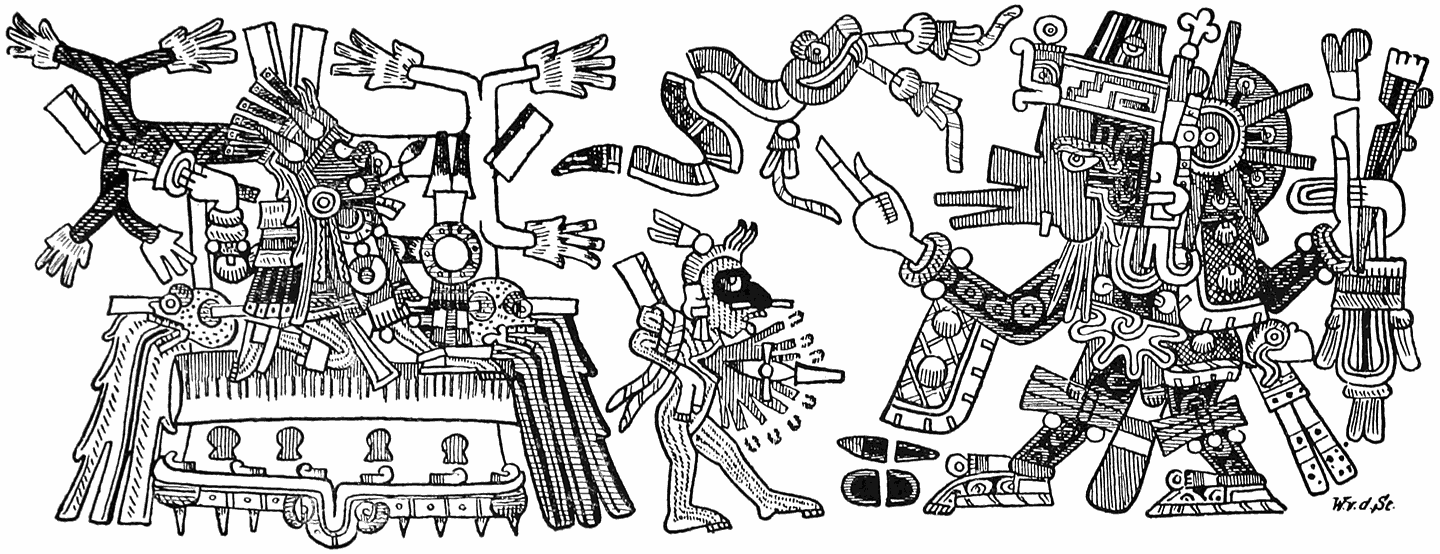
FORMS OF QUETZALCOATL.
Quetzalcoatl (right) and Tlauizcalpantecutli. (Codex Borgia, sheet 19.)
Codex Vaticanus B.—Sheet 75: Quetzalcoatl’s body-paint is a dark colour, and in his hair he wears unspun cotton, as does Tlazoltcotl. Sheet 76: Here his face is painted black and he wears the fillet with the step-pattern and the two-coloured cap, and in his hair are stuck the instruments of mortification. He holds in his hand a snake, which is to be regarded as the agricultural implement with which he tills the ground.
Codex Borgia.—Sheet 73: In this place he is set back to back with the Death-god and is surrounded by the twenty day-signs. The body-paint is light blue, and the anterior part of the face has the stellar painting of white circles on a black ground. His conical cap has the parti-coloured painting and the cross, the symbol of the four winds, in the middle. On his breast he wears the snail-shell and in his hand a blue staff. His wind-mask is entirely covered with stellar and lunar emblems. His rattle-staff is light blue, in contradistinction to that of the Death-god, which is sprinkled with blood. Sheet 56: Here he is equipped with the hoe and wears the body-paint of a priest, a necklace of jaguar-skin and teeth, the conical bi-coloured cap, the stepped fillet with conventional bird’s head in front, and the bearded face-mask. Stellar symbols and feather-balls dot his dress and headdress. He stands back to back with the Death-god, and it is clear that here he is intended to represent the heavenly Quetzalcoatl, the giver of breath and life. On sheet 72 we see him as a priest surrounded by day-signs and implements of mortification. Sheet 19: As represented in this sheet he stands opposite the Death-god. He wears a dark-coloured garment, and what can be seen of his face is painted black, with a spiral pattern. His mantle bears the cross-hatchings indicative of rain or water and is ornamented with feather balls. The red wind-mask protrudes beneath a parti-coloured cap with stellar eyes, and a fillet with step-pattern and conventional bird’s head, and he wears the snail-shell breast ornament and carries the implements of mortification. Sheet 16: On the lower right-hand corner of this sheet he is depicted in a precisely similar manner.
FORMS OF QUETZALCOATL.
Quetzalcoatl (right) and the Death-god. (Codex Vaticanus, 3773, sheet 76.)
Codex Magliabecchiano.—Sheet 89: Quetzalcoatl is here represented in a dancing attitude. He wears the Huaxtec hat made of jaguar-skin, the shield with the snail-shell ornament, which is also reproduced on his breast, and the yellow and red face-painting. The bone “reed” for piercing the tongue is stuck in his headgear, and from it depend balls of cotton. He carries an atlatl, or spear-thrower, symbolic of rain or wind, and similar in motif to the nose-ornament of the Maya God B. His mantle is cross-hatched to symbolize rain or water and is decorated with red bows. He wears anklets of jaguar-skin, and a panache of green and yellow feathers.
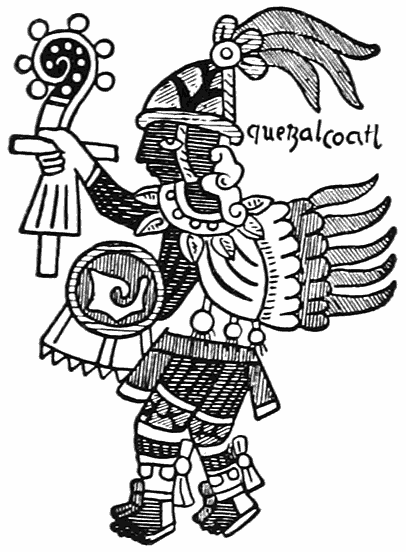
Quetzalcoatl. (From the Sahagun MS.)
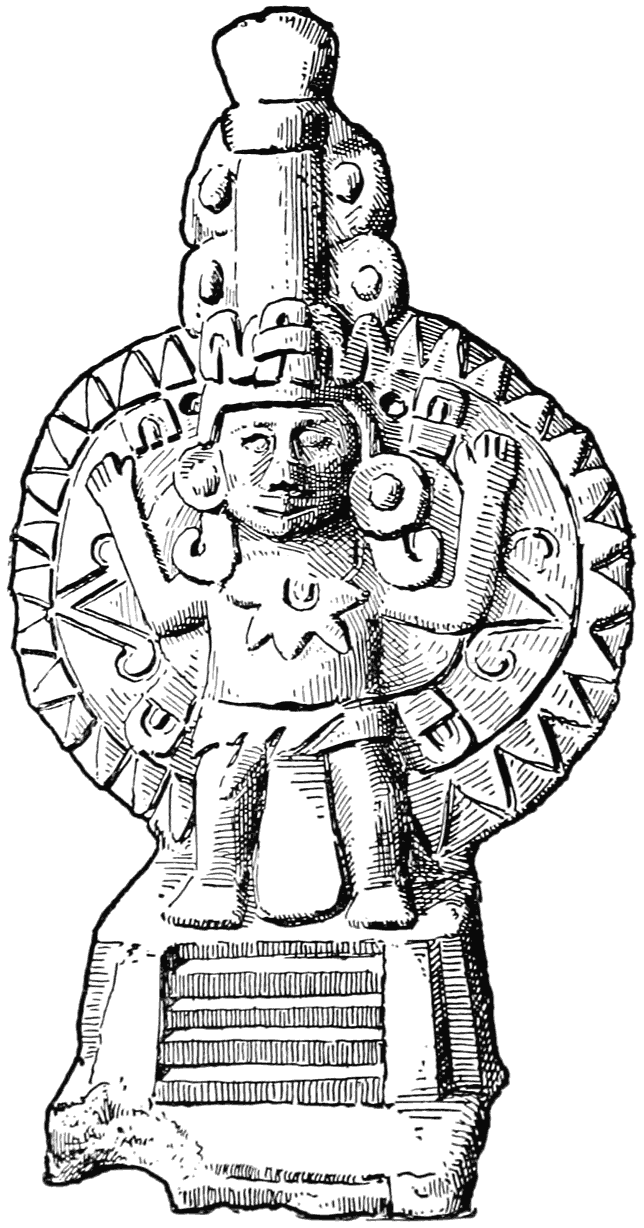
Pottery figure of Quetzalcoatl from Tezcuco.
FORMS OF QUETZALCOATL.
Elsewhere Acosta says: “The greatest idoll of all their gods was called Quezcalcovately.… He never ware but one garment of cotton, which was white, narrow and long, and upon that a mantle beset with certain red crosses. They have certain green stones which were his, and those they keep for relickes. One of them is like an ape’s head.”
Anales de Quauhtitlan.—In this work Quetzalcoatl is described as wearing the turquoise snake-mask and the quetzal-feather ornament—that is, the decorations of the Fire-god: “Lastly in the year one reed they say, when he had arrived on the shore of the sea, then he began to weep and put off the garb with which he was arrayed, his quetzal-feather ornament, his turquoise mask.”
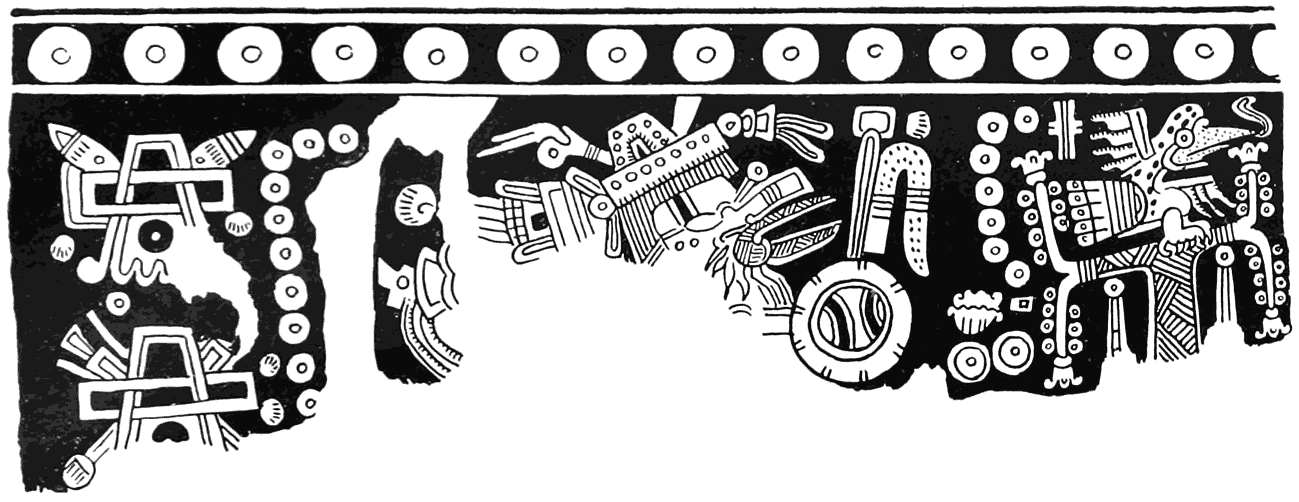
QUETZALCOATL.
(From a wall-painting at Mitla.)
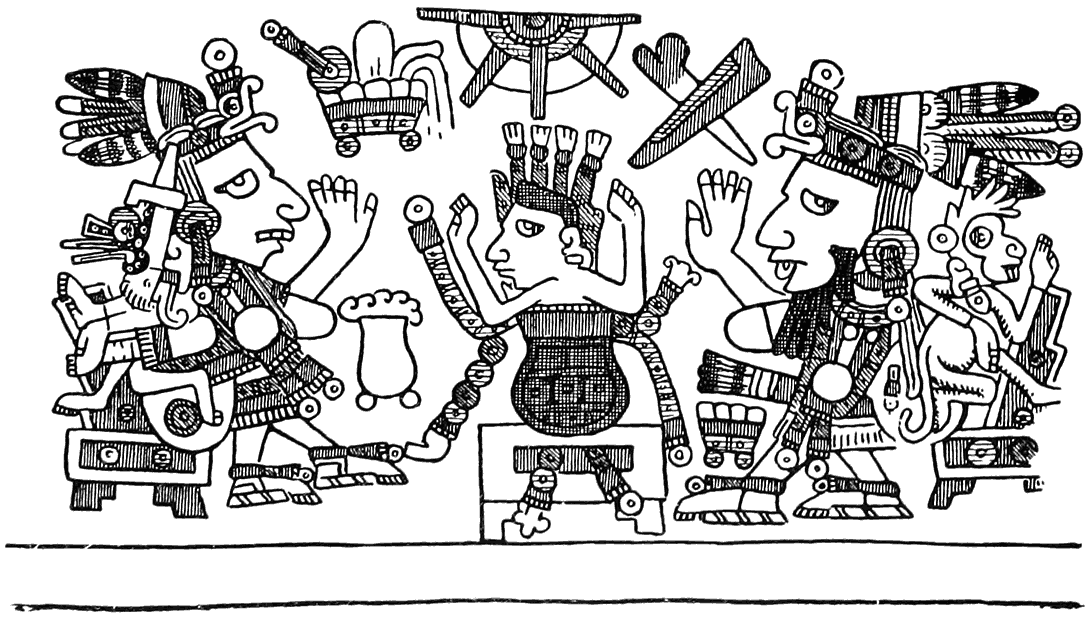
TONACATECUTLI-TONACACIUATL.
(From Codex Borgia.)
STATUARY
A statuette of the god from the Valley of Mexico exhibits him in a high cap, ornamented round the lower portion with a serpentine motif, and wearing the sliced snail-shell dress-ornament. A caryatid found in the Calle de las Escalerillas, Mexico City, on the 16th of October 1900, represents him with a long, pointed beard, which might, however, be interpreted as the mouth-mask of the Wind-god lowered down to show the upper part of the face more clearly, and it would seem from this statue that the beard with which Quetzalcoatl is represented in some places in Mexican art is nothing more or less than the mouth-mask pushed down over the chin and neck, although it must be admitted that his mask is frequently depicted with what is undoubtedly a beard. A relief excavated at the Castillo de Teayo shows Quetzalcoatl wearing the feathered-serpent helmet-mask, which in this representation is most elaborate, and the sliced snail-shell dress-ornament. Two figures of Quetzalcoatl found near Texcuco exhibit considerable differentiation from other forms. In both he is seated on the top of a teocalli or temple, and behind him is seen the solar emblem, represented as a large, flaming disc. He wears a high cap which reminds one of the crown of Upper Egypt, as seen in Egyptian representations, except that it is flanked on either side by two large studs or knobs and is surrounded at the base by the serpent-motif, as in the specimen from the Valley of Mexico. He also wears his usual breast-ornament. In a round sculpture found at Puebla we perhaps see Quetzalcoatl as a butterfly, and can only identify this figure as the god because of the wind-mask it wears.
WALL-PAINTINGS
MYTHS
The myths concerning Quetzalcoatl are numerous and conflicting. In the first place I shall provide a careful précis of the more important, their prolixity rendering full quotation impossible.
The interpreter of the Codex Telleriano-Remensis says regarding Quetzalcoatl:
“Quetcalcoatl they say was he who created the world; and they bestowed upon him the appellation of Lord of the Wind, because they said that Tonacatecotli when it appeared good to him breathed and begat Quecalcoatle. They erected round temples to him without any corners. They said that it was he (who was also lord of these thirteen signs which are here represented) who formed the first man. They celebrated a festival on the sign of four earthquakes, to the destroyer with reference to the fate which again waited the world; for they said that it had undergone four destructions and would again be destroyed. He alone had a human body like that of men; the other gods were of an incorporeal nature.
“After the deluge the custom of sacrificing commenced. Topilcin Quetcalcoatle was born on the day of seven canes; and they celebrated on this same day of seven canes a great festival in Cholula, to which they came from all parts of the country and the cities and brought great presents to the lords and papas of the temple; and they did the same on the day on which he disappeared or died, which was the day of One Cane. These festivals happened at the expiration of every period of fifty-two years.
“They here fasted the last four days to Quecalcoatl of Tula, who is he who was named after the first Calcoatle; and now they name him One Cane, which is the star Venus, of which they tell the fable accredited amongst them.
“Tlavizcalpantecutli is the star Venus the first created light (Civahteltona) before the deluge. They say that it was a fire or a star: it was created before the sun. This star (Venus) is Quecalcoatle. They say this is the star which we call Lucifer from its light; and they accordingly paint it with the sign of one Cane, which was the day dedicated to it. He took this name on the occasion of his departure or disappearance. Tlavizcalpantecutli is the God of Morning when it begins to dawn: he is also the Lord of Twilight on the approach of Night: he presided over these thirteen days during the four last of which they fasted. It properly was the first light which appeared in the world; it here signifies the light which diffuses itself over things, or the surface of the earth.”
The interpreter of Codex Vaticanus A says:
“They invented dreams, the result of their own blindness, relating that a god of the name of Citallatonac, which is the sign seen in heaven called St. James’s or the Milky Way, sent an ambassador from heaven on an embassy to a virgin of Tulan called Chimalman (a shield) who had two sisters, the one named Tzochitlique and the other Couatlique; and that the three being alone in the house, two of them, observing the ambassador of heaven, died of fright, Chimalman alone remaining alive, to whom the ambassador announced that it was the will of this god that she should conceive a son; and having delivered to her the message, he rose and left the house, and as soon as he had left it she conceived a son without connection with man, who they called Quetzalcoatle, who they say is the god of air, and his temples are round in the manner of churches, although till that time such was not the fashion of their temples. He was the inventor of temples of this form as we shall show. He it was, as they say, who caused hurricanes and in my opinion was the god who was called Citaladuali and it was he who destroyed the world by winds. This painting is here wanting, together with another which represented that as soon as the son of this virgin was born he possessed the use of reason. The son of the virgin, Topilcin Quetzalcoatle, knowing that the vices of men were necessarily the cause of the troubles of the world, determined on asking the goddess Chalchiutlicue (this was the heavenly designation of the virgin Chimalman) who is she who remained after the deluge with the man in the tree, and is the mother of the god Tlaloque, whom they have made goddess of water, that they might obtain rain when they stood in need of and accordingly Quetzalcoatle commenced offering sacrifices to obtain rain, as a period of four years had elapsed since it had rained.
“Quetzalcoatltopilzin does penance and makes offerings of prayers, sacrifice, gold gems, incense, etc., to appease divine wrath against the people; draws his own blood with thorns. After the expiration of a long period during which he continued his penance a lizard appeared scratching the ground giving him to understand that the scourge of heaven was past and that the earth would with joy produce its fruits, which quickly came to pass; and accordingly they relate that on a sudden such abundance followed that the earth, which had remained so many years barren, bore many kinds of fruit and from that even they took four signs.
“Quetzalcoatl’s example teaches men to do penance, make offerings. He founded four temples—the first for the nobles; second, for the people; third, House of Fear or Serpent; fourth, Temple of Shame.
“Of Quetzalcoatle they relate that, proceeding on his journey, he arrived at the Red Sea, which is here painted, and which they named Tlapallan; and that entering into it, they saw no more of him, nor knew what became of him, except that they say that he desired them at the time of his departure to restrain their grief and to expect his return, which would take place at the appointed time; and accordingly they expect him even to the present time: and when the Spaniards came to this country they believed that it was he, and when at a later period of 1550 when the Çapotecas revolted, they alleged, as the cause of their insurrection, the report that their god who had to redeem them had already come. Quetzalcoatle was born on the sign One Cane; and the year of the Spaniards’ arrival commenced on the sign One Cane, according to their ancient Computation: whence the occasion arose of their believing that the Spaniards were their gods; because they say that he had foretold that a bearded nation would arrive in those countries who would subject them. They adored him as a god, as will be seen: for they believed it certain that he had ascended into heaven and was that star which was visible at the north of the sun before the break of day, which is the planet Venus; and they represented him accordingly as has already been shown.
“Quetzalcoatle was the first inventor of sacrifices of human blood, amongst the various other things which they offered to the gods; and this was the manner in which they pierced their tongues, that the blood might flow … and their ears and penis; till at last, as we shall presently mention, the custom of human sacrifices was introduced, when they tore out the hearts of the victims to present them to the face of the idol which they considered the image of their wretched god.
“They declare that their supreme deity Tonacatecotle, whom we have just mentioned, who by another name was called Citinatonali, when it appeared good to him, breathed and begot Quetzalcoatle, not by connection with woman, but by his breath alone, as we have observed above, when he sent his ambassador, as they say, to the virgin of Tula. They believed him to be the god of the air and he was the first to whom they built temples and churches, which they formed perfectly round without any angles. They say that it was he who effected the reformation of the world by penance, since as, according to his account, his father had created the world and men had given themselves up to vice, on which account it had been frequently destroyed, Citinatonali sent his son into the world to reform it.… They assigned to him the dominion over the other thirteen signs, which are here represented, in the same manner in which they assigned the preceding thirteen to his father. They celebrated a great festival on this sign, as we shall see on the sign of four earthquakes, which is the fourth in order here, because they feared that the world would be destroyed in that sign, as he had foretold to them when he disappeared in the Red Sea, which event occurred on the same sign. As they considered him their advocate, they celebrated a solemn festival and fasted during four signs.”
The Anales de Quauhtitlan or Codex Chimalpopocâ states that Quetzalcoatl was born in no natural manner, but was a nine years’ child. He created the four classes of men: the men of the four “suns” or periods of the world were made by him on the day chicome ehecatl, or “seven wind.” The record proceeds to relate the circumstances of his rule at Tollan, the manner in which he discovered the value of precious stones, gold and silver, red and white shells, quetzal feathers, the cotinga and red sparrowbill feathers, the various species of cocoa and cotton. When he had drunk the octli offered him by Tezcatlipocâ, he forgot his chastity in the intoxication and indulged in intercourse with Quetzalpetlatl, for which sin he was forced to quit Mexico. When he was driven from Tollan in the year one reed, he arrived on the sea-shore, wept, and divested himself of his garb and turquoise snake-mask. Then he immolated himself by burning, his ashes became dust and changed into birds and his heart was converted into the morning star. Lastly, it is said of him that when he died he was not visible for four days, during which period he tarried in the Underworld. For a subsequent four days “he was bones.” “After eight days appeared the great star which they called Quetzalcoatl. They said that he thus mounted the throne as a god.”
In its second or historical portion the codex states that Quetzalcoatl discovered maize which was concealed in the mountain Tonacatepetl. Many of the gods searched for it, but Quetzalcoatl, taking the form of a black ant, was guided to the spot by a red ant. As he was unable to lift the mountain, it was split open by the magical prowess of Xolotl in his manifestation of Nanahuatl, and the maize became the spoil of Quetzalcoatl. But it was stolen from him by Tlaloc, the rain-god proper, perhaps an allegorical manner of alluding to the more direct influence of that deity upon growth.
Other myths relating to Quetzalcoatl, chiefly as a creative agency, will be found in the précis of the opening chapters of the Historia de los Mexicanos por sus Pinturas, in the chapter on Cosmogony.
In Codex Borgia we find a passage (sheets 35–46) which appears to refer to the progress of Quetzalcoatl and Tezcatlipocâ through the infernal regions, and which might be described as the Mexican “Harrying of Hell.” On this passage Seler has briefly commented (see his Commentary on Codex Vaticanus B, p. 119).
CENTRAL AMERICAN MYTHS RELATING TO QUETZALCOATL
Quetzalcoatl is, perhaps, singular among the deities of Mexico in that a number of well-authenticated Central American myths cluster around his name in its forms of Kukulcan, Gucumatz, and Votan. Certain of these must be considered here, for purposes of comparison and analogy.
“Votan is the third heathen in the calendar (that is the deity who is ascribed to the third division of the calendar), and in the little history written in the Indian language all the provinces and cities in which he tarried were mentioned; and to this day there is always a clan in the city of Teopisa that they call the Votans. It is also said that he is the lord of the hollow wooden instrument which they call tepanaguaste (that is, the Mexican teponaztli); that he saw the great wall, namely, the tower of Babel, which was built from earth to heaven at the bidding of his grandfather, Noah; and that he was the first man whom God sent to divide and apportion this country of India, and that there, where he saw the great wall, he gave to every nation its special language. It is related that he tarried in Huehueta (which is a city in Soconusco), and that there he placed a tapir and a great treasure in a slippery (damp, dark, subterranean) house, which he built by the breath of his nostrils, and he appointed a woman as chieftain, with tapianes (that is, Mexican tlapiani, “keepers”) to guard her. This treasure consisted of jars, which were closed with covers of the same clay, and of a room in which the picture of the ancient heathens who are in the calendar were engraved in stone, together with chalchiuites (which are small, heavy, green stones) and other superstitious images; and the chieftainess herself and the tapianes, her guardians, surrendered all these things, which were publicly burned in the market place of Huehueta when we inspected the aforesaid province in 1691. All the Indians greatly revere this Votan, and in a certain province they call him ‘heart of the cities’ (Corazon de los pueblos).”
In his ninth Pastoral Letter Nuñez says of Quetzalcoatl:
“In most of the Calendars, the seventh sign is the figure of a man and a snake, which they call Cuchulchan. The masters have explained it as a snake with feathers which moves in the water. This sign corresponds with Mexzichaut (Mixcoatl), which means Cloudy Serpent, or, of the clouds. The people also consult them in order to work injury on their enemies, taking the lives of many through such devilish artifices, and committing unspeakable atrocities.”
FESTIVALS
Atlacahualco.—The festival of Atlacahualco or Quaitl Eloa was, says Sahagun, sacred to Quetzalcoatl, as well as to the Tlaloque. For an account of it see the section which deals with Tlaloc.
Ce Acatl.—Says Sahagun: “On the first day of the sign ce acatl the great folk made a feast to Quetzalcoatl, the god of winds. This was celebrated in the calmecac, and here they offered rich gifts to his idol, perfumes and things to eat. They said it was the sign of Quetzalcoatl.”
PRIESTHOOD
The high-priest of Quetzalcoatl was stationed at Cholula and was, perhaps, the most venerated ecclesiastic in Mexico.
TEMPLES
The principal temple of the cult of Quetzalcoatl in Mexico was the well-known teocalli at Cholula. He had also a shrine in the great temple court at Mexico, built in circular form, and thus typical of the Wind-god.
NATURE AND STATUS
If this simple elucidation of the original myth be accepted, it will be seen how naturally its later modifications arise out of it or adapt themselves to it. But before we examine the manner in which they crystallized around it, it becomes necessary to disentangle from the whole mass that portion of it which alludes to the advent of a civilizing agency upon the Mexican plateau.
This speaks of the advance of a body of men from the neighbourhood of Vera Cruz to the Mexican plateau, and precisely in the direction whence the trade-wind comes—that is, from the east, the direction of the land of the Huaxtecs, a people of proto-Maya stock.
Quetzalcoatl is dressed in Huaxtec garb, and wears the truncated sugar-loaf hat and shell-ornaments of this people. This may signify nothing more than that he was so attired because he represented a wind which blew from the direction of the land of the Huaxtecs. Yet, it is certain that several of the deities adopted by the Mexicans had undoubtedly a Huaxtec origin, and this is markedly the case with Tlazoltcotl. There seems to be some ground, then, for the hypothesis that Quetzalcoatl was a god of Huaxtec origin. But the acceptance of such a theory will entail the acknowledgment of certain hypotheses which are among the most controverted questions in Mexican archæology. In the first place, it makes Quetzalcoatl the deity of a people of Maya stock, and secondly it would seem to imply a Huaxtec or Maya origin for the much-debated Toltec culture.
CRITICISM OF THE LATER ELEMENTS OF QUETZALCOATL’S MYTH
In short, the myth of Quetzalcoatl as recorded by Sahagun is obviously developed from a much older one which referred to a season of plenteous rain—the period of the rule of the gentle and beneficent god representing the trade-wind. As it was connected with prosperous conditions in agriculture, it was naturally brought into connection with the Toltec time, the “good old times of long ago,” when conditions were greatly better, and no mouth knew want. Such a concept was obviously of later origin. The revised myth took on a cultural complexion. In terms of allegory, it tells how the powers of the rain-making priest-god fail him; he becomes sick, and is beguiled and defeated by Tezcatlipocâ, the rival wind-god, who tells him that “another old man” awaits him in Tlapallan. And here we seem to find interpolated a reference to the guardian genius of the fountain of perpetual youth, the reservoir of rain and all refreshment, which Quetzalcoatl must visit if he would be cured of the ills of old age, and he is counselled to speak with its keeper if he would return to Mexico “as a boy.” The destruction of his treasure by the banished god seems to point to a reminiscence of the downfall of the Toltec state, and the concealment of his gold and gems by burial to analogous Toltec practice on the defeat or decline of that civilized folk. With his departure the reign of plenty ceases, the trees wither, the birds migrate, the season of the trade-wind rains has come to an end. History and myth are perhaps combined in this story of the latter days of the Toltec régime and those of the revivifying rains. The priest-god withdraws eastwards to the “flute-playing” of the retreating trade-winds. Nahua sorcerers detain him in order to learn the Toltec arts, perhaps a mythical manner of showing how the Nahua barbarians forced captive Toltecs to teach them the mysteries of stone- and metal-craft. He is given the draught of the dead, “that none of the living can drink,” a mythical episode common in all parts of the world. His dwarfish followers (the rain-gods, the Tlaloque, with whom Sahagun associates him elsewhere) are frozen to death in the cold of the mountains, otherwise the rain is congealed into snow.
Motolinia’s story of the fixing of the strap on Quetzalcoatl’s arm is merely a grotesque explanation of the name Acolhua, which in reality signifies “the folk of the great shoulder,” “the pushers,” “the hustling invaders.”
Mendieta, in dwelling upon Quetzalcoatl’s dislike of war, merely retains for us a characteristic of the effeminate people of Cholula. The appearance of Tezcatlipocâ as a spider is typical of the god of the dry season, or of the dry-rot prevalent in that period of the year. As a tiger he symbolizes the fierceness of the hurricane, and the tlachtli game which he and Quetzalcoatl engage in is undoubtedly symbolic of the seasonal strife between the wind-gods.
DEVELOPMENT OF THE CONCEPTION OF QUETZALCOATL
Summarizing the myths relating to Quetzalcoatl we find:
(1) That all of them have their origin in or refer back to an original nature-myth, in which Quetzalcoatl, the trade-wind, is, at the end of the rainy season, regarded as driven from the Mexican Plateau by Tezcatlipocâ (Hurakan) in his guise of the monsoon, or hurricane.
(2) That this myth in the first place became confounded with traditions of the Toltec civilization, naturally enough, as that civilization was the direct outcome of the agricultural wealth stimulated by the god representing the trade-wind.
(3) That it seems to have been associated with a myth relating to the fountain of youth, that is, the fountain in which the refreshing and revivifying rains were stored, to which Quetzalcoatl must return for rejuvenation and a fresh rain-supply.
(4) That the conception of the god Quetzalcoatl became humanized in the light of the agricultural and other manifestations of Toltec culture, thus bringing about the idea of his existence as a priest-king, and culminating in the establishment of a line of priestly rulers bearing his name, which endured as long as Mexican civilization.
(5) Out of these conceptions there naturally arose other related ideas, as those of:
(a) Quetzalcoatl as inventor of the tonalamatl, the instrument by which the festal days of the rain-cult were originally noted, but which on the adoption of the solar calendar as time-count degenerated into what may be regarded as an astrological table.
(c) Regarded as inventor of the tonalamatl, he gained a reputation as the possessor of profound hieratic wisdom, and came to be looked upon as the magician or sage par excellence, the patron of education, the rain-maker who knew precisely when the blood shed in penance should be spent in order that it might return to the soil of Anahuac in an abundant rainfall.
(d) Quetzalcoatl as the god of wind was also regarded as the breath of life, a phenomenon encountered in many mythologies, and therefore came to be conceived as the agency by which souls were originally placed in human bodies. From this, too, we may argue his appearance as a creator, or cosmic deity, although it may have been in his character as fertilizer that he came to be regarded in this light.
(e) Quetzalcoatl is the great penitent, the supreme protagonist of the penitential system, because without the blood spent in penitential exercise no rain might fall. The secondary character of this conception is probable.
This conception of him, evidently strongly sophisticated by priestly theological science, is illustrated in the Codex Magliabecchiano, where he is represented on one sheet along with Tezcatlipocâ, Tlaloc, and Uitzilopochtli. This group, in my opinion, represents the four elements: Fire (Uitzilopochtli), as possessor of the tlachinalli symbol, a hieroglyph for water and fire, and as sun-god; Air (Quetzalcoatl); Earth (Tezcatlipocâ), who as Tepeyollotl was an earth-deity; and Water (Tlaloc). The picture may also be descriptive of the four points of the compass over which he rules. But above and beyond this, as Seler has shown, it implies that these deities were later embodied in the idea of Quetzalcoatl. When Cortéz, coming from the East, landed at Vera Cruz, the Mexicans naturally believed that Quetzalcoatl had returned, and Motecuhzoma sent him as an offering “the dress appropriate to him,” four kinds of attire, the ceremonial costumes of Uitzilopochtli, Tezcatlipocâ, Tlaloc, and Quetzalcoatl.
ETYMOLOGY
There but remains the etymology of Quetzalcoatl’s name. It is compounded of the element quetzalli and coatl. The first denotes the bright green tail-feathers of the quetzal bird, and coatl = “snake,” so that the whole implies “feathered snake.” The generally accepted belief is that this name applies to the rain-bearing clouds which accompany the trade-wind, although others have seen in it a description of the rain itself, and still others the ripples made by wind on water. But quetzal in a secondary sense means “precious,” and coatl is capable of being translated “twin.” The Mexicans themselves, however, frequently drew and sculptured the god as a feathered serpent, although this may easily have possessed a merely pictographic significance. In any case, after prolonged consideration on the etymology of the name, I do not, so far, see any reason to quarrel with the currently accepted rendering of it.