Chapter V · DEITIES OF THE EARTH AND GROWTH PROPER (continued 2)
Reading edition
ITZPAPALOTL = “OBSIDIAN KNIFE BUTTERFLY”
Area of Worship: Originally Chichimec tribes; Mexican Plateau.
Relationship: Associated with Mixcoatl and the Centzon Mimixcoa; one of the Tzitzimimê.
Symbols: The butterfly; Mixcoatl’s stone knife.
Compass Direction: Earth (?).
Calendar Place: Ruler of the sixteenth day, cozcaquauhtli; of the fifteenth “week,” ce calli.
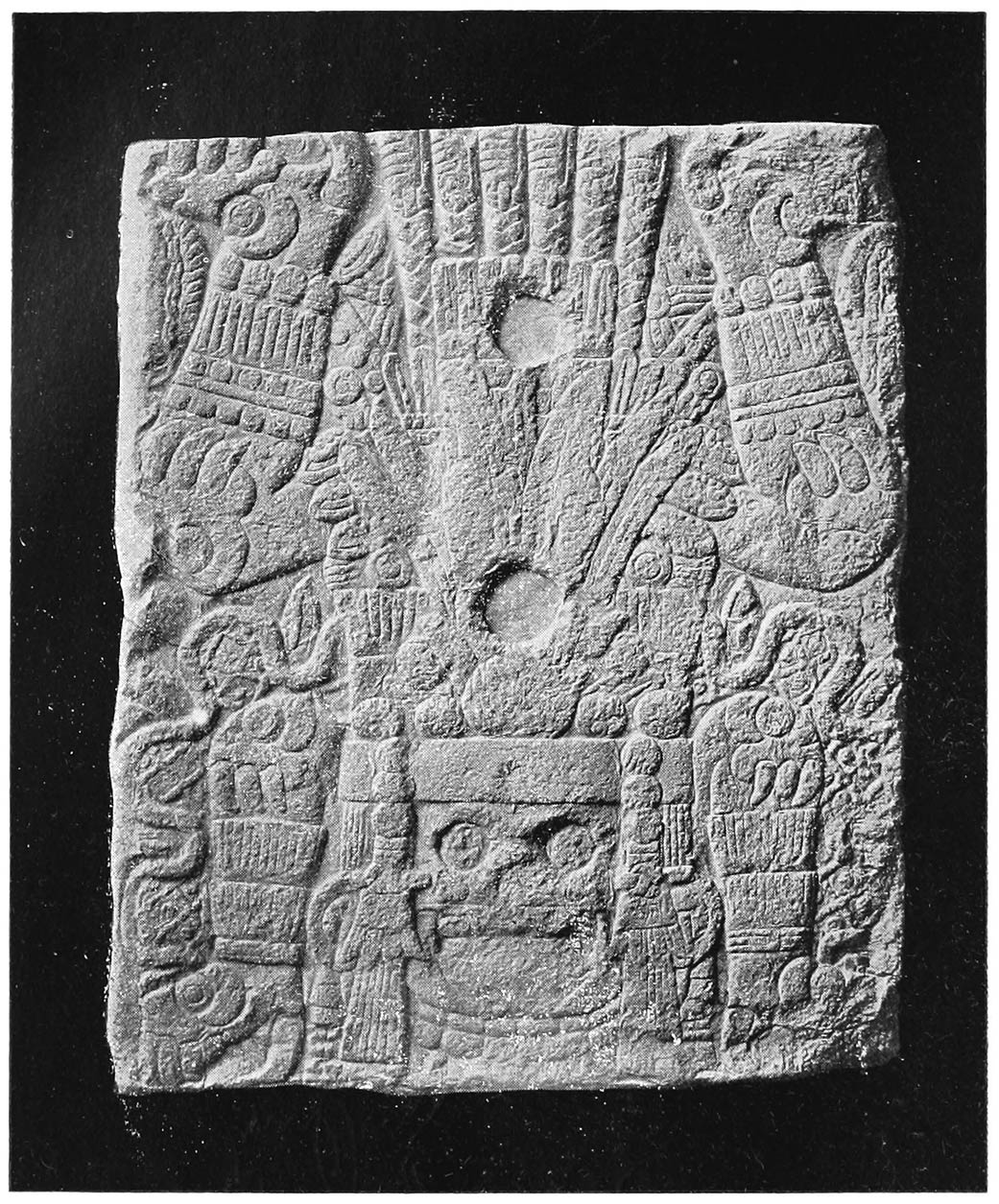
ITZPAPALOTL.
(Stone of Aristides Martel.)
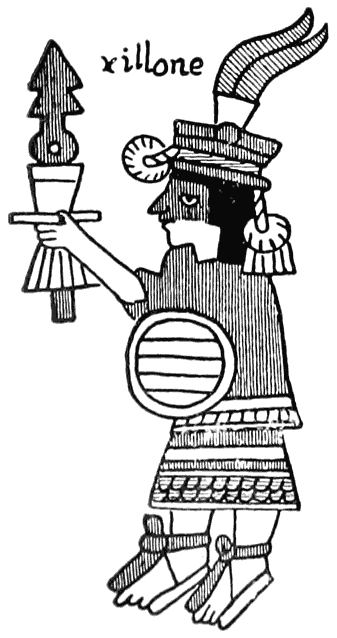
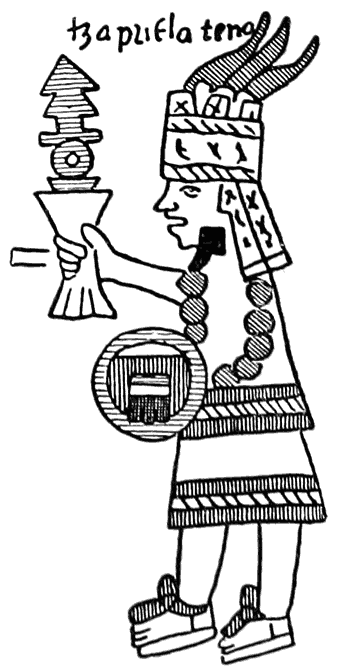
XILONEN. (Sahagun MS.) See p. 228. ZAPOTLANTENAN. (Sahagun MS.) See p. 228.
ASPECT AND INSIGNIA
Codex Vaticanus B.—Sheet 92: In this representation and on the sheet devoted to the fifteenth tonalamatl division and its ruler, Itzpapalotl is depicted as furnished with human teeth, but is predominantly animal in form, retaining, however, certain peculiarities which indicate the intention that she should be regarded as an insect. She displays a kind of butterfly wing, edged round with stone knives. Above her is figured the flowering tree broken in the middle from which blood flows. This symbol denotes the Tamoanchan, or House of Descent, the region of the mythical west, home of the maize-plant and seat of the primeval gods, where the wandering tribes were said to have made a long sojourn. In sheet 63 she is represented as standing upon a platform, which seems to be covered with a symbolic leaf—perhaps that on which butterflies are most usually found. She has a dark body edged with white, and the claws and face are flecked with ulli rubber gum. The head is an adaptation of that of Tlaloc, and a short, wheel-shaped wing occupies the back from nape to tail-root.
Codex Borgia.—Sheet 11: In this place the goddess is depicted as a woman with jaguar claws on hands and feet. The facial painting is like that of Tlauizcalpantecutli, but the features are those of the Death-god—a skull with a stone-knife nose. She wears a collar with the form and colouring of a butterfly’s wing, and her dress is set with stone knives at prominent points. She is accompanied by an animal of rapacious aspect, perhaps a jaguar or ocelot.
Codex Telleriano-Remensis.—A butterfly with antennæ and wings acts as a naualli, or disguise (a kind of helmet-mask), to a female figure which has death’s-head teeth, animal claws on the hands and feet, and a blue-coloured disk on the cheek. As in Codex Borgia, this face has a stone knife on the nose, a collar studded with stone knives, and on the head the warrior’s forked heron-feather ornament. The crown is of dark feathers, the sombreness of which is lightened by quetzal plumes and a loin-cloth like that of the Ciuateteô or Ciuapipiltin, the dead women who had perished in childbed, and who were regarded as partaking of the nature of warriors. The end of the loin-cloth and skirt is trimmed with a hem of teeth. As a back-mirror she wears a death’s-head, below which hangs a “star-skirt,” to the plaited thongs of which rattling snail-shells are attached.
Aubin-Goupil Tonalamatl (15th Division).—Here the goddess looks out of a butterfly helmet-mask. Her face is painted a red colour and she is decorated with dark plumage on arms and legs. She has a snail-shell before her face, and wears a gold disk on the breast. Opposite her are a broken tree and a beheaded captive, whose body spouts two streams of blood in the shape of snakes’ heads. She is seated on a throne ornamented with small disks.
Codex Borbonicus.—Here the goddess is pictured as a demon of darkness, tzitzimitl, who descends from heaven in the form of an eagle.
Bas-relief.—A bas-relief, known as the stone of Aristides Martel, represents the goddess as in the act of flight, and agrees with the representations of her in the Codex Telleriano-Remensis and the Codex Borbonicus. The face is intended to represent that of an insect with round eyes and almost reptilian mouth, and the headdress is flat and covered with feather balls. The hands and feet are furnished with long claws. In this place the feather-marking of the goddess presents a distinctly serpentine appearance and she is surrounded by serpent motifs, between the folds of which is seen the cross-hatching symbolical of these reptiles.
MYTHS
The interpreter of Codex Telleriano-Remensis regards Itzpapalotl as a male deity, probably because, like the Ciuateteô or women who died in childbed, who were regarded as the equals of the warriors, she wore a male loin-cloth. He says: “He was called Xounco and after he sinned Yzpapalotle. The sign of this name is a Knife of Butterflies, and accordingly he is surrounded with knives and wings of butterflies; for they say that he sometimes appears to them, and that they only see feet resembling those of an eagle. Yzpapalotle was one of those who fell from heaven with the rest, whose names are the following: Queçalcoatle, Ochululuchesi, Tezcatlipoca, Caleteotle, and Hatzcanpantecoatl.”
The interpreter of the Codex Vaticanus A also labours under a misapprehension regarding Itzpapalotl’s sex. He states: “Yxpapalotl signifies a knife of butterflies. He was one of those gods who, as they affirm, was expelled from heaven; and on this account they paint him surrounded with knives and wings of butterflies. They represent him with the feet of an eagle, because they say that he occasionally appears to them, and they only see the feet of an eagle. They further add that, being in a garden of great delight, he pulled some roses, but that suddenly the tree broke and blood streamed from it; and that in consequence of this they were deprived of that place of enjoyment and were cast into this world because Tonacatecutli and his wife became incensed, and accordingly they came some of them to the earth, and others went to hell. He presided over these thirteen signs; the first of which the house (calli) they considered unfortunate, because they said that demons came through the air on that sign in the figure of women such as we call witches, who usually went to the highways, where they met in the form of a cross.”
In the song to Tlazolteotl, the fourth of the Sahagun series, we find the following strophes relating to Itzpapalotl:
The stone-knife butterfly
Who hovers over the cactus.
Her food is on the Nine Plains,
She was nurtured on the hearts of deer,
Our mother, the Earth-goddess.
The reference to the Nine Plains alludes to the circumstance that Itzpapalotl is a goddess of the Chichimec, or hunting people. The two first lines of this song are translated by Seler as follows:
“O, she has become a goddess of the melon cactus,
Our mother Itzpapalotl, the Obsidian Butterfly.”
NATURE AND STATUS
Tezcatlipocâ, it may be recalled, is “the obsidian snake.” His obsidian sandals in some MSS. bear the zigzag lines of the snake and, as has already been said, the footgear is frequently eloquent of the name or character of a person or divinity in Mexican painting. In Itzpapalotl we seem to see another deity of the obsidian cult. Certain of her pictures as a butterfly are, as has been indicated, of dragon-like aspect, and we know that the butterfly is in some countries a surrogate of the dragon. Is obsidian to be regarded as the “bones” of the cipactli, the earth-beast or dragon?
ZAPOTLANTENAN = “MOTHER OF ZAPOTLAN”
Area of Worship: Mexico; Zapotlan.
Symbol: The eagle-feather.
ASPECT AND INSIGNIA
Sahagun MS. (Biblioteca del Palacio).—Behind the region of the chin and on the front part of the neck the goddess has a black, almost beard-like painting. She wears a crown of paper flecked with ulli gum, and decorated at the top with quetzal-feathers. Her collar is of chalchihuitl stones and she wears a plain overdress and skirt edged with horizontal bands, connected by slanting strips. Her feet are sandalled, and her shield has the insignia of the eagle-feather. In her hand she carries the rattle-staff of the Rain-god.
PRIESTHOOD
NATURE AND STATUS
ILAMATECUTLI = “THE OLD PRINCESS”
Area of Worship: Tehuacan (?); Cozcatlan (?); Chichimec.
Minor Names: Citlallinicue = “She of the Starry Skirt.” Cozcamiauh = “Necklace of Maize.”
Calendar Place: Thirteenth of the lords of the day-hours.
Compass Direction: The Middle.
Festival: Tititl (“stretching of limbs”) in the seventeenth month.
Relationship: Spouse of Iztac Mixcoatl; variant of Tonacaciuatl or Ciuacoatl.
ASPECT AND INSIGNIA
Codex Borgia.—Sheets 9, 11: In this representation the goddess is shown with hair composed of heron-feathers and wearing a white garment. In the pictures of this codex the contracted corners of her mouth, due to old age, are indicated by a ring-shaped ornament worn below the upper lip.
Codex Borbonicus.—She has a skeleton’s head, which differs from that of the Death-god in that it is coloured yellow, with red lines instead of black, but shows a similarity to it in the ruffled “night-hair” with which it is covered. In most of the pictures of her in this codex her blue dress is dotted with circular white spots which are perhaps intended for stars. This garment is completed with thongs, from which depend snail-shells, a decoration also seen in the rattling girdle ornaments (citlalicue) characteristic of the Earth and Underworld goddesses.
MYTHS
FESTIVAL
Before the victim was dispatched they made her dance to the sound of instruments played by old men, which mingled with the chanting of the priests. The wretched woman wept and sobbed as she danced, and as evening approached she was taken to the temple of Uitzilopochtli, accompanied by all the priests wearing their insignia and the masks of their gods, one of which was that of Ilamatecutli. On arriving at the summit of the teocalli, or pyramid-temple, she was immediately slain, her heart was torn out and she was decapitated. The head was given to the priest attired in the insignia of the goddess, who held it in his right hand by the hair, and engaged in a dance, raising and lowering the horrid trophy, and in this solemn measure he was accompanied by the priests who represented the other divinities. They then descended the steps of the teocalli in procession, and sought their quarters.
The priest of Ilamatecutli carried a great cane, the stock of which had three roots. The mask of the goddess which he bore had two faces with “great mouths, bulging eyes, and surmounted by a crown of paper cut into sharp points.” The priests, disguised as gods, having entered the calpulli, or priests’ quarters, a priest descended from the teocalli dressed as a young exquisite, wearing a splendid cloak, his head decorated with white plumes and wearing in place of sandals the hoofs of a deer. He carried in his hand a leaf of the maguey, surmounted by a little paper banner. He proceeded to the quauhxicalco, a place of sacrifice principally associated with human offerings to Tezcatlipocâ, where there was a small cage made of pine-wood and covered with paper, and known as “the granary of Ilamatecutli.” The priest laid the maguey-leaf in this receptacle and then set the whole on fire. Seeing this, the other priests rushed to the summit of the teocalli. This ceremony was known as the xochipayna, or “flower-running.” Placing on high a flower called teoxochitl, or “blossom of the god,” the first who gained the eminence seized upon it and cast it upon the quauhxicalco where the “cage” burned. Upon the following day the men and boys made little sacks, which they filled with flowers or paper, and with these they skirmished with one another and beat the young girls who chanced to pass by.
The decapitation of the slave girl was probably a dramatic-mythical representation of the reaping of the maize. The “great cane” borne by the priest of Ilamatecutli was, of course, the magic rain-rattle, so prominent an adjunct to many Mexican religious ceremonies. The “young exquisite” we must surely explain as a representative of vegetation, his deer’s-hoofs sandals having, perhaps, a pluvial significance, or else indicating the swift growth of the maize-plant, which takes but four months to ripen. The burning of the maguey-leaf in the granary would seem to indicate the end of the season of vegetative luxuriance and the commencement of that of domestic fires, and the casting of the sacred blossom into the flames probably possessed a similar significance.
NATURE AND STATUS
Ilamatecutli was unquestionably a goddess of the primeval time, as her aged appearance in the manuscripts, her association with Iztac Mixcoatl, the old Chichimec god, and her connection with fire would lead us to suppose. She is primarily a goddess of the earth and of maize. Her stellar connection and her name Citlallinicue (Star Skirt) are eloquent of her Chichimec derivation, and she may represent the starry night sky, or possibly the Milky Way, just as does her mythical husband, and in this she connects with Tonacaciuatl. As an earth-goddess she has also a plutonic significance and can be equated with Mictecaciuatl, mistress of Hades, in this resembling many other earth-goddesses. Again, she is the “old goddess” par excellence, patroness of old women, and worker at the metate, or stone on which the maize cakes were, and still are, made by Mexican women. Her connection with fire proves her relative antiquity. The circumstance that her mask is described as being two-faced leads me to believe that her idol or image had been evolved from the “Kirn-baby,” or doll made at harvests out of the last sheaf of grain and furnished with a face and hands, frequently with two faces, in order that it should not prove of bad omen to those following the image in procession. In this respect Ilamatecutli is similar to Chicomecoatl (q.v.).