Chapter VI · THE GODS OF RAIN AND MOISTURE
Reading edition
INTRODUCTORY
Those of the Tlaloquê, or gods of rain, whose names are known were: Tlaloc, the father of all, Chalchihuitlicue, his wife and sister, Nappatecutli, god of the mat-makers, who used aquatic reeds in their work, Atlaua, “Lord of the Beaches” or lake shores, Uixtociuatl, goddess of salt, and Opochtli, god of fishers and fowlers, and inventor of the net.
TLALOC = “HE WHO MAKES THINGS SPROUT”
Area of Worship: Plateau of Anahuac.
Minor Names: Chicunaui Ocelotl = “Nine Jaguar” (or ocelot).
Calendar Place: Ruler of the seventh day-count, mazatl (deer), and of the seventh tonalamatl division, ce quiautl (one rain).
Compass Direction: The four quarters in his several aspects.
Festivals: Atlacahualco, tozoztontli, etzalqualiztli, tepeilhuitl, atemoztli.
Symbols: His head, with serpentine motif and tusks; the day-sign nine ocelot.
Relationship: Husband (1) of Xochiquetzal; (2) of Matlalcuêyê or Chalchiuhtlicue. Father or brother of the Tlaloquê.
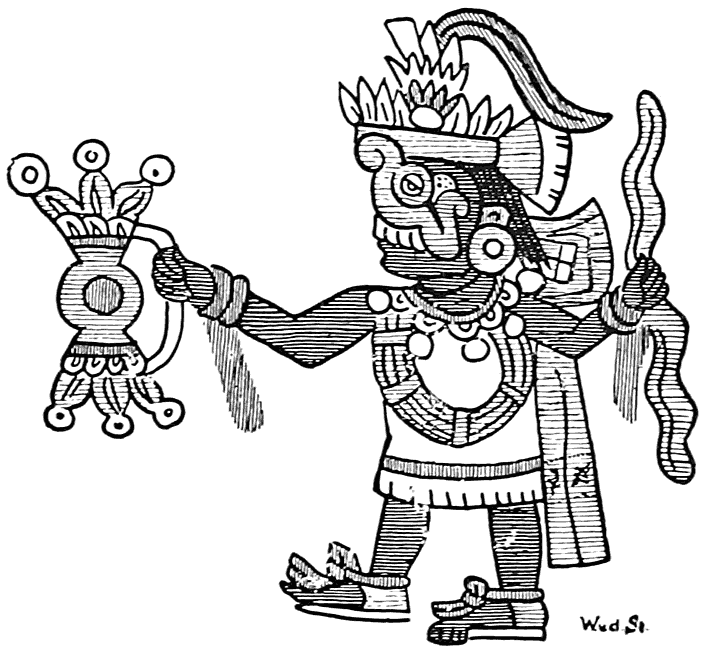
(From Codex Magliabecchiano, 3 fol., sheet 89.)
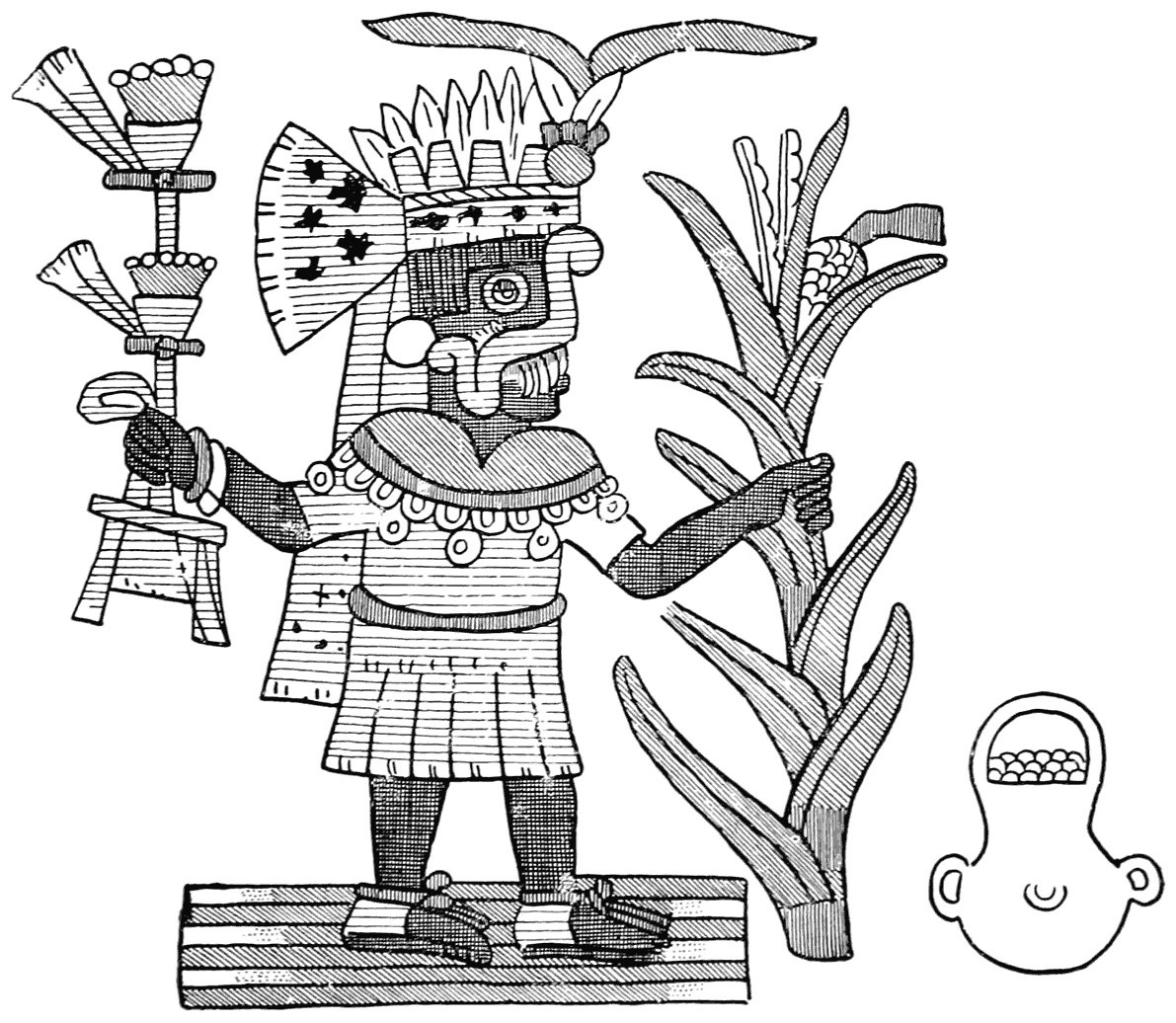
(From Codex Magliabecchiano, 3 fol., sheet 34.)
FORMS OF TLALOC.
ASPECT AND INSIGNIA
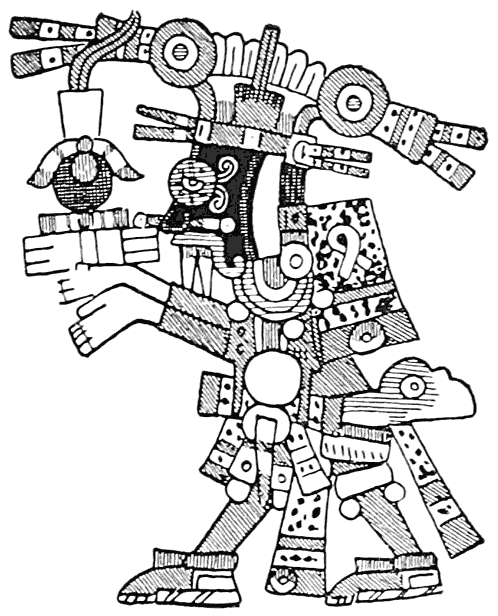
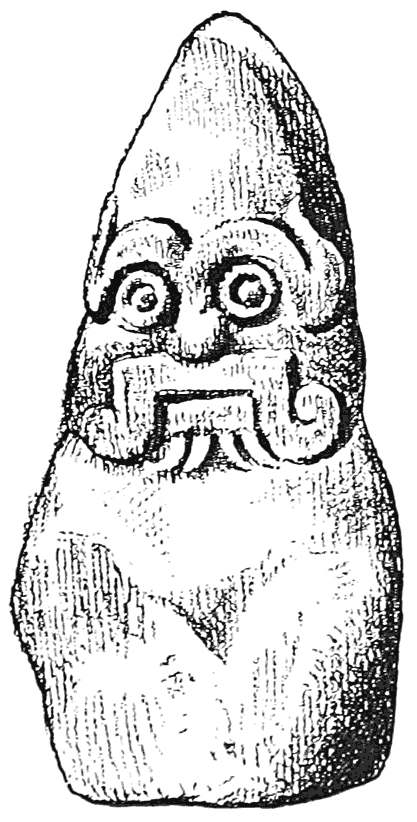
The evolution of the familiar and characteristic face of Tlaloc is perhaps best exemplified in a stone statuette included in the Uhde collection in the Royal Ethnological Museum, Berlin. In this striking example of the Mexican sculptor’s art a representation of the face of the god is skilfully contrived by the arrangement of two snakes or serpents, the tails of which form eye-orbits and a species of nose, the reptiles’ heads meeting in the region of the mouth, their fangs thus serving the god for teeth. It is rarely in aboriginal art that a conception so individual and striking is encountered, and great imaginative ability must be conceded the sculptor who conceived it. It is not known whether the later pictures and carvings of Tlaloc were evolved from this effigy, but it is not unreasonable to suppose that either from it or similar representations the later conception of him came into being. We observe in the examples shown in the illustrations that the custom of representing divine beings in profile resulted in his case in the survival of a mere ring about the eye and a spirally convoluted band forming the upper lip and depending from it for some distance. These are painted blue in the MSS. More faithfully preserved are the long tusk-like teeth, which in certain stone effigies, however, degenerate into several straight, downward strokes. This head of the Rain-god is almost invariably reproduced as the symbol for the day-sign atl (water).
Representations of Tlaloc in the codices of the Borgia group occasionally show a development of the lip-band, which rises upwards and includes the nose, thus, perhaps, indicating a transition form. In the Vatican B, Fejérváry-Mayer, and Laud Codices the prolongation of the lip-band and its serpentine character are apparent, the snake’s teeth and eye being clearly visible.
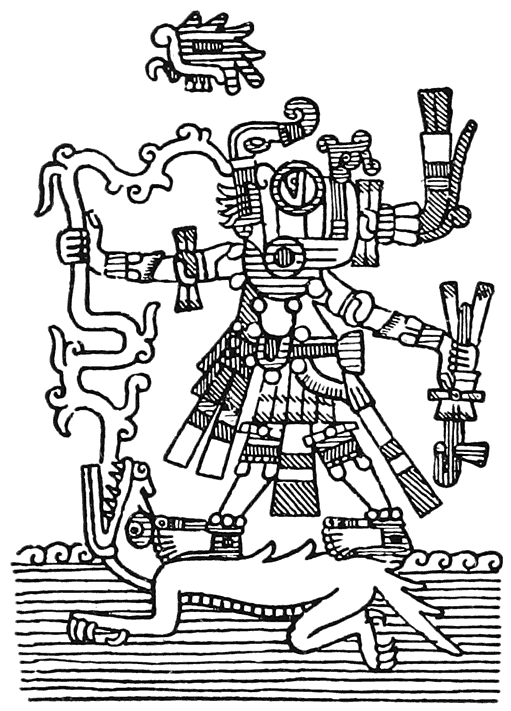
(From Codex Fejérváry-Mayer, sheet 14.)
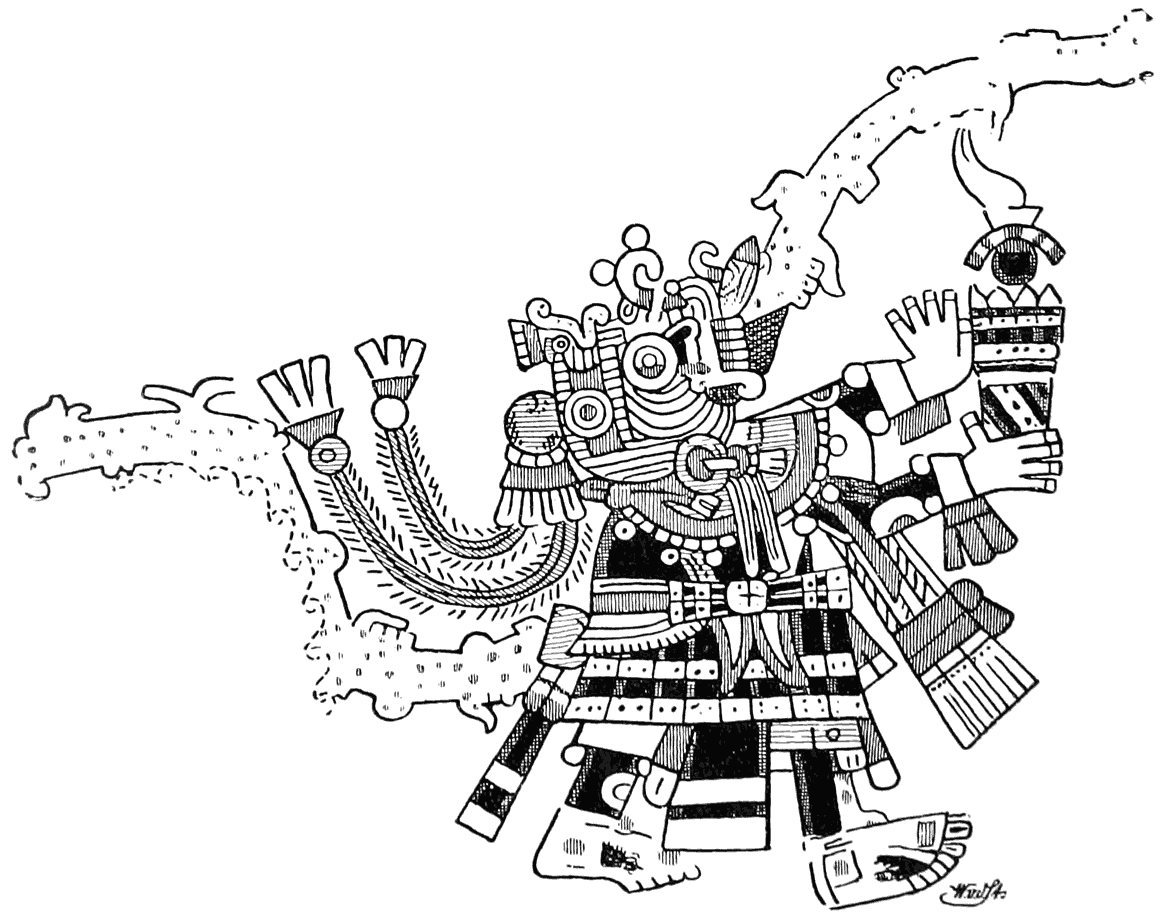
(From Codex Vaticanus A, sheet 20.)
FORMS OF TLALOC.
Codex Borgia.—Sheet 14: In this place the body-paint of Tlaloc is green, although, as a rule, it is black elsewhere. The face is half-black, half-yellow. The eye and lip-bands are blue. The head is crowned with white heron-feathers, such as are worn by the octli gods. A fillet surrounds the forehead, and from this spring four rosettes, which may symbolize the four quarters from which the rain falls. The headdress and its accompanying ornaments are painted in alternate stripes, green and white, sprinkled with liquid rubber. A paper tie adorns the shoulder, such as was used for the decoration of offerings, or in the ceremonial arrangement of the dead. The ear-plug is square, to indicate, perhaps, the four quarters. It is in this codex (sheet 12) that we obtain the best evidence of the reflection of the various points of the compass upon the character of the great god of rain.
The figure on the upper right shows the deity in his northern aspect. The second division of the tonalamatl and of the cycle are indicated in its dating and on its helmet-mask. The yellow colour of the god in this picture is supplemented by the symbolism of a bright atmosphere sending down sharp rays of light, shown in conventional form by V-shaped emblems stabbing downwards from aloft. Beneath the god are shown three vessels filled with the brown-coloured water which falls when the Rain-god is unpropitious. Indeed, it bears within it the symbols of death, the death’s-head eye and bony nasal spine. The artistic effort is to portray water which has been sucked up by the parched and cracked soil of a Mexican June—water which has been insufficient in quantity, or has fallen too late. There are present, too, in the picture, the vampire shapes of such insects as devour the maize, each decorated with the death’s-head. But, more fatal sign than all, from the pitcher of the god descends the lightning-axe, wrapped in symbolic fire. The northern Tlaloc, then, is no deity of plenty, but obviously represents the Rain-god in his most deadly and terrible aspect. The god in his western complexion is painted blue, and wears as a helmet-mask the sign of the third calendar division. A cloudy sky flecked with rain shows the partial descent of the serpent-like showers, and the maize-plants beneath him stand in heavy puddles of water. The southern aspect of Tlaloc (that on the lower left) is painted red, and the helmet-mask is in vulture form, as in consonance with the sign of the fourth calendar division. From a cloudless sky dart the conventional sun-rays as described in the second picture, but beneath the foot of the divinity are representations of the maize-plant run to seed. Small animals, the faces of which bear some resemblance to a death’s-head, devour them. Once again the lightning-axe falls from the jar held by the god, accompanied by its bright, symbolic flame. The central figure represents the influence of the Rain-god from the zenith. The Tlaloc who presides over this situation is striped red and white (the colours of night and twilight) and he is represented in the normal insignia of the Rain-god. He is accompanied by the signs for day and night, and the earth-goddesses cluster around his feet. From the jar he holds are poured all manner of warlike implements—the atlatl, javelin, shield, and banner.
The similar fivefold representation of Tlaloc on sheet 28 is believed by Seler to illustrate his connection with the Venus period.
Codex Vaticanus A.—Sheet 20: Here Tlaloc is represented with the body painted black, the fore-part of the face black and the hinder portion yellow. His chin is bearded and the lip-band is prolonged, as described above. In front of his mantle is a stone knife, from which fire issues. His attire is painted in alternate stripes of black and green, flecked with melted rubber. He wears the fillet of Tonatiuh, the Sun-god, and the strips of hide which fall from the panache of feathers on his head are also part of the Sun-god’s insignia. He holds a burnt offering of firewood and rubber in his hand, enveloped in a covering painted black and green, flecked alternately. The type of the tarns or pools into which such offerings were cast is depicted in front of him, in the depths of which are seen fishes and snails.
Codex Magliabecchiano.—Sheet 92: Here he is represented in female costume and, as in the Sahagun MSS., a white circular spot or patch with black dots is visible on the god’s cheek, which, the text implies, was made of the crushed seed of the Mexican prickly poppy (Argemone Mexicana).
General.—Other details in the costume of the Rain-god are eloquent of his nature and characteristics. In the Borgia group of codices his garment and headdress are dark green, flecked with melted rubber, whilst in those codices from the Mexican country proper we find them painted blue, bespotted with the same unpleasant incense. His robe, the anachxecilli (“dripping-garment,” “cloud-garment”), is said to be “set with green gems,” and in his ear is a broad plate with a dependent band on which are worked smaller figures made of chalchihuitl stones. On his breast he wears a wide collar of plaited stuff (reeds?) also enriched with the precious green stone typical of water, and a large gold disk.
(From Codex Laud.)
Stone figure (from Castella del Teayó.)
FORMS OF TLALOC.
In Codex Vaticanus A, the Codex Magliabecchiano, and the Sahagun MSS. we find him wearing at the nape of his neck a large crescent-shaped loop which projects on each side of the head and is secured in the middle by a rosette, as well as his crown of heron-feathers. In the Codex Vaticanus B a large fan-shaped object painted dark green and white projects behind the head of the god. In Codex Borgia (sheet 14), too, he wears the headdress of Mayauel, the goddess of the agave plant, but the colours in which it is painted (dark green and white with rubber flecking) are his own and not the blue and white of the female divinity.
In the Codex Magliabecchiano (sheet 77) and on a stone relief in the Trocadero Museum, Tlaloc is represented as holding a jug in one hand and a staff in the other, the latter of a blue colour and having serpentine bands in its length. In Codices Vaticanus B and A he also holds this serpentine wand and in the other the incense-pouch marked with a cross, to symbolize the four quarters of the heavens. Occasionally he is seen holding the agave thorn or spike and the omitl bone, the implements of mortification, as in Codex Borbonicus and Codex Borgia (sheet 67).
Gama (Dos Piedras, pt. i, p. 101; pt. ii, pp. 76–79) states that in Tlaloc’s left hand was a shield ornamented with feathers. In his right were thin, wavy sheets of gold, representing his thunderbolts, or sometimes a golden serpent, representing either the thunderbolt or moisture. On his feet were a kind of half-boots, with little bells of gold hanging therefrom. Round his neck was a band or collar set with gold and gems, while from his wrists depended strings of costly stones. His dress was an azure smock, reaching to the middle of the thigh, cross-hatched all over with ribbons of silver forming squares, and in the middle of each square was a circle of silver, while in the angle thereof were flowers, pearl-coloured, with yellow leaves hanging down. His shield was similarly decorated, with feathers of yellow and green, flesh-colour and blue, each colour forming a distinct band. The body was naked from mid-thigh down, and of a grey tint, as was also the face. This face had only one eye, of a somewhat extraordinary character: there was an exterior circle of blue, the interior was white with a black line across it, and a little semicircle below the line. Either round the whole eye or round the mouth was a doubled band or ribbon of blue. In the open mouth were three grinders. The front teeth were painted red, as was also the pendant with its button of gold that hung from his ear. He wore an open crown of white and green feathers, from which depended red and white plumes.
Ixtlilxochitl represents him in the month etzalli pictured with a cane of maize in the one hand, and in the other an instrument with which he is digging the ground, in which he places maize-leaves and a kind of food, like fritters, called etzalli.
Sahagun MS.—This states that the god’s face was entirely black with a few spots of salvia chia. The body was also of a dark colour. He wears a “mist” or “cloud” shirt without sleeves, in the Toltec fashion, falling to the knee, and a cloth is rolled round the hips. The crown is of heron-feathers, and the sandals symbolize the foam of water. The shield is inset with water-flowers or rushes, and the god carries a white rush staff.
STATUARY AND VASES
As has been said, the vases in the Uhde collection and in the Anthropological Museum at Berlin show the Tlaloc face, probably in its earlier state of development. In both of these a serpentine motif arches over the eyes and meets in a knot or twist which forms the nose, while a separate serpent pattern forms the mouth in a moustache-like manner, the long teeth jutting out from underneath it. Another found in the Calle de las Escalerillas, Mexico City, is identical with these last. A stone slab found at Cerro de Zapotitlan, near Castillo de Teayo, and resembling a tombstone, shows the face of Tlaloc very clearly, the characteristic feather crown and the long tusk-like teeth being especially noticeable. Another stone figure found at Teayo is fully illustrative of the god’s facial characteristics, but the two serpents twining together to form the nose spring upwards and, after traversing the position of the eyebrow, end with their tails above this in a flourish. The back-fan is well represented in this figure, which has also a mantle and a waist-belt. In a relief found at Teayo in which Tlaloc is represented along with Xochiquetzal, we see once more the manner in which the serpentine motifs around the mouth and eyes have become unified through the exigencies of representation in profile. The usual insignia are represented here, such as the necklace, the back-fan, and the short tunic; but certain knots or bows on the dress lead me to think that what have been commonly taken for sprinklings of indiarubber gum (ulli) may be small ornamental knots of some textile material. Vases found at Tlaxcallan and in the Mixtec country show precisely the same characteristics.
MYTHS
Another piece of mythic information is found in the Song of the Rain-god, the fourth canticle in Sahagun’s collection, which has been translated as follows:
I
Oh, Mexico has done service with the gods,
The paper flags fly over the four corners of the heavens,
It is no more a time of mourning.
II
Oh, Tlaloc (the Rain-god) has been created
(I.e. my statue has been set on the temple),
My God has become a dark red colour from the blood of the sacrifices.
The whole day they took, with the making of rain in the temple court.
III
O my Chieftain, the maize-prince,
In truth it is your produce;
You created it first;
And yet they only do insult to you.
They can have nothing against you;
Distribute thou no offering.
IV
But they abuse me (abstain from sacrifice),
I am therefore not satisfied,
My father, my old priest,
The Jaguar-serpent.
V
Out of the Tlalocan the turquoise house (the blue house)
Came thy father, Acatonal.
VI
O go, go down on the mountain Poyauhtlan
With the mist rattle-board;
Water will be sent from Tlalocan,
The country of the rain-gods.
VII
O my elder brother Toxcuecuex!
I will go; it is enough to make him weep.
VIII
O send me to the place that no one knows.
Down came his word;
I spoke to him, Tetzauhpilli,
I will go; that is enough to make him weep.
IX
After four years he will be placed over us.
Of thee it was said,
The place of the fallen,
The quetzal feather-house, the place of plenty,
And yet he becomes distributer for the Kingdom.
The god would seem to refer to some unknown myth relating to his own parentage in verse v. The name Acatonal (“Reed of the Sun”) given to his father seems to have a calendric significance. The ceremony of the mist rattle-board, the rattling of which was supposed to bring rain by sympathetic magic, was one of the ceremonies connected with rain-making at more than one of the festivals of the Tlaloquê. Poyauhtlan (“Place of Mugwort”) is a district of Tlalocan, as well as the name of his temple, and Toxcuecuex is Uitzilopochtli. The last verse seems to allude to the myth mentioned in the interpretation of Codex Vaticanus A, where it is stated that, as no rain had fallen for a period of four years, Quetzalcoatl began to make sacrifices to obtain it, and, the worshipper or priest hints, will receive the consequent honour.
According to Boturini, quoting Gemelli Carreri (tom. 6, p. 83), Tlaloc was the deity who at the behest of Tezcatlipocâ raised the earth out of the waters of the universal flood, and who counsels men by his divine messages written in the lightning and the thunderbolt to live wisely and morally. Like most of the theories of this writer, this is pure allegory. Following the analogy of the calendar stone, we seem to see Tlaloc as the sun during the period of Naui Quiauitl, or “Four Rain,” which ended in a universal conflagration. The interpreter of the Codex Vaticanus A alludes to Tlaloc as feminine, speaks of him as “goddess of water,” and explains Tlaloquê as signifying “fine weather.” Farther on he states that “on the 21st of December they celebrated the festival of this god through whose instrumentality they say the earth became again visible after it had been covered with the waters of the deluge; they therefore kept his festival during the twenty following signs, in which they performed sacrifices to him.”
FESTIVALS
Tozozontli.—The second festival to Tlaloc was tozozontli, of which Sahagun says:
“The third month was designated toçozontli, the first day of it being consecrated to the festival of the god Tlaloc, who is the divinity of rain. Many children were slain on the mountains and offered in sacrifice to this god and his colleagues, in order to obtain water. The first fruits of the flowers of the year were offered in the temple called Yopico, no one daring to smell a flower until this offering had been made. The gardeners, who were designated xochimanque, held a festival in honour of their goddess called Coatlicue, also known as Coatlan tonan.
“It was likewise during this month that those who had been wearing the skins of the dead since the month previous, now stripped them off and threw them into the basin of the temple styled Yopico. This was done in procession and with great ceremony. They smelt like rotten dogs; and after disrobing they performed devotional ablutions.
“Sick people made vows to take part in this procession in the hope of being cured of their infirmities, and we are assured that many of them were thus restored.
“The masters of the captives and the people of their houses performed penance for twenty days, neither bathing nor washing until the skins of their victims had been carried to the basin of the temple above mentioned, and alleging their penance was in honour of their captives.
Etzalqualiztli.—The third festival to the Tlaloquê generally was the etzalqualiztli. Concerning this feast Sahagun relates:
“On the first day of this month a festival was held in honour of the gods of rain. The priests of these divinities fasted for four days prior to the festival, these days consequently being the last four of the previous month. On the occasion of these celebrations the attendant satellites of the idols repaired to Citlaltepec to pull the rushes which grow very high and very beautifully in a pond called Temilco. From thence they carried them to Mexico, to decorate the temples. No one was to be seen on the road which they traversed; everyone took care to hide in case they should meet them. But if, unfortunately, the priests encountered anyone on the road, they stripped him of everything, leaving him naked as a worm, and should he dare to defend himself, he was maltreated and left for dead upon the highway. Even had he carried the treasure of Moteuhçoma and been robbed of it, it is quite certain that no punishment would have fallen upon them, for, in their capacity as priests of the idols, they were at liberty to do such things and worse without fear of consequences.
“On the day of the festival of etzalqualiztli, everyone prepared cakes or a broth called etzalli, which was considered as a delicacy among them, everybody partaking of them at home, and sharing the repast with visitors. A thousand follies were perpetrated on that day.
“On the occasion of this festival those priests of the idols who had committed faults in the exercise of their functions were terribly punished on the waters of the lake. They were maltreated to the point of being left for dead on the banks of the lake, whither their parents or relatives repaired to take them home almost lifeless.
Tepeilhuitl.—The fourth festival to the gods of the water-giving mountains was the tepeilhuitl. Sahagun says of this:
“During this month festivals were held in honour of the high mountains which were the point of departure of the clouds, and which are very numerous in this land of New Spain. To each of these a statue in human form was erected out of a paste called tzoalli, and offerings were made to these idols in honour of these mountains.
“Serpents were also made in their honour out of wood or the roots of trees, which were so carved as to terminate in an adder’s head. Long pieces of wood of the size of a fist were also made, which were called ecatotontin (“little winds”). They were smoothed on the surface with a lump of tzoalli, and were baptized as mountains, being placed upon men’s heads.
“Images were also made in memory of people who had been drowned, or of those who had died such a death as entitled their bodies to be buried instead of being burnt.
“Having placed the statues just described upon the altars with great ceremony, tamalli and many other foods were offered to them; hymns were chanted, and wine drunk in their honour.
“The sixteenth month was called atemoztli, that is to say the rain month, when the thunder and heavy rains began to display themselves. The people said, ‘Now the Tlaloquê come.’
TEMPLES AND PLACES OF WORSHIP
“The native historians relate, that the Acolhuas having arrived in that country in the time of Xolotl, the first Chichimecan king, found at the top of the mountain of Tlaloc, an image of that god, made of a white and very light stone, in the shape of a man sitting upon a square stone, with a vessel before him, in which was some elastic gum, and a variety of seeds. This was their yearly offering by way of rendering up their thanks, after having had a favourable harvest. That image was reckoned the oldest in the country; for it had been placed upon that hill by the ancient Toltecas and remained till the end of the XVth or beginning of the XVIth century, when Nezahualpilli, King of Acollhuacan, in order to gain the favour of his subjects, carried it away and placed another in its stead, of a very hard, black stone. The new image, however, being defaced by lightning, and the priests declaring it to be a punishment from heaven, the ancient statue was restored, and there continued to be preserved and worshipped, until the promulgation of the gospel, when it was thrown down and broken by order of the first Bishop of Mexico.”
The principal seat of the worship of Tlaloc was the great temple of Uitzilopochtli at Mexico, which is fully described in the section which deals with that god.
Sahagun speaks (Appendix to bk. ii) of a temple within the sacred precinct of Mexico which was especially dedicated to the Tlaloquê. This was the epcoatl (“pearl serpent”), so called, perhaps, from the circumstance that the victims immolated therein were known by the same name. It was in this place that the priests fasted and did penance for forty days before the feast in honour of their gods. The Mexico Calmecac was a school or junior monastery, where those who were destined to become priests of the god received their training. At the acatla yiacapan uei calpulli (“chief flowery hall”) the slaves intended for sacrifice to the god were assembled, and here their bodies were prepared for the horrid banquet which concluded his festival.
PRIESTHOOD
The Tlaloc Tlamacasque, the second in rank in the Mexican priesthood, stood at the head of the ministers of the god. The acolnauacatl acolmiztli (“he of the puma shoulder” or “dress”) made all arrangements for the festivals of the god, and kept the vestments worn by the king on these occasions. It is also clear from many passages that the priesthood of Tlaloc composed a large and considerable body.
PRAYERS
NATURE AND STATUS
The name Tlaloc was specially given by the Mexicans to a mountain to the east of Tezcuco, near the pass which led to Huetzotzinco, and here it was that his most ancient idol was found by the immigrant tribes. The mountains Popocatepetl and Teocuinaui were also especially sacred to him. He possessed, as will have been observed, both beneficent and terrible aspects, and was the striker, the slayer, as well as the giver of bounteous food-supplies. That his cult was an ancient one in Mexico is proved by the numerous finds of his images among remains of pre-Aztec date at Teotihuacan, at Teotitlan in the Huaxtec country, at Quiengola in the Zapotec district, and at Quen Santo in Guatemala.
Tlaloc denotes the four quarters from which the rain comes, as his symbolism abundantly shows, and the learned priests of Mexico undoubtedly regarded him as the personification of the tlequiauitl, or fire-rain, the disaster which closed one of the epochs of the prehistoric world. He is further analogous to the Maya Chac and God B.
It is significant that Tlaloc wears Toltec dress, and from this and from his name “Nine Jaguar” we may be justified in concluding that he is in a sense to be regarded, like Quetzalcoatl, as the Toltec priest. Balam, the Maya-Quiche word for jaguar, signifies also “priest,” and that the title was superadded to the serpentine conception of him is shown by the expression “Jaguar-serpent,” by which he is alluded to in the hymn quoted above. The Poyauhtlan was not only his temple, but a district of Tlalocan, where he was supposed to hold sway. This I would translate “Place of the Mugwort,” or “Absinthe,” and it is clear that he, as well as Chalchihuitlicue, his spouse, has some mysterious connection with this plant, which has been shown by Dr. Rendel Harris to have been the especial medicine-plant of the Greek Artemis. It is strange, too, to find both the god and his victims, like the dragon-gods of China, connected with the pearl.
Tlaloc is also god of the four quarters or four “weathers.” The seventh day-sign, mazatl (“deer”), which he takes, is appropriate, as the deer symbolizes the quest for water and vegetation. His association with the dog, the lightning-beast, is also significant. Indeed in Codex Bologna Tlaloc is frequently symbolized by the lightning-flash alone.
CHALCHIHUITLICUE = “SHE OF THE JEWELLED ROBE”
Area of Worship: Mexico (worshipped at Tlaxcallan as Matlalcuêyê, “She of the Blue Robe”).
Minor Names: Acuecueyotl = “Water which makes Waves.” Apoçonallotl = “Foam of the Water.” Ahuic = “Motion of Water.” Aiauh = “Fog.” Atlacamani = “Storm.” Xixiquipilihui = “Rising and Falling of the Waves” (Clavigero). Macuilxochiquetzalli = “Five times Flower-feather” (Boturini).
Calendar Places: Ruler of the fifth day (coatl). Ruler of the fifth week (ce acatl). Lord of the sixth night.
Compass Direction: West.
Festivals: Atlcahualco; ce atl (movable feast).
Relationship: Wife of Tlaloc, sister of the Tlaloquê; mother of the Centzon Mimixcoa.
Symbol: The chalchihuitl stone.
ASPECT AND INSIGNIA
In the Aubin tonalamatl she is pictured as standing in a stream, down which swirl away a jewel-box, an armed man, and a woman.
Variations.—The representations of Chalchihuitlicue in the Codex Borgia group, where she is dressed in the snake-helmet, are substantially different from her appearance in the Aubin tonalamatl, the Codex Borbonicus, and elsewhere.
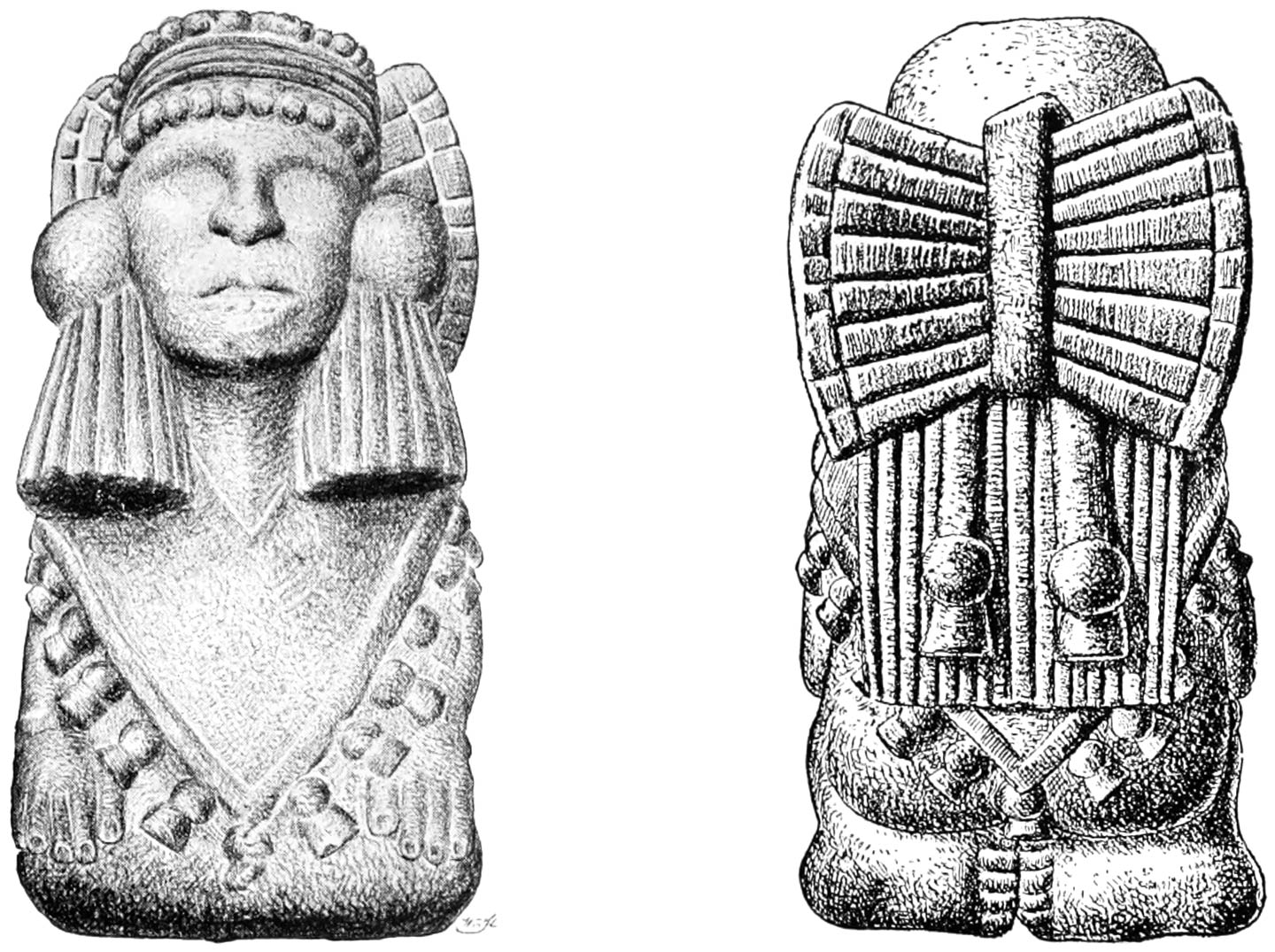
CHALCHIHUITLICUE.
Stone figure from the Christy Collection.
Other interesting variations in connection with this goddess are those found in Codex Vaticanus B and Codex Borgia (sheet 17), in both of which she is seen suckling a human being. In the former she wears on the head two bunches of quetzal-feathers, usually part of the insignia of Xochiquetzal, and she is only to be recognized by the symbol beside her, a variant of the element chalchihuitl.
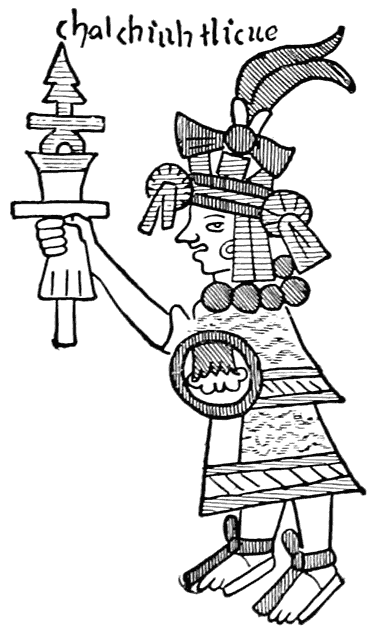
Sahagun describes her as follows in the Biblioteca del Palacio MS.: “The face is yellow, with a red pattern superimposed. She wears a collar of green precious stones, and a crown of paper adorned with a quetzal-feather. The tunic and skirt are painted with water lines, and she wears shells. Her sandals represent the foam of water. On her shield is painted the emblem of a water flower, and she carries the “mist rattle-staff.” Statuettes of Chalchihuitlicue are fairly common. One found in the Valley of Mexico agrees to some extent with her appearance in the Aubin tonalamatl, but not with that in Codex Borgia. She wears the tasselled shawl and the chalchihuitl emblem adorns her dress. Two other stone figures of her in the Uhde collection at Berlin and one in the Christy collection at London are eloquent of her insignia. In all of these she wears the tasselled shawl, and in the Christy example and one of the Uhde figures the large back-bow is well exemplified, as are the two plaits of hair descending at the back. In the other Uhde specimen the plates are shown as part of a knot of the cotton headdress, which is in all cases fringed with balls. In all three figures large, full bands of some material descend over the ear. A stone figure of her, found at the Castillo de Teayo in Vera Cruz and now in the National Museum at Mexico, depicts her with a square headdress, from which radiate what are evidently the feathers of aquatic birds. She wears the V-shaped shawl or tippet and a skirt, on each side of which the chalchihuitl emblem is shown and which is fringed with shells. Teobert Maler reproduces another stone figure of her wearing a high headdress of feathers and a necklace and wristlets of chalchihuitls.
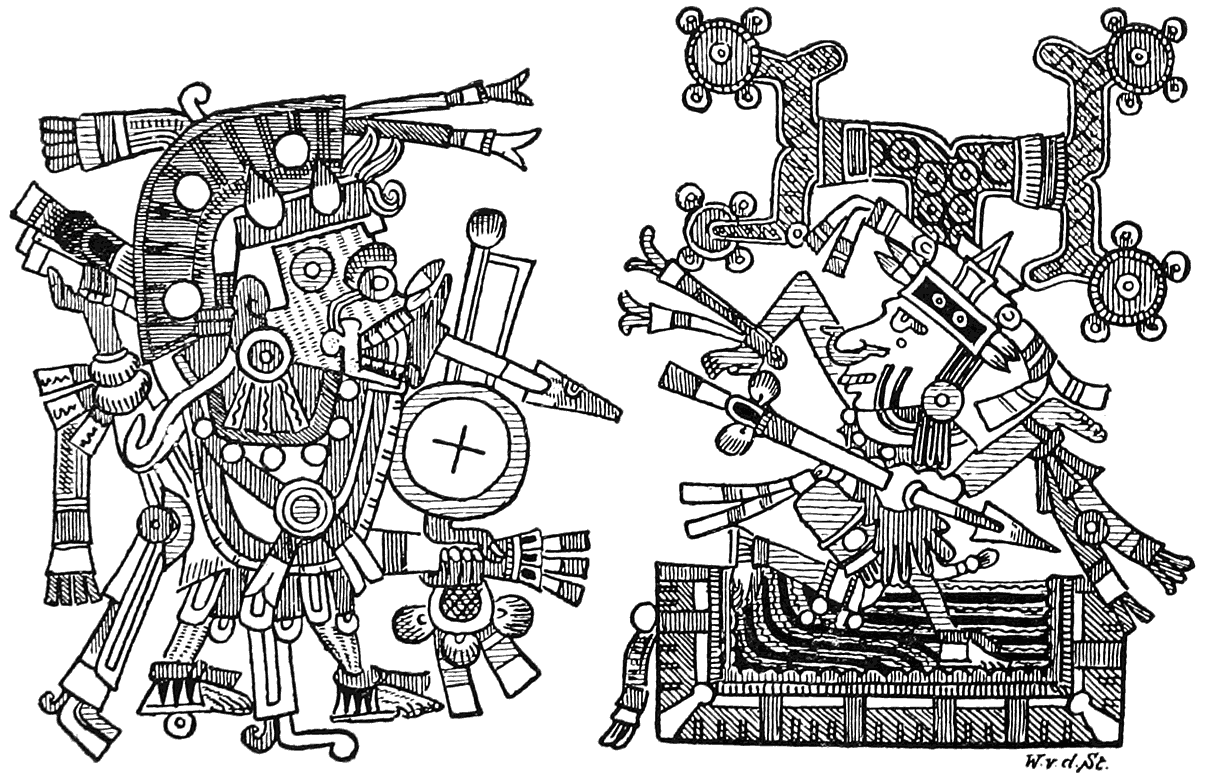
CHALCHIHUITLICUE PIERCED BY TLAUIZCALPANTECUTLI.
(From Codex Bologna, sheet 9.)
MYTHS
The interpreter of the Codex Telleriano-Remensis states that “Chalchiuhtli, who presided over these thirteen days, saved herself in the deluge. She is a woman who remained after the deluge. Her name signifies the ‘Woman who wears a dress adorned with precious stones.’ They here fasted four days till death. They paint her holding in one hand a spinning-wheel, and in the other a wooden instrument, with which they weave; and in order to show that of the sons which women bring forth some are slaves and others die in war, and others in poverty, they paint her with a stream as if carrying them away, so that whether rich or poor all were finally doomed.” The interpreter of Codex Vaticanus A says that she is the same as the virgin Chimalman, who was the mother of Quetzalcoatl. The myth to which this passage alludes is dealt with in the section relating to Quetzalcoatl. Sahagun (bk. i, c. ii) calls the goddess the sister of the Tlaloquê.
FESTIVALS
Chalchihuitlicue was adored at the etzalqualiztli festival to the Tlaloquê (see Tlaloc) and at the feast ce atl (“one week”), when, says Sahagun, “her festival was celebrated by all who in any way dealt in water, or had any connection with it, water-sellers, fishers and the like. These dressed and ornamented her image and made adorations in the house named calpulli. The great lords and rich merchants at the birth of one of their children paid the greatest attention to this sign, and the day and hour at which the child was born. They at once inquired of the astrologers what fortune the child might expect to encounter, and if the sign was propitious, they had the infant baptized without delay, whereas if it were the opposite they waited until the nearest day which had a propitious sign. Food and drink were distributed freely to all.”
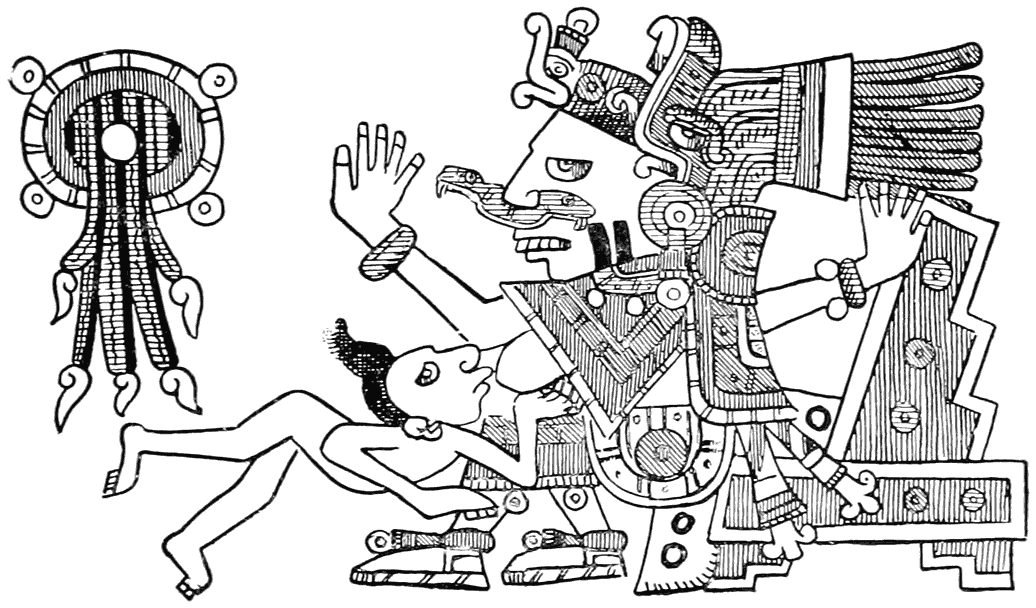
CHALCHIHUITLICUE.
(From Codex Borgia, sheet 17.)
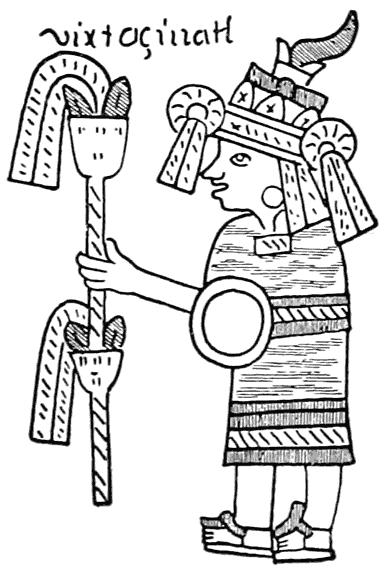
CHALCHIHUITLICUE. (From the Sahagun MS.) UIXTOCIUATL. (From the Sahagun MS.)
PRIESTHOOD
NATURE AND STATUS
Chalchihuitlicue was the female counterpart of Tlaloc, and the goddess of water and moisture. Sahagun (bk. i, c. ii) says of her: “She was supposed to have her existence in the sea, the rivers and lakes, and had power to take the lives of those who ventured upon them, and to raise tempests.”
In Codex Borgia she is seen with a bunch of dried herbs above her, evidently indicating that she had a medicinal side to her character. Certain pictures of her—that, for instance, in the Aubin tonalamatl already described—seem to point to her as the goddess of change in human affairs, of speedy ruin, and this conception was, no doubt, brought about by the ever-changing character of the element she symbolized. She is, indeed, the goddess of water in its mutable and kaleidoscopic form.
There is, however, every reason to believe that she had a still more profound significance in Mexican theology, and this is made clear if we examine the prayer to her preserved by Sahagun in which she seems to represent the purifying and cleansing influence of water as an agency to wipe away the original sin with which it was thought man came into the world.
That the goddess had also a lunar significance is plain from the allusion to her as the mother of the Centzon Mimixcoa, or stars of the Northern Hemisphere, and the great importance attached to the prayers offered up to her in connection with child-bearing. As has been hinted, she had also a medicinal aspect. The child sacrificed to her at the etzalqualiztli festival was slain at the hill known as Yauhqueme (“covered with mugwort”), and, as instanced in the case of Tlaloc, this plant is the especial medicine-herb of the Greek Artemis. In Codex Borgia, indeed, she is associated with a herb which may possibly be the mugwort or wormwood, and Seler thinks she is to be regarded as the giver of “healing draughts of physic.”
Atlaua. (See p. 263.) Napatecutli. (See p. 264.) Opochtli. (See p. 266.)
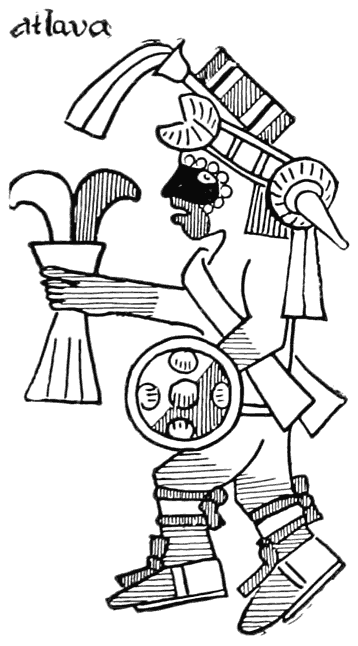
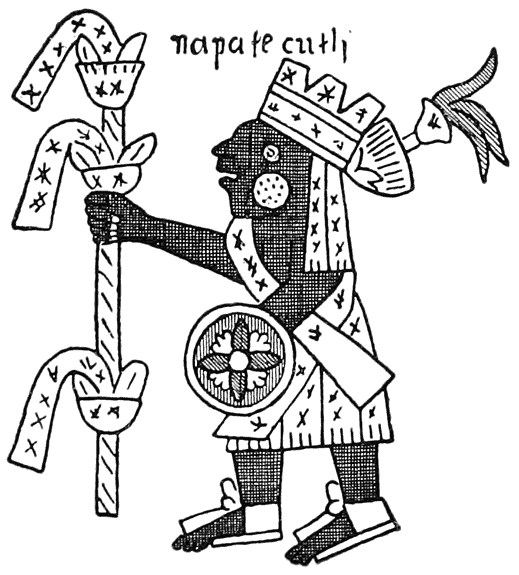
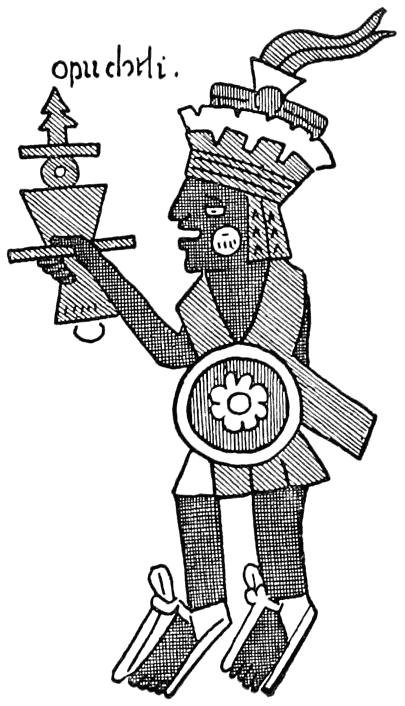
FORMS OF THE TLALOQUÊ.
(From the Sahagun MS.)
UIXTOCIUATL = “SALT WOMAN”
Area of Worship: Originally the eastern sea-coast.
Relationship: Elder sister of the Tlaloquê.
ASPECT AND INSIGNIA
Sahagun MS. (Biblioteca del Palacio).—The goddess is painted yellow and wears a crown of paper or cotton, adorned with quetzal-feathers and a golden ear-plug. Her overdress and skirt are painted with wavy lines of water and she wears sandals. Her shield is entirely white and she bears a rush staff in her hand, from which depend strips of cotton or paper.
FESTIVALS
Tecuilhuitontli.—“The seventh month” (says Sahagun, bk. ii, c. vii) “was designated tecuilhuitontli, the first day of which was dedicated to the goddess of salt, who was styled Uixtociuatl. She was termed the elder sister of the god Tlaloc. A woman was slain in her honour, robed with the same ornaments as were worn by the images of this divinity.
“Several other ceremonies were conducted during this festival and there were frequent scenes of debauchery.”
NATURE AND STATUS
The interpreter of Codex Telleriano-Remensis states that Yxcuina, as he names the goddess, was the protector of adulterers and “the goddess of salt and of dissolute persons.” He further relates that they put adulterers to death before her image. The interpreter of Codex Vaticanus A adds that she was the wife of Mictlantecutli, lord of the realm of the dead. One of the women given as consorts to the victim sacrificed at the principal feast of Tezcatlipocâ was called after the goddess.
The salt-supply was regarded as an indispensable alimentary feature in Mexico, and the relative importance of the worship of Uixtociuatl can readily be gathered from this circumstance. Her connection with lustfulness had probably a physiological basis, and perhaps owed its existence to the saline odour which emanates from the excretions of the privy parts. There is a distinct resemblance between her name and that of the absinthe plant.
ATLAUA = “LORD OF THE LAKE BEACHES”
Area of Worship: Chinampanecs of Cuitlauac.
ASPECT AND INSIGNIA
The lower parts of his extremities are striped blue, like those of Uitzilopochtli. In the Sahagun MS. (Palacio) he wears the domino mask edged round with small white circles (the “stellar face-painting”) and the mouth and chin are blackened or reddened. The headdress resembles the flag used as Uitzilopochtli’s symbol for the panquetzaliztli festival. He carries the shield of Uitzilopochtli, with the five balls of eagle’s down, one half of the weapon being coloured red, like blood, and in his right hand he holds an instrument which, from comparison with another Sahagun MS. (Bib. Laurenz.) we know to be a rattle. In this picture symbols expressive of singing flow from his mouth.
NATURE AND STATUS
He was a god of the inhabitants of the floating gardens of Lake Xochimilco, the tribe known as the Chinampanecs, and from the “stellar face-painting” he wore he must at some time have been identified by one of the early hunting tribes with one or other of the stars. His possession of Uitzilopochtli’s shield is perhaps further proof of his stellar association. He may have been one of the Centzonuitznaua (see Uitzilopochtli—“Myths”).
NAPATECUTLI = “FOUR TIMES LORD”
Area of Worship: Shores of Lake Texcuco.
Relationship: One of the Tlaloquê.
ASPECT AND INSIGNIA
Sahagun MS. (Biblioteca del Palacio).—The body-paint is black, but a plaster of salvia chia is worn on the face underneath the eyes. The god wears a paper crown sprinkled with rubber gum, and a tuft of paper at the back of the head, from which quetzal-feathers depend. Two long strips of paper hang from under the crown down the back of the neck, and these are also sprinkled with rubber gum. Across the right shoulder is slung a band of paper, and an underdress of the same material surrounds the hips, and these are also sprinkled with gum. Sandals are worn, and the shield is decorated with the water-rose motif. A rush staff is carried in the hand, from which strips of paper hang, daubed with melted indiarubber.
NATURE AND STATUS
Sahagun says that Napatecutli “was the god of men who make mats out of aquatic reeds, and was one of the Tlaloquê. He was the inventor of mat-making, and was adored by those who made the low chairs called icpalli, and the hurdles of reeds which are called tolcuextli. He made the reeds to grow and caused the showers that made them spring, and they prayed him for rain and reeds. When they sacrificed a slave to him they dressed him in the god’s garments, placing in his hands a green vase filled with water, with which he besprinkled all with the aid of a branch of willow, as if he were blessing them. Then, in the course of the year, whenever one of this trade wished to feast this divinity, he acquainted the priests with his intention, who chose a priest, dressed him in the attributes of the god, like his image, and conducted him, asperging him on the way, with a branch of willow dipped in water. Arrived at the house, they prayed him to extend his favours to the dwelling, and the feast was celebrated, the ‘god’ eating and drinking with the rest. This was done with the desire to recompense the god, and when they had spent all they had, they said: ‘I care not if I am without means, so long as my god is satisfied with this feast. He may grant me more, he may leave me in misery, so long as his will is accomplished.’ So saying, they covered the representative of the god with a white mantle, who returned with his companions. The householder then feasted privately with his parents. The mat-makers plenished and ornamented the temple of their god with reeds and plants, and anything they placed in the temple was of the best workmanship.”
MATLALCUÊYÊ = “SHE OF THE BLUE ROBE”
(Variant of Chalchihuitlicue)
Area of Worship: Tlaxcallan.
Relationship: Second consort of Tlaloc.
APPEARANCE
She is recognized by her tasselled head-band and cape, and often by a stepped nose-ornament.
NATURE AND STATUS
A variant of Chalchihuitlicue. She was believed to preside over a mountain near Tlaxcallan. One of the women sacrificed to Tlaloc at the great festival to the mountain-gods was called after this goddess.
OPOCHTLI = “THE SOUTHERN,” “LEFT-HANDED,” OR “THE WIZARD”
Area of Worship: The shores of Lake Texcuco.
Relationship: One of the Tlaloquê.
ASPECT AND INSIGNIA
The Sahagun MS. describes the insignia of this god as follows: He is painted black and has a patch or spot made from crushed seeds on his face. His crown is cut out of paper, and from it rise plumes of heron-feathers, mingled with those of the quetzal bird. He has a band made of paper round his shoulders, a loin-cloth and white sandals. His shield bears the solar emblem and he carries a rattle-staff in his hand.
NATURE AND STATUS
Sahagun (bk. i, ch. 17) says of Opochtli, that he is one of the Tlaloquê. To him was attributed the invention of fishing-nets and of the minacachalli, or three-pronged harpoon, an instrument recalling the classical trident, which was also used for spearing birds. He it was who originally contrived the nets used by the fowler to ensnare the aquatic birds which frequented the banks of Lake Texcuco, and the paddle was likewise his invention. Of all the Tlaloquê he appears to have been the most practical, as well as the most closely identified with human pursuits, and naturally he figured as the patron of the fisher, the fowler, and those generally who plied their occupation on the water of the lake or on its shores. Upon the occasion of his festival they offered him food and octli, the ears of maize, flowers, and burned tobacco before him as an incense, as well as copal and the absinthe herb. They also placed before him toasted maize. The older priests chanted his praises and filed before his idol in procession. As we have seen in the case of Uitzilopochtli, the word opochtli may signify “wizard,” and I believe that the net, which would appear to a primitive people an apparatus of the most ingenious kind, would be regarded by them as the invention of a magician. Opochtli would almost inevitably come to be connected with the Tlaloquê because of the employment of his invention to catch fish and snare the aquatic birds which rested on the shores of Lake Texcuco.