Chapter II · COSMOGONY
Reading edition
Accounts of the creation of the world and of man, even as handed down to us by those writers on Mexican mythology who had the best opportunities for collecting them, are prone to vagueness, and differ so materially one from another that we will probably not be in error if we impute their inconsistencies to a variety of local origins. As regards the agencies by whom the creation or reconstruction of the earth was accomplished, we are not in doubt, for certain passages in the Interpretative Codices find almost exact corroboration in the creation story contained in the Popol Vuh, the mythic book of the Quiche of Guatemala (which was unknown to the interpreters of the Mexican Codices), as well as in similar works of Maya origin.
THE “AGES” OF MEXICAN COSMOGONY
Having thus satisfied ourselves regarding the creative personnel of the Mexican pantheon, and preserving further proof of the constructive character of certain of these deities until we come to discuss them individually, we may proceed to examine such myths as tell of the formation of the world. In the belief of the Mexicans the earth was not destined to receive its present inhabitants, although occupied by man-like beings, until it had undergone a series of cataclysms or partial destructions, regarding the precise incidence and even the number of which there is a marked difference of opinion on the part of the older authorities.
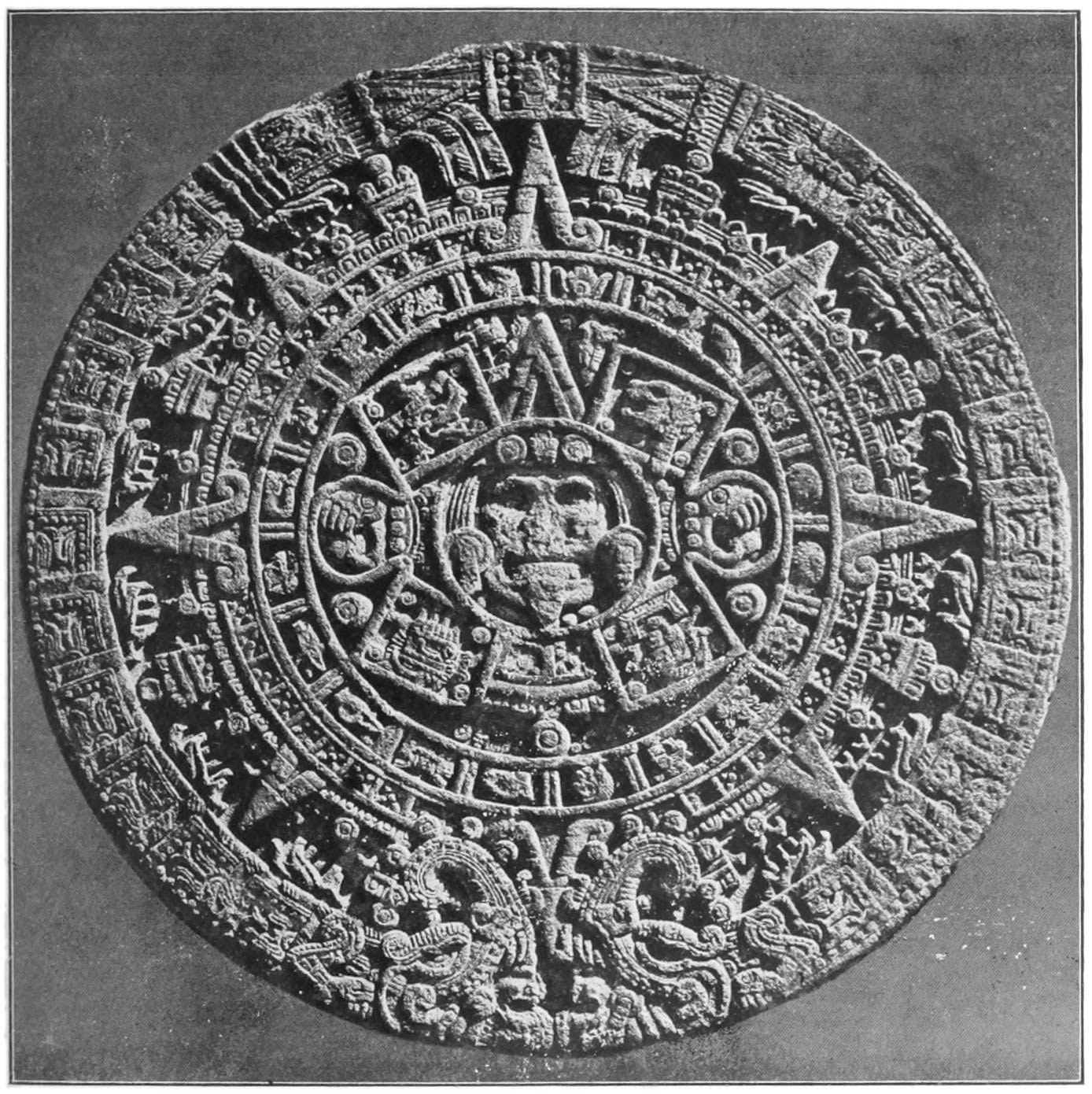
THE GREAT CALENDAR STONE OF MEXICO.
(Now in the Museo Naçional, Mexico.)
THE MAKING OF THE EARTH
The second chapter of the Historia de los Mexicanos por sus Pinturas, a précis of the opening chapters of which is given farther on, states that the gods “created a great fish which is called the Cipactli, which is like the cayman [alligator], and of this fish they made the earth.”
The description of the earth-monster, as it appears in the Codices, as an alligator or sword-fish is, however, by no means convincing. Moreover, the sculptured representation of the earth-monster in Maya art, especially in such examples as that from Copan, is essentially dragon-like in form, and there would seem to be little difficulty in classing the Cipactli as an earth-dragon, similar in nature to the cosmic monster of Chinese art and mythology. The fact, too, that in the native paintings we frequently observe the sun-god in the act of being swallowed by the Cipactli strengthens the analogy with the Chinese example.
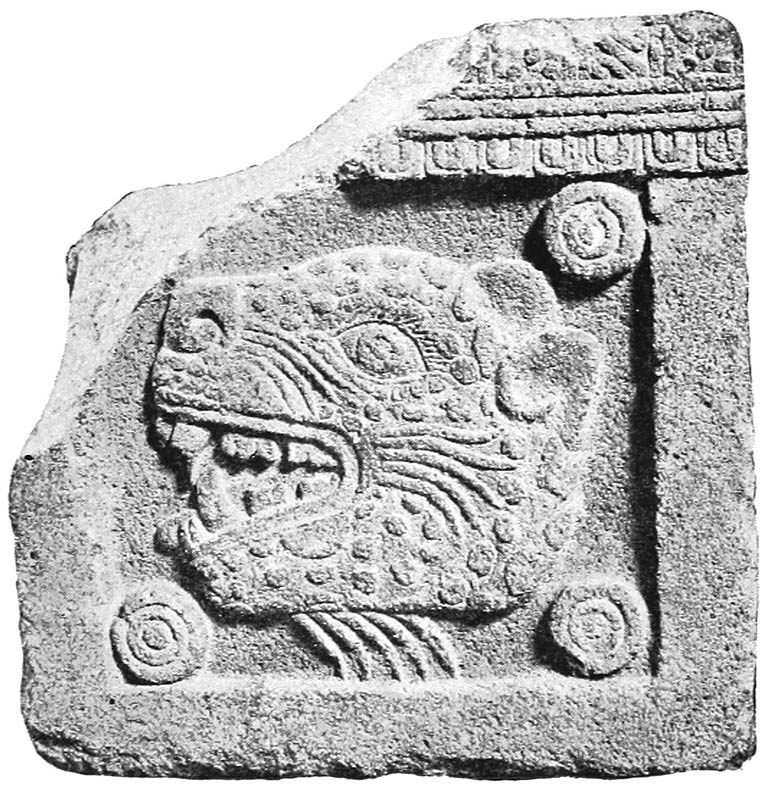
The Jaguar-sun.
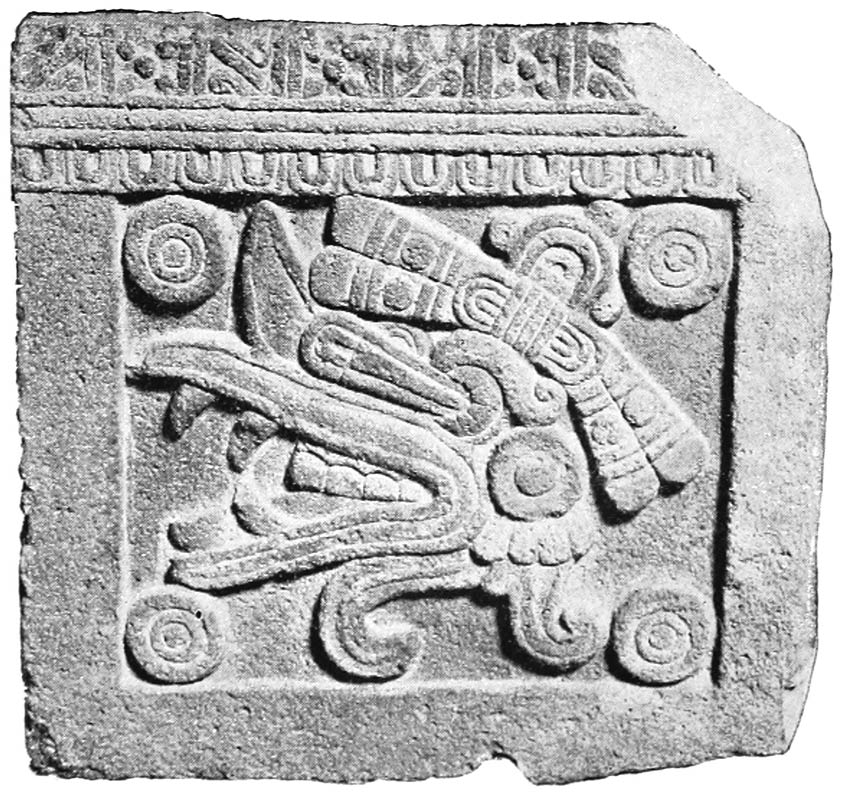
The Wind-sun.
STONES SHOWING THE SYMBOLS OF THE “SUNS” OR AGES.
THE PEOPLING OF THE EARTH
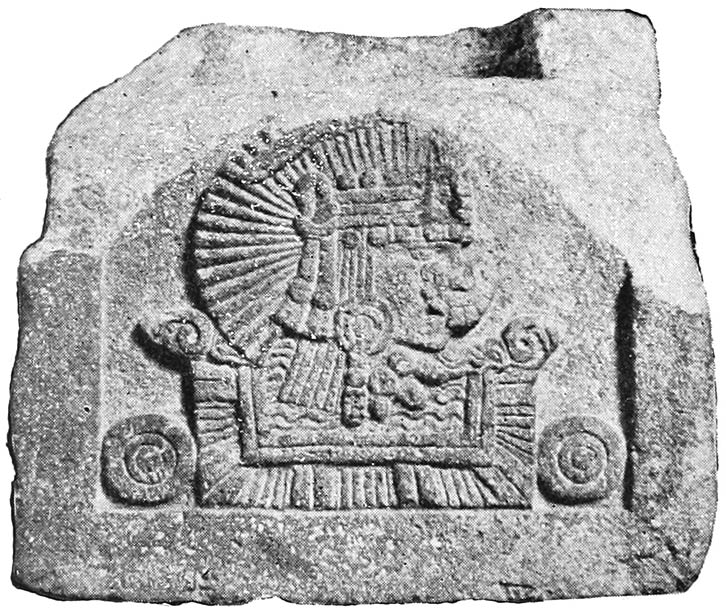
The Water-sun.
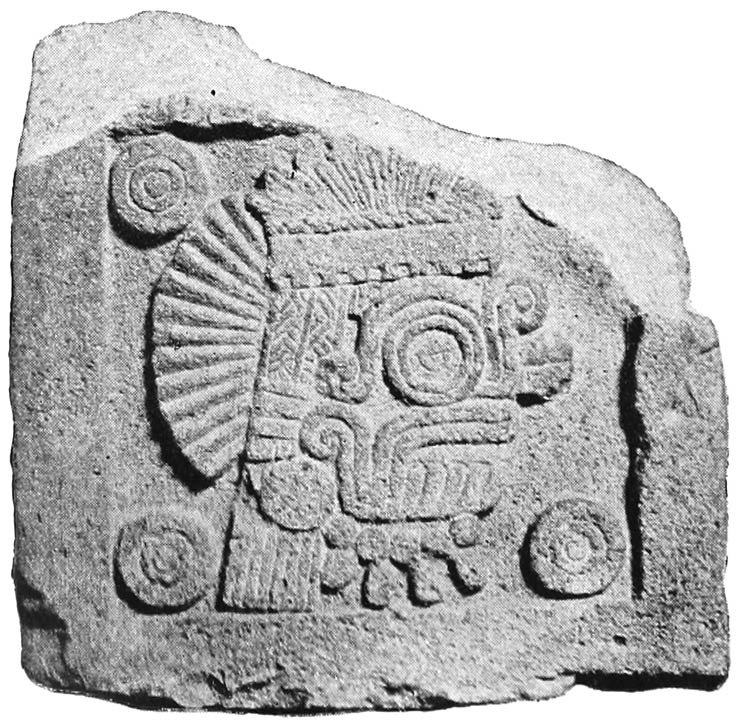
The Rain-sun.
STONES SHOWING THE SYMBOLS OF THE “SUNS” OR AGES.
CREATION OF THE SUN AND MOON
The people of Texcuco, says Olmos, naturally placed the occurrence of these events within their own boundaries, but they added (according to a pictorial manuscript which they showed the friar) that the Sun shot a dart into the ground and at this spot the first man arose. He was imperfect, being formed only from the armpits upward. He was followed by a woman. Mendieta suppresses the remainder of the myth because of its Rabelaisian details, but we may conclude that from these twain humanity was descended.
The gods had already waited some time to witness the resurrection of Nanahuatl, when they beheld the heavens commence to grow red. Terrified at the sight, they fell upon their knees and could not comprehend whence the light had arisen. The glow of sunrise illuminated every point of the compass, but many fixed their gaze upon the East, feeling that in that direction the luminary would first be sighted. Those who gazed thither were Quetzalcoatl (also called Eecatl), Totec, and Tezcatlipocâ. Others called Mimixcoa were innumerable, and there were also present four goddesses, Tiacapan, Teicu, Tlacoeua, and Xocoyotl. When the sun rose at length he appeared very red, and no one might look upon him without being blinded by his rays. The moon appeared at the same time, and gave forth light equal to that of the orb of day. But the gods thought it ill that the moon should be as bright as the sun, and therefore one of them took a rabbit and cast it at the face of the moon, so that it remained there to dim its splendour. Although the sun and moon were raised above the earth, they remained stationary. They spoke mockingly to their erstwhile companions.
When the gods had been slain the wind commenced to whistle and blow with violence, so that at length the burning globe of the sun began to drift over the heavens. But the moon still remained at rest, and in this manner they became separated, so that their habit is to rise at different hours.
The Anales de Quauhtitlan, after the manner of the Book of Genesis, states that the world and all therein were created in seven days. In the sign Tochtli the earth was created, the firmament was erected in Acatl, animals came into being in Tecpatl, and man was made out of dust or ashes on Ehecatl, the seventh day, but completed and perfected by Quetzalcoatl, who appears to have played the part of a demiurgos as regards the human race. There can be little doubt that this myth has been sophisticated, or is a later invention. The Anales de Quauhtitlan, however, sustains the accounts of Olmos and Sahagun regarding the creation of the sun and moon.
THE HISTORIA DE LOS MEXICANOS
The Historia de los Mexicanos por sus Pinturas is a manuscript of such importance to the study of Nahua Cosmogony that a short précis of its earlier chapters may, perhaps, be found of value in this place.
“After six hundred years these four god-like brothers were born, and all came together to order what was to be and the law that they should hold. They made a half-sun in the midst, the other luminaries great and small, and a man and woman named Oxomuco and Cipactonal, commanding him to till the earth and her to spin and weave. From these were born the maceguales or labourers. And to Cipactonal the gods gave certain grains of maize that she might keep them and use them for charms and riddles, and since that day women have used them for that purpose.
“The gods then gave this pair the days of the calendar and divided them into months, twenty days to each month, and three hundred and sixty days in the year. Then they made Mictlantecutli and Mictecaciuatl, man and wife, to be the gods of the infernal regions. Later they made the heavens and space and the water, and then a great fish like the cayman, which is called cipactli, from which they shaped the earth. In order to create the gods of water, all four gods joined together and made Tlaloc and his wife Chalchihuitlicue.
“These gods of water have their place in the four quarters, and in the middle of it was a great court, where there were four tubs of water. One water is very good, and this rains when they grow grain and wheat. And these gods of water have many dwarfish servants in the said house, and these have pitchers, with which they take the water from the tubs, and sticks in the other hand. When the gods of water wish them to go to the boundaries, they take the pitchers and sticks and sprinkle the water as they are told. And when it thunders, they crack the pitchers with the sticks, and when it lightens they break off a portion of the pitcher.
“All the aforesaid things had been made and created without taking any account of the years, and without respect of time. The first man and woman had a son called Piltzintecutli, who desired a wife with whom to live. So the gods made of the hairs of Xochiquetzal a woman, and thus was the first marriage made. This having been done, all the four gods saw that the half-sun which had been created gave but little light. And they saw that they must make another half, because the existing light was not able to illuminate the world.… Then Tezcatlipocâ became the sun-bearer. And the gods created the giants, who were very great men and of much strength.… And they called the age in which Tezcatlipocâ was the sun the age of boasting and of tigers, for the giants gorged and ate and wanted for nothing. And when thirteen times fifty and two years were passed, Quetzalcoatl was the sun. Then Tezcatlipocâ took a great stick and struck upon the water, and turning himself into a tiger, went out to kill the giants. Afterwards he appeared in the sky, for they said that the ursa major sank in the water, because it is Tezcatlipocâ.… During the time Quetzalcoatl was the sun another count went on, which, having ended, Tezcatlipocâ cast out Quetzalcoatl, who became the wind, which, when it blew on the maceguales, turned them into monkeys and apes. And there was for sun Tlaloc, which lasted three hundred and sixty-four years.… During these years Quetzalcoatl rained fire on the sun, and then created as the sun his wife Chalchihuitlicue. She was the sun for three hundred and twelve years.
“In the last year in which Chalchihuitlicue was the sun, it rained so heavily that all the maceguales were turned into fishes. And when it had ceased to destroy, the heavens fell upon the earth and the great rain began, the which year was tochtli. And the gods ordered four roads to be made to the middle of the earth for them, and raised the heavens, and to help them in holding them up they created four men, called Cotemuc, Yzcoadt, Yzmali, and Tenesuchi, who were created by Tezcatlipocâ and Quetzalcoatl. Then they made great trees, Tezcatlipocâ one which was called tazcaquavlt, which is to say “tree of the mirror,” and Quetzalcoatl one which was called queçalhuesuch, and with the help of the men they had made and the trees the gods held up the heavens and the stars and made a road in the sky.
“After the heavens had been raised, in the second year after the flood, which was acatl, Tezcatlipocâ pronounced his name, and there appeared the dumb Mixcoatl, ‘Serpent of the Clouds.’ And they paint him as a serpent. And they drew fire from fire-sticks, which they called heart of the fire. In the seventh year after the flood was born Cinteotl, the first son of the first man, who was a god, and his wife a goddess, and he was made of the hairs of the mother goddess, and it was said that he was not able to die. And in the eighth year after the flood the gods created the maceguales, like those that were before. When the first three years of this group of years had passed, in the first of the next group all the four gods came together, and said that because the earth had no light, and was dark, and that because there was no fire, they would make a sun which would give light to the earth, and which would eat hearts and drink blood. In order to do this they made war, by which they were able to procure hearts and blood. In this time Tezcatlipocâ made four hundred men and a hundred women, and on these the sun lived. In the tenth year, Suchicar, the first wife of Piltzintecutli, the son of the first man, was killed in the war, and was the first so to die.”
If we search for a common factor among these conflicting ideas, we will, indeed, find the task one of difficulty. The nature of the sources from which we obtain them does not permit us to arrange them chronologically, and all that we can found upon in this respect is their subject-matter, which cannot enlighten us much. As has been said, we are probably on safe ground if we accept the version of the several ages hypothetically contained in the so-called Calendar Stone of Mexico. The circumstance, too, that the sun and moon myth, as related by Olmos, agrees for the most part with the version of Sahagun, permits us to regard it as a well-recognized belief. Nor can the variant myth regarding the creation of mankind, which is briefly described in an annotation, shake our confidence in the credibility of Olmos, as it obviously differs more in the names of the actors in the drama of creation than in the circumstances, which are almost identical. But if it is impossible to verify strictly the place of origin of the Olmos myth, although Texcuco was claimed as its home, it is permissible to indicate the universal character of that portion of it which deals with the creation of the heavenly bodies, from its similarity to the analogous passage in Sahagun’s rendering, which proves that that part of it at least must have been more or less widely disseminated throughout Mexico. We know that after the collection of data in any district it was his custom to submit them to experts in other and distant parts of the country for comparison and verification. We may thus be justified in classing the Calendar-stone version of the world’s ages and the Sahagun portion of the creation myth of the luminaries of the last age as among the standard beliefs of Mexican theology. It follows from Sahagun’s general agreement with the Olmos-Mendieta account that the portion of that version which he does not treat of must naturally be within reasonable distance of exactitude. The circumstance that both of these accounts relate the self-immolation of the gods by the sacrificial method of having their breasts opened, seems to prove that the myth was no older than the institution of human sacrifice, which we are perhaps correct in regarding as of no very great antiquity, although arguments of sufficient cogency might be brought against this view.
DELUGE MYTHS
As Mexican myths of the creation differ, so do those concerning the great deluge which at one period was supposed to have overwhelmed the earth. As we have seen, myths which are concerned with the several ages of the earth dwell upon such an event, but separate myths exist which also tell of a great flood which is almost certainly to be identified with the “Water-sun.” The goddess Chalchihuitlicue (the goddess of water), says one of the interpreters of the Codex Telleriano-Remensis, “saved herself in the deluge.” The interpreter of the Codex Vaticanus A. relates that: “Most of the old people of Mexico say that a single man and a single woman escaped from this deluge, from whom, in course of time, mankind multiplied. The tree in which they saved themselves was called Ahuehuete (the fir-tree), and they say that this deluge happened in the tenth sign, according to their computation, which they represented by water, which on account of its clearness they place in their calendar. They say that during the first age men ate no bread, but only a certain kind of wild maize, which they called atzitziutli. They name this first age coniztal, which signifies the white head; others say that not only did these two who were preserved in the tree escape, but that seven others remained hidden in a certain cave, and that the deluge having passed away, they came forth and restored the population of the earth, dispersing themselves over it: and that their descendants in course of time worshipped them as gods, each in his own nation.”
A similar myth in the Anales de Quauhtitlan or Codex Chimalpopoca, is also worthy of quotation.
“And this year was that of Ce-calli, and on the first day all was lost. The mountain itself was submerged in the water and the water remained tranquil for fifty-two springs.
“Now toward the close of the year, Titlacahuan (Tezcatlipocâ) had forewarned the man named Nata and his wife Nena, saying: ‘Make no more pulque, but straightway hollow out a large cypress, and enter it when in the month of Tozoztli the water shall approach the sky.’ They entered it, and when Titlacahuan had closed the door he said: ‘Thou shalt eat but a single ear of maize and thy wife but one also.’
“As soon as they had finished eating, they went forth and the water was tranquil; for the log did not move any more; and opening it they saw many fish.
“Then they built a fire, rubbing together pieces of wood, and they roasted fish. The gods Citlallinicuc and Citlallatonac, looking below, exclaimed: ‘Divine Lord, what means that fire below? Why do they thus smoke the heavens?’
THE “COXCOX” FALLACY
It is unnecessary in this place to deal at any length with the quite artificial myth given by Siguenza and Clavigero, based on a mistaken interpretation of certain Mexican paintings. Briefly, they state that Coxcox, “the Mexican Noah,” and his spouse Xochiquetzal escaped from the deluge in a boat which grounded on the peak of Colhuacan: “the Ararat of Mexico.” Dumb children were born to them, who received innumerable languages from a polyglot dove. Garcia y Cubas published in his Atlas Geografico a letter from Ramirez (April 1858) in which the then conservator of the National Museum of Mexico showed the fallacy of Siguenza’s interpretation and proved that the pictures in question referred to the wanderings of the Aztecs in the Valley of Mexico.
A flood myth which has for its hero one of the giants who were supposed to inhabit the earth in the first age (or rather the first age according to the version which is supported by the Calendar-stone), states that Xelhua, the giant in question, escaped the deluge by ascending the mountain of Tlaloc in the terrestrial paradise, and afterwards built the pyramid of Cholula. The interpreter of the Codex Vaticanus A says of this story: “In this first age giants existed in that country.… They relate of one of the seven whom they mention as having escaped from the deluge, that, the earth becoming populous, he went to Chululan and there began to build a tower which is that of which the brick base is still visible. The name of that chief was Xelhua; he built it in order that should a deluge come again he might escape to it. Its base is 1,800 feet in circumference. When it had already reached a great height lightning from heaven fell and destroyed it. Those Indians who were under that chief who had escaped from the deluge, named Xelhua, made bricks out of a mountain in Tlalamanalco called Cocotle, and from Tlalamanalco to Chulula Indians were placed to pass the bricks and cement from hand to hand: and thus they built this tower, that was named Tulan Chulula, which was so high that it appeared to reach heaven. And being content, since it seemed to them that they had a place to escape from the deluge if it should again happen, and from whence they might ascend into heaven—a chalcuitl, which is a precious stone, fell from thence and struck it to the ground. Others say that the chalcuitl was in the shape of a toad; and that whilst destroying the tower it reprimanded them, inquiring of them their reason for wishing to ascend into heaven, since it was sufficient for them to see what was on the earth. The base of the tower is at the present day still remaining and its circumference is 1,800 feet.”
This myth has equivalents in the Hindoo story of the manner in which Hanuman, king of the monkeys, built a bridge from India to Ceylon, and in Scottish legend, where Corstorphine Church, near Edinburgh, is the scene of the building, the stones being passed on from hand to hand by the “Picts” from Ravelston Quarry, some considerable distance away. But it bears a more striking resemblance to the story of the tower of Babel, the work of another being of gigantic origin—Nimrod. Xelhua was the mythical ancestor of the people of Tehuacan, and Teotitlan del Camino. It may be that his myth has been sophisticated by the priestly writers who set it down, and in any case it seems to be ætiological or explanatory of the Pyramid of Cholula.
THE FALL OF THE GODS
In his interpretation of this goddess in his work on the Aubin-Goupil tonalamatl (pp. 118–119) Seler gives it as his opinion that the insignia of the goddess Tonacaciuatl, consort of the creative deity Tonacatecutli, is identical with that of Xochiquetzal, and proceeds to say that this strongly suggests “that the home of the cosmogonic speculations embodied in the names of Tonacatecutli and Tonacaciuatl was to be sought in the region where dwelt the goddess Xochiquetzal, and this was assuredly not Mexico proper, but appears to have been the group which in one place is comprised by Torquemada under the name Chalmeca, Olmeca, Xicalanca, Tepaneca, Xochimilca, and Tlalhuica. Here by Chalmeca are to be understood the dwellers about the volcano, and by Olmeca, Xicalanca, the aborigines of the Tlaxcallan district.… Originally the goddess Xochiquetzal is perhaps nothing more than the deity of one of those mountains from which the life-giving waters flow down from the fields.” It is easy to believe that Xochiquetzal is a variant of Tonacaciuatl; but it is not necessary to infer therefrom that the Olmec-Tlaxcaltec version of the myth relating to her with its cosmogonic speculations was prior in origin to that which found acceptance at Mexico, even although the Olmecs were regarded as an older race. Tonacatecutli and his consort were believed to be Toltec deities, and had thus a greater antiquity behind them than Olmec myth could invest them with. Codex Vaticanus A tells much the same story regarding Ixnextli and was probably inspired from the same source.
MEXICAN CONCEPTIONS OF THE UNIVERSE
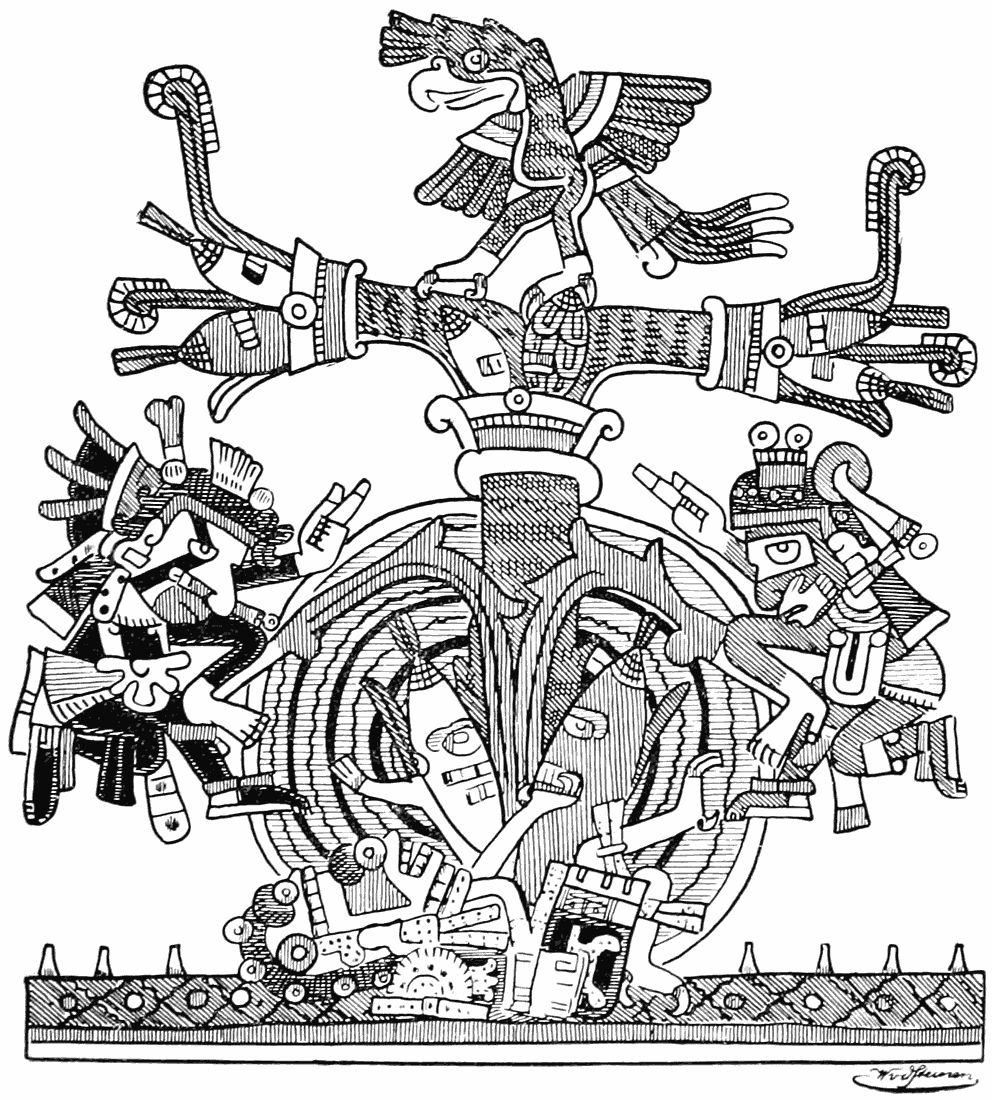
No definite account of the Mexican conception of the universe has come down to us, but we are probably founding correctly if we accept the Maya belief as closely approximating to that in general currency in Mexico. An examination of the central design in the Maya Book of Chilan Balam of Mani, given in Cogolludo’s History of Yucatan (1640), shows the earth as a cubical block, by which term it is practically described in the Popol Vuh (“the quadrated castle, four-pointed, four-sided, four-bordered”). This the Maya described as tem (“the altar”), that is, the altar of the gods, the offering upon which was life. Above this cube on four legs is the celestial vase (cum) containing the heavenly waters, rains, and showers, upon which all life depends. Above it hang the rain-clouds which fill it and from it springs the vax che, or Tree of Life, with outspread branches.
THE FIVE REGIONS OF THE WORLD
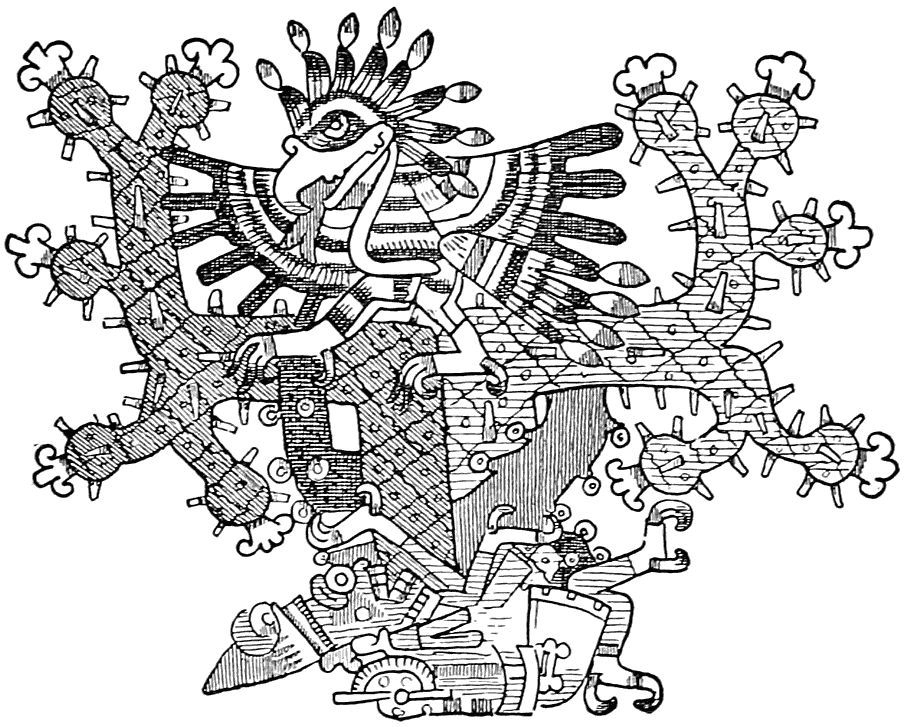
North.
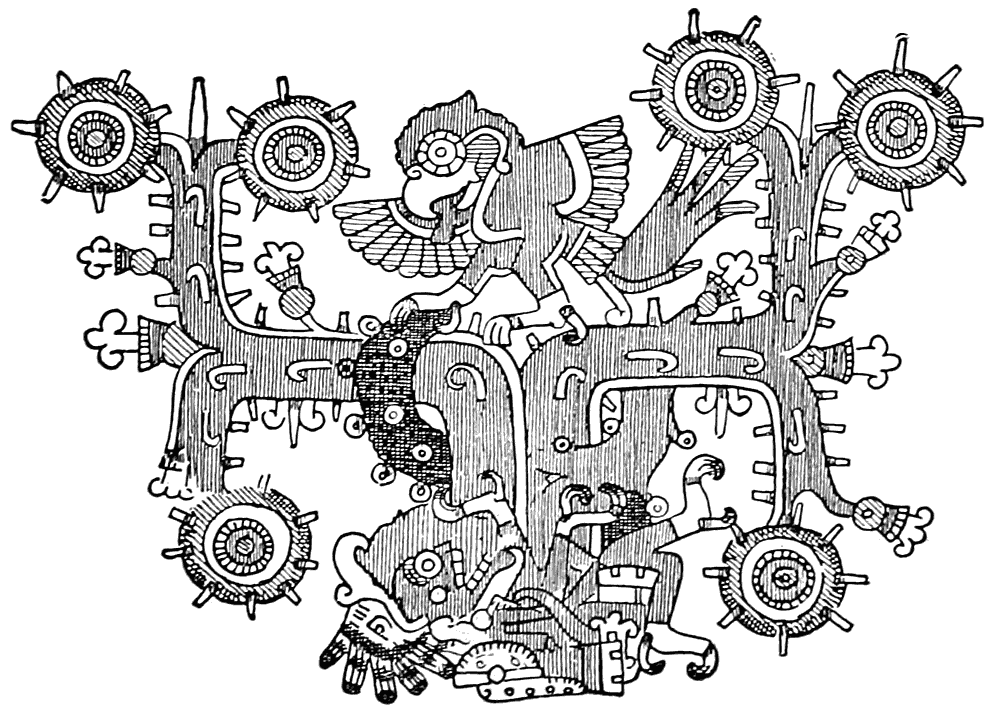
South.
THE TREES OF THE WORLD-QUARTERS.
(Codex Fejérváry-Mayer, sheet 1.)
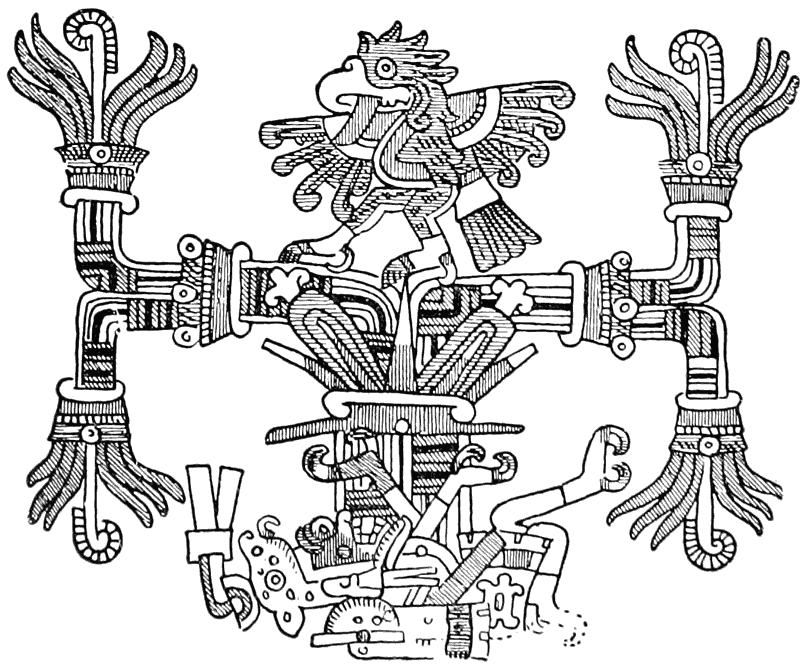
The Tree of the East is represented as a highly conventionalized tree having two boughs, each with four branches which end in the chalchihuitl (greenstone) symbol. Round branches are twisted two ropes, green and blue in colour, set with golden bells. A quetzal bird perches upon the top and the trunk is decorated with the symbol for war, for the spirits of the sacrificed warriors were believed to dwell in the eastern heavens, where the sun rose. The tree springs from the body of the Earth-goddess, and the ornaments borne by it are symbolic of the rich and fruitful character of the Orient.
The Tree of the North.—This tree is painted half-green, half-blue, but is set with thorns in every part. Bands of blood and darkness issue from the body of the Earth-goddess, in which it has its root, and these wind around its boughs. The eagle stands upon the top, each of its plumes bristling with a sacrificial stone knife.
The Tree of the West.—This has a yellow star, and bears the magic bloom at the end of each branch. It is surmounted by the humming-bird, and its trunk is dotted with the stellar eye, in this case the evening star.
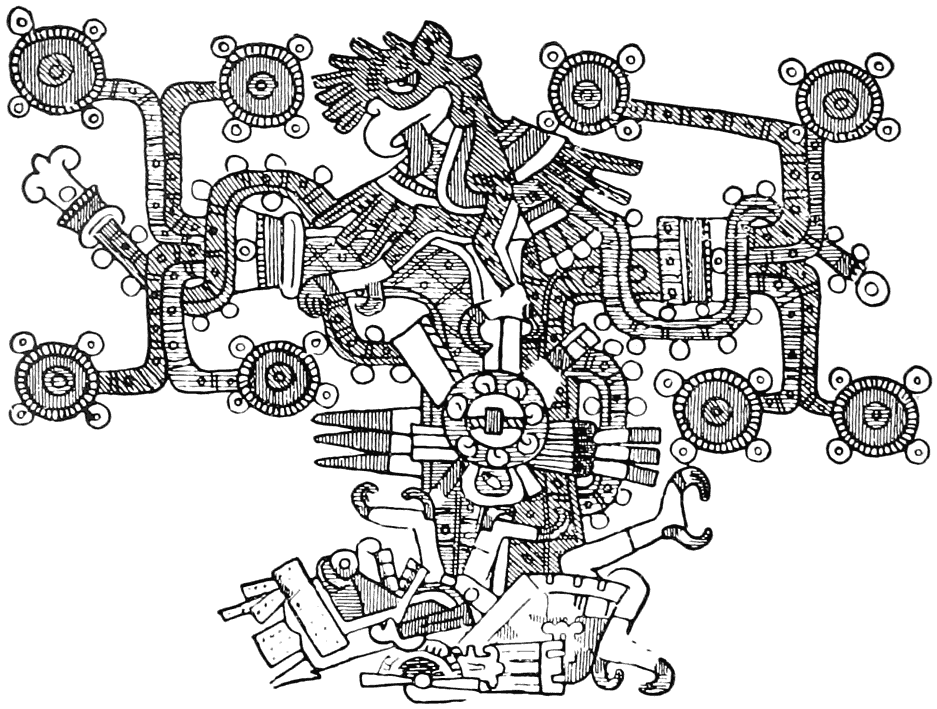
East.
West.
THE TREES OF THE WORLD-QUARTERS.
(Codex Fejérváry-Mayer, sheet 1.)
The Tree of the South.—This, too, is thorny, but painted red, and the trunk is sprinkled with symbols recalling that of the “spoken word” which in the Codices is frequently seen issuing from the mouths of gods and men. It may symbolize smoke or fire, thus alluding to the fiery nature of the region to which the tree belongs. A cloud of darkness and a stream of blood wind around the stem. It is surmounted by the arara bird.
These four trees have parallels in Maya mythology, as, for example, on the altar-pieces of the cross from Palenque (Temple II) and elsewhere.
Centre—Xiuhtecutli.
East—Mixcoatl and Tlaloc.
North—Itztli and Xochipilli.
West—Iztac Mixcoatl and Quetzalcoatl.
South—Macuilxochitl and Xipe.
We find from an examination of the codices that the Mexicans believed that the “world” or universe was divided into:
Tlalxicco, the centre or “navel” of the Earth.
Tlapcopa, “the region of the Dawn” (the East).
Uitznauac, “Place of Thorns” (the South).
Ciuatlampa, “Region of Women” (the West).
Mictlampa, “Place of the Dead” (the North).
These several regions demand a brief description.
Tlalxicco was the dark interior of the earth, which was supposed to be inhabited by an animal-headed god or demon, resembling a badger, to whom no name has as yet been applied, but who seems to possess affinities with sorcery and the darker arts. A good representation of him is to be found on sheet 9 of Codex Vaticanus B.
Tlapcopa, the East, or “Region of the Dawn,” was regarded as a region of prosperity, fertility, and abundant food-supplies. It was the house of the Sun, the region where sacrificed warriors dwelt in bliss, and will be further described when we come to deal with the subject of “heaven and hell.”
THE TREE OF THE MIDDLE-QUARTER.
Uitznauac or Uitzlampa, “Region of Thorns” (the South), was, as its name implied, a place of rather evil omen, for it was sometimes thought of as inhabited by Mictlan, Lord of the Dead. The Mexicans, dwelling in a plateau country where climatic conditions were temperate, probably regarded the tropics to the south as a region fatal to health, and generally insalubrious in character.
Ciuatlampa, “Region of Women” (the West), was the place to which those women who died in their first childbed (Civapipiltin or Ciuateteô) went after death, and as such falls to be described in the section on “heaven and hell.” But it was also the home of the maize-plant, and of the deities producing it, and also of the Gods of Procreation. It was the Region of the Evening Star, Tlauizcalpantecutli, the planet Venus. In Codex Borgia (sheets 43–46) we seem to see a subdivision of the Western region into North, South, and West. This region may also be collated with Tamoanchan, the paradisaical land of abundant maize, where the maize goddess Tlazolteotl gave birth to her son Centeotl.
Mictlampa, “Region of the Dead,” also falls to be noticed in the section on “heaven and hell.” Symbolically it is the region of drought.
THE SUPPORTERS OF THE HEAVENS
THE AZTEC HEAVENS
Tlalocan.—An even more material paradise was presided over by the water-god or deity of moisture, Tlaloc. Sahagun calls this a “terrestrial paradise,” “where they feign that there is surfeit of pleasure and refreshment, void, for a space, of torment.” In that delectable region there is plenteousness of green maize, of calabashes, pepper, tomatoes, haricots, and it is fulfilled with variegated blossoms. There dwell the god Tlaloc and his followers. The persons who gain admittance to this paradise are those who have been slain by lightning or thunderbolt, the leprous and the dropsical—those whose deaths have in any way been caused through the agency of water—for Tlaloc is god of that element. Existence there is perpetual. The paradise of Tlaloc was situated in the east in a climate of eternal summer.
Homeyoca.—The interpreter of the Codex Vaticanus A states that the abode of the Creator of the Universe, Tonacatecutli, was Homeyoca or Homeiocan, “place of the Holy Trinity.” The etymology is vague, but would appear to apply to duality rather than trinity, a suggestion which is buttressed by the androgynous character of the creative deities. In an accompanying picture he points out the various departments of this heaven as “the Red Heaven,” “the Yellow Heaven,” “the White Heaven.” Young children, he says, went to a specific paradise, but it was thought that they would return to re-people the world after the third destruction. They were nourished by a milk-giving tree round which they were seated, getting suck from the branches.
MICTLAMPA AS HADES
The Hades of the Aztec race was Mictlampa, presided over by Mictlantecutli (Lord of Mictlampa) and his spouse (Mictecaciuatl). The souls of the defunct who fared thither were those who died of disease, chiefs, great personages, or humbler folk. On the day of death the priest harangued the deceased, telling him that he was about to go to a region “where there is neither light nor window,” and where all was shadow, a veritable land of gloom, the passage to which swarmed with grisly forms inimical to the soul. It was a vast, trackless, and gloomy desert, having nine divisions, of which the last, Chiconahuimictlan, was the abode of the lord of the place. Rank and privilege would appear to have been maintained even in this dark realm, although all offerings to the dead must first be inspected by Mictlantecutli himself ere being passed on to their proper owners. Sahagun states that four years were occupied in journeying to Mictlampa, evidently an error for four days, as elsewhere he says that the former period was spent within the regions of the dead. The journey thence was replete with terrors. Says the interpreter of the Codex Vaticanus A: “In this region of hell they supposed that there existed four gods, or principal demons, one of whom was superior, whom they called Zitzimatl, who is the same as Miquitlamtecotl, the great god of hell. Yzpuzteque, the lame demon, was he who appeared in the streets with the feet of a cock. Nextepehua was the scatterer of ashes, Contemoque signifies he who descends headforemost; an allusion being made to the etymology which learned men assign to the name of the Devil, which signifies deorsum cadens, which mode of descent after souls they attribute to him from this name and Zon. Yzpuzteque is he whose abode is in the streets, the same as Satan, he who on a sudden appears sideways. It appears that they have been acquainted with the Holy Scriptures, although clearer arguments in proof of this fact are adduced in the course of the following pages. They say that these four gods or demons have goddesses.”
These and other dread beings, according to the same MS., rendered the hellward journey terrible in the extreme, and an attempt was made to mitigate the terrors of the passage between the two worlds by means of passports of much the same character as the spells in the Egyptian “Book of the Dead,” which franked the soul past the numerous demons and dangers which awaited it. The first paper served to pass him by two mountains which threatened to clash together and crush him. The second saved him from the maw of a huge snake. Others helped him to face the lurking terrors of eight deserts and eight hills, and to avoid the grim crocodile Xochitonal. A wind of sharp flint knives then attacked him. Lastly he came to the river Chiconahuopan (Nine Waters), which he crossed on the back of a red-coloured dog which accompanied him and which was killed for that purpose by having an arrow thrust down its throat. It is not clear whether this dog acted as a guide to Mictlampa, or whether it preceded the soul, but it would seem that its master found it awaiting him when he came to the banks of the river, in the passage of which it assisted him. It kept its vigil on the opposite bank, however, and had to swim the river ere it could reach him.
The deceased then came before Mictlantecutli, to whom he made suitable gifts—cotton, perfumes, and a mantle. He was told to which sphere he must go. It is obvious that Mictlampa was not so much a place of punishment as a place of the dead, a Hades, where the souls of the good and evil were alike consigned. Its locality is partially fixed, for it is “the place where the sun slept,” and, like the Egyptian Amenti, it was therefore antipodean, or occupied the centre of the earth. After a four years’ sojourn in this dark monarchy the soul was supposed to come to a place where, according to the interpreter of the Codex Vaticanus, it enjoyed a measure of rest.