Chapter I · INTRODUCTORY
Reading edition
THE TYPE AND EVOLUTION OF MEXICAN RELIGION
If, like the necromancers of old, we possessed the power to summon the shades of the dead before us, and employed this dread authority to recall from the place of shadows the spirit of a member of the priesthood of ancient Mexico, in order that we might obtain from him an account of the faith which he had professed while in the body, it is improbable that we would derive much information regarding the precise significance of the cult of which he was formerly an adherent without tedious and skilful questioning. He would certainly be able to enlighten us readily enough on matters of ritual and mythology, calendric science and the like; but if we were to press him for information regarding the motives underlying the outer manifestations of his belief, he would almost certainly disappoint us, unless our questionary was framed in the most careful manner. In all likelihood he would be unable to comprehend the term “religion,” of which we should necessarily have to make use, and which it would seem so natural for us to employ; and he would scarcely be capable of dissociating the circumstances of his faith from those of Mexican life in general, especially as regards its political, military, agricultural, and artistic connections.
The people whose religious ideas this book attempts to describe were the Nahua of pre-Colombian Mexico, a race by no means extinct, despite the oft-repeated assertions of popular novelists, and which is now usually classed as a branch of the great Uto-Aztecan family of the North American Indian stock. They spoke, and their descendants still speak, a language known as the Nahuatl, or Nahuatlatolli (“speech of those who live by rule” or “by ritual observance”). At the era of the Spanish invasion of their country in 1519 they had succeeded in overrunning and reducing to their dominion practically all that part of modern Mexico which lies between the Tropic of Cancer and the Isthmus of Tehuantepec. They were, in all probability, immigrants from the north, and their art-forms, no less than their physique and beliefs, have led certain writers to form the opinion that they came originally from the neighbourhood of British Columbia, or that they had a common origin with the Indian tribes which inhabit that region at the present time.
However this may be, the first Nahua immigrants would appear to have entered the Valley of Mexico at some time during the eighth century of our era. But the Aztecâ, part of a later swarm of Nahua, do not seem to have descended upon it until the middle of the thirteenth century, or to have founded the settlement of Mexico-Tenochtitlan until about the year 1376. At the period of their arrival in the valley they were a barbarous tribe of nomadic hunters, wandering from place to place in search of fresh hunting-grounds, precisely as did many North American Indian tribes before reservations were provided for them. Gradually, by virtue of their superior prowess in war, they achieved the hegemony of the Plateau of Anahuac, which boasted a tradition and civilization at least five hundred years old. These they proceeded to assimilate with marvellous rapidity, as is not infrequently the case when a race of hunters mingles with a settled agricultural population. Indeed, in the course of the century and a quarter which intervened between the founding of Mexico and the period of the Spanish Conquest, they had arrived at such a standard of civilization as surprised their Castilian conquerors. When the Aztecâ, abandoning their wandering life, finally settled in the Valley of Anahuac, upon the site of Tenochtitlan, now the city of Mexico, they embarked upon a series of conflicts with their neighbours, which ended in the complete subjection of these peoples.
The races over whom they exercised a kind of feudal sway were many and diverse, and only the more important of these can be mentioned here. To the north dwelt the hunting Chichimecs, a related people, and the Otomi, a semi-barbarous folk, probably of aboriginal origin, and speaking a distinct language. To the west dwelt the Tarascans, whose racial affinities are unknown, or, at least, dubious. South of the Rio de las Balsas were situated the Mixtecs and Zapotecs, whose language somewhat resembled that of the Otomi and who possessed a larger measure of civilization. On the East Coast were found the Huaxtecs and Totonacs, races of Maya origin, and south-east of these lay the Olmecs, Xicalancas, and Nonoualcas, of older precedence in the land. Beyond the Isthmus of Tehuantepec were found the Maya, a people of relatively high civilization, whose origin is obscure, and into the question of whose relationship I do not propose to enter in this place.
THE ANTIQUITY OF MEXICAN RELIGION
Although we must necessarily regard Mexican religion as having had a progressive history spread over many generations, we are at present almost ignorant of the gradual changes which accompanied its growth. An effort will be made to outline the probable nature of these mutations, but the endeavour will not receive any great measure of assistance from the abundant but chaotic and unclassified material amassed by Americanists during the last twenty years, which in its present condition is not of much value as regards this particular branch of the subject, but which it is the writer’s intention to employ, so far as it is capable of illustrating the question before us.
THE LITERATURE OF MEXICAN RELIGION
It is necessary at this stage to deal briefly with the sources of Mexican religious history. A literature, bewildering in its scope and variety, has grown up around the subject of Mexican antiquity as a whole, and it is perhaps well for the student if he approaches it with only a partial realization of the spacious character of the material he must review. I have thought it best in such a work as this to relegate most of the bibliographical matter to an appendix, where an endeavour has been made to supply the student with a trustworthy catalogue of such manuscripts and works as are essential to the study of Mexican religion. It is hoped that this may prove of guidance and assistance and spare much initial toil. But for the present I will confine my remarks to such general observations upon the sources from which we partly glean our knowledge of the ancient Mexican faith as will serve the immediate purpose. These sources are four in number: (I) The native codices or paintings; (II) the native annals; (III) native art-forms in architecture, sculpture, pottery, and mural painting, depicting gods and other divine beings; and (IV) the writings of the Spanish conquerors of Mexico.
(II) The Native Writings.—These “annals,” as they are sometimes called, the work of natives who wrote in Spanish, constitute a mine of aboriginal information of nearly equal value with that contained in the codices, but considerable discrimination is necessary in using them in view of the tendency of their authors to corrupt traditional material when inspired by patriotic or other motives. This, however, manifestly does not apply with equal force to accounts of a mythical or ritual nature and to historical events, which offer a much greater temptation than the former to scribes manifestly ignorant of the virtues of literary integrity. The Mexican annals are of two classes: those which represent the historical or traditional relics of native communities, such as the Annals of Quauhtitlan, also known as the Codex Chimalpopocâ; and those which are the work of educated Mexicans or half-breeds, prone to magnify the splendour of the ancient races. Ranking almost as a third or separate class are the sacred songs or hymns included in the Mexican MS. of Sahagun’s Historia General, which that most unwearied of workers received at first hand from approved native scribes. The several native writings will be found described in the appendix, and the hymns, or rather a translation of them into English prose, will be met with in the descriptions of the several deities to which they apply.
(III) Native Art-forms.—Mexican architectural motifs, mural paintings, and especially sculpture and pottery, frequently afford reliable material upon which to form conclusions regarding the aspect and costume of the gods, and reproductions of the most important of these illustrate the descriptions of the several Mexican deities.
(IV) Writings of the Spanish Conquerors of Mexico.—If the representatives of the Church in Mexico must be condemned for their narrow and illiberal action in destroying all native manuscripts and paintings bearing upon the ancient religion of the country, certain more enlightened individuals among them laboured strenuously to remove this reproach by their zealous, if frequently unskilful, attempts to reconstruct a knowledge of the popular faith by unremitting researches into native tradition. This attitude met with but little countenance from their ecclesiastical superiors, and at times they laboured under conditions the reverse of favourable for the collection of traditional material. But it would be ungrateful not to pay a meed of respect to the self-sacrifice of those enlightened and resourceful men, but for whose endeavours our knowledge of Mexican antiquities would be all the poorer.
Undoubtedly the most valuable collection of evidence relative to the Mexican religion compiled by a Spanish churchman is the Historia General of Bernardino Sahagun, whose work, composed with scholarly care and an almost prophetic knowledge of the correct methods to be pursued in the collection of traditional material, was completed about the middle of the sixteenth century, but remained unpublished until 1830. This work has been described so repeatedly as to require no further mention here, and other notable works are included in the bibliography. Some allusion should also be made here to the works known as the Interpretative Codices, compiled by Pedro de Rios and other monks, who retained the services of native painters to execute drawings of Mexican deities or, as some believe, drew these figures themselves, the symbolism and general meaning of which they endeavoured to make plain and interpret, only too often in the light of their knowledge of the Scriptures.
THE ORIGINS OF MEXICAN RELIGION
The question of the origin of Mexican religion, like that of the civilization of which it was perhaps the most salient characteristic, has afforded matter for ardent controversy from the period of the discovery and conquest of the country until the present day. But, even so, it is still unsafe to dogmatize upon Mexican religious origins. At the time of the Conquest we observe Mexican religion as a highly complex faith, with a ceremonial of the most elaborate nature, a priesthood with nicely defined gradations in office, and a pantheon which had obviously been formed by the collocation of the deities of provincial and dependent tribes and peoples around a nucleus composed of the national and departmental gods of the Aztecâ. The great temple-area of Mexico-Tenochtitlan harboured a bewildering array of gods, many of which possessed separate shrines and ministrants. An intensive examination of the alien elements represented, however, tends to prove the identity of many of them with the gods of the Aztecâ, a similarity which, in numerous instances, was manifest to that people themselves and which was the result of tribal affinity or basic resemblance in religious conception. Nevertheless a residuum of unrelated deities remained, which might, perhaps, be accounted for by positing the existence of two markedly different cultures or tendencies in Mexico, barbarous and civilized. This may imply that the opposing influences which gave rise to these variations were alien to each other racially, or it may indicate that, whereas one had remained in an environment of barbarism, the other had developed and enlarged its theological and even its mythical conceptions in the light of the necessities of an advancing material civilization. Whence the seeds of that civilization came is, as has been said, matter of controversy. The existence of a system of monachism in Mexico would seem to indicate a non-American origin. Elements common to both aspects of this interesting faith were sufficiently numerous in Mexican religion. Thus the so-called Chichimecs, or rude hunters of the steppes to the north of the Valley of Mexico, retained in their pristine form the simple beliefs and the ungraded pantheon, which in the case of the more advanced tribes of cognate origin rapidly took shape as a great State religion under the influences of a more complex social system, the stimulus of alien religious conceptions, and above all, of a priesthood skilled in the reduction of theological and mythical material to dogma. This cult, although composed of elements perhaps at first conflicting in aim and character, had yet arrived at a comparative degree of homogeneity and had evolved an intricate and exacting ritual and a symbolism of great richness and artistic complexity, the extensive and bewildering nature of which can be verified by a cursory inspection of the native codices.
EVIDENCES OF EARLY RELIGION IN MEXICO
We shall keep on the trail of a very definite clue if we attempt to descry in such evidences as we possess of archaic Mexican faith the signs of an incipient rain-cult, having its origin in a settled agricultural existence. If we glance at the general characteristics of the numerous members of the Mexican pantheon, we find that very readily and quite naturally they group themselves into three great classes: (a) creative deities, which may be regarded as the outcome of late theological speculation, and which may, accordingly, be passed over in this place; (b) gods of growth; and (c) gods developed from specific objects and deified heavenly bodies, some of which latter were developed from gods of the chase. The “original” deities of Mexico would seem, therefore, to have presided over vegetable growth and conferred on their votaries good luck in the hunt. But as time passed, these latter also took on the attributes of gods of the cereal and vegetable food-supply, and, indeed, often seriously contested the status of the true growth-gods in the elaborate nature of the symbolic vegetal ceremonial with which their festivals were celebrated.
DEIFICATION OF THE ELEMENTS OF GROWTH
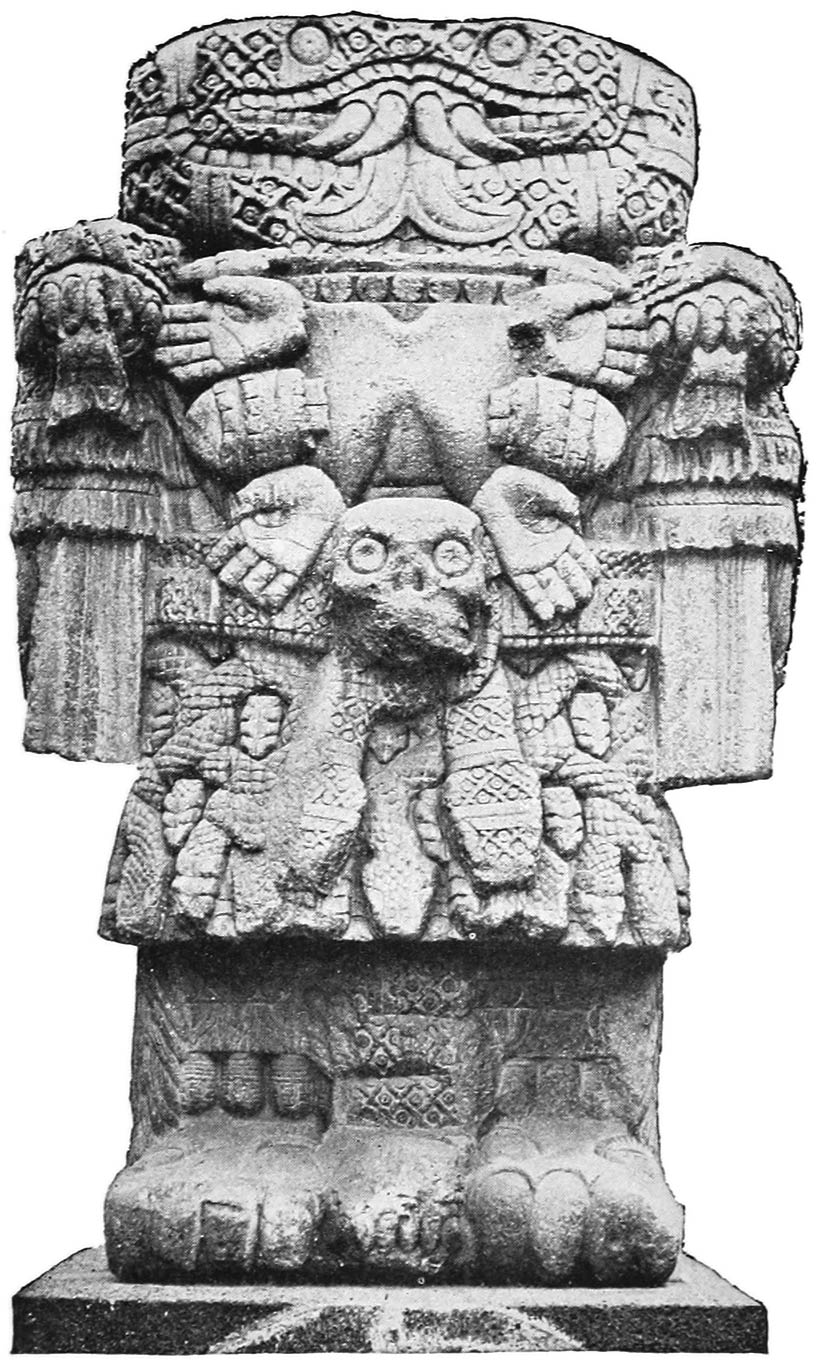
COLOSSAL STATUE OF COATLICUE. (Front.)
(Now in the Museo Naçional, Mexico.)
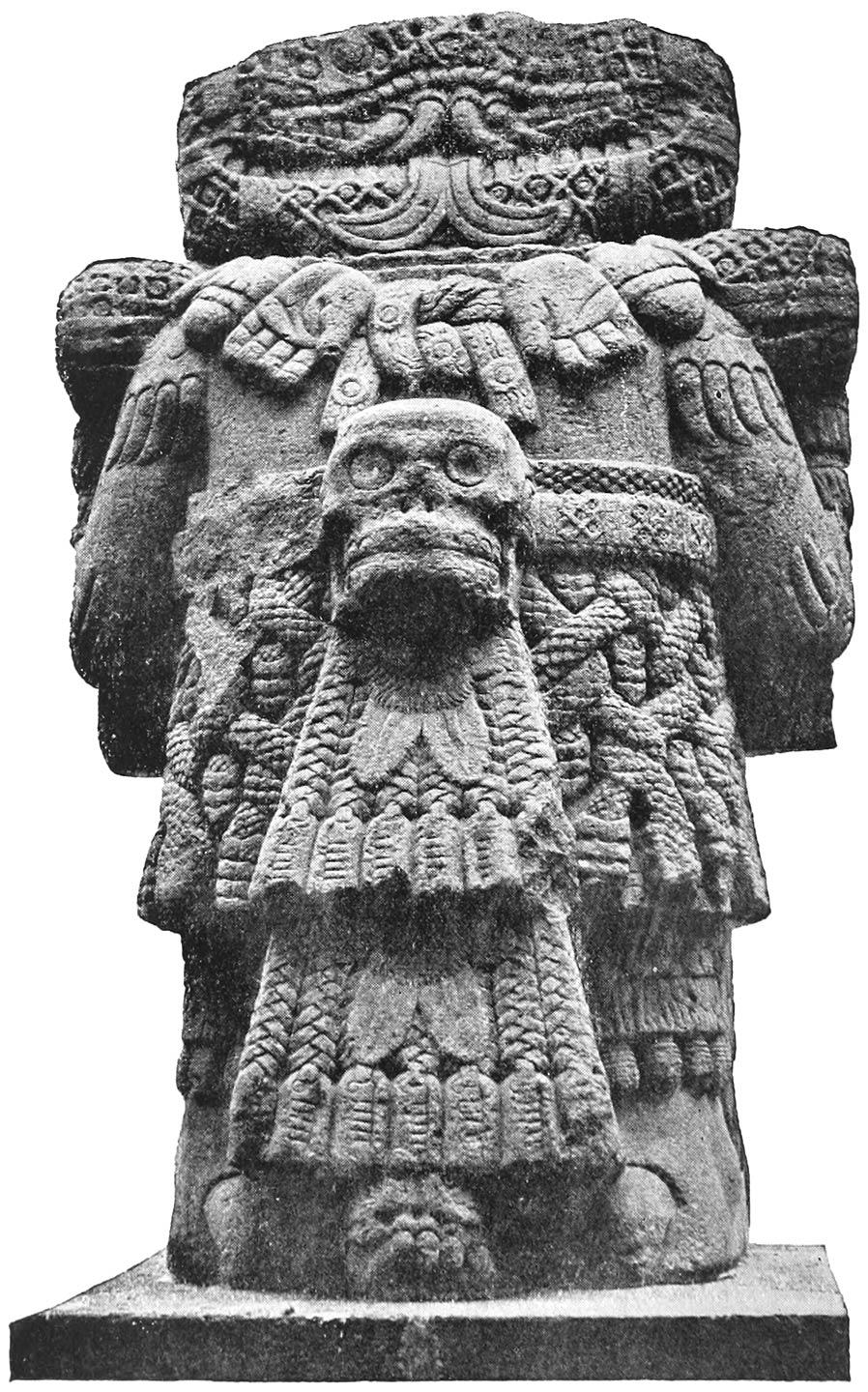
COLOSSAL STATUE OF COATLICUE. (Back.)
The deification of the grain is so universal a phenomenon as to require but little explanation, especially in regard to a country where it formed the staple alimentary supply. It appears to have received divine honours in many districts in Mexico and to have been worshipped under a variety of names, but there was little difference between the characters of these several cults, and the absence of this is well exemplified by the readiness with which they amalgamated and the fusion of their central figures.
EVIDENCE OF PRIMITIVE INFLUENCES
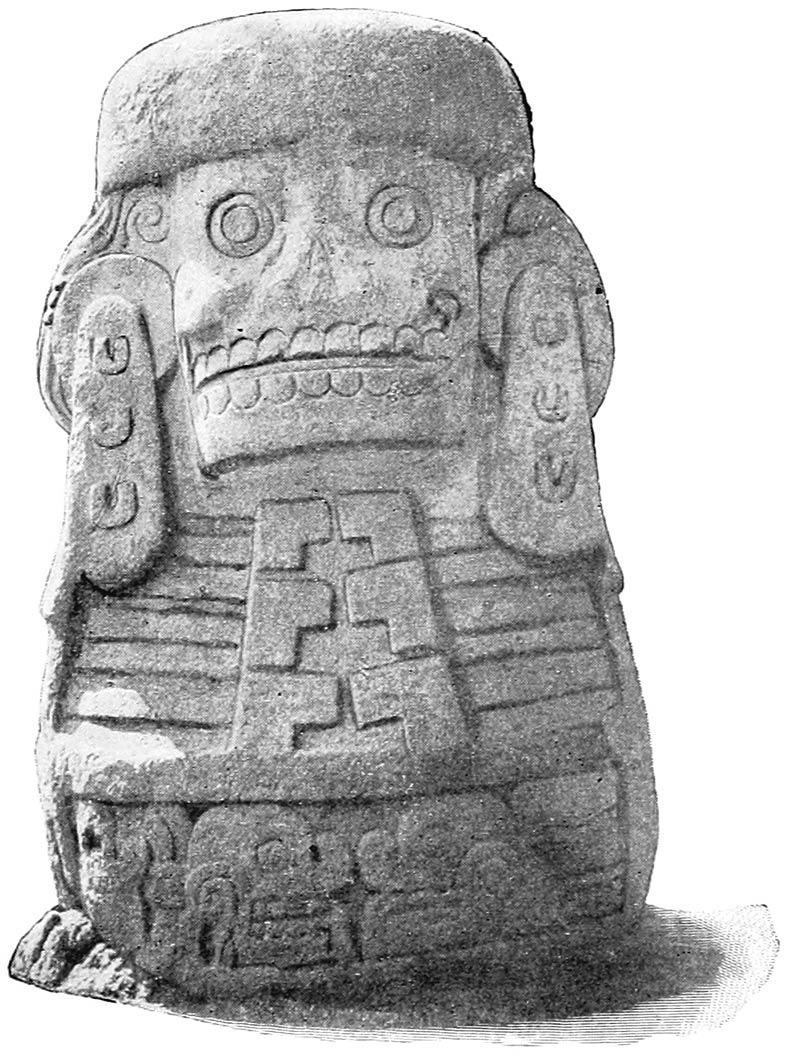
STATUE OF COATLICUE (Front.)
(Found in the Calle del Calisco, Mexico.)
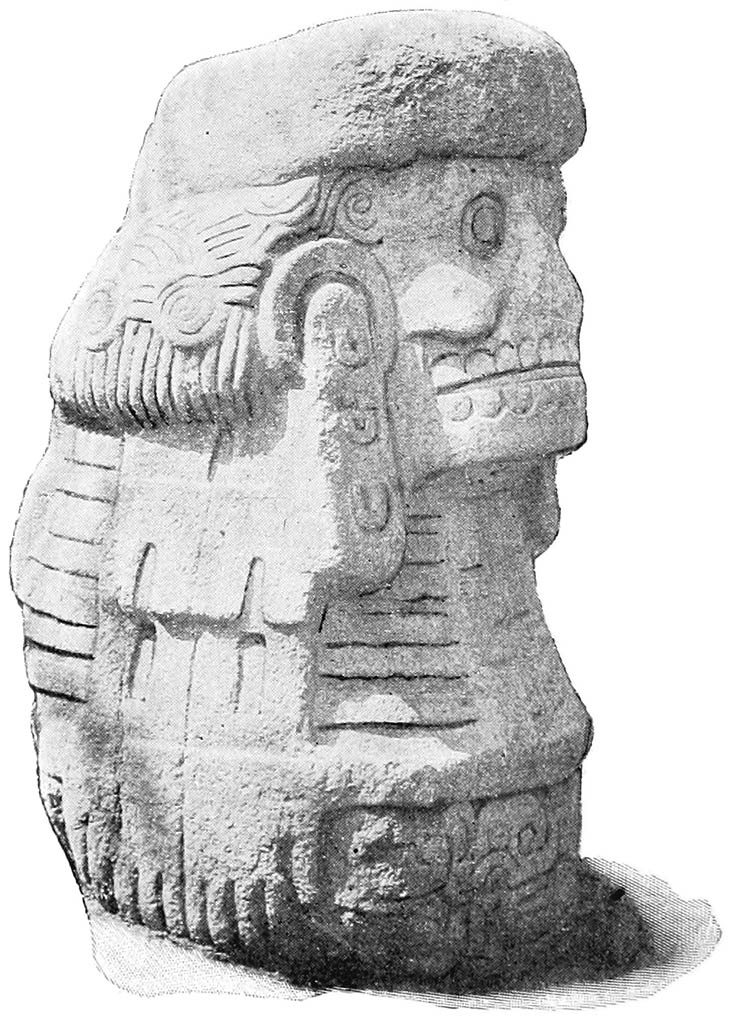
STATUE OF COATLICUE. (Side view.)
“FETISH” ORIGIN OF GODS
More than one of the great gods exhibit the signs of fetishtic origin. Uitzilopochtli, the great tribal patron deity of the Aztecâ of Mexico-Tenochtitlan, was described in tradition as leading them from the mythical northern country of Aztlan in the form of “a little bird.” He is usually represented in the pictorial MSS., where his appearance is infrequent, as wearing a mantle made from humming-birds’ feathers. Later legend spoke of him as the vindicator of his mother, a goddess of vegetation, and as slaying her detractors, his own half-brothers, while in historical times the whole business of war was arranged through the instrumentality of his oracular image and was carried out chiefly in view of the necessity for human sacrifice which characterized his especial cult. But if we examine the roots of the beliefs which cluster around him, we shall find much to convince us that he was, after the entrance of his people into the Valley of Anahuac, identified with the maguey plant, which forms so familiar an object in the Mexican landscape. Extended proof of this lowly origin will be found in the section which deals with the god.
Quite as humble are the beginnings of the god Tezcatlipocâ, perhaps the most universally dreaded among the Mexican deities. Regarding his precise significance nothing very definite has been arrived at by modern authorities. As will be shown later, the early significance of Tezcatlipocâ arises out of his connection with obsidian, which had an especial sanctity for the Mexicans.
ANIMAL GODS
GROWTH OF THE RAIN-CULT
Enough has been said in view of the restricted nature of the evidence, to prove that Mexican religion passed through much the same primitive conditions as other faiths. Further evidence on this point will be adduced as the gods are severally described. We may now proceed to examine such proof as we possess of the onward and upward progress of the cult of rain and growth in Mexico. We may, perhaps, imagine the institution of tribal or village rain or grain fetishes, which in course of time would attain godhead by reason of popularity or supposed auspiciousness. The ministers of these would probably bear a strong resemblance to the medicine-men of North American Indian tribes. Warfare undoubtedly played a great part in the fortunes of these local cults. Thus, did the people of a certain tribal god triumph in feud or battle, his worship would almost certainly be enlarged in a territorial sense. But such a triumph would be a small incentive to further conquest when compared with the absolute necessity for war engendered by the holy law that captives must be obtained for purposes of sacrifice to the tribal deities.
THE NECESSITY FOR HUMAN SACRIFICE
THE LATER ELEMENTS OF MEXICAN RELIGION
CULTURAL ELEMENTS OF MEXICAN RELIGION
THE QUETZALCOATL CULT
The appearance of the Quetzalcoatl cult in Mexico, which would seem to have entered the country at some time about the middle of the eighth century, must have caused very considerable alterations in the simple and probably as yet uninfluenced rain religion which it found in occupancy. From whatever portion of the Isthmian tract it came, one thing regarding it is positively certain—that it introduced into Mexico the rudiments of the calendric computation evolved in Central America. In its phase as imported by the apostles of the Quetzalcoatl religion, it seems fairly certain that the tonalamatl was of the nature of a lunar time-count, and the probabilities are that its protagonists discovered on their arrival in Anahuac that a count similar in character was in use among the priesthood of the Tlaloc worshippers, who as an agricultural people could hardly have been without some such system of computation. The Quetzalcoatl faith, however, was manifestly of a considerably higher status than that which it encountered, as is obvious not only by the numerous and extraordinary traditions regarding the Toltec civilization, but the actual remains it has left. It is clear that, whether it found a calendar or time-count already existing, it placated aboriginal opinion by the amalgamation of the several festivals of the rain-god with its own. The fact that the day-signs of the Mexican calendar or tonalamatl are almost identical with those of the Maya tonalamatl is good proof that the former was developed from the latter; and if only a small proportion of Toltec deities find a place in its monthly festivals, that would seem to be due to the circumstance that later Nahua demands for the inclusion of their tribal deities were acceded to. We may, perhaps, imagine the early tonalamatl of the Quetzalcoatl missionaries to have been similar in form to that of the Maya—that is, it must have been almost wholly concerned with the festivals of deities of a purely agricultural kind.
But the religion of Quetzalcoatl, as observed in his Yucatec form of Kukulkan and his Guatemalan variant of Gucumatz, bore a close resemblance to that of Tlaloc. In Yucatan Quetzalcoatl was regarded by priests and people as the great rain-making priest, the god of moisture, whereas in Mexico he is merely the sweeper of the ways to the Tlaloc deities of rain. This is surely eloquent of the fact that the Tlaloc religion was not only of greater antiquity in Mexico, but that its ministers were disinclined to permit the deity of the new religion to adopt a status similar to that of their own god. With true priestly diplomacy, then, it would seem that they temporized by affording Quetzalcoatl a status as the great rain-making priest, a character which he retained to the last. Myth certainly alludes to Tlaloc as the supplanter of Quetzalcoatl in the affections of the goddess Chalchihuitlicue and as robbing the peaceful culture-hero of the maize-plant which he had discovered. This does not necessarily signify the defeat of an older religion by a more novel faith, but may relate to a successful defence by the more ancient cultus and its absorption of the other.
The theory of the amalgamation of the Tlaloc and Quetzalcoatl cults appears to me to be in some measure assisted by the circumstance that the devotees of both placed a high value upon minerals of a green colour. The word chalchihuitl (“green stone”), of such common occurrence in the works of the Spanish authors who wrote on Mexican affairs, must be taken as applying with equal force to jadeite, nephrite, turquoise, emerald, chlormelanite, green quartz, precious serpentine, or, indeed, any mineral of a green shade. A tradition existed that Quetzalcoatl brought the use and manipulation of jadeite into Mexico, but green was a salient hue in the insignia of Tlaloc, and the name of his consort Chalchihuitlicue (“greenstone skirt”) is eloquent of his connection with the several kinds of stones which the Mexicans grouped under the name chalchihuitl. Whatever significance attached to the colour of these stones, apart from their nature as precious stones, whether or not they were symbolic of water or verdure, or metal, or of all of these agencies, which are regarded as so potent by primitive peoples, it is apparent that both cults employed them symbolically or pseudo-scientifically, and it therefore seems probable that each of these religions was originally connected with the worship of water, and therefore the influence associated with and contained in water, and that this belief would render their amalgamation a process of little difficulty.
THE CULT OF OBSIDIAN
If, then, it be granted that the Chichimec Nahua were acquainted with obsidian and its properties before their entrance upon the Plateau of Anahuac (a hypothesis which is strengthened by the material differences of workmanship between their tools and weapons made of this material and those of the aboriginal peoples of Mexico), sufficient time had elapsed for their development of a cult, which, at the era of the Conquest, exhibited traces of a very considerable antiquity. It was, naturally, as a hunting people that they employed weapons of obsidian. The herds of deer on the flesh of which they chiefly lived roamed the steppes, and proof abounds that the customs of the chase strongly influenced the religious ideas of the early Nahua. Certain of their gods, indeed, seem to have been developed from cervine forms, for among barbarous races the animal worshipped is that which provides the tribe with its staple food, or, more correctly, a great eponymous figure of that animal is adored—for example, the Great Deer, who sends the smaller deer to keep the savage in life. In like manner barbarous fisherfolk are wont to worship the Great Fish, which sends them its progeny or its subjects to serve as food. These deer gods or hunting gods in some way connected with the deer—Itzpapalotl, Itzcuêyê, Mixcoatl, Camaxtli—had also stellar or solar attributes. The deer was slain by the obsidian weapon, which, therefore, came to be regarded as the magical weapon, that by which food was procured. In the course of time it assumed a sacred significance, the hunting gods themselves came to wield it, and it was thought of as coming from the stars or the heavens where the gods dwelt, in precisely the same manner as flint arrowheads were regarded by the peasantry of Europe as “elf-arrows” or “thunder-stones”—that is, as something supernatural, falling from above.
But the obsidian itself became deified as Tezcatlipocâ. I have retained the full proof of this assertion for the section which treats of that god, and must here content myself with a summary of it. The whole cult of obsidian centred in the personality of Tezcatlipocâ. His idol was made of that stone, and in Codex Borbonicus his sandals are painted with the zigzag line of the obsidian snake. In his variant of Itztli (obsidian) he was the god of the sacrificial knife of obsidian, and in certain codices he is represented as having such a knife in place of a foot. From this stone, too, divinatory mirrors were made, one of which was held by the idols of Tezcatlipocâ and served as the mirror or scrying-stone in which he witnessed the doings of mankind. Obsidian, the great life-giver, food-getter, blood-provider, became identified in the form of this god with the cause or breath of life, which, in turn, was identified with the wind, and therefore it came to be classed among those magical stones which in some mysterious manner are considered capable of raising a tempest. In this manner Tezcatlipocâ came to be regarded as a god of wind, and has been identified with the Hurakan of the Quiches of Guatemala, from whose name the expression “hurricane” has been borrowed and who was probably introduced into Central America by the Nahua.
“O, she has become a goddess of the melon cactus,
Our Mother Itzpapalotl, the obsidian butterfly.
Her food is on the Nine Plains,
She was nurtured on the hearts of deer,
Our Mother, the earth-goddess.”
Lest this hypothesis seem overstrained, analogies may be indicated. That which is initially sacred in a primitive cult frequently comes to have interrelations with the whole environment of its deities. Thus the worship of the oak by the Druids appears to have given an oak-like virtue to the oracular birds which dwelt in its branches, to the soil from which it grew, to the sky above it, to the priests who ministered to it and to the sacred implements they employed. The same may be said of the oak-cult of Zeus and the vine-cult of Dionysos. The numerous traditions which cluster round the ceremonial use of jade in China are eloquent of such a tendency. Thus trees, plants, animals, and natural objects are all in a manner identified and connected with the beautiful jade stone in its character as an imparter of vitality. Thus in the great worship of the gods whose cult was connected with obsidian, well-nigh everything with which it had interrelations came to partake of the nature of obsidian—grain, the earth, the atmosphere, the sun, the stars, the priesthood, blood, and rain.
The attribution of higher and abstract qualities to the gods was probably of comparatively late origin. Especially is this to be observed in the case of Tezcatlipocâ, to whom, at the period of the Conquest, we find attributed such a bewildering array of qualities, both concrete and abstract, lofty and the reverse, as would seem to indicate that, had European influences failed to penetrate to Anahuac, his worship might have reached the monotheistic stage, and in time have overshadowed that of the other gods of the Mexican pantheon. Undoubtedly, too, the priesthood, and probably the nobility, fostered a more esoteric and loftier type of religion than was understood of the people, and good proof (which is by no means confined to the rather doubtful circumstance that Nezahualcoyotl of Texcuco built a temple to the “Unknown God”) is forthcoming that theological questions of greater or less complexity had begun to exercise the minds of the hierarchy.
UNITY OF RELIGIOUS CONCEPTION THROUGHOUT MEXICO
Within the historical period but little radical difference existed between the several Mexican cults, which all appear to have been affected by a common influence. We observe, therefore, the phenomenon of certain early religious forms originating under common influences, separated for centuries and profoundly altered by immigrant forces, at length brought together again by the amalgamating powers of conquest under the influence of one central and paramount cult, only, when once more united, to find a common destruction at the hands of the ministers of an alien and invading faith.
Students of religious phenomena not infrequently show distaste for the deeper consideration of the Mexican faith, not only because of the difficulties which beset the fuller study of this interesting phase of human belief in the eternal verities, but also, perhaps, because of the “diabolic” reputation which it has achieved, and the grisly horrors to which it is thought those who examine it must perforce accustom themselves. It is certainly not the most obviously prepossessing of the world’s religions. Yet if a due allowance be made for the earnestness of its priests and people in the strict observance of a system the hereditary burden of which no one man or generation could hope to remove, and the religion of the Aztecâ be viewed in a liberal and tolerant spirit, those who are sufficiently painstaking in their scrutiny of it will in time find themselves richly rewarded. Not only does it abound in valuable evidences for the enrichment of the study of religious science and tradition, but by degrees its astonishing beauty of colour and wealth of symbolic variety will appeal to the student with all the enchantment of discovery. The echoes of the sacred drum of serpent-skin reverberating from the lofty pyramid of Uitzilopochtli, and passing above the mysterious city of Tenochtitlan with all the majesty of Olympic thunder, will seem not less eloquent of the soul of a vanished faith than do the memories of the choral chants of Hellas. And if the recollection of the picturesque but terrible rites of this gifted, imaginative, and not undistinguished people harrows the feelings, does it not arouse in us that fatal consciousness of man’s helplessness before the gods, which primitive religion invariably professes and which reason almost seems to uphold?