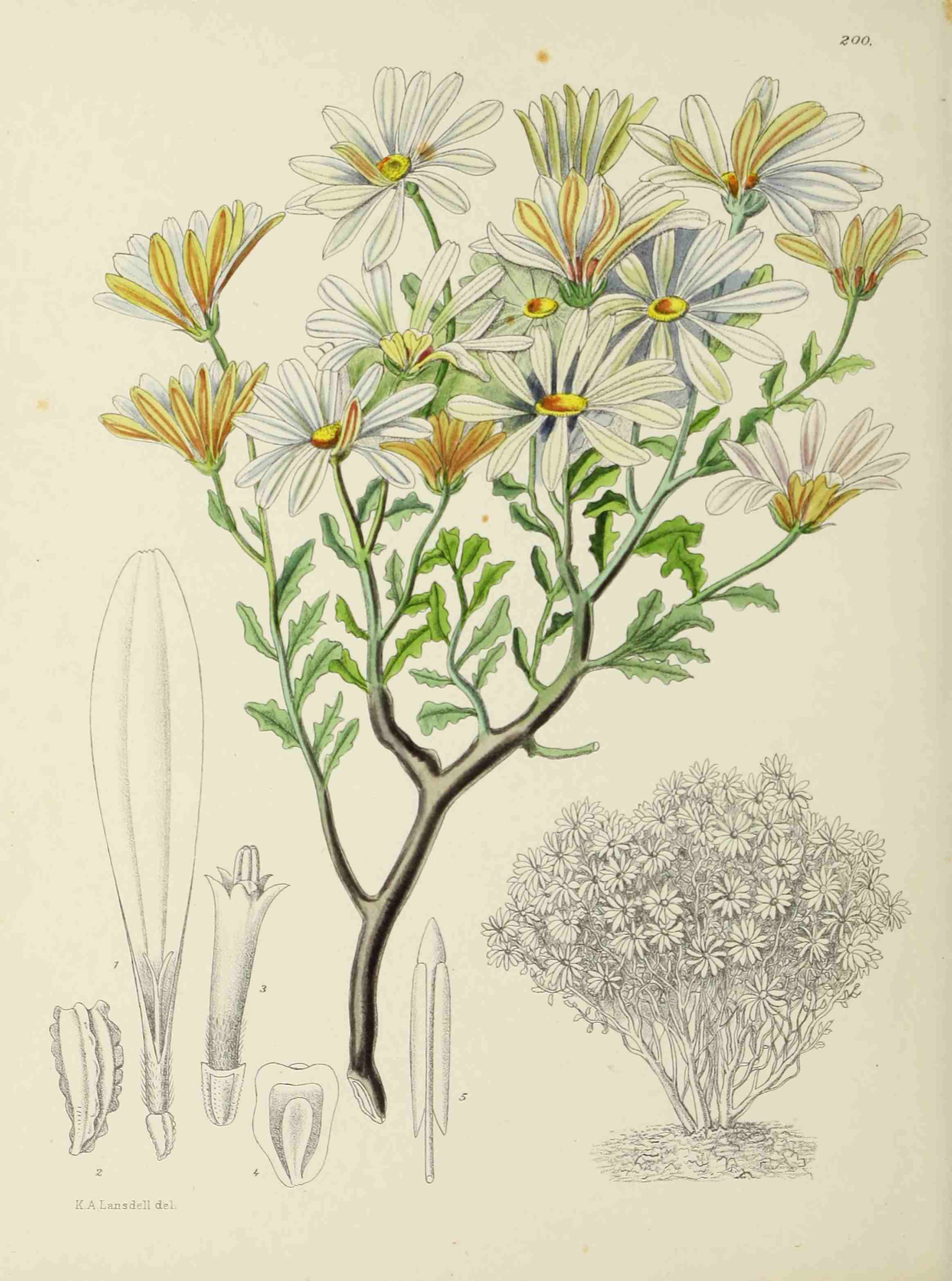
Plate 199.
Reading edition
ERICA BLENNA var. GRANDIFLORA. Cape Province. Ericaceae. Tribe Ericeae. Erica, Linn.; Benth. et Hook. f. Gen. Plant. vol. ii. p. 590.
Erica blenna, Salisb. var. grandiflora, Bolus. Fl. Cap. vol. iv. sect. i. p. 202.
Through the courtesy of Dr. J. Muir of Riversdale we are able to figure for the first time a species of heath, and perhaps one of the most beautiful of all the Cape heaths. The variety grandiflora is only found as far as we know in the Riversdale and Bredasdorp Districts and is by no means a common plant. It is known locally as the “lantern” or “Riversdale” heath. The species itself, like so many of the South African species of Erica, was first collected by Masson about the year 1772, and was successfully cultivated in Europe and figured on more than one occasion in early botanical literature.
Description:—Erect, 0·3 to 0·5 m. high. Branches stout, ascending, virgate or flexuous, puberulous or glabrous. Leaves 3-nate, mostly erect and imbricate or subspreading, linear, subobtuse, flat above, keeled and sulcate beneath, glabrous, 8 to 10 mm. long. Flowers usually solitary, rarely in pairs (“here and there sublateral,” Bentham). Pedicels about 8 mm. long; bracts remote, lanceolate, about 6 mm. long; sepals ovate, acuminate, keel-tipped, thickish, subscarious, viscid, coloured or greenish, about 5 mm. long. Corolla conical-ovoid or suburceolate-conical, much contracted to the mouth but only slightly constricted at the throat, very viscid, 1·6 to 2 cm. long, bright orange-red, the limb and some distance below it green; segments spreading or erect, about one-eighth the length of the tube; filaments broad at the base tapering upwards, bent below the anther; anthers included, dorsifixed well above the base, cuneate, subacute, scaberulous, ciliolate, about 3 mm. long, crested; pore three-fifths to two-thirds the length of the cell; crests quite free from the filament, subsemiorbicular in outline, deeply inciso-lacerate, about half the length of the cell; style included, straight; stigma capitellate; ovary glabrous. (National Herb., Pretoria, No. 2991.)
Plate 199.—Fig. 1, pedicel showing bracts; Fig. 2, androecium and gynaecium; Fig. 3, single stamen; Fig. 4, pistil; Fig. 5, anther enlarged.
F.P.S.A., 1925.