Plate 181.
Reading edition
STAPELIA GIGANTEA var. PALLIDA. Transvaal (?). Asclepiadaceae. Tribe Stapelieae. Stapelia, Linn.; Benth. et Hook. f. Gen. Plant. vol. ii. p. 784.
Stapelia gigantea, N.E. Br. var. Pallida, Phillips var. nov., a typo corolla depressiore differt.
The Stapelia figured on the accompanying Plate is very near S. gigantea, N.E. Br., from which it differs, however, in having the disc portion of the corolla more depressed and being much lighter in colour. It appears to be an intermediate form between this species and S. nobilis, N.E. Br., differing from the latter species in not having such a cup-shaped corolla-disc and not having the lobes of the outer corona 3-toothed. The locality in which the plant is found is not known, and the specimen from which our Plate was prepared was kindly presented by Dr. A. J. T. Janse, who grew it in his rockery.
Description:—Stems robust, bright green, finely pubescent, prominently ridged, with each ridge ending in a tooth-like leaf. Flowers solitary. Pedicel 5 cm. long, terete, finely pubescent. Sepals 1·1 cm. long, lanceolate, acute, pubescent. Corolla 25 cm. in diameter when expanded; lobes 10 cm. long, 3 cm. broad at the base, ovate, long-attenuate, pubescent without, transversely rugose and with fine purple hairs on the inner face; disc shallowly depressed, covered with long soft purple hairs. Outer corona-lobes oblong; inner corona-lobes deeply cleft, with the outer lobes plate-like and the inner lobes linear. (National Herb., Pretoria, No. 2891.)
PLATE 181.—Fig. 1, side view of flower; Fig. 2, corona; Fig. 3, cross-section through stem.
F.P.S.A., 1925.
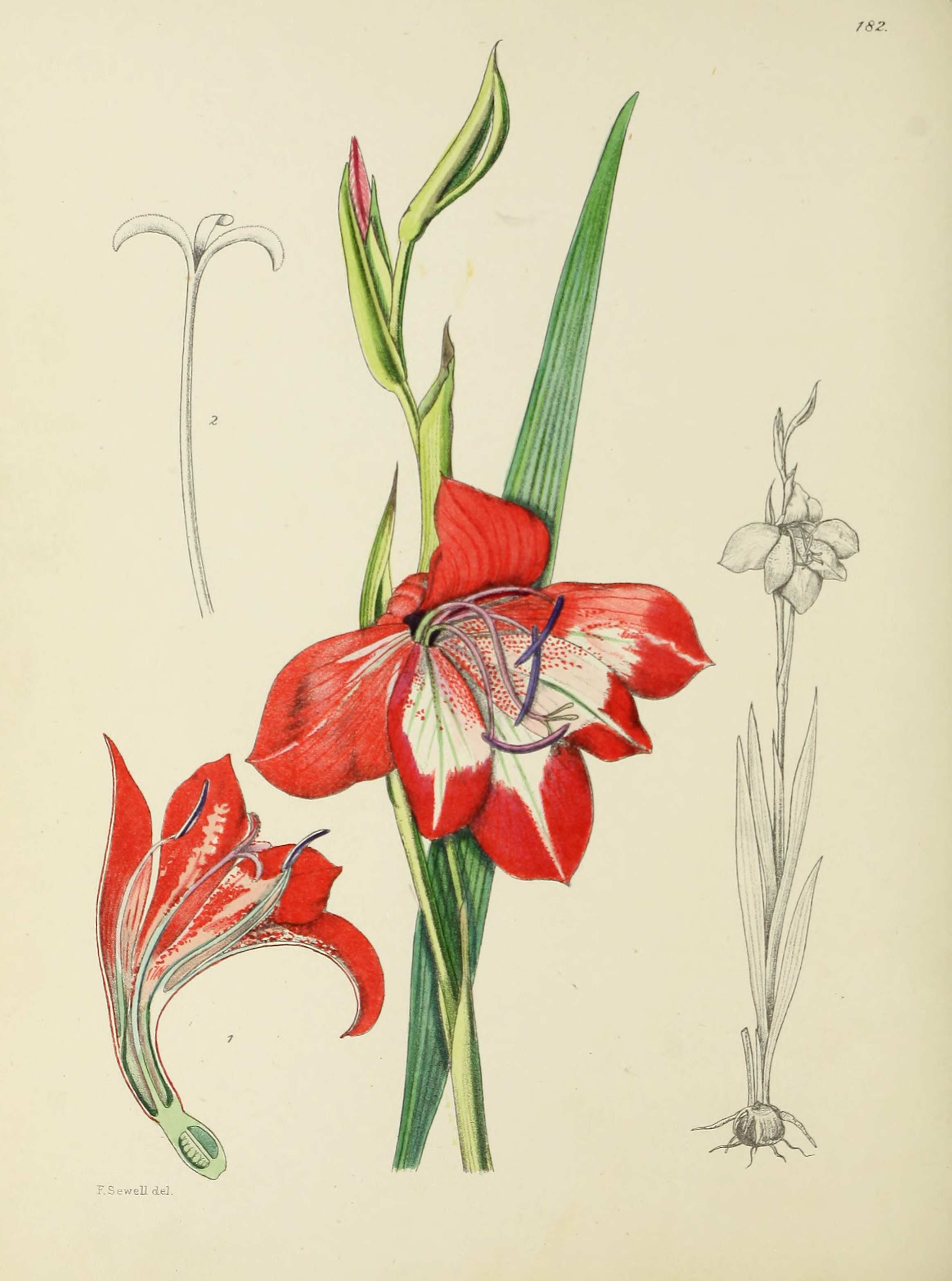
Plate 182.
GLADIOLUS CRUENTUS. Natal, Basutoland. Iridaceae. Tribe Ixieae. Gladiolus, Linn.; Benth. et Hook. f. Gen. Plant. vol. iii. p. 709.
Gladiolus cruentus, Moore in Gard. Chron. 1868, 1138; Bot. Mag. t. 5810; Fl. Cap. vol. vi. p. 157.
This is the first opportunity we have had of figuring a species of Gladiolus belonging to the section Cardinales. As far as our records go the species appears to be little known to botanical science. In 1868 a Mr. Bull flowered it in his nursery at Chelsea, and it was from specimens supplied by Mr. Bull that the Plate in the Botanical Magazine was prepared. We are indebted to Mr. L. F. Wacher, who sent us specimens from Basutoland in 1923, for information about this beautiful plant. Mr. Wacher states that the plant grows in many places in the mountain area of Basutoland, and it is probable that the species is confined to the high mountain regions of Natal and Basutoland. While we have no definite information as to the precise habitat, there appears to be little doubt that it favours similar localities to G. cardinalis of the Cape Province, which is usually found growing near waterfalls.
Description:—Corm 3·5 cm. in diameter, with thick cylindric roots. Leaves about four, 16 to 30 cm. long, 1·5 to 2·5 cm. broad, ensiform, glabrous. Spike few-flowered. Spathe-valves large, lanceolate; the lower from 7 to 15 cm. long. Perianth-tube funnel-shaped, curved; upper segments 5 to 6·5 cm. long, obovate-spathulate; lower segments about 4 cm. long, with a white blotch at the throat covered with red spots. Style-branches papillose on the margins.
Plate 182.—Fig. 1, median longitudinal section of flower; Fig. 2, style showing the style-branches.
F.P.S.A., 1925.