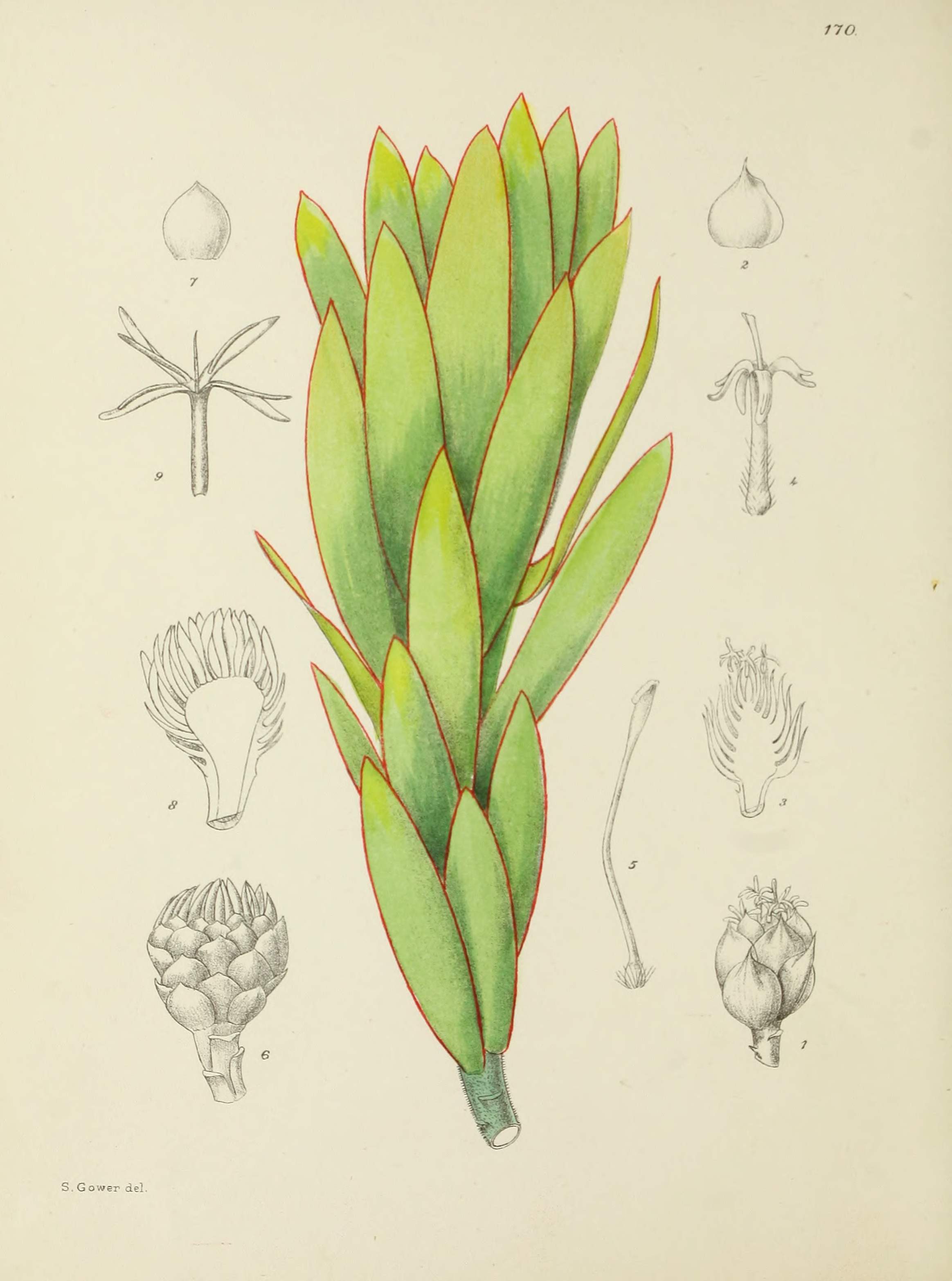
Plate 169.
Reading edition
ALOE ferox. Cape Province, Natal, Transvaal. Liliaceae. Tribe Aloineae. Aloe, Linn.; Benth. et Hook. f. Gen. Plant. vol. iii. p. 776.
Aloe ferox, Miller, Gard. Dict. ed. viii. No. 22; Fl. Cap. vol. vi. p. 326.
This species of Aloe is unique among the South African representatives of the genus as being of some economic importance. The thick juice of the leaves yields the commercial product “aloes.” The method of preparing “aloes” is as follows: A hole is scooped in the ground and lined with a skin, and the cut ends of the leaves are placed on the skin so that the juice exudes and collects. The thick juice is then heated, and on cooling the “aloes” crystallise out.
Aloe ferox is very common in parts of the south-eastern Cape Province and in the midlands of Natal, and the plants form a very characteristic feature in the landscape. Plants may reach a height of 8 to 12 feet, and the simple stem is crowned with a dense rosette of leaves, while the lower portion of the stem is covered with the remains of the leaves.
Our plate was prepared from a specimen flowering at the Division of Botany, Pretoria.
Description:—Stem simple. Leaves many in a dense terminal rosette, varying from 0·5 to 1 m. long, 10 to 15 cm. broad below and gradually narrowing above, convex on the lower surface, concave on the upper surface, prickly on the edges; prickles stout, slightly recurved. Inflorescence a terminal branched raceme. Racemes up to 0·6 m. long, very dense. Bracts ovate, cuspidate. Perianth-segments 1·3 cm. long, 8 mm. broad, oblong, cucullate at the apex. Filaments linear; anthers not much broader than the filaments. Style cylindric, stigma simple.
Plate 169.—Fig. 1, leaf (× 1/8); Fig. 2, margin of leaf showing prickles; Fig. 3, cross-section of leaf; Fig. 4, bract; Fig. 5, flower bud; Fig. 6, mature flower; Fig. 7, perianth-segments; Fig. 8, portion of inner and outer perianth-segments; Fig. 9, stamens, front and back view.
F.P.S.A., 1925.