Plate 167.
Reading edition
CRASSULA rosularis. Cape Province, Natal. Crassulaceae. Crassula, Linn.; Benth. et Hook. f. Gen. Plant. vol. i. p. 657.
Crassula rosularis, Harv.; Fl. Cap. vol. ii. p. 350.
Crassula rosularis belongs to the section Rosulares, which is characterised by having rosulate flat radical leaves and a scape-like flowering stem. Unlike so many species of Crassula, it is a shade-loving plant.
The plant from which our illustration was made was found growing under Aloes near Greytown in Natal, whence it extends southwards to Uitenhage. It is a dainty little plant, and would thrive on a shaded rockery if supplied with humus and a fair amount of moisture. In its choice of habitat it resembles very much C. flabellifolia, C. Saxifraga and C. Septas.
We are indebted to Lady Leuchars for the specimens.
Description:—An acaulescent plant. Leaves rosulate, radical; lower leaves spathulate-oblong, about 5 cm. long; the upper leaves becoming gradually smaller and broadly ovate; all with cartilaginous-ciliated margins. Peduncle scape-like, glabrous. Flowers in peduncled cymes, arranged in a panicle on a common peduncle. Pedicels about 2 mm. long. Calyx half as long as the corolla; lobes lanceolate-oblong, ciliate. Petals obovate-oblong, with a dorsal apiculus just below the apex. Stamens 5, almost as long as the petals and alternating with them. Glands of 5 scales opposite the carpels. Carpels 5; styles short; stigmas capitate. (National Herb. Pretoria, No. 2859.)
Plate 167.—Fig. 1, median longitudinal section of flower; Fig. 2, carpels; Fig. 3, stamens.
F.P.S.A., 1925.
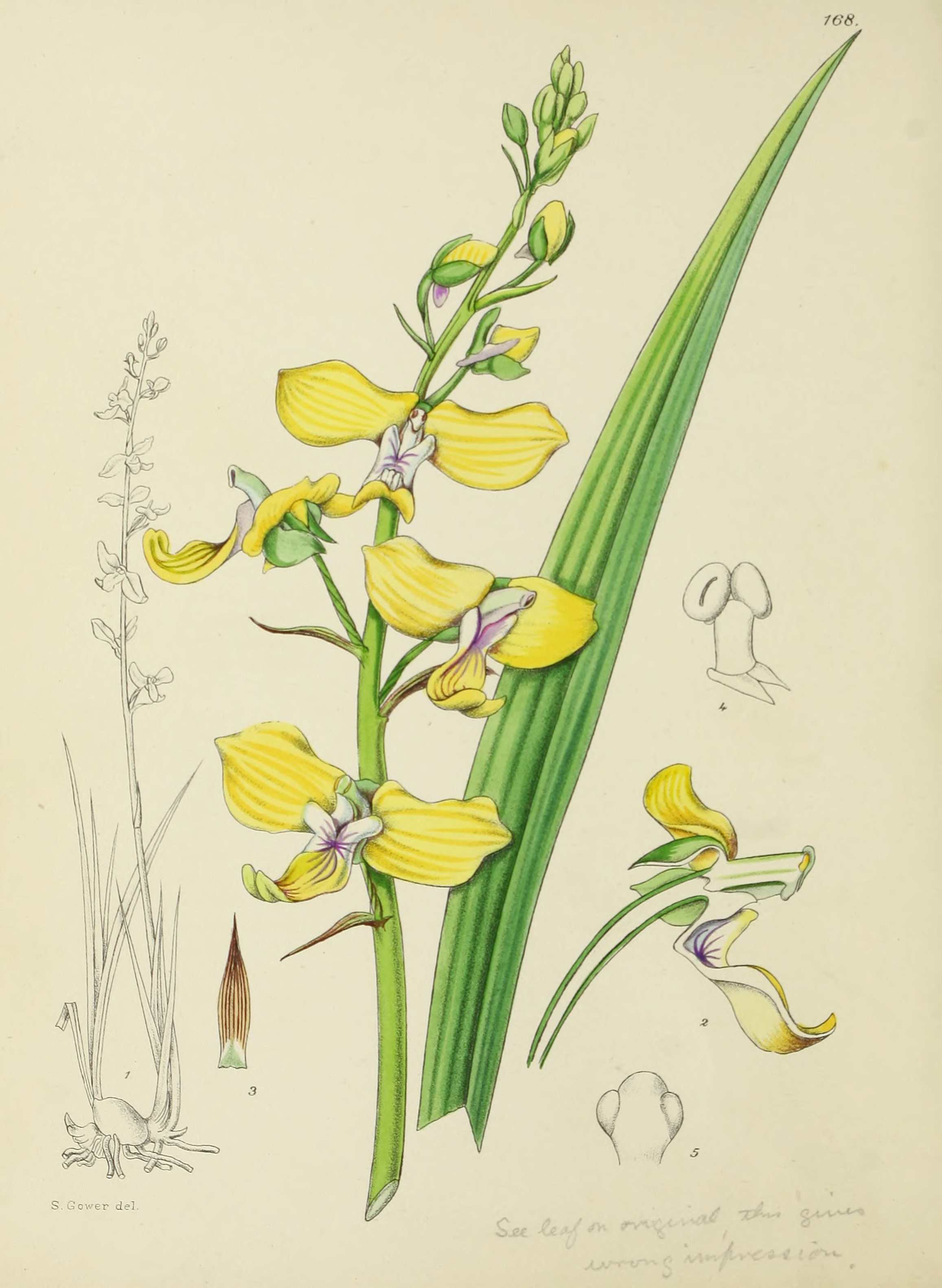
Plate 168.
LISSOCHILUS speciosus. Cape Province, Natal, Transvaal. Orchidaceae. Tribe Vandeae. Lissochilus, R. Br.; Benth. et Hook. f. Gen. Plant. vol. iii. p. 536.
Lissochilus speciosus, R. Br. ex Lindl. Coll. Bot. t. 31; Fl. Cap. vol. v. sect. iii. p. 59.
Lissochilus speciosus is one of the more common species of the genus and has a wide range of distribution. It is found in the Uitenhage Division, and then follows the coastal belt northwards, through the Transkei into Natal, and up to the northern spurs of the Drakensbergen in the Transvaal. The species has also been recorded from Mazoe in Rhodesia. Robert Brown’s genus Lissochilus, which he founded in 1821, was based on this species. But the late Dr. H. Bolus placed it in the genus Eulophia, and redescribed the plant as Eulophia speciosa in 1890, and figured it under the same name in 1911 (Orchids of South Africa, vol. ii. t. 13).
The specimen from which our plate was made was found by Misses H. Forbes and S. Gower at Isipingo, Natal, and grown at the Division of Botany, Pretoria. It is common all along the slopes of the sandhills of the Southern Natal coast.
Description:—Pseudobulbs ovoid, 5 cm. or more long, with a few ovate sheaths, 3-to 5-leaved; leaves elongate, linear, acute, somewhat fleshy, without prominent veins, conduplicate below, not articulated above the base, 15 to 30 cm. or more long, 2 to 2·5 cm. or more broad; scapes erect, stout, up to nearly 1 m. long, with several spathaceous sheaths; racemes long, somewhat lax, many flowered, flowers medium-sized, bracts ovate-oblong to ovate-lanceolate, acuminate, 2 to 2·5 cm. long; pedicels 2 to 2·5 cm. long; sepals ovate to ovate-oblong, subacute or acute, reflexed, green, about 1 cm. long; petals spreading, broadly ovate or ovate-suborbicular, subobtuse, about 2 cm. long, bright yellow; lip 3-lobed, nearly as long as the petals; side-lobes suberect, short and transversely oblong, white with a few reddish lines; front lobe broadly elliptic, obtuse, reflexed at the sides, yellow with a few reddish lines at the base; disc convex, with 3 obtuse keels; spur very short, broadly conical, obtuse, column oblong, 6 mm. long (Flora Capensis).
Plate 168.—Fig. 1, plant much reduced: Fig. 2, median longitudinal section of flower; Fig. 3, bract; Fig. 4, anthers; Fig. 5, back view of anthers.
F.P.S.A., 1925.