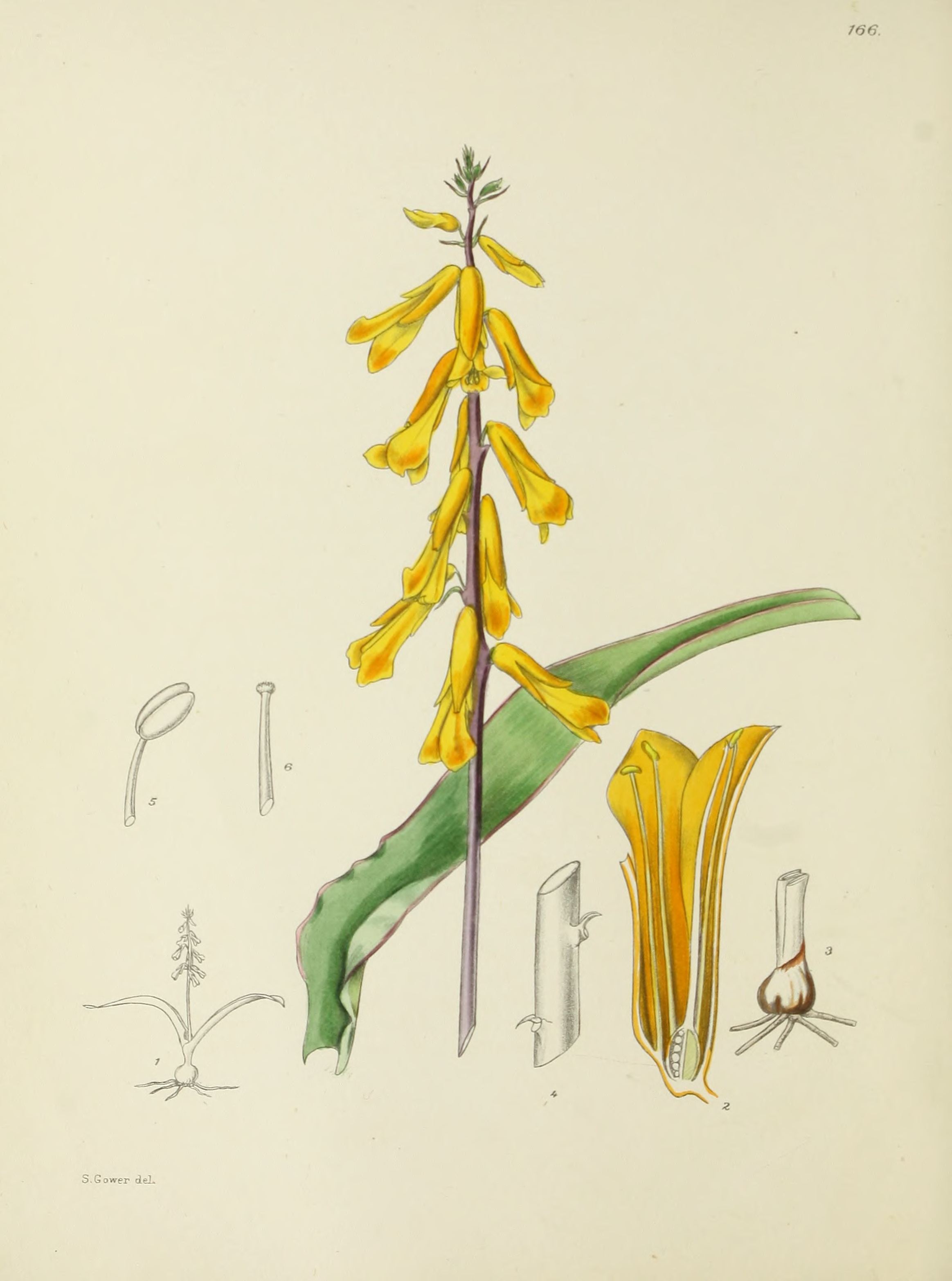
Plate 165.
Reading edition
GLADIOLUS orchidiflorus. Cape Province. Iridaceae. Tribe Ixieae. Gladiolus, Linn.; Benth. et Hook. f. Gen. Plant. vol. iii. p. 709.
Gladiolus orchidiflorus Andr. Bot. Rep. t. 241; Fl. Cap. vol. vi. p. 160.
In the Botanical Magazine for the year 1803 (Plate 688) appeared an excellent figure of this species under the name Gladiolus viperatus, which was given owing to a fanciful resemblance to “the head and appearance of the jaws of the snake when raising itself for defence against its enemy and hissing.” Prior to the figure above quoted Jacquin illustrated the same species (1781-1786).
Like most species of Gladiolus, it lends itself to cultivation and is easily grown in pots.
A comparison of this plate of G. orchidiflorus and Plate 63 (G. alatus var. namaquensis) should be made with other plates of Gladiolus figured. The two species belong to the section Hebea, all the members of which may be easily recognised by the long claws to the perianth-segments.
The plants from which our illustration was made were grown by Dr. I. B. Pole Evans, C.M.G., at Irene, near Pretoria, from corms sent by Mrs. E. Rood of van Rhynsdorp.
Description:—Corm 2·5 cm. diameter, depressed-globose, covered with fibrous tunics. Produced leaves 4; lowest leaf with a lanceolate-linear blade, 6·5 cm. long, 8 mm. broad, prominently 2-ribbed; upper leaves up to 30 cm. long, 5 to 8 mm. broad, linear, acuminate, acute, with 2 of the ribs more prominent than the others, glabrous. Inflorescence about half as long as the leaves, laxly few-flowered. Perianth very unequal; the uppermost segment long-clawed and with an oblong obtuse blade membranous on the margins, arched over the flower and the style and stamens; side segments broadly ovate, clawed, and produced into an acuminate point; lower segments more or less forming a lip, spathulate, long-clawed, obtuse. Stamens arched under the uppermost segment and completely hidden by it. Style arched under the uppermost segment, projecting beyond its apex; lobes spathulate, papillose round the edges. (National Herb. Pretoria, No. 2858.)
Plate 165.—Fig. 1, plant much reduced; Fig. 2, median longitudinal section of flower; Fig. 3, corm; Fig. 4, spathe-valve; Fig. 5, stamen; Fig. 6, top of style showing the 3 stigmas; Fig. 7, fruit.
F.P.S.A., 1925.