Plate 162.
Reading edition
SYNNOTIA bicolor. Cape Province. Iridaceae. Tribe Ixieae. Synnotia, Sweet; Benth. et Hook. f. Gen. Plant. vol. iii. p. 709.
Synnotia bicolor, Sweet, Hort. Brit. ed. 2, p. 501; Fl. Cap. vol. vi. p. 134.
This species was introduced into the Royal Botanic Garden at Kew by George Masson in 1786, and was described as a Gladiolus, and later in the Botanical Magazine (t. 548) as a species of Ixia. From the former genus it is readily distinguished by the membranous lacerated spathe-valves and from the latter by the unilateral stamens.
The plant is rather stiff, but the individual flowers are quite charming. As will be seen from the illustration, the flowers resemble in general shape those of Gladiolus orchidi-florus shown at Plate 165 of this work.
Our specimen was prepared from plants grown by Dr. I. B. Pole Evans, C.M.G., from corms forwarded by Mrs. E. Rood of van Rhynsdorp.
Description:—Corm ellipsoid, 3 cm. long, 1·5 cm. in diameter, covered with fine reticulated sheaths. Leaves 7 in a basal distichous rosette, 8 to 11 cm. long, 0·7 to 1·4 cm. broad, linear-oblong, very acute, with 1 more or less evident mid-rib, but many-veined when viewed in transmitted light. Peduncle about 12 cm. long, flexuose, bearing about 6 distant flowers. Outer spathe-valves 1 cm. long, deeply 3-partite, inner 2-partite. Perianth distinctly 2-lipped; tube 1·5 cm. long, widening upwards; posterior segment 2·5 cm. long, erect, clawed, with an ovate obtuse limb; side-segments 1·7 cm. long, 6 mm. broad, more or less oblong, obtuse, spreading-reflexed; 3 anterior segments more or less horizontal and forming a distinct lip. Style as long as the stamens, divided into 3 lobes dilated at the apex. (National Herb. Pretoria, No. 2860.)
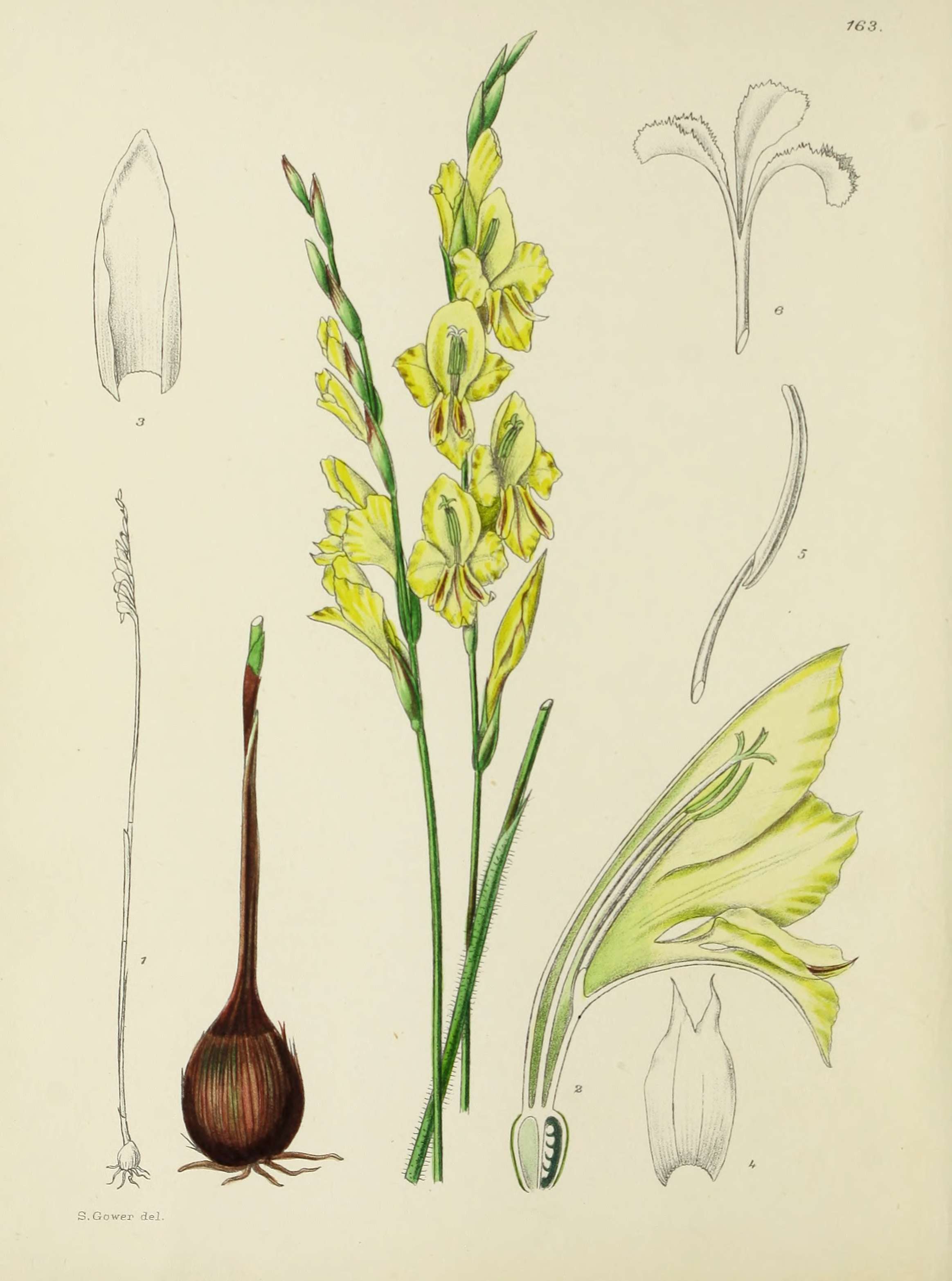
Plate 162.—Fig. 1, median longitudinal section of flower; Fig. 2, spathe-valve; Fig. 3, stamen; Fig. 4, style showing stigmas; Fig. 5, fruit.
F.P.S.A., 1925.