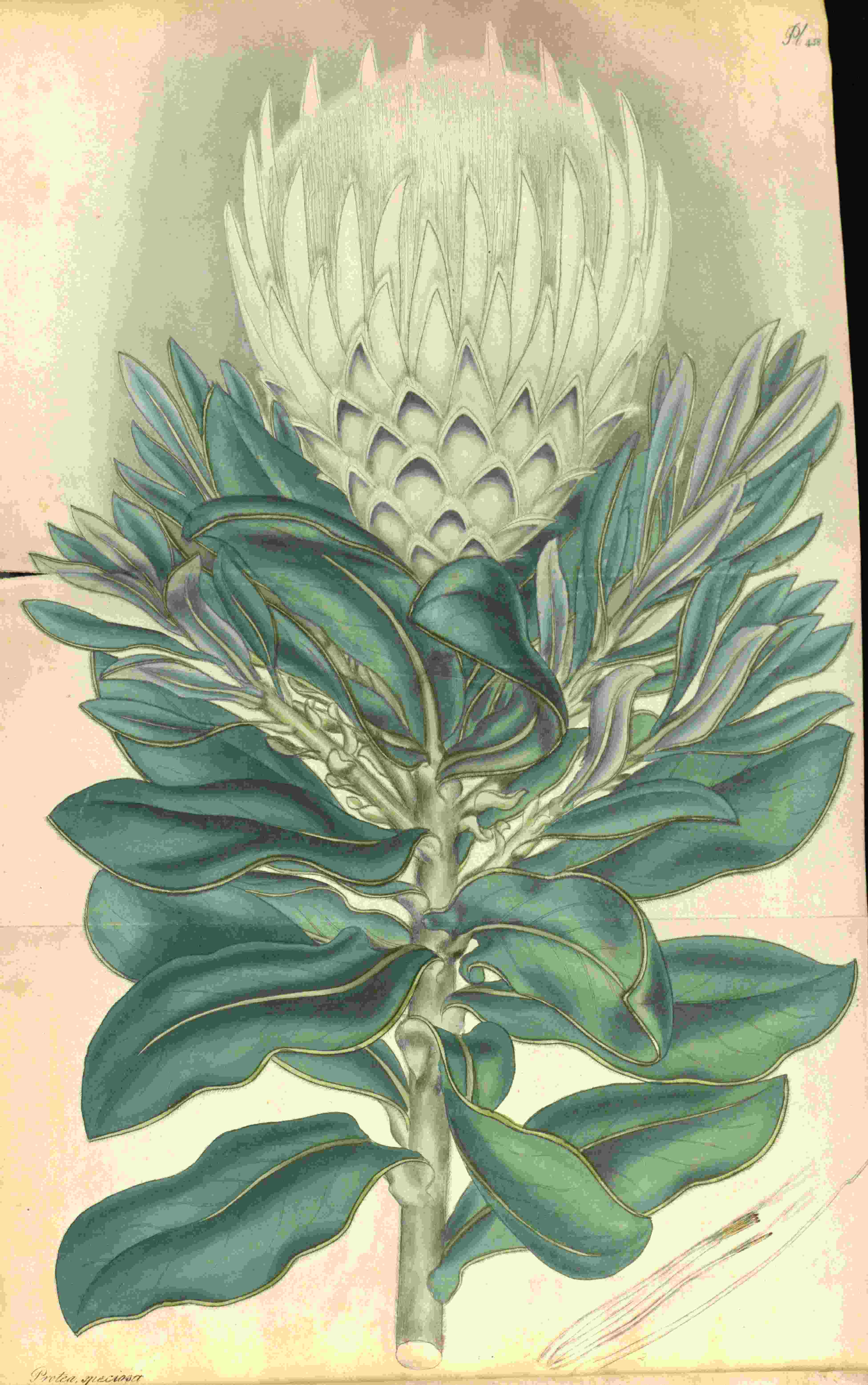
Volume 7 — PLATE CCCCXXXVIII.
Reading edition
PROTEA SPECIOSA.
Showy Protea.
CLASS IV. ORDER I.
TETRANDRIA MONOGYNIA. Four Chives. One Pointal.
ESSENTIAL GENERIC CHARACTER.
Corolla 4-fida, seu 4 petala. Antheræ lineares, petalis infra apices insertæ. Calyx proprius, nullus. Sem. solitaria.
Blossom four-cleft, or of four petals. Tips linear, inserted into the petals below the points. Cup proper, none. Seeds solitary.
SPECIFIC CHARACTER.
Protea, foliis lanceolatis, obliquis, pilosis, undulatis: squamis calycinis superioribus, lanceolatis, barbatis, luteo-albis; squamis infra lato-ovatis, tomentosis, barbatis, apice discoloratis: caulis erectus, tripedalis.
Protea, with leaves lance-shaped, oblique, hairy, and waved: the upper scales of the empalement are lance-shaped, bearded, and of a yellowish white: the scales beneath are broadly ovate, downy, bearded, and discoloured towards the ends. Stem erect, and three feet high.
REFERENCE TO THE PLATE.
1. A blossom, the petals spread to show the situation of the chives. 2. The seed-bud and pointal.
This fine large Protea we believe is not at present in any other collection in Europe, but that of G. Hibbert, esq. It is enumerated in the Hortus Kewensis under the name of Protea speciosa, but the plant itself has been long lost to those gardens. Thunberg, in his dissertation on Protea, describes our plant exactly, under the appellation of speciosa: and, that no doubt might remain with respect to the specific adopted, our figure has been compared with a remarkable fine specimen in the herbarium of A. B. Lambert, esq., sent by Dr. Roxburgh from the Cape of Good Hope under the title of “Protea speciosa of Hottentot Island.” It is undoubtedly one of the grandest of this fine section of Protea; for as a section of this numerous family it will always be better understood than it can possibly be as a discriminative specific. This extended tribe will, we think, admit of at least four or five partitions, but not Generic divisions, for we can by no means agree with those who think every slight variation of sufficient consequence to form new genera; and in this genus think it more objectionable than in any other. The title of Protea being derived from the God Proteus of ever-varying form, the more removed this tribe of plants are in their externa facie from each other, so much the better do they support their mythologic title.