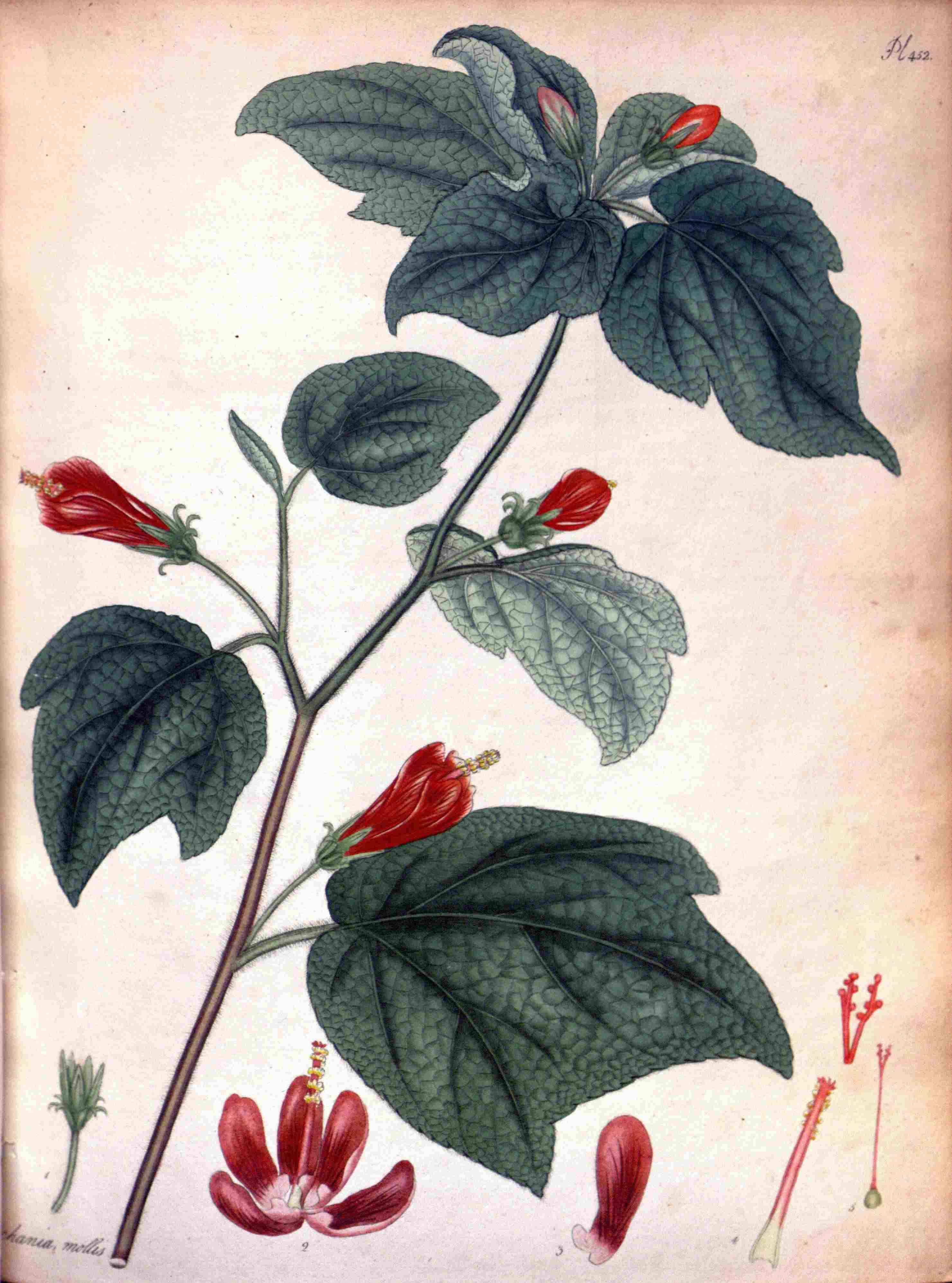
Volume 7 — PLATE CCCCLII.
Reading edition
ACHANIA MOLLIS.
Soft-haired-leaved Achania.
CLASS XVI. ORDER VI.
MONADELPHIA POLYANDRIA. Threads united. Many Chives.
GENERIC CHARACTER.
Calyx duplex. Interior monophyllus, semi-striatus, sub-cylindraceus, quinquefidus, persistens. Exterior octophyllus, basi leviter coalitus.
Corolla sub-clavata, convoluta. Petala quinque, basi uno latere alternatim auriculata, lobis columnam staminum convolventibus.
Stamina. Filamenta plurima, ad basin in tubum corolla longiorem torta, in partem superiorem tubi coalita, cujus apex liberatus est.
Pistillum. Germen sub-globosum. Stylus filiformis. Stigma decemfidum.
Pericarpium. Bacca sub-globosa, quinque-locularis.
Semina solitaria.
Empalement double. The inner one-leafed, half-striped, nearly cylindrical, five-cleft, and remaining. The outer eight-leaved, and slightly attached at the base.
Blossom nearly club-shaped, and folded together. Petals five, alternately eared on one side of the base, the lobes of which are rolled round the columnar shaft of the stamens.
Chives. Threads numerous, united at the base into a tube longer than the blossom, twisted, and united near the upper part of the tube, the point of which is liberated.
Pointal. Seed-bud nearly round. Shaft thread-shaped. Summit ten-cleft.
Seed-vessel. A berry nearly round, with five cells.
Seeds solitary.
SPECIFIC CHARACTER.
Achania foliis tomentosis, cordatis, trilobatis, dentatis. Calyx exterior revolutus, pubescens. Flores solitarii, axillares. Corolla sub-clavata. Petala convoluta, sub-inclusa, læte coccinea, nervosa, tomentosa. Caulis fruticosus, villosus, sub-tripedalis.
Achania with downy leaves, heart-shaped, three-lobed, and toothed. The outer cup is revolute, and hairy. Flowers grow solitary from the axillæ of the leaves. Blossom nearly club-shaped. The petals are folded together and nearly closed, of a bright scarlet colour, nerved, and downy. Stem shrubby, hairy, and near three feet high.
REFERENCE TO THE PLATE.
1. The empalement. 2. A blossom spread open. 3. A petal detached, shown from the outside. 4. The chives spread open. 5. Seed-bud and pointal, summit magnified.
This handsome hot-house plant is certainly an old one, having been a sojourner with us near thirty years, but has not as yet been figured in any publication that we know of:—a neglect most probably resulting from the singularity of its unclosing flowers; so uncommon a character naturally conveying an idea that the plant was in an imperfect state. Under this prejudice it has lost the charm of novelty, and many a less attractive object has been preferred before it. This genus approaches so close to the genera of Hibiscus, Althea, Malva, &c. that it must certainly be considered as a very near relation to that family. Its foliage is frequently deciduous on the lower part of the stem; a defect to which stove plants in general are but too subject. It is a native of South America and the West India Islands, was found by Dr. Houston in Jamaica in 1731, and introduced by B. Bewick, esq. in 1780. It flowers from July till the end of the year.