Volume 7 — PLATE CCCCLXXV.
Reading edition
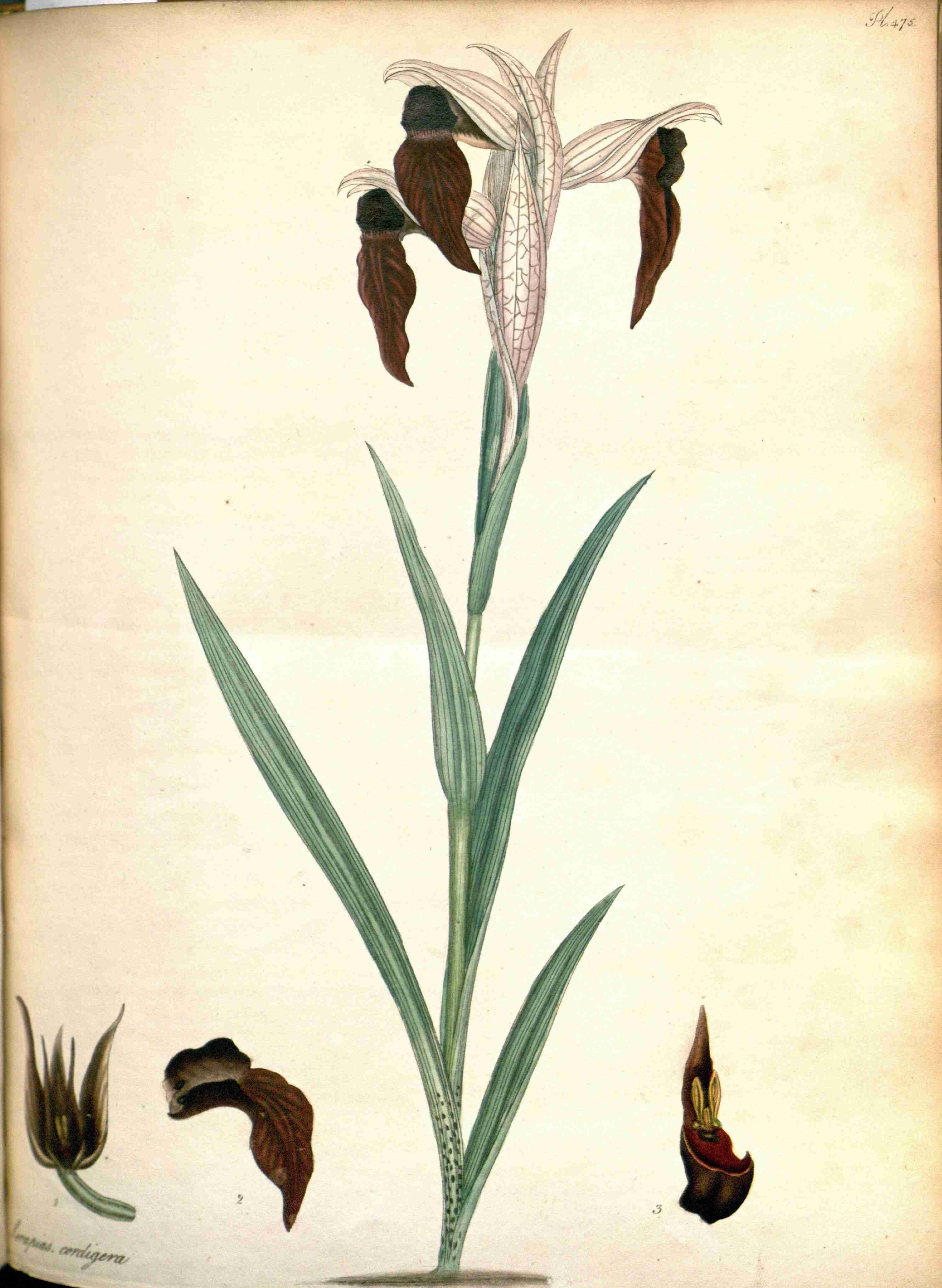
SERAPIAS CORDIGERA.
Heart-bearing Serapias.
CLASS XX. ORDER I.
GYNANDRIA DIANDRIA. Chives on the Pointal. Two Chives.
ESSENTIAL GENERIC CHARACTER.
Corolla 5 petala, ringens: petalis conniventibus: labello nectarii ecalcarato: lamina deflexa: antheræ styli longitudine, adnatæ.
Blossom 5 petals, gaping: petals approaching together. The lip of the honey-cup growing from the spur: the lip bending downwards. The chives the length of the style, and attached to it.
SPECIFIC CHARACTER.
Serapias foliis lanceolatis glaucis, ad basin maculatis. Nectarium tripartitum, ferrugineum: laciniis lateralibus obtusis, erectis, conniventibus: divisio media ovata, acuminata, pilosa, dependens: corollis implicatis, apice involutis, extus pallentibus, intus fusco purpurascentibus.
Serapias with lance-shaped glaucous leaves spotted at the base. Honey-cup three-divided, and of a rusty colour: the side segments obtuse, upright, and approaching: the middle division is ovate, sharp-pointed, hairy, and hanging down. Blossom folded together, and turned inwards at the point, pale-coloured on the outside, and of a purply brown on the inside.
REFERENCE TO THE PLATE.
1. The flower spread open. 2. The lip of the honey-cup. 3. The chives and pointal, with the spur of the honey-cup, magnified.
For this luxuriant specimen of the Serapias cordigera we are indebted to the Right Hon. the Marquis of Blandford. It is a rare plant, of a curious structure but very sombre aspect. It is one of those numerous divisions of the class Gynandria approaching the genus Ophrys on the one side, and Neottia on the other. From the Ophrys it is not easily distinguished; but from Neottia it is separated by the difference of its habit. This plant is well known by the title of cordigera, a specific derived from the resemblance the lip of the nectarium is supposed to bear to the shape of a heart: but the analogy is certainly not very powerful. The flowers remain a considerable time in perfection. It is indigenous to Spain, Barbary, Italy, &c.