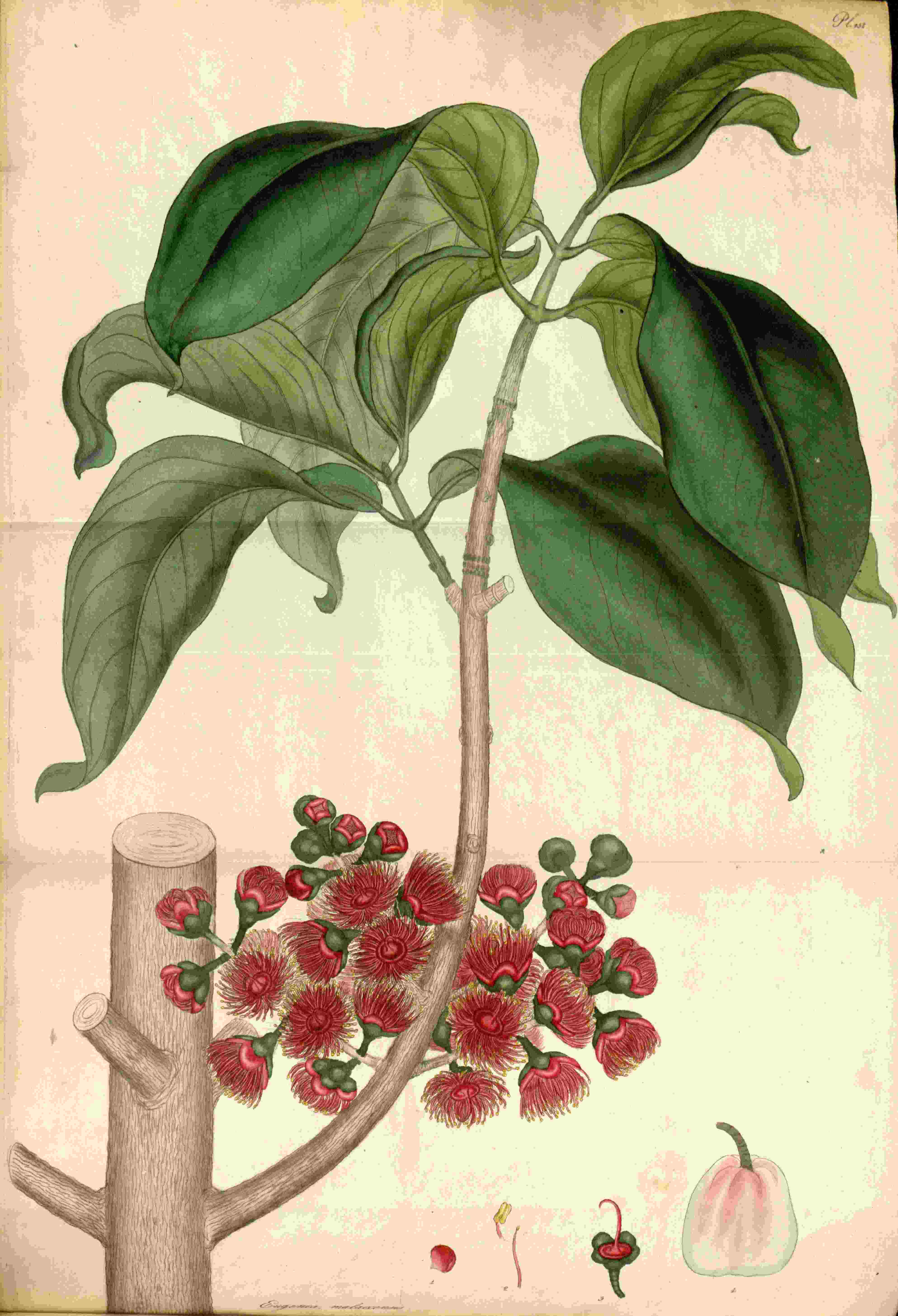
Volume 7 — PLATE CCCCLVIII.
Reading edition
EUGENIA MALACCENSIS.
Malay Apple Tree.
CLASS XII. ORDER I.
ICOSANDRIA MONOGYNIA. Twenty Chives. One Pointal.
GENERIC CHARACTER.
Calyx. Perianthium monophyllum, superum; in medio orbiculus, supra quem quadripartitum est: laciniis concavis, persistentibus.
Corolla. Petala quatuor, calyce duplo majora, obtusa, concava.
Stamina. Filamenta plurima in orbiculo calyci inserta, longitudine corollæ: antheræ parvæ.
Pistillum. Germen turbinatum, inferum. Stylus simplex, longitudine staminum. Stigma simplex.
Pericarpium. Drupa quadrangularis, coronata, unilocularis.
Semina. Nux subrotunda, glabra.
Empalement. Cup of one leaf, above: in the middle is a little circle, above which it is four-divided: the segments are hollow, and remaining.
Blossom. Petals four, twice the size of the calyx, obtuse, and hollow.
Chives. Threads many in a little circle inserted into the calyx: tips small.
Pointal. Seed-bud top-shaped, beneath. Shaft simple, the length of the stamens. Summit simple.
Seed-vessel. A berry four-angled, coronet-shaped, and one-celled.
Seed. A nut nearly round, and smooth.
SPECIFIC CHARACTER.
Eugenia foliis oppositis, alternis, latis, ovalibus, apice acuto, leviter torto, glabris, lucidis. Caulis erectus. Ramuli superiores dumosi, cortice rugoso, colore pulliginoso: ramis floriferis oppositis, alternis, rectis: corollis alternatim oppositis, purpureis.
Eugenia with opposite alternate leaves, broad, and of an oval form, with an acute point, slightly twisted, smooth, and shining. Stem upright. The branches above are bushy. The bark is wrinkled, and of a light brown colour. The flower-branches are opposite, alternate, and straight out. The blossoms are alternately opposite, and purple.
REFERENCE TO THE PLATE.
1. A petal. 2. A chive, one tip magnified. 3. The empalement and pointal. 4. A half-ripe fruit.
The figure of this Eugenia was made from the finest plant in this country in the hot-house of G. Hibbert, esq. where we were in hopes it would have perfected its fruit; but were disappointed, as in a very forward state towards ripening it fell off. But, as far as it was advanced, we have represented it, as in this climate it might probably never arrive at greater maturity, unless a larger house were constructed for it: otherwise the degree of heat necessary to preserve the smaller tropical plants would always be subject to injure those of a large size, from the natural extension of their roots approaching too near the flues. But although so much care is required for it in this clime, in the warmer regions of Macassar, Amboyna, and the Moluccas, where it is indigenous, not the least attention is necessary; for, such is the extreme indolence of the natives, that it is imagined, if any care had been requisite for its preservation, it would soon have been lost for want of it. In the Hortus Malabaricus of Rheede there is an uncoloured figure of it, with descriptions, in which it is said to be a fruit-tree of great general utility to the country from its extreme abundance, grateful taste, and salubrious quality, flowering twice in the year. The fruit in an unripe state is of a bitterish and rather astringent character; but, when ripe, of a fine flavour, exceedingly wholesome, and beneficial as an allayer of inflammation in feverish habits. The flowers are by the Dutch at Amboyna preserved, and frequently eaten by way of salad. It is said to form a tall umbrageous tree, and when in fine bloom must certainly be an object of great beauty.