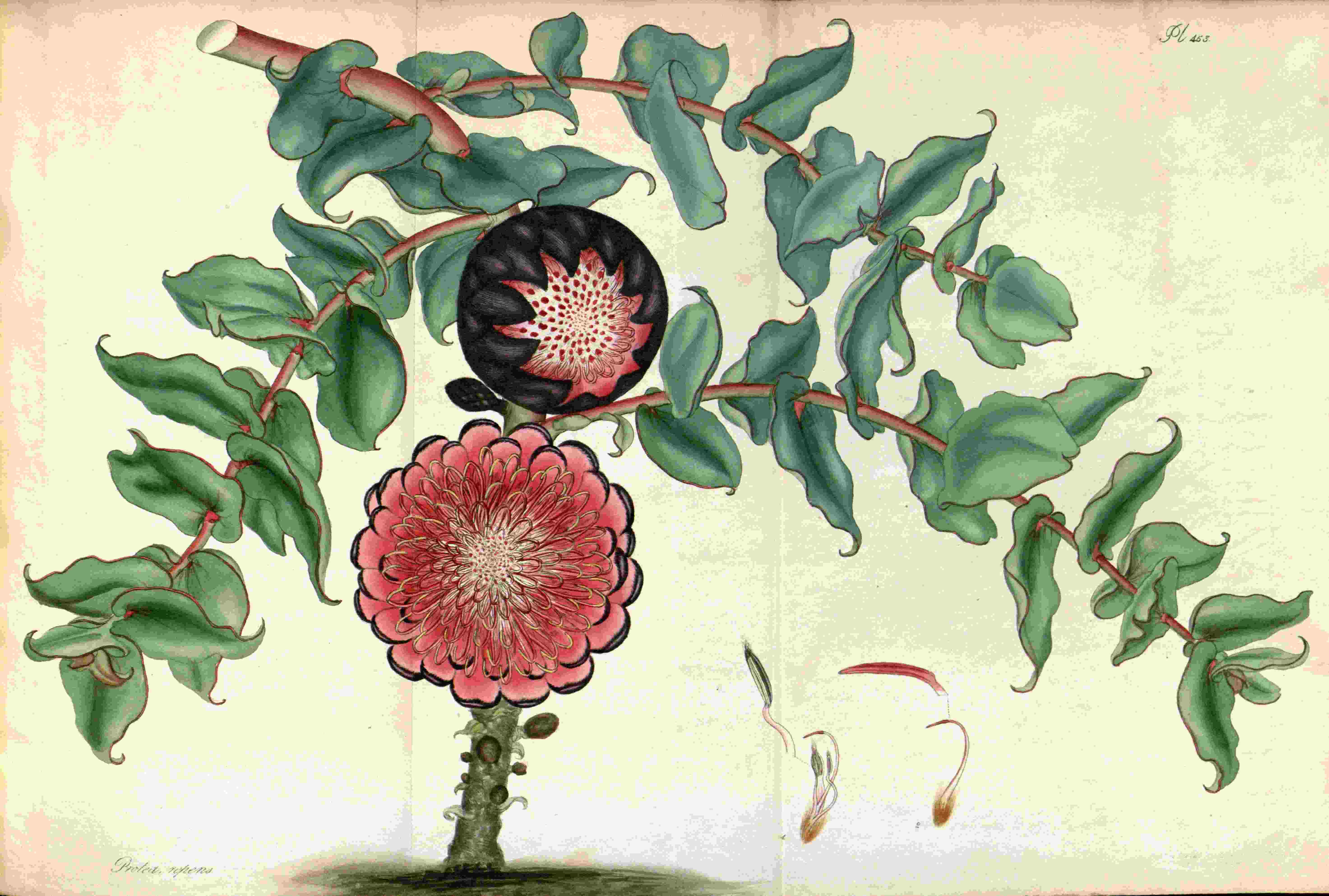
Volume 7 — PLATE CCCCLIII.
Reading edition
PROTEA REPENS.
Creeping Protea.
CLASS IV. ORDER I.
TETRANDRIA MONOGYNIA. Four Chives. One Pointal.
ESSENTIAL GENERIC CHARACTER.
Corolla 4-fida, seu 4-petala. Antheræ lineares, petalis infra apices insertæ. Calyx proprius, nullus. Sem. solitaria.
Blossom four-cleft, or of four petals. Tips linear, inserted into the petals below the points. Cup proper, none. Seeds solitary.
SPECIFIC CHARACTER.
Protea repens, foliis sub-amplexicaulibus, cordatis, undulatis, apice reflexis, acutis, marginibus rubris: floribus sub basin: interius squamarum calycis læte carneum, exterius fusco-purpureum, villosum.
Protea with a creeping stem, and leaves nearly surrounding it, which are heart-shaped, waved, bent back at the end, sharp-pointed, and red at the edges: flowers grow towards the base of the plant: the inside of the scales of the empalement are of a bright flesh colour, and the outside of a purply brown, and hairy.
REFERENCE TO THE PLATE.
1. The blossom complete, and one of the chives magnified. 2. Seed-bud and pointal, summit magnified.
The appearance of this Protea, as cultivated in the gardens, is diametrically opposite to its natural character, which, as its specific indicates, is repent or creeping; instead of which, the branches of the plant are bent from their natural habit, forced as upright as possible, and fastened to a stick; in which situation the flowers only would compare with our figure. But so averse is it to this confined mode of treatment, that, as soon as the branches are liberated, they instantly take the direction most natural to them, and which is certainly the most graceful. Although repens is the more general title of this Protea, yet we have heard it sometimes called amplexicaulis, a name given by some cultivators to a plant whose foliage is so nearly resembling the one now figured, that, when it arrives at a flowering state, it will most probably prove to be no more than a variation of culture. It is a difficult matter to say in what stage the flower is most beautiful, whether in the bud state, before the pointals are released, or afterwards. From their long confinement, the pollen adheres so strongly to them, that when relieved they appear like the antheræ. Our drawing was made at the Hibbertian collection from a plant in fine bloom in the month of February.