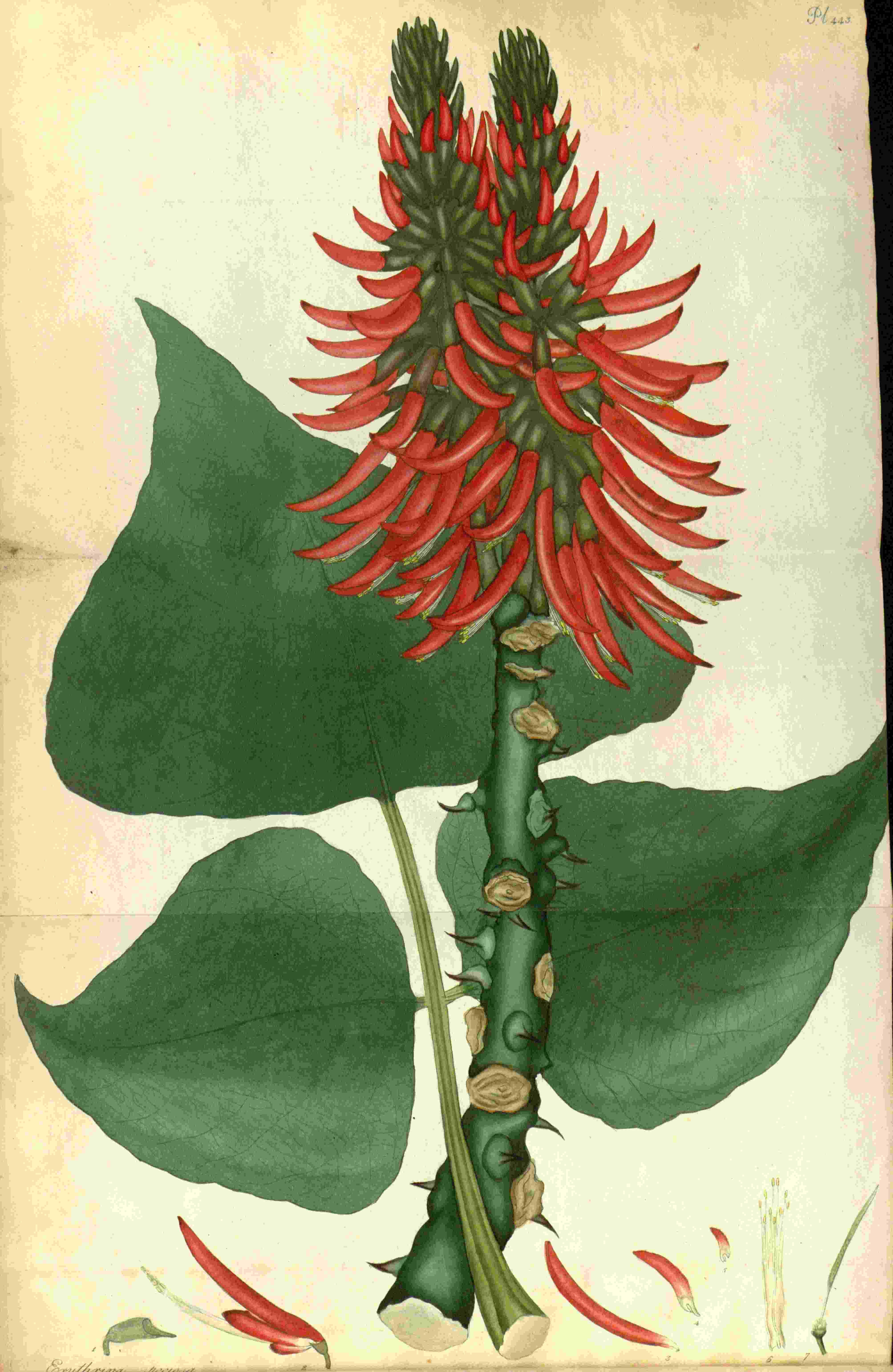
Volume 7 — PLATE CCCCXLIII.
Reading edition
ERYTHRINA SPECIOSA.
Showy Erythrina.
CLASS XVII. ORDER IV.
DIADELPHIA DECANDRIA. Chives in two sets. Ten chives.
GENERIC CHARACTER.
Calyx. Perianthium monophyllum, integrum, tubulosum, ore superne emarginatum, inferne poris melliferis instructum.
Corolla. Papilionacea.
Vexillum lanceolatum, lateribus deflexum, adscendens, longissimum.
Alæ sub-ovatæ, calyce vix longiores, extra tubum vexilli vix eminentes, minimæ.
Carina recta, longitudine alarum, dipetala, emarginata.
Stamina. Filamenta diadelpha, filamenta decem, inferne connata, parum incurva, longitudine dimidii vexilli, inequalia, sagittata.
Pistillum. Germen pedicellatum, subulatum, attenuatum in stylum subulatum, longitudine staminum. Stigma terminale, simplex.
Pericarpium. Legumen longissimum, ac seminis nondum tumidis acuminate terminatum, uniloculare.
Semina reniformia.
Obs. E. Herbacea staminibus decem distinctis.
Empalement. Cup one-leafed, entire and tubular, emarginated on the upper part, the part beneath with little pores containing honey.
Blossom. Butterfly-shaped.
Standard lance-shaped, bowing sideways, ascending, and very long.
Wings nearly egg-shaped and scarcely longer than the tube of the empalement, outside the standard and very small.
Keel straight out, the length of the wings, two-petalled and emarginated.
Chives. Threads in two sets, ten threads joined together beneath, slightly turned inwards, half the length of the standard, unequal, and arrow-headed.
Pointal. Seed-bud with a footstalk awl-shaped, and tapering into the shaft, which is awl-shaped, and of the length of the stamens. Summit terminating simple.
Seed-vessel. A very long pod, and before the seeds are swelled out terminated with a sharp point; of one cell.
Seeds kidney-shaped.
Obs. E. Herbacea has ten distinct stamens.
SPECIFIC CHARACTER.
Erythrina speciosa, foliis magnis, ternatis; foliolis cordatis, subtus nervosis aculeatis. Caulis tripedalis, erectus, spinosus, viridis.
Erythrina with showy flowers, leaves large and three-divided; leaflets heart-shaped, with prickly nerves on the under side. Stem three feet high, upright, thorny, and green.
REFERENCE TO THE PLATE.
1. The empalement. 2. A blossom spread open. 3. The standard. 4. One of the wings. 5. The keel. 6. The chives spread open. 7. Seed-bud and pointal.
This superb Erythrina was communicated to the author by A. B. Lambert, esq., with whom it flowered in the month of November, for the first time in this kingdom. It is at present treated as a hot-house plant, but Mr. Lambert informs us that it is perfectly hardy, and strikes so freely that, although at present it is a nondescript and very rare plant, it will, doubtless, soon make its appearance in most collections: its splendid flowers and easy culture will soon recommend it into general notice. There are but five species of this genus yet known; the present subject will therefore be a valuable addition to the number. The falling off of the leaves is its only defect, which we have no doubt but a hardier mode of treatment will remove. It is supposed to be a native of South America.