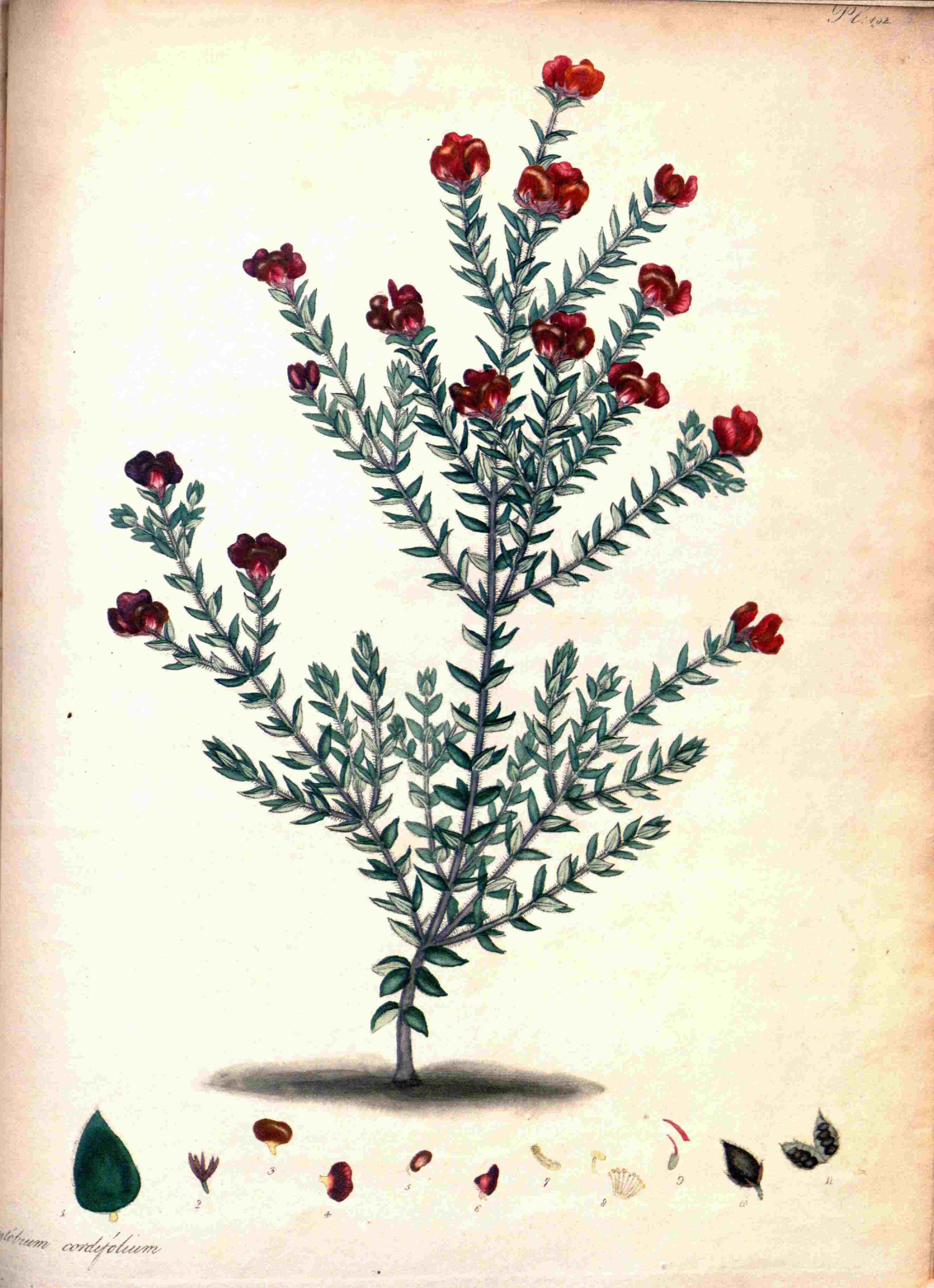
Volume 7 — PLATE CCCCXCII.
Reading edition
OXYLOBIUM CORDIFOLIUM.
Heart-leaved Oxylobium.
CLASS X. ORDER I.
DECANDRIA MONOGYNIA. Ten Chives. One Pointal.
GENERIC CHARACTER.
Calyx simplex, quinquepartitus.
Corolla papilionacea.
Stylus subulatus. Stigma obtusum.
Legumen ovato-acuminatum, apice compressum, polyspermum.
Empalement simple, five-parted.
Blossom butterfly-shaped.
Shaft awl-shaped. Summit blunt.
Pod pointedly egg-shaped, compressed at the end, and many-seeded.
REFERENCE TO THE PLATE.
1. A leaf magnified. 2. The empalement. 3. The standard. 4. A back view of the same. 5. One of the wings. 6. The keel. 7. The chives. 8. The same spread open, one tip magnified. 9. Seed-bud and pointal, summit magnified. 10. A ripe seed-vessel. 11. The same spread open.
Plants of a Papilionaceous character furnish the most frequent opportunity for generic divisions. Nine Genera have already been made by Dr. Smith and others to contain the Butterfly flowers of New Holland. Our little novelty agrees with neither. From Pultenæa, Aotus, Mirbelia, and Dillwynia, it differs in the pod not being two-seeded. The two last genera have also the cups two-lipped, and the first with appendages attached to it. Gompholobium has a globular pod, and Chorizema an oblong one and a bilabiate calyx. Daviesia, Viminaria, and Sphærolobium have pods one-seeded. Thus situated, we are under the necessity of adding one more to the number of genera, perhaps already too extended. We have never seen it exceed a foot in height. The foliage is mostly in whorls: and the stem, leaves, cups, and fruits are hairy.
Our figure represents one of the plants from the nursery of Messrs. Loddige, who first raised it from seed, and where we observed its brilliant little flowers in successive bloom for at least six months.