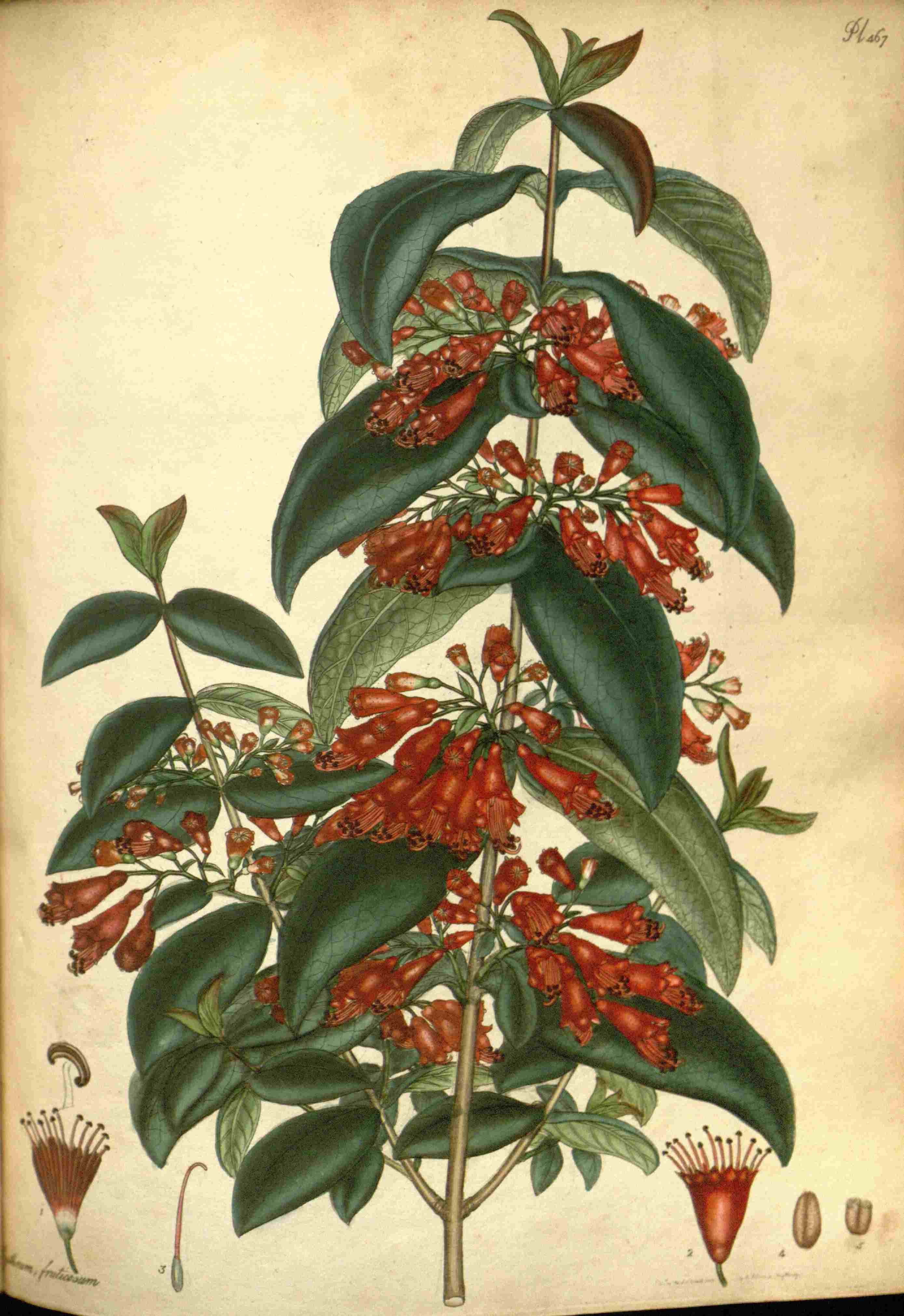
Volume 7 — PLATE CCCCLXVII.
Reading edition
LYTHRUM FRUTICOSUM.
Shrubby Lythrum.
CLASS XII. ORDER I.
DODECANDRIA MONOGYNIA. Twelve Chives. One Pointal.
GENERIC CHARACTER.
Calyx. Perianthium monophyllum, cylindraceum: denticulis duodecim, alternis minoribus.
Corolla. Petala sex, oblonga, obtusiuscula, patentia: unguibus in incisuras calycis insertis.
Stamina. Filamenta 12, longitudine calycis, supra: infra breviora. Antheræ simplices, incumbentes.
Pistillum. Germen oblongum. Stylus subulatus, longitudine staminum, declinatus. Stigma orbiculatum.
Pericarpium. Capsula oblonga, acuminata, loculamentis duobus tecta.
Semina numerosa, parva.
Empalement. Cup one-leaved, cylindrical, twelve-toothed: the alternate ones the smallest.
Blossom. Petals six, oblong, bluntish, and spreading: the ungues or claws are inserted into the divisions of the calyx.
Chives 12 filaments the length of the calyx, above, shorter beneath. Tips simple, and lying on them.
Pointal. Seed-bud oblong. Shaft awl-shaped, the length of the stamens, bent downward. Summit orbicular.
Seed-vessel. Capsule oblong, sharp-pointed, covered with two loculaments.
Seeds numerous, and small.
SPECIFIC CHARACTER.
Lythrum fruticosum: foliis oppositis, alternis, lanceolatis. Flores in racemis axillaribus in numeris irregularibus: corollis tubæformibus, coccineis. Sponte nascens in provinciis borealibus Hindostani.
Lythrum with a shrubby stem. Leaves opposite, alternate, and lance-shaped. Flowers grow in clusters from the axillæ of the leaves in irregular numbers. Blossoms trumpet-shaped, of a scarlet colour. It grows wild in the northern provinces of Hindostan.
REFERENCE TO THE PLATE.
1. A blossom spread open, one tip magnified. 2. The same shown from the outer side. 3. The seed-bud and pointal. 4. A capsule. 5. The same cut transverse.
This plant seems to have been hitherto but imperfectly known, having been figured among Dr. Roxburgh’s Coromandel Plants, vol. i. p. 20, under the title of Grislea tomentosa. It has recently received another new generic title; but upon examination we find it to be the Lythrum of Linnæus; in which opinion the author is sanctioned by the concurrence of some of the ablest botanists of the present day. This handsome shrub is described in the 4th vol. of the Asiatic Researches, under the native title of D.hawry, and is said to grow wild on the hills and banks of rivulets in the northern part of Hindostan, where it is as much esteemed for its utility as its beautiful red flowers, which are gathered both for the use of dyers and apothecaries; the latter giving an infusion of them as a cooling medicine. When used in dyeing, they lose their colour, and only yield a slight brownish tincture to the water; so that the benefit derived from them when used with [A]Aal seems to depend solely on their action as an astringent, and which appears to be confirmed by the substituting of [B]Purwas, a strong astringent, as an equivalent for the flowers of the D.hawry. It is at present treated as a hot-house plant, but would in all probability succeed very well in the careful treatment of the green-house. The figure was taken from a fine plant in the nursery of Messrs. Colville.