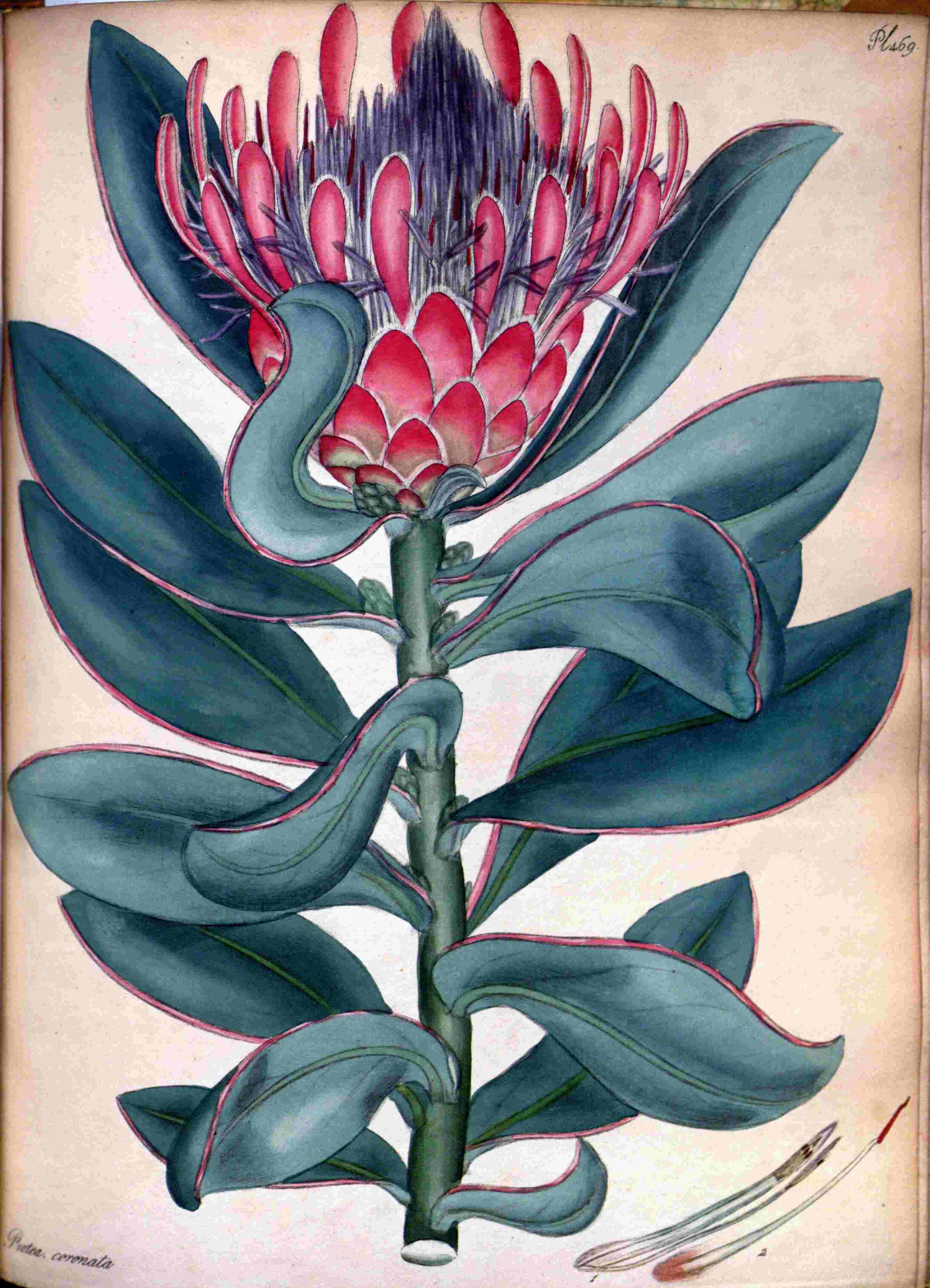
Volume 7 — PLATE CCCCLXIX.
Reading edition
PROTEA CORONATA.
Crown-flowered Protea.
CLASS IV. ORDER I.
TETRANDRIA MONOGYNIA. Four Chives. One Pointal.
ESSENTIAL GENERIC CHARACTER.
Corolla 4-fida, seu 4-petala. Antheræ lineares, petalis infra apices insertæ. Calyx proprius, nullus. Sem. solitaria.
Blossom four-cleft, or of four petals. Tips linear, inserted into the petals below the points. Cup proper, none. Seeds solitary.
SPECIFIC CHARACTER.
Protea foliis lanceolatis, obliquis, transverse et horizontaliter sitis, marginibus tomentosis: squamis calycinis superioribus spathulatis, angustis, tomentosis, margine piloso, incarnatis: squamis infra lato-ovatis, tomentosis, intus melliferis: caulis erectus, sesquipedalis.
Protea with lance-shaped oblique leaves standing sideways in a horizontal direction, with downy edges. The upper scales of the empalement are spathula-shaped, narrow, downy, with hairy edges, and flesh-coloured. The scales beneath are broadly ovate, downy, and furnished with honey on the inner side. Stem upright, a foot and a half high.
REFERENCE TO THE PLATE.
1. A flower complete. 2. Seed-bud and pointal.
This Protea may be regarded as an intermediate character between the P. mellifera and that fine section of Protea speciosa; and certainly, in point of beauty, deserves to be ranked among that showy division: but as the principal leading feature in the Speciosas exists in the powerful feathery fringe upon the edges of the imbrication, and the present one possessing so very slight a characteristic of that description, we could not with propriety rank it amongst them. Its affinity to the P. mellifera is only in the honey-bearing character of its flowers, which, like that species, contain a quantity of nectariferous juice. The unoccupied term of coronata is adopted, from the resemblance its imbrication bears to the form of a crown, and which is more apparent in this species than in any other as yet in cultivation with us. Our figure was made from the Clapham collection.