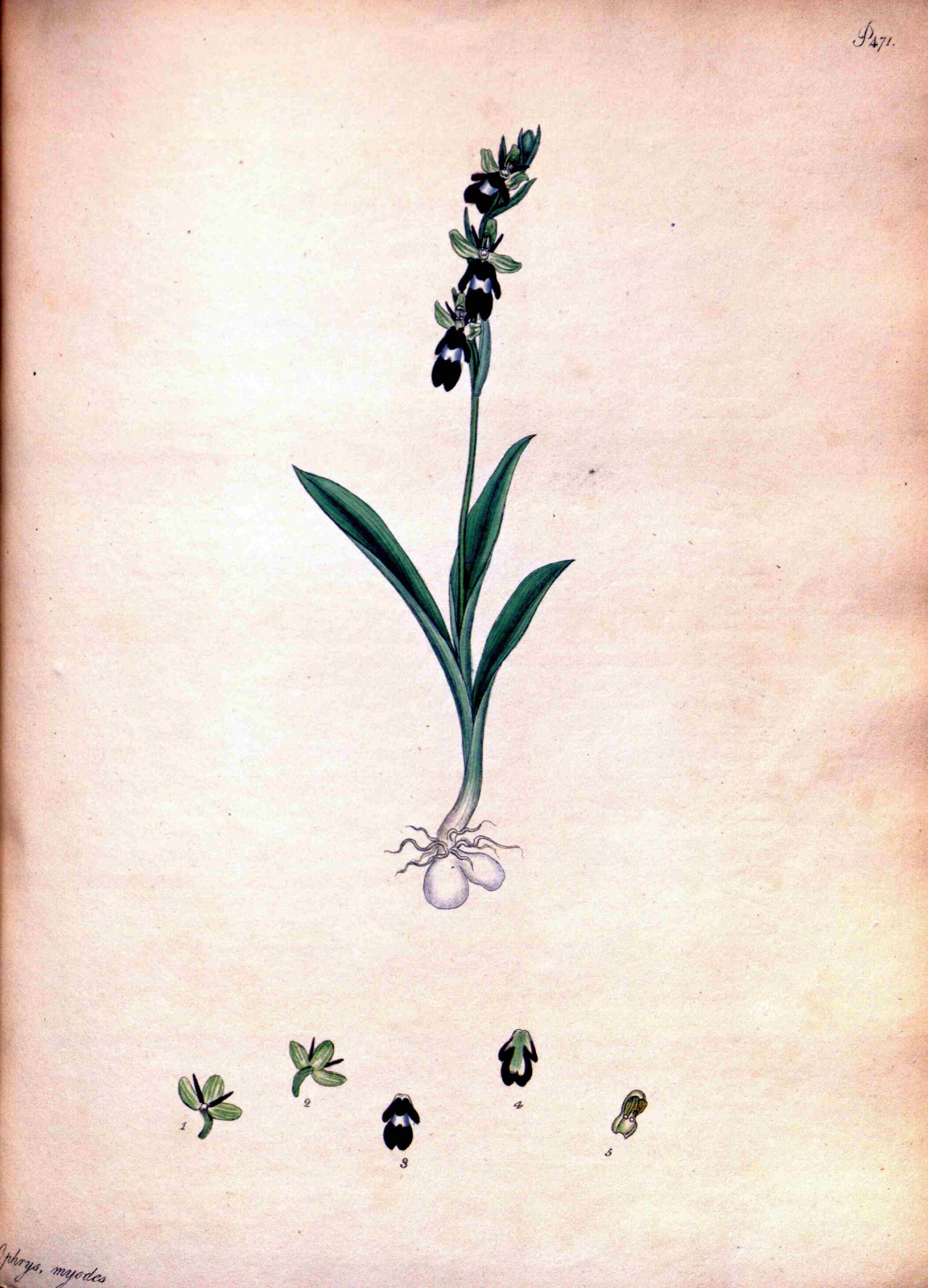
Volume 7 — PLATE CCCCLXXI.
Reading edition
OPHRYS MYODES.
Fly-like Ophrys.
CLASS XX. ORDER I.
GYNANDRIA DIANDRIA. Chives on the Pointal. Two Chives.
ESSENTIAL GENERIC CHARACTER.
Corolla 5 petala, sub-ringens: petalis patentibus: labellum nectarii e basi styli, patens. Antheræ duæ, terminates, adnatæ.
Blossom 5 petals, nearly gaping: petals spreading: the lip of the honey-cup comes from the base of the shaft, spreading. Chives two, terminal, and close together.
SPECIFIC CHARACTER.
Ophrys myodes, floribus alternis, lateralibus: nectarii labio tripartito: laciniis lateralibus: lineari-lanceolatis, media oblonga, biloba, longior lateralibus: petalis patentibus: tribus exterioribus lanceolatis, viridibus, obtusis: duobus interioribus linearibus, brevissimis, purpureis: caule folioso: bulbo subrotundo.
Ophrys with fly-like flowers, alternate, and lateral: the lip of the honey-cup is three-cleft: the side segments are linear, and lance-shaped: the middle one is oblong, two-lobed, and longer than the side ones: the petals are spreading: the three outer ones are lance-shaped, green, and obtuse, the two inner ones are linear, very short, and purple: leaves enfoliating the stem: bulb roundish.
REFERENCE TO THE PLATE.
1. The blossom. 2. The same shown from the outer side. 3. The honey-cup. 4. The same shown from the under side. 5. Chives and pointal, magnified.
Amongst the Alpine plants of G. Hibbert, esq. we met with this curious little insectiferous plant, and which, like the preceding figure, is said to be indigenous to almost all Europe. It is figured in the English Botany of Dr. Smith, but apparently from a taller plant, and differs in the colour of the body. It is also represented in the Botanical Magazine, of a higher stature, but nearly the same in colour. Variations probably the mere effect of climate, and a different mode of culture. As they all bear an unequivocal resemblance to the fly, so exact a representation of ever so humble a species of animated nature will no doubt be always thought deserving a place in every collection.