Second Part. (continued 49)
Joseph F. Sohm translation
Continuing, he speaks of his personal appearance and the manner of his death, saying,
“Hans Landis was a tall, stately person, with a long black and gray beard, and a manful voice.
“When he, cheerful and of good courage, was led out, by a rope, to the Wolfsstadt (being the place made ready for his execution), the executioner, Mr. Paull Volmar dropped the rope, and lifting up both of his hands to heaven, spoke these words:
“ ‘O that God, to whom I make my complaint, might have compassion; that you, Hans, have come into my hands in this manner; forgive me, for God’s sake, that which I must do to you.’
“Hans Landis comforted the executioner, saying that he had already forgiven him: God would forgive him too; he well knew that he had to execute the order of the authorities; he should not be afraid, and see that there was no hindrance in his way.
“Thereupon he was beheaded. After his head had been struck off, the executioner asked: ‘Lord Bailiff of the Empire, have I executed this man rightly according to imperial law and sentence?’ Otherwise it was customary to say: ‘This poor fellow,’ etc. As though he believed that he died saved and rich.
“The people were of the opinion, that the executioner by dropping the rope meant to indicate to Hans that he should run away, it was also generally said: that if he had run away, no one would have followed him, to stop him.” So far the aforementioned extract.
Further Statement.—It is also appropriate to give here what has been stated to us through credible testimony, namely, that when the aforementioned Hans Landis was standing in the place of execution, to be put to death, his dear wife and children came to him with mournful crying and lamentation, to take a last and final adieu and leave from him. But when he saw them, he requested them to go away from him, in order that his good resolution and tranquillity of heart for the death awaiting him might not be disturbed or taken away by their weeping and grief; which having been done, and he having commended his soul into the hands of God, the quickly descending stroke of the sword put an end to his life.
OF A CERTAIN PROHIBITION PUBLISHED BY THOSE OF AERDENBORGH AGAINST THE ANABAPTISTS, AND WHAT WAS DONE BY THE LORDS STATES GENERAL OF THE UNITED NETHERLANDS FOR THE ABOLISHMENT OF THE SAME, A. D. 1615.
Also at Aerdenborgh in Flanders they began to put into execution various means for the oppression of the Anabaptists who resided there and had escaped the claws of the Romish wolf, the cause of which was a certain prohibition emitted by the Bailiff and the council of said city; in which said people in the first place, were refused liberty in the practice of their religion, insomuch that they were not allowed to assemble for this purpose, neither in the city, nor within the limits of its jurisdiction.
Thereupon there began they to afflict these innocent and defenseless people, not only with heavy fines, but also with arrest and imprisonment.
This sad beginning would, to all appearance, have culminated in greater mischief to the aforesaid people, had not their High Mightinesses, the Lords States General of the United Netherlands, who had received information of this, opposed it with a certain mandate, whereby those who were the cause of said oppression were prevented from proceeding with the execution of their aforementioned prohibition, and on the other hand, liberty of religion was granted to those that were oppressed. The contents of the aforementioned mandate are as follows:
The States General, etc., to the Bailiff, Burgomasters and Judges of Aerdenborgh.
Honorable, etc.: We have learned with surprise, that, contrary to our resolution announced to Your Honor by our order by the clerk, Jan Bogaerd, you still hinder the members of the community called Anabaptists or Mennonists, residing in Aerdenborgh and the parts under its jurisdiction, in the freedom of their assembling and the exercise of their religion in Aerdenborgh, and trouble and oppress them, by prohibiting their assembling, by arrests, and fines.
Whereas we desire that the aforesaid members of the community belonging to the Anabaptist persuasion be allowed to enjoy just as much freedom, with all quietness and modesty, in their mind, conscience, assembling, and exercise of their religion, in Aerdenborgh as is the case every where else in the provinces, cities, and places of the United Netherlands, without any contradiction or resistance; except that you may exercise an oversight over their gatherings, as far as they deem it well, and that they, to this end, may inform you every time that they desire to assemble. Hence we command you, to govern yourselves precisely in accordance with this, to the better maintenance of tranquillity, peace and unity in the aforesaid city; without causing the apprehension or execution of the aforesaid members for any fine or contravention, because of previous gatherings. Upon this we shall rely, and, etc. Given this 1st of May, 1615.
This agrees with the minutes preserved in the rolls of their High Mightinesses. Signed,
N. Ruysch.
FURTHER OBSERVATION, A. D. 1619.
When the aforesaid mandate had been drawn up, and properly delivered by order of their High Mightinesses, the hope was indulged in that it would be obeyed, and thereby the peace desired accomplished, but through the intervention of envious and malevolent persons this hope was frustrated; for it was sought, notwithstanding said mandate to find cause whereby the liberty of the aforementioned people might be annulled justly as it were, and their peace disturbed.
To this end served, or at least was used, a certain ordinance decreed in July of the year 1619, by order of the Excellencies lords in power against certain individuals. Though this ordinance had no reference whatever to the Anabaptists, yet their assembling and religious worship was prohibited; hence they again addressed themselves with humble supplications to the High Mightinesses of the United Netherlands, to the end that they might be delivered from this disturbance of their peace, and freely permitted (as had been ordained before) to practice their religion; whereupon followed another mandate to the governor of Sluys, and the bailiff and magistrates of Aerdenborgh, it read as follows:
The States, etc., to the Lord of Haultain, Governor of Sluys and the adjacent parts; as also to the Bailiff and Magistrates of the city of Aerdenborgh.
Noble, august, honorable, dear, particular: We here send you the adjoined request presented to us in the behalf of the members of the community called Mennonites or Anabaptists, residing in Aerdenborgh who complain that they are disturbed in the free exercise of their religion which we have granted them in the aforesaid city; you doing this under the pretext of the decree emitted by us on the 3d of July last; whereupon we have deemed it necessary to advertise and explain to you, that it is not our intention that the supplicants be comprehended in the aforesaid decree of the 3d of July, but that the supplicants shall retain, enjoy, and continue in, said freedom in the exercise of their religion, in Aerdenborgh, even as they have previously had and enjoyed. Hence we charge you, to govern yourselves in accordance with this, without further troubling the supplicants, as that they have to follow our previous concession and resolution. Hereupon we shall rely and commend you into the high protection of the Almighty. From the Hague, the 16th of November, 1619.
This agrees with the minutes preserved in the rolls of their High Mightinesses. Signed,
N. Ruysch.
REMARK AS TO WHAT FOLLOWED HEREUPON.
After this second mandate there followed in the aforesaid city and its jurisdiction the hoped for peace, at least so that we have learned of no note-worthy disturbance or obstruction of religion.
Meantime the mischief broke out again in other places, especially at Deventer, though also from those professing the Calvinistic doctrine; insomuch that the authorities of said city, instigated by certain bitter and malignant persons, endeavored, through a certain edict containing divers punishments against the Anabaptists, to abolish the gatherings of those professing that belief; an account of which we shall forthwith give.
OF AN EDICT OF THOSE OF DEVENTER AGAINST (AMONG OTHERS) THE SO CALLED MENNONISTS OR ANABAPTISTS, A. D. 1620.
When the year sixteen hundred and twenty, after the birth of Christ had come, the aforesaid magistrates emitted an edict, not only against the Romanists (from whom they had formerly suffered persecution themselves), but also against the Mennonites or Anabaptists, who had always shown themselves peaceable and friendly toward and among them, whereby they prohibited, among others, also the assemblies of the Anabaptists, yet not on pain of death.
That this may be well understood, we shall correctly copy the edict; as far as it is directed against the Anabaptists, and present it to the impartial reader.
EDICT.
The magistrates of the city of Deventer prohibit all citizens and residents of their city; that no Mennists, etc., shall hold any secret or open assembly or meeting where any preaching . . .350 marriage, or any other exercise of religion is practiced; under whatever pretext the same may be done; on pain that those who shall be found to practice it shall forthwith be banished from the country forever; and every person that shall be found at such a place or in the assembly, shall forfeit the upper garment and twenty-five guilders in money; the second time, the upper garment and fifty guilders; the third time, to be punished arbitrarily. And he that lends his house, for the purpose of holding such gatherings, forfeits a hundred guilders; the second time, two hundred guilders; the third time, he shall be banished forever. See Chron. van den Ondergang, Book 17, for the year 1620, etc., page 1825, col. 1.
For this is thankworthy, if a man for conscience toward God endure grief, suffering wrongfully. For what glory is it, if, when ye be buffeted for your faults, ye shall take it patiently? but if, when ye do well, and suffer for it, ye take it patiently, this is acceptable with God. For even hereunto were ye called: because Christ also suffered for us, leaving us an example, that ye should follow his steps. 1 Peter 2:19–21.
OF SEVERE SLANDERS AGAINST THE ANABAPTISTS IN THE PROVINCE OF HOLLAND, ETC. (TO INSTIGATE TO PERSECUTION), AND HOW THEY DEFENDED THEMSELVES TO THE STATES OF SAID COUNTRY, ON THE 8TH OF OCTOBER, A. D. 1626.
In the meantime men did not cease to slander and speak evil of the doctrines of the Anabaptists; especially about the article which they confessed concerning God, as also touching the incarnation of the Son of God, etc., even as though they advanced the most absurd, yea, ungodly opinions in regard to it; which was done, in order, if possible, to cause a persecution of these people, even in the midst of the Netherlands.
For this occurred in such a way, that also the high magistrates and States of the country were exercised with regard to it; who, to get full information about this matter, gave orders to divers churches of the Anabaptists, to make a uniform confession touching the aforementioned articles, and to deliver the same to their noble High Mightinesses.
To this the aforementioned Anabaptists were not averse; inasmuch as they composed these articles in writing, and delivered them, on the 8th of October, A. D. 1626, to the deputies of the Court of Holland. The contents thereof were as follows:
Of the only God, Father, Son, and Holy Ghost.
We believe from the heart, and confess herewith according to the testimony of the word of God, that there is one, only, eternal, almighty, merciful and just God (Deut. 6:4; Matt. 19:17; Ps. 90:2; Isaiah 40:28; Rom. 16:26; Gen. 17:1; Ps. 103:8; Philippians 2:4; Dan. 9:7), and none other (1 Corinthians 8:4,5), to whom there is none like (Ex. 8:10; Is. 46:9), whose greatness is immeasurable, and his form indescribable, 2 Chr. 6:18; Job 11:8,9. Before whom, above whom, and beside whom, there is no other, Is. 43:11; Deut. 10:17; 32:39. Who is of himself that he is, Ex. 3:14. To whom all things that are owe their existence, Gen. 1; Ps. 146:6; Acts 14:15. Who is the Alpha and Omega, the first and the last, the beginning and the end, Rev. 21:6; Is. 41:4. Who knows, sees, and hears all things, Ps. 94:11; 1 John 3:20; Ps. 33:13; 94:9. Who alone is good, and the fountain and source of all good, Matt. 19:17; James 1:17. Wherefore to him, blessed be he, belongs and must be given all divine honor, fear, love and obedience (Ps. 29:1; Luke 2:14; Deut. 10:12,20; 6:5; Matt. 22:37; Jeremiah 11:7), which may not be shown to any other, neither to angels, nor to men, nor to any other, whether they be heavenly or earthly creatures, Rev. 19:10; Acts 10:26. For he will not give his glory unto another, neither his praise to idols, Is. 48:11; 42:8. But although God in the aforesaid manner manifests and makes himself known in general by his word: yet by the same word he also shows himself distinctively and separately, as, namely: That there are three that bear record in heaven, 1 John 5:7. Not three gods, but one Father, one Word or Son, and one Holy Ghost, even as this was shown, when the Lord Christ was baptized (Matt. 3:16); and is also taught in the words of Christ, where he commands his disciples to baptize in the name of the Father, and of the Son, and of the Holy Ghost. Matt. 28:19. So that therefore, according to the word of God, the Father is the true Father of the Son (Matt. 7:21; 10:32,33; 16:17; Mark 14:36; John 17), from whom the Son proceeded in an incomprehensible manner from eternity, and was born before every creature. Micah 5:2; Col. 1:15. Hence the Son is also the true Son of the Father (Ps. 2:7,12; Matt. 3:17; 17:5), so that also the Father, as far as he is the Father, is not the Son, John 3:16,17; Rom. 8:3; Gal. 4:4. That likewise the Son, as far as he is the Son, is not the Father, John 16:28; Rom. 5:10. But that herein the Father is another than the Son, and the Son another than the Father, John 5:32,37; 10:25,29; 15:24. That also the Father and the Son, as far as they are Father and Son, are not the Holy Ghost. That also the Holy Ghost, as far as he proceeds or is sent out by the Father, in the name of the Son, is another than the Father or the Son. But as far as the Father is God, eternal, uncreated, but the Creator of all things, with many other divine attributes, herein we believe that the Son and the Holy Ghost are one with the Father, to whom one and the same title of God, in the highest significance, honor, service, and obedience, belongs.
However, the manner, how and wherein Father, Son and holy Ghost are three and also one, we do not think that God has so fully revealed to us in his word; that also all the knowledge of it is not necessary to salvation, since it is a high or deep mystery, which here in this life can be known but in part, as if seen through a glass darkly, 1 Cor. 13:12. The perfect knowledge and true contemplation of which, is hoped for by faith, in this life, but will only hereafter, in the life eternal, be fully known. 1 John 3:2. Wherefore deep investigation of this matter, beyond or above the word of God, is more subtilty than Christian simplicity. The terms, of one essence, trinity, three persons, invented in former times by the ancients, we avoid, because they are unknown to the Scriptures, and because it is dangerous, in naming God, to use other words than those of the holy Scriptures. By the words, three beings, or three in one being, previously used by Jaques Outerman, as also by some of our teachers, we understand nothing else than what is comprehended in this our preceding confession.
Of the incarnation of the Son of God.
We believe and confess, that God, willing to show his very great love to the human race (who through sin had fallen into death and into much corruption), and to perform by the deed his gracious promises made to the fathers (Gen. 3:15; 12:3; 22:18; Deut. 18:18), sent to this purpose his only (John 3:16), dear (Luke 9:35), and beloved Son (Matthew 3:17), who was from eternity (Heb. 1:2), by whom all things were created and made (Col. 1:16; Heb. 1), into this world (John 3:17; 1 John 4:9), who gladly obeyed the will of his Father (Ps. 40:8; Heb. 10:7), and came from above (John 3:31; 8:23), from heaven (3:13; 6:62), came forth from his Father (16:28), leaving his divine glory (17:5), form (Philip. 2:6), and riches (2 Cor. 8:9), descended (Eph. 4:9), came into this world (John 16:28), so that the virgin Mary, by the power of the Most High (Luke 1:35), conceived him (Is. 7:14; Matt. 1:23; Luke 2:7), so that also the same, and no other, was born of her (Is. 7: Matthew 1:25; Luke 1; Gal. 4:4). For although Mary bore the Son of God in another form, than in which he was with the Father before the foundation of the world; yet it is nevertheless the same, whose goings forth have been from of old, from everlasting, Micah 5:2; Is. 9:6. For the Word or Son became flesh. John 1:14. Yea, he that was like unto God, became like another man. Philip. 2:7. The Son of God appeared in the form of sinful flesh (Romans 8:3), and God was manifested in the flesh (1 Timothy 3:16), so that the second man Christ is the Lord himself from heaven. 1 Cor. 15:47. Hence that which the apostles saw in Christ, with their eyes, heard with their ears, and handled with their hands, was of the Word of life; so that they saw that eternal life which was with the Father. 1 John 1. For God brought his first begotten Son into the world, whom all angels and men must worship. Heb. 1:6; Philip. 2:10. And when we thus believe, we have in our favor the testimony of God and of all the righteous, who with one accord unanimously exclaim: that this visible man Christ is the Son of God (Matt. 3:17; John 1:2; 9:37; 11:27; Matt. 16:16; 1 John 4:10; 5:5), who dwelt among men (John 1:14: Zech. 2:10; Bar. 3:37), and whom the high priests, because he confessed himself to be the Son of God, also condemned to death. Mark 14:64; John 18:35. For, not knowing him, they nailed the Lord of glory, that is the Lord from heaven, to the cross. 1 Cor. 2:8; 15:47. There the Son of the living God suffered (Heb. 5:8), whom God did not spare (Rom. 8:32), but delivered him up for the life of the world (John 3:16; 1 John 4:14), to the most ignominious death of the cross. Philip. 2:8. There the Son of God shed his precious blood for the forgiveness of our sins (Acts 20:28; Col. 1:14; 1 John 1:7; Rev. 1:5); he by whom God made the worlds, by himself purged our sins. Heb. 1:2,3. He was buried, and the third day was raised from the dead by the glory of the Father. 1 Cor. 15:12; Acts 3:26: Rom. 6:4; 1 Thess. 1:10. He ascended up to where he was before. John 3:13; 6:62; 16:28; Eph. 4:8; 1 Tim. 3:16. He is sitting there at the right hand of the Majesty of his Father (Eph. 1:20; Heb. 1:3), whence he shall come in the clouds of heaven, to judge the quick and the dead. Matt. 24:30; Acts 10:42; Rev. 1:7.
The final cause of the sending, advent, incarnation, and suffering and death of the only begotten Son of God in this world, was to save sinners (1 Tim. 1:15; Matt. 18:11), or to reconcile the sinful world to God the Father, John 3:17; 1 John 2:2; 2 Cor. 5:19. Hence he is also the only foundation (1 Cor. 3:11), the only door to the Father (John 10), the only way to eternal life (John 14:6), and the only meritorious cause of justification (Acts 13:38; Rom. 3:24), and of eternal salvation; for there is salvation in no other, as the apostle Peter says, neither is there any other name under heaven given among men, whereby they must be saved, than in the name of our Lord Jesus Christ. Acts 4:12. To him be praise, honor and glory forever and ever. Amen.
This was subscribed by twenty ministers of the Anabaptists (who are all well known), in the name of their churches; as of Amsterdam, Haerlem, Leyden, Delft, Rotterdam, Dergoude, Schiedam, Bommel, Blockzijl, etc.
This confession of faith, concerning the articles about God and the incarnation of the Son of God, etc., having been delivered to the deputies of the Court of Holland, produced satisfaction with their High Excellencies, and hence the establishment of greater peace and liberty for the Anabaptists in said country, although to the dissatisfaction of those who, through bitterness, had first endeavored to disturb their peace, and, if they could have succeeded to cause an oppression or persecution of them.
Note.—Just in time two manuscript tracts, in the Swiss language, were sent to us, both of them having been sent before this date, from the Swiss parts, to divers churches of our fellow-believers, but principally to those of Amsterdam, at the request and in the name of some of the oppressed brethren; also, in general, of the ministers and elders of the church in the Palatinate and Alsace.
The first was written and completed on the 15th of September 1645, and bears the signature of Jeremiah Mangold.
The second, in the month of February, 1658, by M. Meyli.
These two tracts, both of them written with one design and purpose, and sent to us, shall aid us in the carrying out of the work we have undertaken; namely, to extend the history of the holy martyrs who suffered for our common Christian faith, to this our present time, and bring it to a completion.
In order to do this in the best manner, and to bring these matters (which in one tract are described very diffusely, and in the other, very briefly, and sometimes abruptly), into a convenient form or shape, we shall not grudge the labor of treating them from their first rise, and to follow up the matters chronologically (though they are described indiscriminately), and to indicate each time, in order that no error be made, as to which tract from which we have taken it.
OF THE INAUGURATION OF THE LAST SWISS PERSECUTION; TOGETHER WITH THE CAUSES OF THE SAME, 1635.
The blooming rose of the church of God, in the Swiss countries, had now for about twenty-one years enjoyed tolerable peace; for it appears, that the thorns which before and about the year 1614 had grown up over it for its oppression, were satisfied with the blood of the last named Hans Landis; until, in the year of our Lord 1635, the old hatred of the misnamed Reformed broke out again in those parts, and principally in the city of Zurich, which, already one hundred and ten years previously, namely, A. D. 1525, in the time of Zwingli, when their church was but five years old (as was shown fol. 80, col. 2), had commenced with public decrees against the Anabaptists.
This originated principally in the conversion of a certain influential, rich, and respected man in the city of Zurich, named Henry F., who being chosen ensign by the authorities there, found his soul troubled with anguish and distress, and became unwilling to be used in the war, in which he was now to serve; hence seeking advice with the church of the defenseless Christians or Anabaptists, he entered into their covenant, and forsaking war, was there accepted through baptism, and recognized as a dear brother of said church. This, through the instigation of the learned there, was very illy received by the authorities in the aforementioned city; the more so, since he continued to live undisturbed on the borders of their territory, and this right opposite their adversaries, namely, the Roman Catholics.
Thereupon it followed that the magistrates issued a command, that all the Baptists (who contemptuously were called Anabaptists) should have to go to church with them and attend their worship, if they wished to retain their liberty.
But when they could not do this with a good conscience, and hence refused to comply with it, the magistrates, incensed at this, towards the close of the year 1635, caused many of them to be arrested, all of whom, with the exception of three, escaped (since the prison was not strong) and fled from the hands of the persecutors. The other three, however, namely, Rudolf Egli, Uhbi Schmied and Hans Muller, remained, and were each separately imprisoned, in the council house, where they persevered about twenty weeks, amidst much conflict, adversity and temptation, inflicted upon them in order to make them apostatize from their faith.
But when they in no wise wished to apostatize, and their adversaries could accomplish nothing with them; inasmuch as they indeed promised, if they should be released, to render their authorities, as they had previously done, all proper honor, subjection, and taxes, but that they would in no wise go to their church, nor attend their worship (which was the principal point); they were enjoined, that they, in order to come to a resolution, should deliberate and advise with their brethren; wherefore they, provisorily, were released from their imprisonment and bonds for a month’s time.
Afterwards, when they, according to the charge given them, and their promise, returned, and could still not consent to or follow with a good conscience that which the authorities demanded of them touching their religion, they were again confined in prison.
But when, as before, their good resolution and firm faith could not be changed, they were finally again released upon the aforementioned, condition, but afterwards, having proved what they had to expect, they did not again appear before them without safe-conduct. But all these things were but the beginning of sorrows. Compare Tract, Jer. Mang. after the preface, fol. 1, A., with Tract, M. Meyli, fol. 2, A.
PROGRESS OF THE INAUGURATION OF THE AFORESAID LAST SWISS PERSECUTION, IN THE CASTLES WADISCHWYL, KNONOW, AND GROENINGEN, AS ALSO IN THE CONSISTORY AT ZURICH, IN THE YEARS 1636 AND 1637.
In the following year, namely, 1636, on the 17th of March, also on the 17th of August of the same year, and also on the 8th of September, and towards the close of the year, but finally, in May of the following year, 1637, nearly all Anabaptists, brethren as well as sisters, in the parts of Switzerland, but principally, in the territory of Zurich, were summoned before certain persons, political as well as ecclesiastical, whom the authorities had delegated thereto.
First in the castles Wadischwyl, Knonow, and Groeningen, where they all had to make known their names and surnames, which were written down.
The second time, again in the same castles, where they were informed: That they should conform to the common mode of worship in the churches; which they refused.
The third time, at Zurich, in the consistory (however not all, but only some), where they disputed with them about three articles of religion, namely, about baptism, the Supper, and church discipline, or evangelical excommunication; so that when they had declared their views touching these points, as also concerning the whole foundation of their faith, and asked the committee, whether one could not be saved with such a faith; they received for an answer: “Yes, one could be saved with it.” However, in the evening, this having occurred during the day, they were again greatly reviled, reproached, and threatened with regard to their faith; for, as the proverb says: “When the fox’s skin does not reach, they use the lion’s pelt.”
The fourth time, again in the same consistory, where it was told them: That they should indicate all their movable and immovable property; with the promise that not one stiver should be taken therefrom; which they candidly did and declared; hence all their property was written down and registered, and they were then put in arrest.
The fifth time, again in the aforementioned castles, to which end a letter of safe-conduct was given them. Here they were asked, what they had resolved as regards conforming to the common worship, etc., which they had been enjoined to consider; whereupon a letter from the high Bailiff, by the order of the high authorities, was read to them, which contained: That if they would not go to church, and therein obey the authorities, they should be imprisoned in certain places, and have to expect no mercy.
In the meantime the aforesaid brethren and sisters frequently requested permission to leave the country (namely, with their property), but consent was never granted; only two things were offered them, of which they might choose one, namely, 1. That they should have to go to church with them; or, 2. That they should have to die in the prisons in which they were to be confined.
The first they would not promise or consent to, and hence had to expect the second.
This is the manner of the proceedings that preceded the last persecution of the believers in Switzerland. Jer. Mang., Tract, fol. 2, A. B.; also, M. Meyli, fol. 3, A. B.
OF THE AFOREMENTIONED PERSECUTION ITSELF, HOW IT OCCURRED, AND IN WHAT MANNER TWELVE BRETHREN WERE APPREHENDED, AND IMPRISONED AT ZURICH, IN THE PLACE OTHENBACH (WITH SOME CRIMINALS); AND HOW IT TERMINATED WITH THEM, A. D. 1637.
After the aforementioned proceedings of the Swiss authorities against the true believers in those parts, had taken place, and said believers could not answer according to the former’s pleasure, since their consciences did not feel free to do so, the aforementioned authorities, especially those of the city of Zurich, in the month of May, 1637, sent out their beadles in great numbers, who with raging and storming, cursing and swearing, cutting and chopping, even as ravening wolves among a flock of sheep, violently entered the houses of the believers, and took with them nearly all that they could get, sparing none; young and old, men and women, those enceinte, and mothers with infants, well and sick; among whom twelve brethren are especially mentioned by name, in the writings of the friends from Zurich; all of whom were imprisoned in the city of Zurich, in a very damp prison, called Othenbach, with some criminals; where much grief, vexation and misery befell them, solely for the steadfastness of their true faith. Some of them, who could not endure the severity of the imprisonment, the lack of food, and other hardships, died in bonds; some, however, escaped, by the help of God, unknown to the authorities, through the prison being opened, without doing violence to their faith; which matters will be treated more clearly and circumstantially in their proper place. Compare this with Jer. Mang., fol. 3, B.
Note.—In the year 1637, in the month of May, three brethren, the names of two of whom are Jacob Rusterholtz and Peter Brubach, were summoned to a certain place and kept prisoners, by the high Bailiff of Wadischwyl. There was also imprisoned at this time, Hans Landis the second, a confirmed minister of the church in Horgerberg; as also his daughter, Margaret Landis, who remained imprisoned about sixty weeks in Othenbach. In the meantime the authorities sold their property, realizing seven thousand guilders from it, which they kept for themselves.
Again, one Rudolf Egly, who two years previously, namely, 1635, had been imprisoned with two other brethren, in the council-house at Zurich, but had escaped, was now, A. D. 1637, again imprisoned, his house destroyed, the children driven out of it, and everything sold; from which there was realized about five hundred guilders, which the authorities also took into their possession.
Afterwards his wife, Martha Lindingerin, was apprehended and confined at Othenbach, in a very damp prison. For a time she was very harshly treated, and also severely tempted in regard to the common money belonging to the poor of the church, of which her husband had charge; for she was conducted into the torture chamber, and the executioner sent for and placed beside her, and she was threatened with severe pain and torture, if she would not indicate it.
In consequence of this she weakened, and gave the desired information, whereupon she was released, and the property of the poor saints seized, amounting in money and notes to about two thousand rix-dollars.
But when her spirit, as it seems, could not rest, and she bewailed this with great sorrow, she was, a considerable time afterwards, again apprehended, and imprisoned in Othenbach; but was, with a good conscience (by breaking out), on the Friday before Easter, with others of her brethren and sisters, delivered from bonds.
Compare both tracts, viz.: Mangold and Meyli.
Note.—In continuation, we shall now show from the first mentioned tract of the Swiss elders and ministers, what persons, as far as we have learned of them, were apprehended during this persecution, as also how it terminated with them.
HANS MEYLI, SR., AND HIS SON’S WIFE, ABOUT THE YEAR 1638.351
In the Knonow Bailiwick, the persecution, at this time, broke out with great violence, so that at one time about thirty thief catchers352 entered, as by storm, the houses of the Anabaptists and defenseless Christians, made many watch-fires, raged and stormed, broke open doors and windows, ran with bare swords through the houses, and afterwards drank and rioted worse than soldiers.
Among others there was also vehemently assailed the house of an old man, named Hans Meyli, a minister of the church, who himself had been imprisoned in the year 1637; but now they also took along his son Martin’s wife, notwithstanding she had an infant at the breast.
She was bound hard, and confined in the convent prison called Othenbach, fed for a long time on bread and water, and very severely treated, in order to cause her to apostatize; but she continued steadfast in all her temptations, and was ultimately, through the grace of God, wonderfully delivered from bonds. Subsequently, being enceinte, she was again apprehended, and taken to the council house at Zurich, thence to Othenbach, and finally into the hospital, and there made fast to a chain, until the pains of travail came upon her, when she was loosed from her bonds, and seeing an opportunity for deliverance, once more escaped the persecutors’ hands. See Tract of the year 1645, by Jer. M., fol. 4, B. and fol. 5, A.
Note.—The authorities laid their hands also on the property, movable as well as immovable, of the old man, and realized from the sale of it fourteen thousand guilders, all of which they kept for themselves, without making any restitution.
Note.—On the 3d of May, A. D. 1639, the two sons of the aforementioned Hans Meyli, namely, Hans Meyli, Jr., and Martin Meyli, together with the wife of this Hans Meyli, were apprehended and imprisoned at Zurich, where there was inflicted upon them, especially upon the men, much misery, vexation and harm, with fetters and handcuffs, as well as iron shackles, which were put upon them twice, in order to make them apostatize from their faith.
Their children, as poor, forsaken orphans, were put out among strangers, which, as may easily be supposed, must have caused no small sorrow and anxiety to the hearts of these imprisoned parents; nevertheless they remained unchanged in their faith, refusing to apostatize therefrom, notwithstanding their love to their afflicted children, to whom they could not come, until they, on the Friday before Easter, A. D. 1641, after three years imprisonment, together with others of their fellow brethren, were delivered, in an unexpected manner, from their bonds, keeping a good conscience. See Tract of the year 1645, by Jer. Mang., fol. 5, A. B.
CATHARINA MULERIN, A. D. 1639.
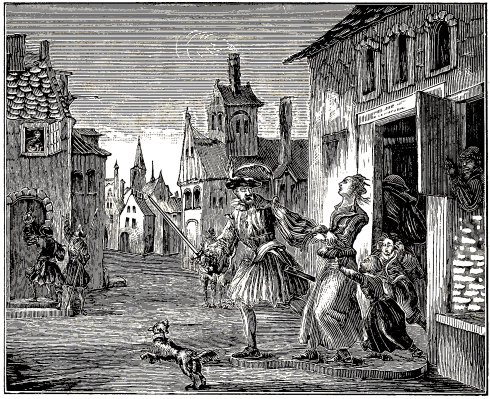
CATHARINA MULERIN APPREHENDED.
The north wind of persecution rose now more and more in the Knonow district, which also appeared in the case of an old sister, named Catharina Mulerin; who having also been apprehended and taken to Zurich, had to suffer much there in prison, for the faith and testimony of Jesus Christ; but was afterwards (as the preceding ones), beyond all hope and expectation, released from bonds. Tract, Jer. Mang., fol. 8, B.
FOUR SISTERS, NAMELY, BARBARA MEYLIN, OTTILA MULERIN, BARBARA KOLBIN, AND ELIZABETH MEYLIN, A. D. 1639.
The persecution did not cease with the foregoing; but they continued and laid their hands also upon four pious sisters, Barbara Meylin, Ottila Mulerin, Barbara Kolbin, and Elizabeth Meylin, who also had to drink out of the bitter cup of the dreadful Zurich prison; however, the Lord preserved them, so that they, unharmed in their faith, unknown to the authorities, unexpectedly also escaped from imprisonment and bonds. See the last mentioned tract, fol. 10, A.
Note.—We made mention, for the year 1635, of one Hans Muller, who, being imprisoned in the council house at Zurich, with two of his fellow brethren, was released for a month upon condition, and then again imprisoned, and released the second time upon the same condition.
He was subsequently (about the year 1639, as the circumstances show) again cruelly persecuted; insomuch that even his neighbors and their houses were not spared, through which the thief-catchers ran like ravening wolves on the track of a sheep; but when they came into his house, from which he had already escaped, they, with pincers and other instruments, broke open chests and drawers, in the hope that they might there find the property of the church or the poor.
These thief-catchers, that night, threatened his little children, with bare swords, that they would kill them, if they did not show them where their father was.
When they could not get him, they took along his wife, whom they bound and imprisoned in Othenbach. Thereupon, it was proclaimed in church, that no one was allowed to lodge, or give food or drink to Hans Muller from the Groeningen Bailiwick, on pain of severe penalty and the disfavor of the authorities.
Now when his life was made exceedingly hard to him, the Bailiff in the convent of Ruti, in the name of the burgomasters and councilors of Zurich, sent to him a letter of this import, namely: That he should have a safe conduct for three weeks, to go and remain wherever he would; also that he might freely come to him in the convent, and, after they should have finished their conference, leave free and unmolested.
Thereupon he voluntarily, with sure confidence in the aforesaid promise, went into the convent; but when he could not consent to the Bailiff’s demand about his having to go to church, he was confined there, guarded day and night, and then taken to Zurich, imprisoned for a time in the council house, and then in Othenbach (that being the place where also his wife was imprisoned), where he was stripped, and kept a prisoner about sixty weeks; in which time he was in irons sixteen weeks, till he with the other prisoners finally, one Friday before Easter, unexpectedly made his escape.
Afterwards he was again hunted with mad fury, even as before, and driven from one place to another, so that he did not dare to live in his house with his wife.
In the meantime it happened, that his wife, having been delivered of twins, and lain in but eleven days, was surprised by ten thief-catchers, who, having surrounded the house by night, entered it with this threat: That if she would not indicate her husband’s hiding place, she should not leave the house for six weeks, or else she would have to go to church herself. But when she would not comply with this, two of the ten remained, and guarded her day and night.
This filled the woman with such terror that, seeing their design, she, on a certain very cold night, broke away with her two infants, and went a long unbeaten way, over hill and dale, and thus escaped the enemies’ hands, forsaking all that she had, which the authorities rented to strangers, realizing thereby a thousand guilders annually. See Jer. Mang. Tract, fol. 13, A.
ELIZABETH HILZIN, A. D. 1639.
In the meantime they treated some far more severely and cruelly than the preceding ones; for they ceased not with mere imprisonment, but the people were suffered to die by sheer want, poverty and misery.
Among those that suffered death, there is numbered Elizabeth Hilzin, a godfearing woman and sister of the church, who having been apprehended, bound, and imprisoned in Othenbach, was there treated so harshly, that she, from that time on, had but few well moments.
Nevertheless no mercy or compassion was shown her, until she, in consequence of all the hardships suffered, wasted in body, and, having surrendered her spirit, which she had received from God, back to him, died. However, the second death shall not hurt her, according to the promise of the Lord: “He that overcometh shall not be hurt of the second death.” Rev. 2:11. See above.
Note.—The authorities extorted a fine of five hundred guilders from the surviving husband of Elizabeth Hilzin.
Further observations.—About this time, 1639, there was also apprehended a young man from Horgerberg, named Hans Aster. He was also taken to Zurich into Othenbach, fed on bread and water for a time, stripped in his bonds, etc., but subsequently helped out, through the assistance of some of his fellow believers.
When this occurred, he was so miserably crippled through the severe imprisonment, that he had to be carried a long distance in the night.
In the meantime, also his wife with her infant child was apprehended, and confined in Othenbach for a time, but subsequently, through divine providence, escaped the enemies’ hands.
The authorities expelled the children into poverty, and sold their house and homestead (realizing from it about four thousand guilders), without restoring any thing.
The parents had therefore to work hard for a living, having lost every thing; but in this they trusted in God’s promises. Tract, Jer. and Meyli.
HANS VAN UTICKEN, A. D. 1639.
Like a sweeping tempest which strikes everything, and carries away whatever is loose, so it also went at this time in the matter of persecution. All that were called Anabaptists were taken along, wherever they could get hold of them. The district of Uticken-wage had to suffer much in consequence of this. Among those that lived here, they also apprehended a pious brother, named Hans van Uticken,353 surnamed Muller, who, in the year 1639, was incarcerated in the convent prison at Zurich.
There they fed him on water and bread, stripped him in his bonds, and treated him most unmercifully, until he, having continued therein two years, became very sick, and as sick as he was, was helped out of prison, through the assistance of some of his fellow-believers, who, as it seems, feared his untimely death.
But when he was brought to his wife and children, and attained to rest, he died; however, with a joyful hope and glad soul, because the course of his pilgrimage (since he was not weakened in his faith and conscience) was now finished.
Thereupon his wife, because she had lodged her husband, and the children, because they had shown mercy to their father, had to pay to the authorities, a fine of forty pounds. Tracts, Jer. Mang., fol. 6, A., and M. Meyli, fol. 7, B., num. 13.
Note.—In the year 1639, the thief-catchers of the city of Zurich, led by one of the ministers of the church there, who went before them with a light (a lantern, torch or candle) like maniacs and madmen, violently entered into the house of a pious brother, named Rudolf Hagi, whom they forthwith took prisoner and conducted to Othenbach, a damp and unwholesome prison of the city of Zurich.
Here he was stripped in his bonds, and kept confined for about eighty-three weeks; during which time he, with other of his fellow-believers, was fettered and chained for sixteen weeks.
In the meantime they searched hard for his wife, but for the first captured only her oldest child, which they threatened with iron bonds and handcuffs, if it would not show where its mother was. Afterwards they also found the mother, whom they imprisoned in Othenbach. They, however, when there was no deliverance at hand, subsequently, by a certain means, made their escape, together with their brethren and sisters that were also imprisoned, without apostatizing from the faith. Tract Jeremiah Mang., fol. 6, A., compared with M. Meyli, on the name Rudolf.
BURCKHARDT AMAN, A. D. 1639.
Burckhardt Aman was a godfearing brother, who lived on the lake of Zurich. He was from there taken to Zurich, and imprisoned in Othenbach. But when his imprisonment had lasted about a year and a half, he, through a certain accident, unexpectedly was released, unknown to the authorities, keeping the faith in a good conscience.
But as in his bonds he had been maltreated very unmercifully and miserably, through many hardships and afflictions that he had suffered, not the least true Christian love or assistance having been shown him, it was impossible for him to live long; and he fell into a lingering sickness, and ultimately died, and was thus numbered among the dead in Christ, who have suffered and fought for his name’s sake. Jer. Mang. Tract for the year 1645, fol. 20, A.
Note.—About this time also two sisters, honorable women, were apprehended on the Lake of Zurich; who, after they had endured the trial of the faith, were released and delivered from their bonds. See Tract, Script., A. D. 1645.
JACOB EGLI, A. D. 1639.
The misery of the beloved friends and children of God continued; insomuch that in the year 1639 they laid their hands also on a pious hero and soldier of Christ, named Jacob Egli, from the Groeningen Bailiwick. He was also taken to Zurich, and there imprisoned in the convent dungeon Othenbach.
Herein he persevered upwards of seventy weeks,354 but was finally no longer able to endure, according to the flesh, the severity of the place and the bad treatment, so that he at last, when his strength failed more and more, and his infirmities increased, with a cheerful heart, commended his soul into the hands of God, and through death departed this life.
Thus he finished the course of his pilgrimage, and entered into the saints’ rest, to triumph hereafter, where there shall be no more death, neither sorrow, nor crying, nor pain; where all things shall be made new and turned into joy, according to the Lord’s promise, Rev. 21:4. See Tract Jer. Mang., fol. 18, B.; also, M. Meyli. Tract, fol. 7, A., num. 10.
Note.—A. D. 1639 there was also apprehended the brother George Weber, an old man, from the county of Kiberg. The same was also taken to Zurich, into the convent Othenbach, and there fed on bread and water.
Finally, through the hardships and long duration of his imprisonment, he became greatly impaired in his body, and fell into a severe sickness, after he had been confined there seventy weeks.
Afterwards, through some of his fellow-prisoners, who opened the prison, he was released, but never again recovered his property.
As regards the homestead of this George Weber, as also that of Jacob Egly, the owners of the same must each annually pay therefor to the authorities five hundred guilders. Jer. Mang. Tract, fol. 19, A.
ULLI SCHEDME, SURNAMED SCHNEIDER, IN THE YEAR 1639.
The fire which the persecutors had kindled continued to burn, and their mad fury did not cease, until they had also apprehended a zealous and godfearing minister of the church, named Ulli Schedme, surnamed Schneider, by descent from Hirtzenstal, in the seignioralty Wadischwyl.
In his imprisonment all manner of vexation and sorrow was inflicted upon him, in order to induce him to conform to the common mode of worship in the churches, and to turn him from his own with whom he had hitherto associated. But as he could not consent to this, and time passed on, he, because of the bad fare and other hardships suffered, continually grew weaker and weaker, till his soul left his body; and he thus, because of his faithfulness, became, through natural death, an heir of the eternal and blissful life; the full possession of which the Lord, at the last day, shall grant to, and make partakers of, all those that have here faithfully and steadfastly served him. Tract, M. Meyli, fol. 6, B., num. 4.
“Henceforth there is laid up for me a crown of righteousness, which the Lord, the righteous judge, shall give me at that day: and not to me only, but unto all them also that love his appearing.” 2 Timothy 4:8.
JACOB RUSTERHEL FROM HORGERBERG, IN THE YEAR 1639.
In the year 1639, there was also brought prisoner to Zurich, Jacob Rusterhel, an old brother of the church at Horgerberg.
He was imprisoned in Othenbach, and they dealt very unmercifully, rigorously and cruelly with him; insomuch that he weakened, and consented to those that kept him in prison, to go to church; wherefore he was released.
But when he came to himself and considered what he had done, and what great offense should arise from it, he repented and very bitterly bewailed his fall, and again prepared himself very valiantly for the coming conflict.
Thereupon he suddenly became weak and sick according to the body, though full of divine power according to the soul, and kept quietly hid in his house.
However this could not remain concealed any longer; hence, being known, he was betrayed, again apprehended, and, as sick as he was, taken to Zurich, and, having been shackled with a chain, confined in the hospital there.
But as he could not endure this, and bodily infirmities came upon him more and more, he there departed this life, in misery, though with a joyful hope, waiting in blessed rest for the day of resurrection from the dead, which shall crown and comfort him and all true lovers of God, for all reproach and affliction suffered, with eternal honor and joy. Jer. Mang., Tract of the year 1645, fol. 13; also, M. Meyli, Tract, fol. 6, B., num. 14.
Note.—We have extracted this from the writing of the Swiss friends, of A. D. 1658, and it must be distinguished from that which is contained in the writing of A. D. 1645, concerning brother Jacob Rusterholtz, who was imprisoned almost two years, and then with wife and child expelled from the country, leaving behind his property, from the sale of which the authorities realized 1700 guilders, without restoring anything of it. See Tract, Jer. Mangold concerning the name Jacob Rusterhel.
But if it is to be understood, that both accounts refer to one and the same person, so that the surnames Rusterhel and Rusterholtz are only to be distinguished in the sound or spelling, and not in signification, it must follow, that said person was imprisoned only a few years ago, and then, when they could accomplish nothing with him, expelled from the country, and his goods seized and sold; but that he was finally again apprehended, and, when he, as before, remained steadfast, fastened to a chain in the hospital, until he died, having commended his soul to God. Compare both tracts, in the places which we have indicated.
STEPHEN ZEHENDER OF BYRMENSDORF, IN THE YEAR 1639.
On the 23d of September of the same year, 1639, there was brought bound to Zurich a godfearing brother, aged in years, named Stephen Zehender, a member of the church at Knonow, but by descent from Byrmensdorf. He was there imprisoned for sixteen weeks, in iron bonds, in the convent prison, a very damp and unwholesome place, called Othenbach, stripped in his bonds, fed on bread and water, and kept very hard in every respect, until he could stand it no longer, and, impaired in body, was befallen with severe misery according to the flesh, and ultimately with death, after he had with a patient and steadfast mind commended his soul unto God. See Jer. Mang., Tract, fol. 7, B., compared with the account of M. Meyli, fol. 6, B., num. 6.
Note.—About this time an old sister named Catharina Grobin, lived concealed (on account of the persecution) with her daughter, in the Knonow Bailiwick; but the preacher of the church at Risterschwyl, knowing this, came and wanted to apprehend her, notwithstanding he was alone; the daughter, however, out of filial love, wanted to save her, but he (O what cruelty from a preacher!) gave her such a thrust, that the pains of travail came upon her, and she was delivered of a dead child. In the meantime the mother escaped the hands of this ungodly man. Tract, M. Meyli, compared with that of Mangold, about the year 1639.
ULRICH SCHNEIDER, WITH HIS TWO SONS, IN THE YEAR 1639.
On the same day that Stephen Zehender was apprehended at Knonow, namely, the 23d of September, of the year 1639, they also seized, in the Seignoralty Wadischwyl, Ulrich Schneider, who was likewise (for his true faith, and because he would not go to the common church with his adversaries) bound and brought into the dungeon Othenbach.355
But when he had persevered here for a long time, lain in irons, and suffered exceeding much temptation, adversity and conflict (inflicted upon him, to make him apostatize), and, moreover, been stripped in his bonds, his bodily strength left him, and having committed his spirit unto God; he died in prison, thereby triumphing valiantly and courageously in the conflict set before him, without having weakened in his faith.
After the death of their father, his two sons were also apprehended, and imprisoned in the same place where their father had died; but the Lord granted them deliverance, so that they, when it was least expected, with a good conscience, through a certain means, unknown to the authorities, obtained their freedom.
In the meantime the authorities broke up this whole family, drove the remaining children among strangers, and sold the house and homestead, realizing therefrom 7000 guilders, which they kept for themselves, but the cast out and forsaken ones joyfully bore the spoiling of their goods.356 Tract, Jer. Mang., fol. 11.
HENRY GUTWOL OF LEHNMER, A. D. 1639.
Two days and one month after the apprehension of the last mentioned witness of Jesus Christ, namely, on the 25th of October, 1639, there also died in the dungeon Othenbach, very miserably, however with a steadfast and joyful mind, Henry Gutwol, of Lehnmer, from the Knonow Bailiwick, after he had suffered much want, poverty and misery there; which painful and prolonged misery, upon which death ensued, shall hereafter, because of his steadfastness in the accepted truth, be returned to him in an eternal, joyful and triumphant life, according to the Lord’s promise: “Be thou faithful unto death and I will give thee a crown of life,” Revelation 2:10. Compare both tracts, that of Mangold as well as that of Meyli; the one of A. D. 1645, the other of A. D. 1658, in the Swiss language, on the name Henry Gutwol.
HANS JACOB HESS, WITH HIS WIFE, A. D. 1639.
Among those who suffered in the Swiss persecution, there was none of the least Hans Jacob Hess, a chosen and confirmed minister of the Christian church.
He was apprehended for the third time in the year 1639; for from the two preceding imprisonments, the first of which had occurred already, in the year 1637, the Lord, beyond all expectation, had remarkably delivered him, through the aid of those that were imprisoned with him; as also out of this third imprisonment. The first lasted nineteen days, the second, eight weeks, the third, eighty-three weeks, or more than a year and a half.
But in the meantime his life was made very bitter and vexatious: for he was stripped, and, together with some of his fellow-believers, put in iron bonds, sixteen weeks, which he nevertheless patiently bore with a steadfast mind, until the time of his deliverance.
While this was taking place, namely in the same year, also his wife was apprehended, who was first imprisoned in the council house, and then in Othenbach, where, through bad treatment and unfit food and drink, for sixty-three weeks, she was so impaired in her constitution, and weakened, that she was seized with consumption, and after suffering much misery, died in prison.
This then was the end of this pious heroine of Jesus, who, to receive the eternal, blessed life, because of the uprightness of her faith, chose to die a lingering death rather than enjoy the temporal rest and pleasure of this life; wherefore the gracious God shall hereafter crown and reward her, with all those that have valiantly suffered and fought for his name’s sake, with the unfading crown of honor. (1 Peter 1:4.) Tract, Jer. Mang., fol. 16, A. B., and fol. 17, A., etc.
Note.—The property of Jacob Hess was seized by the authorities, who realized from the sale of it 4000 guilders, without restoring anything of it to those who remained. O great injustice! How will they be able to account for this before the righteous judgment seat of Jesus Christ?
OF A CERTAIN MANIFESTO, EMITTED BY THOSE OF ZURICH, A. D. 1639, IN EXCUSE OF THE PERSECUTION RAISED; AND OF THE ANSWER WHICH FOLLOWED FROM THE PERSECUTED AS A REFUTATION.
Now when it happened that in consequence of the foregoing evil treatment instituted against the Swiss Anabaptists, those who had commenced this, drew down upon themselves, even from the common world, much opposition, criticism, and reproach, the rulers of the country, and especially of the city of Zurich, as having been the principal ones in said ungodly work of persecution, caused, A. D. 1639, a manifesto, apology, or defense (so called) to be published, in excuse and vindication as it were, of what they had already done and brought about against said Anabaptists.
But as this in many respects, was not according to the truth, but, from partisanship, contrary to the truth, many of the Swiss brethren who were still out of bonds, yet in the same persecution, defended themselves with regard to it, with all proper courtesy in a Christian and discreet manner. We could produce here their answer entire and with all the circumstances, since we have received it correct; but as this would take up too much room, and unduly increase this work, we shall note only some of the most important portions from it.
In regard to the first accusation laid to their charge in the aforesaid manifesto, by the lords of Zurich, namely, that they had separated themselves from the obedience which they owed to the Christian church; they make this reply:
“Herein, right in the beginning; great wrong and injustice is done us; for we desire in no wise to separate ourselves from the Christian church, but seek to adhere to the same and the pure word of God, yea, to sacrifice our bodies, property and blood therefor; but the reason that we cannot unite with their (namely, the so called Reformed) church, is, that her doctrine in many respects is not like the ancient, pure, apostolical doctrine, nor does it agree with the words and commandments of Christ; and that we, through God’s gracious illumination, have before us a better way, namely, the true apostolical foundation, to which, by the help of God, we will also adhere.
“But that nevertheless not we, but the principal learned men, and some of their own number, are those who, having in the beginning of the change held the right views with us, touching baptism, the Supper, excommunication, and resistance or revenge, afterwards again turned away from it shall clearly appear, when we shall rightly examine their first teachings and writings of a hundred years or more ago.”
Hereupon it is stated in the same answer, what teachers in the beginning of the Reformation taught the aforementioned articles aright, from which they subsequently, and especially their descendants, again departed; which appears from these words:
Firstly, as regards baptism, this is declared by the conference of Zwingli and Balthazar Hubmor, held A. D. 1523, at Zurich, in the Graef; where Zwingli publicly confessed: “That infants are not to be baptized before they grow up and attain to a reasonable age.” He also promised that he should make mention of it in his Book of Articles; as he also did, in the eighteenth article respecting Confirmation, where he says:
“That in former times it was not common to baptize children; but that they were publicly instructed together with the rest; who afterwards, when they had attained to their understanding, were called catechumeni, that is, instructed ones in the word,357 whereupon, when the faith was thus firmly implanted in the heart, and they had confessed it with the mouth, they were “baptized.”
This practice of the doctrine, he said, he wished to see readopted in this our time.
Thus also confessed his colleague, Oecolampadius in a letter to the aforementioned Hubmor, saying: “We have up to the present day not met with any passages in the holy Scriptures, that cause us to confess the baptism of infants, as far as we in our littleness can see.”
In like manner, on the sixth chapter of the Epistle to the Romans, treating on the word, Anignoratis, he writes: “That every Christian shall first confess Christ, and then be baptized with the external baptism (of water).”
So also writes Sebastian Hofmeyster, preacher at Schaffhausen, to said Hubmor: “We have publicly confessed before the council at Schaffhausen: That if our brother Zwingli in any wise insists (contrary to his previous opinion), that children are to be baptized, he herein greatly misses the mark, and does not according to the truth of the holy gospel.”
Continuing, he writes: “Truly, I did not allow myself to be compelled that I should baptize my child, who is named Zacharias, hence you also act in a Christian manner, that you bring to light again the true baptism of Christ: which has long been neglected or kept down. We will also undertake to do this.”
Christopher Hogendorf, on the third chapter of the first Epistle of Peter, writes: “You have heard, that faith is put before baptism; hence it is not mere baptism, but also the faith of baptism, which saves us.”
In like manner, Cellarius writes to the aforementioned Hubmor, as follows: “Since you desire that I shall declare to you my judgment concerning baptism and the Lord’s Supper, I will heartily and briefly comply with your request:
“In the first place it is an abomination in the eyes of God, that little children are baptized; which baptism is declared neither in the holy Scriptures, nor in the examples of the holy apostles; and there testify against it also God’s judgments, which manifest themselves in the division of the created things; for in the beginning the earth was without form and void.”
The preachers at Strasburg: Wolfgang Capito, Cestor Hedio, Matthew Zell, Symphonas Polio, Theobald Niger, John Latonius, Anthony Firn, Martin Hatk, and Martin Bucer, in their book, entitled, Ground and Reasons, fol. 1, write: “That in the beginning of the church no one was baptized nor received into the holy Christian church, except those who had entirely submitted to the word of Christ.”
Their ground and reason for such belief, they show from the holy Scriptures, namely, that they confess, that the beginning (before) of our Christian life is sin, and that therefore John the Baptist, Christ, and the apostles always began by saying: “Repent, etc.” Again: “In the congregation of God confession of sins has ever and always been first, which, with the ancients, preceded baptism, for usually adults, and not children, were baptized.”
Fol. 2 and 3, as also further on, they write: “That without the baptism of the Holy Spirit the water and (its) baptism are but a hocus pocus.”
Concerning the article of War or Retaliation. In like manner, some of the foremost Lutherans (who in the beginning were one with the Calvanistic Reformed), and of the Zwinglians, believed with us: That it does not behoove a Christian to war, or offer resistance. Among them we will first adduce Andrew Carlstadt, who, in a little book treating on whether men should forgive sufferings and offenses, printed at Zurich, A. D. 1524, writes as follows concerning resistance:
“We shall not be misled by the objection made: War is a punishment of God; hence there must certainly always be one who wages war against another.” Again: “They warred in the Old Testament.”
In reply to the first he writes: “Hear on the other hand, what Christ says (Matt. 18:7): ‘It must needs be that offenses come; but woe to that man by whom the offense cometh!’ Hence some merit the disfavor of God, so that he punishes and torments them with war, but woe to him that wages war against them; for he (namely, God) punishes the evil with the evil.”
Reply to the second: “The children of Israel waged war, either against sinful nations that would not allow them to go into the promised land, or against those, who, when they were in it, did not leave them in peace, and all this was a figure of the spiritual war, which we must now wage in Christ, as regenerated and new men, against all vice and unbelief.”
Immediately after that he proceeds and writes: “They also bring against us this objection: That we must compel by force of arms those that will not allow that which is right.”
Answer: If we are to speak in a right and Christian manner of the matter, war in no wise becomes us; we ought, according to the teachings of Christ, to pray for those who say all manner of evil against us, and count us fools; yea, if they smite us on one cheek, to offer them the other also; then shall we be children of the Most High.” Thus far, Carlstadt.
From Carlstadt the writer goes on to Luther, saying: “In a little book, printed at Wittenberg, in the year, 1520, Luther states why he burnt the pope’s books. The twenty-second article thereof reads thus: ‘Because he teaches, that it is right for a Christian to defend himself with violence against violence; contrary to the words of Christ (Matthew 5:40): “If any man take away thy coat, let him have thy cloak also.”’
In another book, also printed at Wittenberg, in the year 1522, there are found among other articles (which one Sorbona had extracted as heretical from Luther’s books) also these: “That he (namely, Luther) had taught concerning the words of Christ (Matt. 5:39): ‘Whosoever shall smite thee on thy right cheek, turn to him the other also;’ and again, (Rom. 12:19): Dearly beloved, avenge not yourselves,’ that these words are not advices” that is, which one may, or may not do “as many theologians erroneously teach, but that they are commandments” that is, things which must be observed.
Again: “Christians are forbidden to sue for their rights at the law.” Again: “Since a Christian may not place his affections upon temporal things, he may also not swear an oath because of them.”
In short: “We find that Luther for a considerable time was with mouth and hand opposed to resistance, till he was finally seduced to another belief, by the Jesuits even as Sleydanus, lib. 8, fol. 561, testifies.” See the oldest edition.
A few pages further on the writer comes to speak of Pomeranus, Brentius, and divers others, who, about the years 1520, 1530, 1540, and subsequently, undertook the work of the Reformation from Popery, and also became effectual instruments in that direction; who nevertheless at that time taught not only against retaliation upon enemies, but also, besides infant baptism, the swearing of oaths, and other articles which are not founded in the holy gospel of Jesus Christ; and, on the other hand, taught and defended such things as are founded therein, and are still at the present day taught by the Anabaptists; though some of the aforementioned reformers themselves, and especially their descendants, for the most part, again departed therefrom.
These and similar matters were, in said reply of the persecuted Anabaptists in Switzerland, given for examination to the lords of Zurich, and to those who had drawn up the aforementioned manifesto in excuse of the persecution raised; as clearly showing that not the Anabaptists, but they themselves, had departed from the principles of the Reformation; that consequently not the Anabaptists, who had adhered to their principles, but the apostate reformed themselves, were to blame in this matter. Hence, that the authors of said manifesto had done wrong in charging the aforesaid Anabaptists with having separated themselves from the obedience which they owed to the true Christian Church, only because they would not go to church with them, who are called Reformed, nor receive their religion contrary to their souls and consciences.
Besides this point of disobedience toward the church, the Swiss brethren were also charged in the aforesaid manifesto, that they were also disobedient to the political authorities, etc. But hereupon they, in said answer, roundly declared: That this was unjustly said of them, yea, that they were willing and entirely ready to obey their authorities in all just matters, to pray for them, to pay them due tribute, honor and fear, and, though they should suffer wrong from them, in no wise to avenge it: but willingly and patiently to bear it for the Lord’s sake.
These were about the principal points that were mentioned in the manifesto, and refuted by the persecuted brethren; the other matters are of small importance, and hence not necessary to be adduced here.
But they nevertheless proceeded with the persecution, and granted no mitigation, as will be seen from the following accounts:
WERNER PHISTER AND HIS SON’S WIFE, IN THE YEAR 1640.
The progress of the years brought no cessation of the persecution, nor could aught of what was adduced by way of excuse avail anything. This was clearly evident, for the year 1640 had scarcely come when the Wadischwyl district began again to resound with persecution, insomuch that the servants of the authorities there assailed, with dreadful raging and storming, like howling wolves and bears, the house of an old and pious minister of the church named Werner Phister, beat doors and windows and all that was attached to it in pieces, and apprehended him and his wife, as also his son’s wife, and brought them to Zurich, where they were imprisoned in the place Othenbach.
In the meantime the old man’s wife by a certain accident escaped; but the pious old minister himself, as also his son’s wife, when they would in no wise apostatize from their faith, nor go to the common church, had to forfeit their lives, insomuch that they were suffered miserably to die through want, poverty and hardships. But hereafter they shall no more hunger or thirst, nor be assailed by suffering or death; when the Lord, according to his promise shall reward and crown them with the eternal and blessed life. Tract, Jer. Mang., fol. 14. B, compared with Tract, M. Meyli., dated 1651, fol. 6, number 2.
Note.—We previously, for the year 1637, made mention, in the margin, of a brother named Peter Brubach, who being then imprisoned with two other of our fellow believers, finally was released. The same was now, A. D. 1640, cruelly persecuted; insomuch that on the 6th of May his house was demolished, his male and female servants sent away, the children driven out of the house, his house, homestead, woodland and fields, movables and immovables, yea, everything taken; a part of which was put into Othenbach, and the other part sold, from which 9000 rix-dollars was realized, which the authorities seized. Not long afterwards the three little sons of this man were imprisoned in Othenbach, where they miserably wasted, etc. Tract, Jer. Mang.; edit. 1645.
GALLUS SCHNEIDER, A. D. 1640.
A very old man named Gallus Schneider, from the Seignioralty Wadischwyl, was also apprehended in the year 1640, brought to Zurich, and there imprisoned in the convent dungeon (Othenbach).
He was kept in irons sixteen weeks, and very harshly treated, until he finally, when his faith had been sufficiently tried, and been found immovable, died in his bonds, having committed his soul unto God, from whom he had received it. Compare Jer. Mang. Tract, fol. 15, B., with Tract, M. Meyli, fol. 7, A., num. 7.
Note.—About this time, an old sister from Horgerberg, named Verena Albi, was also imprisoned, but subsequently, through a certain means, delivered out of bonds, but must still keep herself concealed. Tract, Mang., and Meyli.
RUDOLPH BACHMAN, A. D. 1640.
Even as youth on account of the bloom of their life was not spared, so also not the least compassion was had upon old age and declining years; yea, not even upon such as were very feeble and infirm according to the body.
Among these was Rudolph Bachman, from the Wadischwyl district, who was apprehended in the year 1640, and as he on account of his great age, weakness and infirmity, according to the flesh, was not able to walk, he was put on a sled, and thus conveyed from his house to the prison, which was a great distance off.
Afterwards he was placed in chains for a time, in the nearest hospital, and, because of the steadfastness of his faith, not loosed therefrom till he died.
But for this he shall hereafter, being freed from the eternal bonds of darkness, be admitted into the liberty of God’s saved children; on the other hand: “He that leadeth into captivity shall go into captivity.” Rev. 13:10.
Then it shall be seen, what difference there will be between God’s true servants, and those that have afflicted them; for every one shall receive the things done in his body, according to that he hath done, whether it be good or bad. 2 Cor. 5:10. Compared with Tract, M. Meyli, dated 1658, fol. 6, B., num. 3, etc.
Note.—Now, in the year 1640, there was also apprehended Henry Schnebbi, from the Seignioralty Knonow, a God-fearing brother, who was cast into prison with a number of criminals at Zurich, at whose hands he met with much ill-treatment; however, he was finally released. Tract, Jer. M., etc.
In the year 1641, Hans Rudolf Bauman, a very God-fearing man, and a minister of the Church of Jesus Christ at the Horgerberg, was also taken to Zurich, and there confined in the convent prison, where he was very closely kept for over sixty weeks, and for a considerable time fed on bread and water, and put into iron bonds; in consequence of which he fell into a severe sickness.
In the meantime, on a certain Good Friday, through the aid of some of his imprisoned fellow brethren he escaped, but as he on account of his sickness, was not able either to walk or to stand, he was taken up and carried for a considerable distance, so that he escaped the persecutors’ hands.
Thereupon his house and homestead were sold, and wife and children driven therefrom. From the sale was realized 3000 guilders, which the authorities seized and kept for themselves. But the Lord shall render unto every man according to his righteousness, and according to his faithfulness. 1 Samuel 26:23. Compared with Tract, Jer. Mang., fol. 12, A., etc.
ULRICH MULLER, A. D. 1640.
On the 31st of August of the year 1640, there was apprehended Ulrich Muller, a minister of the word of God, in the county of Kiberg.
He was taken from there to Zurich, where he was confined in the council house, and a few days afterwards imprisoned in the convent dungeon at Othenbach.
Here they treated him most unmercifully for thirty-five weeks, so that he completely wasted away, and, adhering to his faith, fell asleep in his bonds in great steadfastness.
After his death his children had to pay a fine of 100 guilders to the authorities on account of their father, who had, as it was thought, died as a heretic. Compare both tracts, that of Mangold is well as that of Meyli, on the name Ulrich.
Note.—At this time, A. D. 1640, there was also apprehended Oswald Landis, with his wife and two of his daughters-in-law, all of whom were imprisoned in the convent Othenbach; Jacob Landis, the son of Oswald, as also his entire family, were exiled into misery.
In the meantime the two imprisoned daughters-in-law, who had nursing infants, escaped out of prison by night; in which subsequently also the old man and his wife succeeded, but they had lost all their property, in consequence of which they had to roam about in poverty. Tract, Jer. M.
In the following year, 1641, they again apprehended divers pious Christians residing in the Seignioralty of Knonow; among whom are mentioned by name, Henry Fricken, and also Hans Ring and his wife.
Henry Fricken was confined in the council house of the city of Zurich, and so unmercifully treated, that he weakened in his purpose, and consented also to go to the common church, which was what they desired; whereupon he was released. But when he considered what he had done, and how he had done violence to his conscience, wronged his soul, and given offense to the Church of God, he fell into great distress, confessed his fall, and, with Peter, bitterly wept over his sin, and in order that his persecutors should no more rejoice over his apostasy, he went back to Zurich, into the council house, to be confined in the place whence he had been released, which was done.
In the meantime, by the order of the authorities, his two large farms were rented for 420 guilders and twenty quarters of corn annually; and in money and notes they took from him over 13,000 guilders; after which he was released, but again apprehended, out of which bonds he again escaped, but was afterwards, as before, sorely persecuted, while wandering about in misery and poverty.
Hans Ring also had to go to Zurich into the council house, and was then imprisoned in Othenbach, and closely guarded. He was conducted into the torture chamber, and twice stripped, near the rack, but yet finally, unweakened in his faith, escaped the tyrants’ hands.
The wife of this Hans Ring, four days after having been confined, and being yet very sick, was unexpectedly so assailed and distressed by the magistrates’ beadles, with furious raging and cursing, that she, in the attempt to save herself as it seems, unexpectedly fell into a gutter, where she could not be found or helped out for the time being; but afterwards, having been found, she was there fastened to a chain, and the people in the house commanded with severe threats, not to let her leave the house.
Finally, however, through the aid of some of her friends, she escaped by night, and, being very weak yet, was carried into another region. Compare Tract, Mang. with Tract, Meyli, on the names above referred to.
OF A CERTAIN SUPPLICATION ADDRESSED AND DELIVERED BY THOSE OF AMSTERDAM, IN FEBRUARY, 1642, TO THE COUNCIL OF THE CITY OF ZURICH, FOR MITIGATION OF THE PERSECUTION RAISED; AND OF THE ANSWER WHICH, IN JUNE OF THE SAME YEAR, FOLLOWED THEREUPON, BY THOSE OF ZURICH.
The laudable magistrates of the city of Amsterdam, in Holland, having an aversion to the proceedings of their fellow-associates at Zurich, on the 20th of February 1642, through the urgent request of the Anabaptists, at Amsterdam, with regard to the distress of the Swiss brethren, sent an humble supplication to the burgomasters and the council of the city of Zurich, in order, if possible, to obtain some mitigation of the persecution commenced against the Anabaptists there.
This supplication having safely and properly arrived and been delivered there, could nevertheless obtain nothing in this direction, save only an unfriendly and irritating reply; which was drawn up by them on the 18th of June, of the same year, and sent to the good magistrates of Amsterdam, and consequently also to the Anabaptists there, accompanied by three of their previously emitted manifestoes of the year 1639, wherein, as we have noticed for said year, nothing but reproach and contumely (though without cause) was heaped upon said persecuted people.
We could here adduce this letter of the Zurich lords, as we have a correct copy of it; but as it contains nothing but unkindness and acrimony, without the least justice or information, and the following work sufficiently declares from what spirit it proceeded, we deem it unnecessary and unworthy, to accord it a place here; without, however, despising said lords, since we are commanded to love even our enemies, and to pray for them that persecute us. Matt. 5:44.
FELIX LANDIS, WITH HIS WIFE ADELHEID EGLI, ABOUT A. D. 1642.
Felix Landis (the son of Hans Landis, who, A. D. 1614, was beheaded at Zurich) was a pious and godfearing brother of the church in Horgerberg. He was apprehended, and imprisoned in Othenbach, in which place he was treated most unmercifully; for he was not given anything to eat for many days, so that even some criminals that were confined near him in another place, took pity on him, and with difficulty, managed to get some food to him, through an opening between them. But when the door-keeper perceived this, he was put into another prison. Finally, however, they gave him some food; but he was so impaired in his body (through shrinking of his bowels, as it seems, on account of having suffered hunger so long), that he could not bear food any more, but prepared himself for death.
Yet in his greatest distress he was carried to church, during the sermon, where he, O dreadful inhumanity! was thrown under a bench; but he soon after gave up the ghost, which he had commended into the hands of God.
His wife Adelheid Egli, who was also imprisoned in Othenbach, was kept there almost four years.
In that time she was treated not only unmercifully, but also shamefully; they threw her into many a stinking corner, stripped her twice in her bonds, and for a time took away her clothes from her every night; however, she afterwards, with a good conscience, escaped from her bonds.
But in the meantime the authorities had broken up their family, put out the children among strangers, and then sold house and furniture, realizing from it 5000 guilders, all of which they kept for themselves.
However the cast out and forsaken ones comforted themselves herein according to the words of the apostle: “Ye took joyfully the spoiling of your goods, knowing in yourselves that ye have in heaven a better and enduring substance.” Hebrews 10:34. Compare Jer. Mang., Tract of the year 1645, fol. 13, A. B., with M. Meyli, Tract, dated 1658, fol. 7, num. 8.
Note.—The time of the imprisonment and death of this martyr, and of the following ones, which we have fixed about the year 1642 and 1643, is not really expressed in the Swiss manuscript, but is inferred from the circumstances.
RUDOLF SUHNER, ABOUT A. D. 1643.
They also apprehended a young lad, named Rudolf Suhner, who, though young in years, was old in the faith and knowledge of Jesus Christ.
He was kept confined nearly two years in Othenbach, during which time he was forced to hard labor.
In the meantime they made his life so bitter to him, by severe threats and terrible representations, that he, through fear of the impending distress, consented to go to church with those that had imprisoned him, whereupon he was released. But soon after, reflecting on his fall, he experienced great sorrow, sincerely wept over his sins, and again prepared himself for the conflict set before him.
Thereupon he was again apprehended, and confined in the aforementioned place, but kept much harder than before. For, for a time all food was denied him (even as had been done to Felix Landis), so that some criminals, who were confined close to him, filled with compassion on his account, poured to him some warm liquid food, through a crevice in the wall.
Finally, when in consequence of having suffered hunger so long, he was so weakened, that he could not live any longer, he requested once more, that they would, in his great distress, allow him a little warm food, which the jailer made known to the lords. This, however, they jointly refused to grant, in order to cause him, if possible, to apostatize. But finally one of the lords, beholding his misery, gave permission that they should give him some thing to eat again. Which when it was done, he could eat or bear it no more, and thus died famishing in his bonds; for which the Lord shall hereafter, at his heavenly table, reward him with eternal satiation. “Blessed are ye that hunger now: for ye shall be filled.” Luke 6:21. Compare Jer. Mang., Tract, fol. 14., A., with Tract, M. Meyli, fol. 7, num. 8.
THREE SISTERS, NAMELY, ELIZABETH BACHMANNI, ELSSA BETHEZEI, AND SARAH WANRIJ, ABOUT A. D. 1643.
The army of God, which at this time prepared itself for the conflict and the sufferings of Jesus Christ, consisted not only of men, who are sometimes judged to be the strongest, but also in women, for God’s power is made strong in weakness, which appeared in the case of three pious heroines of God, namely, Elizabeth Bachmanni, from the Groeningen Bailiwick, the wife of Hans Jaggli, of Bartschwyl; Elssa Bethezei, from the Knonow Bailiwick, the wife of Jacob Isselme; Sarah Wanrij, from the Horgerberg, the wife of Hans Phister, all of whom, imprisoned and bound in the dungeon Othenbach and in the hospital, for the testimony of Jesus Christ, lost their lives through want, hardships, and misery.
All this they endured in the fear of God as well as patiently. They counted their departure from this life as the beginning of the future. And so, their unrest was truly the entrance to the rest of the saints, who shall hereafter, for this brief suffering, which they endured for the name of the Lord, rejoice forever. “For our light affliction, which is but for a moment, worketh for us a far more exceeding and eternal weight of glory.” 2 Cor. 4:17. Compare the above with Tract, Meyli, dated 1658, fol. 8, A., num. 1, 2, 3.
VERENA LANDIS, A. D. 1643.
An old sister, named Verena Landis, was surprised in the night in her own house, with dreadful raging and storming; in consequence of which she was so frightened that she fainted, yea, became sick, and hence could not go with the thief-catchers.
When they could not get her away, she had to promise to remain a prisoner in her house, which promise she kept.
But as they treated her very harshly, and provided her with very bad food, certain death ensued a short time afterwards, and she thus departed this life with a joyful hope and cheerful heart; for which the Lord hereafter, because it was done for his name’s sake, shall crown her with the life of bliss, and deliver her from eternal death. “There shall be no more death, neither sorrow, nor crying, neither shall there be any more pain: for the former things are passed away.” Rev. 21:4. Jer. Mang., Tract, fol. 15, B., compared with Tract, M. Meyli, fol. 8, A.
BARBARA NEEFF, ABOUT A. D. 1643.
This woman was very near her confinement, when she was driven hither and thither through the persecution.
After she was delivered and had lain in three days, she was betrayed and apprehended.
She was forthwith, in the bitter cold of winter, taken to prison, a distance of four hours’ walk; in which she, on account of the intolerable cold, her health became irrevocably ruined, so that she, though she was released from prison previous to her death, she died soon after, and is now resting with her soul under the altar of God. Compare Jer. Mang., Tract of the year 1645, fol. 16, A., with M. Meyli, Tract, fol. 8, after the three women first mentioned, num. 1.
BARBLY RUFF, ABOUT A. D. 1643.
The persecutors did not rest, but continued, so that having hastily entered into the Knonow Bailiwick, they fell upon another sister, named Barbly Ruff, who was likewise enceinte; in consequence of which this good woman was so exceedingly frightened, it happened so unexpectedly, that the pains of travail came upon her, and she was therefore not able to accompany her captors.
Therefore she was fastened to a chain in the house of her brother-in-law, and the family or servants there enjoined to guard her well.
But when she had been delivered of her child, and had gained a little strength, although not yet quite recovered from all the hardships she had suffered, she, when it was not expected, escaped into another district, but since her life had been greatly weakened through the persecution she had suffered she died soon after; which she bore willingly and patiently, with a valiant and steadfast mind, to the praise of the Lord, entering into the saints’ rest, and waiting for the day that shall hereafter comfort her and all the pious. M. Meyli Tract, dated 1658, fol. 8, B., compared with Jer. Mang., Tract of the year 1645, on the name Barbly, etc.
Note.—About this time, 1643, there were also apprehended for their faith, two sisters, namely, Martha Lindne and Annill Blau, very well known and noted women. Martha was imprisoned in Othenbach, and threatened with the executioner, who stood beside her, if she should not reveal the poor fund, which was intrusted to her husband; which when she had pointed out, they took the whole of it and kept it, it amounting to about 1,000 dollars. Annill being enceinte, was fastened to a chain in the hospital till she was delivered. But, as many interceded for her, and especially through the intercession of the chief curate, Printiger, she was released, and went to the Lower Palatinate, where she and her husband, named Moneth Meylich, who, on account of the steadfastness of his faith, had also endured much persecution, tribulation and imprisonment, settled down, and (nothing to the contrary being known) they still live, enjoying prosperity through the blessing of God. Compare tracts of M. Meyli and Jer. Mang., on the names above referred to.
HENRY BOLLER, ABOUT A. D. 1644.
It continued to be a common custom to let people die in prison. This appeared also in the case of a godfearing brother, named Henry Boller,358 from the Seignioralty Wadischwyl, a man of very great age, and very infirm according to the body.
He was apprehended, and taken to the aforementioned prison Othenbach at Zurich, and there put in bonds.
But as they treated him most unmercifully and without the least compassion, his many years and natural infirmity were not able to bear up under it; hence, having commended his spirit into the hands of God, he died there in prison: but he shall be rewarded for this in the day of resurrection, when there will be fulfilled what the prophet says: “Thy dead men (O God!) shall live, together with my dead body shall they arise. Awake and sing, ye that dwell in dust: for thy dew is as the dew of herbs.” Is. 26:19. Compare Tract, Jer. Mang., fol. 16, A., with the account of M. Meyli, fol. 6, B., though, through a mistake in copying, instead of Henry, it reads Hans.
Note.—On the 11th of June of the year 1644 there was apprehended an old brother from the Horgerberg, named Conrad Stricke, who, though he had been apprehended outside of the Zurich jurisdiction, was nevertheless imprisoned at Zurich, in the place Othenbach, and put in chains every night.
So was also his wife apprehended, and imprisoned in the same place; however, she, through a certain means, keeping her faith, escaped again; but the aforementioned Conrad, her husband, was not so successful, so that he remained in severe imprisonment until the close of the year 1645, after which time we have learned nothing of him or of his deliverance. See Jer. Mang. Tract, edit. 1645, on the name Conrad.
OF A CERTAIN WRITING FROM SWITZERLAND, TOUCHING THE THREATS MADE BY THOSE OF BERNE AGAINST THE ANABAPTISTS IN THOSE PARTS, A. D. 1645.
Now when some brethren and sisters in the Swiss dominions had died in prison, of misery, want, hunger and grief, but five still lived in confinement, the remaining ones who were yet out of bonds, when they were threatened, especially by those of Berne, that they should expel them all from the country, and seize their goods, and sell them, had recourse, next to God, with an humble and friendly letter, to their fellow believers in Holland and elsewhere in the Netherlands, requesting that they should everywhere fervently call upon God the Lord in their behalf, for comfort and grace, to the end that they might patiently endure that which might come upon them according to the flesh, for his holy name’s sake.
This letter was written the 22d of July, old style, in the year of our Lord 1645, and was signed by
Hans Duster, at Baltzen, an elder in the word of the Lord. From the Berne jurisdiction.

Ruth Kunstel, at Muchem, a minister in the word of the Lord.
Ruth Hagen, an elder. From the Zurich jurisdiction.

Hans Mully, a minister.
Hans Stuss, a minister.
What followed therefrom, and how it subsequently went with those who were imprisoned, can be seen in a subsequent account, in a marginal note, in connection with Ully Wagman.
But as to how the poor wanderers that were not imprisoned managed in their misery and poverty, we have received no clear information, but it can be sufficiently inferred from the sad condition of affairs.
AN EDICT PUBLISHED BY THOSE OF SCHAFFHAUSEN AGAINST THOSE CALLED ANABAPTISTS, ABOUT THE YEAR 1650.
The persecution of the sheep of Christ remained at this time not confined in the limits of Zurich and Berne; but as a fire of gunpowder, or a flash of lightning, rapidly passes from one place to another, so it went also here; for also those of Schaffhausen, being one of the Swiss cities designated by the name of Cantons, following the footsteps of their fellow believers, took, even as the former, to banishing the defenseless people who, having hitherto peaceably lived under their protection, were called Anabaptists.
There was however some time set them, in which they might leave with their families; hence the distress of those whom this befell was not so great as that of those of whom we made previous mention, and of whom we shall hereafter speak.
All this was caused by a certain edict published for this purpose, which, if it were necessary, could be adduced here; but for certain reasons we are compelled to be brief, and to abridge our account as much as is possible.