Second Part. (continued 48)
Joseph F. Sohm translation
And as regards the incarnation of our Lord Jesus Christ, we believe what the holy Scriptures declare concerning it, and are satisfied with the confession of Peter, when Christ asked his disciples, who men said that he was: Some said Jeremiah, Elias, or one of the prophets. Hence Christ asked his disciples: But whom say ye that I am? Peter answered: Lord, thou art the Son of the living God. Matthew 16:13. And as also Nathaniel testifies: Thou art the King of Israel. John 1:49. Paul says: For if, when we were enemies, we were reconciled to God by the death of his Son; much more, being reconciled, we shall be saved by his life. Rom. 5:10. And John says: The blood of Jesus Christ his Son cleanseth us from all sin. 1 John 1:7. And in the Acts of the Apostles it is written: God raised up his child Jesus. Acts 3:26. Now if he raised up his child, it must certainly have been dead. And in Isaiah it is written: A virgin shall receive [conceive], and bear a son. Is. 7:14. If she received [conceived] him, it is my belief that she did not receive more than she brought forth; and I am satisfied with the work of God, however it may have been effected. That I should believe, that he is of her flesh and blood, of this I have no testimony in the holy Scriptures, and am content with the aforesaid confession.
We further practice, according to the doctrine of Christ and of the apostles, an excommunication, whereby the disorderly, who pervert their faith in improper works must be punished, as Christ and Paul declare. It must be used with those that have entered into the communion of the saints and been baptized into one body with them, but relapse into any carnal works, as in adultery, whoredom, murder, drunkenness, idolatry, and the like. Matthew 16:19; 1 Cor. 5:11; 1 Tim. 5:20.
Hence, my child, when you attain to your understanding, defer not to take up the cross, as much as you value your soul, for it is written: “If any man come to me, and hate not his father, and mother, and wife, and children, and brethren, and sisters, yea, and his own life also, he cannot be my disciple. And whosoever doth not bear his cross, and come after me, cannot be my disciple. Luke 14:26,27. Hence everything must be forsaken for the Lord’s sake, for Christ also says in the same chapter: “Whosoever forsaketh not all that he hath cannot be my disciple.” Verse 33.
Therefore, my dear child, look not at the great multitude, but remember the time of Noah, how few there were saved when the world perished by the flood. And that from the five cities of Sodom and Gomorrah there were left but three persons.
Hence, my dear child, separate also from the spiritual Sodom, that you be not a partaker of her sins, and receive not of her plagues. Rev. 18:4. It is also written, 2 Cor. 6:17,18; 7:1: “Come out from among them, and be ye separate, saith the Lord, and touch not the unclean thing; and I will receive you, and will be a Father unto you, and ye shall be my sons and daughters, saith the Lord Almighty.” Having therefore these promises, dearly beloved, let us cleanse ourselves from all filthiness of the flesh and spirit, perfecting holiness in the fear of God. For the time will come when they shall lament it, who have spent their life here in that which was not proper; for when they shall say, Peace and safety; then sudden destruction cometh upon them, as travail upon a woman with child; and they shall not escape. 1 Thess. 5:3.
Hence, my dear child, Paul says: “But ye are not in darkness, that that day should overtake you as a thief. Ye are all the children of light, and the children of the day: we are not of the night, nor of darkness. Therefore let us not sleep, as do others; but let us watch and be sober. For they that sleep, sleep in the night; and they that be drunken are drunken in the night. But let us, who are of the day, watch and be sober.” Verse 4. As also Peter says: “Be sober, be vigilant; because your adversary the devil, as a roaring lion, walketh about, seeking whom he may devour: whom resist steadfast in the faith, knowing that the same afflictions are accomplished in your brethren that are in the world.” 1 Pet. 5:8,9.
We also believe in a resurrection of the flesh, at the last day, of the good and of the evil, of the just and the unjust, so that all that are in the grave, shall hear the voice of the Son of God; and they that have done good shall come forth unto the resurrection of eternal life; and they that have done evil shall come forth unto eternal damnation. John 5:28,29.
Hence, my dear child, order your paths according to the holy Scriptures, which will show you the right truth; for he that seeketh findeth, and to him that knocketh it shall be opened. Hence, pray the Lord for help and assistance, for he is the giver of every good thing; that after this life you may hear the welcome voice: “Come, ye blessed of my Father, inherit the kingdom prepared for you from the foundation of the world: for I was a hungered, and ye gave me meat: I was thirsty, and ye gave me drink: I was a stranger, and ye took me in: naked, and ye clothed me: I was sick, and ye visited me: I was in prison, and ye came unto me. Matt. 25:34.
Hence, my dear child, exercise yourself herein, and have your delight in it; do according to Tobit’s advice: If thou hast much, give much; if thou hast little, give little, and that with a faithful heart. Tobit 4:8.
O my dear child, be mindful of what I have written you, and be always faithful and obedient to people, in all that is not contrary to the truth; and be diligent in your labor, courteous, gentle and meek; for the fruit of the Spirit is in all goodness and righteousness and truth. Eph. 5:9.
Herewith I commend my dear child to the Lord, and to those that fear God.
This was written by me your father, Bartholomeus Panten, on the same day that I was tortured for the name of the Lord; some of it before the torturing, and some after it. Let all of you that read this, or hear it read, bear in mind, and not be surprised, though this has taken place, for the apostle Peter says: Beloved, think it not strange, as though some strange thing happened unto you; but rejoice, inasmuch as ye are partakers of Christ’s sufferings; that in the time of revelation ye may be glad with exceeding joy, if ye are now reproached here for the name of Christ. Amen. By me,
Bartholomeus Panten.
MICHIEL HAZEL, A. D. 1592.
In this year, 1592, also one Michiel Hazel, after he had been imprisoned over four years, for the Christian faith, was beheaded in prison, at Witling, in the country of Wurtemberg, on the seventh day of the month of July, continuing firm, steadfast and of good cheer in the Lord, though he had to suffer much misery and tribulation in the time of his imprisonment. For a long time he was confined, not knowing but that he should have to remain in confinement all the days of his life; yet he would not forsake the faith and the divine truth, no matter what might come upon him, even though it were death. Hence even the unbelieving had to give a good testimony of him; for the castellan himself said: This was a good man; and that if such a man did not get into heaven, he would not venture to knock; yea, that if he should come to such an end, he should rejoice over it from the heart.
THOMAS HAN, A. D. 1592.
In the year 1592, on the twelfth day of May, also Thomas Han, of Nicktsburg, was imprisoned for the faith, at Freiburg, in Bavaria; he was also very severely tortured and racked, and in order that he should tell what they wanted, and renounce his faith, they had him suspended by ropes from eight until eleven o’clock. But he answered them: “You have my body; do with it what you will; you shall not deprive me of my soul, and I shall also not tell you what you want, nor betray any one; though you extract the veins out of my body, one after another, and cut away a strip from my skin every day, yet I will not renounce, nor depart from the truth.” They applied to him many words of reproach, as that he was a deceiver, and had seduced many to the sect of the Anabaptists. But he said to them: “It is the true, Christian baptism, and not anabaptism; and if I could convert the whole world, I would gladly die three times if it were possible.”
When he had been in confinement about seven weeks, he was (since he could not be brought to recant) on the 8th of July brought into the council house to be sentenced. As this took place, he turned to the people and exclaimed thrice with a loud voice: “Honor and thanks be to God, that it has come to this, and that this is his will.” The executioner then bound him, and wanted to place him into a wagon, but he said: “I will walk to death, even as also Christ our Lord walked to death;” and he thereupon commenced to sing. The beadle enjoined him silence, but the executioner said: “Let him alone.” In going out, a priest joined himself to him, and also other persons went with him. The priest asked (when he refused to be instructed) whether he thought, that he and his like alone were righteous, and that the rest were all damned. But brother Thomas answered: “We endeavor to live piously, and shun sin; but those who will live in sin, we put away from us, and do not tolerate them; yet we condemn no one; but every one that commits sin is condemned by his evil works, and this we tell them.” Thereupon the priest said: “We also reprove sin.” The brother said: “How should you reprove, for where the shepherd is not good, how then should the sheep be good? You are false prophets, how then should you reprove falseness?” And he further said to the priest: “Go away, you false prophet; I cannot behold you any longer.” Thereupon the priest began to exalt his sacrament, that it was the true body and blood of Christ, and that whosoever partakes of it has no sin. The brother said: “You go around with your sacrament, and sell it for money, even as Judas sold and betrayed the Lord; but we observe the Lord’s supper in remembrance of him, according to his command.”
He then asked the priest, where there was anything written of the sacrament. The priest became silent, and did not know what to answer, except that he said: “It is written in the Bible.” Thomas asked: “Where?” The priest said: “Paul writes of it in the fifteenth chapter.” The brother said: “That is not so;” and then went on to say: “Do go away from me, you false prophet.” When they arrived at the place of execution, the executioner asked whether he wanted to pray. This he did, and then said: “I have finished my prayer; proceed now, for I wish to get out of this world.” He then knelt down, and the executioner quickly drew forth the sword, to frighten him, and then begged him three times for God’s sake, to renounce, and he would let him go. But the brother said: “Renounce I will not; but proceed with your work, for it must be.” Thus the executioner beheaded him, he peacefully commending his spirit to God. The executioner then placed the body upon the wood, and singed it a little, and then buried the severed head with the body. And though there was a strong wind that day, yet the smoke of the fire ascended straight up to heaven, as can also be testified by all who saw it. This happened at Freiburg, in Bavaria, on the 8th of July, A. D. 1592.
MATTHEUS MAIR, A. D. 1592.
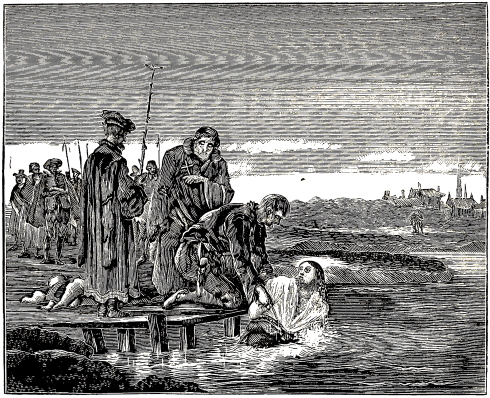
MATTHEUS MAIR DROWNED.
The same year 1592, on Mary Magdalene’s day, Mattheus Mair was apprehended at Wier, in the district of Baden. This was brought about by a priest, who upon coming out of the church, and noticing the brother, sent his servant maid after him, to see whether he should leave the village. He further commanded her, that she should so speak to him, as though she also wanted to become of his persuasion, and would like to go with him to his people; in the meantime he should come, and send other persons there, who should speak with him. With such words the maid delayed the brother, till the priest sent out some peasants, who apprehended him, and conducted him into the town of Baden. Six days after, namely, the 28th of July, as he would not follow them, nor renounce his faith, the ungodly pack of priests proceeded with him; however, what they talked with him, or what he answered them, this they did not allow to come to the light. When he was led forth to death, there were present his brother-in-law and several of his friends, who interceded for him, and also offered to give money for him; but they could obtain nothing, yea, not even to speak with him.
Now as he was going forth to death, he asked among the people, where his brother-in-law and friends were, and how they might come to him; saying that he had to charge them, that they should tell his brethren and sisters, to take care of his wife and child, for they were with a pious people. This he spoke aloud among the people. Then one of his friends among the people consoled him and said, that he should not yield, but be valiant; he should soon have overcome. Thereupon one smote the friend, who had said this, for it, and said that he was also a heretic, and ought to be treated like the rest. Now when the executioner had thrust brother Matheus into the water, he drew him out again three or four times, and each time asked him whether he would recant. But he always said, No, as long as he was able to speak; hence he was drowned, on the twenty-ninth day of the month of July, through the power of God steadfastly persevering in the faith. There was much said about his death, by high and low, as that they had murdered him, and the traitorous Judas and priest were cursed; for this Matheus was a well-known, good and pious man; hence God also gave him power to continue steadfast in the faith unto his end.
Note.—The envy of some of the Calvanists in the town of Middelborgh was at this time so great against the defenseless sheep of Christ, who had come to them from various papistic towns, to escape the distress and persecution, and expected to rest under their protection, that they paid no attention, and had no regard, neither to humble supplications nor the repeated commands of the Prince of Orange, who in the years 1577 and 1578 had given orders to the magistrates there, to let these people dwell in peace; but disturbed the peace of said people, and the practice of their religion. Hence Maurice, the oldest son of the aforesaid Prince, of honorable memory, following the footsteps of his father, issued, for the third time, a prohibition concerning the oppressing of the aforesaid people, to the end that they might now certainly obtain liberty of conscience, as appears from the following act:
Transcript.
Maurice, born Prince of Orange, Count of Nassau, Marquis van der Vere, to the honorable, most learned, wise, discreet, dear, particular, etc.
That which has been brought to our knowledge, on behalf of Mailjaert de Poorter, and Joost Leonisse, sawyers and wood-sellers, residing in the town of Middelborgh, you will learn at length from the accompanying request; and though we do not doubt at all, but that you will conduct yourselves, with the supplicants, in the points of their request and complaint, entirely according to the import of the resolution previously taken with regard to this, by the Lords States of Holland and Zealand; and will conform to such acts and letters as have been granted to the supplicants and their fellow brethren in the same profession, in the time of our lord and father the Prince of Orange, of worshipful memory; yet we would nevertheless hereby earnestly request you, seeing this matter concerns not only the town of Middelborgh in particular, but these United Provinces in general, that you will regulate yourself according to the import of the aforesaid resolutions, in all quietness and friendship, allowing the aforesaid supplicants and their fellow brethren to enjoy such liberties as have been granted them by said resolutions and acts respectively, until the aforesaid Lords General States of these United Provinces shall have further considered and disposed of the aforesaid matter. And besides that, we deem it reasonable and just, it is our pleasure.
And hereby, honorable, most learned, wise, discreet, dear, particular, we commend you to God.
Gravenhage, on the 4th of March, 1593.
Signed:
Your very good friend, Maurice de Nassau.
The superscription was: To the honorable, wise and discreet, our dear, particular Burgomasters, Judges and Rulers of Middelborgh, and was sealed with his Excellency’s seal.
Below was written: Compared with the original, and found to agree with it.
J. Milander.
Further Observation.—Upon this followed, it appears, some rest, so that the scattered flock of Christ began to increase some at that place, and to extend its membership. In the meantime, however, [in the dominion] of popery they were still persecuted to death; of whom, among others that lost their lives there, the following have come to our notice; from which the distress of that time, though there was rest in some places, can be inferred and judged.
AELTGEN BATEN, AND MAEYKEN WOUTERS, A. D. 1595.
Aeltgen Baten was an aged woman, and Maeyken Wouters a young woman of about twenty-four years. Both were born at Sonhoven, in the seignioralty of Vogelsanck, belonging under the territory of Luyck, and resided there. Through the grace of God they obtained the true knowledge of the holy gospel, believed the same, amended their lives, according to its requirements, and had themselves baptized upon the faith in Jesus Christ, according to his divine commandment and the practice of his dear apostles. As this however could not be tolerated, complaints were entered against them at Luyck, where the Court is held, and where orders were given to bring them thither as prisoners, which was done in the following manner: The lords of Luyck have certain beadles, called trappers, whom they send through the country whenever they want to have any one apprehended. They sent fourteen of these trappers from Luyck to Sonhoven, to apprehend these two women, or any others, and to bring them to Luyck. They first captured Aeltgen, and afterwards Maeyken and her brother (who was still very young), who had made themselves ready and it was the intention of both of them, if their father should have been taken, to go with him and not to forsake him; but as they did not catch the father, her brother also escaped the trappers.
Thus they began to conduct these two lambs to Luyck; but as they, on their way to Luyck, had to pass through Hasselt, a town about a league distant from Sonhoven, these two lambs were spoken to by many of their acquaintances at Hasselt, and it was greatly lamented, that they had to go to Luyck, into prison, and much sympathy and solicitude was expressed for them. Maeyken said to them: “If the Lord has so ordered it, I would rather go to Luyck (namely, for the testimony of Christ), than home. And thus they proceeded through the city, and went to Luyck, in all a distance of about eight leagues. When they got there, they were imprisoned ten weeks in the official’s tower. During this time, they showed each other great love, tending as it appears, much to edification and encouragement; for the young sister would gladly have borne in her own body, if it had been possible to do so, all the hardships which her dear, old sister suffered. They endured much vexation, being threatened, frightened, and also entreated, in order to turn them from the faith.
Once the bishop’s chaplain came to the young sister, with bland words, and brought a can of wine with him, in the hope that he should overcome her. With words of greatest suavity he presented to her the matter; yea, he got down upon his knees, and with folded hands begged her to recant and to believe the Romish church. But Maeyken proved herself faithful, and repelled the devil’s deceit, so that the tempter went away. On another occasion, a man from her village, who was acquainted with her, came to Luyck. He had heard that it was reported that she should have to die, and his soul was set on fire, and the matter excited his carnal sympathy, thinking: “And must that young girl die?” Hence he thought with himself, that he would talk with her, in order to see whether he might not move her. He therefore went to her in prison, and called Maeyken out alone, and said: “My dear Maeyken, O that you would obey, and yield a point, to be released from these bonds. When you get out, you can live as before.” Thereupon she replied: “My dear friend (calling him by name), would you advise me this, that I should forsake God and become a child of the devil?” The man said: “Then you will have to die.” Thereupon Maeyken said: “I should rather have this come to pass with us, than enjoy the light of day.” When the man heard this, he became silent, so that he turned around with weeping eyes, and said nothing more to her. They were both tortured and suspended on Thursday night; but they remained silent and fainted away. Then they poured water over Maeyken, upon which she cried aloud; but more than that they did not obtain from either. During the night they lay together quietly. On Friday night they sang with great joy. Having been thus imprisoned for a long time, they were finally brought into the official’s court, and condemned according to their spiritual law. When they heard their sentence, they thanked the Lord with a joyful heart, yea, with a laughing mouth. They then delivered these two persons over to the secular judge, who received them, and placed them again in his prison, in which they suffered great distress for a few days, on account of the uncomfortable condition of the prison. However the Lord ordered it, so that they took consolation and courage in the Lord, and Aeltgen’s husband sent her money and blankets for her needs, for which she thought she had no further use, and hence refused it altogether. She asked her dear sister Maeyken, whether she would have it. Maeyken said: “I have as little need of it as you, my dear sister;” for they trusted soon to live in all fullness and joy with the Lord. “Yes,” said Aeltgen, “if the door stood open, I should not wish to go away.” And since in all their sufferings they were so joyful in God, they thanked God in heaven in their hearts, and sang praises to him in prison.
Afterwards they wanted to sentence them by the secular law, which it was said, was done by four judicial persons, or judges, namely, that these two persons should be drowned (for the word of God), by being cast alive, bound, from the Meuse bridge. On that same Saturday there came to them to Luyck two men from their locality, to ask both of them, whether they had some word to send yet. Coming thus unbeknown, they found them in a chamber, where sat the lords to sentence them, and they were standing in their midst, and when Aeltgen saw her acquaintance she said to him: “Nephew, have you come to visit us once more? we trust to offer up our sacrifice within one hour; we thank you heartily for it, and I request you to please tell my husband, to bring up my children in the fear of God.” Maeyken also said: “Do bid my father and mother many adieus.” This they spoke while standing among the lords, expecting their sentence. The men tarrying a little, one of the lords bowed himself before Maeyken, begging her to recant and to believe in the Romish church; and her life should be spared. Thereupon Aeltgen said: “We want to die, as Christ’s apostles did.” Now when their last hour was approaching, both were brought forth from prison. Hence, both of them being rejoiced, they began to sing and to thank and praise God; but alas! the poor lambs could not long enjoy this; for what is granted to thieves and murderers, namely, to speak, of this they were deprived, and they were conducted back to prison, where their mouths were gagged, and they were thus, as dumb lambs, led to the slaughter and death. When they arrived on the Meuse Bridge, many and various reports of this matter were circulating among the common people. When they arrived at the place appointed, the executioner began to bind them, but they had to keep silent, until the executioner loosed the cloth that was before their mouths, and tied it over their eyes. Then Aeltgen first said: “O Lord, this is a beautiful city indeed; would that it repented with Nineveh;” and commending herself to God, the executioner forthwith cast her from the bridge down into the water, and she was instantly drowned.
The executioner then also released Maeyken’s mouth, so that she was heard to speak, saying to the executioner: “Grant me, that in my greatest extremity I may pray to God and call upon him.” The executioner said: “Pray to our lords the magistrates, and believe with us in the Romish church; and you shall save your life. Maeyken said: “I have never done amiss to the magistrates; hence I also need not to worship them;” but the executioner gave her a short answer, and giving her no time, cast her down from the bridge immediately; she did not sink instantly as Aeltgen, but with blooming cheeks she drifted upon the water for a long time, until, it is said, she had reached the lower side of the city.
Thus these two Christians ended their lives to the honor of God, on the 24th of July, 1595.
HERE FOLLOWS A LETTER WHICH MAEYKEN WOUTERS WROTE FROM PRISON TO HER PARENTS, AND TO OTHERS OF HER FELLOW BELIEVERS.
The abundant mercy of God our heavenly Father, through Jesus Christ his only Son our Lord, this I wish you, my dear father and mother, brothers and sisters, whom I love much from the heart, but our heavenly Father above all, for he has called me, that I should help him bear his sufferings, for which I have asked him many times, if I might be worthy of it. Hence I followed him with great joy.
My dear father and mother, think not (though I am bodily separated from you and the flock of Christ) that my Bridegroom will forsake me; think what he has said: Though a mother should forsake her child, yet will I never forsake mine elect, whom my heavenly Father has given me. Is. 49:15. Hence if it is his pleasure, I shall soon be delivered. But if you now deliver me with temporal wealth, you deprive our Bridegroom of his honor, and believe not that he will deliver me.
Hence, my dear father and mother, grieve me no more about paying the costs; for you have burdened me greatly, day and night, because I sent word to you so many times, that you should not ransom me, and you did not write me an answer.
Hence, my dear father and mother, speak with our friends, so that I may receive a comforting letter from you or from the others, which would be to me a great joy; for otherwise I desire no comfort from men, only from our heavenly Father alone, who is able to provide for us.
O dear friends, if I continue steadfast in that which my heavenly Father lays upon me, what great treasure I hope to gather thereby, which will fall to me hereafter, which is a great joy to me. O my dear father and mother, is this not a greater joy to you, than if I had not done according to your will, and had gone off with a young man, as you have doubtless heard of other girls? Hence rejoice and make melody to the Lord in your hearts, because the Lord has made me, unworthy one, worthy thereto and you have brought me up to God’s praise. Remember that there is still more written, where the Lord says: Blessed are ye, when men persecute and revile you for my name’s sake; rejoice and be exceeding glad then, for great shall be your reward in heaven. Matt. 5:11,12.
Know, dear father and mother, that I have been before so many lords and authorities, also priests and Jesuits, who sought nothing but to murder my soul. But the Lord our God gave me wisdom and understanding, and a mouth to speak which, I believe, was pleasing to our dear Lord. Very many times they predicted my eternal damnation, and said to me: “If you do not forsake your sect, and live according to the holy Roman Church, as the whole world does, you will, as truly as God is in eternal life, never attain to repentance.” Then I said to them: “I doubt not, but trust, that if we finish it by the help of the Lord, we shall through grace obtain the eternal joy.” Then they said to me: “God has nothing to do with you; you are a child of the devil; the devil has you by the throat, who will confirm you even unto the fire. God created you beautiful, and made you after his own image; and is it not a pity now, that you will have to die an ignominious death, and hereafter inherit eternal fire?” I said to them: “I will rather die, than apostatize from my faith, if it is God’s pleasure. Thus I am ready, much rather to-day than to-morrow; I will not fear men, who must die; but I will much rather fear my heavenly Father, who has given me my life; though I now, for his sake, lose it, he can give it to me again.”
Then they left me. The omnipotent, strong and mighty God, our heavenly Father, who always helps us to triumph, and does not forsake them that have put their hope in him, and never turn their faith from him, the Lord our God, who sits in the highest throne of glory, come to our aid; he alone is worthy to receive praise and thanks, honor and glory, and blessing forever and ever. Amen.
Hereby I most heartily greet my dear father and mother, brother and sister, with the peace of the Lord. Dear friends, when you offer up your prayers before the Lord, do not forget me, since I shall not forget you; may the Lord be our helper. Amen.
Once more, in particular I greet father and mother, brother and sister, and further all believers and lovers of the truth; let all pray heartily for me. I hope to be diligent, as far as the Lord has given me grace. God be with us all. Amen.
I had this letter written, when I was in prison for the testimony of the truth, in the town of Luyck, A. D. 1595. I, a feeble member of the Christian church, bearing now in my body the marks of my Lord. Adieu, now, all of you.
Maeyken Wouters.
ANNEKEN VAN DEN HOVE, 1597.
At Brussels, under the reign of the archduke Albert, there was apprehended for her faith and following Christ, a young maiden named Anneken van den Hove (being the servant-maid of Nicolaes Rampaert’s sister), having been betrayed, as it was said, by the pastor of the Savel church at Brussels.
This Anneken was imprisoned two years and seven months, in which time she suffered much temptation, from priests, monks, Jesuits and others, who thereby sought to make her apostatize from the faith she had accepted; but however great pains they took with her, in the way of examining, tormenting, fair promises, threats, long imprisonment, and otherwise, she nevertheless constantly remained steadfast in the faith in her Lord and Bridegroom, so that finally, on the ninth of July 1597, certain Jesuits came and asked her whether she would suffer herself to be converted, for in that case she should be released and set at liberty. Thereupon she replied: “No.” They then offered to give her six months more time for consideration; but she desired neither day nor time, but said: They might do what seemed good to them, for she longed to get to the place where she might offer up unto the Lord a sacrifice acceptable unto him. This answer having been conveyed to the judges, information was brought her about two hours afterwards, that if she wanted to die, prepare herself, unless she wished to turn.
Hence the justice of the Court, and also a few Jesuits, went out with her about eight o’clock, half a mile without the city of Brussels, where a pit or grave was made, while in the meantime she fearlessly undressed herself, and was thus put alive into the pit, and the lower limbs having first been covered with earth, the Jesuits who were present asked her: Whether she would not yet turn and recant? She said: “No;” but that she was glad that the time of her departure was so near fulfilled. When the Jesuits then laid before her, that she had to expect not only this burying alive of the body into the earth, but also the eternal pain of the fire in her soul, in hell. She answered: That she had peace in her conscience, being well assured that she died saved, and had to expect the eternal, imperishable life, full of joy and gladness in heaven, with God and all his saints.
In the meantime they continued to throw earth and (as has been stated to us) thick sods of heath ground upon her body, up to her throat; but notwithstanding all their asking, threatening, or promising to release her and take her out of the pit, if she would recant, it was all in vain, and she would not hearken to it.
Hence they at last threw much additional earth and sods upon her face and whole body, and stamped with their feet upon it, in order that she should die the sooner.
This was the end of this pious heroine of Jesus Christ, who gave her body to the earth, that her soul might obtain heaven; thus she fought a good fight, finished her course, kept the faith, and valiantly confirmed the truth unto death.
Since she then so loved her dear leader, Christ Jesus, that she followed him not only to the marriage at Cana, but also, so to speak, even to the gallows-hill, there cannot be withheld from her the honor and name of a faithful martyress, who suffered all this for his name’s sake.
Hence she will also afterwards, when going forth as a wise virgin, yea, as a dear friend of the Lord, to meet her heavenly Bridegroom, be joyfully welcomed and received in the heavenly halls of immortal glory, together with all steadfast servants of God.
O God, be merciful also unto us that are still living, that continuing faithful unto the end, we may with her, and all the saints receive thy blessed inheritance.
FURTHER OBSERVATION TOUCHING THE CAUSE OF DEATH OF ANNEKEN VAN DEN HOVE.
It was for a long time believed (which originated in the assertions of some adherents of the Reformed Church), that the aforementioned Anneken van den Hove died for the sake of the Calvanistic or so-called Reformed faith; but this was long ago justly contradicted, by written as well as by oral testimonies; among others, through a certain letter, which was written in the month of July (when she was offered up) by some one from Antwerp, to one of his friends; in which it is stated, in papistic style, that she was buried alive outside of the city of Brussels, because she belonged to the Anabaptists.
One year subsequently, namely, 1598, there was published, a printed work called the Apologia Catholica, by Franciscus Kosterus, in which, on page 160, these words are found: “Moreover, there was no injustice done at Brussels, to Anneken van den Hove, inasmuch as they proceeded against her in accordance with the old laws of the Emperor’s; nor need the Calvinists complain of the lords; for she was found a Mennonist and Anabaptist, who, Calvin himself confesses, ought to be punished.” See the aforementioned book, printed at Antwerp, by Joachim Trognesius, edition 1598, at the place referred to.
Subsequently, in the year 1601, another tract was printed and published at Antwerp, by Hieronymus Verdussen, entitled: Brief and true account of the sufferings of some pious and glorious martyrs, etc.; wherein she, near the close, is pronounced an Anabaptist.
Moreover, a certain school teacher and sexton of the papistic church at Aelst, who then resided in Brussels, near the Stone Gate, where she was imprisoned, and who often brought her food, made the verbal statement, according to creditable testimony, that she had such a faith and religion as the Mennonites, etc.
It was also then, and shortly after that time a common saying at Brussels, of those that had any knowledge concerning her views, that she agreed therein with the Anabaptists, etc.
OF THE DESTRUCTION OF SOME TYRANTS OF THIS LAST PERSECUTION.
We will abridge this century with which formerly also our old Offerboeck was concluded; showing the destruction of some tyrants, who were no small cause of this last and severest persecution of all.
Even as the old man whom King Antiochus had sent out to Jerusalem, notwithstanding he set up many abominations, and tyrannized against the law of God, could nevertheless not suppress the people of God and his law, but had to behold their increase [even] under the persecution, and besides see that the country was full of wars and commotions and resisted the king; even so it also came to pass with the aged Ferdinand Alvares de Toledo (also called Duke of Alva), whom King Philip II had sent from Spain into these Netherlands; however much he endeavored to make every one accept the abomination of idolatry, above God and his word, and however dreadfully he raged, utterly to exterminate the true lovers of the divine truth, and ardent followers of the holy gospel, yet he could not, to the satisfaction of his furious and blood-thirsty disposition, accomplish his presumptuous undertaking.
For under his severe and bloody persecution, the church of the godfearing, the pure bride of Christ, still constantly bloomed as a beautiful rose among pricking thorns, and was fruitful, to the praise of the Most High.
But he himself, who sought to rule over all Netherland lords, and to oppress others, met with resistance from some of those whom he sought to exterminate, who, however, were not of the defenseless sheep of Christ, so that, after he had for about seven years indulged his desire for bloodshed, slaying and murdering for the faith (when the country was full of war on his account), he had to depart in disgrace, and with him one John Vergas, who was a member of his council of blood; which many regarded as a punishment of God for his wickedness. But a still severer fate awaited Jacob Hessel, one of the chief members of his deadly court, and Jan de Vis, Bailiff of Ingelmunster; who, some time afterwards, were taken out of prison, without previous announcement, or sentence having been pronounced conducted without the city of Ghent, and hanged to a tree. And even as they had sentenced many others to death unexpectedly, so they also had to yield up their lives unexpectedly, and thus there was meted to them with the same measure with which they had measured to others. From this we can easily perceive God’s just punishment upon those who persecute and kill Christ and his members. Likewise in the case of the high Bailiff of Halewijn, named George de la Rave, who also participated in the tyranny over the children of God, by persecuting, dispersing and apprehending them, and otherwise. In the year 1571 he assisted in apprehending, among others, one Adriaen Jans Hoedmaecker (who was burnt at Rijssel on account of his faith), and in the year following, on the same spot where Adriaen had been apprehended, he met together with some intoxicated persons, with whom he and his servants fell into an altercation and fight in which he was wounded to such an extent, that he had to lie in bed with the wound for a long time and finally died a painful death in great distress of mind. Hence he had several confessors come to him, who could nevertheless not rid him of the gnawing worm of a torturing conscience; but he had to end his life as a tyrant in misery.
But especially can it be seen, how hard it is to kick against the goads, in the case of one Pieter Titelman, the Dean of Ronse, who was probably the chiefest inquisitor in Flanders. He was about this time in Kortrijck, smitten with a severe disease by God, lice growing out of his wicked body so abundantly, that he could not be kept clean therefrom, notwithstanding he was supplied with clean linen, and otherwise cleansed two or three times a day. No remedy could be procured and he died a most distressing and miserable death.
Concerning this Dean of Ronse it is also written, that having gone forth on a certain occasion with a small number of men, to apprehend these witnesses of God, and thus to deliver them into the hands of the torturers and slayers, he came; at evening, into an inn, where he met a bailiff, who had gone out with a great number of beadles, to apprehend vagrants and wicked men. The bailiff asked Ronse with surprise, how he dared trust his body with so few servants, to apprehend other people; for if I were to do so, said he, I would soon lose my life. Thereupon Ronse replied, that he had no fear in this respect, since he had gone out to catch only good men, from whom he had no danger to apprehend. Upon this the Bailiff, particularly reflecting upon Ronse’s words, answered: “If you arrest the good people, and I the bad, who then shall remain free?” Hereby this Dean of Ronse certainly bore testimony of himself, that he had laid his hands on the just, who had not resisted him. So it can also be perceived from this bailiff’s remark, that he himself well knew that the magistracy’s power ought to be used only for the punishment of the evil, and the protection of the good; and that therefore this Ronse and his adherents shamefully abused their authority on these people.
It also happened at Dixmuyden, in Flanders, in the year 1553, when the pious Wouter Capelle, who is mentioned in this book, was burnt for the truth, that there was a simple, harmless fellow, who was arrested by the lords of Dixmuyden. He begged in the streets, and was thus fed by good-hearted people. And since the aforementioned Wouter Capelle, (by trade a say-weaver) was very liberal in supplying the poor with food, communicating to them from the labor of his hands, it occurred, two or three days before Wouter was apprehended, that this simple fellow, late in the evening, came to Wouter’s house. Wouter asked him whether he wanted something to eat. He said: “Yes.” Hence Wouter brought him a piece twice until he did not wish any more. Now when it came to pass, that Wouter Capelle was sentenced to be burnt, this simple fellow cried: “You thieves and murderers, you shed innocent blood; this man has done no evil but has very kindly fed me.” And this he cried constantly, and as Wouter was brought forth to be burned, he also stepped near and wanted to run into the fire with the condemned man, so that they had to carry him away by force. And when he was dead, the burnt body having been brought outside of the city to the gallows-field, this simple fellow daily resorted thither, heeding neither snow nor rain, and stroked with his hands the burnt body, and said: “O poor fellow, you have surely done no evil, and yet they have shed your blood; and you have fed me so kindly.” Finally, when the body had been almost devoured by the birds, this man on a certain occasion took off the whole skeleton, laid it upon his shoulders, and ran in to the gate with it. Hence many people followed him, to see whither he should take it, but he went with it to the lord burgomaster of the city, and when the latter had opened his door, he threw the whole skeleton down into the hall, and said (also other lords being gathered there): “You thieves and murderers, if you have eaten the flesh of this man, eat the bones too.” And as the lords of Dixmuyden had erected an iron stake in the place where the aforesaid Wouter Capelle had been executed, for a token and lasting memorial, that such a heretic (as they regarded him) had been burned there; it came to pass that the burgomaster of said city, into whose house the skeleton had been thrown, became sick unto death, and his sickness so affected him, that in his delirium he cried out: That he had seen the angel of God fly over the stake with the soul of the burnt Wouter Capelle. And this he constantly cried, till the lords caused the iron stake to be removed; then he ceased his cry; but died most miserably shortly afterwards. In consequence of this, it seems, those of Dixmuyden were so frightened that afterwards they shed no more innocent blood.
Concerning this avenging hand of God, which he very signally exercised upon blood-thirsty tyrants and persecutors of his people, you may also read in an epistle of Menno Simon’s, S. G. folio 133,348 which the latter wrote in his time to Martin Mikron, and which partly related to the aforementioned Menno himself. It reads as follows:
“It is now about eighteen or nineteen years since that a very eminent and distinguished man, who was highly esteemed by the world, but whose name and country I will not mention, wickedly advised, how they should extirpate me and the pious. He had scarcely finished his words and wicked thought, when the avenging hand of the Most High touched him. He dropped at the table, and thus in a moment ended his impenitent, blood-thirsty, wicked, ungodly life in a most dreadful manner, O terrible judgment?” This happened about the year 1539.
“About the same time it happened to another man, who thought that he would so set his trap for me, that I could not escape, that he, in like manner, at the same meal he was eating, while speaking the words, was suddenly pierced by an arrow from the Lord’s quiver, being smitten with a severe disease, and thus had to give an account before the almighty, avenging God, and was buried within eight days from the time he had spoken these words.
“Still another, who was to become an officer to the Emperor in a certain place, fancied that he should exterminate this people, if there was any virtue in the imperial authority. He came to the place where he was to be located and serve in his capacity; and four or five days thereafter, the bell was tolled and the requiem sung over him.
Behold, thus God the Lord annihilates the designs of the ungodly who assail his holy mountain, and brings to naught all those that hate his truth and are inimical thereto.
“In the year 1554, it also occurred that three of our brethren were at Wisbuy in Gotland, for the purpose of earning a livelihood there. A preacher of that city, whose name was Laurentius, who was led by the spirit of his Father [the devil], cried after them on the street, and reviled them as much as he could, saying that they should not practice their religion there, though it should cost him all that was inside of his coat, namely, body and soul. A few days afterwards he came to converse with one of these brethren, another preacher also being present, who was somewhat more reasonable in disposition. He reviled, and carried on dreadfully; but the great Lord smote him in the presence of them both, so that he was suddenly deprived of his speech, and within twenty-one hours (alas!) was numbered with the dead. O terrible punishment and judgment of God!
“A case almost similar occurred the same year at Wismar, where they had accepted a crier, named Doctor Smeedesteed, who said that he would rather have a hat full of our blood, than a hat full of our gold. He persuaded the magistrates (who gladly have and want to hear such pillow makers) to proclaim just before cold winter, to the poor children, to clear the place before St. Martin’s day; or they should be put where they should not like to be. Smeedesteed was very joyous that he had accomplished the fulfillment of his heart’s desire; but to his sore judgment; for that very day the almighty, great Lord laid the hand of his wrath upon him, and within six or seven days took him away by an awful and severe sickness. Yet the hardened, blind and stupid world did not perceive it.
“A. D. 1555, it occurred again in that city, that there was a preacher, named Vincentius (who still lives there), who never grew tired of his ungodly reviling and severe reproaching. On the day they call the Lord’s Ascension day, he read from the Scriptures (Mark 16:16): ‘He that believeth and is baptized shall be saved,’ and said he should reproach and revile us, as long as his mouth was open. Instantly the strong power of God closed it, and bound his tongue, and he fell down in the pulpit, and was carried out by some of those present, as one punished of God, and taken into his house a dumb man. Behold, thus he can punish those who would touch and injure the apple of his eye.
“If I were to relate all the incidents which in my time befell the enemies of the saints, it would require a separate volume.” Thus far from Menno Simons.
It is appropriate to add here, what happened to the said godfearing Menno Simons himself. A traitor sold him for a certain amount of money, binding himself to deliver him into the hands of the tyrants, or he would lose his own head in stead; in which, however, to his own injury he did not succeed, though he put forth his utmost diligence to accomplish it. He repaired to their meeting, and diligently spied out a place where they assembled; but Menno in a miraculous manner escaped his hands.
It occurred also, that the traitor and the officer, who had gone out to seek and apprehend Menno, unexpectedly met him in a small boat on a canal. The traitor kept silence, till Menno had passed on a piece, and then jumped on shore, to escape with less peril. Then the traitor said: “See there, the bird has escaped us.” The officer called him a villain, and upbraided him for not speaking in time. The traitor replied: “I could not speak, for my tongue was held.” This was taken so amiss by the lords, that they severely punished the traitor, for a rigorous and instructive example to all bloodthirsty traitors.
Thus there can, by these and similar examples mentioned in divers places in this book, as also in both Testaments, in murderous Cain, Pharaoh, Jezebel, Antiochus, Herod, and many similar ones, be manifestly seen and perceived the avenging hand of the almighty God, and how grievously they offend against the God of heaven and earth, who here afflict, persecute and kill his people; and what intolerable punishment they have to expect at the coming of Christ from heaven; of which this temporal punishment is but a beginning and foretaste, seeing the Son of God, in the day when he will arise to avenge Zion, will regard all that has been inflicted upon his own, as though the apple of his own eye had been touched. Then shall all persecutors be sorry with too late repentance, and groan for anguish of spirit, who here condemned and killed the just, who did not resist them. Wis. 5:3; James 5:6.
Hence the wise woman Judith says in her song of praise: “Woe to the nations that rise up against my kindred! for the Lord Almighty shall judge them, and visit them in the day of judgment; for he shall put fire and worms in their flesh, that they shall burn, and feel it for ever.” Judith 16:17.
O how good were it for all tyrannical men, if they would consider and lay to heart these and similar passages of holy Scripture, and would fight no more against the high God, for it will be required of them at that day, before the judgment seat of Christ. Since faith is a pure gift, which comes from God alone, and hence can neither be given nor taken away by any man, however highly esteemed he may be. All princes and rulers ought also to commit the matter of faith to the Creator of all things, who alone is the discerner of the hearts and reins of all men, and who knows and beholds the hidden thoughts and intents of the heart, clear and uncovered before his eyes; before whose high majesty both the judge and the condemned must finally appear together. He will judge the world in righteousness, and offer faith to every one. Acts 17:31. He shall then judge according to truth, as to who believed and walked righteously or falsely. Hereunto we would from the inmost of our soul, counsel and entreat all lords and princes, as for their own welfare. O that God Almighty would be pleased to grant all princes and lords who have received the sword of justice, the grace, that they would use their sword and authority no further than only upon the bodies and goods of men in civil matters, for the punishment of evil-doers, and the protection of the good; to which end the same has been given them of God; and would let God Almighty be the Lord and Judge over the faith, souls, and consciences of men, which unquestionably belongs to him (blessed be he) alone. And that they would moreover consider, how very short and uncertain man’s life is, and how soon these earthly kingdoms can pass from one nation to another. And if the incoming lords hold different views than the former ones, city and country are instantly in great danger of revolt, uproar and destruction, if they want to force all their subjects to the religion which they have accepted; or the common people must resort to dissimulation and hypocrisy, to escape the punishment threatened; for such lords seldom lack preachers who for the sake of great prebends are willing to preach according to the pleasure of the lords.
And O that men would once consider, how many thousands of persons have for many centuries been deprived of life and property, on account of religious differences, because the magistrates (through the instigation of their preachers) would force them to their religion; which nevertheless wrought no improvement, but the conflict remained uninterrupted. But how utterly blind and unreasonable they proceed in this matter, it is easy to perceive; since we certainly, most clearly and abundantly find, that even the Lord’s apostles, which he had sent and highly enlightened, could bring but a very small proportion of men to one religion, and that in their time, besides the innumerable multitude of unbelievers and persecutors of the truth, were also many false apostles and deceitful workers, who preached Christ out of envy and strife, and not sincerely; so that Christ was preached in many ways, in season and out of season. 2 Cor. 11:13; Philippians 1:15,16. Who then shall believe that in this last and evil time, in which iniquity prevails, whole countries and kingdoms can be brought into the obedience of the apostolical doctrine, through the sword and constraint of the magistracy? The more so, since Christ himself says, that at his coming it shall be as it was in the days of Noah and Lot. Luke 17:26. Hence the Lord Jesus also seems to ask doubtfully: Whether, when the Son of man cometh, he shall find faith on the earth?
For the number of believers has from the beginning of the world been very small among the children of men; and not all men have faith, as Paul says; and the whole world, according to the teaching of the apostle, lieth in wickedness; and all that is in the world, the lust of the flesh, the lust of the eyes, and the pride of life, is not of the Father, but of the world, and the world and the lust thereof shall pass away; and Solomon seems to compare this world and all her ungodliness to a magnificently adorned woman, in the attire of a harlot, subtle, wild and stubborn, so that her feet could not abide in her house; whereby she seduced and deceived the foolish youth, so that he followed her in wickedness.
Compare with it now this present evil world; how one can see every city and country polluted with pride, boasting, cursing and swearing, tippling houses, tennis-courts, dancing halls, and shameful brothels, or houses of ill-fame, where one can perceive, with open eyes, what a countless multitude of people, especially of the young, gorgeously arrayed and adorned in honor of the world and the devil, allow themselves to be lured and seduced thither; whereas it is certainly known, and also unanimously acknowledged, by all the one another opposing sects, according to the express words of God, that the end of such a life and walk, without true fruits of repentance, is eternal death. Nevertheless, we do not find that the preachers, to prevent this wickedness, work with the authorities to punish and root out in every respect, by rigorous decrees and corporal penalties, this indubitable evil and soul deception; but in the point of religion (in which through the craftiness and subtlety of men, there are so very many articles of contention and doubtful and conflicting views) we see them labor with all their might, to punish, exterminate, and use constraint upon the faith and consciences of others, though the latter cannot be accused of any of the evils mentioned. Yet experience teaches, that many of these preachers are themselves so uncertain and wavering in their faith, that they would rather change their faith many times, according to the desire of the authorities, as the chameleon its color, before they would on this account forsake their large salary. Hence it is our hearts’ wish and earnest prayer to all rulers, that they would be pleased not to hearken to such treacherous preachers, who seek the loss and destruction of other people; but that they would use their authority for the punishment of evil doers and the protection of the good; so that we may lead a quiet and peaceable life under them, in all godliness and honesty; and at the last day may, together find comfort and grace before the judgment-seat of Christ, when we all shall stand so greatly in need of grace and comfort. To this end may the Lord strengthen and keep us by his Spirit. Amen.
CONCLUSION OF THE SIXTEENTH CENTURY.
We will take leave of this sixteenth century with a certain conclusion appended to the Martyrs Mirror of the year 1631; wherein we will say nothing, as far as respects the sense of the same, but what our dear fellow believers have said in that work.
We have here presented to you, kind reader, many beautiful examples (as we have found them in printed works of former times, as well as in those of more recent date, from different regions, from the criminal records of city and country), of men, women, youths and maidens, who faithfully followed their Savior, Christ Jesus, in the true faith, feared God from the inmost of their soul, and with a pure heart sought eternal life; who flourished and shone as bright lights, before all the world, in the love and power of God, their mouths flowing in wisdom with the holy word and doctrine of the Lord; which appeared more in the manifestation of the Spirit, than in elegant language or human wisdom; for their thoughts, words and actions were all to please their Leader and only Shepherd, for whose name’s sake they gladly delivered up their lives into temporal death, as not seeking to possess a worldly and peaceful kingdom here upon this earth, but, as true strangers, to journey to the eternal and heavenly fatherland, well knowing and having experienced, that they that will live godly must suffer persecution. There must also be noticed the difference between the children of God and the children of unrighteousness, between the persecuted and the persecutors, because we know, and it can clearly be shown from the holy Scriptures, that from the beginning of the world the unrighteous, whose works were evil, always envied, reviled, persecuted and oppressed those that were righteous and practiced virtue, for an unreasonable zeal impelled them to it. And it has been observed, that many times the teachers or leaders, who ought to have taught and led the people to the true religion, and into the way of life, misled them to idolatry and into the way of error and death. The shepherds, who ought to have carefully fed the sheep of the Lord with the word of God, and protected them against the ravening wolves, have fattened themselves, and paid no attention to the flock, but presented to them mostly human doctrine and the reasonings of their own mind; clothed themselves with the wool of the sheep, and thus, in the appearance of sheep but the nature of wolves, themselves been disturbers and devourers of the flock, or have delivered them into the talons of the eagle, and the teeth of the lion. So also, the ministers of God, who were endowed with great honor and dominion by the Lord, and who had received the sword to punish the wicked and to protect the good, did not content themselves with these high offices and honor, but, abusing their power, through instigation or ignorant zeal, laid their hands in the Lord’s husbandry, and inconsiderately plucked off the wheat for the tares; and though it tended to the salvation of the oppressed, it was nevertheless a presumptuous procedure, thus to root out, destroy and thoughtlessly condemn with an unjust judgment, the green plants in the Lord’s field, before the harvest; for no one but the Lord himself can truly know who is worthy of the fire or of the garner.
Hence there are no savants upon earth wise enough to step into any office of the only wise God, and to execute the judgment which he has reserved for himself; for who can fathom man’s heart, save he that sees all things, and knows all mysteries, who penetrates the hearts and reins, and knows the thoughts of all men. Such things indeed are not man’s province, for men are often, though they think they are standing, cumbered with sin, unbelief and perverted views, much more than they are aware of; and all that men know and believe here is but in part. Besides, the examiners of the faith can easily be blinded or deceived by lies and a hypocritical life.
Hence those who would defend persecuting and killing for matters of faith, and represent and urge it as right, accomplish no good by their fury, but instead of good wheat they gather much impure chaff, and fill the sheepfold with dissembling, hypocritical goats. And if any one thinks, that it does not behoove a king or prince to tolerate all sorts of doctrines, persuasions or heretics in his country, but that he may practice such a religion in it, as he understands to be needful for the salvation of his subjects, and to prohibit all others; such a one must also consider this, that if in any country several princes, differing in religion, should come to rule one after another, and each one, seeking to enforce his faith, pollute the land with the blood of its inhabitants, such a country would be nothing else than a hell, or a pool full of disquietude and oppression, where the minds of men would be in such lamentable misery, as ships, which on the dreary and turbulent ocean are rocked hither and thither in the storm by all sorts of winds, till they at last suddenly perish. But how can they so greatly hate and cast out any one for the faith, even though he should err? this is not the nature of the children of God, who do not oppress even the unrighteous, even as it is not the nature of the sheep to devour the wolves, but to flee from them, and suffer devouring.
And why will they force any one to the faith, which only God can give to man? He that errs, errs for himself; if he falls, he falls unto his Lord, who can and will lift him up again, for he calls and invites every one to it, offering to him water and fire, life and death; each may choose what he will. And this choosing, seeking or finding of a faith to his salvation, is certainly as free to every citizen or inhabitant, as it is to the king or prince; for does not Christ call to him all that are burdened and heavy laden? Hence no one may think, that such calling concerns only the rulers, and that it is enough for the subjects, to look to and follow them. O no! each shall have to give an account for himself; for at the last judgment every one’s heart, whatever his rank or title, shall be equally closely searched; the counsel of every heart shall be made manifest; each shall receive reward according to his own works; and it shall not concern only the princes or the shepherds. No one shall there be responsible for another, but every one shall find his own burden heavy enough to carry. However, one need not be surprised, as though some new or strange thing happened, if God thus tries and purifies his elect. For if even the Prince of life and of salvation had to enter into his glory through much suffering; if the way to get into the joyful kingdom was so narrow for him, how shall his followers get there, except by the same way? What guilt was there in him? What wickedness, uproar, or crimes did he commit? Why was this harmless, innocent, spotless Lamb (which sought the harm of no one, but the welfare of all) persecuted so malignantly? What made the blind scribes so incensed at him? and why were they so exceedingly eager to follow the advice of inconsiderate Caiaphas? And was not the cause of all this the fact that mad ignorance urged them on? which so ofttimes inflamed the heads of the people, so that they (as though it had been a great service to God) wanted to exercise dominion over the minds as well as over the bodies of men, and use the sword to constrain the faith as well as to civil unity. However not all rulers were infected with this madness, for it was seen that the Gentiles, who were called strangers to the knowledge of God (as Felix, Festus, Agrippa, Gallius, and the like), were more considerate in well administering the office they had received, in careful maintenance of the common peace, and, according to Gamaliel’s wise counsel, committing to God the dominion over the faith, than the envious Jews, who according to the promise ought to have been children of God and true branches in the true olive tree. And thus we see, that God, who does all things according to his good pleasure, at some times and places, still grants such authorities who do not compel their subjects in matters of faith, but only seek their peace and welfare; even as we in our time lived to see a Polish and also a French king, who did not so strictly examine their subjects concerning their faith, nor investigate whether the same agreed with the common belief; but solely, whether their course of action tended to hinder or advance the welfare of the country, which they considered with sincere love and sought to promote.
Herein also not too much praise can be bestowed upon the Lords States of the United Netherlands, who, however vehemently they have sometimes been incited to it, do also not consent to such blind zeal in the way of constraint of conscience and investigation of faith. And since we are commanded to pray God for the magistrates, that we may lead a quiet, peaceable and godly life under them, how much more are we bound to thank God for his loving kindness, who also grants us the grace, that we may dwell under the protection of such authorities who oppose the wicked zeal of these blood-thirsty tyrants of conscience (as we have now enjoyed it in this country for about fifty years), and who according to their ability execute their offices, leaving the dominion and investigation of man’s heart and conscience to God.
We are also most solemnly bound to pray the Most High for them, that he will constantly keep them in this purpose, and moreover give them wisdom and understanding, so to rule their country and people, that all may tend and conduce to the peace of the subjects and the honor of God; that he may also give them such believing hearts, that they may truly know whereto they are set here by God, and, finally, walk before him in such a godfearing manner, that at the last day (when the crucified Jesus Christ shall appear with his mighty angels, in the clouds of heaven, as an almighty Potentate, Victor and glorious King, to execute vengeance upon all those that have not known God, and not obeyed the Gospel) they may also be glorified with all God’s saints, and appear with the elect believers in the resurrection and the revelation of the heavenly glory, to be clothed with the same, by the power of Christ, and with him to inherit the imperishable glory in perfection, and possess it forever and ever, without end. Amen.
AN ACCOUNT OF THOSE WHO SUFFERED IN THE SEVENTEENTH CENTURY,
FROM 1600 TO 1660.
SUMMARY OF THE MARTYRS IN THE SEVENTEENTH CENTURY.
[After the preceding, sixteenth century closed with the burying alive of Anneken van den Hove, in the year 1597, the following, seventeenth century commenced, not without threats, and the shedding of the blood of the pious witnesses of the Lord.
The first year of this century begins with a decree (though not unto death), published by those of Groeningen and Sneeck against the Anabaptists.
Huybert op der Straten. Trynken his wife, Pieter ten Hove, and Lysken te Linschoten, near Witgensteyn, for the aforementioned faith, led around the gallows, scourged and banished from the country, in 1601.
Hemes Nimrich, a teacher of the aforementioned people, and others, four years subsequently, namely, 1605, near Steyn, scourged out of the city, Hemes having first been led through under the gallows.
Marcus Eder and Hans Poltzinger apprehended on the 24th of April, of the same year, at Nimbach, in Bavaria, and on the 26th of the same month taken to Riet; and, for the steadfastness of their faith, finally put to death with the sword, and burnt with fire, on the 26th of August, A. D. 1605.
Hans Landis beheaded in the city of Zurich; further observations touching the circumstances of his death; for the year 1614.
An account respecting a certain prohibition published by those of Aerdenborgh against the Anabaptists, and what was done by the Lords States General of the United Netherlands for the abolishment of the same.
An extract from certain letters of said Lords States to the Lord of Haultain, Governor of Sluys, as also to the bailiff and magistrates of Aerdenborgh, for the cessation of the oppression began A. D. 1619.
A decree of those of Deventer against the Mennists or Anabaptists, A. D. 1620.
A note touching severe slanders against the Anabaptists in Holland, and how they, by a certain confession of faith, defended themselves before the States of said country, A. D. 1626.
The inauguration of the last Swiss persecution, as also the cause of the same, A. D. 1635.
The progress of the inauguration of said persecution in the castles Wadischwyl, Knonow and Groeningen, as also in the consistory, at Zurich, A. D. 1636.
Concerning said persecution, and the manner in which twelve brethren were apprehended, and imprisoned in the place Othenbach, at Zurich, as also how it terminated, A. D. 1637.
Hans Meyli, Sr., and his son’s wife, conducted to Zurich and imprisoned, A. D. 1638.
This year (1639), fruitful of martyrs and martyresses, many having suffered in prison, at Zurich, in body as well as in life; an account of whom is given in order; namely; Catharina Mulerin; the four sisters, Barbara Meylin, Ottila Mulerin, Barbara Kolbin, and Elizabeth Meylin; as also, Elizabeth Hilzin; the brethren, Hans von Uticken, Burckhardt Aman, Jacob Egly, Ully Schedme, surnamed Schneider, Jacob Rustenhel of Horgerberg, Stephen Zehender of Byrmensdorf, Ulrich Schneider, with his two sons, Henry Gutwol of Lehnmer, Hans Jacobs Hess, as also his wife.
A certain manifesto published by those of Zurich in excuse of the persecution commenced, answered and refuted by the persecuted; in the aforesaid year 1639.
Werner Phister, and his son’s wife, as also Gallus Schneider, Rudolph Bachman, and Ulrich Muller, put to death in the year 1640, at Zurich, in the prison Othenbach.
A supplication of those of Amsterdam to the council of Zurich, for mitigation of the persecution; as also the answer, A. D. 1642.
Felix Landis (the son of Hans Landis) dies of hunger and want in prison Othenbach, A. D. 1642; his wife delivered out of her bonds.
Rudolph Suhner, a young lad, follows in the footsteps of the aforesaid Felix, and also dies of want, A. D. 1643.
A number of women suffer much for the truth, namely, Elizabeth Bachmanni, Elsa Bethezei, Sarah Wanry, Verena Landis, Barbara Neff, and Barbly Ruff, about A. D. 1643.
Henry Boiler dies bound in prison, A. D. 1644.
A certain letter from Switzerland, touching the threats made by those of Berne against the Anabaptists in those parts, A. D. 1645.
Mention is made, A. D. 1650, of a decree published by those of Schaffhausen against those called Anabaptists.
A certain mandate proclaimed against the Anabaptists, three years later, namely, 1653.
Ully Wagman and another brother, both imprisoned; Ully dies A. D. 1654, while the other brother remained in prison long afterwards.
A certain letter from Mackhenheym, in defense of the brethren persecuted in Switzerland, sent to Amsterdam, A. D. 1658.
Seven teachers apprehended at Berne, namely, Ully Bogart, Anthony Hinnelberg, Jegly Schlebach, Hans Zaug, Ully Baumgartner, Christian Christians, and Rudi Peters. See year 1659.
A decree published by those of Berne, against those called Anabaptists, on the 9th of August, A. D. 1659.
A record of what the Lords States of the United Netherlands did with those of Berne, for the mitigation of the aforesaid decree, by letters of recommendation, as also of letters of recommendation of some Dutch cities in particular, for the same purpose; A. D. 1660.
Herewith this whole work, and consequently the whole Book of Martyrs, is abridged and concluded.]
This century will be brief, and extend not over much more than half a century. Neither will the martyrizations that occurred in it be so severe as those in any of the preceding centuries. Beheading people, or suffering them to die of want in prison, will be the severest punishments that were inflicted according to the body upon the following witnesses of the Lord. In the meantime, when the north wind of persecution began to blow its fiercest, according to the course of the times, the pleasant south wind of rest and liberty from persecution intervened. The most, however, mischief in this brief century, in the parts of Zurich and Berne, was caused by such as called themselves Reformed; others, who bore the same name, and especially the rulers of the United Netherlands (as being friends of peace, and enemies of constraint of conscience), opposed it, and kindly and in a fatherly manner protected the innocently persecuted ones, according to all their ability.
This work begins with Groningen and Sneeck in Vriesland, and ends with Zurich and Berne, in the confines of Switzerland. This is the order which we shall follow.
OF A DECREE PUBLISHED BY THOSE OF GRONINGEN AND SNEECK AGAINST THE ANABAPTISTS, A. D. 1601.
With the beginning of this century, when the constraint exercised by the papists upon the faith and conscience of the pious, began to cease somewhat, some who had separated from popery, and yet nevertheless retained the disposition of the papists, in the matter of oppressing others for their religion, poured out their bitterness not only upon those who had formerly oppressed them, but principally upon such as had never done them evil, but always good; however, not unto death, nor severe punishment of the body, but lighter and lesser penalties, of which those of Groningen and Sneeck were the inventors and inaugurators. Which decree, as far as it is directed against the Anabaptists, we shall copy literally.
THE DECREE.349
The burgomasters and the council make known: Whereas it has come to our certain knowledge that not only many in the city and in the jurisdiction of the same presume to exercise and practice, contrary to the treaty sworn to and made with the city, A. D. ’94, another religion than the Reformed, to the adulteration of the word of God, to the misuse of his holy sacraments, and to the offense and seduction of many persons; but that also nearly all disorders and abuses in and without the marriage state, and also others contrary to the Christian church regulations established and customary here, creep in and are practiced; and we by virtue of our office recognize it our duty to meet and check all this with proper penalties: therefore, we have ordained, and do ordain and decree by these presents, as follows:
Firstly, that the exercise of all other religions than the Reformed is herewith again strictly prohibited.
And if any one be found to allow his house or place to the Anabaptists, contrary to the church regulations of this city, for the purpose of preaching or holding meetings therein, he shall each time be fined ten dollars.
The preachers, as aforesaid, if found to be preaching, shall for each offense be fined ten dollars, or be imprisoned two weeks on water and bread; and when detected in thus preaching the third time, shall be expelled from the city or the jurisdiction of the same.
And all that shall be found attending such preaching or gatherings, shall each time be fined two dollars.
Whoever shall be found to have rebaptized any one, shall be fined twenty dollars; and when detected the second time, shall be imprisoned on water and bread, and expelled as aforesaid.
Again, unbaptized children shall not receive inheritance, according to the city statutes.
No one also shall be admitted to any administration or office, public or private, nor be accepted as a witness, except he render the solemn oath required for it.
And all that refuse such oath shall be punished as is proper according to law.
(Note.—Here follow two other articles, which do not properly belong to this matter; hence we have omitted to place them here; but proceeding we read thus:)
As regards the disposing of the aforesaid fines, one half shall go to the informer, and the other half, like other fines, fall to the city and its jurisdiction.
Thus resolved on the 5th of September, to be published by the bell on the ensuing Monday.
The aforewritten, touching the exercise of religion, was published by the bell, the 7th of September, 1601, old style.
See Chronijck van den Ondergang, edition 1620, page 1539, col. 2, compared with the apology of the decree, letter A., fol. 4; also, Tegenberecht, letter A., 3, 4.
FURTHER OBSERVATION.
Whether this decree by those of Groningen and Sneeck caused any serious oppression, then or about that time, by way of banishment or the like, to those baptized according to Christ’s ordinance, we have not been able to learn; but that they afterwards in those places proceeded much more severely than the decree justified, by hard imprisonment, etc., against those people, we have found only too much to have been the case; however to the great good and happiness of those who suffered this for the testimony of the Lord and his holy truth.
Moreover, said year did not end without the shedding of blood of the saints, and the spoiling of their goods, in the parts of Witgensteyn, as will appear from the following account.
FOUR PERSONS, NAMELY, HUYBERT OP DER STRATEN, TRIJNKEN HIS WIFE, PIETER TEN HOVE, AND LIJSKEN TE LINSCHOTEN, NEAR WITGENSTEYN LED AROUND THE GALLOWS, SCOURGED, AND BANISHED FROM THE COUNTRY, A. D. 1601.
In the year of our Lord sixteen hundred and one it occurred that Johann von Steyn, Count of Witgensteyn, Lord of Hamburg, being a member of the Calvinistic church, purposed to abolish the Romish and Lutheran doctrine, and at the same time laid his hands on the defenseless sheep of Christ, which were contemptuously called Anabaptists, and put them in prison.
Among these are mentioned by name, Huybert op der Straten, Trijnken his wife, Pieter ten Hove, and Lijsken te Linschoten, which latter, as we have learned, was an aged woman of over seventy years.
The first three mentioned were imprisoned twelve weeks, the latter seventeen days, she having been apprehended much later.
They suffered much temptation, by way of bitter threats as well as by entreaties, in order to cause them to apostatize; but when they (the persecutors) could not destroy their souls, or cause them to apostatize or depart from the truth all four were finally condemned upon a false accusation (namely, that they had been convicted with the holy Scriptures, which was altogether untrue, and that they would nevertheless continue in their deceptive heresy of Anabaptism, etc.) in this manner:
That all their property should be forfeited, and that each should be scourged with rods, to the number of about forty stripes, and moreover be forever banished from the country; which was accordingly done.
Thus, say the authors, they stripped these innocent, pious persons, led them around the gallows, and scourged them, spoiled them of their property, and shamefully drove them forth with empty hands, and sent them out of the country. See preface to the old Offerboeck, of the year 1615, letter iij, col. 1.
HEMES NIMRICH, A TEACHER OF THE ANABAPTISTS, TOGETHER WITH SEVERAL OTHERS, SCOURGED OUT OF THE CITY, FOR THE TESTIMONY OF JESUS CHRIST, HEMES HAVING PREVIOUSLY BEEN LED THROUGH UNDER THE GALLOWS, A. D. 1605.
Under the aforementioned Count of Steyn (or Witgensteyn) in Germany, though he was called Reformed, the Anabaptists also at this time, had to suffer much persecution for their faith.
A teacher of said faith, named Hemes Nimrich, was apprehended together with several others. “He was led to the gallows,” writes P. J. Twisck, “not knowing but he was to be beheaded; but when he arrived there, he was (as had been done to the preceding persons) led through under the gallows, and severely scourged; the other prisoners were scourged out of the city.” Chron. van den Ondergang, page 1590, col. 2.
MARCUS EDER AND HANS POLTZINGER, A. D. 1605.
On the 24th of April, A. D. 1605, two brethren, named Marcus Eder, a cart-wright, and Hans Poltzinger, a tailor, were apprehended for their faith and for the sake of the divine truth, at Nimbach in Bavaria, where they were traveling through and were betrayed. Early in the morning on the 26th of April both were taken prisoners to Riet, where they remained in confinement until in the fifteenth week. In the meantime they dealt with them in many and various ways, seeking to make them apostatize from the faith. Two Jesuits were also brought to them from the town of Oting, who were to instruct them, and teach them their faith. But they continued firmly and steadfastly in the true faith, and would not hearken to the voice of strangers. The priests at Riet often came to them, and wanted to persuade them to their faith; but the brethren said: “It is a faith of idolatry and fornication, a faith of sin and blasphemy, as the fruits testify.” And thus they did in no wise suffer themselves to be moved, but always defended themselves well according to the truth and the simplicity of Christ, concerning what God had made known to them; and thereto they would adhere unto the end; and though they, by God’s permission, should deprive them of their lives, they could not harm their souls.
Now when all the false doctrine of the priests could accomplish nothing with them, they gave them over to the executioner that he should try his skill on them, and had them twice very cruelly tortured, wanting to know of them, who had lodged them, and who they were to whom they wanted to go; the brethren however would not tell them, but said that it was not necessary for them to know.
Now when they could in no wise accomplish their purpose with them, there came, after much proceeding, an order from the government at Berckhausen, that they should be executed with the sword, and then burnt with fire.
When they arrived at the place of execution, brother Marcus requested the executioner, that he should first execute Hans, which he also did; and when this had been done, Marcus said to the people, of whom there were many present: “God be praised, my brother has overcome; and I will do likewise.” After these words brother Marcus was also beheaded, whereupon both were burnt together. This occurred on the twenty-sixth day of the month of August of the aforesaid year. The executioner had received orders, that if he should perceive that one of them wanted to recant, though he should already have drawn forth the sword, he should yet forbear and not proceed with it; but in this hope they were disappointed. Thus these two brethren testified to the faith and the divine truth valiantly and steadfastly unto death, with their blood; God, who gave them power and strength thereto, be praised and thanked forever.
The following brief account, which is found in the Chronijck van den Ondergang, page 1590, col. 2, will serve as a confirmation of the foregoing.
In the year 1605 (says the writer), on the 24th day of April, Marcus Eder and Hans Poltzinger, Anabaptists, were apprehended for the faith, at Nimback, in Bavaria, and taken prisoners to Riet, where they remained in confinement until the fifteenth week.
When they could neither by the Jesuits, nor by the priests, move them from the faith, they gave them over to the executioner to try his skill on them, and had them tortured twice very cruelly, wanting to know of them, who had lodged them, and who they were to whom they wanted to go; but the brethren would not tell them. Thereupon both of them were executed with the sword, and their bodies burnt together, on the 26th of August, of the same year. Compare the aforementioned chronicle with Jac. Th. Dal., and W. Att. letters.
HANS LANDIS, A. D. 1614.
That the bloody constraint or dominion over the consciences of men still obtains, is a sad thing, and especially is it to be deplored, that those who boast of being, more than others, followers of the defenseless Lamb, have not more the nature of the lamb, but much rather that of wolves in them. It certainly cannot stand as an excuse, that such a course is conducive to the maintenance of purity of the church; but it appears to be a hot zeal to weed out the tares (or what they judge to be tares); whereas the servants of the lord, when their zeal urged them to root out the tares, did not venture to do it: but asked permission, and when they were forbidden to do it, they forbore. If these would also ask, or examine the law book of their Lord, they would find there, that the Shepherd does not teach his flock to devour, but sends them as sheep among wolves; that it is also not his will, that the erring should be destroyed, but that they should be guided into the true way; and that he also does not desire the death of the sinner, but that he should repent and live. And many other similar doctrines, all of which tend to the salvation and not the destruction of men. But it is very evident that there is still a veil before their hearts, so that they cannot understand this; or that a frantic zeal has inflamed their hearts to such blood-thirst, that they cannot tolerate it, that any one should walk the way to heaven in any other manner than just as they have chosen it, and in which they want to compel every one to walk, as was seen in the year 1614, at Zurich, in Switzerland, in the case of a pious witness of the divine truth, named Hans Landis, a teacher and minister of the gospel of Christ, who had gone up the river Rhine, where he had his place of residence, to feed and refresh with the word of the Lord some souls that were hungering and thirsting for righteousness.
When the council at Zurich learned of this, they, instigated by the disposition of the envious scribes and Pharisees, could not tolerate this, but instantly caused it to be forbidden him, as though they had thought thereby to hinder the true progress of the word of the gospel. But he, who knew with Peter, that we must obey God’s commands more than the commandments of men, had such love to the truth, and to the young suckling’s on Zion’s breasts, that no human threats could induce him to forbear feeding them with the true food of the soul. Hence the enviers of the same apprehended him, and sent him ironed from Zurich to Solothurm, to the papists, expecting that he should forthwith be sent to sea or upon the galleys; but through the help of good-hearted people he was there released; but subsequently apprehended again and taken to Zurich, where he was rigorously examined concerning his doctrine, and when he would in no wise desist from his godly purpose or from his faith, they showed in him, that their decree of eighty-four years previous was not yet forgotten, neither had the spirit of it died of old age; for, according to the import of the same, they sentenced him from life to death, and hence, in the month of September of the aforesaid year, 1614, for the sake of the truth he was beheaded as a true follower of Christ. Which they nevertheless would not acknowledge, but pretended, and persuaded the common people, to deceive them, that he was not punished and put to death for his religion, but for his obstinacy and disobedience to the authorities.
In this they evinced their old nature of Pharisees; who, when they condemned to death the innocent Lamb, the Savior of us all, did not say that it was for his virtuous doctrine by which he converted man to God, but that he had to die for his blasphemy. And this is the nature of all tyrants, to heap upon the innocent, besides sufferings and death, also false accusations. But when the last day of judgment shall come, when they must also expect and shall receive a sentence for their inconsiderate sentences, and shall lament in amazement: “Behold, these whom we once had in derision, and a proverb of reproach, how are they now exalted;” then they shall too late repent of their wicked course, and lament it forever with gnashing of teeth.
But on the other hand, this pious martyr and witness of God, and all the righteous that are still under the altar and wait for the fulfillment of the number of their brethren who shall also make their robes white in the blood of the Lamb, shall receive a glorious reward, and shall then together, in shining raiment, with great boldness, as valiant heroes and confessors of Christ, with the wise virgins, be admitted by the Bridegroom to his marriage, where they shall enjoy eternal happiness, and possess the kingdom of the Father, prepared for them from the beginning. Amen.
FURTHER OBSERVATIONS TOUCHING THE PERSON AND THE DEATH OF HANS LANDIS.
Having through our good friends B. Louwr and H. Vlaming come into possession of a certain extract from a letter dated, A. D. 1659, July 19–29, from one of the preachers at Zurich, who witnessed the death of the aforementioned martyr, we have deemed it well to add it here, that is, as much of it as is necessary to be given here for fuller information.
“Further you remember,” he writes, “that Hattavier Salr. witnessed the beheading of Hans Landis, which I also still remember well, having seen it myself in the Wolfsstadt, the whole transaction being as fresh in my recollection, as though it had happened but a few weeks ago.”