First Part. (continued 8)
Joseph F. Sohm translation
Afterwards, in his first book on John’s Revelation, he says: “He is arrayed in a white robe, who is clothed with Christ, and is strong in the faith which worketh by love; but as many of you as have been baptized, have put on Christ.” Gal. 3:27. Bapt. Hist., page 408.
Nowhere in the holy Scriptures, are infants enjoined to put on Christ; but this is throughout and without exception said to believers. See Rom. 13:14; Gal 3:27; Eph. 4:24; Col. 3:10. These epistles were written and sent only to believers. But to remove all doubt, Primasius himself explains what he understands by this putting on of Christ, by adding: “and is strong in the faith.” This is certainly not anything that children can do; hence the baptism which he applies to such as he speaks of is not the baptism of infants.
NOTE.—At this time mention is made, in a certain African council, of certain people, as being agitators with regard to baptism, and how they should be suppressed. Compare Seb. Franck, Chron. Rom., Conc., fol. 48, col. 4, with our remarks in the account of the martyrs of the fifth century, on the year 497.
A. D. 498.—It is stated that at this time there lived and wrote, the excellent teacher, Fulgentius, who, writing, among other things on baptism says (lib. de fide, ad Petrum, cap. 30): “Rest assured of this, and doubt not in anywise.” Continuing he says: “That no man can receive eternal life, who has not previously been converted from his sins through repentance and faith, and through the sacrament of faith and repentance been redeemed, that is, through baptism; this is absolutely necessary for adults, namely that they repent of their sins, understand the common faith, according to the truth, and receive the sacrament of baptism (upon it).”
This is the only testimony of Fulgentius, respecting baptism, which we have been able to find; from which we can draw no other conclusion than that he esteemed baptism upon faith very highly, yea, that this, and no other, was considered true baptism by him; for when he speaks of baptism, he connects it with faith and repentance, and, hence, calls it a sacrament of faith and repentance, adding that it is necessary for adults. How could one speak more clearly and plainly of the true Christian and apostolical baptism, which is peculiar to believers and penitents. We will, therefore, let the matter rest, as having been sufficiently explained by Fulgentius.
NOTE.—It appears that the doctrine of baptism upon faith had at this time, A. D. 498, made its way even to the papal chair, which, however, we do not recognize. Bapt. Hist., page 463, Pope Leo I., in his epistle, declaims with great warmth against the Bishops of Sicily, Campania, Samnia, and Picena, because they baptized not only on Easter and Whitsuntide, but also on Epiphany and other holidays. Observe: this is utterly opposed to infant baptism, as we have shown elsewhere. On page 464, Pope Leo (Serm. 1, de natia Dom., cap. 4) thus exhorts those who had been baptized: “Remain steadfast in the faith which you have confessed before many witnesses, and in which you are regenerated.” Again, Leo writes (Epist. 4, ad Episcob., in Sicilia, cap. 6): “You plainly see that two reasons must be observed, in which the elect (that is, believers) are to be baptized.”
See, beloved reader, such is the power of truth, that even the mouth of the liar, yea, of antichrist, must confess it. But though Pope Leo confessed this, other popes declared those who confessed the same, heretics, yea, cursed, persecuted, and killed them, as shall be shown in the proper place.
At this time Fulgentius taught that the holy Scriptures contained all that was necessary for salvation—food for children, as well as for adults. S. Veltius, Geschlacht-register, 1649, page 123.
A. D. 500.—P. J. Twisck, in the conclusion of his account of the fifth century, complains of the desolation, both in civil and spiritual affairs, occasioned chiefly by the power of the Pope of Rome, saying: “In this time, and still longer, through the desolation caused in the lands by the invasion of many different armies, and by other destroyers, as well as through immorality and heresies, the best people and chiefest authors perished, piety and learning diminished, and whatever of good remained, became for the most part corrupted. For although the baptism of adults was still administered, and church history from the time of Christ up to about this period, does not in the least, as far as I know, mention infant baptism, the latter nevertheless, according to other writers, more and more lifts up its head, and this with papal pollution, is confirmed by a decree, and considered not necessary to salvation.” Chron., 5th book, page 174.
From this we may gather the reason why at times so few orthodox and good writers are found, and, hence, how it comes that in those early days, there was sometimes, for a long period, only one, or a few, who openly maintained baptism upon faith, and other wholesome articles of faith, of which we will not speak further now.
The statement, that church history, from the time of Christ up to about this time (A. D. 500), does not in the least mention infant baptism, gives rise to the grave suspicion, that the authors which appear to have written long before the year 500, were interpolated by some of their descendants who maintained infant baptism. A few instances of this kind we have already given, respecting the writings of Dionysius the Areopagite, Justin, Origen, and others.
But be this as it may, posterity must make the best of the aforesaid writings, as we also must now do; and, according to their account, infant baptism obtained at this time, and long before, in many of the (Roman) churches, though many kept aloof from it, so that even with them, it was not generally adopted until about the year 900, yea, almost to the year 1000, as we hope to show in the proper place, and as may be seen in various prominent authors.
In the mean time we have shown (which suffices us) that the fifth century was not without men who, opposing infant baptism, maintained baptism upon faith, according to the teaching of Christ, and confirmed it by doctrine and example.
NOTE.—It is stated that about A. D. 500, Clodovius and his people were baptized upon faith, or the confession of the same, by Remigius, Bishop of Rheins. Bapt. Hist., page 435. But he did not show himself a Christian in every respect, which we would not commend. Moreover, his two sons were baptized before his conversion as Blondus writes (lib. 3, decade 1, also Bapt. Hist., page 436), notwithstanding their mother, Clotildis was a godly, Christian woman, as is stated in Bapt. Hist., page 435. From this it appears that at that time, even among the Romanists, it was not a general custom to baptize infants, but that some permitted their children to attain to the years of understanding, before they were baptized; however in other places, in the Roman dominion, infant baptism was strictly observed. In the mean time the true Christians kept quiet, and practiced baptism upon faith, as has been sufficiently shown.
AN ACCOUNT OF THOSE WHO SUFFERED IN THE FIFTH CENTURY.
SUMMARY OF THE MARTYRS OF THE FIFTH CENTURY.
[First of all, mention is made of the tyrants who in the beginning of this century tyrannized over the defenseless lambs of Christ; among them are mentioned Isdigerdis, and his son Geroranes.
The bloody edict issued by the two Emperors, Honorius and Theodosius, against the so-called Anabaptists, is adduced, according to different versions, and explained.
The couplet of Prosperus, which proclaims to the candidates for baptism, that their baptism must be perfected by martyrdom, is explained.
Albanus, a pious teacher at Mentz,116 and others, martyred.
The threatenings of the Nestorian Emperor, Theodosius, against the upright teacher, Cyril of Alexandria.
The tyranny of Theodosius, Bishop of Jerusalem, against many upright people, especially towards a pious teacher of the church of Christ, whom he first caused to be scourged, and then beheaded.
Benjamin, a deacon, after suffering many torments, put to death with a knotty stick, in Persia.
The cruelty of Honoricus, the Arian King, towards certain bishops and elders who would not swear an oath, described at large, as also his destruction.
Thereupon it is shown in the margin, that about this time, in different councils held in Africa, there were made five hundred and five laws, some of them relating to infant baptism; the agitation about baptism, suppression of the same, etc.
The bloody oppression of the believers, which, it appears, occurred in the time of Fulgentius.
Two persons who denied infant baptism, condemned in a certain council at Carthage (as is shown in the margin); but we commit them to God. With this we conclude the fifth century.]
We now come to fulfill the promise we repeatedly made in the Account of Baptism in the Fifth Century, namely, that we would show that of those who were baptized according to the ordinance of Christ, and of those who defended them and their views, a number had to lose their lives on this account; and that others, who escaped death, were severely persecuted or had to suffer corporal punishment. In order to show this properly, we shall first notice the tyrants of this time, and their tyranny; and then the persons who through this tyranny were oppressed and suffered unto blood.
TOUCHING THE TYRANTS OF THIS TIME, AND THEIR TYRANNY, ACCORDING TO THE ACCOUNT CONTAINED IN THE FIFTH BOOK OF THE ONDERGANG DER TYRANNEN, FOR THE YEAR 401, PAGE 135, COL. 2.
Among all the cruel bloodhounds, and persecutors of the Christians may well be counted Isdigerdis and his son, Geroranes, who not only flayed and roasted the Christians alive, but also split reeds, and bound them, with the cut side inwards, tightly around the naked bodies of the martyrs, whom they then drew out by force, thus shockingly lacerating the bodies of the Christians. They also confined the steadfast martyrs, naked, in cells, bound them hand and foot, and then chased in a great number of rats, which, impelled by hunger, gnawed their bodies, and, in the course of time, entirely devoured them. Nevertheless, they could not, through these and similar cruelties, force many Christians to a denial of their Redeemer. All this is related in order to convey an idea of the cruel tyranny which was at this time practiced against the Christians. Compare with Chron. Leonh., lib. 2. Will Baudart. Denckw., lib. 5. Hist. Joh. Wega, lib. 4, cap. 3. Theodoret., lib. 5, cap. 39.
THE BLOODY EDICT ISSUED, A. D. 413, AGAINST THE SO-CALLED ANABAPTISTS, BY THE TWO EASTERN EMPERORS, THEODOSIUS AND HONORIUS.
In order to give a thorough account of this bloody edict, and this in the best possible manner, we shall present the different versions which we have found of it, word for word, and then state our own views in regard to the matter.
FIRST VERSION, ACCORDING TO THE ACCOUNT OF SEBASTIAN FRANCK, IN HIS CHRONIJK, 1563, FOL. 136, COL. 3.
“The most important matter in this transaction” he writes, “is the imperial code, which contains cap. 1, lib. 2, an edict issued by the Emperors Theodosius and Honorius, which reads thus: “If any minister of the Christian church is found guilty of having rebaptized any one, he, together with the person thus rebaptized, provided the latter is proved to be of such an age as to understand the crime, shall be put to death.”
SECOND VERSION, ACCORDING TO THE ANNOTATION OF MARTIN BELLIUS, IN THE TRACT, VAN DE KETTERS, EN OF MAN DE SELVE SAL VERVOLGEN, DEDICATED TO CHRISTOPHER, DUKE OF WURTEMBERG, PAGE 53.
“Since we must speak,” he writes, “of that imperial code, we will relate the following, namely, about the law contained in the first codex prohibiting rebaptism. Joined to the other, it reads thus:
The Emperors, Honorius and Theodosius, to A. A. Antonius, the magistrate:
If information is obtained that any one has rebaptized a servant of the Catholic [general] religion, he shall be put to death, together with the latter, who has committed a punishable crime, provided he is of an age admitting of the capability, to commit such (and has been instructed concerning the matter).”
THE ABOVE EDICT, ACCORDING TO THE ANNALS OF CARDINAL CESAR BARONIUS, IN HIS CHRONICLES, A. D. 413, NUMBER 6.
In that year, he writes, the Emperor Theodosius issued an edict against the Anabaptists, commanding that they should be put to death.
This was subsequently also quoted by the inquisitor of Leeuwærden, in his controversy with Jacques d’Auchi, in the year 1558. See register of the 2d book, on the name Jacques. Also, Introduction, fol. 47, col. 2.
These several versions of the edict of Honorius and Theodosius unanimously indicate three things: 1. That at that time, A. D. 413, there were people who were called Anabaptists. 2. That on account of this matter of rebaptizing, these people were exceedingly hated by the world, especially by the great. 3. It is shown how they were hated, namely, unto death, so that the command was given, that they should be punished with death. However, intelligent people well know, that Christ, our Savior predicted long before, that such things would befall his disciples and followers. Matt. 10:22; 24:9; Mark 13:9; Luke 21:12; John 15:19; 16:2.
Moreover, that the aforementioned people, against whom said edict was issued, were not strange, unknown, erring spirits, but such people as are also in our day styled Anabaptists; this not only the inquisitor of Leeuwærden, A. D. 1558, readily admitted, as has been shown in the proper place, but all the particulars of the last mentioned authors make it almost as clear as the sun at midday, that this is the general opinion of the Romanists. Nay, it appears that the edict of Honorius and Theodosius was carried into execution, not only A. D. 413, and in some of the subsequent years, but that it was no small cause of the last great persecution of the Anabaptists, which began about A. D. 1524, through the strong urging of the Papists, especially of their clergy, who, to all appearance, by it induced the Emperor, Charles V., to renew said edict against the Anabaptists of their time, as being an identical people, and of the same faith, with those who lived in the time of Honorius and Theodosius. At least, that many papistic magistrates put to death innumerable pious Anabaptist Christians, by virtue of said ancient edict of A. D. 413, appears with such certainty from various authors, that it cannot, with truth, be denied. Compare Seb. Franck, fol. 136, col. 3, with Martin Bellius, page 53.
Now the couplet of Prosperus was verified, namely, that baptism did indeed sanctify the true candidate in some measure, but that all this was perfected by the crown of martyrdom. This was afterwards rendered in German, by Jacob Mehrning, thus:
“Was heylligs bringt die Tauffe schon: Solchs gants erfuellet der Martrer chron.”117
Bapt. Hist., 2d part, page 413, ex Prosp. in Epigramm.
He means to say, that those who were then baptized, had to expect martyrdom. We shall therefore show what persons suffered at this time for the testimony of Jesus Christ, either by virtue of the abovementioned edict, or otherwise.
ALBANUS, A PIOUS TEACHER AT MENTZ, WITH OTHERS, MARTYRED FOR THE FAITH, A. D. 424.
In A. D. 424, eleven years after the Emperors Honorius and Theodosius had issued their bloody edict against the so-called Anabaptists, a pious teacher, who, intending to spread abroad the name of Jesus Christ, and promulgate the doctrines of the holy Gospel, had come to Mentz, was lamentably slain; as were also some others. Besides other authors, P. J. Twisck describes this, with these words: “When Albanus preached Christ at Mentz, he was martyred, together with others.” Chron., 5th book, page 149, col. 2, from Hist. Andr. 143.
THE SEVERE THREATENINGS OF THE NESTORIAN EMPEROR THEODOSIUS, AGAINST THE FAITHFUL TEACHER, CYRIL OF ALEXANDRIA, BECAUSE THE LATTER WOULD NOT ACCEPT THE NESTORIAN ERRORS, A. D. 429.
The Emperor Theodosius, not content with having, together with his co-emperor, Honorius, A. D. 413, threatened the aforesaid Anabaptists with death, seems to have finally been seduced so far as to endeavor to compel the orthodox believers to assent to the very absurd errors of the Nestorians. Among others, he intended to compel, as one of the chief opponents of said errors, Cyril of Alexandria, the purity and uprightness of whose faith was very conspicuous. He threatened him with a certain edict (apparently with severe punishment), if he would not desist from his views, or at least accept the doctrine of Nestorius. Of this we find the following account in the Chronijk van den Ondergang der Tyrannen: “Cyril, a celebrated teacher, strenuously opposed the heresy of Nestorius; but as the Emperor Theodosius, who, in many respects is greatly praised, was somewhat infected with the doctrine of Nestorius, he sent Cyril an edict, severely threatening him, if he would not assent to the doctrine of Nestorius. Fifth book, pag. 151, col. 21, from Merula, fol. 352.
THE TYRANNY OF THEODOSIUS, BISHOP OF JERUSALEM, TOWARD MANY UPRIGHT PEOPLE, BUT IN PARTICULAR, TOWARD A PIOUS TEACHER OF THE CHRISTIAN CHURCH, WHO WAS FIRST SCOURGED AND THEN BEHEADED, A. D. 453.
Not only the Emperor Theodosius, who was a secular judge, but also one Theodosius, Bishop of Jerusalem, who ought to have been a spiritual judge, yea, a shepherd and leader of the flock of Jesus Christ, caused no small disturbance among the orthodox, well-meaning, and beloved friends of God.
Of Theodosius, the secular Judge and Emperor, we have already spoken; we now speak of Theodosius of Jerusalem, who, though only the administration of the spiritual law was committed to him, nevertheless, showed himself not less of a tyrant than the former, oppressing on account of their obedience to God, not only the souls and consciences of men, but also their bodies, even unto death. With regard to this, ancient writers furnish us among others, with the following example: That he had a certain pious minister of the church of Christ scourged and beheaded, and after his body had been dragged through the city, he caused it to be thrown before the dogs; simply because the latter, together with other pious Christians, opposed his wickedness. Compare Merulae Tract, fol. 370, with P. J. Twisck, chron. 5th, book, pag. 160, col 1.
BENJAMIN, A DEACON OF THE CHURCH OF CHRIST, AFTER SUFFERING MANY TORMENTS FOR THE NAME OF THE LORD JESUS, PUT TO DEATH WITH A KNOTTY STICK IN PERSIA, A. D. 456.
This Benjamin was a deacon of the Christian church in Persia, who, when opportunity offered itself, also proclaimed the doctrines of the holy gospel to the people, at which Geroranes, the King of Persia, took such offense, that he caused him to be cast into prison, in which he remained without deliverance for two years. After this, a certain ambassador came to the King to transact some state business. Having heard of Benjamin and his dreary confinement, he besought the King to set him free. The King consented, yet on the condition, that the prisoner should not speak to any of his magi or priests of the Christian religion or dispute with them. The ambassador promised the King in Benjamin’s name that his command should be heeded. But when he came to Benjamin, and admonished him to this, Benjamin answered: “I do not wish to do what you have promised in my name. I can not withhold the doctrine of the light of the gospel, which I have received from God, from others, not communicating it to them; for I have learned from the gospel how severely those will be punished, who bury the talent which has been given them to gain something therewith, in the earth.”
In the meantime, the King, knowing nothing of the answer which Benjamin had returned to the ambassador gave command to release him from his confinement. Benjamin once more free, ceased not to exhort the people as before, and to set the light of the holy gospel on the candle-stick. When this had continued for about the space of one year after his liberation from prison, new complaints were brought against him before the King, who had him brought before him, and commanded him to renounce the God whom he served, on pain of bodily punishment. Then Benjamin asked the King: “What punishment, beloved King, does he deserve, who deserts and renounces thee and thy government, and submits himself to, and serves another lord?” The King answered: “Such a man deserves punishment on body and property, yea, the severest penalty of death.” Benjamin asked again saying: “What punishment does the man deserve who forsakes his God, the Creator of all things, in order to exalt one of his servants as God, and to give to a creature the worship due to God alone?”
These words so incensed the King, that he commanded his guards to sharpen twenty reeds and to thrust them between the flesh and the nails of his fingers and toes. But when the King saw that the pious martyr endured all this with steadfastness, yea, regarded it but very little, he, after other torments, ordered the executioners to prepare a knotty stick, which by cutting away the branches, was made as sharp as a stick of thorns. This he caused to be thrust into the nether part of his body, and then pulled backwards and forwards, until the faithful servant and professor of Christ ended his life under the hands of the executioners, like a defenseless lamb that is led to the slaughter and opens not its mouth. Compare the account of Abr. Mellinus, 2d, book, fol. 260, col. 1, 2, taken from Theod., lib. 5, pag. 38, and Merul, Graec., with the annotation of P. J. Twisck, Chron., 5th book, page 191, col. 1, from Hist. Eccl. Tripart, 2d, part, lib. 11, cap. 33, Hist. Andr. Hondorff, fol. 20.
THE CRUELTY OF THE ARIAN KING, HONORICUS, ALSO CALLED HUNNERICUS, THE SECOND KING OF THE VANDALS, TOWARDS SOME BISHOPS AND ELDERS WHO WOULD NOT SWEAR, AND OTHER CRUELTIES, A. D. 477.
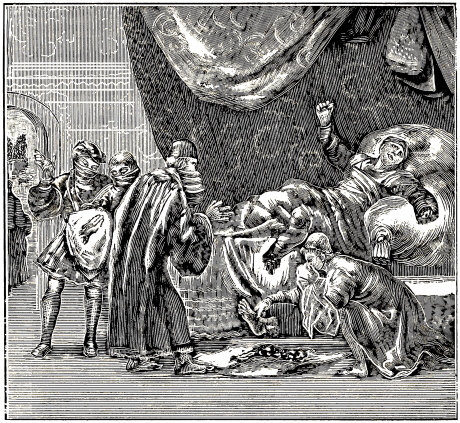
GOD’S JUDGMENT ON KING HONORICUS.
A. D. 477, Honoricus, King of the Vandals, an adherent of the Arian sect, arose with great violence against those who would not assent to his views, cruelly persecuting, and lamentably maltreating them. He had honorable women and maidens suspended naked; their bodies burned with torches; their breasts and arms cut off; hot pitch applied to their back, breasts and sides; he also caused them to be drawn up, and heavy stones tied to their feet, etc.
When he proposed to many that they should swear an oath, some thought it not contrary to God, but the bishops and elders of the church of Christ would not swear, saying that it was prohibited in the gospel, since Christ says: “Swear not.” Thereupon they were martyred, or at least severely punished. Those, however, who had been prevailed upon to swear, did not escape free, for, according to ancient writers, he punished both alike; these, because they had sworn contrary to the command of the gospel, and those, because they refused to swear.
In the meantime, the distress and misery were so great that scarcely a house could be found that was not filled with wailing and lamentations.
After this terrible tyrant had put to death, by these and similar torments, as well as exiled, a countless number, God, after many plagues had been sent upon that country, awfully punished him: worms and lice so gnawed his flesh that his whole body became putrified, one member dropping off after another, so that he was buried piecemeal, thus coming to a horrible and not less ignominious end—the evident vengance of God for his tyranny against the Christians. Compare P. J. Twisck, Chron., 5th, book, pag. 166, col. 2, with Chron. Carionis, lib. 3, fol. 29. Eccl. Caspar Hedio 3d, part, lib. 2, cap. 18–21, 25, 27, Chronol. Leonh. Krantz., lib. 3, fol. 87, 89. Paul. Merula, fol. 381, 382. Histor. Andr., fol. 180. Jan. Crespin, fol. 139.
NOTE.—It is stated that about this time, until the year 495, and afterwards, there were made in different councils held in Africa five hundred and five laws (called canons or rules), in which among other things it was resolved by the Roman church: 1. “That the children of the Donatists, (namely those Donatists who had renounced the doctrine of Donatus) shall not be re-baptized.” 2. “That those who say that a child is not to be baptized for the forgiveness of sins, etc., are excommunicated.” 3, Act. 23. That the agitation about baptism should be suppressed by military force.” Seb. Franck, Chron. der Roomsche Concilien, fol. 48, col. 2–4, etc.
NOTE.—From the third article it appears: 1. That at this time there were people who stirred up agitation about baptism, that is, infant baptism, for this was now practiced by the Roman church. 2. That these people were suppressed by military assistance or force. What views, besides this article, these people held, or in which manner they were suppressed, we have not been able to ascertain; hence we let this suffice.
THE BLOODY OPPRESSION OF THE BELIEVERS, WHICH, IT APPEARS, OCCURRED IN THE TIME OF THE TEACHER, FULGENTIUS, A. D. 498.
It appears that at this time the persecution and marytyrization of those who were baptized according to the ordinance of Christ was still in progress; of which the godfearing teacher Fulgentius makes mention to his contemporaries. Bapt. Hist., 2d part, page 464, num. 12, from D. Vicec., lib. 3, cap. 3, from Fulgentius, lib de fide ad petrum, cap. 30.
“Rest assured of this,” he writes, “and doubt not that those who, for the name of Christ are baptized in their blood, without which no man shall receive eternal life, that is, who has not previously been converted from his sins through repentance and faith, and redeemed through the sacrament of faith and repentance, that is, through baptism.”
When Fulgentius here speaks of those who, for the name of Christ are baptized in the blood, etc., he plainly indicates thereby, that blood was shed then inasmuch as people were baptized with it as it were, that is, such people as he speaks of further on, namely, “who are converted through repentance and faith, and redeemed through the sacrament of faith and repentance, that is, through baptism,” etc.
However, if to any one the above words of Fulgentius appear rather too obscure for the purpose in view, we leave him to the free and unrestrained enjoyment of his own judgment.
NOTE.—At this time, namely about the close of this century, those who opposed infant baptism were so hated by the Roman church, that in a certain council of Carthage, two persons, whose names we for certain reasons omit, were condemned, because they had denied infant baptism. Bapt. Hist. 2d, part, page 436, taken from the 9th chapter van de Doop gebruyken der Roomsche Kerke, fol. 460.
As to the persons themselves that were condemned, we commit them to God, since our only aim is to show how exceedingly the aforementioned doctrines were hated, and those who defended them, oppressed, yea, condemned at that time. With this we conclude our account of the martyrs of the fifth century.
AN ACCOUNT OF THE HOLY BAPTISM OF THE MARTYRS IN THE SIXTH CENTURY.
SUMMARY OF BAPTISM IN THE SIXTH CENTURY.
[Shortly after the beginning of this account, Alcimus is introduced who declares that baptism was prefigured in the suffering of Christ; his testimony, however, in regard to this, is reserved for another place.
Cassiodorus follows Alcimus, saying that in baptism believers are regenerated to new creatures.
He is followed by Fortunatus, who speaks of the virtue and benefit of baptism, saying that those who are regenerated by baptism, become children of God.
People who indicate that infant baptism is not in accordance with the holy Scriptures.
The council of Ilerda, in Spain, establishes various canons or rules against the Anabaptists and those baptized by them; forbidding to eat with them.
The council of Agathe decrees that all Jews who desire baptism must first be instructed for eight months, with the catechumens. Confession of faith preached to those desiring baptism (see margin as well as column).
In the first council of Constantinople it is decreed that the Eunomians and Montanists must first walk for a considerable length of time with the church [brotherhood], hear the holy Scriptures, and shall then, if found faithful, be baptized.
Of certain persons termed fanatics, who prevailed upon the imperial councilors, to abolish infant baptism.
Justus Origelitanus says excellent things with regard to the nature and efficacy of baptism.
One Peter, and his companion Zoroaras defend Anabaptism.
An account, from Gregory, of certain Jews, some of whom were baptized on Easter, others on Whitsuntide, after previous instruction.
Vincentius shows that it was customary to renounce, before baptism, all pomp, and the works of Satan.
Of the white robes put on the newly baptized, and the gifts it was customary to present to them.
How Brunechildis, the daughter of Arthanagildus, was rebaptized.
Of Euthimius, who entertained some that had been baptized, forty days; and how he admonished them.
Touching a certain prayer pronounced over the candidates, containing very beautiful sentiments respecting the dignity and benefit of baptism.
It is held that Theophilus Alexandrinus differs from the Roman church, in regard to holy baptism and the holy Supper.
The followers of Donatus again cited, and excused in various things.
Christian novices, before baptism, divided in two classes.
Statements with regard to the corruption of the writings of the ancients; yet that on the subject of baptism authentic testimonies still remain. With this we have abbreviated and concluded this century.]
Although in the sixth century, Roman darkness, as regards the corruption of divine worship, began to arise more and more, and the divine and evangelical truth necessarily had to sink out of sight at times, inasmuch as the Roman Bishop and others, who held with him, began, as it were, with the black smoke of manifold superstitions, shamefully and lamentably to darken the bright and transparent commands of Christ, as baptism, the holy Supper, the command not to swear, and others; so that baptism on faith was converted into infant baptism, the Lord’s Supper into a superstitious mass, the command not to swear, into a permission to swear, and other articles also greatly corrupted; yet in the meantime nevertheless, there were people, yea eminent persons, and even such, at times, as (living in quiet as they did) were reckoned to belong to the Roman church, through whom the aforesaid darkness was illuminated, the superstitions removed, and the pure truth of the holy Gospel brought to light as a brightly shining sun; inasmuch as they, opposing infant baptism, recommended baptism upon faith; abolishing the mass or transubstantiation, taught the simple Supper of Jesus Christ; rejecting, according to the doctrine of Christ and James, oaths and swearing, commanded the people not to use oaths, or to swear at all.
But it would require too much time to treat on, and show, all these things; hence we shall follow the custom we adopted in the beginning, and speak principally of baptism, showing briefly, by whom and in what manner the same was practiced according to the rule of Christ and the usage of his apostles, and confirmed by doctrine or example.
Alcimus writes (lib. 1, de Orig. Mundi) in the 6th Cent. Magdeburg., fol. 112, concerning the doctrine of baptism: “That baptism is prefigured in the suffering of Christ.” Thereupon follows a certain verse from Alcimus, in which baptism is compared to the water which flowed from Christ’s side, and to the blood of the martyrs; of which, however, we will not speak further at present, as we intend to reserve it for a place where it will be more to the purpose. Jacob Mehrning also notices this verse in Bapt. Hist., page 467.
A. D. 508.—Or at the time of the Emperor Anastasius, surnamed Flavius Valerius, the highly enlightened and gifted Cassiodorus, is stated to have lived and written, who says with regard to baptism (on Cant., cap. 7), “that it is a divine fountain, in which believers are regenerated to new creatures.” J. M., Bapt. Hist., page 467.
What else is this, than what our Savior himself says (Mark 16:16), that believers must be baptized; and (John 3:5), that one must be born again of water and of the Spirit; which accords with the words of Paul (Tit. 3:5), where he calls baptism the washing of regeneration, because, believers, when they are baptized, must forsake the old life, and be regenerated into a new life. Rom. 6:4.
Cassiodorus, on Cant., cap. 4, teaches (Bapt. Hist., page 468), That all believers shall (or must) be baptized. “There can be,” he says, “no believer without the washing of baptism (that is, no true believer, who can stand before God and his word, without baptism; for he who commanded faith, also commanded baptism).
Again, in cap. 7: “No one can enter the church, who has not previously been washed with the water of baptism, and made to drink of the fountain of wholesome doctrine. This well agrees with the words of the apostles, who thus testifies of himself and of the Corinthian church: “For by one Spirit we are all baptized into one body . . . and have been all made to drink into one Spirit.” 1 Cor. 12:13. By this, the apostle (like Cassiodorus) indicates that all who are true members of the church of Jesus Christ, must have communion in two things: First, they must have been made one body with each other by baptism. Secondly, they must have been made to drink into the Spirit, or the doctrine of the divine word; which, as every intelligent person knows, are things that cannot be complied with by infants, but only by adult and intelligent persons.
Cassiodorus, on Ps. 23 (page 469), says: “The water of refreshing is the washing of baptism, in which divine gifts are poured upon the souls that have become barren through the withering influence of sin, that they may bring forth good fruits.”
Again: “The souls of the elect (or of the baptized) have, in baptism, forsaken the corruption of the old man, and are renewed in Christ.”
Again: “As the people (of Israel) were preserved by the Red Sea, in which Pharaoh perished, even so, the church of the heathen, has been redeemed, through baptism, from the bondage of the devil, and brought into the true promised land, the liberty of the Gospel; and thus she (that is the church of the heathen) who was formerly a handmaid of iniquity, has now become the friend of Christ, and been washed, through baptism, from the filth of sin.”
Beloved reader, attentively consider the last three passages of Cassiodorus, and you shall find that they, in every particular, indicate that the baptism of which he speaks, is not at all infant baptism, but such a baptism as Christ commanded to be administered upon faith; for, when he says, in the first passage, that in (or through) the water of baptism, divine gifts are poured upon the souls that have become barren through the withering influence of sin, that they may bring forth good fruits, he certainly thereby indicates that he speaks of such candidates as had previously become barren through the withering influence of sin, and to whom gifts were now imparted in (or through) baptism (namely, by God, for the strengthening of their faith), that they might bring forth good fruits, which, as every one knows, can be done by none but adult and virtuous persons. By the second passage, in which he says, that the souls of the elect (or of the baptized) have forsaken, in baptism, the corruption of the old man, and are renewed in Christ, he again indicates that the persons of whom he speaks, had lived, before baptism, in the corruption of the old man, wherefore it was necessary for them to forsake it in baptism, and, by a pious life, to be renewed henceforth in Christ; but how this applies to infants, may be judged.
We now come to the third passage, in which he speaks of the passage of the people of Israel through the Red Sea. He compares the Israelites to those who, having been converted from heathenism, were baptized; the Red Sea, by which the people of Israel were delivered, he compares to baptism, through which those who had been converted from heathenism, had obtained their redemption, according to the soul, depending on the merits of Jesus Christ; Pharaoh, who was drowned with his people in the Red Sea, he compares to the bondage of the devil, from which believers are redeemed in baptism, through the grace of the Son of God; the entrance of Israel into the land of Canaan, he compares to the entrance of believing, baptized Christians into the true promised land—the liberty of the Gospel. Finally he says, in the same passage: “Thus she who was formerly a handmaid of iniquity, has now become a friend of Christ, and been washed from the filth of sin.”
All these things militate so clearly against infant baptism, and confirm baptism upon faith, according to the ordinance of Christ, that it seems unnecessary to me, to add anything further respecting Cassiodorus. The impartial will judge aright.
About A. D. 515.—Or properly after Cassiodorus, is placed, in the History of the Holy Baptism, the wise, but as it appears, excessively accused Fortunatus; from whose writings the author of said history adduces several passages, respecting which he makes the following annotation in the margin: “All the preceding commendations must be understood as referring solely to the true baptism of Christ, which is received as he has ordained it, and which consists in the word, Spirit, and water, and is obtained in (or upon) faith; and not as relating to any self-invented infant baptism.”
He then shows, page 468 in his account, what Fortunatus himself writes concerning it, saying: “Of the virtue and benefit of baptism, Fortunatus teaches (lib. 10 in Expos. Orat. Dom.): Man, when regenerated by baptism, becomes a child of God, who previously, through transgression, belonged to his enemy, and was lost.” “Man, before baptism,” he further says, “is described as being carnal, but after baptism, as being spiritual.”
In a letter of the orientals to Symmachus, it is written: “Christ our Savior has taken away, on the cross, our handwriting, that we might henceforward, after the washing of regeneration (that is, baptism) be no longer subject to the sins of our wickedness.”
These passages pertain only to adults, or at least to such as are possessed of understanding, but in no wise to those who have attained to neither years nor understanding; for it certainly means something, to be regenerated by baptism, yea, to be made a child of God, which Fortunatus, in the first instance, so expressly confesses.
Touching the regeneration of water and the Spirit, Christ did not command it to the unintelligent, but to a master of Israel, John 3:5; and of those who had put on Christ, through baptism, the apostle says: that by faith they became the children of God. Gal. 3:26,27.
Thus also it is a matter of moment, to be carnal before baptism, and spiritual after baptism, which he nevertheless adds: For, beloved reader, what is it to be carnal, but to live after the lusts of the flesh? This, says our author, is done before baptism; hence it is also evident that he speaks of a baptism before the reception of which one can live after the flesh.
What, on the other hand, is it to be spiritual, but to live after the inclination of the spirit? that is, according to the rule which agrees with the spirit, and the word of God; but this, he states, is done after baptism; hence it follows that the baptism of which he treats, is of such a nature, that he who has received it, can live after the Spirit.
But how can these two things, namely, to live after the flesh before baptism, and after the Spirit after baptism, apply to infants, of this he that has experience may judge.
That which is written to Symmachus, in the letter of the orientals, is of the same nature; for there it is said of regenerated baptized persons that after the washing of regeneration, that is, after baptism, they are no longer subject to the sins of wickedness; which sufficiently indicates that he speaks of such people as are subject, before baptism, that is, before they are baptized, to the sins of wickedness, but from which they are freed after baptism, through the grace of God and a holy purpose. Certainly, infants differ widely from this.
A. D. 520.—That at this time, and thence forward, there were persons who not only taught baptism upon faith as ordained by Christ, but who also, now and then, opposed infant baptism; this is unanimously maintained by the well-tried Jacob Mehrning, scholar of the holy Scriptures, and the very learned Montanus, in these words: “Nevertheless, as truth cannot remain suppressed, some were found, in the course of time, who, seeing that infant baptism did not accord with the holy Scriptures, dared candidly confess this. Of such there were many. A. D. 520, and from that time forward in this century, for several years in succession, as may clearly be gathered from the fourth canon of the council of Gerunda, in Spain, held the aforementioned year, in which it was decreed concerning catechumens, that they should be baptized on Easter and on Whitsuntide; but in case of feebleness or sickness, also on other days. From Cent. Magdeb., Cent. 6, cap. 9, de Synodi.
For, that those who were born of Christian parents, and had been brought up from their youth, in the Christian religion, were reckoned among the catechumens, is evident from the example of Ambrose, and his brother, Satyrus, sons of the Christian parents Symmachus and Marcellina, as may be seen in the oration of Ambrose, on the death of Satyrus; and it is further confirmed by the example of Theodosius, Ambrose, Jerome, Basil, M. Augustine himself, his natural son Adeodatus, and Alipius; who though born of Christian parents, as already stated, were nevertheless reckoned among the catechumens, till the day after previous instruction, they were baptized. Bapt. Hist., page 480. H. Mont. Nietigh., pages 79, 80.
Perhaps some one may think, in which of the preceding words is infant baptism spoken against? which is nevertheless so distinctly asserted by Jacob Mehrning and H. Montanus. We reply, that they do not express it in formal words, but indicate it by the circumstances which they adduce. For, when they, in the first place, speak of the fourth canon of the council of Gerunda, in Spain, in which it was decreed that catechumens should be baptized on Easter and on Whitsuntide, they thereby indicate that the baptism of new-born infants cannot have been practiced there, because infants are born not only on Easter and Whitsuntide, but throughout the whole year; and in another place it is stated that not only no catechumens, but no one else, should be baptized at any other time than Easter and Whitsuntide.
In the second place, when they declare that by the catechumens here spoken of, there are to be understood not only such youths, or scholars, as were of heathen descent, but also those born of Christian parents, as is proved by the example of Ambrose, Satyrus, &c., it shows that many Christians, at that time, left their children unbaptized till they, after sufficient instruction, as was given to the catechumens, were baptized of their own accord, on either of the two feasts, Easter or Whitsuntide.
Sebastian Franck calls the catechumens, of whom the aforementioned council speaks, scholars of the faith, and relates the decree of said council, as well as the time when the same was held, on this wise: “The council of Gerunda, held in the seventh year of King Theodoric, passed, among nine decrees, also this: That the catechumens, that is, the scholars in the faith, should be baptized only on Easter and Whitsuntide, except imminent death should require it otherwise.” Chron. Rom. Council., fol. 73, col. 1.
About A. D. 525.—Or in the 15th year of Theodoric, King of France, those of the Roman church again found themselves in great embarrassment with regard to the so-called Anabaptists. The matter rose to such a pitch that it was thought well to assemble a council against them, as had been done by Pope Felix, A. D. 487, at Rome. Accordingly, about A. D. 525, the second council against the Anabaptists was convened, not at Rome, as the first, but at Ilerda, in Spain; to which there assembled, as was usually the case, many of the bitterest papistic bishops—in order to extirpate, or at least check, the heresy, as it was called—who made a number of rules and laws, not only against the Anabaptists, but also against those who, having separated from the Roman church, had been rebaptized by them; of which rules, among others, the following are noted:
Canon 9. “Concerning those who through transgression have been rebaptized, and have fallen without necessity, it is our will, that the statutes of the Nicene synod be observed respecting them, which are considered to have been passed for such offenders: that they shall pray for seven years among the catechumens, and two years among the catholics, and then,” &c.
Canon 14. “Godly believers shall not eat with the rebaptized”. Bapt. Hist., pages 477, 478, from the 6th Cent. Magd,. cap. 9, fol. 240, ex Decret. Synod, Ilerdensis.
The 13th canon of this synod, also given in the same place, we suspect, has been misquoted; however, as it does not apply here, we leave it in its own merit.
That the 14th canon, however, which speaks only of the rebaptized, concerns the so-called Anabaptists, appears from the annotation of Sebastian Franck, of Wordens, in part 3 of his Chronijk, fol. 73, col. 1, who translates this canon thus: “The clergy and believers shall not partake of meals with the Anabaptists.”
From this it can be seen in what detestation, yea, abhorrence, the so-called Anabaptists in the time past, were held by the Romanists, inasmuch as they were not considered worthy to eat with, even as once the Samaritans, publicans, and sinners had been regarded by the Jews.
We will not investigate minutely, whether the so-called Anabaptists of that time held the same views, in regard to every article, with those who, at the present day, are designated by that name; nor will we, if perhaps in some points they did not teach aright, or were not fully enlightened, defend, much less, praise them; it suffices us, that they, besides other good and wholesome articles, mentioned by us in another place, held this in common with the Anabaptists of the present day, namely: That they did not approve of the baptism which by the Romanists is administered to infants, but rejected it, so that they baptized, or, at least, baptized aright at first, those who, having come to adult years, embraced their faith.
It also is praiseworthy in them, that they, notwithstanding the anathema of the Pope and the councils, yea, regardless of persecution, suffering, and death, as shall be shown in the proper place, maintained and manfully defended their views. We know of nothing further that we could say of them, from authentic writers, but will commend them, as well as ourselves, to God and his grace. As regards the manner in which they were proceeded against, in subsequent times, as well as how they conducted themselves herein, we shall show in the proper time and place.
About A. D. 530.—D. Joseph Vicecomes, in his treatise records (Bapt. Hist., page 482), the following testimonies from the sixth century.
Of the decree of the Christians, at Agathe, about A. D. 530, he says, lib. 3, cap. 1: “The council of Agathe, cap. 13, says: It is the will of all the church, that on the eighth day before Easter, the confession of faith be preached publicly in the church to those desiring baptism.”118
We do not especially favor the decrees of councils; yet, when they agree with the word of God, we accept them, not because men have uttered them, but because they have been pronounced already in the word of God. Thus, when it is said of all the churches which existed at that time, that it was their will that the confession of faith should be publicly preached on the eighth day before Easter; and also that it was added, how and to whom it was to be preached, namely, before those desiring baptism, we find not only that it well accords with the word of God, Mark 16:15,16, but, moreover, that not only a few individuals, but all the churches, namely, those which dissented from the church of Rome, held that view, namely, to baptize after previous instruction.
In the second place, when it is said here, that the confession of faith should be preached to those desiring baptism (that is, not to infants), it clearly follows that the candidates here spoken of, had themselves to desire baptism, yea, that they themselves had to profess the confession of faith preached to them, else there would have been no reason to preach it to them.
Vicecomes (lib. 2, cap. 2, page 483), quotes the following words from the 7th chapter of the first council of Constantinople: “As many of the Eunomians and Montanists as desire to embrace the faith, we receive, as we do the Grecians; on the first day we instruct them in Christianity, on the second day we receive them as disciples, and on the third day we bless them (or require them to renounce Satan); and thus we instruct them, taking care that they walk in the church for a considerable time, and hear the holy Scriptures, and then, and not before, if they are found upright, we baptize them.
This first council of Constantinople is placed, according to the order of D. J. Vicecomes, in Bapt. Hist., immediately after the council of Agathe, held about A. D. 530; and although we have long searched for it, we have not been able to ascertain the correct date of it; hence we make no change in the order.
After this, Vicecomes places the sixth council of Constantinople, in which several things illustrating the point we have in view respecting baptism upon faith are presented; but since we find from other writers, that said council was not held in this century, but many years after, Vicecomes having greatly erred in this, we will not proceed further with it here, but reserve our account of it for the proper time and place. We therefore turn to what is quoted in the 7th chapter of the first council of Constantinople, where it is said in regard to those of the Eunomians and Montanists who should desire to unite with that church, that they should not be baptized until they had been instructed one, two, or three days, yea, had walked for a considerable time in the church, and heard the holy Scriptures.
Take this matter, as you may, and it indicates that the Constantinopolitan teachers recognized no other baptism than that administered in their own church, namely, after previous instruction; notwithstanding the Eunomians and Montanists might have alleged that they had been baptized in their infancy; yet this was regarded as useless and of no value.
About A. D. 538.—It is recorded that at the time of Justin and Justinian, the Roman Emperors, there were people, termed fanatics by their opponents, who brought over to them and persuaded the imperial councilors and ministers, that infant baptism should be abolished; against which the aforementioned Emperors set themselves to prevent it. Concerning this, Jacob Mehrning, in Bapt. Hist., page 487, says: “M. Rulichius, page 249, from whom M. Glaneus quotes this, acknowledges (page 627) that at that time there came forth many strange fanatics (he calls them fanatics, though they were far more pious teachers and Christians than Rulichius and Glaneus, and reproved, from the ordinance of the baptism of Christ, the encroaching abuses of infant baptism) who prevailed on and persuaded the imperial councilors and ministers, that infant baptism should be abolished. But Justin, and other Emperors would prevent the same by their authority and interdiction.”
He then relates, from the constitutions [laws] of the Emperors, Justin and Justinian, in what the interdiction, or, at least, the decree, ordained by these Emperors respecting this matter, consisted; from which it can be seen, that not only was infant baptism rejected and contemned by those contemptuously called fanatics, but that even by the adherents of the Roman church it was not looked upon as a command, but merely as a matter which was permitted; though at other times again, through the decrees of popes and councils, it exceedingly prevailed.
In the meantime, it is gratifying to us, that even our opponents, who were strenuous advocates of infant baptism, I mean M. Rulichius and M. Glaneus, confess that also at that time (about A. D. 538), there were persons who sought to abolish infant baptism; from which it appears that the truth of baptism upon faith could not be suppressed to such an extent that it did not, according to opportunity, manage to raise its head; and that, on the other hand, the error of infant baptism did not triumph to such a degree that it did not have its opponents when opportunity offered. Thus blooms the rose among thorns, Cant. 2:2. God remains faithful to his promises, Ps. 33:4. Christ is with his church even unto the end of the world, Matt. 28:20.
About A. D. 542.—Justus Origelitanus says (in Cant., Bapt. Hist., page 469): “They that are baptized in the name of Christ, are filled with the Holy Ghost.” Doubtless, this has reference to Acts 2:37,38, where Peter says to those who inquired what they must do to be saved: “Repent, and be baptized every one of you, in the name of Jesus Christ . . . and ye shall receive the gift of the Holy Ghost;” which certainly was not spoken to infants.
Again: “The fair church of Christ,” says Justus, “is cleansed by the washing of water (that is, by baptism).”
Thus also Paul speaks, Eph. 5:26, saying that Christ has cleansed his church with “the washing of water by the word;” whereby he indicates that the believers of whom he speaks were cleansed not only with the washing of water (that is, baptism), but also by the word, that is, the doctrine of the Gospel; upon which passages Justus has based his declaration, though he, for the sake of being brief, it seems, is silent about the word.
Again: “They have ascended,” he says, “from the washing of water, when they, having received the forgiveness of sins by baptism, have increased in Christ.”
His speaking here of ascending, that is, climbing up from, the washing of water, and of increasing in Christ, clearly shows that he does not speak of infants, but of persons who have the ability to climb up from the washing of water, and to increase in Christ, which is peculiar to believers only.
He then gives some additional testimony, in the same place, corroborative of the point we have in view; but as it is expressed in almost the same language as that quoted above, we pass it by, so as not to repeat the matter.
About A. D. 545.—Or immediately after Justus Origelitanus, Olympiodorus is placed, who speaking of baptism, says: “The spiritual birth, which is effected by the washing of regeneration, resembles the death (of Christ) in that those who are regenerated, in this divine washing, are buried with Christ in baptism.” Bapt. Hist., 469, from Olympiodor., in Eccles., cap. 3.119
Certainly, this is clearly following, though in other words, that which the apostle presents to the consideration of the believing Romans (Rom. 6:3), where he asks them whether they knew not that they all who were baptized into Jesus Christ, were baptized into his death; that like as Christ was raised up from the dead by the glory of the Father, even so they also should walk in newness of life. We need not say anything further in regard to this, since the matter as to what persons and what baptism are here spoken of, is self-evident.
About A. D. 548.—Or 550, it is related, that one Peter, as well as one Zoroaras defended Anabaptism; but as to how and in what manner it was done, whether they rejected infant baptism, or whether they recognized no other baptism than that upon faith and administered in their own church, or otherwise, of this I find no other account than that recorded in Bapt. Hist., page 472, from Nicephorus, where it is said: “Nicephorus writes (lib. 17, cap. 9): Peter, Bishop of Apamea in Spain, and Zoroaras, a Syrian monk, defended Anabaptism.”120
But if these men have erred in other respects perhaps, which in that dark age could very easily have been the case, we would not justify it; it suffices us that they, as regards this article, dared oppose the common doctrine of the Roman church; which could not have been done without peril of life, or, at least, not without reaping calumny and obloquy.
About A. D. 551.—That it was customary at this time, to baptize on Easter and Whitsuntide, is recorded from Gregory, who says that several Jews were baptized on Easter, and several on Whitsuntide. Bapt. Hist., page 472, from Gregor., lib. 5, Hist. cap. 11.
That this custom of baptizing on Easter and Whitsuntide, pertained only to believing penitents, and in no wise to children, we have previously sufficiently shown; to which we refer the reader. But to remove all doubt, mention is also made in the same place, in the History of Holy Baptism, of the preaching or doctrine of faith which it was then customary to present to the novices, who were to be baptized. As an example of this is adduced the wife of Sigibert, who, having been rightly instructed in the faith through such holy preaching, was ultimately baptized. Bapt. Hist., page 472, from Greg. Turon., lib. 4, cap. 26.
About A. D. 553.—When, as it appears, the good old custom of renouncing and forsaking Satan, which was wont to be done publicly at baptism, in connection with the confession of faith, began to cease, or, at least, fall into neglect, it was revived and again brought to remembrance, by the teacher Vincent;121 concerning which the following observation is found in Bapt. Hist., page 473, from Vinc., lib. 21, cap. 6: “It was the custom, to renounce (that is, forsake), before baptism, all pomp and the works of the devil, which can certainly not be done by children.”
About A. D. 556.—At this time white robes were put on the newly baptized, after baptism. Thus, Gregory Turon (lib. 5, cap. 11), says—that at Avernio five hundred Jews were baptized at once, and then went their way, clothed in white robes.
Gifts were also presented to the baptized; thus, Guentheramus gave presents to Clotharius, when the latter had been baptized. Bapt. Hist., p. 484, from Gregor. Turon., lib. 10, cap. 27.
This putting on of the white robes after baptism, signified that the newly-baptized, having put off the garment of sin, must henceforth be clothed in the clean white robe of true righteousness and holiness; to which applies Eccl. 9:8: “Let thy garments be always white;” and Rev. 3:4: “They shall walk in white;” also, Rev. 19:8: “And to her was granted that she should be arrayed in fine linen, clean and white: for the fine linen is the righteousness of saints.”
As to the gifts presented to the newly-baptized, this indicated that God thus imparts his heavenly gifts and blessings to them; as Peter said to those whom he exhorted to be baptized: “And ye shall receive the gift of the Holy Ghost,” Acts 2:38.
However, if it should be, that with this putting on of white robes, and giving of presents, there was coupled any superstition (of which, however, we are not aware,), we would not commend, but rather speak against it. What we have in view here, is simply this, that such ceremonies were not, and could not be, performed with infants, inasmuch as the latter are too weak in understanding to comprehend, as well as in ability to perform, the same. Hence it follows, that such baptism, at that day, was not administered to infants, but to adult, reasonable, and believing persons.
About A. D. 560.—It is stated, from Adon. Aetat. 4, and Turon., lib. 4, cap. 26, that Brunechildis, the daughter of Arthanagild, had been baptized, probably in her infancy, by the Arians, but that subsequently, having been married to Sigibert, she was rebaptized in the name of the Holy Trinity. This is related more fully by J. Mehrning, in Bapt. Hist., p. 475. But whether Brunechildis continued in the true footsteps of the faith, after her rebaptism, of this we have no account; it suffices us to know that having been baptized, probably in infancy, by the Arians, she was afterwards, in adult age, rebaptized, or, at least, baptized aright, upon confession of faith; the first baptism having no foundation.
About A. D. 562.—Joseph Vicecomes (lib. 5, cap. 53), quotes Cyril Monachus, in the life of the Patriarch, Enthymius as follows: “When he had entertained for forty days, several persons that had been baptized, had admonished, and diligently instructed them in godliness, and inculcated in them, in various ways, the things necessary to their salvation, he let them depart in peace.” Bapt. Hist., page 484.
In what place and manner, and under what circumstances, the aforementioned persons were baptized, is not stated; hence we must be content with what is shown, from which we can infer that those persons were baptized upon faith, seeing they were yet confirmed, after baptism, in the doctrine of faith and godliness; and thus it follows that the custom of baptizing upon faith was practiced at the place where this occurred.
About A. D. 570.—Vicecomes (lib. 4, cap. 12), quotes, from Severus Alexandrinus, a certain prayer, which it was customary, at that time, for the teacher to pronounce over those who were baptized: “O God! take out from them the old man, which destroys himself through the lusts of error, and clothe them with the new man, which is daily renewed in thy knowledge.”
Again (lib. 5, cap. 27): “O Lord God! who hast imputed unto us redemption through Christ, and through the water, in the Holy Ghost, hast given to these thy servants, regeneration; thou, O Lord, who lovest light, confirm and uphold them in holiness, that they, illuminated by the light of thy grace, and standing before thy table, may be made worthy of thy eternal salvation.”
In chap. 38 he relates how the candidates, immediately after baptism, were brought to the holy Supper, and crowned with wreaths, and how the teacher then addressed them, exhorting them to joy and holiness of life, saying: “Dear brethren, sing a hymn of praise unto the Son of the Lord over all, who has crowned you with royal crowns. You have now, my beloved, received unfading crowns from the waters of Jordan, through the power of the Holy Ghost. Dear brethren, ye have put on to-day the glory of the baptism of the heavenly Adam.”
He finally adds the wish addressed by the teacher to God, saying: “The holy God give you holiness with this seal wherewith you are sealed, and mark you with the ring of a sweet-smelling anointing, by this baptism wherewith you are baptized; may he make you worthy of his kingdom, and crown you, instead of this perishable crown, with the crown of righteousness and every good work.”
Having quoted this much, Jacob Mehrning says: “All this is utterly inapplicable to infant baptism.” Bapt. Hist., page 486.
Same year as above.—It is stated that about this time there also lived Theophilus Alexandrinus, who, it appears, held views entirely different from those of the Roman church, with regard to baptism as well as to the holy Supper; so that he wrote against the manifold adjurations which were wont to be connected with the consecrating of the baptismal water, as also against transubstantiation or the essential change of the bread into the body of Christ, as follows: “A false Christian (namely, one who deems adjurations over the baptismal water necessary), does not consider that the water, in holy baptism, is sanctified by the word of God (which was wont to be spoken to the candidates who confessed the faith), and the advent of the Holy Ghost; and that the bread of the Lord, by which the body of our Savior is signified, and which we break for our sanctification, is consecrated through invocation of the Lord.” Observe he does not say, transubstantiated, but consecrated.122 See Bapt. Hist., page 486, from D. J. Vicecomes, lib. 1, cap. 14.
A. D. 586.—Long since, namely, for the year 317, we cited Donatus, and showed, according to Seb. Franck, Chron. Rom. Kill., letter D., that he was a very learned Bishop of Carthage, a native of Numidia, and that he taught that the Pope and his adherents did not have a Christian church, and, consequently, no true baptism; and hence held that those who had been baptized in the Roman church, needed to be rebaptized, saying that there was only one church, one baptism, one faith, one Gospel, and that no children should be baptized, but only believing adults who desired baptism. At first almost all Africa adhered to him. See the place indicated above.
This doctrine, however, did not die with him, seeing mention is made of his followers much later (namely A. D. 586), that they at that time, under the leadership of one Peter, Bishop of Apamia, rebaptized those who had been baptized by the orthodox (or Catholic) church. See concerning this, P. J. Twisck, Chron., 6th book, page 201, col. 1, from Greg. lib. 8, Merul., fol. 446. Also our account for the year 548.
NOTE.—-The followers of Donatus, of whom we speak here, have of old been severely accused by their opponents of gross errors, tyranny, &c., but are acquitted thereof by other celebrated authors. Nevertheless, we would not accept them in every respect, but only in those of their teachings which are good and true.
H. Bullinger compares them throughout to the Anabaptists, or as he calls them Baptists, saying: “Here our Baptists again disclose their ignorance, when they teach that no one should be compelled to that which is good, or to the faith;” and, continuing, he says: “They resemble the ancient Baptists, the Donatists, in every respect.” “These,” he writes further, “were of the opinion, that heretics should be allowed to live without restraint and with impunity in their faith;” that is, without persecution or blood shedding. They were opposed by Augustine. H. Bulling., lib. 5, fol. 216, 222.123
As to the accusations formerly brought against their faith as well as their life, these have been refuted by several prominent authors. “It would be desirable,” writes P. J. Twisck, “if we ourselves had their writings, doctrines, and deeds; for, if it is true, that they resemble the Baptists in every respect, and are not willing that any one should be compelled in matters of faith.” It is therefore sufficiently, as Bullinger says, evident, that they were unjustly accused. Chron., 5th book, page 147, col. 2. This is more fully spoken of in the account for the year 317.
About A. D. 600.—We will now bring the history of baptism in the sixth century to a close. We would adduce more writers in confirmation of said matter, but we fear that many authors of that time did not write faithfully and uprightly; besides, that many of their descendants, in order to give color to infant baptism and similar doctrines, appear to have corrupted their writings, of which many excellent men have complained.
Jacob Mehrning, in his Indachtigmaeckinge over het Doopsel, of the 6th century, says: “Thus the Centuriatores Magdeburgenses, also the two doctors, Calixtus and Brandanus Detrius, in their disputations about baptism, must themselves confess that in this century, and much longer, the Christian novices were divided into two classes, as in the primitive church, which observed a distinction between the catechumens and believing applicants for baptism, or the “elect,” as they were called by the ancients.
But continuing, he writes the following concerning the corruption of the writings of the true teachers: “Here must also be taken into consideration, that which the Centuriatores Magdeburgenses, Dr. Calixtus, Dr. Meysner, Dr. Johan Gerhard, Dr. Guil. Perkins, in Ementito Catholicismo, and many others so frequently complain of, namely, that the writings of the fathers and the primitive teachers of the church, have been so amazingly abused, in manifold ways, corrupted, interpolated and mutilated. Pray, who indeed will be our surety, that Augustine and others of the fathers have written and taught about infant baptism, all that is ascribed to them.
However, the fathers and teachers of the church, whose writings are extant, constitute but a very small part of the whole number. Were the writings, books and testimonies of the countless hundreds and thousands of other teachers of the church, bishops, and laymen experienced in the word of God, who have written, preached, taught, and spoken against it, in various parts of the wide world, to come to light, and could we also have the original manuscripts of the fathers, namely, those who have written against infant baptism, and compare them together, we would be astonished to see how faithfully the truth has been maintained in all ages, but also, how it has been suppressed by the innovators of baptism (that is, those who baptized infants). Yet, however mutilated and corrupted the writings of the fathers as we now have them, are, there are nevertheless to be found in them many very excellent testimonies respecting Christ’s true ordinance of baptism, and very confused ones as regards infant baptism; for which we owe special thanks to God, and to him only, who thereby mightily confirms us in the truth. Bapt. Hist., 2d part, pages 481, 482.
Thus, not we, but those who have unfaithfully dealt with the writings of the fathers, are the cause that we must here close our account of the baptism of this time; however, in some of the following centuries, where we meet with more authentic writers, we shall be able to explain and amplify this more conclusively.
AN ACCOUNT OF THOSE WHO SUFFERED IN THE SIXTH CENTURY.
SUMMARY OF THE MARTYRS OF THE SIXTH CENTURY.
[The verse of Alcimus, reserved in the preceding account of baptism in this century, is now adduced, as the first proof of the martyrization of this time, and circumstantially explained.
Mention is made of various severe persecutions that occurred about this time, of which fifteen are enumerated; it is also shown in what kingdoms, principalities, or countries they took place, as well as who the tyrants were by whom all this was committed against the Christian believers.
An explanation that it is hardly credible, that all the countries in which the aforementioned fifteen persecutions occurred, were subject to the Roman See; which is amplified, and its signification shown.
Arnold, a teacher of the Gospel, martyred in a forest, in France, and buried by his wife, presented as a pious martyr in the year 511.
In the margin (in connection with Arnold) a severe persecution in Arabia, A. D. 520, is spoken of; what inference may be drawn from it.
The oppression of the church and the servants of God, under Granus, son of the King of France, is noticed, for the year 562; then, in the margin, mention is made of forty Christian peasants, who suffered under the Longobards; however, for certain reasons, they are not absolutely accepted.
After this, for the year 566, other forty persons are mentioned, the most of whom were put to death with the sword, because they would not commit idolatry, or forsake Christ; in the margin an explanation is given with reference to this, and they are recognized by us as true martyrs.
Golauduch, a Christian woman of Persia, put to death, by the Persian Priests, A. D. 598.
Some remarks respecting the time in which Evagrius lived, who has recorded the last mentioned instance of martyrdom.]
Here will be the proper place to sing, with mournful voice, the blood-red verse of Alcimus, mentioned by us on a former occasion; as the author of the history of holy baptism places Alcimus at the very beginning of this century, which arrangement meets our approbation. With regard to the oppression of the Christians of his time, he expresses, in the German language, as a song of mourning, the following lines:
Der Kriegsknecht stach in Christi Seit; Wasser sprang aus der Wunden weit: Den Vœlkern das die Tauff bedeut; Der Martrer Blut auch so fleuszt heut. The soldier pierced the Savior’s side: There gusheth forth the wat’ry flood, A sign124 of the baptismal rite; Thus flows to-day the martyrs’ blood.
The question now is, what Alcimus meant to say by this verse. He treats of two things: 1. of Baptism; 2. of Martyrdom, comparing thereto the water that flowed from Christ’s side, when a soldier had pierced it with a spear.
I. Of Baptism.—Of this we shall say but little, since this subject has been sufficiently discussed in our preceding account of baptism as practiced in this century; yet, in order to proceed properly, and to pass by no part of said verse, we say that the resemblance which Alcimus here finds in the blood that flowed from Christ’s side, saying that it was to the people, or to the peoples, a sign of baptism, neither can nor may be applied as referring to infant baptism; for not only the sense, but even the words of the verse, would contradict this. As to the words, he does not say that said water is to infants a sign of baptism, which he certainly must have said, had he meant infant baptism by it; but he says that it was to the people, or peoples, a sign of baptism, which word (people, or peoples), in holy Scripture as well as in secular authors, is generally understood to mean adult, or, at least, intelligent persons, who can be taught, or to whom something can be signified; as, for instance, Christ said to his disciples: “Go and teach all nations, baptizing them,” etc. Matt. 28:19. Moreover, that infants are unable to understand the signification of little things, even to say nothing of this great mystery of baptism, is so clear that it cannot, with truth, be controverted.
II. Of Martyrdom.—This is what we have chiefly had in view; for he says in the last line of the aforementioned verse: “Thus flows to-day the martyrs’ blood.” Certainly, here he indicates that at the time when he wrote this, the blood of the (believing) martyrs was shed; for this is indicated by the word, to-day, which generally is understood to mean the present day; but here properly signifies the present current time. Moreover, as to the persons whom Alcimus notices as martyrs, and of whom he says that their blood flowed to-day, they cannot be understood to have been other than orthodox martyrs, or, at least, such as held the same views and doctrines with him; for the first, ancient, and true Christians called none martyrs, but their fellow-believers who had suffered or been put to death for the faith. From this, it would seem, has proceeded the old adage, which is still used: “Not the suffering, but the good cause from which he suffers, makes the martyr.”
Of the correct views of Alcimus, and, consequently, of those whom he calls martyrs, especially in regard to baptism, we have spoken before, and have also just now given some explanation with reference to it; which must suffice for the present. The impartial reader may decide for himself. In the meantime it behooves us to investigate and, if possible, show when, where, why, and how said martyrs suffered. But, not being able, on account of the scarcity of ancient writers, to ascertain all this, we shall content ourselves with what we do find in regard to it, and shall therefore endeavor to follow the most faithful and truthful records.
OF VARIOUS SEVERE PERSECUTIONS INSTITUTED IN AND ABOUT THIS TIME, AGAINST THE CHRISTIANS, IN MANY KINGDOMS, PRINCIPALITIES, PROVINCES, AND COUNTRIES, BY JEWS, HEATHEN, AND FALSE OR APOSTATE CHRISTIANS; OF WHICH WE SHALL BRIEFLY POINT OUT THE PRINCIPAL ONES.
We have counted from Abraham Mellinus alone, besides from many ancient writers referred to by him, who have more fully recorded the martyrdom of this time, fifteen persecutions in this century, which were raised most vehemently against the Christians, in various countries.
In order to condense this as much as possible, so as not to weary the reader, we shall not present the account of the aforementioned author word for word, but extract from it the pith and import thereof, and present it as clearly as is possible for us to do. In the 2d book of the History of the Persecutions, etc., under the head: “Exposition of Satan bound a thousand years,” fol. 293, col. 1–4, are described, in consecutive order, among other things, the aforementioned persecutions, within the bounds of the sixth century, namely, from A. D. 518 to the close of the century; which we have briefly summed up thus:
First of all, mention is made of many oppressions by the Jews, heathen, and others; by which all Christendom was kept in commotion, from the reign of the Emperor Constantine the Great, to that of Justin the Great (fol. 293, col. 2); however, since said oppressions occurred before the time of Justin the Great, that is before A. D. 518, we will leave them, as not belonging to the number mentioned by us.
OF THE PERSECUTIONS WHICH TOOK PLACE AFTER THE TIME OF JUSTIN THE GREAT, FROM A. D. 518 TO THE CLOSE OF THIS CENTURY.
1. It is stated that besides the persecution instituted in the beginning of the reign of Justin the Great, by Theodoricus, the Arian, against those who were called orthodox Christians, a certain Jewish tyrant, called Dunan, in the fifth year of Justin’s reign, violently persecuted the Christians in the city of Nagra. Fol. 293, col. 3.
2. Of Amalric, King of the West Goths, in France, it is stated that he heaped much vexation and contempt upon his own wife, Clotildis, because she was orthodox in the Christian faith. Ibidem, from Hist. Gall. and Isidor., in Chron.
3. It is declared that in the third year of Justinian the Great, nephew of Justin the Great, a persecution against the Christians was raised by the Samaritan Jews in Palestine. Ibidem, col. 4.
4. Afterwards there was also a short persecution of the Christian believers, by the Vandals, in Africa. Ibid.
5. Also, the Arian persecution of the Christians, by Totila, which is said to have taken place under Justinian, in Italy, is mentioned by the same writer.
6. Besides these the persecution originated by the Jews and Samaritans, at Cesarea, in Palestine, was repeated in the 29th year of the reign of Justinian. See above.
7. We read that in the time of Justin II., the Christian churches in Pers-Armenia were oppressed by Chosroe, the King of Persia. See above.
8. In the third year of said Justin, Alboin, the first King of the Longobards, invaded Italy, having sworn to annihilate all the blood of the Christians with the sword. Ibid.
9. At this time, also a Saracenic persecution against the Christians was carried on, by Manucha.
10. After this, Chilperic, an enemy of the Christians, exercised great cruelty towards them. Fol. 294, col. 1.
11. In the first year of Mauritius, Emperor of the Cappadocians, the Persians instituted a persecution with fire and sword, in Armenia. Ibid.
12. At this time, the Longobards, throughout Italy, did not cease to oppress the Christian believers. See same place.
13. About this time there was also a persecution in France.
14. Also in Spain.
15. In England the heathen sought to exterminate the Christians. For full information on the above persecutions, read, aside from the above references, A. Mell., pages 293, 294 and on to p. 303.
NOTE.—In said fifteen persecutions that occurred in this century, we notice that twelve different kingdoms, principalities, and other countries, are mentioned, situated not only in Europe, much less in Italy (which can also be reckoned only as a single country), where the Roman Bishops chiefly had their seat and ungodly dominion; but also, yea, for the most part, in Asia and Africa, which were far remote from Italy, being different parts of the world. The countries mentioned, in consecutive order, are these: 1. Nagra, a place or region in Arabia. 2. France. 3. Palestine. 4. Some region in Africa. 5. Italy. 6. Cesarea. 7. Pers-Armenia. 8. A certain country where the Saracens persecuted the Christians. 9. Another country, where Chilperic tyrannized. 10. Armenia. 11. Spain. 12. England. These are the countries mentioned, besides those that are passed over, but were also subjected to persecution.
Who will believe now, that all these countries were under the Roman Empire? Yea, more than that, what man of ordinary intelligence will think that they all adhered to the Roman See, and, consequently, that all the persons who were slain in said fifteen persecutions, professed the Roman religion? Surely, this does by no means appear; but the opposite is quite evident. In the first place, because we do not find, in reliable authors, that the authority and power of the Roman Bishop, or Pope, was so great at this time, that not only Europe, but also Asia and Africa, constituting the whole of the ancient or then known world, bowed to him; which would nevertheless have to be proved and established, for in these three divisions of the world are situated the abovementioned kingdoms, principalities, and countries, and the aforementioned persecutions occurred not only within, but also beyond their boundaries.
In the second place, that at this time there were people in different countries, who, not only in regard to baptism, but also in other points of religion, held views entirely different from what those of the Roman church understood and believed, is so clearly evident from our previous account of baptism in this century, that no reasonable person will dispute, much less be able to refute it.
Hence it follows, that to all appearance, in the abovementioned fifteen persecutions, not a few, or, at least, some, orthodox believers were put to death, as true martyrs; for such have of old been paramountly subject to persecution. We shall therefore investigate what people have at this time, as pious witnesses of Jesus, steadfastly testified to the truth of their Savior by their death, and sealed it with their blood.
ARNOLD, A TEACHER OF THE GOSPEL AND THE CHRISTIAN FAITH, MARTYRED IN A FOREST NEAR PARIS, A. D. 511.
It is stated that in the eleventh year of the sixth century, a certain pious teacher, by the name of Arnold, not willing to bury the talent given him by God, in the earth, but if possible, to obtain some spiritual gain for Christ his Savior, by preaching the Gospel, exchanged his life for death in the forests of France, and has thus been reckoned among the number of the pious martyrs. Concerning this, P. J. Twisck, among others, notes the following, for the year 511: “When Arnold preached the Gospel of Christ and the Christian faith in a forest in France, near Paris, he was martyred, and was buried there by his wife.” Chron., 6th book, p. 177, col. 2, from Chron. Nicol. Gillem., fol. 44.
NOTE.—All the particulars mentioned respecting said Arnold, clearly indicate the uprightness of his mind and views, as well as how far he stood aloof from the superstitions of the Roman church, which superstitions then had already risen very high. The latter especially appears from various circumstances.
First, Because it is stated that he did not preach the traditions and legends of the Romanists, but the Gospel.
Secondly, Because it is shown what he preached from the Gospel, namely, Christ and the Christian faith, but nothing about the power of the Roman bishop, or about the Roman faith.
Thirdly, because it is stated, according to ancient writers, that having been martyred for said faith, he was buried there (where he had been put to death) by his wife; but to have a wife the Romanists had many years before forbidden, to teachers and deacons, on pain of deposition. With regard to this, the article established about the year 495, in a certain papal council, reads as follows: “The priests, that is, those who also preach, and deacons shall abstain from taking unto themselves wives; if they do not observe this, they shall be deposed from their office.” Seb. Franck, Chron. Rom. Concilen, fol. 48, col. 4, from Concil. Aphr.
Fourthly, because we have found, in the ancient registers, in which the names of the principal ancient teachers and martyrs are recorded, not the least charge laid against this man, either of superstition, or anything else; although we searched diligently, and had others search.
NOTE.—It appears that about nine years after the death of said martyr, Arnold, namely, A. D. 520, a great persecution arose in Arabia against the Christians; of which P. J. Twisck writes the following: “A. D. 520, a seditious Jew, who pretended to be the second Moses, caused an awful massacre and persecution of the Christians, at Nagra in Arabia, in the reign of the Emperor Justin; he slew the pious Bishop Arethas and many thousands of Christians. Chron. 6th book, page 180, col. 1, from Nicephor., lib. 16, cap. 6. But as we have not been able to obtain reliable information, except that which we have shown, concerning this Bishop Arethas, as to whether he was a true and orthodox Bishop, as well as in regard to the many thousands of Christians who were slain with him, as to whether they professed a good profession of faith, which we doubt very much, we will not concern ourselves with them. Nevertheless, it must be considered, that among so great a number there were at least some, here and there, who died in the true faith, seeing the same were sometimes scattered in various countries. Of this we will let the well-meaning reader judge for himself.
THE OPPRESSION SUFFERED BY THE CHURCH AND THE SERVANTS OF GOD, UNDER GRANUS, THE SON OF THE KING OF FRANCE A. D. 562.
That believers and the leaders of the church of God had to suffer great oppression at this time, our beloved brother and co-worker in Christ, P. J. Twisk, deceased, in his time, signified to his cotemporaries with these words: “About this time (562), the churches and the servants of God were greatly vexed by Granus, the wicked son of the King of France.” Chron. 6th book, page 192, col. 1, from Paul Merula, fol. 431, hist. Wenc., fol. 78.125
ABOUT FORTY PIOUS CHRISTIANS SEIZED BY THE LONGOBARDS IN ITALY, AND MOST OF THEM PUT TO DEATH WITH THE SWORD, FOR REFUSING TO COMMIT IDOLATRY, A. D. 566.
Shortly after the death of the peasants just spoken of in the margin, as the heathen Longobards, according to their custom, were offering to Satan the head of a he-goat, about forty meek and pious Christians were apprehended. When their captors, in honor of Satan, had gone round their sacrifice, consecrated it by their sorcerous incantations and conjurations, and had bowed their heads before it, and worshiped it, they wanted to constrain the captive Christians to worship with them this head of the he-goat. But most of the Christians, preferring to die and strive for life immortal, rather than to live and worship the idol, refused to bow their heads, which they had always bowed in honor to God their Creator, before a vain and perishable creature. Thereupon, the enemies of God and his Anointed, who had not hesitated to fight against the Lord, and to kick against the pricks, put to death with the sword, all of said captive Christians who would have no fellowship with their idolatry; and thus they (the latter), all became blessed martyrs of Jesus Christ. Compare A. Mell. 2d book, 1699, page 299, col. 4, from lib. 5 Dialog., cap. 28.126
GOLAUDUCH, A CHRISTIAN WOMAN OF PERSIA, MUCH TORTURED, AND PUT TO DEATH, FOR THE TESTIMONY OF JESUS CHRIST, ABOUT A. D. 598.
About A. D. 598, in the time of the Emperor Mauritius, Golauduch, a woman of Persia, who had once been an adherent of the Persian religion, but subsequently become converted to Christ, and, consequently, had been baptized upon her faith, and remained steadfast in the confession of the Christian religion, even unto death. Of this, Evagrius makes mention, whom we take to be the same one of whom we have spoken elsewhere, and shown that he has described and commended as something praiseworthy, the baptism of candidates; that is of those who were baptized upon confession of faith. He writes the following of said Golauduch: “At that time (namely, in the reign of Mauritius), there lived among us, the godly martyress, Golauduch, who, having suffered many and severe torments at the hands of the magi or Persian priests, finally obtained the martyrs’ crown; of whose life, old Stephen, Bishop of Hierapolis, has written an account.” Compare Evagr., lib. 6, cap. 19; also, Nicephor., lib. 18, cap. 25, ex Act. Sabulosis, with A. Mell., 1619, fol. 301, col. 1.
Abraham Mellinus and J. Mehrning, however, differ in regard to the supposed time in which Evagrius (who, it appears, wrote the above account of the martyrdom of Golauduch), is said to have lived, J. Mehrning referring him to the middle of the fifth century, while Abr. Mellinus, on the other hand, places him almost at the close of the sixth. This difference of chronology we leave to them, holding, nevertheless, that they both wrote of one and the same person; who was a good historian and well versed in ecclesiastical affairs.
This person, then, called Evagrius, having commended as praiseworthy the baptism of the above mentioned candidates, that is, of those who had previously been instructed in the faith, afterwards, it appears, also makes mention of said martyress Golauduch, virtually calling her his sister in the faith, and a member of his church. For, when he says: “At that time, there lived among us, the godly martyress Golauduch,” what else does he mean to indicate thereby, but that said woman belonged to, and lived in, the very church of which he was a member, or, at least, whose doctrine he loved and cherished? Besides, we have not found anything laid to her charge, as regards her faith and good conversation, as has been stated of the preceding martyrs; hence we are satisfied with regard to her.
AN ACCOUNT OF THE HOLY BAPTISM IN THE SEVENTH CENTURY.
SUMMARY OF BAPTISM IN THE SEVENTH CENTURY.
[Adrian is mentioned as the first one who, in this century, declared himself, not so much in words as in deed, against infant baptism; as to the manner, however, in which the Romanists proceeded against him, shall be more fully spoken of elsewhere.
The Bracerensian papists, to prevent the decline of infant baptism, confirm it in a certain council.
The pious adhere to the true ordinance of the baptism of Christ, notwithstanding the power of the Pope and the decree of the aforementioned council.
In the mean time there were baptized (that is, in adult age), Anastasius, the Persian; Theodorus or Theodus; many hundred Jews; some in Upper and Lower Saxony; some in England.
Probation or examination in the faith, was at this time practiced by the orthodox, as did, among others, Amandus, Birinus, another teacher.
Those of the Jewish nation now became members of the Christian church; some of whom, after confessing the faith, asked for baptism.
How Zeno of Verona was wont to address the candidates; explanation of his address.
The example of the Egyptian divines, who preached the doctrine of faith, before baptism, to the candidates, is followed by others at this time.
The time for baptism, which was fixed on Easter and Whitsuntide, is ordained to every day, on account of infant baptism. The Pope also decrees that during the mass the kiss of peace be offered to the people, in order that the mass, which, it appears, was esteemed but little by many, might be regarded the more highly.
The believers were not turned away from their faith, by said papal decree; nay, it appears that even some of the Roman church declared themselves against the papal superstitions; as, 1. Isidorus, 2. Cesarius, 3. Adelheymius, 4. Agatho, 5. Julian Pomorius. In the mean time, mention is also made of Isidorus of Spain, and what he has written on baptism, namely of the applicants for baptism, and fellow-prayers.
The Christian parents, Lutgerus and Libuga, left their son Lutgerus unbaptized, till he, having accepted the faith in France, was baptized thereupon.
Finally, the difference between those of the Roman church and those who administered baptism upon faith.
Conclusion of the account for this century.]
Notwithstanding in this century the seat of anti-Christ was exalted to its highest altitude, inasmuch as the Emperor Phocas, A. D. 606, conferred upon the Roman Bishop the title of Papa, that is, Pope or Supreme Father, which name was first assumed by Boniface III., writing, in the decrees emitted by him to enjoin obedience: “We will, we ordain, we decree, we command, etc.; thus I will, thus I ordain, thus I decree, thus I command;” whereby many superstitions and human inventions were presented to the people as the word of God; such as image worship, salutation of the sacrament, observance of infant baptism as necessary to salvation, etc.; yet many pious people not only refused to obey all these things which the Pope prescribed, but some even flatly opposed it, daring to censure, reject, and contume, some in this and some in that respect, the papal and Roman superstitions, as among other points, was done with regard to infant baptism and all that pertains to it, with which not only some of the common people, but also some eminent and learned men were dissatisfied, so that they abandoned it altogether, yea, indicated by words and actions, that they were opposed to it; which became manifest even in Rome, as will be shown in the proper place.127
A. D. 606.—In this very year, in which the Pope was accepted, by Phocas, as the head of the general Latin church, the celebrated teacher and Bishop Adrian publicly opposed infant baptism, wishing neither to baptize the children himself, nor to have them baptized, but utterly refusing them baptism; on account of which he was accused by Gregory the Great, Bishop of Rome, to John, Bishop of Larissa, as appears from a certain letter sent by Gregory to John, in which, among other things, the following is contained: “The second article of the accusation against Bishop Adrian is this: that he refused baptism to infants, thus letting them die.” Centur. Magd., Cent. 9, cap. 4, page 141, according to the account in Bapt. Hist., page 496, and H. Mont. Nietigh., page 80.