First Part. (continued 5)
Joseph F. Sohm translation
Symphorian answered: “What matters it, if we deliver up this life to Christ, since, by reason of debt, in any event we must pay it to him? Your gifts and presents are mingled with the sweetness of the adulterated honey, with which you poison the minds of the unbelieving. But our treasures and riches are ever in Christ, our Lord, alone; and do not perish through age or length of time; whereas your desire is insatiable, and you possess nothing, even though you have everything in abundance. The joy and mirth which you enjoy in this world, is like fine glass, which, if placed in the radiance and heat of the sun, cracks and breaks in two; but God alone is our supreme happiness.”
After Symphorian had said these and like things before the Judge, Heraclius, the Proconsul, pronounced sentence of death upon him, saying: “Symphorian, having openly been found guilty of death, because he hath blasphemed against the holy altars, shall be executed with the sword.”
When this godly confessor was led to death, to be offered up to Christ, his mother called down to him from the wall of the city this comforting admonition: “Symphorian, my son! my son! remember the living God; let thy heart be steadfast and valiant. We can surely not fear death, which beyond doubt leads us into the true life. Lift up thy heart to heaven, my son, and behold him who reigns in heaven! To-day thy life will not be taken from thee, but be changed into a better one. If thou remainest steadfast to-day, thou shalt make a happy exchange: leaving this earthly house, thou shalt go to dwell in the tabernacle not made with hands.”
Symphorian, having been thus strengthened by his mother, was taken out of the city, and beheaded there, having commended his soul into the hands of God, in the time of Emperor Aurelian, and Heraclius, the Proconsul, at Autum in Burgundy. His dead body was buried by certain Christians. Compare A. Mell., 1st book, fol. 19, col. 4, and fol. 90, col. 1, ex Actis Proconsul. Greg. Turan. Degl. Confess., cap. 77, and Hist., lib. 2, cap. 15, with different other authors concerning Symphorian.
SEVERAL YEARS AFTER THE DEATH OF THE PRECEDING MARTYRS, A. D. 284, DIOCLETIAN ATTAINED TO THE REIGN OF THE ROMAN EMPIRE, AND SHORTLY AFTERWARDS ISSUED HIS FIRST EDICT AGAINST THE CHRISTIANS, WHICH WAS FOLLOWED BY A SECOND IN 302, CALLED THE Tenth Persecution of the Christians.
Before the tenth general and severe persecution of the Christians began, A. D. 302, many Christians were put to death in different places, and throughout this whole period, by virtue of the first edict of Diocletian. Of these we shall present a few, and then, with the beginning of the next century, proceed to the tenth and severest persecution.
CLAUDIUS, ASTERIUS, AND NEON, THREE BROTHERS, CRUCIFIED FOR THE TESTIMONY OF JESUS CHRIST; ALSO TWO WOMEN, DONUINA AND THEONILLA, TORMENTED TO DEATH FOR THE SAME TESTIMONY, AT ÆGÆA IN CILICIA, A. D. 285.
It is stated that in the second year of the reign of Emperor Diocletian, which coincides with the year 285, three pious Christians, spiritual as well as natural brothers, called Claudius, Asterius, and Neon, were accused to the Judge of the City of Aegæa, in Cilicia, of being Christians, by their stepmother, who, as it seems, was a heathen woman.
Two godfearing Christian women, named Donuina, and Theonilla, were also accused with them. They were all imprisoned till the arrival of Lysias, the Proconsul, who, on his tour through the provinces of Cilicia, also came to Aegæa, and there held criminal court against the Christians.
How Claudius was examined first.—Claudius being first brought before his judgment-seat, Lysias asked him for his name, and admonished him, not thus rashly to throw away the bloom of his youth, but to sacrifice to the gods, and thus obey the command of the Emperor, that he might escape the ready penalty.
Claudius answered: “Our God does not need these sacrifices; he has more pleasure in works of love and mercy towards our fellowmen, and in holiness of life; but your gods are unclean evil spirits, and delight in such sacrifices, by which they bring eternal punishment upon those who offer them. You shall therefore never be able to persuade me to honor them.”
Lysias said: “Bind him, and scourge him with rods; for there is no other way to tame his folly.”
Claudius said: “By these severe tortures thou shalt not harm me, but wilt bring down upon thyself eternal punishment.”
Lysias said: “Our lords, the Emperors, have commanded that the Christians shall sacrifice to the gods. It is their will, that the disobedient be punished; while to them who obey their commandment they promise honor and office.”
Claudius replied: “These gifts and benefits endure but a short time, but the confession of Christ imparts eternal glory.”
Lysias commanded that they should suspend him on the torture-stake, put fire under his feet, and cut off pieces from his heels.
Claudius said: “They who fear God with all their hearts cannot be overcome either by fire or by other torments; for they know that even these things are serviceable to them unto eternal life.”
Lysias commanded: “Let him be tormented with pincers, scraped or cut with potsherds, and burned with torches.”
Claudius said: “I say nevertheless, that thou doest all this for Satan, and that it conduces to my welfare, but tends to thy eternal perdition. Yea, thy fire and all these torments promote my salvation. Such is our condition, that those who thus suffer for the name of Christ, obtain eternal life.”
Lysias then commanded: “Desist from him; lead him back into prison, and bring forth another.”
Asterius examined.—When Asterius, the second brother, stood before the Proconsul, Lysias said: “Obey me, Asterius! sacrifice to the gods, and thus escape punishment.”
Asterius answered: “I shall not do it; for I worship the only true God, who has created heaven and earth, and who shall come to judge the quick and the dead.”
Lysias said: “Throw him on the rack, tear his flesh from his sides with pincers, and say to him: ‘Believe now at least, and sacrifice to the gods.’ ”
Asterius replied: “I am a brother of him who was tormented just now, and we hold the same confession of faith in Christ. Do what thou mayest; my body is in thy power, but not my soul.”
Lysias commanded: “Bind him hand and foot, stretch him out, and torture him; take the pincers, throw hot coals under his feet, scourge him with rods and thongs.”
Asterius said to the Proconsul: “Thou doest foolishly, since thou art preparing, not for me, but for thyself, much severer torments. Do thy best, for aught I care. I can stand it, if not one member of my body remains untormented.”
Lysias said: “Loose him, and keep him in custody with the other; and let the third one be brought forth.” This was done.
Neon examined.—When Neon stood before the judgment-seat, Lysias said to him: “Son, listen to me, and sacrifice to the gods, so that thou needst not suffer all this.”
Neon said: “There are no gods, neither have they any power. You worship idols, but I honor the God of heaven.”
Lysias said: “Take him by the throat and let the crier announce to him, to desist blaspheming the gods.”
Neon answered: “He that speaks does not blaspheme the truth.”
Lysias commanded: “Stretch him out on the rack; put coals under him; beat and cut him.”
Neon said: “I know what is needful for me. Whatever, then, is profitable to my soul, that shall I do; but I cannot be moved from my faith.”
Lysias having gone within to the other members of the tribunal, and having drawn the cover over the court, determined with them upon the sentence of death for the three brothers. When he came out, he read from a tablet their sentence, which was as follows: “Claudius, Asterius, and Neon, brothers, who are Christians, who blaspheme the gods, and refuse to sacrifice, shall be crucified before the forum, and their bodies be given to the birds of heaven as food, to be devoured by them; and this shall be executed by Eulalius, the jailer, and Archelaus, the executioner.”
However, before they were led forth to death, they were taken back to prison. Then Eulalius, the jailer, brought out Donuina, one of the women imprisoned, to whom Lysias, the Proconsul, said: “See, woman, this fire and these torments are ready for you. If you desire to escape unhurt by them, sacrifice before the gods.”
Donuina replied: “I shall not do it, lest I fall into the everlasting pains of hell. I serve God and his anointed Christ, who has created heaven and earth, and all that is therein. Your gods are of wood and stone, and are made by human hands.”
Donuina examined on the rack.—Lysias said: “Strip her stark naked, stretch her, and lacerate all her members with rods.” While they were beating her she died. Then said Archelaus, the executioner, to the Proconsul: “Your highness, Donuina has died.” Lysias commanded: “Let her dead body be thrown into the river.”
Eulalius, the jailer, then said: “Here is Theonilla.” Lysias said to her: “Woman, thou hast seen, what punishment they who were disobedient have suffered, and how they have been tormented. Honor the gods, therefore, and sacrifice, so that thou mayest be delivered from these punishments.”
Theonilla answered: “I fear him who has power to cast both soul and body into the fire of hell; and who will burn with it all those who depart from God, and give honor to Satan.”
Lysias said: “Smite her on the cheeks, throw her down, bind her feet, and torment her greatly.”
Theonilla answered: “Does it seem to thee, to be right and proper, thus to maltreat a well-born woman? Thou knowest, that thou canst not conceal from God what thou doest to me.”
Lysias commanded: “Hang her up by the braids of her hair, and smite her on the cheeks.”
Theonilla severely examined on the rack.—Having been stripped naked, Theonilla said: “Art thou not ashamed to uncover my nakedness, seeing that through me, thou puttest to like shame thy mother and thy wife, who are also women?”
Lysias asked whether she had a husband, or whether she was a widow?
Theonilla replied: “I have been a widow now for over twenty-three years, and have remained thus single, in order to more zealously serve God with fasting, watching and praying; which God I did not know until after I had renounced the world and the idols.”
Lysias commanded them, in order to disgrace her the more, to shave the hair from her head, put bundles of thorns around her body, and stretch her out between four stakes, then, to beat her over her whole body, and put hot coals upon her, that she might be consumed. When Eulalius, the jailer, and Archelaus, the executioner, had done all this, death ensued, and they said to Lysias: “Sir, she is dead now.” Lysias commanded that her dead body should be sewed up in a leathern bag, and thrown into the water; which was done. Thus did these holy martyrs suffer, under Lysias, the Proconsul of Cilicia, in Aegæa, on the 23d of August, in the second year of Diocletian, when he was Burgomaster with Aristobulus, A. D. 285. These acts have for the most part been taken from the records of the clerk of the criminal court of the city of Aegæa, and were gathered by the ancient Christians. These court documents were called Acta Proconsularia. Compare this with A. Mell., 1st book, fol. 92, col. 3, 4, and fol. 93, col. 1.
ZENOBIUS AND HIS SISTER ZENOBIA, BEHEADED AFTER MANY TORMENTS, FOR THE TESTIMONY OF JESUS CHRIST, AT AEGÆA IN CILICIA, A. D. 285.
Not long afterwards, under the same Emperor and Proconsul, and in the same year, Zenobius, Bishop of the church of Aegæa in Cilicia, and his sister, were apprehended; and when there were held out to him on the one hand, great wealth, honor, and position, if, in accordance with the command of the Emperor, he would serve the gods, but on the other hand, manifold torments, Zenobius answered: “I love Jesus Christ more than all the riches and honor of this world. Death and the torments with which you threaten me, I do not consider a disadvantage, but my greatest gain.”
Having received this answer from the martyr, Lysias caused him to be suspended on the rack, and inhumanly tormented on his whole body.
While the executioners were busy with Zenobius, his sister Zenobia, having learned of it, came running, crying with a loud voice: “Thou tyrant, what villainy has my brother committed, that thou dost thus cruelly torment him?”
Having thus addressed Lysias, and set at naught his entreating as well as his threatening words, she, too, was seized by the servants, stripped naked, and stretched out, and roasted beside her brother on a redhot iron bed, or roasting pan. The tyrant, deriding the martyrs, said: “Now let Christ come and help you, seeing you suffer these torments for him.”
Zenobius replied: “See, he is already with us, and cools, with his heavenly dew the flames of fire on our bodies; though thou, surrounded as thou art with the thick darkness of wickedness, canst not perceive it on us.”
Lysias, almost beside himself, commanded that they should be put naked into boiling caldrons. But seeing that the boiling water did not injure them, or, at least, that they could not thereby be made to apostatize, he had them taken out of the city and beheaded. Their dead bodies were buried by Caius and Hermogenes in the nearest cave. This happened A. D. 285, on the 30th day of October; in the city of Aegæa in Cilicia. Idem. Ibidem. ex Actis Zenobii procons. per Metaphorast.
THARACUS, PROBUS, AND ANDRONICUS, THREE PIOUS CHRISTIANS, FIRST VERY DREADFULLY TORMENTED, THEN THROWN BEFORE THE WILD BEASTS, AND FINALLY THRUST THROUGH, FOR THE FAITH OF THE SON OF GOD, AT TARSUS IN CILICIA, A. D. 290.
At Tarsus in Cilicia, the birthplace of the apostle Paul, there were imprisoned, A. D. 290, three pious Christians, namely, Tharacus, Probus, and Andronicus; who, having been brought to prison, before the tribunal, and to the rack, and having suffered beyond measure for the name of the Lord and the faith in Jesus Christ, were finally put to death, concerning which we shall notice and present to the reader the judicial proceedings, as we have found them in ancient authors. From Act. Procons.
When Diocletian was Emperor for the fourth, and Maximian for the third time, Tharacus, Probus, and Andronicus were brought by the captain Demetrius before Maximus, the President, at Pompeiopolis.
First examination of Tharacus.—Maximus first asked Tharacus his name, because the latter was the oldest. Tharacus answered: “I am a Christian.”
Maximus said: “Be silent about this ungodly name, and tell me your name.”
Tharacus again replied: “I am a Christian.”
Maximus said to his beadles: “Break his jaws, and tell him not to answer me thus any more.”
Tharacus responded: “I have told thee my best name; but if thou desirest to know how my parents called me, my name is Tharacus, and when I followed war, I was called Victor.”
The President asked him: “Of what nation art thou, Tharacus?”
He answered: “Of the noble nation of the Romans, and was born at Claudianopolis, a city in Syria; but being a Christian I have abandoned war.”
The Proconsul said: “Thou art not worthy of the pay, but how didst thou leave the service?”
Tharacus replied: “I asked Publius, our General, for permission, and he discharged me.”
The President said: “Have regard for thy age, then; for I desire thee, too, to be one of those who obey the commands of our lords, the emperors; so that thou mayest be promoted by me to great honors. Come hither, therefore, and sacrifice to our gods, for the princes themselves, who are the monarchs of the whole world, honor the gods.”
Tharacus answered: “They err grossly; however, they are seduced by Satan.”
The President said: “Smite him on the cheek, because he has said that the emperors err.”
Tharacus replied: “Yes, I have said it, and say it still, that they as men are liable to err.”
The President said: “Sacrifice to our gods, and forsake thy folly.”
Tharacus answered: “I serve my God, and sacrifice to him: not with blood, but with a pure heart; for these sacrifices (namely such as are stained with blood) are unnecessary.”
The President said: “I have pity for thy age; therefore I admonish thee, to forsake this folly, and sacrifice to the gods.”
Tharacus replied: “I will not depart from the law of the Lord; and because I honor the law of God, I shall beware of such wickedness.”
The President said: “Is there, then, another law besides this, thou wicked wretch?”
Tharacus answered: “Your law commands to worship wood, stone, and the work of man.”
Tharacus put to the rack.—The Proconsul or President then said to his hangmen: “Smite him on the neck, and tell him not to speak such folly.”
While they were beating Tharacus, he said: “I shall by no means abandon this confession, which saves me.”
The Proconsul said: “I shall make thee forsake this folly, and be more prudent.”
Tharacus answered: “Do what thou wilt; thou hast full power over my body.”
Maximus, the Proconsul, said to his servants: “Strip him, and scourge him with rods.”
Tharacus answered, as he was scourged: “Truly, thou hast made me more prudent, since by these stripes thou strengthenest me more and more in my confidence in God and his Anointed, Jesus Christ, who is his Son.”
The President said: “Thou accursed and unrighteous fellow! how canst thou serve two gods at once. See, now thou dost certainly confess more than one god. Why then, deniest thou those whom we worship? Dost thou not confess Christ and the Lord?”
Tharacus answered: “Yea, I do; for he is the Son of God, the hope of all Christians, for whose sake we are wounded, and healed.”
The President said: “Leave off this useless babbling; come hither, and sacrifice.”
“I do not say much,” replied Tharacus, “but I speak the truth; for I am now sixty-five years old, and have believed thus, and do not desire to depart from the truth.”
Demetrius, the Centurion, said: “O wretched man! spare thyself, sacrifice, and follow my advice.”
Tharacus answered: “Depart from me, thou servant of Satan, with thy advice.”
Maximus commanded them, to put heavy iron chains on him, and take him back to prison, and to bring forth another.
Probus examined.—Demetrius, the Captain, said: “Lord, here is one already.”
Thereupon the President said to Probus: “Tell me first thy name.”
Probus answered: “In the first place, my noblest name is, that I am a Christian; secondly, men call me Probus.”
The Proconsul asked again: “Of what nation and descent art thou?”
Probus replied: “My father was from Thracia, a citizen, born at Pergamus, in Pamphilia; but I am a Christian.”
The Proconsul said: “Thou shalt not gain much by this name; but listen to me, and sacrifice to the gods; that thou mayest be honored by the princes, and be our friend.”
Probus answered: “I desire neither honor from the emperors nor thy friendship; for not small was the wealth which I forsook, in order faithfully to serve the living God.”
The Proconsul commanded them, to take his cloak off him, strip him, rack him, and scourge him with raw thongs. While they scourged him, Demetrius, the captain, said: “O wretched man! behold, how thy blood is spilled upon the earth.”
Probus replied: “My body is in your hands; but all these torments are a precious balm to me.”
After he was scourged, the Proconsul said to him: “Thou wretch! wilt thou not yet cease from thy folly? and dost thou still persist in thy obstinacy?”
Probus answered: “I am not vain, but more courageous in the Lord, than you people are.”
The President said to his servants: “Turn him over, and scourge him on his stomach.”
Probus prayed, saying: “O Lord, come and succor thy servant.”
Maximus, the Proconsul, said to the executioners: “While you scourge him, ask him, saying: ‘Where is thy helper?’ ”
Probus replied as they scourged him: “He has helped me, and shall still help me.”
The President said: “Thou wretched man! do spare thine own body; for the earth is soaked with thy blood.”
Probus answered: “Be assured, the more my body suffers for the name of Christ, the more my soul is healed and quickened.”
After he had been thus scourged and tortured, the Proconsul commanded them to fetter his hands and feet with irons, and thus keep him in prison; however to bring before him another.
Andronicus examined.—Demetrius, the Centurion, placed Andronicus before Maximus’ judgment seat, saying: “Sir, here is the third one.”
The Proconsul said: “What is thy name?”
Andronicus answered: “Wouldst thou openly know who I am? I am a Christian.”
Maximus said: “Those who have preceded thee have gained nothing by this name; therefore thou must answer me aright.”
Andronicus replied: “Men generally call me Andronicus.”
Maximus asked him of what nationality he was.
Andronicus answered: “Of noble blood.”
Maximus said: “Spare thyself, and hearken to me, as to thy father; for those who have prated such nonsense before thee have gained nothing by it. But honor thou the princes and the fathers, and be obedient to our gods.”
Andronicus replied: “Thou didst well call them fathers; for thou art of the father, the devil, and, having become one of his children, thou doest his works.”
Maximus said: “Wilt thou, a stripling, despise and mock me? Knowest thou not, what torments are ready for thee?”
Andronicus said: “Dost thou think I am a fool, that I should be willing to be found inferior to my predecessors, in suffering? I stand prepared to endure all thy torments.”
The Proconsul commanded that he should be stripped, ungirded, and suspended to the torture-stake. Demetrius, the Captain, moved by pity, said: “Listen to me, wretched man, before thy body be racked.”
Andronicus answered: “It is better that my body perish, than that thou shouldst do with my soul according to thy pleasure.”
Maximus said: “Take advice, and sacrifice, before thou be tortured to death.”
Andronicus replied: “Never from my youth up did I sacrifice, and do still not wish to do so, though thou constrain me.”
Maximus said: “Lay on, and rack him well.”
Anaximus, the horn-blower, who was to execute the sentence, spoke to Andronicus, saying: “I am old enough to be thy father; I advise thee to the best: do what the Proconsul commands thee.”
Andronicus replied: “Because thou art older, and hast no understanding, therefore thou advisest me to sacrifice to stones and evil spirits.”
While he was being tormented, the Proconsul said: “Thou wretched man! Dost thou not feel any torments, seeing thou hast no compassion upon thyself, and dost not forsake thy folly, which cannot save thee?”
Andronicus answered: “My sincere confession, which thou callest a vain folly, is perfectly good, as putting all hope and confidence upon the Lord our God; but thy temporal wisdom shall die forever.”
The President asked: “Who is it that has taught thee this folly?”
Andronicus replied: “The quickening word, by which we are quickened, teaches us that our Lord is in heaven, who works in our hearts the living hope of our blessed resurrection from the dead.”
Maximus said: “Desist from this folly before we torture thee still more severely.”
Andronicus answered: “My body is before thee; thou hast full power over it; do as it pleaseth thee.”
The Proconsul said: “Torture him exceedingly on the mouth.”
Andronicus replied: “The Lord sees that you punish me even as a murderer.”
The President said: “Dost thou still despise the commands of the princes? and thinkest thou my tribunal is without power?”
Andronicus answered: “I trust in the mercy and truth of God’s promise, and therefore I suffer all this patiently.”
Maximus asked: “Have, then, the princes transgressed, thou wretched man?”
Andronicus replied: “Yes, according as I understand it, they have; for it is a transgression to sacrifice to idols.”
While he was being tormented, the Proconsul said: “Turn him over, and torment him on his sides.”
Andronicus said: “I am before you. Torment me as you please.”
The President said to the executioners: “Take potsherds, and scrape open the old wounds.”
When they had done this, Andronicus said: “You have strengthened my body by these torments.”
Maximus said: “Ere long I shall exterminate thee; ere long I shall kill thee.”
Andronicus answered: “I do not fear thy threats; my sentiments are better than all thy wicked thoughts.”
Then the Proconsul commanded that irons should be put on his neck and feet, and he be kept with the others until the second examination.
SECOND EXAMINATION OF THE THREE AFOREMENTIONED CHRISTIANS.
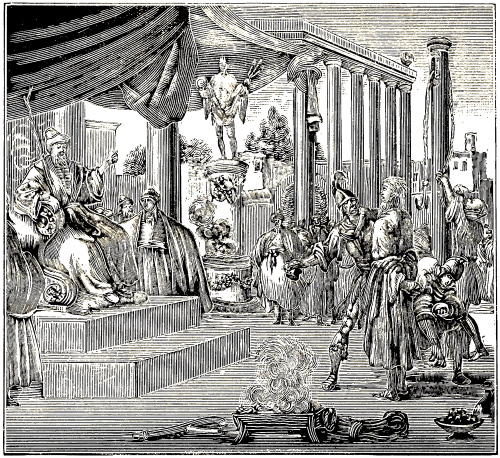
SECOND EXAMINATION OF THARACUS.
When Maximus held court the second time over these faithful witnesses of Jesus Christ, and sat upon his judgment-seat, he said: “Call in the ungodly Christians.” Demetrius, the captain, answered: “Here I am, my lord!” Then said the Proconsul to Tharacus: “Knowest thou not, that age is honored in many respects? Hast thou, then, not considered it, whether thou wilt still persist in thy first intention? Yea, advise with thyself, and sacrifice to the gods, for the prosperity of the princes; that thou mayest attain to honor.”
Tharacus answered: “If the princes and others who are of the same opinion with you, knew what there is in this honor, they themselves would turn away from the blindness of their vain conversation.”
Tharacus put on the rack the second time.—The Proconsul said to his beadles: “Strike him on the mouth with stones, and say to him: Desist from thy folly.” Tharacus answered: “If I did not exercise more care for my salvation than you people do, I would be as foolish as you are.”
The President said to him: “See, they have knocked thy teeth out; do have compassion upon thyself.”
Tharacus replied: “Do not imagine this; for though thou shouldst cause everyone of my members to be crushed, I could still remain strong and steadfast in him who strengthens me.”
The President said: “Believe me, it is better for thee, that thou sacrifice.”
Tharacus answered: “If I knew that it were better for me, I would not wait for this advice from thee.”
When Tharacus ceased to speak, the Proconsul said to his hangmen: “Smite him on the mouth, and make him speak.”
Tharacus replied: “My cheeks are knocked to pieces; how can I answer any longer?”
Maximus said: “And wilt thou, madman, not yet consent to worship, and sacrifice to the gods?”
Tharacus answered: “Although thou hast deprived me of my voice, so that I cannot cry aloud, thou shalt nevertheless not injure my soul; but thou hast in this hour greatly strengthened me in my opinion.”
Maximus said to his servants: “Bring fire! stretch out his hands, and put fire on them.”
Tharacus replied: “I do not fear thy temporal fire; but I would have to fear the eternal fire, if I should obey thee.”
When the glowing fire was laid upon his hands, the President said: “See, the fire is consuming thy hands; desist, therefore, from thy folly and sacrifice to the gods.”
Tharacus answered: “Thou speakest to me, as though because of thy cruelty I had already yielded to thy wish; however, but through the grace of God I am, in all my sufferings, as strong as ever.”
The Proconsul said: “Tie his feet together, and hang him up by his heels, and make a thick smoke under his face.”
Tharacus replied: “I neither regard thy fire, nor do I fear thy smoke.”
When he was hung up, Maximus said to him: “There shalt thou hang, until thou consentest to sacrifice to the gods.”
Tharacus answered: “Thou mayest sacrifice; for thou art accustomed to sacrifice human beings; but for me it is not lawful.”
Maximus said to his servants: “Bring vinegar mixed with salt, and pour it into his nostrils.”
NOTE.—Here a whole leaf is wanting in the original, namely, of the tortures which Tharacus, Probus, and Andronicus suffered in the second examination on the rack; however, concerning Andronicus the following additional was found.
The Proconsul said (namely, to Andronicus): “All this nonsense can avail thee nothing. But come, and sacrifice to the gods, that thou mayest not perish under the punishment.”
Andronicus replied: “It is the same that thou hast heard the first and the second time; for I am not a child, to be moved or turned by words.”
The President said: “You shall nevertheless neither conquer me, nor despise my tribunal.”
Andronicus answered: “We do not conquer thee, but our Lord Jesus Christ strengthens us.”
The President said: “The next time we hold court over these men, let other modes of torture be put in practice. In the meantime put him (Andronicus) in irons, and keep him in prison until tomorrow, and let no one see him.”
THE THREE MARTYRS EXAMINED ON THE RACK THE THIRD TIME.
The President said: “Call the ungodly Christians in.” Demetrius, the centurion, answered: “Here I am.”
Tharacus brought forth first.—When he had brought forth Tharacus, the Proconsul said: “Dost thou still despise imprisonment, bonds, punishments, and tortures? Follow my advice, O Tharacus, and abandon this confession, which profits thee nothing. Rather sacrifice to the gods, by whom all things exist.”
Tharacus answered: “Woe shall come upon them. Thou thinkest that the world is governed by them; whereas they are destined for eternal fire; and not they only, but all those also who serve them.”
The President said: “And dost thou not yet desist, thou impious blasphemer! or thinkest thou not that for thy rash words I should cause thee to be instantly beheaded?”
Tharacus replied: “Then I would not die a lingering death, but a short one. But let me have a long conflict, that in the meantime my faith in the Lord may grow and increase.”
The President said: “Thou and thy fellow-prisoners must die according to the laws.”
Tharacus answered: “What thou sayest is an evidence of thy ignorance; for those who do evil die justly; but we who know of no evil, that is, who have committed nothing worthy of death before men, but suffer for the Lord, expect with confident hope the heavenly reward from the Lord.”
The Proconsul said: “Thou accursed miscreant! what reward have ye to expect, seeing you die for your wickedness?”
Tharacus replied: “It is not lawful for thee to inquire into, or to ask, what reward the Lord has laid up for us in heaven; and therefore we patiently suffer the wrath of thy madness.”
The President said: “Darest thou thus address me, thou accursed [one], as though thou wert mine equal?”
Tharacus answered: “I am not thine equal; but it is lawful for me to speak, and no one can silence me, for the sake of him who strengthens me, namely, the Lord.”
The Proconsul said: “Thou miscreant, I shall deprive thee of the power.”
Tharacus answered: “No one can take away the power from me, neither thou, nor your princes, nor Satan, the father of you all.”
Tharacus put to the rack.—The President said: “Now, seeing thou art bound and suspended, in order that you may be tortured, sacrifice in time, before I cause thee to be punished according to thy deserts.”
Tharacus replied: “That thou mayest do; but since I was formerly a soldier, thou mayest not torment me with all manner of punishment. Yet, lest thou think, I might yield to thy perverseness, go on and devise and inflict upon me all sorts of punishment.”
The President said: “Do not think that I shall sentence thee at once. I shall cause thee to be put to death by degrees.”
Tharacus answered: “Whatever thou intendest to do, do at once, and do not threaten.”
The President said: “If thou think, that some women will come and embalm thy body, thou art greatly mistaken, for it is my intention that nothing shall remain of thee.”
Tharacus replied: “Do with my body as pleaseth thee, now as well as after my death.”
“Maximian,” said the Proconsul, “break his jaws, and tear his lips.”
Tharacus answered: “True, thou hast crushed and marred my face; but thou hast quickened my soul.”
The President said: “Thou wretched man! Desist from thy vain thoughts, and sacrifice; that thou mayest be delivered from these pangs.”
Tharacus replied: “Dost thou think I am a fool or a madman, and that I, who trust in the Lord, shall not live in heaven? Thou mayest deprive me of this temporal life for a little while; but thou wilt thereby cast thine own soul into eternal damnation.”
The President said to the executioners: “Put the branding irons into the fire, and brand him on his cheeks or shoulders.”
Tharacus answered: “Though thou inflict many more torments than these upon me, thou shalt nevertheless not turn the servant of God to the shameful idolatry of devils, to worship them.”
The President said: “Bring a razor; cut off his skin; shave his head bald, and put burning coals upon it.”
Tharacus replied: “And though thou cause my whole body to be flayed, I shall still not depart from my God, who strengthens me, to endure all the weapons of your torturing.”
The President said: “Get the branding irons; let them get still hotter, and apply them to all his members and joints.”
Tharacus, as he suffered this, cried out: “May the Lord look down from heaven, and judge!”
The President said: “What lord dost thou call upon, thou accursed fellow?”
Tharacus answered: “The Lord whom thou dost not know, and who recompenses every one according to his works.”
The President said: “And shall I not exterminate thee, as I have told thee? Yea, even thy remains I shall burn, and scatter thy ashes to the wind; that the women may not come, and wind thy dead body in clothes to embalm it with precious ointments and spices.”
Tharacus replied: “I have said it, and say so still, do what thou wilt: thou hast full power over my body in this world.”
The President said: “Put him back into prison, and keep him until the next time for the wild beasts. Let another be brought before the tribunal.”
Probus brought forward.—Demetrius, the captain, said to the Proconsul: “Sir, here he is already, namely, Probus.”
The President said to Probus: “Advise with thyself, Probus, that thou mayest not fall again into the same punishment; for others, who on thy account have persisted in their obstinacy have rued it. Sacrifice now, therefore, that thou mayest be honored by us and the gods.”
Probus answered: “We are all of one mind, serving God with one heart and soul. Think not, therefore, that thou wilt hear anything different from us; for thou hast ere this heard and seen enough to convince thee, that thou canst not turn us. Here I stand before thee the third time, and do not yet regard thy threats. What dost thou wait for, then?”
The President said: “Ye have conspired together to deny the gods. Bind him, and hang him up by his heels.”
Probus replied: “Dost thou not yet cease to fight for Satan?”
Maximus said: “Believe me, before thou be tortured; have compassion upon thine own body. See, what dreadful torments are being prepared for thee.”
Probus answered: “All that thou mayest do unto me, shall conduce to the comfort of my soul; therefore, do what thou wilt.”
The President said: “Heat the branding irons red-hot, and apply them to his sides, so that he may desist from his folly.”
Probus replied: “The more foolish I appear to thee, the wiser I shall be in the law of the Lord.”
The President said: “Press the branding irons on his back.”
Probus answered as he was suffering: “My body is subject to thy power; but God will behold from heaven my humility and patience.”
In the meantime the President commanded that meat and wine should be brought, which had been sacrificed to the idols, saying to the executioners: “Pour wine down his throat, and take meat, and force it into his mouth.”
While they were busy doing this, Probus said: “The Lord behold from his high throne the violence ye do to me, and judge my cause.”
The President said: “Thou wretched man! thou hast suffered so much, and, behold! thou hast thyself received the sacrifice.”
Probus replied: “Ye have not accomplished much, by doing me violence. The Lord knoweth my intentions.”
The President said: “Thou hast eaten and drank what was sacrificed to the gods.”
Probus answered: “The Lord knoweth it, and hath seen the violence I have suffered.”
The President said to the executioners: “Apply the branding irons to the calves of his legs.”
Probus replied: “Neither the fire, nor the torments, nor thy father, Satan, can turn the servant of God from his confession.”
The President said to his servants: “Let sharp nails be heated, and put them into his hands.”
Probus answered as he suffered this: “I thank thee, O Lord, that thou hast made my hands worthy, to suffer for thy name.”
The President said: “The many torments have deprived thee of thy mind.”
Probus replied: “The great power which thou hast, has not only made thee a fool, but also blind; for thou knowest not what thou art doing.”
The President said: “Thou who hast been tormented on thy whole body excepting the eyes, darest thou speak thus to me?” “Pinch his eyes,” said he to the executioners, “that he may gradually become blind.”
When this had been done, Probus said: “Behold, thou has also deprived me of my bodily eyes, but thou shalt never be permitted to destroy the eyes of my faith.”
The President said: “Dost thou think thou wilt survive all these torments, or that thus thou shalt die happy?”
Probus answered: “Fighting thus, I gradually approach the end, so that I may finish my good and perfect confession, and be put to death by you without mercy.”
The President said: “Take him away, bind him, put him in prison, and let none of his companions come near him, to praise him for having continued so steadfast in his wickedness. He, too, shall be cast before the wild beasts at the next show.”
Andronicus put to the rack.—Then said the President: “Let Andronicus come forth.”
Demetrius, the captain, said: “He is already here.”
The President said to Andronicus: “Have at least compassion on thy youth, if thou hast prudently advised with thyself to reverence the gods: consent and sacrifice to the gods, that thou mayest be released.”
Andronicus answered: “May God never suffer thee, O tyrant, that I do aught against the law of God. Thou shalt never shake my good confession, which I have founded upon my Lord. Here I stand ready, for thee to make manifest on me thy hardness.”
The President said: “Methinks, thou art raving, and possessed of the devil.”
Andronicus replied: “If I had the devil in me, I should obey thee; but because I confess the Lord, I do not submit to the commands of the devil. But hast not thou the devil in thee? For, being deceived by the devil, thou doest the works of the devil.”
The President said to the Executioners: “Make bundles of paper, and put fire upon his body.”
When this was done, Andronicus said: “Though I burn from head to foot, the spirit nevertheless is alive in me. Thou shalt not conquer me; for the Lord, whom I serve is with me.”
The President said: “Thou madman! how long wilt thou remain thus obstinate? Seek at least to die upon thy bed.”
Andronicus answered: “As long as I live, I shall overcome thy wickedness.”
The President said: “Heat the branding-irons red-hot again, and put them between his fingers.”
Andronicus replied: “O foolish despiser of God! Thou art full of the wicked thoughts of Satan. Seest thou not that my body is almost consumed through the manifold torments thou hast inflicted upon me. Thinkest thou that now at the last I shall begin to fear thy devices? I have Christ dwelling in my heart, and despise thy torments.”
The President said: “Thou miscreant! knowest thou not that this Christ, whom thou worshipest became man, and was punished under the Judge Pontius Pilate?”
Andronicus answered: “Be silent, for it is not lawful for thee to speak evil of him.”
The President said: “What gainest thou by thy faith and hope in this man whom thou callest Christ?”
Andronicus replied: “I have thereby in expectation a great reward and gain; hence I endure all this so patiently.”
The President said: “Break open his mouth, and take meat that has been sacrificed, from the altar, and force it into his mouth, and pour in wine also.”
Andronicus called God to witness, saying: “O Lord! Lord! behold, what violence I suffer!”
The President said: “How long wilt thou thus obstinately endure the punishment? See, thou hast certainly eaten of that which has been sacrificed to the gods.”
Andronicus answered: “Cursed be all who honor the idols, thou and thy princes.”
The President said: “Thou miscreant, cursest thou the princes, who have obtained for us so lasting and tranquil peace?”
Andronicus replied: “They are cursed, who, as the pestilence, and as bloodhounds, turn the whole world upside down; whom the Lord by his mighty arm shall confound and destroy.”
The President commanded the executioners: “Put an iron into his mouth, and with it break out all his teeth, and cut out his blasphemous tongue, that he may learn no more to blaspheme the princes. Take away his teeth, and burn his tongue to ashes, and scatter the latter all about, lest his fellow-Christians, or some women, gather his remains, and keep them as precious relics. Take him away from here, and put him into prison, that at the next show he, together with his companions, Tharacus and Probus may be thrown before the wild beasts.” Acta Procons. per Metaph. and alios.
It is declared that the above account concerning the examination of the three aforementioned Christians was written entirely by the heathen themselves, who put them to death; only a few words having been altered, to make the sense clearer. A certain celebrated author mentioning this, writes as follows: “Herewith ends the third examination or inquisition on the rack, and thus far these proceedings with the martyrs have been recorded by the heathen clerk of the criminal court himself, and were doubtless afterwards bought for money by the Christians.”
Beloved reader! I could not forbear to translate these records, just as they were, for the most part word for word; not only because I have found them to be true and genuine in every respect; but also, because we can very clearly see therefrom, what form of inquisition or examination the heathen employed against the Christians; as well as with what manifold torments the obdurate heathen sought to compel the Christians to apostatize from the faith, and how remarkably God preserved his own against the devices and wiles of the devil.
It need not seem strange to the reader, that the proconsuls or criminal judges so frequently put to the rack the same Christians, to cause them to apostatize from the faith: for Lactantius tells us of a president in Bithynia, who for two years endeavored by all manner of torments to compel a Christian to apostatize, and who, when this Christian finally seemed to yield, boasted of it just as though he had conquered a whole province of a barbaric country.
As touching the rest of the matter, that is, how and when the sentence of the Proconsul was executed, the heathen have not recorded it; but some Christian brethren, namely, Macarius, Felix, and Verus, probably bought those records from the clerk of the criminal court, and added from their own observation what was wanting, since they had been eye-witnesses of it at the theatrical drama the following day.
AN ACCOUNT OF THE DEATH OF THE AFOREMENTIONED MARTYRS, WRITTEN BY SOME CHRISTIAN BRETHREN WHO WITNESSED IT.
Numerius Maximus, Proconsul of Cilicia, summoning Terentian, the provider of public sacrifices and theatrical performances which were held in Cilicia, commanded him to provide for the dramas for the next day. The following day a great number of men and women assembled in the amphitheatre, which was situated about a mile, or one thousand paces from the city. When the amphitheatre was filled with people, Maximus also came to witness the play, and in the first act of it, when many wild beasts were let out at the same time, many human bodies were devoured. We Christians kept ourselves concealed and waited with great fear for the bringing forth of the martyrs. Suddenly the Proconsul commanded the soldiers to bring in the Christian martyrs, namely, Tharacus, Probus, and Andronicus. The soldiers compelled some to carry the Christian martyrs on their shoulders, for they were torn and lacerated to such a degree, that they could not walk. We then saw them carried thus disfigured into the amphitheatre, and seeing how they had been maltreated, we turned our faces, and cried bitterly. Thus the martyrs were thrown down into the middle of the arena, as the offscouring or refuse of this world; and when the multitude beheld them, they were all frightened, and the people murmured greatly against Maximus for having thus tormented them, and then yet sentencing them to be thrown to the beasts; yea, many went away from the amphitheatre, censuring Maximus for his inhuman cruelty. When Maximus saw this, he commanded the soldiers who stood near him, to note those who murmured against him, and were leaving; so that he might afterwards examine them in regard to it. In the meanwhile he commanded that the wild beasts should be let out, to rend the martyrs. In Scriptura Christianorum Fratrum.
In order to avoid prolixity, we shall sum up what follows here in the aforementioned account of the Christian brethren, in these words: “The wild beasts were let out, especially a frightful bear, and then a lioness; both of which indeed, by roaring terribly, made a dreadful noise, so that also the spectators were frightened by it; but they did not harm the martyrs, much less tear or devour them. The Proconsul in his rage commanded the spear-men, to thrust the bear through; the lioness, however, on account of the fear of the people, was let out by a back door, which was broken in pieces. Then Maximus ordered Terentian, to let in the gladiators, who should first kill the Christians, and then fight with each other for life. These, when they came in, first thrust through the martyrs; which happened on the 11th day of October, A. D. 290, at Tarsus in Cilicia.” When the drama was over, and the Proconsul was about to go home, he left ten soldiers in the amphitheatre, charging them, to mingle the dead bodies of the martyrs with those of the heathen gladiators, that the Christians might not be able to distinguish them. However, it is stated in the above account, that the Christians removed their dead bodies, and buried them in a cave in a rock.
In regard to this, A. Mellinus, who has referred to it, has the following remark: “They who did this, also wrote the conclusion of this history; hence we have not the least reason to doubt the veracity of this account of the proceedings against the martyrs.” First book of the Mart. 1619, fol. 96, col. 1; but with reference to the previous proceedings against the martyrs, see fol. 93, col. 3, and fol. 94, col. 1–4, and fol. 95, col. 1–3.
AN ACCOUNT OF THE HOLY BAPTISM OF THE MARTYRS IN THE FOURTH CENTURY.
BRIEF SUMMARY OF BAPTISM IN THIS CENTURY.
At the close of the third century the eminent Arnobius was introduced, and inasmuch as his life extended from one century into the other we refer to him again here in the beginning of the fourth century. He speaks of the virtue and benefit of baptism, as may be seen in the proper place.
Fusca and the handmaid Maura were baptized after previous instruction.
At this time (in the time of Sylvester) there existed such sects as were afterwards called Waldenses, Anabaptists, etc.
One Donatus was called an Anabaptist, and his followers, Anabaptists.
Athanasius, while yet a child, indicated, with other children, that at Alexandria they baptized upon confession of faith.
In Canon 12, 13, 15, of the Council of Nice several good things are established with regard to baptism.
Athanasius, having become a man, teaches wholesome doctrine, not only with respect to baptism, but also in regard to other matters of religion.
Soon after him comes Marius Victorinus, who joins together faith, confession, and baptism.
Then appears Hilarius, who wrote very appropriately on baptism, and also opposes antichrist, images, and traditions.
Monica, the mother of Augustine, was baptized in adult years, though she was born of Christian parents.
In the Council of Neocesarea, the candidates for baptism, the baptizing of pregnant women, Christ’s baptism, etc., were discussed.
Again sects appear, who were like the Baptists.
St. Martin was instructed from his twelfth to his eighteenth year, and then baptized. He strongly opposed war.
Ambrose was baptized in adult years, at Milan, though his parents were Christians. He advanced sound views on baptism, against war, of the sacrament, etc.
Ephrem, Gregory of Nyssa, the Councils of Laodicea and Elibertum, and also Optatus Milevitanus, give correct views on baptism.
Gregory of Nazianzus, born of Christian parents, was already in his twentieth year when he was baptized. Nectarius was baptized in adult years. Basil, the son of a Christian, and Eubulus, consulted together, and were baptized on their faith, at Jerusalem. Posthumanius made a glorious confession at his baptism. John Crysostom was suffered by his parents, though they were Christians, to remain unbaptized, not receiving baptism until he was twenty-one years old. Also, his views respecting baptism; his teaching against war, confession, etc.
Jerome, also born of Christian parents, was baptized at Syridon, when he was thirty years old.
Augustine, Adeolatus, Alipius, Euodius, Epiphanius, with his sister, all baptized upon faith. Conclusion of baptism in the fourth century.
That the holy order of the baptism of Jesus Christ was practiced also in the fourth century, appears from various teachings and examples of the fathers, from which, we shall present only a few, but such as are certain and genuine testimonies.
A. D. 301.—At the close of the preceding century, for A. D. 300, we introduced the eminent Arnobius, and showed that, speaking of baptism, he says: “That the candidates for baptism, when they are baptized, state before the minister their perfect willingness, and make their confession with their own lips.”
This Arnobius follows us also in the beginning of this century, namely through the years 301, 302, 303, 304; and having not abandoned his previous views regarding this matter, he confirms them with the following testimonies.
Speaking against the tenets of the Romanists, who ordain consecrated, or, properly speaking, exorcised water for baptism, he writes thus (in Psalm 74): “It is written: Thou breakest the heads of the dragons in the waters; that is,” says he, “the heads of the dragons in baptism;” but by saying, in the waters, he means to signify that the same baptism can be administered in all kinds of waters, as, in rivers, lakes, wells, baths, seas, etc. In these the head of the dragon, that is Satan, is broken in all waters. Jacob Mehrn. Bapt. Hist., page 323.
Of the virtue and benefit of baptism he teaches as follows, Psalm 32, where the Psalmist says: “In the floods of great waters they shall not come nigh unto him,” upon which he remarks: “that men, by the true water of baptism, draw nigh to God, who is a refuge from the fear of Satan that encompasses us.” Jacob Mehrn., page 324.
Again, Psalm 32, he says: “Man is redeemed; no angel, nor any other creature, but man alone praises his mercy, says the Lord, whose sins he forgives in baptism.” Jacob Mehrn., page 325.
Although these words of Arnobius are somewhat obscure, yet they contain light enough, to emit rays of divine truth concerning the matter of baptism. For when in the first place he says, that the head of the dragon is broken in baptism (by dragon meaning Satan), he certainly indicates thereby, that he speaks of persons who, having attained maturer years, become subject to the assaults of Satan, and that these, in baptism, break the head of the dragon, that is, Satan, by means of the true faith, through Christ; hence he does not speak of children—who are ignorant of the assaults of Satan—and, consequently, not of infant baptism.
Secondly, when he says that men, by the true water of baptism, draw nigh to God, he certainly indicates that he speaks of men who have departed from God through disobedience, consequently, of persons who have arrived at the years of discretion; and not of infants; for how can any one draw nigh to God by baptism, who has not departed from him? Infants have not departed from God through disobedience; hence they cannot draw nigh to him by baptism.
Thirdly, when he speaks of man, who praises the mercy of the Lord, and whose sins the Lord forgives in baptism, he certainly indicates that he speaks of men who are capable of praising the mercy of the Lord, namely, men possessing understanding, and who have sinned; for only he that has sinned can have his sins forgiven; but with infants, who have never sinned, no forgiveness can take place, and consequently, no baptism for the remission of sins. By this the obscure words of Arnobius became clear.
NOTE.—P. J. Twisck records, for the year 306, that Constantine the Great, the son of the believing Helena, was baptized in Jordan, in the sixty-fifth year of his age, after having been instructed (Chron. 4th book, page 89, col. 1); from which it is apparent, that at that time Christians left their children unbaptized, in order that they themselves might believe and be baptized.
A. D. 308.—Fusca, the pious maiden, conceived a desire for the Christian faith when she was quite young, and, having manifested this desire to the servant-maid, Mauro, who also felt an inward drawing towards Christ, they were thoroughly instructed in the Christian faith at Ravenna, by the teacher Hermola, and baptized. P. J. Twisck, Chron. 4th book, page 90, col. 1, from Grond. Bew., letter B, Leonh., lib. 2.
A. D. 315.—It is stated that already in the time of Sylvester, there was taught and maintained the same doctrine which was afterwards maintained by countless numbers of the baptistic Waldenses, yea, that those churches which in the 11th, 12th, 13th, and in subsequent centuries were styled Waldenses Albigenses, and lastly, Mennonites, or Anabaptists, had existed already at that time, and indeed, long before. Of this a certain celebrated author among the Romanists bitterly complains, in a very old book, saying: “These heretics (the people mentioned above) have always had many sects among them; but of all that ever existed, none was more pernicious to the church of God (understand the Roman church) than the Poor of Lyons (the Waldenses or Anabaptists), and this for three reasons: In the first place, because of their antiquity; some asserting that they existed already in the days of Sylvester, others referring them even to the time of the apostles.” Jac. Mehrn., page 615.
In another place Jacob Mehrning writes thus about the abovementioned people: “This is not a new sect that originated only at that time (that is, in the time of Waldus); for the papistic writers themselves confess that they existed already in the time of Pope Sylvester, nay, long before him, even in the time of the apostles.” B. H., page 670.
In another place he writes that Flaccius has also recorded the same, from an ancient papistic book, namely, that they existed from the time of Sylvester, yea, from the time of the apostles; and that Thuanus, though he compares them to another people, states that their doctrine has continued through many centuries.” Page 682.
The time of the reign of Sylvester, who was the first pope of this name, and on the register of the Roman bishops the 34th, is fixed in the year 315. See P. J. Twisck, Chron., 4th book, p. 93, col. 1, from Platina, fol. 63. Fasc. Temp., fol. 99, Hist. Georg., lib. 1, Fr. Ala., fol. 22, Chron. Seb. Fr., fol. 13.
A. D. 317.—Donatus, an over-learned bishop at Carthage,101 who had many adherents in Africa, taught among other things: “That the preaching of the divine word and the administration of the sacraments by an ungodly minister, were of no avail. They (his followers) held that the church of Christ existed only among them, and hence, they rebaptized all who wished to adopt their religion, saying that the heretics, or the Pope, had no Christian church, and consequently, no baptism, inasmuch as there was only one God, one faith, one Gospel, one church, and one baptism. ‘They, like the Anabaptists, also held,’ says Franck, ‘that no children, even in the extremity of death, should be baptized, but only believing adults who desired it.’ ”
When he was imprisoned he upbraided Augustine, saying that no one ought to be imprisoned on account of his faith, God had given man his free will, to believe as he chose. Concerning all this, see, P. J. Twisck Chron., 4th book, p. 93, col. 2, and page 94, col. 1, from Merula, fol. 255. Zeg., fol. 79. Seb. Franck, Chron. van de Roomsche Ketters, letter D., fol. 76, printed A. D. 1563.
As regards Donatus, if it be true that he erred in some things, or failed in some matter of faith, we will not defend him therein; however, this much is certain, that owing to the absence of his writings, we have no other information concerning him, than that which comes to us through the mouth and hand of his adversaries.
Concerning this, P. J. Twisck, in a certain place, expresses his regret, saying, that in his Chronijk, for the year 410, he wrote something derogatory to his followers, before he had been properly informed regarding it; which he afterwards, for the year 417, refutes and explains more clearly by quoting from Bullinger: “That the followers of Donatus were similar to the Anabaptists (whom he calls Baptists); that they taught, that no one ought to be compelled to do good or to accept the faith.” Again: “that every heretic should be left to follow his particular faith without restraint or compulsion.”
On this account, P. J. Twisck, in the same place, relates from another author, that it is quite probable that these people were burdened with many unjust accusations. “It would be desirable,” writes he, “to have in our possession their writings, teachings, and deeds; for if it be the case, that they were in all respects like the Anabaptists, and would compel no one in matters of faith, then it is sufficiently apparent, that they are unjustly charged by other writers, with tyranny. I have given this a place here, because the year 410 was already arranged when this reached me.” Thus far, P. J. Twisck, Chron., 5th book, page 147, col. 2, from H. Bulling. Contra Anbapt., lib. 5, fol. 216, 222.
NOTE.—We accept of the writings of Donatus only that which is good and true; for the rest we assume no responsibility.
About A. D. 318.—It appears that when Athanasius was yet a boy, at Alexandria also, baptism was not administered otherwise than upon confession of faith; at least, that it was not customary to baptize infants, is evident from the following circumstances of a certain occurrence related by Ruffinus and Zozomenus: “When the day of the martyr Peter was celebrated at Alexandria, by the Bishop Alexander, and he, after the solemn service was over, was awaiting his assistants, or pupils to dine with him, he observed in the distance some children playing on the sea shore, who, very probably, not for the first time were imitating the bishop and those things which are generally done in church. But when he observed the children more attentively, he noticed that they were performing some mysterious things. Astonished at this, he summoned his assistants to him, and showed them what he had seen from a distance. Then he commanded them to seize the children and bring them to him. When they came, he asked them, what they had been playing, and what and how they had been doing? They, as was natural for their years, at first were frightened, and denied the matter, but afterwards related it just as it had taken place, and confessed that they, through Athanasius, who in this game had imitated the Bishop, had baptized some catechumens, that is, boys who had not been baptized. Alexander then inquired of those who they said had been baptized, what questions had been put to them, and what they had answered; likewise interrogating him who had put the questions; and found that all was in accordance with the manner of our religion. Jac. Mehrn., 2d part, pp. 356, 357, from Nicephor., lib. 8, cap. 44. Also, H. Montan. Nietigh., pp. 64, 65, from Ruffin. Eccl. Hist. 1, cap. 14. Zozom. Eccl. Hist., lib. 3, cap. 16.
From these circumstances it is evident that infant baptism was not customary there. First, when we take into consideration the conduct of these boys, we see that in the Christian church at Alexandria the usual mode of baptizing at that time was this, namely: that the Bishop, or whoever administered baptism, first interrogated the candidates for baptism, and then, after they had answered him, they were baptized.
Secondly, if we consider the boys themselves, who apparently were ten or twelve years old, which probability is increased by the fact that Ruffinus (as H. Montanus shows), calls them catechumens, that is, such as were being instructed in the faith, which is plainly indicated by their performance, since they were able to imitate in every particular such important services. These boys are nevertheless called unbaptized, wherefore Athanasius, though by way of play, baptized them.
Moreover, that these boys were born of Christian parents, appears in various ways, as, for instance, in this, that they diligently attended the Christian assemblies, for without this they could never have represented so completely in all its particulars, the baptism practiced in the church. Likewise, in the fact that Alexander and his assistants (as the account further sets forth), enjoined the parents of these boys, who before were unbaptized, but had now been thus baptized, to bring them up in that vocation, namely, in the Christian religion, which certainly would not have been done, had their parents been heathen and not Christians. It is also stated that this was done with invocation and confession of God’s holy name, which certainly would not have been the case with heathen, who worshiped either no god, or many gods.
As to what Alexander held of this performance, we leave it to its own merits; it suffices us to have shown that at that time the Christians at Alexandria suffered their children to remain unbaptized; inasmuch as they were first instructed, and then baptized upon confession of their faith, which, as has been shown, is clearly indicated by the course of the aforementioned boys.
A. D. 333.—It is recorded that in the first great council at Nice, held against Arius, and various innovations in the church, it was resolved among other things:
“Canon 21. The Paulianists and Photinians shall be rebaptized.”
“Canon 12. If any apostatize under persecution, without having been tormented, and sincerely repent, they shall be put among the catechumens for five years, and after two more years, shall be reinstated among the faithful, with prayer.”
“Canon 13. But they who, for the sake of the confession of the faith, have relinquished the military profession and again return to it, shall do penance for thirteen years, and then be received again; however, if they truly repent, the bishop is authorized to mitigate the term of penance, provided he sees that their repentance is fruitful and devout.”
“Canon 15. Concerning the catechumens who have apostatized, it is decided, that they shall be excluded from the prayers of the catechumens who have not apostatized, for three years, and at the end of that time be received back again.” Jac. Mehrn., pages 352, 353, ex Concil. Nicen. Secund. Ruffin.
This is the great Council which is extolled as orthodox and Christian by nearly all so-called Christians. Be this as it may, we see no reason to praise it so highly, seeing that we must honor the precepts of God’s holy word alone, whereas the rules of that council were made by fallible men. Yet, so far as these men have laid down precepts that accord with the precepts of God’s holy word, or, at least, do not militate against them, so far we accept, or, at least, do not oppose them.102
When it is said, in Canon 21, that the Paulianists and Photinians shall be rebaptized, it establishes, that, according to the Holy Scriptures, not every baptism is a genuine or true baptism, and that consequently there is but one baptism which can in truth be called genuine, namely, that baptism which is administered by the true church, and upon the true faith. This is also established at this day by the Anabaptists, and regarded as a precept from the holy word of God.
It is also said in the 15th Canon concerning the catechumens, that if they have fallen, they shall be excluded three years from the prayers of those catechumens who have not fallen. This is an indication of the carefulness exercised by that assembly, to admit to baptism, according to the doctrine of the holy Gospel, no unprepared catechumens before they had truly repented after their fall.
The 12th Canon, speaking of the penance to be performed by those who, under persecution, had apostatized without having been tormented; and the 13th Canon, treating of the very great and long penance to be endured by those, who, after having become Christians, had resumed the military profession, and thus become apostates; these precepts we say, militate neither against the holy Scriptures, nor against the views of the Anabaptists, but sufficiently confirm them both.
NOTE.—It is recorded that at this time pseudo-apostles taught that the church of Rome was rejected of God, and that it was not his church, but Babylon, and the whore mentioned in the Apocalypse, who rides the beast with the seven heads; and that we therefore do not owe obedience to the Pope; that under the New Testament we are in no wise bound to give tithes to the priests; that all manner of swearing is unlawful; that a consecrated church is not better to pray in than a pigsty. Seb. Fr. Chron., fol. 120, col. 3.
A. D. 335.—At this time, Athanasius vigorously maintained the cause of such as had been baptized according to order of Christ, against those who, it seems, asserted that baptism might take place without previous instruction, or confession of faith. He says (Serm. 3., Contra Arian.): “Our Savior did not simply command to baptize, but first said, teach, and then, baptize; so that true faith may proceed from the doctrine, and then baptism be perfected with faith.” P. J. Twisck, Chron., 4th book, page 99, col. 2; from Grond. Bew., letter A. Jac. Mehrn., Bapt. Hist., 2d Part, page 370.
NOTE.—At this time Athanasius taught that it is the duty of every Christian, to read the holy Scriptures, on the 6th chap. Eph. Again, he prohibited the practice of making a likeness of God for the purpose of worshiping him thereby, etc., as being an unlawful thing. Contr. Gent. Sam. Veltius, in the Geslacht-register, page 118.
Notice concerning several writings attributed to Athanasius.—The pedobaptists, prone to bring forward everything that seems in any wise to favor their views, were wont to adduce the 114th and the 124th question of a certain book called, Various Questions of Holy Scripture, attributed to Athanasius. But in answer to this we say: that said book is not the work of Athanasius, but of some other author who wrote subsequently to him; as in his 23d question he cites Athanasius as one having lived before him, saying: “This is the testimony of the great Athanasius, a man who was mighty in the divine Scriptures; but we, who are enlightened by him.” Moreover, that book contains many opinions foreign to Athanasius, as shown by the Centuriatores Magdenburgenses, Cent. 4, cap. 10, p. 1032. See also, H. Montan. Nietigh., p. 69, and J. M., Bapt. Hist., pages 360, 361.
NOTE.—A. D. 320. Lactantius Firmianus taught at this time: 1. “That the sacrifices of the Christian are, a good life, purity, and good works. 2. That there is no religion in a place where there are images. Lib. 2, of the Divine Instruction. Also, Sam. Veltius, in the Geslacht-register,. pp. 116, 117. 3. He taught against compulsion of conscience, and revenge, as appears from the following. He writes to the Emperor Constantine (5th book, chap. 20): “The more the religion of God is suppressed, the more it breaks forth and grows; hence they should employ reasoning and admonition; it is not necessary to proceed with violence. For religion admits of no compulsion; persuasive words can do more to promote the cause than blows.” Again (5th book, chap. 21) he writes: “We Christians do not desire that any one should serve God, the Creator of all, against his will; neither are we angry if he does not serve him; for we trust his Majesty, who can as easily avenge himself against those who despise him, as he does the vexations and injuries inflicted upon his servants. Therefore, when we suffer such shameful things, we say not one word against it, but commit all vengeance to God; not doing as those who would be regarded protectors of their gods, and very cruelly assail those who do not worship them.” Korte ontschuldiging, by P. V. K., edition of 1643, page 47, from Religions Vryheydt, 2d part, p. 10.
About A. D. 340.—Marius Victorius writes in the fifth book against Arius: “Every one that is baptized, and says he believes, and accepts the faith, receives the Spirit of truth, that is, the holy Ghost, and is made holier by him.” J. Mehrn., Bapt. Hist., page 325. I find in authentic writers, no other account of baptism by this Marius, so that this seems to be the only thing he has written about baptism, and from this, too, it is obvious that he must have been a stranger to infant baptism, seeing he joins together confession, faith, and baptism, in the one that is to be baptized.
A. D. 350.—About this time Hilarius attained to the faith in Jesus Christ, and having been baptized upon this faith, he proceeded to defend the truth which he had received and accepted, and, for the strengthening of the faith he had adopted, and that he might live according to the same, he prayed to God (lib. 12 de Trinit.) as follows: “Dear God, preserve my faith and the testimony of my conscience, that I may ever keep that which I confessed in the sacrament of my regeneration, when I was baptized in the name of the Father, the Son, and the Holy Ghost; namely, that I worship thee, O God our Father, and thy Son with thee, and that the Holy Spirit, that proceeds from thee, may be awakened.”
Again Vicecomes (lib. 2, cap. 27) quotes from Hilarius, on the 15th chapter of Matt. the following: “They that come to baptism confess first, that they believe in the Son of God, and in his suffering and resurrection; and this confession is made or pronounced at the sacrament of baptism.”
Again, Hilarius writes (vol. 2, de Trinitate): “The Lord has commanded to baptize in the name of the Father, and of the Son, and of the Holy Ghost; that is, upon the confession of the Author (that is, him who in the beginning created all things), and the First-born, and the Free Gift (that is, the Son and the Holy Ghost).” Jac. Mehrn. Bapt., Histor., 2d part, pages 371, 372.
HILARIUS ON BAPTISM AND SEVERAL OTHER ARTICLES OF HIS FAITH, ACCORDING TO THE ACCOUNT OF P. J. TWISCK.
Hilarius, originally a heathen, who subsequently became a Christian, and was baptized at Rome, A. D. 350, was a very learned and eloquent man. He writes (lib. 2): “The Lord has commanded to baptize on, or in, the name of the Father, of the Son, and of the Holy Ghost, that is,” etc.
He also defended the truth against the Arians, on account of which he was exiled; and he likewise vigorously opposed the arrogance of the see of Rome, and its dominion over other churches, and said that antichrist would devastate the earth through wars and murder.
To those who concerned themselves more in wondering at the building of the temple, than in the consideration of the doctrine he says: “You are indeed unwise, to look with wonder upon these things; for, you must know that antichrist shall once set his throne there.
“The nature of the name antichrist is opposition to Christ, which he effects under a specious semblance of the Gospel. He transforms himself into an angel of light, that he may alienate the Christian mind. He has already, to some extent, commenced his progress, pretending to be Christ, though he is departed very far from Christ.
“They (that is, the Antichristians) ambitiously desire the aid of the secular power, which they draw to themselves in order to advance their name and honor, and to protect their church; thus working with a worldly ambition, notwithstanding it is folly to employ secular power in defense of the Christian church.
“Let me ask you, ye bishops, what aid did the apostles employ in proclaiming the Gospel? by the assistance of what magistracy did they preach Christ, and convert the heathen from idolatry to God?
“Now the church courts the favor of the world, and boasts that the world loves her, who could at no time have been the church of Christ, without being hated by the world.”
Again, on the 68th Psalm, he says: “God is now preached, honored, and worshiped in stone, wood, and metal, and the Master-builder of the world, the Father of us all, is fashioned in perishable matter, to which they have been brought by the enticing words of philosophy. With these and like words he greatly censures the abuse practiced by the church of Rome.” P. J. Twisck, Chron., 4th book, page 104, col. 1, 2, from Socrat., lib. 3. Casp. Swinc., epist. 1, fol. 877. Seb. Fr.
Since the above passages from Hilarius are not only excellent, but also plain, so that they require no explanation, we leave them and proceed to others who confessed the same faith.
NOTE.—At this time, Hilarius taught that all human traditions, on account of which God’s commandments are transgressed, must be rooted out. On Matt. 15, Canon 14. Sam. Veltius, Geslacht-register, page 122. He also writes: “The Father revealed to Peter, who said: ‘Thou art the Son of God,’ that the church should be built upon this rock of confession.” “This faith,” he says, “is the foundation of the church; this faith has the keys of heaven.” In the same place, as well as in the 6th book on the Trinity.
A. D. 350.—In the meantime we find that the parents of Augustine’s mother, though they were Christians, did not have their daughter Monica baptized in her infancy; inasmuch as she was not baptized until she had reached the years of understanding, and this at the time when the followers of Cyprian practiced infant baptism to a very great extent. With regard to this, I find the following account: “Moreover, even in Africa, where Cyprian had held the aforesaid council—to determine on the precise time for baptizing infants—and resolved that baptism should be administered to infants as soon as they were born, it was, about the year 350, not observed by all Christian believers. Of this, we have an example in Monica, Augustine’s mother, a very pious woman, born of Christian parents, who also was baptized when she had reached the years of understanding, as Augustine himself testifies.” H. Montan. Nietigh., page 71, from Augustine, lib. 2. Confess., cap. 3, and lib. 9, cap. 8 and 13.
A. D. 351.—It is recorded that the Christians at Neocesarea declared themselves openly against infant baptism, in a convention or assembly of the ministers, called the council of Neocesarea; so that infant baptism, which then began to prevail in different places, could gain no support there, as appears from the various rules adopted by this body.
In Canon 5, we read: “If a catechumen who is not yet baptized, and has his place among the catechumens in the church, has been seen in a sin, he shall hear the preaching on his bended knees; that he may refrain from the sin he committed; but if he persists in it, he shall be expelled.”
In Canon 6, we read: “Pregnant women may be baptized, whenever they desire it; for in this sacrament there is no communication between the mother and the child which is born of her; but every one must in this confession himself declare his free will and good intention.
Canon 11, after some other words declares: “The Lord was not baptized until he was thirty years old, and thereupon he preached.” Jacob Mehrn., Bapt. Hist., 2d part, pages 351, 352.
First, when in Canon 5 mention is made of the catechumens, it certainly indicates that it was customary to instruct the young before baptism, in the articles of the faith, upon which followed the confession of the same, and baptism. This cannot be contradicted.
Secondly, when in Canon 6 it is established that pregnant women may be baptized whenever they desire it, because there is no communication between the mother and the child which is born of her, it clearly confirms that infant baptism had no place whatever among them, but, that they were indeed inimical to it. It appears that a difficulty was raised at that time, as to whether pregnant women might be baptized or not; for it was thought or feared that the fruit had such communion with the mother, that the child, too, would become a partaker of the baptism received by the mother; which would have been contrary to the views held by the church, that no one should be baptized except upon his own confession of faith, and consequently, no infants, much less unborn children. But this apprehension or difficulty was removed, when it was declared that in the reception of baptism there is no communication between the mother and the child, and that for this reason the child does not participate in the baptism received by the mother. This is too clear to be refuted.
Thirdly, when in Canon 11, mention is made of Christ being baptized when he was thirty years old, notwithstanding that preaching is here spoken of, and that the same ought not to be undertaken by one before he is thirty years old, the baptism which is administered upon faith or in adult years, is nevertheless also recommended and deemed necessary. For, as Christ was baptized in adult years, and forthwith began to preach, so that the time of his baptism was also the time of his preaching, even so (the Canon apparently means to say), baptizing, like preaching, may only take place in adult years; for as the one requires understanding, so does the other, according to the example of Christ.
A. D. 360.—P. J. Twisck writes: “Notwithstanding that at this time, much bloody cruelty was practiced against the bishop who sided with Arius, so that this party was almost wholly crushed, still, according to history, there remained sects like the Anabaptists, etc. If their books were extant, we might give an account of what they taught concerning all these matters; but as it is, we let it suffice with what others have written.” P. J. Twisck, Chron., 4th book, page 106, col. 2, from Jac. P. Verm. Onsch., lib. 4, fol. 131.
It is exceedingly to be regretted that so few of the writings of the Anabaptists who lived at that time, are extant; for thereby we are compelled to receive information concerning them from the mouths of their enemies; which information, as we may readily judge, was not dictated by love, but by animosity. However, we owe thanks to God, that even this much has come down to us respecting their history; since Satan, through the instrumentality of his adherents, has always aimed to exterminate, not only their books, but also their lives, yea, their bodies and souls, if this were possible.
A. D. 362.—Saint Martin, born of heathen parents, when he was ten years old, went, contrary to the will of his parents, to the meetings of the Christians, embraced Christianity and was baptized when he was eighteen years old. Being now a Christian, he desired to be discharged from the military profession into which he had been brought by his parents; hence he said to the apostate Emperor, Julian, that it was not lawful for him to fight, because he was a Christian.
But as the Minorite, Thomas van Heerentaals, in his Mirror of the Ten Commandments and Seven Sacraments, gives a somewhat fuller account concerning St. Martin, and especially of baptism as practiced at that time, we shall make a short extract from it. He says: “In former times it was customary to administer holy baptism but twice a year, namely, on Easter eve and on Pentecost eve; except in cases of necessity, which was fourfold: 1. In a siege. 2. In danger of martyrdom. 3. In peril at sea. 4. In dangerous sickness. In such cases they baptized all, and at all times, that no one might die without baptism. But when these four reasons did not exist, baptism was administered only on the two abovementioned days, and that with great solemnity and dignity, and all who were admitted to baptism, had attained the years of understanding; even St. Martin, that holy man, was a catechumen for six years—from the time he was twelve, until he was eighteen years old—before he received baptism. P. J. Twisck, Chron., 4th book, page 110, col. 1, 2.
A. D. 363 and 364.—In the time of Julian the apostate there lived and shone as bright lights, various excellent men, whose learning and piety it is not necessary to extol, since it is sufficiently known. They gave expression to their orthodox convictions by word and by deed, especially with regard to the matter of baptism, that it ought to be administered after previous instruction, upon faith and repentance.
At the same time, A. D. 363, there lived Ambrose, who is stated to have been born of Christian parents. His father’s name was also Ambrose, while that of his mother was Marcellina. He, too, was not baptized until the day on which he was chosen bishop of Milan, after having been instructed in the catechism, that is, in the doctrines of the faith.103 See concerning this, Tract van den loop der wereld, by F. H. H., printed 1611, page 47, 48, from Paul, de vita Ambrosii. Naucler. Chron. Generat. 13.
Such a procedure, namely, thus precipitately to elect any one bishop or teacher, as is stated here concerning Ambrose, we do not commend; but we notice here, that Christians at that time had not generally adopted infant baptism; nay, that some, notwithstanding the papal power, purposely did not have their children baptized; causing them, when they had reached maturer years, to be instructed first, and then baptized, upon their own confession.
Ambrose (Serm. 61) makes the statement: “It was customary for all people to be baptized at Easter.” In Lib. de Jejunio, cap. 10, he says: “Now comes the day of the resurrection; now the elect are baptized.” Yet on 1 Tim. 4, he says that the sick were baptized on any day. Jac. Mehrn., Bapt. Hist., 2d part, page 334.
These words of Ambrose confirm our preceding assertion; for when he says that at Easter it was customary to baptize all people, he sufficiently declares that at that time infant baptism was not a custom. For not only at Easter, but throughout the whole year, children are born, the baptism of which, because of the danger that they might die, could never have been postponed until Easter, had infant baptism been deemed necessary for salvation. But Ambrose removes all doubt when he says what persons were baptized then, namely, all people; for by the word people there are generally understood adult or rational persons, and not infants in the cradle.
Moreover, when he writes that the sick were baptized on any day, he proves thereby, that infant baptism was not practiced in the church of which he speaks. For, if it had been customary there, to baptize infants, it would not have been necessary to baptize the sick on any day, since they would have been baptized already in their infancy; or our opponents must show that the sick, who were baptized any day, were also baptized in their infancy; which they dare not maintain, seeing these churches would then have to be regarded anabaptistic. Nevertheless, one of two things must follow: Either that the sick who were baptized in their infancy were rebaptized, or that the adults baptized had not been baptized in their infancy. If the former is true, then the Anabaptists, as they are called, flourished already in those early times. But if the latter is true, then there were at that time whole churches who rejected infant baptism, or, at least, suffered their children to remain unbaptized. This is so clear that it cannot be refuted.
OF SEVERAL OTHER ARTICLES OF FAITH TAUGHT BY AMBROSE, ACCORDING TO THE ACCOUNT OF P. J. TWISCK.
“Ambrose (on Rom. 1) ridicules those who say: ‘We cannot come before God except through the mediation of the saints, just as we come before a king through the mediation of counts.’ ‘Well then,’ says he, ‘is not he guilty of contempt of majesty, who ascribes to counts the honor due to the king? Certainly. Why then, will not they consider themselves sinners, who give God’s name and honor to creatures, and, setting aside the Lord, worship his servants? Because kings are not acquainted with the individual wants of every one, interpreters and advocates appear before them; but God, to whom nothing is hid, needs no advocates or informants, but simply an humble heart.’
“Again: ‘They now bestow such names and honors upon the images, as they would never have dared to give to the living person, namely, divine honor; and this, when they are dead.’ Thus Ambrose reproves the image worship of the Roman church, and (on Col. 1) positively asserts that ‘neither elements, nor saints, nor angels should be honored or worshiped, but Christ alone.’
“It seems,” says he, “that Ambrose, too, would seek antichrist at Rome;” for he says that ‘antichrist shall restore to the Romans their freedom, under his name,’ and calls the city of antichrist ‘the city of the devil.’ He says further, that ‘antichrist shall be revealed after the downfall of the Roman Empire, or when the Emperors shall have lost their power;’ and history shows that the decline of the Roman Emperors was the augmentation of the power and dominion of the Popes or antichrists.
“Ambrose says further: ‘The violence of worldly opponents must not be overcome with worldly, but with spiritual weapons; and heretics must be punished only by exclusion from the church; for the champions of Christ seek neither weapons nor iron balls.’
“Again, in regard to marriage he says: ‘Purity of the body is something to be desired by us, and I commend it by way of advice, but do not enjoin it as a command; for the virgin state may be advised, but not commanded.’ Hist. Tripart., lib. 7, cap. 8. Adolphus Tectander Apol., fol. 163. Casp. Swinck, Epist. 1, fol. 877. Hier. Zanc., fol. 65. D. Anth. l., fol. 116.
“Again: The words of Ambrose clearly indicate that he means that the sacrament (the Lord’s Supper), should be received under both forms, that is, with bread and wine. Lib. 9, cap. 30. Seb. Fr., fol. 50.
“Again: ‘The body of Christ is not material or earthly food, or bread, but a spiritual, eternal bread, which feeds believing souls. Regenerated men belong to this table, of which the ungodly cannot partake.’ Chron. Seb. Fr. on Ambrose.
“Again: Ambrose says also: ‘We are in duty bound to examine the churches, and if there is one which rejects the faith, and does not hold to the foundation of the apostolical doctrine, we must leave it.’ ” In Lucam, lib. 6, cap. 9. P. J. Twisck, Chron., 4th book, page 114, col. 2 and 115, col. 1, 2.
A. D. 364.—It is recorded that in or about the second year of Julian, the Apostate, there lived and wrote the very learned, yet humble, Ephrem, surnamed Syrus, who, in writing of baptism, relates that in his time it was customary for people, when they were baptized, to renounce with express words the devil and all his works, Jac. Mehrn. in Bapt. Hist., 2d part, page 328.
Ephrem (Lib. de Poenit., cap. 5) also enumerates the works of Satan which we renounce in baptism, as fornication, adultery, uncleanness, lying, stealing, envy, etc.
Page 336. He also states (Orat. 3, de S. Lavacro) that it is customary for the candidates for baptism to confess their sins. And from his book on Repentance, chap. 5, it appears that those who were thus baptized confessed their faith before many witnesses, and said: “I renounce thee, O Satan, and all thy works.”
Page 384. Vicecomes (Lib. 1, cap. 20) quotes the following from Ephrem Syrus: “This declaration of renunciation, as it is called, which we make in baptism, seems to be a small matter, but it has a deeper meaning, and he that observes it rightly is truly blessed; for with these few words, namely those spoken in baptism, we let go all that is called evil, and is hated of God, and renounce the same; and these things are not one, two, or ten, but everything that can be called evil, for you say: ‘I renounce Satan and all his works.’ ” “This,” writes Jac. Mehrn., “is certainly not a meaningless or frivolous performance that can be imposed on infants.”
A. D. 365.—About the beginning of this year, Gregory of Nyssa is mentioned, who, observing, it seems, how some came to baptism, unprepared and with an ungodly mind, wrote the following for their instruction: “When we pass through the sacramental water of baptism, we must mortify in the water all that is evil and vicious, such as unchastity, rapacity, luxury, frivolity, pride, vanity of the mind, envy, and the like. We must also drown and forsake in the water, as much as is possible, not only the gross vices, with their operations, but also the emotions and pollutions of the mind which, in some measure, cleave to human nature.” Greg. Nyss., lib. de vita Mosis. Also, Jac. Mehrn., Bapt. Hist., page 328.
When at this time some thought it was needful to be baptized in consecrated water, he declared in a certain sermon, that this was not necessary, but that faith and the blessing of the minister were all that a person needed for baptism; for every place is the Lord’s, and all kinds of water may be used for baptism, if God only finds faith, for this he accepts, and the blessing of the minister, which sanctifies. Bapt. Hist., 2d. part, page 376, from Vicecom., lib. 1, cap. 14, from Greg. Nyss.
In another place he very earnestly admonishes some persons who deferred their baptism, that they should have their names registered among the catechumens, in order that, having been truly examined and instructed in the faith, they might receive baptism. Concerning this, I find the following annotation (Bapt. Hist., page 376, from Vicecom., lib. 2, cap. 12): “Gregory of Nyssa says in a sermon, to those who had long deferred their baptism: ‘Come, ye who are burdened to your sanctification; give me your names, that I may write them with ink in earthly books; but may God record them on tablets that never perish.’ ”
Thus, also Gregory of Nyssa, as has been shown, wrote sound and correct doctrine respecting baptism. Besides this we have not been able to find any other testimony from him relative to this subject.
A. D. 366.—Infant baptism, as it appears, beginning to gain a foothold in some places, the teachers at Laodicea, in Phrygia Pacatiana, declared themselves decidedly against it, in a public convention or assembly, in which, among other things, it was resolved: “That those whom it was the intention to baptize, should previously be instructed in the faith, and be examined concerning it, on Thursday of the last week of Lent.” Compare Seb. Franck, Cons. Laod., with P. J. Twisck, Chron., p. 112, col. 1, 2.104
It is recorded that about this time, in another convention of ministers, called the Elibertine Council, it was resolved among other things: “That persons who embrace the Christian faith shall, if they lead a pious life, be admitted to baptism, in eighteen months or two years.” Vicecom., lib. 2, cap. 8, from the 42d Canon of the Elibertine Council, as noted by Jac. Mehrn., Bapt. Hist., page 372.
Here we cannot but see the uprightness and carefulness of the aforementioned ministers, who, so as not to act contrary to the command of Christ, and baptize any without true faith and repentance, deemed it preferable to defer for eighteen months or two years, the baptism of even those catechumens, whose life was well spoken of; in order that, having in the meantime well counted the cost, they might erect a good building, and be built up by baptism as living stones in the Christian temple of the church.
In the meantime, it appears that an abuse obtained in the administration of baptism, namely, that a plate was presented to the candidates, that they might put some money on it (either for the minister, or for the poor). But this was also abolished at that time, with these words: “It has also seemed proper to us, to ordain that hereafter the candidates for baptism shall not put any money on the plate, as has been the custom.” Bapt. Hist., page 372, ex Concilio Elibertino Vicecom., lib. 4, cap. 2.
From this custom of presenting a plate to the candidates, that they might put money on it, and from its abolishment, the plain inference is, that the candidates were not little children, and that the decree enacted concerning them, did not concern little children, for these have neither the knowledge nor the ability to do it, or voluntarily to omit it.