First Part. (continued 9)
Joseph F. Sohm translation
It appears, indeed, that this said Adrian was criminally punished for his views against infant baptism, and because he let the infants die unbaptized, as is stated by the ancients, and shall appear more fully in our account of the martyrs.128
A. D. 610.—Infant baptism, it appears, being at this time, held in very little esteem by many, whether in consequence of the teaching of the above mentioned Adrian, or for some other reason, so that it was considered useless and not necessary to salvation, those of the Roman church publicly opposed this sentiment, in order either to eradicate it, or, at least, to excommunicate it by the anathema of the Pope; wherefore, A. D. 610, in the second Bracerensian Council, among other articles, it was established, decreed, and published: “That infants must be baptized, as necessary to their salvation.” Seb. Franck, Chron., Rom., Kett., fol. 74, col. 2. P. J. Twisck, Chron., 7th book, page 213, col. 2.
But how the true Christians, who rightly observed Christ’s ordinance of baptism, conducted themselves with reference to this matter, and whether they suffered any persecution on account of it, is not clearly expressed, but, if necessary, shall be explained more fully in its proper place.
About A. D. 620.—Although, through the authority of the Roman Pope, who had been chosen the supreme head of the church, and through the decree of said Bracerensian council, infant baptism was now so firmly established, that no one who wished to remain a member of the Roman church, dared utter a word against it; yet, among those who loved Christ more than the Pope, and esteemed the Gospel more highly than the decrees of popes and councils, the true faith and the true ordinances of Christ, especially the article of baptism, were nevertheless maintained aright; concerning which very much might be stated, had not the books and writings of the pious been so lamentably and tyrannously destroyed by those of the Roman church. However, we are in possession of as much testimony from authentic writers, as is necessary to establish said matter.
As regards this, that baptism was at that time administered to adult persons, by those who were opposed to the decree of the Roman church in the matter of infant baptism, appears from three circumstances: 1. from the time of baptizing; 2. from the place of baptizing; 3. from the persons baptized.
As to the time of baptizing, Easter was expressly specified in the Anti-idiorensian council, where it was established, in opposition to those who baptized new-born infants every day: That no one should be baptized at any other time than Easter, except in case of imminent death. In Decr. Antis.; until which time instruction in the faith was usually given to the candidates, as is sufficiently shown above.
As regards the place of baptizing, it was not in a font or basin, but in the wilderness, here and there at the rivers, whither, as every one can easily judge, new-born infants cannot go; neither can they observe the manner then customary at baptism, namely, to kneel during baptism, and go in or under the water; of which there were many instances at this time in warm countries. Among others, Bede (lib. 2, cap. 16), writes: “That Paulianus baptized many persons at noon, close by the city of Trovulsinga, in the river Trehenda.”
This manner of baptizing, by the ancients called immersion or submersion, has long been observed, even up to the present time, especially by the eastern and southern nations, who understood the Greek word baptisma (baptism), or baptizo (to baptize), to signify a total immersion or submersion in water; however, it is found that, according to the idiom of the Greek language, said words do not only signify an immersion or submersion in, but also a washing or sprinkling with, water. For instance, baptisma, baptismos, is translated sprinkling, washing, dipping, etc. See Dictionar. Tetraglott., in quo voces Latine omnes cum Græca, Gallica and Belgica interpretatione. Amsterodami ex Typographia Ravesteniana, A. D. 1634.
However, we leave the above mode of baptism to its own merits; it suffices us to have shown that it could not be administered to infants, and that those who were baptized after this manner, must have been adult and intelligent persons.
As to the third point, namely, what persons were then baptized, has been made sufficiently clear from the two preceding circumstances of time and place; but over and above this, we will mention some persons. At this time there was baptized at Jerusalem, Anastasius the Persian; at Constantinople, the celebrated Persian woman, Cæsarea, with her husband and many of her followers were baptized; in Bavaria, Theodorus, also called Theodo or Theodus, with much people received baptism; in Spain, many hundreds of Jews were baptized upon faith, the number of which are reckoned by some writers to have been several thousands, which number, however, in order not to overstep the bounds of truth, we have not dared to give or follow; the same occurred in Upper and Lower Saxony, in England, and other countries, where at this time, it is stated, countless numbers attained to the faith, and were baptized upon it. This is stated in Bapt. Hist., page 491, from John Magnus, Paul Diaconus, Bede, Hist. Gath, etc., which should be compared together.
About A. D. 632.—At this time, probation and examination in the faith were practiced by the orthodox teachers. Those who presented themselves for baptism, whether of Jewish, heathen, or Christian parentage, were first proved and examined in the faith, which examination generally took place six or seven times in the week before Easter or Whitsuntide; to the end, that the candidates, having made a good confession, and having been confirmed in the faith, might be baptized at the approaching holiday. This custom is noticed by many writers; we will, however, present only this brief extract from Bapt. Hist., page 492: “The Bishop or teacher Amandus made the son of Dagobert a catechumen, before he baptized him.” Regina, lib. 1. In Lower Saxony, Birinus observed it as a rule not to baptize people before he had catechized, that is, instructed, them. Bede, lib. 4, cap. 16. Another teacher, according to Metaphrastes, instructed a certain Jewish virgin, before he baptized her. Vincent states of Arnulph, that he baptized (that is, after previous instruction), a sick person, who shortly afterwards got well. Lib. 23, cap. 76, by which we would not indicate that baptism possesses any virtue to heal the body, but that it is administered to intelligent persons, and that upon faith, according to the ordinance of the Lord, Mark 16:15,16.
About A. D. 646.—As the doctrine of faith in Jesus Christ was now greatly spreading, and the believers increased in many places, so that the church, which at times, on account of persecution, had been wont to hide in dens and caverns, began to arise here and there, as herbs spring up from the earth in spring-time, her growth was seen to proceed not only from those who, born of Christian parents, accepted the faith, nor only from heathen who became converted to the faith, but principally from the Jews, who had previously been very bitter against the Christians, but who now came in multitudes, as occurred not long since, to be baptized in the name of Christ, upon faith; an example of which is given by Gregory of Turon (lib. 5, Chron. Franc., cap. 11). Some Jews who desired baptism, said with one accord to the teacher: “We believe that Jesus is the Son of the living God, promised unto us for a Prophet and Messiah; therefore we pray to be washed by baptism, that we may not abide in our sins.” The teacher rejoiced at this confession, and, in the night before Whitsuntide, when it was customary to watch and to pray, he went to the place of baptism, situated without the city walls; where the whole multitude fell down before him and prayed to be baptized. Bapt. Hist., page 499.
About A. D. 658.—D. Joseph Vicecomes quotes from Zeno of Verona, a certain address which the latter was accustomed to direct to the candidates, saying, when they were about to be baptized: “Rejoice (beloved friends); it is true, in baptism you are divested of your clothes, but adorned in the heavenly robe, you shall soon ascend again, white as snow; whosoever will not defile it, shall inherit the kingdom of heaven.” Bap. Hist., page 501, from Vicecom., lib. 4, cap. 10, from Zeno’s second homily on baptism.
All these are certainly expressions that relate to intelligent persons, and are not in the least applicable to infants; for, when, in the first place, it is said here: “Rejoice,” this is the opposite of sorrow, which sorrow the candidates previously were wont to feel on account of their manifold sins, over which they wept and mourned; but now, being washed in baptism, through faith and the blood of Christ, they had reason to rejoice, even as the jailer, who, having been baptized, rejoiced with all his house, Acts 16; and as the Ethiopian, who, after baptism, went on his way rejoicing, Acts 8:39.
The putting off of the bodily clothes before baptism, and the putting on of the snow-white robe of righteousness in baptism, as well as the solicitude not to defile it with sin after baptism, referred to in the above address to the candidates, is no work for infants, but only for adult persons; hence, the baptism spoken of there, is not infant baptism, but a baptism peculiar solely to the adult and those of reasonable minds.
About A. D. 670.—At this time, the holy baptismal ordinance of Christ was still rightly observed in Egypt; namely, the doctrines of the faith were preached to the candidates before baptism; yea, this practice was so highly regarded there, that some in other countries, separating from the Roman church in this article resolved to restore the Christian religion according to the example of the Egyptian Christians; hence they were styled beginners in the Christian religion. In allusion to this, quotation of Vicecomes (lib. 2, cap. 3), from Jacob Pamelius’ book on Tertullian, is no doubt made, saying that the beginners in the Christian religion (that is, those who, separating from the Roman church, established the Christian religion upon the original apostolical foundation), adopted the practice of catechization (that is, teaching the doctrines of the faith), before baptism from the Egyptian divines. Bap. Hist., page 501.
About A. D. 682.—As the believers who strictly observed the baptismal ordinance of Jesus Christ, increased in no small degree, as can be inferred, in many countries, yea, even in the Roman church, so that, in regard to the time when baptism should be administered, they had, here and there, settled on a fixed time; namely, that it should take place on one of the two feasts, Easter or Whitsuntide, and that to this end, the catechumens should previously be notified and, in the weeks preceding said feasts, instructed in the faith; those of the Roman church, as may easily be judged, were not well satisfied with this, seeing it was a means to completely set aside infant baptism; and not only this, but to abolish entirely all other superstitions and human inventions, which, with so great labor and costs, by councils and otherwise, had been introduced into the Roman church, ostensibly for the best. It was therefore—in order to prevent this, it seems—deemed expedient to renew and republish the import of what had previously, A. D. 610, been decreed in the second Bracerensian council, namely: “That infants should be baptized, as necessary to their salvation,” that is, on pain of damnation. But what was really done in this matter, is not expressed in all its particulars; however, it has not been passed by unnoticed, seeing Pope Leo II., according to the Roman notation, the 82d, who then occupied the chair, ordained: That during mass the kiss of peace should be offered to the people, and that baptism might be administered any day. P. J. Twisck, Chron., page 233, col. 1, from Hist. Georg., lib. 4. Chron., S. F., fol. 19.
From this it can be seen that the Pope’s principal concern was, not to lose the mass and infant baptism, both of which were chief points upon which rested the Roman church, as the temple of Dagon upon two pillars, which were threatened, now by this Sampson and now by another, by the arms of the Spirit and the word of God, yea, were in danger of being utterly pulled out and broken. Now, what does the Pope to prevent this? As regards the mass, he ordains that during mass the kiss of peace should be offered to the people. But how could he more insinuatingly and affably bind the common people to the superstition of the mass, than by offering to them the kiss of peace? But when the lion’s skin will not reach, that of the fox is brought into requisition.
As to infant baptism, what does he ordain to preserve it? This: that baptism might be administered any day. But some one may think: This does not concern infant baptism; consequently the latter is not confirmed by this decree. We answer, that the pope certainly sought to establish it thereby; for, inasmuch as infant baptism was weakened in no small degree by the practice of the believers who baptized their candidates only on Easter and Whitsuntide, as already stated, there was hardly another remedy to maintain infant baptism, than to ordain all times and days for baptism, for thus it could be administered to new born infants, who are born not only on Easter and Whitsuntide, but throughout the whole year, and who, according to his view, must then also be baptized.
A. D. 699.—The decree of Pope Leo II., for the confirmation of infant baptism and the mass, as mentioned for the year 682, did not have the effect of causing the believers who had separated from the Roman church, and maintained the baptism upon faith, to swerve in the least from their faith and the practice of the same; on the contrary, it appears that still more, yea, even learned men, separated from the Roman church in this said article and joined the little flock of Christ, so that some of them who formerly had maintained infant baptism, the mass, the traditions, the meritoriousness of good works, and the seven sacraments, now taught differently, and opposed the Pope in these points. Of these, five persons are mentioned in the Chronicles, whom P. J. Twisck, in his seventh book, for the year 699, notes, saying: “Isidorus, Cesarius, Adelheymius, Agatho, and Julian Pomorius taught in opposition to the Pope concerning the holy Scriptures, justification, good works, that there are but two sacraments, and concerning the name of the church, which was not built upon Peter, but on Christ.” Page 238, col. 1, from Joh. Munst., fol. 121.
But preeminently is mentioned by other writers, Isidorus of Spain, who, having at one time been a strenuous advocate of infant baptism, now taught and wrote such things as could, with reason and judgment, in no wise be applied thereto. For, commenting on John’s baptism, which even our opponents admit to have been administered only to adult, penitent sinners, he compares it to the baptism of his own time, saying: “I hold that all who were baptized by John unto repentance, were patterns of the catechumens.” Bapt. Hist., page 498, from Vicecom., lib. 2, cap. 4, from Isidorus of Spain, in lib. de Div. Officiis.
What kind of persons these catechumens were, and how they were instructed before baptism in the doctrine of the faith, called the catechism, has already been sufficiently explained, and it is not necessary to repeat it here: yet, over and above this, we will adduce the man’s own words, as I have found them translated in Bapt. Hist., page 499. “After the catechumens,” he says, “there is the second grade—the applicants for baptism or fellow-prayers, that is, those who are striving for the doctrine of the faith, and sobriety of life, in order to receive the grace of Christ in baptism, and, hence, are called fellow-prayers, that is, such as pray for the grace of Christ.” Lib. 2, de Div. Officiis, cap. 21.
What took place ultimately with these applicants for baptism, in his time, he indicates with these words: “On Palm Sunday (that is, the Sunday before Easter), the Symbolium (that is, the twelve articles of faith) is delivered to the applicants for baptism, on account of the approaching glorious Easter feast, in order that they, as striving to receive the grace of God (that is, baptism) should first learn the faith which we confess.” Bap. Hist., page 499, from Isid., lib. 2, de Div. Off., cap. 27.
These words, compared with the preceding ones, clearly show, what custom as regards baptism, prevailed at that time in the church of which he speaks; namely, that the catechumens, or, at least, the novices, were first instructed in the catechism, that is, in the doctrine of the faith, until they were meet to be baptized; and that from that time on, they were called applicants for baptism, and fellow-prayers, because they desired baptism and prayed for it. This could certainly not be done by newborn infants.
As regards that which is noted elsewhere from Isidorus (ex lib. de summo bono), with reference to other views on baptism which he is said to have entertained, we do not accept it as having been written by him, and this for good reasons, which, however, it would require too much time to relate; unless it be said that he wrote it before he was converted, and had obtained light on the matter; and here we would let the matter rest.
A. D. 700.—We come now to the last year of this century, in which we perceive that at that time not only those of Jewish or heathen parentage, but also those born of Christian parents, were instructed in the faith before they were admitted to baptism; so that the Christians who sought the salvation of their children, left them unbaptized, till they were able themselves to confess their sins, profess the faith, and thereupon desire baptism as a sign of the same. Among these, the two pious Christians, Lutgerus and his wife Libuga, are not considered of the least. It is stated of them, that they left their son Lutgerus unbaptized, till he, having learned and accepted the faith in Jesus Christ, in France, was baptized thereupon, A. D. 700. P. J. Twisck, Chron., 7th book, page 239, col. 1, from Grondig. Bewijs., letter B.
We now leave this account of baptism in the seventh century; in which, on the one side, the oppressed believers practiced the true ordinance of the baptism of Christ upon faith; while, on the other side, the oppressing Roman church deviated the longer the more from it, so that they not only forsook, but also opposed the command of Christ to baptize only upon faith.
On the other hand, infant baptism and many other superstitions were so firmly established, that almost no one except those who did not fear the anathema of the Pope, and death, dared oppose these things. It is truly astonishing, what P. J. Twisck writes, and truthfully, concerning this, in his conclusion to the seventh century, with which we will also conclude this: “The Pope of Rome, having been declared head of all the churches by the Emperor Phocas, gradually established the boundaries of his power, authority and jurisdiction, not only in, but also beyond, Italy, yea, beyond Europe, and this with exceeding haughtiness. The pomp and greatness became unendurable; yea, the avarice of the clergy generally was so great that they obtained ecclesiastical offices through presents, in order to derive temporal gain therefrom, and would scarcely baptize an infant, unless money was given them for it.”
Herewith enough has been said regarding this matter, and we will therefore turn to the martyrs who suffered at this time for the truth of Christ their Savior.
AN ACCOUNT OF THOSE WHO SUFFERED IN THE SEVENTH CENTURY.
SUMMARY OF THE MARTYRS OF THE SEVENTH CENTURY.
[After the oppression exercised by the heathen and Arians, the Roman Pope also began to direct his arrows against the orthodox Christians. This forms the beginning of our account.
Bishop Adrian, of whom we have already related that he refused baptism to infants, is now criminally punished for this cause, A. D. 606.
Concerning the chapter of criminal matters, some further observations are made; also, as to whether said Adrian really suffered corporal or capital punishment.
Thereupon follows a notice concerning the following martyrs, noted by P. J. Twisck for the years 614 and 628, and recorded by us.
Many Christians apprehended by the Longobards, and put to death, A. D. 614, because they refused to eat, in honor of the idols, food offered to idols.
Of the sufferings of the Christians in Persia, and how a great many of them were delivered from imprisonment, given for the year 628.
Mention made of eight severe persecutions instituted against Christian believers, from A. D. 622, to the close of the century; the places where these persecutions happened, and the names of some of the tyrants who originated them.
Further observations concerning said persecutions and martyrs, which concludes the account of the martyrs of this century.]
When first the heathen and then the Arians, the former by open, wicked violence, the latter by secret, tyrannical hypocrisy, had for a long time not only scattered the flock of Christ, but devoured with wolves’ teeth, as it were, many of its innocent and defenseless lambs, then, in this century (a thing almost unheard of), the Roman Bishop, now called Pope, began to arise as the forerunner of antichrist, seeking to destroy those who opposed the Roman church, not only by anathematizing, excommunicating, and awfully threatening them, which alone would have been sufficient to strike terror into the heart, but, besides this, it seems, by criminal and actual punishments, which generally touched the body or the life. Of this we hope presently to show an example from which the rest of his wicked deeds may be inferred.
ADRIAN, A CHRISTIAN BISHOP OR TEACHER, CRIMINALLY PUNISHED FOR REJECTING INFANT BAPTISM, ABOUT THE CLOSE OF THE YEAR 606.
In our account of baptism for the year A. D. 606, we made mention of the celebrated teacher and Bishop Adrian, and stated, from a certain letter sent by Gregory the Great to John, bishop of Larissa, that Adrian was accused of having refused baptism to infants. But it seems it did not stop at said accusation, but that they, to all appearance, proceeded further and more severely and cruelly against him; for the above was imputed to him for a crime or a heinous sin. Hence he was criminally proceeded against, which criminal punishment sometimes related to property, but most frequently it was of a corporal, or capital nature.
Moreover, though said punishment was ordained for great crimes and criminals, yet in the case of Adrian, we can perceive, it was founded on nothing but his disregard and rejection of infant baptism, as appears from the sequel of Gregory’s letter to John, which reads thus: “Pursuant to the chapter of criminal matters, a charge was preferred against Bishop Adrian, or brought against him by way of punishment, concerning the children which, by his orders, had been kept from baptism, and died in darkness, unbaptized (or unwashed) from the filth of sin.” Compare with the account in Bapt. Hist., page 546.
If any one should object that said chapter of criminal matters, was not comprehensive and rigorous enough, and that therefore, Adrian was probably not really punished corporally or with death, by virtue of the same, with such a one we do not feel inclined to dispute. It suffices us, to have learned, on the one hand, that this teacher Adrian, did not hesitate, even though he should incur severe penalty, to speak against infant baptism, yea, what is still more, to reject infants from baptism, and to let them die unbaptized, as being under the grace of God; and on the other hand, that those of the Roman church were exceedingly dissatisfied with this, yea, to such a degree, that the chapter of criminal matters was opened and, apparently by form of sentence, set before this good man, either to send him (after preceding excommunication) into banishment, or to strip him of his property, or to punish him corporally or capitally. But whether said sentence was actually executed on him, is not clearly expressed; hence we commit the truth of the matter to God.
In the meantime, there appears what we have said before, namely, that the Pope or the Roman church did not hesitate, not only to anathematize, as had formerly been customary, their opposers, especially those who spoke against infant baptism, but to proceed against them criminally or by way of corporal punishment. This was done with the said teacher Adrian, concerning whose departure we have a good hope, whether he died a natural or a violent death. The Lord knows his own, and shall in the hereafter not leave them unrewarded, who have suffered for testifying to his truth, and opposing error.
NOTICE CONCERNING THE FOLLOWING MARTYRS NOTED BY P. J. TWISCK FOR THE YEARS 614 AND 628, AND RECORDED BY US.
We have not been able to obtain certain or clear information as regards the confession of faith of the martyred persons of whom we shall presently speak; hence we dare not reckon them all indiscriminately among the true and orthodox confessors of the true faith; the more especially, as the sword of persecution then came upon all who bore the Christian name (as had before, yea, frequently, been the case), in places where such persecutions occurred. Persons were also not examined so very closely with regard to this or that controverted point of the faith (I speak of those who were apprehended by the heathen), for these were things of which the persecutors knew nothing, while it was quite different with those who fell into the hands of the papists mentioned above. The people were simply asked whether they would sacrifice to the idols, renounce Christ, etc. Hence the reason, that in the confession of the martyrs who suffered among the heathen, but little is said regarding controverted matters of faith which are now discussed among Christians; but this is discussed more fully elsewhere.
The negligence of the writers of those times, the absence of the art of printing, and the violence of persecution, which caused people to flee and roam about, are also no small cause why so little can be adduced concerning the confessions of the martyrs. This has been more fully explained in our account of baptism.
Therefore we hold, according to the judgment and nature of love, that among the martyrs of whom we shall speak, there were, if not all, at least some, who viewed the matter aright, and whose martyrdom had for its foundation a good confession; but to accept them altogether, or to enter deeper and more fully into the matter, we do not deem advisable, for reasons already mentioned.
In order, then, to present the matter in the briefest and simplest manner, we shall follow the account of P. J. Twisck, as being a summary of what the ancients have recorded concerning it.
OF MANY CHRISTIANS WHO WERE APPREHENDED BY THE LONGOBARDS, AND PUT TO DEATH BY THEM, BECAUSE, IN HONOR OF THE IDOLS, THEY REFUSED TO EAT FOOD OFFERED TO IDOLS. A. D. 614.
“The Longobards,” says Twisck, “apprehended many Christians, and sought to compel them, to eat meat which they had offered to their idols; and when they refused, they put them to death. They also put to death four hundred who would not worship their gods.” Chron., page 216, col. 1.
As to what might be adduced concerning the confession of faith of these slain persons, and how far we accept them as martyrs, see the foregoing notice.
OF THE SUFFERINGS OF THE CHRISTIANS IN PERSIA, AND HOW AFTERWARDS MANY OF THEM WERE DELIVERED FROM IMPRISONMENT, A. D. 628.
Continuing in his account, the above mentioned author finally speaks of the year 628, for which, in the beginning, he records these words: “About this time, the Christians had to suffer much also in Persia.” He then relates that the Emperor Heraclius, having come into Persia, liberated many of the imprisoned Christians; the number, however, of those who suffered, as well as of those who were delivered from imprisonment, is not expressed, and hence we can add no further explanation. Chron., page 221, from Hist. Eccl. Hedio., lib. 5, cap. 18 and 19.
All explanation further necessary, concerning the imprisonment and the sufferings of said Christians in Persia, and how far they are recognized by us, must be looked for in the preceding notice.
OF EIGHT SEVERE PERSECUTIONS INSTITUTED AGAINST CHRISTIAN BELIEVERS, FROM A. D. 622 TO THE CLOSE OF THIS CENTURY.
It behooves us to record here, that from A. D. 622, to the close of this century, various other persecutions and severe oppressions were instituted against those who were called Christian believers, among whom, to all appearance, there were here and there, some who died upon a pure confession of faith; of which persecutions and oppressions of the Christian believers, among others, eight are enumerated, which we will briefly extract from A. Mellinus. Having spoken of the chronology of the Turks or Mohammedans, he proceeds to the year 622, and says:
1. “In Italy a new persecution arose against the Christians who resided there, under the Arian King of the Longobards.
2. “In France also some (namely, Christian believers) were made martyrs.
3. “Constantine, the son of Heraclius, having reigned four months, and Heracleonas six months, Constant, the son of Constantine, became Emperor, and reigned for twenty-seven years. He followed in the footsteps of his grandfather Heraclius, in espousing the cause of the Monothelites, and for the sake of this sect carried on a severe persecution (namely, against those Christians who held different views).
4. “In the twenty-eight years during which said three Emperors reigned, the Arabians or Saracens conquered many countries and cities, and put to death a countless number of Christians (namely, of those who lived under said reign). There was also considerable commotion in France and England (understand, on account of the Christian religion). He afterwards says:
5. “But in France, during the seventeen years of his reign several were put to death as martyrs.”
After this, he speaks of the persecutions which, during the twenty-seven years comprising the reign of Justinian II., and the time of Leontius and Tiberius Apsimarus, arose against the Christians, through the Longobards as well as the Saracens. Finally he says:
“Also in France, 6. in England, 7. in Germany, and in Spain 8. many became martyrs at this time.” A. Mell., 2nd book, fol. 303, col. 1, 2.
What has been remarked concerning the martyrdom of those slain in the years 614 and 628, applies also to the eight persecutions just mentioned; hence, see the above mentioned notice.
FURTHER OBSERVATIONS TOUCHING THE ABOVE MENTIONED MARTYRS.
Here we are compelled to leave our account of the martyrs of this century, since the ancient writers have left us no further information respecting this matter; at least we have not found anything more that would shed light on the subject. However, it will be sufficient for the defense of the cross-bearing church of the Anabaptists and defenseless Christians; for, though among the great number of martyrs that have been noticed by us there are found but few open professors of the faith, but this diminishes neither the respectability nor the verity of said cross-bearing church; since already in our account of baptism throughout this century various, yea, many, professors of said faith have been presented, to prevent and oppose whom divers means were frequently resorted to. See the account of baptism for the years 610, 682, 699, etc.
Moreover, it seems hardly possible that all those who were, in such great numbers, it appears, designated Anabaptists, in the fifth century, and against whom bloody decrees were ordained, A. D. 413, should all have been slain and exterminated so that none were left remaining. This, we say, seems hardly possible, since even in the severest persecutions the persecuted, especially if their number is great, cannot be spied out so closely as to make it impossible for any to escape, or that not one or the other will be able to conceal himself. This being the case, those remaining (for it can scarcely be otherwise) allowed the living faith which was in them, to manifest and work out its power, in order to implant in the people of that age, but especially, in their children and descendants, the belief and doctrine which they themselves professed, and for the sake of which they had imperiled their lives, escaping death however, through the grace of God.
It certainly appears that in the following (sixth) century there were again people of such belief and doctrine; and not only that, but such as to honor Christ their Savior, did not hesitate, as true martyrs, to pour out their blood like water. Concerning this, both with respect to the confession and the martyrdom, our observations on the sixth century may be referred.
Is it a matter of surprise, then, that we hold it for certain, that the seventh century also was not destitute of persons who, having professed a good confession of faith, had to taste death thereupon? Certainly, we have no reason to doubt it; or the ancients must not have well instructed their cotemporaries and descendants, or there must have been no persecutions in this century. As regards the former, the very nature of love will lead us to believe otherwise; while the latter has already been sufficiently refuted, seeing we have shown that various persecutions occurred during that time. We will now conclude, since our object has been sufficiently explained above; besides, many of the confessors and martyrs noted for this century, will bear testimony to it.
AN ACCOUNT OF THE HOLY BAPTISM IN THE EIGHTH CENTURY.
SUMMARY OF BAPTISM IN THE EIGHTH CENTURY.
[The example of Lutgerus (adduced in the last year of the preceding century) is rehearsed, by way of introduction, in the beginning of this; to which is added an account of Herinigild, who was baptized by Leander, after previous instruction:
Germanus, a father at Constantinople, states that it was customary to make confession of sins before baptism.
Bede the presbyter treats of the baptism of the apostles; of the baptism of the Angles who were baptized in the Rhine and Swalbe; of the catechumens, to whom, before baptism, the confession of faith was delivered; of four things which do not apply to infant baptism; of Paulinus, the teacher at York, and how he baptized Eadfrid and Offrid, the sons of Edwin; that there can be no baptism without water and the word; that all believers must be baptized; that the bread of the holy Supper is a figure of the body of Christ; which latter is further explained in the margin.
Amalarius Fortunatus states that the newly planted or, newly baptized, Christians were led to the church for eight days; he admonishes the candidates to fast for several days before baptism; and, in the margin, it is stated that he taught against transubstantiation, etc.
The views of Antharitis, who refused baptism to the infants of the Christians, are presented.
Of some among the Romanists, who held that fasting, reading, and praying must be connected with baptism; that the teachers should first baptize the men, and then the women; what prayer should be spoken over the men and women to be baptized; that the baptized must kneel down and pray to God, etc.
Wittikind becomes a catechumen, is instructed in the faith, and then baptized together with Albion.
The baptism of the son of Carloman, and of his daughter Gisla; what we think of it.
Albinus requires faith at baptism, that is, that baptism must be received with faith; he also says that with baptism there are connected three visible and three invisible things; of which the visible are: 1. the body of the candidate; 2. the baptizer; 3. the water; and the invisible are: 1. the soul; 2. faith; 3. the Spirit of God; that baptism without the invocation of the holy Trinity is void; that not only the creed, but also the Lord’s prayer was said at baptism; that examination in the faith took place at baptism; which custom, however, according to Vicecomes, was abolished after infant baptism came into vogue; that the factitious practices of the papists commenced when baptism ceased to be administered to adults. Thereupon follows the opinion of Jacob Mehrning, that about the year 800, infant baptism was doubtful and hung by a thread.
Seb. Franck quotes the statement of Beatus Rhenanus (from Turtullian), saying that according to the usage of the ancients, the adults were baptized with the washing of regeneration; which is also confirmed by the testimony of Polydorus.
The conclusion taken from P. J. Twisck, is to the effect, that the ancient custom of baptizing adult, believing and penitent persons, seems to have still obtained in some measure, even with the general church. Conclusion for this century.]
As in winter the sun does not always, but only at times, send down his bright beams upon the earth, even though he has risen above the horizon, and even reached the meridian, so it was also in the eighth century, with the true faith, and the baptism which is administered upon faith. For although the light of the holy Gospel had at that time risen in the hearts of many pious persons, so that they apprehended the faith, and, in token of it, were baptized thereupon, yet, there were but few who exhibited to mankind, by their writings, the bright splendor of the evangelical truth; at least this is true, that but very little has come down to the present generation. Nevertheless, we have met with enough to prove that this dark age also was not entirely destitute of persons who shone forth as flaming torches in the midnight of papal error, and shed abroad the radiance of God’s truth, especially in the matter of baptism. To prove this will not be difficult for us; hence we begin.
A. D. 701.—For the last year of the preceding century, that is, for A. D. 700, we showed that Lutgerus and Libuga, two Christian parents, left their son Lutgerus unbaptized till he, having accepted the faith, was baptized of his own accord. This occurred in France, at the time referred to, and it is also stated that the same year, in Spain, Herinigild, having attained to the faith through the instruction of Leander, was baptized; besides various other persons, both before and at that time, as the chronicles show.
From this it clearly follows that the people who held this belief must have existed also in the beginning of this century, since a religion that has once obtained a footing, cannot well be abolished in a year or two, especially if it is spread over different countries, and is zealously advocated, which latter, as has been shown, the true believers did. Hence we shall proceed to the persons who held this belief and whose names are mentioned in this century.
A. D. 716.—Bapt. Hist., page 534, D. Vicecomes (lib. 3, cap. 5), quotes from Germanus, a father at Constantinople, who lived in the time of Leo Isauricus, that it was still customary then, to make confession of sins before baptism.
He speaks here of a general custom observed at that time in the East, in the Greek churches; which custom consisted in this, that confession of sins was made before baptism; which, as every one can judge, could not be done by infants, but only by adult persons.
If any one should object here, that this related only to the intelligent, but that infants were baptized, though they did not make such confession, we reply that this does not appear at all, nay, that the contrary follows clearly, since the custom spoken of was a general one, binding for all who were to be baptized; and as infants could not follow this custom, it is incontrovertible, that they were not admitted to the baptism which required it.
From A. D. 724 to 736.—At this time there was conspicuous in the kingdom of England, Bede,129 surnamed the Presbyter, who, having at one time maintained the Roman superstitions, and among these, infant baptism, now openly declared to hold different views in many points. Touching baptism, he is stated to have declared the following (Bapt. Hist., page 532, on Acts 19): “All who came to the apostles to be baptized, were first instructed and taught by them; and having been instructed and taught concerning baptism, they were baptized, by virtue of the apostolic office.” Compare with Mark 16:16.
Page 533, D. Vicecomes (lib. 1, cap. 5) quotes the following testimonies from Bede. He writes: “Bede says that the Angles were baptized in the Rhine and in the Swalbe.” Regarding the manner, compare this with Matt. 3:6: “And were baptized of him in Jordan, confessing their sins.” Again: “And John also was baptizing in Enon, near to Salim, because there was much water there: and they came and were baptized” John 3:23. This mode of baptism, as we have shown elsewhere, was not administered to infants, but only to adult and intelligent persons; nay, it is shown there, that this could not be otherwise.
Bede, in his exposition on the book of Esdras (D. Vicecomes, lib. 2, cap. 3), writes, “To the hearers of the new life (that is, the catechumens) we deliver the confession of faith as laid down by the twelve apostles.”
From the circumstance mentioned here, that the confession of faith was delivered to the catechumens, namely, that they might learn it, and be baptized thereupon, it appears that at the time and place of which he speaks, no such haste was made to have infants baptized, as had been done previously, and as was also done subsequently, by those of the Roman church. For these catechumens were certainly not baptized in their infancy, or presented for baptism by their parents; but, in order to be truly baptized, they first learned the catechism, which was the instruction in the faith of the Christians in those times; and in order that they might be perfectly instructed therein, the whole confession of faith was delivered to them, before they were baptized.
Bede (lib. 3, cap. 3), on Hebr. 6, further says: “The separation from the Egyptians signifies the separation from sin, which those who are to be baptized (must) profess . . . as Saint Peter has said, Acts 2: ‘Repent, and be baptized every one of you, in the name of Jesus Christ our Lord;’ as though he would say: Depart from Egypt; go through the Red Sea. Moreover, in the epistle to the Hebrews, there is mentioned before baptism, repentance from dead works; but what else is repentance from dead works, than a being slain unto sin, that we may live unto God in holiness?”
Here four things are mentioned which do not apply to the baptism of infants. 1. The separation from sin, which those who were to be baptized, must confess. 2. Peter’s exhortation, Acts 2: “Repent,” etc., which was not spoken to infants, but to intelligent, penitent sinners. 3. The passage of Paul, from the epistle to the Hebrews, chap. 6, verse 2, where before baptism repentance from dead works is mentioned. 4. Bede’s exposition of said passage: “What is repentance from dead works, but a dying unto sin, that we may live unto God in holiness?”
I feel confident that even our opponents will concur with us in saying that the conditions which Bede here joins to baptism, do not relate to infants, and, hence, cannot be applied to the baptism of infants.
Bede (in lib. 2, Hist. Anglic.), writes of Paulinus, the teacher at York: He preached the word of God from that time on for six years, and there believed and were baptized as many as were ordained (or destined) to eternal life, etc.; among whom there were Offrid and Eadfrid, the sons of King Edwin, who were both born to him in the misery of his exile, and were both taken out of this life while yet in their white garments.”
This is a noble example of Paulinus, who preached the word of God to the people, before he baptized them; nor is it less remarkable, that those who believed were baptized, and that the sons of Edwin, though exiles, yet the scions of a great race, having accepted the faith, humbled themselves to baptism. It was to be lamented, however, that these two youths, who might long have been lights and ensamples in the church, were taken out of this life so suddenly, even while they yet had on their white garments, which it was customary to wear immediately after baptism, as a sign of purity.
In the mean time we must rejoice that even in those benighted times, so much light of the faith shone forth, that not only some of the common people, but also the children of the great were enlightened by it, so that they willingly bowed themselves under the yoke of Christ, through baptism.
Bede, on John 4, says: “Take away the water, and there is no baptism; take away the word of God, and there is also no baptism.” Bapt. Hist., p. 505.
By this he indicates that the water cannot be separated from the word, neither the word from the water; that is, that the doctrine cannot stand without baptism, and baptism not without the doctrine; thus his meaning is, that both doctrine and baptism must go together. But how this applies to infant baptism, in which the word is separated from the water, or the doctrine from the baptism, any one that has understanding can judge.
That all believers must be baptized, Bede teaches in his exposition of Job 1: “Through the obedience of faith all believers must come to baptism,” and on chap. 2 he says: “No one is worthy to enter into the kingdom of God, unless he is born again of water and of the Spirit.”
In the first sentence he indicates that the believers must come to baptism; of others he makes no mention; even as Philip said to the Ethiopian: “If thou believest with all thine heart, thou mayest.” Acts 8:37.
In the second sentence he speaks of the regeneration of water and of the Spirit; concerning which Christ spoke to Nicodemus, who was not an infant, but a man of years, yea, a master in Israel. John 3:1,10. Hence, it can or should be sufficiently understood, what kind of a baptism it is of which he speaks in said place, namely, such a baptism as belongs not to children, but to the reasonable and regenerated.
That which is adduced, in lib. 4, Cantic., of his belief respecting the faith of children, we do not accept as his work, but as the production of some one who chose to publish it under his name; because, in the first place, its tenor throughout does not accord with the style of his writing; and in the second place, because we know neither the writer nor the authenticity of said work.
We will conclude this subject with the account given by P. J. Twisck, in his Chronijk., 8th book, page 254, col. 2: “Bede, formerly a learned priest130 and monk in England, died this year, A. D. 736 (Merula says A. D. 734), aged 70 years. He wrote many good books, as history testifies. He says: “All who came to the apostles to be baptized, were instructed and taught by them, and having been instructed and taught concerning the sacrament of baptism, they accepted the holy administration of baptism.” On Acts 19, Histor. Vinc., lib. 24, Leonh., lib. 2, Grond. Bewijs., letter A.
Again: He calls the Lord’s bread a sacrament and figure of the body and blood of Christ, and says: “Since bread sustains the body, and wine makes blood, Christ has compared the bread to his body, and the wine to his blood.”131 From Seb. Franck, fol. 65.
Thus Bede declared against the Pope and the Roman church, and, as can be inferred, in favor of the belief of the Anabaptists, not only in the matter of baptism, but also in regard to the holy Supper, and other points, which we have not mentioned.
NOTE.—A. D. 732. Bede taught at this time, that Christ instituted a sacrament as a memorial of redemption. On Luke 22.
Isidore explained the words of Christ: “Thou art Peter,” etc., thus: “Upon this rock which thou hast confessed, I will build my church. For that rock,” he says, “was Christ, upon which foundation also Peter was built.” Lib. 7, Etim., cap. 9, Samuel Veltius, Geslacht-register, page 126.
About A. D. 760.—D. Vicecomes (lib. 1, cap. 35, Bapt. Hist., page 523), records that Amalarius Fortunatus,132 a learned man of this period, writes the following concerning the newly-baptized Christians: “Our newly-planted Christians are led to the church for eight days, by their leaders.”
This, as every one knows, can not be done with or by infants. Continuing, Vicecomes (lib. 3, cap. 6 and 7) writes what advice Amalarius Fortunatus gave to those who wished to be baptized, saying: “He that desires to be baptized, must fast for several days previous to it, according to the example of Cornelius, who, in order to receive baptism worthily, prayed at the ninth hour, and fasted in his house.”
He does not speak of such candidates as had no knowledge, and to whom baptism was administered without their knowing and wishing it, but of such as had come to knowledge, and desired to be baptized. Hence his words are: “He that desires to be baptized.”
The example of Cornelius, adduced by him in order to teach the candidates to fast and pray before baptism, confirms our preceding view, namely, that he is not treating of infants, but of intelligent persons.
Amalarius (lib. 1, de Offic. Eccles., Vicecomes, lib. 3, cap. 14, page 524), writes: “The second meeting of the catechumens takes place four weeks from the time of fasting; then, on the fourth day of said week is held the third examination; they are then instructed in the beginning of the four evangelists, and receive on that day the Lord’s Prayer and the apostles’ creed, which they recite (or profess) on holy Easter Eve.
Concerning what is related between, and which we have not noticed, namely, how the teacher would touch the ear of the novices with his finger, this we leave as it is, neither commending nor condemning it, seeing it is of small importance. In the mean time, it is gratifying to us, that the novices were then examined in the faith before baptism, which is a proof that the example of the first church, yea, of the holy apostles, was still followed. See Acts 8:35,36,37.
Besides the above, D. Vicecomes (lib. 5, cap. 39) quotes the following from Amalarius: “On holy Easter and Whitsuntide, the church (of God) has always been want to gather unto God new members, through baptism, and we justly rejoice over their salvation, since the white garments worn by them indicate the brightness of their purified minds.” Bapt. Hist. page 524.
As regards the custom of baptizing on Easter and Whitsuntide, and the white garments then put on the candidates, an explanation has been given elsewhere, namely, that this was done to none but believers. With this we leave the testimony of Amalarius Fortunatus.
Note.—It is stated that about the same time there lived an eminent man and defender of the Christian religion, named Antharitis, who, however, was opposed to the Roman church, and particularly to the baptism of infants, holding the opinion that they should not be baptized; on account of which it was reported of him that he rejected baptism entirely; or, at least, that he said, no baptism should be taught; which is to be understood of the baptism administered to infants. Concerning this, I find this annotation: “Gregory, in the Register of the Longobards, writes that Antharitis refused baptism to the children of Christians.” Seb. Franck, Chron., Rom. Kett., fol. 74, col. 2.
About A. D. 768.—We find that at this time even among some of the Romanists, instruction in the faith was practiced before baptism, so that to this end they established certain rules, by which infant baptism was weakened not a little, and baptism upon faith, according to the ordinance of Christ, greatly strengthened. Touching the rules established at said time, the following, among other things, is recorded in Bapt. Hist., page 527, from Vicecom., lib. 1, cap. 26: “On the Sabbath (or Sunday) of holy Whitsuntide they shall all fast, and observe all the divine services, with reading and praying as well as with baptism.” Cap. 27. Those who desire to be baptized, shall come to church (or to the assembly) with their leaders, after the third hour, on the Sunday before Easter. Cap. 29. Here it is taught, how the teachers are to descend to the baptismal water, and how they are to baptize first the men and then the women.
Having noted these things, D. Vicecomes (cap. 6) writes concerning it the following: “The men and the women were separately admitted to the catechism, that is, to the instruction in the faith; first the men, and then the women. Hence, in the ordination (for this purpose) there occurs the prayer: Almighty, eternal God, and Father of our Lord Jesus Christ, behold with gracious eyes these thy servants, whom thou hast made worthy to be called to the first principles of the faith.” A like prayer was pronounced over the women.
A little further on he writes: “When this was done, he (the teacher) went among them, and laid his hands upon their heads, saying: Sing with a loud voice, ‘I believe in one God the Father.’ Turning then to the women, he did the same.”
This, the author says, was done for the sake of discipline and virtue, that these might be implanted together with the doctrine of the faith, in the catechumens; for Christ said to his apostles (Matth. 28): “Teach all nations, baptizing them in the name of the Father, and of the Son, and of the Holy Ghost;” adding: “Teaching them to observe all things whatsoever I have commanded you.”
Understanding this to be the best course, the apostle Peter (Acts 2) first enlightened the people by preaching, and taught them to repent of their former wicked life; whereupon those who with eager ears heard the word of God, and had derived profit therefrom, were baptized.
“Would to God,” says the writer who has quoted this, “that the Roman church had continued in the baptismal ordinance of Christ and his holy apostles; never would there have become of it such an absurd infant baptism, and, thence, such a grossly barbarous and ignorant Christendom in Europe.” Bapt. Hist., page 528.
Those who had been baptized thus (that is, upon faith), were then exhorted several times by a deacon, to pray on their bended knees. Bapt. Hist., page 532, ex Ord. Rom., and Amal. Fort.
Who will believe that these persons, who have thus written on baptism, were members of the Roman church? I say nothing of the many other points which they, as can be inferred, maintained in opposition to the common Romanists. Who would not hold it certain, that these people were entirely separated from the papists, who observed the Roman superstitions? Yea, that at the present day they would be declared heretics by the Pope, and, should persecution arise, be placed at stakes and burned alive? as has occurred not long since, yea, recently, to many of our fellow-believers, on account of the same belief, as will appear more fully in the sequel of this history.
We shall, therefore, commit these people to God. Whether they agreed in all other points with the common Anabaptists, we are not able to show; it suffices us that they, though called Romanists, opposed the belief of the common Romanists, and that they approached very near the truth in important points, especially in the article of baptism. With this we will leave them, and proceed to other testimonies.
About A. D. 772.—We quote the following from Bapt. Hist., page 515: “Those who had come to adult years, had to be instructed first in the Christian doctrine, and were then examined before baptism.
“Wittikind became a catechumen, was instructed in the faith, and then baptized with Albion.
“They had to say the creed and the Lord’s Prayer.” Syn. Aug., cap. 2.
“The teachers had to instruct the people, how to renounce (Satan) at baptism, and what to believe.” Syn. Turon., cap. 18.
Page 516: “They had to be tolerably instructed in the doctrine of Christ, and be given to godliness, for (in the council of Arles) it was enjoined upon the leaders to teach them.”
“They used to renounce the devil and his works; which works are—murder, fornication, adultery, drunkenness, and such like; the pomp is pride, presumption, vanity, vain-glory, temerity.” Syn. Tur.
Certainly, these were all wholesome and good rules, approaching very near the apostolical teachings; hence we accept them as good instruction in this iron and corroded age. It is achieving a good deal, if one who stands at the point where many crooked roads meet, takes the right, or, at least, the best one. That these people who observed said rules, were entirely free from error in other points, it is not our intention to maintain. He that walks amidst the darkness of night, can easily miss the way; so also they, living as they must, in the darkness of popery, could easily be misled in this or that point. We let God judge them, being content with this, that through the darkness we have seen the rays of their knowledge and good practice.
A. D. 781.—This is the year which is mentioned by different writers as the one in which the far-famed Carloman, though he had accepted the Christian faith himself, presented his son, who was then several years old, and whom he had up to this time left unbaptized, for baptism, which was administered to him in the city of Rome, on Easter; likewise his daughter Gisla, of whom it is stated that she was baptized the same year, at Milan, by the Bishop or teacher Thomas. Bapt. Hist., page 523, H. Montan. Nietigh., pages 80, 81, from Centur. 9, Magdeb., cap. 4, Annal. Francor. Regino., lib. 2, Adon. Aetate, 6.
From this manner of proceeding it appears, that at this time no such reasoning obtained, as was afterwards, and had also previously been, resorted to by those of the Roman church, who commanded parents, on peril of their salvation, yea, on pain of damnation, to have their children baptized. But those who took a proper view of the matter, and esteemed the command of Christ more than the decrees and statutes of men, did not allow themselves to be intimidated by these threats, but deferred the baptism of their children, till they, having grown up, accepted the faith, and themselves desired to be baptized thereupon.
We say nothing respecting Carloman, the father here spoken of, neither of him who baptized his son, and would conclude neither this nor that touching their life and faith; we simply commend their action in this matter; on the one hand, that the father, though he had professed Christ, and was called a member of the church, left his son and daughter unbaptized, as an evidence that he considered infant baptism (as a human invention) useless; on the other hand, that those who baptized them, did not censure this course, but rather assented to and confirmed it with the deed, which is the more evident from the fact that the ordinance was administered with great pleasure, yea, joy, as history tells us.
About A. D. 792.—Albinus teaches on John 1 (Bapt. Hist., page 505), that baptism is to be received with faith. He writes: “It is aptly said that the forerunner of our Lord baptized in Bethabara; for Bethabara signifies a house of obedience, that they should all, through the obedience of faith, come to the baptism of Christ.”
This Albinus, surnamed Flaccus, was a remarkably learned and beloved man of that age, but nevertheless called ignorant, and hated, by his adversaries. In his confession he was greatly opposed to the common belief of the Roman church, especially in the matter of baptism. In baptism he required faith, regeneration, and newness of life, declaring that these were the means to receive it worthily; which things, though highly spoken of with the mouth, yet in infant baptism are practically ignored.
In the defense of his belief he was bold, regarding, it seems, neither the hatred nor the favor of the people, so that, besides what we have just mentioned, he left various excellent things concerning the baptism of adults; of which we will present a few instances.
On John 15 (page 509) he says: “Why does not the Lord say: Ye are clean because of the baptism in which ye are washed? but says: Through the word which I have spoken unto you. For, take away the word, and what is the water, but water? When the word meets the element, then it becomes a sacrament. Whence derives the water the power, that, though it wets the body, the soul is purified, if the word does not effect this? But this is not effected, because it is spoken, but because it is believed.
In baptism there are three visible things: 1. the body (of the one baptized), 2. the water, 3. the teacher; and three invisible things: 1. the soul, 2. faith, 3. the Spirit of God.”
We can almost see with our eyes, and feel with our hands, that this man here intended to oppose the belief of the common Romanists. He makes use of two special arguments, with which he sufficiently denies, yea, refutes, the Roman infant baptism. His first argument opposes the belief of those who were wont to tie salvation to the elementary water of baptism, and, consequently, to save them, as it were, baptized the infants; in opposition to which he averred that the element of water without the word of God is merely an element, and no sacrament; but that the water becomes a sacrament through the word of God, not because the latter is spoken, but because it is believed. And thus he removes with his first argument also another error of the Romanists, who imagined that in baptism, through the saying of a few words, the water was consecrated and made a means of salvation; which he refutes, however, by the declaration that the consecration is not effected by the speaking of the word, but because it is believed.
If then, in baptism, the water is ineffectual without the word, and the word has no virtue unless it is believed, as Albinus declares, he flatly opposes infant baptism, since there the water only is used, without the instructing word, and without the latter being believed by the infants.
His second argument is a sufficient refutation of those who administered baptism to infants, without regard as to whether they had intelligent minds, true faith, and the fruits of God’s Spirit, or not; for, this belief he opposes when he says that in baptism there must be not only three visible things, 1. the body, 2. the water, 3. the teacher, but also three invisible things, 1. the soul [mind], (that is, an intelligent soul, for otherwise the soul cannot properly be so called); 2. faith (that is, that which consists in a sure confidence, for this is peculiar to true faith, Hebr. 11:1); 3. the Spirit of God (that is, that which is fruitful in virtues), for the Spirit of God is known by its fruits, Gal. 5:22. But who has ever been found that was able to discover such works of the soul, of faith, and of the Spirit, in infants? without which, indeed, baptism has no virtue, as conclusively follows from the arguments of Albinus, which are in accordance with the teachings of the holy word of God. How this harmonizes with infant baptism, the impartial may judge.
Of regeneration, Albinus, in the 7th penitential psalm (page 510), says: “Thou art my God; thou hast created me. I can be re-created by no one but thee, by whom I have been created. Thou hast created me by thy Word, which, O God, abideth with thee. Thou createst me again by the Word, which has become flesh for our sakes.”
The Romanists were accustomed sometimes to call baptism, by which they meant infant baptism, a regeneration, without respect to newness of life, merely on account of the water, which, with the speaking of a few words, was administered to the infants. But Albinus here declares that as he was created by the word, even so he is re-created and regenerated by the word. He says nothing at all about the water; not to depreciate the outward administration of water baptism, but to show that recreation or regeneration does not lie in it; for, that the same must be effected by the word, whereupon the administration of water baptism follows, as a sign of it, seems to be the burden of his whole argument.
Moreover, it is also deserving of notice, that in the above passage, touching the incarnation of Jesus Christ, he says, that the Word (namely, by which all things were made) became flesh for our sakes, which accords with our confession, and also agrees with John 1:14.
Albinus (lib. 3, de Trin., cap. 17, page 512) says: “We are not to believe that he (Christ) then received the gifts of the Holy Ghost; he who from his birth was always full of the Holy Ghost; but that the mystery of the Holy Trinity might be declared unto us in baptism, the Son of God was baptized, being a man; the Holy Spirit descended as a dove; God the Father was heard in a voice, without the invocation of which, no baptism can avail anything. Therefore, the Son of God wished to signify by his own baptism, that the whole Trinity was present; who commanded the stewards of his mysteries (the apostles): “Go, teach all nations, baptizing them in the name of the Father, and of the Son, and of the Holy Ghost.”
Again: Why did the Lord have himself baptized? Namely, that no one, though he might possess great gifts and power, should despise to be baptized.
He makes use here of three modes of speaking which are incompatible with infant baptism. First, when he says that without the invocation of the holy Trinity no baptism can avail anything; for, who knows not that infants cannot invoke the Holy Trinity? Secondly, when he adduces, as a foundation of baptism, the command of Christ: “Teach all nations, baptizing them,” etc.; for there teaching and baptizing are joined together, which, as even some pedobaptists declare, is inapplicable to infants. Thirdly, when he shows why the Lord had himself baptized? Namely, that no one, though he might possess great gifts and power, should despise to be baptized. For, that this also cannot be understood of infants, even nature teaches; since they have no great gifts or power, and, consequently, can neither rely upon them nor despise baptism.
D. Vicecomes (lib. 1, cap. 32, page 535) quotes the following from Albinus Flaccus: “At baptism, on holy Easter-day, the catechumens (the novices who have been instructed in the faith), if they desire baptism, recite the Lord’s Prayer and the creed from memory.”
This is certainly clear testimony of the custom of the believers of that age, from which it is evident, that their children and novices had to know the Lord’s Prayer and the creed, yea, had to recite it from memory, and must themselves desire baptism, before they were baptized. Who would say that new-born infants can do this? Moreover, it was not only required, to recite the Lord’s Prayer and the creed from memory, but also to give reason for it, and this not only once, but several times, on different days appointed for this purpose, in the weeks before Easter and Whitsuntide, as shown above, to which we refer the reader. See also, G. Durand., lib. 6. Ration. Div. Offic. de 4. Feria Hebel. 4. Quadrag, etc.
Page 536. Vicecomes (lib. 3, cap. 21), says: “He (Albinus) also makes mention of the examinations (in the faith) of the elect, that is, those chosen to be baptized, tracing them down from the times of the apostles.” Cap. 22, he says: “Then took place the examinations (in the faith), in order that it might be ascertained with greater certainty, whether, after the renunciation of Satan, the word of God and the faith promised to it, had taken deep root in the heart.” Cap. 26: “Albinus Flaccus, in the chapter on baptism, writes: ‘For the baptism of the elect, who are examined (in the faith), according to the rule of the apostles, consecrated by fasting, and instructed by diligent preaching, two seasons are set apart, Easter and Whitsuntide.’ ”
To this, D. Vicecomes adds this comment: “If these examinations were held according to the rules of the apostles, they must needs have been observed by all; but subsequently, when infant baptism came into vogue, this necessary practice was abolished (or discontinued) by the church, A. D. 860, in the reign of the Emperors Louis the Pious and Lothaire; of which abundant proof exists.”
What do you think, beloved reader, of this last testimony? to say nothing of the testimonies of Albinus Flaccus. This Vicecomes was a pedobaptist and strenuous maintainer of pedobaptism; yet he states that the necessary (yea, apostolical) practice of examinations (in the faith) was abolished or discontinued when infant baptism came into vogue; he also indicates the time when this occurred, namely, A. D. 860. As to how he came at this, we leave to him to answer.
In the meantime, this is also quite a refutation of those who fix the origin of infant baptism very early, indeed according to some, in the time of the apostles. However, that infant baptism, together with many other superstitions, originated soon after the death of the apostles, they can, in some measure substantiate; but that it wavered in the Roman church, for many centuries, till the year 900, yea, almost 1000, being now established, then abolished, adopted in one place, and rejected in another, etc., appears sufficiently from the books in which we have read the same.
We confine ourselves to the time of Albinus Flaccus, who lived about A. D. 792, when this intrusion was already rapidly gaining ground, which also D. Vicecomes has seen, for, when he mentions the chrism in baptism, and some other factitious practices of the papists, he adds that it is his opinion that all this did not begin until after the time of Albinus Flaccus, when they ceased to baptize adults. Lib. 5, cap. 5 and 19.
I cannot forbear adding here the verdict of Jacob Mehrning, who, immediately after noting the preceding passages from D. Vicecomes, writes: “Thus we see from the history of this time, that infant baptism hung yet as by a thread between both, being received by some, and rejected by others, which is a strong proof that it is not apostolical, much less instituted by Christ himself. But what immeasurable damage to souls, and what grossly barbarous ignorance in Christendom, the introduction of this absurd infant baptism has brought about, many intelligent persons, even in that age, were able to discern. Bapt. Hist., page 537.
A. D. 800.—Various writers state that at this time, the last year of the eighth century, infant baptism, although those of the Roman church in general stoutly adhered to it, was nevertheless not practiced, yea, positively rejected by many, insomuch that they observed the very ancient custom mentioned by us in different preceding centuries, of baptizing only adults, on Easter and Whitsuntide.
Sebastian Franck, writing of this time and custom, and having referred to Tertullian’s book, De Corona Militis, says: “Respecting this passage, Beatus Rhenanus notes that it was the custom of the ancients, to baptize and wash adults with the washing of regeneration; which custom was observed till the time of Charlemagne and the Emperor Louis, A. D. 800.” Chron. Rom. Kett., page 123, col. 2.
P. J. Twisck gives the following account for the year 800: “The ancient custom was, to baptize adults with the washing of regeneration, which was observed till the time of the Emperors Charlemagne and Louis. This is shown by the laws established by them, in which the priests (that is, the teachers) were prohibited from baptizing at any other time than Easter and Whitsuntide, except where death was imminent.” Again: “It was the custom of the ancients (Polydorus says), to baptize mostly adults, and to put a white garment on them after baptism. This was done at Easter and Whitsuntide; in the meantime, before these feasts, those to be baptized were instructed in the mystery of the faith, and were called catechumens, that is, such as are being instructed; for, when they had apprehended the mystery, they were baptized.” Chron., 8th book, page 271, col. 2, from Polydor. de Inventoribus rerum, lib. 4. Beatus Rhenanus in Annat. super., Tertull., Grond. Bewijs, letter B., Chron. Seb. Franck., Thom. Imbr., fol. 26.
Although this century, in the beginning, seemed to be doomed to darkness, as regards the true doctrine, especially with reference to the matter of baptism upon faith, yet the sun of truth rose to a considerable altitude, so that his beams shone out in every direction, illuminating the face, that is, the people, of the earth. For not only the separate Christian communities, but even many of those who still adhered to the Roman church, observed baptism, to say nothing of different other articles, according to the original Christian and apostolical custom.
P. J. Twisck, in the conclusion of the eighth century, though greatly deploring the manifold human inventions which were then increasing in the Roman church, through the power of the Pope and of the councils, declares nevertheless that the baptism of adults still obtained in some measure among them; his words are: “The ancient custom of baptizing adult believers and penitents appears still to exist in some measure in the church.”133 Page 274.
From this we can judge how much more this practice must have flourished among those who entirely free themselves from the Roman superstitions, and who had fled as from Babel,—I mean the members of the true Christian church, who had to hide themselves as doves before the eagle, as shall be shown. With this we will conclude our account of baptism in the eighth century.
AN ACCOUNT OF THOSE WHO SUFFERED IN THE EIGHTH CENTURY.
SUMMARY OF THE MARTYRS OF THE EIGHTH CENTURY.
[We commence with a certain severe persecution of the Christians in the East, instituted by Haumar, King of the Saracens, about A. D. 718.
Thereupon follows a note concerning said persecution; it is related that those of the East had long before separated from those of the West (that is, from the Roman church); mention is also made of the Thessalonian churches, which, from the time of the apostles, are said to have continued unchanged in religion; from which it is concluded that apparently also some of these true believers were put to death for the true faith, in said eastern persecution.
A very brief account of the great cruelty exercised by Elvelid, the Mohammedan, A. D. 739, against all Christian prisoners in the eastern countries, whom without mercy, he caused to be put to death, because of the Christian worship; upon which follows a note containing more particulars, and some explanation with regard to Eutichius, Peter of Damascus, Peter Mavimenus, and others, who were put to death for the Gospel, in the East, particularly at Damascus.
Derthuin, Bertherius, Anobert, Hunored, and others, oppose the superstitions of Boniface, the papal Legate; whereupon they are deposed from their ministry, about A. D. 748.
Albert of Gaul, and Clement of Scotland, follow the aforementioned persons, and reprove Boniface for introducing his superstitions; then it is related, of each separately, what happened on this account to Albert and Clement; and how they died, according to the most reliable testimony, about A. D. 748; a discrepancy among authors as to the time of their death; how the discrepancy can be reconciled.
Two followers of the aforementioned martyrs, Samson and Sydonius, as well as some others, whose names are not mentioned, maintain their doctrine against the papists, especially against Boniface, the aforementioned papal legate; but whether for this they were martyred or put to death, is not stated.
A circumstantial account of a severe and lamentable persecution instituted by Mady, King of the Arabians, against the Christian believers in the East, about A. D. 780.
A note touching said persecution, as well as how the Arabians proceeded in persecuting the Christians in other places; also, what might be adduced, as regards the matter of martyrization, from our account of baptism in this century. Conclusion.]
SEVERE PERSECUTION IN THE EAST, ABOUT A. D. 718.
There was now considerable tranquillity in the western countries, but in the East commotions began to arise; for about the year 718, Haumar,134 King of the Saracens, issued bloody decrees for the persecution of the Christians. He prohibited wine, according to the laws of Mohammed, which, however, did not matter much; but the most grievous of all was this: he endeavored to compel the Christians to apostatize and deny Christ; he promised exemption from tribute and taxes to those who, forsaking Christ, should adhere to Mohammed; on the other hand, he threatened to punish with death, all those who should cling steadfastly to Christ. In the meantime he oppressed them with intolerable burdens, and deprived some of life, by various torments.135
He also made a law that the testimony of a Christian should not be valid, nor be accepted against a Saracen. In short, it is stated that by virtue of said decrees, many of the innocent and defenseless Christians became martyrs; but in default of faithful historians of that time, the names of said martyrs have not come down to us, save a few, as shall appear.
NOTE.—Above all, it must be observed in this account of the eastern martyrs, that, as far as regards open churches or communities, those of the East had long before separated from those of the West, that is, from the Roman church, because they would not be subject to the power and dominion of the Pope of Rome, who, already, A. D. 606, had been declared head of all the churches; but as such they would by no means recognize or accept him. This separation, in the course of time, assumed such proportions, that, as far as we know, they have not united again even to the present day.
Moreover, it is established by different writers, that, besides said separated churches, called the Greek, there are other churches in the East, principally in the region of Thessalonica, who are agreed in all respects with the Anabaptists of the present day, and have maintained such faith and practice uninterruptedly from the time of the apostles; of this, however, we shall speak more fully in the sixteenth century, in connection with baptism.
This being the case, it would not be surprising, if in said persecution of the Christians in the East, not only this or that single person, but, what is more, very many true believers were martyred and put to death for the true faith in Jesus Christ, and the sincere practice of the precepts of the Gospel. Nevertheless, we can tell no more than what the ancient writers have left us, and shall, therefore, proceed accordingly, adding, whenever we think it necessary, our own opinion in the margin or in a note.
THE GREAT CRUELTY OF ELVELID, THE MOHAM- MEDAN, TOWARDS ALL CHRISTIAN PRISONERS, WHOM HE, WITHOUT MERCY, CAUSED TO BE PUT TO DEATH, ON ACCOUNT OF THE CHRISTIAN RELIGION, A. D. 739.
It is stated that A. D. 739, in the 23d year of Leo Isaurus, the Mohammedan Prince Elvelid caused all the imprisoned Christians in every city to be put to death, on account of the Christian religion. Among them is mentioned one Eutichius, who was carried away to Karras, in Mesopotamia, and, at the time when said slaughter and martyrization of all imprisoned Christian believers occurred, offered up, because of the same faith and testimony, for his Savior Jesus. Compare Paul. Diac., lib. 21, with A. Mellinus, 2d book, fol. 305, col. 2, 3.
NOTE.—Of said Eutichius we find no further account, touching the confession of his faith, save that, when the other martyrs were put to death, he, too, was offered up for Christ; which must also be understood of various others. See the abovementioned authors, compared with what we have stated in the beginning of this century.
We will say nothing of Peter, Bishop of the church of Damascus, Peter Mavimenus, and others, who, at this time, were also put to death in the East, particularly at Damascus, for the testimony of the Lord Jesus, about the year 742; since the ancient writers have left us no definite information respecting their particular confession of faith, only a general statement, namely, that they suffered for Christ, and for the Christian or evangelical truth.
Hence it has come, that some who boast of Christ and his holy Gospel with their mouths, yet, by their singular expositions, yea, by their deeds and works, are very far therefrom, have nevertheless not hesitated, to claim as of their number, and produce as witnesses for their strange, and, in many respects, unchristian and unevangelical confessions, persons of whom we maintain, because of certain circumstances mentioned by ancient writers, that they believed and lived in perfect accordance with the true tenor of the holy Gospel, and, as a seal of this, testified to this with their blood and steadfast death.
O, how greatly it is to be lamented that the ancients have not left us more definite and clear information with regard to this! We feel confident, that it would still refresh many a well-meaning heart, and serve to confirm their faith, if they should see that in those early, and not less turbulent times, many of their fellow brethren and sisters had such love for Christ, their beloved blood-bridegroom, and for his heavenly doctrine (which they confess with them), that they did not hesitate, the one in the fire, another in the water, some under the teeth and claws of wild beasts, others under the sword, the deadly halter, or otherwise, to bear testimony to it.
But we hope that in the right place, and throughout, we have given as much information and explanation in regard to it, as will satisfy a true Christian and well-meaning soul. All things cannot be discussed in one place.
We will here leave this, and proceed from the East, of which we have hitherto spoken, to the West, where now we think we can find clearer information concerning several special points of the faith, namely, of such persons as did not suffer under the heathen, Mohammedans, Saracens, or the like, but under the Pope of Rome, or the Roman church, where it was customary to condemn people on some particular articles of worship. But before we proceed to the martyrs who were punished as criminals and with death, we deem it well, by way of introduction to, and preparation for, this matter, to show first, how this, as by steps, took its rise; namely, how first a few persons, whom we shall name, about this time, opposed a certain papal Legate, with words and censures, for introducing certain superstitions; and what occurred to them, on this account, from the Pope.
OF DERTHUIN, BERTHERIUS, ANOBERT, HUNORED, AND OTHERS, WHO WERE DEPOSED FROM THEIR MINISTRY, BECAUSE THEY WOULD NOT ACCEPT THE SUPERSTITIONS OF THE PAPAL LEGATE, ETC., ABOUT A. D. 748.
A certain Boniface, Archbishop of Mayence, having been sent out, as an apostle, ambassador and legate, by Pope Zacharias I., to convert the heathen to the Roman see (as it was called), and to inoculate to those who already belonged to it, the Roman ceremonies and superstitions, and cause them to observe the same, many bishops, overseers, or teachers, in Germany, Bavaria, and France, opposed it with spiritual weapons, namely, with reproofs from the word of God, refusing to obey in this respect, either the Pope or his Legate.
Among those who thus refused, there are mentioned by name, Derthuin, Bertherius, Anobert, and Hunored. These men were accused to the Pope, and charged not only with said matter, but, from envy, also with being avaricious, proud and desirous of filthy lucre. Thereupon they were all deposed from their ministry, by authority of the Pope and his Legate; but how it ended with them, is not stated, though it is to be presumed that some kind of ecclesiastical exclusion, anathematization or excommunication followed; however, since this is passed by in silence, we can conclude nothing certain concerning it.
In the meantime, there appears, on the one hand, the boldness of said persons in reproving the Roman superstitions, and, on the other hand, the shameless arrogance of the Pope and his legate, in deposing and removing those who, loving the good, could not refrain, according to the doctrine of the word of God, from reproving the evil. See A. Mell., fol. 328, col. 2, compared with Aventin. Annal. Boj., lib. 3.
HOW ALBERT OF GAUL, AND CLEMENT OF SCOTLAND, ALSO OPPOSED THE PAPAL SUPERSTITIONS, ABOUT A. D. 750; ON ACCOUNT OF WHICH THEY WERE MARTYRED.
It is stated that about A. D. 750, there lived two very eminent men, Albert, surnamed Gallas, that is, of Gaul or France, and Clement, surnamed Scotus, that is, of Scotland. Both opposed the superstitions of common popery in various points; Albert began first, in some part of France, and was followed by said Clement, who came from Scotland and joined him. In consequence of this, both, yet each separately, had to feel the sting of the Pope, in such a manner as the sequel will show. In order to present this, together with the circumstances pertaining to it, in the most suitable way, we shall treat of each separately, beginning with Albert, since he was the first and principal one in said matter.
ALBERT OF GAUL, FOR OPPOSING THE ROMAN SUPERSTITIONS, CAST INTO PRISON AT FULDA, IN WHICH HE, TO ALL APPEARANCE, PERISHED THROUGH WANT, ABOUT THE CLOSE OF THE YEAR 750.
Enlightened by the heavenly radiance of the doctrine of the apostles, Albert, with voice and pen, had again and again reproved the errors and superstitions of the Roman church, asserting, namely, that priests or teachers should not be prohibited from marrying; that the relics, or bones, of the saints ought not to be venerated; that images should not be worshiped or saluted as a religious service, and that the Pope has no right to the primacy (or supremacy) over the church. He condemned the masses for the dead, purgatory, etc., as [human] inventions. Wicelius adds: He rejected as unnecessary and superstitious, ceremonies, the imposition of hands, the making the sign of the cross, confirmation, etc., and, in short, all such things as are practiced in popery for the purpose of confirming infant baptism.
Boniface, the papal Legate, therefore, accused him to the Pope, fabricating and disseminating many slanders, which were spewed out against him as bitter gall. The Pope lost no time, nor sought to delay the matter, but immediately condemned him unheard upon these false accusations; and the abovementioned articles, excommunicated him, and sent the sentence of excommunication to said false accuser, namely, to Boniface, his dear Legate, that the latter should publish it against Albert, throughout France. Hence it is, that the papists number him among the heretics, though they fail to show what heresy it was, for which he was condemned and thus shamefully excommunicated; which matter must be gleaned from other writers, except the testimony quoted above from Wicelius, according to A. M.
Having received said letter containing Albert’s excommunication, from the Pope, Boniface not only caused the same to be published throughout France, and deposed him from his ministry, but also incarcerated him in the monastery at Fulda, in which imprisonment he probably died of hunger, thirst, and divers wants. Compare Wilibald. in vita Bonifacii, Aventin. Annal., lib. 3. Nauc. Gen. 26, vol. 2. Balaeus. Cent. 14, cap. 30, 31, in Append. Epist. Zach. ad Bonif., Tom. 2, Concil Lutsenb. Haigiol. in vita Bon., with A. M., fol. 328, col. 3; also, J. Gys., edition of 1657, fol. 30, col. 2, 3.
FURTHER OBSERVATION, RESPECTING THE TIME OF THE PRECEDING EVENT.
Most ancient writers, it seems, with whom also A. Mellinus agrees, fix the time of the excommunication and martyrdom of said Albert, about A. D. 750. A. M., fol. 329, col. 1. Seb. Franck fixes it ten years earlier, namely, A. D. 740. In Chron. Rom. Kett., fol. 64, col. 2.
However, this discrepancy can easily be reconciled, if a distinction is made between the time when Albert commenced to teach against the Pope and the Roman Church, and the time when he was anathematized by the Pope, and, ultimately, deprived of life in the dungeon at Fulda; for ten years can easily have intervened, and Seb. Franck may therefore have had regard to the time when he began to teach, while the other authors, including Mellinus, may have referred to the time of his death.
Regarding this it appears that John Gysius made a great error, either through incorrect authors, or for some other reason, when he fixes the time of the aforesaid martyr, A. D. 900. See in the margin of the place referred to above.
CLEMENT OF SCOTLAND, A COMPANION OF ALBERT, EXCOMMUNICATED AND THEN BURNED, AS A HERETIC, BY THE ROMANISTS, ACCORDING TO THE TESTIMONY OF THE ANCIENTS, A. D. 750, FOR THE SAME REASON, NAMELY, FOR OPPOSING AND REJECTING THE ROMAN SUPERSTITIONS.
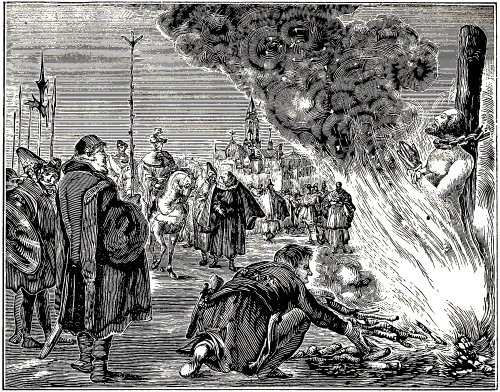
CLEMENT OF SCOTLAND BURNED BY THE ROMANISTS.
When Clement, having come from Scotland, had joined the aforesaid Albert as a companion, and united with him in regard to doctrine, he not only began, but ceased not, even as the friend whom he had found, to combat with the spiritual armor, and if possible, to overcome, in an evangelical manner, the Pope and the Roman Church, in various points, touching mostly her ceremonies. Thereupon he was also accused, and put to death in such a manner as in the proper place, we presently hope to show.
The accusations brought against him were of the same nature as those preferred against Albert, his companion; which was not at all strange, since he had placed himself under Albert, not only as a friend and companion, but also as a disciple. For this reason, the Pope, through the accusation of Boniface, the papal Legate, pronounced the same excommunication against him.
But when he presented himself for the purpose of vindicating his conduct in a full synod, Boniface prevented him from taking this course, making the people believe that it were not lawful to admit a heretic who had been excommunicated or excluded from the church, to divine worship, or to a synodal assembly; yea, that such an one should not be permitted to have the benefit (in whatever this might consist) of the laws or ordinances of the church.
Seeing that by this pretense his lips were sealed, making it impossible for him to properly defend himself, he had recourse to his pen and wrote a book concerning this matter, against Boniface.
Finally, it is stated and maintained that this steadfast witness of Jesus Christ, was burned as a heretic by the Romanists, even against the will of Pope Zacharias, about A. D. 750, or a little after.
Compare this entire account of Clement with Willibaldi, Naucleri, Aventini. Balae. Alij ubi supra. Also, Annal. Boj. Bernhard. Lutz, in Catal. Hæres., Tom. 2, Concil. Also, A. M., 2d book, H. M., 1619, fol. 328, 329. Hist. Mart. I. S., 1645, fol. 30.
FURTHER OBSERVATIONS TOUCHING THE CASE OF ALBERT AND CLEMENT, ACCORDING TO THE ACCOUNT OF SEBASTIAN FRANCK.
“In the year” etc., “these two men drew to them much people in France, pretending to be followers of the apostles, and speaking great things of the mysteries of God, and the life and conduct of man. Boniface, Archbishop of France, wrote the whole matter to the Pope, who, in a council of the bishops, laid it before them. They rejected the opinion of the (supposed) heretic from the church.” Finally he says: “They were unanimously deposed and anathematized.” Chron. Rom. Kett., fol. 64.
SPECIAL ACCOUNT OF CLEMENT, ACCORDING TO P. J. TWISCK.
“Clemens Scotus, a faithful disciple of Bishop Adelbert, taught with great power in France and Germany, especially in Bavaria and Franconia, that the Pope ought not to have so much power; that he (the Pope) very improperly would forbid the priests (or teachers) to marry; that he introduced many new and unknown ceremonies into the church, and originated false doctrines. He (Clement) was condemned without a hearing or examination, and his writings or books were burned.” Chron., page 258, col. 2, and 259, col. 1, from Joh. Munst., fol. 125. Aventin., lib. 3. Chron. Seb. Fr., fol. 54.
OF TWO FOLLOWERS OF THE AFORESAID MARTYRS, NAMED SAMSON AND SYDONIUS, WHO, WITH OTHERS, MAINTAINED THEIR DOCTRINE AGAINST POPERY, PARTICULARLY AGAINST THE PAPAL LEGATE, BONIFACE, ARCHBISHOP OF MAYENCE; BUT WHETHER FOR THIS THEY WERE MARTYRED, IS NOT STATED.
Samson was also a Scotchman by descent, and an elder and companion of said Clement. He and Sydonius, Bishop in Bavaria, and others of like purpose and belief, were as one heart and soul, to oppose with the word of God, Boniface, the papal Legate, who proposed to oppress the people with manifold superstitions and burdens. This, not only Samson, but also Sydonius and the others boldly did. They taught with word and pen, that the apostolical embassy (as it was called) of Bishop Boniface bore a closer resemblance to paganism or anti-christendom, than to christendom, and that he had deformed rather than reformed, France and Germany. Again, that he was a sycophant and flatterer of the Pope of Rome, to whom he had not only bound, but completely sold himself, as a sworn slave.
This they were able to prove, since, by a solemn oath, he had sworn to the two Popes, Zacharias I. and Gregory II.: That he would bring all the persons whom he should draw to him, also into obedience to the Roman see. These things were known from documents written by himself and transmitted to said Popes.
They also censured him for his evil practices in the administration of baptism (that is, infant baptism), consisting in the saying of certain words, by way of exorcism. In this several questions were generally put to the unintelligent infants, namely: “Believest thou?” etc., whereupon the sponsors, in the child’s name, answered: “Yea, I believe,” etc.; which things certainly deserved no little censure, though without them, infant baptism had but little virtue or respectability.