First Part. (continued 10)
Joseph F. Sohm translation
They were also greatly offended, because he would forbid them to marry, as contrary to the institution of God, Gen. 1:27,28, yea, as being a doctrine of devils, 1 Tim. 4:1–3.
Finally it is stated, that said persons, and others, unable, in Germany as well as in France, to bring about any improvement with their doctrine, were greatly oppressed, partly through the tyranny of the popes of Rome, and partly through the authority of the kings of France, yea, were condemned in open synods, deposed from their ministry, and shut up in prisons and dungeons, and thus closely guarded that they might not escape. But as to what finally became of these persons, and others of like belief, A. Mellinus states, that the papistic historians are ashamed to tell. Compare Aventin. 3, Annal. Centur. Balaei., 14, cap. 31, and in Append., Tom. 2. Concil. in Decret. Greg. 2, Epist. Bonifac. ad Zachar. Citante Balaeo. Hist. Boj., lib. 3, with A. Mell, 2d book, fol. 329, col. 1, 2.
SEVERE AND LAMENTABLE PERSECUTION, INSTITUTED BY MADY, KING OF THE ARABIANS, AGAINST THE CHRISTIAN BELIEVERS IN THE EAST, ABOUT A. D. 780.
About A. D. 780, in the fifth year of Leo IV., son of Constantine Copronymus, Mady, King of the Arabians, greatly devastated the church of God in the East, constraining the innocent and defenseless Christians to apostatize, especially the servants and slaves. To this end he had given full power to one Thesias, surnamed Zelotes, to inflict upon the Christians all manner of oppression. The latter, upon coming to Emesas, promised to constrain no one to apostatize, or to become marked with the sign of Mohammed, except the Jews, or those who had long before not been Christians, but unbelievers. But when the Jews and the Christians had been separated, he commenced to torment the Christians far more cruelly than had ever been done by the Governors Lysias and Agricolaus, under the heathen Emperors; so that he put to death many of them, men as well as women, for the name of Jesus Christ.
In the meantime something remarkable occurred here. Certain women whom he visited with various torments, to see whether he could not make them yield to his ungodliness, remained steadfast, overcoming, through the grace of our Lord Jesus Christ, his fury with patience. He caused a thousand stripes to be given them, and had them scourged and tormented unto death, till they received from Christ the crown of victory.
Proceeding thence throughout Syria, he demolished, as far as Damascus, all the meeting-places of the Christians, and ravaged the churches, thus breaking the promise made by the Arabians to those of Syria, viz.: That under their rule they should live in peace and tranquillity, and enjoy the free and unrestricted practice of their religion. But (as the apostle says) as then, he that was born after the flesh persecuted him that was born after the Spirit, even so it was now, Gal. 4:29. See Abr. Mell., 2d book, fol. 306, col. 1, compared with Paul. Diac., lib. 23, Histor. Rom., in Leone 4. Sigibert. Chron., A. D. 781; others, however, fix it A. D. 780.
FURTHER OBSERVATIONS RESPECTING THE AFOREMENTIONED PERSECUTION.
We commenced this century in the East, thence proceeded to the West, and have now returned to the East, namely, to the countries situated east from Italy, and, consequently, far from Rome, and the Roman see of papal dominion.
As regards the aforesaid persecutions, as well as the churches which existed in the East, especially in the Thessalonian regions, and the martyrs who fell there, namely, what and how much is to be held of them, can be gleaned from the explanation which we gave in the beginning, and to which we here refer the reader.
These Arabians proceeded and brought still more persecution and misery upon many Christian believers in other countries; however, for reasons already mentioned, we are again prevented from speaking more fully, or, at least, separately, of each person that may have been martyred there.
The account of holy baptism, which we have given for this century, would furnish us with not a little matter, to fill these hundred years to the very end with true professors of the true faith, also with such as, to all appearance, did not hesitate, in testimony of their upright and unwavering minds, to lay down their lives for the sake of Jesus Christ, which is the utmost that can be required of any martyr; but as we have not been able to find their names, they can have no place in this book. It is sufficient, we hope, that their names, by the hand of God, are written in the Book of life and eternal salvation.
AN ACCOUNT OF THE HOLY BAPTISM IN THE NINTH CENTURY.
SUMMARY OF BAPTISM IN THE NINTH CENTURY.
[This account begins with a sad lamentation, that nearly all the learned and celebrated men were corrupted through the Roman superstitions.
Immediately, however, a consolation follows, namely, that in this corrupt age there were still people who did not adhere to the Roman superstitions.
Then it is shown from Haimo, that teaching must precede baptism; that the candidate must first be instructed; that he must first be enlightened, etc. Thereupon, in the margin, A. D. 821, it is noticed that Christus Taurinensus wrote against the invocation of images, of the cross, of relics, of the saints, and against the power of the Pope, pilgrimages, etc. In the margin, for the year 825, a certain council of Paris is adduced, against image worship. In the same place, Gratian says that Christians must not oppose weapon with weapon, but flee before persecution.
Rabanus Maurus appears, A. D. 830, and teaches how in his time the catechumens were prepared for baptism. Of those who asked for baptism, and made haste for it. His exposition of Cant. 3:6: “Who is this that cometh up white as snow?” Again, that the candidate must previously be instructed in the faith of the incarnation of Jesus Christ; also, that in the sacrament of the Supper, the language is figurative.
Angelomus follows Rabanus, teaching that the sins which have been committed through the senses, are washed away (that is, forgiven) in or through baptism; which is more fully explained.
Thereupon, A. D. 840, Bertram, Heymon, and Walafrid appear, who declare themselves against the Roman church, in various points, as in the matter of baptism, transubstantiation, justification, good works as practiced by the papists.
The council of the Christians at Paris, in the time of Louis and Lothaire, is introduced; lamentation on account of the encroachment of infant baptism, and the neglect of the instruction once connected with baptism.
The conversion of the Slaves (of Slavonia) is stated; also, that they were baptized, though not according to the Roman custom, nor in the Roman language. Marginal notice, for A. D. 843, that Christus Lupim at Ferrara refuted the new Roman doctrines, as purgatory.
A few good things respecting the baptism of adults are adduced, for the year 848, and explained in a simple manner. In the margin, for A. D. 858, it is stated of Gunther, Bishop of Cologne, that he calls the Pope a tyrant, yea, a wolf.
Idiota declares that in baptism we accept Christ as our bridegroom. In the margin, mention is made of Ulric, Bishop of Augsburg, that he accused the Pope of error.
Hincmar, Bishop of Landun, opposes the baptism of infants, and prohibits their being baptized; on account of which he is severely accused.
Paschasius advances three things which are incompatible with infant baptism.
Remigius teaches against the Pope; likewise, Tergand, Bishop of Triers, who calls him antichrist, and Rome Babylon. Conclusion from P. J. Twisck and John Patrick.]
Jesus Christ our Savior, speaking of the grievous times which should come after his departure, says, (Matt. 24:12): “And because iniquity shall abound, the love of many shall wax cold.” This was experienced at this time; for with the growth and increase, through very many ungodly and unrighteous superstitions, of the iniquities of the Pope of Rome and the whole Roman church, the true love for God’s commandments decreased, so that but few were found, who, as bright lights, penetrated the smoke that came up from the Roman pit; yea, nearly all men of learning and celebrity were corrupt. O sad and lamentable matter!136
Nevertheless, as Noah and his family served God in the first world; Lot, in Sodom; Daniel and the three youths, Shadrach, Meshach, and Abed-nego, in Babylon; Elijah and the seven thousand who were hidden and had not bowed their knees to Baal, in the land of Israel, where the prophets of the Lord were slain, and his altars thrown down; even so there remained some, though but few, at this time, who, living in the midst of popery, did not adhere to the Roman superstitions, but abhorred them.
However, in order to avoid prolixity, we shall confine ourselves, omitting, as has been our custom, other points to the article of baptism, except where it may be found necessary to add something else; and shall show when and by whom this article, with the rejection of infant baptism, was maintained salutarily and in the fear of God, according to his words. Hence we will begin thus.
A. D. 814.—In the days of Louis the Pious, the first of this name, who began to reign with the year 814, there lived and wrote the celebrated Haimo, of whom various praiseworthy things concerning baptism upon faith are still extant.
Haimo, on Matt. 28:19, (Bapt. Hist. page 561,) writes: “In this place the order how to baptize aright is pointed out to us; in which it is ordained, that teaching must precede baptism, for he says: ‘Teach all nations;’ and then adds: ‘baptizing them.’ He, then, that is to be baptized, must previously be instructed, that he may first learn faith, which he shall afterwards receive in baptism.
How could any one give clearer testimony concerning the true baptism of Jesus Christ? how, also, could anybody more plainly reject infant baptism, than by such a declaration? every word emphatically says it.
He begins with Matt. 28:19, where the Lord says: “Go ye therefore, and teach,” or, in other words make disciples of; which he explains thus: “that teaching must precede baptism;” for the Lord first says: teach, and then, baptize, and that therefore he that is to be baptized, must first be instructed, and learn the faith. Certainly, these are things which pertain only to the adult and intelligent; hence it would be sinning against the truth to apply them to unintelligent infants.
Haimo (Serm. Domin. 12, Trinit., page 564) says: “Since those who are baptized, must first be enlightened with the grace of the Holy Spirit, then instructed by the teachers, and finally called to confess the faith, hence arises the custom that,” etc.
This accords fully with the preceding; for he declares the same still more plainly, since here not only instructing is joined to baptizing, but the illumination of the Holy Spirit, the instruction of the teachers, and the confession of the faith are connected with, yea, required before baptism; which is so clear, according to the purport of the first declaration, that it is unnecessary to add another word; the impartial may judge. As to what he further says in the same place, concerning the touching of the tongue, the saying of the word Hephphatha, etc., we leave as it is, neither praising nor censuring it, since it is of little consequence, if the truth and the signification of the matter is rightly preserved.
Haimo, on Rom. 1 (page 542), writes: “At the time of baptism we confess that we believe on God the Father, and on the Lord Jesus Christ, and on the Holy Ghost; likewise, that we renounce the devil and all his pomp and works. If we observe this thus, we belong to God in faith; but if we do not, we are convinced of unbelief.137
A little before, in his exposition of Rom. 6 (page 540), he makes mention of four different baptisms: 1. In the water only, as was John’s baptism. 2. In fire and the Spirit, with which the apostles were baptized on the day of Pentecost. 3. In water and the Spirit, which baptism then obtained in the church. 4. In the shedding of the blood with which the Lord himself and all the holy martyrs were baptized.
These four different baptisms can pertain to none but the intelligent and believing; for, as regards the first, namely, John’s baptism, it is expressly stated that those to whom it was administered, confessed their sins and repented. Matth. 3:6,8,11. As to the second, namely, the baptism of fire and the Holy Ghost, which was administered to the apostles by God himself from heaven, this did not at all relate to infants, seeing that all who were thus baptized, spake with tongues and magnified God. Acts 2:3,4. Concerning the third, namely, the baptism in water and the Spirit, which then obtained in the church, this likewise could not be peculiar to infants, since the fruits of the Holy Ghost, without which the Holy Ghost cannot be, do in no wise appear in them. See Gal. 5:22. Respecting the fourth, namely, the baptism by the shedding of blood, this, according to his statement, is peculiar only to Christ and the martyrs; consequently it cannot be regarded as applying to infants, for these do not even know of confessing Christ, much less of suffering one’s blood to be shed for his name’s sake, and of dying in constancy.
Continuing, he shows in the same place (Rom. 6) that in him that is to be baptized, there must be three invisible things: 1. Faith. 2. The soul, which is washed from sin. 3. The Holy Ghost, by whose cooperation the forgiveness of sins is imparted. We would explain these things more fully; but since this is a passage expressed in almost the very words which Albinus, in the preceding century, for the year 792, wrote (on John 15), of which we gave an explanation, we will, to avoid repetition, take leave therefrom, referring the reader to said explanation.
Haimo teaches, on Canticles 4 (page 544), that all who desire to become brethren must be baptized, saying: “Without the washing of baptism, no one can be a true believer.”
What else is this than what the holy Scripture teaches, namely, that in baptism we put on Christ? and that by faith (which is professed in baptism) we become the children of God? Paul says: “Ye are all the children of God by faith in Christ Jesus. For as many of you as have been baptized have put on Christ.” Gal. 3:26,27.
But some one may think: Haimo speaks of becoming brethren by baptism; whereas Paul speaks of becoming children of God, of putting on Christ, etc. True, beloved reader; but who, with only a little experience in the holy Scriptures, knows not that to be a child of God, or to be a brother of the church of Christ, is one and the same thing? Certainly, it is the same; for the same Spirit that makes us children of God, also makes us brethren of Christ, yea, joint heirs with him. Rom. 8:15–17. For this reason, Christ calls them both his brethren and his children, saying: “I will declare thy name unto my brethren, in the midst of the church will I sing praise unto thee.” And again: “Behold, here am I and the children which God hath given me.” Hebr. 2:12,13. Who now shall say that Haimo, who calls the baptized, brethren, and Paul, who terms them children of God, contradict each other? Their accordance is sufficiently proven, and at this we will let it rest.
Of the dignity of baptism, Haimo, on Hos. 2 (page 547), says: “Baptism is sanctified by faith in the sufferings of our Lord.”
“What doth hinder me to be baptized?” said the Ethiopian to Philip. Philip replied: “If thou believest with all thine heart, thou mayest,” Acts 8:36,37; indicating that, in order to receive baptism worthily, sincere faith is required, by which baptism is sanctified, which is just what Haimo has expressed in the above words; and thus his words agree with those of the holy Scripture which we have quoted.138
The righteous, Haimo says, on Ps. 38 (page 548): “Live in baptism, in which they die unto sin and the world.”
Again, on Ps. 136, he says: “By the Red Sea we understand holy baptism, which (so to speak) is red, being sanctified through the blood of Christ,” and a little further on: “By the impartation of the same, the believers begin (to proceed) in the way by which they come to God.”
On Zech. 13 he says: “When we receive the faith, we are regenerated in Christ, and in baptism we are washed from all our sins; and they that through faith are regenerated in baptism, are made children of God.[typo?: ” missing]
Again, on Cant. 1, he speaks thus: “As Israel was preserved in the Red Sea, but Pharaoh drowned, even so the church of the Gentiles, by baptism, is delivered from the bondage of the devil, and led into the true land of promise, to the liberty of the Gospel; thus she who was formerly an handmaid of iniquity, is become a friend139 [beloved] of Christ, cleansed and washed, by baptism, from the filth of sin.”
These passages are like the jets of a fountain, which, though they shoot forth in different places, proceed from one source. In the first passage, it is said of the righteous, that they “live in baptism, yea, die unto sin and the world.” The life spoken of here signifies a spiritual life, and is contrasted with death, which comes by sin; the dying unto sin and the world, signifies a forsaking and renouncing of the same, which can be done only by those who previously adhered to, and loved, sin and the world.
In the second passage, baptism is compared to the Red Sea, and it is said that “by the impartation of the same, the believers proceed.” But is not this the very thing which Paul spoke of the figurative baptism of the believing patriarchs, saying: “Brethren, I would not that ye should be ignorant, how that all our fathers were under the cloud, and all passed through the (Red) sea; and were all baptized unto Moses in the cloud and in the sea” (1 Cor. 10:1,2); which is not to be understood of infants that were wont to be carried, but of adult persons, who were able to proceed and walk.
In the third passage, faith, regeneration, baptism, and being made children of God, are joined together. “They that through faith are regenerated in baptism, are made children of God,” he writes. But how can this be interpreted otherwise, than with reference to intelligent persons, who, having attained to faith, by the hearing of the word of God, are regenerated, and, in token thereof, baptized, and adopted as children of God into his church? Faith certainly comes by hearing, and hearing by the word of God. Rom. 10:17. Regeneration takes place after the death of the first birth, or after the mortifying of the old man. John 3:4,5; Rom. 6:4. Baptism is administered to the believing and regenerated, as a sign of faith and regeneration. Acts 8:37; Tit. 3:5. Those are made children of God, who, through faith, have put on Christ, and, in proof of this, have been baptized. John 1:12, compared with Gal. 3:26,27. Judge now, whether these are things that can be done by new-born infants. I am fully confident that you will say: No. Yet, these things are connected with baptism, not only by Haimo, but principally by God, in the holy Scriptures; yea, without them, baptism is of no value. Hence we say: “What God has joined together, let not man put asunder.” Matth. 19:6.
In the fourth passage it is said, that “The church of the Gentiles, by baptism, is delivered from the bondage of the devil,” and that “she who was a handmaid of iniquity, is (thus) become a friend [beloved] of Christ.” This certainly savors not at all of infant baptism, for it cannot be said of infants, that they are the church of the Gentiles, under the bondage of the devil, a handmaid of iniquity, nor that they, by baptism, are delivered from the service of the devil, and become a friend of Christ. Certainly, no one can be delivered from the service of the devil, but he who has served the devil; no other can be liberated from the servitude of iniquity except she who previously committed iniquity; she who previously blasphemed; no other can be adopted as a friend of Christ, than she who formerly, by wicked works, was at enmity with Christ; consequently it is indisputable, that this cannot be understood of infants, seeing these things can have no place with them; this even those who maintain infant baptism, must admit, and hence we dismiss the subject.
“The adult (candidates) also made confession of their sins, and a penance was imposed on them, for forty, twenty or seven days.” Haimo, on Heb. 6, (p. 552).
Here adult and not infant candidates are spoken of, yea, such, upon whom, when they had made confession of sins, a penance (or amendment of life) was imposed; which are things pertaining to adults, and not to little children; this is too plain to be refuted.
Said baptism was so firmly maintained and thus valued by Haimo, that he held that it should never be repeated, if it had been administered according to the rule of the holy Scriptures; for, treating of the 6th chapter of Romans, he says, by way of exposition: “If we have once died unto sin in baptism, we may not be baptized again.” Bapt. Hist., p. 543. This well accords with the custom of the Anabaptists of the present day; for, though they rebaptize such as have been baptized in their infancy, when they attain to the faith; regarding the baptism which is received in infancy as no baptism at all, because it is not according to holy Scripture; yet no one is rebaptized by them, who has been baptized aright, that is, upon faith.
NOTE.—A. D. 825.—The council held at Paris, A. D. 825, decreed against image worship. Sam. Veltius, Geslacht-register, page 127. Gratian said to his cotemporaries: “The Lord, in saying to his disciples: ‘When they persecute you in this city, flee ye into another,’ teaches that Christians when persecuted, should not repel weapon with weapon, but flee therefrom”. See Grondelijke Verklaringe Danielis ende Johannis, printed at Harlem, in the year 1635, p. 56.
A. D. 830.140—It is stated that A. D. 830, in the sixteenth year of the reign of Emperor Louis I., surnamed the Pious, there shone forth as a bright light, and wrote, one Rabanus Maurus, residing at Fulda, who, among various things written by him against the Roman church, also speaks of baptism, in the discussion of which he throughout employs such language as pertains only to believers, and in no wise to infants; notwithstanding he at one time, it appears, had been a maintainer of infant baptism, and many other superstitions of popery, so much so that he had been an abbot. But passing this by, we shall show what he wrote of baptism, and how closely it agrees with the teaching of the holy Scriptures.
In Jacob Mehrning’s history of baptism, various passages from Rabanus Maurus are adduced, some of which, it is suspected, have been attributed to him unjustly, or, at least, that, if he has written them, he wrote them before he was enlightened or converted; as, among others, in lib. 2, de Proprit. Serm., cap. 200; again, lib. 4, cap. 10; of which we let the intelligent judge.
Nevertheless various things are found, which, we doubt not, are justly ascribed to him, as, for instance: Of the instruction of the catechumens before baptism, and how the novices ought to learn the faith before they are baptized. In Decretis de Consecrat. dist. 4, cap. Ante Bapt., ex Rabano, Bapt. Hist., page 560. Likewise, the quotation made by Vicecomes (lib. 2, cap. 40) from Rabanus (in lib. de instruct. Cleric.), which reads as follows: “The order according to which the catechumens are prepared for baptism, is this: First they are interrogated whether they renounce the devil,” etc. Bapt. Hist., page 562. The rest we omit.
By this he indicates, that in his time, in the church of which he was a member, the custom of preparing the novices for baptism was still observed, inasmuch as first, the instruction of the faith, called the catechism, was presented and taught them; also, that they had to renounce Satan, &c.; which was observed not only at this time, but in nearly all the preceding times, as appears from this passage: “They are wont to renounce the devil with his works and pomp.” Syn. Turon. Bapt. Hist., page 516, num. 7.
That in the time of Rabanus the instruction of novices extended not only to those of heathen descent, but also to such as were born of Christian parents, is declared by Jacob Mehrning, Bapt. Hist., page 560, contra Rulichium.
D. Vicecomes (lib. 3, cap. 9), quotes from Rabanus Maurus (page 562): “The fellow petitioners for baptism are those who, through the doctrine of the faith, and by refraining from disorderly conduct, make haste to receive the grace of Christ in baptism.”
This confirms our former assertion, namely, that before baptism a preparation had to be made, in order that it (baptism) might be received worthily; which preparation is here called “the doctrine of the faith and refraining from disorderly conduct.” In it are comprised both parts of the doctrine which John presented to those who came to his baptism, saying: “Repent ye, and believe,” etc. Matt. 3:2, compared with Mark 1:15, and Acts 19:4.
Moreover, they are called fellow petitioners, and it is said that “They make haste to receive the grace of Christ in baptism,” which are things that cannot be done by infants.
Hence he writes, on Cant. 3:6, (page 540): “Who is this that cometh up white as snow?” applying the same to the candidates, who, cleansed from their former sins, come up from baptism, and increase in virtue. “This mystery,” he says, “is not otherwise than under the invocation of the Holy Trinity, that is, in the name of the Father, of the Son, and of the Holy Ghost; thus the Lord says to the apostles, Matt. 28:19: ‘Go and teach,’ ” etc.
Hence, when he speaks of coming up from the water, and of the invocation of the Holy Trinity, as well as of the passage, Matt. 28:19, he sufficiently shows that he does not speak of the baptism of infants, since they cannot come up from baptism, nor invoke the Holy Trinity, nor fulfill the passage, Matt. 28; which is too clear to be refuted. We will therefore briefly conclude this account of Rabanus with that which P. J. Twisck records concerning him.
THE VIEWS OF RABANUS MAURUS CONCERNING VARIOUS OTHER ARTICLES OF HIS FAITH, ACCORDING TO THE AFOREMENTIONED AUTHOR.
He writes, A. D. 830: “Rabanus, an eminently learned man writes and says: ‘The catechism, that is, the doctrine of the faith, shall precede baptism, so that the candidate (catechumen) may first learn the first principles of the faith.’ ”
He further says: “The Lord Christ first anointed the eyes of the man born blind, with clay made of spittle, before he sent him to the water of Siloam; therefore, the candidate shall first be instructed in the faith of the incarnation of Christ, and, if he then believes, admitted to baptism; that he may know what grace he obtains in baptism, and to whom he owes his service for it.”
Again: “Rabanus writes also, that in the sacrament the language is figurative, and that Christ, having gone to heaven (in order that we being regenerated by faith, should long the more ardently for him) left us this sacrament, as a visible figure and symbol of his flesh and blood, so that we the more abundantly, might apprehend in faith the invisible things.” This language, Twisck writes, the Roman church now greatly curses.
“He also taught contrary to the Roman church, of the authority of the holy Scriptures, of justification, repentance, the state of the soul after this life, and against other141 papal errors, as his books testify.
“The same thing was done at this time, by Angelomus, who treated of the grace of God, good works, and the keys of the church, in opposition to the Pope. Chron., 9th book, page 283, from John Munst., fol. 120, 133. John Boea., lib. 4, Grond. Bewijs, letter A. Chron. Seb. Franck, fol. 77, Casp. Swinck, fol. 115.
Same year as above.—This Angelomus just mentioned is referred to in Jacob Mehrning’s History of Baptism, in which it is stated that, besides the aforementioned views held by him contrary to the Roman church, he left the following testimony with regard to the matter of baptism:
Angelomus (in cap. 7, lib. 3, Reg. 1, page 548), says: “From all that we have sinned with the sight, hearing, smelling, tasting and feeling, we are redeemed through the grace of God, by the washing of the living fountain of water (that is, water-baptism). But the forgiveness of previous sins is not enough, if we are not diligent to lay up good works: for, otherwise, the devil who was gone out of the man, finding him empty of good works, returns, manifold, and makes the last state of that man worse than the first.”
Hence, when Angelomus here speaks of the sins which before baptism were committed through the senses, as, through the sight, hearing, smelling, tasting, and feeling, he certainly indicates thereby, that the persons of whom he speaks, are not unintelligent infants, seeing these can neither use nor abuse their senses, and, consequently, as long as they lack the knowledge and power, they can not sin with them.
Hence it also appears that the baptism of which he speaks, is not infant baptism; for this can have no regard to sins committed previously through the abuse of the senses. The baptism in question, then, is such a baptism as is received by persons who can lay aside previous sins, and lay up good works; who also give no room to the devil gone out of them, that the last state may not be worse than the first; for of all this, Angelomus speaks. We will, therefore, leave this, and proceed to other testimonies serving the same purpose.
A. D. 840.—That at this time not only baptism, but also various other articles of Christian doctrine were maintained contrary to the belief of the Roman church. P. J. Twisck indicates, in his Chronijk., for the year 840, with these words: “Bertram, a courageous and learned man, now vigorously assailed the doctrine of transubstantiation, in a remarkable book, dedicated to the King of France. Heymon, Bishop of Halberstadt, also contended against this doctrine, and wrote much of baptism, the Supper, justification, good works, and of the church and her office, in opposition to the opinion of the papists. Also Walafrid opposed the new doctrine of the Romanists very vigorously.142 P. J. Twisck, Chron., 9th book, page 286, col. 2, and page 287, col. 1, from Joh. Munst., fol. 129, and 132.
A. D. 841.—It is recorded that at this time, in the reign of the Emperors Louis and Lothaire, a council was held at Paris, concerning which it is written (chap. 6): “In the beginning of the holy church of God, no one was admitted to receive baptism, who had not previously been instructed in the faith, and in the mystery of baptism, as is testified by the words of Paul, Rom. 6:3: ‘Know ye not, that so many of us as were baptized into Jesus Christ were baptized into his death?’ which passage of the apostle has reference to the sacrament of baptism.”
In the council of Laodicea (Tit. 46), it is also written, that “those who desire to come to baptism, shall learn the faith, and recite the same to the bishop or teacher, on the fifth day of the great week.”
Again (Tit. 47): “That those who were baptized in sickness, shall, after recovery, diligently study their faith and know what great grace they have received; which words plainly indicate, that those who attain to the Christian faith, are also previously instructed concerning said faith and the mysteries of baptism. But now, sad to relate, also the infants of Christian parents are baptized, who, on account of their tender age, cannot comprehend this matter, which to learn even persons of understanding must exert themselves diligently, and which, owing to the negligence of some, has gone out of use in the Christian church. O what great neglect! O what great mischief.” Jacob Mehrning, Bapt. Hist., page 538.
About A. D. 842.—It is stated that at this time a number of slaves who had become converted were baptized, yet not in the Roman manner, nor in the Roman language, as was customary with the Roman church, as well as with all other churches which adhered to the Roman see; but in a different manner and in another language; so that it appears from this occurrence that this church must have been separated from the superstitions of the Roman church not only in forms, but also, as may be inferred, in faith and practice. To this, the following annotation (Bapt. Hist., page 552, num. 9), among others, has reference: “They (those of the Roman church) used the Roman language not only in Italy, but also in other regions that were subject to the papal power; but that baptism was administered also in other languages, is proved by the history of the conversion of the slaves.”143 Ex. Historia Sclav.
About A. D. 848.—That the instruction of novices, before baptism, obtained also at this time, Jacob Mehrning, Bapt. Hist., page 550, informs us with these words: “The adults had (then) to be instructed in the faith, and were catechized before baptism, as has been proven above, from Rabanus, Haimo, and others; thereupon they had to confess the faith, as Rabanus (lib. 1, de Cleric. Institutione, cap. 27) relates. They were asked, whether they believed in God the Father, the Almighty, and on his only Son, our Lord, and on the Holy Ghost, a general (christian) church, forgiveness of sins, resurrection of the flesh,” etc.144 Bapt. Hist., p. 550, num. 4.
These were good and salutary customs for the upbuilding of the church of God; by which the name of the Lord was praised, the church edified, the word of God most strictly observed, and the salvation of many promoted. But the ancient saying: “Where God builds a temple, Satan builds one in opposition to it,” was also verified here; for, at the same time that those who loved the truth, baptized believers, upon the confession of their faith, nearly all the others, who were called Roman or Greek Christians, baptized infants, who, as every one knows can neither believe nor confess the faith; this has been referred to above.
About A. D. 854.—It is stated that very near the time of Haimo, there lived and wrote Idiota. In J. Mehrning’s History of Baptism is found a quotation by him, relating to baptism, which reads as follows: “In holy baptism we accept Christ for our bridegroom, and enter his chamber, which is ornamented with manifold graces and virtues.” De Innocentia, cap. 3.
To accept Christ for one’s bridegroom, to enter his chamber, is certainly not the work of children, but of believers. Those accept Christ for their bridegroom, who betroth themselves to him by faith, and, in token thereof, are baptized. John 3:26,29. Those enter his chamber, who, through obedience, join themselves to his church; for they are no more “strangers and foreigners, but fellow-citizens with the saints, and of the household of God.” Eph. 2:18.
That which is further said of the chamber of the bridegroom, namely, that it is ornamented with graces and virtues, has reference to the spiritual ornament of the church of God, which latter is the true chamber of our heavenly bridegroom Jesus Christ. This church of God cannot be ornamented with graces and virtues by infants, seeing infants are ornamented with neither actual graces nor real virtues; hence, it has also respect to the believers, who, having come, through baptism, to the church of God, ornament the same with actual graces and real virtues. This concludes our exposition of the passage of Idiota.
Note.—A. D. 859.—Huldricus or Uldoricus, Bishop of Augsburg, greatly complained of the violence of the popes, and said: “What will become of this flock, when the shepherds become wolves?” He openly maintained that the Pope was fallible, and that it was lawful to admonish him for his error, and to reject his bad decrees. P. J. Twisck, Chron., 9th book, page 298, col. 1, from Merula, fol. 177. Jan. Crespin, fol. 211, 215, 216.
A. D. 860.—At this time, there departed from the belief and practice of infant baptism, Hincmar, at one time Bishop of Laudun, inasmuch as he would no longer baptize children, so that they grew up without baptism, and many also, who did not attain the years of understanding, died unbaptized; on account of which he was then greatly accused by Hincmar, Bishop of Rheims, who, to this end, wrote to him as follows: “And thou, who knowest that it is true what the Lord says: ‘Except a man be born of water, and of the Spirit, he cannot enter into the kingdom of heaven;’ hast nevertheless commanded, that infants shall not be baptized in thy church, not even when in peril of death, so that they should not be saved, though it is written: ‘The Son of man is not come to destroy men’s lives, but to save them.’ Thou hast also acted contrary to the decrees of Syricius, Leo, Gelasius, and the African council, as I have informed thee now twice by writing.” H. Mont. Nietigh., page 81, ex Biblioth. Patr., Tom. 9, part 2, page 137. Cent. Magd., Cent. 9, cap. 4, pages 40, 41.
In another letter, the Bishop of Rheims, with entreating, and not less earnest words, endeavors to draw him away from his belief, writing: “Desist from preaching this (namely, that infants may not be baptized), the mere thought of which is awful; desist from scattering the flock of Christ (meaning thereby, through error, the Roman church), lest the destruction of all the people come upon thee; and do not, from excessive love for thy belief, sever thyself from,” etc. H. Mont., page 82, from Cent. Magd., Cent. 9, pages 157, 158. Also, Bapt. Hist., page 545.
From these two letters it appears that Hincmar, Bishop of Laudun, had not only departed from the doctrine of infant baptism, but also earnestly preached against it, so that many of the Roman church, particularly at Laudun, became his adherents; for, what did the Bishop of Rheims mean by writing: “Desist from preaching this,” but to say that Hincmar of Laudun should cease preaching against infant baptism? What else does he indicate when he says: “Desist from scattering the flock of Christ, lest the destruction of all the people come upon thee?” Certainly, these words indicate that many had already left the Roman church on this account, yea, that the state of things was such that all the people at Laudun adhered to this doctrine.
Moreover, from the last letter we see, how firmly, and almost immovably, said Hincmar must have stood, at Laudun, in his doctrine and belief against infant baptism, seeing such great endeavors were made to draw him away; now by presenting his belief in the most odious light, as though he preached things the mere thought of which was awful; now by flattery: “And do not, from excessive love for thy belief, sever thyself from,” etc. But whether through this he was in any wise turned away from his belief, we have not been able to ascertain; hence we will let the matter rest.
In reference to what he may have taught with regard to other points, we can, on account of the default of history, give nothing certain; it is sufficient for us, that in those perilous times he dared oppose the common Roman church, by rejecting infant baptism, and that much people adhered to him therein, as has been shown above.
A. D. 867.—We have now come to the year in which an uncommon and quite unexpected matter is mentioned by ancient writers, of which we will forthwith give an account. Just now, for the year 860, we told of a certain champion of the Roman superstitions, especially of infant baptism, namely, Hincmar, Bishop of Rheims, who, once and again, by express letters, immoderately accused another Hincmar, Bishop of Laudun, because the latter refused to baptize infants, and would also not allow them to be baptized, though they were in danger of dying. This same person now, seven years after making the above accusations respecting the non-baptizing of infants, opposed the Pope, not only in one point, but in many, among which infant baptism may also have been. Concerning this P. J. Twisck, from other authors, writes thus: “Hincmar, Bishop of Rheims, opposed Pope Adrian II. in many points, in defense of the truth. He charged him with innovation, saying that he could not be Bishop and King at the same time; that he should have nothing to do with secular affairs.” Chron., 9th book, page 305, col. 2, from Hist. Georg., fol. 314, Catal. Test., fol. 52.
It is a pity and to be lamented, that the ancients have not left us more information regarding the particular points maintained by Hincmar, Bishop of Rheims, against the Pope, and, consequently, also against the Roman church.
It would not be very surprising, if among the points maintained by him against the Pope, the denial of infant baptism was one; for, when he, seven years before that, accused Hincmar, Bishop of Laudun, for not baptizing the infants, the latter apparently, either from the holy Scriptures, or by conclusive arguments, demonstrated to him the groundlessness and vanity of infant baptism in such a manner that he may easily have attained to very different views, not only in regard to infant baptism, but also in other points which were maintained after the manner of the papists. But as this is not clearly indicated, we will not discuss it any further, but leave it as a probable conjecture. Moreover, it is not our purpose to justify said Bishop in every article of religion, nor to declare him orthodox on the whole; but to show that the same person who had previously so stoutly defended the Roman church and the papal superstitions, especially in the matter of infant baptism, now dared attack not only the Roman church, but even the Pope, who is called its head, and to oppose him in many points, as has been shown. With this we take our leave of Hincmar of Rheims.
A. D. 880.—At this time there lived Paschasius, a remarkably experienced and virtuous man, who wrote various things against the belief of the Roman church; but as the thread of our account extends only, or, at least, principally, over the matter of baptism, we will also here turn our special attention to the same, and, so as not to be encumbered with many testimonies, present but one passage of his belief with reference to this matter, as recorded in Jacob Mehrning’s history of baptism.
Paschasius (de Corp. and Sang. Dom., cap. 10, page 594) says: “In the sacrament of baptism the door is opened to believers, to enter into the sonship of God, that we, being delivered from evil through this regeneration, may afterwards become one body with the members of Christ; in which baptism, when the Holy Ghost is shed abroad in the souls of the regenerated, the whole church of Christ is quickened, and becomes one body, by one Spirit received by all.”
Here he indicates three things incompatible with infant baptism. Firstly, when he says that “In the sacrament of baptism the door is opened to believers, to enter into the sonship of God.” For, that this cannot relate to infants, appears from the nature of faith and of the believers; as to faith, it is a sure confidence of the things hoped for. Hebr. 11:1. This faith comes by hearing, and hearing by the word of God. Rom. 10:17. That neither this sure confidence, nor hope, nor intelligent hearing of the word of God, can have place in infants, is quite evident, since neither their powers nor their knowledge can reach these things. See Deut. 1:39; 1 Cor. 13:11.
Secondly, when he says: “That we, being delivered from evil through this regeneration, may afterwards become one body with the members of Christ.” For the word regeneration is no where in Scripture applied to infants, but to adults. John 3:3; Tit. 3:5. Likewise, to be delivered from evil, is applied only to such persons as, through evil works, were previously ensnared and held captive by sin. 2 Tim. 2:26. Hence, the second also does in no wise apply to infants.
Thirdly, when he, expounding the utility of baptism, says: “In which baptism, the whole church of Christ is quickened and becomes one body, by one Spirit received by all.” For, when mention is made here of the quickening Spirit of God, which in baptism is imparted to the church, or, at least, to those who, by baptism, are incorporated as members into the church, it follows almost incontrovertibly, that this relates neither to infants nor to infant baptism; for, as regards infants, instead of becoming quickened by the Spirit of God, after baptism, that is, instead of becoming adorned with all divine and Christian virtues, we see, on the contrary, that they generally, from that time on, as their powers increase, are led by their own spirit, so that with the increasing years, perverseness also increases, yea, sometimes gains the ascendency; hence, those who have reached their years, are admonished, that they must be born again, that is, that they must lead another and better life; or that they cannot enter into the kingdom of God. John 3:5,7.
This being the case, it stands fast, that Paschasius, in said passage, speaks neither of infants nor of infant baptism. Leaving this subject here, we will conclude with the account of P. J. Twisck, who records of Paschasius, besides what we have stated above, that he mentions but two sacraments, namely, 1. baptism; 2. the Supper; or, as it was anciently called, the body and blood of the Lord; which militates against the seven sacraments of the Roman church. P. J. Twisck, Chron., page 310.
Same year as above.—“Remigius,” he writes in the same place, “also taught much against the Pope, saying, among other things: “That we must address our prayers not to idols, but to the living God; and that the church must conform to the holy Scriptures.” Chron., 9th book, page 310, col. 1, from John Munst., fol. 61, 131, 133. Perk., fol. 249.
In the mean time, the pious were exceedingly oppressed in this century, by the power of the Pope and the Roman clergy; so that, on account of the smoke of the papistic errors, the fire of the pure doctrine could not burn freely, which was also the reason that not more learned and godfearing men manifested themselves at that time, in defense of the truth of God.
A. D. 900.—That at this time, some dared oppose not only infant baptism and other tenets of the Roman church, but even the Pope of Rome, who might well be called the father of all superstitions, the example of Tergandus sufficiently indicates, who, at this time, dared designate him by the name of antichrist, wolf, etc.; concerning which, Samuel Veltius (from other authors) has noted the following for the year 900: “Tergandus, Bishop of Treves, called the Pope of Rome antichrist, yea, a wolf, and Rome, Babylon.” Geslacht-register, page 128.
Note.—We will close with the account of P. J. Twisck, in his conclusion to the ninth century: “In this century, the occidental or western, Roman Empire, which has been at a stand-still now for 324 years, begins afresh. The clergy, through the folly of the Emperors, obtain power to elect popes and bishops. The Emperors are crowned by the popes, who will themselves to be the masters and lords and rule before and over others, as is evident from this, that some times two, three, and four popes reign at once and seek to domineer over the others, expelling, driving away, exhuming, cursing, each other. Spiritual matters are still greatly on the decline, men seeking their salvation far more in so-called good works, in ceremonies and superstitions, than through justification by faith in Christ Jesus. Disputations about transubstantiation are inaugurated, though the Supper is still administered under both forms, that is, with bread and wine. The people, having been to the supper, offer money or something else.”
What he further relates of exorcism at baptism; of the mass; of the power to canonize saints; of the worship of saints and images; of the ban of the bishops; of the punishment of heretics; of the consecration of temples; of purgatory; of soul-masses, to redeem souls from purgatory, etc., would require too much time to recount. See concerning it, Chron., page 320.
This has been told simply to show how and whereby the orthodox Christians were oppressed at this time in their worship of God; and why so few learned and pious people manifested themselves. We will now proceed to show what pious witnesses of Jesus Christ suffered as martyrs at this time.
Note.—A. D. 884. John Patrick, a man well versed in the Chaldean, Arabian, and Greek languages, in the monastery of Mabelsbury, greatly opposed the doctrine of an offering for the living and the dead; on account of which he was stabbed to death with awls. See Geslacht-register, page 127.
AN ACCOUNT OF THOSE WHO SUFFERED IN THE NINTH CENTURY.
SUMMARY OF THE MARTYRS IN THE NINTH CENTURY.
[The beginning is a repetition of the fourth proposition of the discourse of Haimo (for the year A. D. 814) respecting baptism by the shedding of blood, with which the Lord and all the holy martyrs were baptized.
Of the cruelties instituted by the Danish tyrant, Regnerus (A. D. 818) against the Christian believers; which matter is further explained in a note.
In the margin, mention is made that A. D. 826, the Saracens invaded the islands of the Romans, and, consequently, Creta; where Cyril, Bishop of the church at Gortina was slain.
The tyranny instituted by the King of Bulgaria against the Christians, about the year 842, is shown and confirmed by testimonies.
Great persecution of the believers, caused by the mutual contentions of the Kings in France, noted also for A. D. 842.
Very grievous and lamentable persecution of Christian believers at Cordova, in Spain, A. D. 850, through the wickedness of the Saracens. It is shown that said persecution had commenced long before A. D. 850, but that at this time it raged the most violently.
The distressing martyrdom of John, a tradesman at Cordova, A. D. 850. Note respecting the faith of said martyr.
Nunilo and Aloida, sisters and Christian maidens, put to death with the sword, for the name of the Lord, in the city of Osca, about A. D. 851.
Marginal note, for the year 852, that then the zeal of some to die as martyrs, was so great that multitudes of them confessed Christ, and ran after martyrdom; among whom Emilas and Hieremias are mentioned, who were beheaded for said reason: however, every one is left to judge for himself.
Aurea, a godfearing maiden, after many severe trials, beheaded at Cordova, for the testimony of Jesus Christ, A. D. 856.
After adding a note, we prepare to flee from the Mohammedan persecutions, and turn to England and Italy, where more and clearer light has arisen.
Marginal note of Hincmar, Bishop of Laudun, that, through the hatred of the Bishop of Rheims, and by a certain council held at Dusiacum about A. D. 866, he was condemned and finally sent into banishment.
Johannes Erigena, a Scotchman, and, hence, called Scotus, through the instigation of some monks, put to death by his scholars, for the confession of the evangelical truth, at Meldum, in England, A. D. 884.
Observations about the time of this history, as well as some remarks upon the history itself, according to the accounts of Carion, P. Melancthon, C. Peucer, Sebastian Franck of Worth, P. J. Twisck, Cæsar Baronius, and A. Mellinus. Finally, his belief is compared with that of Berengarius, of whom we shall speak in the eleventh century. Conclusion.]
About the year A. D. 814.—In our account of Holy Baptism for the year 814, we made mention of Haimo, a celebrated teacher of that day, as well as of some salutary and good testimonies, which he left respecting the baptism of believers. Writing on Rom. 6, he treats of four different kinds of baptism, the fourth or last of which he calls baptism by the shedding of blood, indicating withal, what he means thereby, as well as what persons were baptized in this manner. The fourth (baptism), he says, “is by the shedding of blood; with which the Lord himself and all holy martyrs were baptized.” B. H., 2d part, page 540, num. 2, from Centur. Magd. IX., cap. 4, fol. 75.
Some one perhaps may think that in this passage by Haimo, nothing is said of a present persecution or martyrdom, but that it is simply shown that the shedding of the blood of the martyrs can, in some measure, be called a baptism, with which the Lord himself and many of his followers, namely, all the holy martyrs, had, so to speak, been baptized. To this we will offer no objection, for it is well remarked; nevertheless, it will throw light upon the object we have in view, namely, to show the martyrdom of this time. Hence, in order to reach this end, we say: It would not have been necessary then only to recount to the hearers the shedding of the blood of the martyrs, as well as that in a certain way this may be called a baptism, if at that time the exigency of martyrdom or the shedding of blood for the Lord’s sake had not existed, or, at least, if there had been no danger of being persecuted or martyred.
Certainly, all good teachers regard the opportuneness of the times, the condition of persons, and other circumstances, in the matter of teaching, lest the salutary and good words of God, by being spoken at the wrong time, or on an unsuitable occasion, should prove void, powerless, and vain to those who hear it. Thus we must believe that also said teacher (Haimo) proceeded, and that, consequently, when he called the shedding of the blood of the martyrs a baptism, and adduced this for the purpose of instructing his brethren, there must have been an exigency of martyrdom, either at the time, or near at hand; otherwise the assertion and exposition of this excellent teacher would not have been adduced properly, or at the right time and on the proper occasion.
We shall, therefore, ascertain from other authors the condition of that time, and whether then or shortly after, any persecution, bloodshedding or martyrdom arose against the Christian believers, to which the aforementioned teacher might have had reference in his instruction touching said matter.
TOUCHING THE CRUELTIES INSTITUTED BY THE DANISH TYRANT REGNERUS AGAINST THE CHRISTIAN BELIEVERS, ABOUT A. D. 818.
Four years after the admonition of the aforenamed teacher, namely, A. D. 818, mention is made of a certain Danish tyrant, called Regnerus, the sixty-second King of Denmark; who, as regards military affairs, was greatly praised by the champions of war, but, with regard to his cruelty and tyranny towards the Christian believers, deserves to be utterly contemned, yea, counted a tyrant and a blood-thirsty monster.
Concerning this, P. J. Twisck (from various other writers) has left the following as a summary of his wickedness, and how he was punished for it, as a warning to all tyrants. “King Regnerus was a prodigy in matters of war, but a great enemy and persecutor of the Christians. He was conquered by Hella, King of the Britons, and cast into a pool of snakes, to be killed in this manner.” Chron., 9th book, page 280.
Note.—We have not been able to learn in particular the manner in which said tyrant manifested his enmity against the Christians, or how he persecuted them; nor the countries and places in which those persecutions occurred; nor the names of the persons who then suffered; nor how long these persecutions and martyrdoms lasted; hence we cannot more fully speak of these things.
In the meantime, it is our firm conviction, that not a few upright professors of Jesus Christ laid down their lives for the apprehended and accepted truth of the holy Gospel, and were offered up as steadfast martyrs for their love to their Savior, and for the working out of their own salvation. But for the want of their particular confessions and names, we are constrained to break off, as we have had to do in several places in preceding centuries; which things can be compared with the account we have given here; which we commit to the intelligent and impartial reader.
About A. D. 826, the Saracens invaded the islands of the Romans, and took possession of Crete (where Paul had ordained his beloved spiritual son Titus Bishop and shepherd of the church), and put to death, Cyril, the Bishop of the church of Gortina, for confessing Christ. Compare A. Mell., 2d book, fol. 306, col. 2, with Zonar., Tom. 3, in Michaele Balbo Cedren.
TOUCHING THE TYRANNY INSTITUTED BY THE KING OF BULGARIA AGAINST THE CHRISTIANS, ABOUT A. D. 842.
When the aforementioned tyrant Regnerus, who commenced to reign about A. D. 818, had died, in the year 832, having been cast among the snakes, and the Christian believers in the devastated regions, had obtained, it seems, some freedom in the matter of living according to their faith, there arose against them, ten years afterwards, namely, A. D. 842, another miscreant, no better, to all appearance, than the former, though for a time he had borne the name of a Christian, who instituted great tyranny against them.
The last mentioned author, proceeding to the year 842, speaks in his account concerning this matter as follows: “When this King of the Bulgarians had received the kingdom from his father, who wished to retire into privacy, he apostatized from the (Roman) Christian faith to heathen idolatry, and re-established the latter, with much tyranny against the Christians. Chron., 9th book, page 287, col. 1, from Hist. Andræ, fol. 182. Leon., lib. 4, fol. 176. Compare this with the above note.
GREAT PERSECUTION OF THE BELIEVERS, CAUSED BY THE MUTUAL CONTENTIONS OF THE KINGS IN FRANCE, IN SAID YEAR 842.
In the same year in which the abovementioned Bulgarian tyrant reigned and instituted so much wickedness against the Christian believers, namely, A. D. 842, the kings of the Franks, through their wars, though they were brothers, it appears, grievously persecuted and martyred the poor believers, everywhere in the French territories; so that said persecution and martyrdom is compared and regarded as equal to the persecutions instituted in earlier times by the heathen emperors. Of this, the following is found in the last mentioned chronicle, and in the same place: “The fraternal wars between the kings of the Franks, were the cause of much calamity and distress to the poor believers throughout France, so that they might well be compared to the cruel persecutions which in former times occurred under the heathen princes.”
Concerning this, Remigius, Bishop of Auxerre, who lived about this time, writes thus (on Ps. 69): “There are different times of persecution; one, when the heathen fall unmercifully upon the Christians; the other, when the evil purpose of the (false) Christians persecutes the believers, which time still continues in the church; for, though the heathen kings, and others, are dead, still the devil is not dead, who secretly vents his cruelty, by secret instruments, that is, through bad Christians. Chron., 9th book, page 287, col. 1, from Leonhard, lib. 4, histor. Georg., lib. 4, fol. 305.
GRIEVOUS AND LAMENTABLE PERSECUTION OF THE CHRISTIANS, BY THE SARACENS, AT CORDOVA IN SPAIN, ABOUT A. D. 850.
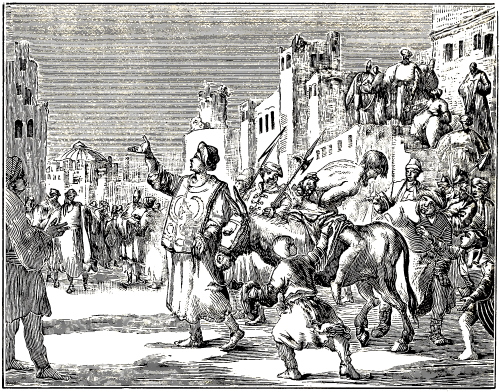
JOHN MOCKED AND TORMENTED.
About A. D. 850, the Saracens, who were adherents to the Mohammedan religion, invaded various islands of the Mediterranean Sea, and also the kingdom of Spain, in which they penetrated so far that their king had his court in the city of Cordova.
In the mean time, in order to treat the inhabitants of said country kindly as it were, and thus draw them gradually over to the Mohammedan religion, the Christians were allowed to remain, on condition that they would not gainsay, revile, or refute their false prophet Mohammed and his laws; also that they should no longer go into their churches, but pay their taxes, and live quietly under their jurisdiction.
The Christians, thus limited, and obeying their conscience by calling evil, evil, and good, good, were easily apprehended by the Saracens, and accused of capital crime; but, what is most to be deplored, these accusations proceeded sometimes from apostate, so-called Christians, yea, from such as bore the name of bishops (apparently political bishops, or such as were designated ordinaries by the Roman church), who, loving the favor of the Saracens more than the favor of God, declared that those who were put to death by them, because they obeyed their conscience, were no martyrs and could not be recognized as such; and what is yet more, they maintained this in a public council.
The persecutors, as can easily be judged, greatly encouraged by this, lamentably persecuted, martyred, and put to death many innocent Christians. O deadly piercings of antichrist, through the instrumentality of his bishops!
It is true, no severe tortures were inflicted upon the Christians who were martyred in this persecution, but for the most part they were simply beheaded; however, after their death their bodies were shamefully treated; first they were suspended for a time on gallows, then burned, and their ashes strewed in the rivers; or they were left unburied, to be torn to pieces by dogs and birds.
It is stated that this persecution commenced long before A. D. 850, but that at this time it was at the height of its fury, for which reason, it seems, the ancient writers have ascribed it to this year. Compare Memor. Sanctor, lib. 1. Apal. Mart. and Doc. Mart. Eulog., lib. 2, cap. 8, 9, and vita Eulogii, with A. Mell., 2d book, fol. 306, col. 2, 3; also, Chron. van den Ondergang, 9th book, page 290, from Hist. Wenc., fol. 443. Chron. Nicoll. Gill., fol. 172, Leonh., lib. 4. However, this persecution is here fixed one year later, namely, A. D. 851.
What has been said of this persecution, is to be further explained by the remarks made in the first note. In the mean time, we will investigate what martyrs mentioned by name, suffered during said persecution for the testimony of Jesus Christ, and the confession of the holy Gospel.
JOHN, A TRADESMAN AT CORDOVA, SEVERELY SCOURGED FOR THE TESTIMONY OF JESUS CHRIST, SET REVERSELY UPON AN ASS, MOCKED, AND MISERABLY TORMENTED, A. D. 850.
A. D. 850, in the city of Cordova, John, an unlearned, but pious man, who kept a few things for sale, was accused to the judge, by false witnesses, for the sake of Jesus Christ, of deriding and reviling Mohammed. But as the witnesses in this case were not found reliable enough in their accusations, to condemn him to death, this faithful servant of God was sentenced to be severely scourged, and constrained to deny Christ. But this pious professor of Christ cried aloud: That he would not forsake the Christian religion unto death, and declared that he was innocent of the false accusations which had been brought against him.
This firmness so enraged the judge against John, that he had him scourged with more than five hundred stripes, causing the executioners to continue beating him, till he, under their hands, fell to the ground, apparently dead. But as he still lived and breathed after this torture, they set him backwards on an ass, and led him through the whole city, from street to street, with a crier, who cried: “Thus shall it be done with the revilers of our prophet, and with the ridiculers of our worship.”
This done they fettered him with heavy chains, and put him in prison; but as to how he finally died, we have not been able to discover in the accounts of the ancients; this much, however, is certain, that he contended for the name of Christ even unto blood. Compare Eulog. Memorial. Sanctor., lib. 1, with the account of Abr. Mellinus, 2d book, fol. 307, col. 1, 2.
Note.—From a want of fuller records by the ancient writers, we have not been able to obtain further information regarding the cause of the martyrdom of the abovementioned John, than that being zealous for the truth of God and his Savior, he suffered principally for the second article of our general Christian faith, in which we confess that we believe in Jesus Christ, the only begotten Son of God; which justly, and according to the rule of God’s word, can be called a good profession, 1 Tim. 6:12.
Moreover, we have found nothing derogatory to his faith, of papal superstition or the like, in other points; notwithstanding in the city of Cordova, where he suffered, there were also people, who, it appears, were not free from the Roman pollutions; of which history has made mention. Hence, since nothing of this kind can be laid to his charge, we are bound, according to the nature of love, to judge the best both of his person and the other points of his faith, and this not only with regard to him, but also to others, who suffered for the same reason, and of whom the ancients, in regard to this matter, have given like testimony.
NUNILO AND ALOIDA, SISTERS AND CHRISTIAN MAIDENS PUT TO DEATH WITH THE SWORD, IN THE CITY OF OSCA, FOR THE NAME OF THE LORD JESUS, ABOUT A. D. 851.
For this contest for the name of Christ, the Lord prepared not only men, but also women, and young maidens so that in the following year, 851, as near as can be reckoned, two sisters, one named Nunilo, the other Aloida, did not hesitate to confess Jesus Christ, their heavenly Bridegroom, among the Mohammedans, not only with their blood, but also with their death; which took place on this wise:
Their father was a Mohammedan, and their mother a nominal Christian, but not very pious, since she, according to the testimony of the ancients, after the death of her husband, married a Saracen (Mohammedan) or unbeliever. In consequence of this, these pious young women could not freely observe, and live up to, the confession of their faith, according to the doctrine of Christ, on account of the constraints placed upon them by their unbelieving stepfather. Compelled, therefore, to leave their mother’s house, they went to live with their aunt or mother’s sister, who, being a true Christian woman, brought them up farther in the Christian religion.
The envious enemy of the human race, filled with jealousy because they, the children of a Saracen father, had become Christians, accused them through the instrumentality of wicked persons, to the chief officer of the city of Osca, so that shortly after they were brought before the Judge. The latter, in order to draw them away from the Christian religion made them great promises of gifts and presents. He moreover offered to secure their marriage with the most excellent young men, etc., if they would but embrace Mohammedanism. But, if they remained stubborn, and despised the advice of the President or Judge, he threatened to torture them with divers torments, and finally to put them to death with the sword.
Thereupon, these pious maidens being strengthened by the Spirit of God, firmly and fearlessly answered the Judge, saying: “O Judge! how is it, that thou dost command us to turn away from true godliness? since God has made known to us, that no one in the world is richer than Jesus Christ, our Savior; and that nothing is more blessed than the Christian faith, by which the just live, and the saints have conquered kingdoms. For, without Christ there is no life, and without his knowledge there is nothing but eternal death. To dwell with him, and to live in him, is our only and true consolation; but to depart from him, is eternal perdition. From his communion we will never be separated as long as we live in this life; for, having given and entrusted our innocence (or youth) into his keeping, we hope eventually to become his bride.
“For, the profit of the transient riches of this world, with which thou didst think to allure us, we count as dung and loss, that we may gain Christ, because we know that everything under the sun, except Christ and true faith in him, is vanity.
“Nor are we moved by the threatened punishment; since we know, that the torments endure but a short time; yea, for death itself, which thou hast presented to us as the final terror, we long the more, because we know that thereby we go without delay145 to heaven, to Christ our bridegroom, there to be embraced by him inseparably, through his love.”
The judge, perceiving the steadfastness of their faith, and the power of their confession, deemed it well to commit these young maidens, each separately to certain Saracen women, to be instructed in the Mohammedan religion, strictly prohibiting them from conversing with each other, or with any others of the Christians. The women, who had undertaken to instruct them in the Saracen or Mohammedan religion, daily presented to them their idolatry and pernicious doctrine, seeking thus to poison them with the cup of the wrath of God, from the hand of Mohammed. But all in vain; they remained steadfast, which was called stubbornness by their enemies.
Finally they were brought before the tribunal and made a public spectacle; where they, confessing Christ as before, and declaring Mohammed an enemy of the Christian faith, as well as rejecting his doctrine, were executed with the sword, in the city of Osca in Spain, on the 22d of October, A. D. 851. Though others differ considerably in their chronology of this matter, we leave it to the decision of the intelligent reader. Compare the account of A. Mellinus, second book, fol. 308, col. 1, 2, with the authors from whom the same has been extracted. Eulog. Memor. Sanctor., lib. 2, cap. 7, and Interp.
Touching these two pious martyresses, there is also to be observed what is said in the added note respecting John, the first mentioned martyr.
Note.—A. D. 852, the zeal of some to die for the name of Jesus Christ was so great that multitudes of them confessed Christ, and, hastening to martyrdom, suffered themselves to be put to death as defenseless lambs, for Christ’s sake. It is stated that among these there were two young heroes of Jesus Christ, namely, Emilas and Hieremias, who, from a well-meaning and special zeal, spoke against Mohammed, and thus offered themselves, to suffer for Christ their Savior. For this they were both executed with the sword, whereupon (according to the testimony of the ancients), though the weather had been fine in the forenoon, immediately at the hour of their death, there followed mighty peals of thunder, so that the earth quaked; terrible lightnings fell from the air; great darkness, heavy hailstorms, furious whirlwinds, and storms manifested themselves, as though the insensible elements (according to Eulogius) were mourning the death of these pious martyrs; whose dead bodies were taken across the river and suspended on stakes, on the 15th of September, A. D. 852. A. Mell., fol. 309, col. 4, from Memor. Sanctor., lib. 2, cap. 2. For certain reasons, however, we will not comment on these persons, though we know of nothing to censure, as regards either their faith or their life.
AUREA, A GODFEARING MAIDEN, AFTER MANY SEVERE TRIALS, EXECUTED WITH THE SWORD, FOR THE TESTIMONY OF JESUS CHRIST, AT CORDOVA, A. D. 856.
Aurea was by descent a noble maiden, and a sister to the martyr John, of whom we have already spoken, from the province Hispalis or Seville, who was betrayed and accused by some of her countrymen. The Judge, who was a relative of hers, endeavored by every possible means to draw her away from Christ, in which he also succeeded. But shortly after, she repented of her apostasy, and went daily into the congregation of the believers, that by the hearing of the word of God she might be strengthened in the Spirit against a like conflict in time to come.
The enemy of mankind, who could not endure it, that Aurea now adhered more firmly to God her Creator, than before, instigated another to accuse this maiden to the Judge, who instantly had her brought by his bailiffs, and threatened her as before. But in the second conflict she was as much stronger to obtain the martyr’s crown, as, in her former apostasy, she had been too weak to resist the temptation; for she thus answered the Judge, saying: “I have never separated myself from Christ my God; I have never forsaken the religion of true godliness; I have never for one moment adhered to your impious worship; though I once, with my tongue, seemed to have apostatized from Christ, my heart was nevertheless far from it, and I had a firm confidence in my Lord Jesus Christ, who has again lifted up my contrite conscience, by his consoling promises, saying: ‘He that believeth in me, though he were dead, yet shall he live.’ Though, with my words, I fell into the snare of denial, yet my heart was strengthened through the power of faith, for, as soon as I went away from you, I kept with heart and mind the faith which I had practiced from infancy. Hence, there is nothing left, but to execute me with the sword, or else you must give me liberty to freely serve my Lord Christ.”
Thereupon the Judge said that she should be kept in prison until he had informed the King of the matter. The result was, that the following day, according to the King’s command, she was put to death with the sword, and then, with a murderer, suspended by her heels on the gallows. Her dead body was sunk with several thieves and murderers in the river Betis. She died on the 19th of July, A. D. 856, at Cordova, under Mahumad, King of the Saracens. In this account, A. M., fol. 311, must be reconciled with Eul., lib. 3, cap. 17.
Remark.—For further information we would remark that the aforementioned martyress, as regards profession in the matter of external religion, is to be distinguished from four other persons, Helias, Paulus, Isidore, and Argimirus, together with others, whom the last mentioned authors, in their account, have noticed just before the martyrdom of Aurea; for they, to all appearance, were of the Roman profession, of which we find no evidence in Aurea. She professed a good profession of Christ her Savior, and died thereupon; on which account she is justly classed among the true believing martyrs, according to what we stated in the note respecting the martyr John, for the year 850.
Note.—Since we do not find sufficient light on the persecutions, with regard to the names, as well as the confessions of the martyrs, we will now prepare ourselves to take leave of them, and commit those whom we have not noticed, as being too dark before our eyes, to the omniscient God, who will bring all to light. Our purpose is, to turn to Italy and England, where more and brighter light has arisen, though it had its beginning in France; so that the papal darkness, particularly in the matter of transubstantiation and the mass, was illumined by it. Yet, this shall end as a tragedy, for we shall show that the bright light of truth had to set in rays of blood and to sink under the earth as it were, to the sorrow of the true believing Christians.
Note.—In our account of holy baptism, for the year 860, we made mention of Hincmar, Bishop of Laudun, and stated that he desired that infants should be left unbaptized, on account of which he was greatly censured. But it seems that this was not the last of it, seeing other writers afterwards relate that he was sentenced and condemned in a certain council in the palace of Dusiacum, in the province of Rheims; moreover, that he was sent into banishment, laid in chains, and, two years after, deprived of both his eyes. However, these writers do not unanimously state that this happened to him solely on account of his rejecting infant baptism, but relate also, that it was done through the bitter hatred of the Arch-bishop of Rheims, as well as from other reasons relating to popery. As to the time of this event, the papist Cesar Baronius fixes it, A. D. 871, though we, from comparison with other authors, should fix it five years earlier. Moreover, though we, as regards the life and walk of said Hincmar, have found nothing but what is good, we dare not give him a place among the martyrs, because of the differing statements of the ancient writers; hence we commit him to God, who will judge his cause.
JOHANNES ERIGENA, A SCOTCHMAN, PUT TO DEATH BY HIS SCHOLARS FOR THE CONFESSION OF THE EVANGELICAL TRUTH, THROUGH THE INSTIGATION OF SOME MONKS, AT MELDUM IN ENGLAND, ABOUT A. D. 884.
Johannes Erigena, a Scotchman, and, hence, called Scotus, flourished, in the matter of his doctrine, in the time of the Emperor Louis the Pious, and his son Lothaire, somewhere in one of the cities of France. He was exceedingly virtuous, learned, and eloquent, and, consequently, for his eminent gifts, highly celebrated and esteemed. For, when Charles, one of the sons of the above Emperor, was desirous of having a good translation and exposition of the books of Dionysius, the Areopagite, especially of the treatise Hierarchia,146 John executed the same very laudably, and with marked ability, so that one Anastasius, who was librarian at the time, and composed a preface to it, writes of him thus: “It is astonishing how this barbarian (that is, foreigner or Scotchman), who hails from the uttermost parts of the world, was able to comprehend with his understanding such high things, and to translate them (said book of Dionysius), into another language, namely, from the Greek into the Latin; I refer to Johannes the Scotchman, concerning whom I have heard that he is a very holy and godly man.”
This is the testimony even of one of his adversaries, touching his learning and godliness; so that it is not necessary for us to adduce additional testimony relative to this point, from other authors, hence we let it suffice.
Afterwards, it seems, he wrote a book on the Eucharist (that is, on the thankoffering of the Supper), in which he very profoundly and conclusively refuted the gross error of the papists in the matter of transubstantiation, or the essential change of the bread into the body of Jesus Christ; also, the mass and the sacrifice which thereby, in popery, is offered for both the living and the dead. This was the cause of his death, as the sequel shows.
When he had written this book, it was greatly esteemed by some, among whom, subsequently, was Berengarius, deacon of the church at Angiers, of whom it is stated that he took and learned his belief respecting this point (and perhaps also against infant baptism, since he strenuously dissuaded from it), from the writings of Johannes Scotus; of which we propose to speak more fully in the proper place. On the other hand, said book was exceedingly hated by those who were zealous defenders of the Roman superstitions, especially of transubstantiation and the mass; so much so, that, when it had come before Pope Leo IX., the result was, that both (as appears) he and his book were condemned and anathematized as heretical; which was done chiefly in the council of Vercellis.
When this had thus happened, and he had incurred the hatred of the Pope and many of the papists, he left the city of Paris—where he was rector of the University—and also France, and went to England, where he took up his residence at Meldum, supporting himself by teaching and instructing inexperienced youths. But after a few years, when the spite and hatred of some monks could tolerate him no longer, on account of his faith against the Roman church, they instigated his scholars against him, so that they stabbed him to death with awls and penknives.
Other writers are of the opinion that the monks did it themselves. Both may be true; the monks, having instigated the young men, and probably finding them too timid, may have led off in the murder, the youths following, with penknives, awls, etc., so that said martyr lost his life under their hands. This much is certain, that he died a cruel death for his faith, and that the monks, through the instrumentality of his scholars, were in no small measure the cause of it, as the records of his death inform us. Compare the account of A. Mellinus, 2d book, fol. 343, col. 2, 3, and fol. 392, col. 4, and fol. 393, col. 1, 2, taken from Trithem. de Script. Eccles., Item, Hist. Reg. Angl., in Alfredo, lib. 2. Hobed. Annal. parte Priore. Westmon., in Flor. Hist., A. D. 883. Idem, Hist. parte Prima. Chron. Car., lib. 4, sub. Henr. 4, Seniore. Lanfranc., lib. de Euch., contra Bereng. Baron. Annal. T. 11, A. D. 1059. Mamelsburi Regum Angl., lib. 2. Testibus. Lanfranco, Guytmundo and Aliis.
CONCERNING THE TIME OF THIS HISTORY.
Note.—P. J. Twisck gives two different accounts concerning it; in the first he fixes the date, A. D. 869. Chron. 9th book, page 306, col. 2, from Hist. Andr., fol. 160. In the second he fixes it, A. D. 884. Page 311, col. 2, from John Munster, fol. 83. In the first place he calls him Johannes Scotus, in the second, Johannes Erigena; however, as the account itself declares, it is the same person.
As to the dates 869 and 884, to which the history of said Johannes has been referred by him, some one might think that this could not very well be reconciled, which may, however, be easily done, if we take the year 869 as the time in which said martyr flourished and propagated his doctrine, and the year 884 as the time when he died and was martyred for the principles which he taught.
FURTHER OBSERVATION TOUCHING THE HISTORY ITSELF, ACCORDING TO THE ACCOUNT OF CARION, P. MELANCTHON AND C. PEUCER.
“In the time of Emperor Louis the Pious,” said authors say, “Johannes Scotus read and explained publicly in the schools, Dionysius’ treatise Hierarchia. This Johannes Scotus, when he censured and refuted with good reasons, the false and impious tenet of the sacrifice of the mass, concerning which others at that time taught that in the Supper Christ was to be offered up for the living and the dead, was stabbed to death by his disciples and hearers, with their penknives.” Chron. Carion., from the beginning of the world until Charles V., enlarged by Phil. Melancthon and Casp. Peucer, printed 1586, 4th book, fol. 476, col. 1.
CONCERNING SAID HISTORY, ACCORDING TO THE ACCOUNT OF SEBASTIAN FRANCK OF WORTH.
“Johannes, surnamed Scotus, not of the Gray Friars, wrote a treatise on the sacrament, denying the presence of the body and blood of Christ. He was condemned in the council of Vercellis. He was rector at Paris, eminently versed in the languages, and the phenix of his age. The Emperor Lothaire held him in great esteem. Of him there have written, Platina,” etc. See Chron. Rom. Kett., fol. 106, col. 4, letter J.
P. J. TWISCK’S ACCOUNT OF SAID JOHANNES SCOTUS.
“Johannes Scotus,” he writes, “lived under the Emperor Louis the Pious, and wrote strenuously against transubstantiation. On a certain occasion, when he, in an exposition, was severely censuring the delusion of the blasphemous oblation or offering up of the Lord Christ in the Supper, for the living and the dead, his disciples and hearers killed him with iron styles.” Chron., 9th book, fol. 306, col. 2, from Hist. Andr., fol. 160.
FURTHER EXPLANATION TOUCHING SAID J. SCOTUS, ACCORDING TO THE ACCOUNT OF THE PAPIST BARONIUS, AS NOTED BY ABR. MELLINUS.
“But let us add,” says he, “the opinion of Baronius, touching this Scotchman: As regards Johannes Scotus, we have said above, in the proper place, that he was in bad repute with the Pope Nicholas I. Although he wrote so violently against the Catholic faith, yet, as he did not spread it among the people, so that his views became known to all, many had a good opinion of him, so much so, that they, though most inconsiderately (thus he speaks, from a papistic standpoint) gave him the title of martyr.” Compare A. Mell., 2d book, fol. 393, col. 1, 2, with Cesar. Baronius’ account touching J. Scotus. Annal. T. 11, A. D. 1059.
From this account it appears that the papist Baronius, who was a cardinal of the Roman see, was not pleased that many had a good opinion of Johannes Scotus, and, what is still more, gave him the title of martyr; but this is not to be wondered at, since the true papists have a good opinion of none but those who adhere to the Roman superstitions, and never dare to utter a word of censure against them; and they would confer the title of martyr upon none but those who have suffered for the Roman see and its traditions (which are a parcel of human inventions). However, we will let them answer for this, and leave it.
We return to Johannes Scotus and say that, as regards his boldness, he showed himself as behooves a true martyr, since, to clear his conscience and defend the oppressed truth, he did not hesitate to incur the hatred of the Pope and the papists, yea, the prospect of being anathematized, excommunicated, and, finally, miserably tortured and put to death for it. He died for the confession of the Christian and evangelical truth, particularly for the article by which we commemorate the Lord’s death, and in which lies the consolation of the soul, with regard to our blessed redemption.
But, since Berengarius, who opposed not only transubstantiation and the mass, but also infant baptism, was afterwards charged with having imbibed and obtained his belief from Johannes Scotus, the aforementioned martyr, we may conclude that said martyr must also have opposed infant baptism; otherwise it could not be said in general words, that Berengarius imbibed or obtained his views from J. Scotus, which is nevertheless frequently and confidently asserted by ancient writers. With this we will take our leave of J. Scotus and also of our account of the martyrs of this century; as being sufficient for the well-disposed—for the evil-disposed we care not; hence, our soul shall rest, and content itself with the pious.
AN ACCOUNT OF THE HOLY BAPTISM IN THE TENTH CENTURY.
SUMMARY OF BAPTISM IN THE TENTH CENTURY.
[The corruption of this century, caused by the papal superstitions, is sadly lamented by Jacob Mehrning and P. J. Twisck.
Nevertheless, it is shown thereupon, that in the midst of papal darkness there were still some who, in the matter of holy baptism, did not differ from the institution of Christ and his apostles.
Giselbert teaches, that baptism must be connected with regeneration and a good will.
Then follows Ansbert, who declares that Christ, through preaching and baptism, is still daily bringing unto himself heirs; that we must be baptized upon the confession of the holy Trinity; and that after baptism we may sin no more.
Smaragdus follows next and says that it is impossible for the body to receive the mystery of baptism aright, if the soul has not previously accepted the truth of the faith; that the excellent ordinance of the baptism of Christ commands the apostles first to teach all nations, and then to incorporate them by the baptism of faith.
Then appears Theophilact, who produces very excellent testimonies concerning baptism; as, among others, that the baptized have put on Christ, Gal. 3:27; that the candidates are like the prodigal son when he was converted; that he is not baptized aright, who has not believed; that in baptism all believers are enlightened by the Holy Ghost; that no one may be recognized as a believer, who is unregenerate or lives after the flesh; that the truly baptized may not drive away the Holy Spirit by wicked works, but must preserve the image of God unspotted; that the good profession of which we read, 1 Tim. 6:12, must take place at the instruction of those that are to be baptized; that those baptized by John, were delivered by repentance from the bonds of the soul; that the novices repented before baptism; that the Supper was administered to the baptized, etc.
Thereupon it is stated, from D. Vicecomes, that the papists, when infant baptism was introduced among them, abolished the practice of administering the Supper to the baptized. It is furthermore demonstrated, that the Romanists ought to have abolished infant baptism just as well as the infant Supper.
The baptism of Olympius, his wife Exuperia, and his son Theodulus, is adduced, from Simon Metaphrastes; also, of the baptism of Theridates, and Nemesius.
Fulbertus Carnotenses is the last witness respecting holy baptism.]
We now pass over to the tenth century after the birth of Christ, to find in it, as we have done in the preceding times, the marks of the Christian believers, namely, the true baptism with its observance according to the institution of Christ and the practice of his apostles; which, as we shall show in the proper place, obtained and was practiced also at this time, though under great difficulties.
Yet, what shall we say of this century? Many well-disposed persons, who loved the truth, abhorred and detested it, because the innumerable human superstitions of the Roman church had risen nigh unto heaven, and the pure commandments of Jesus Christ, without the observance of which men cannot be saved, had been cast almost down into the pit. This was the century concerning which much woful lamentation was made, because papal tyranny, in the matter of worship, had increased so exceedingly. Of these things (after the title), the following is contained in Jacob Mehrning’s History of Baptism.
OF THE DEPLORABLE STATE OF THE WORSHIP OF GOD IN THE TENTH CENTURY.
“In the tenth century the dominion of the Roman Pope had exceedingly obscured, and taken possession of, nearly all the churches in Europe, so that everything, had to be done according to his pleasure, both in spiritual and secular governments; hence, great darkness prevailed at this time, in which but very few learned, virtuous, and celebrated men lived. For fear of the great tyranny, one dared scarcely speak the least word of the adulteration of the doctrine, or the abuses in the false worship, and the increase of the abominable blasphemies; for, as soon as those who knew better, and feared God, uttered the least word of opposition, the Pope instantly thundered, with hail and lightning as it were, excommunications from the Roman chair, so that every one was terrified, since also the secular lords were bewitched and controlled by him. Was it to be wondered at, then, that the corruptions with reference to baptism, increased the longer the more?” Bapt. Hist., p. 566, from Magd. Cent. 10, cap. 1.
Touching the abuses in and about baptism, which were then introduced the decree of the Pope and the councils, they are noticed by different writers, as may be seen in Cent. Magd., Cent. 10, cap. 6, 10, 11.
In short, whereas formerly the catechumens had not been baptized until, after proper instruction, they had given an account of their faith, either on Easter or Whitsuntide, it was now ordained, that, when death or peril of life was apprehended, they should be baptized immediately. Metaphr., lib. 2, cap. 5.
Whereas baptism had formerly been administered with unblessed or unconsecrated water, it was now blessed and consecrated, yea, the chrism was used, the sign of the cross on the forehead, the oil of chrism. Bapt. Hist., page 576, num. 13.
But the most ridiculous of all was, that, whereas formerly only human beings had been baptized, Pope John XIV. now commanded that the great bell in the Lateran church should be baptized and named after him. Bapt. Hist., page 577, ex Balaeo Centur. 2. P. J. Twisck, Chron., 10th book, for the year 965, page 341, col. 1.
These exceeding great errors of the Roman church, and the dreadful darkness in which all nations, with the exception of a few pious people, sat during those dreary times, is described in P. J. Twisck’s Chronijk, in the conclusion of the thousandth year, with the following words (after the title):
FURTHER OBSERVATIONS CONCERNING THE DEPLORABLE STATE OF THE WORSHIP OF GOD IN THIS CENTURY.
“As far as regards the preceding century, I cannot speak of any improvement, inasmuch as the secular affairs manifested themselves with much commotion, strife, misery, and distress. Papal dominion prevailed more and more. The idolatrous ceremonies were very prolific; the baptismal water was consecrated; the oil was prepared by the bishop alone, two days before Easter, as well as imparted to others; the Supper, or sacrament, was administered nearly every Sunday, at an altar or table prepared for this purpose. Excommunication or the ban of the church was used very frivolously, not only against common people, but also against emperors, kings, and princes. The punishment imposed upon penitents consisted much in abstaining for seven years from certain food, meat and wine, or in the giving of alms, building of churches, founding of cloisters, and other like inventions and burdens, according to the ability and mind of each respective individual.
“It was taught, that the saints must be worshiped; not that they should save the supplicants, but that they should intercede, and ask God for help for them.
“Holy people were presented, who had died before the time of Christ, in the Old Testament, and who, as it was said, had been in hell, yet without pain—a strange notion and wicked doctrine respecting the holy fathers.
“It was said that there was a purgatory, where men had to atone after this life, and wash away sin by suffering.