First Part. (continued 6)
Joseph F. Sohm translation
About A. D. 370.—We are informed that about this time there taught and wrote Optatus Milevitanus, a catechist, who, it is stated, by virtue of his office instructed the young in the articles of the faith, in order that after previous instruction, they might be baptized upon their own confession. Speaking of the things that are to be observed in and about baptism, he says: “We know that in the observance of holy baptism there are three essentials. The first relates to the holy Trinity, the second to the believer, and the third to the baptizer; but they must not all be weighed in the same balance.” Bapt. Hist., page 327, from Opt. Mil., lib. 3.
Although these words seem somewhat obscure, they nevertheless contain enough light for us to perceive clearly, of what baptism, and of what matter he speaks. As regards the matter of which he here treats, it apparently is the dignity of baptism, in order to prove which, he alleges that in baptism there are three very worthy things. Mentioning the most worthy first, he says that it is God or the Holy Trinity. As the second, he mentions the believer, namely, him who stands ready to be baptized; for he is very worthy in the sight of God, since Christ says: “He that believeth and is baptized shall be saved.” Mark 16:16. As the third, he mentions the baptizer, namely, him who has received so worthy an office from God. From these three worthy circumstances he justly concludes the dignity of baptism.
From this it is as clear as sunlight, of what baptism he speaks, for in mentioning the believer, in connection with baptism, and speaking of him as the one to be baptized, he certainly indicates that he does not speak of children, or of infant baptism, but of the baptism of believers. Moreover, a little after the preceding words, he says concerning the candidate for baptism, of whom he speaks: “He follows the faith of the believers.”
Vicecomes (lib. 2, cap. 4), cites Optatus Milevitanus, and says that in the 5th book against Parmes he expounds the words of St. Paul, 1 Cor. 3:6, on this wise: “‘I have planted, Apollos watered,’ that is: O ye heathen, I have made you disciples of Christ; Apollos has baptized these disciples.”
Likewise in the 2d book, 7th chapter, Vicecomes writes: “Optatus was a catechist at Carthage.” Also, Bapt. Hist., page 375.
These things confirm our previous declaration; for, when he calls unbelieving and unbaptized persons heathen, and, on the other hand, pronounces those who had been instructed in the faith, and baptized upon it, disciples of Christ, without remarking whether they were born of Christian, or of heathen parents, he declares thereby, that it is not birth, but unbelief and absence of baptism, which constitutes one a heathen, and that not Christian parentage, but faith and baptism, make one a Christian; which well accords with the words of Paul, Gal. 3:26–28: “For ye are all the children of God by faith in Christ Jesus. For as many as have been baptized into Christ have put on Christ. There is neither Jew nor Greek, there is neither bond nor free, there is neither male nor female: for ye are all one in Christ Jesus.”
Again, the fact that Optatus, as Vicecomes writes, was a catechist, indicates that at the place where he was teacher it was the custom, to teach the candidates for baptism the catechism, that is, to instruct them in the faith, before they were baptized; hence these candidates were called catechumens.
NOTE.—Damascenus writes that “at this time, A. D. 370, the Gospel was preached in all the world, not by the force of arms, nor by subjugating its adversaries through war, but by a handful of poor, naked, and martyred people, that is, by patience and faith. For, how could the church have martyrs, if she made martyrs?” Damasc., 3 Cent., cap. 33. P. J. Twisck, Chron., 4th book, page 116, col. 2.
A. D. 380.—Gregory of Nazianzus, in Cappadocia, born of Christian parents, was not baptized until he was in his twentieth year; concerning which, Jacob Mehrning gives the following account: “His father, Bishop at Nazianzus, and also called Gregory, and his mother Nonna, a pious woman of Christian parentage, knew nothing of infant baptism, for they did not have their son (Gregory) baptized in his infancy. His baptism, according to history, did not take place until he was in his twentieth year. Bapt. Hist., page 354. Also, H. Mont. Nietigh., page 62.
In order to show still further, how vain and useless infant baptism was deemed at that time, by various pious and learned men, and how baptism was even deferred till late in life, we will adduce one or two brief examples.105
A. D. 381.—It is stated that in this year there was baptized at Constantinople, Nectarius, after he had attained his full understanding, yea, such an advanced age and penetrating knowledge, that he was at the same time elected bishop or teacher of that place, the like of which occurred previously, as stated concerning Ambrose, in the year 363. See P. J. Twisck, Chron., 4th book, page 122, from Histor. Tripart., lib. 9, cap. 13. Adolph. Apol., fol. 163. Leonh., lib. 2. Merula, fol. 312.
As regards the statement how precipitately and unexpectedly Nectarius was elected bishop or teacher of that place, even as was related of Ambrose, it is not our purpose to defend or advocate it; but simply to show that he deferred baptism in his youth, and was not baptized until he had attained to quite an advanced age.
NOTE.—In A. D. 382, Theodosius, born and bred by Christian parents, was baptized at Thessalonica, by Bishop Ascholius. Hist. Eccl., lib. 5, cap. 6, Socrates. Also, H. Montan., page 70.
A. D. 383.—Basilius106 and Eubulus, said to each other: “Let us sell all our goods, and distribute to the poor, and then journey to the holy city, that we may behold for ourselves the wonderful works of God, and thereby awaken within us a confidence towards God.” Having done this, and taken with them the clothes necessary for baptism, they journeyed to Jerusalem. Vicecom., lib. 3, cap. 4, from Amphilochius. Jac. Mehrn., Bapt. Hist., 2d part, page 389.
Amphilochius writes of a baptized Jewish physician, who distributed the money he had gained by his profession, among the hospitals, and gave the rest to other poor people. Vicecom., lib. 5, cap. 46. Bapt. Hist., see above.
We mentioned Basilius and Eubulus, who journeyed to Jerusalem, taking with them the clothes necessary for baptism, in order to be baptized. From this it appears that it was the custom at that time in Jerusalem—and one that remained in use long afterwards in many warm countries—to baptize the candidates in or at rivers, and that they went partly or with the whole body down into the water, and then came up again; to which end they divested themselves of their own clothes, usually had on a white or linen garment. This is the kind of clothes that Basilius and Eubulus appear to have taken with them, in order to be baptized therein.
Now, compare this with the baptism of infants in the cradle, and you will at once see that this mode of baptism cannot take place with infants, since they have neither the ability nor the understanding necessary for the observance of such a mode of baptism.
We will now proceed to the views of Basilius with regard to baptism, and what he, according to the testimony of ancient writers, has taught and written concerning it. First, it is stated of him, that in writing of baptism, he in no wise mentions infant baptism, but, on the other hand, the baptism of catechumens, that is, persons receiving instruction in the faith.
Concerning this, H. Montanus and Jacob Mehrning unanimously give the following testimony: “The aforementioned Basilius who was bishop of Cesarea, in Cappadocia, A. D. 386, exhorts only the catechumens to baptism, without once mentioning infants, yea, he sufficiently indicates that infant baptism was not the custom there at his time, saying: ‘Ye who have been evangelized by the apostles, repent, and be baptized every one of you in the name of our Lord Jesus Christ.’ ”
True, he exhorts also the young to baptism, yet not such as are altogether destitute of understanding, but those who can hear the words by which he admonishes them to baptism, that is, adults, and not infants. He uses such expressions throughout this entire exhortation, and also in some of his other writings, as in the book of the “Holy Spirit,” chap. 12, 14, and 27; but nowhere does he mention infant baptism. H. Montan. Nietigh., page 73. Jac. Mehrn., Bapt. Hist., page 365.
Moreover, the words of Basilius, whenever he treats of baptism, clearly express that they cannot be applied to infants. For, showing the nature of baptism, and what it is, he says (Lib. 3, Contra Eunom.): “Baptism is a seal of faith.” Again (Exhort. ad Bapt.): “Baptism is the mark of the Christian champion.” Again (de Instr. ad Bapt. Ven.): “Baptism is a likeness of death, burial, and the resurrection of the dead.” Bapt. Hist., p. 322.
These things are so clear that they require no explanation, and we shall therefore proceed to what he says further. As regards the form of baptism, according to the institution of Christ, he writes (Lib. 3, Contra Eunom.): “Our baptism is administered according to the institution of the Lord, in the name of the Father, the Son, and the Holy Ghost.”
Again, concerning the faith which must accompany such baptism, he says (Lib. de Sp. S., cap. 12): “When we believe on the Father, the Son, and the Holy Ghost, we are also baptized in the name of the Father, the Son, and the Holy Ghost.” Bapt. Hist., page 323.
Respecting the words of the candidates, and what manner of conduct they observed at baptism, he says, in the last named book, that the candidates for baptism renounced Satan and all his angels. Again (Exhort. ad Bapt.), he states that they lifted up their hands towards heaven; that they kneeled down in prayer. Bapt. Hist., page 336.
He makes mention, moreover, in many places, of various other circumstances and matters pertaining to baptism; of which we will present the following to the reader.
Basilius the Great writes (Contra Eunom., lib. 3): “Faith must precede, if the believer is to be sealed by baptism.”
D. Vicecomes adduces from Basilius, book 1, chap. 23, of his Exhortation to Baptism the following: “When wilt thou become a Christian? When shall we recognize thee as one of our number? Last year thou deferredst it till the present Easter; and now thou wilt wait till the next. Take heed, lest thou be deceived in thy expectation of a long life.”
Again, chap. 31, Basilius, in the 128th epistle, commends C. Posthumanius, and wishes that he had been his godfather, since the same had made such a glorious confession at his baptism; and this with great contrition, pain, and anguish of spirit; and had evinced in his life and conversation the moderation which the confession of the Christian name demands.
Again, chap. 33, Vicecomes writes: “Basilius is greatly astonished (in the 23d epistle to Boniface), at infant baptism and godfathership, saying: ‘Since you cannot promise anything certain, either with regard to the child’s future faith, or its present thoughts, I pray thee, beloved, what then does it signify that, when the children are brought to baptism, the parents, as sureties, answer in their stead, and say that the children do that which at that age they cannot even think, or, which if they can, is hid from us? But those who bring the child are asked: Does it believe in God? and, for this age, which knows not whether there is a God, the parents answer: It believes. Thus also the other questions are responded to. I am astonished that in such matters the parents answer so presumptuously for the child.’ ” Bapt. Hist., pages 390, 391.
This can certainly be called a candid rejection of infant baptism, and not only of infant baptism, but of all the absurd questions and answers which customarily occurred at the baptism of children, and upon which infant baptism was founded. He accuses the children of ignorance, saying that they do not know whether there is a God; the parents he accuses of presumption because they thus boldly dare answer in their stead, and say: “The child believes.” The priests who baptize such children, he accuses of folly, because they presented such improper and unfounded questions respecting the ignorant infants, and demanded that they should be answered in the child’s name. Infant baptism itself he charges with worthlessness and falsity, seeing, as Vicecomes says, he, in his 23d epistle to Boniface, is greatly astonished at infant baptism.
Basilius, in order to still more fully state his views concerning this matter, adduces various passages, which effectually overthrow infant baptism, and establish baptism upon faith.
D. Vicecomes (Lib. 2, cap. 3), writes thus: “Basilius calls the catechumens nurtured ones, since they were fed and nurtured with instruction in the Christian faith.”
Again (cap. 4, Basilius Serm. 1, de Bapt.) he says: “We must know that we must first teach and instruct, and ultimately administer holy baptism to those thus rightly instructed.” And, a little after this: “Instruction must precede baptism, and first of all everything which stands in the way of teaching and instruction, must be removed.”
Again, in book 3, chapter 4, of the Exhortation to Baptism, he writes: “Examine thy conscience; go into the secret chamber of thy heart; awaken within thee for a time the remembrance of former things.”
Again, chapter 5: “As soon as any one came to John, and confessed his sins, however great and heinous they were, he was baptized in Jordan’s floods, and immediately received remission of sins.” Bapt. Hist., page 392.
All these passages of Basilius as cited by D. Vicecomes, himself a pedobaptist, and noted by J. M. in Bapt. Hist., are so clearly opposed to infant baptism, that further comment is unnecessary. We will therefore let this suffice, and proceed to the testimony of several other persons in the fourth century.
A. D. 390.—John Chrysostom, born of Christian parents, was at this time baptized upon his faith by Bishop Melitius, being twenty-one years old. Episcopii. Antew. op de proeve des Remonstr. Catechism., page 359.
CHRYSOSTOM’S VIEWS RESPECTING BAPTISM.
Chrysostom, though he lived in and under the Roman church, and was not fully enlightened in all respects, nevertheless wrote soundly and correctly on the subject of baptism, as is shown by the following extracts from his writings.
Jacob Mehrning, in Bapt. Hist., following the Centuriæ Magdeburgenses, says, page 403: “How baptism must be received, St. Chrysostom reminds us (Hom. 14, in Marc.): ‘Thus ye who desire to receive baptism, since we are all under the dominion of sin, lay hold first of the feet of your Savior; wash them with your tears; dry them with your hair; and, this done, you may approach his head. When you then descend with your Savior into the fountain of life, that is, the water of baptism, you may learn how the head of your Redeemer was anointed.’ ”
Moreover, he explains still further, how one must prepare himself for baptism, and this with such affectionate words as should move every soul.
In Bapt. Hist., page 445, Homil. 13, Marc., Chrysostom says: “Will you come to baptism? O how happy are you when you shall be regenerated in Christ! when you shall put on Christ; when you are buried with Christ, that you may also rise with him. At another day you shall be made acquainted in proper order with the things that are expedient for this mystery. In the meantime I tell you this, that you may know it, and may prepare yourselves for the coming day (namely, for baptism). But may the almighty God strengthen your hearts, and make you worthy of his baptism. May he himself come into you, at baptism. May he himself hallow the water wherewith you are sanctified. Let no one go there with a doubting heart. Let no one say: Do you indeed think that my sins will be forgiven? He that goeth there thus, his sins shall not be forgiven. It is better, not to go there at all, than in this manner. Remember this, especially you who thus receive baptism, that you may serve God.”
I beg you, dear reader, to observe attentively these words of Chrysostom. Does he say anything at all different from what the Anabaptist teachers of the present day say? O no! he follows the same course. For, first he says: “Will you come to baptism?” He does not say: Will you carry your infants to baptism? How could he speak more plainly? For, to come one’s self, and to desire to come, is certainly no child’s work.
Then he says: “O how happy are you, when you shall be regenerated in Christ? when you shall put on Christ?” (namely, in or through baptism). But what else is there said by this, than what the apostle Paul declares of believers, namely, that they are saved by the washing of regeneration, that is, baptism, Tit. 3:5; and that they put on Christ by baptism, Gal. 3:27.
Then he says: “At another day you shall be made acquainted in proper order with the things that are expedient for this mystery” (that is, baptism). In like manner, Christ teaches to instruct the candidates for baptism before they are baptized. Matt. 28:19; Mark 16:15,16. John likewise first instructed those whom he baptized. Matt. 3:7,8. Peter first instructed the Jews. Acts 2:38. Philip first instructed the Ethiopian. Acts 8:34,35. Ananias first taught Saul the faith. Acts 9:17,18.
He further adds this wish: “May the almighty God strengthen your hearts, and make you worthy of his baptism.” But who knows not, that newborn infants can not be strengthened in their hearts before baptism? and that, consequently, they cannot receive baptism worthily (that is, with a holy purpose and believing hearts), since they know neither good nor evil, Deut. 1:39; nor their right hand from their left, Jonah 4:11; and do as children do, 1 Cor. 13:11. Hence, this wish of Chrysostom, respecting baptism, cannot apply to them.
Finally, having declared, with what heart and purpose we must go to baptism, namely not with a doubting heart, he says: “You who thus receive baptism that you may serve God.” These are certainly plain words, which prove manifestly, that the baptism of which he speaks is far different from the baptism of infants, since these are incapable, not only of going to baptism with an undoubting or assured heart, but also of going there at all; not less incapable are they of receiving baptism with the purpose of serving God. Compare this with the words of Chrysostom, and you will find that they are as different from infant baptism as heaven is from the earth.
Bapt. Hist., page 461. Palladius, in the Life of Chrysostom, speaks of an uproar which the Emperor Theophilus107 raised against bishop Chrysostom, persecuting him; which occurred shortly before Easter. There was no other alternative for those who sided with the bishop, and fasted with him, than to go to the Emperor and the Empress, in the week of confession, and to entreat them with tears, that they would spare the church of Christ, especially on account of the feast, and for the sake of those who were to be baptized, having received sufficient instruction for this purpose; therefore, they should release their bishop.
Here again are several items from which we may perceive that in the church of which Chrysostom was bishop or teacher, baptism was administered after previous instruction, and upon faith. For, in the first place, mention is made of the time in which this took place, namely, shortly before Easter, in the week of confession. Any one who has but a little experience, will find that that was the time and week in which it was customary to instruct the candidates before baptism, hear the confession of their faith, and properly examine them, in order to baptize them on the following Easter days. In the second place, mention is made of those who were to be baptized, and had received sufficient instruction for it; which so plainly illustrates what we have aimed to show, namely, that baptism at that time was administered after previous instruction, that we deem it unnecessary to add anything further with regard to it, and, hence, let it suffice.
OF THE BENEFIT, VIRTUE AND OPERATION OF BAPTISM.
Chrysostom on Phil., chap. 3, page 405, says: “Christ has given or ordained baptism as a purgative, and thus we have spewed out all wickedness, and by it have been made free from all our sins. The heat has abated, the fever is checked, all impurities have departed, and through the Spirit all other evil things have been purged out—those springing from fornication as well as those having their origin in the vanity of the mind.”
Again, on Heb. 7: “Therefore God gives baptism, that it may wash away sin, and not increase it.”
Again, on Col. 3: “Truly, before baptism we were very impure, but after it we become golden.”108
Again, on Heb. 11: “What then constitutes brotherhood, if not the washing of regeneration (that is, baptism)?”
Who does not perceive by these passages of Chrysostom, that the baptism of which he speaks, applies in no wise to infants, but only and exclusively to rational persons; for, when he first says to those who wished to receive baptism, that they should (spiritually) take hold of the feet of Christ, and wash them with their tears, and then says that Christ has given or ordained baptism for a purgative, and that they had thus spewed out all wickedness (that is, sin), he sufficiently indicates thereby that he is not speaking of the baptism of infants, since, these cannot do the things which he describes as being connected with baptism.
All these things are still more clearly established by the following passages from his writings, as we shall show.
In Bapt. Hist., page 406, Chrysostom, on 1 Cor. 10, says: “The passage of the Jews through the Red Sea was a type of the future baptism.” A little further on, he explains this, saying: “For there it was water, here it is also water; yea, here it is the washing, and there it was the sea; here they all go into the water, there they did likewise. But would you know the truth of the matter? There they were delivered from Egypt, but here from idolatry; there Pharaoh was drowned, but here the devil; there the Egyptians perished, but here the old man of sin is buried.”
Again, on John 3, Hom. 27: “We have committed many and grievous sins, and, from youth to old age, have not refrained from staining our souls therewith; yet God does not require an account from us, but absolves us therefrom, through the washing of regeneration (that is, baptism), and has freely given us righteousness and holiness.”
How could any one speak more plainly and clearly of the true baptism of believers? For, when in the first passage he says that in being baptized we are delivered from idolatry, and that in or through baptism the old man of sin is buried; and in the second passage declares that they, having committed many and grievous sins, from youth to old age, are absolved therefrom through the washing of regeneration, that is, baptism, it again is very evident that this does not at all apply to children, since they, never having lived in idolatry, cannot forsake idolatry; neither can they, who, being yet in their infancy, have never lived according to the old man, much less have died unto it, bury the old man of sin in or through baptism; finally, they who being still infants, have not attained to old age, cannot or need not be absolved through the washing of regeneration (that is, by baptism), from the sins which they have not committed in this life.
Bapt. Hist., page 410. That baptism ought not to be deferred, Chrysostom (Hom. 1, on Acts) expounds with these words: “If any one say: I am afraid, I answer: If thou art afraid, thou shouldst have received and observed baptism. But thou wilt say: Even therefore I do not receive it, because I am afraid. But art thou not afraid to die in this condition? Thou sayest: Ah! God is gracious. Well then, therefore receive baptism, seeing he is so gracious, and helps thee.” He says finally: “It is impossible, I say impossible, that he, who on such a hope defers baptism, can do anything good or commendable.”
Bapt. Hist., page 420. The teachers of the church sometimes call baptism a consecration; regarding this Chrysostom says (Hom. 1, on Acts): “Who will fully believe me, how it pains me to the heart, when some one dies, who has not been consecrated,” that is, baptized. And, a little further on he writes: “What anguish of soul I experience, when I see how others do not hasten to baptism till their breath is about to leave them,” that is, when they must die.
These passages of Chrysostom indicate how exceedingly sorry he was, that some deferred their baptism to the end of life, who ought to have received it in time; yet not before the time of faith or repentance, much less in infancy, since he speaks only of those persons who had voluntarily, and not less presumptuously, neglected their baptism. Hence it sometimes occurred that persons desired to be baptized in their sickness, yea, on their deathbed, which this good man opposed with conclusive arguments. Bapt. Hist., page 412, Chrysostom says: “The mysteries are glorious and greatly to be desired, but let no soul that is about to die, receive the washing; for that is not the time for the mysteries (baptism), but to make a will; the time for the mysteries (baptism) is when the mind is sound, and the soul purified.”
Finally, Chrysostom here again produces two things which do not apply to infant baptism. First, his saying that “the mysteries” (namely, of baptism), “are glorious and greatly to be desired;” for such a desire cannot exist in infants. Secondly, his declaration, that “the time for the mysteries (or, for baptism), is when the mind is sound, and the soul purified;” for infants neither have nor know unsoundness of mind or impurity of soul. Hence neither the soundness of their minds nor the purification of their souls can be promoted or had in view, and baptism can, for this very reason, have no place with them.
CHRYSOSTOM’S VIEWS RESPECTING SEVERAL OTHER ARTICLES OF FAITH, ACCORDING TO THE ACCOUNT OF P. J. TWISCK, IN HIS CHRONIJK VAN DEN ONDERGANK DER TYRANNEN, 5th BOOK, PP. 136 AND 137.
“John Chrysostom,” he writes, “a celebrated, zealous, and eloquent teacher or bishop at Constantinople, was expelled from his bishopric, and relegated into misery; much ignominy and suffering were inflicted on him, and he died in banishment.
“His adherents and people were greatly persecuted by imperial edicts commanding them also to attend church and hear their enemies (namely, those of the Roman church), which they would not do, but held their own meetings in the farthest outskirts of the city. When this was reported to the Emperor by the bishop, a squad of soldiers was immediately sent to the place, who with sticks and stones dispersed the meeting, robbed those who had assembled of their goods, and apprehended such as could not make their escape. Finding it impossible to meet in public, they chose voluntary banishment, and forthwith departed, each his own way. Besides this, the adherents of Chrysostom were unjustly accused of having caused a conflagration, which the common people, out of spite towards Chrysostom, had kindled in the temple in which he had taught; on account of which they had to suffer much; the cruelty practiced being as great as that of the first persecutions.
“Again, the aforesaid John Chrysostom, also called, John Goldenmouth,109 on account of his golden or excellent teachings, and his eloquent tongue taught from Matt. 5, that we ought not to swear at all, neither rightly nor falsely, and concludes very forcibly, with many words from the passage, Matt. 5:34: ‘Swear not at all,’ that it is not lawful for a Christian to swear. He conclusively refutes all objections, and maintains that now we ought not to swear. Read yourselves his full exposition of said passages.
Prior to him, likewise Haimus, on Rev. 10, writes, saying, That all swearing is now prohibited unto men, it being lawful only for God and the angels, who neither deceive, nor can be deceived.
Seb. Franck notes the following concerning this Haimus: “Haimus, the teacher also wrote a great deal against the Pope and the Roman church; among other things, that swearing is lawful only for God and the angels, but to men all swearing is forbidden. On Rev. 10, Chron., Roman. Kett., letter H.
NOTE.—This view (that we ought not to swear), is also ascribed to Isiodorus. Tract, Loop der Werelt, page 99.
We return to the account of P. J. Twisck, concerning Chrysostom, page 136, col. 2. He writes: “This Goldenmouth, John Chrysostom, taught also mightily against cruelty, tyranny, war, and bloodshed, maintaining that it is altogether improper for Christians to wage war, and that peace and quiet are to be taught in the kingdom of Christ. Christ, he says, compels not, drives not away, oppresses not, but accords to each his free will, saying: ‘If any man will.’ ”
Read also, on Matt. 13, how he explains that the tares (to which the heretics are compared) are not to be rooted out, which, he says, Christ spoke for the purpose of preventing and forbidding war and bloodshed. No violence is to be employed in heavenly things; the wicked teachings which have proceeded from heretics, are to be reprehended and anathematized; but the men we must spare.
Again, he is also greatly opposed to the worshiping of the saints, saying that God is not like the tyrants, with whom intercession is necessary; and that we are not to confess our sins to any one except to God alone. “Thou must confess thy sins,” he says, “that thou mayest eradicate them. If thou art ashamed to confess to any one, confess them daily in thy soul. I say not, that thou shalt confess them to thy fellow servant, that he may curse them and upbraid thee; but tell them to God, who alone can heal thee from them, and follow herein the prophet, who says: ‘Commit thy way unto the Lord . . . and he shall bring it to pass.’ ” Ps. 37:5.
And on Matt. 23, he says with many excellent words: That with human doctrines, we serve God in vain, and that there is no other testimony of the truth, no other certain test of heresy, than the Holy Scriptures, and no other way by which we may know which is the Christian church.
Again, Chrysostom says: “When the Roman Empire shall be put down, then shall antichrist come.” On Matt. 24, he says: “He speaks not unreasonably, who by the abomination of desolation understands antichrist, who, it is thought, will shortly afterwards rise, and will occupy the holy place of the church, under the name of Christ.” Also, on 2 Thess. 2: “When the Empire shall be waste and vacant, then antichrist shall occupy it, and endeavor to draw to him the kingdom of God and men.”
Further, on Matt. 24: “Beloved, be not moved, when antichrist does the works of Christ, and in the sight of Christians, performs all the offices of Christ; for Satan himself can transform himself into an angel of light. What wonder then, that his servants assume the garb of servants of righteousness, and a semblance of Christianity.
“The Jewish abomination is to be understood as having reference not only to the Jewish war, but, in a spiritual sense, also to antichrist, who in the last time, shall sit in the holy place, occupying the chief places of the church, and leading the souls of men away from God. This is very likely the one of whom Paul says that he shall oppose and exalt himself above all that is called God, or that is worshiped; so that he as God sitteth in the temple of God, shewing himself that he is God. He, standing in the holy place, has laid waste the church of God with multitudes of heresies.”
Then he says: “Since the Lord Jesus knew what great destruction would come in the last days, he commanded that the Christians who are in Christendom, if they would always continue in the true faith, should resort only to the Holy Scriptures; for, if they would look to other things, they would be offended and corrupted, and not understand what the true church is, and, in that way, fall into this horrible abomination, which sitteth in the holy place of the church.”
“Thus,” writes Twisck, “Chrysostom, Augustine, Gregory, Ambrose, Jerome, and most of the ancient teachers, though the Papists esteem them greatly with their mouths, would be nothing better than Roman heretics, and if they were still alive, and would teach these doctrines, they would have to expect nothing but fire and sword.”
“Finally, in the year 408 Chrysostom was released from his life of vexation and exile, in which he suffered much, and fell asleep in peace.” P. J. Twisck, Chron., 5th book, pages 137 and 138, col. 1, from Chron. Sebastian Franck, fol. 56, 92. Tob. Færi, fol. 73. Merula, fol. 338. Joan. Wales, fol. 166. Cornelius Hillenius, fol. 41.
A. D. 390.—Jerome, born of Christian parents at Syridon, in Illyria, or Dalmatia, and instructed in the Christian doctrine from his youth, was baptized at Rome, yet not before he was in the thirtieth year of his age. Bapt. Hist., pages 841, 365, 366, 373, 593. P. J. Twisck, Chron., 4th book, page 29, col. 1. Tract, van den loop der Werelt, page 47, from Erasmus and Wicelius, in the life of Jerome.
In Bapt. Hist., page 374, we read the following: “Jerome writes in the 78th epistle, that he received his baptism and white garment at Rome, though we know that he was born of Christian parents, at Syridon, in Dalmatia. Hence, says the author, the Christians of that age must not have hastened so much with infant baptism, as is the case in the present time.” This Jerome, though some pedobaptists, yea, the Papists themselves, declare him a good and upright teacher, nevertheless wrote several things of such a nature, that at the present day they would be pronounced heresy by many of these same pedobaptists, especially by the Roman church; hence he is classed among the Roman heretics, that is, among those whose views are at this day pronounced heresy by the Roman church. Chron. Seb. Franck, letter H; P. J. Twisck, Chron., 5th book, page 138, col. 1.
Touching as to how it stood with baptism at the time of Jerome, I find, in substance, this annotation, Bapt. Hist., page 335: “It is certain, that in the time of Jerome adults were still baptized in the occidental churches, as may be seen in his epistle against the errors of John of Jerusalem.”
He, in Epist. ad Pammach, and Ambrose, in Epistle 83, testify that those who desired baptism were called fellow-desirers.
H. Montanus writes thus: “Jerome, who also lived about that time, and, as some say, was an elder at Rome, or, much earlier, as others suppose, at Jerusalem, also testifies that in his time it was a prevailing custom, to baptize adults who had been brought up in the Christian faith, when they desired baptism, for which reason they were called Competentes, as Jerome states in his letter to Pammachius.” H. Montan. Nietigh., pages 74, 75.
Having now shown how it stood with baptism at the time of Jerome, and that the same was administered in the occidental churches to adults, we shall proceed to Jerome’s individual views and what he has written on this subject, according to ancient writers.
In Bapt. Hist., page 373, Jerome writes to Pammachius: “It is customary with us, publicly to instruct for forty days, those who are to be baptized, and enjoin them to pray to the Holy Trinity.”
D. Vicecomes finally shows, page 375, chap. 41 and 44, that Jerome wrote, that in his time they gave those who were baptized, milk and honey to eat, which, the annotator remarks, is no food for new-born infants. Moreover, he shows what is required for true baptism; namely, regeneration, consisting in the mortifying of the old, and resurrection of the new man. This he expresses in the following two passages:
Jerome further writes, page 323, lib. 12, Comment. in Ezechiel.: “We need not only the first birth, but also the second, in order that we, who are born in the flesh, may be born again after the Spirit.”
Again, page 328, Apol. Contr. Ruffin.: “We say that the old man entirely dies in baptism, and that the new man is raised with Christ in baptism; that the earthly perishes, and the heavenly is born.”
Then he admonishes the candidates for baptism, how they should conduct themselves before and at baptism; as well as how those who had already been baptized before many witnesses, and had made a good confession, ought to manifest themselves.
Again, page 374, Epist. 83, ad Ocean, he writes: “The catechumens who are learning the Christian faith must observe not to have carnal intercourse with women before baptism.”
Again the words of Paul, 1 Tim. 6:12, he expounds as follows: “Thou hast professed a good profession before many witnesses; which was done through thy baptism, when thou didst renounce the world and its pomp, before the elders110 or teachers, before the ministers, and before the heavenly hosts.”
In the tract called, Klare en Grondige Bewijsing van den Doop, printed 1581, it is stated, letter A, Jerome on Matthew: “The Lord commanded his apostles, that they should first instruct and teach all nations, and then baptize those instructed, in the sacrament of faith; for it is not possible for the body to receive the sacrament of baptism, unless the soul have previously received the true faith.”
Who could ever believe that this man at any time defended, or at least, not opposed but admitted infant baptism, seeing he opposes it in the places mentioned with such abundant clearness and explicitness? We note only the last mentioned passage, where he certainly says, without the least dissimulation or exception, that it is not possible for the body to receive the sacrament of baptism, unless the soul have previously received the true faith. How can, may, or shall this be explained otherwise than that there cannot be or consist any other baptism than that which is received with true faith? for this is the very idea expressed by his words.
Nevertheless, there are men who ascribe to Jerome a certain dialogue against Pelagius, in which one Critobulus interrogates, and one Atticus answers, in this wise: Critobulus asks: “Why are children baptized?” Atticus replies: “That their sins may be forgiven them in baptism.” “Why, what sins have they committed?” asks Critobulus. Atticus answers: “Dost thou ask me this? let the evangelic trumpet answer thee.”
But, in order to prove that Jerome defended infant baptism, it would first have to be shown incontrovertibly, that this dialogue is Jerome’s own production, which we have great reason to doubt, since the style as well as the matter of the same do not accord with his other writings, especially those in which he treats of baptism; moreover, there have of old been forgers, who, in order to gain greater renown for their own productions, have ascribed them to celebrated men, or have interpolated their own opinions into their writings; thus, it has been proven that the writings of Justin have been interpolated. Bapt. Hist., page 170. H. Montan., pages 7, 8, 9. Also, the writings of Origen. Bapt. Hist., pages 283 and 291. H. Mont., pages 29–34, 42, 43.
Yea, in this manner, a whole book, also touching on infant baptism, has been falsely ascribed to Dionysius, the Areopagite, who, it is testified, lived in the time of the apostles; this the Magdeburg pedobaptists themselves show. Centur. 1, cap. 2. Also, Jac. Mehrning, Bapt. Hist., 177, 293, 341.
Again, even if it could be shown, which is by no means certain, that this dialogue is Jerome’s own production, it could nevertheless not be proven thereby, that Jerome himself held the views maintained by one party in the dialogue, namely, that infants may be baptized. For, why should we not, with equal justice, ascribe to him the views of the other party, which demands reasons and proof why they may be baptized? For one would certainly be his work as much as the other.
Moreover, every intelligent person knows that books that are written in the form of dialogues, do not always express the author’s individual views, but that frequently the views and debates of others are handled in them, either to censure them, expose their errors, or correct them.
Finally, how could it be possible, that any one endowed with reason and sound judgment should do such contrary things at one and the same time? We have shown how clearly and correctly he speaks of the baptism of adults, yea, recommends it, and not only this, but how he, though he was born of Christian parents, remained unbaptized until he was in his thirtieth year—how then could he admit infant baptism, seeing he decisively opposed it by doctrine and example? unless it be shown that Jerome wrote this article on infant baptism before his conversion, or that he subsequently apostatized from his adopted views, to infant baptism; but as I can find no account of either we will hold to our previous declaration.
JEROME’S VIEWS TOUCHING SEVERAL OTHER MATTERS OF FAITH, ACCORDING TO P. J. TWISCK’S CHRONIJK, ETC., PAGE 129, COL. 1, 2.
“Jerome, born of Christian parents, and brought up and instructed in the Christian doctrine, was baptized at Rome, in the thirtieth year of his age.” Erasmus, Grondig Bewijs, letter A., Mart. Ball., fol. 102.
“Again, Jerome plainly says, respecting the words of the Supper, that with this bread Christ intended to prefigure, represent, and show the truth of his body, and in many places he calls the cup a figure of the blood.
“Again, he teaches, on Matt. 16, that the priests have no more, or just as little, power, to bind or to loose, than the priests of the Old Testament had, to pronounce the lepers clean or unclean. The words of the priest made them neither clean nor unclean, but simply indicated who, according to the law of Moses, was leprous or not leprous; so now the bishop, according to the law of Christ, pronounces, whose sins are retained, and whose are forgiven.
“Again, he also maintains that all days should be esteemed alike, and that men should constantly keep Easter and Sabbath.
“He would likewise have that men should fast daily, ‘for, what avails it,’ says he, ‘if you carry around an empty stomach, for two or three days, and then overload it? Daily you must hunger, and daily you must eat; you must fast so as not to injure the body, but to subdue and break the desires.’
“Again: ‘The Roman church is not to be esteemed more highly than the church of the whole world, whether of France, or of Britannia, etc. But to worship one Christ, and to have one Ruler, or teacher, of the truth, this constitutes a church.’ Chron. Fra., fol. 65, 86.
“Again, of Antichrist he says: ‘And do we not know that the coming of antichrist is nigh at hand? He shall sit in the temple of God, that is to say, in Jerusalem, or in the church, as I apprehend with more truth. Antichrist shall war against the heathen and overcome them.’
“Again: ‘While man lives here, he may be justified, but after death he has no more opportunity to do good works, though some controvert this, saying that men may increase or decrease even after they have died. While we are in this present life, we may help one another by prayer or deeds; but when we come before the judgment seat of God, neither Job, nor Daniel, nor Noah, can pray for any one; then every one must bear his own burden.’ Valent. Vanius, fol. 112.
“Again, Jerome says: ‘He that is spiritual never persecutes him that is carnal. I have learned from the command of the apostles, to avoid a heretic, but not to burn him. Christ came not to smite, but to be smitten. He that is smitten, follows Christ; but he that smites, follows antichrist.’
“ ‘Again, the Lord commanded his apostles that they should first instruct and teach all nations, and then baptize those instructed, in the sacrament of faith; for it is not possible for the body to receive the sacrament of baptism, unless the soul have previously received the true faith.’ ” P. J. Twisck, Chron., 4th book, page 129.
That also in Thessalia infant baptism was not much practiced at this time, A. D. 390, is shown by Socrates, Bapt. Hist., p. 363, book 5, chap. 21, with these words: “Besides, I also know of another custom in Thessalia, namely, that there they baptize only on Easter days; hence nearly all, few excepted, die without baptism.” See also, H. Montan. Nietigheyd, page 71.
But some one may ask: With what words is it expressed in the passage cited, that also in Thessalia infant baptism was not much practiced in A. D. 390, which the writer so confidently asserts. I answer: He expresses two reasons whereby he proves it; in the first place, because, as he says, It was the custom there, to baptize only on Easter days, which indicates that said baptism was not, as Cyprian and his followers had commanded, administered to newborn infants, for these were not born just on Easter days, and, hence, could not be baptized on Easter days, from which it follows that the custom of baptizing on Easter days, was not instituted for newborn infants, but for adult persons, who could prepare themselves for that time. In the second place, when he says, That therefore nearly all, few excepted, died without baptism, it is certainly obvious from this, that all who died without baptism, had not been baptized in their infancy, and that, consequently, many persons were found at this time, who allowed their children to remain unbaptized.
A. D. 391.—It is stated that Augustine (notwithstanding he afterwards became infected with the doctrine of infant baptism), though born of a Christian mother, and the descendant of Christian ancestors, was not baptized before he was in his thirtieth year, (Nauclerus, book 14, Generat., says, in his thirty-third year, by bishop Ambrose, at Milan, on Easter.)
Jacob Mehrning and H. Montanus thus relate this, namely, that Monica, Augustine’s mother, who, though born of Christian parents, was not baptized until she had reached adult years, likewise did not have her son Augustine baptized in his infancy; but that he was baptized when he was already thirty-three, others say, thirty, years old. It is true, we read, say they, that, having become a youth, and fallen very sick, he desired to be baptized; and also, that his mother was engaged then in preparing him for baptism. But when he suddenly recovered from his sickness, his baptism was deferred. Augustine was at that time of such an age, that if he had been baptized, it would really not have been infant baptism, but a baptism which might have been counted with the baptism of adults, had it sprung from a voluntary resolution, for it should have been connected, as Augustine himself declares with his faith and the confession of the name of Christ, which cannot be the case in the baptism of infants.
Augustine there also relates why his mother at that time deferred his baptism, namely, because she, foreseeing the many and great billows of temptation which would roll over his head in his youthful years, feared that the guilt of his sins, after the washing of baptism, would be the greater and more dangerous, which he himself and the whole family, with the exception of his father, then believed. He also tells us, that there were others, too, at that time, who put off or omitted the baptism of their children, from such considerations. Bapt. Hist., pages 363, 364. H. Montan. Nietigh., pages 71, 72.
It appears, moreover, that on that occasion not only Augustine was baptized upon the confession of his faith, but also his son Adeodatus, and his friend Alipius, concerning which we find this notice. Bapt. Hist., page 444, Augustine, bishop of Hippon, in Africa, when he was thirty-three years old, was baptized at Milan, by bishop Ambrose, together with Alipius, and Adeodatus, his natural son, who was fifteen years old at the time. Of this, Augustine, in the 9th book, 6th chap., of his Confessions, says: “When the time had come, that I was to have my name entered on the register of the candidates for baptism, I left the country, and again journeyed to Milan. My dear friend Alipius desired to be baptized with me. Alipius, who was qualified for it, on account of his humility, and the dominion he had over his body, so that in case of emergency, he would have traveled barefoot in winter through the snow in Italy, accompanied me. We took with us the child (that is, the youth) Adeodatus, begotten by me in sin. Thou, O Lord, didst form him well, according to both soul and body. He was now about fifteen years old, and excelled many worthy and learned men.” A little further on, he says: “We have made him our equal, O Lord, in the reception of thy grace, in order to be further trained up in thy law and school; we are baptized, and the care of our old life has been taken away from us. I could not be satisfied in those days, with the wonderful sweetness which I experienced in the contemplation of the mysteriousness of thy counsel, O Lord, with regard to the salvation of the human race. O how I wept, amidst songs of praise. The tears ran down my cheeks.” Thus far, Augustine.
NOTE. A. D. 392.—The Apollinarians, who derived their origin from Apollinaris, denied that Christ adopted his humanity from the virgin Mary, saying that the word became flesh. P. J. Twisck, Chron., 4th book, page 130, from Tripart., lib. 9. Vincent. Hist., cap. 44. Zeg., fol. 189.
A. D. 393.—Valentinian, or Valens, the son of Christian parents (Valentinian and Justina), was induced to journey to Milan, to be baptized by Ambrose, but was treacherously murdered on the way by one Arbogastes. H. Montan., page 70, from Socrat., lib. 4, cap. 9, 26. H. Montanus, however, erroneously, fixes the date of this occurrence about A. D. 380.
My dear friends, is it not a sad thing, that this man, namely Augustine, who thus defended baptism upon faith, yea confirmed it with his own example, and the example of his son Adeodatus, and his friend Alipius, whom he had admonished thereto, should ultimately fall so far as to admit, yea to become a defender of infant baptism! Surely, it is a lamentable matter. For, no one can deny, that in the beginning right after his baptism, he was exceedingly zealous in defense of the true baptism, which is received with a penitent heart; but, that in the course of time he apostatized to infant baptism, can likewise not be denied by any lover of truth. Still, the example of Augustine, his son Adeodatus, and his friend Alipius, serves to confirm our faith, inasmuch as we see that in Augustine’s time the principal Christians allowed their children to remain unbaptized, until they were grown up and, of their own accord desired baptism; for, thus did Monica with her son Augustine, and Augustine with his son Adeodatus, and his friend Alipius, which is a clear proof of the matter in question, namely, that not infant baptism, but baptism upon faith, was practiced among the chief Christians.
THE CONVERSION OF EUVODIUS, WHO FROM A WORLDLY WARRIOR BECAME A SOLDIER OF CHRIST, IN THE TIME OF AUGUSTINE.
In the 8th chapter of the 9th book of his Confessions, Augustine, after speaking of his own baptism, makes the following confession to the Lord, in regard to the baptism of Euvodius: “Thou, O Lord, who causest those that are of the same mind, to dwell in one house, hast joined to us a companion, a young nobleman, called Euvodius, a native of our city. He, who, when following war, commanded the legions of the Empire, was, before us, converted unto thee, and baptized, and, having abandoned secular war, has betaken himself to thy war. We were together; together we had one will to serve thee, and considered in what place we might best do this.” These are his own words, which we read at the place indicated above, and from them we may see how the church increased at that time—not through the addition of infants, but through the conversion and baptism of adult and rational persons. With this we leave Augustine, and the baptism of his companion Euvodius.
About A. D. 397.—About A. D. 397, it is stated that Epiphanius,111 who subsequently became bishop of Cyprus, was baptized, together with his sister, as it appears, in the presence of his friend and spiritual father Lucian. Of this, D. Vicecomes gives the following account, from Simon Metaphrastes, Bapt. Hist., page 578. Vicecom., lib. 1, cap. 30: “When the Gospel had been read, the bishop, after the baptism, went and commanded Epiphanius and his sister to go in, and with them also Lucian, who became Epiphanius’ spiritual father in holy baptism.
In Bapt. Hist., page 580, lib. 5, cap. 34, Metaphrastes writes of Epiphanius, that immediately upon receiving the doctrine and baptism, the latter, together with an hundred and eight other persons, received the holy Supper, from Bishop Stephen.
NOTE.—In the time of Arcadius and Honorius, about A. D. 397, it was resolved, at Toledo, among other things: “That if any one, after baptism, engages in war, though he have committed nothing special in the war, he shall never be ordained a deacon. Seb. Franck, Chron. Rom. Concil., fol. 73, col. 1.
As to the person who baptized Epiphanius and his sister, as well as administered the Supper to them, we pass by; it suffices us, that this mode of baptism still obtained at that time and in the church where this took place; and that persons were found who administered it, as well as such who were willing to have it administered unto them. Notwithstanding infant baptism had already made great inroads at that time into many places, this baptism was nevertheless administered to persons born of Christian parents, as has been sufficiently shown previously.
A. D. 400.—About this time there flourished, as a writer, the aforementioned Epiphanius, who, by his writings, has shed much light on the subject of baptism, it being sufficiently apparent from all the circumstances relating to him, that he held sound views with regard to the same. Of this, Jacob Mehrning and H. Montanus have given the following account: “Epiphanius, Bishop of Salamina, in Cyprus, A. D. 400, or thereabouts, in speaking of baptism, which he frequently does in his writings, always speak of it in such a manner that it does not include infants; and although occasion often presents itself to him, to speak of infant baptism, yet he never does so; from which we may readily conclude that he did not esteem it much, or that in his time, it was not yet customary in that island.” In Auchoratus he says: “You must not admit every one who is instructed in the faith and desires to come to holy baptism, to this ordinance, simply because he has told your children, that he believes in the Lord; but he must also, with express words, even as the church, our common mother, ours as well as yours, has received it, learn and say: ‘I believe in one God, the Father, the Almighty,’ etc.”
Again, in another place (Contra Haereses, lib. 1, Tom. 1, Haeresi 8): “This great circumcision, baptism, circumcises us from sin, and seals us in the name of God.” Bapt. Hist., page 366. Nietigh., page 74.
When, therefore, Epiphanius, in the first passage, says: “You must not admit every one who is instructed in the faith, and desires to come to baptism, to this ordinance,” and then adds that he must also confess, saying: “I believe,” he plainly indicates that such baptism can certainly not be administered to infants, because they are not only unable to confess the faith, but have not even the capability or qualification to believe, upon which faith and confession alone he admits baptism.
When, in the second passage, he says: “This great circumcision, baptism, circumcises us from sin,” he does not mean to say thereby, as our opponents at this day assert, that baptism has come in the place of circumcision, so that, even as in the time of the Old Testament, the male infants were circumcised, so now, in the time of the New Testament, the infants must be baptized. O no! for this appears by no means. But he says that baptism is a great circumcision, which circumcises us from sin, which certainly does not apply to infants, that have never sinned, and, consequently, cannot be circumcised from their sins by baptism. With this we leave the views of Epiphanius on the subject of baptism, and proceed to what is related of his reproving image worship, according to the account of P. J. Twisck. “Epiphanius,” he says, “an ancient teacher, flourished in this time, who greatly opposed the worshiping of images, of Mary, or of any other creature. He said: ‘Beloved children, be mindful not to bring any images in the church, or to erect them over the graves of the saints; but bear God constantly in your hearts.’ ”
Once, when he went into a Christian church, and observed a painted curtain at the door, bearing the picture of Christ or of some saint, he tore it down, because it was contrary to Scripture, and advised the sexton to bury the corpse of some poor person in it; and when he had sent another curtain in its place, he commanded that they should no more hang up curtains like the former, in the church, “Which,” said he, “is contrary to our religion and faith.” P. J. Twisck, Chron., 4th book, page 119, col. 2, and page 120, col. 1, from Socrat., lib. 6. Tripart., lib. 10. Leonh., lib. 2. Chron. Seb. Franck, 135. Tob. Fabr., fol. 66, 67. Fransch. Ala., fol. 22. Dani. Saut., lib. 1.
NOTE.—In regard to his teaching against image worship, see Samuel Veltius, in Geslacht-register, page 120. Epiphanius taught at this time that the Father, Son, and Holy Ghost are to be worshiped, but that no one should worship Mary, or any other woman, or human being, since this honor belongs to God alone, and must not be accorded even to angels. Again, that the women should not say: We honor the queen of heaven. Tom. 2. Haeres., lib. 3. Haeres. 79, in Geslacht-register, page 29.
Concluding the fourth century, as also we will do, P. J. Twisck says: “Baptism was administered twice a year, at Easter and at Pentecost, and this, to a great extent is still done to adult believers and catechumens.” Chron., page 134.
NOTE.—Besides this, that the true order of the baptism of Jesus Christ was practiced in this century by the orthodox believers, many who belonged to the Roman church deferred (though erring in other matters) the baptism of their children till they came to adult years, as is evident, for instance, in the case of Constantine the Great, whom Helena, his Christian mother, kept from baptism, but afterwards admonished to it; of Theodosius, who, being born of Christian parents, was baptized at Milan, upon his faith; of Valens who was mentioned above. With regard to the baptism of Constantine, see Rom. Adelaer, edition 1642, page 211, from Eusebius and Socrat. Of the baptism of Theodosius, see tract van den loop der Wereldt, printed 1611, in the article on baptism; also De gantsch Klare en Grondige Bewijsinge, nopende het doopsel.
AN ACCOUNT OF THOSE WHO SUFFERED IN THE FOURTH CENTURY.
SUMMARY OF THE MARTYRS OF THE FOURTH CENTURY.
[This lamentable time commenced with the Tenth General Persecution, instituted by Diocletian, and prosecuted by Maximian, his associate; which caused a very severe and distressing state of affairs, with respect to the violence as well as the long duration of the persecution.
In order to proceed systematically, we have presented separately each year with its respective martyrs. In the first year of this persecution Anthimus and many others at Nicomedia; Phileas, Cassianus; Eulalia and Eucratis, aged virgins, laid down their lives for the evangelical truth.
In the second year, Euplius, Pancratius, a youth of fourteen years; Justus; Felix of Thibaris; the two brothers, Primus and Felicianus, suffered martyrdom.
In the third year: Apphianus, Ulpianus, Aedesius, Agathopius and Theodulus; Julitta of Iconia; forty youths, laid down their lives.
In the fourth year Sylvanus, Januarius, Sosius, Proculus, Pelagia, Theonas, Cyrenia, and Juliana, were martyred.
In the fifth year Theodosia, a virgin of Tyre, Pamphilius, a friend of Eusebius, at Cesarea, were put to death.
In the sixth year Ennathas, a virgin from the city of Scythopolis; Catharina of Alexandria, suffered death.
In the seventh year Ares, Promus, and Elias, at Askalon; Peter Abselamus; the three sisters, Biblis, Aquilina, and Fortunata, poured out their blood.
In the eighth year two sisters from Antioch; Irene, with her two sisters, Peter Nilus and P. Mythius; forty who were beheaded; Martionilla, Euphratesia, seven brothers, and others were compelled to die.
In the ninth year Lucian, elder at Antioch, Peter, Faustus, Didius, and Ammonius, Anysia, a girl of Thessalonica, and Demetrius, suffered death.
In the tenth year Eugenius Auxentius, Maodatius, and many others were put to death.
Then follow two other persecutions, one under Lucinius, the other under Julian, which are called the eleventh and the twelfth persecutions.
Under Lucinius suffered: Basileus, Ammon; the two brothers, Donatian and Rogatian, of whom the one was baptized, and the other not.
Under Julian were slain: John and Paul, who opposed war; and some were killed under the Emperor Valens.
After these details we conclude the account of this century.]
A. D. 301.—“At this time,” writes P. J. Twisck, “the persecution was very severe; for when the Emperor, namely, Diocletian would divert himself in the theatre, the whole multitude of the people called to him ten times, that the Christians should not be tolerated, and twelve times, that they should be exterminated.” Chron., 4th book, p. 85, col. 1, from Merul., fol. 237. Leonh. lib. 1.
In the preceding century, in the year 284, we mentioned, in connection with the beginning of the reign of Diocletian, the first bloody edict, issued by this Emperor against the pious and steadfast Christians, upon which followed the death of some of them, as may be seen in the cases of Claudius, Asterius, Neon, Zenobius, and the pious Christian women, Nuina, Theonilla, Zenobia, sister of the aforementioned Zenobius, etc., most of whom died at Tarsus, in Cilicia, the birth-place of the apostle Paul, for the testimony of Jesus, their Savior. This continued from the aforesaid year until the close of that century, as we have related in the proper place.
But in the same place we have also made mention of a second edict by the same Emperor, which, about nineteen years afterwards, was followed by the most violent persecution of the Christians. Of this we promised to speak more fully, and now purpose to do so, having come to the very time in which commenced this, the severest and most grievous persecution, which is called the tenth.
OF THE TENTH GENERAL PERSECUTION OF THE CHRISTIANS, UNDER DIOCLETIAN, COMMENCED A. D. 302.
Various eminent writers have made mention of this awful and lamentable deed of the Emperor Diocletian, and they cannot sufficiently wonder at two things: In the first place, that any one who is at all a human being could commit such great cruelties on his fellow-men, as Diocletian inflicted upon the Christians. In the second place, that the Christians, frail men, as they were, could endure all this, and not only this, but that many of them, from love to Jesus Christ, and because of the certain hope of their reward, manifested great joy in their sufferings. We shall first speak of the former, and then of the latter as follows.
THE CAUSE AND SEVERITY OF THIS PERSECUTION, ACCORDING TO THE ACCOUNT OF P. J. TWISCK, FROM VARIOUS ANCIENT AND CELEBRATED AUTHORS.
These two Emperors (namely, Diocletian and Maximian) jointly governed the empire, in harmony and constancy, and remained undivided. However, when they had reigned about ten years, they took counsel together, and resolved to exterminate the Christians, because the discord of religion caused great dissensions, both in the households and in the Roman Empire.
“The apostate Christians played the part of instigators and firebrands in the raising of this persecution, holding out to the Emperors the hope, that the Christians could be exterminated. The persecution which ensued thereupon, is considered the most grievous.”
Then he writes: “But the enemies of the truth took the occasion to incite the Emperor Diocletian against the Christians, from a certain conflagration in the city of Nicomedia—at that time the place where the Emperors were wont to reside—by which the palace of the Emperor was totally destroyed. With this calamity they charged the Christians. The Emperor, enraged beyond measure on this account, easily believed the slanderers, thinking he had sufficient reason for it. He accordingly, in the nineteenth year of his reign, which coincides with A. D. 302, issued a public decree (as was done in the days of Antiochus), that every one, in every place, should sacrifice to the gods of the Emperors; and that he who should refuse to do so, should be punished with death; also, that the churches or meeting-places, and the books, of the Christians should be utterly destroyed. Yea, there was scarcely a large city in the empire, in which not daily a hundred Christians, or thereabouts, were slain. It is also recorded that in one month seventeen thousand Christians were put to death in different parts of the empire, so that the blood which was shed colored red many rivers. Some were hanged, others beheaded, some burned, and some sunk by whole shiploads in the depths of the sea.”
As touching the fearful tortures inflicted, he then writes thus: “These tyrants had some of them dragged through the streets, tied to the tails of horses, and after they were mangled and bruised, they had them put back into prison, and placed upon beds of potsherds, so that rest might be more excruciating for them than actual torment. Sometimes they bent down with great force the branches of trees, and tied one leg to one branch, and the other to another, and then let the branches spring back into their natural positions, so that their limbs were shockingly rent in pieces. They cut off the ears, noses, lips, hands, and the toes of many, leaving them only the eyes, to inflict still more pain upon them. They sharpened wooden pegs, which they inserted between the flesh and the nails; and had lead or tin melted, and poured as hot as possible over their bare backs.” Chron., 3d book, p. 78, col. 1, 2, and page 79, col. 1, from Euseb., lib. 8, cap. 2, 3, 16, 17, 18. Fasc. Temp., fol. 96. Chron. Mich., fol. 196. Chron. Carionis, fol. 248, 249. Chron. Seb. Fr., fol. 19. Paul. Merul., fol. 232, 238, 239. Pieter Messiæ, fol. 148. Chron. Leonh., lib. 1. Hist. Andræ, fol. 175, 176. Jan Cresp., fol. 66, 67, 68, 70. A. Schri., lib. 13, fol. 349, 350. Hist. D. Matth. Jud., lib. 4, cap. 3.
FURTHER STATEMENT OF THE CAUSE AND SEVERITY OF THIS PERSECUTION, ACCORDING TO THE ACCOUNT IN THE INTRODUCTION TO THE MARTYRS MIRROR.
“In A. D. 302, commenced the tenth persecution of the Christians, namely, in the 19th year of the reign of Emperor Diocletian; for although it had been smouldering previously already, it was in this year, that through the edicts, it was caused to break forth in flames. It was so great as to exceed, not only in cruelty, but also in duration, all the former ones, for under the tyrannous Emperors, Diocletian, Maximian, Maxentius, and Maximin, it lasted twelve years, and this, principally in the east.
“Eusebius, who lived to see this persecution, gives a full description of it. How awful it was, we may read in his church history, book 8. He writes that the cause of it was the great liberty enjoyed by the Christians, who had attained to great distinction. Thus it occurred, says the author of the Introduction, that Diocletian first issued decrees commanding that all the churches or meeting-places of the Christians should be demolished, and the Holy Scriptures burned. Then another decree followed, to the effect, that the leaders, that is, the teachers and ministers, of the churches, should be compelled to sacrifice to the gods, or be put to death. Then the tormenting and putting to death was extended also over the common people of the Christians.112 Some were torn with sharp irons, others lacerated with hooks, some burned with red-hot plates; some were compelled to sacrifice, and even though they did not sacrifice, it was nevertheless proclaimed that they had sacrificed.” Introduction, fol. 42, col. 1, 2, from Baronius, in Chron., A. D. 302, num. 1.
FURTHER ACCOUNT OF THE CAUSES AND SEVERITIES OF THE ABOVEMENTIONED PERSECUTION, ACCORDING TO THE ACCOUNT OF J. GYSIUS.
He writes: “In A. D. 302, in the 19th year of his reign, the Emperor Diocletian instituted a great and unmerciful persecution against the Christians, which is called the Tenth Persecution. Of this persecution, Salpitius Severus speaks thus: ‘About fifty years after Valerian, under the reign of Diocletian and Maximian, there arose the most bitter persecution, which for ten consecutive years ravaged God’s people. At this time the whole world was stained with the holy blood of the martyrs; for men hastened emulously to these glorious and famous contests, that is, to martyrdom, for the name of the Lord; and to obtain, through a worthy and honorable death, the honor which belongs to a martyr was then sought with more eagerness, than at the present time, through a false ambition, men seek after a bishopric. Never was the world so greatly depopulated as through this persecution, and never were greater triumphs gained by us, than when by these ten years of slaughter we could not be conquered.’ ” Salpit. Sever. Hist. Sacr.
“In this persecution, Diocletian also employed his associate, Maximian Herculeus, a man hard, cruel, faithless, and licentious by nature, who in all things obeyed Diocletian’s behests. In this persecution Diocletian raged against those in the east, and Maximian against those in the west.”
The same author then mentions different causes for this persecution, one of which he describes in the following manner: “The Emperor Diocletian, determined to restore the Roman Empire to its ancient flourishing condition, and being desirous therefore, to reestablish all the customs which seemed to be trampled upon, endeavored also to prevent and abolish the difference which he found to exist in the matter of worship, seeking first of all to exterminate the Christian religion as one which cursed and rejected all idolatry. There were very many philosophers and sophists who instigated the Emperor to this, and confirmed him in his purpose. By violent and satiric writings they incited the Emperor and all the princes and judges, ridiculed the Christian religion, and charged it with being an innovation, falsehood, and wicked superstition. On the other hand, they extolled the heathen religion as the most ancient, together with the worship of the gods, who as they said, ruled the world by their power and majesty.
“Among these instigators, besides Apollinius, were Porphyry, a philosopher, who from a Jew had become a Christian, and from a Christian an apostate; and Hierocles, a man of great popularity. Against Porphyry wrote, Methodius, bishop of Tyre, Eusebius, and Apollinaris; and against Hierocles wrote this same Eusebius. Lactantius wrote against both, and all others of the same stamp.”
Touching the torments, he writes among other things the following: “It would take too long to recount in writing, all the different manners in which, through the instigation of the devil, the Christians were put to death at this particular time. Beating, scourging, and lacerating the skin with all manner of sharp instruments, were simply preparatories for severer torments that brought on death. Over some, molten lead was poured; some were roasted before glowing coals, with long-continued torments (as we have shown in another place); others had the fingers of both hands pierced with sharp awls and needles, which were inserted between the flesh and the nails; of others we read that after having been beaten on the bare body for a long time with thin rods and leaden plates, they were cast as food before bears, lions, leopards, and other beasts.” A little further on he says: “Some were suffocated with the smoke of a slow fire of moistened combustibles; others, whose noses, ears, and hands had been cut off, were suffered to roam in misery about the country, as a terror to other, unknown Christians.”
As touching the places where these cruelties were inflicted upon the defenseless and innocent Christians, the aforementioned author writes: “This persecution extended over the whole world—Asia, Africa, Europe, and all the islands, especially Cecilia, Lesbos, and Sonnus.”
Then, after having related the destruction of several cities, he says: “Many other cities had to taste in their whole body the bitter cup of this persecution; especially, Thebes and Antino, in Egypt; Nicopolis, in Thracia; Aquileia, in Italy, where all the Christian believers were slain; Florence, Bergamo, Verona, Naples, Beneventum, and Venusia; in Gallia, Marseilles and Treves, where Rictionarus proceeded with such violence and cruelty, in this matter, that the blood which was shed, colored many rivers; in Germany, the city of Augusta, and even Spain, Britannia, Rhetia, and other provinces were not exempt.” Joh. Gys. Hist., fol. 22, col. 2–4, and fol. 23, col. 1, 2, from Euseb., lib. 7. Oros., lib. 7, cap. 26, 27. Nic., lib. 7. Idem, lib. 7. Multis. cap. Vinc., in Speculo, lib. 12. Sabell. Ennead, lib. 7 and 8.
NOTICE TO THE READER.
Before we proceed to give a special account of the martyrs who were put to death in this persecution, we deem it necessary to call the attention of the reader to the following points.
1. That after A. D. 300, that is, in the beginning of this century, many errors began to arise among some of those who were called Christians, especially among those who belonged under the Roman dominion. Yea, they went so far as to resort to carnal weapons (which, however, had already previously been done by some); through which the defenseless and meek lambs of Christ suffered not a little distress, fear, and sorrow.
2. That, besides the martyrs of the true faith, some of the aforesaid class suffered themselves to be killed for their opinions; whereby the death and the glorious martyrdom of the true Christian believers were not a little obscured.
3. That, in order to distinguish these from the former, we have exerted our utmost diligence, so that as far as we know, there are not found among the martyrs of whom we have given, or may yet give, an account, any who can be shown to have been guilty of gross errors, much less of the shedding of blood. At least we have not been able to detect it in any of them, and hence in accordance with the spirit of love, we must judge and believe the best of them.
As this persecution under Diocletian and Maximian was not only very severe, but also of long duration, we have deemed it well to present its years separately in consecutive order, and to show what the pious martyrs suffered in each year, steadfastly confessing with their blood the truth of God.
FIRST YEAR OF THE PERSECUTION COMMENCED A. D. 302.
The sword of Diocletian had now been drawn from its sheath, and there remained nothing but the shedding of blood, and murdering and burning in manifold ways, all directed against the innocent and defenseless lambs of Christ; of which we shall directly give some examples.
ANTHIMUS, BISHOP OF THE CHURCH OF CHRIST, AT NICOMEDIA, AS ALSO MANY MEMBERS OF HIS CHURCH, BEHEADED IN THAT CITY, FOR THE TESTIMONY OF JESUS CHRIST, A. D. 302.
Among the first martyrs of the Tenth Persecution is counted Anthimus, who was bishop of the church of Christ at Nicomedia. It is stated that he was beheaded in that city for the testimony of Jesus Christ; as also a great number of that church, all of whom obtained with him, in great steadfastness, the crown of martyrdom. See, Abr. Mell. Hist., 1st book, fol. 100, col. 1. Acta per Metaphr., 27 April. Niceph. Hist., lib. 7, cap. 6. Also, Acta super Euphrasiam. P. J. Twisck, for the year 204, in Chr., lib. 4.
FULLER ACCOUNT OF THE MARTYRDOM AND DEATH OF ANTHIMUS, AS RECORDED BY J. GYSIUS.
He writes: “At this time there was also beheaded, after a glorious confession, Anthimus, bishop of Nicomedia, together with a great number of the faithful. Nicephorus writes that he was first most cruelly beaten; that they then bored his heels through with burning pins, threw him on potsherds, put red-hot slippers on his feet, tore the skin and flesh from his body, burned him with torches, stoned him, and finally beheaded him.” The same way trod Tyrannion, bishop of the church of Tyre, Zenobius of Sidon, Sylvanus of Gaza, and Pamphilius, concerning whom Eusebius wrote a special book.” Joh. Gys., fol. 23, col. 3, from Euseb., lib. 8, cap. 6. Cyprian., lib. 7, cap. 6.
PHILEAS, BISHOP OF THE CHURCH OF JESUS CHRIST, AT THUMIS, IN EGYPT, BEHEADED AT THAT PLACE, FOR THE EVANGELICAL TRUTH, A. D. 302.
It is related that after the death of the aforementioned martyrs, Phileas, Bishop of the Church of Thumis, in Egypt, was sentenced to death, and beheaded, by virtue of the edict of the Emperor, on account of his faith in Jesus Christ, and because he would not give honor to the gods, nor sacrifice to them. Jerome has written of him that after he became bishop, he wrote a very excellent book in praise of the martyrs. In Catalogo.
The author of the Introduction, has left on record these words concerning him: “Phileas, Bishop at Thumis, who was entreated by the Judge to have regard for his wife and children, remaining steadfast, nevertheless, was beheaded.” Introduction, fol. 43, col. 1, compared with Mellinus, 1st book, fol. 101, from Euseb.
AN EXTRACT FROM THE LETTERS WHICH THE AFOREMENTIONED MARTYR PHILEAS WROTE CONCERNING THE PERSECUTION AT ALEXANDRIA, TO THE CHURCH OF CHRIST AT THUMIS, AND LEFT FOR THE ADMONITION AND CONSOLATION OF ALL BELIEVERS; CONTAINING THE AWFULNESS OF THE TORMENTS INFLICTED ON THE BELIEVERS, AND HOW STEADFASTLY THEY BORE UP UNDER THEM.
NOTE.—The first part of the letter of bishop Phileas is translated thus by Eusebius in his Church History, 8th book, 10th chapter.
Phileas writes: “The holy martyrs who fought with us, have left us good examples. Being taught out of the divine Scriptures, they fixed the eyes of their hearts on God, and voluntarily, without the least fear, apprehended death for the sake of the truth. For they constantly bore in mind that our Lord Jesus Christ became man for our sakes; and that he has taught us, to fight against sin even unto death. For, being equal with God, he thought it not robbery, but made himself of no reputation, and took upon him the form of a servant. And being found in fashion as a man, he humbled himself unto death, even the death of the cross. The holy martyrs followed his example, enduring all pain and torment, that they might not stain the conscience of their faith; for the perfect love which was in them cast out all fear. It is impossible for me to describe the power, patience, and steadfastness of the martyrs, yea, it is scarcely credible except for those who have seen it with their own eyes; for they were exposed, and every one was at liberty to inflict upon them whatever contumely or torment he pleased, and if any invented a new mode of torture, he was permitted to torment them with it himself.”
Thus far Eusebius’ translation; what now follows, is thus related by Mellinus, from the above letter of Phileas.
“As every heathen had been given full power over the Christians, to inflict upon them all manner of vexation, mockery, and ignominy, yea, to put them to death in every way; they beat some with sticks, others with rods, scourges, whips, thongs, ropes, or whatever they could the most readily lay hold of; which spectacle was changed now and then by new kinds of torture and beating which the Christians had to undergo. Some of them had their hands tied behind their backs, and were suspended from a gibbet, and then all their members were stretched apart by executioner’s instruments. They were then, through the command of the magistrate, scourged with iron rods on the whole body, not only on their sides, as was customary to do with murderers, but even on the belly, the shins, buttocks, and some on all the most sensitive parts of the body. Others were suspended by one hand to the ceiling of a gallery, and thus stretched limb from limb, which exceeds every other torture. Others were tied back to back to pillars or columns, but so that their feet did not touch the ground; and the more the executioners or their assistants tightened the ropes, the more were the martyrs tormented by the weight of their own bodies. And this cruel torment lasted not only while the President was engaged in examining them, but he often let them hang a whole day in this torment. While the President or criminal Judge would go from one to the other to examine them on the rack, he had his servants closely observe the first ones, to see whether any of them, overcome by the intensity of the torments, were ready to yield. He also commanded his executioners that they should tighten the ropes on them the longer the more. But if they should see that the martyrs were almost ready to die, then they should take them down, and drag them over the ground, over stones, shells, potsherds, and caltrops. For they had no other consideration for the Christians, then how they might subject them, if it were possible, to a thousand deaths—just as though they were not human beings.
“Over and above all the tortures mentioned, the enemies of Christ invented still another mode of torment for his anointed, or holy martyrs; for after they had tormented them, they placed some with their feet in the block, and violently stretched apart their legs, as far as they possibly could, even to the fourth hole, and there fastened them, so that the bodies of the martyrs must of necessity lie backwards over the block, yea, that they, on account of their many wounds, could neither move nor stir. Others, who had been taken down from the racks or torture-stakes, were thrown half dead upon the bare ground, which was far more horrible to behold than when they were still being tormented. Of these some died under the executioner’s hands, while they were being tormented; others, in whom life was not yet extinct, were thrown half dead back into prison, and in a few days perished of pain; others, again, who triumphed over their long imprisonment, were healed and restored. These became much stronger in the faith than they had been before, and when it was left to the free choice of each of them, either to touch the shameful heathen sacrifices, and thereby be delivered from all trouble, yea, from death itself, and be invested with the former freedom; or to refuse to sacrifice, and receive sentence of death, they without the least deliberation chose the latter, and boldly went unto death, knowing full well, that it is written in the word of God: ‘He that sacrificeth unto strange gods shall be cut off from the people.’ Again: ‘Thou shalt have no other gods before me.’ ”
Thus far the words of the martyr Phileas, which he wrote in a letter to the brethren of the church of Thumis, of which he was pastor, while he was still in prison, and before he had received his sentence of death; by which letter he wished to inform his church of his condition in prison, as well as to admonish them in the true godliness in Christ, and that they should steadfastly continue therein after his death, which was soon to follow. Compare Eusebius, concerning the death of Phileas, with A. Mellinus, 1st book, fol. 101, col. 2, 3.
CASSIAN, A CHRISTIAN SCHOOL-TEACHER, BY THE ORDER OF THE MAGISTRATE PUT TO DEATH BY HIS HEATHEN SCHOLARS, FOR THE TESTIMONY OF JESUS CHRIST, AT FORUM CORNELII, A. D. 302.
It is stated that in this persecution Cassian, Bishop of the church at Brescia, in Italy, being compelled to flee on account of the violent persecution, settled in the city of Forum Cornelii (at present called Imola), where he established a school for children. However, the persecution, which also there broke forth, did not spare him; for shortly afterwards he was denounced as a Christian, and apprehended. When the Judges asked him what profession or trade he had, he replied that he was a schoolteacher, and taught children to read and write. He was also examined concerning his faith, and as he would not abandon it, or sacrifice to the gods, the Judges sentenced him to a very unusual death, for this was his sentence: “Let the scourger, that is, the school-teacher, be pricked, cut, and stabbed to death by his own scholars, with styles, awls, pens, penknives, and other sharp instruments such as children make use of in school.”
Thereupon Cassian was stripped naked; his hands were tied behind his back, and he was thus delivered unto his scholars, to be maltreated by them in the aforesaid manner. Some of these then stoned him, some beat him with school-boards and wax-tablets, others stabbed him with styles, pens, penknives, and other sharp school utensils, till after unspeakable torments, death ensued, and he, having commended his soul unto God was thus released from this vale of sorrows. Compare A. Mell., 1st book, fol. 104, col. 3, 4, with J. Gys., fol. 24, col. 1, ex Prudent., in Hymno, Steph. Hym., 9. Petr. de Nat., lib. 7.
EULALIA, A CHRISTIAN MAIDEN, BURNED WITH LAMPS AND TORCHES, AND SUFFOCATED THEREBY, FOR THE FAITH IN JESUS CHRIST, AT EMERITA IN LUSITANIA, A. D. 302.
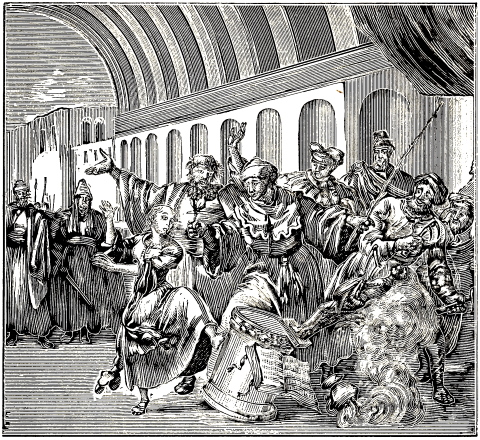
EULALIA REFUSING THE IDOL WORSHIP.
At this time there was a Christian maiden, called Eulalia, not more than twelve or thirteen years old, who was filled with such a desire and ardor of the spirit, to die for the name of Christ, that her parents had to take her out of the city of Merida, to some distant country-seat, and closely confine her there. But this place could not extinguish the fire of her spirit, or long confine her body; for, having escaped on a certain night, she went very early the following day before the tribunal, and with a loud voice said to the Judge and the whole magistracy: “Are you not ashamed to cast your own souls and those of others at once into eternal perdition by denying the only true God, the Father of us all, and the Creator of all things? O ye wretched men! do you seek the Christians, that you may put them to death? Behold, here am I, an adversary of your satanical sacrifices. I confess with heart and mouth God alone; but Isis, Apollo, and Venus are vain idols.”
The Judge before whose tribunal Eulalia spoke thus boldly, was filled with rage, and called the executioner, commanding him to take her away speedily, strip her, and inflict various punishments on her; so that she, said he, may feel the gods of our fathers, through the punishment, and may learn that it will be hard for her, to despise the command of our Prince (that is, of Maximian).
But before he allowed matters to proceed so far, he addressed her with these soft words: “How gladly would I spare thee! O that thou mightest renounce before thy death thy perverse views of the Christian religion? Reflect once, what great joy awaits thee, which thou mayest expect in the honorable state of matrimony. Behold, all thy friends weep for thee, and thy sorrow-stricken, well-born kindred sigh over thee, that thou art to die in the tender bloom of thy young life. See, the servants stand ready to torture thee to death with all sorts of torments; for thou shalt either be beheaded with the sword, or torn by the wild beasts, or singed with torches, which will cause thee to howl and wail, because thou wilt not be able to endure the pain; or, lastly be burned with fire. Thou canst escape all these tortures with little trouble, if thou wilt only take a few grains of salt and incense on the tips of thy fingers, and sacrifice it. Daughter, consent to this, and thou shalt thereby escape all these severe punishments.”
This faithful martyr did not think it worth the trouble to reply either to the entreating or the threatening words of the Judge, but, to say it briefly, pushed far away from her and upset113 the images, the altar, censor, sacrificial book, etc.
Instantly two executioners came forward, who tore her tender limbs, and with cutting hooks or claws cut open her sides to the very ribs.
Eulalia, counting and recounting the gashes on her body, said: “Behold, Lord Jesus Christ! thy name is being written on my body; what great delight it affords me to read these letters, because they are signs of thy victory! Behold, my purple blood confesses thy holy name.”
This she spoke with an undaunted and happy countenance, evincing not the least sign of distress, though the blood flowed like a fountain from her body. After she had been pierced through to her ribs with pincers, they applied burning lamps and torches to the wounds in her sides, and to her abdomen. Finally the hair of her head was ignited by the flame, and taking it in her mouth, she was suffocated by it. This was the end of this heroine, young in years, but old in Christ, who loved the doctrine of her Savior more than her own life. A. Mell., 1st book, fol. 105, col. 4, and fol. 106, col. 1, 2, compared with J. Gys., fol. 23, col. 3, ex Prudent. Steph. Hym. 3.
This happened in Lusitania, at Emerita, now called Merida or Medina del Rio Sacco, in the uttermost or lowest part of Spain, under the Emperor Maximian and the Proconsul Dacian, as may clearly be seen in ancient writers, and also in the aforementioned authors.
EUCRATIS, A VIRTUOUS MAIDEN, DIED IN PRISON, AT CÆSAR AUGUSTA, AFTER RECEIVING MANY STRIPES AND WOUNDS, FOR THE TESTIMONY OF JESUS, HER SAVIOR, A. D. 302.
After the death of Eulalia an account is given (from Prudentius) of another Christian maiden, called Eucratis, who by her steadfastness in suffering, and the violence with which she took the kingdom of heaven, put to shame the spirit of this world, at Cæsar Augusta. The ancients tell us in what manner this heroine of Jesus Christ was martyred, namely, that she was not only tormented on her sides with rods and other iron instruments, but that her breasts were cut off, so that her liver could be seen; hence, having been put back into prison, she very miserably died (yet with a glad hope), in consequence of the putrefaction of the wounds, which she had received for the name of Jesus Christ. See Mell. as cited above, from Steph. Hym. 4. Flos. Sanct. Hisp. Mart. Rom., 16 April.
THE SECOND YEAR OF THIS PERSECUTION BEGAN A. D. 303.
The persecution did not yet cease, though it had already risen to a very high degree. But it may have pleased God to bring his people through much tribulation into his kingdom. Acts 14:22,23.
EUPLIUS, A PIOUS CHRISTIAN, BEHEADED IN THE CITY OF CATANA IN SICILY, FOR THE TESTIMONY OF JESUS CHRIST, A. D. 303.
On the 12th of August, A. D. 303, a certain pious Christian, called Euplius, was surprised by the inquisitors of the Romans, in the city of Catana in Sicily, as he was engaged in reading the Gospel, and instructing other Christians. They apprehended him and brought him near the tribunal, in which sat the clerk of the criminal court and the Judge.
Meanwhile Euplius cried aloud: “I am a Christian, and wish to die for the name of Christ.”
Calvisianus, the Proconsul, hearing this, said: “Bring him in here, who cried thus.”
When Euplius had entered the tribunal, carrying with him the Gospel books, one of the Proconsul’s friends said: “It is not right for him to carry such papers with him contrary to the prohibition of the Emperors.”
The Proconsul asked Euplius, whence he had these writings? Whether he brought them from his house?
Euplius answered: “I have no house. My Lord Jesus Christ knows that I have no house.”
Then the Proconsul commanded him with a loud voice, to read something out of the writings.
Euplius, having opened the book, read these words: “Blessed are they which are persecuted for righteousness’ sake: for theirs is the kingdom of heaven.” Also: “Whosoever will come after me, let him deny himself,” etc.
When he had read these and like passages, the Proconsul said: “What does all this mean?”
Euplius replied: “This is the law of my Lord, of Jesus Christ, the Son of the living God.”
The Proconsul, having heard this confession of Christ, said: “Let him be delivered unto the executioners, put to the rack, and thus examined.”
He was then very grievously, yea, inhumanly tormented, and commanded to deliver up the Scriptures he had with him, and to have them burned to the dishonor of Jesus Christ. All of this he steadfastly refused to do; moreover, he openly invoked the name of Jesus Christ, because he had been found worthy to suffer for his name’s sake.