Volume 1 — The Birds of Washington
Reading edition
VOL. I. Description of Species Nos. 1-181
[1]
Corvidæ—The Crows and Jays
No. 1. NORTHERN RAVEN.
A.O.U. No. 486a. Corvus corax principalis Ridgw.
Synonym.—Formerly called the American Raven.
Description.—Color uniform lustrous black; plumage, especially on breast, scapulars and back, showing steel-blue or purplish iridescence; feathers of the throat long, narrow, pointed, light gray basally; primaries whitening at base. Length two feet or over, female a little smaller; wing 17.00-18.00 (438); tail 10.00 (247); bill 3.20 (76.5); depth of bill at nostril 1.00 (28.5); tarsus 2.68 (68).
Recognition Marks.—Large size,—about twice as big as a Crow; long rounded tail; harsh croaking notes; uniform black coloration. Indistinguishable afield from sinuatus.
Nesting.—Nest: a large but compact mass of sticks, lined with grass, wool, cow-hair, etc., placed high in fir trees or upon inaccessible cliffs. Eggs: 4-7 (8 of record), usually 5, pale bluish green or olive, spotted, blotched, and dashed with greenish brown and obscure lilac or purple. Av. size, 1.90 × 1.33 (48.26 × 33.78). Season: April 15; one brood.
General Range.—“Arctic and Boreal Provinces of North America; south to Eastern British Provinces, portions of New England, and Atlantic Coast of United States, higher Alleghenies, region of the Great Lakes, western and northern Washington, etc.” (Ridgway).
Range in Washington.—Found sparingly in the Cascade and Olympic Mountains, more commonly along the Pacific Coast.
Migrations.—Resident but wide ranging.
Authorities.—[Lewis and Clark, Hist. Ex. (1814), Ed Biddle: Coues. Vol. II. p. 185.] Corvus carnivorus Bartram, Baird, Rep. Pac. R. R. Surv. IX. 1858, pp. 561, 562, 563. (T). C&S. L¹. D¹(?). B. E.
Specimens.—(U. of. W.) Prov. C.
[2]
Altho nowhere abundant, in the sense which obtains among smaller species, nor as widely distributed as some, there is probably no other bird which has attracted such universal attention, or has left so deep an impress upon history and literature as the Raven. Primitive man has always felt the spell of his sombre presence, and the Raven was as deeply imbedded in the folklore of the maritime Grecian tribes as he is today in that of the Makahs and Quillayutes upon our own coast. Korax, the Greek called him, in imitation of his hoarse cry, Kraack, kraack; while the Sanskrit name, Karava, reveals the ancient root from which have sprung both Crow and Raven.
Quick-sighted, cunning, and audacious, this bird of sinister aspect has been invested by peoples of all ages with a mysterious and semi-sacred character. His ominous croakings were thought to have prophetic import, while his preternatural shrewdness has made him, with many, a symbol of divine knowledge. We may not go such lengths, but we are justified in placing this bird at the head of our list; and we must agree with Professor Alfred Newton that the Raven is “the largest of the Birds of the Order Passeres, and probably the most highly developed of all Birds.”
The Raven is a bird of the wilderness; and, in spite of all his cunning, he fares but ill in the presence of breech-loaders and iconoclasts. While it has not been the object of any special persecution in Washington, it seems to share the fate reserved for all who lift their heads above the common level; and it is now nearly confined in its local distribution to the Olympic peninsula; and is nowhere common, save in the vicinity of the Indian villages which still cling to our western shore.
In appearance the Raven presents many points of difference from the Common Crow, especially when contrasted with the dwarf examples of the northwestern race. It is not only larger, but its tail is relatively much longer, and fully rounded. The head, too, is fuller, and the bill proportionately stouter with more rounded culmen. The feathers of the neck are loosely arranged, resulting in an impressive shagginess; and there is a sort of uncouthness about these ancient birds, as compared with the more dapper Crow.
Ravens are unscrupulous in diet, and therefrom has arisen much of the dislike which has attached to them. They not only subsist upon insects, worms, frogs, shellfish, and cast-up offal, but devour the eggs and young of sea-birds; and, when pressed by hunger, do not scruple to attack rabbits, young lambs, or seal pups. In fact, nothing fleshly and edible comes amiss to them. In collecting along the sea-coast I once lost some sandpipers,—which I had not had time to prepare the evening before—because the dark watcher was “up first”. Like the Fish Crow, they hang about the Indian villages to some extent, and dispute with the ubiquitous Indian dog the chance at decayed fish and offal.
[3]
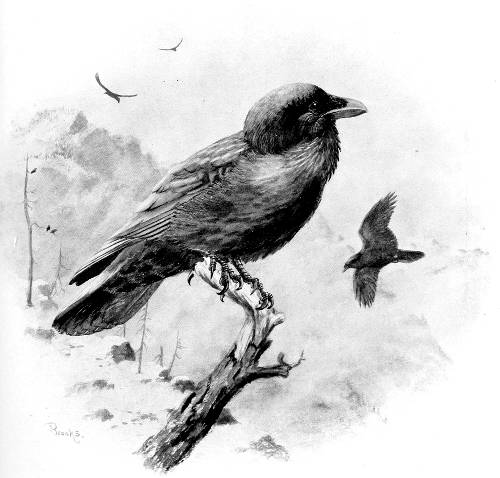
NORTHERN RAVEN.
[4]
Altho by force of circumstances driven to accept shelter and nesting sites in the dense forests of the western Olympic slope, the Raven is a great lover of the sea-cliffs and of all wild scenery. Stormy days are his especial delight and he soars about in the teeth of the gale, exulting, like Lear, in the tumult: “Blow winds, and crack your cheeks!” The sable bird is rather majestic on the wing, and he soars aloft at times with something of the motion and dignity of the Eagle. But the Corvine character is complex; and its gravest representatives do some astonishingly boyish things. For instance, according to Nelson, they will take sea-urchins high in air and drop them on the cliffs, for no better reason, apparently, than to hear them smash. Or, again, they will catch the luckless urchins in mid-air with all the delight of school-boys at tom-ball.
Nests are to be found midway of sea-cliffs in studiously inaccessible places, or else high in evergreen trees. Eggs, to the number of five or six, are deposited in April; and the young are fed upon the choicest which the (egg) market affords. We shall need to apologize occasionally for the shortcomings of our favorites, and we confess at the outset to shameless inconsistency; for even bird villains are dear to us, if they be not too bad, and especially if their badness be not directed against us. Who would wish to see this bold, black brigand, savage, cunning, and unscrupulous as he is, disappear entirely from our shores? He is the deep shadow of the world’s chiaroscuro; and what were white, pray, without black by which to measure it?
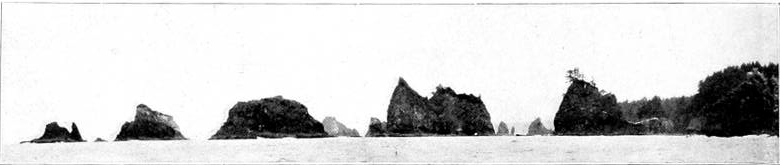
Taken in Clallam County. Photo by the Author. POINT-OF-THE-ARCHES GROUP, A CHARACTERISTIC HAUNT OF THE RAVEN.
[5]
No. 2. MEXICAN RAVEN.
A. O. U. No. 486. Corvus corax sinuatus (Wagler).
Synonyms.—American Raven. Southern Raven.
Description.—Like preceding but averaging smaller; bill relatively smaller and narrower; tarsus not so stout. Length up to 26 inches, but averaging less. Culmen 2.85 (72).
Recognition Marks.—As in preceding—distinguishable only by range.
Nesting.—Nest: placed on ledge or in crannies of basalt cliffs, more rarely in pine trees.
General Range.—Western United States chiefly west of the Rocky Mountains; in its northerly extension nearly coincident with the Upper Sonoran life zone, south to Honduras.
Range in Washington.—May be arbitrarily defined as restricted to the East-side, but common only on the treeless plains and in the Blue Mountain region. Resident.
Authorities.—Corvus carnivorus Bart., Cooper and Suckley, Rep. Pac. R. R. Surv. XII. pt. II. 1860, p. 210. Bendire, Life Hist. N. A. Birds, Vol. II. p. 396 f.
It is no mere association of ideas which has made the Raven the bird of ill omen. Black is his wing, and black is his heart, as well. While it may be allowed that he works no direct damage upon the human race, we cannot but share in sympathy the burden of the bird-world which regards him as the bete noir, diabolical in cunning, patient as fate, and relentless in the hour of opportunity.
As I sit on an early May morning by the water’s edge on a lonely island in the Columbia River, all nature seems harmonious and glad. The Meadowlarks are pricking the atmosphere with goads of good cheer in the sage behind; the Dove is pledging his heart’s affection in the cottonwood hard by; the river is singing on the rapids; and my heart is won to follow on that buoyant tide—when suddenly a mother Goose cries out in terror and I leap to my feet to learn the cause. I have not long to wait. Like a death knell comes the guttural croak of the Raven. He has spied upon her, learned her secret, swept in when her precious eggs were uncovered; and he bears one off in triumph,—a feast for his carrion brood. When one has seen this sort of thing a dozen times, and heard the wail of the wild things, the croak of the Raven comes to be fraught with menace, the veritable voice of doom.
To be sure, the Raven is not really worse than his kin, but he is distinguished by a bass voice; and does not the villain in the play always sing bass? Somehow, one never believes the ill he hears of the soulful tenor, even tho he sees him do it; but beware of the bird or man who croaks at low C.
[6]
Of all students of bird-life in the West, Captain Bendire has enjoyed the best opportunities for the study of the Raven; and his situation at Camp Harney in eastern Oregon was very similar to such as may be found in the southeastern part of our own State. Of this species, as observed at that point, he says:
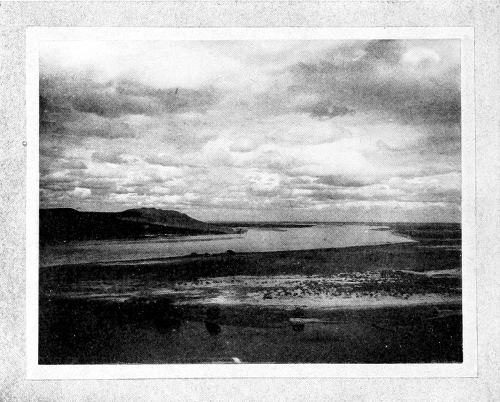
Taken near Wallula. Photo by the Author. THE RAVEN’S FIEF.
“They are stately and rather sedate-looking birds, remain mated thru life, and are seemingly very much attached to each other, but apparently more unsocial to others of their kind. On the ground their movements are deliberate and dignified; their walk is graceful and seldom varied by hurried hops or jumps. They appear to still better advantage on the wing, especially in winter and early spring, when pairs may be frequently seen playing with each other, performing extraordinary feats in the air, such as somersaults, trying to fly on their backs, etc. At this season they seem to enjoy life most and to give vent to their usually not very exuberant spirits by a series of low chuckling and gurgling notes, evidently indifferent efforts at singing.
“Their ordinary call is a loud Craack-craack, varied sometimes by a deep [7] grunting koerr-koerr, and again by a clucking, a sort of self-satisfied sound, difficult to reproduce on paper; in fact they utter a variety of notes when at ease and undisturbed, among others a metallic sounding klunk, which seems to cost them considerable effort. In places where they are not molested they become reasonably tame, and I have seen Ravens occasionally alight in my yard and feed among the chickens, a thing I have never seen Crows do. * * *
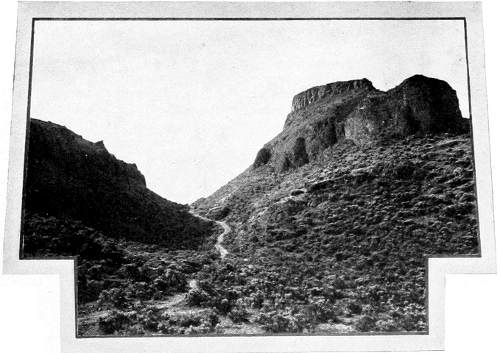
Taken in Walla Walla County. Photo by the Author. NESTING HAUNT OF THE MEXICAN RAVEN.
“Out of some twenty nests examined only one was placed in a tree. It was in a good sized dead willow, twenty feet from the ground, on an island in Sylvies River, Oregon, and easily reached; it contained five fresh eggs on April 13, 1875. The other nests were placed on cliffs, and, with few exceptions, in positions where they were comparatively secure. Usually the nest could not be seen from above, and it generally took several assistants and strong ropes to get near them, and even then it was frequently impossible to reach the eggs without the aid of a long pole with a dipper attached to the end. A favorite site was a cliff with a southern exposure, where the nest was completely covered from above by a projecting rock.”
Having once chosen a nesting site, the Ravens evince a great attachment for that particular locality; and, rather than desert it, will avoid notice by deferring the nesting season, or by visiting the eggs or young only at night.
We have no records of the taking of Raven’s eggs in Washington, but it [8] does unquestionably breed here. A nest was reported to us on a cliff in the Crab Creek Coulee. While we were unable to visit it in season, we did come upon a family group some weeks later, comprising the two adults and five grown young. This is possibly the northernmost breeding station of the Mexican Raven yet reported.
No. 3. WESTERN CROW.
A. O. U. No. 488b. Corvus brachyrhynchos hesperis (Ridgw.).
Synonyms.—California Crow. Common Crow. American Crow.
Description.—Entire plumage glossy black, for the most part with greenish blue, steel-blue, and purplish reflections; feathers of the neck normal, rounded. Bill and feet black; iris brown. Length 16.00-20.00; wing 12.00 (302); tail 6.70 (170); bill 1.83 (46.5); depth at nostril .65 (16.5). Female averages smaller than male.
Recognition Marks.—Distinguishable from Northwest Crow by larger size and clearer voice.
Nesting.—Nest: a neat hemisphere of sticks and twigs carefully lined with bark, roots and trash, and placed 10-60 feet high in trees,—willow, aspen, pine, or fir. Eggs: 4-6, usually 5, same coloring as Raven’s. Occasionally fine markings produce a uniform olive-green, or even olive-brown effect. Av. size 1.66 × 1.16 (42.2 × 29.5). Season: April 15-May 15; one brood.
General Range.—Western United States from Rocky Mts. to Pacific Coast, save shores of northwestern Washington, north in the interior of British Columbia, south to Arizona.
Range in Washington.—Of general distribution along streams and in settled portions of State, save along shores of Puget Sound, the Straits, and the Pacific north of Gray’s Harbor. Not found in the mountains nor the deeper forests, and only locally on the sage-brush plains.
Migrations.—Resident but gregarious and localized in winter. The winter “roosts” break up late in February.
Authorities.—Corvus americanus Aud., Baird, Rep. Pac. R. R. Surv. IX. 1858, 566 (part). Brewster, B. N. O. C. VII. 227. T. C&S. D¹. Kb. Ra. D². Ss¹. Ss². Kk. J. B. E.
Specimens.—BN(?).
While the Raven holds a secure place in mythology and literature, it is the Crow, rather, which is the object of common notice. No landscape is too poor to boast this jetty adornment; and no morning chorus is complete without the distant sub-dominant of his powerful voice, harsh and protesting tho it be.
The dusky bird is a notorious mischief-maker, but he is not quite so black as he has been painted. More than any other bird he has successfully matched his wits against those of man, and his frequent easy victories and consequent [9] boastings are responsible in large measure for the unsavory reputation in which he is held. It is a familiar adage in ebony circles that the proper study of Crow-kind is man, and so well has he pursued this study that he may fairly be said to hold his own in spite of fierce and ingenious persecution. He rejoices in the name of outlaw, and ages of ill-treatment have only served to sharpen his wits and intensify his cunning.
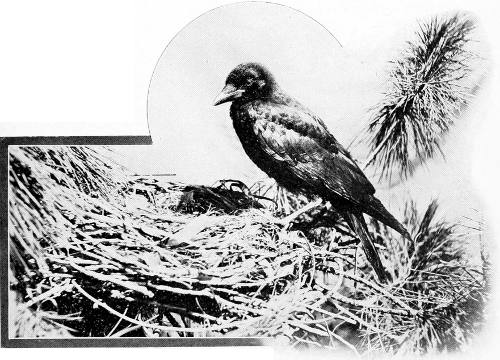
Taken in Oregon. Photo by Bohlman and Finley. WESTERN CROW AT NEST.
That the warfare waged against him is largely unnecessary, and partly unjust, has been pretty clearly proven of late by scientists who have investigated the Crow’s food habits. It is true that he destroys large numbers of eggs and nestlings, and, if allowed to, that he will occasionally invade the poultry yard—and for such conduct there can be no apology. It is true, also, that some damage is inflicted upon corn in the roasting-ear stage, and that corn left out thru the winter constitutes a staple article of Crow diet. But it is estimated that birds and eggs form only about one-half of one per cent of their total diet; and in the case of grain, certainly they perform conspicuous services in raising the crop. Besides the articles of food mentioned, great [10] quantities of crickets, beetles, grasshoppers, caterpillars, cut-worms, and spiders, are consumed. Frogs, lizards, mice, and snakes also appear occasionally upon the bill of fare. On the whole, therefore, the Crow is not an economic Gorgon, and his destruction need not largely concern the farmer, altho it is always well to teach the bird a proper reverence.
The psychology of the Crow is worthy of a separate treatise. All birds have a certain faculty of direct perception, which we are pleased to call instinct; but the Crow, at least, comes delightfully near to reasoning. It is on account of his phenomenal brightness that a young Crow is among the most interesting of pets. If taken from the nest and well treated, a young Crow can be given such a large measure of freedom as fully to justify the experiment from a humanitarian standpoint. Of course the sure end of such a pet is death by an ignorant neighbor’s gun, but the dear departed is embalmed in memory to such a degree that all Crows are thereafter regarded as upon a higher plane.
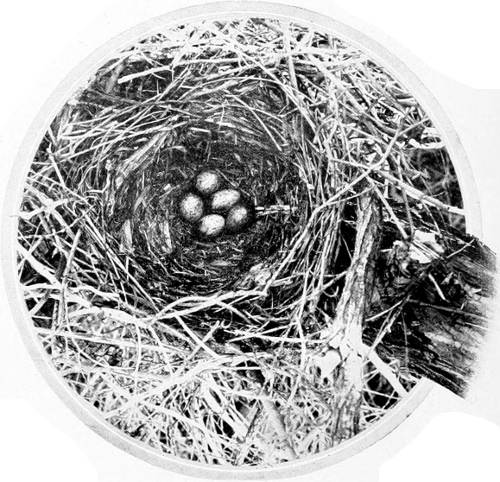
Taken in Benton Co. Photo by the Author. NEST AND EGGS OF WESTERN CROW.
Everyone knows that Crows talk. Their cry is usually represented by a single syllable, caw, but it is capable of many and important modifications. For instance, keraw, keraw, comes from some irritated and apprehensive female, who is trying to smuggle a stick into the grove; kawk-kawk-kawk proclaims sudden danger, and puts the flock into instant commotion; while caw-aw, caw-aw, caw-aw reassures them again. Once in winter when the bird-man, for sport, was mystifying the local bird population by reproducing the notes of the Screech Owl, a company of Crows settled in the tops of neighboring trees, and earnestly discussed the probable nature of the object half-concealed under a camera cloth. Finally, they gave it up and withdrew—as I supposed. It [11] seems that one old fellow was not satisfied, for as I ventured to shift ever so little from my strained position, he set up a derisive Ca-a-a-aw from a branch over my head,—as who should say, “Aw, ye can’t fool me. Y’re just a ma-a-an,” and flapped away in disgust.
Crows attempt certain musical notes as well; and, unless I mistake, the western bird has attained much greater proficiency in these. These notes are deeply guttural, and evidently entail considerable effort on the bird’s part. Hunger-o-ope, hunger-o-ope, one says; and it occurs to me that this is allied to the delary, delary, or springboard cry, of the Blue Jay (Cyanocitta cristata),—plunging notes they have also been called.
Space fails in which to describe the elaborate structure of Crow society; to tell of the military and pedagogical systems which they enforce; of the courts of justice and penal institutions which they maintain; of the vigilantes who visit vengeance upon evil-minded owls and other offenders; or even of the games which they play,—tag, hide and seek, blind-man’s-buff and pull-away. These things are sufficiently attested by competent observers; we may only spare a word for that most serious business of life, nesting.
A typical Crow’s nest is a very substantial affair, as our illustration shows. Upon a basis of coarse sticks, a mat of dried leaves, grasses, bark-strips, and dirt, or mud, is impressed. The deep rounded bowl thus formed is carefully lined with the inner bark of the willow or with twine, horse-hair, cow-hair, rabbit-fur, wool, or any other soft substance available. When completed the nesting hollow is seven or eight inches across and three or four deep. The expression “Crow’s nest,” as used to indicate disarray, really arises from the consideration of old nests. Since the birds resort to the same locality year after year, but never use an old nest, the neighboring structures of successive years come to represent every stage of dilapidation.
West of the mountains nests are almost invariably placed well up in fir trees, hard against the trunk, and so escape the common observation. Upon the East-side, however, nests are usually placed in aspen trees or willows; in the former case occurring at heights up to fifty feet, in the latter from ten to twenty feet up. Escape by mere elevation being practically impossible, the Crows resort more or less to out-of-the-way places,—spring draws, river islands, and swampy thickets.
Notwithstanding the fact that the spring season opens much earlier than in the East, the Crows, true to the traditions of a northern latitude, commonly defer nesting till late in April. Fresh eggs may be found by the 20th of April, but more surely on the 1st of May. Incubation lasts from fourteen to eighteen days; and the young, commonly five but sometimes six in number, are born naked and blind.
It is when the Crow children are hatched that Nature begins to groan. It is then that birds’ eggs are quoted by the crate; and beetles by the hecatomb [12] are sacrificed daily in a vain effort to satisfy the Gargantuan appetites of these young ebons. I once had the misfortune to pitch camp in a grove of willows which contained a nestful of Crows. The old birds never forgave me, but upbraided me in bitter language from early morn till dewy eve. The youngsters also suffered somewhat, I fear, for as often as a parent bird approached, cawing in a curiously muffled voice, choked with food, and detected me outside the tent, it swallowed its burden without compunction, in order that it might the more forcibly berate me.
If the male happened to discover my out-of-doorness in the absence of his mate, he would rush at her when she hove in sight, in an officious, blustering way, and shout, “Look out there! Keep away! The Rhino is on the rampage again!”
I learned, also, to recognize the appearance of hawks in the offing. At the first sign the Crow, presumably the male, begins to roll out objurgatory gutturals as he hurries forward to meet the intruder. His utterances, freely translated, run somewhat as follows: “That blank, blank Swainson Hawk! I thought I told him to keep away from here. Arrah, there, you slab-sided son of an owl! What are ye doing here? Git out o’ this! (Biff! Biff!) Git, I tell ye! (Biff!) If ever I set eyes on ye again, I’ll feed ye to the coyotes. Git, now!” And all this without the slightest probability that the poor hawk would molest the hideous young pickaninnies if he did discover them. For when was a self-respecting hawk so lost to decency as to be willing to “eat crow”?
No. 4. NORTHWEST CROW.
A. O. U. No. 489. Corvus brachyrhynchos caurinus (Baird).
Synonyms.—Fish Crow. Western Fish Crow. Northwest Fish Crow. Puget Sound Crow. Tidewater Crow.
Description.—Similar to C. b. hesperis, but decidedly smaller, with shorter tarsus and relatively smaller feet. Length 15.00-17.00; wing 11.00 (280); tail 6.00 (158); bill 1.80 (46); tarsus 1.95 (50).
Recognition Marks.—An undersized Crow. Voice hoarse and flat as compared with that of the Western Crow. Haunts beaches and sea-girt rocks.
Nesting.—Nest: a compact mass of twigs and bark-strips with occasionally a foundation of mud; lined carefully with fine bark-strips and hair; 4.00 deep and 7.00 across inside; placed 10-20 feet high in orchard or evergreen trees, sometimes in loose colony fashion. Eggs: 4 or 5, indistinguishable in color from those of the [13] Common Crow, but averaging smaller. A typical set averages 1.56 × 1.08 (39.6 × 27.4). Season: April 15-June 1; one brood.
General Range.—American coasts of the North Pacific Ocean and its estuaries from Olympia and the mouth of the Columbia River north at least to the Alaskan peninsula.
Range in Washington.—Shores and islands of Puget Sound, the Straits of Juan de Fuca, and the West Coast (at least as far south as Moclips, presumably to Cape Disappointment). Strictly resident.
Authorities.—[Lewis and Clark, Hist. Ex. (1814), ed. Biddle: Coues, Vol. II. p. 185.] Corvus caurinus Baird, Baird, Rep. Pac. R. R. Surv. IX. June 29, 1858, 569, 570. T. C&S. L¹. Rh. Kb. Ra. Kk. B. E.
Specimens.—U. of W. Prov. E. B.
After lengthy discussion it is pretty well settled that the Crow of the northwestern sea-coasts is merely a dwarfed race of the Corvus brachyrhynchos group; and that it shades perfectly into the prevailing western type, C. b. hesperis, wherever that species occupies adjacent regions. This area of intergradation lies chiefly south and west of Puget Sound, in Washington; for the Crow is ever fond of the half-open country, and does not take kindly to the unmitigated forest depths, save where, as in the case of the Fish Crow, he may find relief upon the broad expanses of shore and tide-flats. The case is quite analogous to that of native man. The larger, more robust types were found in the eastern interior, while those tribes which were confined exclusively to residence upon the sea-shore tended to become dwarfed and stunted; and the region of intergradation lay not chiefly along the western slopes of the Cascades with their crushing weight of tall timber, but in the prairie regions bordering Puget Sound upon the south.
It is impossible, therefore, to pronounce with certainty upon the subspecific identity of Crows seen near shore in Mason, Thurston, Pierce, or even King County; but in Clallam, Jefferson, San Juan, and the other counties of the Northwest, one has no difficulty in recognizing the dwarf race. Not only are these Crows much smaller in point of size, but the voice is weaker, flatter, and more hoarse, as tho affected by an ever-present fog. So marked is this vocal change, that one may note the difference between birds seen along shore in Pierce County and those which frequent the uplands. However,—and this caution must be noted—the upland birds do visit the shore on occasion; and the regular shore dwellers are by no means confined thereto, as are the more typical birds found further north.
The early observers were feeling for these differences, and if Nature did not afford sufficient ground for easy discrimination, imagination could supply the details. The following paragraph from the much quoted work[4] of John Keast Lord is interesting because deliciously untrue.
[14]
“The sea-coast is abandoned when the breeding time arrives early in May, when they resort in pairs to the interior; selecting a patch of open prairie, where there are streams and lakes and where the wild crab apple and white-thorn grows, in which they build nests precisely like that of the Magpie, arched over the top with sticks. The bird enters by a hole on one side but leaves by an exit hole in the opposite. The inside is plastered with mud; a few grass stalks strewn loosely on the bottom keep the eggs from rolling. This is so marked a difference to the Barking Crow’s nesting [“Barking Crow” is J. K. L.’s solecism for the Western Crow, C. b. hesperis], as in itself to be a specific distinction. The eggs are lighter in blotching and much smaller. I examined great numbers [! !] of nests at this prairie and on the Columbia, but invariably found that the same habit of doming prevailed. After nesting, they return with the young to the sea-coasts, and remain in large flocks often associated with Barking Crows until nesting time comes again.”—No single point of which has been confirmed by succeeding observers.
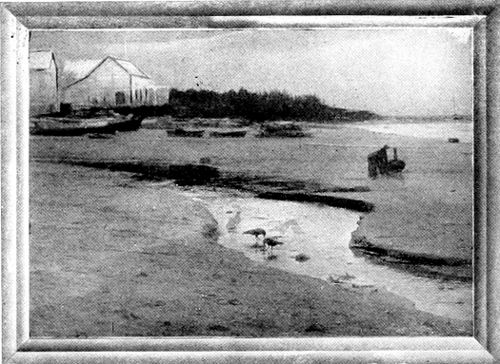
Taken at Neah Bay. Photo by the Author. THE PHANTOM CROWS.
Dr. Cooper wrote[5] with exact truthfulness: “This fish-crow frequents the coast and inlets of this Territory in large numbers, and is much more gregarious and familiar than the common Crow. Otherwise it much resembles that bird in habits, being very sagacious, feeding on almost everything animal and vegetable, and having nearly the same cries, differing rather in tone than character. Its chief dependence for food being on the sea, it is generally found along the beach, devouring dead fish and other things brought up by the waves. It is also very fond of oysters, which it breaks by carrying them upward and dropping again on a rock or other hard material. When the tide is full they resort to the fields or dwellings near the shore and devour potatoes and other vegetables, offal, etc. They, like the gulls, perceive the instant of change of the tide, and flocks will then start off together for a favorite feeding ground. They are very troublesome to the Indians, stealing [15] their dried fish and other things, while from superstitious feelings the Indians never kill them but set a child to watch and drive them away. They build in trees near the shore in the same way as the common crow and the young are fledged in May.”
Mr. J. F. Edwards, a pioneer of ’67, tells me that in the early days a small drove of pigs was an essential feature of every well-equipped saw-mill on Puget Sound. The pigs were given the freedom of the premises, slept in the saw dust, and dined behind the mess-house. Between meals they wandered down to the beach and rooted for clams at low tide. The Crows were not slow to learn the advantages of this arrangement and posted themselves promptly in the most commanding and only safe positions; viz., on the backs of the pigs. The pig grunted and squirmed, but Mr. Crow, mindful of the blessings ahead, merely extended a balancing wing and held on. The instant the industrious rooter turned up a clam, the Crow darted down, seized it in his beak and made off; resigning his station to some sable brother, and leaving the porker to reflect discontentedly upon the rapacity of the upper classes. Mr. Edwards declares that he has seen this little comedy enacted, not once, but a hundred times, at Port Madison and at Alberni, V. I.
The Fish Crows have learned from the gulls the delights of sailing the main on driftwood. I have seen numbers of them going out with the tide a mile or more from shore, and once a Crow kept company with three gulls on a float so small that the gulls had continually to strive for position; but the Crow stood undisturbed.
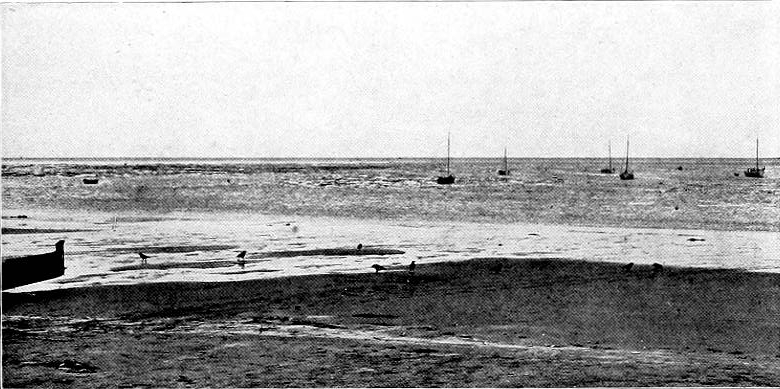
Photo by the Author. BIRDS AND BOATS AT NEAH BAY.
[16]
Speaking of their aquatic tendencies, Mr. A. B. Reagan, of La Push, assures me that he has repeatedly seen them catch smelt in the ocean near shore. These fish become involved in the breakers and may be snatched from above by the dextrous bird without any severe wetting.
Crows are still the most familiar feature of Indian village life. The Indian, perhaps, no longer cherishes any superstition regarding him, but he is reluctant to banish such a familiar evil. The Quillayutes call the bird Kah-ah-yó: and it is safe to say that fifty pairs of these Fish Crows nest within half a mile of the village of La Push. They nest, indifferently, in the saplings of the coastal thickets, or against the trunks of the larger spruces, and take little pains to escape observation. The birds are, however, becoming quite shy of a gun. Seeing a half dozen of them seated in the tip of a tall spruce in the open woods, I raised my fowling piece to view, whereupon all flew with frantic cries. Indeed it required considerable manœuvering and an ambuscade to secure the single specimen needed.
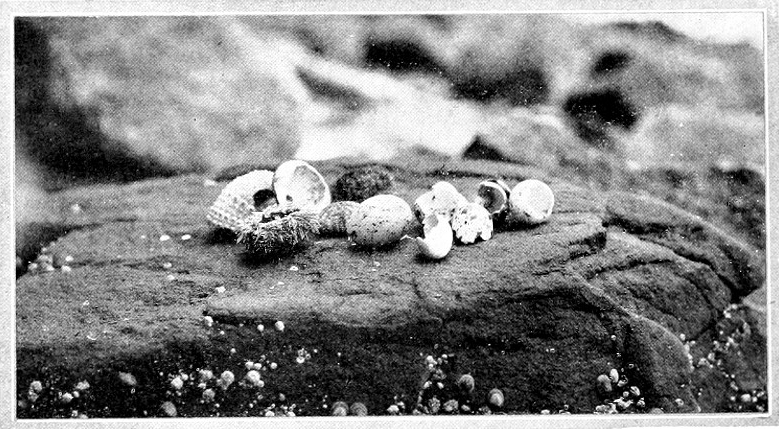
Taken on Waldron Id. Photo by the Author. THE CROW’S FARE.
At Neah Bay the Fish Crows patrol the beach incessantly and allow very little of the halibut fishers’ largess to float off on the tide. And the Oke-t(c)ope, as the Makahs call the birds, have little fear of the Indians, altho they are very suspicious of a strange white man. I once saw a pretty sight on this beach: a three year old Indian girl chasing the Crows about in childish glee. The birds enjoyed the frolic as much as she, and fell in [17] behind her as fast as she shooed them away in front—came within two or three feet of her, too, and made playful dashes at her chubby legs. But might I be permitted to photograph the scene at, say, fifty yards? Mit nichten! Arragh! To your tents, O Israel!
In so far as this Crow consents to perform the office of scavenger, he is a useful member of society. Nor is his consumption of shell-fish a serious matter. But when we come to consider the quality and extent of his depredations upon colonies of nesting sea-birds, we find that he merits unqualified condemnation. For instance, two of us bird-men once visited the west nesting of Baird Cormorants on Flattop, to obtain photographs. As we retired down the cliff, I picked up a broken shell of a Cormorant’s egg, from which the white, or plasma, was still dripping. As we pulled away from the foot of the cliff a Crow flashed into view, lighted on the edge of a Shag’s nest, seized an egg, and bore it off rapidly into the woods above, where the clamor of expectant young soon told of the disposition that was being made of it. Immediately the marauder was back again, seized the other egg, and was off as before. All this, mind you, in a trice, before we were sufficiently out of range for the Cormorants to reach their nests again, altho they were hastening toward them. Back came the Crow, but the first nest was exhausted; the second had nothing in it; the Shags were on the remainder; moments were precious—he made a dive at a Gull’s nest, but the Gulls made a dive at him; and they too hastened to their eggs.
Subsequent investigation discovered rifled egg-shells all over the island, and it was an easy matter to pick up a hatful for evidence. As he is at Flattop, so he is everywhere, an indefatigable robber of birds’ nests, a sneaking, thieving, hated, black marauder. It is my deliberate conviction that the successful rearing of a nestful of young Crows costs the lives of a hundred sea-birds. The Baird Cormorant is, doubtless, the heaviest loser; and she appears to have no means of redress after the mischief is done, save to lay more eggs,—more eggs to feed more Crows, to steal more eggs, etc.
[18]
No. 5. CLARK’S NUTCRACKER.
A.O.U. No. 491. Nucifraga columbiana (Wils.).
Synonyms.—Clark’s Crow. Pine Crow. Gray Crow. “Camp Robber.” (Thru confusion with the Gray Jay, Perisoreus sp.).
Description.—Adults: General plumage smoky gray, lightening on head, becoming sordid white on forehead, lores, eyelids, malar region and chin; wings glossy black, the secondaries broadly tipped with white; under tail-coverts and four outermost pairs of rectrices white, the fifth pair with outer web chiefly white and the inner web chiefly black, the remaining (central) pair of rectrices and the upper tail-coverts black; bill and feet black; iris brown. Shade of gray in plumage of adults variable—bluish ash in freshly moulted specimens, darker and browner, or irregularly whitening in worn plumage. Young like adults, but browner. Length 11.00-13.00; wing 7.00-8.00 (192); tail 4.50 (115); bill 1.60 (40.7); tarsus 1.45 (36.8). Female smaller than male.
Recognition Marks.—Kingfisher size; gray plumage with abruptly contrasting black-and-white of wings and tail; harsh “char-r” note.
Nesting.—Nest: basally a platform of twigs on which is massed fine strips of bark with a lining of bark and grasses, placed well out on horizontal limb of evergreen tree, 10-50 feet up. Eggs: 2-5, usually 3, pale green sparingly flecked and spotted with lavender and brown chiefly about larger end. Av. size, 1.30 × .91 (33 × 23.1). Season: March 20-April 10; one brood.
General Range.—Western North America in coniferous timber, from Arizona and New Mexico to Alaska; casual east of the Rockies.
Range in Washington.—Of regular occurrence in the mountains thruout the State. Resident in the main but visits the foothills and lower pine-clad levels of eastern Washington at the close of the nesting season.
Authorities.—Corvus columbianus, Wilson, Am. Orn. iii. 1811, 29. T. C&S. D¹. D². J. E.
Specimens.—(U. of W.). Prov. E. C.
No bird-lover can forget his first encounter with this singular Old-Bird-of-the-Mountains. Ten to one the bird brought the man up standing by a stentorian char’r’r, char’r’r, char’r’r, which led him to search wildly in his memory whether Rocs are credited with voices. If the bird was particularly concerned at the man’s intrusion, he presently revealed himself sitting rather stolidly on a high pine branch, repeating that harsh and deafening cry. The grating voice is decidedly unpleasant at close quarters, and it is quite out of keeping with the unquestioned sobriety of its grizzled owner. A company of Nutcrackers in the distance finds frequent occasion for outcry, and the din is only bearable as it is softened and modified by the re-echoing walls of some pine-clad gulch, or else dissipated by the winds which sweep over the listening glaciers.
[19]
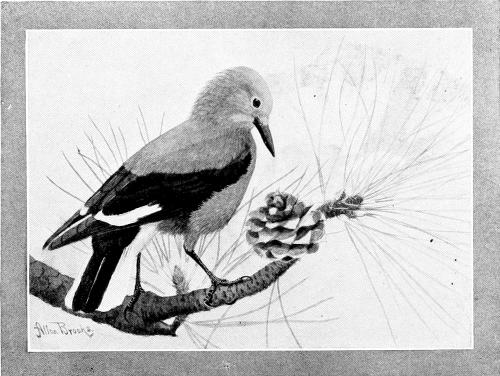
CLARK’S NUTCRACKER.
Clark’s Nutcracker is the presiding genius of the East-side slopes and light-forested foothills, as well as of the rugged fastnesses of the central Cordilleras. His presence, during fall and winter, at the lower altitudes depends in large measure upon the pine-cone crop, since pine seeds are his staple, tho by no means his exclusive diet. This black and white and gray “Crow” curiously combines the characteristics of Woodpecker and Jay as well. Like the Lewis Woodpecker, he sometimes hawks at passing insects, eats berries from bushes, or alights on the ground to glean grubs, grasshoppers, and black crickets. In the mountains it shares with the Jays of the Perisoreus group the names “meat-bird” and “camp-robber,” for nothing that is edible comes amiss to this bird, and instances are on record of its having invaded not only the open-air kitchen, but the tent, as well, in search of “supplies.”
Of its favorite food, John Keast Lord says: “Clark’s ‘Crows’ have, like the Cross-bills, to get out the seeds from underneath the scaly coverings constituting the outward side of the fir-cone; nature has not given them [20] crossed mandibles to lever open the scales, but instead, feet and claws, that serve the purpose of hands, and a powerful bill like a small crowbar. To use the crowbar to advantage the cone needs steadying, or it would snap at the stem and fall; to accomplish this one foot clasps it, and the powerful claws hold it firmly, whilst the other foot encircling the branch, supports the bird, either back downward, head downward, on its side, or upright like a woodpecker, the long clasping claws being equal to any emergency; the cone thus fixed and a firm hold maintained on the branch, the seeds are gouged out from under the scales.”
These Nutcrackers are among the earliest and most hardy nesters. They are practically independent of climate, but are found during the nesting months—March, or even late in February, and early April—only where there is a local abundance of pine (or fir) seeds. They are artfully silent at this season, and the impression prevails that they have “gone to the mountains”; or, if in the mountains already, the presence of a dozen feet of snow serves to allay the oölogist’s suspicions.
The nest is a very substantial affair of twigs and bark-strips, heavily lined, as befits a cold season, and placed at any height in a pine or fir tree, without noticeable attempt at concealment. The birds take turns incubating and—again because of the cold season—are very close sitters. Three eggs are usually laid, of about the size and shape of Magpies’ eggs, but much more lightly colored. Incubation, Bendire thinks, lasts sixteen or seventeen days, and the young are fed solely on hulled pine seeds, at the first, presumably, regurgitated.
If the Corvine affinities of this bird were nowhere else betrayed, they might be known from the hunger cries of the young. The importunate añh, añh, añh of the expectant bantling, and the subsequent gullú, gullú, gullú of median deglutition (and boundless satisfaction) will always serve to bind the Crow, Magpie, and Nutcracker together in one compact group. When the youngsters are “ready for college,” the reserve of early spring is set aside and the hillsides are made to resound with much practice of that uncanny yell before mentioned. Family groups are gradually obliterated and, along in June, the birds of the foothills begin to retire irregularly to the higher ranges, either to rest up after the exhausting labors of the season, or to revel in midsummer gaiety with scores and hundreds of their fellows.
[21]
No. 6. PINON JAY.
A. O. U. No. 492. Cyanocephalus cyanocephalus (Maxim.).
Synonyms.—Blue Crow. Maximilian’s Jay. Pine Jay.
Description.—Adults: Plumage dull grayish blue, deepening on crown and nape, brightening on cheeks, paling below posteriorly, streaked and grayish white on chin, throat and chest centrally; bill and feet black; iris brown. Young birds duller, gray rather than blue, except on wings and tail. Length of adult males 11.00-12.00; wing 6.00 (154); tail 4.50 (114); bill 1.42 (36); tarsus 1.50 (38). Female somewhat smaller.
Recognition Marks.—Robin size; blue color; crow-like aspect.
Nesting.—Not supposed to nest in State.
General Range.—Piñon and juniper woods of western United States; north to southern British Columbia (interior), Idaho, etc.; south to Northern Lower California, Arizona, New Mexico, and western Texas; casually along the eastern slopes of the Rocky Mts.
Range in Washington.—One record by Capt. Bendire, Fort Simcoe, Yakima Co., June, 1881, “quite numerous.” Presumably casual at close of nesting season.
Authorities.—[“Maximilian’s Nutcracker,” Johnson, Rep. Gov. W. T. 1884 (1885), 22.] Cyanocephalus cyanocephalus (Wied), Bendire, Life Hist. N. A. Birds, Vol. II. p. 425 (1895).
Specimens.—C.
Captain Bendire who is sole authority for the occurrence of this bird in Washington may best be allowed to speak here from his wide experience:
“The Piñon Jay, locally known as ‘Nutcracker,’ ‘Maximilian’s Jay,’ ‘Blue Crow,’ and as ‘Pinonario’ by the Mexicans, is rather a common resident in suitable localities throughout the southern portions of its range, while in the northern parts it is only a summer visitor, migrating regularly. It is most abundantly found throughout the piñon and cedar-covered foothills abounding between the western slopes of the Rocky Mountains and the eastern bases of the Sierra Nevada and Cascade ranges in California, Nevada, and Oregon.
“It is an eminently sociable species at all times, even during the breeding season, and is usually seen in large compact flocks, moving about from place to place in search of feeding grounds, being on the whole rather restless and erratic in its movements; you may meet with thousands in a place to-day and perhaps to-morrow you will fail to see a single one. It is rarely met with at altitudes of over 9,000 feet in summer, and scarcely ever in [22] the higher coniferous forests; its favorite haunts are the piñon-covered foothills of the minor mountain regions, the sweet and very palatable seeds of these trees furnishing its favorite food during a considerable portion of the year. In summer they feed largely on insects of all kinds, especially grasshoppers, and are quite expert in catching these on the wing; cedar and juniper berries, small seeds of various kinds, and different species of wild berries also enter largely into their bill of fare. A great deal of time is spent on the ground where they move along in compact bodies while feeding, much in the manner of Blackbirds, the rearmost birds rising from time to time, flying over the flock and alighting again in front of the main body; they are rather shy and alert while engaged in feeding. I followed a flock numbering several thousands which was feeding in the open pine forest bordering the Klamath Valley, Oregon, for more than half a mile, trying to get a shot at some of them, but in this I was unsuccessful. They would not allow me to get within range, and finally they became alarmed, took wing, and flew out of sight down the valley. On the next day, September 18, 1882, I saw a still larger flock, which revealed its presence by the noise made; these I headed off, and awaited their approach in a dense clump of small pines in which I had hidden; I had not long to wait and easily secured several specimens. On April 4, 1883, I saw another large flock feeding in the open woods, evidently on their return to their breeding grounds farther north, and by again getting in front of them I secured several fine males. These birds are said to breed in large numbers in the juniper groves near the eastern slopes of the Cascade Mountains, on the head waters of the Des Chutes River, Oregon. I have also seen them in the Yakima Valley, near old Fort Simcoe, in central Washington, in June, 1881, in an oak opening, where they were quite numerous. Their center of abundance, however, is in the piñon or nut-pine belt, which does not extend north of latitude 40°, if so far, and wherever these trees are found in large numbers the Piñon Jay can likewise be looked for with confidence.
“Their call notes are quite variable; some of them are almost as harsh as the ‘chaar’ of the Clarke’s Nutcracker, others partake much of the gabble of the Magpie, and still others resemble more those of the Jays. A shrill, querulous ‘peeh, peeh,’ or ‘whee, whee,’ is their common call note. While feeding on the ground they kept up a constant chattering, which can be heard for quite a distance, and in this way often betray their whereabouts.”
[23]
No. 7. AMERICAN MAGPIE.
A. O. U. No. 475. Pica pica hudsonia (Sabine).
Synonym.—Black-billed Magpie.
Description.—Adults: Lustrous black with violet, purplish, green, and bronzy iridescence, brightest on wings and tail; an elongated scapular patch pure white; lower breast, upper abdomen, flanks and sides broadly pure white; primaries extensively white on inner web; a broad band on rump with large admixture of white; tail narrowly graduated thru terminal three-fifths; bill and feet black; iris black. Young birds lack iridescence on head and are elsewhere duller; relative length of tail sure index of age in juvenile specimens. Length of adults 15.00-20.00, of which tail 8.00-12.00 (Av. 265); wing 7.85 (200); bill 1.35 (35.); tarsus 1.85 (47).
Recognition Marks.—Black-and-white plumage with long tail unmistakable.
Nesting.—Nest: normally a large sphere of interlaced sticks, “as big as a bushel basket,” placed 5-40 feet high in willow, aspen, grease-wood or pine. The nest proper is a contained hemisphere of mud 8-10 inches across inside, and with walls 1-2 inches in thickness, carefully lined for half its depth with twigs surmounted by a mat of fine rootlets. Eggs: 7 or 8, rarely 10, pale grayish green, quite uniformly freckled and spotted with olive green or olive brown. Occasionally spots nearly confluent in heavy ring about larger end, in which case remainder of egg likely to be less heavily marked than usual. Shape variable, rounded ovate to elongate ovate. Av. size, 1.20 × .88 (30.5 × 22.3). Season: March 20-May 1; one brood.
General Range.—Western North America chiefly in treeless or sparsely timbered areas from southern Arizona, New Mexico, and western Texas north to northwestern Alaska. Straggles eastward to west shore of Hudson Bay, and occurs casually in North Central States, Nebraska, etc. Replaced in California west of the Sierras by Pica nuttalli.
Range in Washington.—Confined to East-side during breeding season, where of nearly universal distribution. Disappears along east slope of Cascades and does not-deeply penetrate the mountain valleys. Migrates regularly but sparingly thru mountain passes to West-side at close of breeding season.
Authorities.—[Lewis and Clark, Hist. Ex. (1814) Ed. Biddle: Coues, Vol. II. p. 185.] Pica hudsonica Bonap., Baird, Rep. Pac. R. R. Surv. IX. pt. II. (1858), 578. T. C&S. Rh. D¹. Ra. D². Ss¹. Ss². J. B. E.
Specimens.—(U. of W.) P. Prov. B. E. BN.
Here is another of those rascals in feathers who keep one alternately grumbling and admiring. As an abstract proposition one would not stake a sou marquee on the virtue of a Magpie; but taken in the concrete, with a sly wink and a saucy tilt of the tail, one will rise to his feet, excitedly shouting, “Go it, Jackity,” and place all his earnings on this pie-bald steed in the race for avian honors. It is impossible to exaggerate this curious contradiction in Magpie nature, and in our resulting attitude towards it. It is much the same with the mischievous small boy. He has surpassed the [24] bounds of legitimate naughtiness, and we take him on the parental knee for well-deserved correction. But the saucy culprit manages to steal a roguish glance at us,—a glance which challenges the remembrance of our own boyish pranks, and bids us ask what difference it will make twenty years after; and it is all off with discipline for that occasion.
The Magpie is indisputably a wretch, a miscreant, a cunning thief, a heartless marauder, a brigand bold—Oh, call him what you will! But, withal, he is such a picturesque villain, that as often as you are stirred with righteous indignation and impelled to punitive slaughter, you fall to wondering if your commission as avenger is properly countersigned, and—shirk the task outright.
The cattle men have it in for him, because the persecutions of the Magpie sometimes prevent scars made by the branding iron from healing; and cases are known in which young stock has died because of malignant sores resulting. This is, of course, a grave misdemeanor; but when the use of fences shall have fully displaced the present custom of branding, we shall probably hear no more of it.
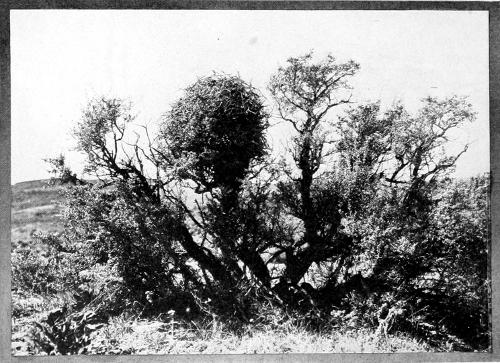
Taken in Yakima County. Photo by the Author. NEST OF MAGPIE IN GREASEWOOD.
[25]
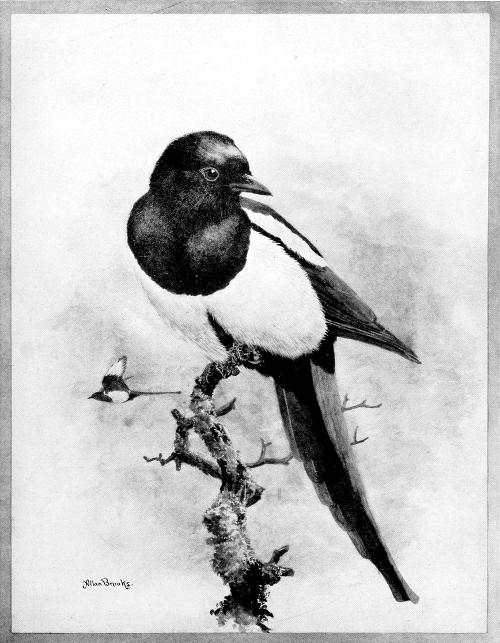
AMERICAN MAGPIE.
[26]
Beyond this it is indisputably true that Magpies are professional nest robbers. At times they organize systematic searching parties, and advance thru the sage-brush, poking, prying, spying, and devouring, with the ruthlessness and precision of a pestilence. Not only eggs but young birds are appropriated. I once saw a Magpie seize a half-grown Meadowlark from its nest, carry it to its own domicile, and parcel it out among its clamoring brood. Then, in spite of the best defense the agonized parents could institute, it calmly returned and selected another. Sticks and stones shied by the bird-man merely deferred the doom of the remaining larks. The Magpie was not likely to forget the whereabouts of such easy meat.
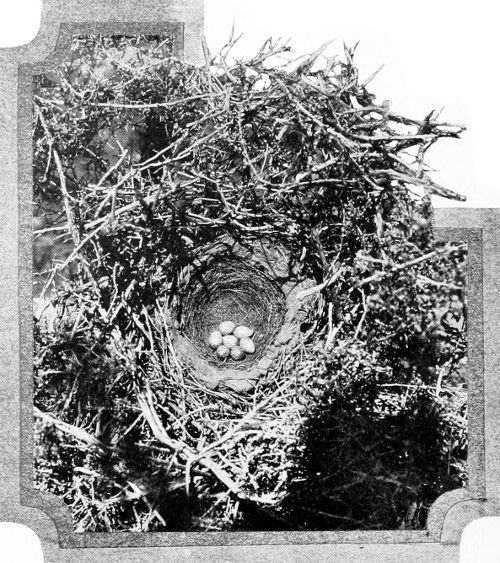
Taken in Yakima County. Photo by the Author. MAGPIE’S NEST FROM ABOVE. WITH CANOPY REMOVED. SAME NEST AS IN ILLUSTRATION ON PAGE 24.
Nor is such a connoisseur of eggs likely to overlook the opportunities afforded by a poultry yard. He becomes an adept at purloining eggs, and can make off with his booty with astonishing ease. One early morning, seeing a Magpie fly over the corral with something large and white in his bill, and believing that he had alighted not far beyond, I followed quickly and frightened him from a large hen’s egg, which bore externally the marks [27] of the bird’s bill, but which was unpierced. Of course the only remedy for such a habit is the shot-gun.
To say that Magpies are garrulous would be as trite as to say hens cackle, and the adjective could not be better defined than “talking like a Magpie.” The Magpie is the symbol of loquacity. The very type in which this is printed is small pica; that is small Magpie. Much of this bird’s conversation is undoubtedly unfit for print, but it has always the merit of vivacity. A party of Magpies will keep up a running commentary on current events, now facetious, now vehement, as they move about; while a comparative cessation of the racket means, as likely as not, that some favorite raconteur is holding forth, and that there will be an explosion of riotous laughter when his tale is done. The pie, like Nero, aspires to song; but no sycophant will be found to praise him, for he intersperses his more tuneful musings with chacks and barks and harsh interjections which betray a disordered taste. In modulation and quality, however, the notes sometimes verge upon the human; and it is well known that Magpies can be instructed until they acquire a handsome repertoire of speech.
In order that their double quartet of youngsters may be lined up for the egg harvest, the Magpies take an early start at home building. April is the nesting month, but I have two records for March 30th,—one of five eggs at Chelan, and one of eight in Yakima County. In the latter instance the first egg must have been deposited not later than March 18th. And because the season affords him no protection, the Magpie resorts to two expedients in nest building in lieu of concealment: he first seeks retirement, the depths of some lonesome swamp, an unfrequented draw, or wooded spring, in the foothills, and then he erects a castle which would do credit to a feudal baron. The nest is a ball of interlacing sticks set about a hollow half-sphere of dried mud. The amount of labor expended upon one of these structures is prodigious. The greasewood nest shown in the accompanying cut is three feet deep and two feet thru, and the component sticks are so firmly interwoven that no ordinary agency, short of the human hand, can effect an entrance. The bird enters thru an obscure passage in one side, and, if surprised upon the nest, has always a way of escape planned thru the opposite wall. The mud cup is carefully shaped with walls an inch or two in thickness, a total breadth of eight or ten inches, and a like depth. In the best construction this cavity is filled to a depth of three or four inches with a loose mat of fine twigs of a uniform size. Upon this in turn is placed a coiled mattress of fine, clean rootlets, the whole affording a very sanitary arrangement.
Another fortress, of single construction, was four feet deep and three and a half feet thru; and that, too, after making liberal allowance for chance projections. The component sticks measure up to three feet in length and [28] three-quarters of an inch in thickness. Nests are repaired and re-occupied year after year; or if they fall into hopeless decay, new structures are erected upon the ruins of the old. The tenement photographed on Homely Island is a double nest (it looks triple, but the upper third is merely the dome for the central portion, or nest proper), and measures seven feet from top to bottom. It contained seven eggs on April 24th, 1905, but altho the oölogist is very fond of little Magpies’ eggs, he left these as a tribute to Mr. and Mrs. Cheops.
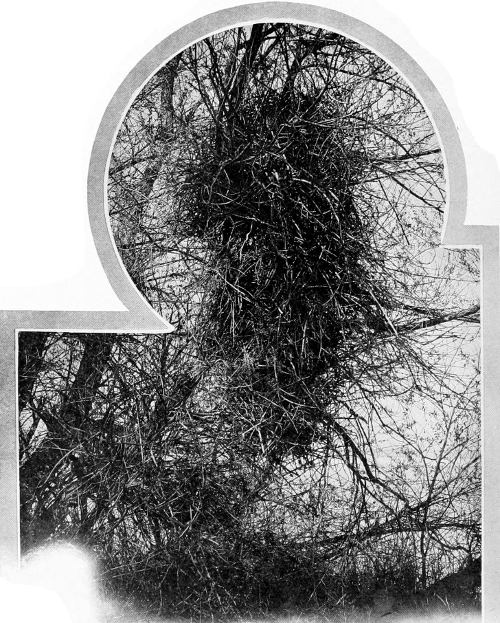
Taken in Benton County. Photo by the Author. MAGPIE’S NEST ON HOMELY ISLAND.
[29]
This historic pile is in marked contrast to one sighted in a willow on the banks of Crab Creek near Odessa. My attention was attracted to the spot by a scuffle, which took place between a Magpie and a pair of Kingbirds; and when I started to examine the nest, I was in honest doubt whether it might not belong to the Kingbirds. The foundation was of mud, but this came near constituting the outside of the nest instead of the inside. The action of the wind upon the willows had compressed the mud bowl to a boat-shaped receptacle wherein lay five brown beauties, unmistakable Magpies’ eggs. There was a copious lining of rootlets, and a light half-cover of thorn twigs; but the whole structure was not over a foot in diameter and scarcely that in depth.
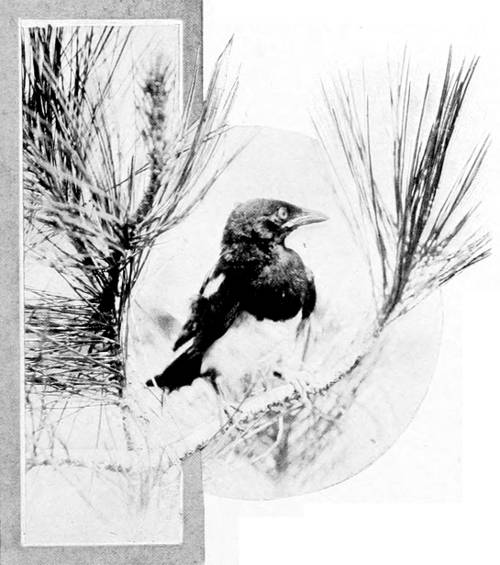
Taken near Spokane. Photo by Fred S. Merrill. YOUNG MAGPIE.
Magpies, like Blue Jays, are discreetly quiet in nesting time, and especially so if they have attempted to nest in the vicinity of a farmhouse. When driven to the hills by persecution they accept any shelter, and will nest in greasewood, sage-brush, or even on the ground. Arbors of clematis (clematis ligusticifolia) offer occasional concealment, but thornapples (Cratægus columbianum, etc.) afford the safest retreat. A Magpie snugly ensconced in a thornapple fortress may well bid defiance to any retributive agency short of man. Among several scores of nests I never saw one in a pine tree in the Yakima country, yet these are freely utilized in Chelan, Okanogan, and Spokane Counties. Indeed, in these latter localities there is a suspicion of dawning preference for the tree-tops and difficult climbs. On the Columbia River I once found a family of Magpies occupying the basement of a huge [30] Osprey’s nest, and had reason to believe that the thrifty pies made efficient, if unwelcome, janitors.
Young Magpies are unsightly when hatched,—“worse than naked,” and repulsive to a degree equaled only by young Cormorants. Hideous as they unquestionably are, the devoted parents declare them angels, and are ready to back their opinions with most raucous vociferations. With the possible exception of Herons, who are plebes anyhow, Magpies are the most abusive and profane of birds. When a nest of young birds is threatened, they not only express such reasonable anxiety as any parent might feel, but they denounce, upbraid, anathematize, and vilify the intruder, and decry his lineage from Adam down. They show the ingenuity of Orientals in inventing opprobrious epithets, and when these run dry, they fall to tearing at the leaves, the twigs, the branches, or even light on the ground and rip up the soil with their beaks, in the mad extremity of their rage.
A pair with whom I experimented near Wallula rather fell into the humor of the thing. The Magpie is ever a wag, and these must have known that repeated visits could mean no harm. Nevertheless, as often as I rattled the nest from my favorite perch on the willow tree, the old pies opened fresh vials of wrath and emptied their contents upon my devoted head. When mere utterance became inadequate, the male bird fell to hewing at the end of a broken branch in most eloquent indignation. He wore this down four inches in the course of my three visits. Once, when my attention was diverted, he took a sly crack at my outstretched fingers, which were hastily withdrawn; and, believe me, we both laughed.
The Black-billed Magpie winters practically thruout its breeding range, but it also indulges in irregular migratory movements, which in Washington take the form of excursions to the coast. While never common on Puget Sound, they are not unlikely to occur anywhere here in the fall of the year, and are almost certain to be found somewhere about the southern prairies. They return early in spring by way of the major passes, and are not again seen within the heavily timbered areas during the breeding season. Mr. D. E. Brown, then of Glacier, on the north fork of the Nooksack River, records under date of March 4, 1905, the appearance of several bands of Magpies passing eastward at a considerable height, perhaps something between three and five thousand feet. He says they were unrecognizable until glasses were trained on them, and he thinks he must have seen at least fifty birds, with chances for many more to have passed unobserved.
East or west the Magpie becomes a pensioner of the slaughter house in winter, and his fondness for meat has often proved his undoing in the cattle country. As a scavenger his services are not inconsiderable. The only trouble is, as has been said, that he sometimes kills his own meat.
Volumes could be written of the Magpie as a pet. He is a brainy chap [31] as well as a wag, and infinitely more interesting than a stupid parrot. Mischief is his special forte: the untying of shoe-strings, the investigation of cavities, the secreting of spoons, and the aimless abstraction of gold teeth are his unending delight. Once when the writer was shelling seed peas in the garden, a spoiled “Jackity” assayed to fill his (the man’s) ears with these innocent pellets; and when he discovered a rent in the knee of the man’s trousers, he fairly chortled, “Well; I see myself busy for a week filling that hole!”
Cage life is irksome for bird or beast; but, if we must be amused, and, above all, if we feel called upon to pass adverse judgment upon this gifted bundle of contradictions, as he exists in a state of nature, let our harshest sentence be sociable confinement with occasional freedom on parole. A bird in the cage is worth two in the obituary columns.
No. 8. CALIFORNIA JAY.
A. O. U. No. 481. Aphelocoma californica (Vigors).
Description.—Adults: In general blue, changing to brownish gray on back (scapulars and interscapulars), whitening variously on underparts; crown, hind neck and sides of neck dull cobalt blue, nearly uniform; wings, tail, and upper tail-coverts dull azure blue; cheeks and auriculars cobalt blue and dusky; chin, throat, and chest, centrally, white, the last-named with admixture of blue in streaks, and passing into the clear blue of its sides; breast sordid gray, passing into dull white of remaining underparts; shorter under tail-coverts pure white, the longer ones tinged with pale blue; bill and feet black; iris brown. In young birds the blue of adults is supplanted by mouse-gray on head and lower neck, rump, etc., save that crown is tinged with blue; the gray of back is of a deeper shade; the underparts are white, save for light brownish wash across breast and sides. Length of adult males 11.50-12.25; wing 5.00 (127); tail 5.60 (143); bill 1.00 (25.4); tarsus 1.60 (41). Females slightly smaller.
Recognition Marks.—Robin size; blue coloration without crest; whitish underparts.
Nesting.—Nest: a bed of small twigs without mud and heavily lined with fine dead grass; 8 inches across outside by 3½ in depth—thus much smaller and lighter than that of the Steller Jay—placed at moderate elevation in tree or bush in thicket near water. Eggs: 3-6, usually 4 or 5, deep green of varying shades, spotted with reddish browns. Av. size, 1.11 × .82 (28.2 × 20.8). Season: first week in May; one brood.
General Range.—Pacific Coast district of United States, including eastern slopes of the Sierra Nevada and the Cascade Range in Oregon, north to southwestern Washington.
[32]
Range in Washington.—Of limited but regular occurrence along the banks of the Columbia west of the Cascades. Resident.
Authorities.—[“California Jay,” Johnson Rep. Gov. W. T. 1884 (1885), 22]. [Belding, Land Birds Pac. Dist. (1890) p. 111] Aphelocoma californica, Lawrence, Auk, July, 1892, p. 301.
Specimens.—C.
Thru the western part of Oregon the breeding limits of the California Jay do not extend as far north as the Columbia River. I have never known of this species nesting about Portland, yet thirty miles south and southwest it is not at all uncommon. Thru the Willamette Valley, one meets this bird about as often as the Steller Jay. The habits of the two jays are much the same, yet the birds are easily distinguished by their dress, the California Jay having more resemblance to the Blue Jay of the East in color but lacking the crest, while the Steller Jay has a dark blue and blackish coat with the long crest.
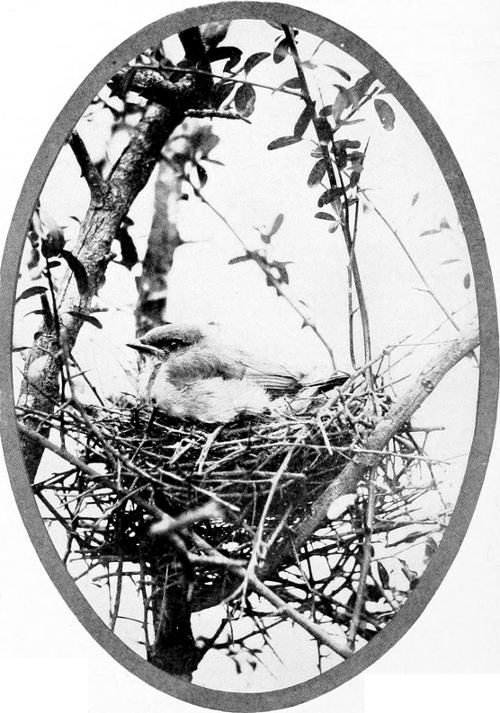
Taken in Oregon. Photo by Finley and Bohlman. YOUNG CALIFORNIA JAY.
According to popular opinion, the California Jay is a bird of bad reputation. Many people think he does nothing but go about wrecking the homes of [33] other birds and feasting on their eggs. This is not true, altho occasionally a Jay will destroy the home of another bird. In Oregon I have often seen this bird feeding on wheat about the edge of the fields after the grain has been cut. Fruit, grain, grasshoppers and other insects make up a large part of his food.
Several years ago I saw a small flock of California Jays along the Columbia River in the dead of winter. During the nesting season the jay is too quiet to show his real character. During the autumn and winter he throws off all restraint, picks up a few mates and goes wandering about from place to place in search of food. The bold and boisterous squawk of the Blue Jay always comes to my ear as a welcome and fitting note to relieve the cold quiet of the winter woods.
One day I was watching several English Sparrows that were feeding on the ground under an oak when a pair of California Jays came flying thru the trees. With a loud squawk one swooped down, with his wings and tail spread and his feathers puffed out as much as possible, evidently expecting to scare the sparrows. He dropped right in their midst with a screech which plainly said, “Get out of here or I’ll eat you up alive!” The bluff might have worked with any bird except an Englisher. The Sparrows sputtered in contempt and were ready to fight but the Jay’s attitude changed in a second. He took on an air of meekness and unconcern and hopped off looking industriously in the grass for something he had no idea of finding. I thought it a good touch of Jay character.
William L. Finley.
No. 9. STELLER’S JAY.
A. O. U. No. 478. Cyanocitta stelleri (Gmelin).
Synonyms.—“BLue Jay.” “Jaybird.”
Description.—Adults: Head and neck all around, and back, sooty black, touched with streaks of cerulean blue on forehead, and pale gray on chin and throat, this color passing insensibly into dull blue on breast and rump and richer blue on wings and tail; terminal portion of tail and wings crossed with fine black bars, sharply on secondaries and tertials, faintly or not at all on greater coverts. Bill and feet black; iris brown. Young birds are more extensively sooty, and wing-bars are faint or wanting. Length of adults about 12.00; wing 5.90 (150); tail 5.43 (138); bill 1.18 (30); tarsus 1.80 (46).
Recognition Marks.—Robin size; harsh notes; blue and black coloration unmistakable.
[34]
Nesting.—Nest: a bulky mass of fine twigs thickly plastered centrally with mud and lined with fine rootlets, placed 6-30 feet high in evergreen tree of thicket, or near edge of clearing. Eggs: 3-5, usually 4, pale bluish green, uniformly but moderately spotted with olive brown and pale rufous and with numerous “shell-markings” of lavender. Av. size, 1.23 × .90 (31.2 × 22.8). Season: April 20-May 10; one brood.
General Range.—North Pacific Coast district from Gray’s Harbor and Puget Sound north to Cook’s Inlet, except Prince of Wales Island and the Queen Charlotte group (where displaced by C. s. carlottæ).
Range in Washington.—Entire western portion from summit of Cascades, shading into C. s. carbonacea along north bank of the Columbia. Resident.
Authorities.—? Cyanura stelleri Swains., Orn. Com., Journ. Ac. Nat. Sci. Phila. VII. 1837, 193. Cyanocitta stelleri, Newberry, Rep. Pac. R. R. Surv. VI. pt. IV. 1857, p. 85. T. C&S. L¹: Rh. Ra. Kk. B. E.
Specimens.—U. of W. Prov. E. B. BN.
Mischief and the “Blue Jay” are synonymous. Alert, restless, saucy, inquisitive, and provoking, yet always interesting, this handsome brigand keeps his human critics in a perpetual see-saw between wrath and admiration. As a sprightly piece of Nature, the Steller Jay is an unqualified success. As the hero-subject of a guessing contest he is without a peer, for one never knows what he is doing until he has done it, and none may predict what he will do next.
The pioneers are especially bitter against him, and they are unanimous in accusing the bird of malicious destructiveness in the gardens, which are dearer than the apple of the eye during the first years of wilderness life. The birds will eat anything, and so, tiring of bugs and slugs, are not averse to trying corn, cabbage leaves, or, best of all, potatoes. They have observed the tedious operation of the gardener in planting, and know precisely where the coveted tubers lie. Bright and early the following morning they slip to the edge of the clearing, post one of their number as lookout, then silently deploy upon their ghoulish task. If they weary of potatoes, sprouting peas or corn will do. Or perhaps there may be something interesting at the base of this young tomato plant. And when the irate farmer appears upon the scene, the marauders retire to the forest shrieking with laughter at the discomfitted swain. Ay! there’s the rub! We may endure injury but not insult. Bang! Bang!
As a connoisseur of birds’ eggs, too, the Steller Jay enjoys a bad eminence. The sufferers in this case are chiefly the lesser song birds; but no eggs whatever are exempt from his covetous glance, if left unguarded. The Jay has become especially proficient in the discovery and sacking of Bush-tits’ nests. Mr. D. E. Brown assures me that he has found as high as fifteen nests of this bird in a single swamp, all gutted by Jays. When it is remembered that these busy little workers make one of the handsomest nests in the world, the shame of this piracy gets upon the nerves. The investigation of Tits’ nests has something of the fascination of the gaming table for the Jay, since [35] he never knows what the wonder pouches may contain, until he has ripped a hole in the side and inserted his piratical beak.
The dense forests of Puget Sound are not so well patrolled by these feathered grafters as are the forests of the East by the true Blue Jay (Cyanocitta cristata). But then our bird has the advantage of denser cover, and we do not know how often we have been scrutinized or shadowed. Upon discovery the Steller Jay sets up a great outcry and makes off thru the thickets shrieking lustily. A favorite method of retreat is to flit up into the lower branches of a fir tree and, keeping close to the trunk, to ascend the succeeding limbs as by a spiral staircase. The bird, indeed, takes a childish delight in this mad exercise, and no sooner does he quit one tree-top than he dashes down to a neighboring tree to run another frenzied gamut.
Owls have abundant cover in western Washington, but should one of them be startled by day, the Steller blue-coat is the first to note the villain’s flight. The alarm is sounded and an animated pursuit begins. When the Owl is brought to bay, the deafening objurgation of the Jays is not the least indignity which he is made to suffer. The Jay, in fact, seeks to make the world forget his own offenses by heaping obloquy upon this blinking sinner.
The notes of the Steller Jay are harsh and expletive to a degree. Shaack, shaack, shaack is a common (and most exasperating) form; or, by a little stretch of the imagination one may hear jay, jay, jay. A mellow klook, klook, klook sometimes varies the rasping imprecations and serves to remind one that the Jay is cousin to the Crow. Other and minor notes there are for the lesser and rarer emotions, and some of these not unmusical. Very rarely the bird attempts song, and succeeds in producing a medley which quite satisfies her that he could if he would.
C. stelleri, like C. cristata again, is something of a mimic. The notes of the Western Red-tail (Buteo borealis calurus) and other hawks are reproduced with especial fidelity. For such an effort the Jay conceals himself in the depths of a large-leafed maple or in a fir thicket, and his sole object appears to be that of terrorizing the neighboring song-birds. One such I heard holding forth from a shade tree on the Asylum grounds at Steilacoom. Uncanny sounds are, of course, not unknown here, but an exploratory pebble served to unmask the cheat, and drove forth a very much chastened Blue Jay before a company of applauding Juncoes.
It is well known that the gentleman burglar takes a conscientious pride in the safety and welfare of his own home. Nothing shall molest his dear ones. The Jay becomes secretive and silent as the time for nest-building approaches. The nest is well concealed in a dense thicket of fir saplings, or else set at various heights in the larger fir trees. If one but looks at it before the complement of eggs is laid the locality is deserted forthwith. If, however, the enterprise is irretrievably launched, the birds take care not to be seen in [36] the vicinity of their nest until they are certain of its discovery, in which case they call heaven and earth to witness that the man is a monster of iniquity, and that he is plotting against the innocent.
In our experience, Steller’s Jay is not, as has been sometimes reported, a bird of the mountains. To be sure, it may be found in the mountain valleys, but if so it is practically confined to them. The bird, is, however, ubiquitous thruout the lowlying countries of Puget Sound, Gray’s Harbor, and adjacent regions, giving way only upon the south to the dubious Grinnell Jay (S. s. carbonacea).
No. 10. GRINNELL’S JAY.
A. O. U. No. 478e. Cyanocitta stelleri carbonacea J. Grinnell.
Synonyms.—“Blue Jay.” Coast Jay (A. O. U.).
Description.—“Similar to C. s. stelleri, but paler thruout, and averaging slightly smaller; color of head very nearly as in C. s. stelleri, but averaging browner or more sooty, the forehead always conspicuously streaked with blue, and throat more extensively or uniformly pale grayish; back and foreneck much paler, slaty brown or brownish slate, instead of deep sooty; blue of rump, upper tail-coverts, and under parts of body light dull cerulean or verditer blue, advancing more over chest, where more abruptly defined against the sooty or brownish slate color of foreneck.” (Ridgway). Adult males: wing 6.10 (150.5); tail 5.51 (140); bill 1.15 (29.1); tarsus 1.75 (44.5).
General Range.—Pacific Coast district from Monterey county, California, north to Columbia River.
Range in Washington.—Has only theoretical status in State, but specimens taken along north banks of Columbia would appear to belong here.
Authorities.—? Corvus stelleri, Nuttall, Man. Orn. U. S. and Can. I. 1832, 229 (“Columbia River”). ? Orn. Com. Journ. Ac. Nat. Sci. Phila. VII. 1837, 193. C. s. frontalis, R. H. Lawrence, Auk XVII. Oct. 1892, p. 355 (Gray’s Harbor). C. s. carbonacea Grinnell, Ridgway, Birds of No. and Mid. Am. Vol. III. p. 354 (footnote). L. Kb.
Ornithology is the furthest refined of the systematic sciences. So zealous have been her devotees and so sagacious her high priests, that no shade of difference in size, form or hue of a bird is allowed to pass unnoticed, or its owner unnamed. It is unquestionably annoying to the novice to be confronted with such subtleties, and the recognition of subspecies in the vernacular names of our birds is of doubtful wisdom; but the fashion is set and we will all be foolish together—so that none may laugh.
The normal range of Grinnell’s Jay, as defined, extends northward to the [37] Columbia River; and since the district lying between the Columbia and Puget Sound presents intergrades between C. stelleri and C. s. carbonacea, obviously, those Jays which inhabit the southern portion of this debatable ground are better entitled to be called carbonacea than stelleri.
No. 11. BLACK-HEADED JAY.
A. O. U. No. 478c. Cyanocitta stelleri annectens (Baird).
Synonyms.—“Blue Jay.” Pine Jay. Mountain Jay.
Description.—Adults: Similar to C. stelleri, but marked with a small lengthened white spot over eye; streaks on forehead (when present) paler blue or whitish; streaks on chin and upper throat whiter and more distinct; blue areas slightly paler and rather more greenish in tone. Size indistinguishable.
Recognition Marks.—As in C. stelleri. White spot over eye distinctive.
Nesting.—As in C. stelleri.
General Range.—Eastern British Columbia and the northern Rocky Mountains, south to Wahsatch Range in Utah, west to eastern slopes of Cascade Range in Washington and Oregon.
Range in Washington.—Forests of eastern Washington, shading into typical stelleri in Cascade Range. Nearly confined to pine timber.
Authorities.—Cyanocitta stelleri annectens, Brewster, Bull. Nutt. Orn. Club, VII., 1882, 229. (C&S.) D¹. D². J.
There is no such difference of plumage between C. stelleri and C. s. annectens as is suggested by the name “Black-headed”; but in endeavoring to mark eight shades of difference between tweedledum and tweedledee within the limits of a single species, we are naturally pretty hard put to it for appropriate names. Annectens marks the annexion, or welding together, of two branching lines in the C. stelleri group. It is the head of the wish-bone, whose divergent arms run down the Sierras to Lower California and along the Rockies to Guatemala respectively.
With a hypothetical center of distribution somewhere in southeastern British Columbia, this subspecies inosculates with stelleri in the mountains of that province, and is roughly separated from the western stock by the central ridge of the Cascades, in Washington.
Black-headed Jays in Washington are normally confined to the limits of coniferous timber, being therefore most abundant in the northern portion, in the Blue Mountains, and along the eastern slopes of the Cascades. We have, however, like Bendire, discovered them on occasion skulking in the [38] willows along creek bottoms some twenty miles from pine timber. On the other hand, they do not assert, with the Gray Jays and Clark Crows, the right to range the mountain heights: but are quite content to maintain their unholy inquisition amidst the groves and thickets of the valley floors.
They are, perhaps, not so noisy as the Steller Jays, being less confident of their cover; and their notes are rather more musical (breath of pines is better than fog for the voice); but for the rest they are the same vivacious, intrepid, resourceful mischief-makers as their kin-folk everywhere.
No. 12. WHITE-HEADED JAY.
A. O. U. No. 484a. Perisoreus canadensis capitalis Ridgw.
Synonyms.—Rocky Mountain Jay. “Canada” Jay. Whiskey Jack. Wisskachon. Camp Robber. Moose-bird. Meat Hawk. Meat-bird.
Description.—Adults: General color plumbeous ash lightening below; whole head white save space about and behind eye connected with broad nuchal patch of slaty gray; wings and tail blackish overlaid with silver gray; tail tipped with white and wings more or less edged with the same. Bill and feet black; iris brown. Young birds much darker and more uniform in coloration than adults—slaty gray to sooty slate with lighter crown and some whitish edging on underparts. Length 12.00-13.00; wing 6.00 (152); tail 5.75 (145); bill .82 (21); tarsus 1.38 (35).
Recognition Marks.—Robin size; slaty gray coloration. White of head with its abruptly defined patch of slate on hind neck distinctive as compared with related species of the genus Perisoreus.
Nesting.—Has not been reported for Washington but bird undoubtedly breeds in the Kalispell range. Nest: in coniferous tree, a large compacted mass of the softest and warmest substances,—twigs for a foundation, then grasses, abundant moss, plant-down and feathers. Eggs: 3-5, usually 4, grayish white, spotted and blotched with brown having a tinge of purplish. Av. size 1.15 × .85 (29.2 × 21.6). Season: Feb.-April; one brood.
General Range.—Higher ranges of the Rocky Mountain district from British Columbia to Arizona.
Range in Washington.—Mountains of northeastern corner of State and (probably) the Blue Mountains.
Authorities.—[“White-headed Jay,” Johnson, Rep. Gov. W. T., 1884 (1885) 22.] Ridgway, Birds of North and Middle America, Vol. III. p. 371, (“Sinzoknoteen Depot, etc.”).
The casual observer, camping first on Calispell Peak in Stevens County, and later on Mt. Stuart, in southern Chelan County, might fail to note any [39] difference in the soberly-dressed Jays, who are the self-appointed overseers of camp economics. For while the birds of the two localities really represent two species, the resemblance in general appearance and behavior is so close as to be virtually negligible afield.
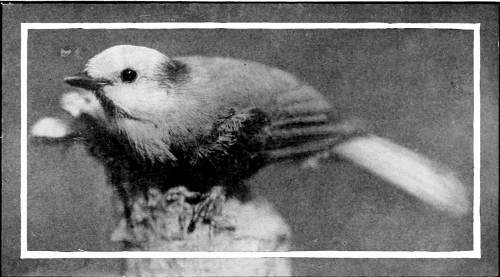
Taken near Spokane. Photo by W. H. Wright. WHITE-HEADED JAY.
Of this bird in Colorado, Mr. Frank M. Drew has observed[6]: “In autumn when on his first tour of inspection around the house he hops along in a curious sidelong manner, just like a school-girl in a slow hurry. White-headed, grave, and sedate, he seems a very paragon of propriety, and if you appear to be a suitable personage, he will be apt to give you a bit of advice. Becoming confidential he sputters out a lot of nonsense in a manner which causes you to think him a veritable ‘Whisky Jack’; yet, whenever he is disposed, a more bland, mind-his-own-business-appearing bird will be hard to find, as will also be many small articles around camp after one of his visits, for his whimsical brain has a great fancy for anything which may be valuable to you, but perfectly useless to him.”
[40]
No. 13. OREGON JAY.
A. O. U. No. 485. Perisoreus obscurus (Ridgway).
Synonyms.—Camp Robber. Meat Bird. Deer Hunter.
Description.—Adults: In general upperparts deep brownish gray; underparts white tinged with brownish; forehead and nasal plumules most nearly clear white; chin, throat, cheeks, auriculars, and obscure band around neck white more or less tinged with brownish; crown and nape sooty brown, nearly black; feathers of back with white shafts more or less exposed; wings and tail drab gray, the former with whitish edging on middle and greater coverts and tertials. Bill and feet black; iris brown. Young birds are nearly uniform sooty brown lightening below. Length 10.00-11.00; wing 5.30 (135); tail 5.00 (127); bill .71 (18); tarsus 1.30 (33).
Recognition Marks.—Robin size; brownish gray coloration, familiar, fearless ways. Not certainly distinguishable afield from the next form.
Nesting.—Nest: a bulky compacted structure of twigs, plant-fibers and tree-moss with warm lining of fine mosses and feathers, placed well up in fir tree. Eggs: 4 or 5, light gray or pale greenish gray spotted with grayish brown and dull lavender. Av. size 1.04 × .79 (26.4 × .20). Season: Feb.-April; one brood.
General Range.—Pacific Coast district from Humboldt county, California, north to Vancouver Island. Imperfectly made out as regards following form.
Range in Washington.—Probably the Olympic Mountains and irregularly thru the heavier forests of southwestern Washington.
Authorities.—P. canadensis Bonap., Baird, Rep. Pac. R. R. Surv. IX. pt. II. 1858, 591 part. Ridgway, Bull. Essex Inst. V. Nov. 1873, 194. (T) C&S. L¹. Rh. Ra. B. E(?).
Specimens.—U. of W. Prov. E. C.
The relative distribution of the Oregon Jay and the more recently distinguished Gray Jay is still very imperfectly understood. It would appear probable that this form is the bird of the rainy district, including all lowlands of western Washington, the Olympic Mountains, and the western slopes of the Cascades, and that it gives place to P. o. griseus not only upon the heights and eastern slopes of the Cascades, but in the deep valleys which penetrate these mountains from the west.
Certainly it is the Oregon Jay which abounds in the Olympic Mountains, and among the dense spruce forests of the adjoining coasts. While the bird is more abundant on the lowlands in winter, the prevalent opinion that the Oregon Jay is exclusively a bird of the mountains is probably incorrect. Altho bold enough where undisturbed, the birds soon learn caution; and their nests have [41] been found near Renton where their presence during the breeding season would otherwise have gone unsuspected. The depths of the forest have no terrors for this quiet ghost, and there are other reasons besides color why he remains the obscure one.
No. 14. GRAY JAY.
A. O. U. No. 485a. Perisoreus obscurus griseus Ridgw.
Synonyms.—Camp Robber, etc.
Description.—“Similar to P. o. obscurus, but decidedly larger (except feet), and coloration much grayer; back, etc., deep mouse gray, instead of brown, remiges and tail between gray (No. 6) and smoke gray, instead of drab gray, and under parts grayish white instead of brownish white.” (Ridgway). Length (Av. of three Glacier specimens) 11.16 (283.5); wing 5.82 (147.6); tail 5.48 (139.1); bill .75 (19); tarsus 1.25 (31.7).
General Range.—Central mountain ranges of central California, Oregon, Washington, and British Columbia.
Range in Washington.—Thruout the Cascade Mountains and irregularly along their lower slopes west (?) to tidewater.
Authorities.—? P. canadensis Bonap., Baird, Rep. Pac. R. R. Surv., Vol. IX, pt. II, 1858, p. 591 (Cascade Mts. W. T.). Ridgway, Auk, Vol. XVI., July, 1899, 225. Kk. ?
The “Camp-Robber” appears promptly as interested neighbor and smell-feast before all who invade the precincts of the mountains. The hunter, the trapper, the prospector, the timber cruiser, the mere camper-out, all know him, and they speak well or ill of him according to their kind. The Gray Jay appears to have forsworn the craftiness of his race, and he wins by an exhibition of artless simplicity, rather than by wiles. The bird is mildly curious and hungry—oh, very hungry—but this is Arcadia, and the shepherds draw nigh with never a doubt of their welcome. There is a childlike insouciance about the way in which the bird annexes a piece of frizzled bacon, humbly intended for the man. “’Shoo,’ did you say? Why, what do you mean? Can’t I have it?” And the bird retires before a flying chip, baffled and injured by such a manifest token of ill-breeding. He complains mildly to his fellows. They discuss the question in gentle whews; generously conclude you didn’t mean it, and return unabashed to the quest.
Hunger is the chief characteristic of these docile birds, and no potential food is refused, nuts, acorns, insects, berries, or even, as a last resort, the buds of trees. Meat of any sort has an especial attraction to them; and they are the despair of the trapper because of their propensity for stealing bait. [42] The hunter knows them for arch sycophants, and he is occasionally able to trace a wounded deer, or to locate a carcass by the movements of these expectant heirs. Says Mr. A. W. Anthony[7]: “While dressing deer in the thick timber I have been almost covered with Jays flying down from the neighboring trees. They would settle on my back, head, or shoulders, tugging and pulling at each loose shred of my coat until one would think that their only object was to help me in all ways possible.”
In the higher latitudes “Whisky Jack,” in spite of carefully secreted stores, often becomes very emaciated in winter, a mere bunch of bones and feathers, no heavier than a Redpoll. While the jays of our kindlier clime do not feel so keenly the belly pinch of winter, they have the same thrifty habits as their northern kinfolk. Food is never refused, and a well-stuffed specimen will still carry grub from camp and secrete it in bark-crevice or hollow, against the unknown hour of need.
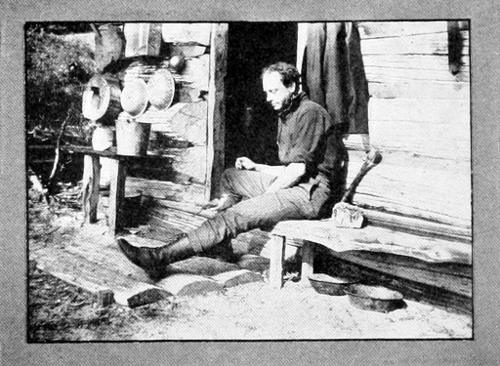
Taken in Rainier National Park. Photo by J. H. Bowles. A BACHELOR’S PET.
I have never heard the Gray Jay titter more than a soft cooing whee ew repeated at random; but Bendire credits it with a near approach to song[8]; and Mrs. Bailey says of the Jays on Mt. Hood[9]: “Their notes were pleasantly varied. One call was remarkably like the chirp of a robin. Another of the commonest was a weak and rather complaining cry repeated several times. A sharply contrasting one was a pure clear whistle of one note followed by a three-syllabled call something like Ka-wé-ah. The regular rallying cry was still different, a loud and striking two-syllabled ka-whee.”
The eggs of the Gray Jay have not yet been reported from this State, but it is known that the bird builds a very substantial nest of twigs, grasses, plant fibre, and mosses without mud, and that it provides a heavy lining of [43] soft gray mosses for the eggs. The nest is usually well concealed in a fir tree, and may be placed at any height from ten or fifteen feet upward, altho usually at sixty or eighty feet. Only one brood is reared in a season, and family groups hunt together until late in the summer.
Icteridæ—The Troupials
No. 15. COWBIRD.
A. O. U. No. 495. Molothrus ater (Bodd.).
Synonyms.—Cow Blackbird. Cuckold.
Description.—Adult male: Head and neck wood-, seal-, or coffee-brown (variable); remaining plumage black with metallic greenish or bluish iridescence. Female: Dark grayish brown, showing slight greenish reflections, darkest on wings and tail, lightening on breast and throat. Young in first plumage: Like female but lighter below and more or less streaky; above somewhat mottled by buffy edgings of feathers. The young males present a striking appearance when they are assuming the adult black, on the installment plan, by chunks and blotches. Length 7.50-8.00 (190.5-203.2); wing 4.40 (111.8); tail 3.00-3.40 (76.2-86.4); bill .65 (16.5); tarsus .95-1.10 (24.1-27.9). Female, length, wing, and tail one-half inch less.
Recognition Marks.—Chewink size; brown head and black body of male; brown of female.
Nesting.—The Cowbird invariably deposits her eggs in the nests of other birds. Eggs: 1 or 2, rarely 3 or 4, with a single hostess, white, often faintly tinged with bluish or greenish, evenly speckled with cinnamon, brown or umber. Av. size, .85 × .65 (21.6 × 16.5), but quite variable. Season: April-June.
General Range.—United States from the Atlantic to the Pacific, north into southern British America, south in winter, into Mexico.
Range in Washington.—Of limited but regular occurrence east of the Cascades, increasing; rare or casual in western Washington. Summer resident.
Authorities.—Bendire, Life Histories of N. A. Birds, Vol. II., p. 434. D¹. D². Ss². J. B. E.
Specimens.—C. P.
While I was chatting with my host at milking time (at the head of Lake Chelan in the ante-tourist days), a dun-colored bird with light underparts flew down into the corral, and began foraging as tho to the manor born. One by one the cows sniffed at the stranger and nosed it about, following it up curiously. But the bird only side-stepped or walked unconcernedly ahead. When I returned with the gun, a moment later, I found a calf investigating the newcomer, and it was difficult to separate the creature from bossikin’s nose. The date was August 3rd; the bird proved to be a young male [44] Cowbird in the lightest juvenile phase of plumage, a waif cuckold far from any of his kin, but shifting for himself with the nonchalance which characterizes his worthless kind.
If our hero had lived (and I make no apology for his demise in the first act), he would have exchanged his inconspicuous livery for the rich, iridescent black of the adult; and he would have done this on the installment plan, by chunks and blotches, looking the while like a ragpicker, tricked out in cast-off finery.
In the month of March Cowbirds mingle more or less with other blackbirds in the migrations, but if the main flock halts for refreshments and discussion en route, a group of these rowdies will hunt up some disreputable female of their own kind, and make tipsy and insulting advances to her along some horizontal limb or fence rail. Taking a position about a foot away from the coy drab, the male will make two or three accelerating hops toward her, then stop suddenly, allowing the impulse of motion to tilt him violently forward and throw his tail up perpendicularly, while at the same moment he spews out the disgusting notes which voice his passion.
Of the mating, Chapman says: “They build no nest, and the females, lacking every moral instinct, leave their companions only long enough to deposit their eggs in the nests of other and smaller birds. I can imagine no sight more strongly suggestive of a thoroly despicable nature than a female Cowbird sneaking thru the trees and bushes in search of a victim upon whom to shift the duties of motherhood.”
The egg, thus surreptitiously placed in another bird’s nest, usually hatches two or three days before those of the foster mother, and the infant Cowbird thus gains an advantage which he is not slow to improve. His loud clamoring for food often drives the old birds to abandon the task of incubation; or if the other eggs are allowed to remain until hatched, the uncouth stranger manages to usurp attention and food supplies, and not infrequently to override or stifle the other occupants of the nest, so that their dead bodies are by-and-by removed to make room for his hogship. It is asserted by some that in the absence of the foster parents the young thug forcibly ejects the rightful heirs from the nest, after the fashion of the Old World Cuckoos. I once found a nest which contained only a lusty Cowbird, while three proper fledgelings clung to the shrubbery below, and one lay dead upon the ground.
When the misplaced tenderness of foster parents has done its utmost for the young upstart, he joins himself to some precious crew of his own blood, and the cycle of a changeling is complete.
While not common anywhere west of the Rockies, the Cowbird is no longer rare east of the Cascades, and it is making its appearance at various points on Puget Sound. The earlier writers make no mention of its occurrence [45] in Washington, and it seems probable that its presence has followed tardily upon the introduction of cattle. Bendire was the first to report it from this State, having taken an egg near Palouse Falls on June 18, 1878, from a nest of the Slate-colored Sparrow (Passerella iliaca schistacea).
Its presence among us is, doubtless, often overlooked because of the superficial resemblance which it bears in note and appearance to Brewer’s Blackbird (Euphagus cyanocephalus). The note of the former is distinctive,—a shrill, hissing squeak in two tones with an interval of a descending third, uttered with great effort and apparent nausea—honestly, a disgusting sound.
No. 16. BREWER’S BLACKBIRD.
A. O. U. No. 510. Euphagus cyanocephalus (Wagler).
Description.—Adult male: Glossy black with steel blue and violet reflections on head, with fainter greenish or bronzy reflections elsewhere; bill and feet black; iris pale lemon yellow or light cream. Adult female: Head and neck all around deep brownish gray with violet reflections; underparts brownish slate to blackish with faint greenish iridescence; upperparts blackish, or outright black on wings and tail, which are glossed with bluish-green; bill and feet as in male, but iris brown. Immature males in first winter plumage resemble adults but have some edging of pale grayish brown. Length of adult males: 10.00 (254); wing 5.00 (128); tail 3.90 (99); bill .89 (22.6); tarsus 1.27 (32.3). Adult female: length 9.25 (235); wing 4.60 (117); tail 3.50 (89); bill .79 (20); tarsus 1.20 (30.5).
Recognition Marks.—Robin size; pure black coloration and whitish eye of male. Larger than Cowbird (Molothrus ater) with which alone it is likely to be confused.
Nesting.—Nest: placed at moderate height in bush clump or thicket, less frequently on ground at base of bush, more rarely in cranny of cliff or cavity of decayed tree-trunk, a sturdy, tidy structure of interlaced grasses, strengthened by a matrix of mud or dried cow-dung and carefully lined with coiled rootlets or horsehair. Nests in straggling colonies. Eggs: 4-7, usually 5 or 6, presenting two divergent types of coloration with endless variations and intermediate phases. Light type: ground color light gray or greenish gray, spotted and blotched with brown of varying shades, walnut, russet, and sepia. (In some examples there is purplish brown scrawling, which suggests the Redwing type. One egg in the writer’s collection is indistinguishable from that of a Cowbird, save for size.) Dark type: ground color completely obscured by overlay of fine brown dots resulting in nearly uniform shade of mummy brown or Vandyke brown. Av. size 1.03 × .72 (26.2 × 18.3). Season: April 20-May 10; one or two broods.