Volume 1 — The Birds of Washington (continued 8)
Reading edition
Nuthatches are not methodical, like Creepers, in their search for insects,—they are haphazard and happy. The branches are more attractive to them than the tree bole, and the dead top of the tree is most alluring of all. The Pygmies are never too busy to talk. The more they find the more excited their chatter grows, pretty lispings and chirpings quite too dainty for our dull ears. It makes us sigh to watch their happiness, and we go off muttering, “We, too, were young.”
Again, it shocks us when we find these youngsters in knickerbockers [295] and braids paired off for nesting time. Tut, tut! children, so eager to taste life’s heavier joys? A nest is chiselled out with infinite labor on the part of these tiny beaks, in the dead portion of some pine tree. The cavity is from four to twelve inches in depth, with an entrance a trifle over an inch in diameter. The owners share the taste of the Chickadees, and prepare an elaborate layette of soft vegetable fibers, fur, hair, and feathers, in which the eggs are sometimes quite smothered.
The parents are as proud as peacocks, and well they may be, of their six or eight oval treasures, crystal white, with rufous frecklings, lavish or scant. When the babies are hatched, the mother goes in and out fearlessly under your very nose; and you feel such an interest in the little family that you pluck instinctively—but alas! with what futility—at the fastenings of your purse.
Certhiidæ—The Creepers
No. 114. SIERRA CREEPER.
A. O. U. No. 726 d. Certhia familiaris zelotes Osgood.
Synonym.—California Creeper (Ridgway).
Description.—Adults: Above rusty brown, broadly and loosely streaked with ashy white; more finely and narrowly streaked on crown; rump bright russet; wing-quills crossed by two whitish bars, one on both webs near base, the other on outer webs alone; greater coverts, secondaries and tertials tipped with whitish or grayish buff; a narrow superciliary stripe dull whitish or brownish gray; underparts sordid white or pale buffy, tinged on sides and flanks with stronger buffy. Bill slender, decurved, brownish black above paler below; feet and legs brown; iris dark brown. Length of adult male about 5.50 (139.7); wing 2.50 (63.5); tail 2.39 (60.8); bill .63 (16); tarsus .59 (15). Female a little smaller.
Recognition Marks.—Warbler size; singularly variegated in modest colors above; the only brown creeper in its range. Lighter colored than the next.
Nesting.—Nest: of twigs, bark-strips, moss, plant-down, etc., crowded behind a warping scale of bark whether of cedar, pine or fir. Eggs: usually 5 or 6, sometimes 7 or 8, white or creamy white speckled and spotted with cinnamon brown or hazel, chiefly in wreath about larger end. Av. Size .61 × .47 (15.5 × 11.9).
General Range.—The Cascade-Sierra mountain system from Mt. Whitney north to central British Columbia, east to Idaho; displaced by succeeding form on Pacific Coast slope save from Marin County, California, southward.
Range in Washington.—Resident in the Cascade Mountains, east in coniferous timber to Idaho where intergrading with C. f. montana.
Authorities.—? Certhia familiaris montana Johnson (Roswell H.), Condor, Vol. VIII., Jan. 1906, p. 27.
Specimens.—U. of W. B.
[296]
People are always remonstrating with the bird-man for the assertion that birds are to be found everywhere if you but know them. Especially do they talk of the great silent forests on the western slopes of the Cascade Mountains, where they have traveled for forty miles at a stretch without seeing or hearing a living thing. Well; you cannot show me a square mile of woodland in all that area where at least the following species of birds may not be found: Western Winter Wren, Western Golden-crowned Kinglet, Western Flycatcher, Varied Thrush and California Creeper[46]; and these, except the Flycatcher, at any season of the year. Silent birds they are for the most part, but each gives vent to a characteristic cry by which it may be known.
The Creeper is, par excellence, the bird of the forest. To him alone the very bigness of the trees is of the greatest service; for his specialty is bark, and the more bark there is the harder is this little atom to distinguish. Not only does he inhabit the deeper forests of the Cascade ranges and foothills, but his domain stretches eastward across the northern tier of pine-clad counties, and he is common among the tamaracks on the banks of the Pend d’Oreille.
In June, in the Stehekin Valley of Chelan County, we found these Creepers leading about troops of fully grown young. A recently occupied nest was disclosed to us by a few twigs sticking out from behind a curled-up bark scale of a fire-killed tree, near the Cascade trail. The twigs proved to be eighteen inches below the top of the nest proper, which was thus about twelve feet from the ground. The intervening space was filled in loosely with twigs, bark-strips, moss, cotton, and every other sort of woodsy loot. The mass was topped by a crescent-shaped cushion over an inch in thickness, deeply hollowed in the center, six inches from horn to horn, and four and a half from bole to bark; and this cushion was composed entirely of soft inner bark-strips and a vegetable fiber resembling flax in quality—altogether a splendid creation.
No. 115. TAWNY CREEPER.
A. O. U. No. 726 c. Certhia familiaris occidentalis Ridgway.
Synonym.—Californian Creeper (A. O. U.).
Description.—“Similar to C. f. zelotes but browner and more suffused with buffy above; wing markings more pronouncedly buff; underparts more buffy” [297] (Ridgway). Length of male: wing 2.44 (61.9); tail 2.41 (61.2); bill .60 (15.2); tarsus .61 (15.5).
Recognition Marks.—As in preceding; darker.
Nesting.—Nest: as in preceding; placed behind sprung bark scale usually at moderate heights, 3-20 feet up (one record of 60). Inner diameter of one nest 1¾ inches, depth 2½. Eggs: 5 or 6, as in C. f. zelotes. Av. size .58 × .47 (14.7 × 11.9). Season: May, June; two broods.
General Range.—Pacific Coast district from Northern California to Sitka.
Range in Washington.—Resident thruout the West-side from tidewater up.
Authorities.—? Certhia familiaris Orn. Com. Journ. Ac. Nat. Sci. Phila., VII. 1837, 193 (Columbia River). Certhia americana Baird, Rep. Pac. R. R. Surv., IX. 1858, p. 372, part. (T). C&S. L¹. Rh. Ra. B. E.
Specimens.—U. of W. Prov. BN.
To one who loves birds with an all inclusive passion—such as the undecided bachelor is wont to confess for the fair sex—the temptation to use superlatives upon each successive species as it is brought under review is very strong. But here perhaps we may be pardoned for relaxing our attention, or, it may be, for being caught in the act of stifling a little yawn. Certhia is a prosy drab, and all the beauty she possesses is in the eyes of her little hubby—dear, devoted creature.
This clerkling (hubby, of course, I mean) was brought into the world behind a bit of bark. His first steps, or creeps, were taken along the bark of the home tree. When the little wings got stronger and when the little claws had carried him up to the top of tree number One, he fluttered and spilled thru the air until he pulled up somehow, with heart beating fiercely, at the base and on the bark of tree number Two. Since then he has climbed an almost infinity of trees (but I dare say he has kept count). Summers and winters have gone over his head, but never a waking hour in which he has not climbed and tumbled in this worse than Sysiphæan task of gleaning nits and eggs and grubs from the never-ending bark. Why, it gets upon the nerves! I pray you think, has not this animate brown spot traveled more relative miles of ridgy brown bark in his wee lifetime than ever mariner on billowy sea! Work, work, work! With the industry of an Oriental he seeks to shame the rollicking caprice of Chickadee, and to be a “living example” to such spendthrifts as Goldikins, the Kinglet.
But wait! I am not sure. Could anyone live in these majestic forests, could anyone breathe this incense of perpetual balsam, could anyone mount triumphantly these aspiring tree-boles, way, way up into the blue, without growing the soul of a poet? Hark! “Tew, tewy, tewy, Piñg, tewy,”—an [298] angel ditty lisped in the tree-tops where the tender green fir fronds melt into the sky—some Warbler, I guess; the Hermit, perhaps, rounding out his unsaid devotions. And again, “kee kus wit it tee swee” like a garland of song caught up at either end and made fast to the ether. No! Would you believe it! It is our prosy clerkling! He has turned fay, and goes carolling about his task as blithely as a bejewelled artiste with nothing to do. Love? Yes; love of the woods, for it is the middle of September.
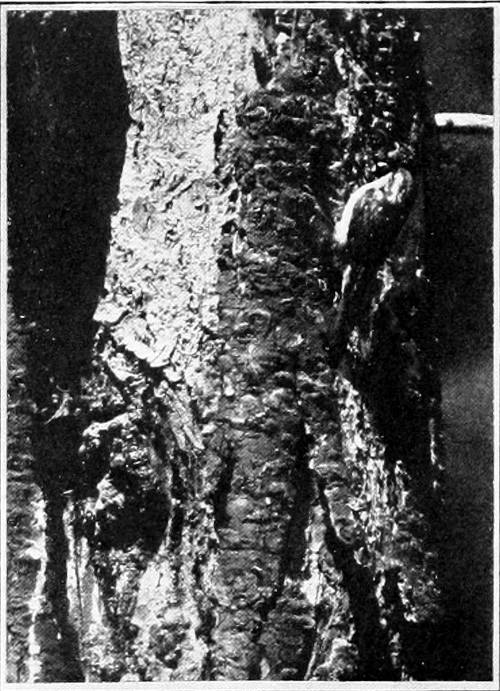
Taken near Tacoma. Photo by Bowles and Dawson. TAWNY CREEPER APPROACHING NEST. THE MOTHER’S BEAK IS LADEN WITH GOOD THINGS.
All of which leads me to apologize for the rude epithets previously used; for one who can sing belongs to the immortals; and never again will we judge a brother harshly, for who knows the vaulting heart of the seeming plodder!
The ordinary, working note of the Tawny Creeper is a faint tsip, and this is varied from time to time by a longer double note, tsue tsee (of a resonant quality which cannot be made to appear in the transcript). This latter it is which one can never quite certainly distinguish from that of the Western Golden-crowned Kinglet. The full song is, indeed, very sweet and dainty, with a bit of a plaintive quality, which serves to distinguish it from the utterances of the Wood Warblers, once you are accustomed.
A knowledge of the Creeper’s nesting habits would be quite unattainable were the bird to choose the tree-tops; but with characteristic humility it seeks the lower levels at the nesting season, so that one need not look much above his head in searching for its nest.
The first one found was at the edge of the forest overlooking a woodland road near Tacoma. We came upon a pair of the birds gleaning from the neighboring trees and calling encouragement to each other as they proceeded. We were not long in divining their local attachments; and finally, after several feints, the mother bird flew to an isolated tree at the very edge of the woods, where investigation disclosed a piece of bark warped and sprung by fire, behind which six callow babies rested on a soft cushion of moss, hair and bark-fiber, supported by twigs criss-crossed and interwoven, to take up all available space below.
[299]
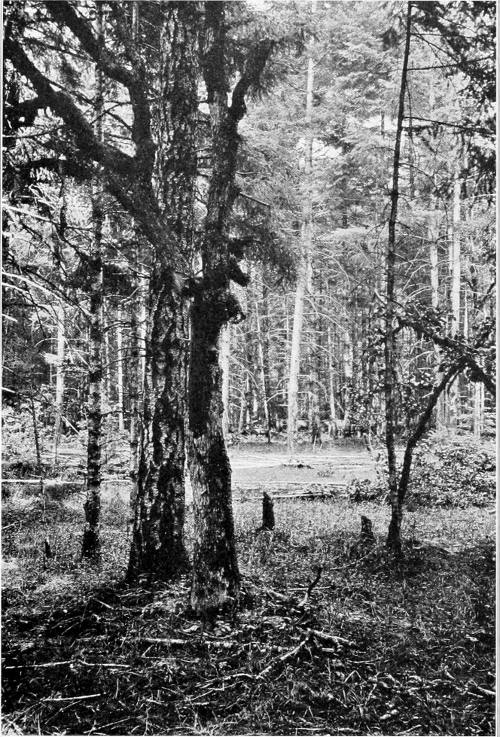
Taken near Tacoma. Photo by W. Leon Dawson. NESTING SITE OF THE TAWNY CREEPER.
[300]
This looked easy; but the most diligent search the following season served only to discover the records of past years and hopeful prospects. Bark scales of just the right dimensions do not abound, and those which do look good prove to be either too infirm or else to have received the scant compliment of a few criss-crossed sticks which mean, “We would have built here, if we had not liked some other place better.”
Not until May 5th, 1907, did Mr. Bowles discover the first eggs, five speckled beauties.
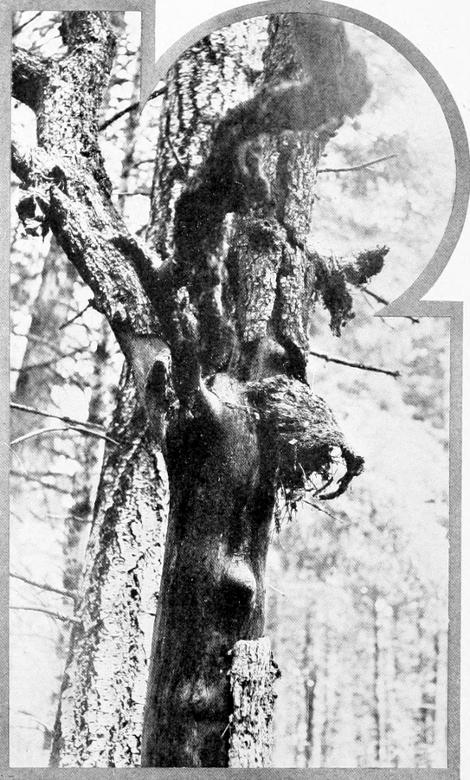
Taken near Tacoma. Photo by W. Leon Dawson. NEST OF TAWNY CREEPER IN DEAD OAK TREE. DETAIL OF PRECEDING ILLUSTRATION. THE NEST APPEARS UNDER THE BARK SCALE ON THE RIGHT, AND THE WONDER IS HOW IT MAINTAINS ITS POSITION.
[301]
Troglodytidæ—The Wrens
No. 116. WESTERN MARSH WREN.
A. O. U. No. 725 c. Telmatodytes palustris plesius (Oberholser).
Synonym.—Interior Marsh Wren.
Description.—Adult: Crown blackish; forehead light brown centrally,—color sometimes spreading superficially over entire crown; hind neck and scapulars light brown (raw umber, nearly); rump warm russet; a triangular patch on back blackish, with prominent white stripes and some admixture of russet; wings and tail fuscous or blackish on inner webs, brown with black bars on exposed surfaces; upper and under tail-coverts usually and more or less distinctly barred with dusky; sides of head whitish before, plain brown or punctate behind; a white superciliary line; underparts white, tinged with ochraceous buff across breast, and with pale brown or isabella color on sides, flanks, and crissum; bill and feet as usual. Length 4.50-5.75 (114.3-146); av. of ten males: wing 2.12 (54); tail 1.82 (46.4); bill .56 (14.2); tarsus .79 (20.1).
Recognition Marks.—Warbler size; brown and black pattern of back with white stripes distinctive; white superciliary stripe and long bill distinctive in haunts. Strictly confined to bulrushes and long grass of marshes. Lighter and larger than T. p. paludicola.
Nesting.—Nest: a ball of reeds and grasses, chinked and lined with cat-tail down, with entrance in side, and suspended in growing cat-tails, bulrushes or bushes. Eggs: 5-7, so heavily speckled with olive brown or sepia as to appear almost uniform brown. Av. size, .65 × .52 (16.5 × 13.2). Season: May, July; two broods.
General Range.—Western United States and southern British Columbia between the Rocky Mountains and the Cascade-Sierra Range, breeding from New Mexico northward; south during migrations to Cape district of Lower California and Western Mexico.
Range in Washington.—Summer resident in all suitable localities east of the Cascades.
Authorities.—Telmatodytes palustris paludicola Brewster, B. N. O. C. VII 1882, 227 (Ft. Walla Walla). D². Ss¹. J.
Specimens.—C. P.
“To the Coots and Rails belong the ooze-infesting morsels of the swamp, but all the little crawling things which venture into the upper story of the waving cat-tail forest, belong to the Long-billed Marsh Wren. Somewhat less cautious than the waterfowl, he is the presiding genius of flowing acres, which often have no other interest for the ornithologist. There are only two occasions when the Marsh Wren voluntarily leaves the shelter of the cat-tails or of the closely related marshables. One of these is when he is driven South by the migrating instinct. Then he may be seen skulking about the borders of the streams, sheltering in the weeds or clambering about the drift. The other [302] time is in the spring, when the male shoots up into the air a few feet above the reeds, like a ball from a Roman candle, and sputters all the way, only to drop back, extinguished, into the reeds again. This is a part of the tactics of his courting season, when, if ever, a body may be allowed a little liberty. For the rest, he clings sidewise to the cat-tail stems or sprawls in midair, reaching, rather than flying from one stem to another. His tail is cocked up and his head thrown back, so that, on those few occasions when he is seen, he does not get credit for being as large as he really is” (The Birds of Ohio).
Since his sphere of activity is so limited, we may proceed at once to the main interest, that of nest-building. And this is precisely as the Marsh Wren would have it, else why does he spend the livelong day making extra nests, which are of no possible use to anyone, save as examples of Telmatodytine architecture? It is possible that the female is coquettish, and requires these many mansions as evidence that the ardent swain will be able to support her becomingly after marriage. Or, it may be, that the suitor delights to afford his lady love a wide range of choice in the matter of homes, and seeks thus to drive her to the inevitable conclusion that there is only one home-maker for her. However this may be, it is certain that one sometimes finds a considerable group of nest-balls, each of apparent suitability, before any are occupied.
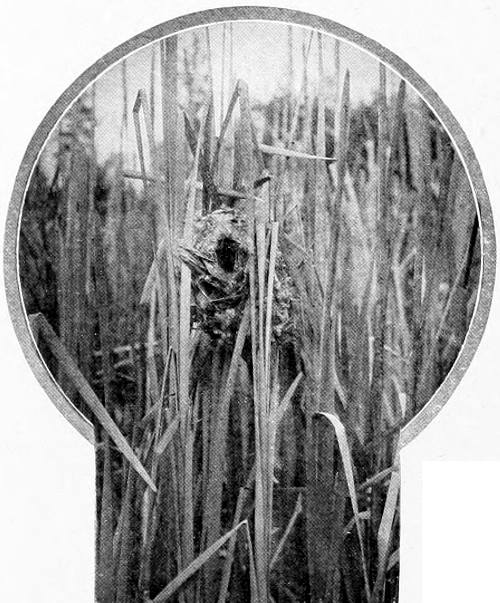
Taken near Spokane. Photo by F. S. Merrill. NEST OF WESTERN MARSH WREN, IN SITU.
On the other hand, the male continues his harmless activities long after his mate has selected one of his early efforts and deposited her eggs; so that the oölogist may have to sample a dozen “cock’s nests,” or decoys, before the right one is found. Some empty nests may be perfectly finished, but others are apt to lack the soft lining; while still others, not having received the close-pressed interstitial filling, will be sodden from the last rains.
The Marsh Wren’s nest is a compact ball of vegetable materials, lashed midway of cat-tails or bulrushes, living or dead, and having a neat entrance hole in one side. A considerable variety of materials is used in construction, but [303] in any given nest only one textile substance will preponderate. Dead cat-tail leaves may be employed, in which case the numerous loopholes will be filled with matted down from the same plant. Fine dry grasses may be utilized, and these so closely woven as practically to exclude the rain. On Moses Lake, where rankly growing bulrushes predominate in the nesting areas, spirogyra is the material most largely used. This, the familiar, scum-like plant which masses under water in quiet places, is plucked out by the venturesome birds in great wet hanks and plastered about the nest until the required thickness is attained. While wet, the substance matches its surroundings admirably, but as it dries out it shrinks considerably and fades to a sickly light green, or greenish gray, which advertises itself among the obstinately green bulrushes. Where this fashion prevails, one finds it possible to pick out immediately the oldest member of the group, and it is more than likely to prove the occupied nest.
The nest-linings are of the softest cat-tail down, feathers of wild fowl, or dried spirogyra teased to a point of enduring fluffiness. It appears, also, that the Wrens often cover their eggs upon leaving the nest. Thus, in one we found on the 17th of May, which contained seven eggs, the eggs were completely buried under a loose blanket of soft vegetable fibers. The nest was by no means deserted, for the eggs were warm and the mother bird very solicitous, insomuch that she repeatedly ventured within a foot of my hand while I was engaged with the nest.
The Marsh Wrens regard themselves as the rightful owners of the reedy fastnesses which they occupy, and are evidently jealous of avian, as well as human, intruders. In one instance a Wren had constructed a sham nest hard against a completed structure of the Yellow-headed Blackbird, and to the evident retirement of its owner. Another had built squarely on top of a handsome Blackbird nest of the current season’s construction, and with a spiteful purpose all too evident.
No. 117. TULE WREN.
A. O. U. No. 725 a. Telmatodytes palustris paludicola (Baird).
Synonyms.—Marsh Wren (locally). Western Marsh Wren (now restricted to T. p. plesius). California Marsh Wren (inappropriate). Pacific Marsh Wren.
Description.—Adult: Similar to T. p. plesius, but smaller and with coloration decidedly darker. Length about 4.75 (120.6); wing 1.97 (50); tail 1.73 (44); bill .52 (13.2); tarsus .78 (20).
[304]
Recognition Marks.—Pygmy size; brownish coloration; reed-haunting habits and sputtering notes distinctive.
Nesting.—Nest: shaped like a cocoanut, of reeds and grasses, lined with plant-down, and with entrance in side; placed two or three feet high in reeds, rarely, high in bushes of swamp. Eggs: 5 or 6, ground-color grayish brown but so heavily dotted and clouded with varying shades of chocolate and mahogany as to be frequently obscured. Av. size .67 × .52 (17 × 13.2). Season: last week in March to July; two broods.
General Range.—Pacific Coast district from British Columbia south during migration to mouth of Colorado River and extremity of Lower California.
Range in Washington.—Resident in suitable localities west of Cascades.
Authorities.—Cistothorus (Telmatodytes) palustris Cab. Baird, Rep. Pac. R. R. Surv. XII. pt. II., 1858, p. 364, part. C&S. L². Ra. Kk. B. E.
Specimens.—U. of W. E. Prov.
When the February sun waves his golden baton over the marshes of western Washington, they yield up a chorus of wren song which is exceeded only by that of the frogs. The frogs, to be sure, have the advantage, in that their choral offering has greater carrying power; but the Wrens at close quarters leave you in no doubt that the palm belongs to them. One hesitates to call the medley of clicking, buzzing, and sputtering, which welters in the reeds, music; but if one succeeds in catching sight of a Tulé Wren, holding on for dear life to a cat-tail stem, and vibrating like a drill-chuck with the effort of his impassioned utterance, he feels sure that music is at least intended.
Wrens are ever busy bodies, and if they could not sing or chatter, or at least scold, they surely would explode. It is a marvel, too, that they find so much to interest them in mere reeds, now green, now brown, set above a foot or so of stagnant water. But, bless you! Do not waste your sympathies upon them. They have neighbors,—Red-wings, Yellow-throats, and the like—and is it not the gossips of the little village who are most exercised over their neighbors’ affairs?
It seems probable that our Tulé Wrens are largely resident. Certainly they are abundant in the more sheltered marshes in winter; and, since the species does not extend very far northward, it is possibly not too much to assume that our birds live and die in a single swamp. They are, as a consequence, very much mixed up on their seasons, and I have heard a swamp in full song in November.
Nesting in the South Tacoma swamp, where several scores at least may be found, begins the last week in March, and full sets of eggs may certainly be found by the first week in April. But “decoys” are, of course, the rule. In a day Mr. Bowles found fifty-three nests, only three of which held eggs or young. At least two broods are raised in a season.
The eggs, usually five or six in number, are so overlaid with tiny dots as [305] to appear of an almost uniform hair brown in color, very dark, except occasionally in the case of the last laid egg. The sitting bird must subject her eggs to frequent turning in the nest, for they become highly polished during incubation.
No. 118. SEATTLE WREN.
A. O. U. No. 719 e. Thryomanes bewickii calophonus Oberholser.
Description.—Adults: Above, dark olive-brown, or warm sepia brown with an olive tinge; the rump with downy, concealed, white spots; wings showing at least traces of dusky barring,—sometimes complete on tertials; tail blackish on concealed portions, distinctly and finely barred with black on exposed portions; the outer pairs of feathers white-tipped and showing white barring, incipient or complete on terminal third; a narrow white superciliary stripe, and an indistinct dark stripe thru eye; underparts grayish white, tinged on sides and flanks with brown; under tail-coverts heavily barred with blackish; bill dark brown above, lighter below; culmen slightly decurved. Length: 5.00-5.50 (127-139.7); wing 2.08 (52.8); tail 2.01 (52.3); bill .59 (15); tarsus .79 (20).
Recognition Marks.—Warbler size; known from Western House Wren by superciliary stripe and whiter underparts, mostly unbarred; a little larger and more deliberate in movements.
Nesting.—Nest: in holes or crannies about stumps, upturned roots, brush-heaps, etc., or in buildings; a rather slight affair of dried grasses, skeleton leaves, mosses, and waste, rarely twigs, lined with wool, hair, or feathers. Eggs: 4-6, usually 5, white, speckled or spotted, rather sparingly, with reddish brown or purplish, uniformly or chiefly in wreath about larger end. Av. size, .68 × .54 (17.3 × 13.7). Season: April 15-June 15; two broods.
General Range.—Pacific Coast district from Oregon to southern British Columbia and Vancouver Island; resident.
Range in Washington.—Resident west of the Cascades, chiefly at lower levels and in valleys.
Authorities.—? Townsend, Journ. Ac. Nat. Sci. Phila. VII. 1837, 154 (Columbia River). Thriothorus bewickii Baird, Pac. Rep. R. R. Surv. IX. 1858, p. 363 part. (T). (C&S). L². Rh. Kb. Ra. Kk. B. E.
Specimens.—U. of W. P. Prov. B. BN. E.
To those who are acquainted only with the typical Bewick Wren of the East, the added vocal accomplishments of our western representative come in the nature of a surprise. For to the characteristic ditty of bewickii proper, calophonus has introduced so many trills and flourishes that the original motif is almost lost to sight. Calophonus means having a beautiful voice, or sweetly sounding, and right well does the bird deserve the name, in a region which is all too conspicuous for its lack of notable songsters.
[306]
Nor was it at all amiss for Professor Ridgway, the eminent ornithologist of Washington, D. C., to name this bird in honor of the Queen City, for it is in the immediate environs of the city, as well as in the untidy wastes of half-conquered nature, that the local Bewick Wren finds a congenial home. Logged-off tracts, slashings and burned-over areas are, however, its especial delight, and if the bird-man catches sight of one that has been making the rounds of all the fire-blackened stumps in the neighborhood, he is ready to declare a new sub-species on the strength of the bird’s soiled garments. No junk dealer knows the alleys of the metropolis better than this crafty bird knows the byways of his log-heaps and the intricate mazes of fire-weed and fern. If there is any unusual appearance or noise which gives promise of mischief afoot, the Seattle Wren is the first to respond. Flitting, gliding, tittering, the bird comes up and moves about the center of commotion, taking observations from all possible angles and making a running commentary thereon. His attitude is alert and his movements vivacious, but the chief interest attaches to the bird’s mobile tail. With this expressive member the bird is able to converse in a vigorous sign language. It is cocked up in impudence, wagged in defiance, set aslant in coquetry, or depressed in whimsical token of humility. Indeed, it is hardly too much to say that the bird makes faces with its tail.
While spying along the lower levels the Wren giggles and chuckles and titters, or else gives vent to a grating cry, moozeerp, which sets the woods on edge. But in song the bird oftenest chooses an elevated station, an alder sapling or the top of a stump. Here, at short intervals and in most energetic fashion, he delivers extended phrases of varied notes, now clear and sparkling, now slurred or pedalled. Above all, he is master of a set of smart trills. One of them, after three preliminary notes, runs tsu′ tsu′ tsu′ tsu′ tsu′ tsu′, like an exaggerated and beautified song of the Towhee. Another song, which from its rollicking character deserves to be called a drinking song, terminates with a brilliant trill in descending scale, rallentando et diminuendo, as tho the little minstrel were actually draining a beaker of dew.
The Seattle Wren is altogether a hilarious personage; and in a country where most song birds are overawed by the solemnity of the forest, it is well enough to have one cheery wight to set all canons at defiance. Even the gray-bearded old fir-stubs must laugh at a time over some of the sallies of this restless little zany. The Wren does not indulge in conscious mimicry, but since his art is self-taught, he is occasionally indebted to the companions of the woods for a theme. The Towhee motif is not uncommon in his songs, and the supposed notes of a Willow Goldfinch, a little off color, were traced to his door, at Blaine.
Of the nesting Mr. Bowles says: “The building sites chosen by this wren for its nests are so variable that hardly anything can be considered typical. It may be in the wildest swampy wood far removed from civilization, but [307] it is quite as likely to be found in a house in the heart of a city. A few of the nesting sites I have recorded are in upturned roots of fallen trees, deserted woodpecker holes, in bird boxes in the city, in a fishing creel hanging on a porch, under a slab of bark that has scaled away a few inches from the body of a tree, or an open nest built on a beam under a bridge.
“A very complete study of this wren has convinced me that it never builds any nests except those used in raising the young. In other words, it is the only wren in the Northwest that is positively guiltless of using ‘decoys’.
“In constructing the nest these birds do not often take over ten days, in which proceeding the female does all the work. One pair, however, that I visited occasionally, were over a month in completing a small nest in the natural cavity of a stump. No explanation of this seems possible, except that the female was not ready to lay her eggs any sooner.
“The nest is a rather slight affair, as a rule, the average nest containing much less material than that of any other wren that I have seen. It is composed of fine dried grass, skeleton leaves, green moss, wool, and very rarely has a basis of twigs, with a lining of hair, the cast skins of snakes, and many feathers.
“A set contains from four to six eggs, most commonly five. These are pure white in ground color, marked with fine dots of reddish brown. The markings are variable in distribution, some specimens being marked very sparingly over all, while in others the markings are largely concentrated around the larger end in the form of a more or less confluent ring. The eggs are rather short ovate oval in shape, and average in measurements .68 × .54 inches.
“Two broods are reared in a season; or perhaps it would be more correct to say that fresh eggs may be found at any time between the middle of April and the middle of June.
“Altho rather timid in the vicinity of her nest, the female generally remains on her eggs until disturbed by a jar or some loud noise. She then disappears and neither bird appears nor makes any complaint in objection to the intruder.”
No. 119. WESTERN HOUSE WREN.
A. O. U. No. 721 a. Troglodytes aedon parkmanii (Aud.).
Synonyms.—Parkman’s Wren. Pacific House Wren.
Description.—Adult: Above, grayish rufous-brown, duller and lighter on foreparts; brighter and more rufous on rump, which has concealed downy white [308] spots; back and scapulars barred (rarely indistinctly) with dusky; wings on exposed webs and tail all over distinctly and finely dusky-barred; sides of head speckled grayish brown, without definite pattern; below, light grayish brown, indistinctly speckled or banded with darker brownish on fore-parts; heavily speckled and banded with dusky and whitish on flanks and crissum; bill black above, lighter below; culmen slightly curved; feet brownish. Length 4.50-5.25 (114.3-133.3); wing 2.08 (52.8); tail 1.75 (44.6); bill .51 (13); tarsus .68 (17.2).
Recognition Marks.—Warbler size; brown above, lighter below; everywhere more or less speckled and banded with dusky, brownish, or white. Larger and with longer tail than Western Winter Wren.
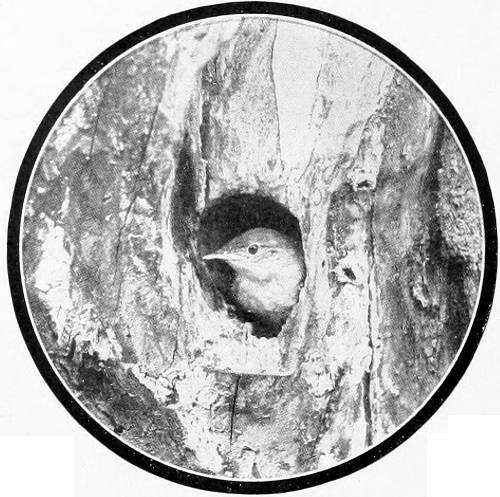
Taken in Oregon. Photo by Finley and Bohlman. HOW’S THE WEATHER OUTSIDE? WESTERN HOUSE WREN AT ENTRANCE OF NESTING HOLE.
Nesting.—Nest: of sticks and trash, lined with fine grasses or chicken-feathers, placed in bird-boxes, holes in orchard trees, crannies of out-buildings, etc. Eggs: 4-8, white, heavily speckled, and usually more or less tinged with pinkish brown or vinaceous, with a wreath of a heavier shade about the larger end. Average size, .64 × .51 (16.3 × 13). Season: About May 15; one brood.
General Range.—Western United States and Canada, north to British Columbia, Alberta and Manitoba, east to Illinois, south to Mexico.
Range in Washington.—Not common summer resident, confined to lower altitudes and, usually, vicinity of settlements.
Migrations.—Spring: Tacoma, April 25, 1906, April 28, 1907.
Authorities.—? Troglodites fulvus Ornithological Committee, Journ. Ac. Nat. Sci. Phila. VII. 1837, p. 193 (Columbia River). ? Troglodytes parkmanii [309] Audubon, Orn. Biog. V. 1839, 310 (Columbia River). Troglodytes parkmanni, Aud., Baird, Rep. Pac. R. R. Surv. XII. pt. II. 1858, p. 368. (T.) C&S. D¹. Ra. D². Ss². Kk. J. B. E.
Specimens.—U. of W. Prov. P. B.
Since our country is pretty well supplied with Wrens, and those too which are content with our climate the year around, this bustling down-Easter, arriving at what he considers the proper season, does not figure so largely in local bird society as across the Rockies. Altho originally described by Audubon from material secured by Townsend, at Vancouver, in the Thirties, parkmanii gives evidence of being a newcomer, comparatively speaking. In the first place, the late arrival, April 25th at Puget Sound points, marks the species in which the tradition of a hard climate is still strong. And, in the second place, the slightly paler plumage acquired while crossing the desert has not yet been lost, altho it is very certain that it could not long withstand consecutive centuries of residence in our humid climate. It is not surprising, therefore, that the House Wren is not abundant nor well distributed in western Washington. On the East-side it is neither common nor rare, being found about long-established ranches and wherever the presence of a little timber affords the variety of cover which is essential to its happiness.
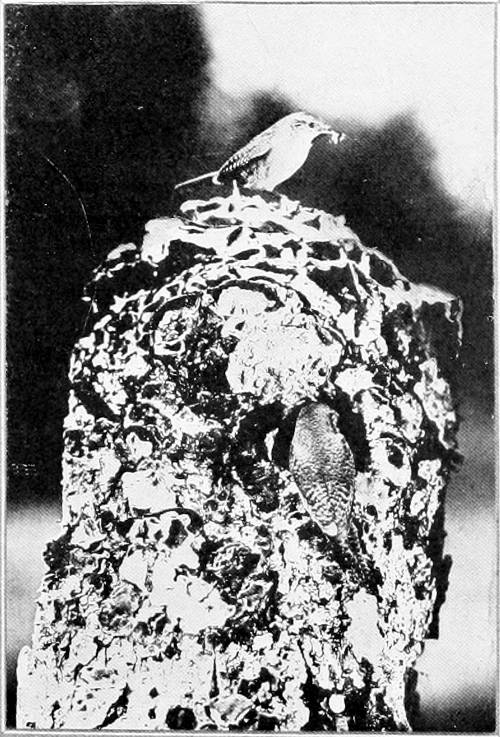
Taken in Oregon. Photo by W. L. Finley. A VERY BUSY WREN. NOT QUITE SO BUSY AS APPEARS, HOWEVER. THE PICTURE IS A COMPOSITE AND PRESENTS THE SAME BIRD TWICE.
Once upon the scene, however, a little House Wren goes a great ways. He is bursting with energy, and music escapes from his busy mandibles like steam from a safety valve. The first task is to renovate last year’s quarters, [310] but there is always time on the side to explore a new brush-heap, to scold a cat, or to indulge innumerable song-bursts. In singing his joyous trill the bird reminds one of a piece of fireworks called a “cascade,” for he fills the air with a brilliant bouquet of music, and is himself, one would think, nearly consumed by the violence of the effort. But the next moment the singer is carrying out last year’s feather bed by great beakfuls, or lugging into some cranny sticks ridiculously large for him.
During the nesting season both birds are perfect little spitfires, assaulting mischievous prowlers with a fearlessness which knows no caution, and scolding in a voice which expresses the deepest scorn. The rasping note produced on such an occasion reminds one of the energetic use of a nutmeg grater by a determined housewife.
In nesting, the Wrens make free of the haunts of men, but are in nowise dependent on them. Old cabins afford convenient crannies, forgotten augur-holes, tin cans, bird boxes, a sleeve or pocket in an old coat hanging in the woodshed,—anything with a cavity will do; but, by the same token, an unused Woodpecker’s hole, or a knot-hole in a stump miles from the haunts of men will do as well. In any case the cavity, be it big or little, must first be filled up with sticks, with just room at the top for entrance. Into this mass a deep hollow is sunk, and this is heavily lined with horse-hair, wool, feathers, bits of snake-skin, anything soft and “comfy”.
Since the Western House Wren makes a brief season with us, it appears to raise but one brood annually.
No. 120. WESTERN WINTER WREN.
A. O. U. No. 722 a. Nannus hiemalis pacificus (Baird).
Description.—Adult: Above warm dark brown, duller before, brighter on rump, sometimes obscurely waved or barred with dusky on back, wings, and tail; barring more distinct on edges of four or five outer primaries, where alternating with buffy; concealed white spots on rump scarce, or almost wanting; a pale brownish superciliary line; sides of head speckled brownish and buffy; underparts everywhere finely mottled, speckled or barred,—on the throat and breast mingled brownish (Isabella-color) and buffy, below dusky and tawny, dusky predominating over brown on flanks and crissum; bill comparatively short, straight, blackish above, lighter below; feet light brown. Length about 4.00 (101.6); wing 1.81 (46); tail 1.18 (30); bill .46 (11.6); tarsus .71 (18).
Recognition Marks.—Pygmy size; dark brown above, lighter below; more or less speckled and barred all over; tail shorter than in preceding species.
Nesting.—Nest: of moss and a few small twigs, lined heavily with wool, rabbits’ fur, hair and feathers, placed among roots of upturned tree, or in crannies [311] of decayed stumps, brush-heaps, etc. Eggs: 4-7, usually 5, white or creamy-white, dotted finely but sparingly with reddish brown; occasionally blotched with the same; sometimes almost unmarked. Av. size .69 × .50 (17.5 × 12.7). Season: first week in April to first week in July according to altitude: two broods.
General Range.—Western North America, breeding from southern California to southern Alaska, east to western Montana. Chiefly resident, but south irregularly in Great Basin States and California in winter.
Range in Washington.—Resident in coniferous timber from sea level to limit of trees; less common east of the Cascade Mountains; of irregular occurrence in open country during migrations.
Authorities.—[Lewis and Clark, Hist. (1814) Ed. Biddle: Coues. Vol. II, p. 186.] ? Orn. Com. Journ. Ac. Nat. Sci. Phila. VII. 1837, 193 (Columbia River). Troglodytes (Anorthura) hyemalis Baird, Rep. Pac. R. R. Surv. IX. 1858, p. 369. (T). C&S. L¹. Rh. D¹. Kb. Ra. Kk. J. B. E.
Specimens.—U. of W. P. Prov. B. BN. E.
Chick—chick chick—chick chick; it is the Winter Wren’s way of saying How-do-you-do? when you invade his domain in the damp forest. The voice is a size too large for such a mite of a bird, and one does not understand its circumflexed quality until he sees its possessor making an emphatic curtsey with each uttereance. It is not every day that the recluse beholds a man, and it may be that he has stolen a march under cover of the ferns and salal brush before touching off his little mine of interrogatives at your knees. If so, his brusque little being is softened by a friendly twinkle, as he notes your surprise and then darts back chuckling to the cover of a fallen log.
Again, if your entrance into the woods has been unnoticed, so that the little huntsman comes upon you in the regular way of business, it is amusing to watch with what ruses of circumvention he seeks to inspect you. Now he appears above a root on your right gawking on tiptoe; then drops at a flash behind its shelter to reprove himself in upbraiding chick chick’s for his rashness. Then, after a minute of apprehensive silence on your part, a chuckle at your other elbow announces that the inspection is satisfactorily completed on that side. The Lilliputian has you at his mercy, Mr. Gulliver.
Dr. Cooper, writing fifty years ago, considered this the commonest species in the forests of “the Territory.” With the possible exception of the Golden-crowned Kinglet, this is probably still true, since it is found not merely along streams and in romantic dells, but thruout the somber depths of the fir and spruce forests from sea level to the limit of trees. It is fond of the wilderness and has as yet learned no necessity of dependence upon man, but it by no means shuns the edges of town, if only sufficient density of cover be provided. Because of the more open character of pine timber, the Winter Wren is less common and is altogether local in its distribution east of the mountains, being confined for the most part to those forest areas which boast an infusion of fir and tamarack.
[312]
In winter, because of heavy snows, the birds appear to retire to a large extent upon the valleys and lowlands, nor do they appear to reoccupy the mountain forests until they have reared a first brood upon the lower levels. Just how familiar a species this bird is at sea-level does not appear to be generally realized. In the spring of 1905 I estimated that forty pairs were nesting in Ravenna Park alone. Nor do they by any means desert the lowlands in toto in summer, for they are seen regularly at that season thruout Puget Sound, upon the islands of Washington Sound, and upon the West Coast.
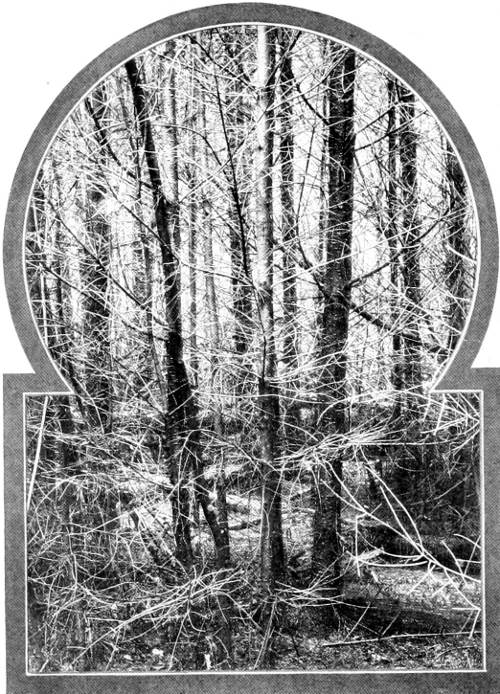
Taken in Seattle. Photo by the Author. A THICKET IN RAVENNA PARK, WHICH ONLY THE WINTER WREN WILL EXPLORE.
It is the Winter Wren, chiefly, which gladdens the depths of the ancient forest with music. Partly because of its unique isolation, but more because of the joyous abandon of the little singer, the song of the Winter Wren strikes the bird-lover as being one of the most refreshing in the Northwest. It consists of a rapid series of gurgling notes and wanton trills, not very loud nor of great variety, but having all the spontaneity of bubbling water, a tiny cascade of song in a waste of silence. The song comes always as an outburst, as tho some mechanical obstruction had given way before the pent-up music. Indeed, one bird I heard at Moclips preceded his song with a series of tittering notes, which struck me [313] absurdly as being the clicking of the ratchet in a music-box being wound up for action.
Heard at close quarters the bird will occasionally employ a ventriloquial trick, dropping suddenly to sotto voce, so that the song appears to come from a distance. Again, it will move crescendo and diminuendo, as tho the supply pipe of this musical cascade were submitted to varying pressure at the fountain head.
A singing bird is the best evidence available of the proximity of the nest. Usually the male bird posts himself near the sitting female and publishes his domestic happiness in musical numbers. But again, he may only be pausing to congratulate himself upon the successful completion of another decoy, and the case is hopeless for the nonce.
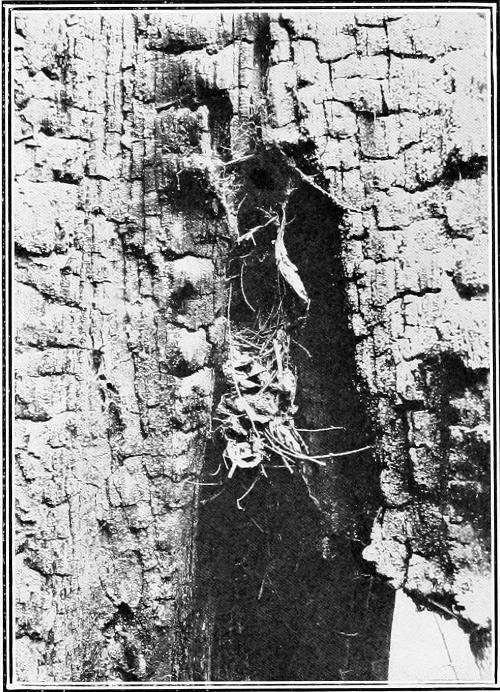
Taken in Seattle. Photo by the Author. NEST OF WESTERN WINTER WREN IN CHARRED STUMP. NOTE THAT A SPIDER WEB ABOVE CLOSELY SIMULATES THE NEST ENTRANCE, WHICH IS REALLY ABOUT MIDWAY.
For nesting sites the Wrens avail themselves of cubby-holes and crannies in upturned roots or fallen logs, and fire-holes in half-burned stumps. A favorite situation is one of the crevices which occur in a large fir tree when it falls and splits open. Or the nest is sometimes found under the bark of a decaying log, or in a crevice of earth in an unused mine-shaft. If the site selected has a wide entrance, this is walled up by the nesting material and only a smooth round aperture an inch and a quarter in diameter is left to admit to the nest proper. In default of any such shelter, birds have been known to construct their nests at the center of some baby fir, or in the [314] drooping branches of a fir tree at a height of a foot or more from the ground. In such case, the nest is finished to the shape of a cocoanut, with an entrance hole in the side a little above the center.
In all cases the materials used are substantially the same, chiefly green moss, with an abundance of fir or cedar twigs shot thru its walls and foundations. This shell is heavily lined with very fine mosses, intermingled with deer hair or other soft substances; while the inner lining is of feathers, which the Sooty and the Ruffed Grouse have largely contributed to the upholstered luxury of this model home.
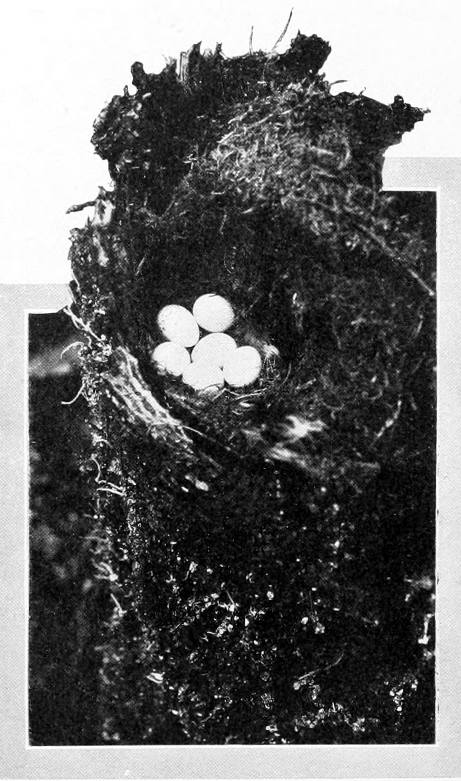
Taken near Tacoma. Photo by Dawson and Bowles. NEST AND EGGS OF WESTERN WINTER WREN IN STUMP. TOP OF STUMP REMOVED. AN UNUSUAL NESTING-SITE WHERE ONE WOULD SOONER HAVE EXPECTED TO FIND OREGON CHICKADEE.
“Cocks’ nests,” or decoys, are the favorite diversion of this indefatigable bird, so that, as with the restless activities of four-year-old children, one sighs to think of the prodigious waste of energies entailed. The aboriginal cause of this quaint instinct, so prevalent among the Wrens, would seem to be the desire to deceive and discourage enemies, but in the case of the Winter Wren one is led to suspect that the hard-working husband is trying to meet a perpetual challenge to occupy all available sites—a miser hoarding opportunities. A troop of young Wrens just out of the nest is a cunning sight. The anxious parents counsel flight and the more circumspect of the brood obey, but now and then one less sophisticated allows a little pleasant talk, “blarney,” to quiet his beating heart. Then a little titillation [315] of the crown feathers will quite win him over, so that he will accept a gently insistent finger in place of the twig which has been his support. The unfaltering trust of childhood has subdued many a savage heart, but when it is exemplified in a baby Wren one feels the ultimate appeal to tenderness.
Mr. Brown, of Glacier, coming upon an old Russet-backed Thrush nest at dusk, thrust an exploratory finger over its brim. Judge of his surprise when out swarmed seven young Winter Wrens. Mr. Brown feels reasonably sure, however, that the birds were hatched elsewhere, and that they were only roosting temporarily in the larger nest, in view of its ampler accommodations.
No. 121. ROCK WREN.
A. O. U. No. 715. Salpinctes obsoletus (Say).
Description.—Adults: Above brownish gray changing on rump to cinnamon-brown, most of the surface speckled by arrow-shaped marks containing, or contiguous to, rounded spots of whitish; wing-quills color of back, barred with dusky on outer webs; middle pair of tail-feathers color of back barred with dusky; remaining rectrices barred with dusky on outer webs only, each with broad subterminal bar of blackish and tipped broadly with cinnamon-buff area varied by dusky marbling; outermost pair broadly blackish- and cinnamon-barred on both webs; a superciliary stripe of whitish; a broad post-ocular stripe of grayish brown; sides of head and underparts dull white shading into pale cinnamon or vinaceous buff on flanks and under tail-coverts; sides of head, throat and upper breast spotted, mottled or streaked obscurely with grayish brown or dusky; under tail-coverts barred or transversely spotted with dusky. Bill dark horn-color above, paling below; feet and legs brownish dusky; iris brown. Young birds are more or less barred or vermiculated above, without white speckling, and are unmarked below. Length: 5.50-6.00 (139.7-152.4); wing 2.76 (70); tail 2.09 (53); bill .70 (17.7); tarsus .83 (21).
Recognition Marks.—Warbler size; variegated tail with broad buffy tips distinctive; rock-haunting habits.
Nesting.—Nest: in crannies of cliffs, of twigs, grasses, wool, hair and other soft substances, approached by runway of rock-chips or pebbles. Eggs: 5-7, white or pinkish white, sprinkled somewhat sparingly with pale cinnamon, chiefly about larger end. Av. size .73 × .56 (18.5 × 14.2). Season: May 1st to June 20th; two broods.
General Range.—Western United States, northern and central Mexico, and southern British Columbia, chiefly in hilly districts; eastward across Great Plains to Kansas, Nebraska, etc.; retires from northern portion of range in winter.
Range in Washington.—Summer resident and migrant in open country east [316] of the Cascades, chiefly confined to cliffs of Columbian lava; casual west of the Cascades.
Authorities.—[“Rock wren,” Johnson, Rep. Gov. W. T. 1884 (1885), p. 22.] Lawrence, Auk, IX. 1892, 47, 357. T. L¹. D¹. D². Ss¹. Ss². Kk.
Specimens.—P. C.
“But Barrenness, Loneliness, such-like things, That gall and grate on the White Man’s nerves, Was the rangers that camped by the bitter springs And guarded the lines of God’s reserves. So the folks all shy from the desert land, ’Cept mebbe a few that kin understand.”—Clark.
A discerning soul is Salpinctes. He loves beyond all else the uplifted ramparts of basalt, the bare lean battlements of the wilderness. They are the walls of a sanctuary, where he is both verger and choir master, while upon the scarred altars which they shelter, his faithful spouse has a place “where she may lay her young.”
The Rock Wren is nestled among the most impressive surroundings, but there is nothing subdued or melancholy about his bearing. Indeed, he has taken a commission to wake the old hills and to keep the shades of eld from brooding too heavily upon them. His song is, therefore, one of the sprightliest, most musical, and resonant to be heard in the entire West. The rock-wall makes an admirable sounding-board, and the bird stops midway of whatever task to sing a hymn of wildest exultation. Whittier, whittier, whittier, is one of his finest strains; while ka-whee, ka-whee, ka-whee is a sort of challenge which the bird renders in various tempo, and punctuates with nervous bobs to enforce attention. For the rest his notes are too varied, spontaneous, and untrammeled to admit of precise description.
Save in the vicinity of his nest, the Rock Wren is rather an elusive sprite. If you clamber to his haunts he will remove, as matter of course, a hundred yards along the cliff; or he will flit across the couleé with a nonchalance which discourages further effort. Left to himself, however, he may whimsically return—near enough perhaps for you to catch the click, click of his tiny claws as he goes over the lava blocks, poking into crevices after spiders here, nibbling larvæ in vapor holes there, or scaling sheer heights yonder, without a thought of vertigo.
At nesting time the cliffs present a thousand chinks and hidey-holes, any one of which would do to put a nest in. The collector is likely to be dismayed at the wealth of possibilities before him, and the birds themselves appear to regret that they must make choice of a single cranny, for they “fix up” half a [317] dozen of the likeliest. And when it comes to lining the approaches of the chosen cavity, what do you suppose they use? Why, rocks, of course; not large ones this time, but flakes and pebbles of basalt, which rattle pleasantly every time the bird goes in and out. These rock chips are sometimes an inch or more in diameter, and it is difficult to conceive how a bird with such a delicate beak can compass their removal. Here they are, however, to the quantity of half a pint or more, and they are just as much a necessity to every well-regulated Salpinctean household, as marble steps are to Philadelphians.
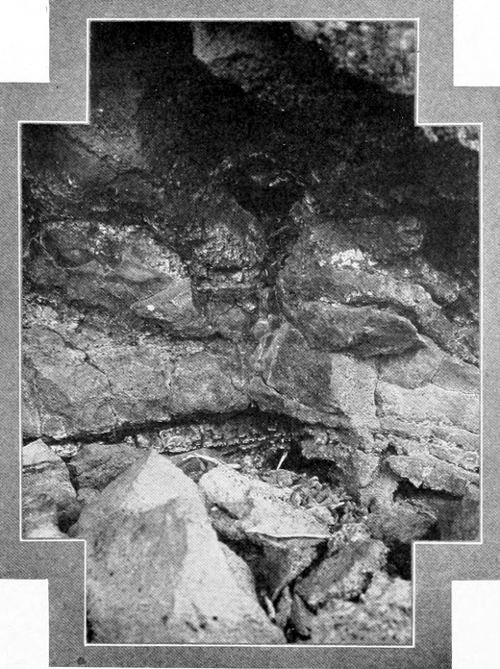
Taken in Douglas County. Photo by the Author. NESTING-SITE OF ROCK WREN IN BASALT CLIFF. THE NEST OCCUPIES THE UPPER CRANNY BUT THE “FRONT WALK” IS COMPLETED BELOW.
The nest itself is rather a bulky affair, composed of weed-stalks, dried grasses, and fine rootlets, with a scanty lining of hair or wool (all East-side birds are enthusiastic advocates of sheep-raising). “Two broods are raised in a season, the first set of eggs appearing early in May, the second about the middle of June. It is possible that even a third set may sometimes be laid still later in the season, but these late sets are more apt to be due to the breaking up of the first or second. The eggs vary from five to seven, and are pure white in color, sprinkled rather sparingly over the surface with dots of a faint brownish red, most heavily about the larger end” (Bowles).
[318]
Failing a suitable cliff-house—not all walls are built to Wrens’ orders—the birds resort to a rock-slide and the possibilities here are infinite. After I had seen a devoted pair disappear behind a certain small rock no less than a dozen times, and had heard responsive notes in different keys, a chittering which reminded one of baby Katydids, I thought I had a cinch on the nest. The crevices of the rocks here and there were crammed with dried grass and stuff which might fairly be considered superfluous nesting material, and the young birds were too young to have traveled far; but as for the actual cradle I could not find it, and I cannot certify that the wrenlets were hatched within seven rods. The little fellows were as shy as conies, but their parents, curiously enough, took my researches good naturedly. One of them came within two feet of my face and peered intently at me as I sat motionless; and even after some square yards of the rock slide had been violently disarranged, they did not hesitate to visit their clamoring brood as tho nothing had happened. Did they trust the man or the rocks rather?
No. 122. CANYON WREN.
A. O. U. No. 717 a. Catherpes mexicanus conspersus Ridgw.
Synonyms.—Canon Wren. Speckled Canon Wren.
Description.—Adult: “Upperparts brown, paler and grayer anteriorly, behind shading insensibly into rich rufous, everywhere dotted with small dusky and whitish spots. Tail clear cinnamon-brown, crossed with numerous very narrow and mostly zigzag black bars. Wing-quills dark brown, outer webs of primaries and both webs of inner secondaries barred with color of back. Chin, throat, and fore breast, with lower half of side of head and neck, pure white, shading behind through ochraceous-brown into rich deep ferruginous, and posteriorly obsoletely waved with dusky and whitish. Bill slate-colored, paler and more livid below; feet black; iris brown” (Coues). Length about 5.50 (139.7); wing 2.35 (59.7); tail 2.06 (52.4); bill .81 (20.5); tarsus .71 (18.1). Female a little smaller.
Recognition Marks.—Warbler size, rock-haunting habits; rich rusty red of hinder underparts; tail finely barred with black, its feathers without buffy tips as distinguished from Salpinctes obsoletus.
Nesting.—Not known to nest in Washington but probably does so. Nest and eggs indistinguishable from those of the Rock Wren.
General Range.—Central arid districts of the western United States and southern British Columbia from Wyoming and Colorado west to northeastern California and south to Arizona.
Range in Washington.—Reported from Palouse country only,—is probably [319] extending range into Upper Sonoran and Arid Transition zones of eastern Washington.
Authorities.—C. mexicanus punctulatus, Snodgrass, Auk. Vol. XXI. Apr. 1904, p. 232. J.
Specimens.—P.
To Mr. Robert E. Snodgrass belongs the honor of first reporting this species as a bird of Washington. He encountered it in the Snake River Cañon at Almota in the summer of 1903, and mentions that it occurred also at Wawawai Ferry, a few miles up the river. Roswell H. Johnson also refers to it casually in the preface to his list of the birds of Cheney[47] as occurring “where conditions were favorable to the south and east.”
It has long been supposed that the Cañon Wrens were confined to a much more southern range. Ridgway[48] assigns the northern limits of this species to Wyoming and Nevada. Its appearance in Washington, therefore, is matter of congratulation and may, perhaps, be taken as an instance of that northward trend of species which undoubtedly affects many of the Passerine forms, and none more notably than the Wrens.
The Cañon Wren frequents much the same situations as the Rock Wren and has the same sprightly ways. In the southern part of its range it is said to be a familiar resident of towns, and nests as frequently in crannies and bird-boxes as does our House Wren (Troglodytes aedon parkmanii). Its alarm note is a “peculiarly ringing dink,” and its song is said to excel, if possible, that of the House Wren. “What joyous notes! * * * His song comes tripping down the scale growing so fast it seems as if the songster could only stop by giving his odd little flourish back up the scale again at the end. The ordinary song has seven descending notes, but often, as if out of pure exuberance of happiness, the Wren begins with a run of grace notes, ending with the same little flourish. The rare character of the song is its rhapsody and the rich vibrant quality which has suggested the name of bugler for him—and a glorious little bugler he surely is” (Mrs. Bailey).
[320]
Mimidæ—The Mockingbirds
No. 123. SAGE THRASHER.
A. O. U. No. 702. Oroscoptes montanus Townsend.
Synonyms.—Sage Mocker. Mountain Mocking-bird (early name—inapropos).
Description.—Adults: General plumage ashy brown, lighter below; above grayish- or ashy-brown, the feathers, especially on crown, streaked mesially with darker brown; wings and tail dark grayish brown with paler edgings; middle and greater coverts narrowly tipped with whitish, producing two dull bars; outer rectrices broadly tipped with white, decreasing in area, till vanishing on central pair; lores grayish; a pale superciliary line; cheeks brownish varied by white; underparts whitish tinged with buffy brown, most strongly on flanks and crissum, everywhere (save, usually, on throat, lower belly, and under tail-coverts) streaked with dusky, the streaks tending to confluence along side of throat, sharply distinguished and wedge-shaped on breast, where also heaviest; bill blackish paling on mandible; legs and feet dusky brownish, the latter with yellow soles; iris lemon-yellow. Young birds are browner and more decidedly streaked above; less distinctly streaked below. Length about 8.00 (203); wing 3.82 (97); tail 3.54 (90); bill .65 (16.4); tarsus 1.20 (30.5).
Recognition Marks.—Chewink size; ashy-brown plumage appearing nearly uniform at distance; sage-haunting habits; impetuous song.
Nesting.—Nest, a substantial structure of thorny twigs (Sarcobatus preferred), usually slightly domed, with a heavy inner cup of fine bark (sage) strips, placed without attempt at concealment in sage-bush or greasewood. Eggs, 4 or 5, rich, dark, bluish green, heavily spotted or blotched with rich rufous and “egg-gray”—among the handsomest. Av. size, .98 × .71 (24.9 × 18). Season: May 1-June 15; two (?) broods.
General Range.—Western United States from western part of the Great Plains (western South Dakota, western Nebraska, and eastern Colorado) north to Montana, west to the Cascades and Sierra Nevada, south into New Mexico, Lower California, and, casually, to Guadalupe Island.
Range in Washington.—Treeless portions of East-side; summer resident.
Authorities.—[“Sage Thrasher,” Johnson, Rep. Gov. W. T. 1884 (1885), p. 22.] Dawson, Wilson Bulletin, No. 39, June, 1902, p. 67. (T). D². Ss¹. Ss².
Specimens.—U. of W. P. C.
It takes a poet to appreciate the desert. Those people who affect to despise the sage are the same to whom stones are stones instead of compacted histories of the world’s youth, and clouds are clouds instead of legions of angels. It is no mark of genius then to despise common things. The desert has cradled more of the world’s good men and great than ever were coddled in king’s palaces. Whistler used to paint “symphonies in gray” and men held back questioning, “Er—is this art?” A few, bolder than their fellows, pronounced favorably upon it, and it is allowable now to admit that Whistler was a great artist—that is, a great discoverer and revealer of Nature.
[321]
Nature has painted upon our eastern hills a symphony in gray greens, a canvas of artemisia, simple, ample, insistent. And still the people stand before it hesitating—it is so common—is it considered beautiful, pray? Well, at least a bird thinks so, a bird whose whole life has been spent in the sage. Listen! The hour is sunrise. As we face the east, heavy shadows still huddle about us and blend with the ill-defined realities. The stretching sage-tops tremble with oblation before the expectant sun. The pale dews are taking counsel for flight, but the opalescent haze, pregnant with sunfire, yet tender with cool greens and subtle azures, hovers over the altar waiting the concomitance of the morning hymn before ascent. Suddenly, from a distant sage-bush bursts a geyser of song, a torrent of tuneful waters, gushing, as it would seem, from the bowels of the wilderness in an ecstacy of greeting and gratitude and praise. It is from the throat of the Sage Thrasher, poet of the bitter weed, that the tumult comes. Himself but a gray shadow, scarce visible in the early light, he pours out his soul and the soul of the sage in a rhapsody of holy joy. Impetuous, impassioned, compelling, rises this matchless music of the desert. To the silence of the gray-green canvas, beautiful but incomplete, has come the throb and thrill of life,—life brimful, delirious, exultant. The freshness and the gladness of it touch the soul as with a magic. The heart of the listener glows, his veins tingle, his face beams. He cannot wait to analyze. He must dance and shout for joy. The wine of the wilderness is henceforth in his veins, and drunk with ecstacy he reels across the enchanted scene forever more.
And all this inspiration the bird draws from common sage and the rising of the common sun. How does he do it? I do not know. Ask Homer, Milton, Keats.
No. 124. CATBIRD.
A. O. U. No. 704. Dumetella carolinensis (Linn.).
Description.—Adult: Slate-color, lightening almost imperceptibly below; black on top of head and on tail; under tail-coverts chestnut, sometimes spotted with slaty; bill and feet black. Length 8.00-9.35 (203.2-237.5); wing 3.59 (91.2); tail 3.65 (92.7); bill .62 (15.8).
Recognition Marks.—Chewink size; almost uniform slaty coloration with thicket-haunting habits distinctive; lithe and slender as compared with Water Ouzel.
[322]
Nesting.—Nest, of twigs, weed-stalks, vegetable fibers, and trash, carefully lined with fine rootlets, placed at indifferent heights in bushes or thickets. Eggs, 4-5, deep emerald-green, glossy. Av. size, .95 × .69 (24.1 × 17.5). Season, first two weeks in June; one brood.
General Range.—Eastern United States and British Provinces, west regularly to and including the Rocky Mountains, irregularly to the Pacific Coast from British Columbia to central California. Breeds from the Gulf States northward to the Saskatchewan. Winters in the southern states, Cuba, and middle America to Panama. Bermuda, resident. Accidental in Europe.
Range in Washington.—Summer resident; not uncommon but locally distributed in eastern and especially northeastern Washington; penetrates deepest mountain valleys on eastern slope of Cascades, and is regularly established in certain West-side valleys connected by low passes. Casual at Seattle, and elsewhere at sea-level.
Authorities.—Galeoscoptes carolinensis, Belding, Land Birds of the Pacific District (1890), p. 226 (Walla Walla by J. W. Williams, 1885). D¹. Ss¹. Ss². J.
Specimens.—U. of W. Prov. P. C.
Those who hold either a good or a bad opinion of the Catbird are one-sided in their judgment. Two, and not less than two, opinions are possible of one and the same bird. He is both imp and angel, a “feathered Mephistopheles” and “a heavenly singer.” But this is far from saying that the bird lives a double life in the sense ordinarily understood, for in the same minute he is grave, gay, pensive and clownish. Nature made him both a wag and a poet, and it is no wonder if the roguishness and high philosophy become inextricably entangled. One moment he steps forth before you as sleek as Beau Brummel, graceful, polished, equal-eyed; then he cocks his head to one side and squints at you like a thief; next he hangs his head, droops wings and tail, and looks like a dog being lectured for killing sheep;—Presto, change! the bird pulls himself up to an extravagant height and with exaggerated gruffness, croaks out, “Who are you?” Then without waiting for an answer to his impudent question, the rascal sneaks off thru the bushes, hugging every feather close to his body, delivering a running fire of cat-calls, squawks, and expressions of contempt. There is no accounting for him; he is an irrepressible—and a genius.
The Catbird is not common in Washington, save in the northeastern portion of the State, where it is well established. Miss Jennie V. Getty finds them regularly at North Bend, and there is a Seattle record; so that there is reason to believe that the Catbird is one of those few species which are extending their range by encroachment from neighboring territory. There can be no question that civilization is conducive to the bird’s welfare, primarily by increasing the quantity of its cover on the East-side, and, possibly, by reducing it on the West. Catbirds, when at home, are found in thickets and in loose shrubbery. River-banks are lined with them, and chaparral-covered hillsides [323] have their share; but they also display a decided preference for the vicinage of man, and, if allowed to, will frequent the orchards and the raspberry bushes. They help themselves pretty freely to the fruit of the latter, but their services in insect-eating compensate for their keep, a hundred-fold. Nests are placed almost anywhere at moderate heights, but thickety places are preferred, and the wild rosebush is acknowledged to be the ideal spot. The birds exhibit the greatest distress when their nest is disturbed, and the entire neighborhood is aroused to expressions of sympathy by their pitiful cries.
My friend, Dr. James Ball Naylor, of Malta, Ohio, tells the following story in answer to the oft-repeated question, Do animals reason? The poet’s house nestles against the base of a wooded hill and looks out upon a spacious well-kept lawn which is studded with elm trees. The place is famous for birds and the neighborhood is equally famous for cats. Robins occasionally venture to glean angle worms upon the inviting expanses of this lawn, but for a bird to attempt to cross it unaided by wing would be to invite destruction as in the case of a lone soldier climbing San Juan hill. One day, however, a fledgling Catbird, overweening and disobedient, we fear, fell from its nest overhead and sat helpless on the dreaded slopes. The parents were beside themselves with anxiety. The birdie could not fly and would not flutter to any purpose. There was no enemy in sight but it was only by the sufferance of fate, and moments were precious. In the midst of it all the mother disappeared and returned presently with a fat green worm, which she held up to baby at a foot’s remove. Baby hopped and floundered forward to the juicy morsel, but when he had covered the first foot, the dainty was still six inches away. Mama promised it to him with a flood of encouragement for every effort, but as often as the infant advanced the mother retreated, renewing her blandishments. In this way she coaxed her baby across the lawn and up, twig by twig, to the top of an osage-orange hedge which bounded it. Here, according to Dr. Naylor, she fed her child the worm.
Comparing the scolding and call notes of the Catbird with the mewing of a cat has perhaps been a little overdone, but the likeness is strong enough to lodge in the mind and to fasten the bird’s “trivial name” upon it forever. Besides a mellow phut, phut in the bush, the bird has an aggravating mee-a-a, and a petulant call note which is nothing less than Ma-a-ry. Cautious to a degree and timid, the bird is oftener heard in the depth of the thicket than elsewhere, but he sometimes mounts the tree-top, and the opening “Phut, phut, coquillicot”—as Neltje Blanchan hears it—is the promise of a treat.
Generalizations are apt to be inadequate when applied to singers of such brilliant and varied gifts as the Catbird’s. It would be impertinent to say: Homo sapiens has a cultivated voice and produces music of the highest order. Some of us do and some of us do not. Similarly some Catbirds are “self-conscious and affected,” “pause after each phrase to mark its effect upon the [324] audience,” etc. Some lack originality, feeling, are incapable of sustained effort, cannot imitate other birds, etc. But some Catbirds are among the most talented singers known. One such I remember, which, overcome by the charms of a May day sunset, mounted the tip of a pasture elm, and poured forth a hymn of praise in which every voice of woodland and field was laid under contribution. Yet all were suffused by the singer’s own emotion. Oh, how that voice rang out upon the still evening air! The bird sang with true feeling, an artist in every sense, and the delicacy and accuracy of his phrasing must have silenced a much more captious critic than I. Never at a loss for a note, never pausing to ask himself what he should sing next, he went steadily on, now with a phrase from Robin’s song, now with the shrill cry of the Red-headed Woodpecker, each softened and refined as his own infallible musical taste dictated; now and again he interspersed these with bits of his own no less beautiful. The carol of Vireo, the tender ditties of the Song and Vesper Sparrows, and the more pretentious efforts of Grosbeaks, had all impressed themselves upon this musician’s ear, and he repeated them, not slavishly, but with discernment and deep appreciation. As the sun sank lower in the west I left him there, a dull gray bird, with form scarcely outlined against the evening sky, but my soul had taken flight with his—up into that blest abode where all Nature’s voices are blended into one, and all music is praise.
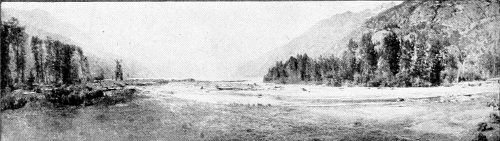
Taken near Stehekin. Photo by the Author. A HAUNT OF THE CATBIRD.
[325]
Cinclidæ—The Dippers
No. 125. AMERICAN WATER OUZEL.
A. O. U. No. 701. Cinclus mexicanus unicolor (Bonap.).
Synonym.—American Dipper.
Description.—Adults in spring and summer: General plumage slaty gray paling below; tinged with brown on head and neck; wings and tail darker, blackish slate; eyelids touched with white; bill black; feet yellowish. Adults in fall and winter, and immature: Feathers of underparts margined with whitish and some whitish edging on wings; bill lighter, brownish. Young birds are much lighter below; the throat is nearly white and the feathers of remaining under plumage are broadly tipped with white and have wash of rufous posteriorly—tips of wing-feathers and, occasionally, tail-feathers extensively white; bill yellow. Length of adult 6.00-7.00 (152-178); wing 3.54 (90); tail 1.97 (50); bill .68 (17.3); tarsus 1.12 (28.5).
Recognition Marks.—Sparrow size but chunky, giving impression of a “better” bird. Slaty coloration and water-haunting habits distinctive.
Nesting.—Nest: a large ball of green moss lined with fine grasses, and with entrance on side; lodged among rocks, fallen timber, roots, etc., near water. Eggs: 4 or 5, pure white. Av. size, 1.02 × .70 (25.9 × 17.8). Season: April-June; one or two broods.
General Range.—The mountains of western North America from the northern boundary of Mexico and northern Lower California to northern Alaska. Resident.
Range in Washington.—Of regular occurrence along all mountain streams. Retires to lower levels, even, rarely, to sea-coast in winter.
Authorities.—Cinclus mortoni, Townsend, Narrative, April, 1839, p. 339. Also C. townsendi “Audubon,” Ibid., p. 340. T. C&S. L¹. Rh. D¹. Ra. D². B. E.
Specimens.—Prov. B. E.
“Advancing and prancing and glancing and dancing, And dashing and flashing and splashing and clashing; And so never ending, but always descending, Sounds and motions forever and ever are blending, All at once and all o’er, with a mighty uproar; And this way the Water comes down at Lodore.”
But the scene of aqueous confusion was incomplete unless a leaden shape emerged from the spray, took station on a jutting rock, and proceeded to rub out certain gruff notes of greeting, jigic, jigic, jigic. These notes manage somehow to dominate or to pierce the roar of the cataract, and they symbolize henceforth the turbulence of all the mountain torrents of the West.
The Water Ouzel bobs most absurdly as he repeats his inquiry after your [326] health. But you would far rather know of his, for he has just come out of the icy bath, and as he sidles down the rock, tittering expectantly, you judge he is contemplating another one. Yes; without more ado the bird wades into the stream where the current is so swift you are sure it would sweep a man off his feet. He disappears beneath its surface and you shudder at the possibilities, but after a half minute of suspense he bursts out of the seething waters a dozen feet below and flits back to his rock chuckling cheerily. This time, it may be, he will rest, and you have opportunity to note the slightly retroussé aspect of the beak in its attachment to the head. The bird has stopped springing now and stands as stolid as an Indian, save as ever and again he delivers a slow wink, upside down, with the white nictitating membrane.
It has been asserted that the Ouzel flies under water, but I think that this is a mistake, except as it may use its wings to reach the surface of the water after it has released its hold upon the bottom. The bird creeps and clings, rather, and is thus able to withstand a strong current as well as to attain a depth of several feet in quieter waters.
The Water Ouzel feeds largely upon the larvæ of the caddice fly, known locally as periwinkles. These are found clinging to the under surface of stones lining the stream, and their discovery requires quite a little prying and poking on the bird’s part. The Ouzels are also said to be destructive to fish fry, insomuch that the director of a hatchery in British Columbia felt impelled to order the destruction of all the Ouzels, to the number of several hundred, which wintered along a certain protected stream. This was a very regrettable necessity, if necessity it was, and one which might easily lead to misunderstanding between bird-men and fish-men. We are fond of trout ourselves, but we confess to being a great deal fonder of this adventuresome water-sprite.
The Ouzel is non-migratory, but the summer haunts of the birds in the mountains are largely closed to them in winter, so that they find it necessary at that season to retreat to the lower levels. This is done, as it were, reluctantly, and nothing short of the actual blanketing of snow or ice will drive them to forsake the higher waters. The bird is essentially solitary at this season, as in summer, and when it repairs to a lower station, along late in November, there is no little strife engendered by the discussion of metes and bounds. In the winter of 1895-6, being stationed at Chelan, I had occasion to note that the same Ouzels appeared daily along the upper reaches of the Chelan River. Thinking that such a local attachment might be due to similar occupation down stream, I set out one afternoon to follow the river down for a mile or so, and to ascertain, if possible, how many bird-squatters had laid out claims along its turbulent course. In places where there was an unusually long succession of rapids, it was not always possible to decide between the conflicting interests of rival claimants, for they flitted up and down overlapping by short flights each other’s domains; but the very fact that these overlappings often occasioned [327] sharp passages at arms served to confirm the conclusion that the territory had been divided, and that each bird was expected to dive and bob and gurgle on his own beat. Thus, twenty-seven birds were found to occupy a stretch of two miles.
Here in winter quarters, the first courting songs were heard. As early as Christmas the birds began to tune up, and that quite irrespective of weather. But their utterances were as rare in time as they are in quality. In fact, it does not appear to be generally known that the Water Ouzel is a beautiful singer, and none of those who have been so fortunate as to hear its song, have heard enough to pass final judgment on it. We know, at least, that it is clear and strong and vivacious, and that in its utterance the bird recalls its affinity to both Thrushes and Thrashers.
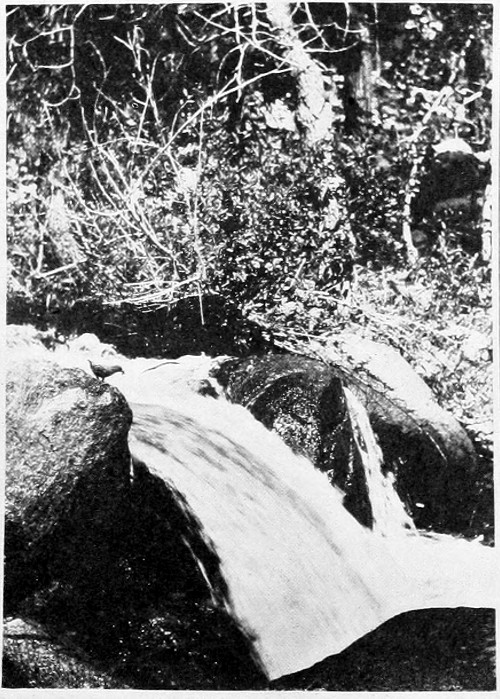
Taken in California. Photo by Frederick Bade. THE LAST STATION. IN ANOTHER MOMENT THE OUZEL WILL VISIT HER BROOD UNDER THE WATERFALL.
The Ouzel places its nest beside some brawling stream, or near or behind some small cascade. In doing so, the chief solicitude seems to be that the living mosses, of which the bulky globe is composed, shall be kept moist by the flying spray, and so retain their greenness. Indeed, one observer reports that in default of ready-made conveniences, the bird itself turns sprinkler, not only alighting upon the dome of its house after returning from a trip, but visiting the water [328] repeatedly for the sole purpose of shaking its wet plumage over the mossy nest.
Unless we mistake, the bird in the first picture is about to visit a nest behind the waterfall, and of such a nest Mr. John Keast Lord says: “I once found the nest of the American Dipper built amongst the roots of a large cedar-tree that had floated down the stream and got jammed against the mill-dam of the Hudson Bay Company’s old grist mill, at Fort Colville, on a tributary to the upper Columbia River. The water rushing over a jutting ledge of rocks, formed a small cascade, that fell like a veil of water before the dipper’s nest; and it was curious to see the birds dash thru the waterfall rather than go in at the sides, and in that way get behind it. For hours I have sat and watched the busy pair, passing in and out thru the fall, with as much apparent ease as an equestrian performer jumps thru a hoop covered with tissue paper. The nest was ingeniously constructed to prevent the spray from wetting the interior, the moss being so worked over the entrance as to form an admirable verandah.”
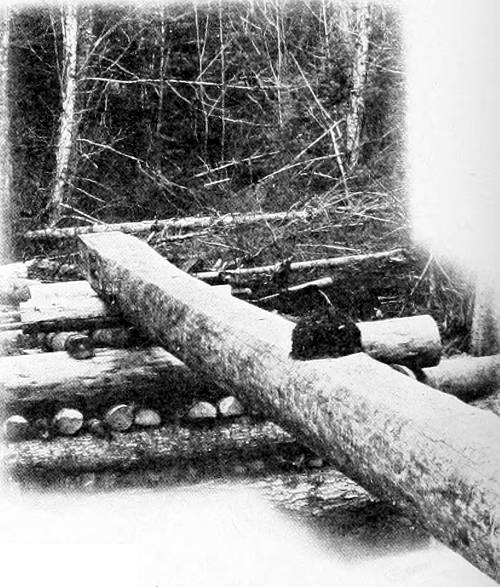
Taken in Oregon. Photo by A. W. Anthony. AN UNSHELTERED NEST.
Of the nest shown in the accompanying illustration, Mr. A. W. Anthony says that it was completed under unusual difficulties. A party of surveyors, requiring to bridge a stream in eastern Oregon, first laid a squared stringer. This an Ouzel promptly seized upon, and in token of proprietorship began to heap up moss. This arrangement did not comport with business and the nest foundations were brushed aside on two successive mornings. A spell of bad weather intervening, the men returned to their work some days later to find the completed nest, as shown, completed but still unoccupied. It was necessary to remove this also, but judge of the feelings of the surveyors when, upon the following morning, they found a single white egg resting upon the bare timber!
[329]
Hirundinidæ—The Swallows
No. 126. PURPLE MARTIN.
A. O. U. No. 611. Progne subis (Linn.).
Description.—Adult male: Rich, purplish black, glossy and metallic; wings and tail dead black. Adult female: Similar to male, but blue-black of upperparts restricted and duller; forehead, hind-neck, and lower parts sooty gray, paler on belly and crissum. Bill black, stout, and broad at the base, decurved near tip; nostrils exposed, circular, opening upward; feet moderately stout. Young males: resemble adult female but are somewhat darker, the steely blue appearing at first in patches. Length 7.25-8.50 (184.2-215.9); av. of eight specimens: wing 5.75 (146.1); tail 2.72 (69.1): bill, breadth at base .73 (18.5); length from nostril .33 (8.4).
Recognition Marks.—Chewink size; the largest of the Swallows; blue-black, or blue-black and sooty-gray coloration.
Nesting.—Nest, of leaves, grass, and trash, in some cavity, usually artificial,—bird-boxes, gourds, etc. Eggs, 4-5, rarely 6, pure, glossy white. Av. size, .98 × .73 (24.9 × 18.5). Season, first week in June; one brood.
General Range.—Temperate North America, except southern portion of Pacific Coast district, north to Ontario and the Saskatchewan, south to the higher parts of Mexico, wintering in South America.
Range in Washington.—Not common summer resident—nearly confined to business sections of the larger cities.
Migrations.—Spring: c. April 15; Tacoma, April 1, 1905. Fall: c. Sept. 1st.
Authorities.—Cooper and Suckley, Rep. Pac. R. R. Surv. XII. pt. II. 1860, p. 136. (T). C&S. [L]. Rh. Ra. Kk. B. E.
Specimens.—Prov. B. E.
This virtually rare bird appears to be strictly confined during its summer residence with us to the business districts of our larger West-side cities. Records are in from Seattle, Tacoma, Olympia, Bellingham, Vancouver, and Victoria only. Really, if this favoritism continues, we shall begin to think of imposing a new test for cities of the first class; viz., Do the Martins nest with you?
Suckley remembers a time when, in the early Fifties, a few Martins were to be seen about the scrub oaks of the Nisqually Plains, in whose hollows and recesses they undoubtedly nested; but all Washington birds have long since adopted the ways of civilization. April 1st is the earliest return I have noted, and we are not surprised if they fail to put in an appearance before the 1st of May. Their movements depend largely upon the weather, and even if they have come back earlier they are likely to mope indoors when the weather is cold and disagreeable. The birds feed exclusively upon insects, and are thus quite at the mercy of a backward spring. Not only flies and nits are [330] consumed, but bees, wasps, dragon flies, and some of the larger predatory beetles as well.
The birds mate soon after arrival, and for a home they select some crevice or hidey-hole about a building. A cavity left by a missing brick is sufficient, or a station on the eave-plate of a warehouse. Old nests are renovated and new materials are brought in, straw, string, and trash for the bulk of the nest, and abundant feathers for lining. Sometimes the birds exhibit whimsical tastes. Mr. S. F. Rathbun of Seattle found a nest which was composed entirely of wood shavings mixed with string and fragments of the woven sheath which covers electric light wires.
The nest is not often occupied till June, when the birds may be most certain of finding food for their offspring; and the rearing of a single brood is a season’s work. Five eggs are almost invariably the number laid, and they are of a pure white color, the shell being very little glossed and of a coarser grain than is the case with eggs of the other Swallows.
Purple Martins are very sociable birds, and a voluble flow of small talk is kept up by them during the nesting season. The song, if such it may be called, is a succession of pleasant warblings and gurglings, interspersed with harsh rubbing and creaking notes. A particularly mellow coo, coo, coo, recurs from time to time, and any of the notes seem to require considerable effort on the part of the performer.
It will prove to be a sad day for the Martins when the English Sparrows take full possession of our cities. The Martins are not deficient in courage, but they cannot endure the presence of the detested foreigners. The Sparrows are filthy creatures, and it may be that the burden of the vermin, which they invariably introduce to their haunts, bears more heavily upon the skins of our more delicately constituted citizens than upon their own swinish hides.
No. 127. CLIFF SWALLOW.
A. O. U. No. 612. Petrochelidon lunifrons (Say).
Synonyms.—Eave Swallow. Republican Swallow.
Description.—Adult: A prominent whitish crescent on forehead; crown, back, and an obscure patch on breast steel-blue; throat, sides of head, and nape deep chestnut; breast, sides, and a cervical collar brown-gray; belly white or whitish; wings and tail blackish; rump pale rufous,—the color reaching around on flanks; under tail-coverts dusky. In young birds the frontlet is obscure or wanting; the plumage dull brown above, and the throat blackish with white specks. Bill and feet weak, the former suddenly compressed at tip. Length 5.00-6.00 (127-152.4); wing 4.35 (110.5); tail 2.00 (50.8); bill from nostril .22 (5.6).
[331]
Recognition Marks.—“Warbler size,” but comparison inappropriate,—better say “Swallow size”; white forehead and rufous rump. Found in colonies.
Nesting.—Nest, an inverted stack-shaped, or declined retort-shaped structure of mud, scantily or well lined with grass, and depending from the walls of cliffs, sides of barns under the eaves, and the like. Eggs, 4-5, white, spotted, sometimes scantily, with cinnamon- and rufous-brown. Av. size, .82 × .55 (20.8 × 14). Season, May 25-June 25.
General Range.—North America, north to the limit of trees, breeding southward to the Valley of the Potomac and the Ohio, southern Texas, southern Arizona, and California; Central and South America in winter. Not found in Florida.
Range in Washington.—Summer resident, abundant but locally distributed east of Cascades; much less common in Puget Sound region.
Migrations.—Spring: April 15-30. Fall: first week in Sept. Tacoma, April 4, 1908.
Authorities.—Hirundo lunifrons, Say, Cooper and Suckley, Rep. Pac. R. R. Surv. XII. 1860, 184. T. C&S. D¹. Kb. Ra. D². Ss¹. Ss². J. B. E.
Specimens.—Prov. P. C.
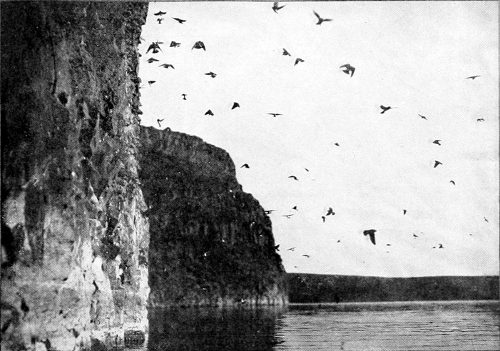
Taken in Douglas County. Photo by the Author. THE CLIFF DWELLERS.
Few birds serve to recall more accurately a picture of sequestered grandeur and primeval peace than do these amiable tenants of Washington’s [332] very limited scab lands. It is true that certain Cliff Swallows, following the example of their weaker eastern brethren, have taken to nesting under the eaves of churches and barns and outbuildings, but they are a negligible quantity in comparison with the swarms which still resort to the ancestral “breaks” of the Columbia gorge and the weird basaltic coulees of Douglas County.
The particular nesting site may be a matter of a season’s use, populous this year and abandoned the next; but somewhere along this frowning face of basaltic columns Swallows were nesting before old Chief Moses and his copper-colored clans were displaced by the white man. Soon after the retreating ice laid bare the fluted bastions of the Grand Coulee, I think, these fly-catching cohorts swept in and established a northern outpost, an outpost which was not abandoned even in those degenerate days when deer gave way to cayuses, cayuses to cattle, and cattle to sheep and fences—fences, mark you, on the Swallow’s domain!
Evidence of this age-long occupation of the lava-cliff is furnished not only by the muddy cicatrices left by fallen nests, but, wherever the wall juts out or overhangs, so as to shield a place below from the action of the elements, by beds of guano and coprolitic stalagmites, which cling to the uneven surface of the rock. Judged by the same testimony, certain of the larger blow-holes, or lava-bubbles, must be used at night as lodging places, at least out of the nesting season.
The well-known bottle- or retort-shaped nests of the Cliff Swallow are composed of pellets of mud deposited in successive beakfuls by the industrious birds. It is always interesting to see a twittering company of these little masons gathering by the water’s edge and moulding their mortar to the required consistency. Not less interesting is it to watch them lay the foundations upon some smooth rock facet. Their tiny beaks must serve for hods and trowels, and because the first course of mud masonry is the most particular, they alternately cling and flutter, as with many prods and fairy thumps they force the putty-like material to lay hold of the indifferent wall.
There is usually much passing to and fro in the case of these cliff-dwellers, and we can never hope to steal upon them unawares. When one approaches from below, an alarm is sounded and anxious heads, wearing a white frown, are first thrust out at the mouths of the bottles, and then the air becomes filled with flying Swallows, charging about the head of the intruder in bewildering mazes and raising a babble of strange frangible cries, as tho a thousand sets of toy dishes were being broken. If the newcomer appears harmless, the birds return to their eggs by ones and twos and dozens until most of the company are disposed again. At such a moment it is great sport to set up a sudden shout. There is an instant hush, electric, ominous, while every little Injun of them is making for the door of his [333] wigwam. Then they are dislodged from the cliff like an avalanche of missiles, a silent, down-sweeping cloud; but immediately they gain assurance in the open and bedlam begins all over again.
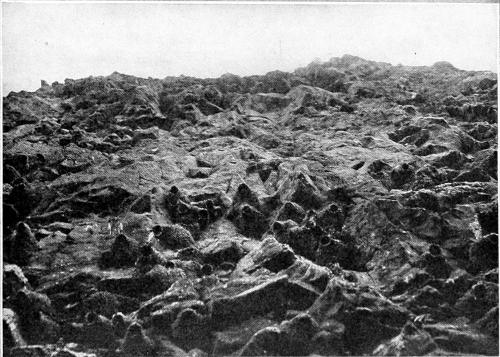
Taken in Douglas County. Photo by the Author. A NESTING CLIFF, FROM BELOW.
The Cliff Swallows are, of course, beyond the reach of all four-footed enemies, but now and again a June rain-storm comes at the cliff from an unexpected quarter and plays sad havoc with their frail tenements. Besides this (in strictest confidence; one dislikes to pass an ill word of a suffering brother) the nests are likely to be infested with bed-bugs. Not all, of course, are so afflicted, but in some cases the scourge becomes so severe that the nest is abandoned outright, and eggs or young are left to their fate. In spite of this compromising weakness, the presence of these Swallows confers an incalculable benefit upon the farmer of eastern Washington, in that they alone are able to cope with a host of winged insect pests. They race tirelessly to and fro across the landscape, weaving a magic tapestry of search, until it would seem that not a cubic inch of atmosphere remains without its invisible thread of flight.
[334]
No. 128. ROUGH-WINGED SWALLOW.
A. O. U. No. 617. Stelgidopteryx serripennis (Aud.).
Description.—Adult: Warm brownish gray or snuff-brown, including throat and breast; thence passing insensibly below to white of under tail-coverts; wings fuscous. Young birds exhibit some rusty edging of the feathers above, especially on the wings, and lack the peculiar, recurved hooks on the edge of the outer primary. Size a little larger than the next. Length 5.00-5.75 (127-146.1); wing 4.30 (109.2); tail 1.85 (47); bill from nostril .21 (5.3).
Recognition Marks.—Medium Swallow size; throat not white; warmish brown coloration, and brownish suffusion below fading to white on belly. It is easy to distinguish between this and the succeeding species if a little care is taken to note the general pattern of underparts.
Nesting.—Nest, in crevices of cliffs, at end of tunnels in sand banks, or in crannies of bridges, etc.; made of leaves, grasses, feathers, and the like,—bulky or compact according to situation. Eggs, 4-8, white. Av. size, .74 × .51 (18.8 × 13). Season: May 20-June 5, June 20-July 10; two broods.
General Range.—United States at large, north to Connecticut, southern Ontario, southern Minnesota, British Columbia, etc., south thru Mexico to Costa Rica. Breeds thruout United States range and south in Mexico.
Range in Washington.—Summer resident, of general distribution, save in mountains, thruout the State. More common east of the mountains, where it has taken a great fancy to banks of irrigating ditches, especially where abrupt.
Migrations.—Spring: First week in April; Tacoma, April 3, 1905, April 6, 1906 and 1908. Fall: c. Sept. 1.
Authorities.—Cotyle serripennis, Bonap. Baird, Rep. Pac. R. R. Surv. IX. pt. II. 1858, 314. C&S. L¹(?). L². Rh. Ra. J. B. E.
Specimens.—(U. of W.) Prov. P. B. E.
It not infrequently happens that some oversight, or want of discrimination, on the part of early observers condemns a species to long obscurity or unending misapprehension. The Bank Swallow was at once recognized by the pioneer naturalists of America as being identical with the well-known European bird, but it was not till 1838 that Audubon distinguished its superficially similar but structurally different relative, the Rough-wing. The cloak of obscurity still clings to the latter, altho we begin to suspect that it may from the first have enjoyed its present wide distribution East as well as West. Hence, in describing it, we take the more familiar Bank Swallow as a point of departure, and say that it differs thus and so and so.
In the first place it has those curious little hooklets on the edge of the wing (especially on the outer edge of the first primary)—nobody knows what they are for. They surely cannot be of service in enabling the bird to cling to [335] perpendicular surfaces, for they are bent forward, and the bird is not known to cling head-downward. It is easy to see how the bird might brace its wings against the sides of its nesting tunnel to prevent forcible abduction, but no one knows of a possible enemy which might be circumvented in this way.
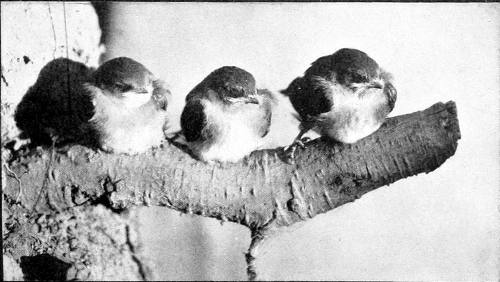
Taken in Oregon. Photo by H. T. Bohlman and W. L. Finley. BABY ROUGH-WINGS.
Again, the Rough-winged Swallow has a steadier, rather more labored flight than that of its foil. Its aerial course is more dignified, leisurely, less impulsive and erratic. In nesting, altho it may include the range of the Sand Martin, or even nest side by side with it, it has a wider latitude for choice and is not hampered by local tradition. If it burrows in a bank it is quite as likely to dig near the bottom as the top. Crevices in masonry or stone quarries, crannies and abutments of bridges or even holes in trees, are utilized. In Lincoln County where cover is scarce and the food supply attractive, I found them nesting along irrigating ditches with banks not over two feet high. One guileless pair I knew excavated a nest in the gravelly bank of an ungraded lot only three feet above the sidewalk of a prominent street, Denny Way, in Seattle. These birds were unsuccessful, but another pair, which enjoyed the [336] protection of some sturdy fir roots below ground, brought off a brood on Fifty-fifth Street, near my home.
Unlike the Bank Swallows, the Rough-wings do not colonize to any great extent, but are rather solitary. Favorable conditions may attract several pairs to a given spot, as a gravel pit, but when together they are little given to community functions.
These Swallows are pretty evenly distributed thruout the length and breadth of the State, save that they do not venture into high altitudes. Since they are so catholic in taste, it would seem that they are destined to flourish. They are possibly now to be considered, after the Cliff Swallow, the most numerous species. I found them regularly along the west Olympic Coast in the summer of 1906; and, with Mr. Edson, of Bellingham, in June, 1905, found a single pair nesting in characteristic isolation on Bare Island, off Waldron.
Further than this, the bird under consideration resembles the other bird quite closely in notes, in habits, and in general appearance, and requires sharp distinction in accordance with the suggestions given above under “Recognition Marks.”
No. 129. BANK SWALLOW.
A. O. U. No. 616. Riparia riparia (Linn).