Volume 1 — The Birds of Washington (continued 11)
Reading edition
Specimens.—C.
Woodpeckers of the Dryobates group are not migrants, but they are inclined to experiment, and so not infrequently turn up in their neighbors’ preserves. A specimen taken at Puyallup, December 25, 1895, must be regarded as a wanderer from the North, altho Brooks characterizes this form as regular at Sumas, B. C.
No. 164. HARRIS’S WOODPECKER.
A. O. U. No. 393c. Dryobates villosus harrisii (Aud.).
Description.—Similar to D. v. hyloscopus, but underparts light smoky brown or smoke-gray; sometimes narrowly streaked with black on sides; spotting on wing-quills still further reduced, that of wing-coverts usually wanting. Length of adult: 9.00-10.50 (228.6-266.7); wing 5.00 (127); tail 3.35 (85.1); bill 1.25 (31.8).
Recognition Marks.—Robin size; black-and-white pattern of head (with touch of scarlet on hind-neck of male); smoky below as compared with D. v. monticola or D. v. hyloscopus.
Nesting.—Nest: a hole about 25 feet up in a dead fir tree, lined with chips. Eggs: usually 4, crystalline white. Av. size, 1.05 × .74 (26.7 × 18.8).
General Range.—Pacific coast district from northern California north to southern Alaska.
Range in Washington.—West-side, resident, chiefly at lower levels; east slopes of Cascades, where intergrading either with D. v. homorus southerly (?) or D. v. monticola northerly.
Authorities.—Picus harrisii, Audubon, Orn. Biog. 1839, 191; pl. 417. Townsend, Narrative, (1839), p. 347. T. C&S. L¹. Rh. D¹. Kb. Ra. Kk. B. E.
Specimens.—U. of W. P. Prov. B. BN.
[422]
Dr. Cooper judged the Harris to be the most abundant Woodpecker in Western Washington; and this, with the possible exception of the Flicker (Colaptes cafer saturatior), is still true. The bird ventures well out upon the eastern slopes of the Cascade Mountains, and is found sparingly in the higher mountain valleys; but his favorite resorts are burns and the edges of clearings, rather than the depths of the woods. Altho he is resident the year around we are quite likely to overlook his presence until cold weather appears to quicken his pulses, and to send him careering noisily over the tree-tops. He has spent the night, it may be, in the heart of a fir stub at the end of his winter tunnel, and now he covers a half-wooded pasture with great bounds of flight, shouting, plick, plick, from time to time; and he gives a loud rolling call—a dozen of these notes in swift succession—as he pulls up in the top of a dead tree to begin the day’s work.
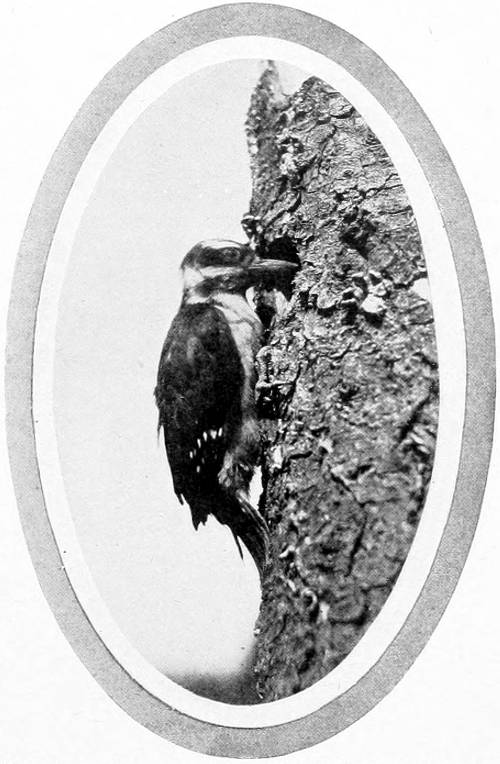
Taken in Oregon. Photo by Bohlman and Finley. HARRIS WOODPECKER.
He is an active fellow, hitching up or dropping down the tree trunk with brusque ease, and publishing his progress now and then in cheerful tones. But he knows how to be patient too. In the search for hidden worms and burrowing larvæ it seems not improbable that the Woodpecker depends largely upon the sense of hearing—that he practices auscultation, in fact. A meditative tap, tap, is followed by a pause, during which the bird apparently marks the effect of his strokes, noting the rustle of apprehension or attempted escape on the part of the hidden morsel. It is not unusual for the bird to spend a half hour tunneling for a single taste, and even then the wary game may withdraw along some tunnel of its own, even beyond the reach of the bird’s extensible tongue. But besides that which [423] must be secured from the bowels of the wood, there is much to be gleaned from the surface and in the crannies of the bark. The winter fare is also supplemented by cornel berries and the fruit of certain hardy shrubs.
It is a fair question whether the Harris Woodpecker did not get his dingy breast thru long association with his grimy grub cupboards. The dead trees which he frequents, where not actually blackened by fire, are often stained by decaying fungic growths and clinging spores, so that the snowy shirt-front of the eastern Hairy Woodpecker would be small satisfaction to him here. Or if this grimy condition of tree-trunk be not the terminus a quo the smoky front of the Woodpecker started, it is certainly the terminus ad quem its color is accurately tending. And, of course, it is easy to see how these conditions are due exactly to the humidity which prevails on the Pacific Coast, and to a lesser degree thruout the Cascades. The dry dirt of the Rocky Mountain pines is by comparison clean dirt, and so Dryobates villosus is able to take some decent pride in his linen as he proceeds eastward.
The Harris Woodpecker visits the winter troupes only in a patronizing way. He is far too restless and independent to be counted a constant member of any little gossip club, and, except briefly during the mating season and in the family circle, he is rarely to be seen in the company of his own kind.
The nest of this bird is usually placed well up in a small dead fir tree in some burn or slashing on dry ground. It is about ten inches deep and has no lining save fine chips, among which the crystal white eggs, four or five in number, lie partially imbedded. Incubation is begun from the last week in April to the last week in May, according to altitude, and but one brood is raised in a season. These Woodpeckers are exceptionally valiant in defense of their young, the male in particular becoming almost beside himself with rage at the appearance of an enemy near the home nest.
No. 165. DOWNY WOODPECKER.
A. O. U. No. 394 c. Dryobates pubescens medianus (Swains.).
Description.—Similar to D. v. monticola, but much smaller; wing-coverts heavily spotted with white,—a round blotch on tip of each feather; wing-quills and primary-coverts heavily spotted with white on both webs, the blotches on outer webs forming bars on the closed wing; tertials barred and tipped with white; the outer tail-feathers barred with black; underparts white or slightly soiled. Length of adult 6.25-7.00 (158.8-177.8); wing 3.75 (95.3); tail 2.60 (66.1); bill .66 (16.8).
Recognition Marks.—Sparrow size; black-and-white color pattern with [424] small size distinctive; red nape of male; heavily white-spotted on wings as compared with D. p. homorus; white below as compared with D. p. gairdnerii.
Nesting.—Does not breed in Washington. Nest: A hole in stub or decayed limb of tree, usually at moderate height, unlined. Eggs: 4-6, white. Av. size, .75 × .59 (19.1 × 15).
General Range.—Middle and northern portions of United States and northward; of casual occurrence in the Pacific Northwest.
Range in Washington.—One example, Seattle, Feb. 20, 1892, by S. F. Rathbun.
Authorities.—Dryobates pubescens (Linn.), Bendire, Life Hist. N. A. Birds, Vol. II. 1895, pp. 55, 56. Ra.
Specimens.—P¹(?). C. E.
On the 20th of February, 1892, Mr. S. F. Rathbun took what is considered to be a typical specimen, a female, of this species, near Seattle; and on the 23rd of March, 1896, I took one at Chelan which belongs either to this or to the more recently elaborated D. p. nelsoni. Apart from D. gairdnerii, whose center of distribution, at least, is pretty well known, great confusion exists in our knowledge of Dryobates pubescens and its varieties in the Northwest. Downy Woodpeckers are not migratory, but they rove considerably in winter, and the most we can say of these Washington specimens is that they point to the presence of D. pubescens or D. p. nelsoni, or both, as resident birds in British Columbia.
No. 166. BATCHELDER’S WOODPECKER.
A. O. U. No. 394b. Dryobates pubescens homorus (Cab.).
Synonym.—Rocky Mountain Downy Woodpecker.
Description.—Similar to D. p. medianus, but larger, clearer white below, and with less white spotting on wing, that of middle and greater coverts reduced or wanting. Length: 6.75-7.50 (171.5-190.5); wing 4.00 (101.6); tail 2.65 (67.3); bill .73 (18.5).
Recognition Marks.—As in preceding; white spotting of wing reduced as compared with D. p. medianus; underparts clear white as compared with D. p. gairdnerii.
Nesting.—Nest and Eggs as in preceding. Season: May; one brood.
General Range.—Rocky Mountain region of western United States and British Columbia, west to eastern slopes of Cascade-Sierra Range.
Range in Washington.—East-side, not uncommon resident, especially in [425] valleys of more heavily timbered section; intergrades with next form on eastern slopes of Cascades.
Authorities.—Dawson, Auk, Vol. XIV. 1897, p. 174. J. E(H).
Specimens.—U. of W. Prov.
In the nature of the case the line of demarcation cannot be clearly drawn between this species and the more abundant Gairdner’s. Specimens taken by Dr. J. C. Merrill, U. S. A., at Fort Sherman, Idaho, near our eastern boundary, were doubtfully referred to this subspecies, and really represent intergrades between homorus and gairdnerii. I have seen specimens in Spokane County which favored this form, in the whiteness of the underparts, much more strongly than gairdnerii.
Moreover, Batchelder’s Woodpecker, if it be he, is not nearly so common in the pine and larch districts of the extreme Northeast, as is the Rocky Mountain Hairy. In the course of a two-weeks’ trip along the Pend d’Oreille in May and June we encountered it only once. Bendire met with Downy Woodpeckers of some sort near Walla Walla, but found them of rare occurrence and confined to the willows of stream banks.
No. 167. GAIRDNER’S WOODPECKER.
A. O. U. No. 394a. Dryobates pubescens gairdnerii (Aud.).
Description.—Similar to D. p. homorus, but white spotting of wing still further reduced, usually wanting on coverts; underparts smoky gray; under tail-coverts spotted or barred with black. Length of adult about as in D. p. medianus.
Recognition Marks.—Sparrow size; black-and-white pattern of head; white back contrasting with black scapulars, etc.; much the commonest woodpecker; wing scarcely spotted as compared with D. p. medianus; underparts smoky as compared with D. p. homorus.
Nesting.—Nest: A hole, usually in deciduous tree, some 20 feet up. Eggs: 4-6, glossy crystalline white; rounded ovate in shape. Av. size, .74 × .56 (18.8 × 14.2). Season: c. May 1st; one brood.
General Range.—Pacific coast district from southern California north to British Columbia; extends somewhat beyond eastern slopes of mountain ranges southerly, shades into D. p. homorus along ridge of Cascades northerly.
Range in Washington.—West-side, common resident, especially in lowland groves and about clearings; occupies eastern slopes of Cascades southerly.
Authorities.—Picus gairdneri, Audubon, Orn. Biog. V. 1839, 317. T. C&S. Rh. Kb. Ra. D². Ss². Kk. B. E.
Specimens.—U. of W. Prov. B. E.
[426]
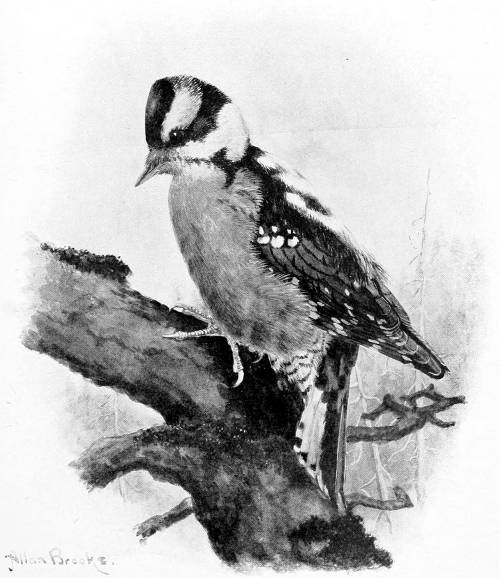
GAIRDNER WOODPECKER.
[427]
The local representative of the widespread Downy type is a perfect miniature of the more abundant Harris Woodpecker, even in flight and voice; and to the same causes must be attributed the soiling of a bosom once immaculate. Unlike his greater double, however, Gairdner’s Woodpecker is for the most part confined to deciduous timber, and shows a great preference for wooded bottoms and the borders of streams. Here his industrious tap, tap and cheery pink notes may be heard not alone from the trunks of trees, but from the smaller branches. These he traces to the very end in a search for lurking grub or nit.
The presence of this bird is a benediction in an orchard, for he inspects every niche and crevice of a fruit tree, and if he finds deep-seated troubles, the holes he drives are as necessary as the physician’s lancet. But folks still call them “sapsuckers,” and shoot their little benefactors. Such people should be fined, for a first offense; and the fine remitted only in case they agree to “read up.” For a second offense—Well, I believe in capital punishment myself.
The little Downies, strictly resident, as they are, wherever found, are not so hardly put to it to subsist in winter here as they are north and east. If grubs are scarce there are always edible berries and seeds to fall back on. Yet Gairdners relish nuts or a bit of suet hung out in winter time; and if the would-be patron be not too eager in first advances a very pretty friendship may be established in the course of a season.
Also, because of the season’s mildness, winter bird troupes are not such an important institution as in the frigid East. But wherever Kinglets, Juncoes, Creepers, Wrens, and Chickadees do associate together for benevolent offense and defense, there is Downy in the midst,—and one can hardly help adding (the Master would be the last to forbid it) “and that to bless.”
It is at times difficult to distinguish, in the case of the pink notes and the longer rattling call, between the voices of this bird and the Harris, but the notes of the smaller bird are usually much less in volume and strength, and have a rather more nasal quality. All Woodpeckers have also a sort of signal system, or Morse code, consisting of sundry tattoos on resonant wood. These calls are used principally, or exclusively, during the mating season, and consist, in the case of the Gairdner, of six or seven taps in regular and moderate succession. The birds have favorite places for the production of these sounds; and it is probable that birds are able to distinguish their calling mates by the timbre of the smitten wood, as well as by some subtle variation of tempo which escapes unfamiliar ears.
Gairdners place their nests at inconsiderable heights in deciduous trees, and those, if possible, among thick growths on moist ground. Both sexes assist in excavation, as in incubation. Partially decayed wood is selected [428] and an opening made about an inch and a quarter in diameter. After driving straight in an inch or two, the passage turns down and widens two or three diameters. At a depth of a foot or so the crystal white eggs are deposited on a neat bed of fine chips. Incubation lasts twelve days and the young are hatched about the 1st of June.
Mr. Bowles asserts that when a tree containing eggs is rapped the sitting bird will try, sometimes successfully, to deceive the inquirer by coming to the entrance and dropping out a mouthful of chippings, thus conveying the impression that she is still building. It’s a shame to give it away.
No. 168. WHITE-HEADED WOODPECKER.
A. O. U. No. 399. Xenopicus albolarvatus (Cass.).
Description.—Adult male: Body plumage and tail glossy black; wings dull black with large blotch of white on median portion of inner primaries and secondaries, and some disconnected white spotting distally; throat and entire head (not deeply) white; a scarlet patch on nape. Bill and feet slaty black; iris red. Female: Exactly as male without scarlet nuchal band. Length: 9.00-9.50 (228.6-241.3); wing 5.15 (130.8); tail 3.50 (88.9).
Recognition Marks.—Chewink to Robin size; white head unique.
Nesting.—Nest: A hole in live pine tree at moderate height. Eggs: 3-7, usually 4, pure white. Av. size, .95 × .71 (24.1 × 18). Season: June-July, according to altitude; one brood.
General Range.—Mountains of the Pacific Coast States north into British Columbia, east to Idaho and Utah.
Range in Washington.—Resident in the mountains, chiefly east of the Cascade summit.
Authorities.—Picus albolarvatus, Baird, Rep. Pac. R. R. Surv. IX. 1858, p. 97. C&S. D¹. D². J.
Specimens.—Prov. C.
There is a Gray’s Harbor record for this bird, but the occurrence is unique west of the Cascades. So far as our experience goes, the White-head is to be looked for only in the pine timber which clothes the eastern slopes of the Cascades and their outliers. The range of the species extends casually northward into British Columbia, but the southern boundary of Oregon is nearer its center of distribution, and the birds decrease rapidly in numbers north of the Peshastin Range in Washington.
At first glance we would say that this bird eschews protective coloration altogether, but Mrs. Bailey argues that even black and white are not very [429] conspicuous colors under our interior sun, and claims that the bird gains inattention from its very unbirdlikeness. Dr. Merrill, who made a most satisfactory study of this species near Fort Klamath in Oregon, regards the bird in winter as the very simulacrum of a broken branch strongly shadowed, and crowned with snow.
Concerning its food habits, Dr. Merrill says[71]; “I have rarely heard the Woodpecker hammer, and even tapping is rather uncommon. So far as I have observed, and during the winter I watched it carefully, its principal supply of food is obtained in the bark, most of the pines having a very rough bark, scaly and deeply fissured. The bird uses its bill as a crowbar, rather than as a hammer or chisel, prying off the successive scales and layers of bark in a very characteristic way. This explains the fact of its being such a quiet worker, and, as would be expected, it is most often seen near the base of the tree, where the bark is thickest and roughest. It must destroy immense numbers of Scolytidæ, whose larvæ tunnel the bark so extensively, and of other insects that crawl beneath the scales of bark for shelter during winter. I have several times imitated the work of this bird by prying off the successive layers of bark, and have been astonished at the great number of insects, and especially of spiders, so exposed. As a result of this, and of its habit of so searching for food, the White-headed Woodpeckers killed here were loaded with fat to a degree I have never seen equalled in any land bird, and scarcely surpassed by some Sandpipers in autumn.”
The White-headed Woodpecker is a quiet bird in manner and voice. I have never heard it utter a sound even in the presence of a nest robber but it is said to have “a sharp, clear ‘witt-witt’” which it uses after the fashion of the Harris Woodpecker, when it flies from tree to tree. The bird is quite wary; but when it cherishes suspicions, it flies away composedly, with no such air of ostentatious offense as Harris indulges on occasion.
The first nest reported from this State was found on July 22nd, 1896, in the valley of the Methow, where this Woodpecker is not at all common. The entrance showed like a clean-cut augur hole, one and five-eighths inches in diameter, driven in a live pine; and was reached conveniently from horseback. Four fresh eggs lay on a bed of chips, some eight inches down, and they were remarkable only for a somewhat uniform distribution of sparse, black spots,—probably dots of adherent pitch, derived from the chips, and soiled to blackness by contact with the sitting bird.
[430]
No. 169. ARCTIC THREE-TOED WOODPECKER.
A. O. U. No. 400. Picoides arcticus Swains.
Synonym.—Black-backed Three-toed Woodpecker.
Description.—Adult male: Upperparts glossy blue-black, duller on flight feathers; primaries and outer secondaries with paired spots of white on edges of outer and inner webs; a squarish crown-patch of yellow (cadmium orange); a small post-ocular spot of white, a transverse white cheek-stripe meeting fellow on forehead and cut off by black malar stripe from white of throat and remaining underparts; sides heavily barred or mingled with blue-black. Bill and feet plumbeous black; iris brown. Adult female: Like male, without yellow crown-patch. Length 9.00-10.25 (228.6-260.4); wing 5.25 (133.3); tail 3.50-4.00 (88.9-101.6); bill 1.25 (31.7).
Recognition Marks.—Chewink to Robin size; yellow crown-patch of male; back without white as compared with P. americanus fasciatus; and black of head continuous with that of back as compared with the Dryobates villosus group.
Nesting.—Not known to breed in Washington, but probably does so. Nest: hole in pine or fir stub, 10-18 inches deep. Eggs: 4-6, white, moderately glossed. Av. size, .96 × .72 (24.4 × 18.3). Season: last week in May, June; one brood.
General Range.—Northern North America from the Arctic regions south to northern tier of states, and in the Sierra Nevada to Lake Tahoe, south in New England and in Alleghany Mountains in winter, but breeding thruout western range.
Range in Washington.—Rare resident in coniferous forests of the central Cascades.
Authorities.—[“Black-backed three-toed woodpecker,” Johnson, Rep. Gov. W. T. 1884 (1885), 22.] Bendire. Life Hist. N. A. Birds, Vol. II. 1895, p. 74. E.
Specimens.—U. of W. Prov. C. E.
The Black-backed Woodpecker should occur in all our mountains, and especially upon the pine-timbered slopes of the eastern Cascades and in the Blue Mountains. It must, however, be considered rather rare, for we have never met with it afield, and have records of only two specimens, one taken at Glacier and the other near Lake Kichelas. The species is practically non-migratory and should breed wherever it occurs. It is ordinarily a very quiet bird, devoting itself assiduously to its search for tree-boring insects and their larvæ, chiefly Buprestidæ and Cerambycidæ; and at other than breeding seasons appears stolidly to ignore the presence of strangers. Its note is described as a sharp, shrill “chirk, chirk”; and it is besides a most persistent drummer, rattling away at a single station for [431] minutes at a time, so that the ornithologist who is suspicious may follow the lead from a half mile’s distance.
Nesting is chiefly at moderate heights—from two and a half to eight feet from the ground, Bendire says; so that there ought not to be any difficulty in studying this species once it is found.
No. 170. ALASKAN THREE-TOED WOODPECKER.
A. O. U. No. 401 a. Picoides americanus fasciatus Baird.
Synonym.—Ladder-backed Three-toed Woodpecker.
Description.—Adult male: Upperparts chiefly black, the back strongly barred with white, these bars more or less confluent centrally; flight-feathers marked with paired white spots, and wing-coverts sometimes more or less spotted with white; two central pairs of tail-feathers black, the next succeeding pair black mingled with white, and the remaining pairs pure white; a squarish yellow patch on crown; a distinct white post-ocular stripe extending to nape; a broad white stripe from lore to side of neck; underparts white, the sides and flanks heavily but narrowly barred with black. Bill and feet plumbeous black; iris brown. Adult female: Similar but without yellow crown patch; sometimes largely white on crown. Length of adult: 8.00-9.50 (203.2-241.3); wing 4.60 (116.8); tail 3.60 (91.4); bill 1.20 (30.5).
Recognition Marks.—Chewink to Robin size; lustrous black above with central white in broad bars; sides black-and-white barred.
Nesting.—Nest: In hole at various heights. Eggs: usually 4, white. Av. size, .92 × .70 (23.4 × 17.8). Season: June; one brood.
General Range.—Timbered mountains of northern Washington, British Columbia and Alaska.
Range in Washington.—Sparingly resident in northern Cascades.
Authorities.—Brewster, Auk, X. July, 1893, pp. 236, 237.
Specimens.—Prov. C.
This is a permanent resident of the Hudsonian zone on the Mt. Baker range both north and south of the international boundary; also at lower elevations on Vancouver Island and on Salt Springs Island, Gulf of Georgia. Further in the interior it is of irregular distribution, being in some districts replaced by Picoides arcticus, and in others occupying the same localities as that species. I have no records for arcticus west of the Cascade range. At one time I was convinced that the Alaskan Three-toed Woodpecker occupied a higher breeding zone than the Black-backed species (arcticus), but had to modify this opinion on finding a pair of fasciatus [432] breeding in the low hills back of Clinton, where one would hardly expect to find any three-toed woodpecker. Usually the species is found in the gloomy forests of balsam, spruce, and hemlock, and up to timber line. Here it is a silent bird, its tapping being usually the only sign of its presence.
The cry is a sharp cluck without the insistent ring of its allies of the Dyrobates group. In spring the usual chattering cry, common to so many woodpeckers, is heard, but this is more subdued and guttural than that of the Hairy Woodpecker. The males will also hang for hours on some dead spire beating the regular rattling tattoo of all true woodpeckers.
When shot, even if instantly killed, three-toed woodpeckers of both species have a marvelous faculty of remaining clinging to the tree in death. Where the trunks are draped with Usnea moss, it is impossible to bring one down, except when winged—then they attempt to fly, and fall to earth; but when killed outright they remain securely fastened by their strong curved claws. Repeated shots fail to dislodge them, and it is no joke to drop a big tree with a camp axe, as I have done, only to find at the finish that you cannot discover the object of your quest in the tangle of broken branches and dense rhododendron scrub. The only chance is to leave the bird and to visit the foot of the tree when the relaxing muscles have at length permitted the body to drop—usually within two days. Once I was fortunate enough to observe the exact position that enabled the bird to maintain its grip. I had shot and killed an Arctic Three-toed Woodpecker on a low stump. On going up I found the bird’s feet to be three inches apart by measurement; the tail was firmly braced, and the further the body was tilted back the more firmly the claws held in the bark.
Allan Brooks.
No. 171. RED-NAPED SAPSUCKER.
A. O. U. No. 402 a. Sphyrapicus varius nuchalis Baird.
Description.—Adult male: Pileum, throat, and nuchal band carmine (or poppy-red to crimson); crown and throat patches defined by black, narrowly on sides, broadly behind, the black border of throat below forming a conspicuous crescentic chest-band; a white streak over and behind eye, more or less continuous with black-and-white mottling of upper-back; a transverse stripe from nostril around throat and chest, and continuous with white of underparts; remaining upperparts black, variously spotted, banded, and blotched with white; middle coverts and upper tail-coverts nearly pure white, the first-named forming with the exposed edges of the greater coverts a broad white wing-band; underparts centrally pure white or flushed with sulphur-yellow; sides, flanks, and under tail-coverts [433] heavily barred, or marked chiefly in hastate pattern, with black. Bill and feet slaty black; iris brown. Adult female: Like male but carmine nuchal patch reduced or wanting; throat-patch reduced by white of chin. In young birds the areas of red are much reduced (wanting except on crown?) the throat being clouded with dusky instead. Length about 8.50 (215.9); wing 5.00 (127); tail 3.20 (81.3); bill 1.00 (25.4).
Recognition Marks.—Chewink size; highly variegated black, white, and red (and sometimes tinged with yellow below); red throat-patch defined by black (or white above in female) distinctive.
Nesting.—Nest: A gourd-shaped excavation in decaying wood of live aspen tree, 5 to 30 feet up; entrance 1½ inches wide; hole 8-10 inches deep; no lining. Eggs: 3-6, white, moderately glossed, ovate to elliptical ovate. Av. size, .90 × .67 (22.9 × 17). Season: June 1-15; one brood.
General Range.—Rocky Mountain and adjacent ranges from Arizona and New Mexico north to about Lat. 54° in Alberta and British Columbia; west to eastern slopes of Cascade Mountains in Washington and Oregon and to the Sierra Nevada; in winter south to Lower California and Mexico; casual in Kansas.
Range in Washington.—In general, in the hilly country of the northeastern part of the State and in the Blue Mountains; commonly along river bottoms in Stevens County; rare or casual on eastern slopes of the Cascades.
Authorities.—Bendire, Auk, Vol. V. July, 1888, 226. Sr¹. J.
Specimens.—Prov. C.
The western variety of the Yellow-bellied Sapsucker differs only slightly from the eastern bird in appearance, and not at all in disposition. Of varius I have already said[72]:
Before the maple sap has ceased running, our woods are invaded from the south by a small army of hungry Sapsuckers. The birds are rather unsuspicious, quiet, and sluggish in their movements. Their common note is a drawling and petulant kee-a, like that of a distant Hawk; but they use it rather to vent their feelings than to call their fellows, for altho there may be twenty in a given grove, they are only chance associates and have no dealings one with another. Starting near the bottom of a tree, one goes hitching his way up the trunk, turns a lazy back-somersault to reinspect some neglected crevice, or leaps out into the air to capture a passing insect. The bulk of this bird’s food, however, at least during the migration, is secured at the expense of the tree itself. The rough exterior bark layer, or cortex of, say, a maple, is stripped off, and then the bird drills a transverse series of oval or roughly rectangular holes through which the sap is soon flowing. The inner bark is eaten as removed and the sap is eagerly drunk. It is said also that in some cases the bird relies upon this sugar-bush to attract insects which it likes, and thus makes its [434] little wells do triple service. According to Professor Butler, an observer in Indiana, Mrs. J. L. Hine, once watched a Sapsucker in early spring for seven hours at a stretch, and during this time the bird did not move above a yard from a certain maple tap from which it drank at intervals.
Orchard trees suffer occasionally from this bird’s depredations, but the sap of pine or fir trees is its favorite diet and available the year around.
In nesting the Red-naped Sapsucker shows a marked preference for aspen trees and its summer range is practically confined to their vicinity. A nest found on the banks of the Pend d’Oreille, opposite Ione, was placed twenty-five feet up in an aspen tree some sixteen inches in diameter. The tree was dead at the heart but there was an outer shell of live wood two inches in thickness. The bird had penetrated this outer shell with a tunnel as round as an augur-hole, and an inch and a half in diameter, and had excavated in the soft heart-wood a chamber ten inches deep vertically, five and a half horizontally, and three from front to back. Here five eggs, “as fresh as paint,” reposed on the rotten chips. Like all, or most, Woodpecker eggs, these were beautifully transparent, with the position of the contained yolk clearly indicated. One egg was broken with a small round hole, as tho a careless claw had been stuck into it.
The parent birds, especially the male, who was caught on the eggs as tho inspecting the latest achievement, were very attentive, flying back and forth in neighboring trees, and giving utterance to the keé ah and other notes. After my descent from the ruined home, the male alighted beside the hole and tapped at the edges, as tho seeking in the sound of the wood explanation of the disaster.
No. 172. RED-BREASTED SAPSUCKER.
A. O. U. No. 403. Sphyrapicus ruber (Gmel.).
Synonym.—Red-breasted Woodpecker.
Description.—Adult male: Somewhat as in preceding but distinctive markings of head and neck and chest nearly obliterated by all-prevailing carmine which reaches well down on breast; marks alluded to most persistent in anterior portion of transverse (white) cheek-stripe and in black of lores; breast (posterior to carmine) and remaining underparts strongly suffused with yellow; white spotting of upperparts greatly reduced in area and oftenest tinged with yellow; white wing-bar fully persistent but often yellow-tinged—thus an evolved form of S. v. nuchalis, with which males are said to exhibit every degree of gradation. Adult [435] female: like male but duller. Young birds are said to be “gray with dull reddish suffusion as if the head had been dipped in claret wine.” Length, etc., as in preceding.
Recognition Marks.—Chewink size; bright crimson of head, “shoulders” and fore-breast distinctive; yellow underparts. Brighter than succeeding.
Nesting.—Nest and Eggs as in S. r. notkensis.
General Range.—Northern Lower California, the Pacific Coast States and British Columbia, save in northwestern portion where displaced by succeeding form; retires from northern portion of range in winter.
Range in Washington.—Summer resident and migrant chiefly along the eastern slopes of the Cascades, shading into succeeding form west of the divide.
Authorities.—[Lewis and Clark, Hist. Ex. (1814) Ed. Biddle: Coues, Vol. II. p. 185.] Bendire, Auk, Vol. V. July, 1888, p. 230. T. D¹.
Specimens.—U. of W.
It is all very well for the economic ornithologist to tell us that Sapsuckers are somewhat injurious to orchard trees, but the sight of one of these splendid creatures, dropping with a low cry to the base of a tree and hitching coquettishly up its length, is enough to disarm all resentment. From what spilled chalice of old Burgundy has the bird been sipping? Or from what baptism of blood has he lately escaped that he should be dyed red for half his length? Recrudescent mythology, ill at ease in these commercial times, nevertheless casts furtive glances at him, and longs to account in its inimitable way for the telltale color.
For myself, if young fruit trees will lure such beauty from the woods, I will turn orchardist. Nor will I begrudge the early sap from my choicest pippins. I am fond of cider myself, but there are worthier. Drink, pretty creature, drink!
Well, of course, there are biographical details; but what of it? Have you not yourself been so smitten with beauty that you forgot to inquire pedigree? Tut, now; you do not even remember a single sentence she said that day. But you remember her. Enough!
Once when the bird-man was camping on the Snoqualmie trail, this crimson vision appeared at the edge of a clearing, and proceeded to inspect our plant approvingly; and while the bird-man’s heart was in his mouth, it lit on the tent-post and gave it two or three inquiring raps. What need of details!
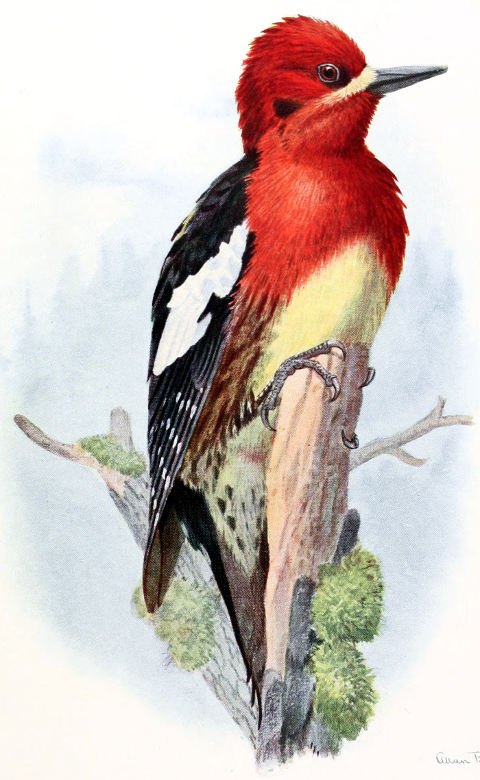
RED-BREASTED SAPSUCKER MALE, NEARLY LIFE SIZE From a Water-color Painting by Allan Brooks
[436]
No. 173. NORTHWEST SAPSUCKER.
A. O. U. No. 403 a. Sphyrapicus ruber notkensis Suckow.
Synonyms.—Northern Red-breasted Sapsucker. Crimson-headed Woodpecker.
Description.—Like preceding but darker, red a deep crimson or maroon purple. Original markings of S. varius nuchalis still further effaced. Av. measurements of two adults from Glacier: Length, 9.94 (252.5); wing 5.24 (133.1); tail 3.40 (86.4); bill 1.03 (26.2).
Recognition Marks.—Chewink size; dark crimson of head, neck, and breast distinctive.
Nesting.—Nest: An unlined cavity excavated in dead fir or living deciduous tree, usually at considerable height. Eggs: 5-7, white. Av. size, .92 × .69 (23.4 × 17.5). Season: May or June; one brood.
General Range.—Breeding in Northwest coast district of North America from Oregon to Sitka, Alaska; south in winter to southern California.
Range in Washington.—Summer resident west of the Cascades; also partially resident in winter.
Authorities.—Sphyrapicus ruber Baird, Baird, Rep. Pac. R. R. Surv. IX. 1858, pp. 104, 105. C&S. Rh. Ra. B. E.
Specimens.—P. Prov. B. E.
Victor Savings, of Blaine, pointed out a hole fifty feet up in a big fir stub as the Sapsucker’s nest. Soon the female flew to the entrance; whereupon the male bird emerged, gorgeous in crimson panoply, and flew away, the female taking his place on the eggs. After a bit Victor pounded on the tree to raise a possible Harris further up, for the tree above is riddled with nesting holes. The female Sapsucker promptly thrust out her head and studied the situation for five minutes or so, after which she dropped back content. The only notable thing about the nest externally was a round smooth patch, the size of a dollar, upon the tree about four inches below the nest, worn and polished by the tail-feathers of the alighting birds. Judged by this mark of identification, only one of the unused holes above belonged to the Sapsucker; the remainder to the Harris Woodpecker.
The stub commands a view of the Savings’s orchard, where, Victor says, the Sapsuckers do immense damage, especially to the pear trees. This nesting tree was sixteen feet around at the base, above the root bulge, and perfectly desolate of limbs. Fortunately, also, it had long since disposed of its shaggy coat of bark,—fortunately, I say, for when a fir stub sheds its fir coat it does so suddenly, and great is the fall thereof.
It was a far cry up that barren shaft with one knew not what possibilities of [437] defeat at the end of it; but, of course, if one wanted eggs, one had to go after them. First, we laid out a liberal supply of stout two-foot fir cleats, and a couple of pounds of small spikes. A ladder gave us a twenty-foot start, after which I nailed up the cleats with the aid of a three-quarter-inch rope passed round the tree and my body. My companion at the bottom of the tree supplied building materials which I hoisted from time to time by means of another rope.
In this laborious fashion the nest was reached. The birds, meanwhile, having become increasingly anxious, made frequent approaches from a neighboring tree, crying, kee-a, kee-aa, in helpless bewilderment. Several times they lighted near the scene of operations, but were frightened off by the resounding blows of the hand-axe. When all was over, they raised a high, strong qué-oo,—qué-oo, never before heard, and reminding one generically of the Red-headed Woodpecker of boyhood days.
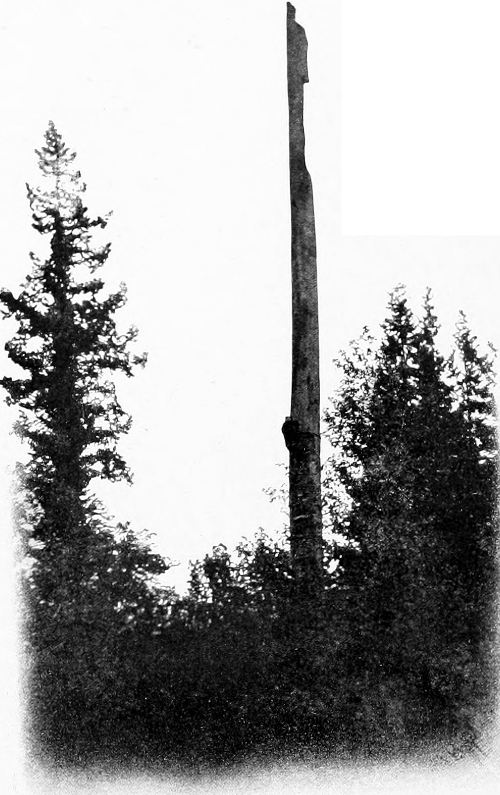
Taken near Blaine. Photo by Victor Savings. NESTING SITE OF THE NORTHWEST SAPSUCKER.
By the time I had a hole large enough to thrust in the hand, the eggs were quite buried in chips and rotten wood. But when they were uncovered, they were seen to lie, seven of them, in two regular lines, four in the front rank with sides touching evenly, and three in the rear with points dove-tailed between. There was, of course, no lining for the nest, save the rotten wood itself. The eggs were perfectly fresh and had a warm pink tint before the contents were [438] removed. Their surface is highly polished, and their texture varied, giving an effect as of water-marked linen paper, in heavy branching lines and coarse frost-work patterns.
No. 174. WILLIAMSON’S SAPSUCKER.
A. O. U. No. 404. Sphyrapicus thyroideus (Cass.).
Synonyms.—Williamson’s Woodpecker. Red-throated Woodpecker (male). Brown-headed Woodpecker (female). Black-breasted Woodpecker (female).
Description.—Adult male: In general glossy black including wings and tail; throat, narrowly, scarlet; belly gamboge yellow; sides, flanks, lining of wings and under tail-coverts more or less mingled with white,—black-and-white barred, or marked with black on white ground; a broad oblique bar on wing-coverts and small more or less paired spots on wing-quills and upper tail-coverts, white; a white post-ocular stripe and a transverse stripe from extreme forehead passing below eye to side of neck. Bill slaty; feet greenish gray with black nails; iris dark brown. Adult female: Very different; in general, closely barred black-and-white, or black-and-brownish; breast only pure black, in variable extent; whole head nearly uniform hair-brown, but showing traces of irrupting black; post-ocular stripe of male faintly indicated and occasionally with touch of red on throat; some intermediate rectrices black but exposed surfaces of central and outer tail-feathers black-and-white barred; white spots of wing-quills larger, paired, and changing to bars on inner quills. Young male: Like adult male, but black not glossy; belly paler; throat white. Young female: Like adult female but barring carried across head, neck, throat, and breast. Length of adult: 9.00-9.75 (228.6-247.6); wing 5.25 (133.3); tail 3.80 (96.5); bill .90-1.15 (22.9-29.2).
Recognition Marks.—Small Robin size; fine barring of female distinctive; extensive black of male with white head-stripes, white rump (upper tail-coverts) and white wing-bar; pattern of underparts (in male) clearly a modification of that of S. v. nuchalis, but red of throat much reduced, and black much extended.
Nesting.—Nest: A hole excavated by birds at any height in live deciduous tree or dead conifer. Eggs: 3-7, usually 4, white. Av. size, .96 × .67 (24.4 × 17). Season: May-June; one brood.
General Range.—Western United States chiefly in mountains and foothills from eastern slopes of the Rocky Mountains to western slopes of Sierra-Cascades, breeding from mountains of Arizona and New Mexico north to British Columbia (in the valley of the Okanagan); south in winter to Southwestern States and Mexico.
Range in Washington.—Summer resident chiefly on eastern slopes of the Cascades.
Authorities.—Bendire, Life Hist. N. A. Birds, Vol. II. 1895, p. 97. D².
Specimens.—C.
[439]
Over and beyond the interest of life, which is always the greatest charm of an animal, be it bird or snail, a curious interest attaches to many creatures thru some accident of discovery, some misapprehension, or neglect, or absurd surprise,—the historical interest, humanly considered. Now the amusing thing about Williamson Sapsuckers, male and female, is that ages after God had joined them together man snatched them rudely asunder, thrusting Mr. Williamson into one pigeon-hole, labeled williamsonii, and Mrs. Williamson—under a vernacular alias of Brown-headed Woodpecker—since she was indiscreet enough to flit out alone one day, into another, labeled Picus thyroideus. This legal crime, which was committed in the probate court of ornithological inexperience in 1853 and 1857, was not corrected until 1873, when Mr. Henshaw caught a pair of these really very dissimilar birds innocently conspiring to set the decree of a blundering divorce court at naught.
Of the occurrence of this species in Washington, there is little to be said. There is a record for British Columbia, Similikameen, June, 1882, by R. V. Griffin, whence Bendire evidently assumes its presence along the eastern slope of the Cascade Mountains in Washington. I am aware of only one published instance[73], recording a female narrowly observed by myself at the Yakima Soda Springs, on August 9, 1899. Besides that we have obtained momentary glimpses of others in the Stehekin Valley in three successive seasons, 1906-1908.
Bendire notes that these Sapsuckers are like the other species in habit, except that they are not at all confined to deciduous trees, and that they are found (in Oregon, California, and Colorado) at the higher levels, from 5000 feet up. So far, we have found them in Washington only at altitudes of 1000 to 1500 feet.
No. 175. NORTHERN PILEATED WOODPECKER.
A. O. U. No. 405 a. Phlœotomus pileatus abieticola (Bangs).
Synonyms.—Logcock. Cock-of-the-Woods. Black Woodcock.
Description.—Adult male: General plumage sooty black, lusterless save on wings and back; whole top of head and lengthened crest bright red; red malar stripes changing to black behind, and separating white spaces; chin and upper throat white; also a white stripe extending from nostrils and below eye to nape, and produced downward and backward to shoulder; narrow white stripe over and behind eye; lining and edge of wing, and a large spot (nearly concealed) at base of primaries, white; black feathers of sides sparingly white-tipped; bill dark plumbeous above, lighter below, save at tip; feet black. In some specimens the [440] whites are everywhere tinged with pale sulphur-yellow, the color being especially noticeable in the axillaries and lining of wings. Adult female: Similar, but black on forehead, and black instead of red malar stripes. Length 15.50-19.00 (393.7-482.6); wing 8.50-10.00 (215.9-254); tail 5.85-7.40 (148.6-188); head 4.50-5.50 (114.3-139.7); bill 1.75-2.65 (44.5-67.3).
Recognition Marks.—Largest size; black, white and red on head in stripes; body mainly black.
Nesting.—Nest: high in dead trees. Eggs: 4-6, white. Av. size, 1.29 × .94 (32.8 × 23.9). Season: May; one brood.
General Range.—Formerly the heavily wooded regions of North America south of about latitude 63°, except in the southern Rocky Mountains. Now rare or extirpated in the more settled parts of the Eastern States.
Range in Washington.—Not uncommon resident in larger coniferous forests thruout the State.
Authorities.—[Lewis and Clark, Hist. Ex. (1814) Ed. Biddle: Coues, Vol. II. p. 185.] Hylatomus pileatus Baird, Baird, Rep. Pac. R. R. Surv. IX. 1858, p. 107. T. C&S. L². Rh. D¹. Ra. Kk. B. E.
Specimens.—U. of W. P. Prov. B. BN.
One’s first acquaintance with this huge black fowl marks a red-letter day in woodcraft, and it is permitted the serious student to examine the bird anatomically just once in a life-time. The scarlet crest attracts first attention, not only because of its brilliancy, but because its presence counterbalances the bill, and imparts to the head its hammer-like aspect. This crest was much sought after by the Indians of our coast, and figured prominently as a personal decoration in their medicine dances, as did the bird itself in their medicine lore. A measurement of twenty-eight inches from wing-tip to wing-tip marks the size of this “Black Woodcock,” while the stiffened tail-feathers with their down-turned vanes show what adequate support is given the clinging claws when the bird delivers one of its powerful strokes. The bill is the marvel. Made apparently of horn, like other birds’ bills, it has some of the attributes of tempered steel. The bird uses it recklessly as both axe and crowbar, for it hews its way thru the bark of our largest dead fir trees, in its efforts to get at the grubs, which have their greatest field of activity between the bark and the wood. It pries off great chips and flakes by a sidewise wrench of its head. A carpenter is known by his chips, but no carpenter would put his chisels to such hard service as the bird does his. As a result there is no mistaking the bark pile which surrounds the base of certain old stubs in the forest for the work of any other agency.
Possibly the most interesting of all is the Log-cock’s tongue, which it is able to protrude suddenly to a distance of four or five inches beyond the tip of its beak. This provision enables the bird to economize labor in the tracking of buried sweets, and the arrangement is made possible by the great [441] development of the hyoid bones with their muscular attachments. These extend backward from the base of the tongue over and around the skull, nearly to the upper base of the bird’s bill again.
The great forest fires which have ravaged our State have proved a god-send to the Woodpeckers, altho they are in no way responsible for them. The Pileated Woodpecker does his share in staying the ravages of the wood-working insects, but he is even more interested in the spoliation of fallen logs and so hastens rather than retards decay. A pair of these Woodpeckers will gradually tear a rotten log to pieces in pursuit of the grubs and wood-boring ants which it harbors. They are shy or confiding just in proportion to the amount of persecution which they have been called upon to endure. I have waited half a day trying to get a specimen, and again I have sat under a shower of chips or ogled a busy pair in the open at forty feet.
The Log-cock has a variety of notes, and one who learns them will find the bird much more common than he may have supposed. The most noteworthy of these is a high-pitched stentorian call, which is not exactly laughter, altho something like it in form, hü ha ha ha ha ha ha ha hü. “At a distance this call sounds metallic; but when at close range it is sent echoing thru the forest, it is full and clear, and it is the most untamably wild sound among bird notes.”
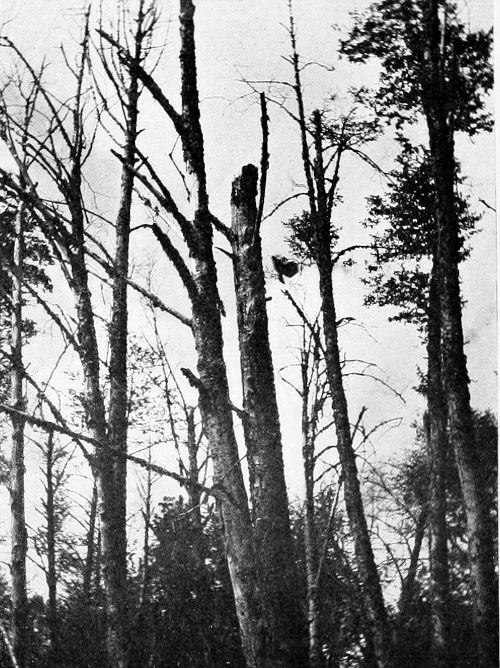
Taken in Pierce County. Photo by J. H. Bowles. PILEATED WOODPECKER LEAVING NEST.
In this connection wish to mention a mysterious sound which I have several times heard in the depths of [442] the western forest, but to whose authorship I have no clew unless it proceeds from this bird. The note comes from well up in the trees, and is repeated slowly, after little intervals, and with a sort of funereal solemnity. If I venture to literate it, the letters are to be thought rather than said,—or better still, thought while whistled in a low key (si) poolk(ng) - - - (si)poolk(ng) - - (si)poolk(ng). Who will “riddle me this mystery”?
The Pileated Woodpecker chisels out its nesting hole at any height in dead timber, whether of fir, pine, spruce, or other. It nests regularly in this State, but the taking of its eggs is something of a feat; so, in default of much-coveted “luck,” we fall back on Bendire[74]: “From three to five eggs are usually laid to a set, but I have seen it stated that the Pileated Woodpecker often laid six, and that a nest found near Farmville, Virginia, contained eight. An egg is deposited daily, and incubation begins occasionally before the set is completed, and lasts about eighteen days, both sexes assisting in the duty, as well as in caring for the young. Like all Woodpeckers the Pileated are very devoted parents, and the young follow them for some weeks after leaving the nest, until fully capable of caring for themselves. Only one brood is raised in a season. The eggs of the Pileated Woodpecker are pure china-white in color, mostly ovate in shape; the shell is exceedingly fine-grained and very glossy, as if enameled.”
No. 176. LEWIS’S WOODPECKER.
A. O. U. No. 408. Asyndesmus lewisi Riley.
Synonym.—Black Woodpecker.
Description.—Adults: Above shining black with a greenish bronzy luster; “face,” including extreme forehead, space about eye, cheeks, and chin, rich crimson; a collar around neck continuous with breast hoary ash; this ashy mingled intimately with carmine, or carmine-lake, on remaining underparts, save flanks, thighs and crissum, which are black; feathers of nape and underparts black and compact at base but finely dissected on colored portion of tips, each barb lengthened and bristly in character. Bill and feet black; iris brown. Young birds lack the crimson mask and hoary collar; the underparts are gray mingled with dusky below, with skirtings of red in increasing abundance according to age. Length of adult: 10.00-11.00 (254-279.4); wing 6.75 (171.5); tail 4.50 (114.3); bill 1.20 (30.5).
Recognition Marks.—Robin size; shining black above, hoary collar and breast; red mingled with hoary ash on underparts distinctive.
[443]
Nesting.—Nest: in hole excavated in dead tree, usually at considerable height. Eggs: 5-9, white, slightly glossed. Av. size, 1.03 × .80 (26.2 × 20.3). Season: third week in May to first week in June; one brood.
General Range.—Western United States from the Black Hills and the Rocky Mountains to the Pacific, and from southern British Columbia to southern Alberta, south to Arizona, and (in winter) western Texas. Casual in Kansas (A. O. U.).
Range in Washington.—Summer resident in timbered sections (Arid Transition and lower Canadian life-zones) east of the Cascades; especially partial to cottonwood timber lining the larger streams; locally distributed or colonizing west of the mountains, chiefly in burns.
Authorities.—[Lewis and Clark, Hist. Ex. (1814), Ed. Biddle; Coues, Vol. II., p. 187]. Melanerpes torquatus, Bonap. Baird, Rep. Pac. R. R. Surv. IX., 1858, p. 116. T. C&S. L². D¹. Kb. Ra. D². Ss¹. Ss². Kk. J. B. E.
Specimens.—U. of W. P. Prov. C. E.
Not the least strange of the many new creatures discovered by a famous expedition of a hundred years ago was this curious black Woodpecker, which Wilson named torquatus (collared), but which soon became known by the name of the intrepid leader, Captain Meriwether Lewis. In habit and appearance the bird combines Crow, Jay, Woodpecker, Flicker, and Flycatcher. It is perhaps as flycatcher that we know him best, as we see him sail out from the summit of a cottonwood or towering pine-tree and make connection with some object to us invisible. If the insects are flying freely, the bird may conclude to remain aloft for a few minutes, fluttering about in great watchful circles, ready for momentary dashes and adroit seizures. A dozen of his fellows may be similarly engaged in the same vicinity, for Lewis is ever a sociable bird, and when he returns to his perch he will raise a curious raucous twitter, a rasping, grating, obstructed sound, which is his best effort at either conversation or song.
In passing from tree to tree the Woodpecker presents a Crow-like appearance, for it moves with a labored, direct flight, which is quite different from the bounding gait so characteristic of many of its real kinfolk. In alighting, also, the bird is as likely to bring up on top of a limb, in respectable bird-fashion, as to try clinging to the tree trunk.
Lewis Woodpeckers are rather wary, and if one starts out to secure a specimen, he is surprised to note how the birds manage to edge off while still out of range, and to fly away across the tree-tops rather than trust themselves to the lower levels. It is well worth one’s while to examine a specimen, because of the exceptional character of the bird’s plumage. The hoary ash of the collar contrasts strikingly with the glossy green of the upperparts, while the rich crimson, mingled with ashy, below, serves to emphasize the extraordinary hair-like character of the feathers themselves. If it had been [444] a Sapsucker, now, or a Harris, we could readily understand how the abdominal plumage might have been teased to rags thru constant friction with rough bark; but this lazy Jack-of-all-trades, who is more flycatcher than true woodpecker, how did he get his under-plumage so fearfully mussed?
For all the Black Woodpecker keeps largely to the tops of trees, it is not averse to ground-meats, and where unmolested, will descend to feed with Cousin Flicker upon crickets, geotic beetles, or fallen acorns. Grasshoppers are a favorite food, and during the season of their greatest abundance the bird requires little else. Service-berries are a staple in season, wild strawberries are not often neglected, and the bird has been known to filch a cherry now and then. Indeed, it is noteworthy that in certain fruit-growing sections, such as the Yakima Valley, Black Woodpeckers have increased in numbers of late. It must not be hastily concluded on this account that the Woodpecker is a menace to the orchard. He earns what he eats. Orchards attract insects, and insects attract birds. Which will you have, no birds, more insects, and so, eventually, no fruit? or more birds, fewer insects, and enough fruit for all?
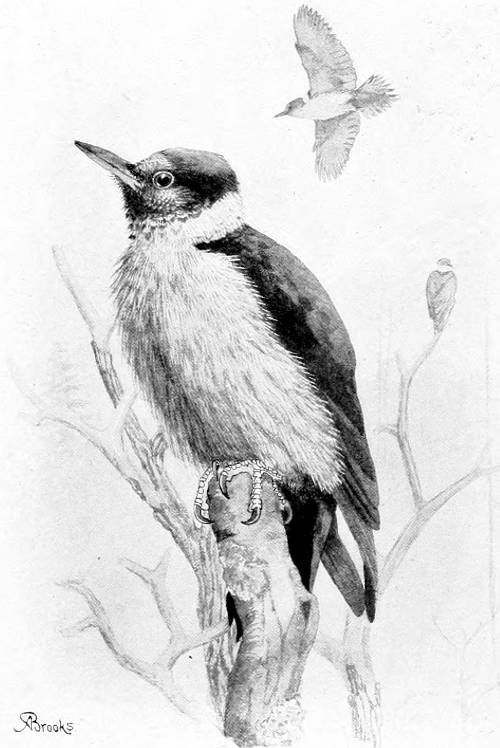
LEWIS WOODPECKER.
The occurrence of the Black Woodpecker west of the Cascades is [445] subject to little-understood fluctuations. One year the birds will abound in a certain section, while the year following none are seen. Whether this is because the local food supply has become exhausted with a season’s foraging, or whether the birds are simply whimsical in choice, we do not know. Doubtless, in any event, the rapid opening up of new territory, thru the cutting and partial burning of timber, has provided a field of opportunity too large for the species to fully occupy. With such wealth before them the early colonists may naturally have become a little saucy.
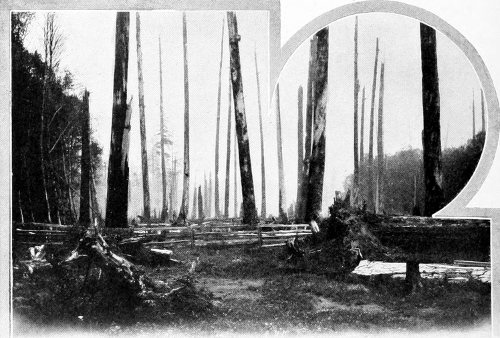
Taken in Whatcom County. Photo by the Author. AN OLD BURN SUCH AS LEWIS WOODPECKERS DELIGHT IN.
[446]
No. 177. YELLOW-SHAFTED FLICKER.
A. O. U. No. 412a. Colaptes auratus luteus Bangs.
Synonyms.—Flicker. Northern Flicker. Golden-winged Woodpecker. Yellow-hammer. High-hole. High-holder. Pigeon Woodpecker. Wake-up.
Description.—Adult male: Top of head and cervix ashy gray, with a vinaceous tinge on forehead; a bright scarlet band on the back of the neck; back, scapulars, and wings vinaceous gray with conspicuous black bars, brace-shaped, crescentic or various; primaries plain dusky on exposed webs; lining of the wing and shafts of the wing-quills yellow; rump broadly white; upper tail-coverts white, black-barred in broad, “herring-bone” pattern; tail double-pointed, black, and with black shafts on exposed upper surface; feathers sharply acuminate; tail below, golden-yellow and with yellow shafts, save on black tips; chin, sides of head, and throat vinaceous, enclosing two broad, black, malar stripes, or moustaches; a broad, black, pectoral crescent; remaining underparts white with heavy vinaceous shading on breast and sides, everywhere marked with sharply defined and handsome round, or cordate, spots of black. Bill and feet dark plumbeous. Adult female: Similar, but without black moustache. Sexes about equal in size. Length 12.00-12.75 (304.8-323.9); av. of thirteen specimens: wing 6.13 (155.7); tail 4.34 (110.2); bill 1.34 (34).
Recognition Marks.—Size not comparable to that of any better known bird; scarlet nuchal band; yellow “flickerings” in flight; pectoral crescent; white rump; black-spotted breast, etc.
Nesting.—Does not breed in Washington. Nest: an excavation in a tree or stump, usually made by the bird, at moderate heights; unlined, save by chips. Eggs: 4-10, usually 7 or 8, glossy white. Av. size, 1.09 × .85 (27.7 × 21.6).
General Range.—Northern and eastern North America, west to the eastern slope of the Rocky Mountains and Alaska. Occasional on the Pacific slope from California northward. Accidental in Europe.
Range in Washington.—Casual during migrations—a straggler from Alaska.
Authorities.—Dawson, Auk, Vol. XXV., Oct. 1908, p. 484.
Specimens.—Prov. E.
The true Yellow-shafted Flicker, the familiar bird of the Eastern States, is occasionally taken as a straggler during the fall migrations. Mr. D. E. Brown took a typical specimen at Glacier, in 1904, and Mr. Victor Savings, of Blaine, has shot one and seen several others. A specimen in Mr. Rathbun’s collection was taken by Mr. Matt. H. Gormley, on Orcas Island, October 15, 1903. The bird is a male and is typical save for the faintest possible tinge of salmon in the yellow, which marks him as a border-line specimen, probably a British Columbian bird which did not deflect eastward sufficiently in the autumn retreat.
[447]
According to Nelson, this bird is abundantly distributed thruout the timbered portions of Alaska, west even to the neighborhood of Bering Straits, and it is only surprising that so few of them come straight south to winter.
Upon the eastern borders of the range of C. cafer, viz., upon the eastern slopes of the Rocky Mountains in British Columbia, Idaho, Montana, and southward, specimens showing mixed characters of cafer and auratus are found—in such numbers, indeed, that they were formerly given a distinctive name, Colaptes hybridus Baird. This half-breed stock is perhaps the most interesting example of hybridization in American ornithology, presenting, as it does, not the familiar border-line of types being differentiated by varying environment, but the re-amalgamation of related types, differentiated ages ago from a common stock, presumably in Mexico.
No. 178. RED-SHAFTED FLICKER.
A. O. U. No. 413. Colaptes mexicanus collaris (Vigors).
Synonyms.—Red-winged Woodpecker. High-holder. “Yellow-hammer.” Pigeon Woodpecker.
Description.—Adult male: Similar to C. auratus luteus, but yellow of feather-shafts, etc., replaced by orange-vermillion; cast of upper plumage correspondingly reddish (very faintly, a mere vinaceous tinge to the brown); no scarlet nuchal patch; a broad malar stripe of scarlet (replacing the black stripe of C. a. luteus); sides of head and throat clear bluish ash; underparts tinged with lilaceous. Adult female: Like male but scarlet malar stripe replaced by brown. Between this and Colaptes auratus luteus every form of gradation exists. Hybrids (for such they really are) most frequently reveal themselves by the presence of three scarlet patches (in the male), i. e., two malar and one nuchal. Length: averaging larger than C. a. luteus, up to 14.00 (355.6); wing 6.90 (175.3); tail 5.00 (127); bill 1.50 (38.1).
Recognition Marks.—Little Hawk size; brown finely barred with black above; underparts heavily spotted with black; flame-color of under wing surface prominent in flight; scarlet malar stripe of male distinctive; lighter than succeeding.
Nesting.—Much as in C. a. luteus, and eggs indistinguishable. For nesting sites makes use of wooden buildings or earth-banks in default of trees. Season: May; one brood, rarely two.
General Range.—Western United States and British Columbia from the Rocky Mountains to the Pacific and south into northern Mexico, giving place to succeeding form on northwest coast slopes, to C. chrysoides in extreme southwest, and hybridizing with C. auratus luteus in northeastern and northern portion of range.
Range in Washington.—East-side, common summer resident and migrant, [448] found to timber-line in the Cascades, where shading into next; partially resident in winter.
Authorities.—[Lewis and Clark, Hist. Ex. (1814) Ed. Biddle: Coues, Vol. II., p. 185]? C. cafer, Allen, B. N. O. C. VI. (1881), p. 128. (T). L¹.(?) D¹. Sr. D². Ss¹. Ss². J. B.
Specimens.—(U. of W.) P¹. Prov. B. BN.
Nature has not dealt justly with the East-side Flicker in the matter of providing an abundance of dead timber for nesting sites. What more natural, then, than that the stinted bird should joyfully fall upon the first “frame” houses and riddle them with holes? The front door of a certain country parsonage near North Yakima testifies to at least one pastoral vacation, by the presence of three large Flicker holes in its panels. The church hard by is dotted with tin patches which conceal this bird’s handiwork; and the mind recalls with glee how the irreverent Flicker on a summer Sunday replied to the parson’s fifthly, by a mighty rat-at-at-at-at on the weather siding. The district schoolhouse of a neighboring township is worst served of all, for forty-one Flicker holes punctuate its weather-beaten sides—reason enough, surely, for teaching the young idea of that district how to shoot. Indeed, the school directors became so incensed at the conduct of these naughty fowls that they offered a bounty of ten cents a head for their destruction. But it is to laugh to see the fierce energy with which these birds of the plains, long deprived of legitimate exercise, fall to and perforate such neglected outposts of learning. The bird becomes obsessed by the idea of filling a particular wall full of holes, and no ingenuity of man can deter him. If work during union hours is discouraged, the bird returns stealthily to his task at four a. m., and chisels out a masterpiece before breakfast. If the gun speaks, and one bird falls a martyr to the sacred cause, another comes forward promptly to take his place, and there is always some patriotic Flicker to uphold the rights of academic research.
Of course the situation is much relieved in the timbered foothills and along the wooded banks of streams, where rotten stubs abound. The Flicker is at home, also, to the very limit of trees in the Cascade Mountains. Nests are ordinarily excavated late in April, and any tree or stump may serve as host. In Okanogan County I saw a Flicker’s nest in a stump only two feet high, and its eggs rested virtually upon the ground. Others occur in live willows, cottonwoods, and apple trees, as well as in dead pines—the last named occasionally at a height of sixty or seventy feet. They nest also in the walls of buildings, in which case they lug in the chips to lay on beam or sill, and so prevent the eggs from rolling. In Chelan County a nest was found in a bank of fine earth among those of a colony of Bank Swallows. True to tradition the birds had gone downward after entering this bank. Excavation proved to be such a pleasant task that they had dug a hole not only eighteen inches deep but two feet long and one wide, measured horizontally. Three cubic feet of earth these industrious [449] birds had removed, not after the familiar pick and kick fashion of most bank delving species, but by the beakful, as Woodpeckers should.
From six to ten highly polished, semi-transparent, white eggs are laid upon the rotten wood or chips, which usually line a nest; and incubation begins customarily when the last egg is laid. Bendire notes an instance, in the Blue Mountains of Oregon, of a Flicker’s nest which contained at one time three young birds just hatched, two pipped eggs, and five perfectly fresh eggs, of which one was a runt.
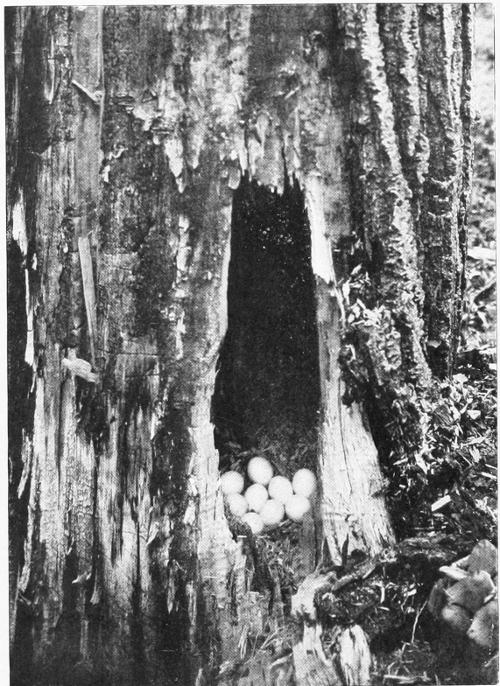
Taken in Oregon. Photo by A. W. Anthony. NEST AND EGGS OF RED-SHAFTED FLICKER.
The female is a close sitter and instances are on record where pebbles dropped in upon her have failed to dislodge her, or where once being lifted off she brushed passed the disturber to re-enter the nest. Altho provided with a bill which might prove a formidable weapon, the Flicker is of too gentle a nature to wield it in combat, and seldom offers any resistance whatever to the intruder.
After fourteen days young birds are hatched, blind, ugly, helpless. In a few days more, however, they are able to cling to the sides of the nesting [450] hollow, and are ready to set up a clamor upon the appearance of food. This noise has been compared to the hissing of a nest of snakes, but as the fledglings grow it becomes an uproar equal to the best efforts of a telephone pole on a frosty morning.
The young are fed entirely by regurgitation, not an attractive process, but one admirably suited to the necessities of long foraging expeditions and varying fare. When able to leave the nest the fledglings usually clamber about the parental roof-tree for a day or two before taking flight. Their first efforts at obtaining food for themselves are usually made upon the ground, where ants are abundant. These with grasshoppers and other ground-haunting insects make up a large percentage of food, both of the young and adults. It will appear from this that the Red-shafted Flicker is not only harmless but decidedly beneficial—save in the matter of hostility to school boards, above mentioned.
No. 179. NORTHWESTERN FLICKER.
A. O. U. No. 413 a. Colaptes mexicanus saturatior Ridgway.
Description.—Like C. m. collaris but darker; ground color of upperparts burnt umber with a purplish tinge; ground color of underparts vinaceous buff to color of back; sides of head and throat deep smoke-gray; pileum cinnamomeous. Specimens in the Provincial Museum at Victoria indicate hybridization between this form and C. auratus luteus. Of twenty-seven males from Vancouver Island nine possess in whole or in part the scarlet nuchal patch characteristic of auratus. Length up to 14.00 (355.6); av. of five Glacier specimens: wing 6.55 (166.4): tail 5.13 (130.3); bill 1.55 (39.4).
Recognition Marks.—As in preceding; darker.
Nesting.—Nest: much as in preceding, but usually higher up. Eggs: usually 6, somewhat less glossy than those of C. m. collaris.
General Range.—Northwest coast from northern California to Sitka, hybridizing with C. a. luteus northerly.
Range in Washington.—Common resident west of Cascades, breeding from tide-water to timber-line, migrating irregularly to East-side in winter; probably some substitution of northern birds for local summer residents on Puget Sound in winter.
Authorities.—? Picus mexicanus, Audubon, Orn. Biog. V., 1839, 174, pl. 416. Colaptes mexicanus Swains, Baird, Rep. Pac. R. R. Surv. IX., 1858, pp. 120, 121. C&S. Rh. Kb. Ra. Kk. B. E.
Specimens.—U. of W. P. Prov. B. BN. E.
[451]
Thoughtless people often call the Flickers of Washington “Yellow-hammers,” quite regardless of the fact that the western Flicker is no longer yellow, but orange-red. Such an oversight is unpardonable, but it would require a nice eye to distinguish out of hand this really deeply-tinted bird from its lighter brother, the Red-shafted, across the Cascades. The Cascade Mountains mark the ground of intergradation between mexicanus and saturatior, and it would seem probable that specimens taken in winter in eastern Washington and dubbed saturatior, are really birds which summer on the eastern slopes of the Cascades, and which approach the saturated type of plumage, rather than migrants from across the mountains, as has been assumed. These are mere subtleties. It is more important to note that birds of the mexicanus type do not appear to differ in song or in psychology from the familiar Colaptes auratus of the East. I therefore transcribe three paragraphs from “The Birds of Ohio” without apology, only substituting flame (i. e., orange-red) for “cloth of gold.”
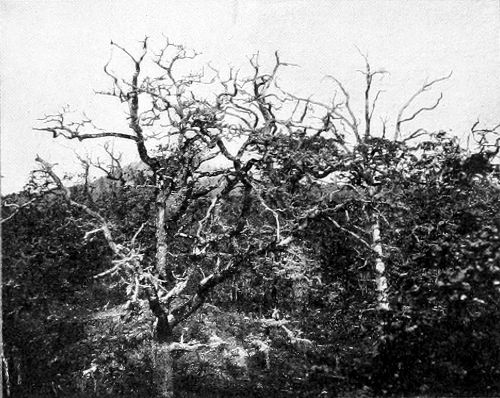
Taken near Victoria. Photo by the Author. THE OAK TREES OF CEDAR HILL. A NESTING HAUNT OF THE NORTHWESTERN FLICKER.
It is perhaps as a musician that the Flicker is best known. The word musician is used in an accommodated sense, for the bird is no professional singer, or instrumental maestro; but so long as the great orchestra of Nature is rendering the oratorio of life, there will be place for the drummer, the screamer, and the utterer of strange sounds, as well as for the human obligato. The Flicker is first, like all other Woodpeckers, a drummer. The long rolling tattoo of early springtime is elicited from some dry limb or board where the greatest resonance may be secured, and it is intended both as a musical performance and as a call of inquiry. Once, as a student, the writer roomed [452] in a large building, whose unused chimneys were covered with sheet-iron. A Flicker had learned the acoustic value of these elevated drums, and the sound of this bird’s reveille at 4:00 a. m. was a regular feature of life at “Council Hall.”
The most characteristic of the bird’s vocal efforts is a piercing call delivered from an elevated situation, clape or kly-ak, and cheer or kee-yer. The scythe-whetting song is used for greeting, coaxing or argumentation, and runs from a low wee-co, wee-co—thru wake-up, wake-up, wake-up—to an emphatic wy-kle, wy-kle, wy-kle, or, in another mood sounds like flicker, flicker, flicker.
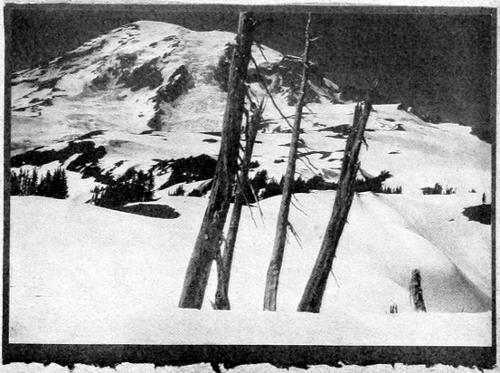
Taken in Rainier National Park. Photo by W. Leon Dawson. A NESTING SITE OF THE NORTHWEST FLICKER. THE LARGEST STUB CONTAINED SIX EGGS ON THE POINT OF HATCHING JULY 7, 1908, WHEN THIS PICTURE WAS TAKEN.
In the early days of April courtship is in progress, and the love-making of the Flicker is both the most curious and the most conspicuous of anything in that order. An infatuated Flicker is a very soft and foolish-looking bird, but it must be admitted that he thoroly understands the feminine heart and succeeds in love beyond the luck of most. A bevy of suitors will lay siege to the affections of a fair lady, say in the top of a sycamore tree. Altho the rivalry is fierce, one gallant at a time will be allowed to display his charms. This he does by advancing toward the female along a horizontal limb, bowing, scraping, pirouetting, and swaying his head from side to side with a rythmical motion. Now and then the swain pretends to lose his balance, being quite blinded, you see, by the luster of milady’s eyes, but in reality he does it that he may have an excuse to throw up his wings and display the dazzling flame which lines [453] them. The lady is disposed to be critical at first, and backs away in apparent indifference or flies off to another limb in the same tree. This is only a fair test of gallantry and provokes pursuit, as was expected. Hour after hour, and it may be day after day, the suit is pressed by one and another until the maiden indicates her preference, and begins to respond in kind by nodding and bowing and swaying before the object of her choice, and to pour out an answering flood of softly whispered adulation. The best of it is, however, that these affectionate demonstrations are kept up during the nesting season, so that even when one bird relieves its mate upon the eggs it must needs pause for a while outside the nest to bow and sway and swap compliments.
The Northwestern Flicker is largely, but not exclusively, resident in winter. Being restricted at that season as to its insect diet, its presence appears to depend more or less upon the abundance of fruits and nuts. It eats not only grubs and worms but seeds, acorns and berries of various kinds. The fruit of the madrone appears to be a special favorite with this bird, as it is with the Robin, and I fancied that Flickers were unusually abundant on that account in the winter of 1907-08.
Cuculidæ—The Cuckoos
No. 180. CALIFORNIA CUCKOO.
A. O. U. No. 387 a. Coccyzus americanus occidentalis Ridgway.
Synonyms.—Western Yellow-billed Cuckoo. Rain-crow.
Description.—Adult: Above nearly uniform, satiny, brownish gray, with something of a bronzy-green sheen; the inner webs of the primaries cinnamon-rufous, the outer webs and sometimes the wing coverts tinged with the same; central pair of tail-feathers like the back and completely covering the others during repose; remaining pairs sharply graduated,—blackish with broad terminal white spaces, the outer pair white-edged; a bare space around the eye yellow; underparts uniform silky white or sordid; bill curved, upper mandible black, except touched with yellow on sides; lower mandible yellow, with black tip. Immature: Similar to adult, but plumage of back with slight admixture of cinnamon-rufous or vinaceous; tail-feathers narrower,—the contrast between their black and white areas less abrupt. Length 12.50-13.50 (317.5-342.9); wing 6.00 (152.4); tail 6.50 (165.1); bill 1.06 (26.9); depth of bill at base .38 (9.7).
Recognition Marks.—Robin to Kingfisher size; slim form and lithe appearance; brown above, white below; sharply-graduated, broadly white-tipped tail-feathers.
Nesting.—Nest: a careless structure of twigs, bark-strips, and catkins, placed in trees or bushes, usually at moderate heights. Eggs: 3 or 4, pale greenish blue, [454] becoming lighter on continued exposure. Av. size, 1.31 × .94 (33.3 × 23.9). Season: June-August; one brood.
General Range.—Western temperate North America from northern Lower California north to southern British Columbia, east to New Mexico and western Texas, and south over tablelands of Mexico.
Range in Washington.—Rare summer resident, chiefly west of Cascades.
Authorities.—[“Yellow-billed cuckoo” Johnson, Rep. Gov. W. T., 1884 (1885), 22]. Lawrence, Auk, Vol. IX., No. 1. Jan. 1892, p. 44. T.(?) L¹. D¹. Ra. B. E.
Specimens.—(U. of. W.) Prov. E.
It is possible that these birds are really more numerous in Washington, west of the Cascades, than is generally supposed. They are, however, extremely shy and retiring in their habits, and very local in distribution. The latter characteristic is carried to such an extent that they may almost be said to colonize. For example, the only place they may be found with certainty, near Tacoma, is in a small area well within the city limits and surrounded by houses. In this small space four or five pairs may be found at any time during the summer.
Their harsh krow-krow-krow-krow, and the more plaintive kru-kru, kru-kru, is most often heard along the outskirts of some swamp encircled by a heavy growth of brush and small conifers mixed with deciduous trees. From the krow-krow note the birds have gained the name Rain Crow, popular superstition pointing out the fact that it usually rains soon afterward (an occurrence not at all unlikely to happen in western Washington, irrespective of the suggestion of the Cuckoo).
Their food consists entirely of caterpillars, spiders, and other insects, this being perhaps the only bird to make war extensively upon the tent-caterpillar. The poem, “He sucks little birds’ eggs to make his voice clear,” etc., applies only to the Cuckoo of Europe. Small birds, it is true, are very often seen in pursuit of a Cuckoo, but this must be purely on account of its close resemblance in form to that of their arch-enemy, the Sharp-shinned Hawk.
The nest is rather a frail structure, tho much more bulky than nests of the Black-billed or Yellow-billed Cuckoo. It is placed from four to ten feet from the ground, usually nearer ten, and is most often built against the trunk of a baby fir. The materials used consist of coarse dead twigs, heavily lined with coarse tree-moss and sprays of dead fir needles.
The eggs are two or three in number, most often three, and are laid from the second week in June to the first of July. They are a pale bluish green in color, overlaid with a light chalky deposit, somewhat like that found on Cormorant eggs. In shape they vary from long to rounded oval, and [455] average in measurement 1.60 × .99 inches. A week often elapses between the laying of the first and the last egg.
Upon one occasion I noticed a most interesting trait in these birds, which I never observed in any other species. While standing in an open woodland listening to a pair of Cuckoos calling to each other, I saw the male suddenly fly past with a large green worm in his bill. He flew directly to the female, who was perched in a tree a few yards distant, and for a moment or two they sat motionless a few inches apart looking at each other. The male then hovered lightly over his mate and, settling gently upon her shoulders, gracefully bent over and placed the worm in her bill. It was a pretty and daintily performed piece of love-making.
J. H. Bowles.
Alcedinidæ—The Kingfishers
No. 181. BELTED KINGFISHER.
A. O. U. No. 390. Ceryle alcyon (Linn.).
Synonym.—Commonly called plain Kingfisher.
Description.—Adult male: Above, bright bluish gray, feathers with blackish shafts or shaft-lines; loosely crested; edge of wing white; primaries dusky, white-spotted on outer web, narrowly white-tipped, broadly white on inner web; coverts often delicately tipped or touched with white; tail bluish gray above, the central feathers with herring-bone pattern of dusky; remaining feathers only blue-edged, dusky, finely and incompletely barred with white; lower eyelid white, and a white spot in front of eye; throat and sides of neck, nearly meeting behind, pure white; a broad band of bluish gray across the breast; remaining underparts white, sides under wing, and flanks, heavily shaded with blue-gray; bill black, pale at base below; feet dark. Adult female: Similar, but with a chestnut band across lower breast, and with heavy shading of the same color on sides. Immature: Like adults, except that the plumbeous band of breast is heavily mixed with rusty (suggesting chestnut of female). Length 12.00-14.00 (304.8-355.6); wing 6.21 (157.7); tail 3.84 (97.5); bill from nostril 1.69 (42.9).
Recognition Marks.—“Kingfisher” size; blue-gray and white coloration; piscatorial habits; rattling cry.
Nesting.—Nest: at end of tunnel in bank, four to six feet in, unlined. Eggs, 6-8, pure white. Av. size, 1.31 × 1.04 (33.3 × 26.4). Season: May; one brood.
General Range.—North America from the Arctic Ocean south to Panama and the West Indies. Breeds from the southern border of the United States northward.
Range in Washington.—Summer resident, chiefly at lower levels; partially resident west of the Cascades, and casually resident on the East-side.
Authorities.—[Lewis and Clark. Hist. Ex. (1814) Ed. Biddle: Coues. Vol. II., p. 189.] Ceryle alcyon, Boie, Baird, Rep. Pac. R. R. Surv. IX., 1858, p. 158. T. C&S. L¹. D¹. Sr. Kb. Ra. D². Ss¹. Ss². Kk. J. B. E.
Specimens.—U. of W. P. Prov. B. BN. E.
[456]
When we were small boys and had successfully teased our fathers or big brothers to let us go fishing with them, we were repeatedly admonished not to “holler” for fear of scaring the fish. This gratuitous and frequently emphatic advice would have been discredited if the example of the Kingfisher had been followed. Either because noise doesn’t matter to fish, or because he is moved by the same generous impulse which prompts the cougar to give fair and frightful warning of his presence at the beginning of an intended foray, the bird makes a dreadful racket as he moves up stream and settles upon his favorite perch, a bare branch overlooking a quiet pool. Here, altho he waits long and patiently, he not infrequently varies the monotony of incessant scrutiny by breaking out with his weird rattle—like a watchman’s call, some have said; but there is nothing metallic about it, only wooden. Again, when game is sighted, he rattles with excitement before he makes a plunge; and when he bursts out of the water with a wriggling minnow in his beak, he clatters in high glee. If, as rarely happens, the bird misses the stroke, the sputtering notes which follow speak plainly of disgust, and we are glad for the moment that Kingfisher talk is not exactly translatable.
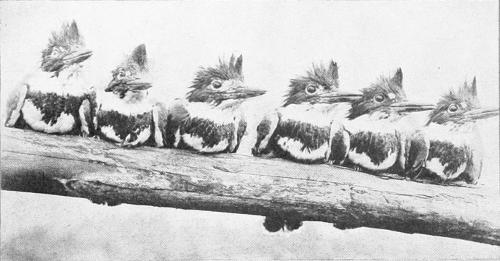
Taken near Portland. Photo by A. W. Anthony. THE KING ROW.
It is not quite clear whether the bird usually seizes or spears its prey, altho it is certain that it sometimes does the latter. The story is told of [457] a Kingfisher which, spying some minnows in a wooden tub nearly filled with water, struck so eagerly that its bill penetrated the bottom of the tub, and so thoroly that the bird was unable to extricate itself; and so died—a death almost as ignominious as that of the king who was drowned in a butt of Malmsey wine.
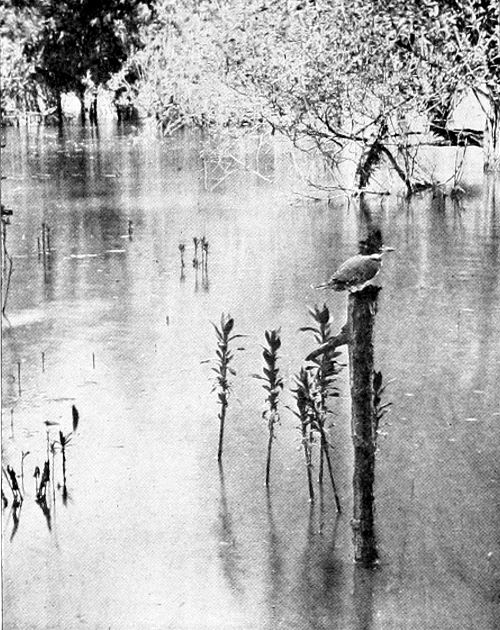
Taken near Portland. Photo by A. W. Anthony. A FISHER PRINCE AT HOME.
When a fish is taken the bird first thrashes it against its perch to make sure it is dead, and then swallows it head foremost. If the fish is a large one its captor often finds it necessary to go thru the most ridiculous contortions, gaspings, writhings, chokings, regurgitations, and renewed attempts, in order to encompass its safe delivery within.
Kingfishers have the reputation of being very unsocial birds. Apart from their family life, which is idyllic, this reputation is well sustained. Good fishing is so scarce that the birds deem it best to portion off the territory with others of their own kind, and they are very punctilious about the observance of boundaries and allotments. For the rest, why should they hunt up avian companions, whose tastes are not educated to an appreciation of exposed, water-soaked stubs, and a commanding view of river scenery? However, I did once see a Kingfisher affably hobnobbing with a Kingbird, on a barren branch which overlooked a crystal stream in Idaho. I wonder if they recognized a mutual kingliness, this humble fisherman and this petulant hawk-driver?
Kingfisher courtship is a very noisy and spirited affair. One does not know just how many miles up and down stream it is considered proper for the gallant to pursue his enamorata before she yields a coy acceptance; and it is difficult to perceive how the tender passion can survive the din of the [458] actual proposal, where both vociferate in wooden concert to a distracted world. But la! love is mighty and doth mightily prevail.
The nesting tunnel is driven laterally into the face of a steep bank, preferably of sand or loam, usually directly over the water, but occasionally at a considerable distance from it. Dr. Brewer reports one in a gravel pit at least a mile from water. The birds are not so particular as are the Bank Swallows about digging near the top of the bank, but, especially if the bank is small, usually select a point about midway. The tunnel goes straight in or turns sharply to suit an occasional whim, until a convenient depth, say five or six feet, is reached, when a considerable enlargement is made for the nest chamber. Here, early in May, six or seven white eggs are laid, usually upon the bare earth, but sometimes upon a lining of grass, straw and trash. From time to time the birds eject pellets containing fish scales, the broken testæ of crawfish and other indigestible substances and these are added to the accumulating nest material. Sanitary regulations are not very strict in Kingfisher’s home, and by the time the young are ready to fly we could not blame them for being glad to get away. The female is a proverbially close sitter, often permitting herself to be taken with the hand, but not until after she has made a vigorous defense with her sharp beak. If a stick be introduced into the nest she will sometimes seize it so tightly that she can be lifted from the eggs, turtle fashion.
EVENING ON THE PEND D’OREILLE.
The parents are very busy birds after the young have broken shell, and it takes many a quintal of fish to prepare six, or maybe seven, lusty fisher princes for the battle of life. At this season the birds hunt and wait upon their young principally at night, in order not to attract hostile attention to them by daylight visits. Only one brood is raised in a season, and since fishing is unquestionably a fine art, the youngsters require constant supervision and instruction for several months. A troop [459] of six or eight birds seen in August or early in September does not mean that Kingfisher is indulging in mid-summer gaities with his fellows, but only that the family group of that season has not yet been broken up.
The Kingfisher is not only a fresh water bird of wide distribution, but a lover of the sea. It is found thruout the length of our ample shores on both sound and ocean; but is, of course, most common where suitable nesting bluffs of clay or sand are afforded. Thruout western Washington the bird is largely resident, and if this very stable species ever does begin to show variation, it will be in the Pacific Northwest.