Volume 1 — The Birds of Washington (continued 9)
Reading edition
Synonym.—Sand Martin.
Description.—Adult: Upperparts plain, brownish gray; wings fuscous; throat and belly white; a brownish gray band across the breast; a tiny tuft of feathers above the hind toe. There is some variation in the extent of the pectoral band; it is sometimes produced indistinctly backward, and sometimes even interrupted. Length 5.00-5.25 (127-133.3); wing 3.95 (100.3); tail 1.97 (50); bill from nostril .20 (5.1).
Recognition Marks.—Smallest of the Swallows; throat white; brownish gray pectoral band on white ground.
Nesting.—Nest, at end of tunnels in banks, two or three feet in; a frail mat of straws and grasses and occasionally feathers. Breeds usually in colonies. Eggs, 4-6, sometimes 7, pure white. Av. size, .70 × .49 (17.8 × 12.5). Season: June; one brood.
General Range.—Northern Hemisphere; in America south to West Indies, Central America, and northern South America; breeding from the middle districts of the United States northward to about the limit of trees.
Range in Washington.—Summer resident; not common. A few large colonies are known east of the Cascades; westerly they are rare or wanting.
Migrations.—Spring: May 11, 1896, Chelan.
[337]
Authorities.—Clivicola riparia, Dawson, Auk, Vol. XIV. April, 1897, p. 179. T. [L¹.] D¹. Kb. D². Kk. B. E. (H).
Specimens.—Prov. C.
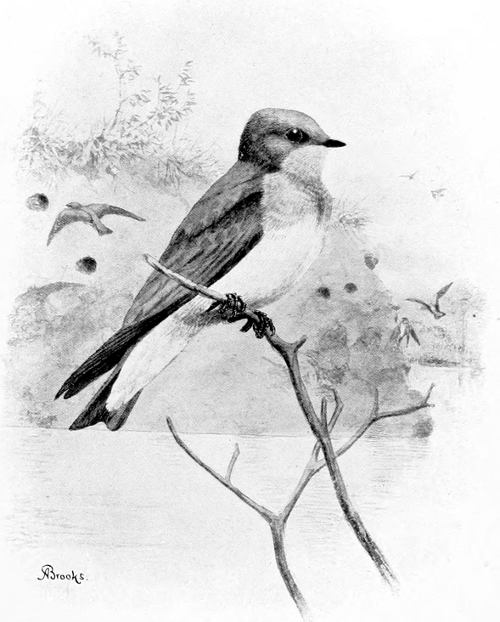
BANK SWALLOW.
Those who know, conceive a regard for this plain-colored bird which is quite out of keeping with its humble garb and its confessedly prosy ways. The fact is, we have no other bird so nearly cosmopolitan, and we of the West, who are being eternally reminded of our newness, and who are, indeed, upon the alert for some new shade of color upon the feather of a bird for each added degree of longitude, take comfort in the fact that here at least is an unchangeable [338] type, a visible link between Stumptown-on-Swinomish and Florence on the Arno. Birds of precisely this feather are summering on the Lena, or else hawking at flies on the sunny Gaudalquivir, or tunneling the sacred banks of the Jordan; and the flattery is not lost upon us of such as still prefer the Nespilem and the Pilchuck.
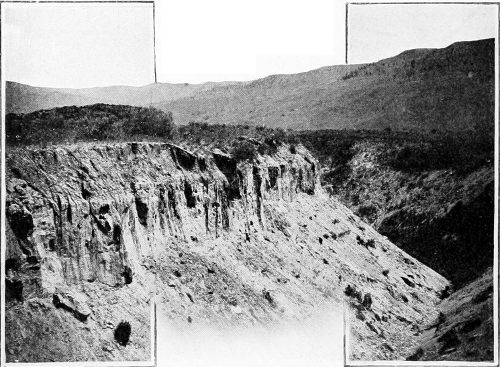
Taken near Chelan. Photo by the Author. NESTING SITE OF THE BANK SWALLOW.
The life of a Swallow is so largely spent a-wing, that our interest in it centers even more than in the case of other birds upon the time when it is bound to earth by family ties. We are scarcely conscious of the presence of the Bank Swallow until one day we see a great company of them fluttering about a sand-bank which overlooks the river, all busily engaged in digging the tunnels which are to shelter their young for that season. These birds are regularly gregarious, and a nesting colony frequently numbers hundreds.
The birds usually select a spot well up within a foot or two of the top of a nearly perpendicular bank of soil or sand, and dig a straight, round tunnel three or four feet long. If, however, the soil contains stones, a greater length and many turns may be required to reach a safe spot for the slight enlargement where the nest proper is placed. The bird appears to loosen the earth with [339] its closed beak, swaying from side to side the while; and, of course, fallen dirt or sand is carried out in the mouth. Sometimes the little miner finds a lens-shaped tunnel more convenient, and I have seen them as much as seven inches in width and only two in height. While the members of a colony, especially if it be a small one, usually occupy a straggling, horizontal line of holes, their burrows are not infrequently to be seen in loose tiers, so that the bank presents a honey-combed appearance.
Communal life seems a pleasant thing to these Swallows, and there is usually a considerable stir of activity about the quarters. A good deal of social twittering also attends the unending gyrations. The wonder is that the rapidly moving parts of this aerial kaleidoscope never collide, and that the cases of turning up at the wrong number are either so few or so amicably adjusted. The nesting season is, however, beset with dangers. Weasels and their ilk sometimes find entrance to the nesting burrows, and they are an easy prey to underbred small boys as well. The undermining of the nesting cliff by the swirling river sometimes precipitates an entire colony—at least its real and personal property—to destruction.
A certain populous bank near Chelan faced west, and whenever the west wind blew, the fine volcanic ash, which composed the cliff, was whirled into the mouths of the burrows, so rapidly, indeed, that the inmates required to be frequently at work in order to maintain an exit. A few dessicated carcasses, which I came across in old, filled-up burrows, I attributed to misfortune in this regard.
Bank Swallows are the least musical of the Swallow kind,—unless, perhaps, we except the Rough-winged species, which is naturally associated in mind with this. They have, nevertheless, a characteristic twitter, an unmelodious sound like the rubbing together of two pebbles. An odd effect is produced when the excited birds are describing remonstrant parabolas at an intruder’s head. The heightened pitch in the tones of the rapidly approaching bird, followed instantly by the lower tone of full retreat, is enough to startle a slumbering conscience in one who meditates mischief on a Swallow’s home.
No. 130. AMERICAN BARN SWALLOW.
A. O. U. No. 613. Hirundo erythrogastra Bodd.
Synonyms.—American Barn Swallow. Fork-tailed Swallow.
Description.—Adult: Above lustrous steel-blue; in front an imperfect collar of the same hue; forehead chestnut; lores black; throat and breast rufous; the remaining underparts, including lining of wings, more or less tinged with [340] the same, according to age and season; wings and tail blackish, with purplish or greenish reflections; tail deeply forked, the outer pair of feathers being from one to two inches longer, and the rest graduated; white blotches on inner webs (except on middle pair) follow the bifurcation. Immature: Forehead and throat paler; duller or brownish above; lateral tail-feathers not so long. Length about 7.00 (177.8); wing 4.75 (120.6); tail 3.00-4.50 (76.2-114.3); bill from nostril .24 (6.1).
Recognition Marks.—Aerial habit; rufous of throat and underparts; forked tail; nest usually inside the barn.
Nesting.—Nest: a neat bracket or half-bowl of mud, luxuriously lined with grass and feathers, and cemented to a beam of barn or bridge. In Washington still nests occasionally in original haunts, viz., cliffs, caves, and crannied sea-walls. Eggs: 3-6, of variable shape,—oval or elongated; white or pinkish white and spotted with cinnamon or umber. Av. size .76 × .55 (19.3 × 14). Season: last week in May and first week in July; two broods. Stehekin, Aug. 10, 1896, 4 eggs.
General Range.—North America at large. Perhaps the most widely and generally distributed of any American bird. Winters in Central and South America.
Range in Washington.—Summer resident of regular occurrence at lower levels thruout the State, less common west of the Cascades, more common elsewhere in the older settled valleys.
Migrations.—Spring: c. May 1st; Yakima County, April 27, 1907; May 3, 1908. Fall: c. September 10th; Seattle, September 20, 1907.
Authorities.—Hirundo horeorum Benton, Cooper and Suckley, Rep. Pac. R. R. Surv. XII., pt. II., 1860, p. 184. T. C&S. L. Rh. D¹. Kb. Ra. D². Ss¹. Ss². J. B. E.
Specimens.—Prov. P¹. C. E.
One hardly knows what quality to admire most in this boyhood’s and life-long friend, the Barn Swallow. All the dear associations of life at the old farm come thronging up at sight of him. You think of him somehow as a part of the sacred past; yet here he is today as young and as fresh as ever, bubbling over with springtime laughter, ready for a frolic over the bee-haunted meadows, or willing to settle down on the nearest fence-wire and recount to you with sparkling eyes and eloquent gesture the adventures of that glorious trip up from Mexico.
Perhaps it is his childlike enthusiasm which stirs us. He has come many a league this morning, yet he dashes in thru the open doors and shouts like a boisterous schoolboy, “Here we are, you dear old barn; ar’n’t we glad to get back again!” Then it’s out to see the horse-pond; and down the lane where the cattle go, with a dip under the bridge and a few turns over the orchard—a new purpose, or none, every second—life one full measure of abounding joy!
Or is it the apotheosis of motion which takes the eye? See them as they cast a magic spell over the glowing green of the young alfalfa, winding about in the dizzy patterns of a heavenly ballet, or vaulting at a thought to snatch an [341] insect from the sky. Back again, in again, out again, away, anywhere, everywhere, with two-mile a minute speed and effortless grace.
But it is the sweet confidingness of this dainty Swallow which wins us. With all the face of Nature before him he yet prefers the vicinage of men, and comes out of his hilly fastnesses as soon as we provide him shelter. We all like to be trusted whether we deserve it or not. And if we don’t deserve it; well, we will, that’s all.
The Barn Swallow is not a common bird with us as it is east of the Rockies, nor is it evenly distributed thruout our State. Wherever the country is well settled it is likely, but not certain, to be found; while for the rest it is confined to such lower altitudes as afford it suitable shelter caves and nesting cliffs.
At the head of Lake Chelan in 1895 I found such a primitive nesting haunt. The shores of the lake near its head are very precipitous, since Castle Mountain rises to a height of over 8,000 feet within a distance of two miles. Along the shore-line in the side of the cliffs, which continue several hundred feet below the water, the waves have hollowed out crannies and caves. In one of these latter, which penetrates the granite wall to a depth of some twenty feet, I found four or five Barn Swallows’ nests, some containing young, and two, altho it was so late in the season (July 9, 1895), containing eggs. Other nests were found in neighboring crannies outside the cave. A visit paid to this same spot on August 10th, 1896, discovered one nest still occupied, and this contained four eggs.
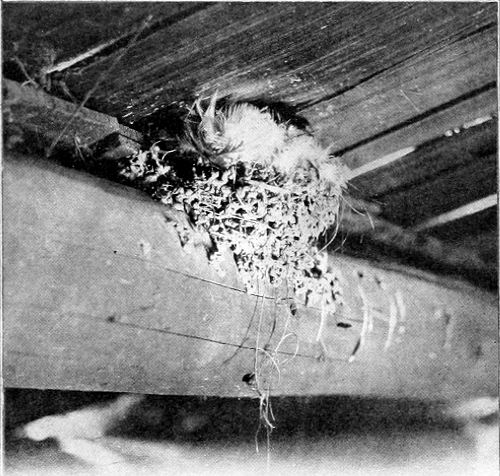
Taken near Spokane. Photo by F. S. Merrill. NEST OF BARN SWALLOW.
Mr. F. S. Merrill, of Spokane, reports [342] the Barn Swallow as nesting along the rocky walls of Hangman’s Creek, in just such situations as Cliff Swallows would choose; and back in ’89, I found a few associated with Violet-greens along the Natchez Cliffs, in Yakima County.
A colony of some twenty pairs may be found yearly nesting on Destruction Island, in the Pacific Ocean. A few of them still occupy wave-worn crannies in the sand-rock, overlooking the upper reaches of the tide, but most of the colony have taken refuge under the broad gables of the keepers’ houses.
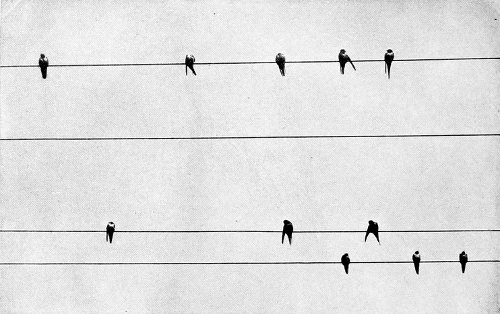
Taken in Blaine. From a Photograph Copyright, 1908, by W. L. Dawson. THE NOONING. BARN SWALLOWS ON TELEGRAPH WIRES.
The nest of the Barn Swallow is quadrispherical, or bracket-shaped, with an open top; and it usually depends for its position upon the adhesiveness of the mud used in construction. Dr. Brewer says of them: “The nests are constructed of distinct layers of mud, from ten to twelve in number, and each separated by strata of fine dry grasses. These layers are each made up of small pellets of mud, that have been worked over by the birds and placed one by one in juxtaposition until each layer is complete.” The mud walls thus composed are usually an inch in thickness, and the cavity left is first lined with fine soft grasses, then provided with abundant feathers, among which the speckled eggs lie buried and almost invisible.
[343]
Bringing off the brood is an event which may well arrest the attention of the human household. There is much stir of excitement about the barn. The anxious parents rush to and fro shouting tisic, tisic, now in encouragement, now in caution, while baby number one launches for the nearest beam. The pace is set, and babies number two to four follow hotly after, now lighting safely, now landing in the hay-mow, or compromising on a plow-handle. Upon the last-named the agonized parents urge another effort, for Tabby may appear at any moment. He tries, therefore, for old Nellie’s back, to the mild astonishment of that placid mare, who presently shakes him off. Number five tumbles outright and requires to be replaced by hand, if you will be so kind. And so the tragi-comedy wears on, duplicating human years in half as many days, until at last we see our Swallows among their twittering fellows strung like notes of music on the far-flung staff of Western Union.
If birds really mean anything more to us than so many Japanese kites flown without strings, we may surely join with Dr. Brewer in his whole-souled appreciation of these friendly Swallows: “Innocent and blameless in their lives, there is no evil blended with the many benefits they confer on man. They are his ever constant benefactor and friend, and are never known even indirectly to do an injury. For their daily food and for that of their offspring, they destroy the insects that annoy his cattle, injure his fruit trees, sting his fruit, or molest his person. Social, affectionate and kind in their intercourse with each other; faithful and devoted in the discharge of their conjugal and parental duties; exemplary, watchful, and tender alike to their own family and to all their race; sympathizing and benevolent when their fellows are in any trouble,—these lovely and beautiful birds are bright examples to all, in their blameless and useful lives.”
No. 131. TREE SWALLOW.
A. O. U. No. 614. Iridoprocne bicolor (Vieill.).
Synonym.—White-bellied Swallow.
Description.—Adult male: Above, lustrous steel-blue or steel-green; below, pure white; lores black; wings and tail black, showing some bluish or greenish luster; tail slightly forked. Female: Similar to male, but duller. Immature: Upper parts mouse-gray instead of metallic; below whitish. Length about 6.00 (152.4); wing 4.57; (116.1) tail 2.19 (55.6); bill from nostril .25 (6.4).
Recognition Marks.—Aërial habits; steel-blue or greenish above; pure white below; a little larger than the next species.
Nesting.—Nest: in holes in trees or, latterly, in bird houses, plentifully lined [344] with soft materials, especially feathers. Eggs: 4-6, pure white,—pinkish white before removal of contents. Av. size .75 × .54 (19.1 × 13.7). Season: last week in May, first week in July; two broods.
General Range.—North America at large, breeding from the Fur Countries south to New Jersey, the Ohio Valley, Kansas, Colorado, California, etc.; wintering from South Carolina and the Gulf States southward to the West Indies and Guatemala.
Range in Washington.—Summer resident; abundant on West-side; not common east of the Cascade Mountains.
Migrations.—Spring: First week in March or earlier; Seattle, March 4, 1889; March 7, 1890; Tacoma, March 2, 1907; March 3, 1908; Bellingham (Edson), Tacoma (Bowles), Steilacoom (Dawson), February 25, 1905; Skagit Marshes near Fir (L. R. Reynolds), February 1, 1906; Seattle (Dr. Clinton T. Cooke), January 21, 1906.
Authorities.—Hirundo bicolor Vieillot, Baird, Rep. Pac. R. R. Surv. IX., pt. II., 1858, p. 311. T. C&S. Rh. D¹. Kb. Ra. D². J. B. E.
Specimens.—U. of W. P. Prov. C.
One Swallow does not make a summer, but a little twittering company of them faring northward makes the heart glad, and fills it with a sense of exaltation as it responds to the call of these care-free children of the air. The remark applies to Swallows in general, but particularly to Tree Swallows, for in their immaculate garb of dark blue and white, they seem like crystallizations of sky and templed cloud, grown animate with the all-compelling breath of spring. They have about them the marks of high-born quality, which we cannot but admire as they spurn with a wing-stroke the lower strata, and rise to accept we know not what dainties of the upper air.
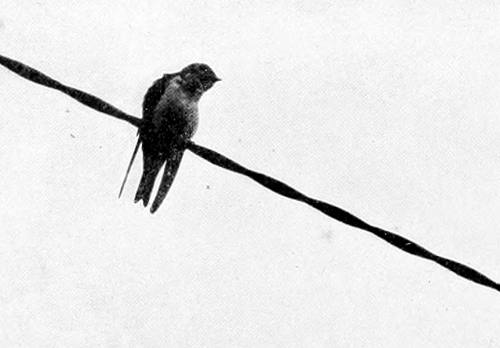
Taken in Seattle. Photo by the Author. TREE SWALLOW.
While not so hardy as Robin and Bluebird, since it must maintain an exclusive diet of insects, Tree Swallow is, occasionally, very venturesome as to the season of its northward flight. Indeed a succession of mild winters [345] might induce it to become a permanent resident of the Puget Sound country, and it is not certain that it has not already done so in some instances. It often reaches Seattle during the first week in March; while it was simultaneously observed at Tacoma (Bowles), and Bellingham (Edson) on the 24th day of February, 1905. In 1906 Mr. L. R. Reynolds reported seeing it in numbers on the Skagit marshes near Fir, on the 1st of February; and Dr. Clinton T. Cooke, looking from his office window in the Alaska Building, saw a large specimen, apparently an adult male, soaring about over the Grand Opera House, in Seattle, on the 21st day of January.
The Tree Swallow is a lover of the water and is seldom to be found at a great distance from it. It is close to the surface of ponds and lakes that the earliest insects are to be found in spring, and it is here that the bird may maintain the spotlessness of its plumage by frequent dips. Hence a favorite nesting site for these birds is one of the partially submerged forests which are so characteristic of western Washington lakes. The birds are not themselves able to make excavations in the wood, but they have no difficulty in possessing themselves of the results of other birds’ labors. Old holes will do if not too old, but I once knew a pair of these Swallows to drive away a pair of Northwest Flickers from a brand new nesting-hole, on the banks of Lake Union, and to occupy it themselves.
The nesting cavity is copiously lined with dead grass and feathers; and sometime during the last week of May from four to six white eggs are deposited. The female sits very closely and it is sometimes necessary to remove her by hand in order to examine the nest. Both parents are very solicitous on such occasions, and should a feather from the nest be tossed into the air, one of them will at once catch it and fly about awaiting a chance to replace it. Or if there are other Swallows about, some neighbor will snatch it first and make off with it to add to her own collection.
Tree Swallows are slowly availing themselves of artificial nesting sites. In fact, several species of our birds have become quite civilized, so that nowadays no carefully constructed and quietly situated bird-box need be without its spring tenant. A pair once built their nest in a sort of tower attic, just inside a hole which a Flicker had pierced in the ceiling of an open belfry of a country church in Yakima. When in service the mouth of the swinging bell came within two feet of the brooding bird. One would suppose that the Swallows would have been crazed with fright to find themselves in the midst of such a tumult of sound; but their enterprise fared successfully, as I can testify, for at the proper time I saw the youngsters ranged in a happy, twittering row along the upper rim of the bell-wheel.
[346]
No. 132. VIOLET-GREEN SWALLOW.
A. O. U. No. 615. Tachycineta thalassina lepida (Mearns).
Synonym.—Northern Violet-green Swallow.
Description.—Adult male: Upperparts, including pileum, hind-neck, back, upper portion of rump, scapulars, and lesser wing-coverts, rich velvety bronze-green, occasionally tinged with purple, crown usually more or less contrasting with color of back, greenish-brown rather than bronze-green, and more strongly tinged with purple; a narrow cervical collar, lower rump, and upper tail-coverts, velvety violet-purple; wings (except lesser coverts) and tail blackish glossed with violet or purple; lores grayish; underparts, continuous with cheeks and area over and behind eye, and with conspicuous flank patch, nearly meeting fellow across rump, pure white; under wing-coverts pale gray, whitening on edge of wing. Bill black; feet brownish black; iris brown. Adult female: Like male but usually much duller, bronze-green of upperparts reduced to greenish brown, or brown with faint greenish reflections. Young birds are plain mouse-gray above and their inner secondaries are touched with white. Length 4.50-5.50 (114.3-139.7); wing 4.41 (112); tail 1.77 (45); bill .20 (5.2).
Recognition Marks.—Smaller; green and violet above, white below; white-cheeked and white-rumped (apparently) as distinguished from the Tree Swallow.
Nesting.—Nest: of dried grasses with or without feathers, placed in crevice of cliff or at end of vapor hole in basalt walls; latterly in bird boxes and about buildings. Eggs: 4-6, pure white. Av. size .72 × .48 (18.3 × 12.2). Season: June.
General Range.—Western United States, from the eastern base of the Rocky Mountains to the Pacific, north to the Yukon Valley, south in winter to Costa Rica.
Range in Washington.—Summer resident, of regular occurrence in mountain valleys and among the foothills; rare or local elsewhere; becoming common in the larger cities.
Migrations.—Spring: “About the 10th of May” (Suckley)[49]; now at least March; Chelan, March 27, 1896; Seattle, March 24, 1906; Tacoma, March 16, 1907; March 14, 1908; Olympia, February 27(?), 1897.
Authorities.—?Ornith. Com. Ac. Nat. Sci. Phila., VII., 1837, 193 (Columbia River). Hirundo thalassina Swainson, Baird, Rep. Pac. R. R. Surv. IX., pt. II., 1858, p. 312. T. C&S. L¹. Rh. D¹. D². Ss¹. Kk. J. B. E.
Specimens.—(U. of W.) Prov. P¹. C. E.
To appear to the best advantage this dainty sky-child should be seen on a bright day, when the livid green of back and crown may reflect the glancing rays of the sun with a delicate golden sheen. At such a time, if one is clambering about the walls of some rugged granite cliff of the lower Cascades, he feels as if the dwellers of Olympus had come down in appropriate guise to inquire his business. Not, however, that these lovely creatures are either meddlesome or shrewish. Even when the nest is threatened by the strange presence, the birds seem unable to form any conception of harm, and pursue their way in sunny disregard. Especially pleasing to the eye is the pure white of the bird’s underparts, rising high on flanks and cheeks and sharply contrasting with the pattern of violet and green, in such fashion that, if Nature had invited us to “remold it nearer to the heart’s desire,” we must have declined the task.
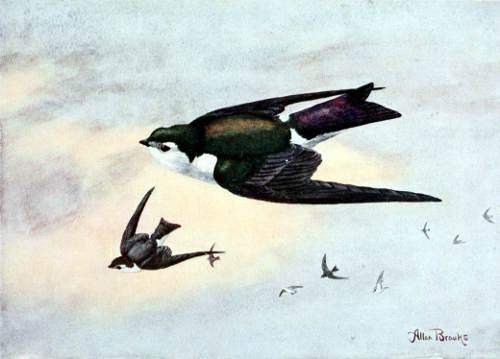
VIOLET-GREEN SWALLOW MALE, 8/11 NATURAL SIZE From a Water-color Painting by Allan Brooks
[347]
Before the advent of the white man upon Puget Sound, these birds commonly nested in deserted woodpecker holes and in natural cavities of trees, while upon the East-side they nested (and still do to a large extent) upon the granite or lava cliffs. In the last-named situations they utilize the rocky clefts and inaccessible crannies, and are especially fond of the smaller vapor holes which characterize the basaltic formations. Favorable circumstances may attract a considerable colony, to the number of a hundred pairs or more, but even so it is not easy to find a getatable nest. If one is able to reach the actual nesting site, the mouth of the ancient gas-vent which the birds have chosen for a home may prove too small to admit the hand.
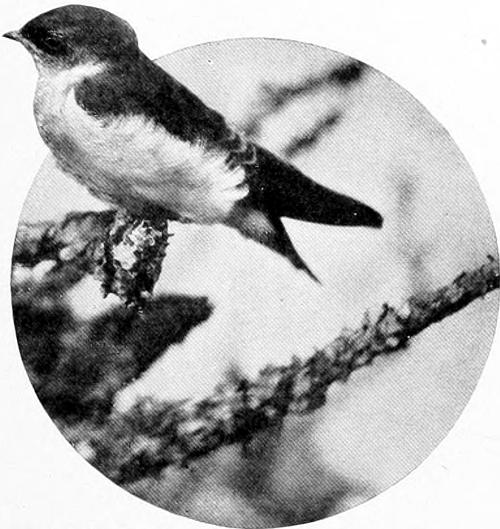
Taken in Oregon. Photo by Finley and Bohlman. YOUNG VIOLET-GREEN SWALLOW.
Thruout the State, however, and especially upon the West-side, these exquisite birds are forsaking their ancient haunts and claiming protection of men. Already they have become common in larger cities, where they occupy bird-boxes and crannies of buildings. South Tacoma, being nearest to their old oak nurseries, is quite given over to them, and it is a pretty sight on a sunny day in April to see them fluttering about the cottages inspecting knot-holes and recessed gables or, in default of such conveniences, daintily voicing their disapproval of such neglect on the part of careless humans.
In these birds and in the Barn Swallows, the well known twittering and creaking notes of Swallows most nearly approach the dignity of song. Indeed, Mr. Rathbun contends that the song heard at close quarters is a really creditable affair, varied, vivacious, and musical.
The Violet-greens are somewhat less hardy or venturesome than the Tree Swallows, arriving usually during the last week in March. Last year’s [348] nesting site becomes at once the spring rendezvous, but the duties of maternity are not seriously undertaken until about the 1st of June. At the head of Lake Chelan some twenty pairs of these Swallows, having left the old nesting cliff a mile away, had engaged quarters at Field’s Hotel, being assigned to the boxed eaves of a second-story piazza in this pleasant caravanserai; but they had not yet deposited eggs on the 20th of June, 1906.
Altho not formerly so fastidious—I have found cliff nests composed entirely of dried grass—these birds have become connoisseurs in upholstery of feathers, and their unglossed white eggs, five or six in number, are invariably smothered in purloined down, until we begin to suspect that our fowls rather than our features have favored our adoption.
Ampelidæ—The Waxwings
No. 133. BOHEMIAN WAXWING.
A. O. U. No. 618. Bombycilla garrula (Linn.).
Synonyms.—Northern Waxwing. Greater Waxwing.
Description.—Adults: A conspicuous crest; body plumage soft, grayish-brown or fawn-color, shading by insensible degrees between the several parts; back darker, passing into bright cinnamon-rufous on forehead and crown, and thru dark ash of rump and upper tail-coverts into black of tail; tips of tail feathers abruptly yellow (gamboge); breast with a vinaceous cast, passing into cinnamon-rufous of cheeks; a narrow frontal line passing thru eye, and a short throat-patch velvety black; under tail-coverts deep cinnamon; wing blackish-ash, the tips of the primary coverts and the tips of the secondaries on outer webs white, tips of primaries on outer webs bright yellow, whitening outwardly; the shafts of the rectrices produced into peculiar flattened red “sealing-wax” tips; bill and feet black. Length about 8.00 (203.2); wing 4.61 (117.1); tail 2.56 (65); bill .47 (11.9).
Recognition Marks.—Chewink size; grayish-brown coloration. As distinguished from the much more common Cedar-bird; belly not yellow; white wing-bars; under tail-coverts cinnamon.
Nesting.—Not known to breed in Washington. Like that of next species. Eggs, larger. Av. size, .98 × .69 (24.9 × 17.5).
General Range.—Northern portions of northern hemisphere. In North America, south in winter irregularly to Pennsylvania, Ohio, Illinois, Kansas, southern Colorado, and northern California. Breeds north of United States; also, possibly, in the mountains of the West.
Range in Washington.—Winter resident, regular and sometimes abundant east of the Cascades, especially in the northern tier of counties; rare or casual on the West-side.
Authorities.—Ampelis garrulus, Brewster, B. N. O. C. VII. Oct. 1882, p. 227. D¹. J. E.
Specimens.—(U. of W.) Prov. P¹. C.
[349]
Nothing can exceed the refined elegance of these “gentlemen in feathers” who visit us yearly in winter, rarely on Puget Sound, but abundantly in the northeastern portion of the State. Demure, gentle, courteous to a fault, and guileless to the danger point, and beyond, these lovely creatures exceed in beauty, if possible, their more familiar cousin, the Cedarbird. They move about in flocks, sometimes to the number of hundreds, and as the rigors of winter come on they search the orchard and berry-patch for ungarnered fruit, or divide with hungry Robins the largess of rowan trees. Much time is spent in amiable converse, but it is not at all fair to call them “chatterers,” or garrulus, as tho they were monkeys. Dignity is of the very essence of their being, and, as fond as they are of good living, they would starve rather than do anything rude or unseemly.
An observer in Utah[50] relates how an ill-mannered Robin, jealous of the good behavior of a company of these visitors, in an apple tree, set about to abuse them. “He would bluster and scream out his denunciations till he seemed unable longer to restrain himself, when, to all appearances, absolutely beside himself with rage because the objects of his wrath paid no attention to his railings, he did the catapult act—hurling himself straight at the intruders. Several of the Waxwings, in order to avoid an actual collision, left the places where they were feeding, and alighting on twigs near by paused for a moment, as if to observe the antics of the furious Robin, when they would resume their feeding. Their indifference to the loud bullying protests of the Robin, and their persistence in remaining on the premises after he had ordered them off so exasperated Mr. Redbreast that with screams of defiance he dashed from group to group without stopping to alight, until, exhausted quite as much by the heat of anger as by the unusual exertions he was making, he was glad to drop to a branch and pant for breath”—while the Waxwings continued to ignore the churl, as gentlemen should.
Concerning the nesting range of this bird there has been much surmise. For many years the single eggs taken by Kennicott at Fort Yukon on July 4, 1861, remained unique; but latterly we are learning that it also nests much further south. Mr. Brooks took four sets, one from a Murray pine and three from Douglas firs, at 158-Mile House, B. C., in June, 1901[51]. Dr. C. S. Moody[52] reports the taking of a set of five eggs at Sandpoint, Idaho, July 5, 1904. On June 26, 1904, Robert G. Bee, of Provo City, found a nest near Sunnyside, Utah[53]. With such examples before us it is practically certain that the species will be found nesting in this State. Indeed, Mr. F. S. Merrill, of Spokane, believes that he once found a nest of the Bohemian Waxwing on the headwaters of the Little Spokane River near Milan. The nest he describes [350] as having been placed in an alder at a height of eight feet, and it contained four eggs on the point of hatching. The brooding bird allowed a close approach while upon the nest, but was not seen again after being once flushed.
No. 134. CEDAR WAXWING.
A. O. U. No. 619. Bombycilla cedrorum Vieill.
Synonyms.—Cedar-bird. Cherry-bird. Carolina Waxwing. Lesser Waxwing.
Description.—Adults: A conspicuous crest; extreme forehead, lores, and line thru eye velvety-black; chin blackish, fading rapidly into the rich grayish-brown of remaining fore-parts and head; a narrow whitish line bordering the black on the forehead and the blackish of the chin; back darker, shading thru ash of rump to blackish-ash of tail; tail-feathers abruptly tipped with gamboge yellow; belly sordid yellow; under tail-coverts white; wings slaty-gray, primaries narrowly edged with whitish; secondaries and inner quills without white markings, but bearing tips of red “sealing-wax”; the tail-feathers are occasionally found with the same curious, horny appendages; bill black; feet plumbeous. Sexes alike, but considerable individual variation in number and size of waxen tips. Young, streaked everywhere with whitish, and usually without red tips. Length 6.50-7.50 (165.1-190.5); wing 3.70 (94); tail 2.31 (58.7); bill .40 (10.2).
Recognition Marks.—Sparrow size; soft grayish-brown plumage; crest; red sealing-wax tips on secondaries; belly yellow; wings without white bars or spots, as distinguished from preceding species.
Nesting.—Nest, a bulky affair of leaves, grasses, bark-strips and trash, well lined with rootlets and soft materials; placed in crotch or horizontally saddled on limb of orchard or evergreen tree. Eggs, 3-6, dull grayish blue or putty-color, marked sparingly with deep-set, rounded spots of umber or black. Av. size, .86 × .61 (21.8 × 15.5). Season: June, July; two broods.
General Range.—North America at large, from the Fur Countries southward. In winter from the northern border of the United States south to the West Indies and Costa Rica. Breeds from Virginia, Kansas, Oregon, etc., northward.
Range in Washington.—Of regular occurrence in the State, but irregular or variable locally. Resident, but less common in winter.
Authorities.—Ampelis cedrorum Baird, Cooper and Suckley, Rep. Pac. R. R. Surv. XII. pt. II. 1860, p. 187. T. C&S. Rh. D¹. Kb. Ra. D². Ss². Kk. B. E.
Specimens.—(U. of W.) Prov. P. B. E.
One does not care to commit himself in precise language upon the range of the Cedarbird, or to predict that it will be found at any given spot in a given season. The fact is, Cedarbirds are gypsies of the feathered kind. There are always some of them about somewhere, but their comings and goings are not according to any fixed law. A company of Cedarbirds may throng the [351] rowan trees in your front yard some bleak day in December; they may nest in your orchard the following July; and you may not see them on your premises again for years—unless you keep cherry trees. It must be confessed (since the shade of the cherry tree is ever sacred to Truth) that the Cedarbird, or “Cherrybird,” has a single passion, a consuming desire for cherries. But don’t kill him for that. You like cherries yourself. All the more reason, then, why you should be charitable toward a brother’s weakness. Besides, he is so handsome,—handsomer himself than a luscious cherry even. Feast your eyes upon him, those marvelous melting browns, those shifting saffrons and Quaker drabs, those red sealing-wax tips on the wing-quills (he is canning cherries, you see, and comes provided). Feast your eyes, I say, and carry the vision to the table with you—and a few less cherries. Or, if there are not enough for you both, draw a decent breadth of mosquito-netting over the tree, and absolve your soul of murderous intent. Remember, too, if you require self-justification, that earlier in the season he diligently devoured noxious worms and insect pests, so that he has a clear right to a share in the fruit of his labors.
Cherries are by no means the only kind of fruit eaten by these birds. Like most orchard-haunting species, they are very fond of mulberries, while the red berries of the mountain ash are a staple ration in fall and winter. Truth to tell, these beauties are sad gluttons, and they will gorge themselves at times till the very effort of swallowing becomes a delicious pain.
The Cedarbird, being so singularly endowed with the gift of beauty, is denied the gift of song. He is, in fact, the most nearly voiceless of any of the American Oscines, his sole note being a high-pitched sibilant squeak. Indeed, so high-pitched is this extraordinary note that many people, and they trained bird-men, cannot hear them at all, even when the Waxwings are squeaking all about them. It is an almost uncanny spectacle, that of a company of Waxwings sitting aloft in some leafless tree early in spring, erect, immovable, like soldiers on parade, but complaining to each other in that faint, penetrating monotone. It is as tho you had come upon a company of the Immortals, high-removed, conversing of matters too recondite for human ken, and surveying you the while with Olympian disdain. You steal away from the foot of the tree with a chastened sense of having encountered something not quite understandable.
The dilatory habits of these birds are well shown in their nesting, which they put off until late June or July, for no apparent reason. In constructing the nest the birds use anything soft and pliable which happens to catch the eye. Some specimens are composed entirely of the green hanging mosses, while others are a complicated mixture of twigs, leaves, rootlets, fibers, grasses, rags, string, paper, and what not. The nest may be placed at any moderate height up to fifty feet, and a great variety of trees are used altho orchard trees are favorites. The birds are half gregarious, even in the nesting [352] season, so that a small orchard may contain a dozen nests, while another as good, a little way removed, has none. In the Nooksack Valley, near Glacier, Mr. Brown showed me a tiny pasture carved out of the woods, where he had found, during the previous season, six nests of the Cedarbird, placed at heights ranging from three to six feet above the ground in small clumps of vine maple or alder saplings. In Chelan we found them nesting in the tops of the solitary pine trees which line the stream.
The female sits closely upon her eggs, not infrequently remaining until forcibly removed. Once off, however, she makes away without complaint, and pays no further attention to the incident until the intruder has departed.
Always of a most gentle disposition, when the nesting season arrives, according to Mr. Bowles, these birds richly deserve the name of Love Birds. A leaf from his note-book supports the statement: “July 7, 1896. To-day I watched two Cedarbirds selecting a nesting site, first one location being tested, then another. Finally they decided upon a suitable place and commenced picking both dry and green leaves from the surrounding trees, placing them upon a horizontal limb where two or three twigs projected. Almost all of these leaves blew off as soon as placed, greatly to the surprise of the birds, who solemnly watched them drop to the ground. These fallen leaves were never replaced, fresh ones being gathered instead, and these were always secured from growing trees. Then one got a long strip of plant silk and, placing it on the leaf foundation flew a foot or two away and lit. The other bird promptly took away the silk and brought it to its mate, who very gently took it and put it back. This operation was repeated again and again. At times both held the silk, sitting only an inch or two apart, whereupon the bird who was the original finder would, very gently, pull it from the bill of its mate and replace it. At the end of fifteen minutes of this loving passage I was obliged to retire, and I shall never know whether the plant fiber was successfully placed or merely worn out.”
Laniidæ—The Shrikes
No. 135. NORTHERN SHRIKE.
A. O. U. No. 621. Lanius borealis Vieill.
Synonyms.—Great Northern Shrike. Butcher-bird.
Description.—Adult: Upperparts clear, bluish gray, lightest—almost white—on upper tail-coverts; extreme forehead whitish; wings and tail black, the former with a conspicuous white spot at base of primaries, the latter with large, white terminal blotches on outer feathers, decreasing in size inwardly; a black band through eye, including auriculars; below grayish white, the feathers of the breast [353] and sides narrowly tipped with dusky, producing a uniform, fine vermiculation which is always present; bill blackish, lightening at base of lower mandible; feet black. Young birds are barred or washed with grayish brown. The plumage of adult is sometimes overcast above with a faint olivaceous tinge. Length 9.25-10.75 (235-273.1); wing 4.50 (114.3); tail 4.19 (106.4); bill .72 (18.3); tarsus 1.07 (27.3).
Recognition Marks.—Robin size; gray and black coloring; sharply hooked bill; breast vermiculated with dusky, as distinguished from next species.
Nesting.—Does not breed in Washington. Nest: a well constructed bowl of sticks, thorn-twigs, grasses, and trash, heavily lined with plant-down and feathers; in bushes or low trees. Eggs: 3-7, dull white or greenish gray, thickly dotted and spotted with olive-green, brown, or lavender. Av. size, 1.07 × .78 (27.2 × 19.8).
General Range.—Northern North America; south in winter to the middle and southern portions of the United States. Breeds north of the United States except sparingly in northern New England.
Range in Washington.—Spring and fall migrant and not common winter resident thruout the State, chiefly at lower levels.
Authorities.—? Townsend, Journ. Ac. Nat. Sci. Phila. VIII. 1839, 152 (Columbia River). Baird, Rep. Pac. R. R. Surv. IX. 1858, 325. C&S. D¹. Ra. D². B. E.
Specimens.—(U. of W.) P¹. Prov. B. E.
Flitting like a gray ghost in the wake of the cheerful hosts of Juncoes and Redpolls, comes this butcher of the North in search of his accustomed prey. If it is his first visit south he posts himself upon the tip of a tree and rasps out an inquiry of the man with the gun. Those that survive these indiscretions are thereafter faintly descried in the distance, either in the act of diving from some anxious summit, or else winging swiftly over the inequalities of the ground.
All times are killing time for this bloodthirsty fellow, and even in winter he “jerks” the meat not necessary for present consumption—be it chilly-footed mouse or palpitating Sparrow—upon some convenient thorn or splinter. In spring the north-bound bird is somewhat more amiable, being better fed, and he pauses from time to time during the advance to sing a strange medley, which at a little remove sounds like a big electric buzz. This is meant for a love song, and is doubtless so accepted by the proper critics, but its rendition sometimes produces about the same effect upon a troop of Finches, which a cougar’s serenade does upon a cowering deer.
Experts try to make out that this creature is beneficial, on the whole, because of the insects he devours, but I have seen too much good red blood on this butcher’s beak myself. My gun is loaded!
Suckley writing in the Fifties remarks the scarcity of all Shrikes in Oregon or Washington “Territories,” and this is fortunately still true, especially west of the Cascades. The probable explanation is that the mild climate of the Pacific slope of Alaska retards or prevents the southward movement of the more hardy species.
[354]
No. 136. WHITE-RUMPED SHRIKE.
A. O. U. No. 622 a. Lanius ludovicianus excubitorides (Swains.).
Description.—Adult: Dark bluish gray above, changing abruptly to white on upper tail-coverts; scapulars chiefly white; wings black, a small white spot at base of primaries; the inner quills narrowly tipped with white; tail black, the outer pair of feathers chiefly white, and the succeeding broadly tipped with white in descending ratio until color disappears in two central pairs; below white slightly soiled on breast, but everywhere strongly contrasting with upperparts; narrow frontal line including nasal tufts, lores, and ear-coverts, black,—continuous, and passing mostly below eye; bill and feet black. Immature: Colors of adult less strongly contrasted; lower parts washed with brownish; loral bar obscure; more or less vermiculated with dusky all over (in younger birds), or upon the underparts alone; ends of wing-quills, coverts, and tail-feathers often with ochraceous or rusty markings. Length of adult male: 8.50-10.00 (215.9-254); wing 3.96 (100.6); tail 3.9 (99); bill .60 (15.3); tarsus 1.1 (28).
Recognition Marks.—Chewink to Robin size; dark gray above; whitish below; longitudinal black patch of head; wings black and white; breast of adult unmarked, as distinguished from both L. borealis and L. l. gambeli.
Nesting.—Nest: a bulky but well-built structure of sticks, thorn-twigs, sage-bark, dried leaves, etc., heavily lined with wool, hair, and feathers; placed at moderate heights in sage-brush or sapling. Eggs: 5-7, dull grayish or greenish white, thickly speckled and spotted with pale olive or reddish brown. Av. size, .97 × .73 (24.6 × 18.5). Season: April, June; two broods.
General Range.—Western North America from the Great Plains westward, except Pacific Coast district and from Manitoba and the plains of Saskatchewan south over the tablelands of Mexico; south in winter over the whole of Mexico intergrading with L. l. migrans in region of the Great Lakes.
Range in Washington.—Common summer resident east of the Cascades, chiefly in sage-brush country.
Authorities.—Dawson, Auk, XIV. 1897, 179. (T). D¹. D². Ss¹. Ss².
Specimens.—(U. of W.) P. C.
The brushy draws of the low lava ranges and the open sage stretches of the East-side constitute the favorite preserve of this lesser bird of prey. He arrives from the South early in March when his patchy plumage harmonizes more or less with the snow-checkered landscape, but he is nowise concerned with problems of protective coloration. Seeking out some prominent perch, usually at this time of year a dead greasewood or a fence-post, he divides his time between spying upon the early-creeping field mouse and entertaining his lady love with outlandish music. Those who have not heard the White-rumped Shrike sing, have missed a treat. He begins with a series of rasping sounds, which are probably intended to produce the same receptive condition in his [355] audience which Ole Bull secured by awkwardly breaking one string after another on his violin, till only one was left. There, however, the resemblance ceases, for where the virtuoso could extract a melody of marvelous variety and sweetness from his single string, the bird produces the sole note of a struck anvil. This pours forth in successive three-syllabled phrases like the metallic and reiterative clink of a freely falling hammer. The chief difference which appears between this love song and the ordinary call of warning or excitement is that in the latter case the less tender passions have weighted the clanging anvil with scrap iron and destroyed its resonance.
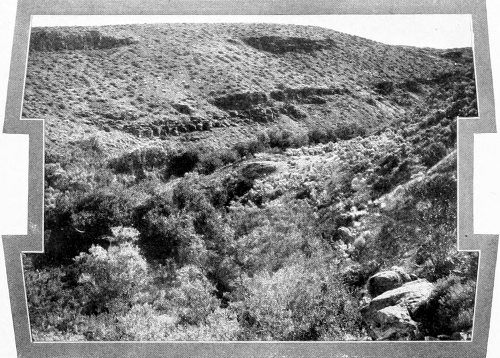
Taken in Douglas County. Photo by the Author. THE SHRIKE’S PRESERVE.
The Shrike is a bird of prey but he is no restless prowler or hoverer, wearing out his wings with incessant flight—not he. Choosing rather a commanding position on a telegraph wire, or exposed bush top, he searches the ground with his eye until he detects some suspicious movement of insect, mouse, or bird. Then he dives down amongst the sage, and if successful returns to his post to devour at leisure. The bird does not remain long enough at one station to inspire a permanent dread in the local population of comestibles; but rather moves on from post to post at short intervals and in methodical fashion. In flight the [356] bird moves either by successive plunges and noisy reascensions, or else pitches downward from his perch and wings rapidly over the surface of the vegetation.
The Sage Shrikes are prolific and attentive breeders. The first brood is brought off about the 1st of May, but fresh eggs may sometimes be found as early as the last week in March in the southern part of the State. A second brood may be expected from June 1st to 15th.
The nest is a bulky but usually well-built affair, placed habitually in a sage bush, or a greasewood clump, with wild clematis for third choice. The structure is designed for warmth and comfort, so that, whenever possible, to the thickened walls of plant fibers, cow-hair, or sheep’s wool, is added an inner lining of feathers, and these not infrequently curl over the edge so as completely to conceal the nest contents. One nest examined in Walla Walla County contained the following materials: Willow twigs, broom-sage twigs, sage bark, weed stems, dried yarrow leaves, dried sage leaves, hemp, wool, rabbit fur, horse-hair, cow-hair, chicken feathers, string, rags, and sand, besides a thick mat of finely comminuted scales, soft and shiny, the accumulated horny waste from the growing wing-quills of the crowded young—altogether a sad mess.
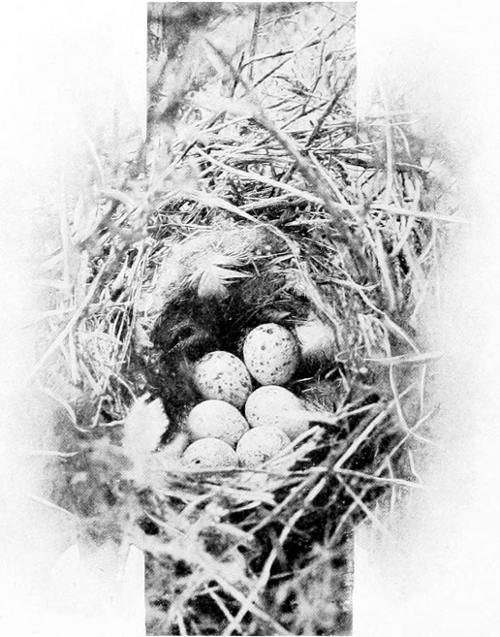
Taken in Douglas County. Photo by the Author. NEST AND EGGS OF WHITE-RUMPED SHRIKE.
The parent birds are singularly indifferent as a rule to the welfare of a nest containing eggs alone. The female sits close, but once flushed, stands clinking in the distance, or else absents herself entirely. When the young are hatched, however, the old birds are capable of a spirited and deafening defense.
[357]
It is curious that in Washington we have seen no signs of the out-door larder, consisting of grasshoppers, mice, garter-snakes, etc., impaled on thorns, which the eastern birds of this species are usually careful to maintain somewhere in the vicinity of the nest. It may be simply that the lack of convenient thorns accounts for this absence, or for the failure of the habit.
Altho this bird belongs to a bad breed, one containing, among others, the notorious “Neuntöter,” or Ninekiller, of northern Europe, concerning which tradition maintains that it is never satisfied until it has made a kill of nine birds hand-running, the evidence seems to be overwhelmingly in its favor. Birds are found to constitute only eight per cent of this bird’s food thruout the year, while, on account of its services in ridding the land of undoubted vermin, its presence is to be considered highly beneficial.
No. 137. CALIFORNIA SHRIKE.
A. O. U. No. 622 b. Lanius ludovicianus gambeli Ridgway.
Description.—Similar to L. l. excubitorides but decidedly darker, duller gray above; underparts more sordid, tinged with brownish or with more or less distinct transverse vermiculation of pale brownish gray on chest and sides of breast; averaging slightly smaller.
Recognition Marks.—As in preceding—duller.
Nesting.—As in L. l. excubitorides—has not yet been reported from Washington.
General Range.—Pacific Coast district from southwestern British Columbia to northern Lower California; south in winter to Cape St. Lucas and western Mexico.
Range in Washington.—Rare summer resident west of the Cascades.
Authorities.—? Orn. Com., Journ. Ac. Nat. Sci. Phila. VII. 1837, 193 (Columbia River). Lanius ludovicianus excubitorides Lawrence, Auk, IX. 1892, 46.
Resident Shrikes, presumably referable to this recently elaborated subspecies, are exceedingly rare in western Washington. Mr. Bowles has not seen any near Tacoma, and neither Mr. Rathbun nor myself have encountered them in Seattle. Mr. R. H. Lawrence, however, notes having seen three “White-rumped Shrikes” on June 10, 1890, in a small clearing on the Humptulips River[54].
The smaller Shrikes are birds of the open country, and they should be found in at least Lewis, Thurston, and Pierce Counties.
[358]
Vireonidæ—The Vireos
No. 138. RED-EYED VIREO.
A. O. U. No. 624. Vireosylva olivacea (Linn.).
Description.—Adult: Crown grayish slate, bordered on either side by blackish; a white line above the eye, and a dusky line thru the eye; remaining upperparts light grayish olive-green; wings and tail dusky with narrow olive-green edgings; below dull white, with a slight greenish-yellow tinge on lining of wings, sides, flanks, and crissum; first and fourth, and second and third primaries about equal, the latter pair forming the tip of wing; bill blackish at base above, thence dusky or horn-color; pale below; feet leaden blue; iris red. Little difference with age, sex, or season, save that young and fall birds are brighter colored. Length 5.50-6.50 (139.7-165.1); wing 3.15 (80); tail 2.10 (53.5); bill .49 (12.5); tarsus .70 (18).
Recognition Marks.—Warbler size; largest; white superciliary line contrasting with blackish and slate of crown; red eye. Note smoother, and utterance a little more rapid than in L. s. cassinii.
Nesting.—Nest, a semi-pensile basket or pouch, of bark-strips, “hemp,” and vegetable fibers, lined with plant-down, and fastened by the edges to forking twigs near end of horizontal branch, five to twenty feet up. Eggs, 3 or 4, white, with black or umber specks and spots, few in number, and chiefly near larger end. Av. size, .85 × .56 (21.6 × 14.2). Season: c. June 1; one brood.
General Range.—Eastern North America, west to Colorado, Utah, Washington and British Columbia; north to the Arctic regions; south in winter from Florida to the equator. Breeds nearly thruout its North American range.
Range in Washington.—Imperfectly made out. Summer resident on both sides of the Cascades. Either increasingly abundant or more observed latterly (Brook Lake, Chelan, Stehekin, Seattle, Tacoma, Kirkland breeding 1908).
Migrations.—Spring: Seattle, May 3, 1908.
Authorities.—Belding, Land Birds of the Pacific District, 1890, p. 199. (Walla Walla by J. W. Williams, 1885). Ss². B.
Specimens.—C.
We are rubbing our eyes a little bit and wondering whether the Red-eyed Vireo has really been here all the time, or whether he only slipped in while we were napping a decade or two since. Certain it is that the bird’s presence in the Pacific Northwest was unknown to the pioneers, Townsend, Cooper, Suckley, and the rest; and the first intimation we had of the occurrence of this Vireo west of the Rockies was Chapman’s record, published in 1890[55] of specimens taken at Ducks and Ashcroft, B. C. The year following, viz., August 4, 1891, a singing Red-eye was recognized by Mr. C. F. Batchelder, [359] of Cambridge, Mass., at the Little Dalles, in this State[56]. Mr. Lyman Belding, the veteran ornithologist, of Stockton, Cal., advises me, however, that this Vireo was first seen by his friend, Dr. J. W. Williams, of Walla Walla, on June 4 and 24, 1885, and that six specimens were taken. Dr. Merrill, writing in 1897[57], records them as abundant summer visitors at Fort Sherman, Idaho; and Fannin notes their occurrence upon Vancouver Island. Messrs. C. W. and J. H. Bowles met with this species in the Puyallup Valley on June 23, 1899, when they saw and heard at least half a dozen. Mr. Bowles and I were constantly on the lookout for this bird during our East-side trip in May and June, 1906, but we failed to observe it in either Spokane or Stevens Counties. We found it first in a wooded spur of the Grand Coulee on June 13th; then commonly at Chelan, where it nested; and also at the head of Lake Chelan with Cassin Vireos right alongside. And now comes the announcement of its breeding at Kirkland where Miss Jennie V. Getty took two sets in the season of 1908.
The truth is, the Cassin Vireo has so long occupied the center of the stage here in the Northwest, that we may never know whether his cousin, Red-eye, stole a march on us from over the Rockies, or was here for a century grieving at our dullness of perception. In habit the two species are not unlike, and their ordinary notes do not advertise differences, even to the mildly observant. Those of the Red-eye are, however, higher in pitch, less mellow and soft in quality, and are rendered with more sprightliness of manner. Its soliloquizing notes are often uttered—always in single phrases of from two to four syllables each—while the bird is busily hunting, and serve to mark an overflow of good spirits rather than a studied attempt at song. His best efforts are given to the entertaining of his gentle spouse when she is brooding upon the nest. A bird to which I once listened at midday, in Ohio, had chosen for his station the topmost bare twig of a beech tree a hundred feet from the ground, and from this elevated position he poured out his soul at the rate of some fifty phrases per minute, and without intermission during the half hour he was under observation.
So thoroly possessed does our little hero become with the spirit of poesy, that when he takes a turn upon the nest he indulges, all unmindful of the danger, in frequent outbursts of song. Both birds are closely attached to the home, about which center their fears and their hopes; and well they may be, for it is a beautiful structure in itself. The nest is a semipensile cup, bound firmly by its edges to a small fork near the end of some horizontal branch of tree or bush, and usually at a height not exceeding five or ten feet. It is composed largely of fibers from weed-stalks, and fine strips of cedar or clematis bark, which also forms what little lining there is. A curious characteristic of the entire Vireo [360] family is the attention paid to the outside instead of the inside of the nest. The outside is carefully adorned with lichens, old rags, pieces of wasp nests, or bits of newspaper, with no idea of furthering concealment, for the result is often very conspicuous. The walls are not over a third of an inch thick, but are so strong that they not infrequently weather the storms of three or four seasons.
When we came upon a female sitting contentedly in her nest in the center of a charming birch tangle in Chelan County, we had as good as photographed the eggs. We were particularly elated at our good fortune because the eggs had not yet been taken within the limits of the State. When we had watched the mild-eyed mother for ten minutes, and had lessened the distance to five feet, we began to suspect young; but when she flitted, we found nothing at all. She was only fooling.
No. 139. WESTERN WARBLING VIREO.
A. O. U. No. 627 a. Vireosylva gilva swainsonii (Baird).
Description.—Adult: Above, dull ashy, almost fuscous, tinged with olivaceous, same on pileum,—the last-named color brightest on interscapulars, rump, and edgings of secondaries and rectrices; wings and tail fuscous, the primaries with faint whitish edgings; no wing-bars; first primary spurious,—only about a third as long as the others; point of wing formed by third, fourth, and fifth primaries; second shorter than sixth; below white with slight tinges on sides,—buffy on sides of head and neck, olive-fuscous on sides of breast, sulphur-yellow on sides of belly and flanks, and sometimes vaguely on breast; lores and space about eye whitish, enclosing obscure dusky line thru eye; bill dusky above, lighter below; feet blackish. Length 5.00-6.00 (127-152.4); wing 2.64 (67); tail 1.94 (49.3); bill .39 (10); tarsus .69 (17.5).
Recognition Marks.—Warbler size; general absence of positive characteristics,—altogether the plainest-colored bird of the American avifauna.
Nesting.—Nest: a pensile pouch of bark-strips, grasses, vegetable fibers, and trash, carefully lined with plant-down; hung usually from fork of small limb, at any height. Eggs: 3 or 4, white, sparingly and distinctly dotted or spotted, or, rarely, blotched with black, umber, or reddish brown, chiefly at the larger end. Av. size .75 × .55 (19 × 13.9). Season: June 1-20; one brood.
General Range.—Western United States and Canada (British Columbia, Alberta and Athabasca), breeding south to southern border of United States and southern extremity of Lower California; south in winter thru Mexico to Vera Cruz and Oaxaca.
Range in Washington.—Summer resident thruout the State in deciduous timber, chiefly at lower levels.
Migrations.—Spring: Yakima, May 6, 1900; Seattle, May 5, 1905; Yakima, May 4, 1906; Tacoma, May 5, 1907; Seattle, May 3, 1908.
[361]
Authorities.—? Vireo gilvus, Townsend, Journ. Ac. Nat. Sci. Phila., VIII. 1839, p. 153 (Columbia River). Vireo gilvus (swainsonii proposed), Baird, Rep. Pac. R. R. Surv., IX. pt. II. 1858, 336. T. C&S. L. Rh. D¹. Ra. D². J. B. E.
Specimens.—U. of W. Prov. B. BN. E.
The old-fashioned name “Greenlet,” as applied to the Vireos, was a misnomer, if a description of plumage was intended; but if it was intended to memorialize the bird’s fondness for greenery, nothing could have been more apt. The Warbling Vireo’s surroundings must be not only green, but freshly green, for it frequents only deciduous trees in groves and riverside copses. It is not an abundant bird, therefore, in Washington, altho equally distributed, whether in the willows and birches which gather about some lonesome spring in the bunch-grass country, or among the crowded alders and maples of the turbid Nooksachk. Moreover, the bird is not so frequently found about parks and shade trees as in the East, altho it looks with strong favor upon the advent of orchards. And the orchardist may welcome him with open arms, for there is not among all his tenants a more indefatigable gleaner of bugs and worms.
Because he is clad in Quaker gray there is little need for the Vireo to show himself as he sings, and he remains for the most part concealed in the dense foliage, a vocal embodiment of the living green. Unlike the disconnected fragments which the Red-eye furnishes, the song of this bird is gushing and continuous, a rapid excursion over pleasant hills and valleys. Continuous, that is, unless the bright-eyed singer happens to spy a worm in medias res, in which event the song is instantly suspended, to be resumed a moment later when the wriggling tid-bit has been dispatched. The notes are flute-like, tender, and melodious, having, as Chapman says, “a singular alto undertone.” All hours of the day are recognized as appropriate to melody, and the song period lasts from the time of the bird’s arrival, early in May, until its departure in September, with only a brief hiatus in July.
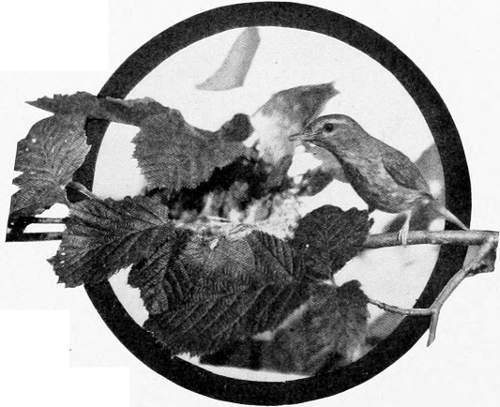
Taken in Oregon. Photo by Bohlman and Finley. WESTERN WARBLING VIREO AT NEST.
In sharp contrast with the beautiful canzonettes which the bird showers down from the tree-tops, come the harsh, wren-like [362] scolding notes, which it often delivers when searching thru the bushes, and especially if it comes across a lurking cat.
The Warbling Vireo’s cradle is swung midway from the fork of some nearly horizontal branch in the depths of a shady tree. In height it may vary from fifteen to twenty-five feet above the ground; but I once found one in a peach tree without a shadow of protection, and within reach from the ground. The structure is a dainty basket of interwoven grasses, mosses, flower-stems, and the like. It is not, however, so durable as that of some other Vireos, since much of its thickness is due to an ornamental thatching of grass, bark-strips, green usnea moss, and cottonwood down, which dissolves before winter is over. The female is a close sitter, sticking to her post even tho nearly paralyzed with fear. The male is usually in close attendance, and knows no way of discouraging the inquisitive bird-man save by singing with redoubled energy. He takes his turn at the eggs when his wife needs a bit of an airing, and even, it is said, carries his song with him to the nest.
No. 140. CASSIN’S VIREO.
A. O. U. No. 629 a. Lanivireo solitarius cassinii (Xantus).
Synonym.—Western Solitary Vireo.
Description.—Adult male: Crown and sides of head and neck deep olive-gray; a supraloral stripe and eye-ring whitish, the latter interrupted by dusky of lore; remaining upperparts olive-green overcast with gray, clearing, pure olive-green on rump and upper tail-coverts; wings and tail blackish with edging of light olive-green or yellowish (white on outer web of outer rectrices); tips of middle and greater coverts yellowish olive, forming two rather conspicuous bars; underparts white tinged with buffy, changing on sides and flanks to sulphur yellow or pale olive; under tail-coverts yellowish; bill grayish black above, paler below; feet dusky, iris brown. Adult female: Like male but duller, browner on head and neck, less purely white below. Immature: Head and neck more nearly like back; supraloral streak, orbital ring, and underparts washed with brownish buff. Length about 5.50 (139.7); wing 2.84 (72.2); tail 2.05 (52.2); bill .39 (10); tarsus .75 (19).
Recognition Marks.—Warbler size; slaty gray head contrasting with olivaceous back; whitish eye-ring distinctive; voice has more of an edge than that of V. olivacea.
Nesting.—Nest: a semi-pensile basket of woven bark-strips, grasses, and vegetable fibers, variously ornamented externally with cherry petals, spider cases, bits of paper, etc., lashed to bark of horizontal or descending bough of sapling [363] (oak, vine-maple, fir, etc.) at a height of from five to thirty feet; bulkier and of looser construction than that of other Vireos; measures 2¼ inches across by 1½ inches deep inside; walls often ¾ of an inch in thickness. Eggs: 3-5, usually 4, white or creamy white, sparingly marked with spots, which vary from rich red brown to almost black—but unmarked specimens are of record. Av. size .75 × .55 (19 × 13.9). Season: May 15-June 5; one brood.
General Range.—Pacific Coast district north to British Columbia, east to Idaho (Ft. Sherman; Ft. Lapwai), breeding from Los Angeles County, California, northward thruout its range; south in winter to western Mexico.
Range in Washington.—Common summer resident on both sides of the Cascades, found chiefly in timbered areas.
Migrations.—Spring: Seattle-Tacoma, c. April 15.
Authorities.—? Vireo solitarius, Ornithological Committee, Journ. Ac. Nat. Sci. Phila., VII. 1837, 193 (Columbia River). V. solitarius Vieillot, Baird, Rep. Pac. R. R. Surv., IX. pt. II 1858, p. 340, part. (T). C&S. Rh. D¹. Ra. D². Ss². J. B. E.
Specimens.—(U. of W.) B. Prov. P¹.
Nothing so endears a bird to a human admirer as a frank exhibition of confidence. Overtures of friendship on the bird’s part may traverse all rules of caution and previous procedure, but henceforth there is a new relation established between them, bird and man, and the man, at least, is bound to live up to it. At the oncoming of a smart shower on Capitol Hill (before the “For Sale” days) the bird-man put into a fir-covered nook for shelter, and had not been there two minutes before a pair of Cassin Vireos entered for the same reason. They were not in the least disturbed by the man’s presence, but cheerfully accepted him as part of Things as They Are. Therefore, they proceeded to preen their dampened feathers at distances of four or five feet, while the bird-man sat with bated breath and glowing eyes. The birds roamed freely about the nook and once, I think, he made a grimace behind the bird-man’s back; for when they came around in front again, I judged she was saying, “Ar’n’t you the wag!” while he tittered in droll recollection.
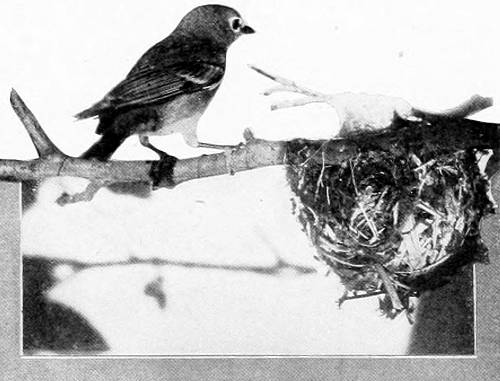
Taken in Oregon. Photo by Finley and Bohlman. CASSIN VIREO AT NEST.
[364]
These Vireos roam the half-open woods at all levels, like happy school children; and their childish curiosity is as little to be resented. If one hears a bird singing in the distance, he need only sit down and wait. Curiosity will get the better of the bird, and under pretense of chasing bugs it will edge over, singing carelessly now and then, by way of covering the inquisitive intent. At close range the song is stifled, and you feel for the ensuing moments as you do when you have overtaken and passed a bevy of ladies on a lonesome street, all hands and feet with a most atrocious swagger. Inspection done, the bird suddenly resumes the discarded melody, and you no longer have to “look pleasant.”
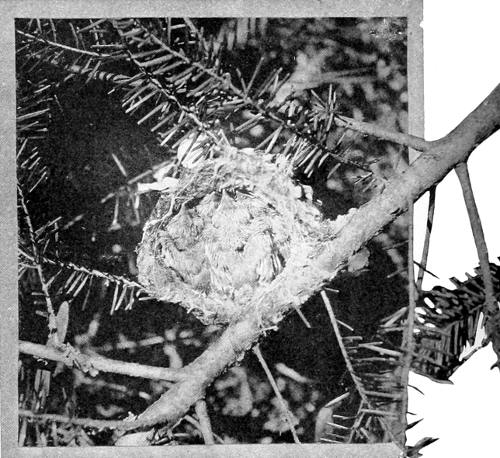
Taken near Tacoma. Photo by Dawson and Bowles. BRIMFUL.
Like most Vireos, Cassin sings as he works; and, as he works a good deal of the time, albeit in leisurely fashion, he sings in tiny phrases, separated by unembarrassed intervals of silence, a sort of soliloquizing commentary on life, very pleasant to the ear,—Weé ee-tsiweéoo-tsoo psooi-petewer-ptir-sewtrs-piti-wee-sueeé-pisooor. But our schoolboy does not fully express himself in music so staid and delicate. He has at command a rasping, nerve-grating war-cry, possibly intended by Nature as a defense against cats, but used, as matter of fact, when the bird is in particularly fine spirits. The note in question may perhaps be fitly likened to the violent shaking of a pepper-box, [365] a rattling, rubbing, shaking note, of three or more vibrations, ending in a little vocal flourish.
These Vireos swing a bulky basket from the lower or middle heights of oak trees, fir trees, alders, or saplings of various sorts. Usually no dependence is placed in cover, save that the ornamented nest corresponds roughly with its general surroundings of leaf, moss and lichen. In sheltered places, the texture of the nest is so well preserved that it may require close inspection the second season to distinguish it from a new nest. One such I examined, green with growing moss, and stark at the lowermost branch-tip of an unleafed cornel sapling, and I could not have determined its age save for a tiny weed-shoot germinating from the bottom of the cup.
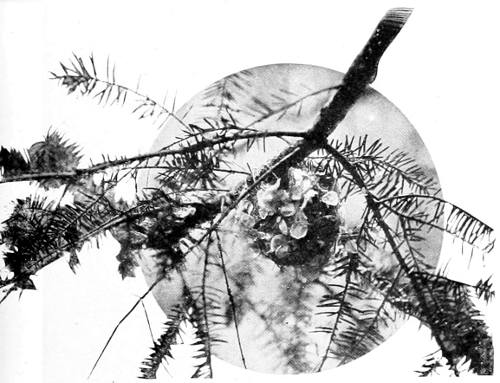
Taken near Tacoma. Photo by Bowles and Dawson. A DECORATED NEST.
Further Mr. Bowles says of their nesting habits: “Both birds assist in the duties of incubation, the male singing most assiduously while on the nest, and usually singing close to his mate while she is sitting. His turn at sitting seems to come between nine o’clock in the morning and noon, and the nest is not hard to find if his song can be traced. The bird student must work quietly, however, as the song at once ceases should any unusual noise occur. They are most courageous while on the nest, seldom leaving until removed by hand, when both birds remain within a few feet of the intruder, scolding vigorously. So much noise do they make that all the birds in the vicinity are attracted—indeed this is about the only sure method of ascertaining the presence of some of our rarer Warblers. On one such occasion a female Cooper Hawk left her nest, which was seventy-five yards distant, and sat on a branch overhead, screaming at me.
“They are the quickest as well as the slowest birds in completing their nests that have come under my notice. One pair built a [366] handsome nest and laid four eggs in precisely ten days; while another pair were more than three weeks from the time the nest was started until the eggs were laid.
“They are the only Vireos that I have ever known to nest in communities. Single pairs are the rule, but I have found as many as six occupied nests inside of a very small area, the nests being only a few yards apart.”
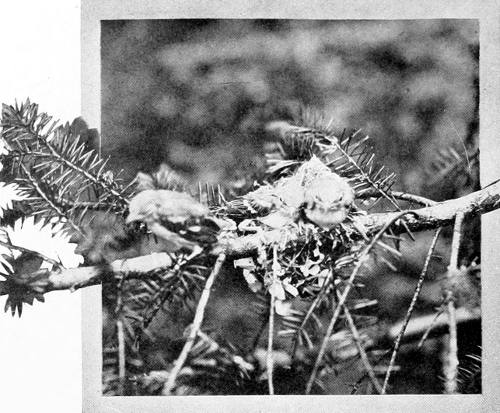
Taken near Tacoma. Photo by Bowles and Dawson. O’ER YOUNG TO FLIT.
No. 141. ANTHONY’S VIREO.
A. O. U. No. 632 c. Vireo huttoni obscurus Anthony.
Synonym.—Dusky Vireo.
Description.—Adults: Above dull olive, brightening (more greenish) posteriorly; wings and tail dusky, edged chiefly with pale olive-green; two prominent wing-bars of pale olive-yellow or whitish, formed by tips of middle and greater coverts; tertials broadly edged with palest olive on outer, and with whitish on inner webs; outer web of outermost rectrix whitish; underparts sordid whitish and more or less washed, chiefly on breast and sides, with dingy olive-yellow; lores pale; an orbital ring of whitish, or palest olive-yellow, interrupted midway of upper lid by spot of dusky; bill horn-color above, pale below. Length about 4.75 (120.6); average of three specimens in Provincial Museum at Victoria: wing 2.46 (59.9); tail 2.20 (55.8); bill .35 (8.9); tarsus .75 (19).
[367]
Recognition Marks.—Pygmy to warbler size; dingy coloration; whitish wing-bars serve to distinguish bird from Vireosylva g. swainsonii, but throw it into confusion in summer with the Western Flycatcher (Empidonax difficilis), which it otherwise closely resembles, and in winter with the Sitkan Kinglet (Regulus c. grinnelli). From the Flycatcher it may be distinguished by its shorter, narrower and yet thicker bill, and by its more restrained yellowness; from the Kinglet by its greater size and much stouter bill, more prominent wing-bars, and rather less prominent eye-ring; and from both by its demure ways.
Nesting.—Nest: a semipensile basket of interwoven mosses lined with grasses (nine feet high in fir tree—one example known). Eggs: 2-5(?); .72 × .52 (18 × 12.9). Season: June (probably also earlier).
General Range.—Pacific Coast district from western Oregon to southwestern British Columbia at lower levels (not at all confined to oak woods as variously reported).
Range in Washington.—West-side, as above; strictly resident.
Authorities.—? Townsend, Journ. Ac. Nat. Sci. Phila. VIII. 1839, 153 (Columbia River). Bowles (C. W. and J. H.), Auk, XV. 1898, 138. Ra. B. E.
Specimens.—U. of W. Prov. B. E.
In approaching the study of Anthony’s Vireo one must forget all he knows or thinks he knows about Vireos in general. This bird is sui generis, and deviations from all known rules are its delight. It has been, in fact, until quite recently, a sort of woodland sphinx, an ornithological mystery, the subject of much inquiry and hazard. Its presence in Washington was quite overlooked by Cooper and Suckley, and Mr. Rathbun’s appears to be the record[58] of first occurrence, that of a bird taken May 14, 1895. I took a specimen on Capitol Hill on the third day of June of the same year; and since that time appearances have become a matter of course to the initiated. Samuel N. Rhoads[59], writing in 1893, considered Anthony’s Vireo a rare visitor to Vancouver Island, where he secured a specimen in 1892 near Victoria. Fannin[60] records it as “a summer resident on Vancouver Island.” As matter of fact, the bird is resident the year round wherever it occurs. I saw it near Victoria during the coldest weather of 1905-6, and find it regularly at Seattle and Tacoma during the winter season. J. H. Bowles secured a specimen, a male in full song, at American Lake on January the 26th, 1907. Moreover, this bird had a bare belly as tho it might have been assisting with incubation.
The very fact that these birds winter with us argues that they have been here for always and always, and the darkening of plumage (as compared with the type form, V. huttoni) testifies further to their long residence.
Anthony’s Vireo is leisurely, almost sluggish at times, in its movements. [368] During the winter it mingles freely with the local troops of Kinglets and Chickadees, and keeps largely to the depths of fir trees. When moving about silently, it bears a striking resemblance to the Ruby-crowned Kinglet. It is, of course, slightly larger and much more deliberate, lacking especially the wing-flirt of the Kaiserkin. The region about the eye is more broadly whitish, and the wing-bars concede a difference upon inspection, but the resemblance is so close as altogether to deceive the unwary.
In spring the bird separates itself from its late companions, and begins to explore the budding alders and maples. As the season advances the bird plants itself in some thicket and complains by the hour in strange, monotonous, unvireonine notes. The songs vary endlessly in different individuals, but have this in common, that they are a deliberate, unvarying succession of double notes, usually, but not always, of a slightly nasal character. Chu-wêem - - - - chu-wêem - - - - - - chu-wêem - - ad lib., is the common type; Pu-cheéañ - - - - - pu-cheéañ - - - - - - pucheéañ, is a French variation; Poo-eêpt - - - poo-eêpt and jüreêt - jüreêt - jüreêt are types lacking the nasal quality. Only once I heard the notes pronounced quite rapidly, pe-eg′, pe-eg′, pe-eg′, pe-eg′ pe-eg′, ad infinitum, or rather ad adventum shotguni. Occasionally the first syllable is accented; as, (pe)cheê-oo or cheê-oo, cheê-oo.
Before he has found a mate Anthony roams about with some degree of restlessness, shifting his burden of song from place to place with a view to effect, and uttering now and then coaxing little requests which are certainly meant to win the heart of the lady in hiding. This squeaking note is sometimes raised to the dignity of song, at which times it is not unlike the whining of a dog, a most extraordinary sound to come from so tiny a throat. And if one mentions a chirp, or chuck, like that of a Red-wing Blackbird on a small scale, we have most of the representative efforts of this eccentric genius.
Only one nest of this subspecies has been reported to date, that discovered by Mr. C. W. Bowles, on June 21, 1897, near South Tacoma. It was placed nine feet up in a young fir, where it hung suspended by two small twigs. Externally it was composed entirely of a long hanging moss, some variety of Usnea, very thickly and closely interwoven, being thus conspicuously devoid of such exterior decorations as other Vireos provide. Inside was a carefully prepared bed of fine dry grasses, upon which lay two eggs half incubated.
“The female bird was on the nest when first seen and, unlike the majority of our Vireos, flushed the instant the ascent of the tree was attempted. From the nest she flew about twenty feet into a neighboring fir, where she looked down upon our operations with apparently no concern whatever. Beyond rearranging her feathers from time to time, there was nothing to indicate that she had a nest anywhere in the vicinity, as she made no sound or complaint of any kind. Neither was there any of the nervous hopping from [369] twig to twig in the manner by which so many of the smaller birds as clearly display their anxiety as they do by their notes of distress.”[61]
Tyrannidæ—The Tyrant Flycatchers
No. 142. KINGBIRD.
A. O. U. No. 444. Tyrannus tyrannus (Linn.).
Synonyms.—Eastern Kingbird. Bee Martin. Tyrant Flycatcher.
Description.—Adult: Above ashy black changing to pure black on head, and fuscous on wings; crown with a concealed orange-red (cadmium orange) patch or “crest,” the orange feathers black-tipped and overlying others broadly white at base; wings with whitish and brownish ash edgings; tail black, all the feathers broadly white-tipped, and the outermost pair often white-edged; below white, washed with grayish on breast; bill and feet black. Immature birds lack the crown-patch, and are more or less tinged with fulvous or buffy on the parts which are light-colored in the adult. Length 8.00-9.00 (203-228.6); wing 4.60 (116.8); tail 3.31 (84.1); bill from nostril .52 (13.2).
Recognition Marks.—Chewink size; blackish ash above; white below; black tail conspicuously tipped with white; noisy and quarrelsome.
Nesting.—Nest: at moderate heights in trees, usually over water, of weed-stalks, plant-fibres and trash, with a felted mat of plant-down or wool, and an inner lining of fine grasses, feathers, rootlets, etc. Eggs: 3 or 4, sometimes 5, white or cream-white, distinctly but sparingly spotted with dark umber and occasional chestnut. Av. size .98 × .73 (24.9 × 18.5). Season: first week in June; one brood.
General Range.—North America from the British Provinces south; in winter thru eastern Mexico, Central and South America. Less common west of the Rocky Mountains. Not recorded from northern Mexico and Arizona.
Range in Washington.—Not uncommon summer resident on East-side; not common, but of regular occurrence in certain localities west of the Cascades; nearly confined to vicinity of water in lake or pond.
Authorities.—Tyrannus carolinensis Baird, Baird, Rep. Pac. R. R. Surv., IX. pt. II. 1858, p. 171. T. C&S. D¹. Ra. D². Ss¹. Ss². J. B. E.
Specimens.—(U. of W.) Prov. P¹. C. E.
No one has come forward with a theory to account for the testiness of this bird’s temper, not for the domineering qualities which distinguish him above all others; but I hazard that it is because his glowing crown is partially concealed by bourgeois black. Those whose regal marks are more patent are wont to receive homage as matter of course, but the scion of an unacknowledged [370] house, a feathered Don Carlos, must needs spend a fretful life in defense of his claims. Toward those who knuckle down tamely the little tyrant is often very gracious, and it may be conceded that he does perform a real service in holding the common enemies at bay. Who has not seen him as he quits his perch on some commanding tree and hurries forward, choking with vengeful utterance, to meet and chastise some murderous hawk, who before any other foe is brave? Down comes the avenger! The Hawk shies with a guttural cry of rage and terror, while a little puff of feathers scatters on the air to tell of the tyrant’s success. Again and again the quick punishment falls, until the tiny scourge desists, and returns, shaking with shrill laughter, to give his mate an account of his adventure.
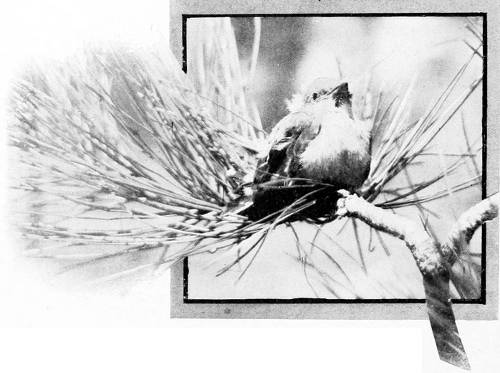
Photo by F. S. Merrill. Taken near Spokane. A DEMURE YOUNG TYRANT.
It is easily possible, however, to exaggerate the pugnacity of the Kingbird, or to infer from extreme examples that all are quarrelsome. It is not unusual for Kingbirds to be on the best of terms with their immediate neighbors, thieves always excepted. I once found in one small aspen tree at Chelan the nests of three birds each containing eggs, viz., a Robin, an Oriole, and a Kingbird. The two latter were within five feet of each other. Dr. Brewer also records an exactly similar case. Kingbird’s courage, which is unquestionable, is often tempered by prudence; altho at other times it quite overbalances his better judgment. The Burrowing Owl will tolerate none of his nonsense, and I have seen the birds make sad mistakes in molesting these virtuous mousers. The sight of a Shrike will make a Kingbird shrink into the smallest possible compass, while Catbirds, too, are said to be, for valid reasons, quite exempt from molestation.
[371]
The food of the Kingbird consists entirely of insects, caught on the wing for the most part, by sallies from some favorite perch. His eyesight must be very good, as he not infrequently spies his prey at distances of from twenty to fifty yards. Honey bees form an occasional but inconsiderable article of diet. Grasshoppers are not overlooked, and they sometimes capture, not without a scuffle, those big brown locusts (Melanoplus sp.) which make flippant exposure of their persons on a summer day. Both in the taking of food and in the discharge of police duties the Kingbird exhibits great strength and swiftness, as well as grace in flight. Once, when passing in a canoe thru a quiet, weed-bound channel, I was quite deceived for a time by the sight of distant white-breasted birds dashing down to take insects near the surface of the water, and even, occasionally dipping under it. They had all the ease and grace of Tree Swallows, but proved to be Kingbirds practising in a new role.
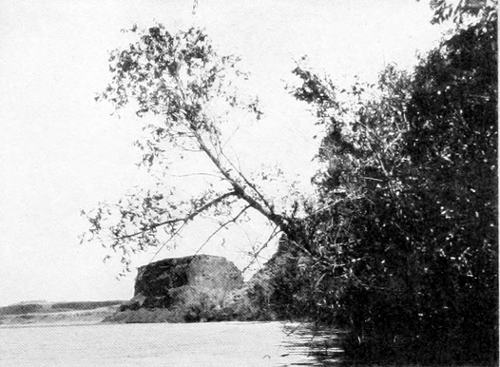
Taken in Douglas County. Photo by W. L. Dawson. COLD SPRING LAKE. THE ORIOLE-KINGBIRD NEST APPEARS NEAR THE TOP OF THE PROJECTING TREE.
This fondness for water is often exhibited in the birds’ choice of a nesting site. Where accustomed to civilization, orchard or shade trees are preferred, but on many occasions nests are found on low-swinging horizontal branches overhanging the water; and, as often, in tiny willow clumps or isolated trees entirely surrounded by it. The nest of the Kingbird sometimes presents that studied disarray which is considered the height of art. Now and then a nest has such a disheveled appearance as to quite discourage investigation, unless the owners’ presence betrays the secret of occupancy. On the shore of Cold Spring Lake, in Douglas County, we noted a last year’s Bullock Oriole’s nest, which would not have attracted a second glance, with the newer nest hard [372] by, had it not been for the constant solicitude of a pair of Kingbirds. Investigation showed that the ancient pocket had been crammed full of grass and twigs, and that it contained two fresh eggs of the Flycatcher. Ordinarily the nest is placed in an upright or horizontal fork of a tree at a height of from three to forty feet. Twigs, weed-stalks, and trash of any kind enter into the basal construction. The characteristic feature of the nest, however, is the mould, or matrix, composed of vegetable plaster, ground wood, and the like, or else of compacted wool and cow-hair, which is forced into the interstices of the outer structure and rounded inside, giving shape to the whole. This cup, in turn, is lined with fine grasses, cow-hair, or variously. Occasionally, nests are found composed almost entirely of wool. In others string is the principal ingredient.
Altho the Kingbird never sings, it has a characteristic and not unmusical cry, tizic, tizic (spell it phthisic, if you favor the old school) or tsee tsee tsee tsee, in numerous combinations of syllables, which are capable of expressing various degrees of excitement and emotion.
In eastern Washington this Kingbird is common and well distributed, tho far less abundant than the larger, grayer “Western.” West of the Cascades it is rare but regular, being found chiefly along the wooded margins of lakes.
No. 143. WESTERN KINGBIRD.
A. O. U. No. 447. Tyrannus verticalis Say.
Synonyms.—Arkansas Kingbird. Arkansas Flycatcher.
Description.—Adult Male: Foreparts, well down on breast, and upper back ashy gray, lightening, nearly white, on chin and upper throat, darker on lores and behind eye; a partially concealed crown-patch of orange-red (Chinese orange); lateral boundaries of this patch olivaceous; back, scapulars, and rump ashy glossed with olive-green; this color shading to black on upper tail-coverts; wings fuscous; tail black, the outer web of outermost rectrix white, or faintly tinged with yellow; underparts below breast rich canary yellow, paler on wing-linings and lower tail-coverts; bill and feet black; iris brown. Adult Female: like male but crown-patch usually somewhat restricted, and primaries much less attenuated. Young birds are duller and browner without crown-patch, and with little or no olivaceous on back; the yellow of underparts is paler (sulphury or even whitish), and the primaries are scarcely or not at all attenuated. Length of adult males about 9.00 (228.6); wing 5.12 (130); tail 3.68 (93.5); bill .73 (18.7); tarsus .74 (18.8). Females average less.
Recognition Marks.—Chewink to Robin size; noisy, petulant ways; ashy foreparts and yellow belly distinctive.
Nesting.—Nest: of twigs, grasses, string, wool, and other soft substances, placed at moderate heights in bushes or trees, or more commonly on beams and [373] ledges of barn or outbuildings. Eggs: 3-5, like those of T. tyrannus, but averaging smaller, .93 × .68 (23.6 × 17.3). Season: first week in June; one brood.
General Range.—Western United States, north regularly to southern British Columbia, occasionally to Alberta, Assiniboia, and Manitoba, north to western Minnesota, eastern Nebraska, and western Texas, breeding thruout range, and south to Chihuahua, Mexico; south in winter thru Mexico to highlands of Guatemala.
Range in Washington.—Common summer resident east of the Cascades, rare or casual on the West-side.
Migrations.—Spring: c. May 1st; Wallula April 26, 1905; Yakima April 30, 1900; Chelan May 11, 1896.
Authorities.—Baird, Rep. Pac. R. R. Surv. IX. 1858, p. 174. T. C&S. D¹. D². Ss¹. Ss². J. B. E.
Specimens.—U. of W. P¹. Prov. B. E.
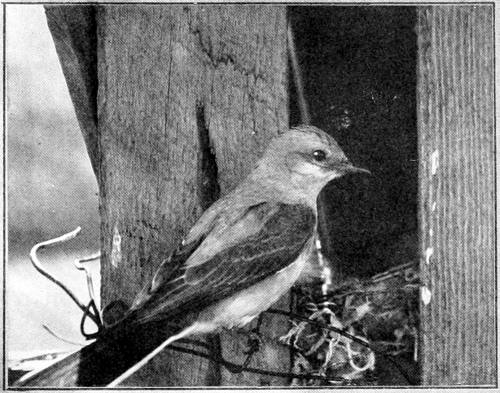
Taken in Douglas County. Photo by the Author. WESTERN KINGBIRD AT NEST.
Here is the presiding genius of all properly conducted ranches upon the sunny side of the Cascade Mountains. Guest he is not, host rather; and before you have had time to dismount from your panting cayuse this bird bustles forth from the locust trees and hovers over you with noisy effusiveness. [374] The boisterous greeting is one-third concern for his babies in the locust tree hard-by, one-third good fellowship, and the remainder sheer restlessness. The Western Kingbird is preeminently a social creature. And by social in this case we mean, of course, inclined to human society. For, altho the bird may start up with vociferating cries every time a member of the besieged household sets foot out of doors, one is reminded by these attentions rather of a frolicsome puppy than of a zealous guardian of the peace. Those who have been most honored by their presence year after year claim that the birds become fond of certain members of the family, and allow a familiarity in nest inspection which would be shriekingly resented in the case of strangers.
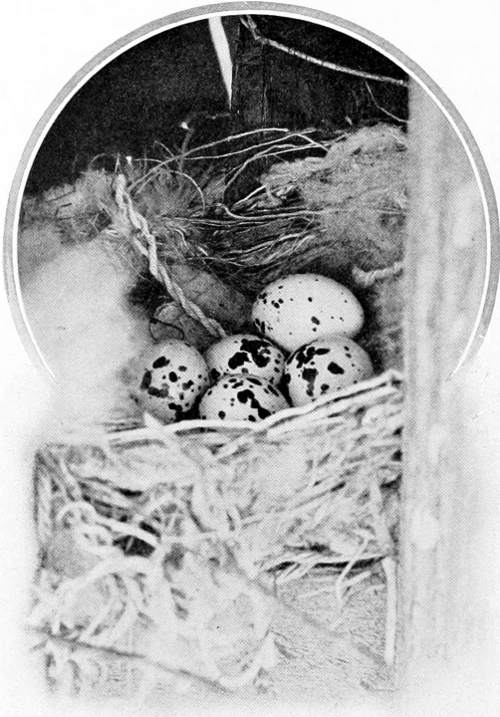
Taken in Douglas County. Photo by the Author. “BEAUTIES THEY ARE.”
One can readily guess a utilitarian consideration in favor of ranch life, viz., the greater variety and abundance of insects afforded. Of these the Kingbirds enjoy a practical monopoly by reason of their confidence in man. They are fond of flies, moths, butterflies, crickets, winged ants, and all that sort of thing. Moreover, they eat bees. But,—[Hold on, Mr. Rancher! Don’t grab that shot-gun and begin murdering Kingbirds] they eat only drones. A bee-keeper in California was curious on this point [375] and dissected over a hundred specimens of Western Kingbirds and Phœbes, using a microscope in the examination of stomach contents. The birds had been shot about the apiaries, where they had been seen darting upon and catching bees. Altho many of the birds were gorged, no working bees were found, only drones. This is an important distinction to bear in mind, for the reduction of drones is unqualifiedly beneficial. And when one stops to think of it, it is absurd to suppose that a bird could swallow bees, stings and all, with impunity.
But the real secret of Kingbird’s attachment for mankind is not discovered until we see his nest. It is our strings which have won his heart. Whatever else the nest may or may not contain, it is sure to have string,—string in strands, string in coils, string in bunches, hanks, and tangles, drug store string of a dissipated crimson hue, white string that came around the sugar, greasy string that you had tied around your finger to remind you to feed the chickens, string of every length and size and use and hue.
Those Western Kingbirds which have not yet adopted men manage to subsist somewhat after the fashion of their eastern cousins, and build a nest of twigs, grass, weed-stalks, bark strips, and cottonwood down, placing it against the trunk, or saddling it upon a horizontal fork of willow, poplar, cottonwood, or pine, usually near water. One we found in Douglas County built in a small willow which emerged from a shallow lake, a hundred feet from shore.
But, more commonly, nests are placed about crannies and projections of farm buildings, fences, unused wagon-ricks, or upon the house itself. If no such conveniences offer, a shade tree is second choice, and the nest includes all the soft waste which the farm affords, bits of cloth, wool, cow-hair, feathers, and string.
Taken at Stratford. Photo by the Author. A DIVIDED HOUSE.
Eggs to the number of 4 or 5 are deposited from the 1st to the 15th of June. [376] Beauties they are too, creamy white with bold and handsome spots of chestnut in two shades, and lilac-gray. Incubation is accomplished in twelve or thirteen days, and the youngsters fly in a matter of two weeks.
These Kingbirds are model parents, devoted in brooding and courageous in defense. Noisy they are to a fault, garrulous in an unnumbered host of cajolatives and ecstatics, as well as expletives. Unlike the members of Tyrannus tyrannus, they are good neighbors even among their own kind. At the call of need neighbors rally to the common defense, but this is usually in villages where demesnes adjoin. On several occasions I have found other birds nesting peaceably in the same tree with these Kingbirds; and, as in the case of T. tyrannus, Bullock Orioles appear to be rather particular friends.
The nests shown in the cut on preceding page are the work of one pair of birds. Embarrassed by a wealth of string and unable to decide which of two good locations to utilize, the birds built in both; the female laid eggs in both, three in one and two in the other. Moreover, she sat in both, day and day about, a bird of a divided mind.
No. 144. ASH-THROATED FLYCATCHER.
A. O. U. No. 454. Myiarchus cinerascens (Lawrence).
Description.—Adults: Above dull grayish brown changing to clear brown on crown; wings dusky brown, the middle and greater coverts tipped broadly, and the secondaries edged with pale buffy brown or dull whitish, the primaries edged, except toward tips, with cinnamon-rufous; tail darker than back, with paler grayish brown edgings, that of outermost rectrix sometimes nearly white; tail feathers, except central pair, chiefly cinnamon-rufous on inner webs; sides of head and neck gray (slightly tinged with brown) fading into much paler gray on chin, throat, and chest, changing to pale yellowish on breast and remaining underparts; yellow of underparts strengthening posteriorly, and axillars and under wing-coverts clear (primrose) yellow. Bill blackish; feet and legs black; iris brown. Length of adult male about 8.35 (212); wing 3.94 (100); tail 3.63 (92); bill .75 (19); tarsus .91 (23).
Recognition Marks.—Chewink size; brownish gray above; ashy throat shading into pale yellow of remaining underparts.
Nesting.—Nest: a natural cavity or deserted Flicker hole, copiously lined with wool, hair, or other soft materials. Eggs: 3-6, usually 4, buffy or creamy as to ground, but heavily marked, chiefly in curious lengthwise pattern, with streaks of purplish chestnut of several degrees of intensity. Av. size, .88 × .65 (22.4 × 16.5). Season: first week in June; one brood.
[377]
General Range.—Western United States and northern Mexico, north irregularly to Washington; south in winter thru Mexico to Guatemala.
Range in Washington.—Breeding near North Yakima in summer of 1903; one other record, Tacoma May 24, 1905.
Authorities.—Snodgrass (R. E.), Auk. Vol. XXI, Apr. 1904, p. 229. B.
Specimens.—P. C.
Flycatchers are somewhat given to wandering, or at least exploring, on their own account, regardless of traditions. A Gray Kingbird (Tyrannus dominicensis), normally confined to the Gulf of Mexico, is of record for Cape Beale on Vancouver Island; and that dashing gallant, the Scissor-tailed Flycatcher, of Texas, has ventured as far north as Hudson Bay. The Ash-throated Flycatcher is typically a bird of the south-western United States; but it is not altogether surprising that it should have extended its northern range into the Upper Sonoran belt of eastern Washington, as it did in the season of 1903, when it was observed at North Yakima by Mr. Bowles, and, independently, by Mr. Robert E. Snodgrass, the latter collecting for Pullman College. Without precedent or excuse, however, was the appearance of a handsome pair near Tacoma, as recorded by Mr. Bowles, on the 24th day of May, 1905.
“The Ash-throated Flycatcher is quite expert upon the wing but never indulges in protracted flight if it can help it. It seems to be rather quarrelsome and intolerant in its disposition toward other birds, and will not allow any to nest in close proximity; in fact, I am inclined to believe that it not infrequently dispossesses some of the smaller Woodpeckers of their nesting sites.
“Its food consists mainly of beetles, butterflies, grasshoppers, flies, moths, and occasionally of berries, especially those of a species of mistletoe.
“By the beginning of May most of the birds are mated, and nidification begins shortly afterward. The nests are usually placed in knot-holes of mesquite, ash, oak, sycamore, juniper, and cottonwood trees, as well as in cavities of old stumps, in Woodpeckers’ holes, and occasionally behind loose pieces of bark, in the manner of the Creepers.
“The Ash-throated Flycatcher nests at various heights from the ground, rarely, however, at greater distances than twenty feet. The nest varies considerably in bulk according to the size of the cavity used. Where this is large the bottom is filled up with small weed-stems, rootlets, grass, and bits of dry cow- or horse-manure, and on this foundation the nest proper is built. This consists principally of a felted mass of hair and fur from different animals, and occasionally of exuviæ of snakes and small lizards; but these materials are not nearly as generally used as in the nests of our eastern Crested Flycatcher—in fact, it is the exception and not the rule to find such remains in their nests” (Bendire).
[378]
No. 145. SAY’S PEWEE.
A. O. U. No. 457. Sayornis saya (Bonap.).
Synonyms.—Say’s Phoebe. Western Phoebe.
Description.—Adults: General color drab (grayish brown to dark hair-brown), darker on pileum and auriculars, lighter on throat, shading thru upper tail-coverts to black; tail brownish black; wings fuscous, the coverts and exposed webs of tertials edged with lighter grayish brown; underparts below breast cinnamon-buff; axillars and lining of wings light buff or cream-buff. Bill and feet black; iris brown. Young birds are more extensively fulvous, and are marked by two cinnamomeous bands on wings (formed by tips of middle and greater coverts). Length of adult male 7.50 (190.5); wing 4.14 (105); tail 3.23 (82); bill .62 (15.7); tarsus .79 (20). Female averages smaller.