Volume 1 — The Birds of Washington (continued 6)
Reading edition
Recognition Marks.—Medium Warbler size; black with salmon-red and salmon patches of male; similar pattern and duller colors of female and young; tail usually half open and prominently displayed, whether in sport or in ordinary flight.
Nesting.—Nest, in the fork of a sapling from five to fifteen feet up, of hemp and other vegetable fibers, fine bark, and grasses, lined with fine grasses, plant-down and horse-hair. Eggs, 4 or 5, greenish, bluish, or grayish-white, dotted and spotted, chiefly about larger end, with cinnamon-rufous or olive-brown. Av. size .68 × .51 (17.3 × 13). Season: June; one brood.
General Range.—Temperate North America in general, regularly north to Nova Scotia, the Mackenzie River (Fort Simpson), etc., west to southern Alaska, British Columbia, eastern Washington, Utah, etc., casual in eastern Oregon, northern California, and in the southeastern states; breeding from the middle portion of the United States northward; south in winter thruout West Indies, Mexico and Central America to northern South America.
Range in Washington.—Rare but regular summer resident in northern portion of State east of Cascades (Methow Valley, Grand Coulee, etc.), casual(?) in the Blue Mountains.
Authorities.—[J. K. Lord in “Nat. in Vancouver Id. and B. C.”, 1866, p. 162 (Colville Valley).] Brewer, Bull. Nutt. Orn. Club. V., 1880, 50 (Ft. Walla Walla). D¹. Ss¹. J.
Specimens.—C. P¹.
The “start” of Redstart is from the old Anglo-Saxon steort, a tail; hence, Redstart means Redtail; but the name would hardly have been applied to the American bird had it not been for a chance resemblance which it bears to the structurally different Redstart of Europe, Ruticilla phoenicurus. In our bird the red of the tail is not so noticeable as is the tail itself, which is handled very much as a coquette handles a fan, being opened or shut, or shaken haughtily, to express the owner’s varied emotions.
The Redstart is the presiding genius of woodland and grove. He is a bit of a tyrant among the birds, and among his own kind is exceedingly [212] sensitive upon the subject of metes and bounds. As for the insect world he rules it with a rod of iron. See him as he moves about thru a file of slender poplars. He flits restlessly from branch to branch, now peering up at the under surface of a leaf, now darting into the air to secure a heedless midge, and closing upon it with an emphatic snap, now spreading the tail in pardonable vanity or from sheer exuberance of spirits; but ever and anon pausing just long enough to squeeze out a half-scolding song. The paler-colored female, contrary to the usual wont, is not less active nor less noticeable than the male, except as she is restrained for a season by the duties of incubation. She is even believed to sing a little on her own account, not because her mate does not sing enough for two, but because she—well, for the same reason that a woman whistles,—and good luck to her!
During the mating season great rivalries spring up, and males will chase each other about in most bewildering mazes, like a pair of great fire-flies, and with no better weapons—fighting fire with fire. When the nesting site is chosen the male is very jealous of intruders, and bustles up in a threatening fashion, which quite overawes most birds of guileless intent.
Redstart’s song is sometimes little better than an emphatescent squeak. At other times his emotion fades after the utterance of two or three notes, and the last one dies out. A more pretentious effort is represented by Mr. Chapman as “Ching, ching, chee; ser-wee swee, swee-e-e-e.” Many variations from these types may be noted, and I once mistook the attempt of a colorless young stripling of one summer for that of a Pileolated Warbler.
Our Redstart shares with the Yellow Warbler alone the distinction of representing among us in ipsa specie the Warbler hosts of the East. Even so, our scanty summer population of Redstarts, confined as it is to the northeastern counties, appears to represent an overflow of the eastern hordes, or, perhaps, the van of occupation, rather than regularly established citizens. I have seen them as far south as Brook Lake, and as far west as Stehekin only; but Mr. Allan Brooks records a specimen from Chilliwhack, in western British Columbia.
Alaudidæ—The Larks
No. 87. ALASKA HORNED LARK.
A. O. U. No. 474 a. Otocoris alpestris arcticola Oberholser.
Synonyms.—Arctic Horned Lark. Pallid Horned Lark. Winter Lark.
[Description of type form, Otocoris alpestris.—Adult male in breeding plumage: A narrow patch across fore-crown with ends curving laterally backward [213] and produced into a feather-tuft or “horn,” black; a broad bar from nostril to eye thence curving downward and expanding to involve hinder portion of cheeks and auriculars anteriorly, black; a crescentic patch across upper chest black; forehead and superciliaries pale yellow (primrose yellow) paling posteriorly; auriculars yellow continuous with and deepening into straw yellow of chin, throat and malar region; remaining underparts white, the sides and flanks dull vinaceous streaked with dusky; upperparts in general warm grayish brown, the middle of crown, occiput, nape, lesser wing-coverts and upper tail-coverts vinaceous-cinnamon; back, scapulars and rump grayish brown, each feather edged with paler and having dusky center; wings hair-brown with paler edgings, the outermost primary edged with white; tail chiefly black, the middle pair of feathers dusky, edged with whitish, the two lateral pairs edged with white. Bill black lightening below (basally); legs and feet black; iris dark brown. Adult female in summer: Like male but duller and paler, the black areas reduced in extent and obscured by brownish or buffy tips; yellow of superciliary stripe, etc., duller and paler; upperparts more noticeably streaked and with less of vinaceous tint on hind neck and upper tail-coverts. Both sexes in fall and winter are somewhat more heavily and more uniformly colored save on black areas which are overcast by buffy or brownish tips; also forebreast dusky or obscurely spotted. Young birds are heavily speckled above with yellowish white on brownish and dusky ground. Length of adult male: 7.00-7.50 (177-190); wing 4.37 (111); tail 2.83 (72); bill .48 (12.2); tarsus .94 (24). Adult female: 6.75-7.25 (171-184); wing 4.09 (104); tail 2.48 (63); bill .43 (11.1); tarsus .91 (23.2).]
Description.—Adults: Similar to O. alpestris but upperparts paler and grayer, less warmed by vinaceous; no yellow (or merest tinge on head and throat)—white instead; size about the same.
Recognition Marks.—Sparrow size; black crescent on upper chest; black cheek and crown patches; feather-tufts or “horns” directed backward. To be distinguished from O. a. merrilli and O. a. strigata by larger size and absence of yellow.
Nesting.—Not certainly known to breed in Washington but possibly does so above timber-line. Nest: a cup-shaped depression in the surface of the ground, plentifully lined with fine grasses, moss, grouse feathers, etc. Eggs: 3 or 4, greenish- or grayish-white, profusely and minutely dotted with olive-buff, greenish-brown and lavender. Av. size .95 × .66 (27 × 16.7).
General Range.—“Breeding in Alaska (except Pacific coast district) and valley of the Upper Yukon River, Northwest Territory; migrating southward to Oregon, Utah, Montana, etc.” (Ridgway).
Range in Washington.—Common winter resident and migrant east of the Cascades. Birds breeding on the higher mountains are doubtfully referable to this form.
Authorities.—O. a. leucolæma (Coues), Dawson, Auk, XIV. 1897, 176. D². J.
Specimens.—Prov.
The Horned Lark bears the reputation of being the most plastic of American species—the Song Sparrow (Melospiza melodia) being a close second [214] in this respect. A monograph by Mr. H. C. Oberholser[29] enumerates twenty-three forms, of which seventeen are described as North American, and four Mexican, beside one from Colombia (O. a. peregrina) and another (O. a. flava) from Eurasia. Of this number the majority occur west of the Mississippi River, where climatic conditions are more sharply differentiated, and where, especially in the Southwest, the situation allows of that permanent residence which is conducive to the development of subspecific forms.
The situation in Washington appears to be somewhat as follows: O. a. strigata, strongly marked, but showing relationship to merrilli, and likeness to insularis, of the Santa Barbara Islands, summers in western Washington in open prairies, and at low altitudes only. In winter it retires southward, or straggles irregularly eastward[30]. O. a. merrilli is related to strigata on the one hand, and to leucolæma (the Desert Horned Lark) on the other, but it curiously reproduces the appearance of praticola (being indistinguishable in certain plumages); and also bears close resemblance to giraudi, a non-migrant form of the Gulf shore of Texas. It summers thruout eastern Washington, and even (doubtfully) occupies the western coast of British Columbia. An isolated colony occurring on Mount Baker, above timber-line, is referred by Oberholser to this form, but I should prefer to call it an intergrade with arcticola. In winter merrilli retires completely from its Washington range, and its place is taken by arcticola, sweeping down from the highlands of British Columbia and Alaska in considerable numbers.
It is not at all difficult for one who is accustomed to the appearance of merrilli to recognize these newcomers when they appear, late in October, for they are decidedly larger, more lightly colored, and show no slightest trace of yellow. They are much given to wandering about in straggling flocks, and the mild cries which they scatter freely have a subdued and plaintive tone, borrowed, no doubt, from the chastened character of the season. A sitting flock will sometimes allow a very close approach, but when they do so they “freeze,” so perfectly that the eye can scarcely find them. The only thing to do under such circumstances is to freeze also, until the birds begin to limber up and steal cautiously away, taking advantage, for concealment, of every tuft of grass or depression of the ground, and giving occasional admonitory yips to their fellows.
[215]
No. 88. COLUMBIAN HORNED LARK.
A. O. U. No. 474 i. Otocoris alpestris merrilli Dwight.
Synonyms.—Dusky Horned Lark. Merril’s Horned Lark.
Description.—Similar to O. a. strigata but somewhat larger and decidedly grayer above, streaks narrower and dusky rather than black; underparts not suffused with yellowish and yellow of head, especially superciliary, not so strong as in O. a. strigata. Length (skins) 6.25 (159); wing 4.05 (103); tail 2.32 (59); bill .43 (11); tarsus .85 (21.6).
Recognition Marks.—As in preceding; smaller, darker and more yellow than O. a. arcticola; larger, grayer and less yellow than O. a. strigata.
Nesting.—Nest and eggs as in preceding. Av. size of eggs .93 × .61 (23.6 × 15.5). Season: April-July; two or three broods.
General Range.—Breeding in northwestern interior district of the United States from northwestern Nevada and northeastern California north thru Oregon and Washington well up into British Columbia, east to Idaho; south in winter (at least) to central California.
Range in Washington.—Common summer resident and migrant east of the Cascades. Breeding birds of the high Cascades may possibly be of this form.
Authorities.—Eremophila alpestris, Brewster, B. N. O. C. VII. Oct. 1892, p. 227. D¹. Sr. D². Ss¹. Ss². J. E.
Specimens.—P¹. Prov. E(?).
A modest bird is the Columbian Horned Lark, for his home is on the ground, and he hugs its tiny shelters when disturbed, as tho quite assured that its brownness matches the tint of his back. If attentively pursued, he patters away half trustfully, or if he takes to wing, he does so with a deprecating cry of apology, as if the fault were his instead of yours. If his business keeps him in the same field, he will reappear presently, picking from the ground with affected nonchalance at a rod’s remove, or else pausing to face you frankly with those interesting feather-tufts of inquiry, supported by black moustachios and jetty gorget on a ground of palest primrose.
The unseeing class the Horned Larks among “brown birds” and miss the vaulting spirit beneath the modest mien. Yet our gentle Lark is of noble blood and ancient lineage. The Skylark, of peerless fame, is his own cousin; and, while he cannot hope to vie with the foreign bird in song, the same poet soul is in him. Whether in the pasture, upon the hillside, or in the desert, the coming of spring proclaims him laureate; and the chief vocal interest of nesting-time centers in the song-flight of the male Horned Lark.
The song itself is, perhaps, nothing remarkable, a little ditty or succession of sprightly syllables which have no considerable resonance or [216] modulation, altho they quite defy vocalization; yet such are the circumstances attending its delivery that it is set down by everyone as “pleasing,” while for the initiated it possesses a charm which is quite unique. Twidge-widge, widgity, widgy-widge, conveys no idea of the tone-quality, indeed, but may serve to indicate the proportion and tempo of the common song; while Twidge, widgity, eelooy, eelooy, idgity, eelooy, eew, may serve the same purpose for the rare ecstasy song. The bird sometimes sings from a fence post, a sage bush, or even from a hummock on the ground, but usually the impulse of song takes him up into the free air. Here at almost any hour of the day he may be seen poising at various heights, like a miniature hawk, and sending down tender words of greeting and cheer to the little wife who broods below.
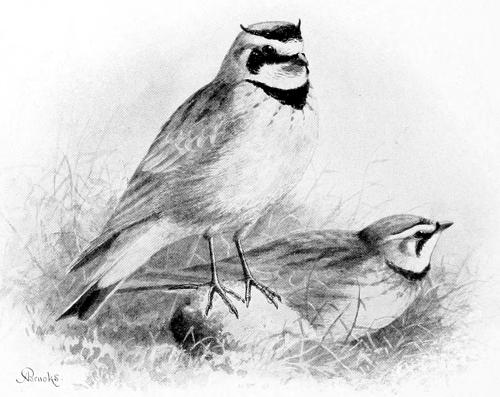
COLUMBIAN HORNED LARKS.
It is, however, at the sacred hour of sunset that the soul of the heavenly singer takes wing for its ethereal abode. The sun is just sinking; the faithful spouse has settled herself to her gentle task for the night; and the bird-man has lain down in the shadow of the fence to gaze at the sky. The bird gives himself to the buoyant influences of the trembling air and mounts aloft by easy gradations. As he rises he swings round in a wide, loose circle, singing [217] softly the while. At the end of every little height he pauses and hovers and sends down the full voiced song. Up and up he goes, the song becoming tenderer, sweeter, more refined and subtly suggestive of all a bird may seek in the lofty blue. As he fades from the unaided sight I train my glasses on him and still witness the heavenward spirals. I lower the glasses. Ah! I have lost him now! Still there float down to us, the enraptured wife and me, those most ethereal strains, sublimated past all taint of earth, beatific, elysian. Ah! surely, we have lost him! He has gone to join the angels. “Chirriquita, on the nest, we have lost him.” “Never fear,” she answers; “Hark!” Stronger grows the dainty music once again. Stronger! Stronger! Dropping out of the boundless darkening blue, still by easy flights, a song for every step of Jacob’s ladder, our messenger is coming down. But the ladder does not rest on earth. When about two hundred feet high the singer suddenly folds his wings and drops like a plummet to the ground. Within the last dozen feet he checks himself and lights gracefully near his nest. The bird-man steals softly away to dream of love and God, and to waken on the morrow of earth, refreshed.
The Columbian Horned Lark enjoys a wide distribution thruout eastern Washington during the nesting season, the only requirement of the bird being open country. The convenience of water is no object, and the bird favors the undifferentiated wastes of sage, rather than the cultivated fields. Elevated situations are especially attractive, and thousands of these Horned Larks nest along barren, wind-swept ridges and on the smaller mountains where no other species can be found.
No. 89. PACIFIC HORNED LARK.
A. O. U. No. 474 g. Otocoris alpestris strigata Henshaw.
Synonym.—Streaked Horned Lark.
Description.—Similar to O. alpestris but darker and much smaller, above streaked broadly with black and tinged with buffy; nape, rump and bend of wing more rufescent; underparts usually more or less suffused with yellowish. Adult female more strongly and handsomely marked than that of any other form. Length of adult male (skins) 5.98 (52); wing 3.85 (98); tail 2.59 (65.8); bill .44 (11.3); tarsus .82 (20.8).
Recognition Marks.—As in preceding; smaller, darker and more yellow than other local forms.
Nesting.—Nest and eggs as in preceding. Season: second week in May, second week in June; two broods.
General Range.—Breeding in Pacific Coast district of Oregon, Washington [218] and British Columbia; “migrating to eastern Oregon and Washington, and northern California (Red Bluff; San Francisco)” (Ridgway).
Range in Washington.—Found breeding only on prairies west of Cascades, therefore chiefly confined to Pierce, Thurston and Chehalis Counties; said to winter on East-side.
Migrations.—Spring: last week in February; Tacoma, February 25, 1905, February 10, 1908.
Authorities.—Eremophila cornuta Boie, Baird, Rep. Pac. R. R. Surv., IX. 1858, 404, 405. (T). C&S. L¹. Ra. B.
Specimens.—(U. of W.) Prov. B.
The prairies of Pierce, Thurston, and Chehalis Counties, so often referred to in these pages, are of comparatively recent formation—mere gravel beds leveled off by the action of a retreating sea—and so thoroly washed thru portions of their area as to be capable of supporting little else than a carpet of moss. The wanton recklessness of the Pacific Horned Larks, which inhabit these open stretches, is really but one degree removed from the modesty of their more fortunate kinfolk across the Cascades. It is modesty without opportunity; and that easily becomes shamelessness. For here the ground is of an uncompromising green, and the “cover,” afforded by slight depressions in the moss, is usually unworthy of the name.
The perfection of green barrenness was attained in the golf-links of South Tacoma, before they were surrendered to the demands of the growing city. Yet this was the very place where the Horned Larks appeared to the best advantage. Returning, as they did, about the 25th of February, in good seasons, they disported themselves like mad Pixies for a month or so, engaging in amorous pursuit and frequent song-flight; until in some way, late in April, domestic order began to emerge from the chaos of rival claims, and little homes dotted the prairie, where belted squires and red-jacketed ladies pursued the twinkling gutta-percha. The conflict of interests, avian and human, was sometimes disastrous to the birds. Mr. Bowles records three instances in which Larks were killed by flying golf balls; and another gentleman, himself a devotee of the game, tells me he once saw a bird struck dead in mid-air.
By the spring of 1906 matters had gone from bad to worse. The golf-links became a sort of common, despairingly resorted to by a few enthusiasts and a motley laity. The northwest portion of the section was staked out into lots, and the whole area was criss-crossed by roads and paths, whereby workmen, school-boys and delivery wagons hastened to and fro. Then it became the special pasture of a band of fifty cows, the lean kine of Pharaoh’s dream multiplied by seven; and to the terrors of two hundred heedless hoofs was later added a flock of sheep, being fattened for sacrifice at a neighboring slaughter-house. This common was also a favorite romping ground for children, while dogs simply went crazy upon it. I saw one rabid beast in a [219] delirium of unfettered bliss do off about six miles in twice as many minutes, with a Horned Lark, flying low, as the invariable object of his chase. When to such conditions as these was added the scantiness of cover, one marveled indeed that the daffy Horned Lark still persisted upon his ancient heritage.
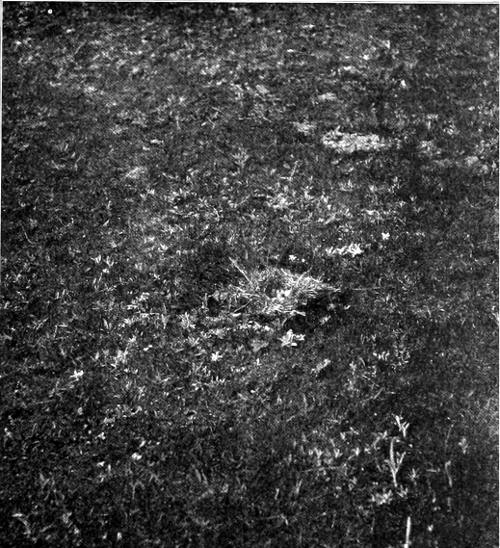
Taken at South Tacoma. Photo by Dawson and Bowles. THE NEST ON THE GOLF LINKS.
Yet on the 11th of April (the earliest record by far), in the barest of it, we marked a deep rounded cavity which Mr. Bowles declared belonged to the Streaked Horned Lark. Returning on the 27th, we found that the hole in the ground had become a bump instead. The bird, grown callous amid the impending evils, or else frankly intending to warn off trespassers, had filled the cavity full to overflowing, and had erected upon its site a monumental pile visible at a hundred yards. So zealous had the bird’s efforts been that the crest of the nest stuck up two and a half inches above the close-cropped landscape, and the bottom of the nest was above the ground. This creation was quite ten inches across, while it included upon its skirts bits of sod, cow-chips and pebbles,—a motley array, possibly designed to distract attention from the dun-colored eggs which the nest contained. The most lavish display of this sort of brumagem marked a runway of approach, offset by a corresponding depression upon the other side. The nest was composed chiefly of dried grasses and weed-stalks with soft dead leaves, and was lined, not very carefully, with grass, dried leaves, and a single white chicken-feather.[31]
[220]
Once the attention of the oölogist was directed to this structure, it rose from the plain like a pyramid of Cheops before his strained anxieties. It was torture to have to leave it for half an hour. How could that school-boy pass at twenty yards and not see it! Then, when I returned to reconnoiter, the dear cattle were just being turned loose for the morning, and they, forsooth, must straggle past it. At the end of another hour, unable longer to endure the suspense, I returned to perform the last offices. The band of sheep was out then, and they were drifting so perilously close, that I ran the last hundred yards to head them off, and none too soon. Yet that precious monument of simplicity held three eggs, unharmed until the advent of the man, who wrought the ruin surely, in the name of—Science(?). Consistency, thou art a jewel found in no egg-collector’s cabinet!
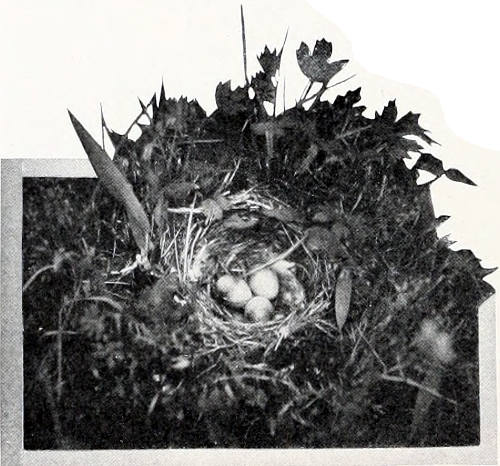
Taken near Tacoma. Photo by J. H. Bowles. NEST AND EGGS OF PACIFIC HORNED LARK.
The nest of the Pacific Horned Lark is not often concealed, but usually it does not more than fill the hollow of some cavity, natural or artificial,—a wheel-rut, a footprint of horse or cow, a cavity left by an upturned stone, or, as in one instance, the bottom of an unused golf-hole. The only attempt at concealment noted was where the nest had been placed under the fold of a large strip of tar paper, most of which had become tightly plastered to the ground.
In spite of the comparatively mild weather prevailing in April, eggs are not often laid before the second week in May, and a second set is deposited about the second week in June. The number of eggs in a set varies from two to four, three being most commonly found. In color the ground is grayish white, while dots of greenish gray or reddish gray are now gathered in a heavy wreath about the larger end, and now regularly distributed over the entire surface—sometimes so heavily as to obscure the ground. The eggs are often very perceptibly glossed and there is frequently a haunting greenish or yellowish tinge which diffuses itself over the whole—an atmosphere, as the artist would say. Variation in size runs from ovate to elongate oval, and measurements range from .93 × .60 to .81 × .58.
Horned Larks owe their preservation chiefly to the wariness of the female, [221] for she flushes at long distances. Either she will slip off quietly and sneak at thirty yards, or else flush straight at a hundred. When the nest is discovered she is quite as likely to ignore the intruder, and seldom ventures near enough to betray ownership. On the other hand, given patience and a pair of strong binoculars, “tracking” is not a difficult accomplishment.
Motacillidæ—The Wagtails and Pipits
No. 90. AMERICAN PIPIT.
A. O. U. No. 697. Anthus rubescens (Tunstall).
Synonyms.—American Titlark. Brown Lark. Louisiana Pipit.
Description.—Adult in spring: Above soft and dark grayish brown with an olive shade; feathers of crown and back with darker centers; wings and tail dusky with paler edging, the pale tips of coverts forming two indistinct bars; outer pair of tail-feathers extensively white; next pair white-tipped; superciliary line, eye-ring and underparts light grayish brown or buffy, the latter streaked with dusky except on middle of throat and lower belly,—heavily on sides of throat and across breast, narrowly on lower breast and sides. Winter plumage: Above, browner; below, duller buffy; more broadly streaked on breast. Length 6.00-7.00 (152.4-177.8); wing 3.37 (85.6); tail 2.53 (64.3); bill .46 (11.7); tarsus .90 (22.9).
Recognition Marks.—Sparrow size; brown above; buffy or brownish with dusky spots below; best known by tlip-yip notes repeated when rising from ground or flying overhead.
Nesting.—Nest: at high altitudes, a thick-walled structure of grasses and moss set into deep excavation in sloping hillside or in cranny of cliff. Eggs: 4-6, usually 5, so heavily speckled and spotted with reddish or dark brown as almost entirely to obscure the whitish ground color. Often, except upon close examination, the effect is of a uniform chocolate-colored egg. Av. size .77 × .57 (19.6 × 14.5). Season: June 15-July 25; one brood.
General Range.—North America at large, breeding in the higher parts of the Rocky and Cascade Mountains and in sub-Arctic regions; wintering in the Gulf States, Mexico, and Central America. Accidental in Europe.
Range in Washington.—Abundant during migrations; common summer resident in Cascade Mountains above timber-line; winters sparingly west of mountains.
Migrations.—Nomadic; retires from mountains early in September; moves southward across State Oct. 15-Dec. 15; northward April 1-May 15.
Authorities.—? Townsend, Journ. Ac. Nat. Sci., Phila., VIII., 1839, 154 (Columbia River). Anthus ludovicianus, Licht. Baird, Rep. Pac. R. R. Surv. IX. pt. II., 1858, p. 233. T. C&S. L¹. Rh. D¹. Sr. Ra. D². J. B. E.
Specimens.—U. of W. P¹. Prov. B. E.
The American Pipit does not sustain the habitual dignity of the boreal breed. He is no clown, indeed, like our Chat, nor does he quite belong to the [222] awkward squad with young Blackbirds; a trim form and a natty suit often save him from well merited derision, but all close observers will agree that there is a screw loose in his make-up somewhere. The whole Pipit race seems to be struggling under a strange inhibitory spell, cast upon some ancestor, perhaps, by one knows not what art of nodding heather bells or potency of subtly distilled Arctic moonshine. As the flock comes straggling down from the northland they utter unceasing yips of mild astonishment and self-reproach at their apparent inability to decide what to do next. Their indecision is especially exasperating as one rides along a trail which is closely flanked by a primitive rail fence, as I have often done in Okanogan County. One starts up ahead of you and thinks he will settle on the top rail and watch you go by. As his feet near the rail he decides he won’t, after all, but that he will go a few feet farther before alighting. If he actually does alight he instantly tumbles off with a startled yip, as tho the rail were hot and he had burnt his toes. Then he tries a post with no better success, until you get disgusted with such silly vacillation and inane yipping, and clap spurs to your horse, resolved to escape the annoyance of having to follow such dubious fortunes.
In social flight the Pipits straggle out far apart, so as to allow plenty of room for their chronic St. Vitus’s dance to jerk them hither or thither or up or down, without clashing with their fellows. Only a small percentage of those which annually traverse the State fly low enough to be readily seen; but when they do they are jolting along over the landscape and complaining at every other step. The note is best rendered tlip-yip, less accurately pip-it (whence of course the name); and a shower of these petulant sounds comes spattering down out of the sky when the birds themselves are nearly or quite invisible.
The fall migrations of this species appear to have a compound character. Birds which make their appearance early in September are likely to quarter themselves in a given locality for several weeks at a time, tho whether these represent the first refugees from the high North, or mark the practical retreat of our own mountaineers, we cannot tell. Late comers pass thru more rapidly, and the main host clears by late October, but stragglers may be found in any open lowland situation until late November. They are especially partial to prairies, close-cropped pastures, the gravelly shores and bars of rivers, lakes and ponds, and the shingle of sea-beaches. At Semiahmoo the great ricks of barnacle-covered piles, which are annually corded on shore at the close of the fishing season, are regarded in the light of a Pipit hotel. The birds not only shelter among the timbers, but, after the fashion of Sandpipers, glean busily from their surfaces where the marine creatures, thru exposure to the air, are dying a fragrant death.
The return movement of spring sets in early, and the main flight is more [223] direct. But here there is suspicion of desultory wintering on the one hand (I have a record of forty birds seen on the Nisqually Flats, Feb. 10, 1906; and Fannin says they sometimes winter on Vancouver Island) and there is always a small percentage of loiterers who linger into May. Spring flocks may be looked for in freshly-plowed fields, where they feed attentively, often in absolute silence, moving about with “graceful, gliding walk, tilting the body and wagging the tail at each step, much in the manner of a Seiurus.”
Pipits are boreal breeders; but inasmuch as our own superb Alps claim kinship with the Arctic, there is no more favorable spot to study the nesting of the Pipits than upon the Cascades of northern Washington. At home the Pipit is a very different creature from the straggler of the long trail. On his native heather, surrounded by dwarfed fir trees, melting snow-fields, and splendid vistas of peak and cloud, he knows exactly what he wants and is quite capable of flying in a straight line.
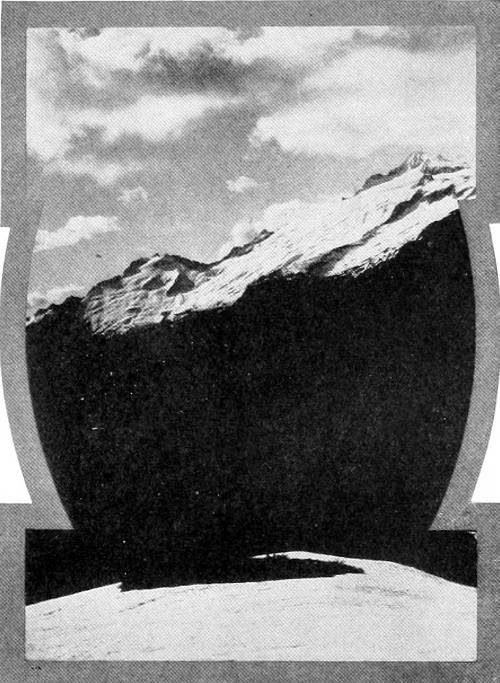
Taken in Skagit County. Photo by W. L. Dawson. OUR LADY OF THE SNOWS. A CHARACTERISTIC SUMMER HAUNT OF THE PIPIT.
All is bustle and stir along Ptarmigan Ridge,—the transverse rock-rib of Cascade Pass which divides the waters of Stehekin, Chelan, and the Columbia from those of the Cascade, Skagit, and Puget Sound. The season is late, June 23, 1906, and the snows have only just released the ridge at 6000 feet elevation. Slate-colored Sparrows are carolling tenderly from the thickets of stunted fir. Sierra Hermit Thrushes, those minstrels of heaven, flit elusively from clump to clump or pause to rehearse from their depths some spiritual strain. Leucostictes look in upon the scene in passing, but they hasten at a prudent thought to their loftier ramparts. The real [224] busybodies of the place are the Pipits. Females, lisping suspiciously, hurry to and fro, discussing locations, matching straws, playfully rebuking over-bold swains, and hastily gulping insects on the side. The male birds hover about their mates solicitously—never helping, of course—or else sing lustily from prominent knolls and rocks.
The Pipit song in many of its phases is strikingly like that of the Rock Wren (Salpinctes obsoletus). It has the same vivacity and ringing quality, tho perhaps less power, and the similarity extends to the very phrasing. An alarm note runs pichoo pichoo pichoo, given six or seven times, rapidly and emphatically; while another, wee iich, wee iich, wee iich, is rendered, unless my eyes deceive me, with the same springing motion which characterizes the Wren. An ecstacy song of courting time (heard on Mount Rainier) runs twiss twiss twiss twiss (ad lib.), uttered as rapidly as the syllables may be said. It is delivered as the bird describes great slow circles in mid-air; and when the singer is exhausted by his efforts, he falls like a spent rocket to the ground.
For all this activity, however, the nests are hard to find. Finally, as we keep ascending the ridge, bare save for occasional patches of snow in the hollows, Jack spies an old nest, last year’s of course, in the recess of a soil tussock, completely overarched by earth. The secret is out, and we can search with more intelligence now. Soon I flush a female at her task of incubation. She has been digging out a pocket, or cave, in a moist bank which the snow had set free not above three days before. The earth removed from the interior is piled up for the lower rim, or wall, and a few rootlets, doubtless those secured in the process of excavation, have been culled out and laid horizontally along the edge of the dirt. The hole is about as large as my double fists, and the nest, when completed, evidently cannot be injured by falling snow.
In July of the following year, work was carried on in the Upper Horseshoe Basin, a few miles further north. The song period was evidently past, but a nest of five eggs slightly incubated, was taken from a heather slope on the 20th of the month. The sitting bird flushed from under the beating stick, but only after I had passed.
On the 17th, a venturesome climb over the rock-wall which fronts the glacier of the Upper Basin, had yielded only a last year’s Leucosticte’s nest. As I was nearly down the cliff and breathing easier, a Pipit flew unannounced from a spur of the cliff upon which I was standing to the one beyond. Evidently she had heard the call of her mate, for the instant she lighted upon the cliff he was near her. But budge not a foot would he; whether he was suspicious or only exacting, one could not quite tell. At any rate he kept giving vent to a ringing metallic note of apprehension. The female coaxed with fluttering wings, and moved slowly forward as she did so, finally securing the worm from her reluctant lord, when—whisk! she was back again and out [225] of sight around the cliff on which I stood. I hastened forward to the furthest outstanding point which gave a partial view of the wall’s face. No bird was in sight. Then I tossed pebbles against the cliff-side, and from beneath the second summons fluttered the frightened Pipit. Five beautiful eggs, of a warm weathered oak, rather than “mahogany” shade, lay in a niche of rock. A tussock of grass clung just below, and a dwarf shrub afforded a touch of drapery above; while from the outstretched hand a flint-flake might have fallen clean of the wall to the ice, a hundred feet below. The male bird continued his outcries from the distant cliff, but the female at no time reappeared.
With the advance of summer, the Pipits lead their broods about the disrobed peaks, even to the very summits, as do the noble Leucostictes. Knowing this, we may readily excuse any little eccentricities which appear in our friends during the duller seasons. The Pipit has redeemed himself.
Turdidæ—The Thrushes
No. 91. TOWNSEND’S SOLITAIRE.
A. O. U. No. 754. Myadestes townsendi (Aud.).
Synonyms.—Townsend’s Flycatching Thrush. Townsend’s Thrush. Townsend’s Flycatcher.
Description.—Adults: General color smoky gray, lighter below, bleaching on throat, lower belly and under tail-coverts; a prominent white orbital ring; wings and tail dusky; wing quills crossed by extensive tawny area originating at base of innermost secondary and passing obliquely backward—this appears in the closed wing as a spot at the base of the exposed primaries but does not reach nearer the edge of the wing than the fifth or sixth primary; another obscure tawny or whitish patch formed by subterminal edging on outer webs of seventh and eighth (sometimes ninth) primaries; greater coverts and tertials tipped with white of varying prominence; a blotch of white on each side of tail involving distal third of half of outermost rectrix, tip of second and sometimes tip of third. Bill and feet black; irides brown. Young birds are heavily spotted with buff above and below (showing thereby Turdine affinities),—above, each feather has a single large spot (rhomboidal in some, heart-shaped in others) of buff, centrally, and is edged with blackish, thus producing a scaled appearance; below, the ground color is a pale buff or buffy gray with blackish edgings to feathers. Length about 8.00 (203.2); wing 4.60 (117); tail 4.05 (103); bill .49 (12.4); tarsus .79 (20).
Recognition Marks.—Chewink size; brownish gray coloration with spots of white (or pale tawny) on tail and wings. No black, as compared with a Shrike.
Nesting.—Nest: in hollow under bank, cranny or rock wall or in upturned roots of tree, of sticks, coarse weeds and trash, lined with rootlets. Eggs: 4, grayish white spotted with pale brown, chiefly about larger end. Av. size, .96 × .70 (24.4 × 17.8). Season: May or June; one brood.
General Range.—Western North America, breeding chiefly in mountainous districts, from northwestern Mexico to Alaska and Yukon Territory, wintering [226] irregularly from British Columbia (Sumas) southward, straggling into Mississippi Valley during migrations.
Range in Washington.—Not uncommon spring and fall migrant thruout the State, summer resident in the mountains to the limit of trees and elsewhere irregularly to sea level; partially resident in winter west of the Cascade Mountains.
Authorities.—? Ptiliogonys townsendi, Townsend, Narrative, 1839, p. 338. Myiadestes townsendii Baird, Rep. Pac. R. R. Surv. IX. 1858, 321. T. C&S. D¹. Ra. J. B. E.
Specimens.—U. of W. P¹. Prov. B. BN. E.
“Of this singular bird I know nothing but that it was shot by my friend, Captain W. Brotchie, of the Honorable Hudson’s Bay Company, in a pine forest near Fort George, (Astoria). It was the only specimen seen.” In these words J. K. Townsend, the pioneer ornithologist of the Pacific Northwest, records[32] the taking of the first example of this species known to science.
The bird thus presented as a conjectural native of Washington, has long been a puzzle to naturalists. It has been called Flycatcher, Thrush, and a combination of the two; but the name Solitaire seems to express both our noncommittal attitude toward the subject, and the demure independence with which the bird itself proceeds to mind its own affairs. Barring the matter of structure, which the scientists have now pretty well thrashed out, the bird is everything by turns. He is Flycatcher in that he delights to sit quietly on exposed limbs and watch for passing insects. These he meets in mid-air and bags with an emphatic snap of the mandibles. He is a Shrike in appearance and manner, when he takes up a station on a fence-post and studies the ground intently. When its prey is sighted at distances varying from ten to thirty feet, it dives directly to the spot, lights, snatches, and swallows, in an instant; or, if the catch is unmanageable, it returns to its post to thrash and kill and swallow at leisure. During this pouncing foray, the display of white in the Solitaire’s tail reminds one of the Lark Sparrow. Like the silly Cedar-bird, the Solitaire gorges itself on fruit and berries in season. Like a Thrush, when the mood is on, the Solitaire skulks in the thickets or woodsy depths, and flies at the suggestion of approach. Upon alighting it stands quietly, in expectation that the eye of the beholder will thus lose sight of its ghostly tints among the interlacing shadows.
And so one might go on comparing indefinitely, but the bird is entitled to shine in its own light. The Solitaire is sui generis—no doubt of that. As soon as we establish for it a certain line of conduct, the bird does something else. We banish it to the mountains for the nesting season—a pair nests in a railroad [227] cut near Renton, altitude 200 feet. We describe to our friends the beauty of its song—they go to its sanctuaries and the bird is silent. A bird of such dainty mould should winter in the South. It does,—at times. It also winters at Sumas on our northern border. This poet of the solitudes, he should avoid the haunts of men. He does, usually. But another time he may be seen hopping from bush to log in a suburban swamp, or moping under the edge of a new sidewalk. Indeed, I once saw a Solitaire flutter up from under a passenger coach, as it lay in station. He had happened to spy some bread crumbs and there was nothing to hinder save the conductor’s brisk “all aboard.” Surely such a bundle of contradictions you never did see—and all belied by an expression of lamb-like artlessness and dolce far niente, which would do credit to a rag-doll.
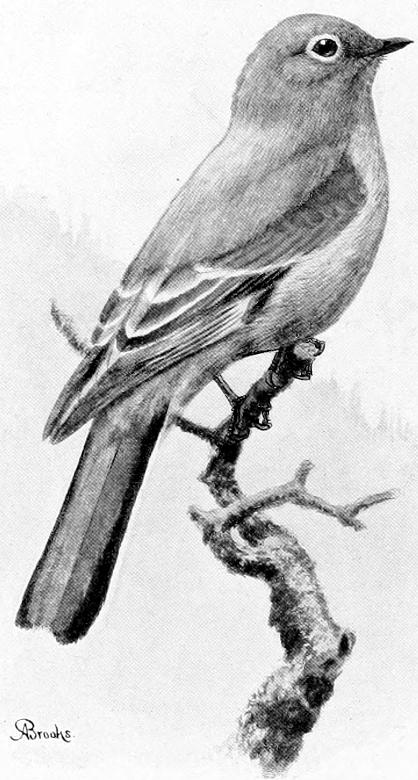
TOWNSEND’S SOLITAIRE.
All observers testify to the vocal powers of the Solitaire, and some are most extravagant in the bird’s praises. My own notes are very meager. A song heard on Church Mountain, in Whatcom County, May 12, 1905, is characterized as “a dulcet strain of varied notes. It reminds one strongly of the Sage Thrasher, but it is somewhat less impetuous.” In view of this meagerness, I venture to quote at length two older accounts, now hidden away in volumes not easily accessible. Dr. J. S. Newberry first encountered the Solitaire in the cañon of the Mptolyas River, at the base of Mount Jefferson (Or.), and declared its song to be full, rich, and melodious, like that of a Mimus[33] [228] “We followed down the river in the bottom of the cañon; all day the gorge was filled with a chorus of sweet sounds from hundreds and thousands of these birds, which from their monotonous color, and their habit of sitting on the branch of a tree projecting into the void above the stream, or hanging from some beetling crag, and flying out in narrow circles after insects precisely in the manner of the Flycatchers I was disposed to associate with them.
“Two days afterward in the cañon of Psuc-see-que Creek, of which the terraced banks were sparsely set with low trees of the western cedar (J. occidentalis), I found these birds numerous. * * * With the first dawn of day they began their songs, and at sunrise the valley was perfectly vocal with their notes. Never, anywhere, have I heard a more delightful chorus of bird music. Their song is not greatly varied, but all the notes are particularly clear and sweet, and the strain of pure gushing melody is as spontaneous and inspiring as that of the Song Sparrow. At this time, September 30, these birds were feeding on the berries of the cedar; they were very shy, and could only be obtained by lying concealed in the vicinity of the trees which they frequented.”
Mr. T. M. Trippe, speaking for the Clear Creek Cañon in Colorado, says[34]: “In summer and fall its voice is rarely heard; but as winter comes on, and the woods are well-nigh deserted by all save a few Titmice and Nuthatches, it begins to utter occasionally a single bell-like note that can be heard at a great distance. The bird is now very shy; and the author of the clear, loud call, that I heard nearly every morning from the valley of Clear Creek, was long a mystery to me. Toward the middle and latter part of winter, as the snow begins to fall, the Flycatching Thrush delights to sing, choosing for its rostrum a pine tree in some elevated position, high up above the valleys; and not all the fields and groves, and hills and valleys of the Eastern States, can boast a more exquisite song; a song in which the notes of the Purple Finch, the Wood Thrush, and the Winter Wren are blended into a silvery cascade of melody, that ripples and dances down the mountain sides as clear and sparkling as the mountain brook, filling the woods and valleys with ringing music. At first it sings only on bright clear mornings; but once fairly in the mood, it sings at all hours and during the most inclement weather. Often while travelling over the narrow, winding mountain roads, toward the close of winter, I have been overtaken and half-blinded by sudden, furious storms of wind and snow, and compelled to seek the nearest tree or projecting rock for shelter. In such situations I have frequently listened to the song of this bird, and forgot the cold and wet in its enjoyment. Toward spring, as soon as the other birds begin to sing, it becomes silent as tho disdainful of joining the common chorus, and commences building its nest in May, earlier than almost any other bird. During this season it deserts the valleys, and confines itself to partially wooded hill-tops.”
[229]
No. 92. WILLOW THRUSH.
A. O. U. No. 556 a. Hylocichla fuscescens salicicola Ridgway.
Synonym.—Western Wilson Thrush.
Description.—Adult: Above, dull tawny-brown, uniform; wing-quills shading to brownish fuscous on inner webs; below white, the throat, except in the upper middle, and the breast, tinged with cream-buff, and spotted narrowly and sparingly with wedge-shaped marks of the color of the back; sides and flanks more or less tinged with brownish gray; sides of head buffy-tinged, with mixed brown, save on whitish lores; bill dark above, light below; feet light brown. Adult male, length 7.25-7.75 (184.2-196.9); wing 3.93 (100); tail 2.95 (75); bill .55 (14); tarsus 1.18 (30).
Recognition Marks.—Sparrow to Chewink size; dull cinnamon brown above; breast buffy, lightly spotted.
Nesting.—Nest: of leaves, bark-strips, weed-stems and trash, lined with rootlets; placed at height of two or three feet in thickets or, rarely, on ground. Eggs: 3-5, plain greenish blue, not unlike those of the Robin. Av. size, .90 × .65 (22.8 × 16.5). Season: first or second week in June; one brood.
General Range.—Western interior districts of United States and Canada; breeding from North Dakota and Manitoba west to interior of British Columbia and southward to Nevada, Utah and Colorado; southward during migrations thru Arizona, etc., to Brazil, also thru the Mississippi Valley and, casually, eastward.
Range in Washington.—Summer resident in the hilly districts of northwestern Washington,—Blue Mountains(?).
Authorities.—Howe, Auk, XVII. Jan. 1900, p. 19 (Spokane). T(?). J.
Specimens.—Prov.
The Willow Thrush shares with its even more retiring cousin, the Olive-back, the forests of the northwestern portion of the State. Here it may be found in the seclusion of spring draws and alder bottoms, or in the miscellaneous cover which lines the banks of the larger streams. It is confined almost entirely to the vicinity of water, and spends much of its time on the damp ground poking among the fallen leaves and searching the nooks and corners of tree-roots. Since the bird is but a flitting shade, one cannot easily determine its color-pattern, and must learn rather the range and quality of its notes. The bird is, rather than has, a voice, an elusive voice, a weird and wonderful voice. And only after one has heard the song, with its reverberant, sweet thunder, and its exquisitely diminishing cadences, as it wells up at eventide from some low thicket, may one be said to know the Willow Thrush.
For the most part the bird betrays interest in your movements by a subdued yewi, a note of complaint and admonition, variously likened to a grunt, a bleat, or a nasal interjection. Not infrequently this becomes a clearly [230] whistled wheé-ew; and this, in turn, is varied and strengthened to ve-er-u, or Veery, whence the common name of the typical form, H. fuscescens, in the East. The song proper consists of six or seven of these ve-er-ys, rolled out with a rich and inimitable brogue. The notes vibrate and resound, and fill the air so full of music that one is led to suspect the multiple character of each. The bird is really striking chords, and the sounding strings still vibrate when the next is struck. There is, moreover, in the whole performance, a musical crescendo coupled with a successive lowering of pitch, which is fairly ravishing in its impression of mystery and power.
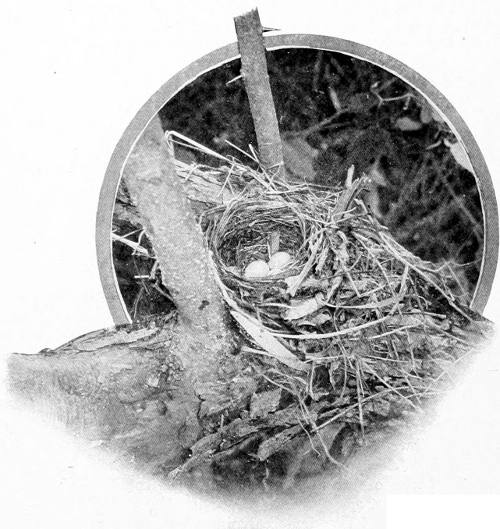
Taken near Spokane. Photo by F. S. Merrill. NEST AND EGGS OF THE WILLOW THRUSH.
The distribution of this species is as yet imperfectly made out. Having made its acquaintance at Spokane and along the valley of the Pend d’Oreille, we were able to recognize it later at Chelan and Stehekin, the latter unquestionably the westernmost record of its occurrence in the United States. Whether it may also extend further south along the east front of the Cascades, remains to be seen.
A nest before me was taken by Mr. Fred S. Merrill, in Spokane. It was placed in the crotch of an alder at a height of two feet, and contained, on the ninth day of June, four slightly incubated eggs. The nest is a rather loosely constructed affair of bark-strips, dead leaves, coarse grasses, shavings, leaf-stems, etc., and has a careless lining of dessicated leaves and broken grasses. The matrix of mud, or leaf-mold, which gives strength and consistency to the [231] nests of certain other thrushes, is conspicuously lacking in this one. The brooding hollow is only three inches from brim to brim, by one and three-quarters in depth. The eggs are in every way miniature Robins’, being without spots, and representing only three-fifths or two-thirds the bulk of those of the larger bird.
No. 93. RUSSET-BACKED THRUSH.
A. O. U. No. 758. Hylocichla ustulata (Nutt.).
Synonym.—“Wood Thrush” (name properly restricted to H. mustelina of the East).
Description.—Adults: Above olive-brown, substantially uniform; a conspicuous orbital ring of pale buff; sides of head buffy mingled or streaked with olive-brown; chin, throat and chest buff (or lightening to buffy white toward chin); sides of throat and entire chest with triangular marks of deep olive-brown, smaller and narrower on throat, larger and broader (sector-shaped) posteriorly; breast, especially on sides, transversely spotted with light brown; sides and flanks heavily marked with brownish; remaining underparts white. Bill blackish, paling basally on mandible; feet and legs brown; iris brown. Winter specimens are brighter, more deeply tinged with buff before and with under tail-coverts buffy. Young birds are more or less marked and streaked with buffy and tawny above and the markings of underparts are mostly transverse. Length 6.50-7.50 (165.1-190.5); wing 3.83 (97); tail 2.87 (73); bill .54 (13.7); tarsus 1.10 (28).
Recognition Marks.—Sparrow size; uniform olive-brown above; heavy spotting and buffy wash on chest; sides of head and eye-ring buffy; brown above as compared with H. u. swainsonii.
Nesting.—Nest: of bark-strips, moss and grasses, with a heavy inner mat or mould of dead leaves, lined with rootlets and fine grasses; placed usually at moderate heights in bushes or saplings of thickets, sometimes 30-60 feet high in trees. Eggs: 3-5, usually 4, greenish blue or dull grayish blue dotted and spotted, rather sparingly, with various shades of brown. Av. size, .93 × .67 (23.6 × 17). Season: June, July; one or two broods.
General Range.—Pacific coast district from southern California to Alaska (Juneau), breeding thruout its range; south in winter thru Mexico to Central and northern South America.
Range in Washington.—Common summer resident and migrant west of the Cascade Mountains; probably overflows thru mountain passes to at least the eastern slopes of the Cascades.
Authorities.—Turdus ustulatus Nuttall, Man. Orn. U. S. and Canada, Land Birds, ed. 2, 1840, pp. VI. 830 (Columbia River). C&S. L¹. Rh. D¹. Kb. Ra. D². Ss². Kk. B. E.
Specimens.—U. of W. P¹(?). Prov. B. BN. E.
[232]
Artists of the later schools agree that shadows are not often black, as they have been conventionally represented for centuries. Their deepest color note is always that of the ground, or screen, which bears them. The Thrush, therefore, is the truest embodiment of woodland shade, for the shifting russets of its upperparts melt and blend with the tints of fallen leaves, dun roots, and the shadows of tree-boles cast on the brown ashes of fallen comrades. Not content, either, with such protective guarantee, this gentle spirit clings to cover, and reveals itself only as a flitting shade and a haunting voice. Now and then a brown gleam does cross some open space in the forest, but the action is hasty and the necessity much regretted.
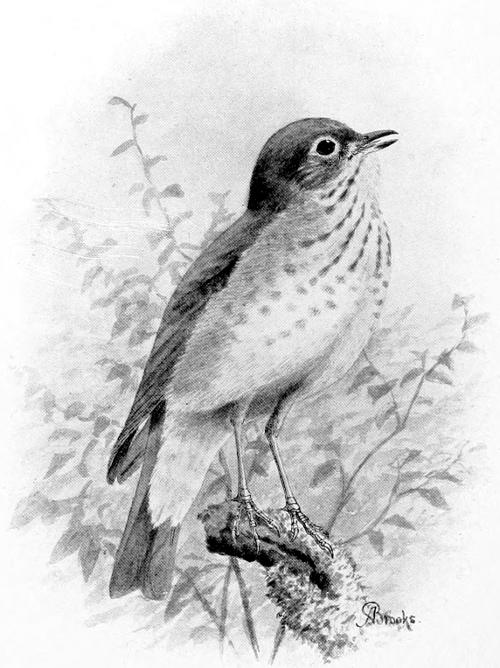
RUSSET-BACKED THRUSH.
The Russet-backed Thrush is not much given to song, altho on occasion the woodside may ring with the simple melody of its wee loo weelo weeloeee[35]. Other notes are more notable and characteristic; and by these one may trace the bird’s every movement [233] without recourse to sight. Quit, or hwit, is a soft whistled note of inquiry and greeting, by which the birds keep in constant touch with each other, and which they are nowise disinclined to use in conversations with strangers. Hwootaylyochtyl is the name which the Quillayute lad gives the bird, the first syllable being whistled rather than spoken, in imitation of the bird’s note. At the friendly call the Thrush comes sidling over toward you thru the brush, until you feel that you could put your hand on it if you would; but the bird remains invisible, and says, quit, quit, with some asperity, if you disregard the convenances.
A longer call-note, of sharper quality, queee, may be as readily imitated, altho its meaning in the bush is uncertain. The bird has also a spoken note, a sort of happy purring, which I call the coordaddy cry. In this the daddy notes are given in from one to six syllables, and are spoken “trippingly on the tongue.”
Recalling again the queee note, we are surprised to find that it is the commonest sound heard during migrations. At midnight when a solemn hush is over all besides, this weird note comes down from the sky at any height, from every angle, a greeting en passant from the voyageurs, the tenderest, the most pathetic, the most mysterious voice of Nature. There are a dozen variations of pitch and tone, quééé, quee, kooo, etc., but the theme is one, and the quality is that of the Russet-backed Thrush. Now it is incredible that any one species should so abound to the exclusion of all others, or that one alone should speak, while others flit by silently. Moreover, the intermittent utterance of a single bird proclaims the rate at which that bird is moving, and oftener argues for the passing of the smaller species, Warblers and the like. Repeated observation would make it appear certain that this quee note is the common possession of many, perhaps of all species of migrant song birds, a sort of Esperanto for “Ho, Comrade!” by which the flying legions of the night are bound together in a great fellowship.
Much of the apparent difference in the call-notes of these night-birds is explained when we remember that they are reaching us from different angles. Thus, the quee of a rapidly approaching bird is raised sharply and shortened, quĕĕ; while the same voice, in passing, falls to a ghostly kwoo, at least a musical third below. It is, perhaps, needless to add that practiced lips may join this mystic chorus and hold delightful converse with these brothers of the air—may, indeed, provoke them to trebled utterance in passing.
But only the Russet-backed Thrush may repeat this cabalistic note, by day. He is the bugler in that greatest of all armies and he must needs keep in practice while on furlough.
Russet-backs are tardy migrants, seldom arriving before the first week in May; and they are off again for the Southland by the first week in September. Two instances are on record, however, of the bird’s wintering hereabouts. [234] On the 7th of March, 1891, several birds were “engaged in conversation” by the writer near Tacoma; and on the 22nd of January, 1907, two birds were encountered on the University grounds in Seattle. In the latter instance the birds would not disclose themselves, altho they passed half way around me in the thicket, uttering their characteristic and unmistakable notes.
In home building this Thrush makes no effort at nest concealment, trusting rather to the seclusion of its haunts. The materials which enter into the construction of the nest are themselves in a measure protective, especially in those numerous instances in which the exterior is composed entirely of green moss. At other times, twigs, bark-strips, and grasses are used; but the two things which give character to the nest of this Thrush are the mud-cup, or matrix, of mud and leaf-mold, and the lining of dried leaf-skeletons. I have surprised a mother Russet at her task of cup-moulding, and verily her bib was as dirty as that of any child making mud pies. For altho the beak serves for hod and trowel, the finishing touches, the actual moulding, must be accomplished by pressure of the bird’s breast.
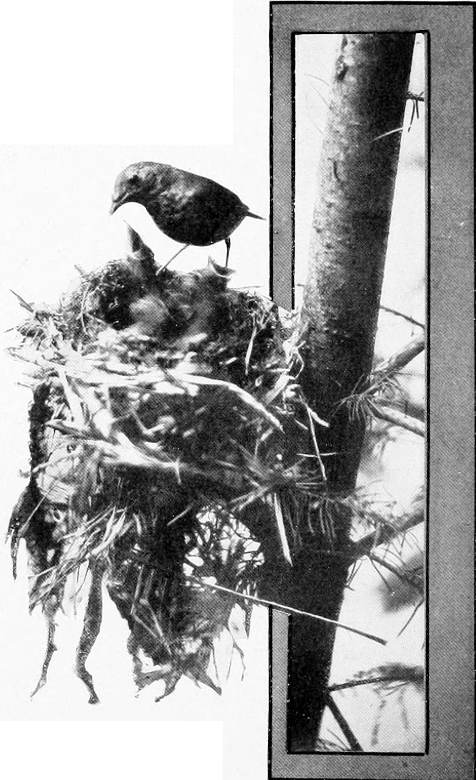
Taken in Oregon. Photo by Bohlman and Finley. MOTHER RUSSET AND HER BROOD.
During a season’s nesting at Glacier, in the Mount Baker district, Mr. D. E. Brown located about a hundred sets of the Russet-backed Thrush, taking no account of nests in other stages of occupation. In distance from the ground, nests varied from six inches to forty feet, altho a four or five foot elevation was about the average. Nests were found in thickets, where they were supported by the interlacing of branches, or else saddled upon the inclined stems of vine maples, or in fir trees. In the last-named [235] places, nests might be set against the trunk on a horizontal limb, but were more often at some distance from it. The birds were very sensitive about molestation before eggs were laid, and would desert a nest in process of construction on the merest suspicion that a stranger had looked into it. After deposition, however, the mother Thrush was found to be very devoted to her charges, and great confidence was often engendered by carefully considered advances.
At Glacier, nest-building averaged to commence about the 25th of May, and the first eggs were found on the 1st of June. The last set was found July 15th. All nests examined in the earlier part of the season contained four eggs; those found later, presumably second efforts, never had more than three.
As a curious example of the use of the imagination on the part of early writers, take this from our venerated Cooper[36]: “The eggs, unlike those of most thrushes, are white, spotted thickly with brown, and four or five in number.” The brown spotting is all right and an unpigmented shell is not an impossibility, but deviations from the characteristic greenish blue of the ground-color have not since been reported.
No. 94. OLIVE-BACKED THRUSH.
A. O. U. No. 758 a. Hylocichla ustulata swainsonii (Cab.).
Synonyms.—Swainson’s Thrush. Eastern Olive-back. Alma’s Thrush (H. u. almæ Oberh., disallowed by A. O. U. Com.).
Description.—Adults: Similar to H. ustulata but grayer and more olivaceous; “color of upperparts varying from olive to grayish hair brown in summer, from deep olive to slightly brownish olive in winter”; ground color of underparts lighter buffy (yellowish buff or creamy buff); sides and flanks grayish—instead of brownish-olive. Size of last.
Recognition Marks.—As in preceding; grayer above, lighter buffy below.
Nesting.—Nest and Eggs indistinguishable from those of typical form, H. ustulata.
General Range.—North America in general except Pacific coast district south of Cross Sound and Lynn Canal; breeding from the mountainous districts of the United States (especially northerly) north to limit of trees; south in winter thruout Mexico and Central America to Peru, Bolivia, etc.
Range in Washington.—Imperfectly made out as regards that of H. ustulata. Found breeding in the valley of the Stehekin hence presumably summer resident in timbered districts of eastern Washington.
Authorities.—Bowles and Dawson, Auk, Vol. XXV. Oct. 1908, p. 483.
Specimens.—Prov. B.
[236]
The more open woods and more abundant suns of eastern Washington effect that reduction of color in the “burnt” Thrush, which henceforth characterizes the species clear thru to the Atlantic. It would be idle to trace in detail all accompanying changes of manner and habit, but we can hardly fail to note the improved quality of the Olive-back’s song. This is most nearly comparable to that of the Willow Thrush and has something of the same rolling vibrant quality. It is, however, less prolonged and less vehement. It may or may not retain the liquid l’s, but it discards outright the rich r’s, which the Veery rolls under his tongue like sweet morsels; and the pitch of the whole rises slightly, perhaps a musical third, as the volume of sound diminishes toward the end: We-e-o, we-e-o, we-o we-o weee. A song heard some years ago at the head of Lake Chelan, weeloo weeloo weelooee looee, seemed to have all the music of perfected swainsonii in it, yet it was not till the season of 1908 that Mr. Bowles established the fact of the Olive-back’s presence and the Russet-back’s absence from the Stehekin Valley. On the other hand, Ridgway finds that both forms sometimes occur together, even during the breeding season; so we are not yet prepared to make generalizations as to the relative distribution of these birds in Washington.
No. 95. ALASKA HERMIT THRUSH.
A. O. U. No. 759. Hylocichla guttata (Pallas).
Synonym.—Kadiak Dwarf Thrush (Ridgw.).
Description.—Adult: Upperparts plain grayish brown (hair brown to near broccoli brown) changing on rumps to dull cinnamon-brown of upper tail-coverts and tail; a prominent whitish orbital ring; sides of head mingled grayish brown and dull whitish; underparts dull white, clear only on belly,—throat and breast tinged with pale creamy buff; sides and flanks washed with pale grayish brown; throat in confluent chain on side and lower throat, chest and upper breast—spotted with dusky or sooty, the spots narrow and wedge-shaped on lower throat, broadening and deepening on chest, fading and becoming rounded on breast. Bill drab brown paling on mandible basally; feet and legs brown; iris dark brown. Winter specimens are brighter and more strongly colored thruout. Young birds are streaked with buffy above and the spotting of underparts inclines to bars on breast and sides. Length 6.30-7.40 (160-188); wing 3.46 (88); tail 2.52 (64); bill .50 (12.7); tarsus 1.14 (29).
Recognition Marks.—Sparrow size; cinnamon of tail (and upper-coverts) contrasting more or less with duller brown of remaining upperparts.
Nesting.—Does not breed in Washington. Nest and Eggs as in H. g. sequoiensis.
General Range.—Coast district of Alaska breeding northward and westward [237] from Cross Sound; southward in winter as far as Texas and western Mexico, migrating chiefly coastwise.
Range in Washington.—Spring and fall migrant west of the Cascades.
Migrations.—Spring: Tacoma, April 15, 1905 (J. H. Bowles). Fall: Seattle Sept. 21, 1907 (Jennie V. Getty).
Authorities.—Bowles and Dawson, Auk, XXV. Oct. 1908, p. 483.
Specimens.—P(Alaskan). Prov. B.
About all we can certify to, so far, is that there are two varieties of the Hermit Thrush which may be seen on Puget Sound during the migrations: a lighter and grayer form, presumably from northwestern Alaska; and a darker, more warmly-tinted bird, H. g. nana, which may or may not summer to some extent in western Washington. Specimens so far encountered in eastern Washington are probably H. g. sequoiensis, en route to or from their breeding haunts in the high Cascades; while if any are ever captured in the mountains of Stevens County, they will probably prove to be of the H. g. auduboni type, which prevails in the eastern portion of British Columbia.
No. 96. SIERRA HERMIT THRUSH.
A. O. U. No. 759 part. Hylocichla guttata sequoiensis (Belding).
Synonyms.—Western Hermit Thrush. Cascade Hermit Thrush. Mountain Hermit.
Description.—Similar in coloration to H. guttata but larger, paler and grayer. Adult male: wing 3.65 (92.8); tail 2.83 (71.8); bill .53 (13.5); tarsus 1.12 (28.4).
Recognition Marks.—As in H. guttata.
Nesting.—Nest: of bark-strips, grasses, leaves and moss, lined with fine rootlets, placed on ground in thickets or at moderate heights in fir trees. Eggs: 3 or 4, greenish blue unmarked—not certainly distinguishable from those of the Willow Thrush. Av. size, .85 × .65 (21.6 × 16.5). Season: June, July; one brood.
General Range.—Mountains of the Cascade-Sierra system and from Mt. Whitney north thru central British Columbia, etc., to the Yukon River; south in winter to Lower California, Sonora, etc.
Range in Washington.—Common summer resident in the Cascade Mountains—further distinction undetermined.
Authorities.—Dawson, Auk, Vol. XXV. Oct. 1908, p. 483.
Specimens.—D.
[238]
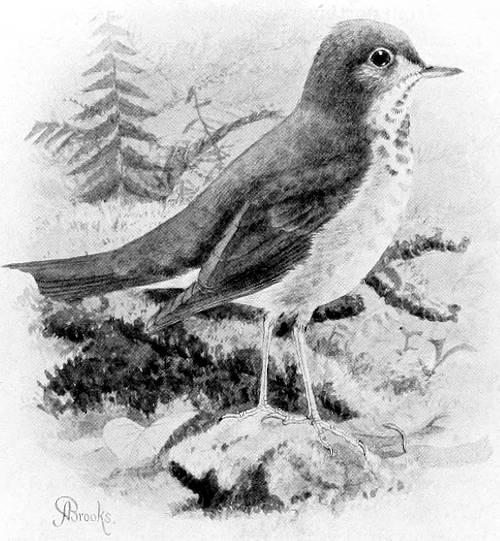
SIERRA HERMIT THRUSH.
When asked to name the best songster of Washington, I answer, unhesitatingly, the Hermit Thrush. It is not that the bird chooses for his home the icy slopes and stunted forests of the high Cascades, tho that were evidence enough of a poetic nature. It is not for any marked vivacity, or personal charm of the singer, that we praise his song; the bird is gentle, shy, and unassuming, and it is only rarely that one may even see him. It is not that he excels in technique such conscious artists as the Catbird, the Thrasher, and the Mockingbird; the mere comparison is odious. The song of the Hermit Thrush is a thing apart. It is sacred music, not secular. Having nothing of the dash and abandon of Wren or Ouzel, least of all the sportive mockery of the Long-tailed Chat, it is the pure offering of a shriven soul, holding acceptable converse with high heaven. No voice of solemn-pealing organ or cathedral choir at vespers ever hymns the parting day more fittingly than this appointed chorister of the eternal hills. Mounted on the chancel of some low-crowned fir tree, the bird looks calmly at the setting sun, and slowly phrases his worship in such dulcet tones, exalted, pure, serene, as must haunt the corridors of memory forever after.
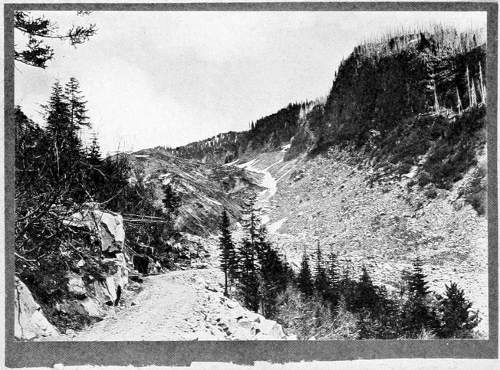
Taken in Rainier National Park. From a Photograph Copyright, 1908, by W. L. Dawson. FOOT OF NISQUALLY GLACIER FROM GOVERNMENT ROAD. A CHARACTERISTIC HAUNT OF THE SIERRA HERMIT THRUSH.
You do not have to approve of the Hermit Thrush,—nor of Browning, nor of Shelley, nor of Keats. The writer once lost a subscription to “The Birds of Washington, Patrons’ Edition, De Luxe, Limited to One Hundred Copies” and all that, you know, because he ventured to defend Browning. “No; I do [239] not want your bird-book.” Quite right, Madame, it would have been a waste of money—for you. But I have heard the Hermit Thrush.
“Ah, did you once see Shelley, plain, And did he stop and speak to you, And did you speak to him again? How strange it seems, and new!
“But you were living before that, And also you are living after; And the memory I started at— My starting moves your laughter!
“I crossed a moor with a name of its own, And a certain use in the world, no doubt, Yet a hand’s breadth of it shines alone ’Mid the blank miles around about:
[240]
“For there I picked up on the heather, And there I put inside my breast, A moulted feather, an eagle feather! Well, I forget the rest.”
No. 97. DWARF HERMIT THRUSH.
A. O. U. No. 759 c. Hylocichla guttata nana (Aud.).
Synonyms.—Pacific Hermit Thrush. Sitkan Dwarf Thrush (Ridgway).
Description.—“Similar to H. g. guttata but coloration darker and browner, the color of back, etc., more sepia brown, upper tail-coverts more russet, tail more chestnut, and spots on chest larger and darker” (Ridgway). Adult male: wing 3.42 (86.8); tail 2.58 (65.5); bill .48 (12.2); tarsus 1.13 (28.8).
Recognition Marks.—As in H. guttata.
Nesting.—As in H. g. sequoiensis.
General Range.—Pacific coast district, breeding from western Oregon (presumably) north to Cross Sound, Alaska; south in winter to Southwestern States.
Range in Washington.—Probably common but little known, during migrations. Presumably resident in summer west of the Cascades.
Authorities.—? Turdus nanus Audubon, Orn. Biog. V. 1839, 201 (Columbia R.) ?Townsend, Journ. Ac. Nat. Sci. Phila. VIII. 1839, 153 (Col. R.) Belding, L. B. P. D. 1890, p. 254 (Walla Walla, J. W. Williams, 1885).
Specimens.—U. of W. Prov. E.
As one passes thru the woods in middle April while the vine maples are still leafless, and the forest floor is not yet fully recovered from the brownness of the rainy season, a moving shape, a little browner still, but scarcely outlined in the uncertain light, starts up from the ground with a low chuck, and pauses for a moment on a mossy log. Before you have made out definite characters, the bird flits to a branch a little higher up and more removed, to stand motionless for a minute or so, or else to chuckle softly with each twinkle of the ready wings. By following quietly one may put the bird to a dozen short flights without once driving it out of range; and in so doing he may learn that the tail is abruptly rufous in contrast with the olive-brown of the back, and that the breast is more boldly and distinctly spotted than is the case with the Russet-backed Thrush.
This bird will not tarry with us, unless it may choose to haunt the solitudes of the Olympics. In the vicinity of Sitka, however, Mr. J. Grinnell reports [241] the species as “very common everywhere, especially on the small wooded ‘islands.’”[37]
When disturbed in its nesting haunts the Hermit Thrush has a nasal scolding cry, not unlike that of the Oregon Towhee. This note lacks the emphasis of Towhee’s, tho its dual character is still apparent—Murrry or Murre. But one forgets all trivial things as he listens to the angelic requiem of the Hermit at eventide. Not Orpheus in all his glory could match that,—for he was a pagan.
No. 98. AMERICAN ROBIN.
A. O. U. No. 761. Planesticus migratorius (Linn.).
Synonym.—Eastern Robin.
Description.—Adult male: Head black, interrupted by white of chin and white with black stripes of throat; eyelids and a supraloral spot white; tail blackish with white terminal spots on inner webs of outer pair of rectrices; wings dusky except on external edges; remaining upperparts grayish slate; below,—breast, sides, upper belly and lining of wings cinnamon-rufous; lower belly and crissum white, touched irregularly with slate; bill yellow with blackish tip; feet blackish with yellowish soles. Adult female: Similar to male, but duller; black of head veiled by brownish. Adults in winter: Upperparts tinged with brown, the rufous feathers, especially on belly, with white skirtings. Immature: Similar to adult, but head about the color of back; rufous of underparts paler or more ochraceous. Very young birds are black spotted, above and below. Length about 10.00 (254); wing 5.08 (129); tail 3.75 (95.3); bill .78 (19.8).
Recognition Marks.—“Robin” size; cinnamon-rufous breast; the “corners” of the tail conspicuously white-tipped, as distinguished from P. m. propinquus.
Nesting.—Does not breed in Washington. Nest and eggs as in next (sub) species, save that eggs 4 or 5, sometimes 6.
General Range.—Eastern and northern North America westward nearly to the Rocky Mountains and northwestward to valley of Kowak River in Alaska; breeds from the southern Alleghenies, Pennsylvania, Ohio, Iowa, etc., northward; winters in Gulf States; south irregularly across the Western States during migration.
Range in Washington.—An early spring (and late fall?) migrant, both sides of the Cascades. Winters sparingly on Puget Sound.
Authorities.—Turdus migratorius Brewster, B. N. O. C. VII., Oct. 1882, p. 227. B. E.
Specimens.—B. E.
[242]
A small proportion, not over one per cent, of the Robins which annually cross our borders have enough white in the “corners” of their tails to proclaim them true “Americans.” The difference is striking and unmistakable, and we feel sure that we have here, not a chance variation, but an alien element, a slender stream of migration diverted from the accustomed channels of typical P. migratorius, and straggling down, or up, on the wrong side of the Rockies. When it is remembered that the American Robin winters in Florida and the Gulf States, and that its spring migrations take it as far west as the Kowak River, in Alaska, that is, due northwest from Atlanta, it is less surprising that the birds should occasionally bear west northwest instead, and so make Washington en route. It is almost certain that this is the case, for the wintering birds west of the Rockies and in Mexico are invariably of the western type, propinquus.
No. 99. WESTERN ROBIN.
A. O. U. No. 761a. Planesticus migratorius propinquus (Ridgw.).
Description.—Similar to P. migratorius, but white on inner webs of outer rectrices much reduced or wanting; gray of upperparts paler and more olivaceous, more sharply contrasting with black of head; cinnamon-rufous of underparts averaging paler; wing, tail, and tarsus slightly longer. Length of males about 10.25 (260.3); wing 5.52 (140); tail 4.13 (105); bill .80 (20.3); tarsus 1.34 (34.1). Females slightly smaller.
Recognition Marks.—“Robin” size; cinnamon-rufous below—everyone knows the Robin—without white on “corners” of tail as distinguished from preceding.
Nesting.—Nest: a thick-walled but shapely bowl of mud (rarely felted vegetable fibers instead) set about with twigs, leaves, string and trash, and lined with fine grass-stems; placed anywhere in trees or variously, but usually at moderate heights. Eggs: 3 or 4, rarely 5; greenish blue, unmarked. Av. size 1.15 × .79 (29.2 × 20.1). Season: April 15-July 10; two broods.
General Range.—Western North America from the Rocky Mountains to the Pacific, north to limit of trees in coast forest district in Alaska; south thru highlands of Mexico and occasionally Guatemala; breeding nearly thruout its range.
Range in Washington.—Common summer resident and migrant thruout the State, more common in settled portions; rare in mountains save in vicinity of settlements; irregularly resident in winter, sometimes abundantly on Puget Sound.
Migrations.—Spring: West-side, last week in February; East-side, first or second week in March. Fall: October.
[243]
Authorities.—[Lewis and Clark, Hist. Ex. 1814 Ed. Biddle: Coues, Vol. II. p. 185.] Turdus (planesticus) migratorius, Linn., Baird, Rep. Pac. R. R. Surv. IX. pt. II. 1858, p. 219. (T.) C&S. L¹. Rh. D¹. Sr. Kb. Ra. D². Ss¹. Ss². Kk. J. B. E.
Specimens.—U. of W. P¹. Prov. BN. B. E.
There are, it may be, a thousand fruits, sweet, acid or spicy, which delight the palate of man, yet if we were forced to choose among them, not many of us would fail to reserve the apple. In like manner, we could perhaps least afford to spare our tried and trusted, old, familiar friend, the Robin. He is a staple.
Everybody knows Robin. He is part and parcel of springtime, chief herald, chief poet, and lord high reveller of that joyful season. It is a merry day when the first flock of Robins turns itself loose on the home landscape. There is great bustle and stir of activity. Some scurry about to note the changes wrought by winter, some wrestle with the early and unsophisticated worm, while others voice their gladness from the fence-post, the gable, the tree-top, anywhere. Everywhere are heard interjections of delight, squeechings and pipings of ardent souls, and no end of congratulations over the home-coming.
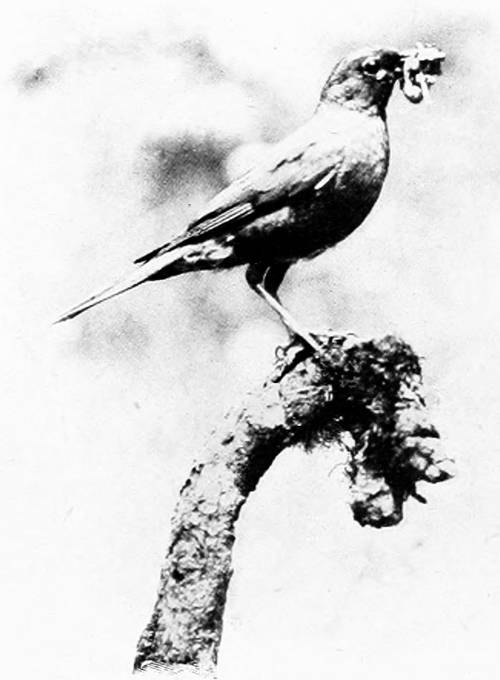
Taken in Oregon. Photo by W. L. Finley. BACK FROM MARKET.
Robin has cast in his lot with ours, for better or for worse. Our lawns are his lawns, our shade-trees were set on purpose to hold his homely mud-cup, and he has undertaken with hearty good will the musical instruction of our children. He serves without pay—Oh, a cherry now and then, but what of that? The fruit-grower never had a more useful hired man; and it is written: “Thou shalt not muzzle the ox that treadeth out the corn.” I wonder if we realize how much of life’s good cheer and fond enspiriting we owe to this familiar bird.
Near the close of a burning day in the desert, we drew near to a little ranch where a bravery of green, supported by a windmill and a tiny trickle of water, defied the engulfing waste of sand and sage. It seemed to me that I [244] had never seen anything more pathetic than the stubborn faith of the man who had dreamed of rearing a home amidst such desolation. How could a man be happy here? and how dare he bring a wife and tender children to share such a forlorn hope? Why, the wilderness around had raised nothing but sage-brush and jack-rabbits for countless millenniums; but here in this tiny oasis were locust trees and poplars. And here, as the sun sank low in the West, a Robin burst into song. The nearest human neighbor was miles away, and the nearest timber further. Yet here was this home-loving Robin, this reincarnation of childhood’s friend, pouring out in the familiar cadence of old his thanksgiving for shelter and food, his praise for joy of life and gladness to the Almighty, who is Father of all. And then I understood.
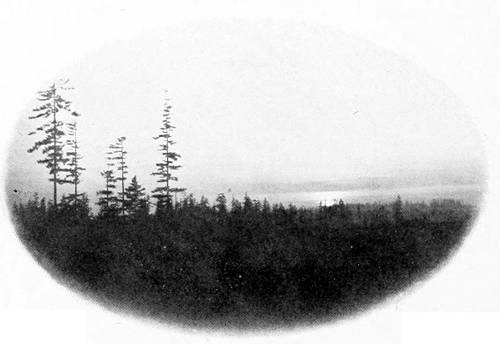
Taken in Seattle. Photo by the Author. SUNSET AT THE ROBIN ROOST.
The Robin’s song in its common form is too well known to require particular description, and too truly music to lend itself well to syllabic imitation. It is a common thing, indeed, like the upturned mold and the air which fans it, but out of these come the varied greens which beautify the world; the homely piping of the Robin has given birth to many a heaven-directed aspiration, and purged many a soul of guilty intent. Robin conceives many passages which are too high for him, and these he hums inaudibly, or follows in silent thought, like a tenor with a cold. When the theme reaches his compass again, he resumes, not where he left off but at the end of the unheard passage. It must be confessed, however reluctantly, that the song of the Western Robin is a little more subdued in character than that of the Eastern. The bird is a little less devoted to his art, and the total volume of sound yielded by any one chorus has never equalled, in my experience, that of a similar effort in the East.
When the Robin is much given to half-whispered notes and strains unusually tender, one may suspect the near presence of his fiancée. If you are [245] willing to waive the proprieties for a few moments you will hear low murmurs of affection and soft blandishments, which it would tax the art of a Crockett to reproduce. And again, nothing can exceed the sadness of a Robin’s lament over a lost mate. All the virtues of the deceased are set forth in a coronach of surpassing woe, and the widower declares himself forever comfortless. It is not well, of course, to inquire too particularly as to the duration of this bereaved state—we are all human.
In spite of his fondness for human society, there are two periods of retirement in Robin’s year. The first occurs in March and early April, and may be denominated the season of courtship. After the first ardent greeting of the home folks, Robins gather in loose companies and keep to the seclusion of the woods, following the sun from east to south and west, ransacking the roots of trees and the edges of standing water for food, and, above all, sketching in the matrimonial plans of the season. When Robins have become common about the streets and yards of village and town, partners have usually been selected, but there still remain for many of the cocks hard-contested battles before peaceful possession is assured. These are not sham fights either; a Robin will fight a hated rival, beak and claw, till he is either thoroly winded or killed outright.
In late July and August Robins again forsake their familiar haunts, and spend the moulting season in the woods, moving about like ghosts in great straggling, silent companies. When the moult is completed, as autumn advances, they return in merry bevies to claim their share of the ripening fruits—no longer begrudged now, for they prefer such harmless viands as mountain-ash berries, and the insipid clusters of the madrone tree.
Robins occasionally winter on the east side of the mountains; and they are hard put to it unless they find a sufficient supply of ungathered fruit, preferably apples, left out to freeze or rot as the season dictates. West of the mountains they winter irregularly but quite extensively. There is nothing in the climate to forbid their staying all the time but I am inclined to think that their abundance in winter depends upon the berry crop, and especially that of the Madrona (Arbutus menziesii). The fall of 1907 was notable in this regard. The trees were in splendid bearing, and a certain patch on the bluff south of Fauntleroy Park was a gorgeous blaze of red, to which Robins resorted in hundreds.
Under such circumstances the birds establish winter roosts in convenient thickets, and repair to them at nightfall in great numbers. One such roost has been maintained on the outskirts of Seattle, just east of Ravenna Park, and in the winter of 1907-08 I estimated its population at some four thousand. The winter, it will be remembered, was a mild one, and every one in Seattle remarked the abundance of Robins.
In nesting, the Robin displays little caution, its homely mud-walled cup [246] not being withdrawn from most familiar observation. Indeed, as in the case of the accompanying illustration, the bird appears rather to court notoriety. The major crotches of orchard or shade trees are not shunned. From five to fifteen feet is the usual elevation, but nests are sometimes found at fifty feet; and again, tho rarely, on the ground. Window sills and beams of porches, barns, and outbuildings are favorite places, and, in default of these, brush-piles or log-heaps will do.
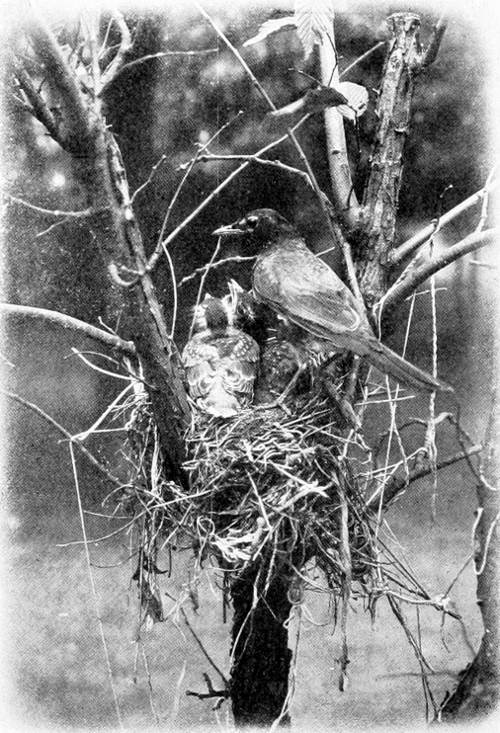
Taken in Michigan. From a Photograph Copyright, 1908, by L. G. Linkletter. THE ROBIN’S NEST.
The mud used in construction is, of course, carried in the beak. Arrived at the nest with a beakful of mud, the mother bird drops her load, or plasters it loosely on the inside of the cup. Then she hops into the nest, settles as low as possible, and begins to kick or trample vigorously with her feet. From time to time she tests the smoothness or roundness of the job by settling to it with her breast, but the shaping is altogether accomplished by the peculiar tedder action of her feet.
On the other hand, one Robin’s nest which I found in the open sage had no mud in its construction and was altogether composed of felted vegetable [247] materials. Another freak nest, in Spokane, showed a hatchet handle firmly imbedded in its foundation and projecting from it a distance of six inches. The presence of the handle was not adventitious, for the nest was saddled on a pine branch, but it is difficult to conceive how the birds could have placed it in position at a height of fifteen feet.
Three eggs is the rule for the Western Robin; four is not unusual; but five is rare, and I have never seen six. In this respect, therefore, the Western Robin falls a little behind her eastern cousin.
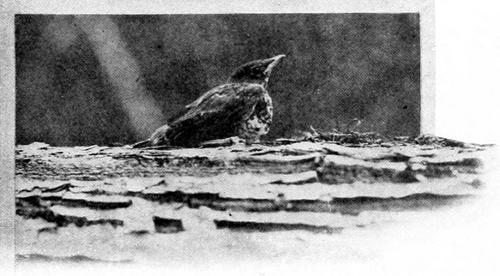
A ROBIN BABY.
Young Robins are darling creatures; that is conceded by everyone,—even by the cat. And hungry! Oh, so hungry! It is estimated that if the appetite of a man were proportioned to that of a young Robin, he would consume daily the equivalent of a sausage four inches in diameter and twelve feet long!
In spite of the law-makers, who knew exactly what they were doing in declaring the Robin worthy of protection, thousands of these birds are annually slaughtered by unthinking people because of a rumored fondness for cherries and other small fruits. And yet we are assured by competent authorities that cultivated fruit forms only four per cent of the Robin’s food thruout the year, while injurious insects constitute more than one-third. Robins in the cherry trees are provoking, especially when they bring the whole family and camp out; but there is one way to limit their depredations without destroying these most distinguished helpers; plant a row of mulberry trees, preferably the Russian Mulberry, along the orchard fence, and the birds will seek no further. I have seen a mulberry tree swarming with Robins, while neighboring fruit trees were almost untouched. The plan is simple, humane, and efficacious.
[248]
No. 100. VARIED THRUSH.
A. O. U. No. 763. Ixoreus nævius (Gmelin).
Synonyms.—Mountain Robin. Winter Robin. Oregon Robin. Columbian Robin. Varied Robin. Painted Robin.
Description.—Adult male: Above dark slate-color (plumbeous slate to blackish slate), sometimes, especially in winter, tinged with olivaceous; wings dusky edged more or less with slaty, the flight-feathers varied by ochraceous-buff, the middle and greater coverts tipped broadly with tawny or ochraceous forming two conspicuous bars; tail blackish, the outermost or several lateral rectrices tipped with white on inner web; a conspicuous lateral head-stripe originating above eye and passing backward to nape ochraceous or ochraceous-buff; area on side of head, including lores, suborbital space and auriculars, black or slaty-black connected narrowly on side of neck with a conspicuous pectoral collar of the same shade; chin, throat and remaining underparts tawny (or ochraceous-tawny to ochraceous-buff), paling on sides and flanks where feathers broadly margined with slaty-gray, changing to white on abdomen; under tail-coverts mingled white, slaty and ochraceous; axillars and under wing-coverts white basally broadly tipped with slaty-gray and under surface of flight-feathers crossed basally by band of white or buffish. Bill brownish black paling basally on mandible; feet and legs ochre-brown; irides brown. Adult female: Similar to adult male but paler and duller; upperparts olive-slaty to olive brownish; tawny of underparts much paler and pectoral collar narrower, of the shade of back or a little darker; more extensively white on abdomen; Young birds: Like adult female but more yellowish ochraceous below; pectoral band indistinct composed of ochraceous feathers having darker edges; other feathers of throat and breast more or less tipped with olive dusky. Length of adult 9.50-10.00 (241-254); wing 4.92 (125); tail 3.43 (87); bill .83 (21); tarsus .87 (22).
Recognition Marks.—Robin size; blackish collar distinctive; wings conspicuously varied by tawny markings; head pattern distinctive—otherwise very Robin-like in bearing and deportment.
Nesting.—Nest: of sticks, twigs, grasses and rotten wood smothered in moss, a bulky, handsome structure placed in saplings or trees at moderate heights without attempt at concealment. Eggs: usually 3, rarely 4, greenish blue sparingly speckled or spotted, rarely blotched with dark brown. Av. size 1.12 × .80 (28.4 × 20.3). Season: April 20-May 10, June 10-July 1; two broods.
General Range.—Mountains and forests of western North America, breeding from northern California (Humboldt County) to northern Alaska, wintering from Kadiak Island to southern California and straggling irregularly eastward during migrations.
Range in Washington.—Resident in coniferous forests thruout the State from sea-level to limit of trees; retires to valleys and lowlands in winter; less common east of the main divides (Cascade).
Authorities.—[Lewis and Clark, Hist. Ex. (1814), Ed. Biddle; Coues, Vol. II., p. 184]. Turdus nævius, Baird, Rep. Pac. R. R. Surv. IX., 1858, pp. 211 (“Simiahmoo, W. T.”), 220. T. C&S. L¹. D¹. Kb. Ra. Kk. J. B. E.
Specimens.—U. of W. P¹. Prov. B. E.
[249]
No; it does not always rain in western Washington. So far is this from being the case, that we will match our Februaries against all comers, and especially invite the attention of “native sons” of California. Our summers, too, are just a little dry latterly, and we begin to wonder with a vague uneasiness whether we are to be condemned to mediocrity after all. This paves the way for a declaration that the true web-footer, nevertheless, loves the rain, and will exchange a garish sky for a gentle drizzle any day in the year. The Varied Thrush is a true Web-footer. He loves rain as a fish loves water. It is his native element and vital air. He endures dry weather, indeed, as all of us should, with calm stoicism. Lehrne zu leiden ohne zu klagen, as poor Emperor Frederick II, the beloved “Unser Fritz,” used to say. But the Varied Thrush is not the poet of sunshine. Dust motes have no charm for his eyes, and he will not misuse his vocal powers in praise of the crackling leaf. Ergo, he sits silent in the thickets while avian poet-asters shrill the notes of common day. But let the sun once veil his splendors, let the clouds shed their gentle tears of self-pity, let the benison of the rain-drops filter thru the forest, and let the leafage begin to utter that myriad soft sigh which is dearer than silence, and our poet Thrush wakes up. He mounts the chancel of some fir tree and utters at intervals a single long-drawn note of brooding melancholy and exalted beauty,—a voice stranger than the sound of any instrument, a waif echo stranding on the shores of time.
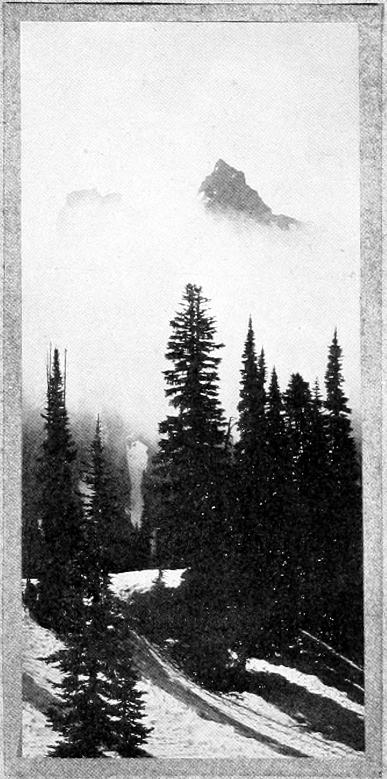
Taken in Rainier National Park. From a Photograph Copyright, 1908, by W. L. Dawson. A MORNING IN PARADISE.
[250]
There is no sound of the western woods more subtle, more mysterious, more thrilling withal, than this passion song of the Varied Thrush. Somber depths, dripping foliage, and the distant gurgling of dark brown waters are its fitting accompaniments; but it serves somehow to call up before the mind’s eye the unscaled heights and the untried deeps of experience. It is suggestive, elusive, and whimsically baffling. Never colorless, it is also never personal, and its weird extra-mundane quality reminds one of antique china reds, or recalls the subdued luridness of certain ancient frescoes. Moreover, this bird can fling his voice at you as well from the tree-top as from the ground, now right, now left, the while he sits motionless upon a branch not fifteen feet above you.
Fantastic and varied as is this single note which is the Thrush’s song, it may be fairly reproduced by a high-pitched whistle combined with a vocal undertone. At least, this imitation satisfies the bird, and it is possible to engage one after another of them in a sort of vocal contest in which curiosity and jealousy play unquestioned parts. Sometimes the Thrush’s note is quite out of reach, but as often it descends to low pitches, while now and then it is flatted and the resonance crowded out of it, with an indescribable effect upon the listener, somewhere between admiration and disgust. At other times a trill is introduced, which can be taken care of by a trained palate, in addition to the vocal sound and the whistle.
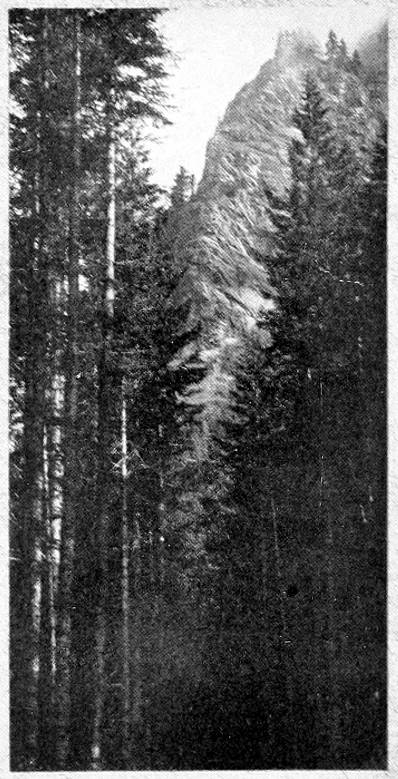
Taken in Rainier National Park. Photo by W. L. Dawson. “GIVEN TALL TIMBER.”
In a unique degree the Varied Thrushes are found thruout the forest depths. Given tall timber and plenty of it, the precise altitude or location are [251] matters of no consequence. The prettiest compliment that Nature can pay to the genuine wildness of Ravenna Park, in Seattle, or Defiance Park, in Tacoma, is the continued presence of the Varied Thrush in nesting time. Run a survey line across any timbered valley of western Washington, or up any timbered slope of the Cascades or Olympics, and the bird most certainly encountered, without reference to local topography or presumed preference, will be the Varied Thrush. The bird may likewise be found among the larches and cedars of the Calispell Range.
The Varied Thrush is known by a variety of names, none more persistent or fitting than Winter Robin. It is a Robin in size, prevailing color, and general make-up; and it appears in the lowlands in large numbers only in the winter time, when the deep snows have driven it out of the hills. The Thrush is much more shy than the Robin, and altho it moves about in straggling companies, and does not shun city parks, it keeps more to cover. It also feeds largely upon the ground, and when startled by a passer-by it flutters up sharply into the trees with a wing-sound whose quality may soon be recognized as distinctive. At such times the bird makes off thru the branches with a low chuck, or tsook, or else tries the air by low notes which are like the song, only very much more subdued. This is manifestly an attempt to keep in touch with companions, while at the same time attracting as little hostile attention as possible. This note is, therefore, barely audible, and has very little musical quality, aarue, or üür.
The nesting of the Varied Thrush was most fully brought to light by Mr. D. E. Brown, at Glacier, in the season of 1905. Like some tireless retriever, this ardent naturalist quartered the mazes of the dense spruce forest which covers the floor of the North Fork of the Nooksack, and in a range of some fifteen miles up and down that stream succeeded in locating forty-five nests of this, till then, little-understood species. Of these, twenty-five contained full sets of eggs, while the remainder fell before such accidents as desertion, robbing by Jays, Owls, etc. The first set taken was on May 5th, and the eggs were slightly incubated. The last, with fresh eggs, was taken June 19th,—probably the second nesting of some bird robbed earlier in the season. Among the nests examined, three contained sets of four each, and the remainder three. Of the entire number, all were placed in evergreen trees, save two. Of these last, one was set in the splinters in the broken top of a willow, about fifteen feet up; and the other was placed in an upright crotch of an elderberry bush at four feet from the ground.
[252]
Taken near Mt. Baker. Photo by the Author. “THE VARIED THRUSH BUILDS WELL UP IN A SMALL FIR TREE.”
Here are the woods that abound in moss-bunches,—great balls of thrifty green which grow, without apparent excuse, alike from the flimsiest and from the most substantial supports. It is in view of the abundance of these, that the Varied Thrush builds as it does, right out in the open of the underwood, near the top, or at least well up, in a small fir tree. The searcher has only the advantage of knowing that in order to secure adequate support the bird must build close up to the stem of the tree. The only exception to this rule is when branches intersect, and so offer additional strength. Owing to the fact that the large timber affords considerable protection to the younger growth below, and because of the superior construction of the nests, they prove very durable. [253] Old nests are common; and groups of half a dozen in the space of a single acre are evidently the consecutive product of a single pair of birds.
There is a notable division of territory among these Thrushes. As a rule, they maintain a distance of half a mile or so from any other nesting pair. In two instances, however, Mr. Brown found nests within three hundred yards of neighbors.
When one approaches the center of a reserve, the brooding female slips quietly from the nest and joins her mate in denouncing the intruder. The birds flit restlessly from branch to branch, or from log to log, uttering repeatedly a stern tsook, which is almost their sole recourse. If the nest is discovered and examined, the birds will disappear silently; and the chances are that they will never again be seen in that locality.